04
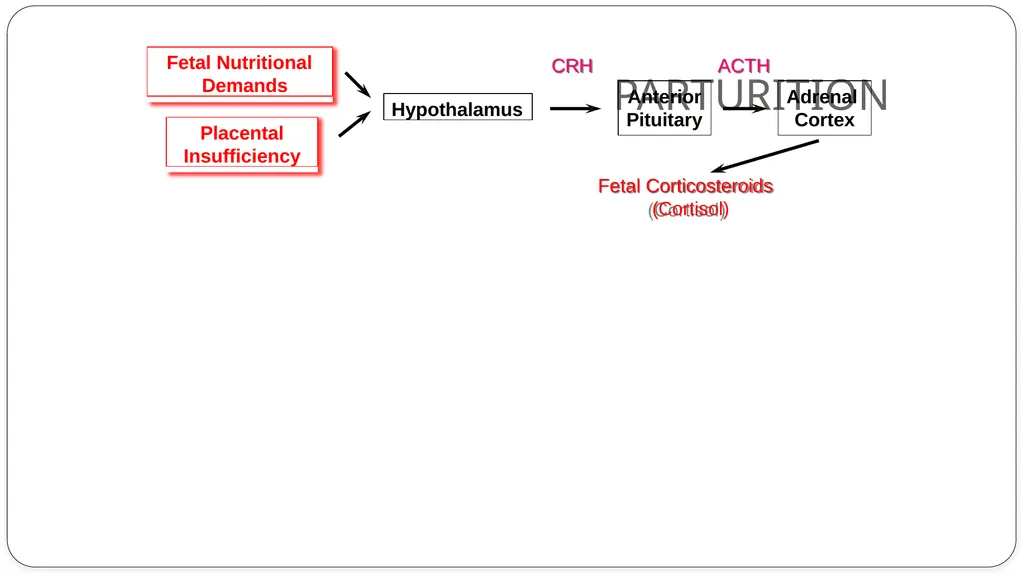
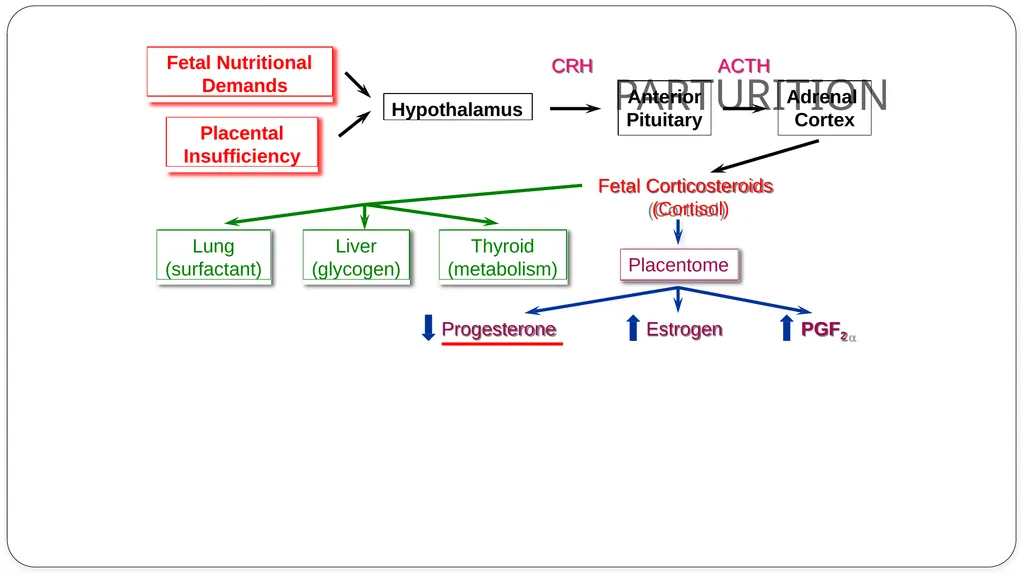
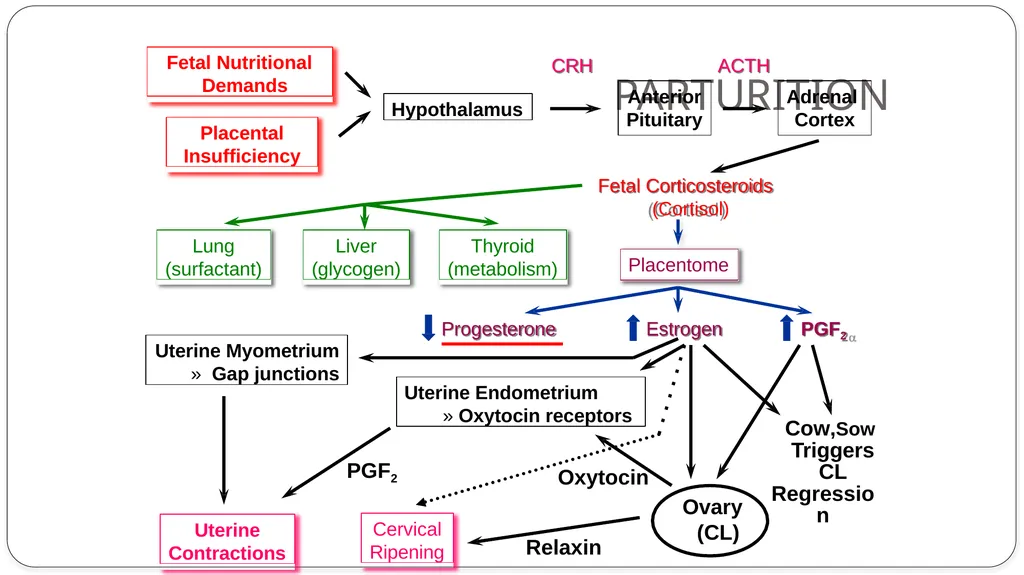
PARTURITION Fetal Nutritional Demands Placental
Insufficiency Hypothalamus Anterior
Pituitary Adrenal
Cortex CRH ACTH Fetal Corticosteroids (Cortisol) Lung (surfactant) Liver (glycogen) Thyroid (metabolism) Progesterone Estrogen PGF2 Uterine Contractions PGF2 Relaxin Oxytocin Uterine Endometrium
» Oxytocin receptors Uterine Myometrium
» Gap junctions Ovary (CL) Cow,Sow Triggers CL
Regression Placentome Cervical
Ripening<br>
05
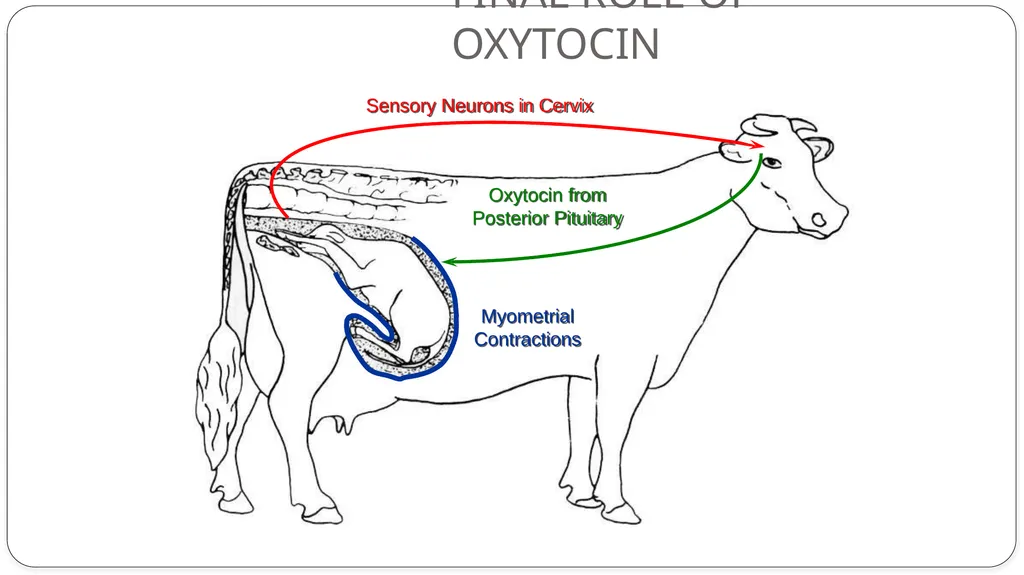
FINAL ROLE OF OXYTOCIN Sensory Neurons in Cervix Oxytocin from Posterior Pituitary Myometrial Contractions<br>
06
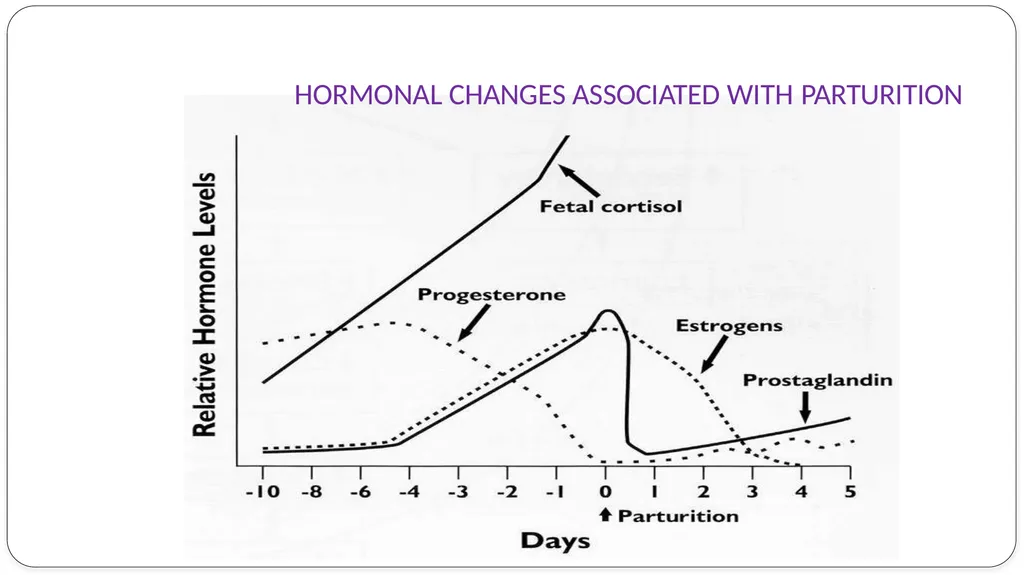
HORMONAL CHANGES ASSOCIATED WITH PARTURITION<br>
07
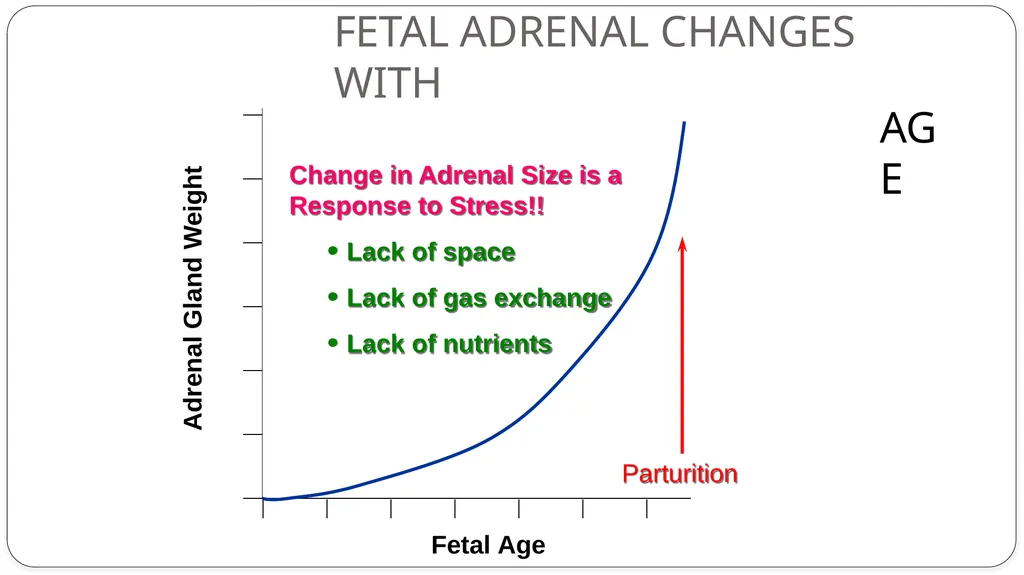
FETAL ADRENAL CHANGES WITH AGE Adrenal Gland Weight Parturition
Fetal Age Change in Adrenal Size is a
Response to Stress!!
Lack of space
Lack of gas exchange
Lack of nutrients<br>
08
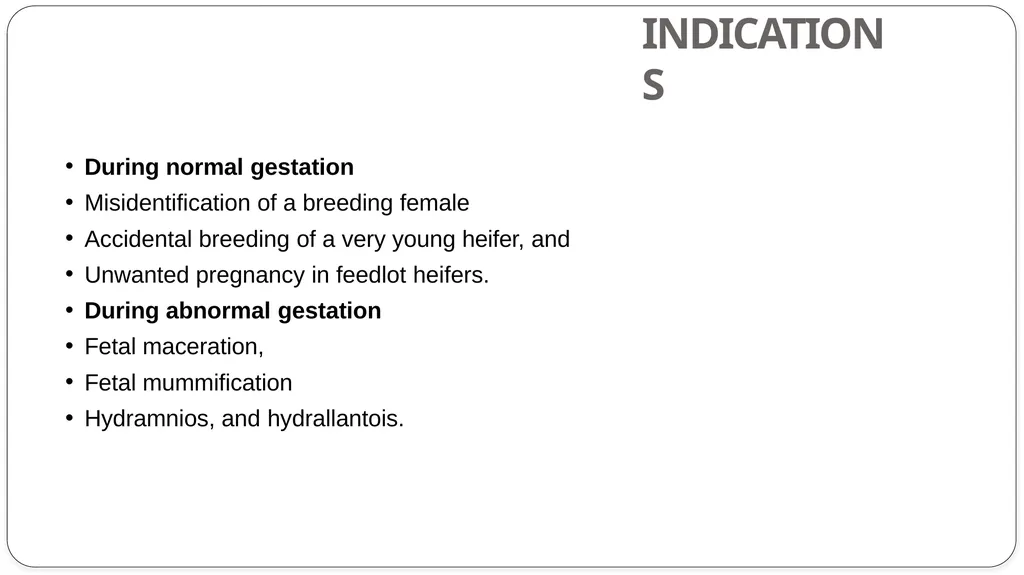
INDICATIONS During normal gestation
Misidentification of a breeding female
Accidental breeding of a very young heifer, and
Unwanted pregnancy in feedlot heifers.
During abnormal gestation
Fetal maceration,
Fetal mummification
Hydramnios, and hydrallantois.<br>
09
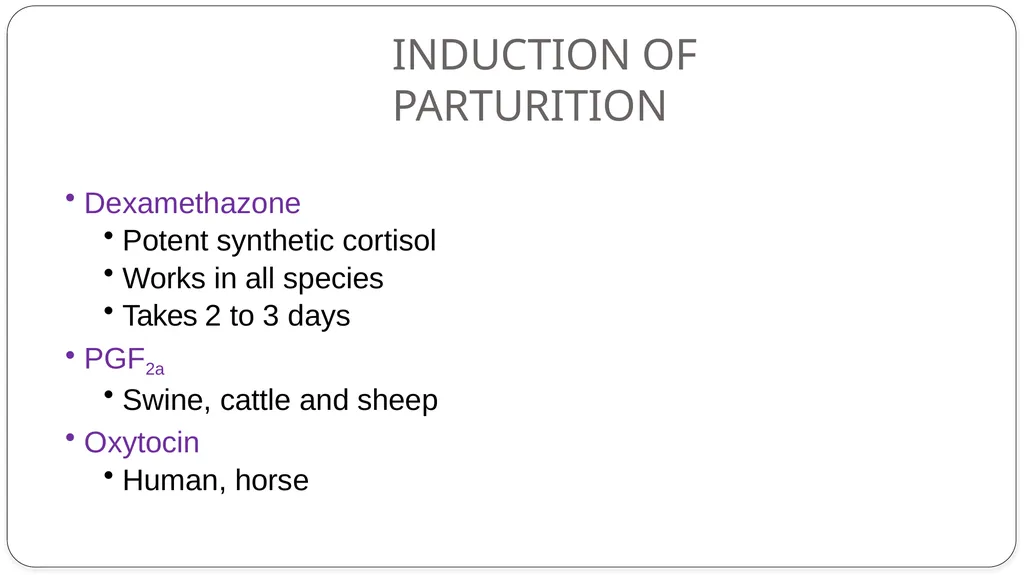
INDUCTION OF PARTURITION Dexamethazone
Potent synthetic cortisol
Works in all species
Takes 2 to 3 days
PGF2a
Swine, cattle and sheep
Oxytocin
Human, horse<br>
10
PGF2α results in luteolysis at any stage of pregnancy;
PGF2α treatment alone induces abortion only up to 5 months of gestation.
Rarely, luteolysis is incomplete, (luteal progesterone remains above the threshold), and partial cervical dilation and abdominal straining may occur before the cow resumes normal gestation.<br>
11
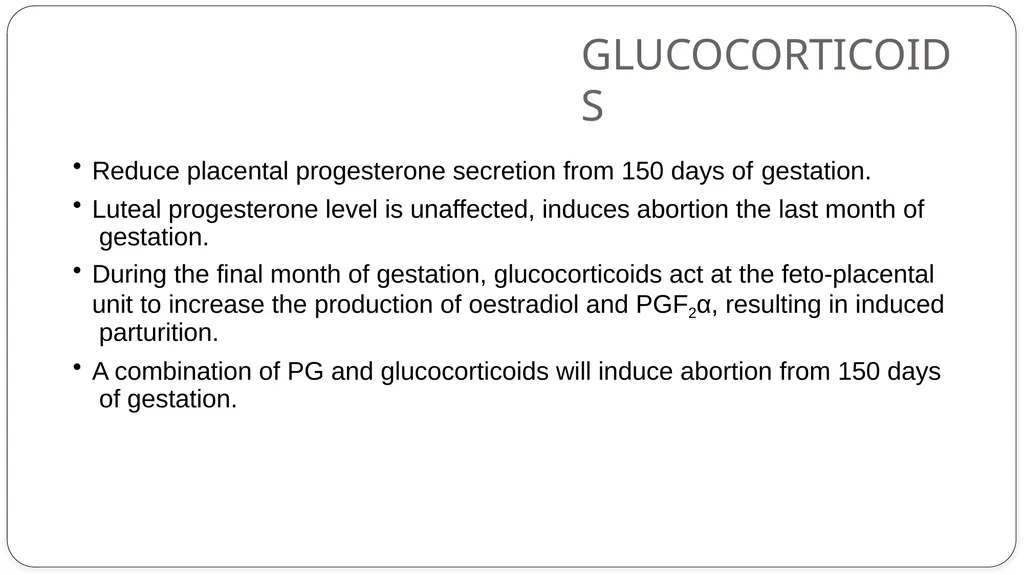
GLUCOCORTICOIDS Reduce placental progesterone secretion from 150 days of gestation.
Luteal progesterone level is unaffected, induces abortion the last month of gestation.
During the final month of gestation, glucocorticoids act at the feto-placental unit to increase the production of oestradiol and PGF2α, resulting in induced parturition.
A combination of PG and glucocorticoids will induce abortion from 150 days of gestation.<br>
12
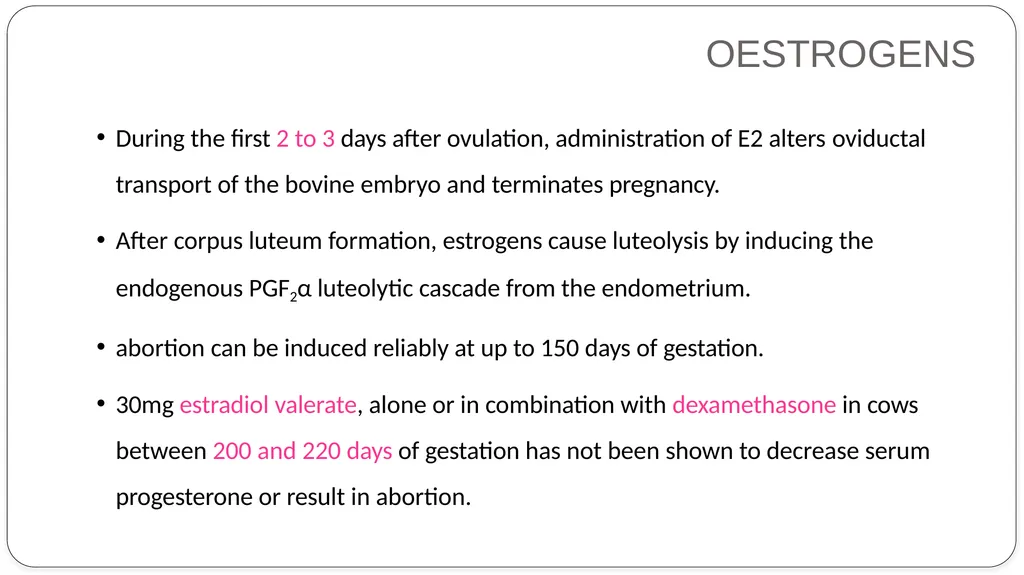
OESTROGENS During the first 2 to 3 days after ovulation, administration of E2 alters oviductal
transport of the bovine embryo and terminates pregnancy.
After corpus luteum formation, estrogens cause luteolysis by inducing the endogenous PGF2α luteolytic cascade from the endometrium.
abortion can be induced reliably at up to 150 days of gestation.
30mg estradiol valerate, alone or in combination with dexamethasone in cows between 200 and 220 days of gestation has not been shown to decrease serum progesterone or result in abortion.<br>
13
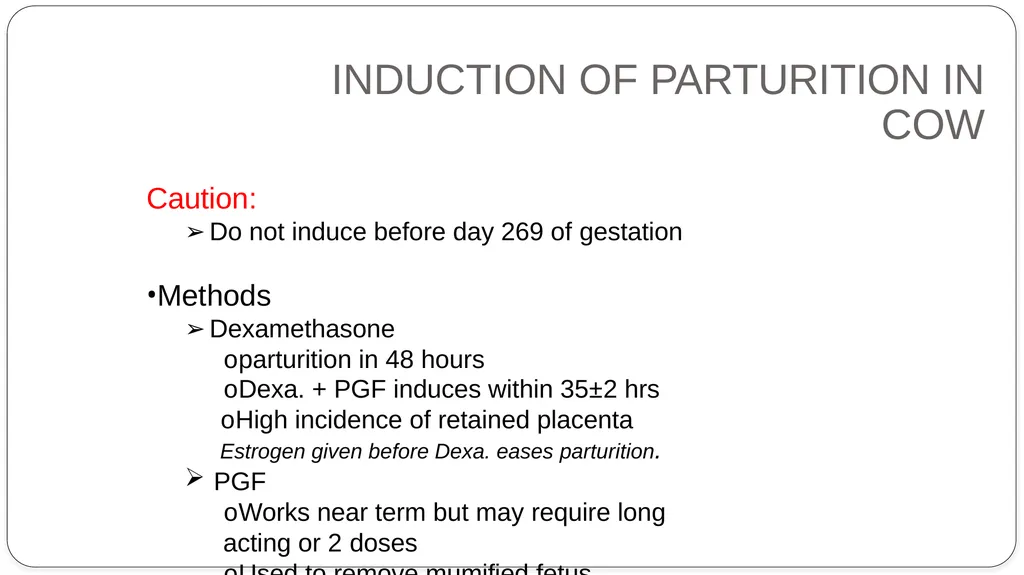
Caution:
Do not induce before day 269 of gestation
Methods
Dexamethasone
oparturition in 48 hours
oDexa. + PGF induces within 35±2 hrs oHigh incidence of retained placenta Estrogen given before Dexa. eases parturition.
PGF
oWorks near term but may require long acting or 2 doses
oUsed to remove mumified fetus. INDUCTION OF PARTURITION IN
COW<br>
14
INDUCTION OF PARTURITION IN
EWE Dexamethasone
Parturition within 24 – 72 hrs
No retained placenta problem.
PGF2a
Lutalyse
works best to abort prior to day 50
multiple injections will work to induce parturition near term<br>
15
INDUCTION OF PARTURITION IN
THE SOW Survival only after day 111 of gestation
PGF2a
Parturition within 24 – 48 hrs
PGF at 8 AM followed by oxytocin 24 hrs latter
Sows farrow between 8 AM and 5 PM following oxytocin
Farrowing:1 to 8 hrs. with 15 min interval b/w piglets.
Oxytocin can be given if delay in expulsion of subsequent piglet is noticed.
decrease stillbirth – occurs in large litters or after extended parturition<br>
16
INDUCTION OF PARTURITION IN THE
MARE Do not do this unless absolute need!!!
Variable length of gestation in mare
Not sure of foal maturity
Oxytocin after day 320
Problems
Foal may require extensive veterinary care in first few weeks of life – impact on social maturity of foal
Colostrum in mare
Lung maturity in foal<br>
17
INDICATIONS Mismating
Change in ownership
Age or health of dam
Abnormal gestation, and
Twin pregnancy.<br>
18
TERMINATION OF PREGNANCY UP TO 150
DAYS Prostaglandins
Upto 5 months of pregnancy.
PGF2α or an analogue
PGF2α : 25 mg IM
Cloprostenol: 500 µg IM
Fenprostalene: 1 mg SC<br>
19
Intrauterine infusion of irritating solutions
Between days 5 and 10 after ovulation, prevents the establishment of pregnancy and may cause luteolysis and early return to oestrus.
Later than 11 days after ovulation occasionally lengthens the oestrous cycle.
Up to 90 days of gestation, causes embryonic death necessitating manual evacuation of uterine contents.
Suitable solutions
Aqueous iodine 0.5%
Tetracycline 2 Gm in saline.<br>
20
Oxytocin
First few days after ovulation may prevent the establishment of pregnancy
Oestrogens
Administration within 72 h of ovulation impedes oviductal transit of embryos.
Up to 5 months of gestation, administration of an oestradiol ester, such as oestradiol valerate, results in abortion within 7 days. Occasional abortions occur up to 14 days after treatment.
Oestradiol should be administered every 4 days until abortion.
Diethylstilesterol: 40-80 mg IM
Oestradiol ester: 4-8 mg IM<br>
21
MANUAL TECHNIQUES 1.Manual enucleation of the CL
By transrectal manipulation manual enucleation of CL removes progesterone support for pregnancy and results in abortion at up to 150 days.
Conceptus will be aborted in 2-5 days late or resorbed.
Limitations
Induce adhesions of the ovary and ovarian bursa
Occasionally, severe hemorrhage, sometimes fatal.<br>
22
2.Manual rupture of the amniotic vesicle
By transrectal manipulation it is possible to manually rupture once the vesicle can be palpated at 30 to 35 days of gestation.
After 60 days and up to 120 days of gestation, it is possible to terminate pregnancy
by manual decapitation of the fetus.
The mean time to abortion is 25 days, but abortion may occur up to 8 weeks after treatment.<br>
23
IN HYDRALLANTOIS AND HYDRAMNIOS Pregnancy can be terminated within 48 h in cows with simultaneous administration of PGF2α and dexamethasone.
Supportive treatment is necessary to compensate fluid loss.
Parturition usually is abnormal.
C-section may be an alternative to induced parturition.<br>
24
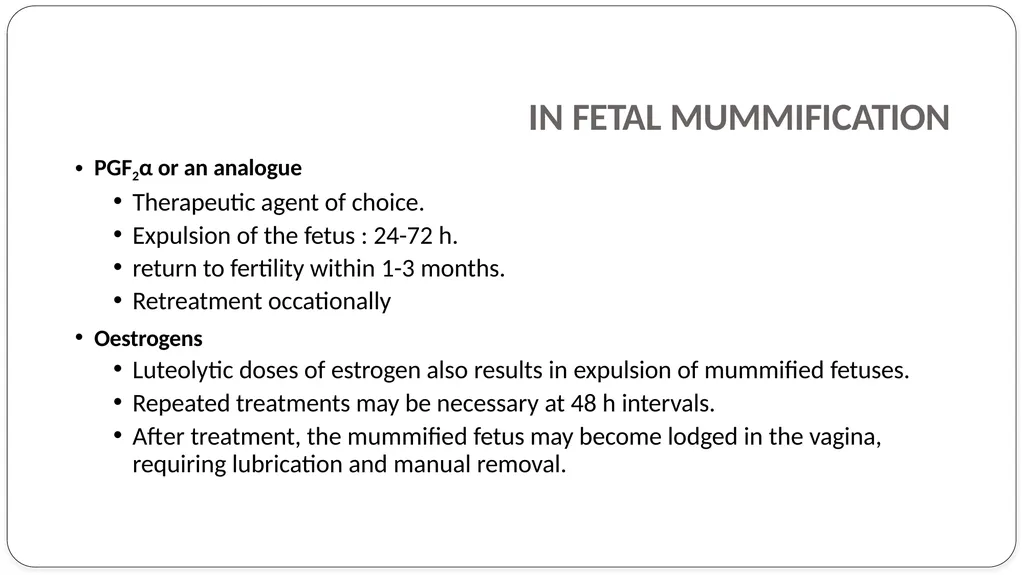
IN FETAL MUMMIFICATION PGF2α or an analogue
Therapeutic agent of choice.
Expulsion of the fetus : 24-72 h.
return to fertility within 1-3 months.
Retreatment occationally
Oestrogens
Luteolytic doses of estrogen also results in expulsion of mummified fetuses.
Repeated treatments may be necessary at 48 h intervals.
After treatment, the mummified fetus may become lodged in the vagina, requiring lubrication and manual removal.<br>
25
MTP Mismated dogs that may be too young or small for breeding, may be held in reserve for breeding at some future date, or scheduled to be bred to a different stud.
Injury or disease that may compromise the life<br>
26
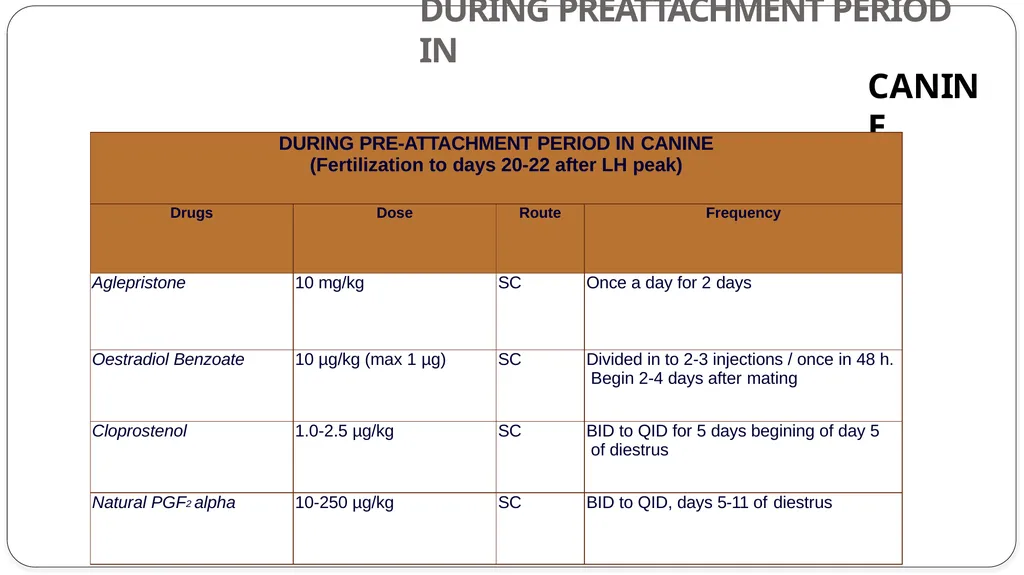
DURING PREATTACHMENT PERIOD IN CANINE<br>