
Industry resource toolkit Article 3: Responding to
Description: Industry resource toolkit Article 3: Responding to an Emergency Plant Pest under the EPPRD This graphic pack support the Industry resource toolkit an educational series aimed at providing Plant Health Australia (PHA) Plant Industry
Related Topics
Download Presentation
"Industry resource toolkit Article 3: Responding to" is the property of its rightful owner. Permission is granted to download and print the materials on this website for personal, non-commercial use only, and to display it on your personal computer provided you do not modify the materials and that you retain all copyright notices contained in the materials. By downloading content from our website, you accept the terms of this agreement.
Presentation Transcript
slide1. Industry resource toolkit
Article 3: Responding to an Emergency Plant Pest under the EPPRD This graphic pack support the Industry resource toolkit – an educational series aimed at providing Plant Health Australia (PHA) Plant Industry Members with a resource toolkit containing information on national response arrangements under the Emergency Plant Pest Response Deed (EPPRD).
The toolkit is a collection of 12 articles developed by Plant Health Australia to help Plant Industry Members educate their own members about the Emergency Plant Pest Response Deed (EPPRD).
This pack supports the content contained in Article 3, Responding to an Emergency Plant Pest under the EPPRD. The graphics include:
icons that depict Emergency Plant Pests.
the structure of a Control Centre within an Incident Management Team
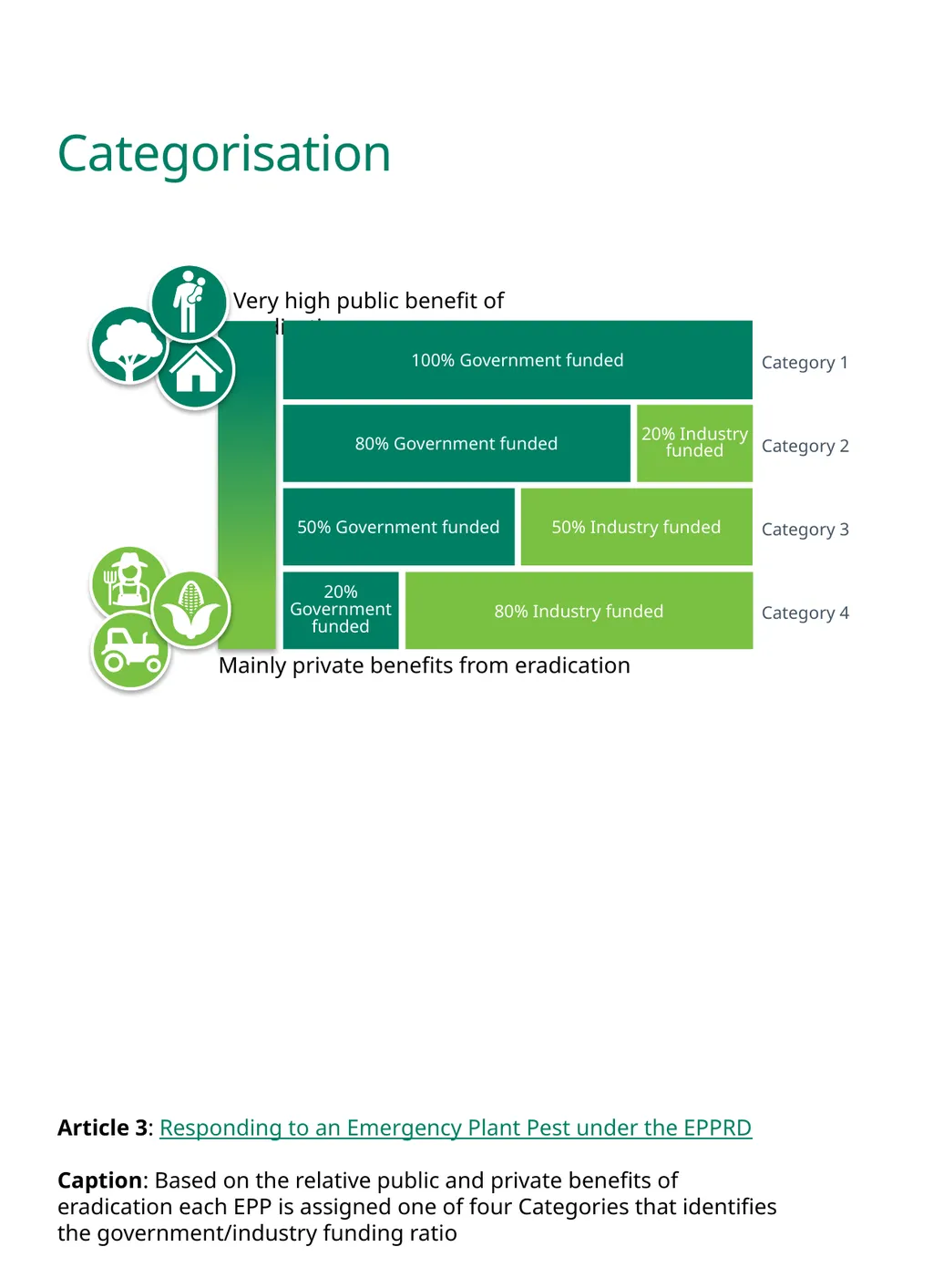
how the cost of a response is equitably shared between governments and industries based on the relative public and private benefit of eradicating the EPP.
Use the graphics to:
customise the colours to suit your organisation’s branding
create images for social media, website, newsletters, and other formats.
incorporate them into your member training and educational programs
in your promotional material as brochures and flyers.
Learn more about customising the graphics contained in this pack:
how to add a colour palette in PowerPoint to match your organisation's branding
how to change the colour of a diagram in PowerPoint
how to save a PowerPoint slide as a .png or .jpeg file.
Find out more about the Industry resource toolkit.<br>
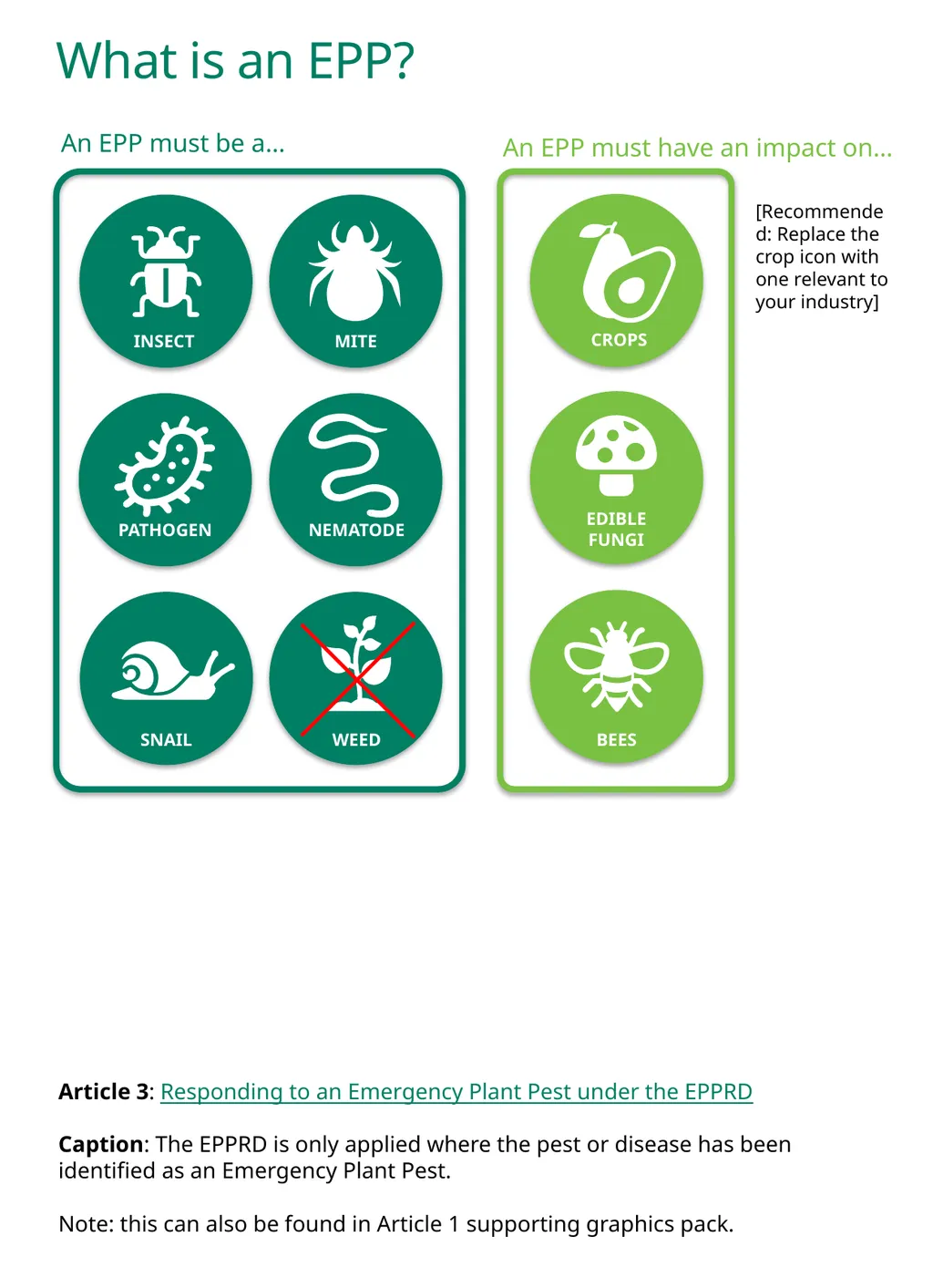
slide2. What is an EPP? An EPP must be a… An EPP must have an impact on… CROPS INSECT PATHOGEN NEMATODE SNAIL WEED BEES EDIBLE
FUNGI MITE [Recommended: Replace the crop icon with one relevant to your industry] Article 3: Responding to an Emergency Plant Pest under the EPPRD
Caption: The EPPRD is only applied where the pest or disease has been identified as an Emergency Plant Pest.
Note: this can also be found in Article 1 supporting graphics pack.<br>
slide3. Control centre structure Article 3: Responding to an Emergency Plant Pest under the EPPRD
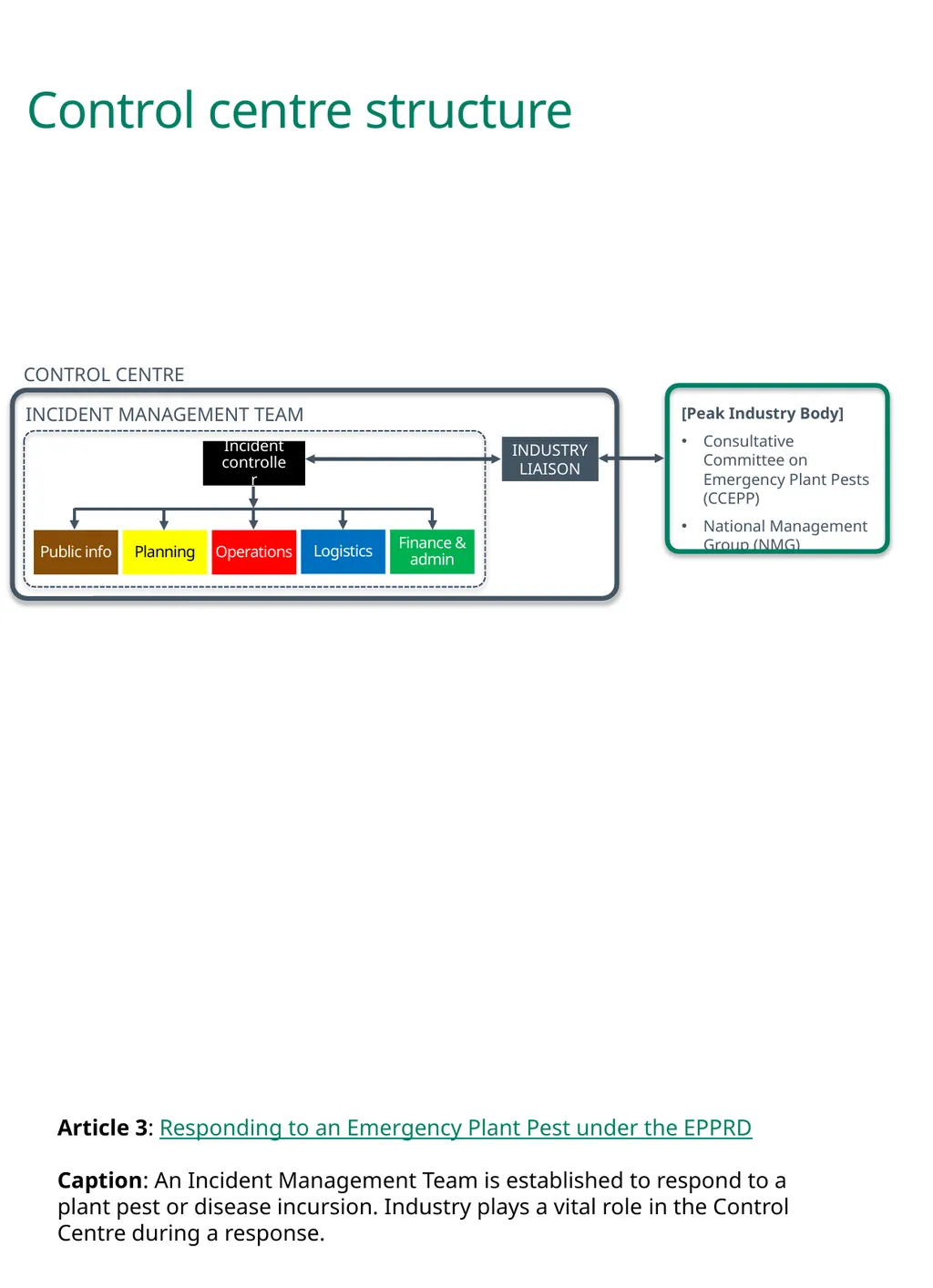
Caption: An Incident Management Team is established to respond to a plant pest or disease incursion. Industry plays a vital role in the Control Centre during a response. Incident controller Public info Planning Operations Logistics Finance & admin INDUSTRY LIAISON [Peak Industry Body]
Consultative Committee on Emergency Plant Pests (CCEPP)
National Management Group (NMG) CONTROL CENTRE INCIDENT MANAGEMENT TEAM<br>
slide4. Categorisation Very high public benefit of eradication Mainly private benefits from eradication 100% Government funded Category 1 80% Government funded Category 2 20% Industry funded 50% Government funded Category 3 20% Government funded Category 4 80% Industry funded 50% Industry funded Article 3: Responding to an Emergency Plant Pest under the EPPRD
Caption: Based on the relative public and private benefits of eradication each EPP is assigned one of four Categories that identifies the government/industry funding ratio<br>
The toolkit is a collection of 12 articles developed by Plant Health Australia to help Plant Industry Members educate their own members about the Emergency Plant Pest Response Deed (EPPRD).
This pack supports the content contained in Article 3, Responding to an Emergency Plant Pest under the EPPRD. The graphics include:
icons that depict Emergency Plant Pests.
the structure of a Control Centre within an Incident Management Team
how the cost of a response is equitably shared between governments and industries based on the relative public and private benefit of eradicating the EPP.
Use the graphics to:
customise the colours to suit your organisation’s branding
create images for social media, website, newsletters, and other formats.
incorporate them into your member training and educational programs
in your promotional material as brochures and flyers.
Learn more about customising the graphics contained in this pack:
how to add a colour palette in PowerPoint to match your organisation's branding
how to change the colour of a diagram in PowerPoint
how to save a PowerPoint slide as a .png or .jpeg file.
Find out more about the Industry resource toolkit.<br>
slide2. What is an EPP? An EPP must be a… An EPP must have an impact on… CROPS INSECT PATHOGEN NEMATODE SNAIL WEED BEES EDIBLE
FUNGI MITE [Recommended: Replace the crop icon with one relevant to your industry] Article 3: Responding to an Emergency Plant Pest under the EPPRD
Caption: The EPPRD is only applied where the pest or disease has been identified as an Emergency Plant Pest.
Note: this can also be found in Article 1 supporting graphics pack.<br>
slide3. Control centre structure Article 3: Responding to an Emergency Plant Pest under the EPPRD
Caption: An Incident Management Team is established to respond to a plant pest or disease incursion. Industry plays a vital role in the Control Centre during a response. Incident controller Public info Planning Operations Logistics Finance & admin INDUSTRY LIAISON [Peak Industry Body]
Consultative Committee on Emergency Plant Pests (CCEPP)
National Management Group (NMG) CONTROL CENTRE INCIDENT MANAGEMENT TEAM<br>
slide4. Categorisation Very high public benefit of eradication Mainly private benefits from eradication 100% Government funded Category 1 80% Government funded Category 2 20% Industry funded 50% Government funded Category 3 20% Government funded Category 4 80% Industry funded 50% Industry funded Article 3: Responding to an Emergency Plant Pest under the EPPRD
Caption: Based on the relative public and private benefits of eradication each EPP is assigned one of four Categories that identifies the government/industry funding ratio<br>