
INFECTION CONTROL IN OPERATION THEATRE DR RAHUL
AM
Published · 66 slides · 0 views

1 / 1





Description
INFECTION CONTROL IN OPERATION THEATRE DR RAHUL KAMBLE MBBS, MD Microbiology Diploma Infectious Diseases (UNSW, Australia) CC infection Control (Harvard Medical School) Six Sigma Black Belt (GOI Certified) CIA-JCI, NABH, NABL, RBNQA PGDBA,
Related Topics
Share
Embed code
Download this presentation From Below
"INFECTION CONTROL IN OPERATION THEATRE DR RAHUL" is the property of its rightful owner. Permission is granted to download and print the materials on this website for personal, non-commercial use only, and to display it on your personal computer provided you do not modify the materials and that you retain all copyright notices contained in the materials. By downloading content from our website, you accept the terms of this agreement.
Presentation Transcript
01
INFECTION CONTROL IN OPERATION THEATRE DR RAHUL KAMBLE
MBBS, MD Microbiology
Diploma Infectious Diseases (UNSW, Australia)
CC infection Control (Harvard Medical School)
Six Sigma Black Belt (GOI Certified)
CIA-JCI, NABH, NABL, RBNQA
PGDBA, PGDHM,PGDHA, PGDSR, PGDCR,
PGDOM, PGDMLS, PGDHI, PGDIM, PGDBI<br>
02
Infection Control Philosophy The aim of ICP is to eliminate the infection as quickly as possible and to ensure that patients, staff, equipment and floors are not a source of infection because
Contamination of the operating theatre is a major cause of nosocomial infection.
Good hygiene practice in hospitals and in operating theatres is mandatory to minimise nosocomial postoperative infections.<br>
03
Safe environment of physical plant and storage space in restricted area of the OT All the floors in the operating room (s) should be:
Hard
Seamless
Easy to clean
Without drains
All the walls in the operating room (s) are free of fissures, or crevices
All the ceilings in the operating room (s) are seamless and easy to clean
There is one or more scrub sink areas with running water with elbow/foot taps for surgical scrubbing outside of the operating room (s)
There is an area to store sterile and/or high-level disinfected supplies, instruments and equipment with:
Limited access to the storage area
Closed cabinets/ or Shelves<br>
04
The operating theatre must be clean. Absence of blood, dust, soil, debris, trash, insects and spider webs in the following sites:
Floors
Walls
Ceilings
Windows
OT lamps
Chairs
Sinks for surgical scrub
Tabletops and counters Ledges and any other flat surfaces
OT tables
Trolleys
Equipment:
Oxygen cylinders
Suction machines
Anesthesia equipment
Storage area
Recovery beds
Toilets<br>
05
Aseptic techniques during surgical procedures. Scrubbed personnel:
Remove jewelry
Wear clean scrub suit covering bare arms (one or two pieces)
Wear clean surgical cap or hood that covers hair
Wear gumboots or impervious closed shoes
Wear sterile gown
Wear sterile surgical gloves
Wear double gloves if the procedure involves coming in contact with large amount of blood or other body fluids (e.g. C-sections), and/or if the procedure is longer than 30 minutes Wear protective eyewear
Wear face masks covering mouth and nose
Touch only sterile items or areas
Replace sterile gloves, as promptly as safety permits, if they become contaminated or torn during the procedure
Keep arms and hands within the sterile field at all times
Keep talking to a minimum in the presence of a sterile field
Keep forearms above the waist level
Never place hands under the upper arms<br>
06
Surgical scrub properly performed before each surgical procedure (1) Keep fingernails short and healthy - do not polish nails
If it is a water and antiseptic soap scrub:
Turn on and adjusts the water
Hold hands above the level of the elbow, wet hands thoroughly and apply soap or an antiseptic soap
Begin at the fingertips, lathers and rubs vigorously
Wash between all fingers
Move from fingertips to elbows of one hand and repeat for the other hand
Use of a brush or sponge is unnecessary
Wash for 2-5 minutes using antiseptic soap
Rinse each forearm separately, fingertips first, holding hands above level of elbows
Use a separate clean cloth towel for each hand to wipe from fingertips to the elbow and then discard the towel
Hold hands above the level of the waist and away from the body without touching anything
Immediately wear sterile garb/gown<br>
07
Surgical scrub properly performed before each surgical procedure (2) If it is hand washing followed by use of a waterless alcohol-based hand rub:
Turn on and adjusts the water
Hold hands above the level of the elbow; wet hands thoroughly and applies soap
Thoroughly wash hands and forearms to the elbow with soap and water for 2 minutes
Use of a brush or sponge is unnecessary
Rinse each forearm separately, fingertips first, holding hands above level of elbows
Dry hand and forearms thoroughly with a clean dry towel or air dry
Apply 5 ml (about one teaspoonful) of a waterless, alcohol-based hand rub to hands, fingers and forearms, and rub until dry
Repeat application and rubbing 2 more times for a total of at least 2 minutes, using a total about 15 ml of the hand rub
Hold hands above the level of the waist and away from the body and avoid touching anything
Immediately wear sterile garb/gown<br>
08
The operating room is set up properly before each surgical procedure. Tables, Mayo stands and ring stands are:
Organized side by side
In an area that is away from the traffic flow
At least 46 cm from walls, cabinets and other non-sterile surfaces
A clean sheet is placed on the OT bed
A clean leak-proof container for soiled linen is placed away from sterile items
Puncture-resistant containers to dispose off sharps are placed away from the sterile items
A leak-proof plastic bag is placed in each container for waste disposal
Clean plastic containers with fresh 0.5% chlorine solution are placed in the OT room
Supplies that are checked and ready to open are placed on the tables
Mayo stand and other non-sterile surfaces are covered with sterile barrier materials if they are to be used during the procedure<br>
09
Non-scrubbed personnel follow the aseptic techniques during surgical procedures.<br>
10
Patient’s skin is properly prepped before surgical procedures to prevent infections Patient wears a clean gown and is covered with clean linen
Hair is not shaved around the operative site
If hair must be cut, it is trimmed close to the skin surface with scissors immediately before surgery in an area outside of the OT room
If visibly soiled, the operative area is cleaned with soap and water, and dried before applying an antiseptic
Sterile gloves are worn for the prepping procedure
Patient’s skin is thoroughly cleaned from the operative site outward for several centimeters in a circular motion
If prepping contaminated areas (e.g., abdominal-perineal or abdominal-vaginal areas), 2 separate prepping procedures are done using different prep trays, solutions and gloves; the contaminated area is done first, covered with a sterile towel, and then the other area is prepped
Antiseptic is not allowed to pool underneath the patient’s body
Antiseptic is allowed to dry before beginning the procedure<br>
11
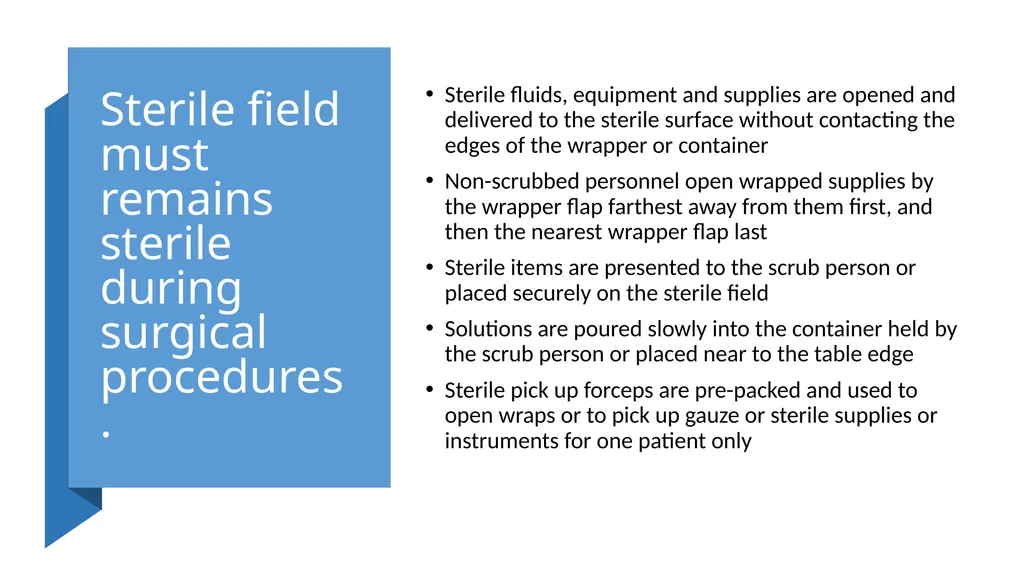
Sterile field must remains sterile during surgical procedures. Sterile fluids, equipment and supplies are opened and delivered to the sterile surface without contacting the edges of the wrapper or container
Non-scrubbed personnel open wrapped supplies by the wrapper flap farthest away from them first, and then the nearest wrapper flap last
Sterile items are presented to the scrub person or placed securely on the sterile field
Solutions are poured slowly into the container held by the scrub person or placed near to the table edge
Sterile pick up forceps are pre-packed and used to open wraps or to pick up gauze or sterile supplies or instruments for one patient only<br>
12
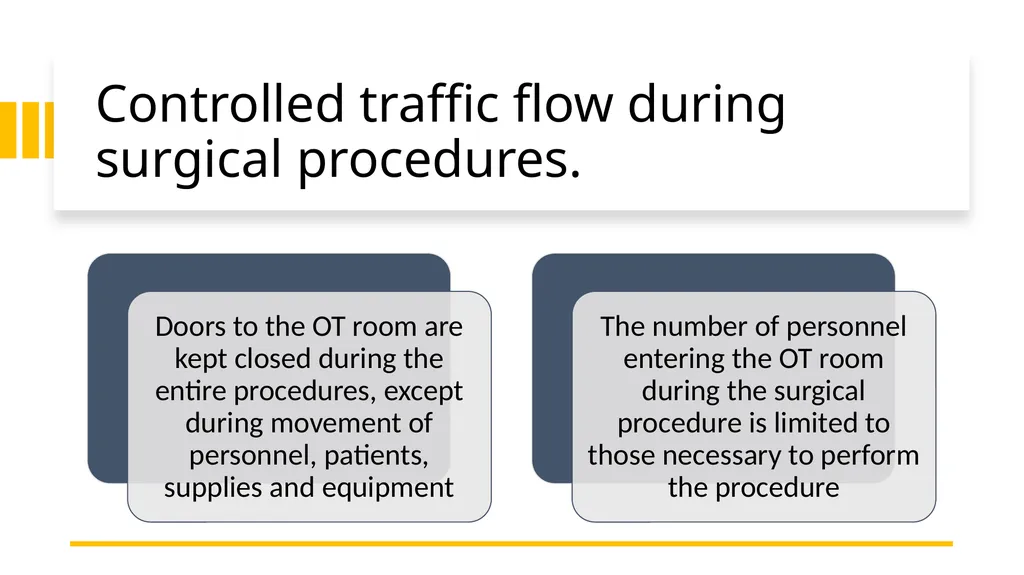
Controlled traffic flow during surgical procedures.<br>
13
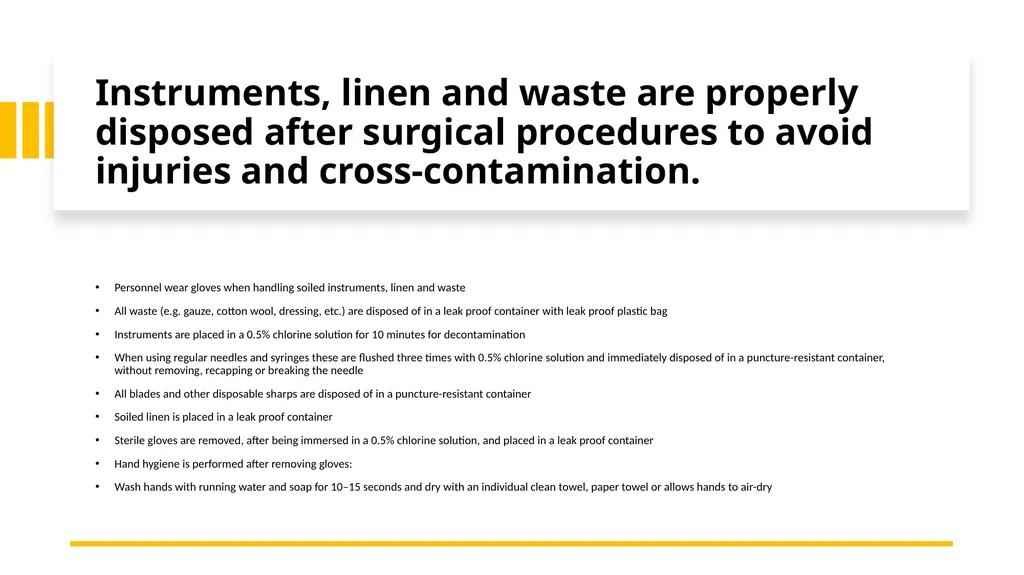
Instruments, linen and waste are properly disposed after surgical procedures to avoid injuries and cross-contamination. Personnel wear gloves when handling soiled instruments, linen and waste
All waste (e.g. gauze, cotton wool, dressing, etc.) are disposed of in a leak proof container with leak proof plastic bag
Instruments are placed in a 0.5% chlorine solution for 10 minutes for decontamination
When using regular needles and syringes these are flushed three times with 0.5% chlorine solution and immediately disposed of in a puncture-resistant container, without removing, recapping or breaking the needle
All blades and other disposable sharps are disposed of in a puncture-resistant container
Soiled linen is placed in a leak proof container
Sterile gloves are removed, after being immersed in a 0.5% chlorine solution, and placed in a leak proof container
Hand hygiene is performed after removing gloves:
Wash hands with running water and soap for 10–15 seconds and dry with an individual clean towel, paper towel or allows hands to air-dry<br>
14
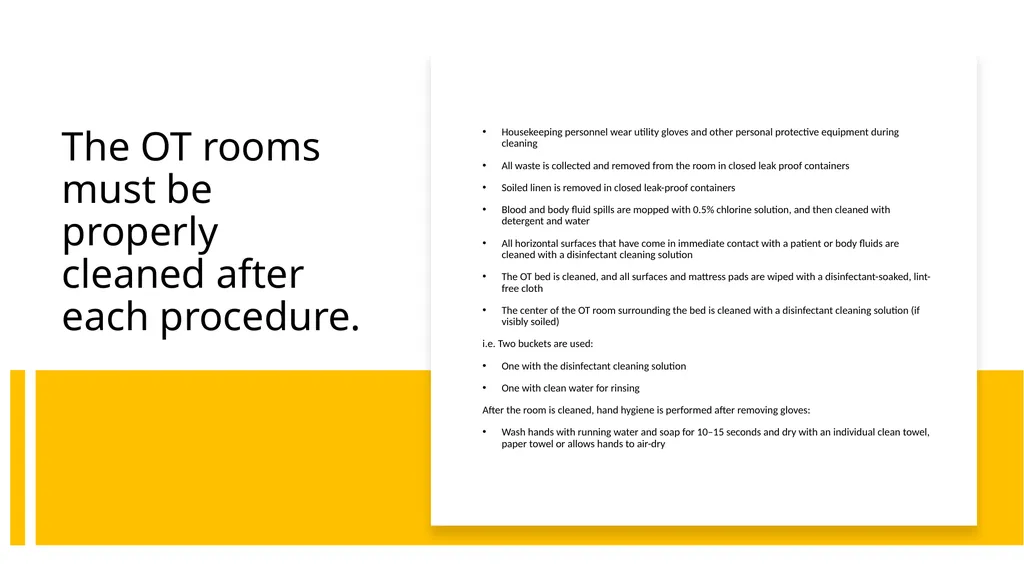
The OT rooms must be properly cleaned after each procedure. Housekeeping personnel wear utility gloves and other personal protective equipment during cleaning
All waste is collected and removed from the room in closed leak proof containers
Soiled linen is removed in closed leak-proof containers
Blood and body fluid spills are mopped with 0.5% chlorine solution, and then cleaned with detergent and water
All horizontal surfaces that have come in immediate contact with a patient or body fluids are cleaned with a disinfectant cleaning solution
The OT bed is cleaned, and all surfaces and mattress pads are wiped with a disinfectant-soaked, lint-free cloth
The center of the OT room surrounding the bed is cleaned with a disinfectant cleaning solution (if visibly soiled)
i.e. Two buckets are used:
One with the disinfectant cleaning solution
One with clean water for rinsing
After the room is cleaned, hand hygiene is performed after removing gloves:
Wash hands with running water and soap for 10–15 seconds and dry with an individual clean towel, paper towel or allows hands to air-dry<br>
15
A disinfectant cleaning solution must be prepared properly. Cleaning solution is prepared as follows:
A 0.5% chlorine solution is prepared
Detergent without an acid, ammonia or ammonium is added to the 0.5% chlorine solution until a mild soapy cleaning solution is made.<br>
16
The cleaning equipment must be decontaminated, cleaned and dried before reuse or storage. Mops, buckets, brushes and cleaning cloths are:
Decontaminated by soaking for 10 minutes in 0.5% chlorine solution or other approved disinfectant
Washed in detergent and water
Rinsed in clean water
Dried completely before reuse or storage<br>
17
Collection of medical waste must be performed properly to prevent injuries and contamination. Medical waste (e.g. cotton wool, gauze, etc) must be placed in a washable container with a leak-proof plastic bag
Containers are closed and collected when ¾ full or daily if not ¾ full<br>
18
Flow and activity patterns in the CSSD designed to avoid cross-contamination. Traffic is limited to authorized personnel only
Personnel are required to wear surgical attire including head cover
Receiving/clean-up area separated with a physical barrier (wall and/or door) from the processing area
The receiving/clean-up area must have:
A receiving counter
At least one sink with running water
A counter for instruments to dry
A clean work area for wrapping/packing with:
A large work table
Shelves for holding clean package
At least an autoclave and/or a dry heat oven
Storage area for clean supplies, instruments and equipment with:
Shelves for storing clean equipment
Office desk for record keeping
Store for sterile and/or high-level disinfected supplies, instruments and equipment with:
Limited access to the storage area
Closed cabinets/ or shelves<br>
19
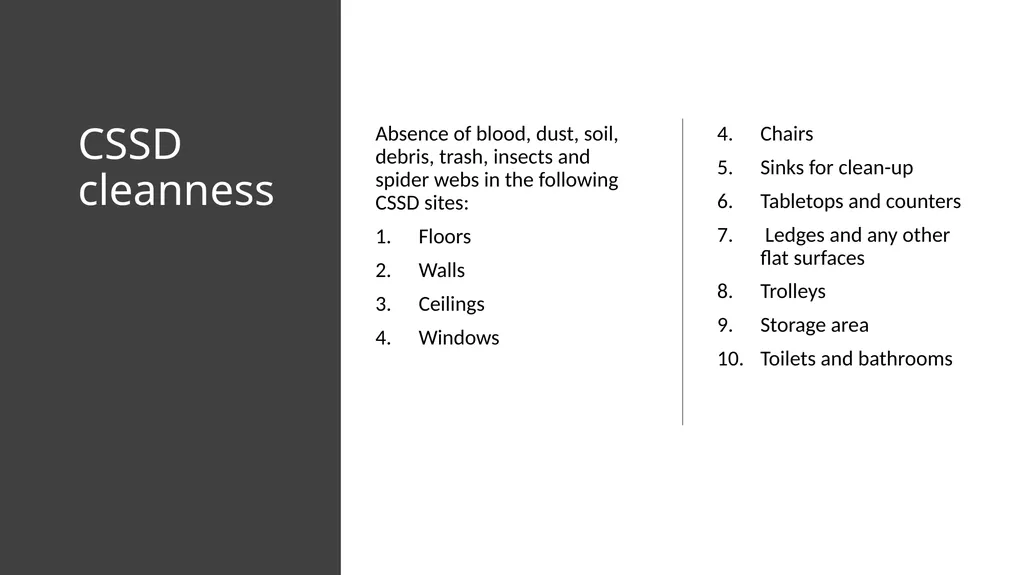
CSSD cleanness Absence of blood, dust, soil, debris, trash, insects and spider webs in the following CSSD sites:
Floors
Walls
Ceilings
Windows Chairs
Sinks for clean-up
Tabletops and counters
Ledges and any other flat surfaces
Trolleys
Storage area
Toilets and bathrooms<br>
20
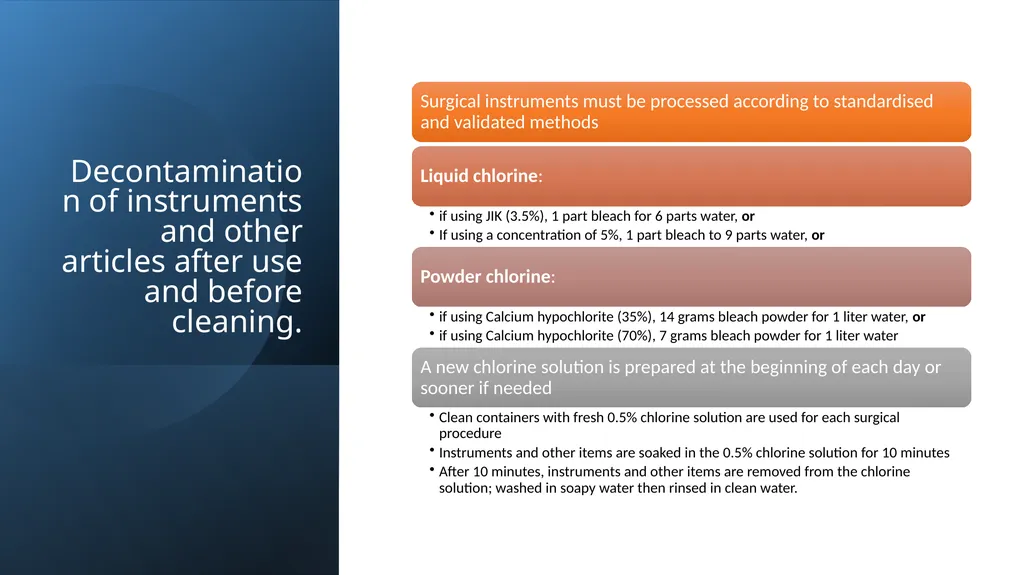
Decontamination of instruments and other articles after use and before cleaning.<br>
21
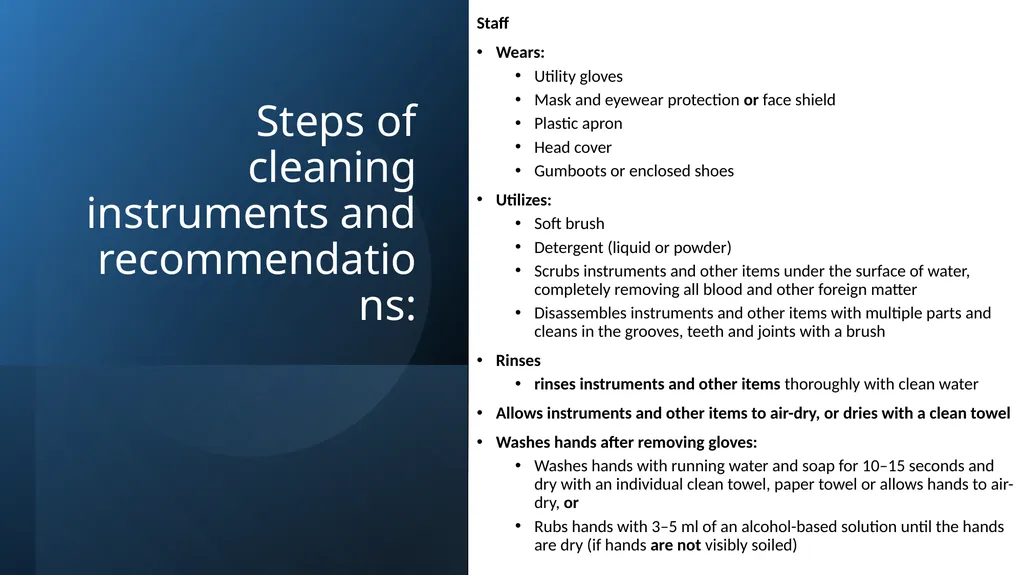
Steps of cleaning instruments and recommendations: Staff
Wears:
Utility gloves
Mask and eyewear protection or face shield
Plastic apron
Head cover
Gumboots or enclosed shoes
Utilizes:
Soft brush
Detergent (liquid or powder)
Scrubs instruments and other items under the surface of water, completely removing all blood and other foreign matter
Disassembles instruments and other items with multiple parts and cleans in the grooves, teeth and joints with a brush
Rinses
rinses instruments and other items thoroughly with clean water
Allows instruments and other items to air-dry, or dries with a clean towel
Washes hands after removing gloves:
Washes hands with running water and soap for 10–15 seconds and dry with an individual clean towel, paper towel or allows hands to air-dry, or
Rubs hands with 3–5 ml of an alcohol-based solution until the hands are dry (if hands are not visibly soiled)<br>
22
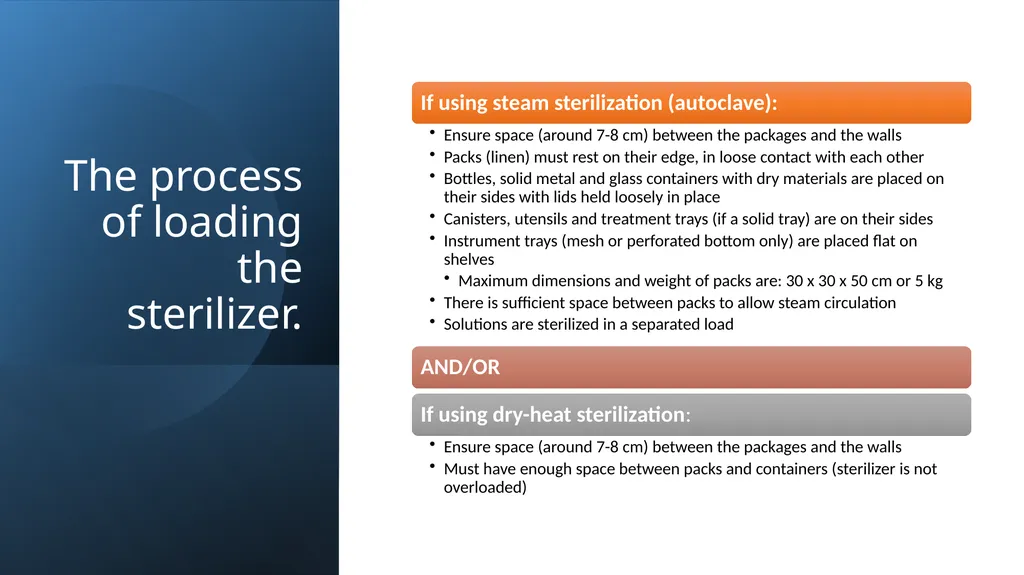
The process of loading the sterilizer.<br>
23
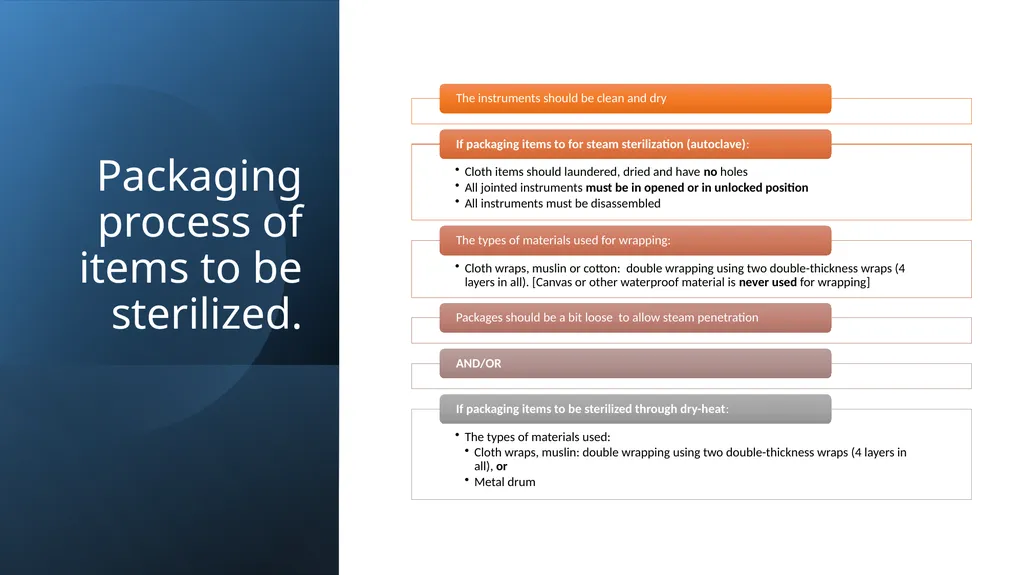
Packaging process of items to be sterilized.<br>
24
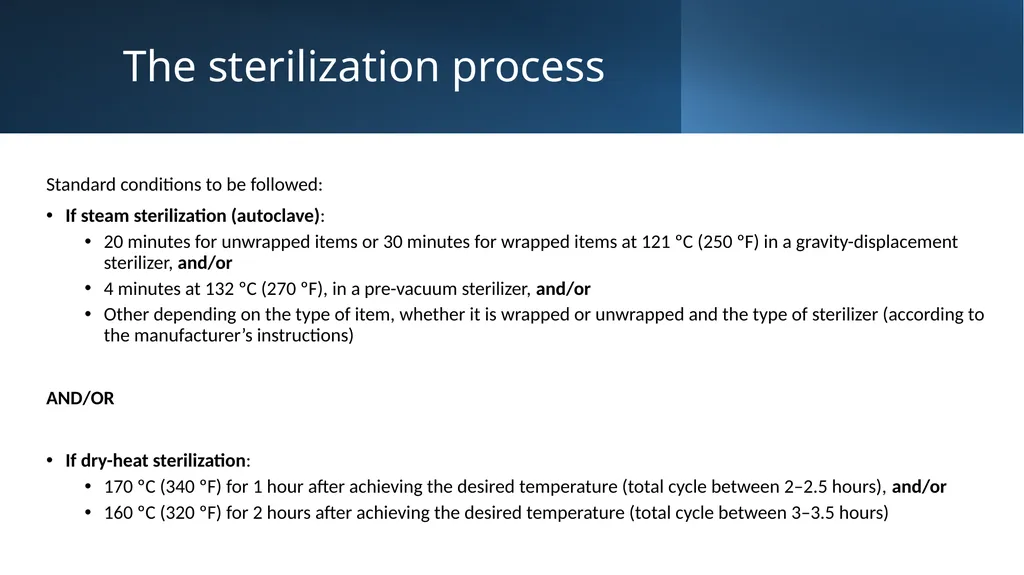
The sterilization process Standard conditions to be followed:
If steam sterilization (autoclave):
20 minutes for unwrapped items or 30 minutes for wrapped items at 121 ºC (250 ºF) in a gravity-displacement sterilizer, and/or
4 minutes at 132 ºC (270 ºF), in a pre-vacuum sterilizer, and/or
Other depending on the type of item, whether it is wrapped or unwrapped and the type of sterilizer (according to the manufacturer’s instructions)
AND/OR
If dry-heat sterilization:
170 ºC (340 ºF) for 1 hour after achieving the desired temperature (total cycle between 2–2.5 hours), and/or
160 ºC (320 ºF) for 2 hours after achieving the desired temperature (total cycle between 3–3.5 hours)<br>
25
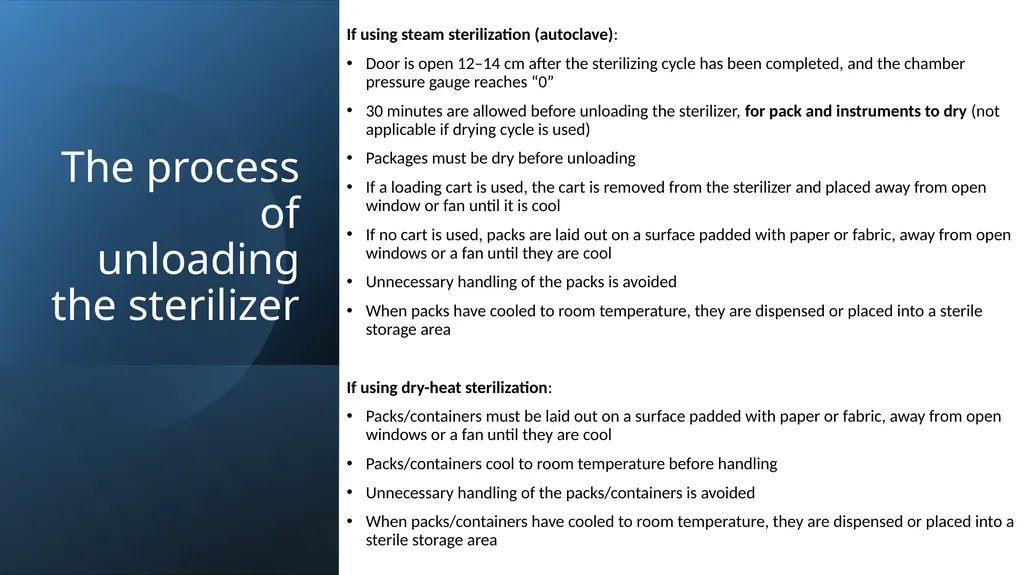
The process of unloading the sterilizer If using steam sterilization (autoclave):
Door is open 12–14 cm after the sterilizing cycle has been completed, and the chamber pressure gauge reaches “0”
30 minutes are allowed before unloading the sterilizer, for pack and instruments to dry (not applicable if drying cycle is used)
Packages must be dry before unloading
If a loading cart is used, the cart is removed from the sterilizer and placed away from open window or fan until it is cool
If no cart is used, packs are laid out on a surface padded with paper or fabric, away from open windows or a fan until they are cool
Unnecessary handling of the packs is avoided
When packs have cooled to room temperature, they are dispensed or placed into a sterile storage area
If using dry-heat sterilization:
Packs/containers must be laid out on a surface padded with paper or fabric, away from open windows or a fan until they are cool
Packs/containers cool to room temperature before handling
Unnecessary handling of the packs/containers is avoided
When packs/containers have cooled to room temperature, they are dispensed or placed into a sterile storage area<br>
26
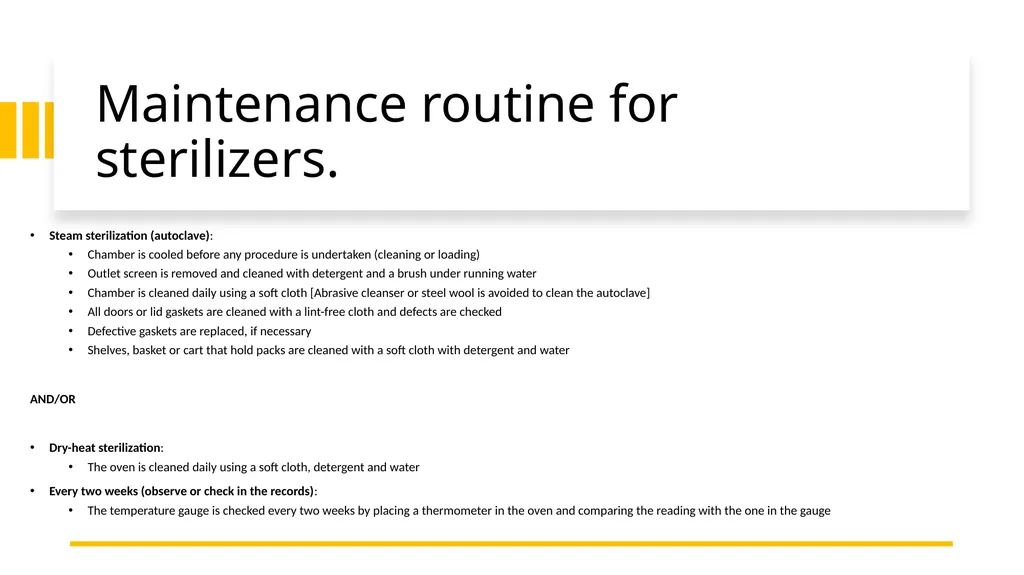
Maintenance routine for sterilizers. Steam sterilization (autoclave):
Chamber is cooled before any procedure is undertaken (cleaning or loading)
Outlet screen is removed and cleaned with detergent and a brush under running water
Chamber is cleaned daily using a soft cloth [Abrasive cleanser or steel wool is avoided to clean the autoclave]
All doors or lid gaskets are cleaned with a lint-free cloth and defects are checked
Defective gaskets are replaced, if necessary
Shelves, basket or cart that hold packs are cleaned with a soft cloth with detergent and water
AND/OR
Dry-heat sterilization:
The oven is cleaned daily using a soft cloth, detergent and water
Every two weeks (observe or check in the records):
The temperature gauge is checked every two weeks by placing a thermometer in the oven and comparing the reading with the one in the gauge<br>
27
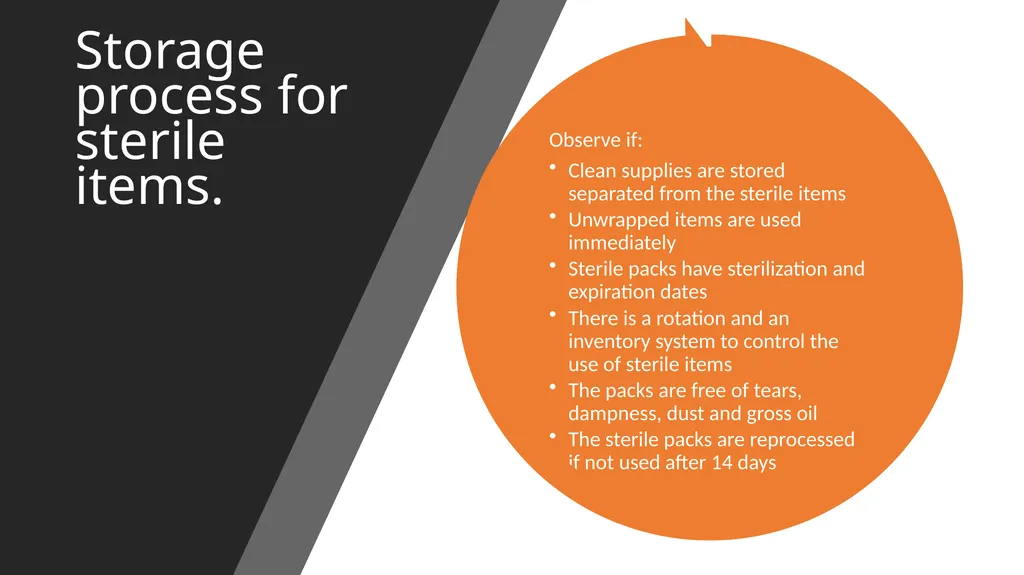
Storage process for sterile items.<br>
28
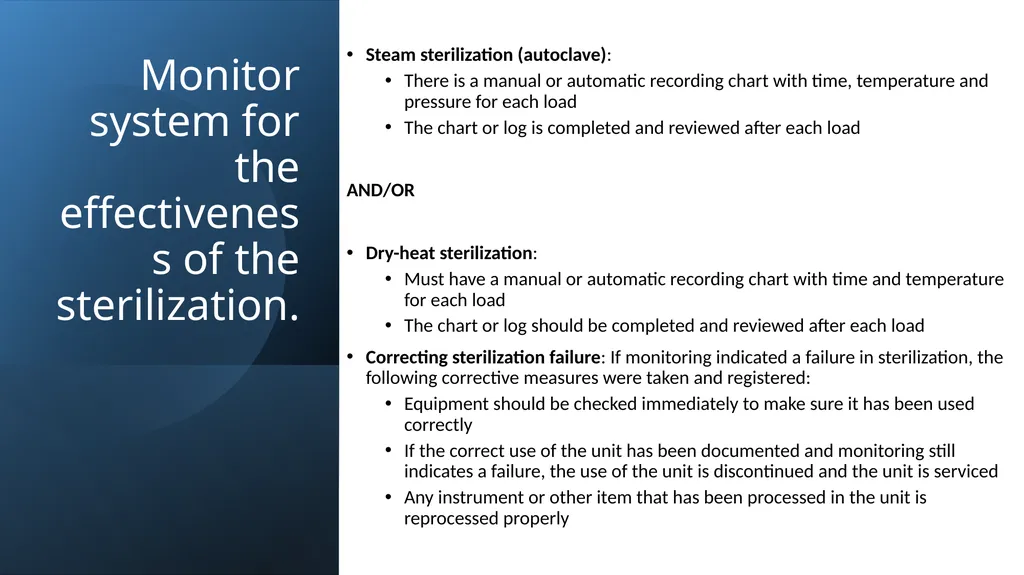
Monitor system for the effectiveness of the sterilization. Steam sterilization (autoclave):
There is a manual or automatic recording chart with time, temperature and pressure for each load
The chart or log is completed and reviewed after each load
AND/OR
Dry-heat sterilization:
Must have a manual or automatic recording chart with time and temperature for each load
The chart or log should be completed and reviewed after each load
Correcting sterilization failure: If monitoring indicated a failure in sterilization, the following corrective measures were taken and registered:
Equipment should be checked immediately to make sure it has been used correctly
If the correct use of the unit has been documented and monitoring still indicates a failure, the use of the unit is discontinued and the unit is serviced
Any instrument or other item that has been processed in the unit is reprocessed properly<br>
29
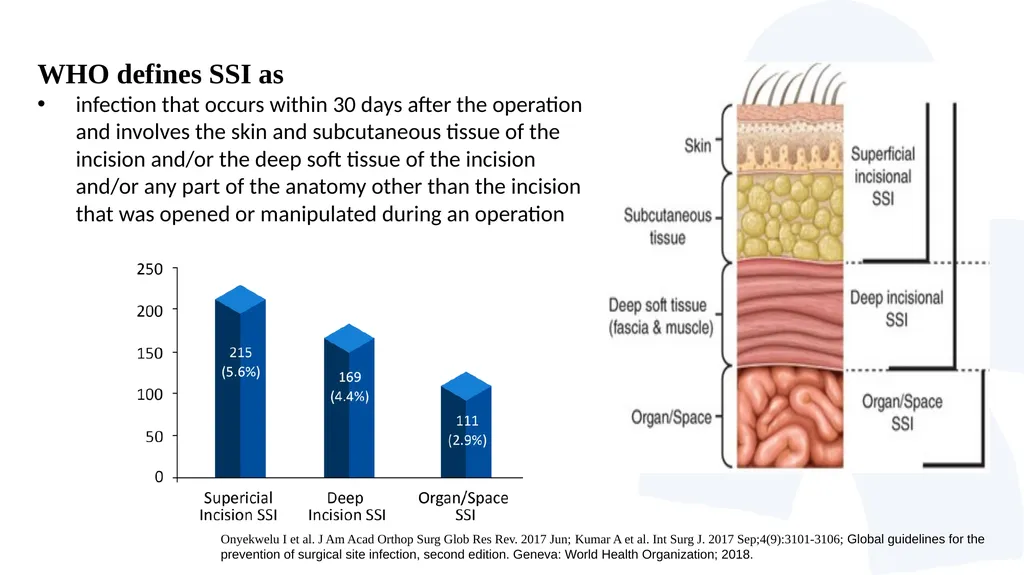
WHO defines SSI as
infection that occurs within 30 days after the operation and involves the skin and subcutaneous tissue of the incision and/or the deep soft tissue of the incision and/or any part of the anatomy other than the incision that was opened or manipulated during an operation Onyekwelu I et al. J Am Acad Orthop Surg Glob Res Rev. 2017 Jun; Kumar A et al. Int Surg J. 2017 Sep;4(9):3101-3106; Global guidelines for the prevention of surgical site infection, second edition. Geneva: World Health Organization; 2018.<br>
30
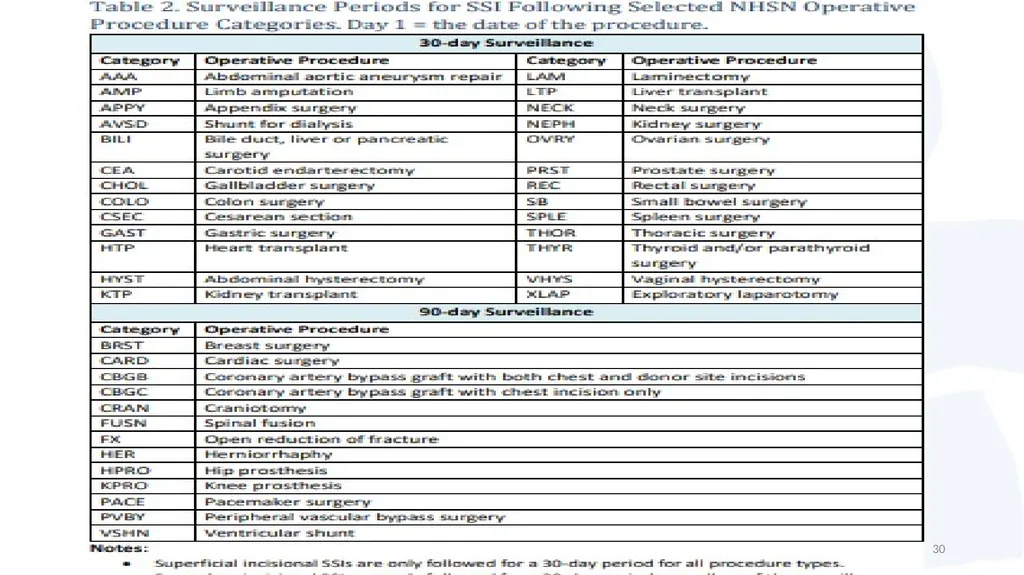
30<br>
31
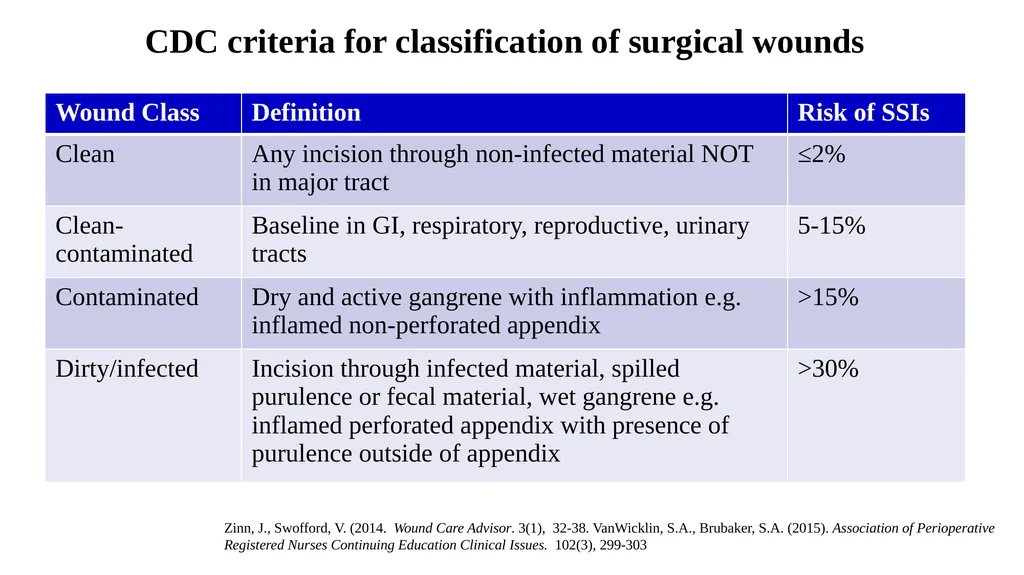
CDC criteria for classification of surgical wounds Zinn, J., Swofford, V. (2014. Wound Care Advisor. 3(1), 32-38. VanWicklin, S.A., Brubaker, S.A. (2015). Association of Perioperative Registered Nurses Continuing Education Clinical Issues. 102(3), 299-303<br>
32
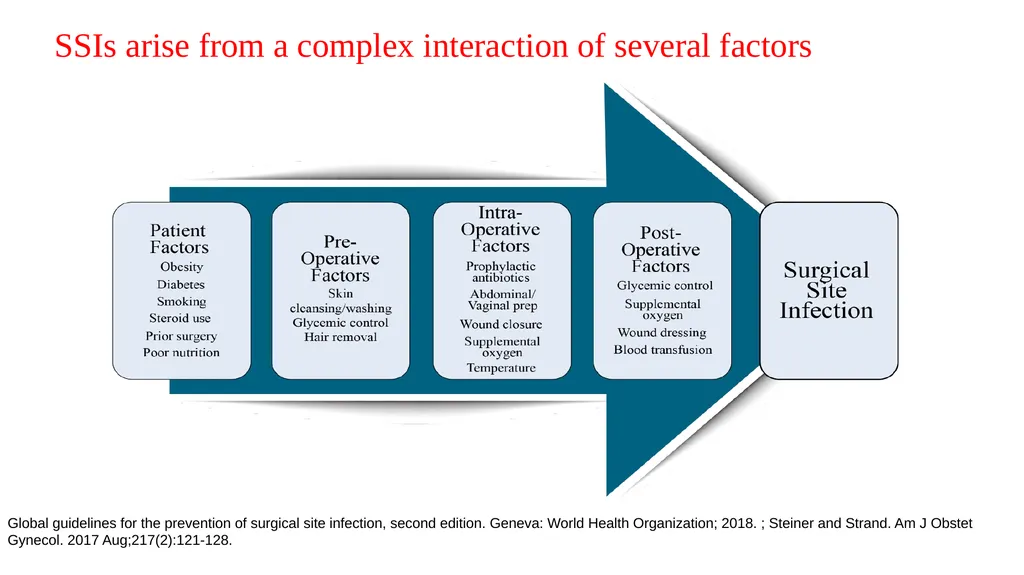
SSIs arise from a complex interaction of several factors Global guidelines for the prevention of surgical site infection, second edition. Geneva: World Health Organization; 2018. ; Steiner and Strand. Am J Obstet Gynecol. 2017 Aug;217(2):121-128.<br>
33
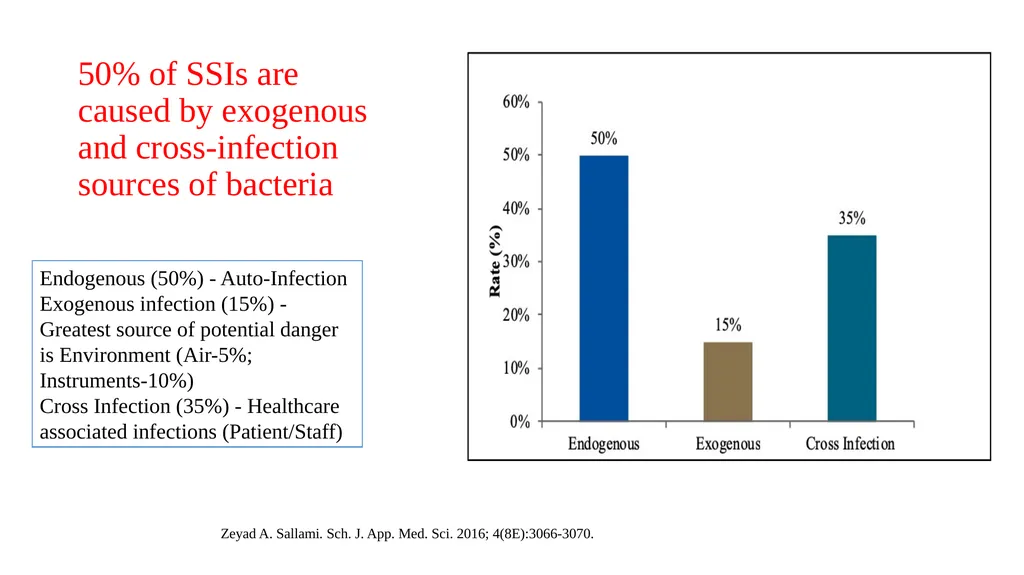
50% of SSIs are caused by exogenous and cross-infection sources of bacteria Zeyad A. Sallami. Sch. J. App. Med. Sci. 2016; 4(8E):3066-3070. Endogenous (50%) - Auto-Infection
Exogenous infection (15%) - Greatest source of potential danger is Environment (Air-5%; Instruments-10%)
Cross Infection (35%) - Healthcare associated infections (Patient/Staff)<br>
34
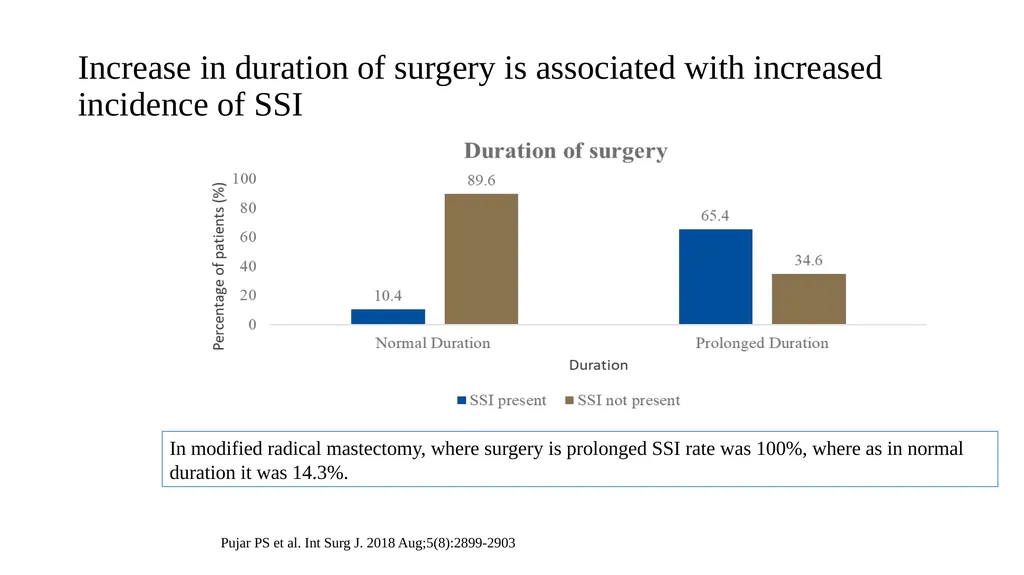
Increase in duration of surgery is associated with increased incidence of SSI Pujar PS et al. Int Surg J. 2018 Aug;5(8):2899-2903 In modified radical mastectomy, where surgery is prolonged SSI rate was 100%, where as in normal duration it was 14.3%.<br>
35
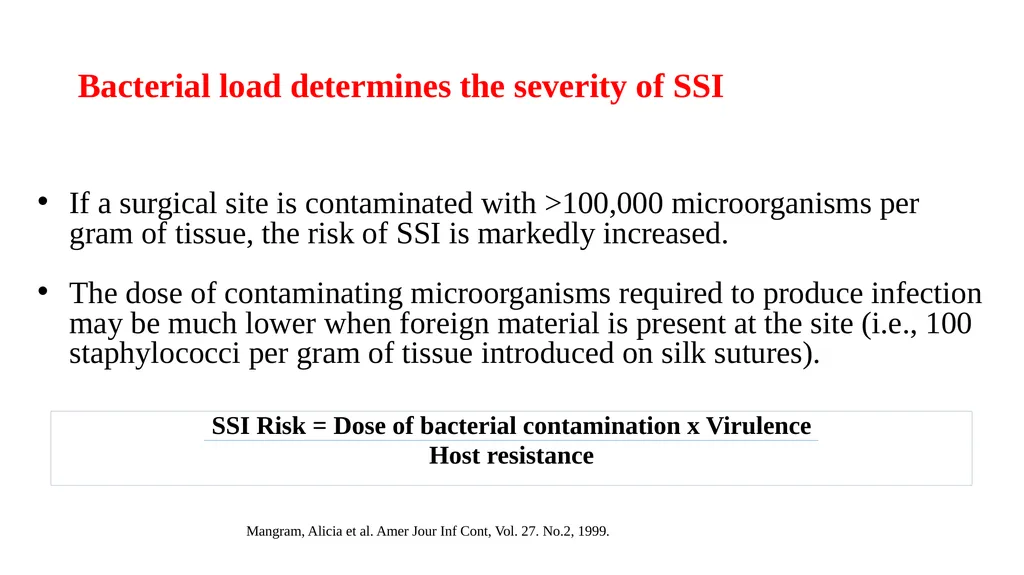
Bacterial load determines the severity of SSI If a surgical site is contaminated with >100,000 microorganisms per gram of tissue, the risk of SSI is markedly increased.
The dose of contaminating microorganisms required to produce infection may be much lower when foreign material is present at the site (i.e., 100 staphylococci per gram of tissue introduced on silk sutures). Mangram, Alicia et al. Amer Jour Inf Cont, Vol. 27. No.2, 1999. SSI Risk = Dose of bacterial contamination x Virulence
Host resistance<br>
36
A microbiological analysis from India: Staph aureus is the most common pathogen isolated from SSI Bhave PP et al. Int J Res Med Sci. 2016 Jul;4(7):2630-2635 In many SSIs, the responsible pathogens originate from the patient’s endogenous flora
Most commonly isolated organisms are Staphylococcus aureus, Coagulase negative staphylococci and Escherichia coli.<br>
37
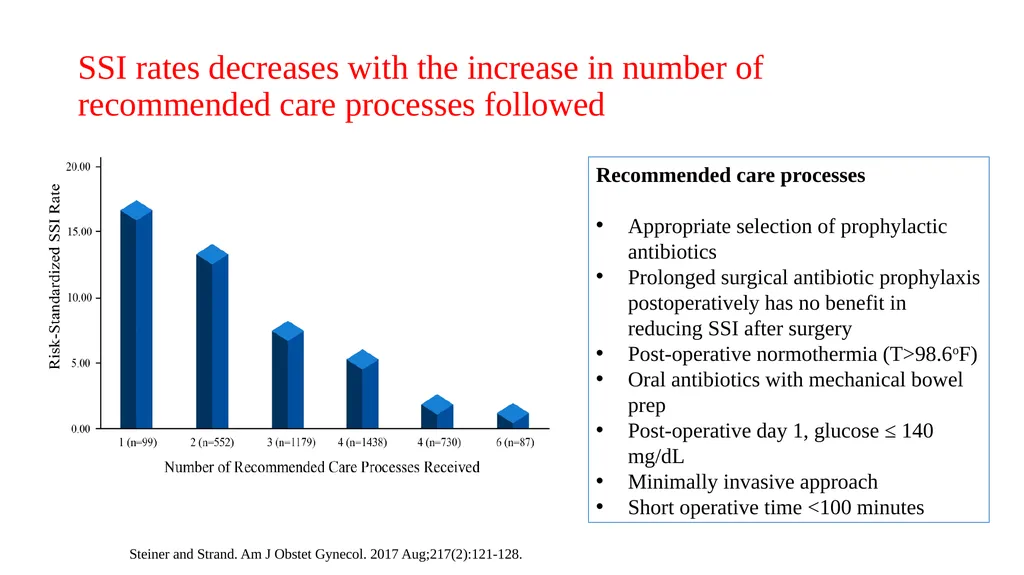
SSI rates decreases with the increase in number of recommended care processes followed Steiner and Strand. Am J Obstet Gynecol. 2017 Aug;217(2):121-128. Recommended care processes
Appropriate selection of prophylactic antibiotics
Prolonged surgical antibiotic prophylaxis postoperatively has no benefit in reducing SSI after surgery
Post-operative normothermia (T>98.6oF)
Oral antibiotics with mechanical bowel prep
Post-operative day 1, glucose ≤ 140 mg/dL
Minimally invasive approach
Short operative time <100 minutes<br>
38
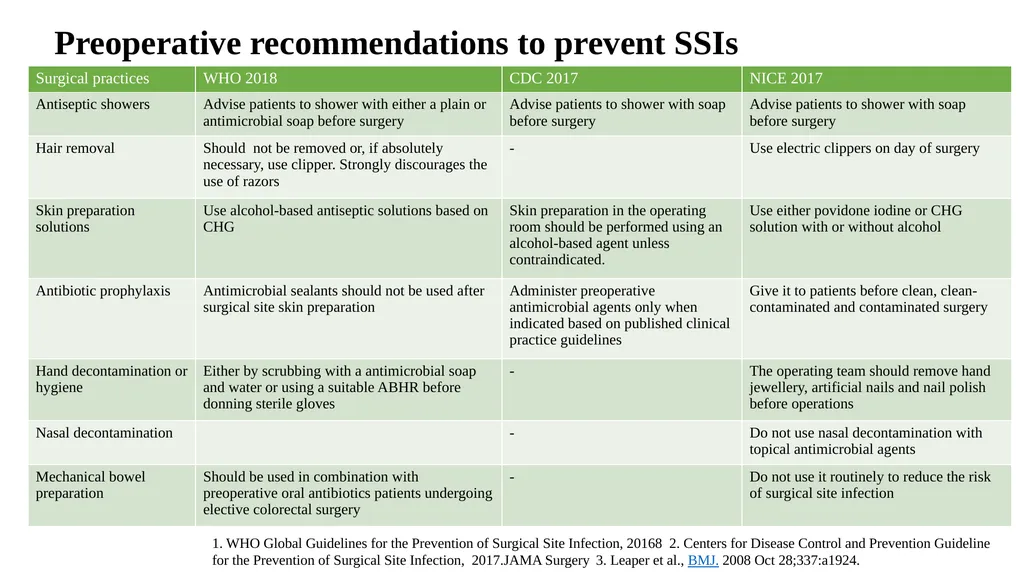
Preoperative recommendations to prevent SSIs 1. WHO Global Guidelines for the Prevention of Surgical Site Infection, 20168 2. Centers for Disease Control and Prevention Guideline for the Prevention of Surgical Site Infection, 2017.JAMA Surgery 3. Leaper et al., BMJ. 2008 Oct 28;337:a1924.<br>
39
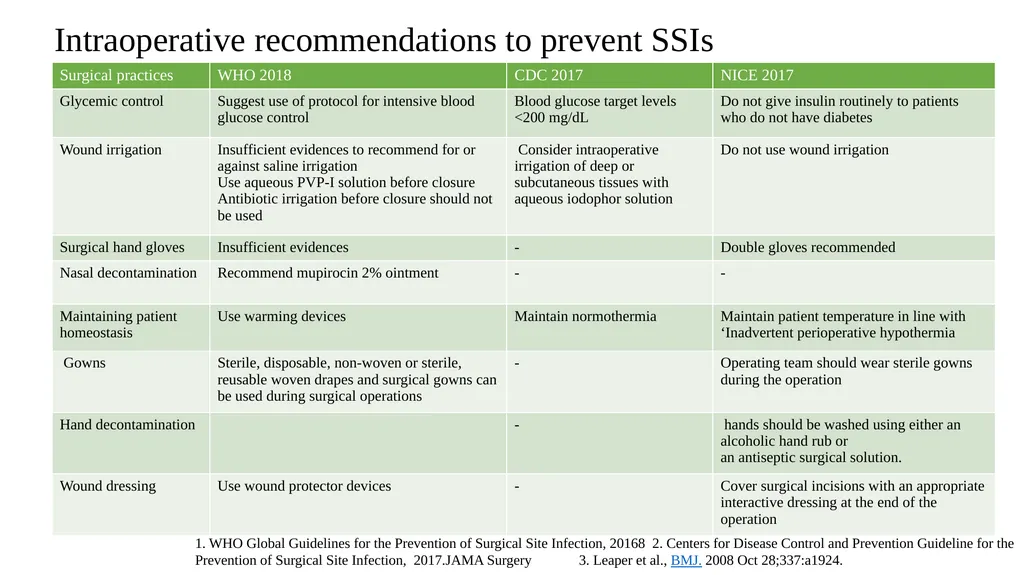
Intraoperative recommendations to prevent SSIs 1. WHO Global Guidelines for the Prevention of Surgical Site Infection, 20168 2. Centers for Disease Control and Prevention Guideline for the Prevention of Surgical Site Infection, 2017.JAMA Surgery 3. Leaper et al., BMJ. 2008 Oct 28;337:a1924.<br>
40
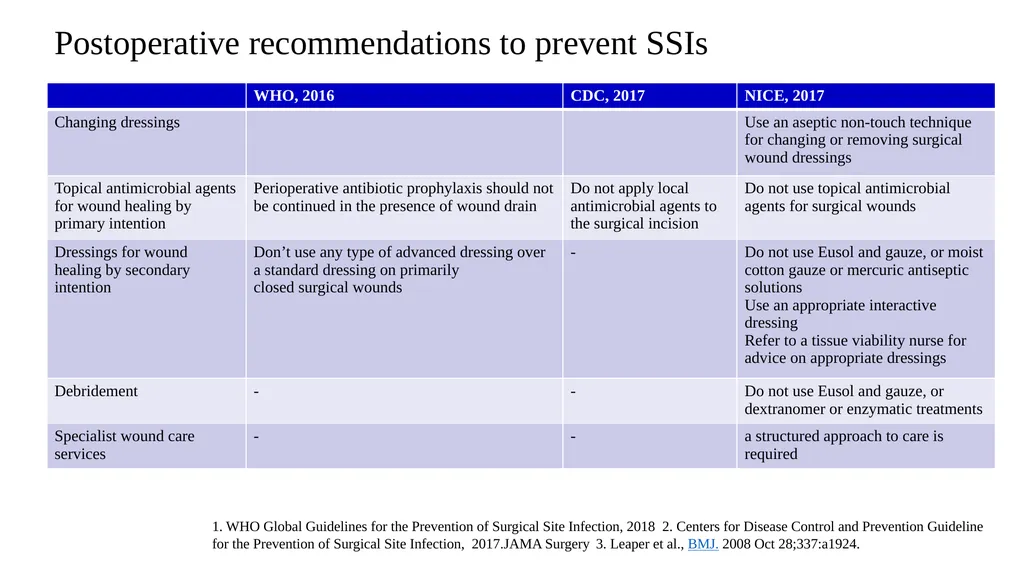
Postoperative recommendations to prevent SSIs 1. WHO Global Guidelines for the Prevention of Surgical Site Infection, 2018 2. Centers for Disease Control and Prevention Guideline for the Prevention of Surgical Site Infection, 2017.JAMA Surgery 3. Leaper et al., BMJ. 2008 Oct 28;337:a1924.<br>
41
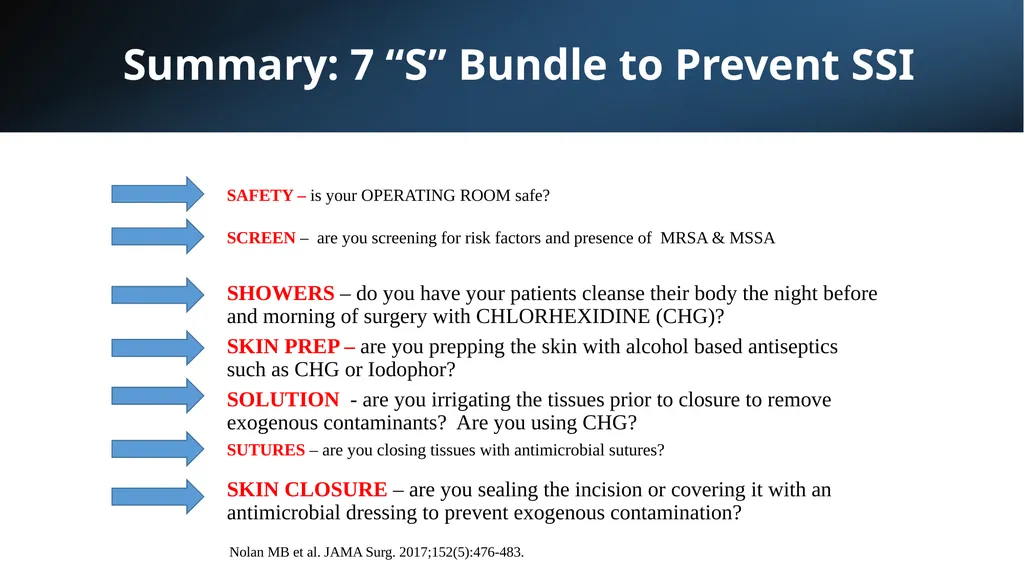
Summary: 7 “S” Bundle to Prevent SSI Nolan MB et al. JAMA Surg. 2017;152(5):476-483.<br>
42
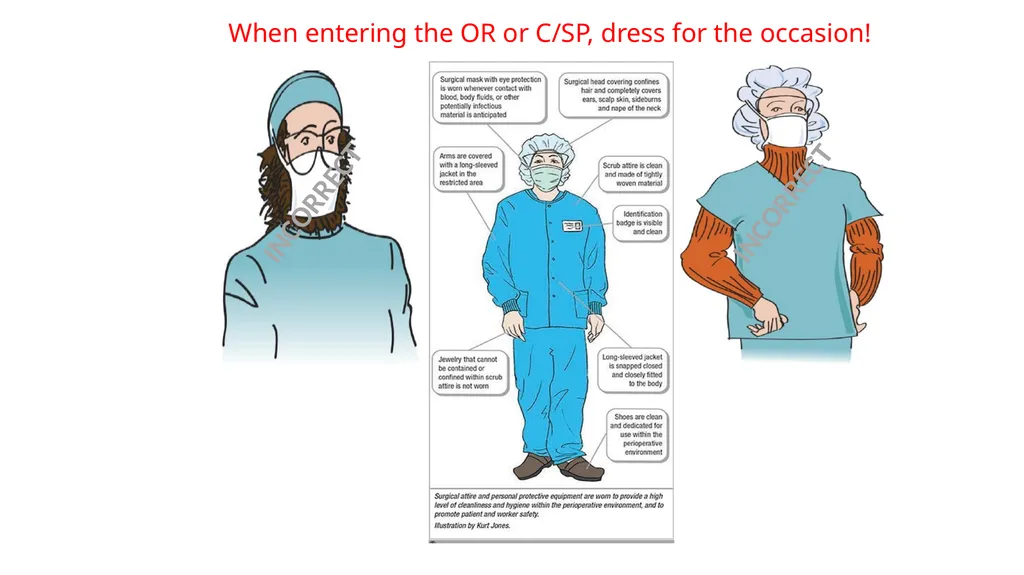
When entering the OR or C/SP, dress for the occasion! INCORRECT INCORRECT<br>
43
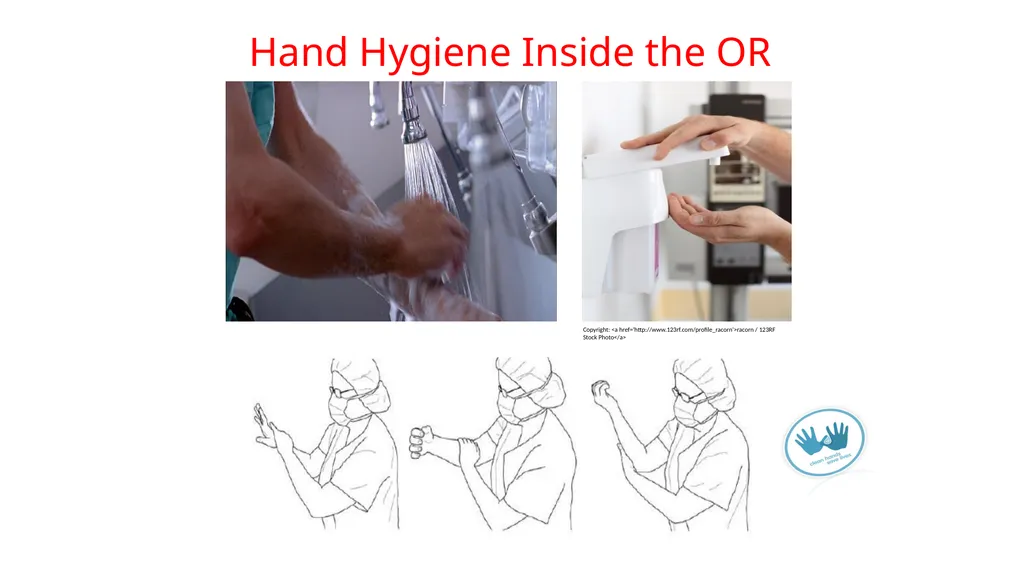
Hand Hygiene Inside the OR Copyright: <a href='http://www.123rf.com/profile_racorn'>racorn / 123RF Stock Photo</a><br>
44
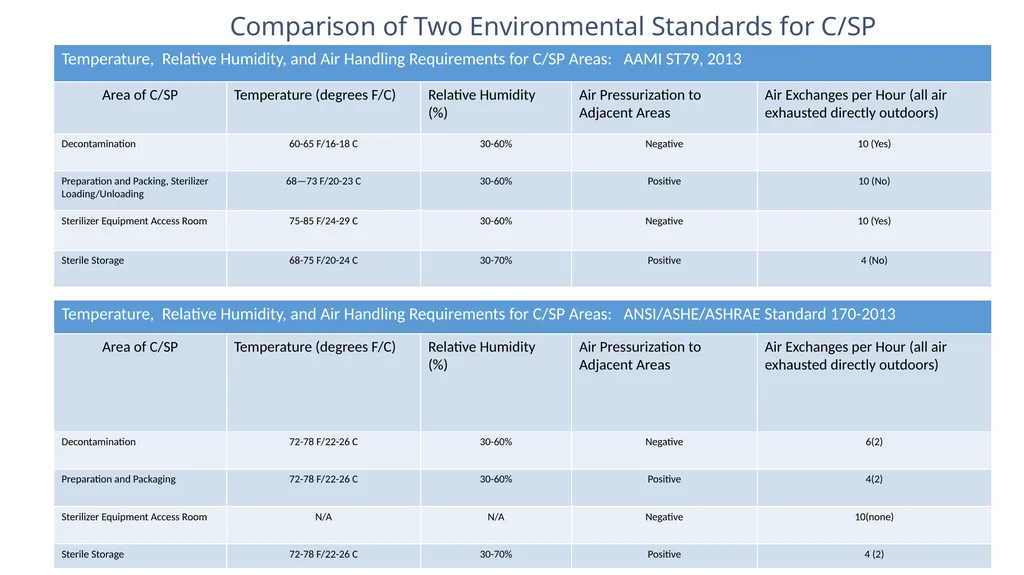
Comparison of Two Environmental Standards for C/SP<br>
45
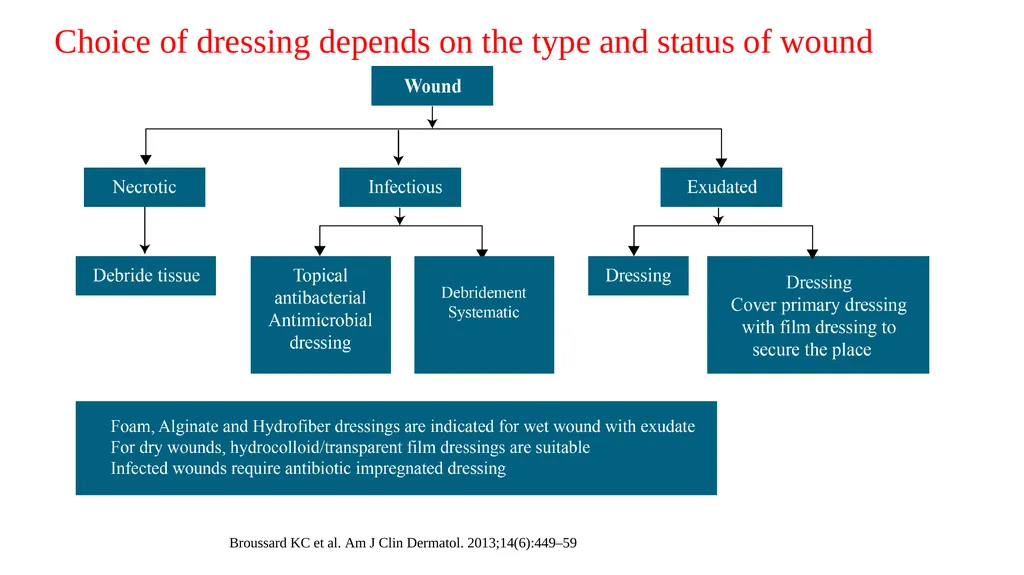
Choice of dressing depends on the type and status of wound Broussard KC et al. Am J Clin Dermatol. 2013;14(6):449–59<br>
46
Transparent film dressings allow postoperative wound inspection without disturbance of the dressing Waterproof, Sterile Barrier - Impervious To Liquids, Bacteria and Viruses
Low adherence - Relatively painless and easy removal
Breathable - Lets oxygen in and moisture vapor out and maintain an optimal moist wound environment
Prevent further contamination Leaper et al., BMJ. 2008 Oct 28;337:a1924.<br>
47
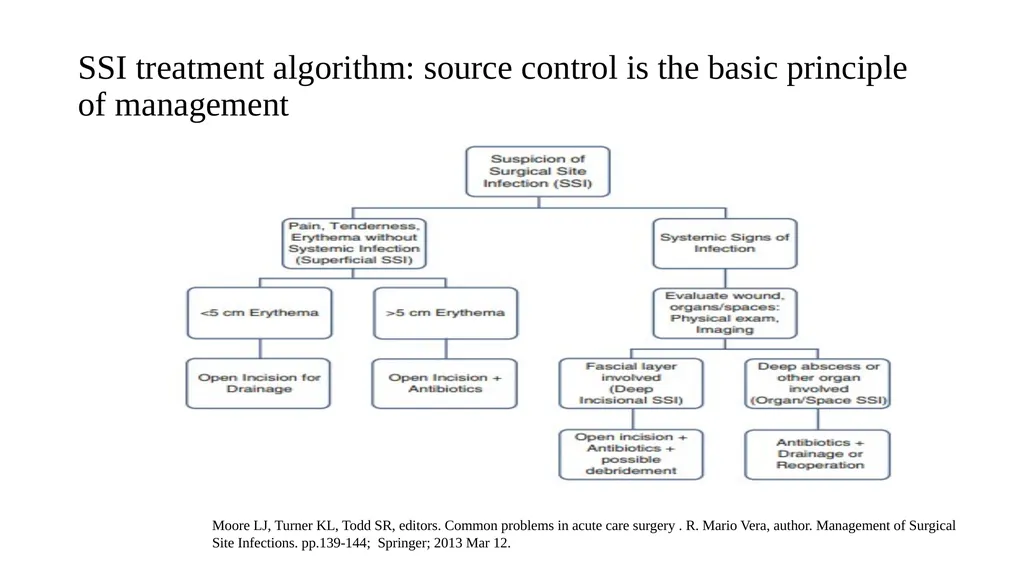
SSI treatment algorithm: source control is the basic principle of management Moore LJ, Turner KL, Todd SR, editors. Common problems in acute care surgery . R. Mario Vera, author. Management of Surgical Site Infections. pp.139-144; Springer; 2013 Mar 12.<br>
48
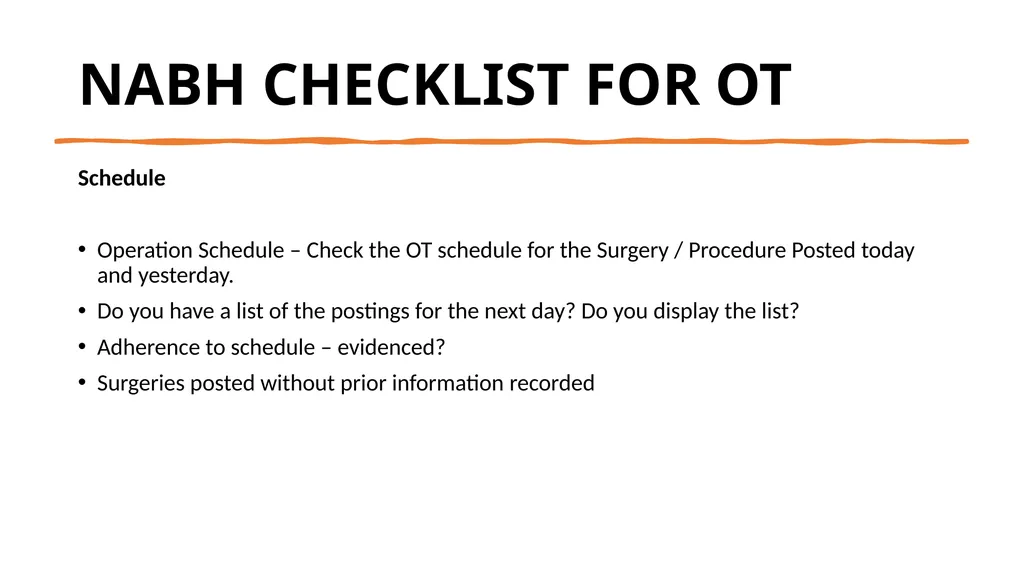
NABH CHECKLIST FOR OT Schedule
Operation Schedule – Check the OT schedule for the Surgery / Procedure Posted today and yesterday.
Do you have a list of the postings for the next day? Do you display the list?
Adherence to schedule – evidenced?
Surgeries posted without prior information recorded<br>
49
Checklist, Preparation, Patient’s Right and Responsibility What protocol is followed to check Right Patient, Right Site? Is the surgical site marked?
Is there exception list for marking site?
Is there an alternative for patients who are allergic to ink used for marking sites?
How the staff does records when site is marked or not marked? Is it documented?
Check if the patients come with the ID band on the wrist. Is the identification of the patient documented?
Is the identification of the patient verified & confirmed at least by 2 different personnel from OT?<br>
50
Is the Surgery consent form signed / completely filled up
Are the consent forms used in Local Language for those who don’t understand English?
Is the patient/ family’s involvement in decision making evident in the consent form?
Has the doctor used illustration/ diagrammatic representation to explain the procedure (only where applicable)?
Are the specific risks/ complications or any other unanticipated outcomes are mentioned in the consent form?
High Risk consent taken where found necessary?
Criteria to categorize “High Risk” defined?
Check if patient is cleared for surgery<br>
51
Check if there is any protocol available for handling patient valuables (Dentures, old reports)?
Is there a checklist for the same?
Is the Pre Procedure checklist filled out completely by both ward and or OT nurse?
Checklist of OT filled Before Start of First Case
Checklist of OT filled in-between two Case
Before induction of anaesthesia or when the patient is awake, do the doctors/ any other staff talk among themselves ignoring the presence of a patient?
Is the patient confidentiality maintained? Do the doctor/ nurses discuss patient’s details when the other patient/s is awake?<br>
52
Anaesthesia Pre Anaesthetic Evaluation completed before the patient brought to OR?
Is there an immediate pre op anaesthesia evaluation done?
Is the Anaesthesia Plan documented?
Check if the Anaesthesia consent is filled and signed?
In the minor OT – consent is taken for both surgery & anaesthesia
The person performing the procedure is different than the person administering the sedation?
After sedation, patient is monitored continuously
Anaesthesia Notes – written<br>
53
Medicine Pre medication orders filled up?
What is the defined time limit for antibiotic prophylaxis?
Antibiotic prophylaxis – is it last given within the time frame?
Is the prophylaxis as per the antibiotic policy of the hospital?
Medicines- who checks and updates the availability of the medicines?
Inventory of the medicines – checked daily?
High risk medicines – anaesthetic, narcotic drugs kept under lock
Sound Alike Look Alike medicines are labeled, stored separately? Staffs are aware of the importance of color coding?
Is there a checklist for medication given/stored?<br>
54
Patient’s Case Sheet Check the case sheet of a patient posted today for Surgery / Ongoing Surgery.
Operation notes – written
Are the Serology investigations carried out?
If any specific precautions need to be undertaken e.g. infected cases (HBsAg, HIV)
How do you prepare patients for operation and are there a protocol / document for the same?
Is surgery safety checklist completed for all cases?
Is there a facility to store blood bags? Temperature monitored?
Is there a protocol to discard blood bags, which were not used?
Is this recorded in the patient’s file?<br>
55
Are the details of implants used mentioned in the master log book with the sticker?
Observe one on-going operation and check the following;
Following all protocol – pre / intra / post operation
Surgery Safety (Time-out) checklist filled?
How do you ensure that the instruments are not accidentally displaced inside the patient?
Is there a time period defined to complete the operative notes in writing & for the typed out?
Are the operating notes complete in all aspects? procedure details, post operative care plan, specimen details, etc?
Patient’s file has post operative care plan mentioned after recovery of Patient (In the Recovery Room)?
Recovery Room notes are written in anaesthesia record?
Before transferring the patient out of the Recovery Room, Alderete Score recorded in the Anaesthesia Record?<br>
56
Is there any documented plan of care while handing over the patient to ICU or Ward Staff?
Does the plan specify nursing interventions also?
If there is a Discharge to Home, is there a Discharge Summary handed over to the patient/ family?
Is that summary & follow up advice explained to the Patient/ Family?
Discharge Criteria from Recovery Room displayed?
Staff aware of these criteria?
Evidence for these criteria being carried out for discharge from Recovery Room?<br>
57
How is the postoperative handing over of the patients done? How is it planned and documented.
Is the pain management protocol followed as per organizational pain management policy?
Specimen containers are labeled before placing the specimen?
Labeling is done appropriately?
Who takes the decision if there is any tissue requires to be discarded? Is there a written policy for the same?
Is there an appropriate signage where specimen is stored?
Is there similar containers kept for tissues/ parts to be discarded?<br>
58
Infection Control Measures How are the infection control measures implemented in OT?
Did the OT In Charge allow you to enter without OT attire?
Were you asked to wash hands before entering the OR
Was there hand wash facility after you removed your footwear?
Was there hand wash facility before you could enter OT?
Check for the marked area / display beyond which patient is to be handed over to the OT
Is there cris-crossing of the sterile, unsterile and soiled items?
What are the different zones in OT and how do you ensure aseptic conditions of the same.<br>
59
Is the Pre-holding room is utilized for patients’preparation?
Changing area and how is it maintained if there is place to sit, hang clothes, sleepers etc?
Does the OT staff know the scrubbing technique?
Is it displayed where necessary / in the wash area??
Observe scrubbing procedure for 1 or 2 staff.
Check if all the steps followed for the recommended duration.
How stringent is the dress code?
Does the staff restrict their movements in the scrub suit?<br>
60
How do you handle waste generated? Waste segregation – appropriately done?
Is the staff aware of the color-coding is it displayed anywhere?
What is the protocol for ensuring OT is ready between 2 surgeries
Is there surface cleaning done after every case?
Can we see the records for the same above all?
Is rodent control performed in the OT?
Is the staff immunized who ensures the same?<br>
61
Equipments Is there a list of equipments?
Where & how are the equipments kept after every use?
Is there a checklist to ensure the availability of the equipments and materials prior to the surgery
Is there a checklist for instruments for specific procedures and is it available for reference?
How do you keep the chitels forceps after every use?
How do you determine the sterility of equipments?
Who checks the viability / condition of the instruments?
Are the oxygen cylinders checked for any leakage?
In case of a sudden power breakdown is there any plan of action? UPS
Does anybody check the lights in OT prior to the surgery?
Maintenance of machines
Is the Calibration of equipments done and who is responsible for the same?
Are any precautionary measures listed for the dept?
Check the PM – Preventive Maintenance sheet? Calibration sticker on Boyle’s Apparatus<br>
62
Emergency Emergency Cases handling- Is there a provision for performing emergency surgery (unscheduled)?
Does the schedule accommodate such cases?
In case of an emergency during operation is a note made later and reasons looked into and documented
Is there emergency set of equipments available?
What is the procedure to ensure availability of blood in Emergency?
Cardiac arrests in Operating/Recovery Room analyzed using Event Recorder?
Who breaks bad news? Are they trained for breaking bad news?
Crash cart, intubation tray, oxygen available in the Minor OT?<br>
63
Quality Indicator Statistics prepared by every month?
Check if the following Quality Indicators monitored; raw data available
Is analysis for surgeries performed per month done and the failure case analyzed?
Re-exploration Rate
Anaesthesia Adverse Events
Change/ modification of anaesthesia plan
Anaesthesia related mortality rate
Antibiotic prophylaxis given 60 minutes prior to incision
Time gap between 2 surgeries
Time taken for the histopath specimen to reach lab
Rate of OT utilization (per OT)<br>
64
How often the corrective and preventive actions taken?
For ordering OT consumables is there a reorder level determined for commonly used materials?
HEPA filters efficiency checked? Next due date?
How do you ensure sterility of the air in the OT (laminar air flow)
Are the audits of the following done OR are the following factors monitored?
Post operative glucose levels
Post Operative hypothermia
Biomedical Waste disposal
Antibiotic usage
Post op Pain Management
Post Op Hypoxia
Post op Nausea & Vomiting
Post Op MI
Post Op Headache
Awareness under Anaesthesia<br>
65
Conclusion SSIs are the most common complication of surgical procedures
In India, SSI rate rise from ~3-4% in clean to >40% in dirty wounds
SSIs result in prolonged hospital stay and increased hospital associated cost
SSIs arise from a complex interaction of several factors including exogeneous source, cross-contamination, diabetes, smoking and bacterial infections
Staph aureus is the most common pathogen implicated in SSI
Practices like patient hygiene, skin preparation with alcohol based solutions, antibiotic prophylaxis, aseptic precautions during surgery are important for preventing SSI
The main purposes of a surgical dressing (by primary intention) are to control any postoperative bleeding, absorb exudate if anticipated, ease pain and provide protection for newly formed tissue.
Choice of dressing is governed by type of surgical wound
Transparent dressing promotes wound healing by providing optimal conditions and allowing visual check<br>
66
Thank You..<br>