
Infection Prevention and Control: Risk Recognition

Description: Infection Prevention and Control: Risk Recognition and Communication Project Firstline is a national collaborative led by the U.S. Centers for Disease Control and Prevention (CDC) to provide infection control training and education to
Related Topics
Download Presentation
"Infection Prevention and Control: Risk Recognition" is the property of its rightful owner. Permission is granted to download and print the materials on this website for personal, non-commercial use only, and to display it on your personal computer provided you do not modify the materials and that you retain all copyright notices contained in the materials. By downloading content from our website, you accept the terms of this agreement.
Presentation Transcript
slide1. Infection Prevention and Control:
Risk Recognition and Communication<br>
slide2. Project Firstline is a national collaborative led by the U.S. Centers for Disease Control and Prevention (CDC) to provide infection control training and education to frontline healthcare workers and public health personnel. AAP is proud to partner with Project Firstline, as supported through Cooperative Agreement CDC-RFA-OT18-1802. CDC is an agency within the Department of Health and Human Services (HHS). The contents of this program do not necessarily represent the policies of CDC or HHS and should not be considered an endorsement by the Federal Government. Acknowledgements<br>
slide3. Applying Current IPC Guidance for COVID-19 at your Job and Facility<br>
slide4. Objectives Understand how to assess infection prevention and control practices.
Understand how to apply current infection prevention and control guidance in your health care facility.<br>
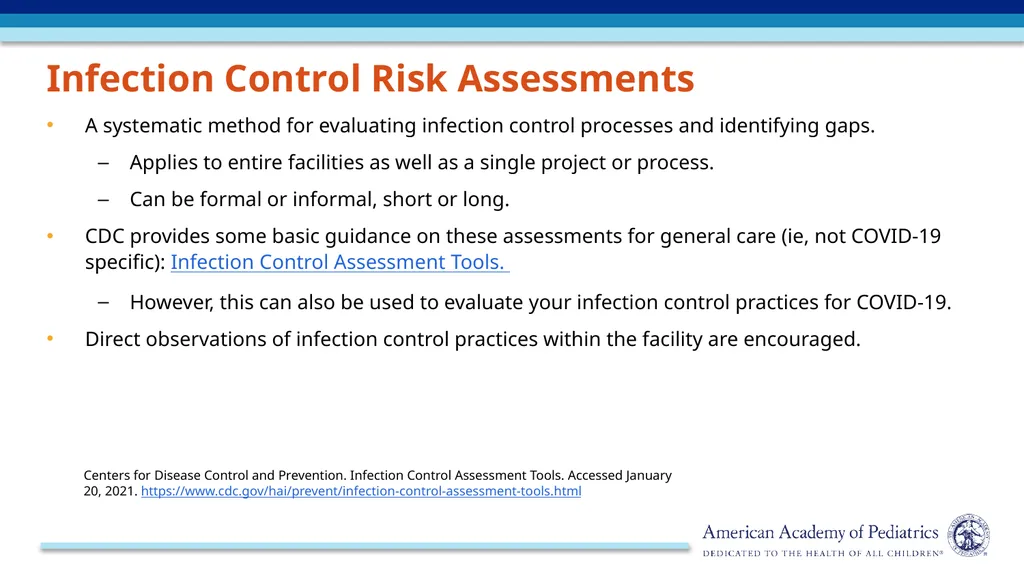
slide5. Infection Control Risk Assessments A systematic method for evaluating infection control processes and identifying gaps.
Applies to entire facilities as well as a single project or process.
Can be formal or informal, short or long.
CDC provides some basic guidance on these assessments for general care (ie, not COVID-19 specific): Infection Control Assessment Tools.
However, this can also be used to evaluate your infection control practices for COVID-19.
Direct observations of infection control practices within the facility are encouraged. Centers for Disease Control and Prevention. Infection Control Assessment Tools. Accessed January 20, 2021. https://www.cdc.gov/hai/prevent/infection-control-assessment-tools.html<br>
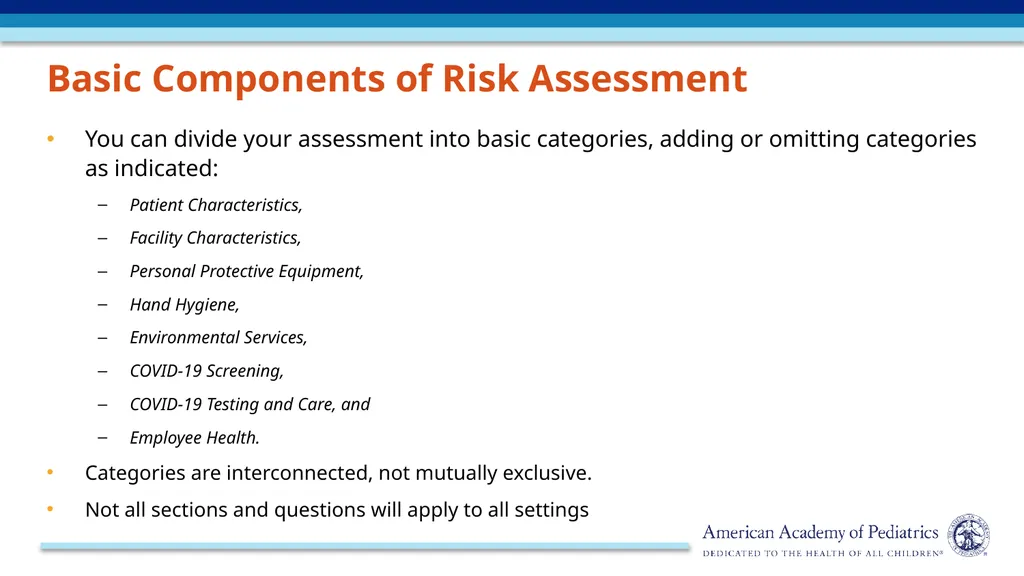
slide6. Basic Components of Risk Assessment You can divide your assessment into basic categories, adding or omitting categories as indicated:
Patient Characteristics,
Facility Characteristics,
Personal Protective Equipment,
Hand Hygiene,
Environmental Services,
COVID-19 Screening,
COVID-19 Testing and Care, and
Employee Health.
Categories are interconnected, not mutually exclusive.
Not all sections and questions will apply to all settings<br>
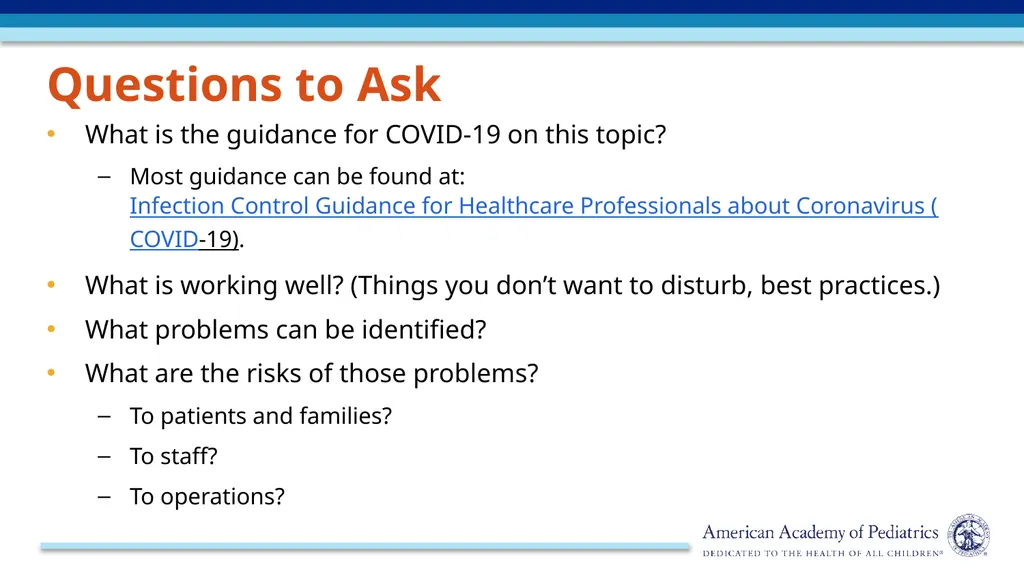
slide7. Questions to Ask What is the guidance for COVID-19 on this topic?
Most guidance can be found at: Infection Control Guidance for Healthcare Professionals about Coronavirus (COVID-19).
What is working well? (Things you don’t want to disturb, best practices.)
What problems can be identified?
What are the risks of those problems?
To patients and families?
To staff?
To operations?<br>
slide8. Facility Characteristics Consider the types of care provided at your facility.
Inpatient vs. outpatient.
Procedures:
Infusions,
Nebulizer treatments, and
Biopsies/injections/other bedside procedures.<br>
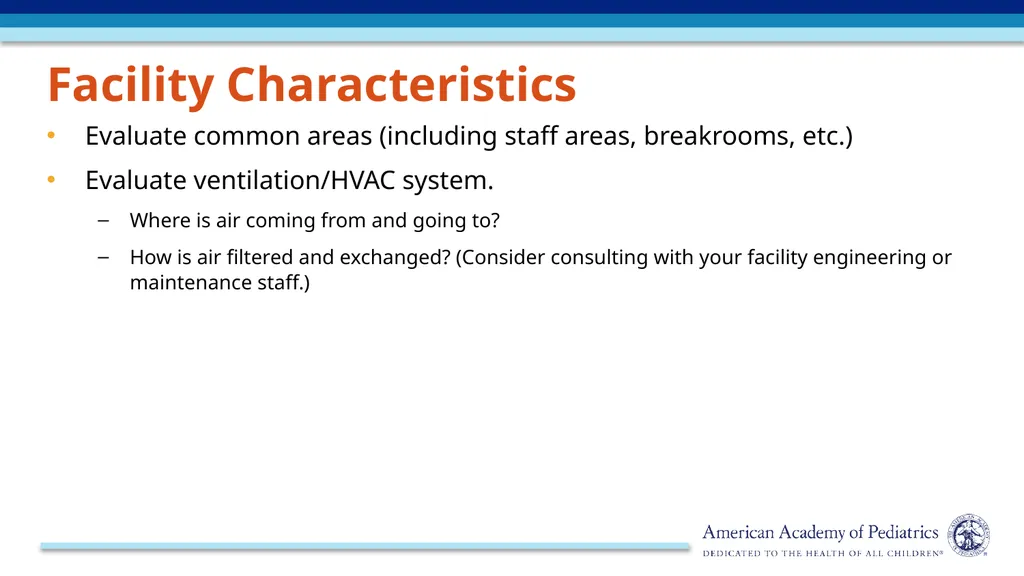
slide9. Facility Characteristics Evaluate common areas (including staff areas, breakrooms, etc.)
Evaluate ventilation/HVAC system.
Where is air coming from and going to?
How is air filtered and exchanged? (Consider consulting with your facility engineering or maintenance staff.)<br>
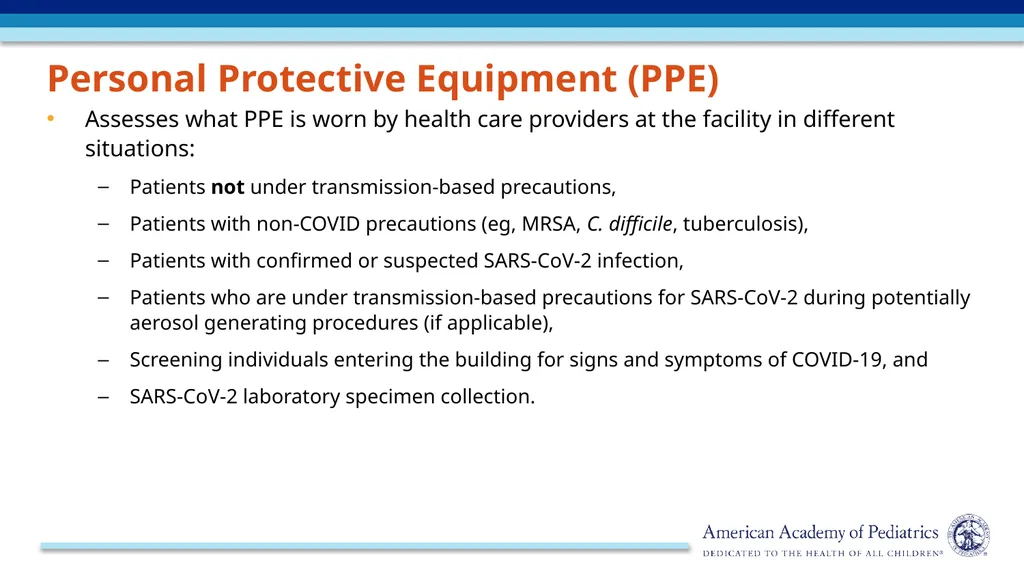
slide10. Personal Protective Equipment (PPE) Assesses what PPE is worn by health care providers at the facility in different situations:
Patients not under transmission-based precautions,
Patients with non-COVID precautions (eg, MRSA, C. difficile, tuberculosis),
Patients with confirmed or suspected SARS-CoV-2 infection,
Patients who are under transmission-based precautions for SARS-CoV-2 during potentially aerosol generating procedures (if applicable),
Screening individuals entering the building for signs and symptoms of COVID-19, and
SARS-CoV-2 laboratory specimen collection.<br>
slide11. Personal Protective Equipment (PPE) Determine where health care providers obtain new PPE and where it is disposed.
What are the procedures for Extended Use and Reuse?<br>
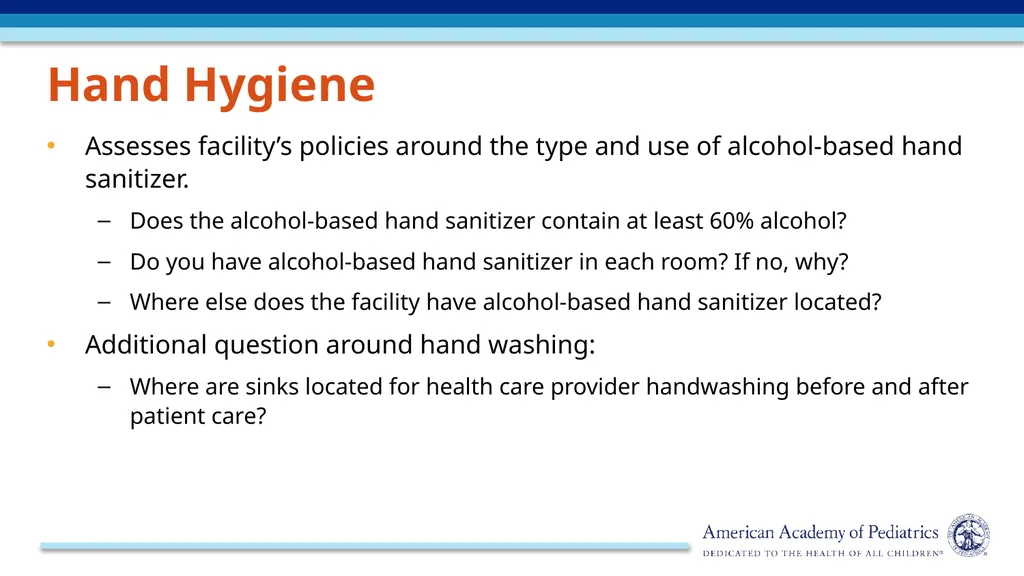
slide12. Hand Hygiene Assesses facility’s policies around the type and use of alcohol-based hand sanitizer.
Does the alcohol-based hand sanitizer contain at least 60% alcohol?
Do you have alcohol-based hand sanitizer in each room? If no, why?
Where else does the facility have alcohol-based hand sanitizer located?
Additional question around hand washing:
Where are sinks located for health care provider handwashing before and after patient care?<br>
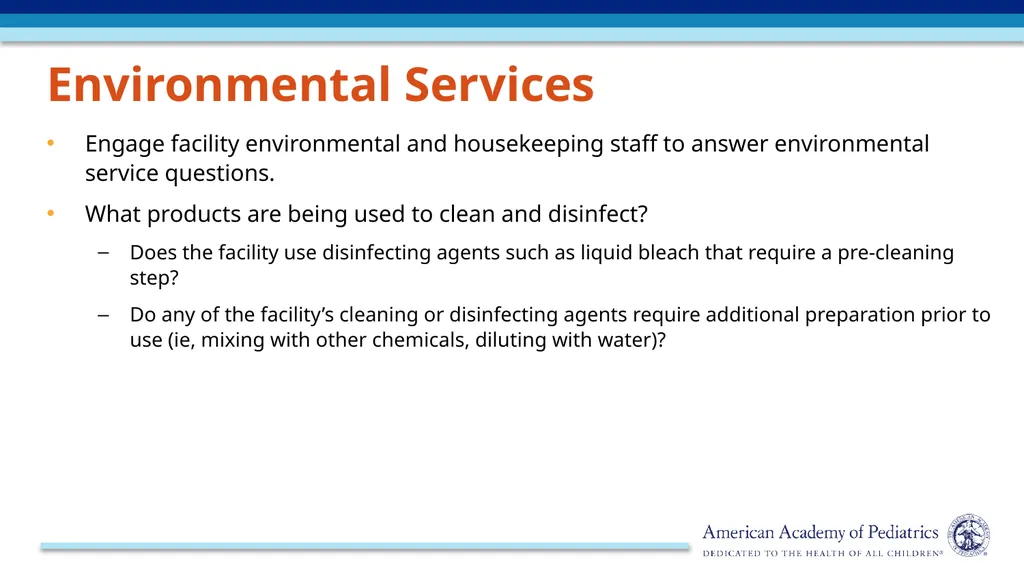
slide13. Environmental Services Engage facility environmental and housekeeping staff to answer environmental service questions.
What products are being used to clean and disinfect?
Does the facility use disinfecting agents such as liquid bleach that require a pre-cleaning step?
Do any of the facility’s cleaning or disinfecting agents require additional preparation prior to use (ie, mixing with other chemicals, diluting with water)?<br>
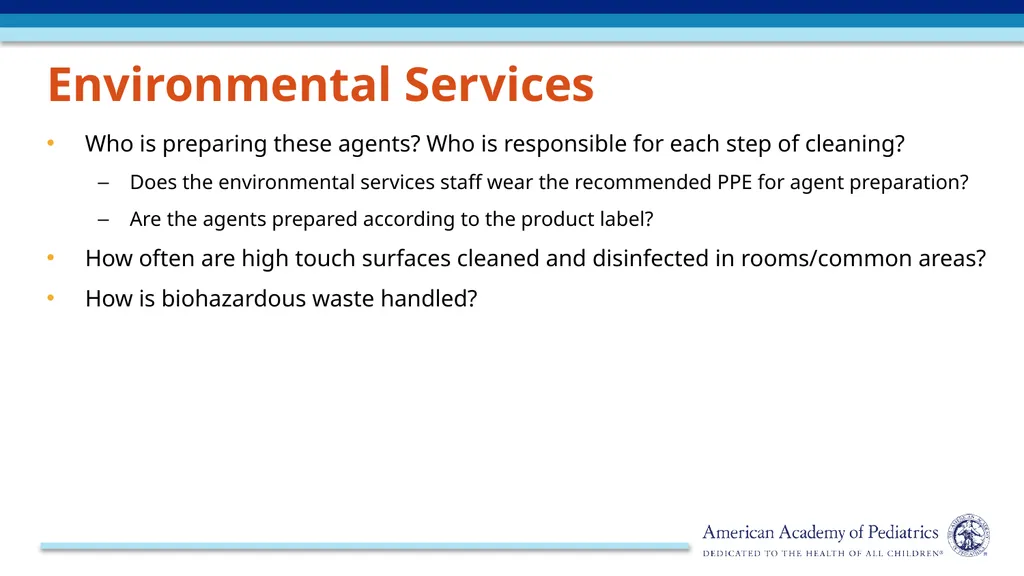
slide14. Environmental Services Who is preparing these agents? Who is responsible for each step of cleaning?
Does the environmental services staff wear the recommended PPE for agent preparation?
Are the agents prepared according to the product label?
How often are high touch surfaces cleaned and disinfected in rooms/common areas?
How is biohazardous waste handled?<br>
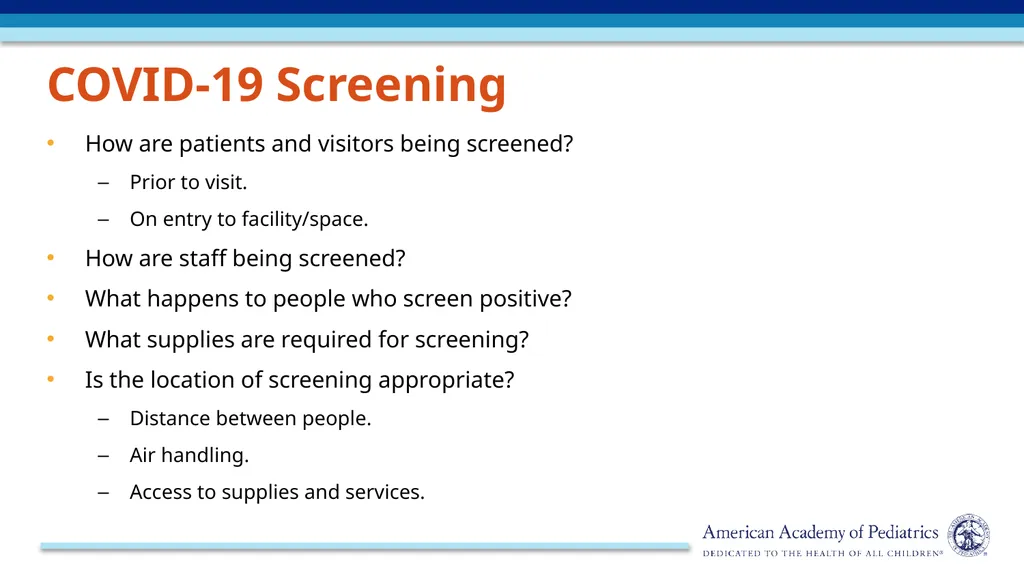
slide15. COVID-19 Screening How are patients and visitors being screened?
Prior to visit.
On entry to facility/space.
How are staff being screened?
What happens to people who screen positive?
What supplies are required for screening?
Is the location of screening appropriate?
Distance between people.
Air handling.
Access to supplies and services.<br>
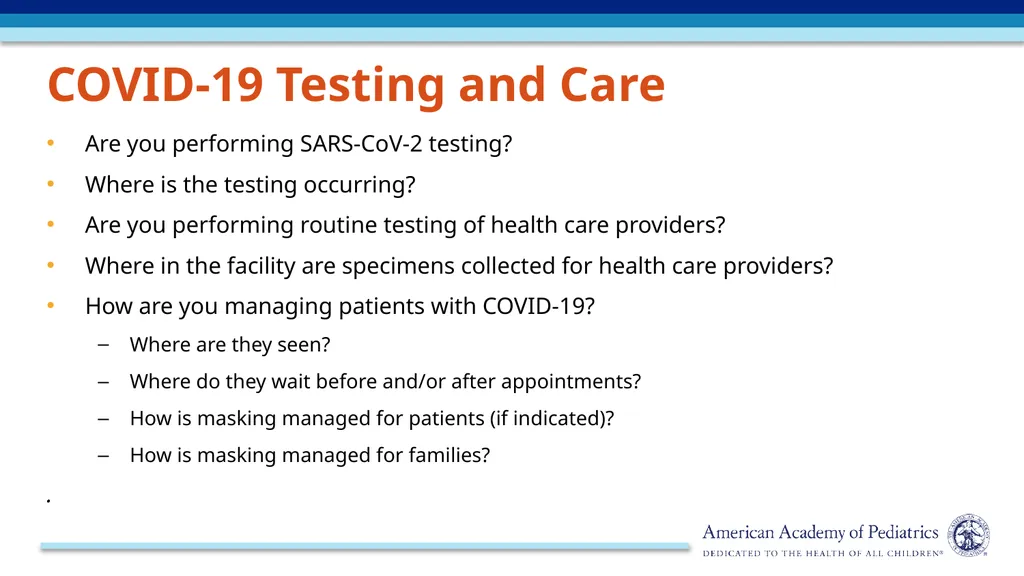
slide16. COVID-19 Testing and Care Are you performing SARS-CoV-2 testing?
Where is the testing occurring?
Are you performing routine testing of health care providers?
Where in the facility are specimens collected for health care providers?
How are you managing patients with COVID-19?
Where are they seen?
Where do they wait before and/or after appointments?
How is masking managed for patients (if indicated)?
How is masking managed for families?
.<br>
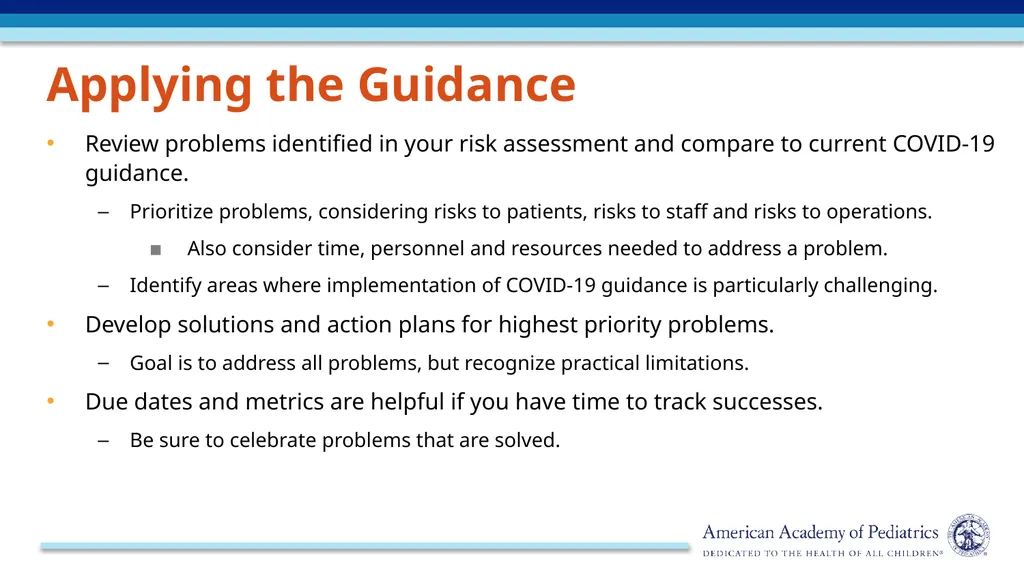
slide17. Applying the Guidance Review problems identified in your risk assessment and compare to current COVID-19 guidance.
Prioritize problems, considering risks to patients, risks to staff and risks to operations.
Also consider time, personnel and resources needed to address a problem.
Identify areas where implementation of COVID-19 guidance is particularly challenging.
Develop solutions and action plans for highest priority problems.
Goal is to address all problems, but recognize practical limitations.
Due dates and metrics are helpful if you have time to track successes.
Be sure to celebrate problems that are solved.<br>
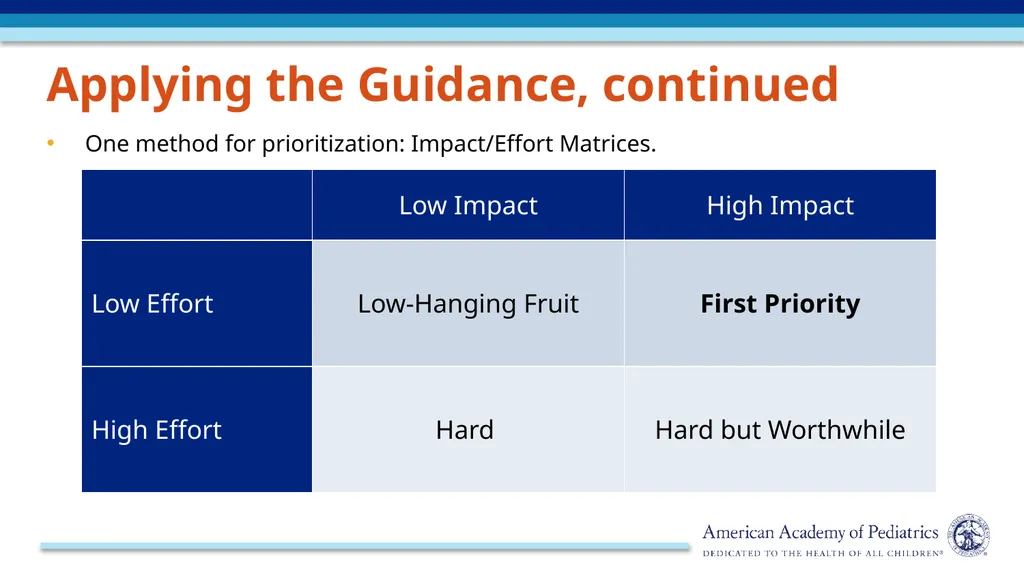
slide18. Applying the Guidance, continued One method for prioritization: Impact/Effort Matrices.<br>
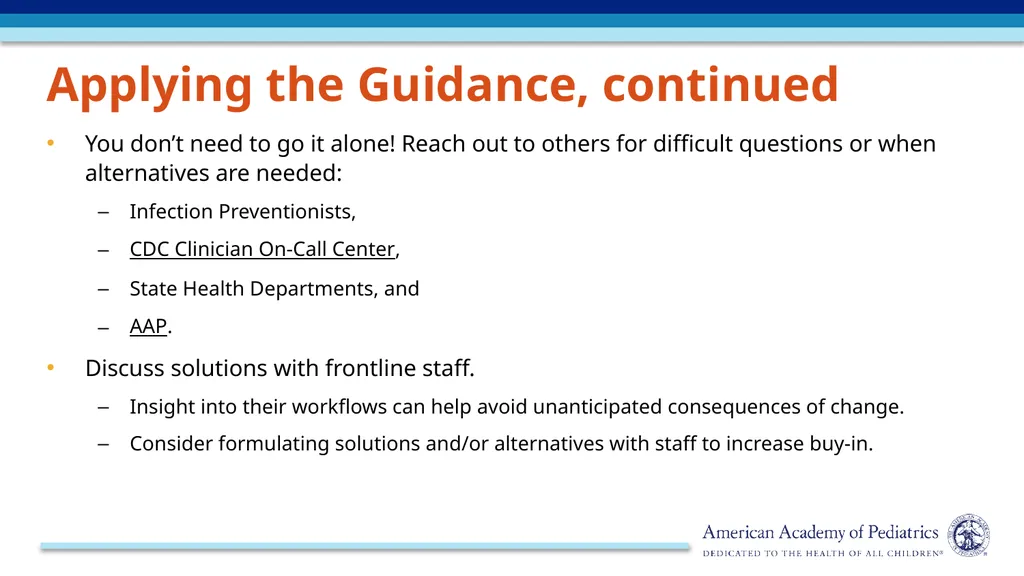
slide19. Applying the Guidance, continued You don’t need to go it alone! Reach out to others for difficult questions or when alternatives are needed:
Infection Preventionists,
CDC Clinician On-Call Center,
State Health Departments, and
AAP.
Discuss solutions with frontline staff.
Insight into their workflows can help avoid unanticipated consequences of change.
Consider formulating solutions and/or alternatives with staff to increase buy-in.<br>
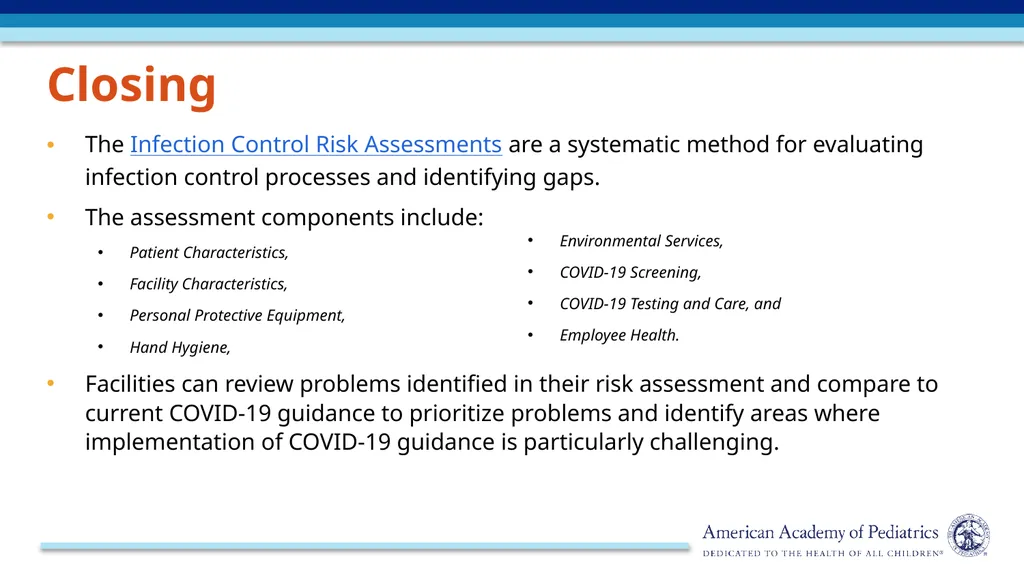
slide20. Closing The Infection Control Risk Assessments are a systematic method for evaluating infection control processes and identifying gaps.
The assessment components include:
Patient Characteristics,
Facility Characteristics,
Personal Protective Equipment,
Hand Hygiene,
Facilities can review problems identified in their risk assessment and compare to current COVID-19 guidance to prioritize problems and identify areas where implementation of COVID-19 guidance is particularly challenging. Environmental Services,
COVID-19 Screening,
COVID-19 Testing and Care, and
Employee Health.<br>
slide21. Resources American Academy of Pediatrics COVID-19 Guidance and Resources
Caring for Children With Acute Illness in the Ambulatory Care Setting During the Public Health Emergency
Practice Management Tips
Guidance on the Use of Personal Protective Equipment (PPE) for Pediatric Care in Ambulatory Care Settings During the SARS-CoV-2 Pandemic
Centers for Disease Control and Prevention
Infection Prevention and Control Assessment and Response Tools (ICAR)
Infection Control Assessment Tool for Acute Care Hospitals
Infection Control Assessment Tool for Long-term Care Facilities
Infection Control Assessment Tool for Outpatient Settings
Interim Infection Prevention and Control Recommendations for Healthcare Personnel During the Coronavirus Disease 2019 (COVID-19) Pandemic
Project Firstline<br>
slide2. Project Firstline is a national collaborative led by the U.S. Centers for Disease Control and Prevention (CDC) to provide infection control training and education to frontline healthcare workers and public health personnel. AAP is proud to partner with Project Firstline, as supported through Cooperative Agreement CDC-RFA-OT18-1802. CDC is an agency within the Department of Health and Human Services (HHS). The contents of this program do not necessarily represent the policies of CDC or HHS and should not be considered an endorsement by the Federal Government. Acknowledgements<br>
slide3. Applying Current IPC Guidance for COVID-19 at your Job and Facility<br>
slide4. Objectives Understand how to assess infection prevention and control practices.
Understand how to apply current infection prevention and control guidance in your health care facility.<br>
slide5. Infection Control Risk Assessments A systematic method for evaluating infection control processes and identifying gaps.
Applies to entire facilities as well as a single project or process.
Can be formal or informal, short or long.
CDC provides some basic guidance on these assessments for general care (ie, not COVID-19 specific): Infection Control Assessment Tools.
However, this can also be used to evaluate your infection control practices for COVID-19.
Direct observations of infection control practices within the facility are encouraged. Centers for Disease Control and Prevention. Infection Control Assessment Tools. Accessed January 20, 2021. https://www.cdc.gov/hai/prevent/infection-control-assessment-tools.html<br>
slide6. Basic Components of Risk Assessment You can divide your assessment into basic categories, adding or omitting categories as indicated:
Patient Characteristics,
Facility Characteristics,
Personal Protective Equipment,
Hand Hygiene,
Environmental Services,
COVID-19 Screening,
COVID-19 Testing and Care, and
Employee Health.
Categories are interconnected, not mutually exclusive.
Not all sections and questions will apply to all settings<br>
slide7. Questions to Ask What is the guidance for COVID-19 on this topic?
Most guidance can be found at: Infection Control Guidance for Healthcare Professionals about Coronavirus (COVID-19).
What is working well? (Things you don’t want to disturb, best practices.)
What problems can be identified?
What are the risks of those problems?
To patients and families?
To staff?
To operations?<br>
slide8. Facility Characteristics Consider the types of care provided at your facility.
Inpatient vs. outpatient.
Procedures:
Infusions,
Nebulizer treatments, and
Biopsies/injections/other bedside procedures.<br>
slide9. Facility Characteristics Evaluate common areas (including staff areas, breakrooms, etc.)
Evaluate ventilation/HVAC system.
Where is air coming from and going to?
How is air filtered and exchanged? (Consider consulting with your facility engineering or maintenance staff.)<br>
slide10. Personal Protective Equipment (PPE) Assesses what PPE is worn by health care providers at the facility in different situations:
Patients not under transmission-based precautions,
Patients with non-COVID precautions (eg, MRSA, C. difficile, tuberculosis),
Patients with confirmed or suspected SARS-CoV-2 infection,
Patients who are under transmission-based precautions for SARS-CoV-2 during potentially aerosol generating procedures (if applicable),
Screening individuals entering the building for signs and symptoms of COVID-19, and
SARS-CoV-2 laboratory specimen collection.<br>
slide11. Personal Protective Equipment (PPE) Determine where health care providers obtain new PPE and where it is disposed.
What are the procedures for Extended Use and Reuse?<br>
slide12. Hand Hygiene Assesses facility’s policies around the type and use of alcohol-based hand sanitizer.
Does the alcohol-based hand sanitizer contain at least 60% alcohol?
Do you have alcohol-based hand sanitizer in each room? If no, why?
Where else does the facility have alcohol-based hand sanitizer located?
Additional question around hand washing:
Where are sinks located for health care provider handwashing before and after patient care?<br>
slide13. Environmental Services Engage facility environmental and housekeeping staff to answer environmental service questions.
What products are being used to clean and disinfect?
Does the facility use disinfecting agents such as liquid bleach that require a pre-cleaning step?
Do any of the facility’s cleaning or disinfecting agents require additional preparation prior to use (ie, mixing with other chemicals, diluting with water)?<br>
slide14. Environmental Services Who is preparing these agents? Who is responsible for each step of cleaning?
Does the environmental services staff wear the recommended PPE for agent preparation?
Are the agents prepared according to the product label?
How often are high touch surfaces cleaned and disinfected in rooms/common areas?
How is biohazardous waste handled?<br>
slide15. COVID-19 Screening How are patients and visitors being screened?
Prior to visit.
On entry to facility/space.
How are staff being screened?
What happens to people who screen positive?
What supplies are required for screening?
Is the location of screening appropriate?
Distance between people.
Air handling.
Access to supplies and services.<br>
slide16. COVID-19 Testing and Care Are you performing SARS-CoV-2 testing?
Where is the testing occurring?
Are you performing routine testing of health care providers?
Where in the facility are specimens collected for health care providers?
How are you managing patients with COVID-19?
Where are they seen?
Where do they wait before and/or after appointments?
How is masking managed for patients (if indicated)?
How is masking managed for families?
.<br>
slide17. Applying the Guidance Review problems identified in your risk assessment and compare to current COVID-19 guidance.
Prioritize problems, considering risks to patients, risks to staff and risks to operations.
Also consider time, personnel and resources needed to address a problem.
Identify areas where implementation of COVID-19 guidance is particularly challenging.
Develop solutions and action plans for highest priority problems.
Goal is to address all problems, but recognize practical limitations.
Due dates and metrics are helpful if you have time to track successes.
Be sure to celebrate problems that are solved.<br>
slide18. Applying the Guidance, continued One method for prioritization: Impact/Effort Matrices.<br>
slide19. Applying the Guidance, continued You don’t need to go it alone! Reach out to others for difficult questions or when alternatives are needed:
Infection Preventionists,
CDC Clinician On-Call Center,
State Health Departments, and
AAP.
Discuss solutions with frontline staff.
Insight into their workflows can help avoid unanticipated consequences of change.
Consider formulating solutions and/or alternatives with staff to increase buy-in.<br>
slide20. Closing The Infection Control Risk Assessments are a systematic method for evaluating infection control processes and identifying gaps.
The assessment components include:
Patient Characteristics,
Facility Characteristics,
Personal Protective Equipment,
Hand Hygiene,
Facilities can review problems identified in their risk assessment and compare to current COVID-19 guidance to prioritize problems and identify areas where implementation of COVID-19 guidance is particularly challenging. Environmental Services,
COVID-19 Screening,
COVID-19 Testing and Care, and
Employee Health.<br>
slide21. Resources American Academy of Pediatrics COVID-19 Guidance and Resources
Caring for Children With Acute Illness in the Ambulatory Care Setting During the Public Health Emergency
Practice Management Tips
Guidance on the Use of Personal Protective Equipment (PPE) for Pediatric Care in Ambulatory Care Settings During the SARS-CoV-2 Pandemic
Centers for Disease Control and Prevention
Infection Prevention and Control Assessment and Response Tools (ICAR)
Infection Control Assessment Tool for Acute Care Hospitals
Infection Control Assessment Tool for Long-term Care Facilities
Infection Control Assessment Tool for Outpatient Settings
Interim Infection Prevention and Control Recommendations for Healthcare Personnel During the Coronavirus Disease 2019 (COVID-19) Pandemic
Project Firstline<br>