
Information Session April 7, 2025 3rd Call for
KL
Published · 58 slides · 0 views
1 / 1



Description
Information Session April 7, 2025 3rd Call for Proposals Phase I Meeting Guidelines Agenda: CfP3 - Phase I Info Session Welcome and Overview of the Pandemic Fund 01 Our Story So Far Pandemic Fund Mission We provide a dedicated stream of
Related Topics
Share
Embed code
Download this presentation From Below
"Information Session April 7, 2025 3rd Call for" is the property of its rightful owner. Permission is granted to download and print the materials on this website for personal, non-commercial use only, and to display it on your personal computer provided you do not modify the materials and that you retain all copyright notices contained in the materials. By downloading content from our website, you accept the terms of this agreement.
Presentation Transcript
01
Information Session
April 7, 2025 3rd Call for Proposals – Phase I<br>
April 7, 2025 3rd Call for Proposals – Phase I<br>
02
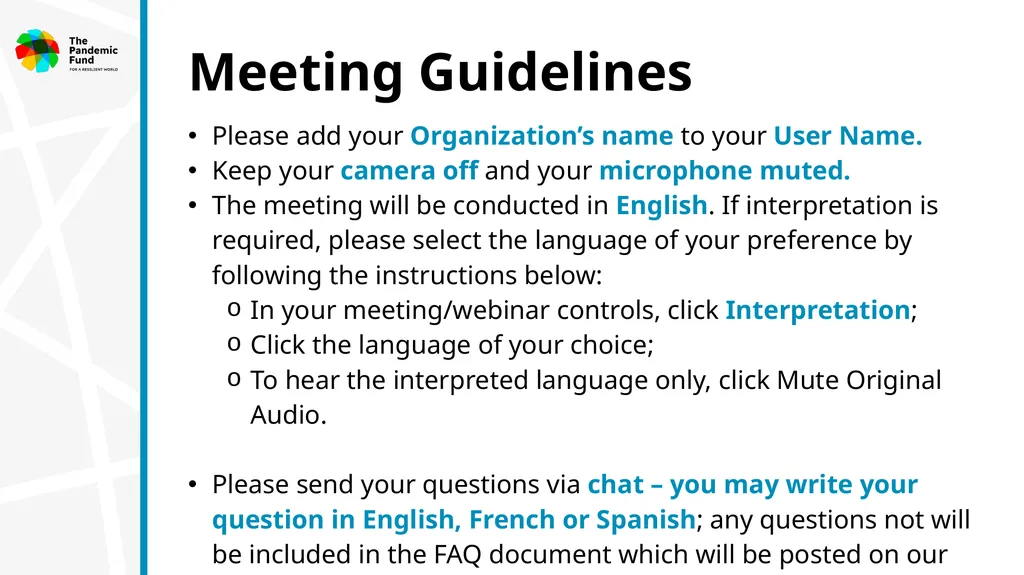
Meeting Guidelines<br>
03
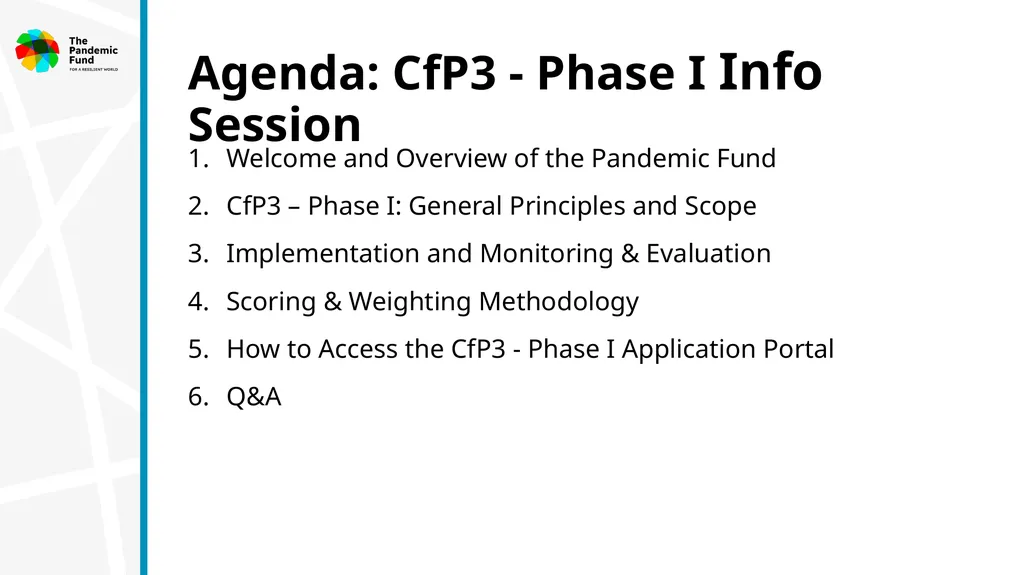
Agenda: CfP3 - Phase I Info Session<br>
04
Welcome and Overview of the Pandemic Fund 01<br>
05
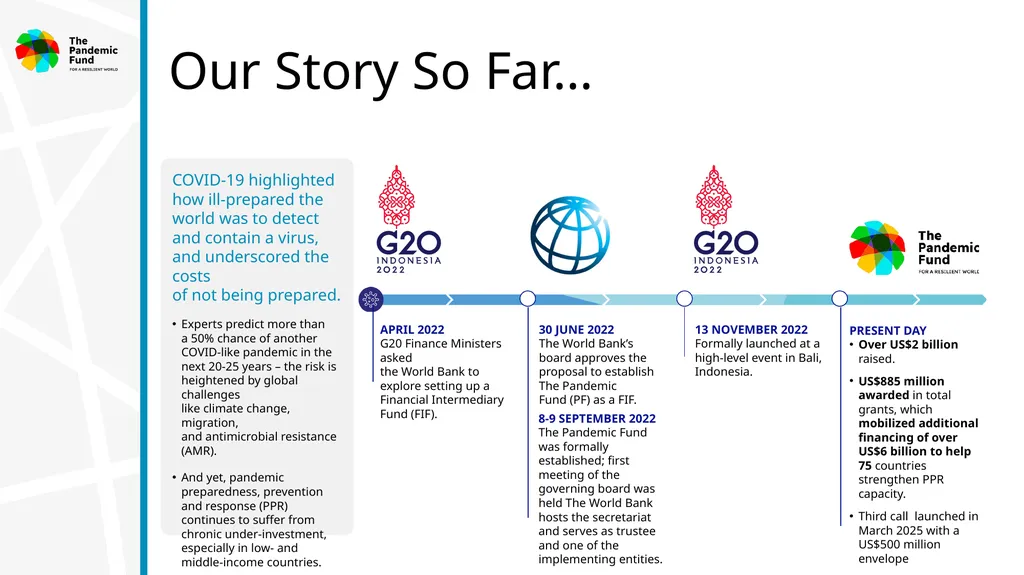
Our Story So Far…<br>
06
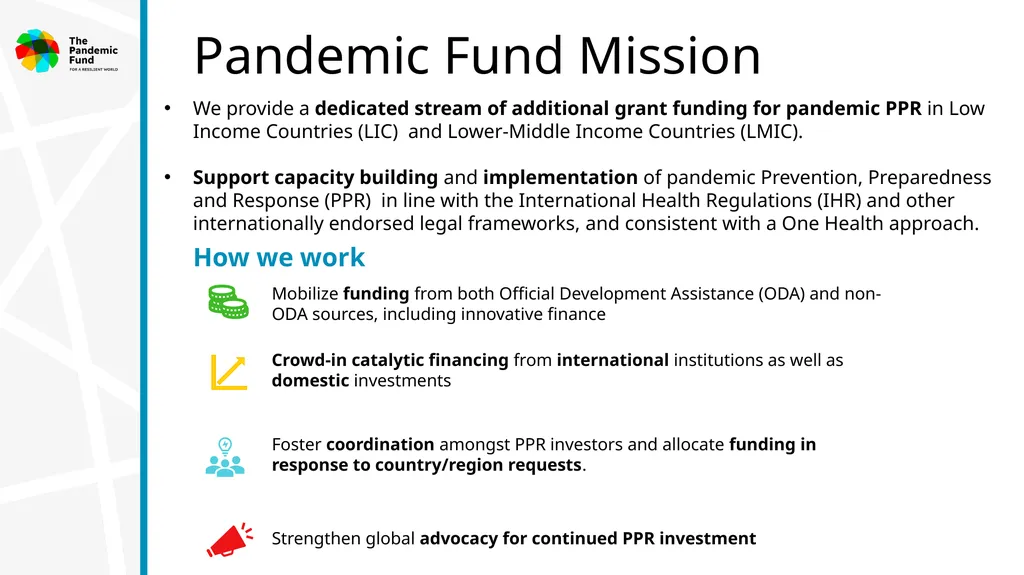
Pandemic Fund Mission We provide a dedicated stream of additional grant funding for pandemic PPR in Low Income Countries (LIC) and Lower-Middle Income Countries (LMIC).
Support capacity building and implementation of pandemic Prevention, Preparedness and Response (PPR) in line with the International Health Regulations (IHR) and other internationally endorsed legal frameworks, and consistent with a One Health approach. How we work Mobilize funding from both Official Development Assistance (ODA) and non-ODA sources, including innovative finance Crowd-in catalytic financing from international institutions as well as domestic investments Foster coordination amongst PPR investors and allocate funding in response to country/region requests. Strengthen global advocacy for continued PPR investment<br>
Support capacity building and implementation of pandemic Prevention, Preparedness and Response (PPR) in line with the International Health Regulations (IHR) and other internationally endorsed legal frameworks, and consistent with a One Health approach. How we work Mobilize funding from both Official Development Assistance (ODA) and non-ODA sources, including innovative finance Crowd-in catalytic financing from international institutions as well as domestic investments Foster coordination amongst PPR investors and allocate funding in response to country/region requests. Strengthen global advocacy for continued PPR investment<br>
07
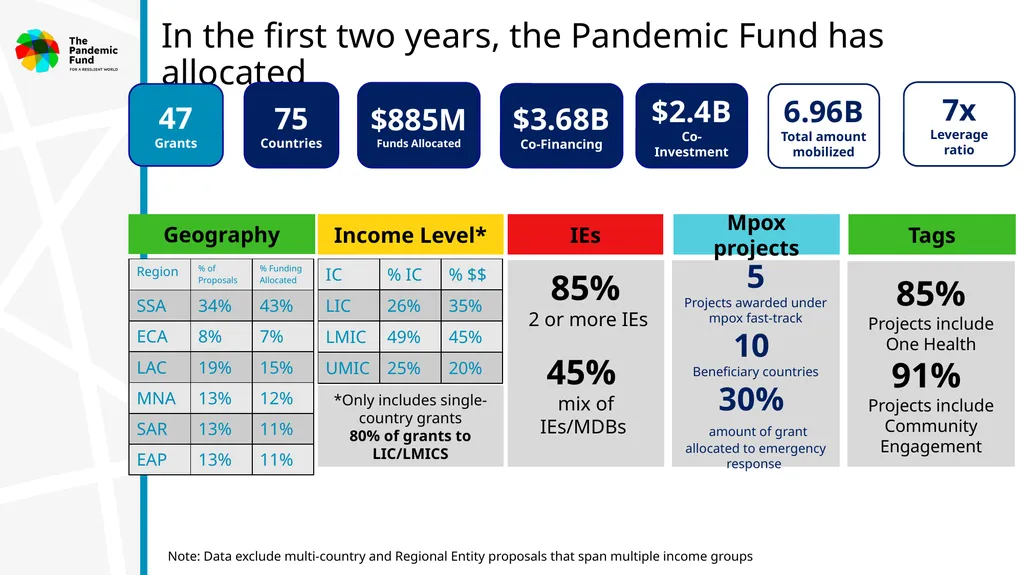
In the first two years, the Pandemic Fund has allocated Geography Note: Data exclude multi-country and Regional Entity proposals that span multiple income groups<br>
08
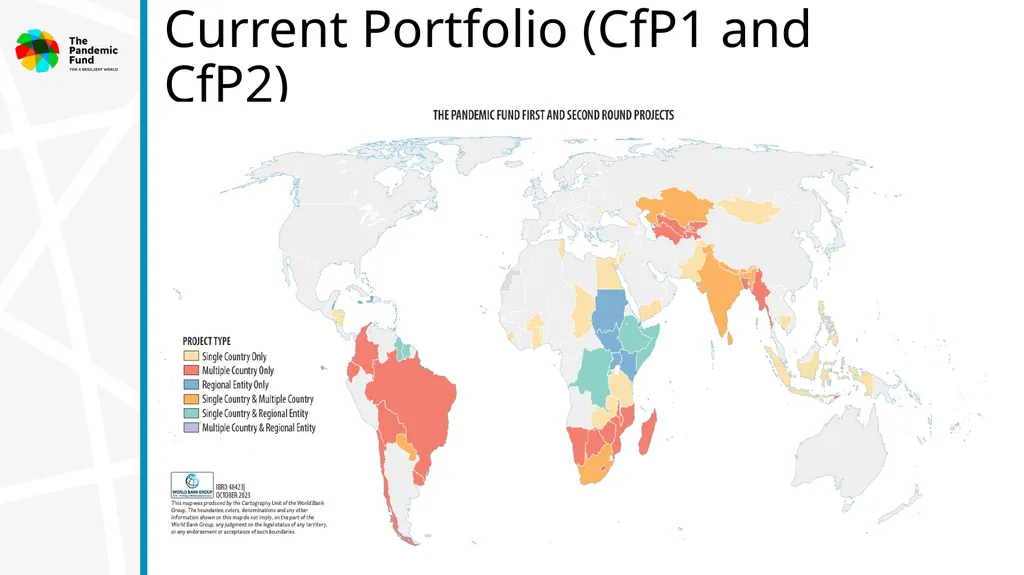
Current Portfolio (CfP1 and CfP2)<br>
09
3rd Call for Proposals – Phase I 02<br>
10
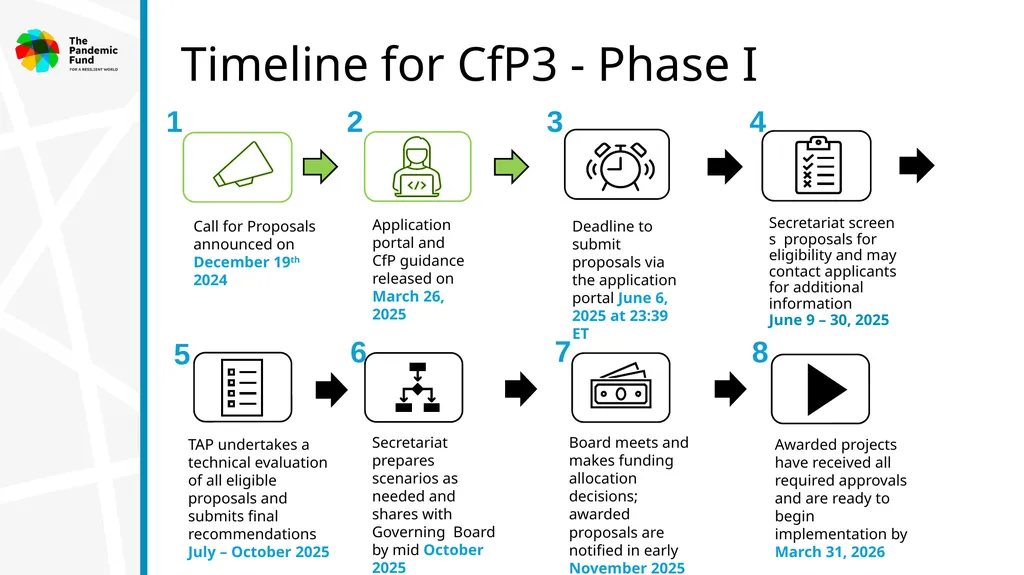
Timeline for CfP3 - Phase I Secretariat screens proposals for eligibility and may contact applicants for additional information
June 9 – 30, 2025 Call for Proposals announced on December 19th 2024 Application portal and CfP guidance released on March 26, 2025 1 2 3 Deadline to submit proposals via the application portal June 6, 2025 at 23:39 ET 4 6 TAP undertakes a technical evaluation of all eligible proposals and submits final recommendations
July – October 2025 5 Awarded projects have received all required approvals and are ready to begin implementation by March 31, 2026<br>
11
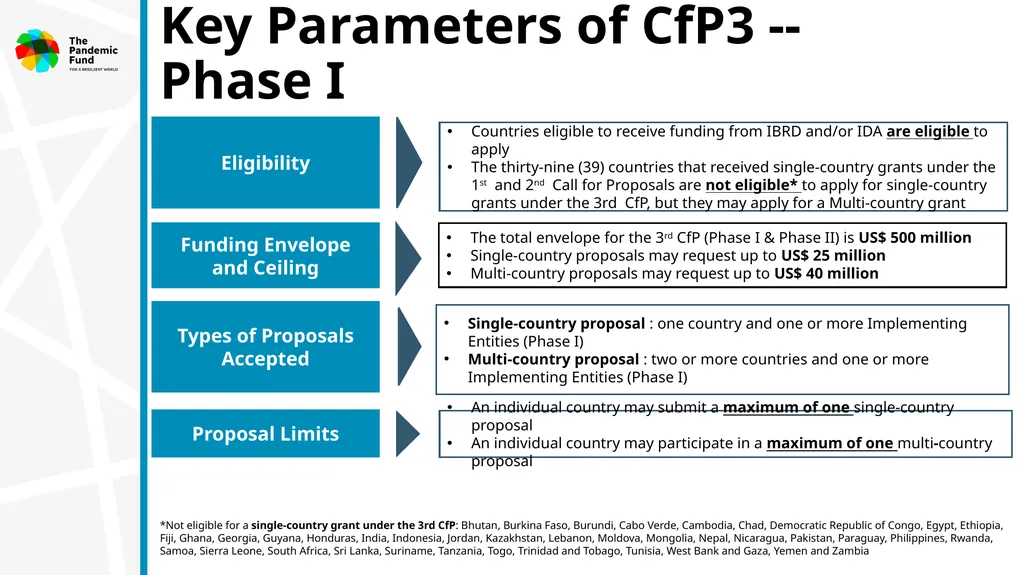
Key Parameters of CfP3 -- Phase I Countries eligible to receive funding from IBRD and/or IDA are eligible to apply
The thirty-nine (39) countries that received single-country grants under the 1st and 2nd Call for Proposals are not eligible* to apply for single-country grants under the 3rd CfP, but they may apply for a Multi-country grant Single-country proposal : one country and one or more Implementing Entities (Phase I)
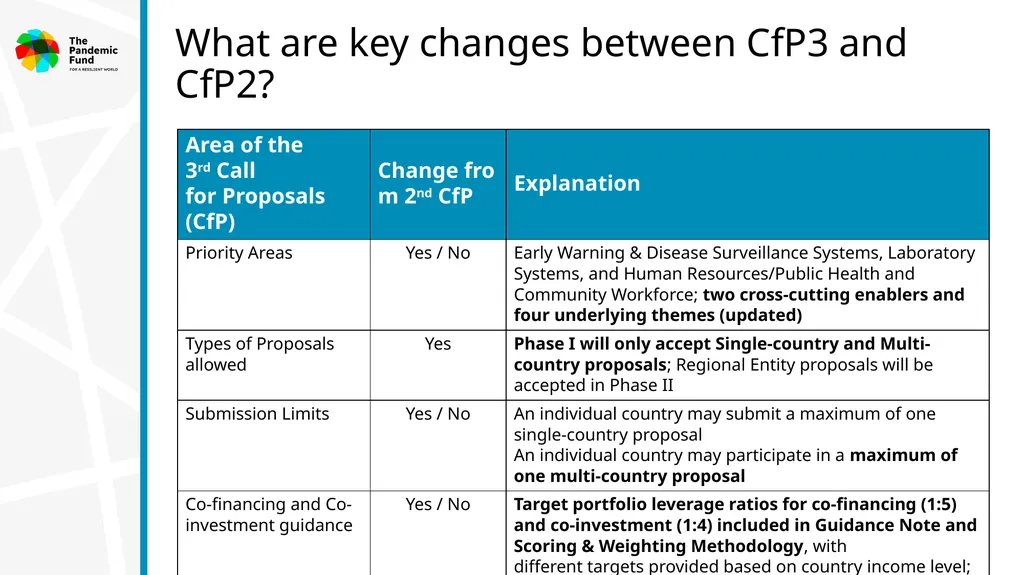
Multi-country proposal : two or more countries and one or more Implementing Entities (Phase I) An individual country may submit a maximum of one single-country proposal
An individual country may participate in a maximum of one multi-country proposal *Not eligible for a single-country grant under the 3rd CfP: Bhutan, Burkina Faso, Burundi, Cabo Verde, Cambodia, Chad, Democratic Republic of Congo, Egypt, Ethiopia, Fiji, Ghana, Georgia, Guyana, Honduras, India, Indonesia, Jordan, Kazakhstan, Lebanon, Moldova, Mongolia, Nepal, Nicaragua, Pakistan, Paraguay, Philippines, Rwanda, Samoa, Sierra Leone, South Africa, Sri Lanka, Suriname, Tanzania, Togo, Trinidad and Tobago, Tunisia, West Bank and Gaza, Yemen and Zambia Funding Envelope and Ceiling The total envelope for the 3rd CfP (Phase I & Phase II) is US$ 500 million
Single-country proposals may request up to US$ 25 million
Multi-country proposals may request up to US$ 40 million<br>
The thirty-nine (39) countries that received single-country grants under the 1st and 2nd Call for Proposals are not eligible* to apply for single-country grants under the 3rd CfP, but they may apply for a Multi-country grant Single-country proposal : one country and one or more Implementing Entities (Phase I)
Multi-country proposal : two or more countries and one or more Implementing Entities (Phase I) An individual country may submit a maximum of one single-country proposal
An individual country may participate in a maximum of one multi-country proposal *Not eligible for a single-country grant under the 3rd CfP: Bhutan, Burkina Faso, Burundi, Cabo Verde, Cambodia, Chad, Democratic Republic of Congo, Egypt, Ethiopia, Fiji, Ghana, Georgia, Guyana, Honduras, India, Indonesia, Jordan, Kazakhstan, Lebanon, Moldova, Mongolia, Nepal, Nicaragua, Pakistan, Paraguay, Philippines, Rwanda, Samoa, Sierra Leone, South Africa, Sri Lanka, Suriname, Tanzania, Togo, Trinidad and Tobago, Tunisia, West Bank and Gaza, Yemen and Zambia Funding Envelope and Ceiling The total envelope for the 3rd CfP (Phase I & Phase II) is US$ 500 million
Single-country proposals may request up to US$ 25 million
Multi-country proposals may request up to US$ 40 million<br>
12
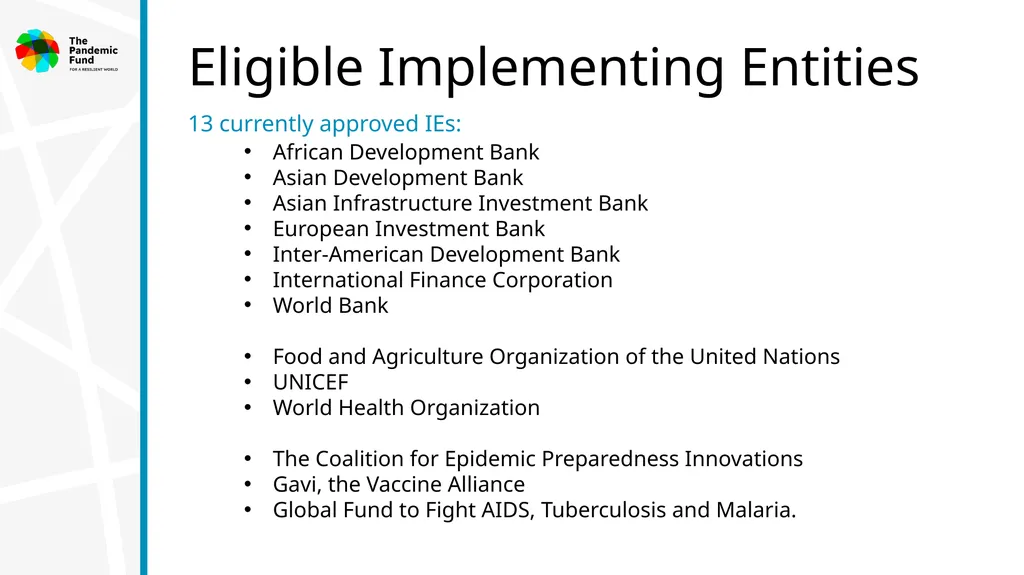
African Development Bank
Asian Development Bank
Asian Infrastructure Investment Bank
European Investment Bank
Inter-American Development Bank
International Finance Corporation
World Bank
Food and Agriculture Organization of the United Nations
UNICEF
World Health Organization
The Coalition for Epidemic Preparedness Innovations
Gavi, the Vaccine Alliance
Global Fund to Fight AIDS, Tuberculosis and Malaria. Eligible Implementing Entities 13 currently approved IEs:<br>
Asian Development Bank
Asian Infrastructure Investment Bank
European Investment Bank
Inter-American Development Bank
International Finance Corporation
World Bank
Food and Agriculture Organization of the United Nations
UNICEF
World Health Organization
The Coalition for Epidemic Preparedness Innovations
Gavi, the Vaccine Alliance
Global Fund to Fight AIDS, Tuberculosis and Malaria. Eligible Implementing Entities 13 currently approved IEs:<br>
13
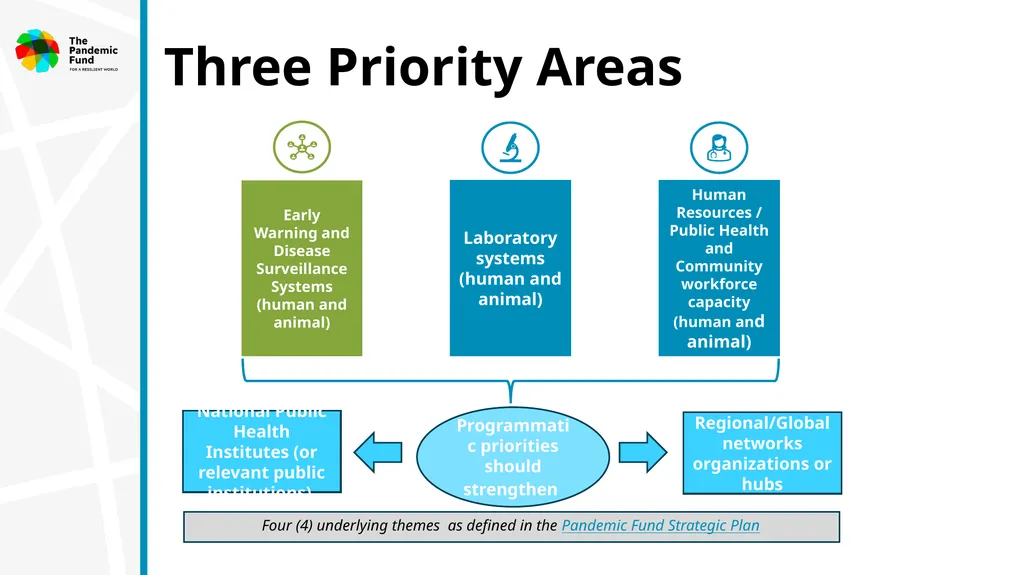
Three Priority Areas Four (4) underlying themes as defined in the Pandemic Fund Strategic Plan<br>
14
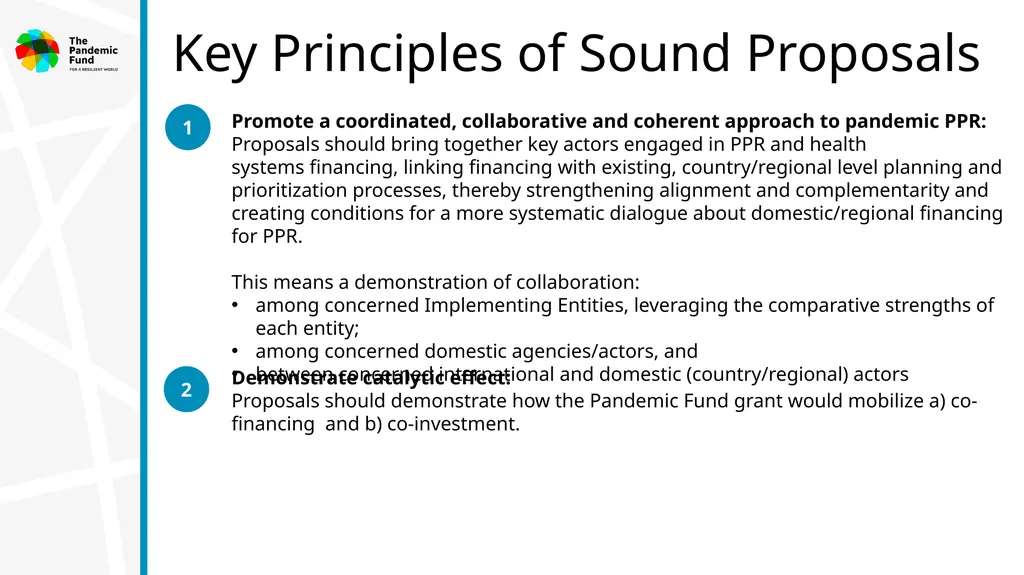
Key Principles of Sound Proposals<br>
15
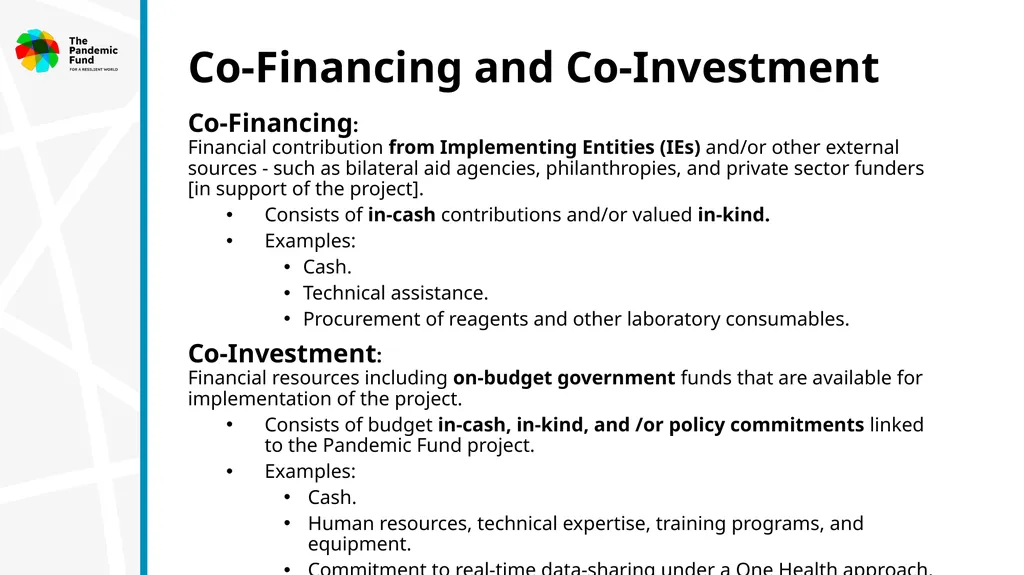
Co-Financing and Co-Investment Co-Financing:
Financial contribution from Implementing Entities (IEs) and/or other external sources - such as bilateral aid agencies, philanthropies, and private sector funders [in support of the project].
Consists of in-cash contributions and/or valued in-kind.
Examples:
Cash.
Technical assistance.
Procurement of reagents and other laboratory consumables.
Co-Investment: Financial resources including on-budget government funds that are available for implementation of the project.
Consists of budget in-cash, in-kind, and /or policy commitments linked to the Pandemic Fund project.
Examples:
Cash.
Human resources, technical expertise, training programs, and equipment.
Commitment to real-time data-sharing under a One Health approach.<br>
Consists of in-cash contributions and/or valued in-kind.
Examples:
Cash.
Technical assistance.
Procurement of reagents and other laboratory consumables.
Co-Investment: Financial resources including on-budget government funds that are available for implementation of the project.
Consists of budget in-cash, in-kind, and /or policy commitments linked to the Pandemic Fund project.
Examples:
Cash.
Human resources, technical expertise, training programs, and equipment.
Commitment to real-time data-sharing under a One Health approach.<br>
16
What are key changes between CfP3 and CfP2?<br>
17
Implementation and Monitoring & Evaluation 03<br>
18
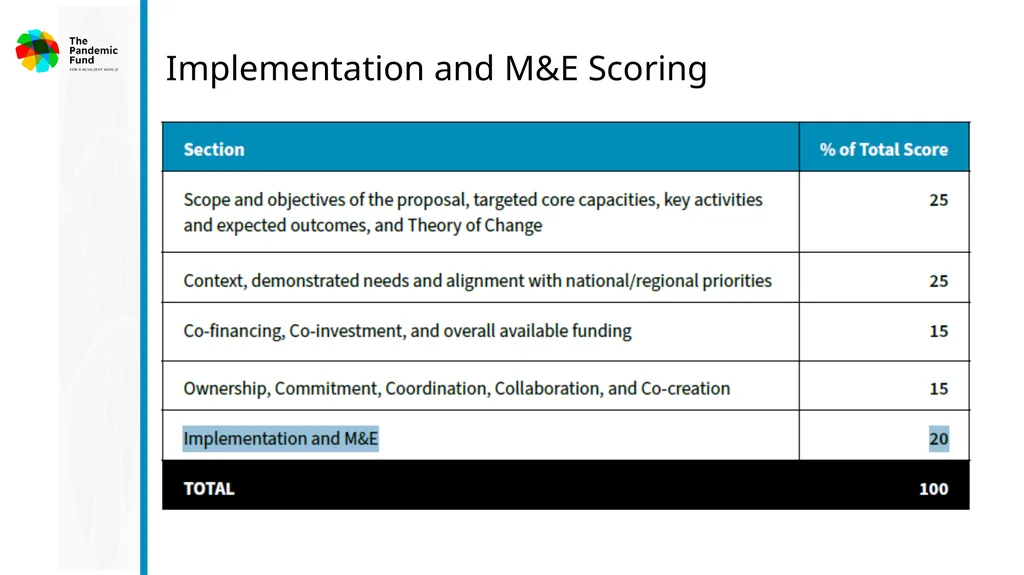
Implementation and M&E Scoring<br>
19
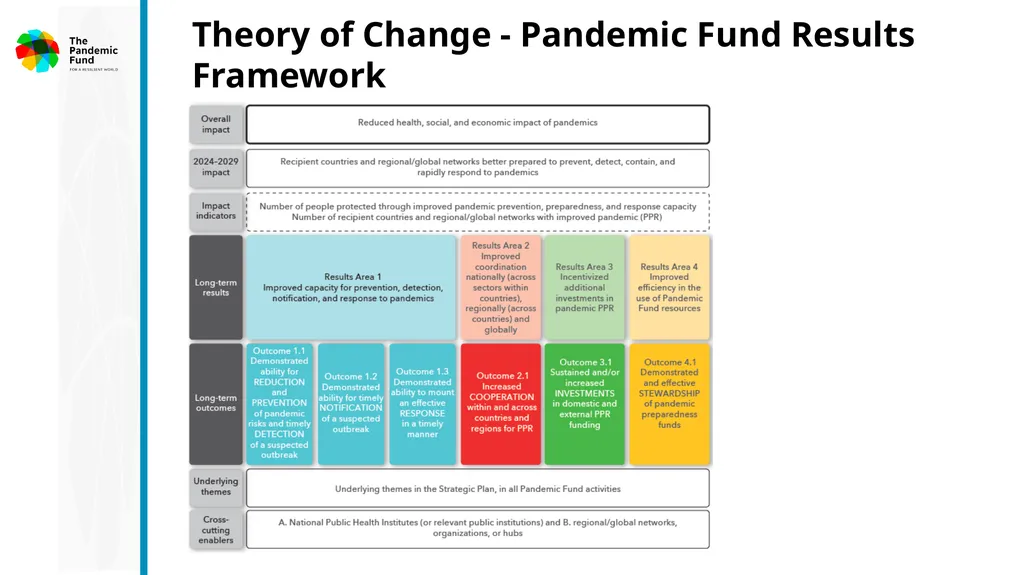
Pandemic Fund Results Framework
Click here 19<br>
Click here 19<br>
20
Theory of Change - Pandemic Fund Results Framework<br>
21
Project Specific Results Framework
M&E Guidelines 21<br>
M&E Guidelines 21<br>
22
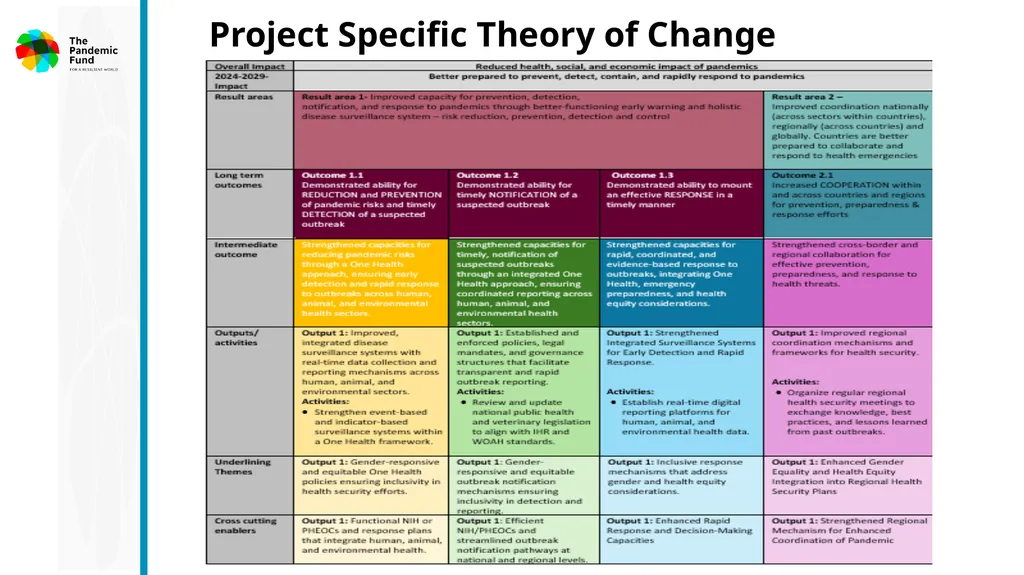
Project Specific Theory of Change<br>
23
Project Specific Theory of Change Proposals should include a detailed Theory of Change, demonstrating its connection to the overall impact and Results Areas outlined in the Pandemic Fund Results Framework.
It should include examples of long-term outcomes, intermediate outcomes, outputs, and related activities, with a particular focus on Results Areas 1 and 2.
Intermediate outcomes, outputs, and activities should also address Results Area 3 (Incentivized Additional Investments in Pandemic PPR) and Results Area 4 (Improved Efficiency in the Use of Pandemic Fund Resources).<br>
It should include examples of long-term outcomes, intermediate outcomes, outputs, and related activities, with a particular focus on Results Areas 1 and 2.
Intermediate outcomes, outputs, and activities should also address Results Area 3 (Incentivized Additional Investments in Pandemic PPR) and Results Area 4 (Improved Efficiency in the Use of Pandemic Fund Resources).<br>
24
Project Specific Indicators Proposals should include a Project Specific Results Framework (PSRF) which should cover project level activities, outputs, and intermediate outcomes.
Each indicator in the PSRF will be defined/described, and will have data source, data collection methods, data type, analysis, and responsibilities for data management, are described in the Pandemic Fund Results Framework
Examples of project specific indicators are in the annex of the M&E Guidelines<br>
Each indicator in the PSRF will be defined/described, and will have data source, data collection methods, data type, analysis, and responsibilities for data management, are described in the Pandemic Fund Results Framework
Examples of project specific indicators are in the annex of the M&E Guidelines<br>
25
Costed M&E Workplan Proposals should include a Costed M&E workplan with a table that should specify
Key M&E activities e.g. data collection, report writing, dissemination, M&E training/capacity building, etc.
Responsibility for each activity
Implementation timeline e.g. Year 1, 2, 3
Budget by year<br>
Key M&E activities e.g. data collection, report writing, dissemination, M&E training/capacity building, etc.
Responsibility for each activity
Implementation timeline e.g. Year 1, 2, 3
Budget by year<br>
26
Scoring & Weighting Methodology 04<br>
27
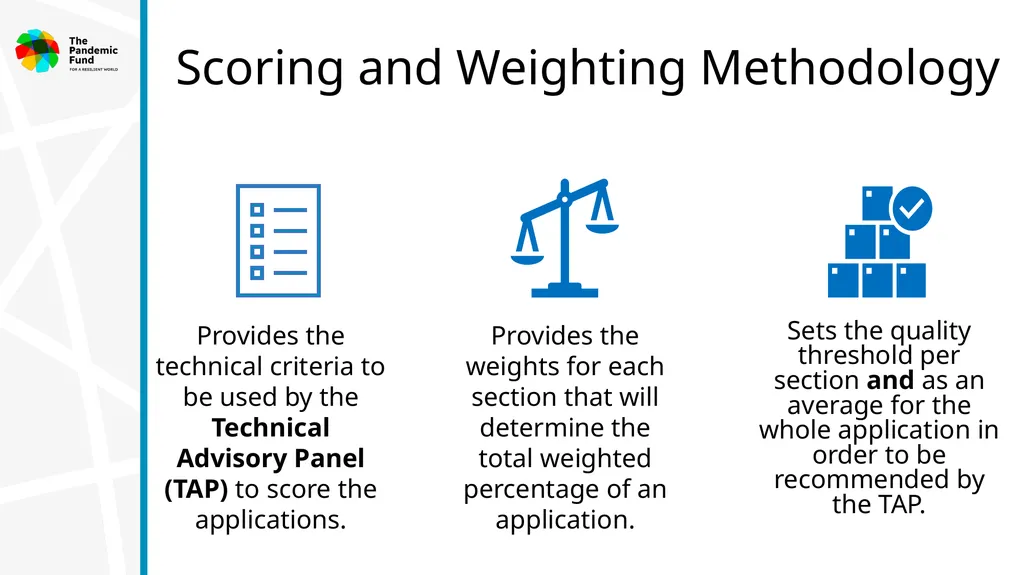
Scoring and Weighting Methodology Sets the quality threshold per section and as an average for the whole application in order to be recommended by the TAP. Provides the technical criteria to be used by the Technical Advisory Panel (TAP) to score the applications. Provides the weights for each section that will determine the total weighted percentage of an application.<br>
28
Scoring Criteria are numerically aligned with the questions in the application template.
Each question includes 4-5 possible responses. The scoring descriptions are consistent (to the extent possible):
Clear description
Moderate description
Limited description
No description
A score will be assigned to each response, and the sum will constitute the total score for each application.<br>
Each question includes 4-5 possible responses. The scoring descriptions are consistent (to the extent possible):
Clear description
Moderate description
Limited description
No description
A score will be assigned to each response, and the sum will constitute the total score for each application.<br>
29
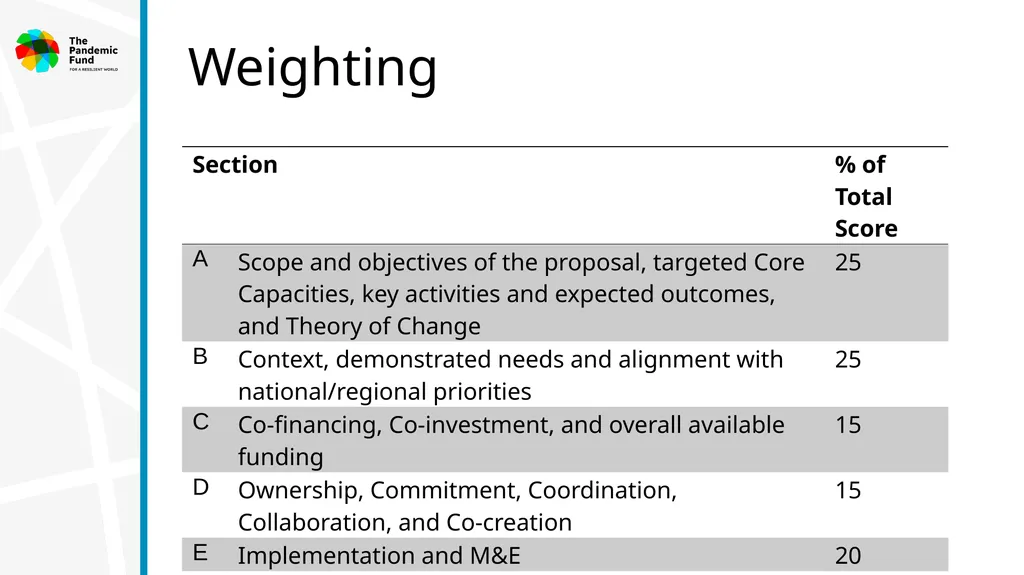
Weighting<br>
30
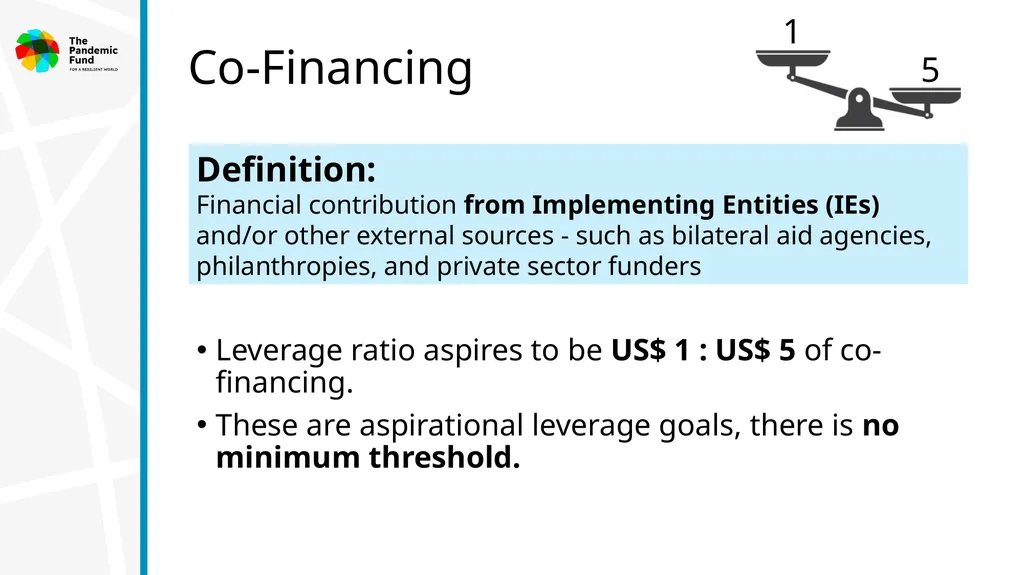
Co-Financing Leverage ratio aspires to be US$ 1 : US$ 5 of co-financing.
These are aspirational leverage goals, there is no minimum threshold. 1 5 Definition: Financial contribution from Implementing Entities (IEs) and/or other external sources - such as bilateral aid agencies, philanthropies, and private sector funders<br>
These are aspirational leverage goals, there is no minimum threshold. 1 5 Definition: Financial contribution from Implementing Entities (IEs) and/or other external sources - such as bilateral aid agencies, philanthropies, and private sector funders<br>
31
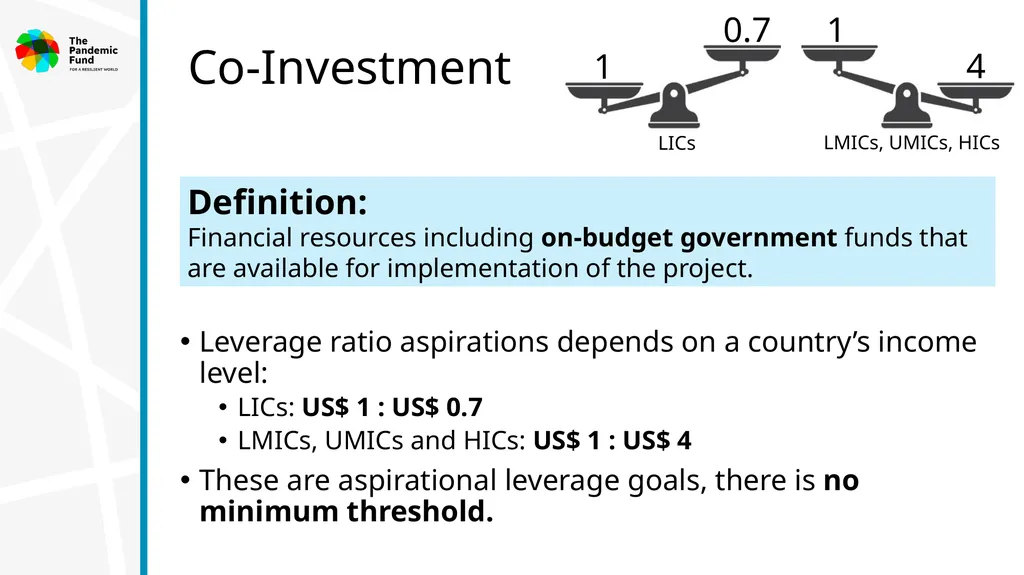
Co-Investment Leverage ratio aspirations depends on a country’s income level:
LICs: US$ 1 : US$ 0.7
LMICs, UMICs and HICs: US$ 1 : US$ 4
These are aspirational leverage goals, there is no minimum threshold. LMICs, UMICs, HICs 1 0.7 LICs 1 4 Definition: Financial resources including on-budget government funds that are available for implementation of the project.<br>
LICs: US$ 1 : US$ 0.7
LMICs, UMICs and HICs: US$ 1 : US$ 4
These are aspirational leverage goals, there is no minimum threshold. LMICs, UMICs, HICs 1 0.7 LICs 1 4 Definition: Financial resources including on-budget government funds that are available for implementation of the project.<br>
32
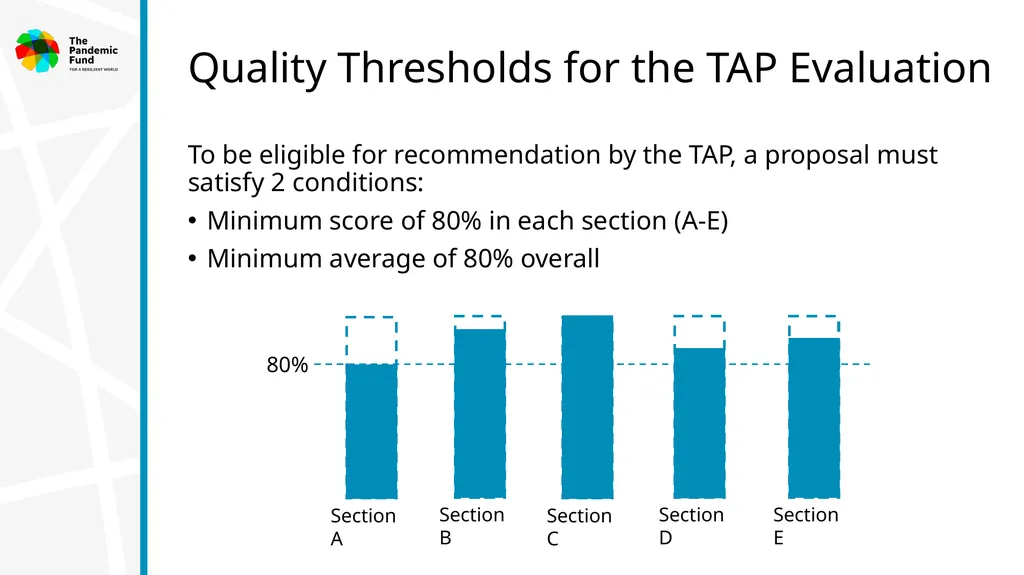
Quality Thresholds for the TAP Evaluation To be eligible for recommendation by the TAP, a proposal must satisfy 2 conditions:
Minimum score of 80% in each section (A-E)
Minimum average of 80% overall<br>
Minimum score of 80% in each section (A-E)
Minimum average of 80% overall<br>
33
Accessing the CfP3 – Phase I Application Portal 05<br>
34
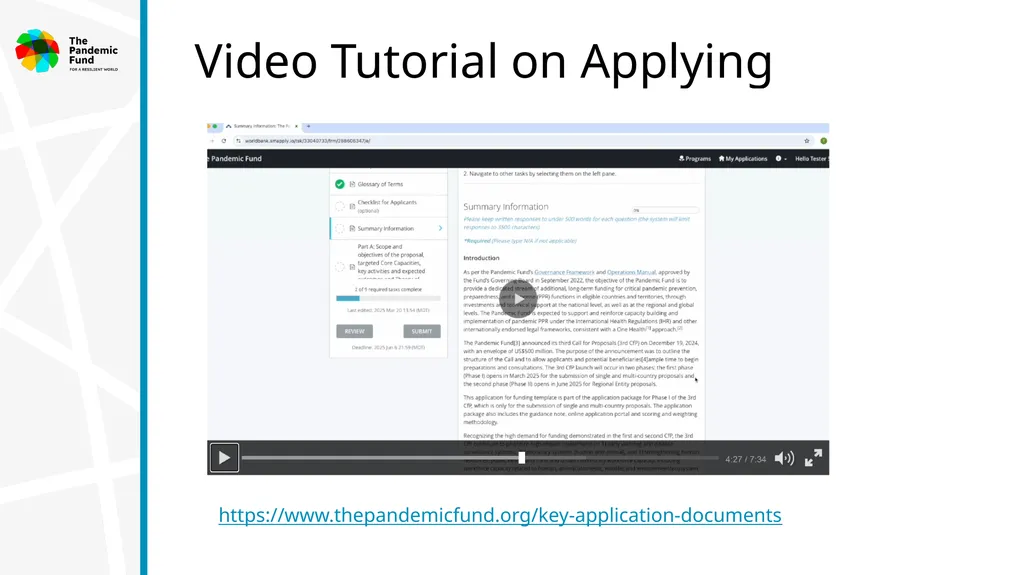
Video Tutorial on Applying https://www.thepandemicfund.org/key-application-documents<br>
35
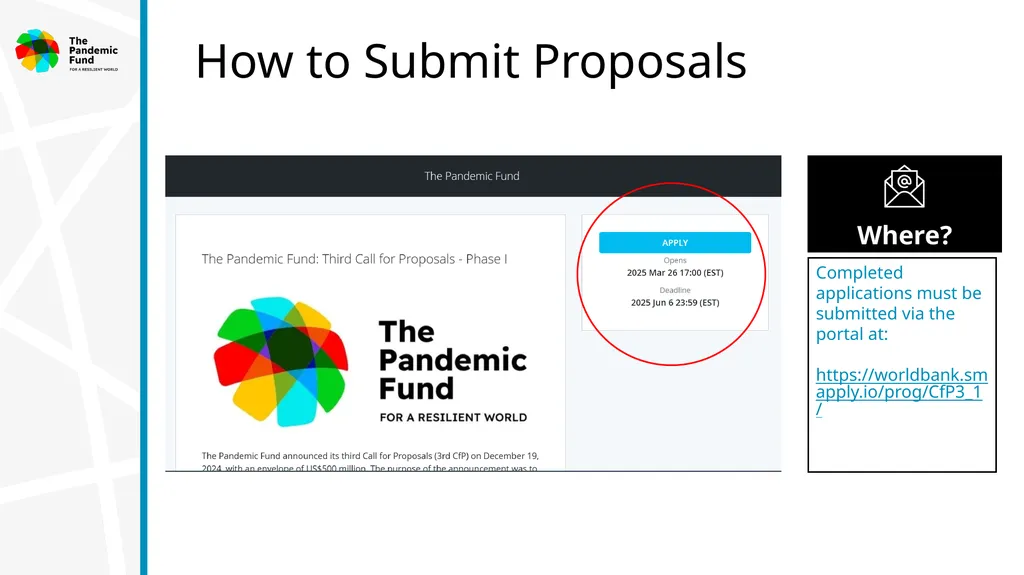
How to Submit Proposals<br>
36
Questions & Answers 05<br>
37
Frequently Asked Questions From April 1, 2025 Info Session<br>
38
Are countries that received funding in the first or second calls eligible to apply for the third call? Eligibility Countries that received single-country grants are not eligible for another single-country grant, but MAY apply for one multi-country grant.
Countries that were part of a multi-country grant or Regional Entity proposal (but not a single-country proposal) are eligible to apply for one single-country grant and one multi-country grant in the 3rd CfP.
There is a table with different scenarios in the Guidance Note that might be helpful.<br>
Countries that were part of a multi-country grant or Regional Entity proposal (but not a single-country proposal) are eligible to apply for one single-country grant and one multi-country grant in the 3rd CfP.
There is a table with different scenarios in the Guidance Note that might be helpful.<br>
39
Do proposals need to demonstrate civil society engagement? Coordination We encourage the engagement of civil society organizations (CSOs) and other community-based organizations in the development of proposals submitted by Countries and / or Implementing Entities to the Pandemic Fund. Community engagement is one of the four underlying themes of PF projects as defined in the Pandemic Fund Strategic Plan. These organizations may also be contracted to serve as Delivery Partners during implementation.<br>
40
How does an entity become an Implementing Entity (IE)? Implementation The Pandemic Fund has an established process for IE accreditation, which is done by an independent Accreditation Panel.
To date, 13 entities have signed Financial Procedures Agreements (FPAs) with the World Bank as Trustee. Any new applications from entities that wish to be accredited must submit applications to the Pandemic Fund Secretariat.<br>
To date, 13 entities have signed Financial Procedures Agreements (FPAs) with the World Bank as Trustee. Any new applications from entities that wish to be accredited must submit applications to the Pandemic Fund Secretariat.<br>
41
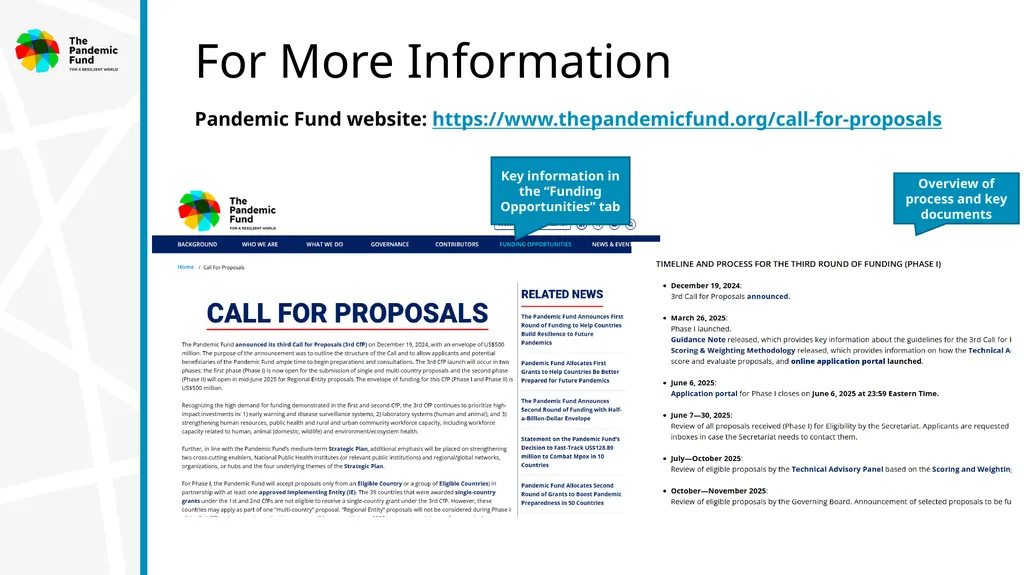
For More Information Pandemic Fund website: https://www.thepandemicfund.org/call-for-proposals Key information in the “Funding Opportunities” tab Overview of process and key documents<br>
42
Quick Links Guidance Note was released in March 2025 and is available on the Pandemic Fund website in English, French (coming soon), and Spanish (coming soon).
Electronic Application Portal is now open. Information on how to access the portal – including a "how-to" video and FAQ – are available on the Pandemic Fund website.
Scoring and Weighting Methodology is available now (translations will be available in French and Spanish in mid-April 2025).
Application Template is available (translations will be available in French and Spanish in mid-April 2025).
Results Framework, Monitoring and Evaluation Guidelines, and Project Specific Results Framework (PSRF) and Associated Costs Excel Template are available now.
Information Sessions open to all prospective applicants on April 1 and April 7, 2025, with sign-up on the Pandemic Fund website. We will also post the slides and recordings.
Additional Questions? Please submit a ticket at the Helpdesk or Email us at: pandemicfundcfp@worldbank.org
Please follow us on social media for the most up-to-date information: X @Pandemic_Fund and LinkedIn.<br>
Electronic Application Portal is now open. Information on how to access the portal – including a "how-to" video and FAQ – are available on the Pandemic Fund website.
Scoring and Weighting Methodology is available now (translations will be available in French and Spanish in mid-April 2025).
Application Template is available (translations will be available in French and Spanish in mid-April 2025).
Results Framework, Monitoring and Evaluation Guidelines, and Project Specific Results Framework (PSRF) and Associated Costs Excel Template are available now.
Information Sessions open to all prospective applicants on April 1 and April 7, 2025, with sign-up on the Pandemic Fund website. We will also post the slides and recordings.
Additional Questions? Please submit a ticket at the Helpdesk or Email us at: pandemicfundcfp@worldbank.org
Please follow us on social media for the most up-to-date information: X @Pandemic_Fund and LinkedIn.<br>
43
Frequently Asked Questions<br>
44
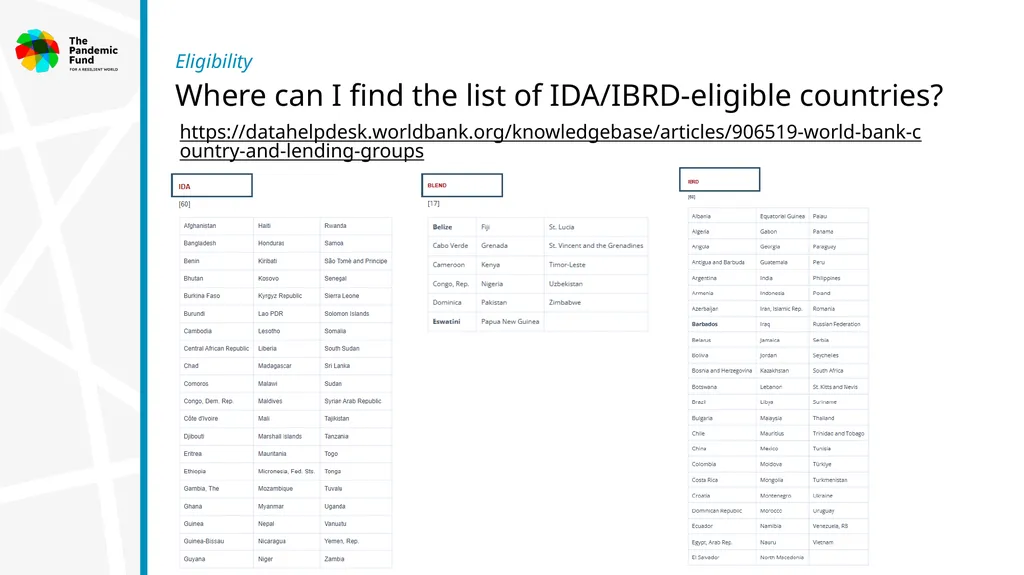
Where can I find the list of IDA/IBRD-eligible countries? Eligibility https://datahelpdesk.worldbank.org/knowledgebase/articles/906519-world-bank-country-and-lending-groups<br>
45
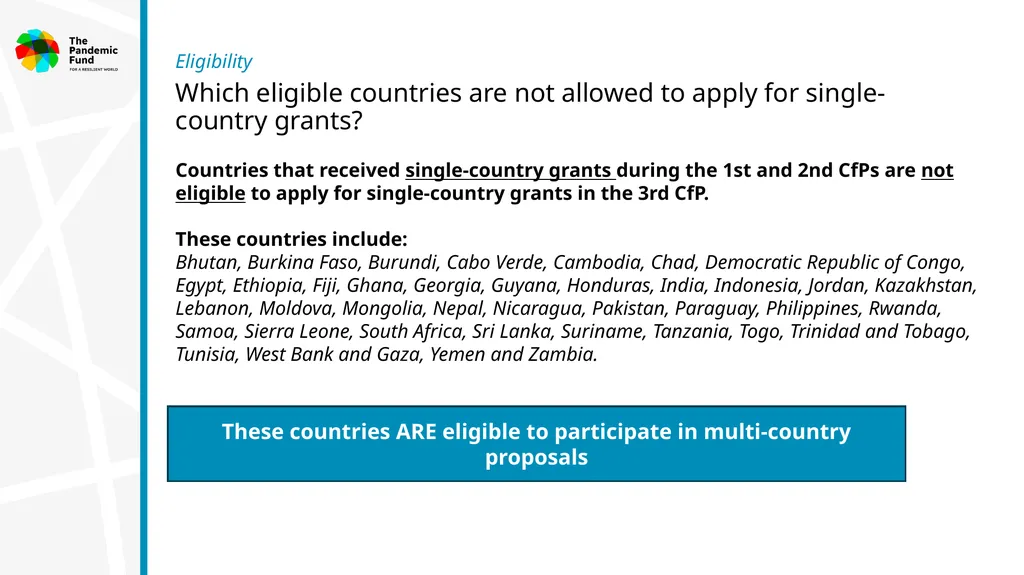
Which eligible countries are not allowed to apply for single-country grants? Eligibility Countries that received single-country grants during the 1st and 2nd CfPs are not eligible to apply for single-country grants in the 3rd CfP.
These countries include:
Bhutan, Burkina Faso, Burundi, Cabo Verde, Cambodia, Chad, Democratic Republic of Congo, Egypt, Ethiopia, Fiji, Ghana, Georgia, Guyana, Honduras, India, Indonesia, Jordan, Kazakhstan, Lebanon, Moldova, Mongolia, Nepal, Nicaragua, Pakistan, Paraguay, Philippines, Rwanda, Samoa, Sierra Leone, South Africa, Sri Lanka, Suriname, Tanzania, Togo, Trinidad and Tobago, Tunisia, West Bank and Gaza, Yemen and Zambia. These countries ARE eligible to participate in multi-country proposals<br>
These countries include:
Bhutan, Burkina Faso, Burundi, Cabo Verde, Cambodia, Chad, Democratic Republic of Congo, Egypt, Ethiopia, Fiji, Ghana, Georgia, Guyana, Honduras, India, Indonesia, Jordan, Kazakhstan, Lebanon, Moldova, Mongolia, Nepal, Nicaragua, Pakistan, Paraguay, Philippines, Rwanda, Samoa, Sierra Leone, South Africa, Sri Lanka, Suriname, Tanzania, Togo, Trinidad and Tobago, Tunisia, West Bank and Gaza, Yemen and Zambia. These countries ARE eligible to participate in multi-country proposals<br>
46
What is a Beneficiary? Projects A Beneficiary is any Eligible Country or Entity that may benefit from the Pandemic Fund through projects or activities undertaken by an IE to advance the objective of the Pandemic Fund. Such projects or activities can involve the government/public sector and private/non-governmental sector in Eligible Countries.<br>
47
Are there submission limits? Eligibility YES, there are submission limits.
An individual country may submit a maximum of one single-country proposal.
An individual country may take part in a maximum of one multi-country proposal.
However, there are no limits on the number of proposals an IE may take part in.
All IEs should be in contact with each other to ensure the country limits are respected.<br>
An individual country may submit a maximum of one single-country proposal.
An individual country may take part in a maximum of one multi-country proposal.
However, there are no limits on the number of proposals an IE may take part in.
All IEs should be in contact with each other to ensure the country limits are respected.<br>
48
Is there a maximum amount of funding that can be requested? Eligibility Single-country proposals may request up to US$ 25 million.
Multi-country proposals may request up to US$ 40 million.<br>
Multi-country proposals may request up to US$ 40 million.<br>
49
What is the expected duration of funding? Projects Proposals must demonstrate that they intend to use the grant financing within three years from the date of approval by the Implementing Entity’s (-ies) relevant authority, bearing in mind that the overall project completion date may extend beyond the three-year period.<br>
50
For existing projects looking for additional funding from the Pandemic Fund, can the value of relevant project components be counted as co-financing / co-investment? Financing No, Pandemic Fund resources must be able to demonstrate additionality and catalytic impact.<br>
51
Can we count co-financing and co-investment with a longer time horizon than the PF grant (e.g. >3 years)? Financing Yes, you should count the total value of co-financing and co-investment available for the lifespan of the project, even if that extends past the three-year grant of the Pandemic Fund.<br>
52
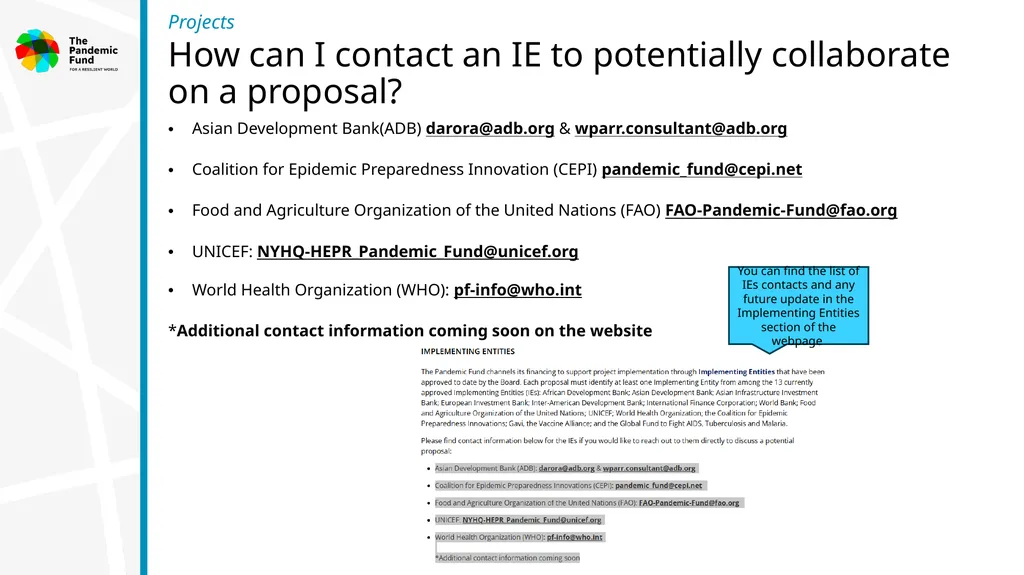
How can I contact an IE to potentially collaborate on a proposal? Projects Asian Development Bank(ADB) darora@adb.org & wparr.consultant@adb.org
Coalition for Epidemic Preparedness Innovation (CEPI) pandemic_fund@cepi.net
Food and Agriculture Organization of the United Nations (FAO) FAO-Pandemic-Fund@fao.org
UNICEF: NYHQ-HEPR_Pandemic_Fund@unicef.org
World Health Organization (WHO): pf-info@who.int
*Additional contact information coming soon on the website You can find the list of IEs contacts and any future update in the Implementing Entities section of the webpage<br>
Coalition for Epidemic Preparedness Innovation (CEPI) pandemic_fund@cepi.net
Food and Agriculture Organization of the United Nations (FAO) FAO-Pandemic-Fund@fao.org
UNICEF: NYHQ-HEPR_Pandemic_Fund@unicef.org
World Health Organization (WHO): pf-info@who.int
*Additional contact information coming soon on the website You can find the list of IEs contacts and any future update in the Implementing Entities section of the webpage<br>
53
By when do projects have to receive approval from the IE’s relevant authority to be considered? Projects The Pandemic Fund wants to support projects that will be able to accept funds as soon as possible. If there is conditional approval by the Pandemic Fund’s Board, the project should ideally be approved by the relevant authority of the IE within 6 months from the decision on the funding allocation. In the case of the 3rd CfP, IEs should be able to begin disbursing PF funds by March 31, 2026.<br>
54
Can Implementing Entities also receive funds for project implementation? What about project execution? Projects The Trustee will pass on the grant to Implementing Entities which will channel funding to Beneficiary countries for carrying out project activities.
Implementing Entities may provide implementation and implementation support (e.g., M&E, analytical and advisory work, research) when needed. Activities that fall under this area should be reported in Table 1 in the Application as c) Project funds that will be used for implementation activities by IE.
On-the-ground execution and delivery of a project’s components should be carried out by the Beneficiary and/or Delivery Partners. IEs should only undertake these activities in exceptional circumstances where there is no viable alternative, and at the specific request of the Beneficiary.<br>
Implementing Entities may provide implementation and implementation support (e.g., M&E, analytical and advisory work, research) when needed. Activities that fall under this area should be reported in Table 1 in the Application as c) Project funds that will be used for implementation activities by IE.
On-the-ground execution and delivery of a project’s components should be carried out by the Beneficiary and/or Delivery Partners. IEs should only undertake these activities in exceptional circumstances where there is no viable alternative, and at the specific request of the Beneficiary.<br>
55
What is the maximum “Administration Fee” for IEs that is allowed? Projects A cap on IE administrative fees at 7% (as a percentage of amount requested) has been instituted for activities related to preparation, administration and supervision of Pandemic Fund funds.
However, for projects operating in Challenging Operating Environments (COE), Fragile and Conflict-Affected Situations (FCS), Small Island Developing States (SIDS) contexts or other exceptional circumstances, the cap could be up to 10% of the grant amount requested by the IE, provided that the proposal includes a clear justification of the rationale behind the higher fee and substantiate this with evidence.<br>
However, for projects operating in Challenging Operating Environments (COE), Fragile and Conflict-Affected Situations (FCS), Small Island Developing States (SIDS) contexts or other exceptional circumstances, the cap could be up to 10% of the grant amount requested by the IE, provided that the proposal includes a clear justification of the rationale behind the higher fee and substantiate this with evidence.<br>
56
What is a delivery partner? Can a delivery partner submit a proposal? Projects A delivery partner is sub-contracted, using the IE’s procurement policies and procedures, to contribute to project execution and delivery on-the-ground.
Delivery partners may include CSOs, NGOs, private sector, academia, individuals, etc. They cannot submit proposals, however they should be consulted during the proposal development process and included in the proposal.<br>
Delivery partners may include CSOs, NGOs, private sector, academia, individuals, etc. They cannot submit proposals, however they should be consulted during the proposal development process and included in the proposal.<br>
57
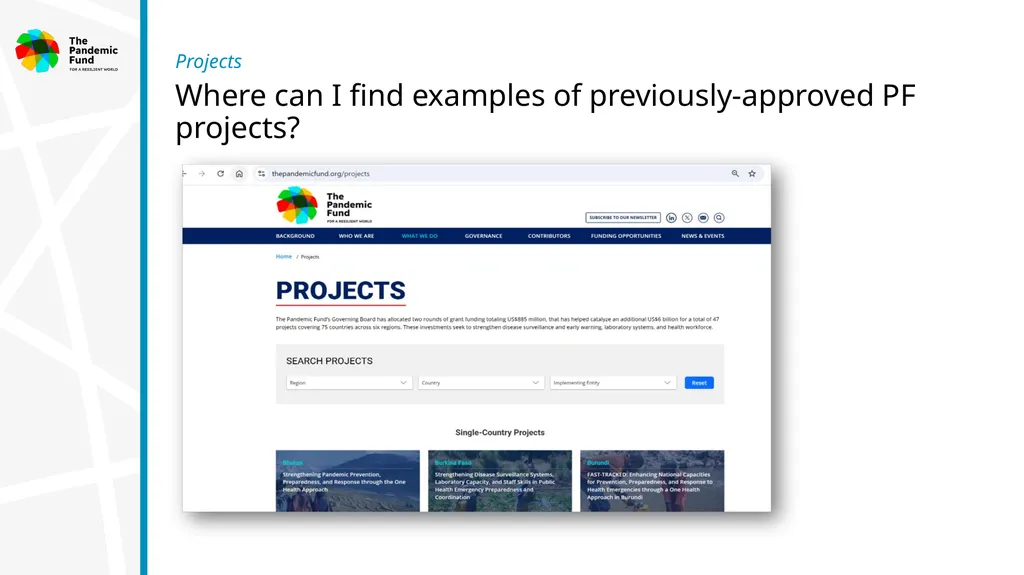
Where can I find examples of previously-approved PF projects? Projects<br>
58
Country Eligibility At-a-Glance<br>