
Ingemar Johansson, Ericsson Research
AM
Published · 15 slides · 0 views
1 / 1

Description
Ingemar Johansson, Ericsson Research Ingemar.s.johanssonericsson.com SCReAM C code SCReAM (Self-Clocked Rate Adaptation for Multimedia) is a congestion control algorithm devised mainly for Video. Congestion control for WebRTC media is
Related Topics
Share
Embed code
Download this presentation From Below
"Ingemar Johansson, Ericsson Research" is the property of its rightful owner. Permission is granted to download and print the materials on this website for personal, non-commercial use only, and to display it on your personal computer provided you do not modify the materials and that you retain all copyright notices contained in the materials. By downloading content from our website, you accept the terms of this agreement.
Presentation Transcript
01
Ingemar Johansson, Ericsson Research
Ingemar.s.johansson@ericsson.com SCReAM C++ code<br>
Ingemar.s.johansson@ericsson.com SCReAM C++ code<br>
02
SCReAM (Self-Clocked Rate Adaptation for Multimedia) is a congestion control algorithm devised mainly for Video.
Congestion control for WebRTC media is currently being standardized in the IETF RMCAT WG, the scope of the working group is to define requirements for congestion control and also to standardize a few candidate solutions.
SCReAM is a congestion control candidate solution for WebRTC developed at Ericsson Research and optimized for good performance in wireless access.
The algorithm is submitted to the RMCAT WG [1], a Sigcomm paper [2] and [3] explains the rationale behind the design of the algorithm in more detail. A comparison against GCC (Google Congestion Control) is shown in [4].
SCReAM and its use in a remote control application is explained in [5].
Unlike many other congestion control algorithms that are rate based i.e. they estimate the network throughput and adjust the media bitrate accordingly, SCReAM is self-clocked which essentially means that the algorithm does not send in more data into a network than what actually exits the network.
To achieve this, SCReAM implements a feedback protocol over RTCP that acknowledges received RTP packets. The C++ code does not assume that feedback is transmitted over RTCP, on the contrary it is possible to transmit the feedback in RTP header extensions in cases where this alternative is more beneficial.
A congestion window is determined from the feedback, this congestion window determines how many RTP packets that can be in flight i.e. transmitted by not yet acknowledged, an RTP queue is maintained at the sender side to temporarily store the RTP packets pending transmission, this RTP queue is mostly empty but can temporarily become larger when the link throughput decreases.
The congestion window is frequently adjusted for minimal e2e delay while still maintaining as high link utilization as possible. The use of self-clocking in SCReAM which is also the main principle in TCP has proven to work particularly well in wireless scenarios where the link throughput may change rapidly. This enables a congestion control which is robust to channel jitter, introduced by e.g. radio resource scheduling while still being able to respond promptly to reduced link throughput.
SCReAM is optimized using a state the art LTE system simulator for optimal performance in deployments where the LTE radio conditions are limiting. In addition, SCReAM is also optimized for good performance in simple bottleneck case such as those given in home gateway deployments. The C++ code is verified to work with simulated bandwidth limitations in the range 20kbps up ~100Mbps. Live LTE tests in the range 1Mbps to 30Mbps have also been conducted.
This presentation describes the C++ implementation of SCReAM. The package is currently implemented as a Visual Studio 2013 solution but should be straightforward to port to other platforms, additional Cmake files makes it possible to compile the code on most platforms
References
[1] http://tools.ietf.org/wg/rmcat/draft-ietf-rmcat-scream-cc
[2] Sigcomm paper http://dl.acm.org/citation.cfm?id=2631976
[3] Sigcomm presentation http://conferences.sigcomm.org/sigcomm/2014/doc/slides/150.pdf
[4] IETF RMCAT presentation, comparison against Google Congestion Control (GCC) http://www.ietf.org/proceedings/90/slides/slides-90-rmcat-3.pdf
[5] https://www.hindawi.com/journals/wcmc/2018/3142496/ Intro<br>
Congestion control for WebRTC media is currently being standardized in the IETF RMCAT WG, the scope of the working group is to define requirements for congestion control and also to standardize a few candidate solutions.
SCReAM is a congestion control candidate solution for WebRTC developed at Ericsson Research and optimized for good performance in wireless access.
The algorithm is submitted to the RMCAT WG [1], a Sigcomm paper [2] and [3] explains the rationale behind the design of the algorithm in more detail. A comparison against GCC (Google Congestion Control) is shown in [4].
SCReAM and its use in a remote control application is explained in [5].
Unlike many other congestion control algorithms that are rate based i.e. they estimate the network throughput and adjust the media bitrate accordingly, SCReAM is self-clocked which essentially means that the algorithm does not send in more data into a network than what actually exits the network.
To achieve this, SCReAM implements a feedback protocol over RTCP that acknowledges received RTP packets. The C++ code does not assume that feedback is transmitted over RTCP, on the contrary it is possible to transmit the feedback in RTP header extensions in cases where this alternative is more beneficial.
A congestion window is determined from the feedback, this congestion window determines how many RTP packets that can be in flight i.e. transmitted by not yet acknowledged, an RTP queue is maintained at the sender side to temporarily store the RTP packets pending transmission, this RTP queue is mostly empty but can temporarily become larger when the link throughput decreases.
The congestion window is frequently adjusted for minimal e2e delay while still maintaining as high link utilization as possible. The use of self-clocking in SCReAM which is also the main principle in TCP has proven to work particularly well in wireless scenarios where the link throughput may change rapidly. This enables a congestion control which is robust to channel jitter, introduced by e.g. radio resource scheduling while still being able to respond promptly to reduced link throughput.
SCReAM is optimized using a state the art LTE system simulator for optimal performance in deployments where the LTE radio conditions are limiting. In addition, SCReAM is also optimized for good performance in simple bottleneck case such as those given in home gateway deployments. The C++ code is verified to work with simulated bandwidth limitations in the range 20kbps up ~100Mbps. Live LTE tests in the range 1Mbps to 30Mbps have also been conducted.
This presentation describes the C++ implementation of SCReAM. The package is currently implemented as a Visual Studio 2013 solution but should be straightforward to port to other platforms, additional Cmake files makes it possible to compile the code on most platforms
References
[1] http://tools.ietf.org/wg/rmcat/draft-ietf-rmcat-scream-cc
[2] Sigcomm paper http://dl.acm.org/citation.cfm?id=2631976
[3] Sigcomm presentation http://conferences.sigcomm.org/sigcomm/2014/doc/slides/150.pdf
[4] IETF RMCAT presentation, comparison against Google Congestion Control (GCC) http://www.ietf.org/proceedings/90/slides/slides-90-rmcat-3.pdf
[5] https://www.hindawi.com/journals/wcmc/2018/3142496/ Intro<br>
03
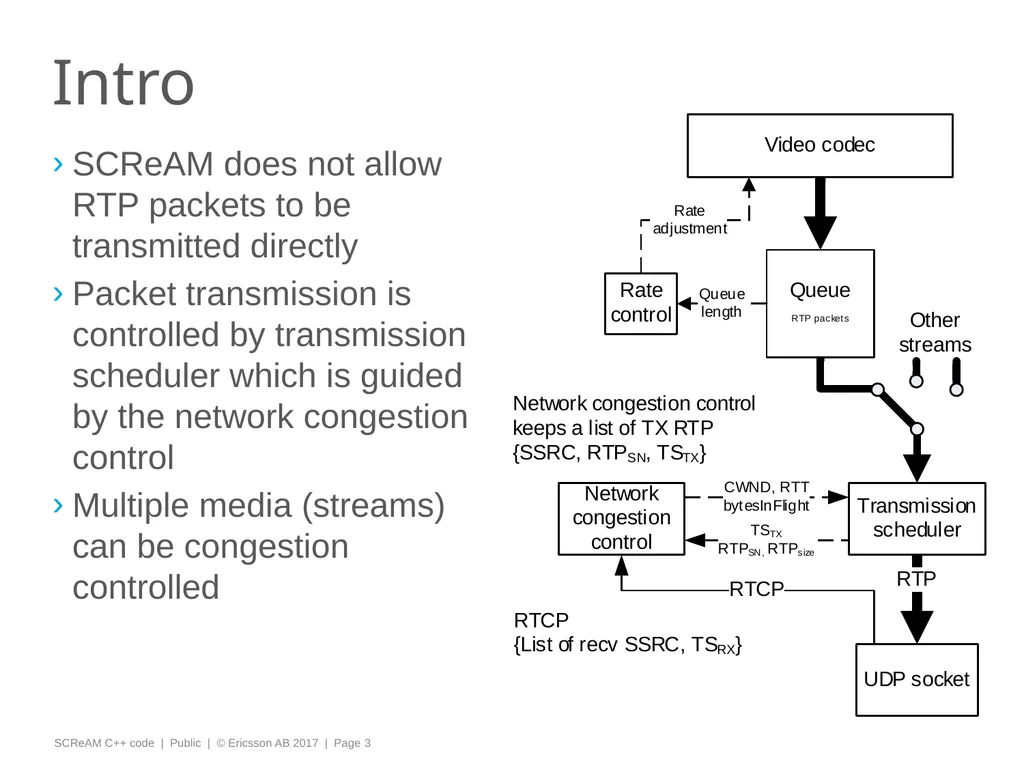
SCReAM does not allow RTP packets to be transmitted directly
Packet transmission is controlled by transmission scheduler which is guided by the network congestion control
Multiple media (streams) can be congestion controlled Intro<br>
Packet transmission is controlled by transmission scheduler which is guided by the network congestion control
Multiple media (streams) can be congestion controlled Intro<br>
04
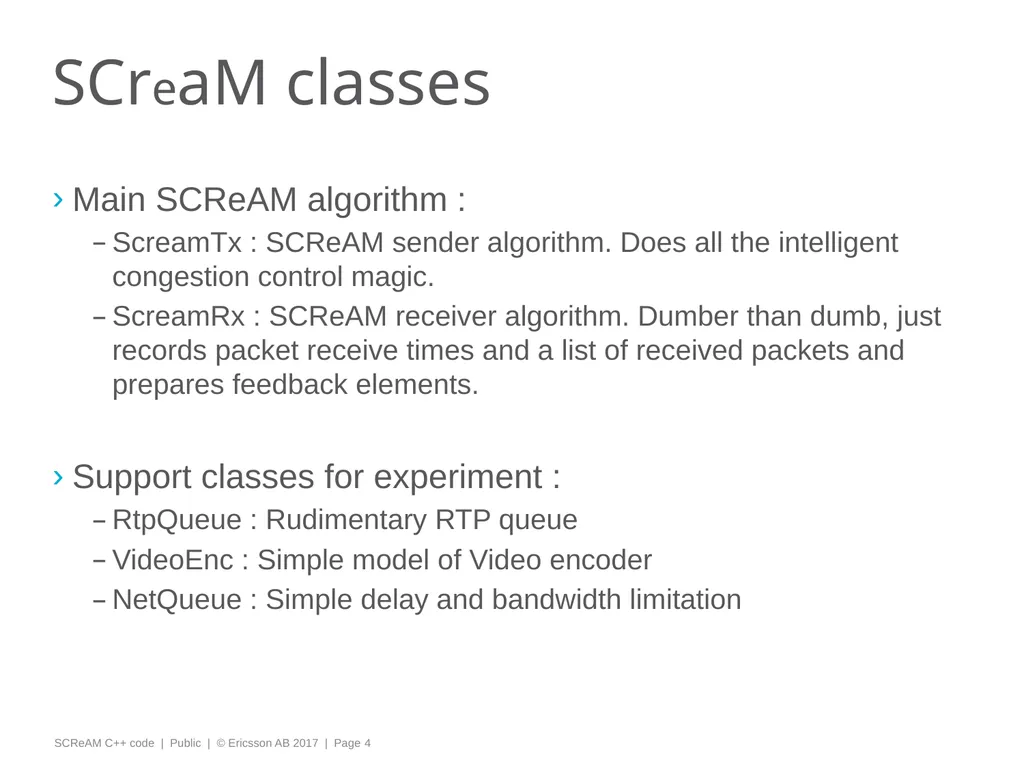
Main SCReAM algorithm :
ScreamTx : SCReAM sender algorithm. Does all the intelligent congestion control magic.
ScreamRx : SCReAM receiver algorithm. Dumber than dumb, just records packet receive times and a list of received packets and prepares feedback elements.
Support classes for experiment :
RtpQueue : Rudimentary RTP queue
VideoEnc : Simple model of Video encoder
NetQueue : Simple delay and bandwidth limitation SCreaM classes<br>
ScreamTx : SCReAM sender algorithm. Does all the intelligent congestion control magic.
ScreamRx : SCReAM receiver algorithm. Dumber than dumb, just records packet receive times and a list of received packets and prepares feedback elements.
Support classes for experiment :
RtpQueue : Rudimentary RTP queue
VideoEnc : Simple model of Video encoder
NetQueue : Simple delay and bandwidth limitation SCreaM classes<br>
05
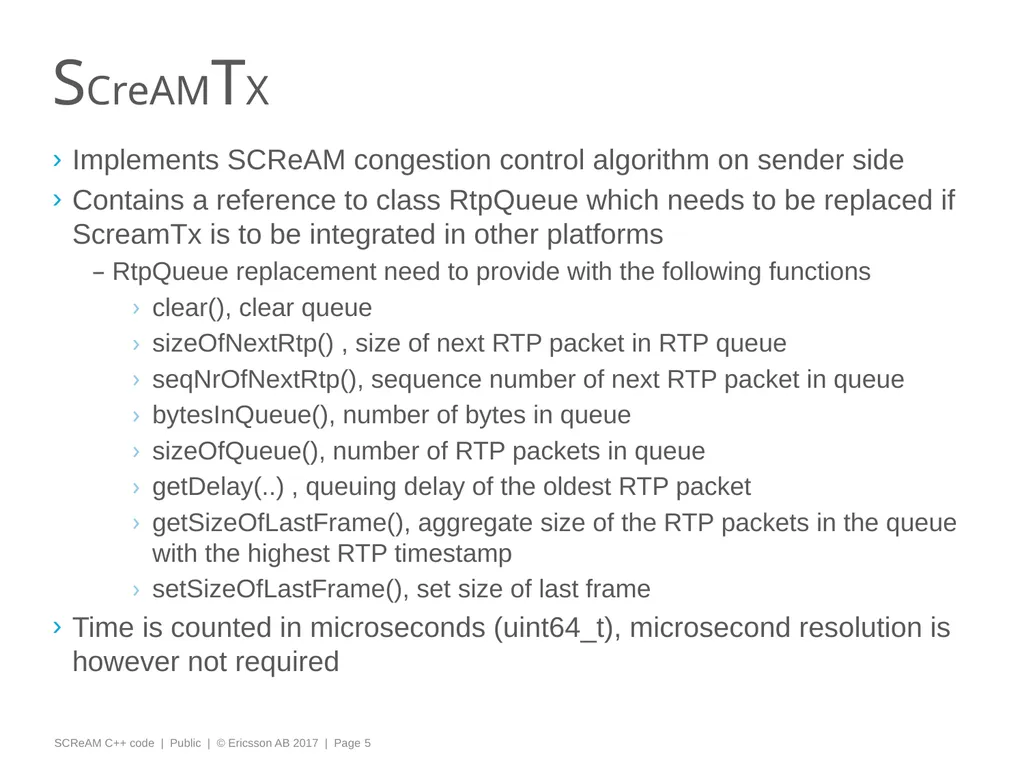
Implements SCReAM congestion control algorithm on sender side
Contains a reference to class RtpQueue which needs to be replaced if ScreamTx is to be integrated in other platforms
RtpQueue replacement need to provide with the following functions
clear(), clear queue
sizeOfNextRtp() , size of next RTP packet in RTP queue
seqNrOfNextRtp(), sequence number of next RTP packet in queue
bytesInQueue(), number of bytes in queue
sizeOfQueue(), number of RTP packets in queue
getDelay(..) , queuing delay of the oldest RTP packet
getSizeOfLastFrame(), aggregate size of the RTP packets in the queue with the highest RTP timestamp
setSizeOfLastFrame(), set size of last frame
Time is counted in microseconds (uint64_t), microsecond resolution is however not required SCreAMTX<br>
Contains a reference to class RtpQueue which needs to be replaced if ScreamTx is to be integrated in other platforms
RtpQueue replacement need to provide with the following functions
clear(), clear queue
sizeOfNextRtp() , size of next RTP packet in RTP queue
seqNrOfNextRtp(), sequence number of next RTP packet in queue
bytesInQueue(), number of bytes in queue
sizeOfQueue(), number of RTP packets in queue
getDelay(..) , queuing delay of the oldest RTP packet
getSizeOfLastFrame(), aggregate size of the RTP packets in the queue with the highest RTP timestamp
setSizeOfLastFrame(), set size of last frame
Time is counted in microseconds (uint64_t), microsecond resolution is however not required SCreAMTX<br>
06
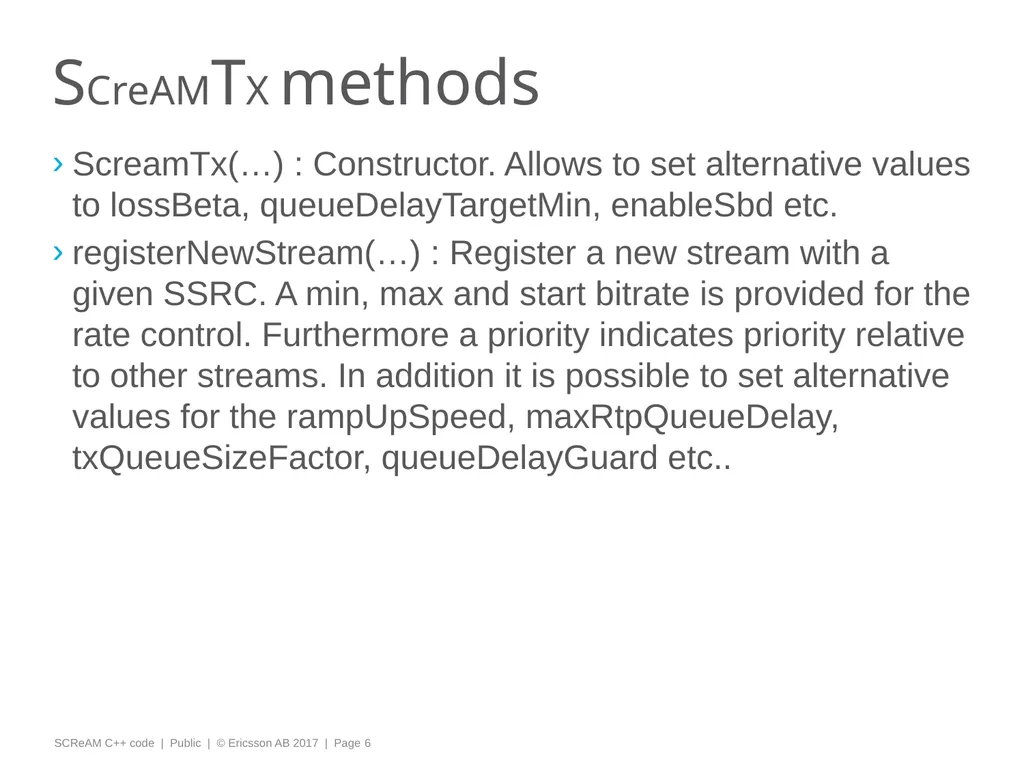
ScreamTx(…) : Constructor. Allows to set alternative values to lossBeta, queueDelayTargetMin, enableSbd etc.
registerNewStream(…) : Register a new stream with a given SSRC. A min, max and start bitrate is provided for the rate control. Furthermore a priority indicates priority relative to other streams. In addition it is possible to set alternative values for the rampUpSpeed, maxRtpQueueDelay, txQueueSizeFactor, queueDelayGuard etc.. SCreAMTX methods<br>
registerNewStream(…) : Register a new stream with a given SSRC. A min, max and start bitrate is provided for the rate control. Furthermore a priority indicates priority relative to other streams. In addition it is possible to set alternative values for the rampUpSpeed, maxRtpQueueDelay, txQueueSizeFactor, queueDelayGuard etc.. SCreAMTX methods<br>
07
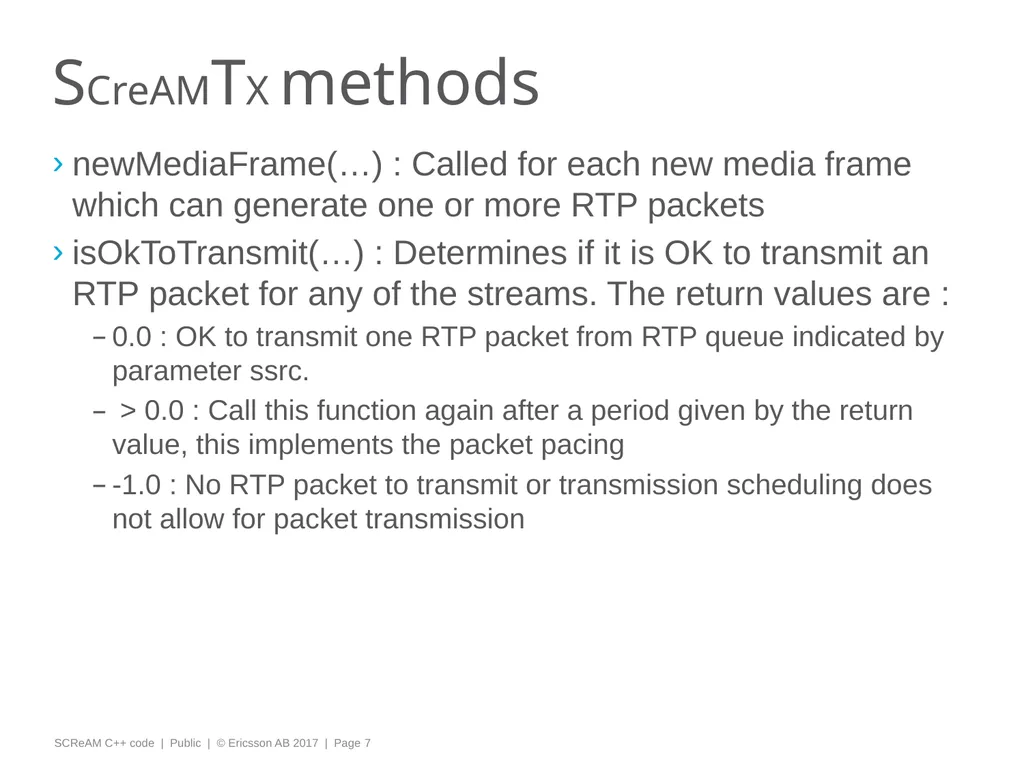
newMediaFrame(…) : Called for each new media frame which can generate one or more RTP packets
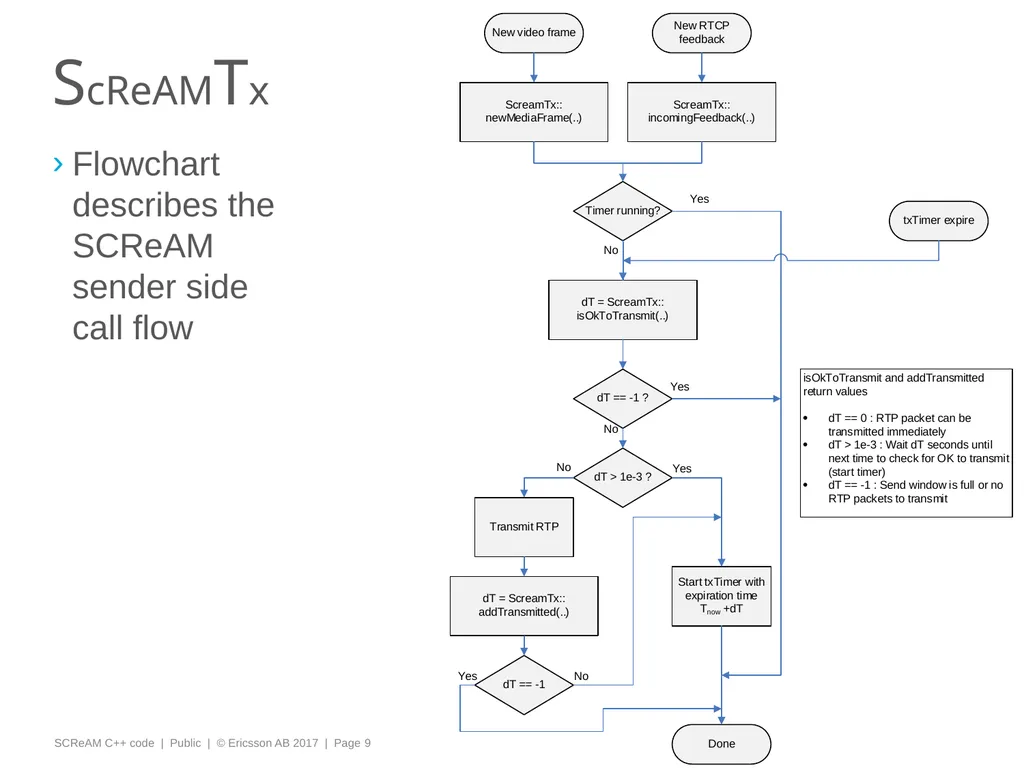
isOkToTransmit(…) : Determines if it is OK to transmit an RTP packet for any of the streams. The return values are :
0.0 : OK to transmit one RTP packet from RTP queue indicated by parameter ssrc.
> 0.0 : Call this function again after a period given by the return value, this implements the packet pacing
-1.0 : No RTP packet to transmit or transmission scheduling does not allow for packet transmission SCreAMTX methods<br>
isOkToTransmit(…) : Determines if it is OK to transmit an RTP packet for any of the streams. The return values are :
0.0 : OK to transmit one RTP packet from RTP queue indicated by parameter ssrc.
> 0.0 : Call this function again after a period given by the return value, this implements the packet pacing
-1.0 : No RTP packet to transmit or transmission scheduling does not allow for packet transmission SCreAMTX methods<br>
08
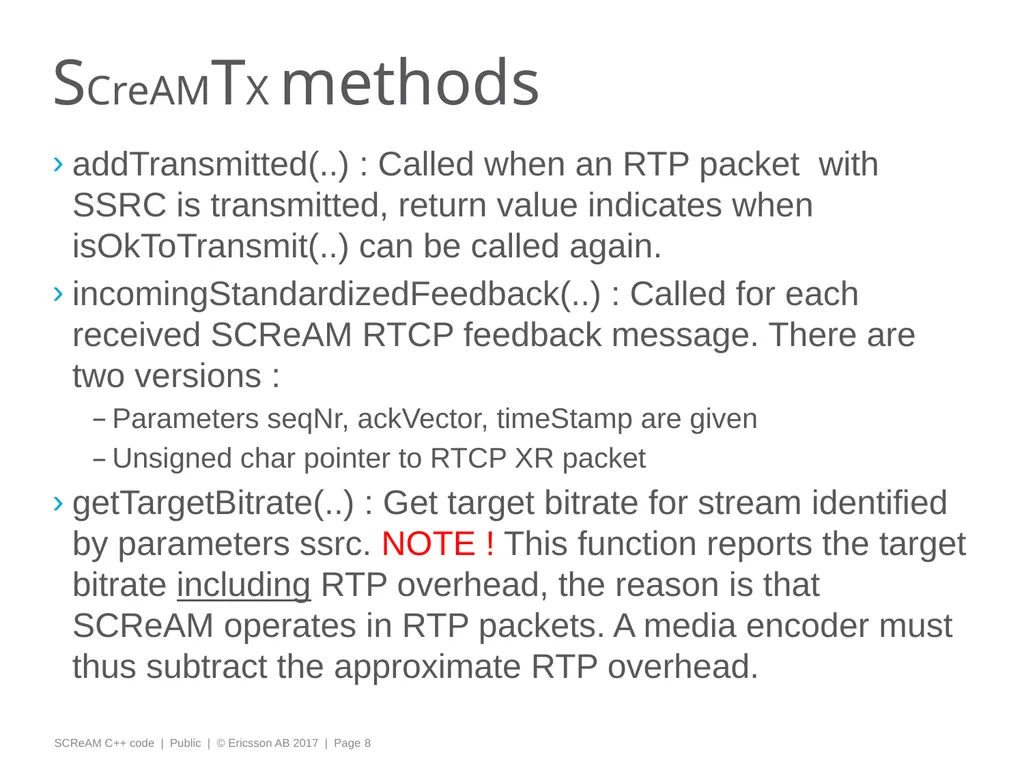
addTransmitted(..) : Called when an RTP packet with SSRC is transmitted, return value indicates when isOkToTransmit(..) can be called again.
incomingStandardizedFeedback(..) : Called for each received SCReAM RTCP feedback message. There are two versions :
Parameters seqNr, ackVector, timeStamp are given
Unsigned char pointer to RTCP XR packet
getTargetBitrate(..) : Get target bitrate for stream identified by parameters ssrc. NOTE ! This function reports the target bitrate including RTP overhead, the reason is that SCReAM operates in RTP packets. A media encoder must thus subtract the approximate RTP overhead. SCreAMTX methods<br>
incomingStandardizedFeedback(..) : Called for each received SCReAM RTCP feedback message. There are two versions :
Parameters seqNr, ackVector, timeStamp are given
Unsigned char pointer to RTCP XR packet
getTargetBitrate(..) : Get target bitrate for stream identified by parameters ssrc. NOTE ! This function reports the target bitrate including RTP overhead, the reason is that SCReAM operates in RTP packets. A media encoder must thus subtract the approximate RTP overhead. SCreAMTX methods<br>
09
ScReAMTx Flowchart describes the SCReAM sender side call flow<br>
10
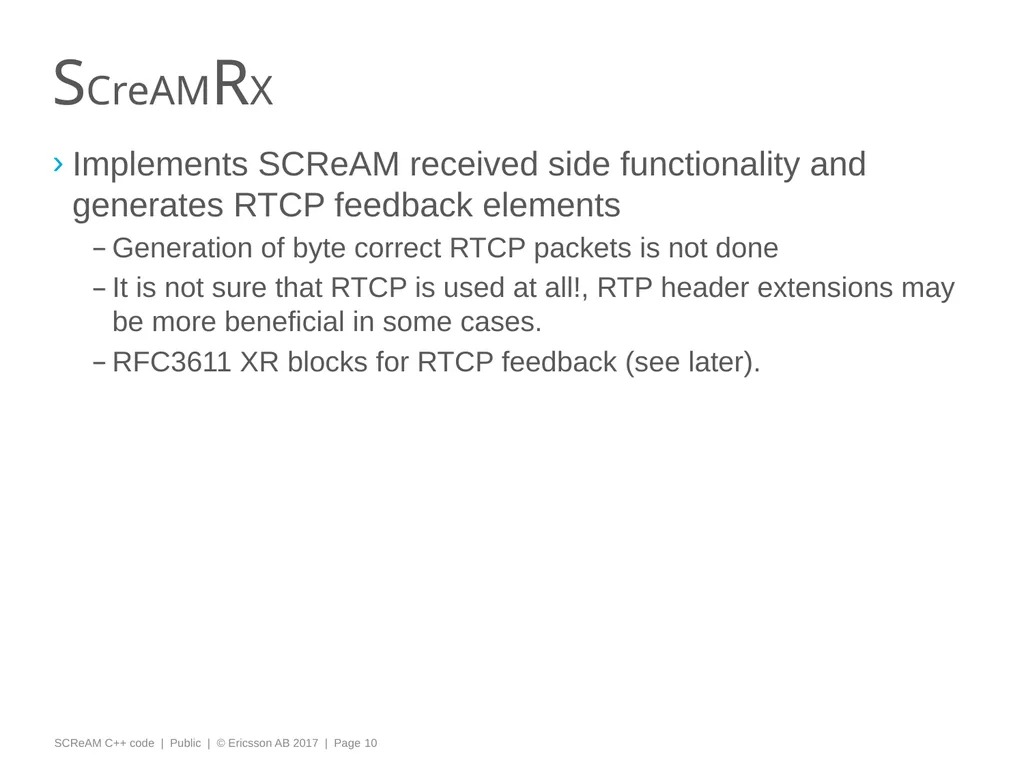
Implements SCReAM received side functionality and generates RTCP feedback elements
Generation of byte correct RTCP packets is not done
It is not sure that RTCP is used at all!, RTP header extensions may be more beneficial in some cases.
RFC3611 XR blocks for RTCP feedback (see later). SCreAMRX<br>
Generation of byte correct RTCP packets is not done
It is not sure that RTCP is used at all!, RTP header extensions may be more beneficial in some cases.
RFC3611 XR blocks for RTCP feedback (see later). SCreAMRX<br>
11
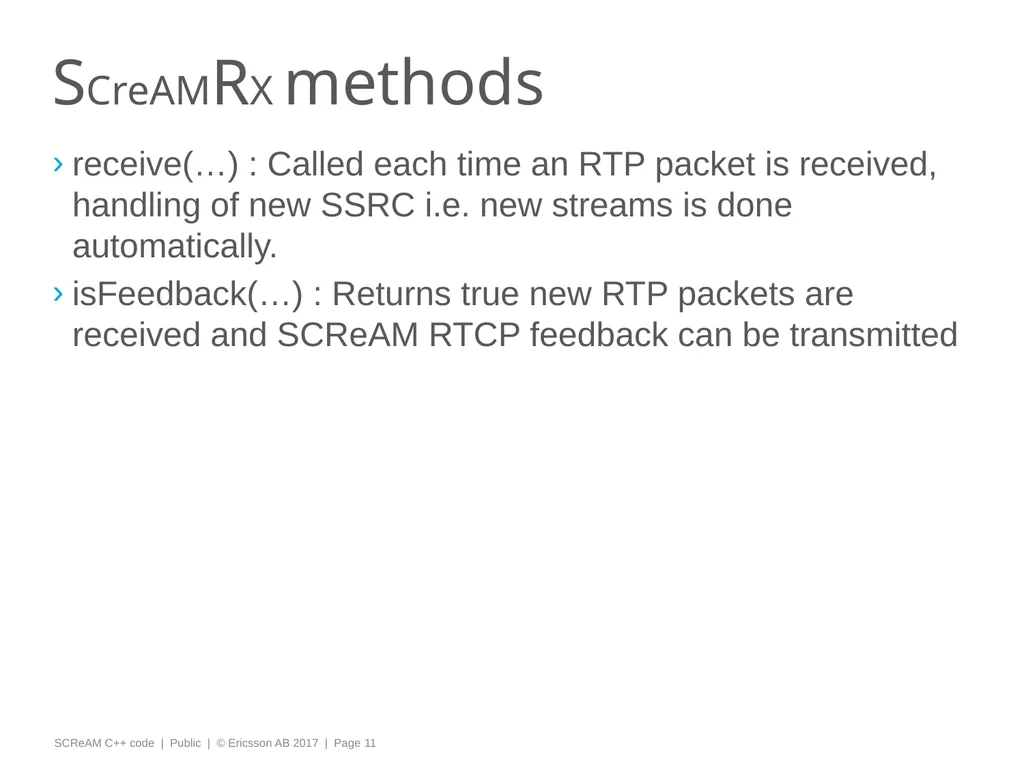
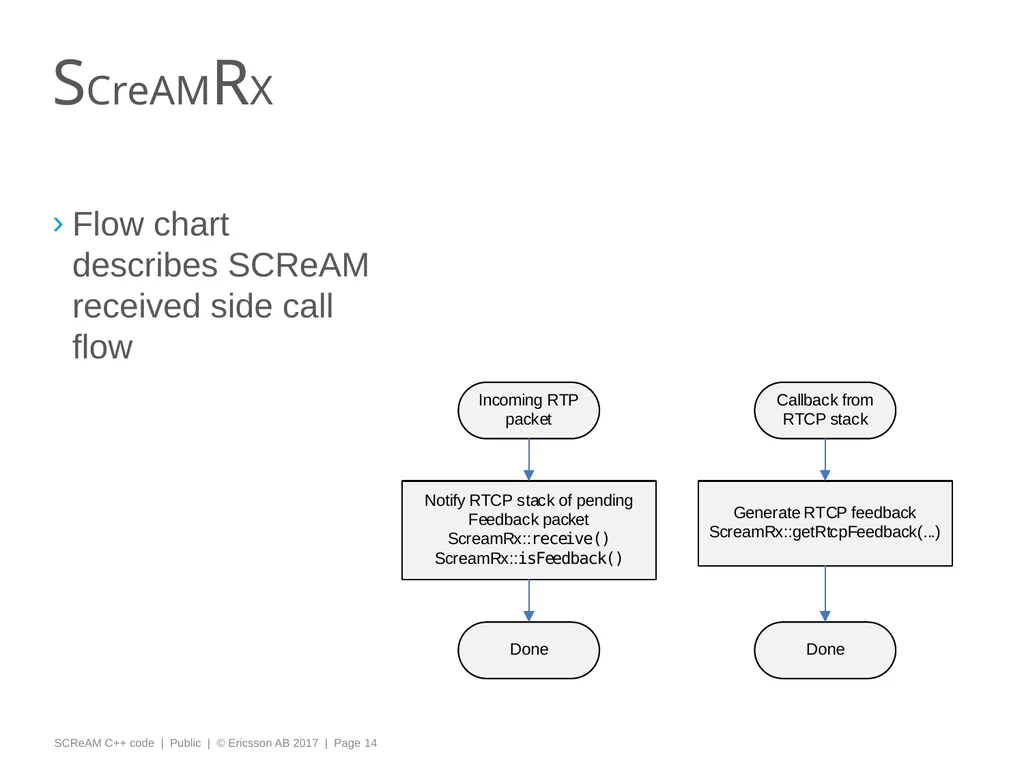
receive(…) : Called each time an RTP packet is received, handling of new SSRC i.e. new streams is done automatically.
isFeedback(…) : Returns true new RTP packets are received and SCReAM RTCP feedback can be transmitted SCreAMRX methods<br>
isFeedback(…) : Returns true new RTP packets are received and SCReAM RTCP feedback can be transmitted SCreAMRX methods<br>
12
getFeedback(…) : Get the feedback elements to generate a new SCReAM RTCP feedback packet. Function returns false if no stream with pending feedback available. The feedback elements are:
uint32_t ssrc : SSRC of sender
uint32_t receiveTimestamp : timestamp, default clock frequency = 1000Hz, important that both sender and received agree on the same clock frequency
uint16_t highestSeqNr : Highest received sequence number (possibly wrapped around)
uint64_t ackVector : 64 bit ACK vector that indicates reception of RTP packets prior to highestSeqNr. The most recent sequence numbers are indicated is the least significant bits, which means that if the ACK vector is truncated, then the LSB should be used. SCreAMRX methods<br>
uint32_t ssrc : SSRC of sender
uint32_t receiveTimestamp : timestamp, default clock frequency = 1000Hz, important that both sender and received agree on the same clock frequency
uint16_t highestSeqNr : Highest received sequence number (possibly wrapped around)
uint64_t ackVector : 64 bit ACK vector that indicates reception of RTP packets prior to highestSeqNr. The most recent sequence numbers are indicated is the least significant bits, which means that if the ACK vector is truncated, then the LSB should be used. SCreAMRX methods<br>
13
createStandardizedFeedback(…) : Creates an RTCP XR that is 32 bytes large. Sender and receiver reports may be prepended if needed. SCreAMRX methods<br>
14
Flow chart describes SCReAM received side call flow SCreAMRX<br>
15
scream_v_a.cpp
A small piece of experiment code that runs the ScreamTx and ScreamRx algorithms Experiment code<br>
A small piece of experiment code that runs the ScreamTx and ScreamRx algorithms Experiment code<br>
16
Non-standards compliant feedback
To be replaced with new feedback format standardized in IETF, later on. Feedback format Implemented In C++ code 0 1 2 3
0 1 2 3 4 5 6 7 8 9 0 1 2 3 4 5 6 7 8 9 0 1 2 3 4 5 6 7 8 9 0 1
+-+-+-+-+-+-+-+-+-+-+-+-+-+-+-+-+-+-+-+-+-+-+-+-+-+-+-+-+-+-+-+-+
|V=2|P|reserved | PT=XR=207 | length=6 |
+-+-+-+-+-+-+-+-+-+-+-+-+-+-+-+-+-+-+-+-+-+-+-+-+-+-+-+-+-+-+-+-+
| SSRC |
+-+-+-+-+-+-+-+-+-+-+-+-+-+-+-+-+-+-+-+-+-+-+-+-+-+-+-+-+-+-+-+-+
| BT=255 | reserved | block length=4 |
+-+-+-+-+-+-+-+-+-+-+-+-+-+-+-+-+-+-+-+-+-+-+-+-+-+-+-+-+-+-+-+-+
| SSRC of source |
+-+-+-+-+-+-+-+-+-+-+-+-+-+-+-+-+-+-+-+-+-+-+-+-+-+-+-+-+-+-+-+-+
| Highest recv. seq. nr. (16b) | ECN_CE_bytes |
+-+-+-+-+-+-+-+-+-+-+-+-+-+-+-+-+-+-+-+-+-+-+-+-+-+-+-+-+-+-+-+-+
| Ack vector (b0-31) |
+-+-+-+-+-+-+-+-+-+-+-+-+-+-+-+-+-+-+-+-+-+-+-+-+-+-+-+-+-+-+-+-+
| Ack vector (b32-63) |
+-+-+-+-+-+-+-+-+-+-+-+-+-+-+-+-+-+-+-+-+-+-+-+-+-+-+-+-+-+-+-+-+
| Timestamp (32bits) |
+-+-+-+-+-+-+-+-+-+-+-+-+-+-+-+-+-+-+-+-+-+-+-+-+-+-+-+-+-+-+-+-+<br>
To be replaced with new feedback format standardized in IETF, later on. Feedback format Implemented In C++ code 0 1 2 3
0 1 2 3 4 5 6 7 8 9 0 1 2 3 4 5 6 7 8 9 0 1 2 3 4 5 6 7 8 9 0 1
+-+-+-+-+-+-+-+-+-+-+-+-+-+-+-+-+-+-+-+-+-+-+-+-+-+-+-+-+-+-+-+-+
|V=2|P|reserved | PT=XR=207 | length=6 |
+-+-+-+-+-+-+-+-+-+-+-+-+-+-+-+-+-+-+-+-+-+-+-+-+-+-+-+-+-+-+-+-+
| SSRC |
+-+-+-+-+-+-+-+-+-+-+-+-+-+-+-+-+-+-+-+-+-+-+-+-+-+-+-+-+-+-+-+-+
| BT=255 | reserved | block length=4 |
+-+-+-+-+-+-+-+-+-+-+-+-+-+-+-+-+-+-+-+-+-+-+-+-+-+-+-+-+-+-+-+-+
| SSRC of source |
+-+-+-+-+-+-+-+-+-+-+-+-+-+-+-+-+-+-+-+-+-+-+-+-+-+-+-+-+-+-+-+-+
| Highest recv. seq. nr. (16b) | ECN_CE_bytes |
+-+-+-+-+-+-+-+-+-+-+-+-+-+-+-+-+-+-+-+-+-+-+-+-+-+-+-+-+-+-+-+-+
| Ack vector (b0-31) |
+-+-+-+-+-+-+-+-+-+-+-+-+-+-+-+-+-+-+-+-+-+-+-+-+-+-+-+-+-+-+-+-+
| Ack vector (b32-63) |
+-+-+-+-+-+-+-+-+-+-+-+-+-+-+-+-+-+-+-+-+-+-+-+-+-+-+-+-+-+-+-+-+
| Timestamp (32bits) |
+-+-+-+-+-+-+-+-+-+-+-+-+-+-+-+-+-+-+-+-+-+-+-+-+-+-+-+-+-+-+-+-+<br>