"Initial Thoughts on FOMC Decision Junko Nishioka" is the property of its rightful owner. Permission is granted to
download and print the materials on this website for personal, non-commercial use only, and to display it
on your personal computer provided you do not modify the materials and that you retain all copyright
notices contained in the materials. By downloading content from our website, you accept the terms of this
agreement.
(212) 224-4568
junko_nishioka@smbcgroup.com
November 2, 2023<br>
02
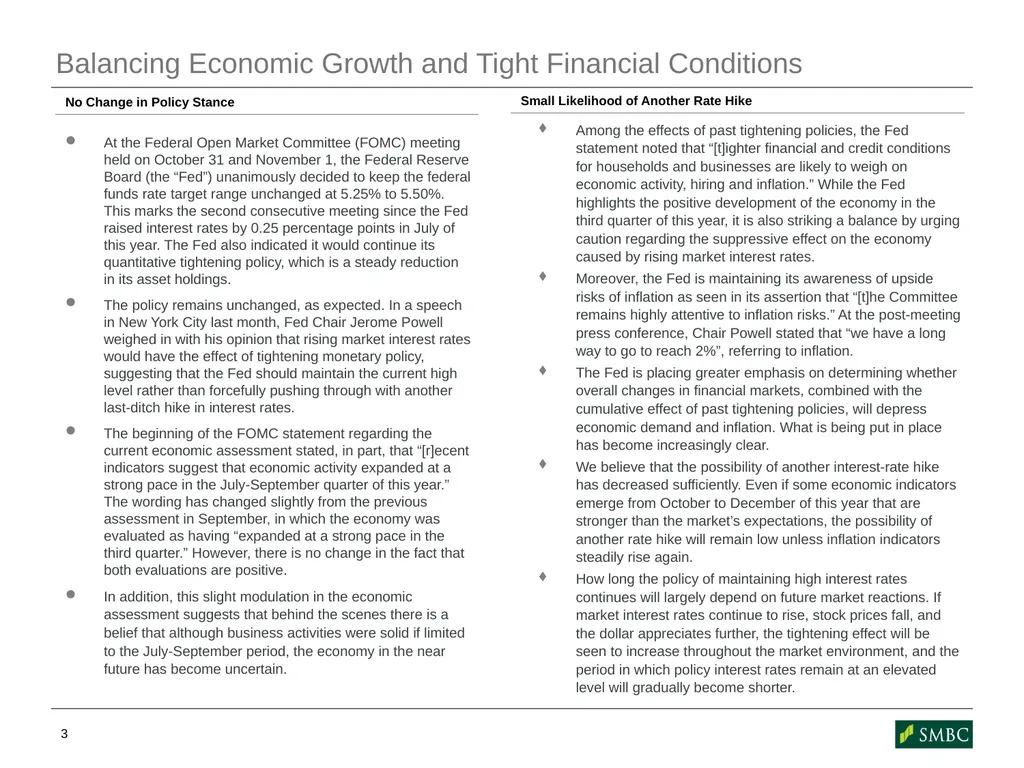
Balancing Economic Growth and Tight Financial Conditions No Change in Policy Stance Small Likelihood of Another Rate Hike At the Federal Open Market Committee (FOMC) meeting held on October 31 and November 1, the Federal Reserve Board (the “Fed”) unanimously decided to keep the federal funds rate target range unchanged at 5.25% to 5.50%. This marks the second consecutive meeting since the Fed raised interest rates by 0.25 percentage points in July of this year. The Fed also indicated it would continue its quantitative tightening policy, which is a steady reduction in its asset holdings.
The policy remains unchanged, as expected. In a speech in New York City last month, Fed Chair Jerome Powell weighed in with his opinion that rising market interest rates would have the effect of tightening monetary policy, suggesting that the Fed should maintain the current high level rather than forcefully pushing through with another last-ditch hike in interest rates.
The beginning of the FOMC statement regarding the current economic assessment stated, in part, that “[r]ecent indicators suggest that economic activity expanded at a strong pace in the July-September quarter of this year.” The wording has changed slightly from the previous assessment in September, in which the economy was evaluated as having “expanded at a strong pace in the third quarter.” However, there is no change in the fact that both evaluations are positive.
In addition, this slight modulation in the economic assessment suggests that behind the scenes there is a belief that although business activities were solid if limited to the July-September period, the economy in the near future has become uncertain. Among the effects of past tightening policies, the Fed statement noted that “[t]ighter financial and credit conditions for households and businesses are likely to weigh on economic activity, hiring and inflation.” While the Fed highlights the positive development of the economy in the third quarter of this year, it is also striking a balance by urging caution regarding the suppressive effect on the economy caused by rising market interest rates.
Moreover, the Fed is maintaining its awareness of upside risks of inflation as seen in its assertion that “[t]he Committee remains highly attentive to inflation risks.” At the post-meeting press conference, Chair Powell stated that “we have a long way to go to reach 2%”, referring to inflation.
The Fed is placing greater emphasis on determining whether overall changes in financial markets, combined with the cumulative effect of past tightening policies, will depress economic demand and inflation. What is being put in place has become increasingly clear.
We believe that the possibility of another interest-rate hike has decreased sufficiently. Even if some economic indicators emerge from October to December of this year that are stronger than the market’s expectations, the possibility of another rate hike will remain low unless inflation indicators steadily rise again.
How long the policy of maintaining high interest rates continues will largely depend on future market reactions. If market interest rates continue to rise, stock prices fall, and the dollar appreciates further, the tightening effect will be seen to increase throughout the market environment, and the period in which policy interest rates remain at an elevated level will gradually become shorter.<br>