
Initiative Summary Measures of Success Develop a
CS
Published · 6 slides · 0 views

1 / 1
Description
Initiative Summary Measures of Success Develop a Set of Common Enrollment Management (EM) Definitions. The goal of this initiative is to have an approved list of Enrollment Management Terms with definitions to be shared university wide and
Related Topics
Share
Embed code
Download this presentation From Below
"Initiative Summary Measures of Success Develop a" is the property of its rightful owner. Permission is granted to download and print the materials on this website for personal, non-commercial use only, and to display it on your personal computer provided you do not modify the materials and that you retain all copyright notices contained in the materials. By downloading content from our website, you accept the terms of this agreement.
Presentation Transcript
01
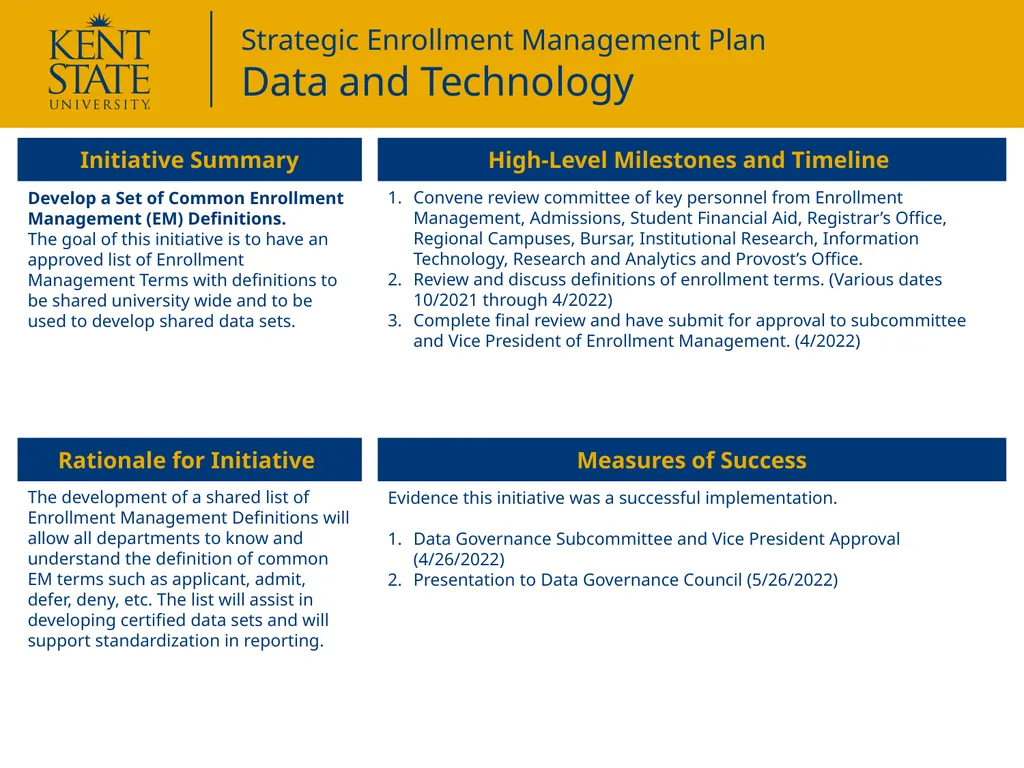
Initiative Summary Measures of Success Develop a Set of Common Enrollment Management (EM) Definitions.
The goal of this initiative is to have an approved list of Enrollment Management Terms with definitions to be shared university wide and to be used to develop shared data sets. Evidence this initiative was a successful implementation.
Data Governance Subcommittee and Vice President Approval (4/26/2022)
Presentation to Data Governance Council (5/26/2022) Convene review committee of key personnel from Enrollment Management, Admissions, Student Financial Aid, Registrar’s Office, Regional Campuses, Bursar, Institutional Research, Information Technology, Research and Analytics and Provost’s Office.
Review and discuss definitions of enrollment terms. (Various dates 10/2021 through 4/2022)
Complete final review and have submit for approval to subcommittee and Vice President of Enrollment Management. (4/2022) Rationale for Initiative High-Level Milestones and Timeline The development of a shared list of Enrollment Management Definitions will allow all departments to know and understand the definition of common EM terms such as applicant, admit, defer, deny, etc. The list will assist in developing certified data sets and will support standardization in reporting. Strategic Enrollment Management Plan
Data and Technology<br>
The goal of this initiative is to have an approved list of Enrollment Management Terms with definitions to be shared university wide and to be used to develop shared data sets. Evidence this initiative was a successful implementation.
Data Governance Subcommittee and Vice President Approval (4/26/2022)
Presentation to Data Governance Council (5/26/2022) Convene review committee of key personnel from Enrollment Management, Admissions, Student Financial Aid, Registrar’s Office, Regional Campuses, Bursar, Institutional Research, Information Technology, Research and Analytics and Provost’s Office.
Review and discuss definitions of enrollment terms. (Various dates 10/2021 through 4/2022)
Complete final review and have submit for approval to subcommittee and Vice President of Enrollment Management. (4/2022) Rationale for Initiative High-Level Milestones and Timeline The development of a shared list of Enrollment Management Definitions will allow all departments to know and understand the definition of common EM terms such as applicant, admit, defer, deny, etc. The list will assist in developing certified data sets and will support standardization in reporting. Strategic Enrollment Management Plan
Data and Technology<br>
02
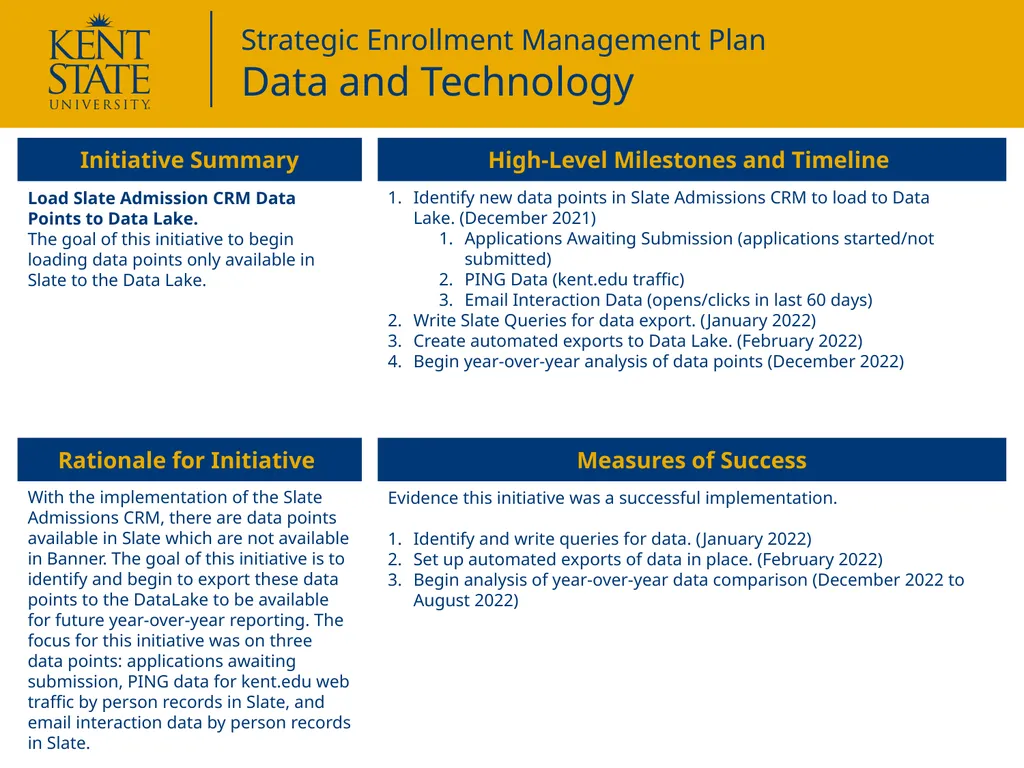
Initiative Summary Measures of Success Load Slate Admission CRM Data Points to Data Lake.
The goal of this initiative to begin loading data points only available in Slate to the Data Lake. Evidence this initiative was a successful implementation.
Identify and write queries for data. (January 2022)
Set up automated exports of data in place. (February 2022)
Begin analysis of year-over-year data comparison (December 2022 to August 2022) Identify new data points in Slate Admissions CRM to load to Data Lake. (December 2021)
Applications Awaiting Submission (applications started/not submitted)
PING Data (kent.edu traffic)
Email Interaction Data (opens/clicks in last 60 days)
Write Slate Queries for data export. (January 2022)
Create automated exports to Data Lake. (February 2022)
Begin year-over-year analysis of data points (December 2022) Rationale for Initiative High-Level Milestones and Timeline With the implementation of the Slate Admissions CRM, there are data points available in Slate which are not available in Banner. The goal of this initiative is to identify and begin to export these data points to the DataLake to be available for future year-over-year reporting. The focus for this initiative was on three data points: applications awaiting submission, PING data for kent.edu web traffic by person records in Slate, and email interaction data by person records in Slate. Strategic Enrollment Management Plan
Data and Technology<br>
The goal of this initiative to begin loading data points only available in Slate to the Data Lake. Evidence this initiative was a successful implementation.
Identify and write queries for data. (January 2022)
Set up automated exports of data in place. (February 2022)
Begin analysis of year-over-year data comparison (December 2022 to August 2022) Identify new data points in Slate Admissions CRM to load to Data Lake. (December 2021)
Applications Awaiting Submission (applications started/not submitted)
PING Data (kent.edu traffic)
Email Interaction Data (opens/clicks in last 60 days)
Write Slate Queries for data export. (January 2022)
Create automated exports to Data Lake. (February 2022)
Begin year-over-year analysis of data points (December 2022) Rationale for Initiative High-Level Milestones and Timeline With the implementation of the Slate Admissions CRM, there are data points available in Slate which are not available in Banner. The goal of this initiative is to identify and begin to export these data points to the DataLake to be available for future year-over-year reporting. The focus for this initiative was on three data points: applications awaiting submission, PING data for kent.edu web traffic by person records in Slate, and email interaction data by person records in Slate. Strategic Enrollment Management Plan
Data and Technology<br>
03
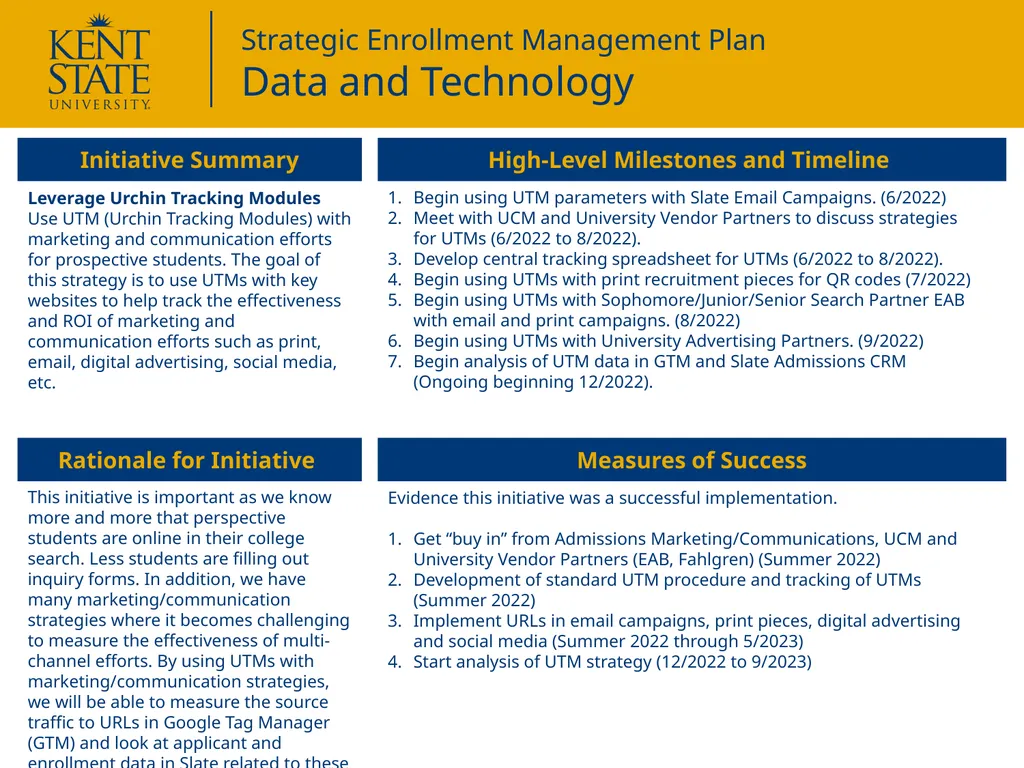
Initiative Summary Measures of Success Leverage Urchin Tracking Modules
Use UTM (Urchin Tracking Modules) with marketing and communication efforts for prospective students. The goal of this strategy is to use UTMs with key websites to help track the effectiveness and ROI of marketing and communication efforts such as print, email, digital advertising, social media, etc. Evidence this initiative was a successful implementation.
Get “buy in” from Admissions Marketing/Communications, UCM and University Vendor Partners (EAB, Fahlgren) (Summer 2022)
Development of standard UTM procedure and tracking of UTMs (Summer 2022)
Implement URLs in email campaigns, print pieces, digital advertising and social media (Summer 2022 through 5/2023)
Start analysis of UTM strategy (12/2022 to 9/2023) Begin using UTM parameters with Slate Email Campaigns. (6/2022)
Meet with UCM and University Vendor Partners to discuss strategies for UTMs (6/2022 to 8/2022).
Develop central tracking spreadsheet for UTMs (6/2022 to 8/2022).
Begin using UTMs with print recruitment pieces for QR codes (7/2022)
Begin using UTMs with Sophomore/Junior/Senior Search Partner EAB with email and print campaigns. (8/2022)
Begin using UTMs with University Advertising Partners. (9/2022)
Begin analysis of UTM data in GTM and Slate Admissions CRM (Ongoing beginning 12/2022). Rationale for Initiative High-Level Milestones and Timeline This initiative is important as we know more and more that perspective students are online in their college search. Less students are filling out inquiry forms. In addition, we have many marketing/communication strategies where it becomes challenging to measure the effectiveness of multi-channel efforts. By using UTMs with marketing/communication strategies, we will be able to measure the source traffic to URLs in Google Tag Manager (GTM) and look at applicant and enrollment data in Slate related to these efforts. Strategic Enrollment Management Plan
Data and Technology<br>
Use UTM (Urchin Tracking Modules) with marketing and communication efforts for prospective students. The goal of this strategy is to use UTMs with key websites to help track the effectiveness and ROI of marketing and communication efforts such as print, email, digital advertising, social media, etc. Evidence this initiative was a successful implementation.
Get “buy in” from Admissions Marketing/Communications, UCM and University Vendor Partners (EAB, Fahlgren) (Summer 2022)
Development of standard UTM procedure and tracking of UTMs (Summer 2022)
Implement URLs in email campaigns, print pieces, digital advertising and social media (Summer 2022 through 5/2023)
Start analysis of UTM strategy (12/2022 to 9/2023) Begin using UTM parameters with Slate Email Campaigns. (6/2022)
Meet with UCM and University Vendor Partners to discuss strategies for UTMs (6/2022 to 8/2022).
Develop central tracking spreadsheet for UTMs (6/2022 to 8/2022).
Begin using UTMs with print recruitment pieces for QR codes (7/2022)
Begin using UTMs with Sophomore/Junior/Senior Search Partner EAB with email and print campaigns. (8/2022)
Begin using UTMs with University Advertising Partners. (9/2022)
Begin analysis of UTM data in GTM and Slate Admissions CRM (Ongoing beginning 12/2022). Rationale for Initiative High-Level Milestones and Timeline This initiative is important as we know more and more that perspective students are online in their college search. Less students are filling out inquiry forms. In addition, we have many marketing/communication strategies where it becomes challenging to measure the effectiveness of multi-channel efforts. By using UTMs with marketing/communication strategies, we will be able to measure the source traffic to URLs in Google Tag Manager (GTM) and look at applicant and enrollment data in Slate related to these efforts. Strategic Enrollment Management Plan
Data and Technology<br>
04
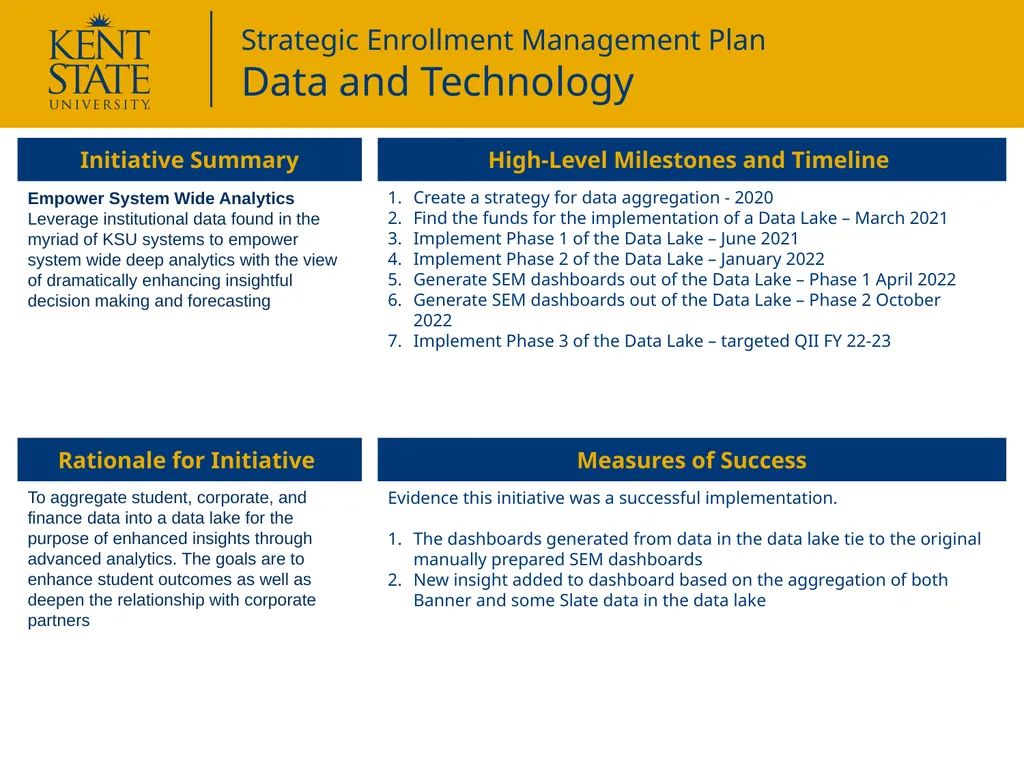
Initiative Summary Measures of Success Empower System Wide Analytics
Leverage institutional data found in the myriad of KSU systems to empower system wide deep analytics with the view of dramatically enhancing insightful decision making and forecasting Evidence this initiative was a successful implementation.
The dashboards generated from data in the data lake tie to the original manually prepared SEM dashboards
New insight added to dashboard based on the aggregation of both Banner and some Slate data in the data lake Create a strategy for data aggregation - 2020
Find the funds for the implementation of a Data Lake – March 2021
Implement Phase 1 of the Data Lake – June 2021
Implement Phase 2 of the Data Lake – January 2022
Generate SEM dashboards out of the Data Lake – Phase 1 April 2022
Generate SEM dashboards out of the Data Lake – Phase 2 October 2022
Implement Phase 3 of the Data Lake – targeted QII FY 22-23 Rationale for Initiative High-Level Milestones and Timeline To aggregate student, corporate, and finance data into a data lake for the purpose of enhanced insights through advanced analytics. The goals are to enhance student outcomes as well as deepen the relationship with corporate partners Strategic Enrollment Management Plan
Data and Technology<br>
Leverage institutional data found in the myriad of KSU systems to empower system wide deep analytics with the view of dramatically enhancing insightful decision making and forecasting Evidence this initiative was a successful implementation.
The dashboards generated from data in the data lake tie to the original manually prepared SEM dashboards
New insight added to dashboard based on the aggregation of both Banner and some Slate data in the data lake Create a strategy for data aggregation - 2020
Find the funds for the implementation of a Data Lake – March 2021
Implement Phase 1 of the Data Lake – June 2021
Implement Phase 2 of the Data Lake – January 2022
Generate SEM dashboards out of the Data Lake – Phase 1 April 2022
Generate SEM dashboards out of the Data Lake – Phase 2 October 2022
Implement Phase 3 of the Data Lake – targeted QII FY 22-23 Rationale for Initiative High-Level Milestones and Timeline To aggregate student, corporate, and finance data into a data lake for the purpose of enhanced insights through advanced analytics. The goals are to enhance student outcomes as well as deepen the relationship with corporate partners Strategic Enrollment Management Plan
Data and Technology<br>
05
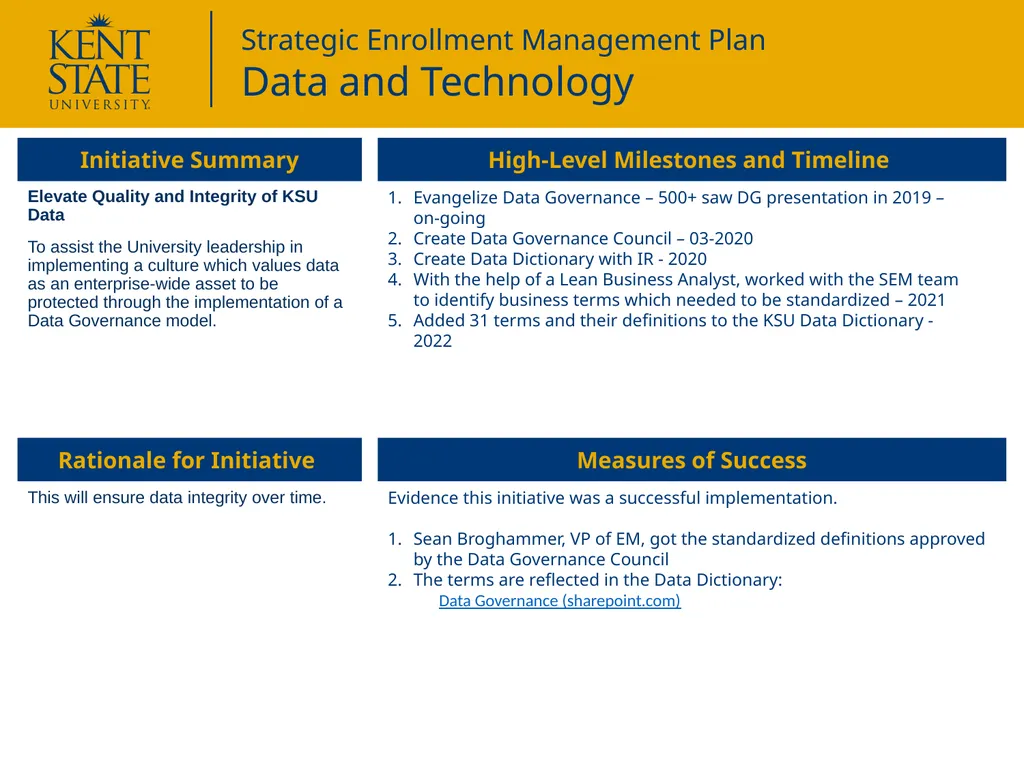
Initiative Summary Measures of Success Elevate Quality and Integrity of KSU Data
To assist the University leadership in implementing a culture which values data as an enterprise-wide asset to be protected through the implementation of a Data Governance model. Evidence this initiative was a successful implementation.
Sean Broghammer, VP of EM, got the standardized definitions approved by the Data Governance Council
The terms are reflected in the Data Dictionary:
Data Governance (sharepoint.com) Evangelize Data Governance – 500+ saw DG presentation in 2019 – on-going
Create Data Governance Council – 03-2020
Create Data Dictionary with IR - 2020
With the help of a Lean Business Analyst, worked with the SEM team to identify business terms which needed to be standardized – 2021
Added 31 terms and their definitions to the KSU Data Dictionary - 2022 Rationale for Initiative High-Level Milestones and Timeline This will ensure data integrity over time. Strategic Enrollment Management Plan
Data and Technology<br>
To assist the University leadership in implementing a culture which values data as an enterprise-wide asset to be protected through the implementation of a Data Governance model. Evidence this initiative was a successful implementation.
Sean Broghammer, VP of EM, got the standardized definitions approved by the Data Governance Council
The terms are reflected in the Data Dictionary:
Data Governance (sharepoint.com) Evangelize Data Governance – 500+ saw DG presentation in 2019 – on-going
Create Data Governance Council – 03-2020
Create Data Dictionary with IR - 2020
With the help of a Lean Business Analyst, worked with the SEM team to identify business terms which needed to be standardized – 2021
Added 31 terms and their definitions to the KSU Data Dictionary - 2022 Rationale for Initiative High-Level Milestones and Timeline This will ensure data integrity over time. Strategic Enrollment Management Plan
Data and Technology<br>
06
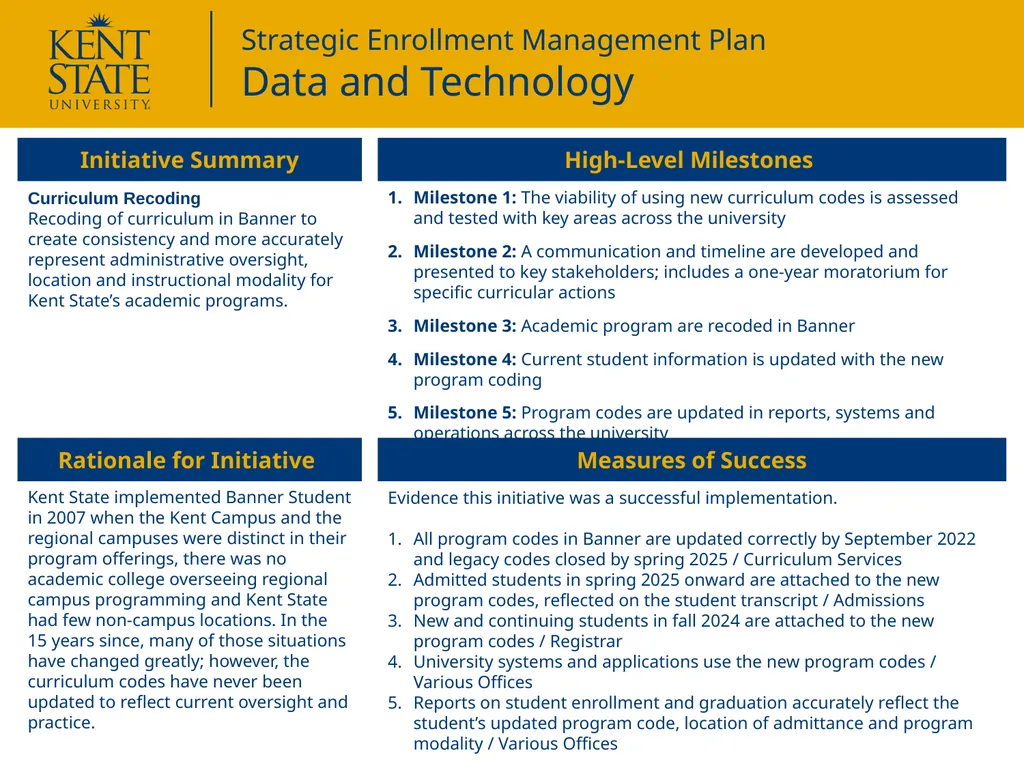
Initiative Summary Measures of Success Curriculum Recoding
Recoding of curriculum in Banner to create consistency and more accurately represent administrative oversight, location and instructional modality for Kent State’s academic programs. Evidence this initiative was a successful implementation.
All program codes in Banner are updated correctly by September 2022 and legacy codes closed by spring 2025 / Curriculum Services
Admitted students in spring 2025 onward are attached to the new program codes, reflected on the student transcript / Admissions
New and continuing students in fall 2024 are attached to the new program codes / Registrar
University systems and applications use the new program codes / Various Offices
Reports on student enrollment and graduation accurately reflect the student’s updated program code, location of admittance and program modality / Various Offices Milestone 1: The viability of using new curriculum codes is assessed and tested with key areas across the university
Milestone 2: A communication and timeline are developed and presented to key stakeholders; includes a one-year moratorium for specific curricular actions
Milestone 3: Academic program are recoded in Banner
Milestone 4: Current student information is updated with the new program coding
Milestone 5: Program codes are updated in reports, systems and operations across the university Rationale for Initiative High-Level Milestones Kent State implemented Banner Student in 2007 when the Kent Campus and the regional campuses were distinct in their program offerings, there was no academic college overseeing regional campus programming and Kent State had few non-campus locations. In the 15 years since, many of those situations have changed greatly; however, the curriculum codes have never been updated to reflect current oversight and practice. Strategic Enrollment Management Plan
Data and Technology<br>
Recoding of curriculum in Banner to create consistency and more accurately represent administrative oversight, location and instructional modality for Kent State’s academic programs. Evidence this initiative was a successful implementation.
All program codes in Banner are updated correctly by September 2022 and legacy codes closed by spring 2025 / Curriculum Services
Admitted students in spring 2025 onward are attached to the new program codes, reflected on the student transcript / Admissions
New and continuing students in fall 2024 are attached to the new program codes / Registrar
University systems and applications use the new program codes / Various Offices
Reports on student enrollment and graduation accurately reflect the student’s updated program code, location of admittance and program modality / Various Offices Milestone 1: The viability of using new curriculum codes is assessed and tested with key areas across the university
Milestone 2: A communication and timeline are developed and presented to key stakeholders; includes a one-year moratorium for specific curricular actions
Milestone 3: Academic program are recoded in Banner
Milestone 4: Current student information is updated with the new program coding
Milestone 5: Program codes are updated in reports, systems and operations across the university Rationale for Initiative High-Level Milestones Kent State implemented Banner Student in 2007 when the Kent Campus and the regional campuses were distinct in their program offerings, there was no academic college overseeing regional campus programming and Kent State had few non-campus locations. In the 15 years since, many of those situations have changed greatly; however, the curriculum codes have never been updated to reflect current oversight and practice. Strategic Enrollment Management Plan
Data and Technology<br>