
Innoslate™ Systems Engineering Management Tool
JO
Published · 23 slides · 0 views

1 / 1

Description
Innoslate Systems Engineering Management Tool Test and Analysis Aron Ceely Justin Mathews Kate Stevenson Bruck Woldie Agenda Background Problem Definition and Objectives Approach Overview Test Strategy Innoslate Feature User Experience
Related Topics
Share
Embed code
Download this presentation From Below
"Innoslate™ Systems Engineering Management Tool" is the property of its rightful owner. Permission is granted to download and print the materials on this website for personal, non-commercial use only, and to display it on your personal computer provided you do not modify the materials and that you retain all copyright notices contained in the materials. By downloading content from our website, you accept the terms of this agreement.
Presentation Transcript
01
Innoslate™ Systems Engineering Management Tool Test and Analysis Aron Ceely
Justin Mathews
Kate Stevenson
Bruck Woldie<br>
Justin Mathews
Kate Stevenson
Bruck Woldie<br>
02
Agenda Background
Problem Definition and Objectives
Approach Overview
Test Strategy
Innoslate™ Feature User Experience and Recommendations
Future Innoslate™ Features
Way Forward
Acknowledgements
Questions and Answers 2<br>
Problem Definition and Objectives
Approach Overview
Test Strategy
Innoslate™ Feature User Experience and Recommendations
Future Innoslate™ Features
Way Forward
Acknowledgements
Questions and Answers 2<br>
03
Background – Innoslate™ Developed as an aggregation of several systems engineering tools and concepts that have been utilized for the past 25 years.
Cloud-based web application developed specifically for systems engineers to encompass activities related to the full systems lifecycle.
Includes capabilities related to Requirements Management, Collaboration, System Modeling, Reporting, and Discrete Event Simulation. 3<br>
Cloud-based web application developed specifically for systems engineers to encompass activities related to the full systems lifecycle.
Includes capabilities related to Requirements Management, Collaboration, System Modeling, Reporting, and Discrete Event Simulation. 3<br>
04
Problem Definition and Objectives Software product development is very new to SPEC Innovations, necessitating a critical review and analysis of the Innoslate™ tool to provide independent feedback and recommendations with a primary focus on usability and functionality.
Objectives:
Testing and critical evaluation of the capabilities offered by Innoslate™.
Compile and detail test results and recommendations as part of a report to the sponsor.
Deliver the final project report.
Present project and findings to the sponsor and GMU faculty. 4<br>
Objectives:
Testing and critical evaluation of the capabilities offered by Innoslate™.
Compile and detail test results and recommendations as part of a report to the sponsor.
Deliver the final project report.
Present project and findings to the sponsor and GMU faculty. 4<br>
05
Approach Overview Leverage completed Systems Engineering (SE) project from a previous MSSE course to test tool in developing SE artifacts.
Scoped Innoslate™ features for testing and evaluation:
Database Viewer
Requirements Viewer
Document Analyzer
Report Generator
Collaboration
Scoped test environment to two browsers: Google Chrome and Mozilla Firefox.
Developed and executed against a test strategy that outlined evaluation criteria and test cases.
Captured and analyzed test results to develop recommendations for growth and future capabilities. 5<br>
Scoped Innoslate™ features for testing and evaluation:
Database Viewer
Requirements Viewer
Document Analyzer
Report Generator
Collaboration
Scoped test environment to two browsers: Google Chrome and Mozilla Firefox.
Developed and executed against a test strategy that outlined evaluation criteria and test cases.
Captured and analyzed test results to develop recommendations for growth and future capabilities. 5<br>
06
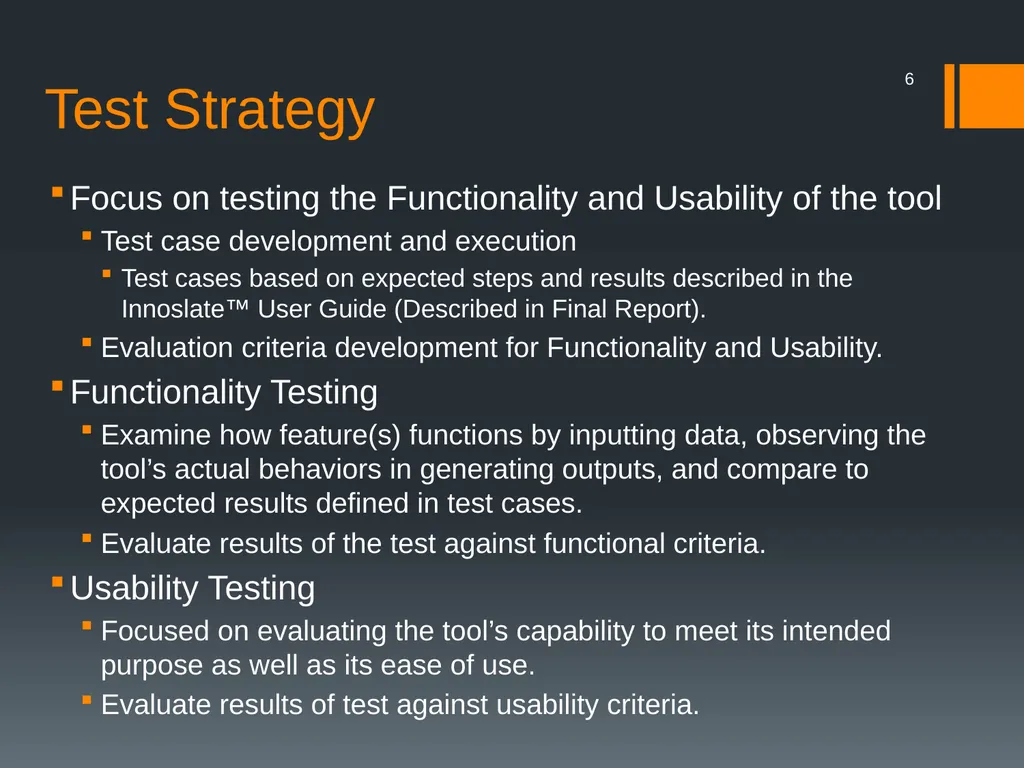
Test Strategy Focus on testing the Functionality and Usability of the tool
Test case development and execution
Test cases based on expected steps and results described in the Innoslate™ User Guide (Described in Final Report).
Evaluation criteria development for Functionality and Usability.
Functionality Testing
Examine how feature(s) functions by inputting data, observing the tool’s actual behaviors in generating outputs, and compare to expected results defined in test cases.
Evaluate results of the test against functional criteria.
Usability Testing
Focused on evaluating the tool’s capability to meet its intended purpose as well as its ease of use.
Evaluate results of test against usability criteria. 6<br>
Test case development and execution
Test cases based on expected steps and results described in the Innoslate™ User Guide (Described in Final Report).
Evaluation criteria development for Functionality and Usability.
Functionality Testing
Examine how feature(s) functions by inputting data, observing the tool’s actual behaviors in generating outputs, and compare to expected results defined in test cases.
Evaluate results of the test against functional criteria.
Usability Testing
Focused on evaluating the tool’s capability to meet its intended purpose as well as its ease of use.
Evaluate results of test against usability criteria. 6<br>
07
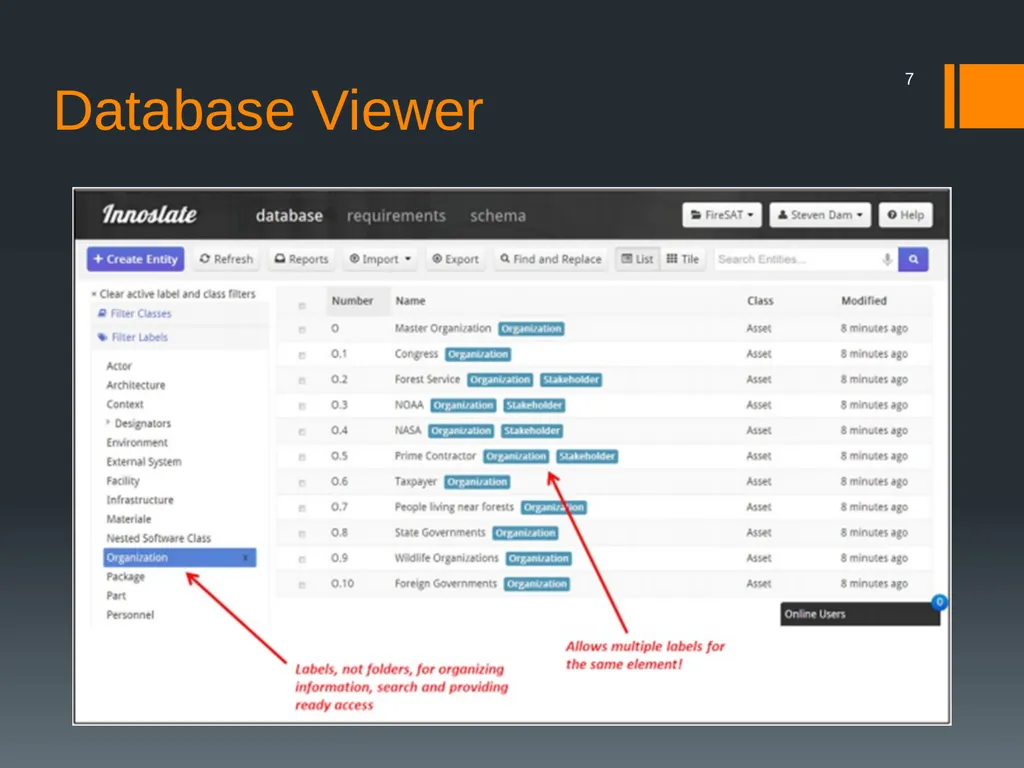
Database Viewer 7<br>
08
Database Viewer – User Experience Robustly designed and developed function providing the ability to create, save, and view various types of class entities such as Assets, Artifacts, and Requirement statements.
User interface browse viewer demonstrates efficient organization of persisted content entities.
Dynamic sorting, filtering, and search functions enables users to find information easily.
Offers the system engineer a valued tool for managing the variety of data elements that comprise system artifacts and documents. 8<br>
User interface browse viewer demonstrates efficient organization of persisted content entities.
Dynamic sorting, filtering, and search functions enables users to find information easily.
Offers the system engineer a valued tool for managing the variety of data elements that comprise system artifacts and documents. 8<br>
09
Database Viewer – Recommendations Include a “Caution/Alert” dialog message to user about data loss when navigating away from an entity create/edit screen.
Include a graphic indicator to denote that an entity contains one or more attached files.
Provide the capability to delete files attached to existing database entities.
Provide a multi-attribute sort capability including the Class attribute within the Database view. 9<br>
Include a graphic indicator to denote that an entity contains one or more attached files.
Provide the capability to delete files attached to existing database entities.
Provide a multi-attribute sort capability including the Class attribute within the Database view. 9<br>
10
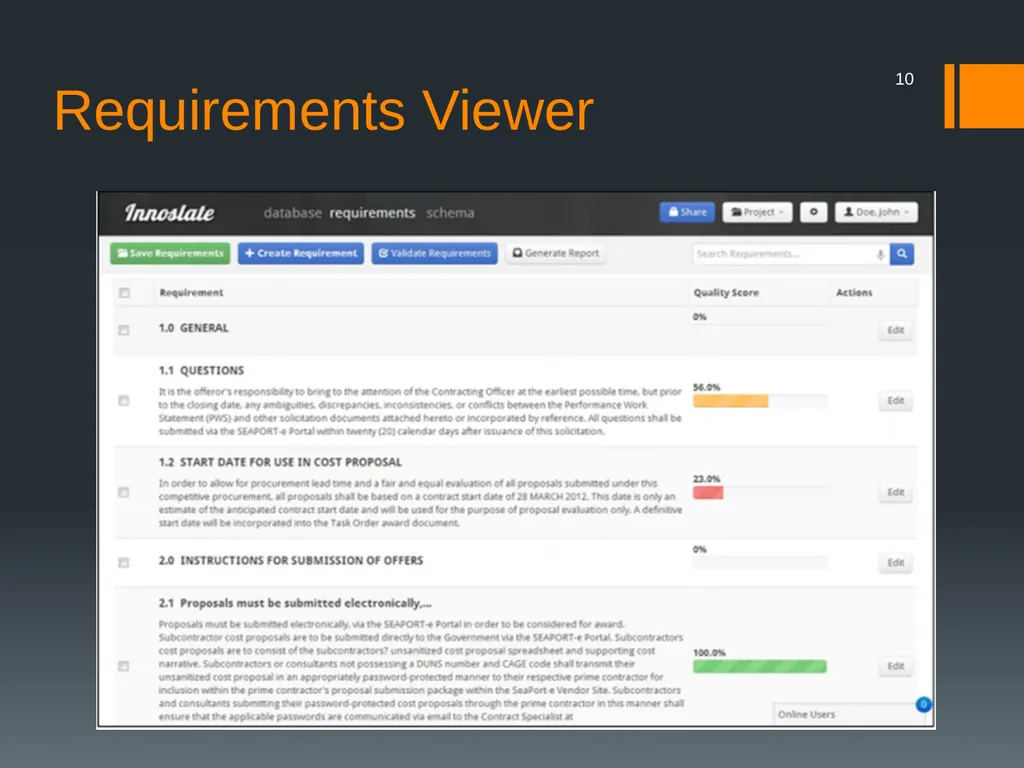
Requirements Viewer 10<br>
11
Requirements Viewer – User Experience Though Requirements Viewer has all basic features to create and manage a project’s requirements, overall, users felt that this capability could evolve to offer more robustness and better performance.
Users did find the validation feature extremely useful enabling systems engineers evaluate the quality of their requirements.
The ability to easily create predefined and custom relations to other entities is a very powerful feature that helps to build traceability into the project.
Addition of advanced charting/diagramming capabilities and support for creating a batch of requirements would greatly enhance this feature’s usefulness. 11<br>
Users did find the validation feature extremely useful enabling systems engineers evaluate the quality of their requirements.
The ability to easily create predefined and custom relations to other entities is a very powerful feature that helps to build traceability into the project.
Addition of advanced charting/diagramming capabilities and support for creating a batch of requirements would greatly enhance this feature’s usefulness. 11<br>
12
Requirements Viewer – Recommendations Provide automatic-numbering of requirements or perhaps provide a visual display noting the current numbering scheme.
Provide a progress bar when running the requirements validation function.
Provide the capability to add multiple requirements at once without having to exit to the database view after creating each requirement. 12<br>
Provide a progress bar when running the requirements validation function.
Provide the capability to add multiple requirements at once without having to exit to the database view after creating each requirement. 12<br>
13
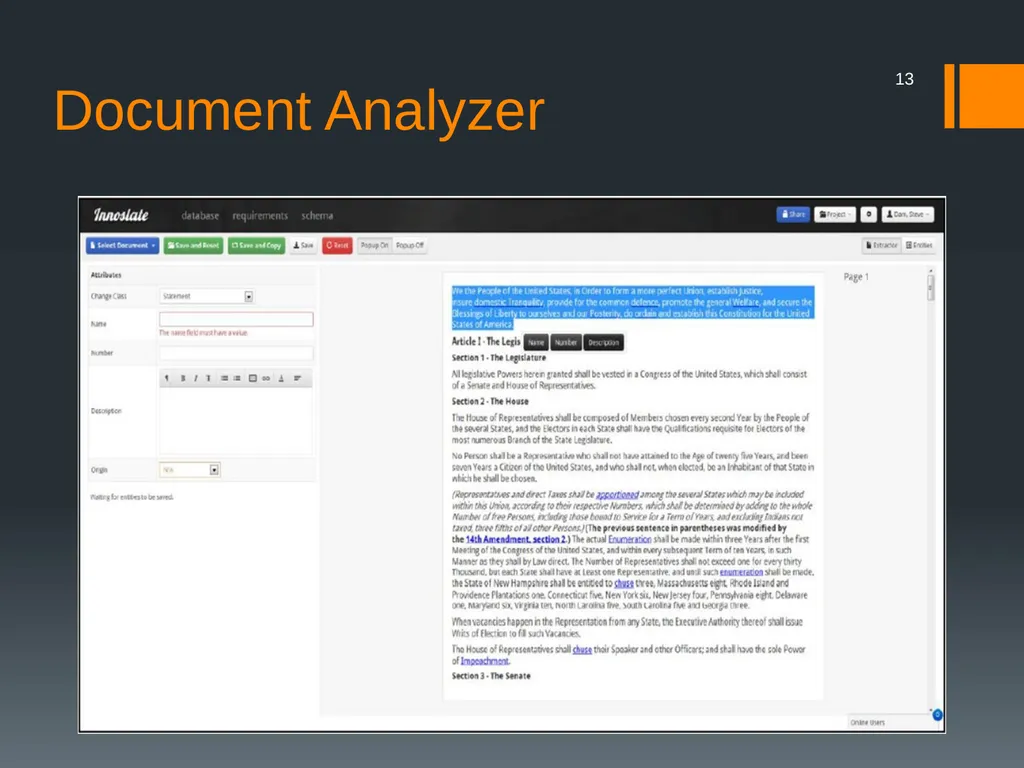
Document Analyzer 13<br>
14
Document Analyzer – User Experience Enables users to easily archive systems engineering artifacts in a single location.
Alleviates users from acquiring and managing other content management tools such as SharePoint.
Can easily leverage existing content from existing artifacts stored in the Innoslate™ database, establish relationships between artifacts and other entities within Innoslate™.
Improves traceability, i.e., requirements, architecture mapping. 14<br>
Alleviates users from acquiring and managing other content management tools such as SharePoint.
Can easily leverage existing content from existing artifacts stored in the Innoslate™ database, establish relationships between artifacts and other entities within Innoslate™.
Improves traceability, i.e., requirements, architecture mapping. 14<br>
15
Document Analyzer – Recommendations Provide explicit message that upload was completed successfully.
Provide error messages that describe the specific reason for upload failures.
During automatic parsing, provide a progress bar to show the status of the parsing process, i.e., percent complete.
During manual parsing, if a file fails to appear in the extractor window after import, provide a message that describes why a file failed to appear in the extractor window (e.g., perhaps user uploads wrong PDF-version). 15<br>
Provide error messages that describe the specific reason for upload failures.
During automatic parsing, provide a progress bar to show the status of the parsing process, i.e., percent complete.
During manual parsing, if a file fails to appear in the extractor window after import, provide a message that describes why a file failed to appear in the extractor window (e.g., perhaps user uploads wrong PDF-version). 15<br>
16
Report Generator 16<br>
17
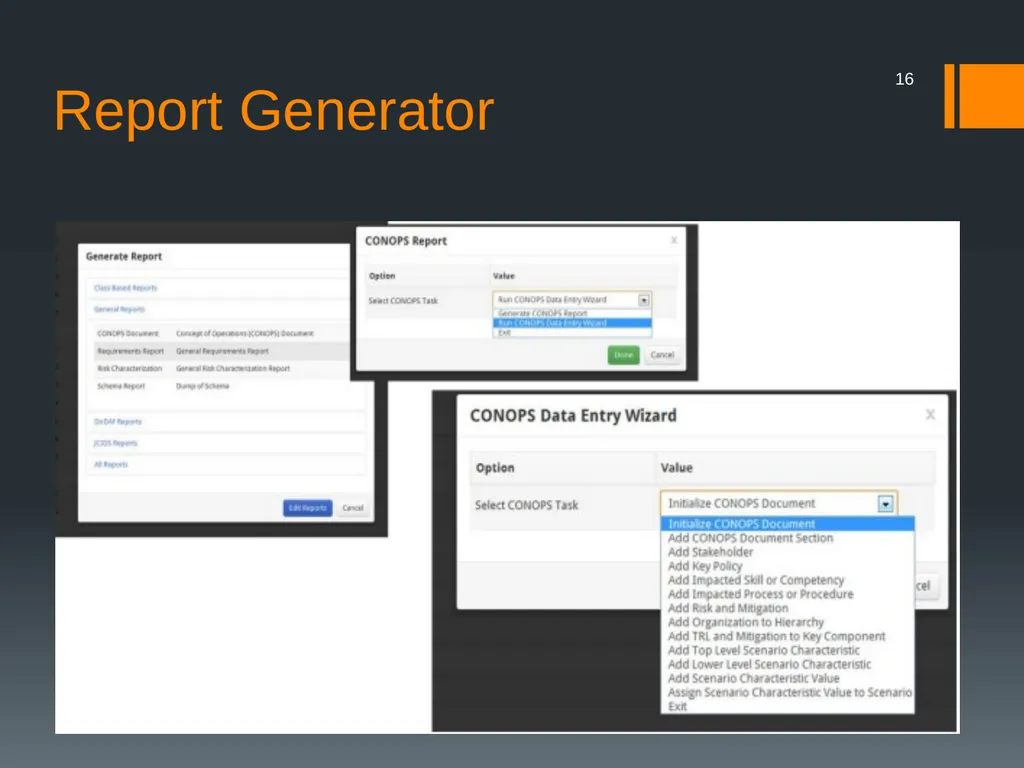
Report Generator – User Experience Offers an impressive list of reports and diagrams that can be easily generated and tailored to meet a systems engineer’s needs.
Enables systems engineers to create common document framework for industry recognized documents and tailor for project’s specific needs.
Offers a single location for content management by storing all reports (Word format) and document frameworks in the database.
Currently successfully generates:
CONOPS
Class Based Reports, i.e., Requirements Documents
Joint Capabilities Integration Development System (JCIDS) Report 17<br>
Enables systems engineers to create common document framework for industry recognized documents and tailor for project’s specific needs.
Offers a single location for content management by storing all reports (Word format) and document frameworks in the database.
Currently successfully generates:
CONOPS
Class Based Reports, i.e., Requirements Documents
Joint Capabilities Integration Development System (JCIDS) Report 17<br>
18
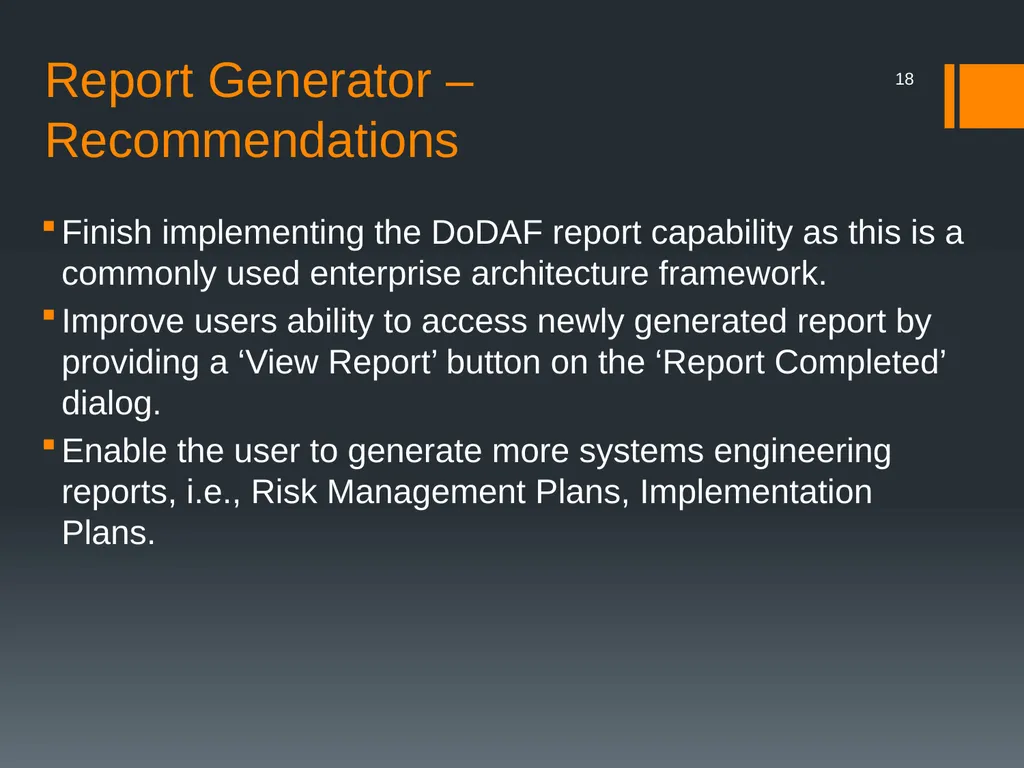
Report Generator – Recommendations Finish implementing the DoDAF report capability as this is a commonly used enterprise architecture framework.
Improve users ability to access newly generated report by providing a ‘View Report’ button on the ‘Report Completed’ dialog.
Enable the user to generate more systems engineering reports, i.e., Risk Management Plans, Implementation Plans. 18<br>
Improve users ability to access newly generated report by providing a ‘View Report’ button on the ‘Report Completed’ dialog.
Enable the user to generate more systems engineering reports, i.e., Risk Management Plans, Implementation Plans. 18<br>
19
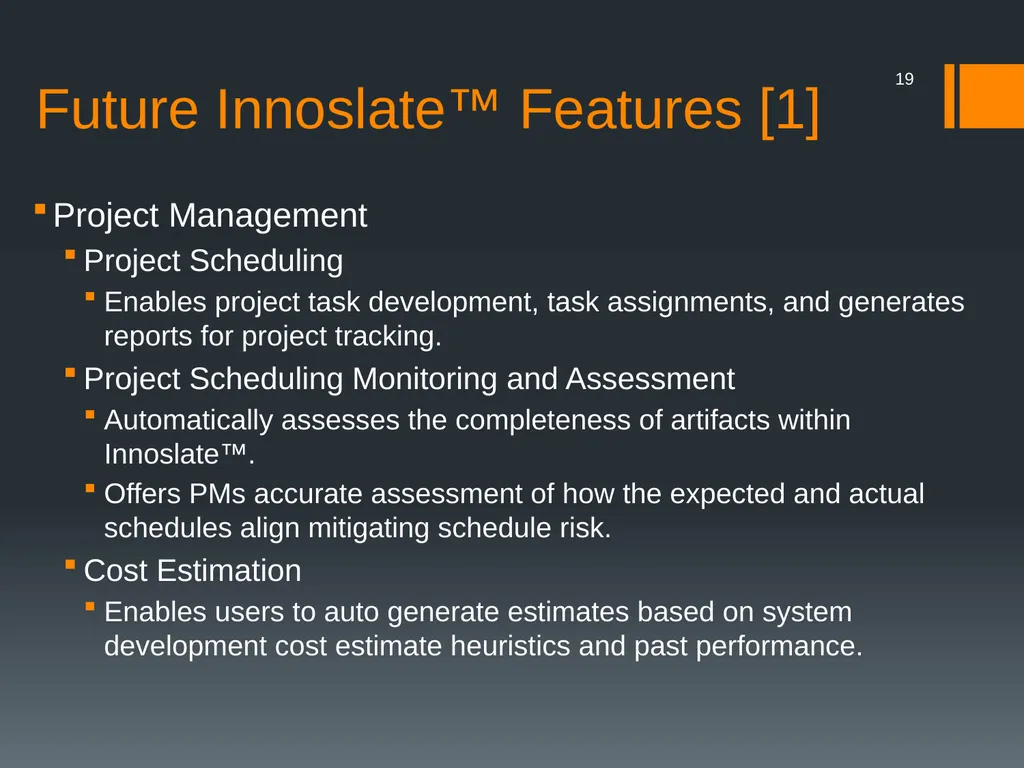
Future Innoslate™ Features [1] Project Management
Project Scheduling
Enables project task development, task assignments, and generates reports for project tracking.
Project Scheduling Monitoring and Assessment
Automatically assesses the completeness of artifacts within Innoslate™.
Offers PMs accurate assessment of how the expected and actual schedules align mitigating schedule risk.
Cost Estimation
Enables users to auto generate estimates based on system development cost estimate heuristics and past performance. 19<br>
Project Scheduling
Enables project task development, task assignments, and generates reports for project tracking.
Project Scheduling Monitoring and Assessment
Automatically assesses the completeness of artifacts within Innoslate™.
Offers PMs accurate assessment of how the expected and actual schedules align mitigating schedule risk.
Cost Estimation
Enables users to auto generate estimates based on system development cost estimate heuristics and past performance. 19<br>
20
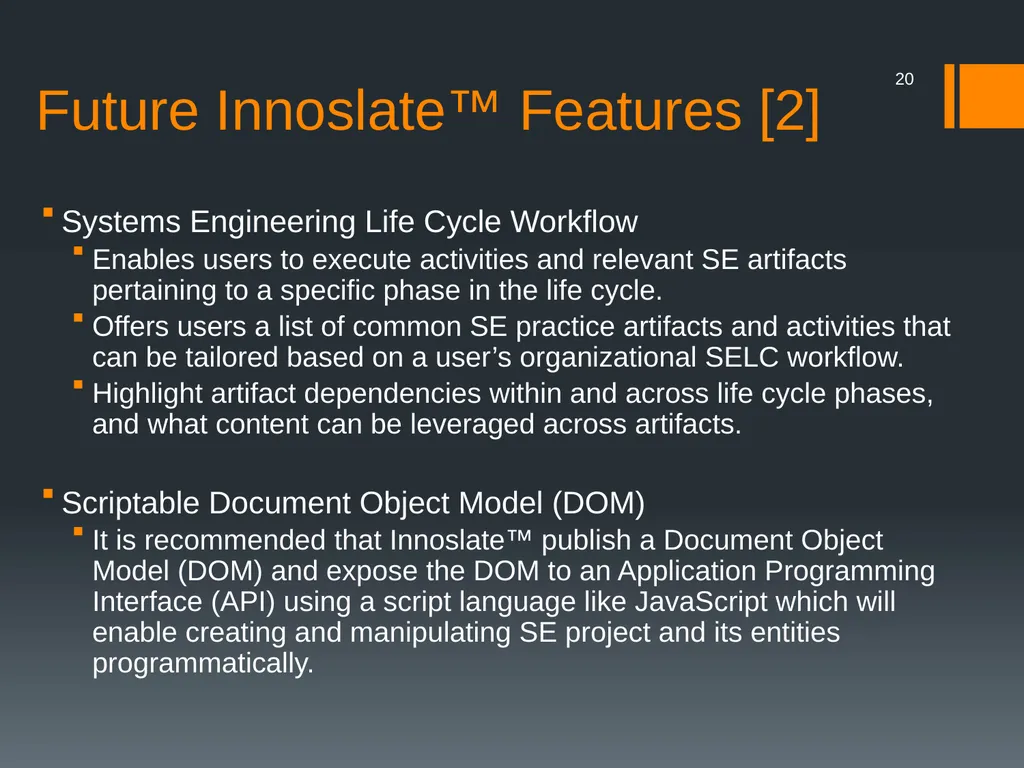
Future Innoslate™ Features [2] Systems Engineering Life Cycle Workflow
Enables users to execute activities and relevant SE artifacts pertaining to a specific phase in the life cycle.
Offers users a list of common SE practice artifacts and activities that can be tailored based on a user’s organizational SELC workflow.
Highlight artifact dependencies within and across life cycle phases, and what content can be leveraged across artifacts.
Scriptable Document Object Model (DOM)
It is recommended that Innoslate™ publish a Document Object Model (DOM) and expose the DOM to an Application Programming Interface (API) using a script language like JavaScript which will enable creating and manipulating SE project and its entities programmatically. 20<br>
Enables users to execute activities and relevant SE artifacts pertaining to a specific phase in the life cycle.
Offers users a list of common SE practice artifacts and activities that can be tailored based on a user’s organizational SELC workflow.
Highlight artifact dependencies within and across life cycle phases, and what content can be leveraged across artifacts.
Scriptable Document Object Model (DOM)
It is recommended that Innoslate™ publish a Document Object Model (DOM) and expose the DOM to an Application Programming Interface (API) using a script language like JavaScript which will enable creating and manipulating SE project and its entities programmatically. 20<br>
21
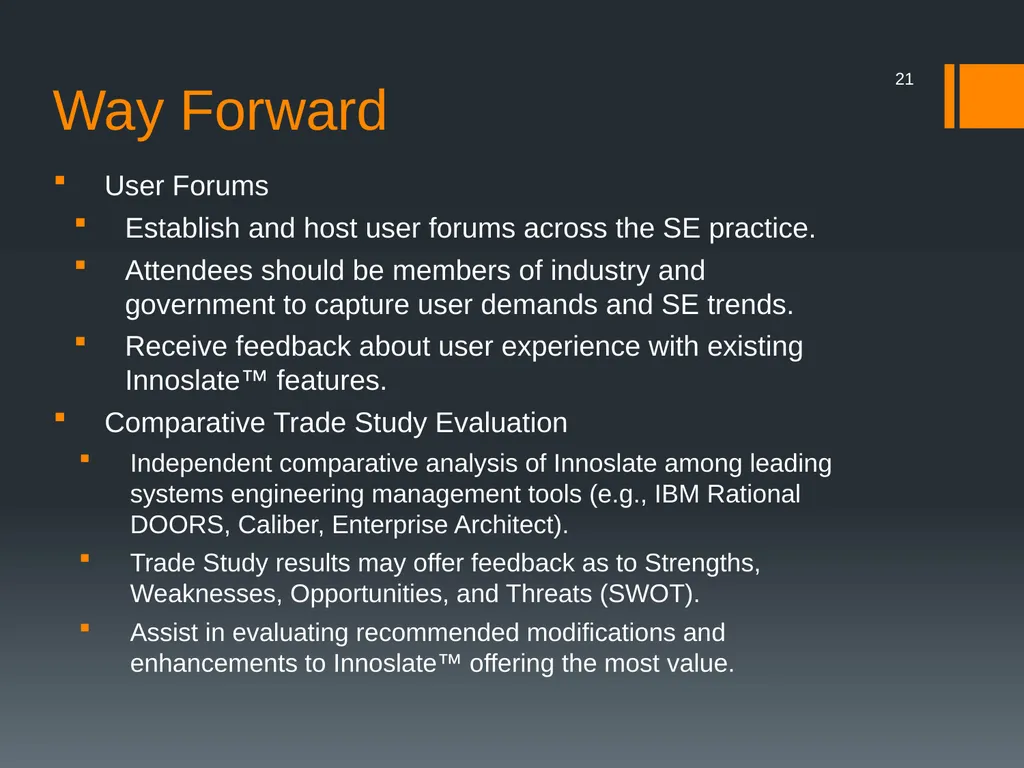
Way Forward User Forums
Establish and host user forums across the SE practice.
Attendees should be members of industry and government to capture user demands and SE trends.
Receive feedback about user experience with existing Innoslate™ features.
Comparative Trade Study Evaluation
Independent comparative analysis of Innoslate among leading systems engineering management tools (e.g., IBM Rational DOORS, Caliber, Enterprise Architect).
Trade Study results may offer feedback as to Strengths, Weaknesses, Opportunities, and Threats (SWOT).
Assist in evaluating recommended modifications and enhancements to Innoslate™ offering the most value. 21<br>
Establish and host user forums across the SE practice.
Attendees should be members of industry and government to capture user demands and SE trends.
Receive feedback about user experience with existing Innoslate™ features.
Comparative Trade Study Evaluation
Independent comparative analysis of Innoslate among leading systems engineering management tools (e.g., IBM Rational DOORS, Caliber, Enterprise Architect).
Trade Study results may offer feedback as to Strengths, Weaknesses, Opportunities, and Threats (SWOT).
Assist in evaluating recommended modifications and enhancements to Innoslate™ offering the most value. 21<br>
22
Acknowledgments Thank you to our sponsors at SPEC Innovations:
Dr. Steven H. Dam, Ph.D
Chris Ritter
Thank you to our advisor, Dr. Karla Hoffman
Thank you to GMU’s SYST and OR departments 22<br>
Dr. Steven H. Dam, Ph.D
Chris Ritter
Thank you to our advisor, Dr. Karla Hoffman
Thank you to GMU’s SYST and OR departments 22<br>
23
Questions and Answers 23<br>