
Innovative Financial Solutions and Green Financing




Description: Innovative Financial Solutions and Green Financing Role of CMAs ESG - BFSI - ICMAI Dr Jnm Dr JNM Introduction What is Green Finance? Every year we can feel hotter summer for prolonged period Dr JNM Green finance Green finance refers to
Related Topics
Download Presentation
"Innovative Financial Solutions and Green Financing" is the property of its rightful owner. Permission is granted to download and print the materials on this website for personal, non-commercial use only, and to display it on your personal computer provided you do not modify the materials and that you retain all copyright notices contained in the materials. By downloading content from our website, you accept the terms of this agreement.
Presentation Transcript
slide1. Innovative Financial Solutions and Green Financing – Role of CMAs
ESG - BFSI - ICMAI Dr Jnm Dr JNM<br>
slide2. Introduction • What is Green Finance?
Every year we can feel hotter summer for prolonged period Dr JNM<br>
slide3. Green finance Green finance refers to providing financial support for projects that have a positive impact on the environment, such as renewable energy, energy-efficient buildings, sustainable agriculture etc.
It encompasses various financial products and services designed to promote environmentally friendly activities Dr JNM<br>
slide4. Maxim ‘We have inherited this earth from our ancestors; we cannot afford to borrow it from our children too’.
It is a collective responsibility to leave a habitable planet for future generations, and thus we must refrain from irresponsible use of natural resources. Dr JNM<br>
slide5. Green finance aims to: By integrating environmental, social, and governance (ESG) factors into financial decision-making, green finance aims to align economic growth with sustainability objectives.
The expansion of green finance is driven by global initiatives like the Paris Agreement and the United Nations Sustainable Development Goals (SDGs), as well as increasing regulatory pressures, investor demand, and corporate sustainability.
The emergence of green finance driven by increasing awareness of climate change, regulatory frameworks, and investor demand for sustainable investments. Dr JNM<br>
slide6. Green finance aims to: Dr JNM Support economic growth and development while ensuring environmental sustainability.
Promote investments in environmentally friendly projects : renewable energy, pollution prevention, sustainable agriculture.
Encourage the transition to a low-carbon, climate-resilient economy by financing initiatives that reduce greenhouse gas emissions
Integrate environmental risks into financial decision-making to ensure long-term financial and environmental sustainability.<br>
slide7. Green finance aims to: Mobilize private and public capital through green bonds, carbon credits, and ESG-focused investment funds.
Support innovation in green technologies by funding research, startups, and new business models that prioritize sustainability.
Ensure accountability and transparency in how funds are used and their environmental impact measured. Dr JNM<br>
slide8. Green Finance Green bonds - Debt instruments issued to raise capital for projects with environmental benefits (e.g., solar parks, clean transportation)
Green loans -- Loans provided specifically for green projects, often with favorable terms for borrowers meeting sustainability criteria.
Sustainable Investment Funds
Mutual funds or ETFs that invest in companies or assets meeting ESG standards.
. Dr JNM<br>
slide9. When was the first Green Bonds issued in India Dr JNM<br>
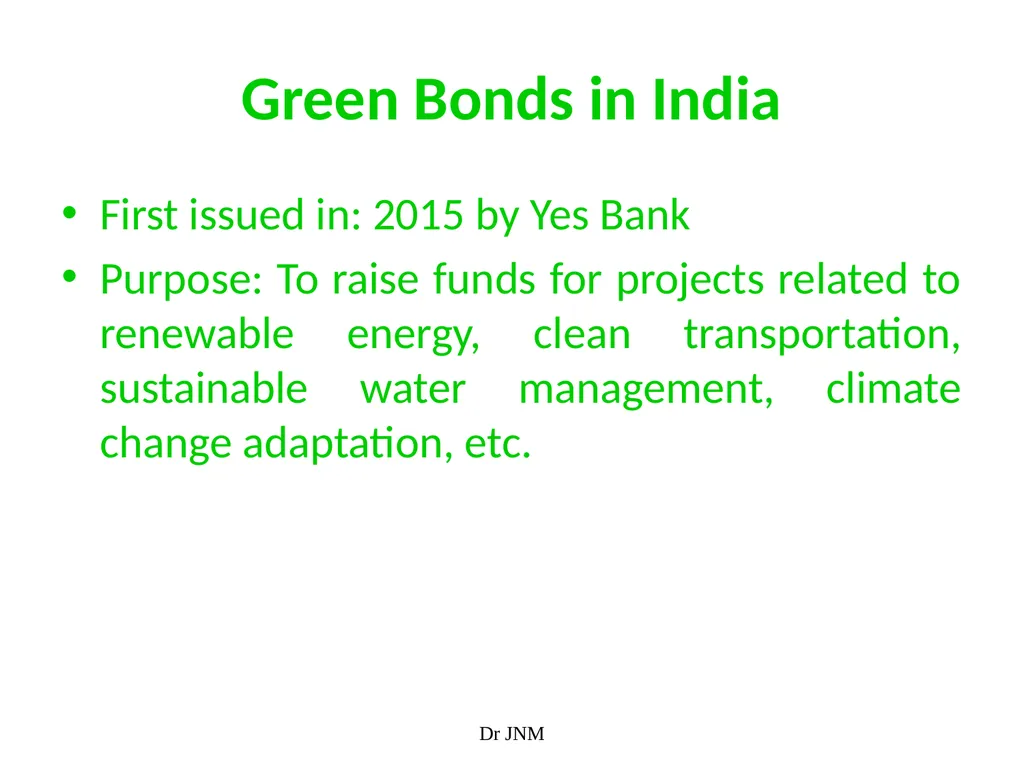
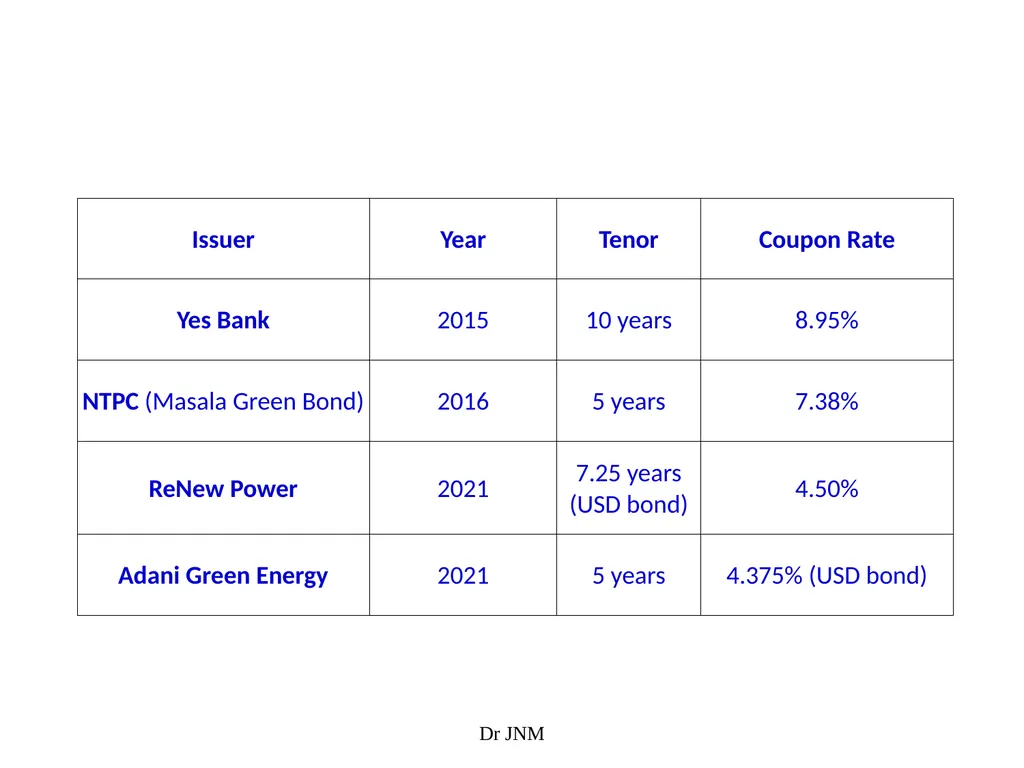
slide10. Green Bonds in India First issued in: 2015 by Yes Bank
Purpose: To raise funds for projects related to renewable energy, clean transportation, sustainable water management, climate change adaptation, etc. Dr JNM<br>
slide11. What is a Masala Bond
When was the first Green Masala Bond isued in India and by whom Dr JNM<br>
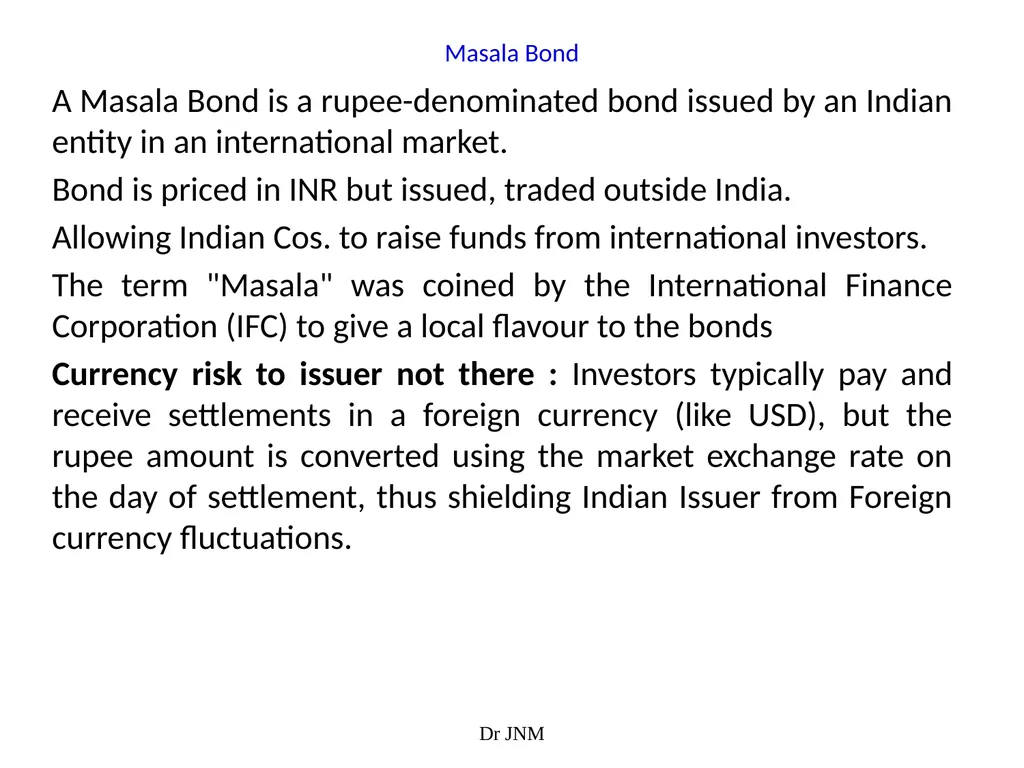
slide12. Masala Bond A Masala Bond is a rupee-denominated bond issued by an Indian entity in an international market.
Bond is priced in INR but issued, traded outside India.
Allowing Indian Cos. to raise funds from international investors.
The term "Masala" was coined by the International Finance Corporation (IFC) to give a local flavour to the bonds
Currency risk to issuer not there : Investors typically pay and receive settlements in a foreign currency (like USD), but the rupee amount is converted using the market exchange rate on the day of settlement, thus shielding Indian Issuer from Foreign currency fluctuations. Dr JNM<br>
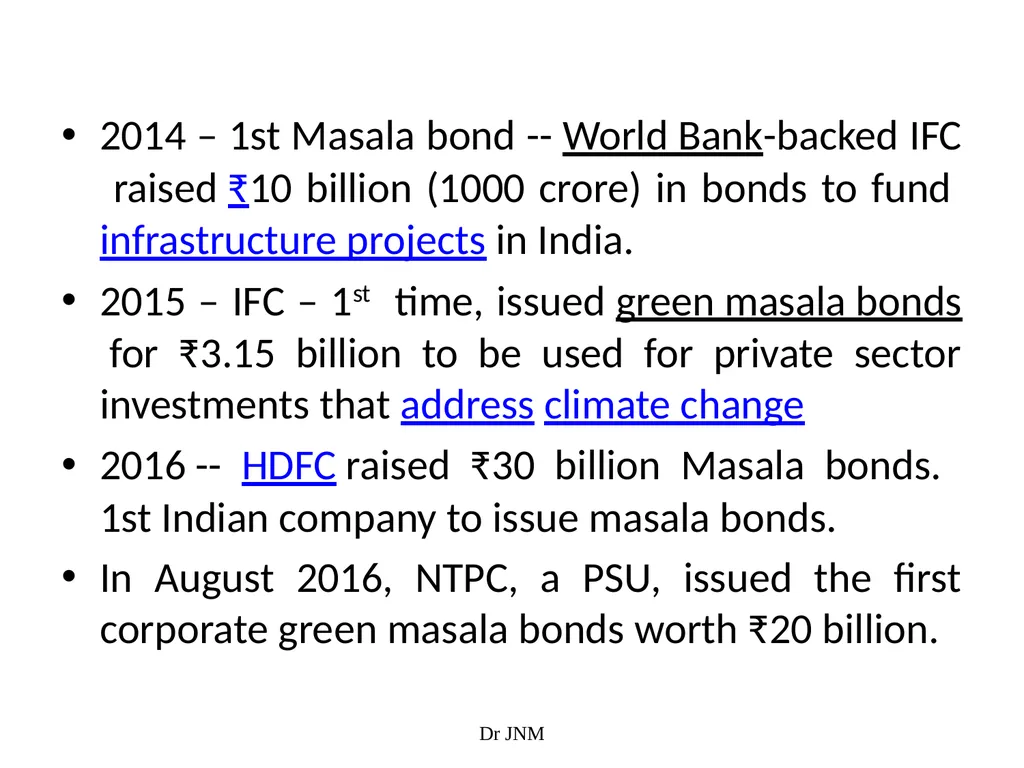
slide13. 2014 – 1st Masala bond -- World Bank-backed IFC raised ₹10 billion (1000 crore) in bonds to fund infrastructure projects in India.
2015 – IFC – 1st time, issued green masala bonds for ₹3.15 billion to be used for private sector investments that address climate change
2016 -- HDFC raised ₹30 billion Masala bonds. 1st Indian company to issue masala bonds.
In August 2016, NTPC, a PSU, issued the first corporate green masala bonds worth ₹20 billion. Dr JNM<br>
slide14. NTPC’s Green Masala Bond in 2016 Dr JNM<br>
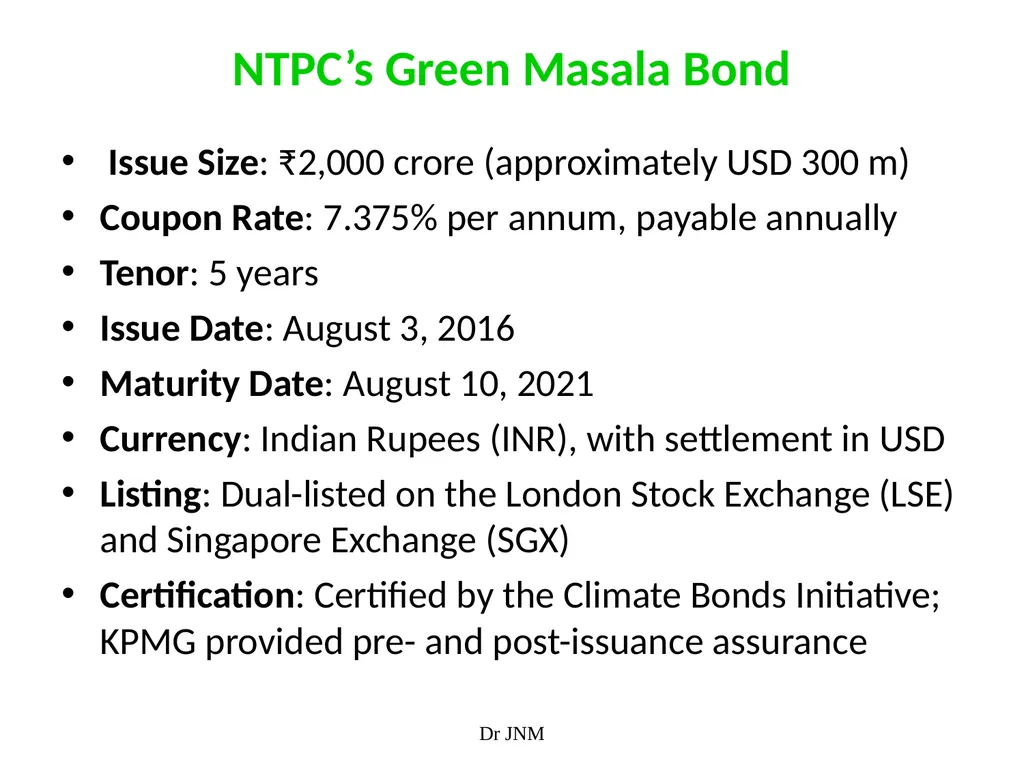
slide15. NTPC’s Green Masala Bond Issue Size: ₹2,000 crore (approximately USD 300 m)
Coupon Rate: 7.375% per annum, payable annually
Tenor: 5 years
Issue Date: August 3, 2016
Maturity Date: August 10, 2021
Currency: Indian Rupees (INR), with settlement in USD
Listing: Dual-listed on the London Stock Exchange (LSE) and Singapore Exchange (SGX)
Certification: Certified by the Climate Bonds Initiative; KPMG provided pre- and post-issuance assurance Dr JNM<br>
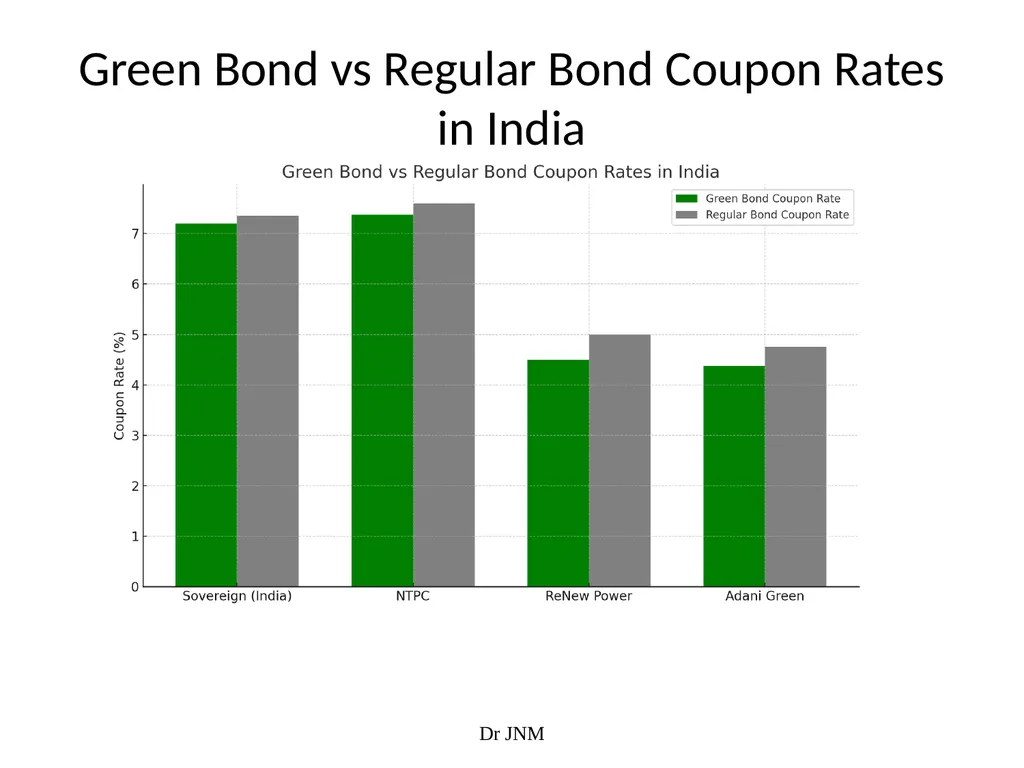
slide16. USD-denominated green bonds from Indian issuers often have lower coupons (due to global investor interest and lower rates abroad).
Sovereign Green Bonds: ~7.1% to 7.3%
Corporate INR Green Bonds: ~7% to 9%
International Green Bonds (USD): ~4% to 5%
Green bonds have lower coupon rates Dr JNM<br>
slide17. Green Bond vs Regular Bond Coupon Rates in India Dr JNM<br>
slide18. Dr JNM<br>
slide19. Innovations in Green Finance Dr JNM<br>
slide20. Innovations in Green Finance 1. Green Bonds with Smart Contracts
Integrating blockchain-based smart contracts can enhance transparency and accountability.
These smart contracts automatically track and verify the environmental impact of funded projects, ensuring compliance with sustainability targets.
Example:
The World Bank and the European Investment Bank have experimented with blockchain-based green bonds, which provide real-time tracking of fund usage Dr JNM<br>
slide21. Innovations in Green Finance Sustainability-Linked Loans (SLLs)
SLLs adjust interest rates based on a company’s environmental performance. If a borrower meets sustainability targets (such as carbon reduction), they receive lower interest rates.
Example:
Companies like Danone and Unilever have secured SLLs tied to their carbon reduction and water conservation efforts. Dr JNM<br>
slide22. Thank You<br>
slide2. Introduction • What is Green Finance?
Every year we can feel hotter summer for prolonged period Dr JNM<br>
slide3. Green finance Green finance refers to providing financial support for projects that have a positive impact on the environment, such as renewable energy, energy-efficient buildings, sustainable agriculture etc.
It encompasses various financial products and services designed to promote environmentally friendly activities Dr JNM<br>
slide4. Maxim ‘We have inherited this earth from our ancestors; we cannot afford to borrow it from our children too’.
It is a collective responsibility to leave a habitable planet for future generations, and thus we must refrain from irresponsible use of natural resources. Dr JNM<br>
slide5. Green finance aims to: By integrating environmental, social, and governance (ESG) factors into financial decision-making, green finance aims to align economic growth with sustainability objectives.
The expansion of green finance is driven by global initiatives like the Paris Agreement and the United Nations Sustainable Development Goals (SDGs), as well as increasing regulatory pressures, investor demand, and corporate sustainability.
The emergence of green finance driven by increasing awareness of climate change, regulatory frameworks, and investor demand for sustainable investments. Dr JNM<br>
slide6. Green finance aims to: Dr JNM Support economic growth and development while ensuring environmental sustainability.
Promote investments in environmentally friendly projects : renewable energy, pollution prevention, sustainable agriculture.
Encourage the transition to a low-carbon, climate-resilient economy by financing initiatives that reduce greenhouse gas emissions
Integrate environmental risks into financial decision-making to ensure long-term financial and environmental sustainability.<br>
slide7. Green finance aims to: Mobilize private and public capital through green bonds, carbon credits, and ESG-focused investment funds.
Support innovation in green technologies by funding research, startups, and new business models that prioritize sustainability.
Ensure accountability and transparency in how funds are used and their environmental impact measured. Dr JNM<br>
slide8. Green Finance Green bonds - Debt instruments issued to raise capital for projects with environmental benefits (e.g., solar parks, clean transportation)
Green loans -- Loans provided specifically for green projects, often with favorable terms for borrowers meeting sustainability criteria.
Sustainable Investment Funds
Mutual funds or ETFs that invest in companies or assets meeting ESG standards.
. Dr JNM<br>
slide9. When was the first Green Bonds issued in India Dr JNM<br>
slide10. Green Bonds in India First issued in: 2015 by Yes Bank
Purpose: To raise funds for projects related to renewable energy, clean transportation, sustainable water management, climate change adaptation, etc. Dr JNM<br>
slide11. What is a Masala Bond
When was the first Green Masala Bond isued in India and by whom Dr JNM<br>
slide12. Masala Bond A Masala Bond is a rupee-denominated bond issued by an Indian entity in an international market.
Bond is priced in INR but issued, traded outside India.
Allowing Indian Cos. to raise funds from international investors.
The term "Masala" was coined by the International Finance Corporation (IFC) to give a local flavour to the bonds
Currency risk to issuer not there : Investors typically pay and receive settlements in a foreign currency (like USD), but the rupee amount is converted using the market exchange rate on the day of settlement, thus shielding Indian Issuer from Foreign currency fluctuations. Dr JNM<br>
slide13. 2014 – 1st Masala bond -- World Bank-backed IFC raised ₹10 billion (1000 crore) in bonds to fund infrastructure projects in India.
2015 – IFC – 1st time, issued green masala bonds for ₹3.15 billion to be used for private sector investments that address climate change
2016 -- HDFC raised ₹30 billion Masala bonds. 1st Indian company to issue masala bonds.
In August 2016, NTPC, a PSU, issued the first corporate green masala bonds worth ₹20 billion. Dr JNM<br>
slide14. NTPC’s Green Masala Bond in 2016 Dr JNM<br>
slide15. NTPC’s Green Masala Bond Issue Size: ₹2,000 crore (approximately USD 300 m)
Coupon Rate: 7.375% per annum, payable annually
Tenor: 5 years
Issue Date: August 3, 2016
Maturity Date: August 10, 2021
Currency: Indian Rupees (INR), with settlement in USD
Listing: Dual-listed on the London Stock Exchange (LSE) and Singapore Exchange (SGX)
Certification: Certified by the Climate Bonds Initiative; KPMG provided pre- and post-issuance assurance Dr JNM<br>
slide16. USD-denominated green bonds from Indian issuers often have lower coupons (due to global investor interest and lower rates abroad).
Sovereign Green Bonds: ~7.1% to 7.3%
Corporate INR Green Bonds: ~7% to 9%
International Green Bonds (USD): ~4% to 5%
Green bonds have lower coupon rates Dr JNM<br>
slide17. Green Bond vs Regular Bond Coupon Rates in India Dr JNM<br>
slide18. Dr JNM<br>
slide19. Innovations in Green Finance Dr JNM<br>
slide20. Innovations in Green Finance 1. Green Bonds with Smart Contracts
Integrating blockchain-based smart contracts can enhance transparency and accountability.
These smart contracts automatically track and verify the environmental impact of funded projects, ensuring compliance with sustainability targets.
Example:
The World Bank and the European Investment Bank have experimented with blockchain-based green bonds, which provide real-time tracking of fund usage Dr JNM<br>
slide21. Innovations in Green Finance Sustainability-Linked Loans (SLLs)
SLLs adjust interest rates based on a company’s environmental performance. If a borrower meets sustainability targets (such as carbon reduction), they receive lower interest rates.
Example:
Companies like Danone and Unilever have secured SLLs tied to their carbon reduction and water conservation efforts. Dr JNM<br>
slide22. Thank You<br>