
InRAD Registry Observational Study Stichting
NS
Published · 16 slides · 0 views
1 / 1
Description
InRAD Registry Observational Study Stichting International Registry for Alzheimers disease and other Dementias (InRAD) Not-for-Profit Foundation Copyright International Registry for Alzheimers Disease and Other Dementias Foundation 2025
Related Topics
Share
Embed code
Download this presentation From Below
"InRAD Registry Observational Study Stichting" is the property of its rightful owner. Permission is granted to download and print the materials on this website for personal, non-commercial use only, and to display it on your personal computer provided you do not modify the materials and that you retain all copyright notices contained in the materials. By downloading content from our website, you accept the terms of this agreement.
Presentation Transcript
01
InRAD Registry Observational Study Stichting International Registry for Alzheimer’s disease
and other Dementias (InRAD) Not-for-Profit Foundation Copyright © International Registry for Alzheimer’s Disease and Other Dementias Foundation 2025
All rights reserved. This presentation and its content are protected by copyright laws
Unauthorised use or reproduction of any part of this presentation without prior written permission is strictly prohibited. https://www.inradnetwork.org/<br>
All rights reserved. This presentation and its content are protected by copyright laws
Unauthorised use or reproduction of any part of this presentation without prior written permission is strictly prohibited. https://www.inradnetwork.org/<br>
02
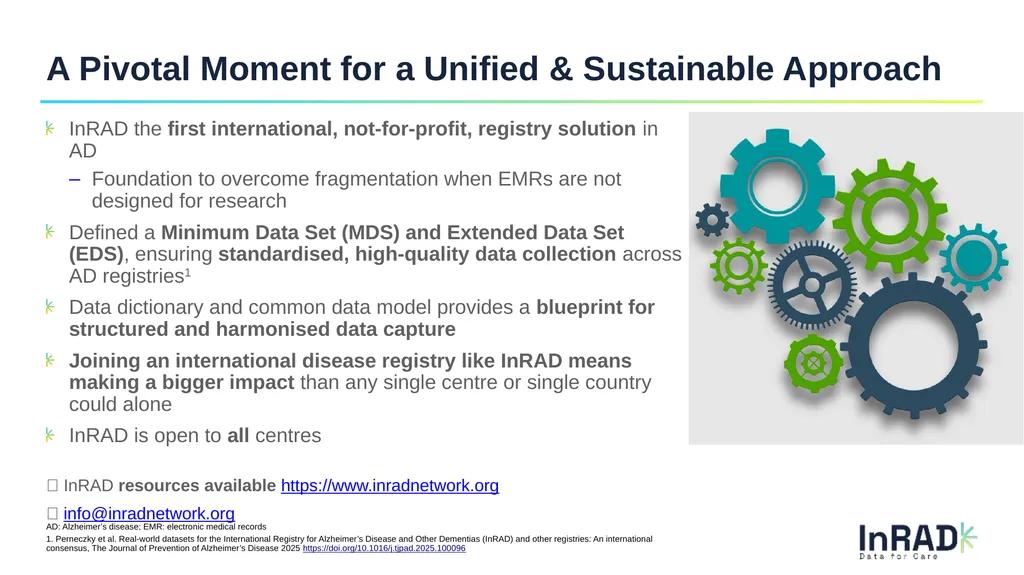
InRAD the first international, not-for-profit, registry solution in AD
Foundation to overcome fragmentation when EMRs are not designed for research
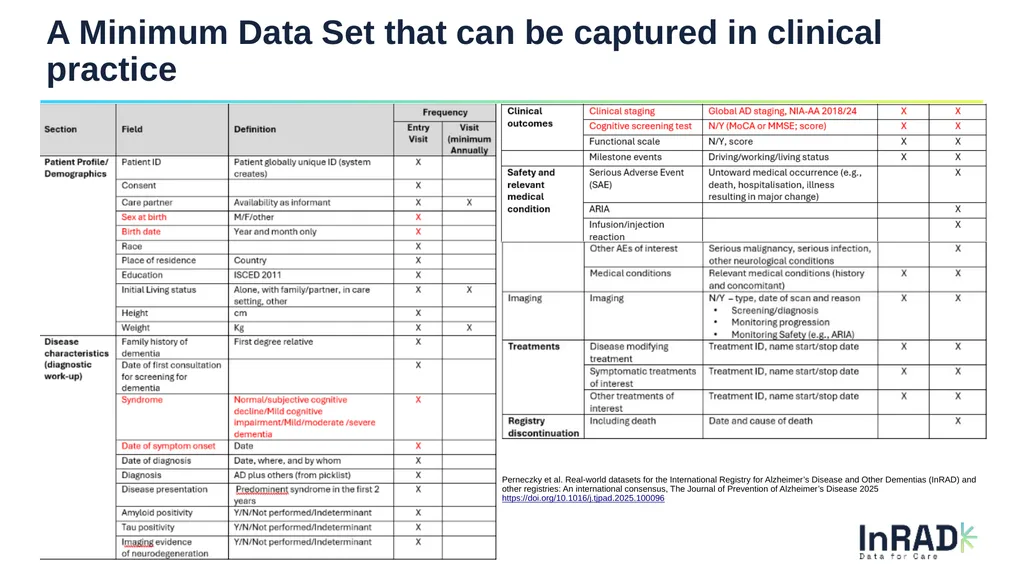
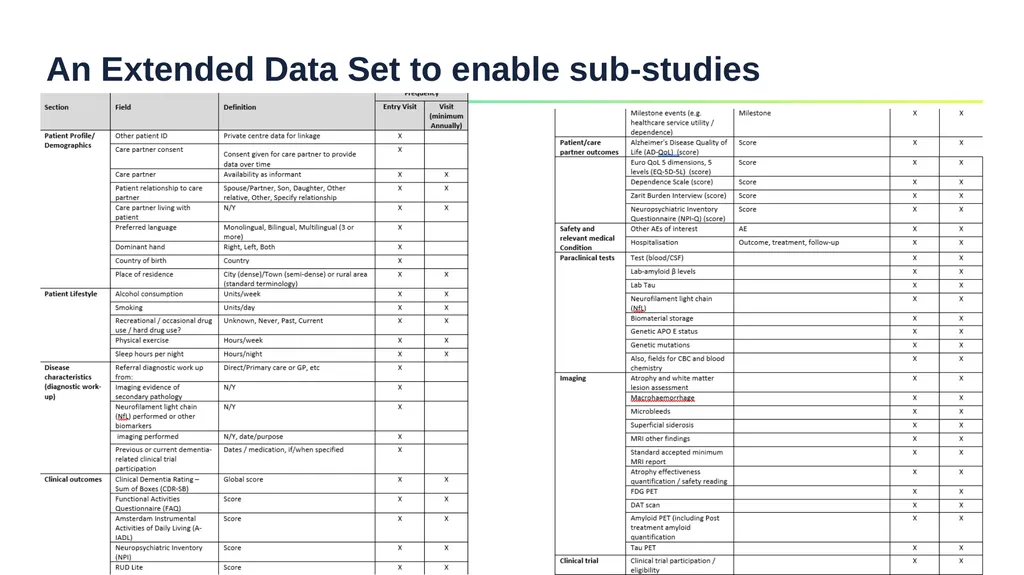
Defined a Minimum Data Set (MDS) and Extended Data Set (EDS), ensuring standardised, high-quality data collection across AD registries1
Data dictionary and common data model provides a blueprint for structured and harmonised data capture
Joining an international disease registry like InRAD means making a bigger impact than any single centre or single country could alone
InRAD is open to all centres
📌 InRAD resources available https://www.inradnetwork.org
📧 info@inradnetwork.org A Pivotal Moment for a Unified & Sustainable Approach AD: Alzheimer’s disease; EMR: electronic medical records
1. Perneczky et al. Real-world datasets for the International Registry for Alzheimer’s Disease and Other Dementias (InRAD) and other registries: An international consensus, The Journal of Prevention of Alzheimer’s Disease 2025 https://doi.org/10.1016/j.tjpad.2025.100096<br>
Foundation to overcome fragmentation when EMRs are not designed for research
Defined a Minimum Data Set (MDS) and Extended Data Set (EDS), ensuring standardised, high-quality data collection across AD registries1
Data dictionary and common data model provides a blueprint for structured and harmonised data capture
Joining an international disease registry like InRAD means making a bigger impact than any single centre or single country could alone
InRAD is open to all centres
📌 InRAD resources available https://www.inradnetwork.org
📧 info@inradnetwork.org A Pivotal Moment for a Unified & Sustainable Approach AD: Alzheimer’s disease; EMR: electronic medical records
1. Perneczky et al. Real-world datasets for the International Registry for Alzheimer’s Disease and Other Dementias (InRAD) and other registries: An international consensus, The Journal of Prevention of Alzheimer’s Disease 2025 https://doi.org/10.1016/j.tjpad.2025.100096<br>
03
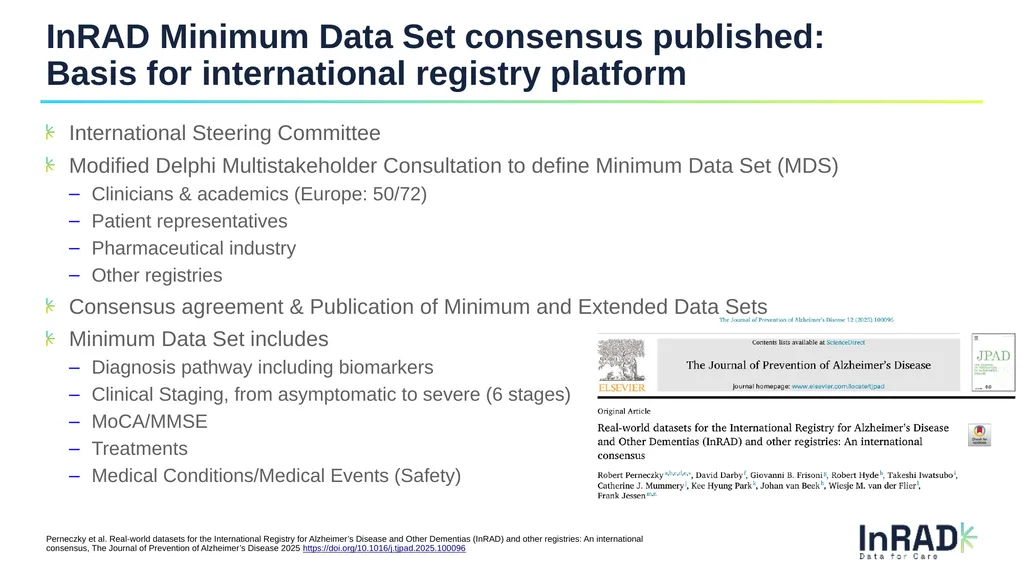
International Steering Committee
Modified Delphi Multistakeholder Consultation to define Minimum Data Set (MDS)
Clinicians & academics (Europe: 50/72)
Patient representatives
Pharmaceutical industry
Other registries
Consensus agreement & Publication of Minimum and Extended Data Sets
Minimum Data Set includes
Diagnosis pathway including biomarkers
Clinical Staging, from asymptomatic to severe (6 stages)
MoCA/MMSE
Treatments
Medical Conditions/Medical Events (Safety) InRAD Minimum Data Set consensus published: Basis for international registry platform Perneczky et al. Real-world datasets for the International Registry for Alzheimer’s Disease and Other Dementias (InRAD) and other registries: An international consensus, The Journal of Prevention of Alzheimer’s Disease 2025 https://doi.org/10.1016/j.tjpad.2025.100096<br>
Modified Delphi Multistakeholder Consultation to define Minimum Data Set (MDS)
Clinicians & academics (Europe: 50/72)
Patient representatives
Pharmaceutical industry
Other registries
Consensus agreement & Publication of Minimum and Extended Data Sets
Minimum Data Set includes
Diagnosis pathway including biomarkers
Clinical Staging, from asymptomatic to severe (6 stages)
MoCA/MMSE
Treatments
Medical Conditions/Medical Events (Safety) InRAD Minimum Data Set consensus published: Basis for international registry platform Perneczky et al. Real-world datasets for the International Registry for Alzheimer’s Disease and Other Dementias (InRAD) and other registries: An international consensus, The Journal of Prevention of Alzheimer’s Disease 2025 https://doi.org/10.1016/j.tjpad.2025.100096<br>
04
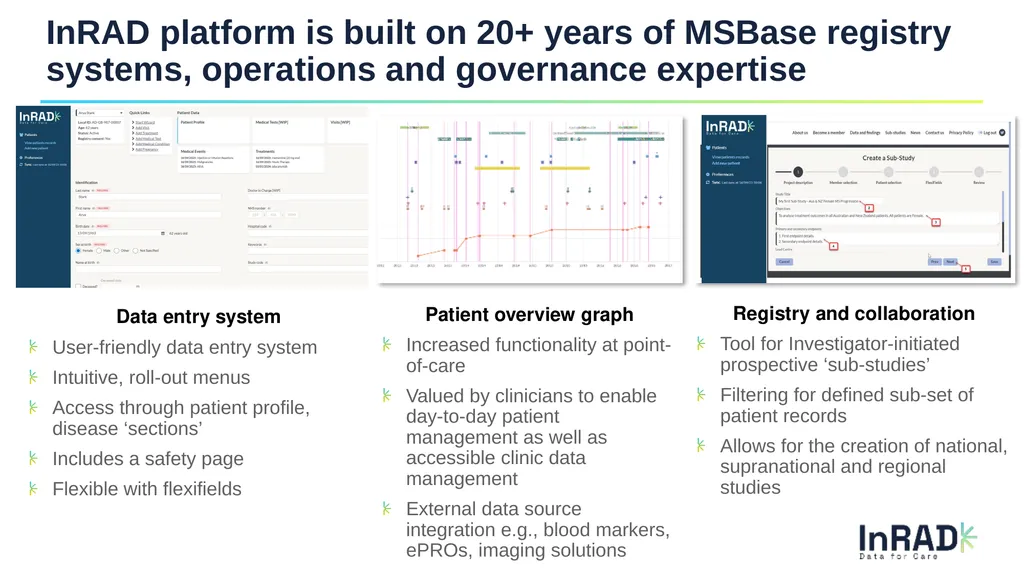
Data entry system
User-friendly data entry system
Intuitive, roll-out menus
Access through patient profile, disease ‘sections’
Includes a safety page
Flexible with flexifields InRAD platform is built on 20+ years of MSBase registry systems, operations and governance expertise Patient overview graph
Increased functionality at point-of-care
Valued by clinicians to enable day-to-day patient management as well as accessible clinic data management
External data source integration e.g., blood markers, ePROs, imaging solutions Registry and collaboration
Tool for Investigator-initiated prospective ‘sub-studies’
Filtering for defined sub-set of patient records
Allows for the creation of national, supranational and regional studies<br>
User-friendly data entry system
Intuitive, roll-out menus
Access through patient profile, disease ‘sections’
Includes a safety page
Flexible with flexifields InRAD platform is built on 20+ years of MSBase registry systems, operations and governance expertise Patient overview graph
Increased functionality at point-of-care
Valued by clinicians to enable day-to-day patient management as well as accessible clinic data management
External data source integration e.g., blood markers, ePROs, imaging solutions Registry and collaboration
Tool for Investigator-initiated prospective ‘sub-studies’
Filtering for defined sub-set of patient records
Allows for the creation of national, supranational and regional studies<br>
05
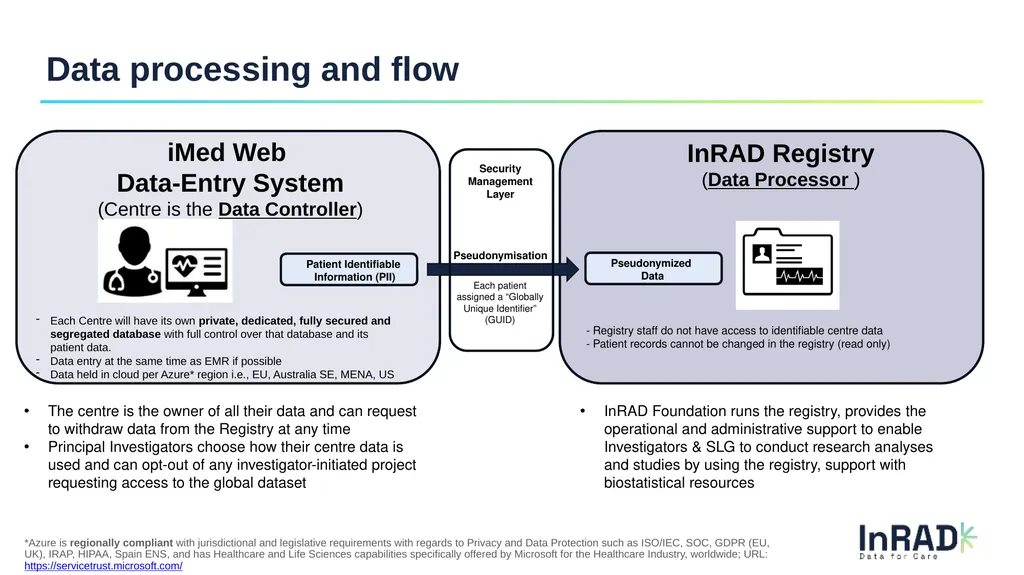
Data processing and flow Each Centre will have its own private, dedicated, fully secured and segregated database with full control over that database and its patient data.
Data entry at the same time as EMR if possible
Data held in cloud per Azure* region i.e., EU, Australia SE, MENA, US iMed Web
Data-Entry System
(Centre is the Data Controller) InRAD Registry
(Data Processor ) Pseudonymisation Security
Management
Layer The centre is the owner of all their data and can request to withdraw data from the Registry at any time
Principal Investigators choose how their centre data is used and can opt-out of any investigator-initiated project requesting access to the global dataset - Registry staff do not have access to identifiable centre data
- Patient records cannot be changed in the registry (read only) Each patient
assigned a “Globally Unique Identifier” (GUID) InRAD Foundation runs the registry, provides the operational and administrative support to enable Investigators & SLG to conduct research analyses and studies by using the registry, support with biostatistical resources *Azure is regionally compliant with jurisdictional and legislative requirements with regards to Privacy and Data Protection such as ISO/IEC, SOC, GDPR (EU, UK), IRAP, HIPAA, Spain ENS, and has Healthcare and Life Sciences capabilities specifically offered by Microsoft for the Healthcare Industry, worldwide; URL: https://servicetrust.microsoft.com/<br>
Data entry at the same time as EMR if possible
Data held in cloud per Azure* region i.e., EU, Australia SE, MENA, US iMed Web
Data-Entry System
(Centre is the Data Controller) InRAD Registry
(Data Processor ) Pseudonymisation Security
Management
Layer The centre is the owner of all their data and can request to withdraw data from the Registry at any time
Principal Investigators choose how their centre data is used and can opt-out of any investigator-initiated project requesting access to the global dataset - Registry staff do not have access to identifiable centre data
- Patient records cannot be changed in the registry (read only) Each patient
assigned a “Globally Unique Identifier” (GUID) InRAD Foundation runs the registry, provides the operational and administrative support to enable Investigators & SLG to conduct research analyses and studies by using the registry, support with biostatistical resources *Azure is regionally compliant with jurisdictional and legislative requirements with regards to Privacy and Data Protection such as ISO/IEC, SOC, GDPR (EU, UK), IRAP, HIPAA, Spain ENS, and has Healthcare and Life Sciences capabilities specifically offered by Microsoft for the Healthcare Industry, worldwide; URL: https://servicetrust.microsoft.com/<br>
06
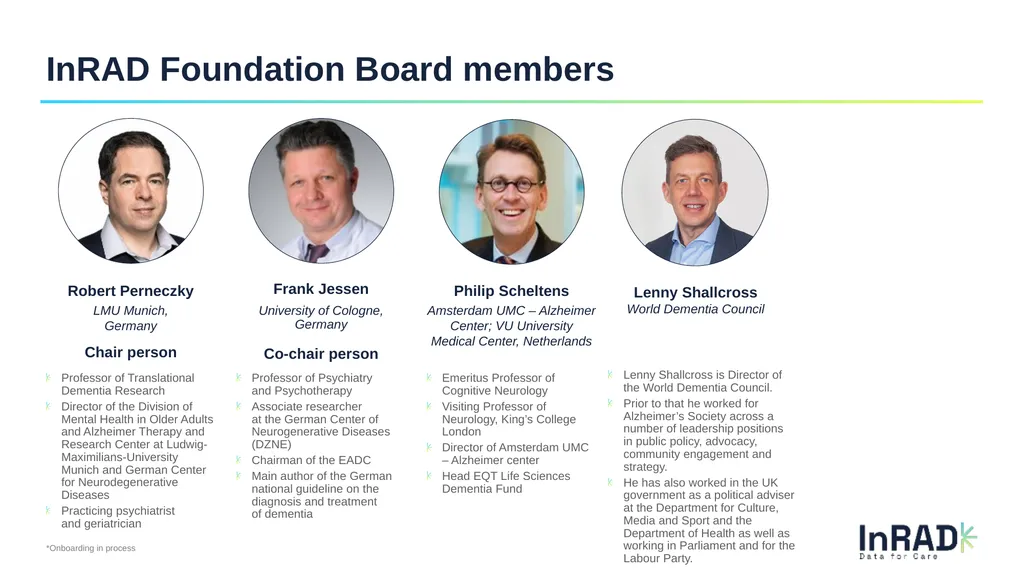
InRAD Foundation Board members *Onboarding in process Lenny Shallcross
World Dementia Council Lenny Shallcross is Director of the World Dementia Council.
Prior to that he worked for Alzheimer’s Society across a number of leadership positions in public policy, advocacy, community engagement and strategy.
He has also worked in the UK government as a political adviser at the Department for Culture, Media and Sport and the Department of Health as well as working in Parliament and for the Labour Party.<br>
World Dementia Council Lenny Shallcross is Director of the World Dementia Council.
Prior to that he worked for Alzheimer’s Society across a number of leadership positions in public policy, advocacy, community engagement and strategy.
He has also worked in the UK government as a political adviser at the Department for Culture, Media and Sport and the Department of Health as well as working in Parliament and for the Labour Party.<br>
07
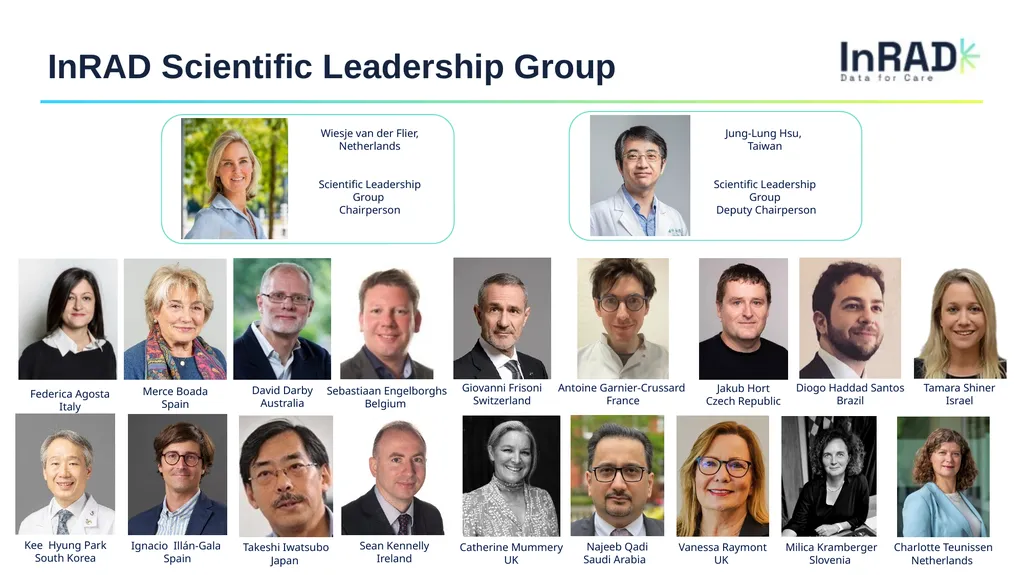
InRAD Scientific Leadership Group Federica Agosta
Italy Charlotte Teunissen
Netherlands<br>
Italy Charlotte Teunissen
Netherlands<br>
08
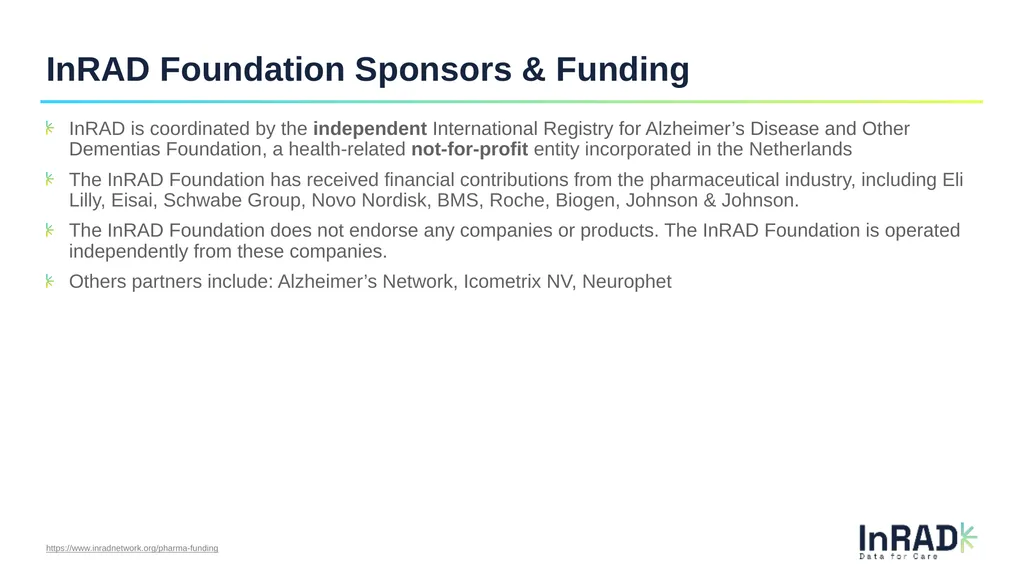
InRAD is coordinated by the independent International Registry for Alzheimer’s Disease and Other Dementias Foundation, a health-related not-for-profit entity incorporated in the Netherlands
The InRAD Foundation has received financial contributions from the pharmaceutical industry, including Eli Lilly, Eisai, Schwabe Group, Novo Nordisk, BMS, Roche, Biogen, Johnson & Johnson.
The InRAD Foundation does not endorse any companies or products. The InRAD Foundation is operated independently from these companies.
Others partners include: Alzheimer’s Network, Icometrix NV, Neurophet InRAD Foundation Sponsors & Funding https://www.inradnetwork.org/pharma-funding<br>
The InRAD Foundation has received financial contributions from the pharmaceutical industry, including Eli Lilly, Eisai, Schwabe Group, Novo Nordisk, BMS, Roche, Biogen, Johnson & Johnson.
The InRAD Foundation does not endorse any companies or products. The InRAD Foundation is operated independently from these companies.
Others partners include: Alzheimer’s Network, Icometrix NV, Neurophet InRAD Foundation Sponsors & Funding https://www.inradnetwork.org/pharma-funding<br>
09
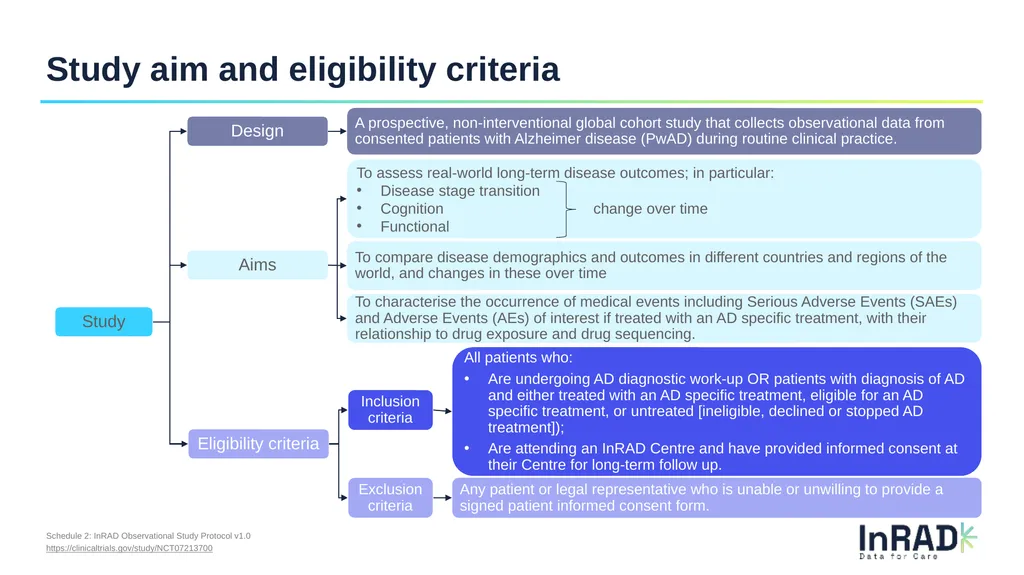
Study aim and eligibility criteria Schedule 2: InRAD Observational Study Protocol v1.0
https://clinicaltrials.gov/study/NCT07213700 Study Aims Design Eligibility criteria To assess real-world long-term disease outcomes; in particular:
Disease stage transition
Cognition change over time
Functional To compare disease demographics and outcomes in different countries and regions of the world, and changes in these over time To characterise the occurrence of medical events including Serious Adverse Events (SAEs) and Adverse Events (AEs) of interest if treated with an AD specific treatment, with their relationship to drug exposure and drug sequencing. A prospective, non-interventional global cohort study that collects observational data from consented patients with Alzheimer disease (PwAD) during routine clinical practice. All patients who:
Are undergoing AD diagnostic work-up OR patients with diagnosis of AD and either treated with an AD specific treatment, eligible for an AD specific treatment, or untreated [ineligible, declined or stopped AD treatment]);
Are attending an InRAD Centre and have provided informed consent at their Centre for long-term follow up. Any patient or legal representative who is unable or unwilling to provide a signed patient informed consent form. Inclusion criteria Exclusion criteria<br>
https://clinicaltrials.gov/study/NCT07213700 Study Aims Design Eligibility criteria To assess real-world long-term disease outcomes; in particular:
Disease stage transition
Cognition change over time
Functional To compare disease demographics and outcomes in different countries and regions of the world, and changes in these over time To characterise the occurrence of medical events including Serious Adverse Events (SAEs) and Adverse Events (AEs) of interest if treated with an AD specific treatment, with their relationship to drug exposure and drug sequencing. A prospective, non-interventional global cohort study that collects observational data from consented patients with Alzheimer disease (PwAD) during routine clinical practice. All patients who:
Are undergoing AD diagnostic work-up OR patients with diagnosis of AD and either treated with an AD specific treatment, eligible for an AD specific treatment, or untreated [ineligible, declined or stopped AD treatment]);
Are attending an InRAD Centre and have provided informed consent at their Centre for long-term follow up. Any patient or legal representative who is unable or unwilling to provide a signed patient informed consent form. Inclusion criteria Exclusion criteria<br>
10
A Minimum Data Set that can be captured in clinical practice Perneczky et al. Real-world datasets for the International Registry for Alzheimer’s Disease and Other Dementias (InRAD) and other registries: An international consensus, The Journal of Prevention of Alzheimer’s Disease 2025 https://doi.org/10.1016/j.tjpad.2025.100096<br>
11
An Extended Data Set to enable sub-studies<br>
12
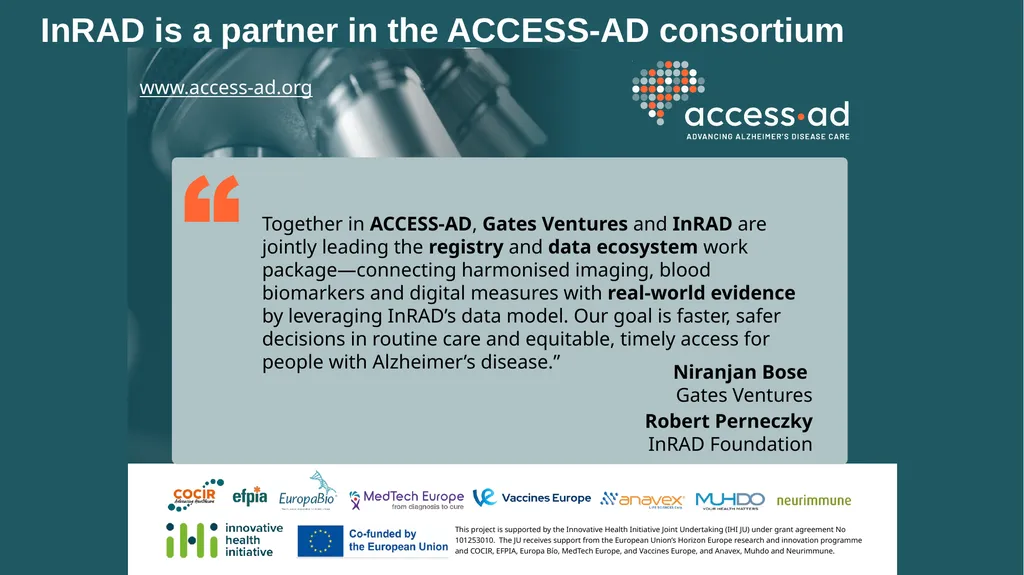
Click to edit Text Together in ACCESS‑AD, Gates Ventures and InRAD are jointly leading the registry and data ecosystem work package—connecting harmonised imaging, blood biomarkers and digital measures with real‑world evidence by leveraging InRAD’s data model. Our goal is faster, safer decisions in routine care and equitable, timely access for people with Alzheimer’s disease.” Niranjan Bose
Gates Ventures This project is supported by the Innovative Health Initiative Joint Undertaking (IHI JU) under grant agreement No 101253010. The JU receives support from the European Union’s Horizon Europe research and innovation programme and COCIR, EFPIA, Europa Bío, MedTech Europe, and Vaccines Europe, and Anavex, Muhdo and Neurimmune. Robert Perneczky
InRAD Foundation InRAD is a partner in the ACCESS-AD consortium www.access-ad.org<br>
Gates Ventures This project is supported by the Innovative Health Initiative Joint Undertaking (IHI JU) under grant agreement No 101253010. The JU receives support from the European Union’s Horizon Europe research and innovation programme and COCIR, EFPIA, Europa Bío, MedTech Europe, and Vaccines Europe, and Anavex, Muhdo and Neurimmune. Robert Perneczky
InRAD Foundation InRAD is a partner in the ACCESS-AD consortium www.access-ad.org<br>
13
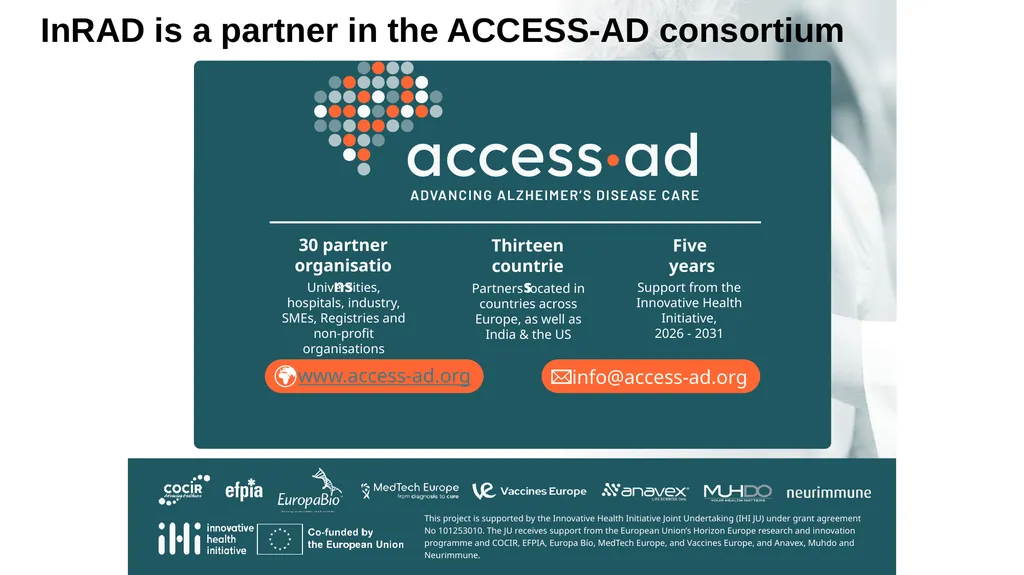
InRAD is a partner in the ACCESS-AD consortium<br>
14
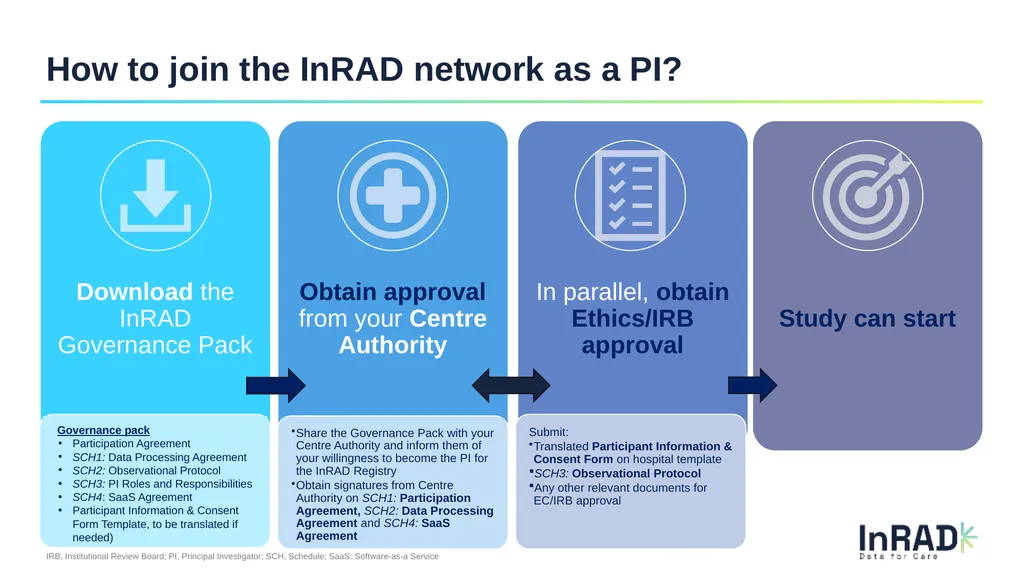
How to join the InRAD network as a PI? IRB, Institutional Review Board; PI, Principal Investigator; SCH, Schedule; SaaS: Software-as-a Service<br>
15
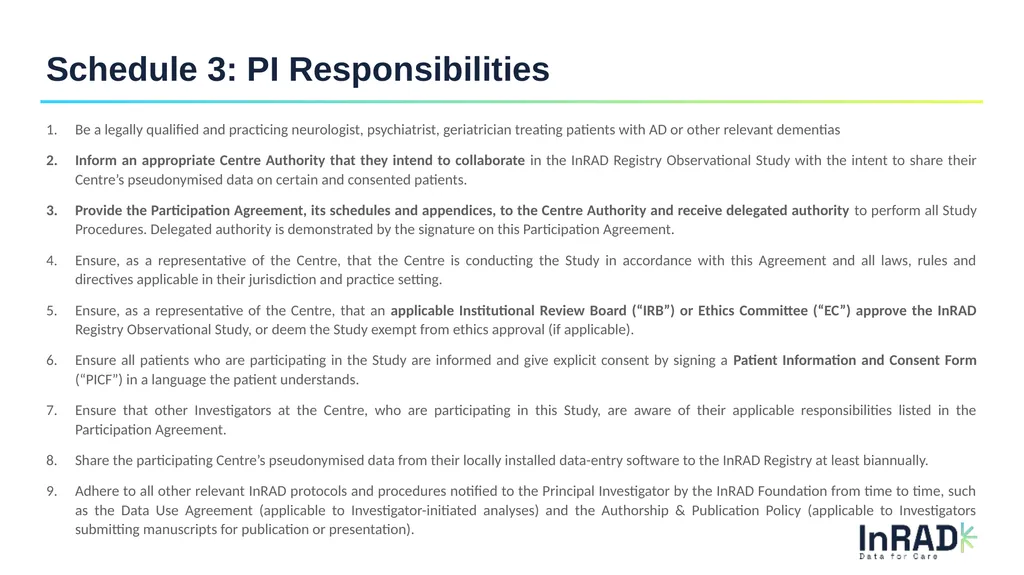
Be a legally qualified and practicing neurologist, psychiatrist, geriatrician treating patients with AD or other relevant dementias
Inform an appropriate Centre Authority that they intend to collaborate in the InRAD Registry Observational Study with the intent to share their Centre’s pseudonymised data on certain and consented patients.
Provide the Participation Agreement, its schedules and appendices, to the Centre Authority and receive delegated authority to perform all Study Procedures. Delegated authority is demonstrated by the signature on this Participation Agreement.
Ensure, as a representative of the Centre, that the Centre is conducting the Study in accordance with this Agreement and all laws, rules and directives applicable in their jurisdiction and practice setting.
Ensure, as a representative of the Centre, that an applicable Institutional Review Board (“IRB”) or Ethics Committee (“EC”) approve the InRAD Registry Observational Study, or deem the Study exempt from ethics approval (if applicable).
Ensure all patients who are participating in the Study are informed and give explicit consent by signing a Patient Information and Consent Form (“PICF”) in a language the patient understands.
Ensure that other Investigators at the Centre, who are participating in this Study, are aware of their applicable responsibilities listed in the Participation Agreement.
Share the participating Centre’s pseudonymised data from their locally installed data-entry software to the InRAD Registry at least biannually.
Adhere to all other relevant InRAD protocols and procedures notified to the Principal Investigator by the InRAD Foundation from time to time, such as the Data Use Agreement (applicable to Investigator-initiated analyses) and the Authorship & Publication Policy (applicable to Investigators submitting manuscripts for publication or presentation). Schedule 3: PI Responsibilities<br>
Inform an appropriate Centre Authority that they intend to collaborate in the InRAD Registry Observational Study with the intent to share their Centre’s pseudonymised data on certain and consented patients.
Provide the Participation Agreement, its schedules and appendices, to the Centre Authority and receive delegated authority to perform all Study Procedures. Delegated authority is demonstrated by the signature on this Participation Agreement.
Ensure, as a representative of the Centre, that the Centre is conducting the Study in accordance with this Agreement and all laws, rules and directives applicable in their jurisdiction and practice setting.
Ensure, as a representative of the Centre, that an applicable Institutional Review Board (“IRB”) or Ethics Committee (“EC”) approve the InRAD Registry Observational Study, or deem the Study exempt from ethics approval (if applicable).
Ensure all patients who are participating in the Study are informed and give explicit consent by signing a Patient Information and Consent Form (“PICF”) in a language the patient understands.
Ensure that other Investigators at the Centre, who are participating in this Study, are aware of their applicable responsibilities listed in the Participation Agreement.
Share the participating Centre’s pseudonymised data from their locally installed data-entry software to the InRAD Registry at least biannually.
Adhere to all other relevant InRAD protocols and procedures notified to the Principal Investigator by the InRAD Foundation from time to time, such as the Data Use Agreement (applicable to Investigator-initiated analyses) and the Authorship & Publication Policy (applicable to Investigators submitting manuscripts for publication or presentation). Schedule 3: PI Responsibilities<br>
16
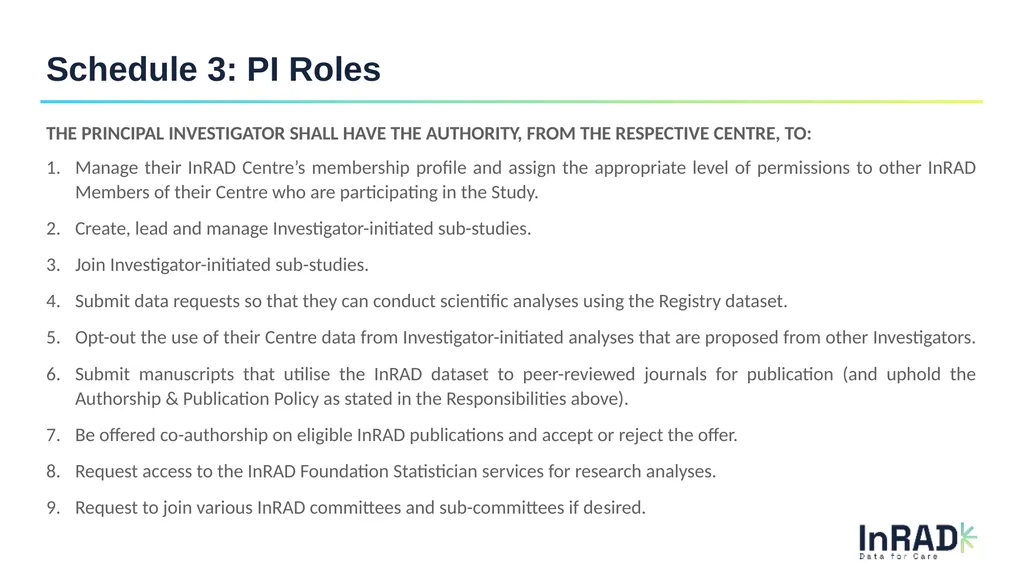
The Principal Investigator shall have the authority, from the respective Centre, to:
Manage their InRAD Centre’s membership profile and assign the appropriate level of permissions to other InRAD Members of their Centre who are participating in the Study.
Create, lead and manage Investigator-initiated sub-studies.
Join Investigator-initiated sub-studies.
Submit data requests so that they can conduct scientific analyses using the Registry dataset.
Opt-out the use of their Centre data from Investigator-initiated analyses that are proposed from other Investigators.
Submit manuscripts that utilise the InRAD dataset to peer-reviewed journals for publication (and uphold the Authorship & Publication Policy as stated in the Responsibilities above).
Be offered co-authorship on eligible InRAD publications and accept or reject the offer.
Request access to the InRAD Foundation Statistician services for research analyses.
Request to join various InRAD committees and sub-committees if desired. Schedule 3: PI Roles<br>
Manage their InRAD Centre’s membership profile and assign the appropriate level of permissions to other InRAD Members of their Centre who are participating in the Study.
Create, lead and manage Investigator-initiated sub-studies.
Join Investigator-initiated sub-studies.
Submit data requests so that they can conduct scientific analyses using the Registry dataset.
Opt-out the use of their Centre data from Investigator-initiated analyses that are proposed from other Investigators.
Submit manuscripts that utilise the InRAD dataset to peer-reviewed journals for publication (and uphold the Authorship & Publication Policy as stated in the Responsibilities above).
Be offered co-authorship on eligible InRAD publications and accept or reject the offer.
Request access to the InRAD Foundation Statistician services for research analyses.
Request to join various InRAD committees and sub-committees if desired. Schedule 3: PI Roles<br>