
INSTITUTIONAL REPOSITORY ADOPTION AMONG NIGERIAN



Description: INSTITUTIONAL REPOSITORY ADOPTION AMONG NIGERIAN PRIVATE UNIVERSITIES: INSTITUTIONAL FACTORS AND WILLINGNESS TO USE ADETOMIWA BASIRU, PhD, cln Senior Librarian Head, Circulation Services Tekena Tamuno Library, Redeemers University, Ede,
Related Topics
Download Presentation
"INSTITUTIONAL REPOSITORY ADOPTION AMONG NIGERIAN" is the property of its rightful owner. Permission is granted to download and print the materials on this website for personal, non-commercial use only, and to display it on your personal computer provided you do not modify the materials and that you retain all copyright notices contained in the materials. By downloading content from our website, you accept the terms of this agreement.
Presentation Transcript
slide1. INSTITUTIONAL REPOSITORY ADOPTION AMONG NIGERIAN PRIVATE UNIVERSITIES: INSTITUTIONAL FACTORS AND WILLINGNESS TO USE ADETOMIWA BASIRU, PhD, cln
Senior Librarian &Head, Circulation Services
Tekena Tamuno Library, Redeemer’s University, Ede, Osun State, Nigeria.
adetomiwat@run.edu.ng<br>
slide2. INTRODUCTION: Universities in Nigeria The private universities are fast expanding segment of Nigerian University educational system. In terms of number, private universities out-numbered the federal government universities in Nigeria. Presently Nigeria has 43 Federal Universities, 52 State Universities, and 79 Private Universities;
making it a total of 174 universities in Nigeria. NUC,2020<br>
slide3. Low Rate of Adoption of (IR)in Nigeria In spite of the potential benefits associated with the adoption of institutional repositories (IRs) by public universities, there is an abysmal low rate of adoption of (IR) among the private universities in Nigeria.
Between 2008 when a study by Christian (2008) found that there was no functioning IR in Nigeria and 2015 thirteen universities have developed IR. There are nineteen (19) functioning open access IRs in thirteen Nigerian Universities as at October 2016. The figure increased to 20 in 2018.
The Open DOAR (2014) also ascertained a dismal record of adoption of IRs in Nigeria, out of 95 open access institutional repositories in Africa, Nigeria has only 8 (7.9%) while South Africa has 28 (31.5%).
As at June 1st 2020, a total of 24 open access (IR) in Nigeria, 19(universities) 5(Other research institutions) Open DOAR (2020).<br>
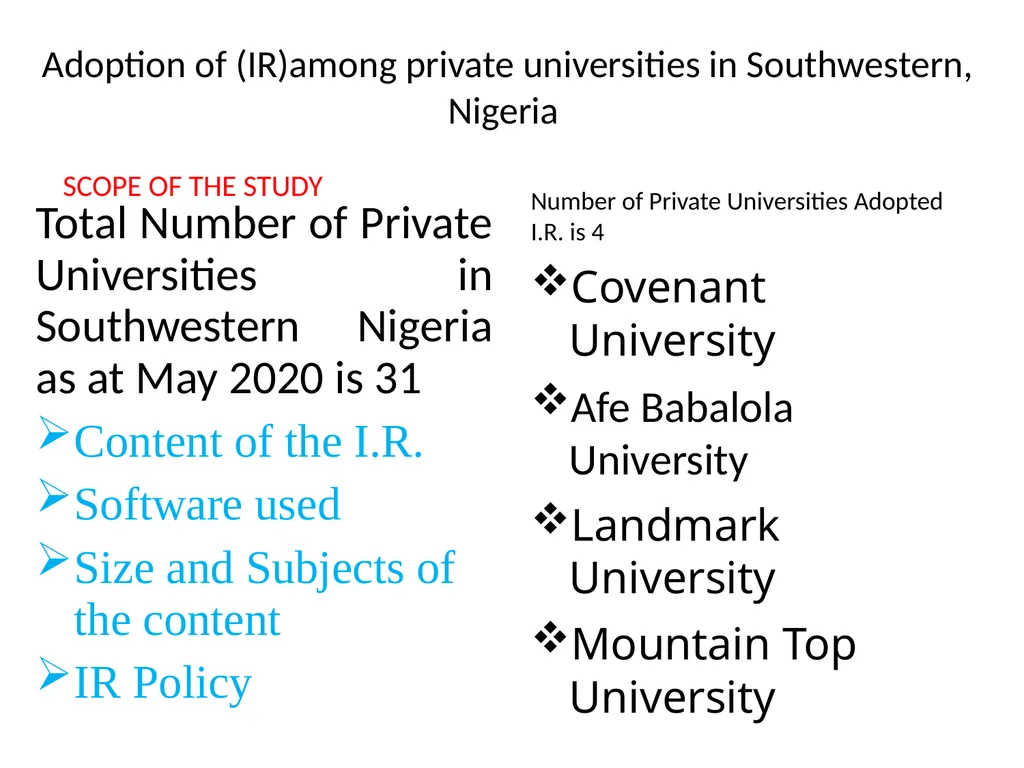
slide4. Adoption of (IR)among private universities in Southwestern, Nigeria SCOPE OF THE STUDY
Total Number of Private Universities in Southwestern Nigeria as at May 2020 is 31
Content of the I.R.
Software used
Size and Subjects of the content
IR Policy Number of Private Universities Adopted I.R. is 4
Covenant University
Afe Babalola University
Landmark University
Mountain Top University<br>
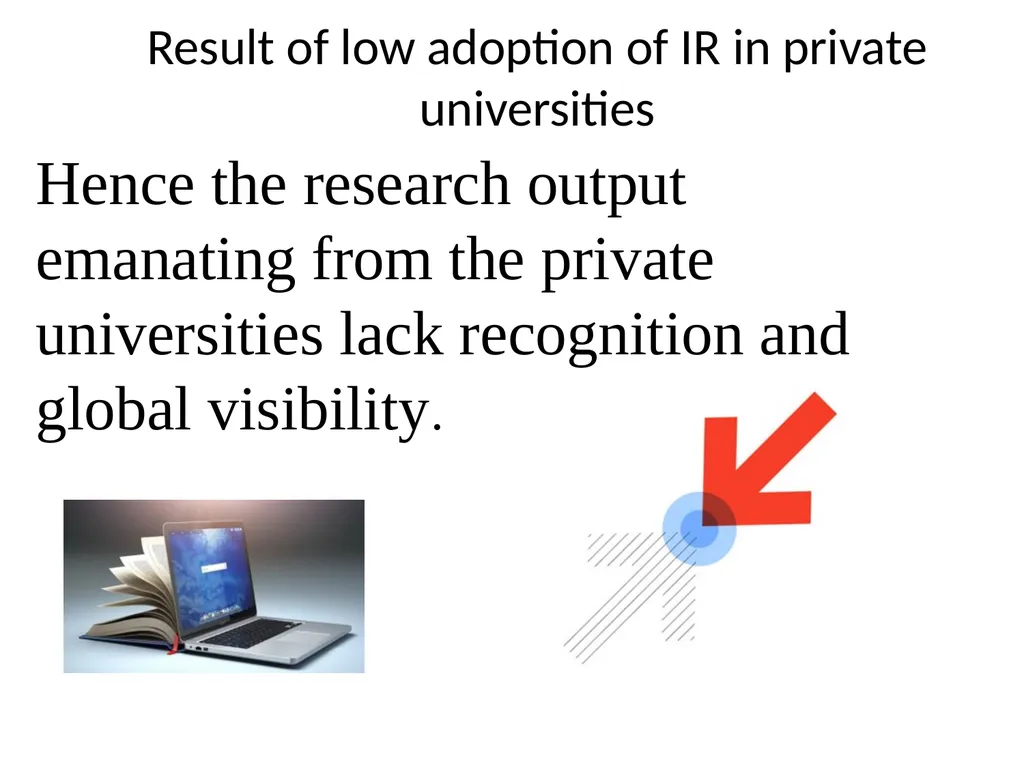
slide5. Result of low adoption of IR in private universities Hence the research output emanating from the private universities lack recognition and global visibility.<br>
slide6. Methodology used Data was collected using a questionnaire and interview.
All the 31 Private Universities in Southwestern, Nigeria were enumerated.
University Librarians from four (4) private universities that have successfully adopted and implemented (IR) were interviewed to know their success stories,
While other twenty (20) private universities that are yet to adopt (IR) agreed to participate in the study using questionnaire. The simple percentage was used to analyze the respondents’ responses.<br>
slide7. Findings INSTITUTIONAL FACTORS
Funding
ICT facilities
manpower
copyright issues
who should lead? (Libraries or faculties) in the establishment of IR WILLINGNESS ON THE PART OF THE ACADEMIC STAFF
negative attitude towards usage of technologies
fear of plagiarism
lack of encouragement and information to deposit their works
low rate of submission of scholarly works by academics
policies
lack of incentives<br>
slide8. Findings…. The four(4) private universities that have adopted I.R acquire their content mainly from their postgraduate schools.
These universities use DSpace, and apply Dublin Core metadata. Available contents in the 4 sampled private universities
Published article
Manuscript
Lecture Note
Curriculum information
Conference paper
Thesis
Administrative documents<br>
slide9. Findings…. The four(4) private universities that have adopted I.R acquire their content mainly from their postgraduate schools.
These universities use DSpace, and apply Dublin Core metadata.<br>
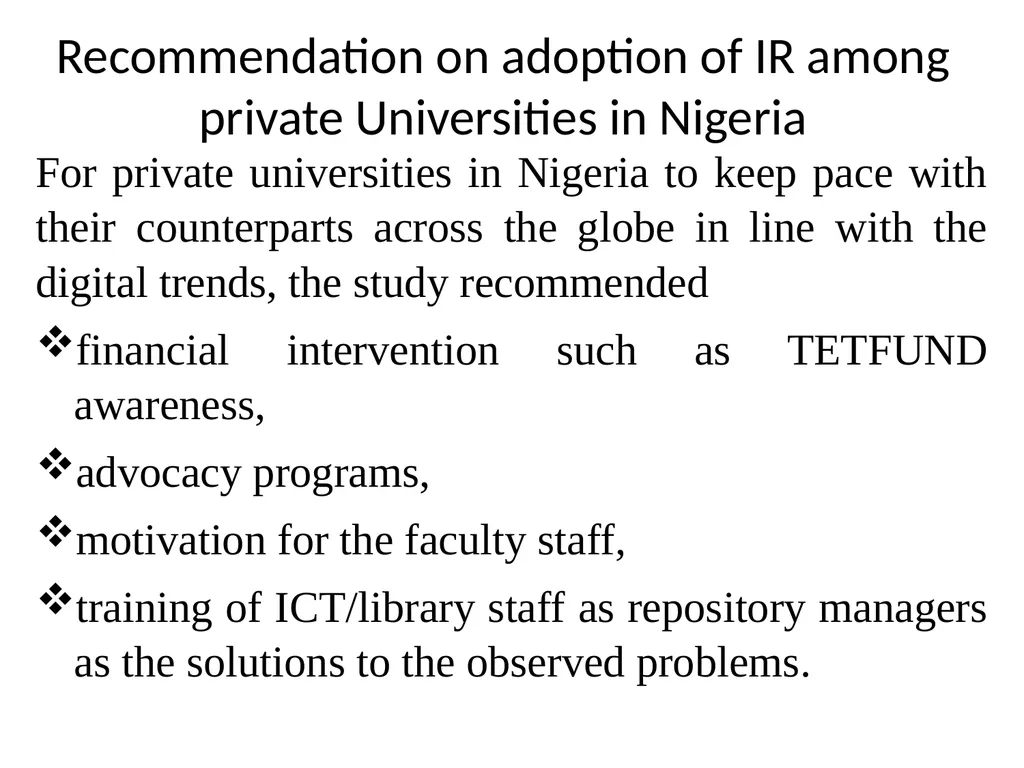
slide10. Recommendation on adoption of IR among private Universities in Nigeria For private universities in Nigeria to keep pace with their counterparts across the globe in line with the digital trends, the study recommended
financial intervention such as TETFUND awareness,
advocacy programs,
motivation for the faculty staff,
training of ICT/library staff as repository managers as the solutions to the observed problems.<br>
slide12. References Christian, G. E. 2008. Issues and challenges to the development of open access institutional repositories in academic and research institutions in Nigeria. International Research and Development Centre (IDRC) Ottawa, Canada Retrieved on September 1, 2012 from http://idl-bnc.idrc.ca/dspace/bitstream/10625/36986/1/127792.pdf
Directory of Open Access Repository (OpenDOAR).
G. Ifijeh, O. Adebayo, R. Izuagbe, and O. Olawoyin, “Institutional Repositories and Libraries in Nigeria: Interrogating the Nexus,” Journal of Cases on Information Technology 20, no. 2 (2018): 16–29.<br>
Senior Librarian &Head, Circulation Services
Tekena Tamuno Library, Redeemer’s University, Ede, Osun State, Nigeria.
adetomiwat@run.edu.ng<br>
slide2. INTRODUCTION: Universities in Nigeria The private universities are fast expanding segment of Nigerian University educational system. In terms of number, private universities out-numbered the federal government universities in Nigeria. Presently Nigeria has 43 Federal Universities, 52 State Universities, and 79 Private Universities;
making it a total of 174 universities in Nigeria. NUC,2020<br>
slide3. Low Rate of Adoption of (IR)in Nigeria In spite of the potential benefits associated with the adoption of institutional repositories (IRs) by public universities, there is an abysmal low rate of adoption of (IR) among the private universities in Nigeria.
Between 2008 when a study by Christian (2008) found that there was no functioning IR in Nigeria and 2015 thirteen universities have developed IR. There are nineteen (19) functioning open access IRs in thirteen Nigerian Universities as at October 2016. The figure increased to 20 in 2018.
The Open DOAR (2014) also ascertained a dismal record of adoption of IRs in Nigeria, out of 95 open access institutional repositories in Africa, Nigeria has only 8 (7.9%) while South Africa has 28 (31.5%).
As at June 1st 2020, a total of 24 open access (IR) in Nigeria, 19(universities) 5(Other research institutions) Open DOAR (2020).<br>
slide4. Adoption of (IR)among private universities in Southwestern, Nigeria SCOPE OF THE STUDY
Total Number of Private Universities in Southwestern Nigeria as at May 2020 is 31
Content of the I.R.
Software used
Size and Subjects of the content
IR Policy Number of Private Universities Adopted I.R. is 4
Covenant University
Afe Babalola University
Landmark University
Mountain Top University<br>
slide5. Result of low adoption of IR in private universities Hence the research output emanating from the private universities lack recognition and global visibility.<br>
slide6. Methodology used Data was collected using a questionnaire and interview.
All the 31 Private Universities in Southwestern, Nigeria were enumerated.
University Librarians from four (4) private universities that have successfully adopted and implemented (IR) were interviewed to know their success stories,
While other twenty (20) private universities that are yet to adopt (IR) agreed to participate in the study using questionnaire. The simple percentage was used to analyze the respondents’ responses.<br>
slide7. Findings INSTITUTIONAL FACTORS
Funding
ICT facilities
manpower
copyright issues
who should lead? (Libraries or faculties) in the establishment of IR WILLINGNESS ON THE PART OF THE ACADEMIC STAFF
negative attitude towards usage of technologies
fear of plagiarism
lack of encouragement and information to deposit their works
low rate of submission of scholarly works by academics
policies
lack of incentives<br>
slide8. Findings…. The four(4) private universities that have adopted I.R acquire their content mainly from their postgraduate schools.
These universities use DSpace, and apply Dublin Core metadata. Available contents in the 4 sampled private universities
Published article
Manuscript
Lecture Note
Curriculum information
Conference paper
Thesis
Administrative documents<br>
slide9. Findings…. The four(4) private universities that have adopted I.R acquire their content mainly from their postgraduate schools.
These universities use DSpace, and apply Dublin Core metadata.<br>
slide10. Recommendation on adoption of IR among private Universities in Nigeria For private universities in Nigeria to keep pace with their counterparts across the globe in line with the digital trends, the study recommended
financial intervention such as TETFUND awareness,
advocacy programs,
motivation for the faculty staff,
training of ICT/library staff as repository managers as the solutions to the observed problems.<br>
slide12. References Christian, G. E. 2008. Issues and challenges to the development of open access institutional repositories in academic and research institutions in Nigeria. International Research and Development Centre (IDRC) Ottawa, Canada Retrieved on September 1, 2012 from http://idl-bnc.idrc.ca/dspace/bitstream/10625/36986/1/127792.pdf
Directory of Open Access Repository (OpenDOAR).
G. Ifijeh, O. Adebayo, R. Izuagbe, and O. Olawoyin, “Institutional Repositories and Libraries in Nigeria: Interrogating the Nexus,” Journal of Cases on Information Technology 20, no. 2 (2018): 16–29.<br>