Institutional Theory for Corporate Law An Invitation Professor Eva Micheler 28 January 2025 Preliminary Points Nexus of contract model and agency theory are dominant. All theories involve abstraction. Scholars deliberately isolate factors
"Institutional Theory for Corporate Law – An" is the property of its rightful owner. Permission is granted to
download and print the materials on this website for personal, non-commercial use only, and to display it
on your personal computer provided you do not modify the materials and that you retain all copyright
notices contained in the materials. By downloading content from our website, you accept the terms of this
agreement.
Presentation Transcript
01
Institutional Theory for Corporate Law – An Invitation Professor Eva Micheler
28 January 2025<br>
02
Preliminary Points Nexus of contract model and agency theory are dominant.
All theories involve abstraction. Scholars deliberately isolate factors at the expense of ignoring others.
Agency theory is useful as a basis for the analysis of conflicts of interest.
But it directs attention away from company law.
Focus only on board-level actors at the expense of lower-level managers and employees.
Assumes rational action
Ignores the behavioral effects of social environments.
Blocks view of scholarship on organizations.<br>
03
Eva Micheler, Company Law – A Real Entity Theory (OUP 2021) Organisations are autonomous actors.
They are more than the sum of the contributions by their participants.
There exists an autonomous structure (a glue) in the form of procedures, processes and culture.
NOTE: this is NOT anthropomorphic. The social structure that holds people together does NOT obey the laws of biological or any other science.
Organisations are the formal and informal processes that shape the actions of their participants. These processes do not form an iron cage. There also exists human agency. The processes can, with time and effort, be modified by the participants.
Law finds organisations.
It formalises organisational action.
Legal personality facilitates autonomous organisational action.
Eva Micheler, ‘Separate legal personality – an explanation and a defence’ (2024) 24 JCLS 301<br>
04
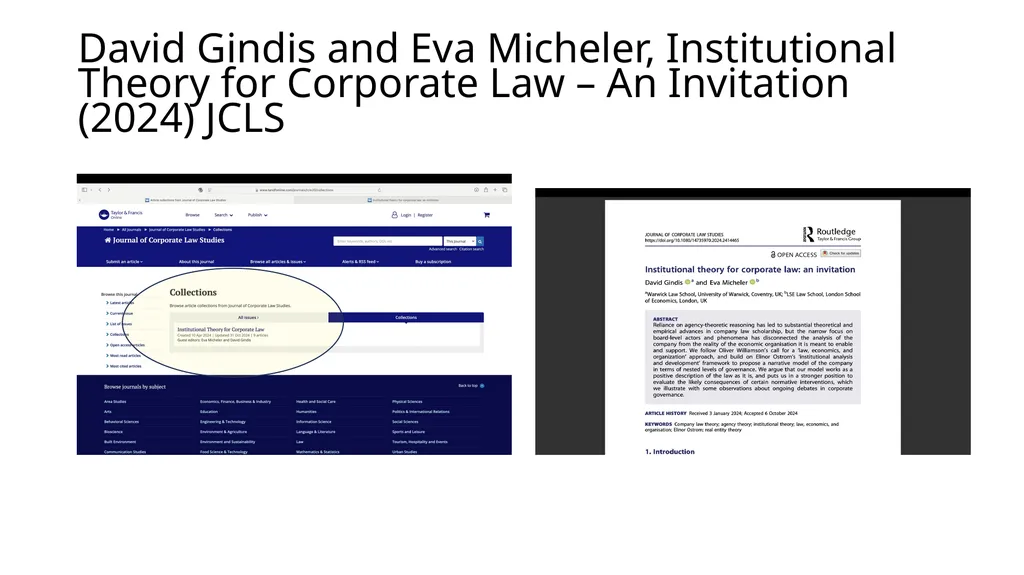
David Gindis and Eva Micheler, Institutional Theory for Corporate Law – An Invitation (2024) JCLS<br>
05
Institutional Theory A Brief Introduction We take inspiration from the New Private Law Literature which combines doctrinal legal analysis with scholarship from the wider social sciences.
Study of (social) rules and socially determined behavior.
Political science distinguishes three broad types:
Rational choice institutionalism (agency theory is part of this school of thought)
Sociological institutionalism emphasizes social structure.
Historical institutionalism: Humans are norm-abiding rule followers as well as self-interested actors.<br>
06
Institutional Theory - A Brief Introduction Sociology and management studies: organizational institutionalism
connections between individuals and group behaviour
organizational structure (chain of command, assignment of roles and responsibilities)
can be industry specific or relate to society at large
identifies ’fields’ with their own ’institutional logic’
Legal Institutionalism
primarily contributes to economics and finance rather than law stressing the importance of law as constituting the economy (Katharina Pistor).<br>
07
Law, Economics and Organization Oliver E Williamson, ‘Why Law, Economics and Organization?’ (2005) 1 Annual Review of Law and Social Science 369
Organizational theory
Elinor Ostrom and the Bloomington School
Interdisciplinary
Empirical and field work
Natural human actors who are embedded in a social environment.
Framework for Institutional Analysis and Development
Tool enabling connections between insights from different disciplines with different methodologies
Imperial view (Posner) v What is going on here? (Williamson)<br>
08
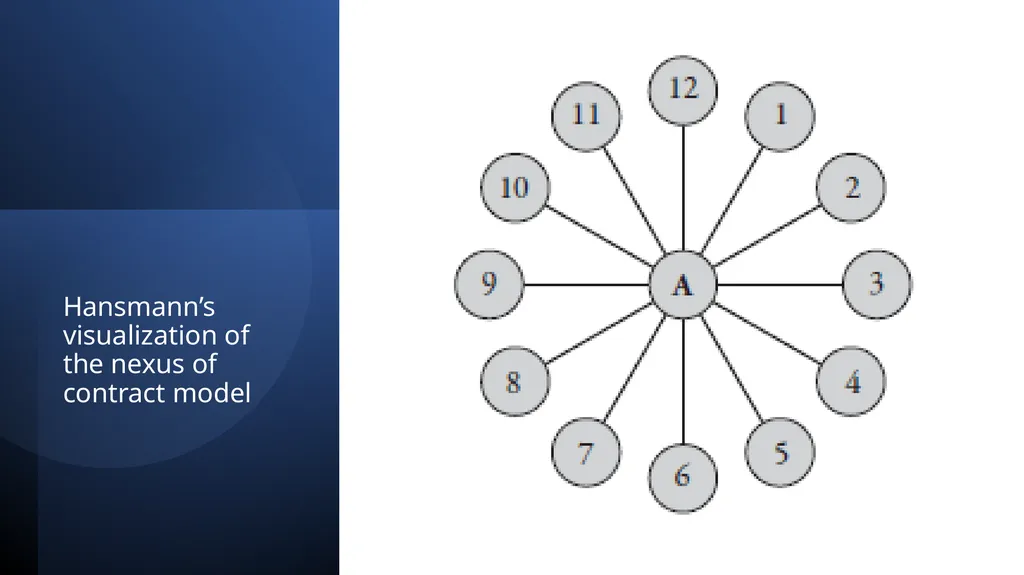
Hansmann’s visualization of the nexus of contract model<br>
09
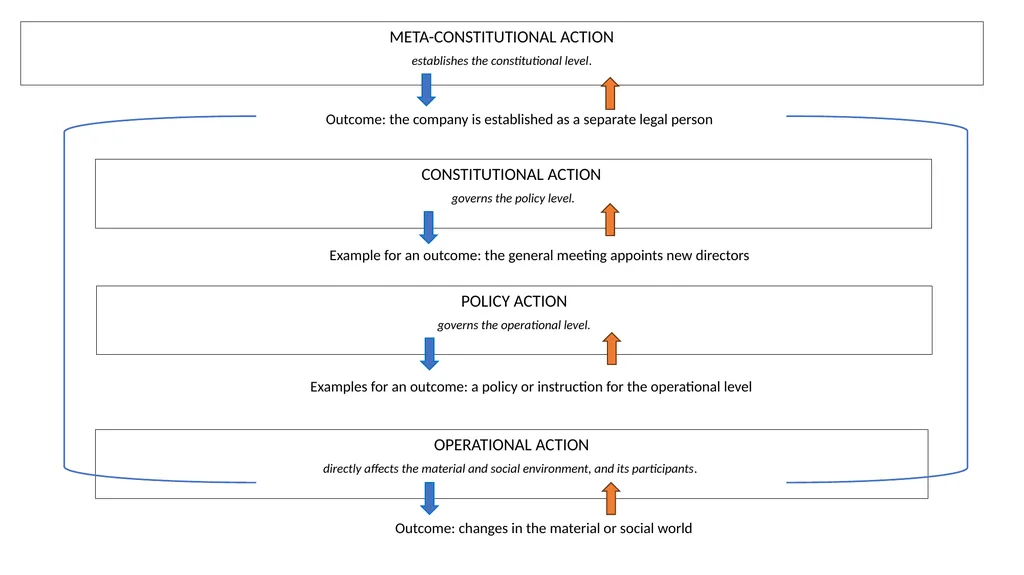
META-CONSTITUTIONAL ACTION
establishes the constitutional level. CONSTITUTIONAL ACTION
governs the policy level. POLICY ACTION
governs the operational level. OPERATIONAL ACTION
directly affects the material and social environment, and its participants. Outcome: the company is established as a separate legal person Example for an outcome: the general meeting appoints new directors Examples for an outcome: a policy or instruction for the operational level Outcome: changes in the material or social world<br>
10
Ostromian visualization of the company Action situations rather than focus only on actors
Natural human actors
Better integrates behavioral insights
Including the problem of self-interest
Dynamic (following decision-making, implementation, information gathering, organizational learning) rather than static
No automatic execution of decisions
No automatic movement of information about outcomes
Distinguishes between companies of different sizes
Integrates law as well as social norms
Analyses company law together with employment law, securities regulation and other relevant sub-fields.<br>
11
Ostromian/organizational model of the company The company is neither public (a concession) nor private (a contract) but hybrid.
Economic efficiency continues to be a normative goal.
But avoids naïve policy making.
What is going on here?
Normative recommendations are developed against a methodologically grounded understanding of the institutional environment.
Neutral as to shareholder v stakeholder debate.
Avoids the trap of thinking that there are easy answers.<br>