INSTRUCTIONS for PSYCHOMETRIC TESTS It provides an in-depth insight into the personality variables that determine ones behavior. It is a widely-used personality assessment instrument, and can assess a wide range of core personality
"INSTRUCTIONS for PSYCHOMETRIC TESTS It provides an" is the property of its rightful owner. Permission is granted to
download and print the materials on this website for personal, non-commercial use only, and to display it
on your personal computer provided you do not modify the materials and that you retain all copyright
notices contained in the materials. By downloading content from our website, you accept the terms of this
agreement.
Presentation Transcript
01
INSTRUCTIONS
for
PSYCHOMETRIC TESTS<br>
02
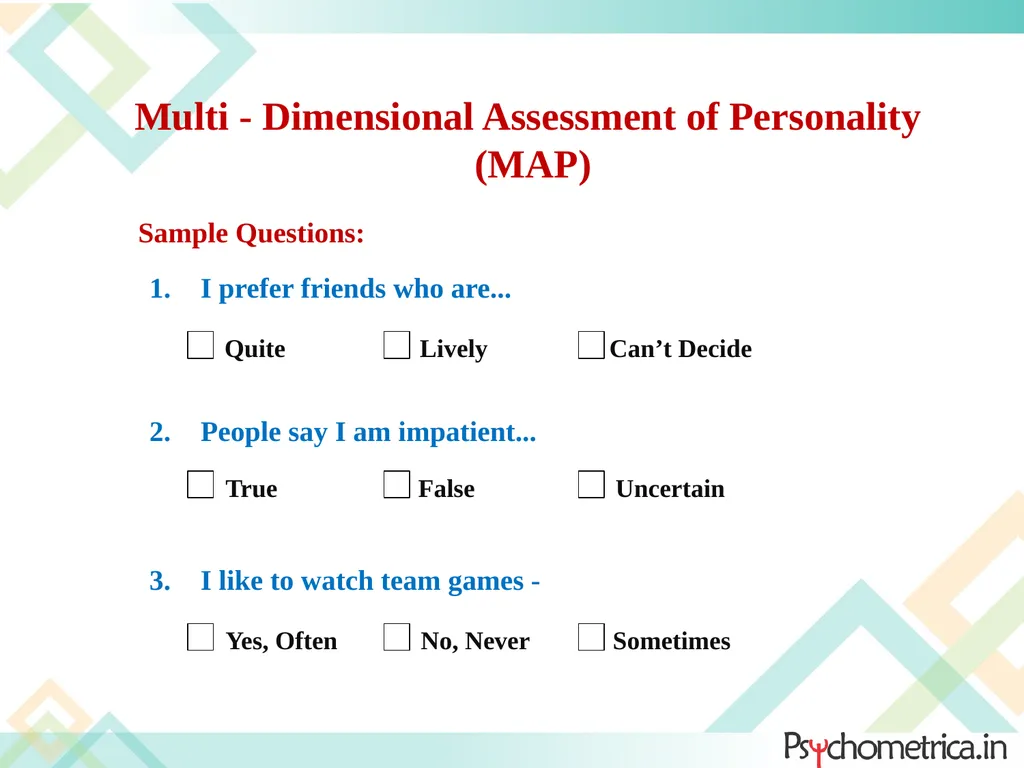
It provides an in-depth insight into the personality variables that determine one's behavior. It is a widely-used personality assessment instrument, and can assess a wide range of core personality characteristics along which people can differ.
It measures 20 primary dimensions of personality and is widely used in industries for selection, and placement in diagnostic and therapeutic settings. This test is for candidates who are 18 years and above, and takes about 45 minutes to complete. TEST 1: Multi - Dimensional Assessment of Personality (MAP)<br>
03
Instructions :
Give only answers that are true for you. It is best to say what you really think.
You may have as much time as you need, but try to go fairly fast. It’s best to give the first answer that comes to you and not spend too much time on any one question.
Answer every item one way or the other. Don’t skip any item.
You should mark the (a) or (b) answer most of the time. Mark the last (c) answer only when you feel you have to, because neither (a) nor (b) seems to be right for you. Multi - Dimensional Assessment of Personality (MAP)<br>
04
Multi - Dimensional Assessment of Personality (MAP)<br>
05
The Standard Progressive Matrices (SPM) is a group or individually administered tests that nonverbally assesses intelligence in children and adults through abstract reasoning tasks.
SPM consists of 60 problems (five sets of 12), all of which involve completing a pattern or figure with a part missing by choosing the correct missing piece from among six alternatives. The test is untimed, but generally takes 15-45 minutes to complete. TEST 2: Standard Progressive Matrices
(SPM)<br>
06
Standard Progressive Matrices
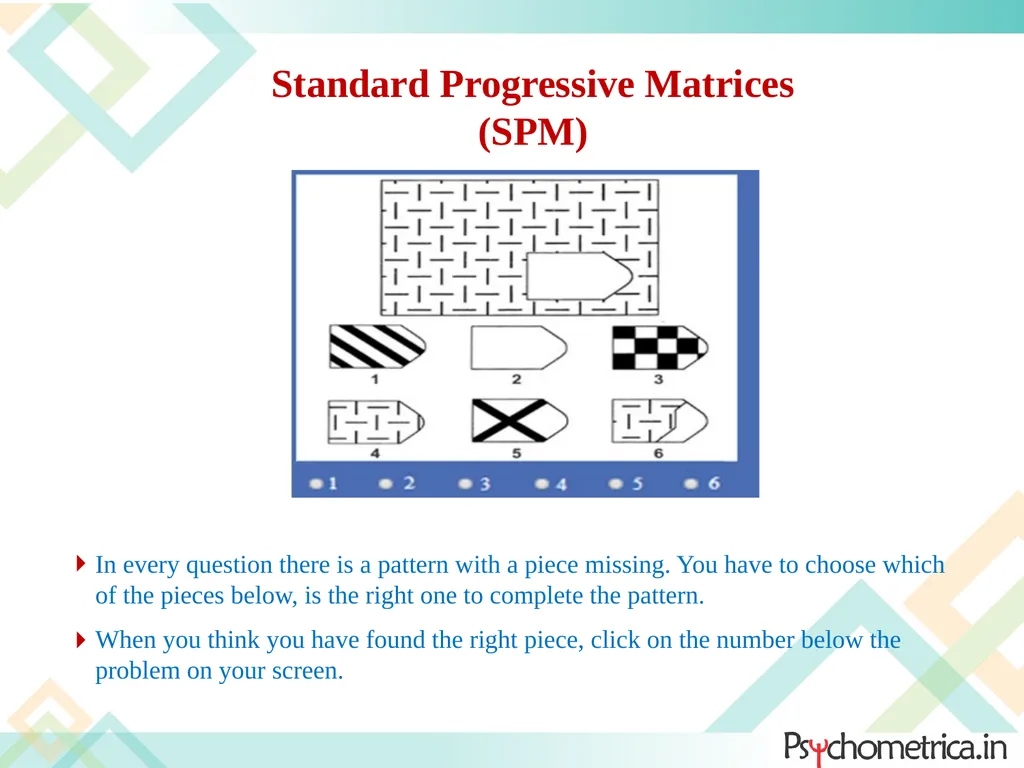
(SPM) In every question there is a pattern with a piece missing. You have to choose which of the pieces below, is the right one to complete the pattern.
When you think you have found the right piece, click on the number below the problem on your screen.<br>
07
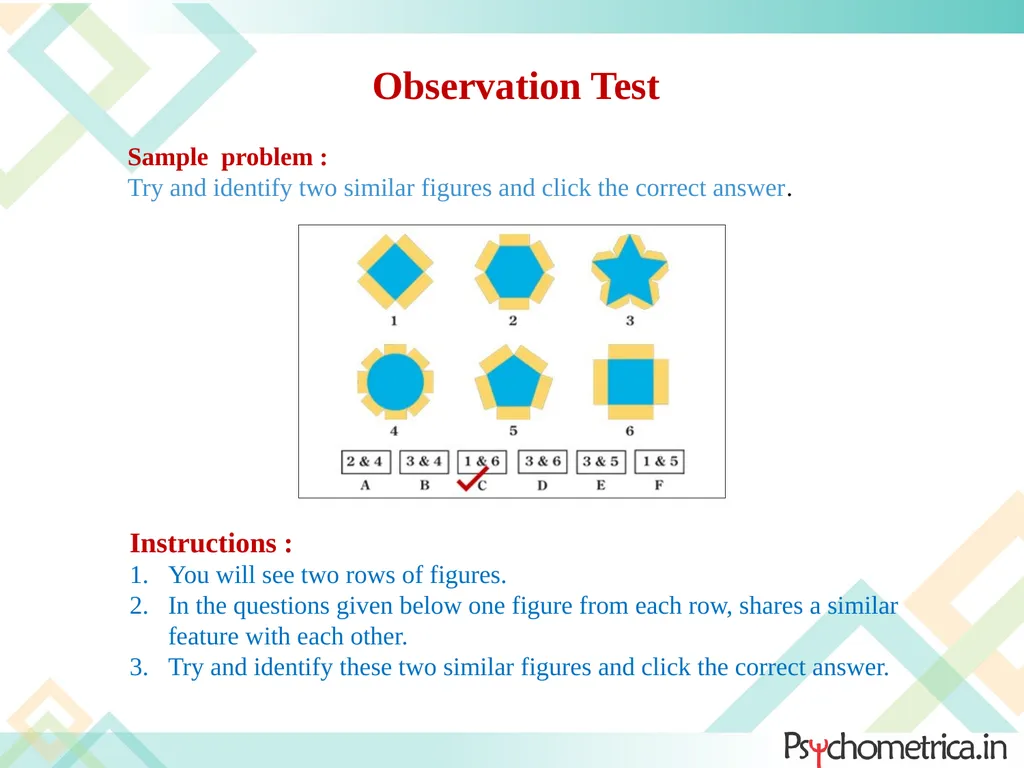
You will see two rows of figures. In the questions given below one figure from each row, shares a similar feature with each other.
This is a test of Power of Observation. In each problem, 6 figures named A, B, C, D, E and F are given. Out of these, five figures are different and one figure is most identical than the others in some respect. You are required to identify the similar figure. TEST 3: Observation Test<br>
08
Instructions :
You will see two rows of figures.
In the questions given below one figure from each row, shares a similar feature with each other.
Try and identify these two similar figures and click the correct answer. Observation Test Sample problem :
Try and identify two similar figures and click the correct answer.<br>
09
This is a test of memorizing Picture-Number combinations. The test is in two parts. In each part, there is a Memory page and a Test page. You are required to remember 21 picture-number pairs given on the Memory page.
After some time you will be asked to go to the Test page, which shows the pictures in a different order.
You will have to indicate the numbers that go with them.
You may pick your answer out of the four options given for each picture and mark the correct answer. TEST 4: Memory Test<br>
10
Instructions :
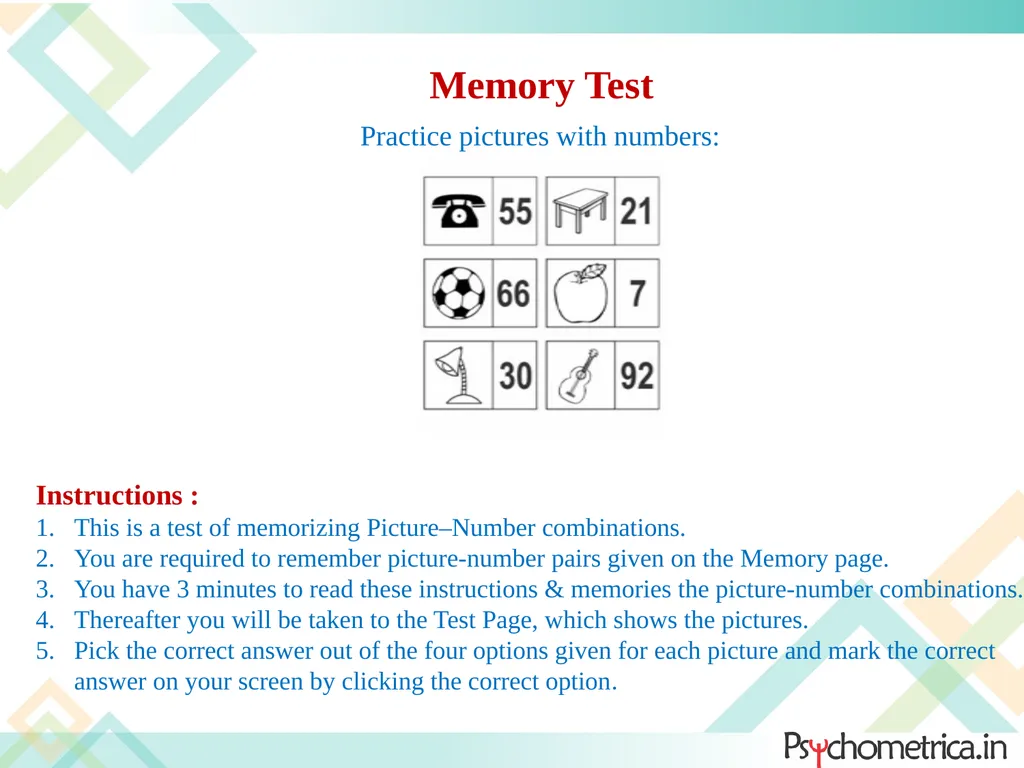
This is a test of memorizing Picture–Number combinations.
You are required to remember picture-number pairs given on the Memory page.
You have 3 minutes to read these instructions & memories the picture-number combinations.
Thereafter you will be taken to the Test Page, which shows the pictures.
Pick the correct answer out of the four options given for each picture and mark the correct answer on your screen by clicking the correct option. Memory Test Practice pictures with numbers:<br>
11
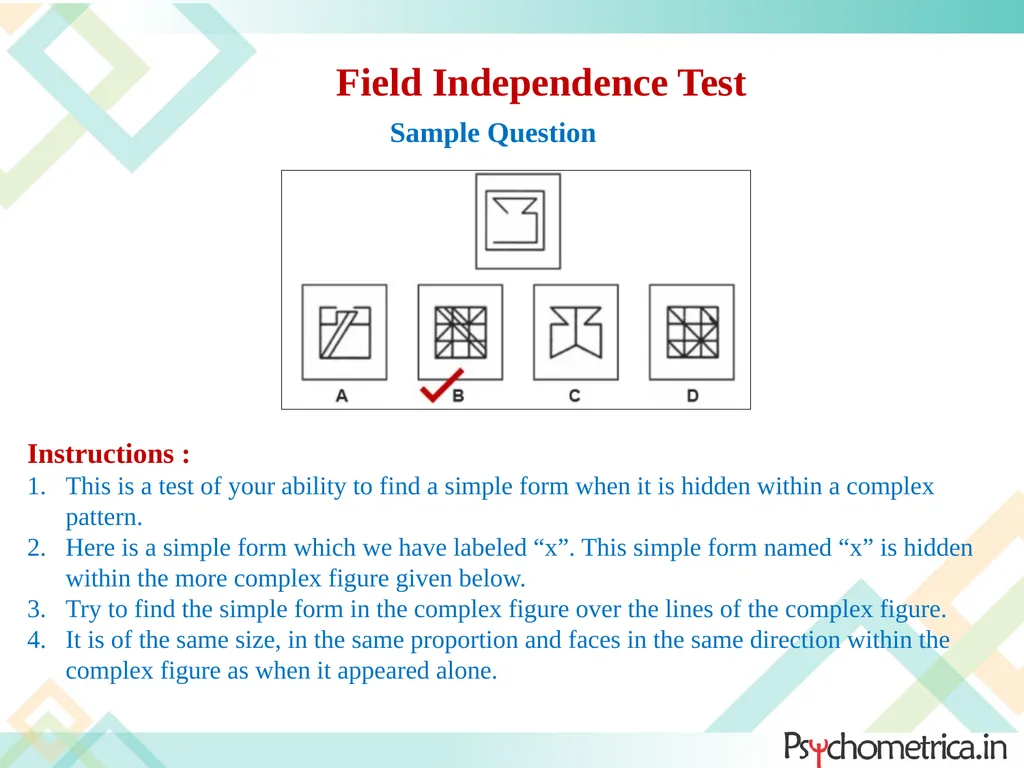
It measures an individual's ability to find, apprehend and identify a known visual pattern embedded in a complex visual array.
Try to find the simple form in the complex figure over the lines of the complex figure. It is of the same size, in the same proportion and faces in the same direction within the complex figure as when it appeared alone. TEST 5: Field Independence Test<br>
12
Instructions :
This is a test of your ability to find a simple form when it is hidden within a complex pattern.
Here is a simple form which we have labeled “x”. This simple form named “x” is hidden within the more complex figure given below.
Try to find the simple form in the complex figure over the lines of the complex figure.
It is of the same size, in the same proportion and faces in the same direction within the complex figure as when it appeared alone. Field Independence Test Sample Question<br>
13
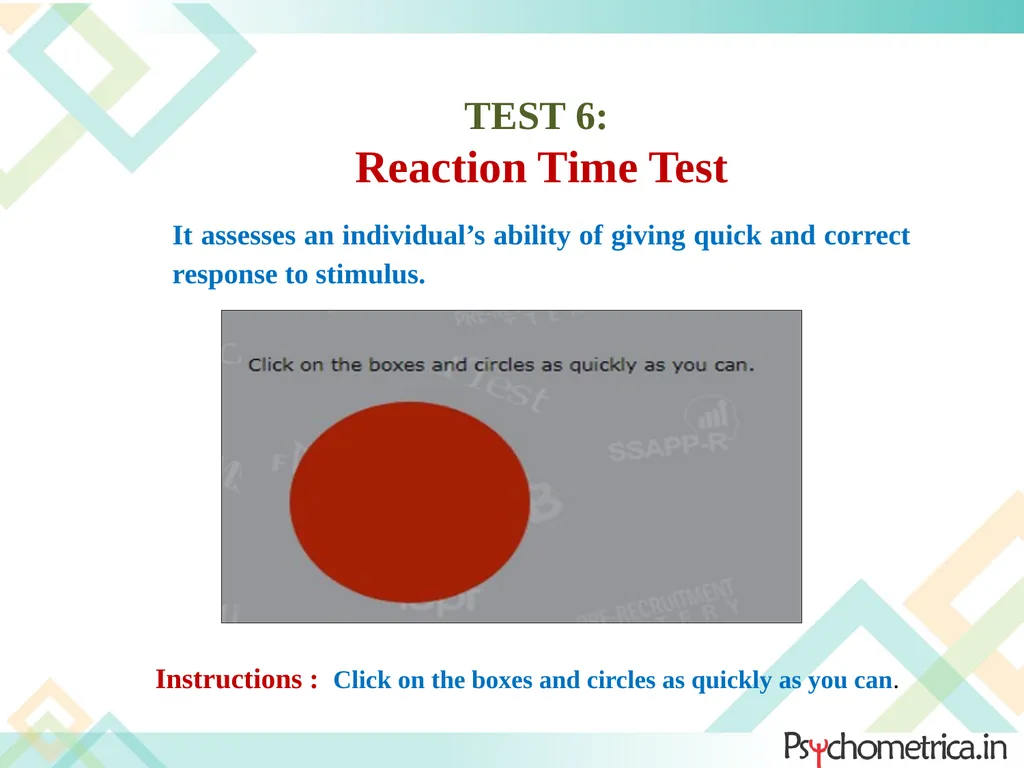
It assesses an individual’s ability of giving quick and correct response to stimulus. Instructions : Click on the boxes and circles as quickly as you can. TEST 6: Reaction Time Test<br>