
Instructions for use (1) This resource is not a
LO
Published · 48 slides · 0 views

1 / 1


Description
Instructions for use (1) This resource is not a teaching and learning program. It should be used in conjunction with the drama Stage 5 sample unit Screen play group-devising through short film and the Screen play sample assessment
Related Topics
Share
Embed code
Download this presentation From Below
"Instructions for use (1) This resource is not a" is the property of its rightful owner. Permission is granted to download and print the materials on this website for personal, non-commercial use only, and to display it on your personal computer provided you do not modify the materials and that you retain all copyright notices contained in the materials. By downloading content from our website, you accept the terms of this agreement.
Presentation Transcript
01
Instructions for use (1) This resource is not a teaching and learning program. It should be used in conjunction with the drama Stage 5 sample unit ‘Screen play – group-devising through short film’ and the Screen play – sample assessment task, available on the Planning, programming and assessing drama (2023) 7–10 webpage. Classroom teachers are encouraged to add and adapt slides as required to meet the needs of their students.
Save a copy of the file to make changes to the slide deck. Go to File > Download a Copy (this downloads a copy to the computer to edit in the PowerPoint app).
To convert the PowerPoint to Google Slides:
Upload the file into Google Drive and open it.
Go to File > Save as Google Slides.
(Note: conversion may cause formatting changes in the slides.) 1<br>
Save a copy of the file to make changes to the slide deck. Go to File > Download a Copy (this downloads a copy to the computer to edit in the PowerPoint app).
To convert the PowerPoint to Google Slides:
Upload the file into Google Drive and open it.
Go to File > Save as Google Slides.
(Note: conversion may cause formatting changes in the slides.) 1<br>
02
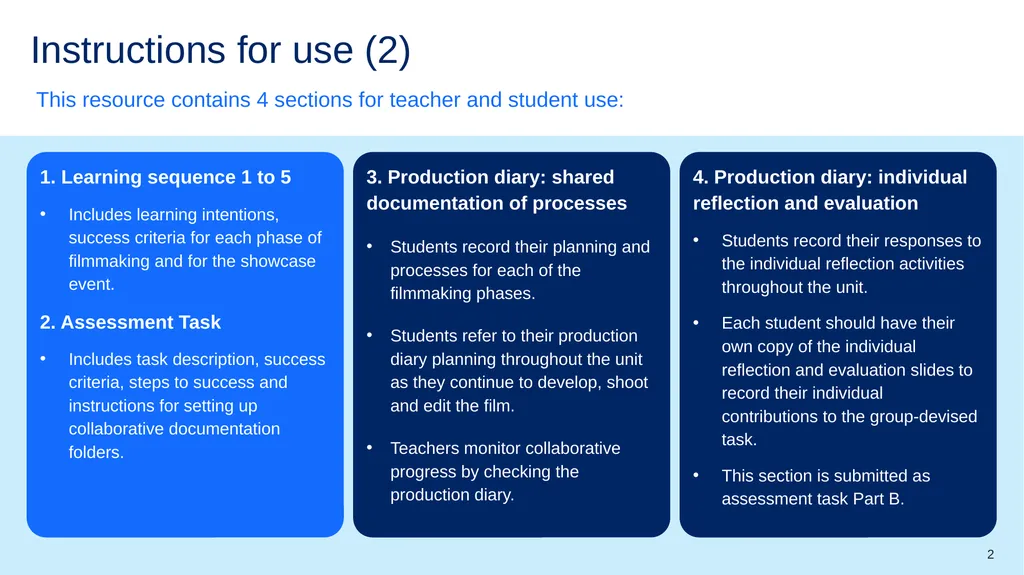
Instructions for use (2) This resource contains 4 sections for teacher and student use: 1. Learning sequence 1 to 5
Includes learning intentions, success criteria for each phase of filmmaking and for the showcase event.
2. Assessment Task
Includes task description, success criteria, steps to success and instructions for setting up collaborative documentation folders. 3. Production diary: shared documentation of processes
Students record their planning and processes for each of the filmmaking phases.
Students refer to their production diary planning throughout the unit as they continue to develop, shoot and edit the film.
Teachers monitor collaborative progress by checking the production diary. 4. Production diary: individual reflection and evaluation
Students record their responses to the individual reflection activities throughout the unit.
Each student should have their own copy of the individual reflection and evaluation slides to record their individual contributions to the group-devised task.
This section is submitted as assessment task Part B. 2<br>
Includes learning intentions, success criteria for each phase of filmmaking and for the showcase event.
2. Assessment Task
Includes task description, success criteria, steps to success and instructions for setting up collaborative documentation folders. 3. Production diary: shared documentation of processes
Students record their planning and processes for each of the filmmaking phases.
Students refer to their production diary planning throughout the unit as they continue to develop, shoot and edit the film.
Teachers monitor collaborative progress by checking the production diary. 4. Production diary: individual reflection and evaluation
Students record their responses to the individual reflection activities throughout the unit.
Each student should have their own copy of the individual reflection and evaluation slides to record their individual contributions to the group-devised task.
This section is submitted as assessment task Part B. 2<br>
03
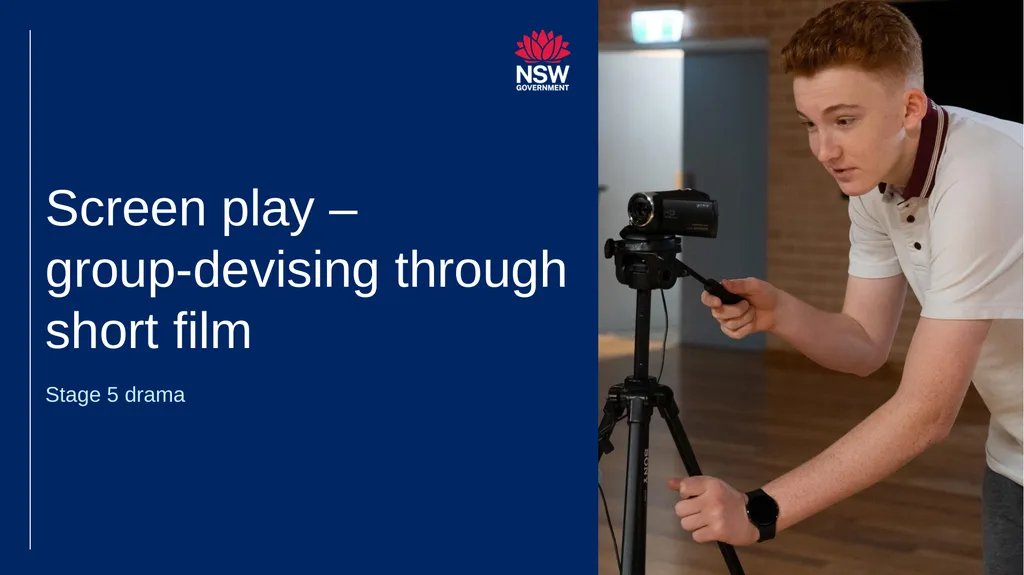
Screen play –
group-devising through short film Stage 5 drama<br>
04
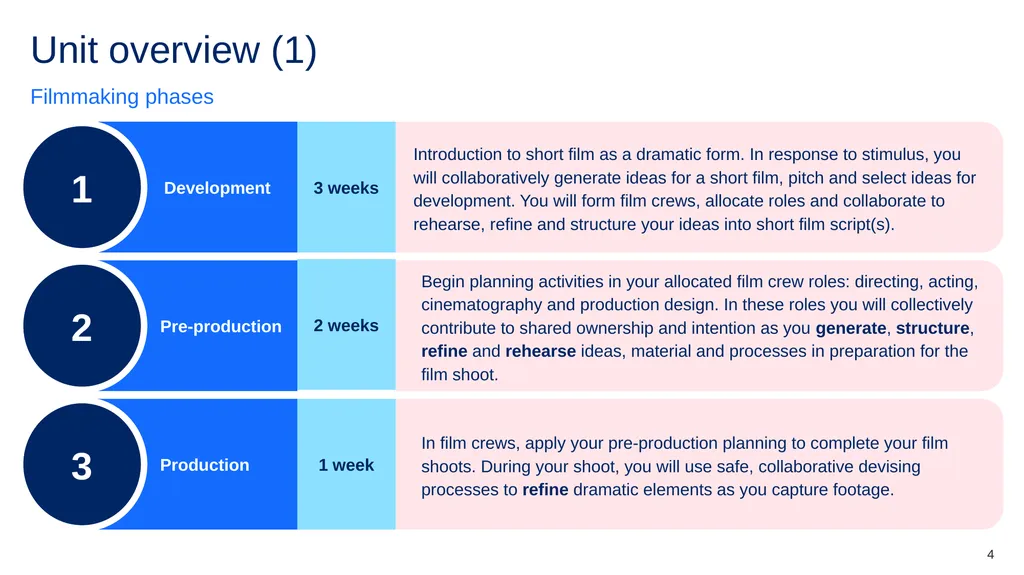
Unit overview (1) Filmmaking phases 4<br>
05
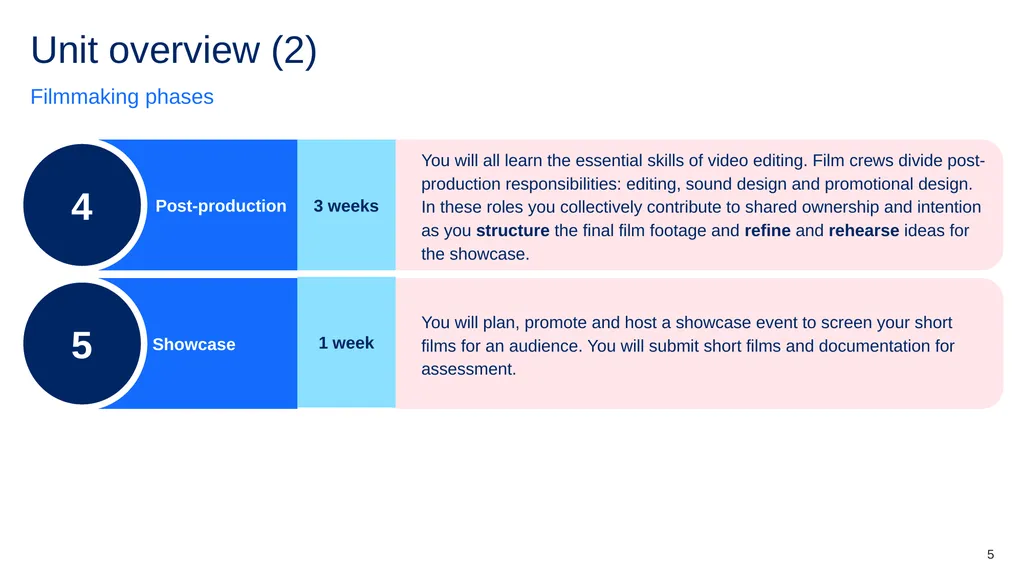
Unit overview (2) Filmmaking phases 5<br>
06
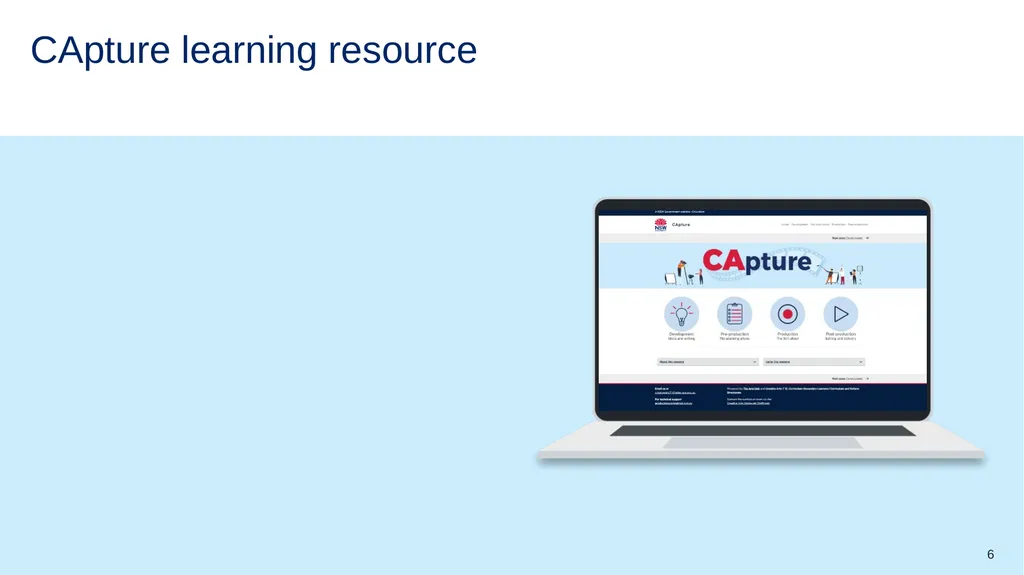
CApture learning resource This unit adapts resources published as part of the department’s CApture filmmaking resource website, which includes:
interviews with film industry professionals
selected sample short films, and examples of pre-production material
scaffolded activities for each phase of production. 6<br>
interviews with film industry professionals
selected sample short films, and examples of pre-production material
scaffolded activities for each phase of production. 6<br>
07
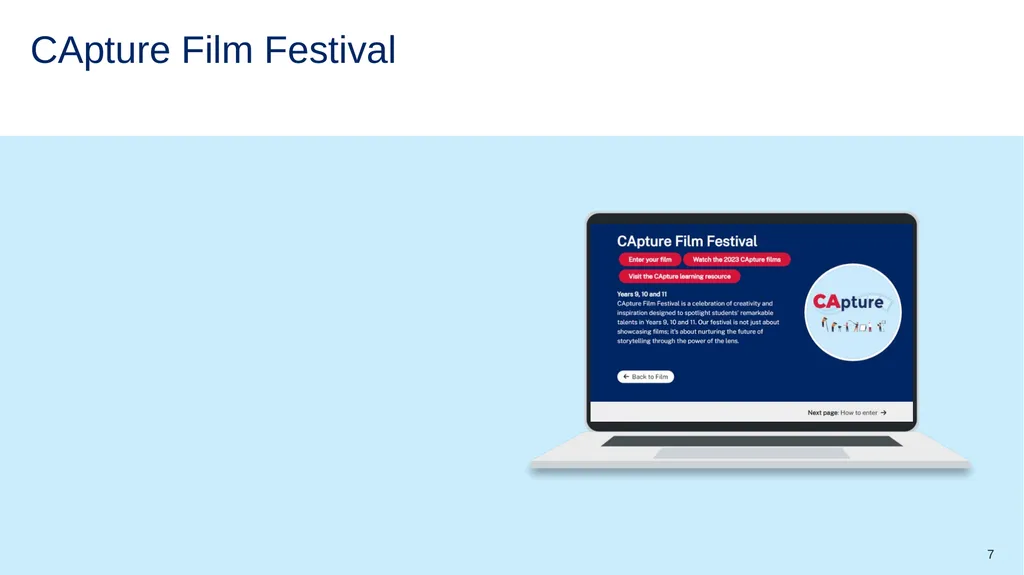
CApture Film Festival The CApture Film Festival is an annual showcase of student films from Year 9, 10 and 11 students in NSW public schools.
The Screen play – group-devising through short film unit is designed to support students to enter their films in this showcase. It is recommended that the screenplay unit be completed in Term 3 to align with the CApture submission dates.
At the beginning of the project, teachers and students should refer to the CApture Film Festival – how to enter webpage for up-to-date submission protocols including the closing date, selection criteria and authority to publish forms.
The festival ‘signature item’ is also updated annually, and, if schools intend to enter the festival, the current year’s item should be used in this unit. 7<br>
The Screen play – group-devising through short film unit is designed to support students to enter their films in this showcase. It is recommended that the screenplay unit be completed in Term 3 to align with the CApture submission dates.
At the beginning of the project, teachers and students should refer to the CApture Film Festival – how to enter webpage for up-to-date submission protocols including the closing date, selection criteria and authority to publish forms.
The festival ‘signature item’ is also updated annually, and, if schools intend to enter the festival, the current year’s item should be used in this unit. 7<br>
08
Learning sequence 1 to 5 – learning intentions and success criteria<br>
09
Learning intentions and success criteria (1) Development We are learning how to
collaboratively develop a short film script using the elements of drama and dramatic processes.
We can
document our analysis of how filmmaking choices can impact an audience
use devising processes to generate and structure ideas for a short film script
use collaborative and safe processes to rehearse and refine ideas. 9<br>
collaboratively develop a short film script using the elements of drama and dramatic processes.
We can
document our analysis of how filmmaking choices can impact an audience
use devising processes to generate and structure ideas for a short film script
use collaborative and safe processes to rehearse and refine ideas. 9<br>
10
Learning intentions and success criteria (2) Pre-production We are learning how to
select and apply the elements of production to collaboratively plan and generate ideas for a short film in the pre-production phase.
We can
experiment with and select appropriate elements of production when generating and structuring material to shoot our short film
use embodied and collaborative processes to create and refine intention and meaning
rehearse and document production choices and analyse how they can impact an audience. 10<br>
select and apply the elements of production to collaboratively plan and generate ideas for a short film in the pre-production phase.
We can
experiment with and select appropriate elements of production when generating and structuring material to shoot our short film
use embodied and collaborative processes to create and refine intention and meaning
rehearse and document production choices and analyse how they can impact an audience. 10<br>
11
Learning intentions and success criteria (3) Production We are learning how to
apply and manipulate elements of drama and production during the production phase of creating a short film.
We can
manipulate performance skills in our chosen film crew roles to refine and communicate clear intention and dramatic meaning
safely collaborate with the class and crew to refine and stage dramatic action in a short film shoot
use and refine elements of production to influence audience response. 11<br>
apply and manipulate elements of drama and production during the production phase of creating a short film.
We can
manipulate performance skills in our chosen film crew roles to refine and communicate clear intention and dramatic meaning
safely collaborate with the class and crew to refine and stage dramatic action in a short film shoot
use and refine elements of production to influence audience response. 11<br>
12
Learning intentions and success criteria (4) Post-production We are learning how to
structure and manipulate elements of drama and production in the post-production phase of our short film.
We can
analyse and evaluate our own and others’ creative choices
experiment with and structure ideas through editing, sound or promotion design
create and refine meaning by manipulating dramatic elements to edit and/or promote our short film
consider audience response as we refine our short film and rehearse ideas for our showcase. 12<br>
structure and manipulate elements of drama and production in the post-production phase of our short film.
We can
analyse and evaluate our own and others’ creative choices
experiment with and structure ideas through editing, sound or promotion design
create and refine meaning by manipulating dramatic elements to edit and/or promote our short film
consider audience response as we refine our short film and rehearse ideas for our showcase. 12<br>
13
Learning intentions and success criteria (5) Showcase and reflection We are learning how to
document, evaluate and reflect on our creative choices through viewing and sharing the final cut of our short film.
We can
analyse how our creative choices and engagement with the collaborative processes shaped a shared intention and meaning in the screening of our final short film
evaluate our use of dramatic elements and how they were manipulated to influence audience response
reflect on how audience engagement can be created through a short film showcase. 13<br>
document, evaluate and reflect on our creative choices through viewing and sharing the final cut of our short film.
We can
analyse how our creative choices and engagement with the collaborative processes shaped a shared intention and meaning in the screening of our final short film
evaluate our use of dramatic elements and how they were manipulated to influence audience response
reflect on how audience engagement can be created through a short film showcase. 13<br>
14
Assessment task<br>
15
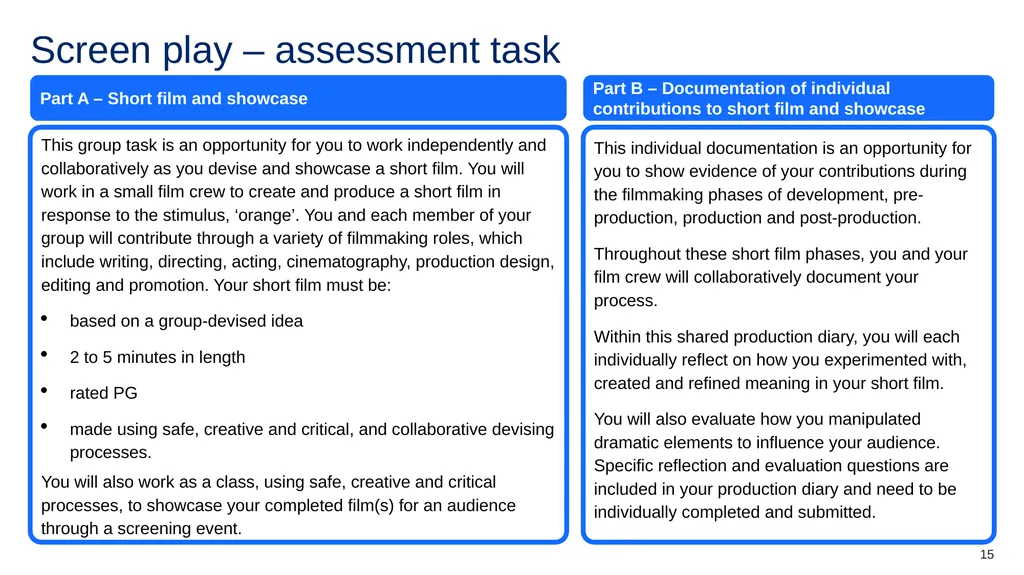
Screen play – assessment task Part A – Short film and showcase This group task is an opportunity for you to work independently and collaboratively as you devise and showcase a short film. You will work in a small film crew to create and produce a short film in response to the stimulus, ‘orange’. You and each member of your group will contribute through a variety of filmmaking roles, which include writing, directing, acting, cinematography, production design, editing and promotion. Your short film must be:
based on a group-devised idea
2 to 5 minutes in length
rated PG
made using safe, creative and critical, and collaborative devising processes.
You will also work as a class, using safe, creative and critical processes, to showcase your completed film(s) for an audience through a screening event. Part B – Documentation of individual contributions to short film and showcase This individual documentation is an opportunity for you to show evidence of your contributions during the filmmaking phases of development, pre-production, production and post-production.
Throughout these short film phases, you and your film crew will collaboratively document your process.
Within this shared production diary, you will each individually reflect on how you experimented with, created and refined meaning in your short film.
You will also evaluate how you manipulated dramatic elements to influence your audience. Specific reflection and evaluation questions are included in your production diary and need to be individually completed and submitted. 15<br>
based on a group-devised idea
2 to 5 minutes in length
rated PG
made using safe, creative and critical, and collaborative devising processes.
You will also work as a class, using safe, creative and critical processes, to showcase your completed film(s) for an audience through a screening event. Part B – Documentation of individual contributions to short film and showcase This individual documentation is an opportunity for you to show evidence of your contributions during the filmmaking phases of development, pre-production, production and post-production.
Throughout these short film phases, you and your film crew will collaboratively document your process.
Within this shared production diary, you will each individually reflect on how you experimented with, created and refined meaning in your short film.
You will also evaluate how you manipulated dramatic elements to influence your audience. Specific reflection and evaluation questions are included in your production diary and need to be individually completed and submitted. 15<br>
16
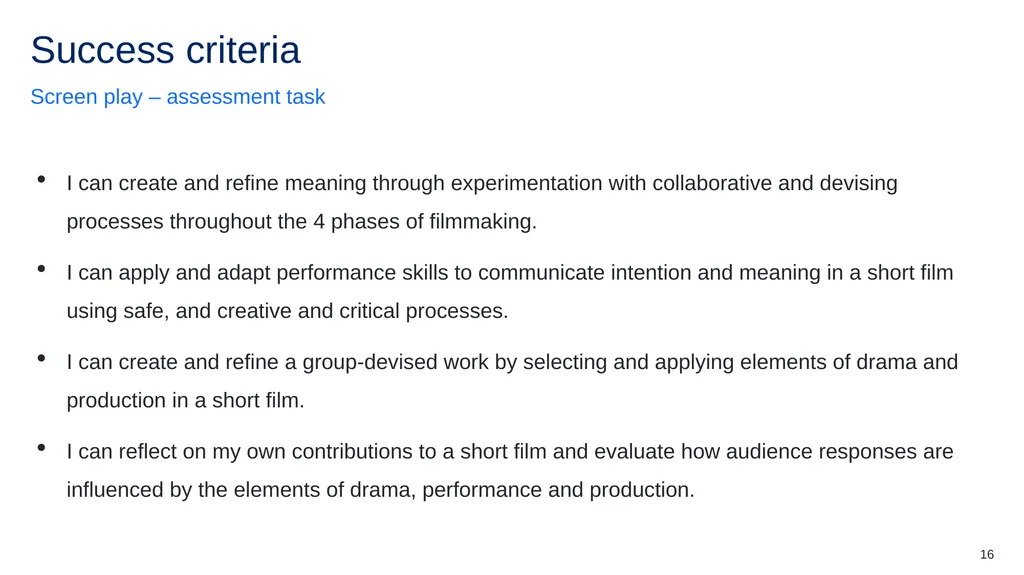
Success criteria Screen play – assessment task I can create and refine meaning through experimentation with collaborative and devising processes throughout the 4 phases of filmmaking.
I can apply and adapt performance skills to communicate intention and meaning in a short film using safe, and creative and critical processes.
I can create and refine a group-devised work by selecting and applying elements of drama and production in a short film.
I can reflect on my own contributions to a short film and evaluate how audience responses are influenced by the elements of drama, performance and production. 16<br>
I can apply and adapt performance skills to communicate intention and meaning in a short film using safe, and creative and critical processes.
I can create and refine a group-devised work by selecting and applying elements of drama and production in a short film.
I can reflect on my own contributions to a short film and evaluate how audience responses are influenced by the elements of drama, performance and production. 16<br>
17
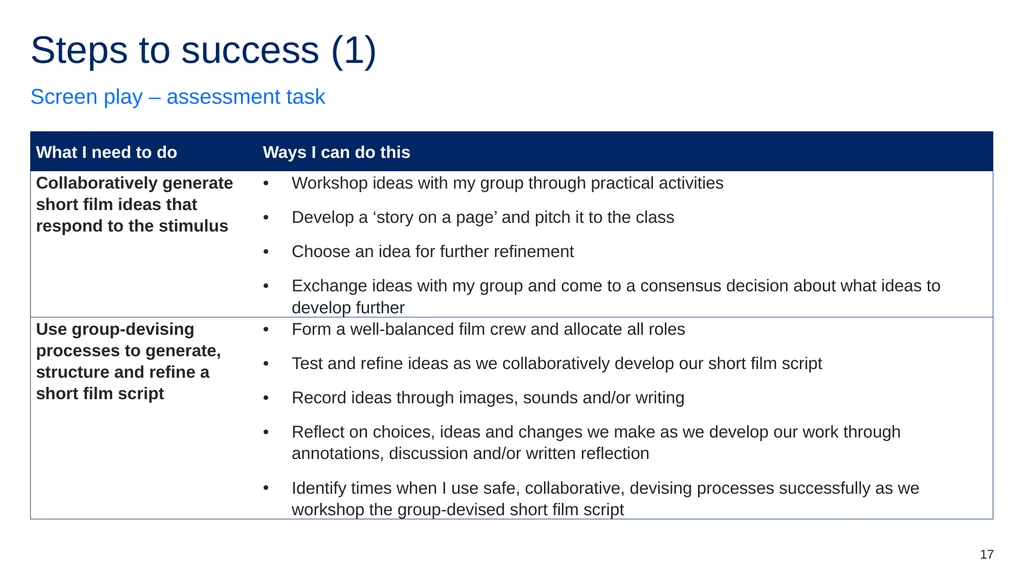
Steps to success (1) Screen play – assessment task 17<br>
18
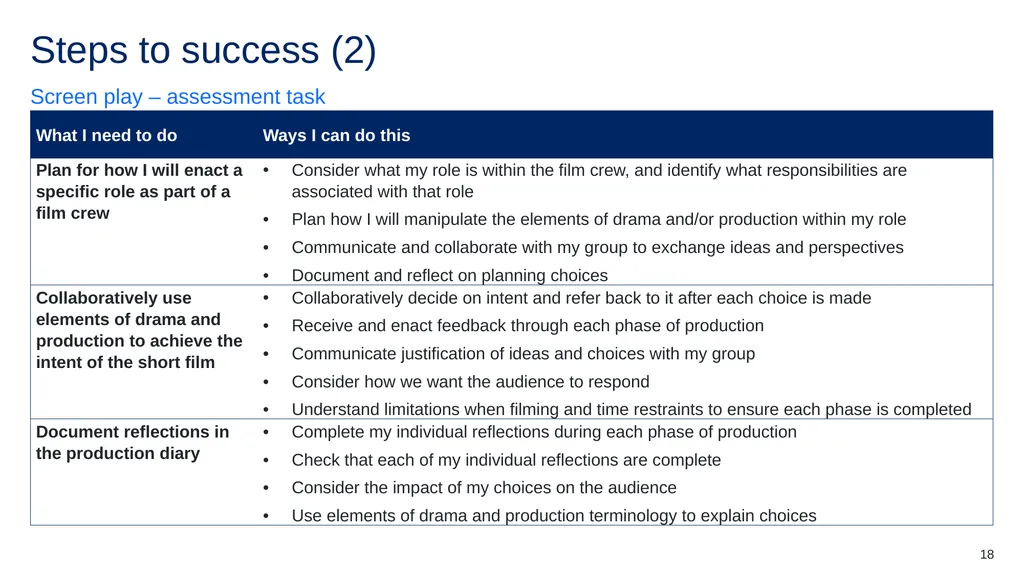
Steps to success (2) Screen play – assessment task 18<br>
19
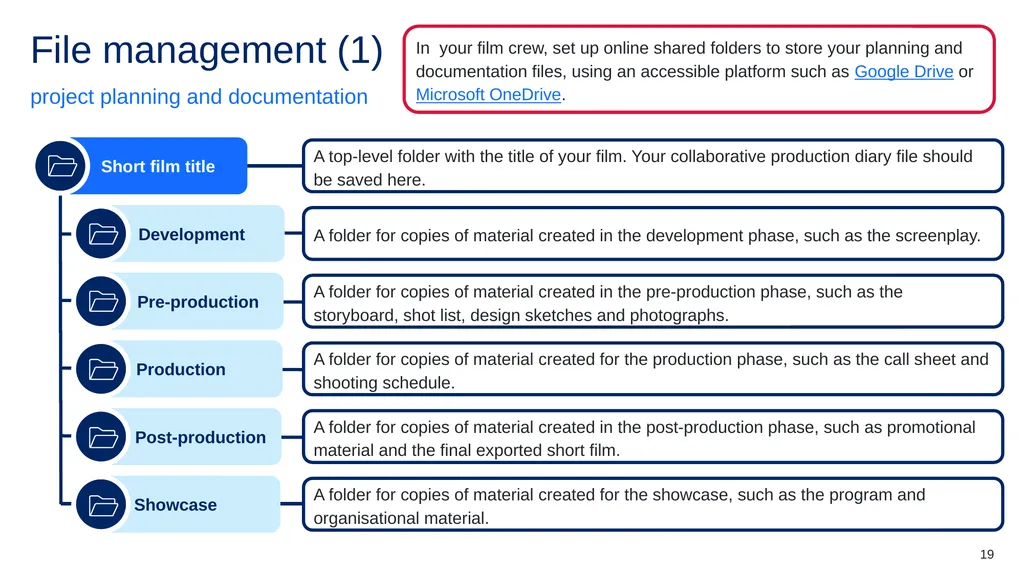
File management (1) project planning and documentation In your film crew, set up online shared folders to store your planning and documentation files, using an accessible platform such as Google Drive or Microsoft OneDrive. A top-level folder with the title of your film. Your collaborative production diary file should be saved here. A folder for copies of material created in the development phase, such as the screenplay. A folder for copies of material created in the pre-production phase, such as the storyboard, shot list, design sketches and photographs. A folder for copies of material created for the production phase, such as the call sheet and shooting schedule. A folder for copies of material created in the post-production phase, such as promotional material and the final exported short film. A folder for copies of material created for the showcase, such as the program and organisational material. 19<br>
20
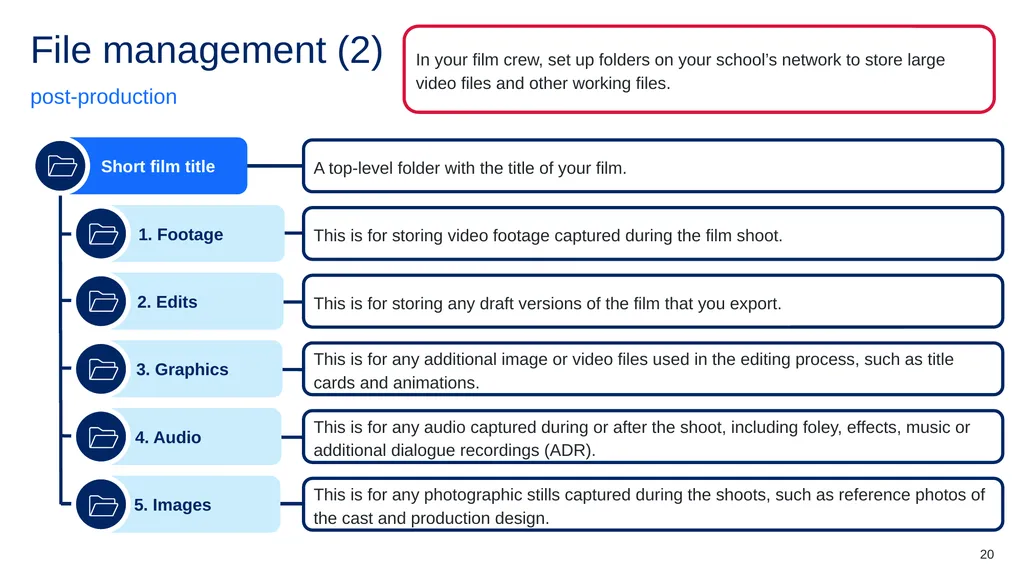
File management (2) post-production In your film crew, set up folders on your school’s network to store large video files and other working files. A top-level folder with the title of your film. This is for storing video footage captured during the film shoot. This is for storing any draft versions of the film that you export. This is for any additional image or video files used in the editing process, such as title cards and animations. This is for any audio captured during or after the shoot, including foley, effects, music or additional dialogue recordings (ADR). This is for any photographic stills captured during the shoots, such as reference photos of the cast and production design. 20<br>
21
Production diary – shared documentation of processes Use this section to document your film crew’s collaborative devising, planning and organisational material during each filmmaking phase. Continue to refer to this material as you move through each phase.<br>
22
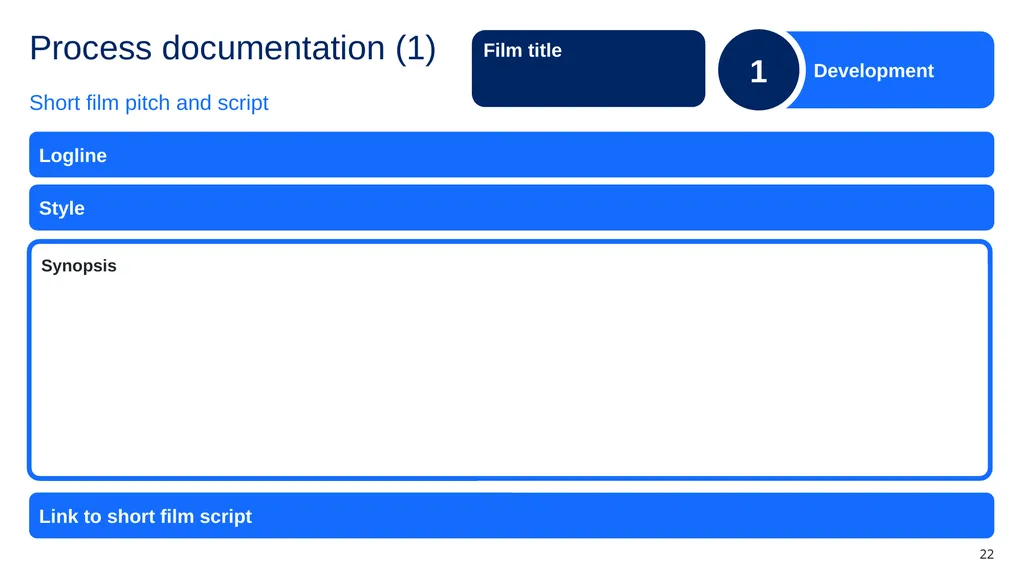
Process documentation (1) Short film pitch and script Film title Logline Style Synopsis Link to short film script 22<br>
23
Process documentation (2) Mood board Film title 23<br>
24
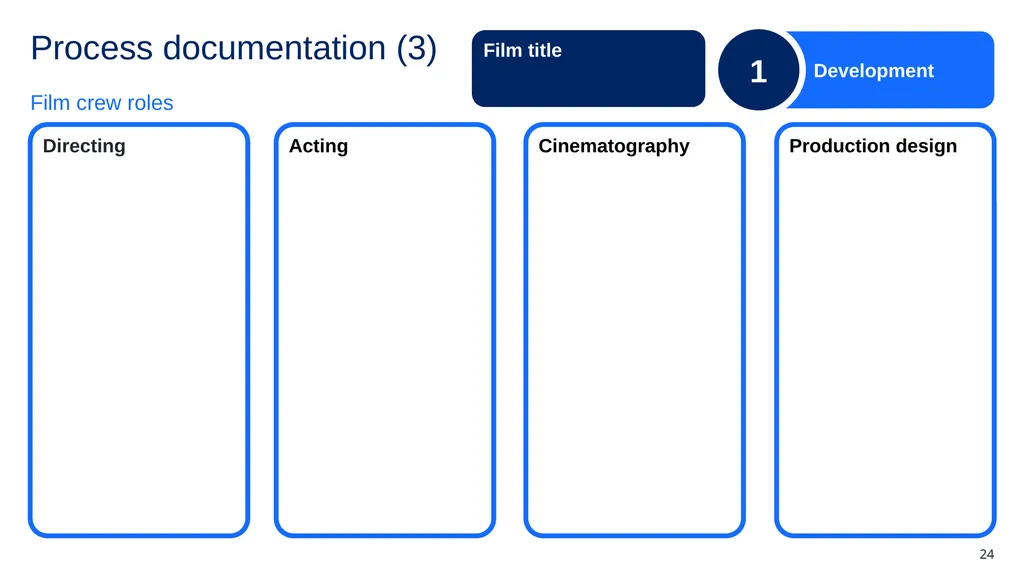
Process documentation (3) Film crew roles Film title Directing Acting Cinematography Production design 24<br>
25
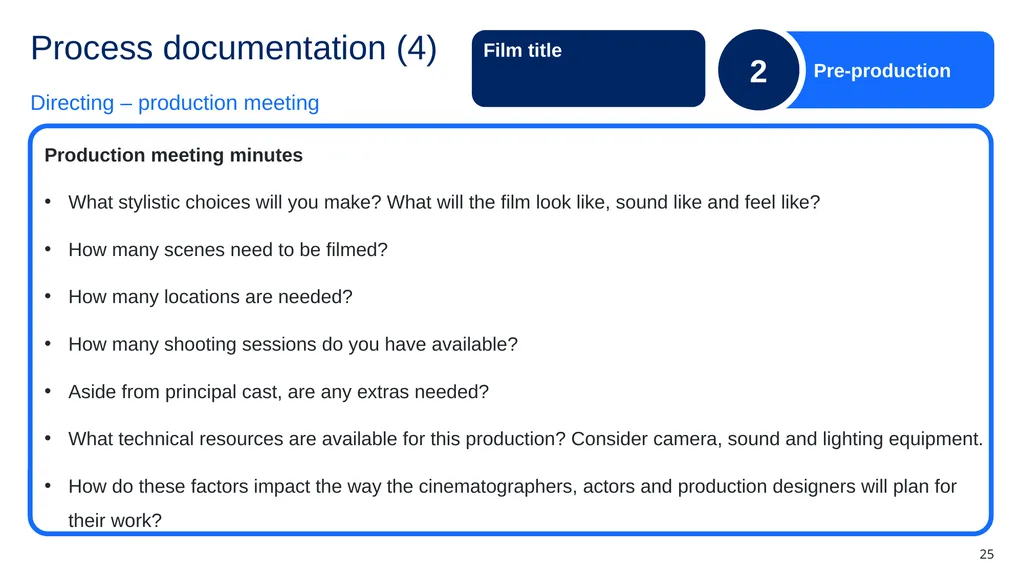
Process documentation (4) Directing – production meeting Film title Production meeting minutes
What stylistic choices will you make? What will the film look like, sound like and feel like?
How many scenes need to be filmed?
How many locations are needed?
How many shooting sessions do you have available?
Aside from principal cast, are any extras needed?
What technical resources are available for this production? Consider camera, sound and lighting equipment.
How do these factors impact the way the cinematographers, actors and production designers will plan for their work? 25<br>
What stylistic choices will you make? What will the film look like, sound like and feel like?
How many scenes need to be filmed?
How many locations are needed?
How many shooting sessions do you have available?
Aside from principal cast, are any extras needed?
What technical resources are available for this production? Consider camera, sound and lighting equipment.
How do these factors impact the way the cinematographers, actors and production designers will plan for their work? 25<br>
26
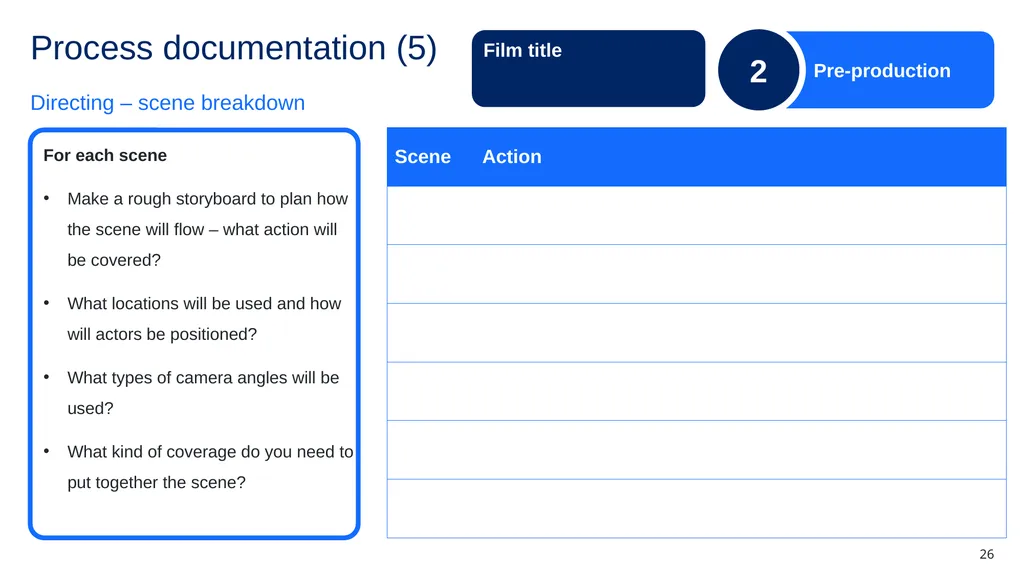
Process documentation (5) Directing – scene breakdown Film title For each scene
Make a rough storyboard to plan how the scene will flow – what action will be covered?
What locations will be used and how will actors be positioned?
What types of camera angles will be used?
What kind of coverage do you need to put together the scene? 26<br>
Make a rough storyboard to plan how the scene will flow – what action will be covered?
What locations will be used and how will actors be positioned?
What types of camera angles will be used?
What kind of coverage do you need to put together the scene? 26<br>
27
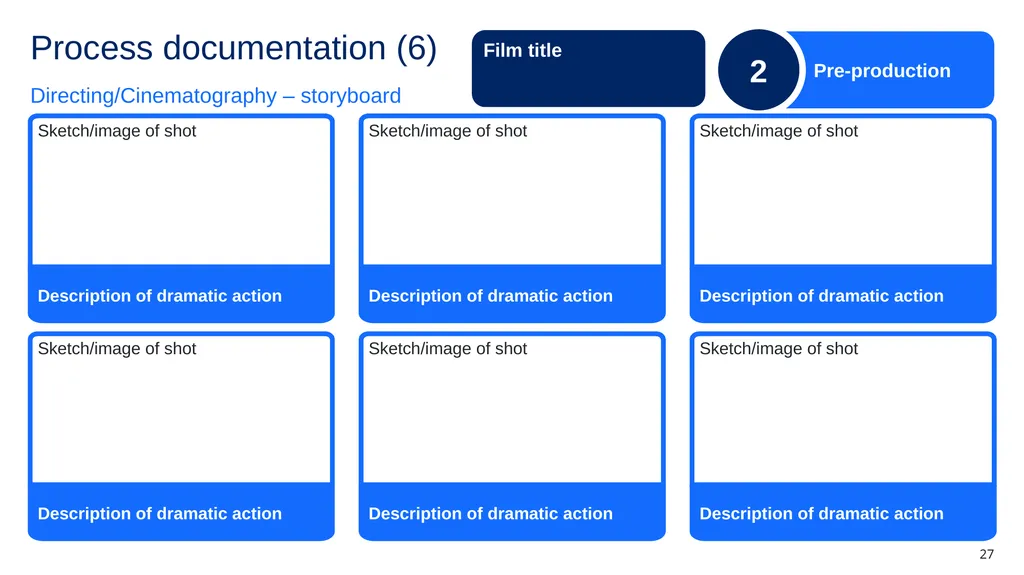
Process documentation (6) Directing/Cinematography – storyboard Film title 27<br>
28
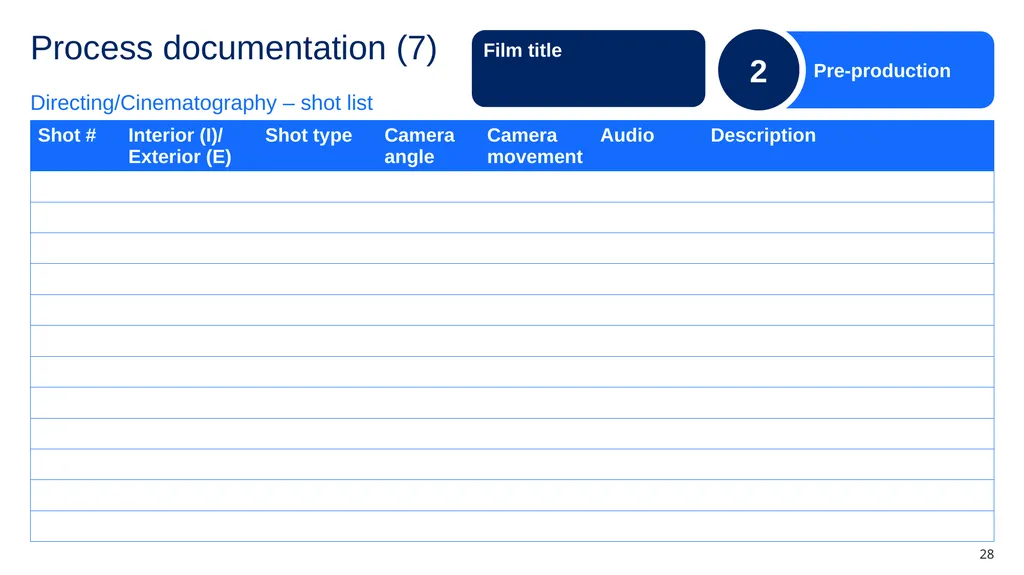
Process documentation (7) Directing/Cinematography – shot list Film title 28<br>
29
Process documentation (8) Directing/Acting – rehearsal notes Film title Rehearsal type, date, cast involved Rehearsal notes and feedback 29<br>
30
Process documentation (9) Directing/Acting – blocking diagram Film title Scene # Blocking diagram 30<br>
31
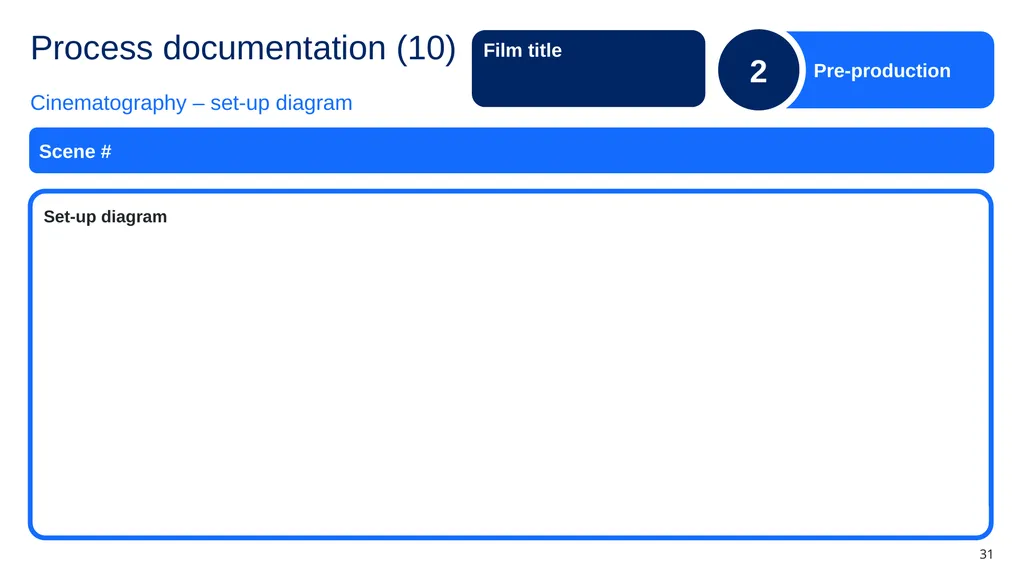
Process documentation (10) Cinematography – set-up diagram Film title Scene # Set-up diagram 31<br>
32
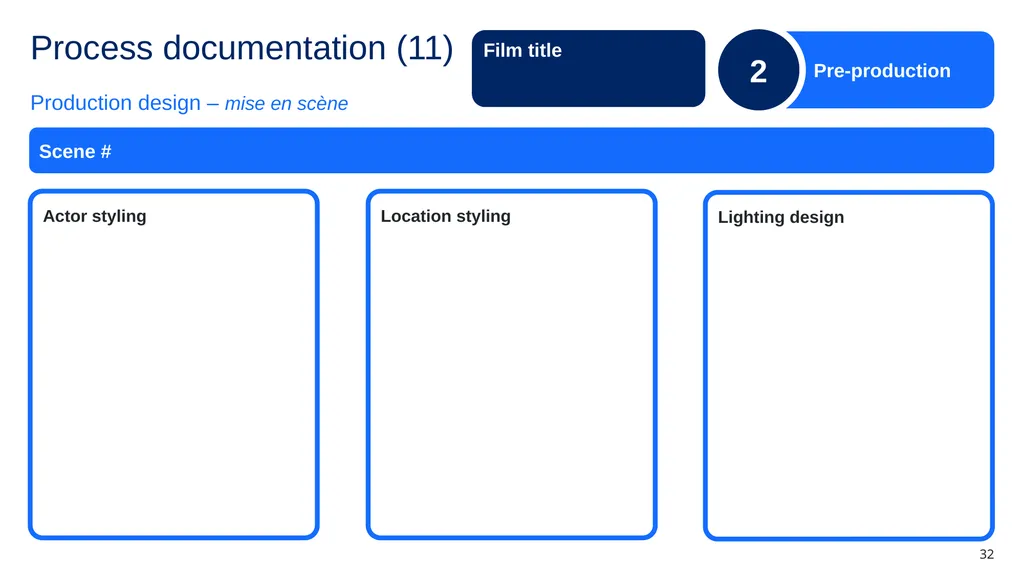
Process documentation (11) Production design – mise en scène Film title Scene # Actor styling Location styling Lighting design 32<br>
33
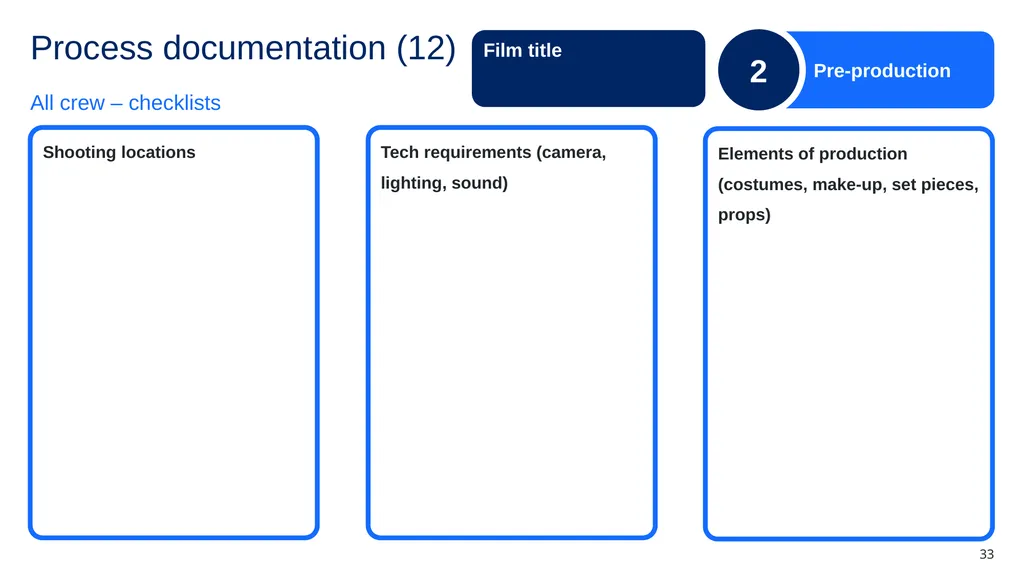
Process documentation (12) All crew – checklists Film title Shooting locations Tech requirements (camera, lighting, sound) Elements of production (costumes, make-up, set pieces, props) 33<br>
34
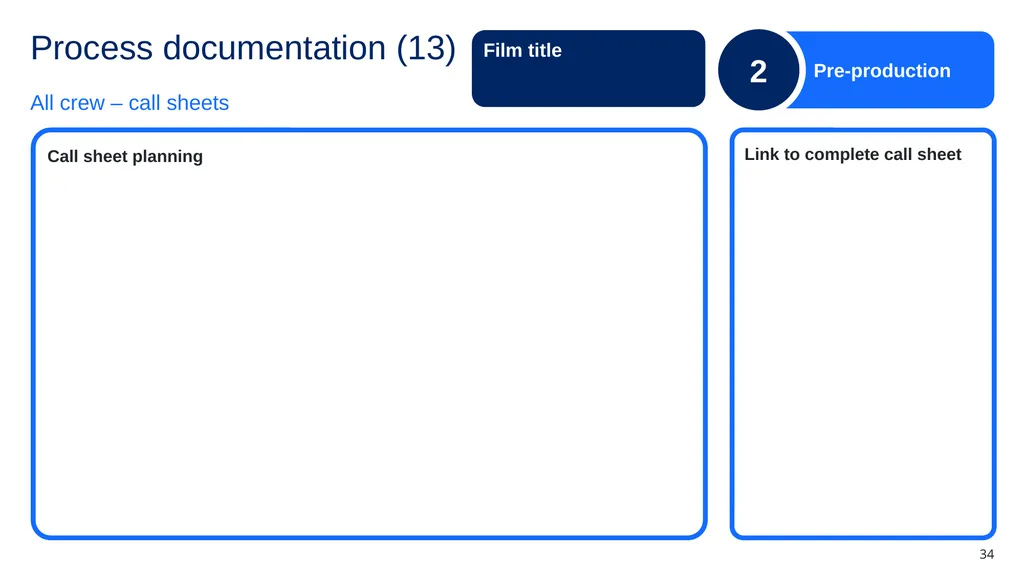
Process documentation (13) All crew – call sheets Film title Call sheet planning Link to complete call sheet 34<br>
35
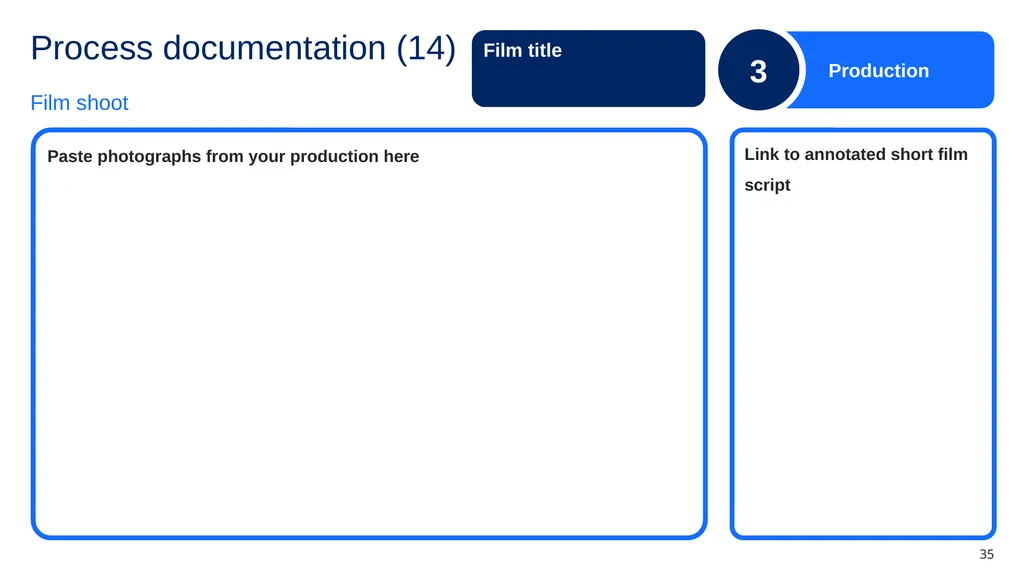
Process documentation (14) Film shoot Film title Paste photographs from your production here Link to annotated short film script 35<br>
36
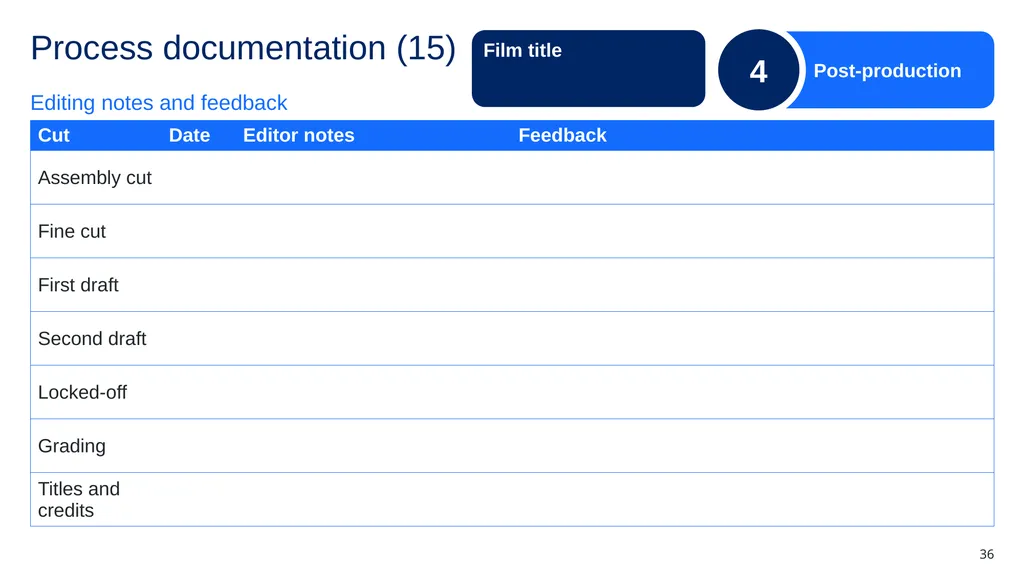
Process documentation (15) Editing notes and feedback Film title 36<br>
37
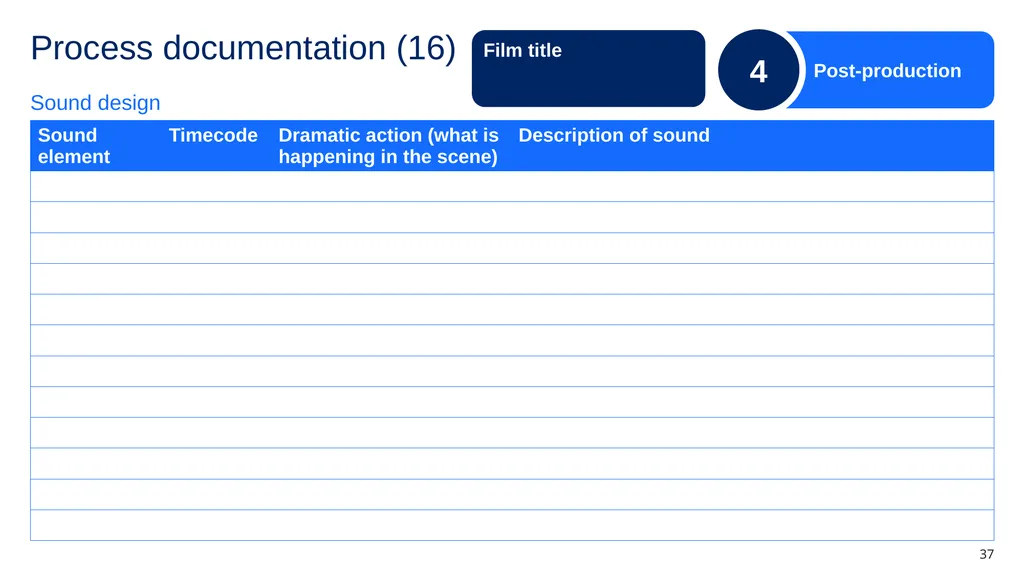
Process documentation (16) Sound design Film title 37<br>
38
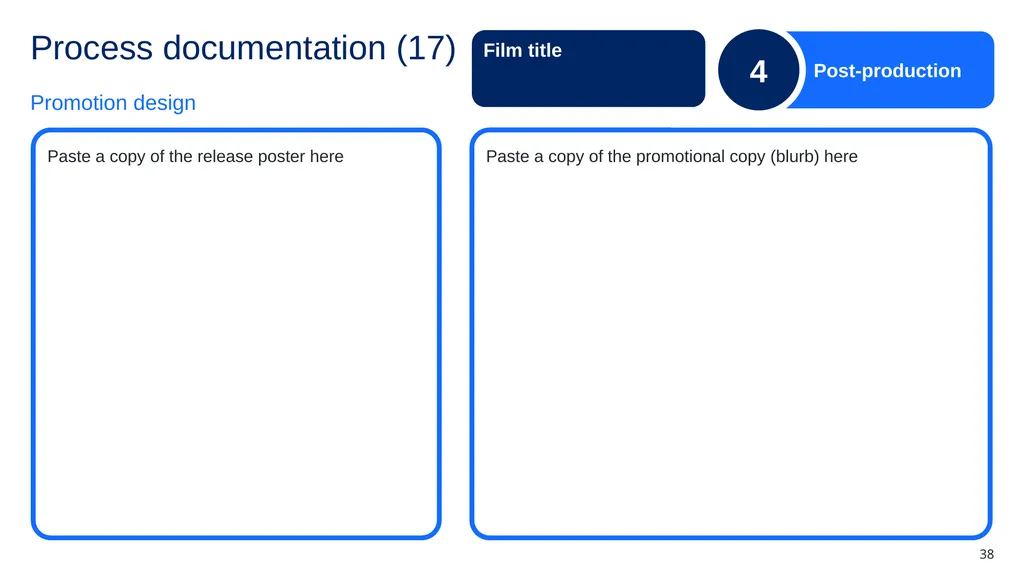
Process documentation (17) Promotion design Film title Paste a copy of the release poster here Paste a copy of the promotional copy (blurb) here 38<br>
39
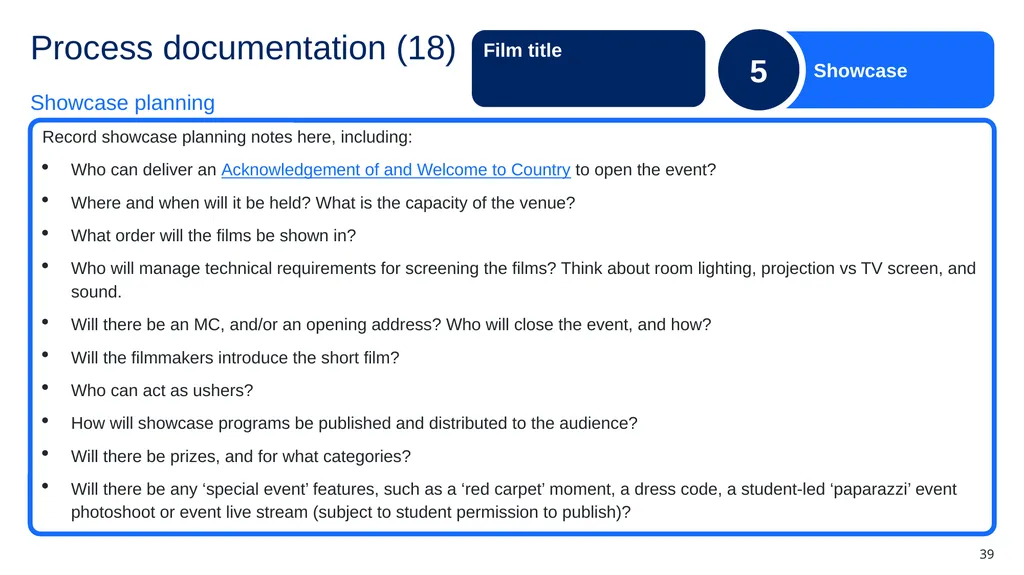
Process documentation (18) Showcase planning Film title Record showcase planning notes here, including:
Who can deliver an Acknowledgement of and Welcome to Country to open the event?
Where and when will it be held? What is the capacity of the venue?
What order will the films be shown in?
Who will manage technical requirements for screening the films? Think about room lighting, projection vs TV screen, and sound.
Will there be an MC, and/or an opening address? Who will close the event, and how?
Will the filmmakers introduce the short film?
Who can act as ushers?
How will showcase programs be published and distributed to the audience?
Will there be prizes, and for what categories?
Will there be any ‘special event’ features, such as a ‘red carpet’ moment, a dress code, a student-led ‘paparazzi’ event photoshoot or event live stream (subject to student permission to publish)? 39<br>
Who can deliver an Acknowledgement of and Welcome to Country to open the event?
Where and when will it be held? What is the capacity of the venue?
What order will the films be shown in?
Who will manage technical requirements for screening the films? Think about room lighting, projection vs TV screen, and sound.
Will there be an MC, and/or an opening address? Who will close the event, and how?
Will the filmmakers introduce the short film?
Who can act as ushers?
How will showcase programs be published and distributed to the audience?
Will there be prizes, and for what categories?
Will there be any ‘special event’ features, such as a ‘red carpet’ moment, a dress code, a student-led ‘paparazzi’ event photoshoot or event live stream (subject to student permission to publish)? 39<br>
40
Production diary – individual reflection and evaluation Use this section to record your responses to the individual reflection and evaluation questions after each filmmaking phase.
Submit this section individually as part of Part B of the assessment task.<br>
Submit this section individually as part of Part B of the assessment task.<br>
41
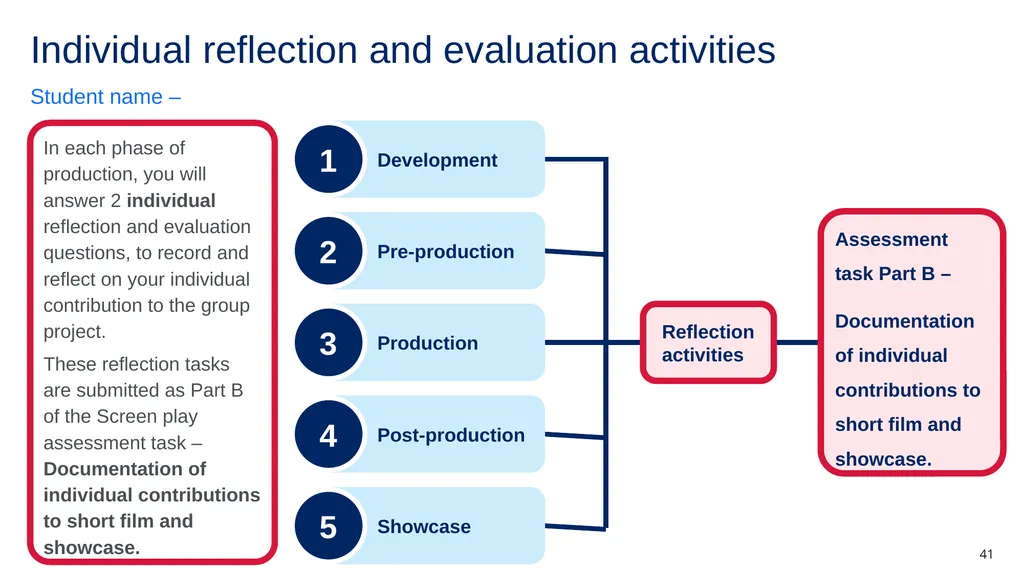
Individual reflection and evaluation activities Student name – In each phase of production, you will answer 2 individual reflection and evaluation questions, to record and reflect on your individual contribution to the group project.
These reflection tasks are submitted as Part B of the Screen play assessment task – Documentation of individual contributions to short film and showcase. Reflection activities Assessment task Part B –
Documentation of individual contributions to short film and showcase. 41<br>
These reflection tasks are submitted as Part B of the Screen play assessment task – Documentation of individual contributions to short film and showcase. Reflection activities Assessment task Part B –
Documentation of individual contributions to short film and showcase. 41<br>
42
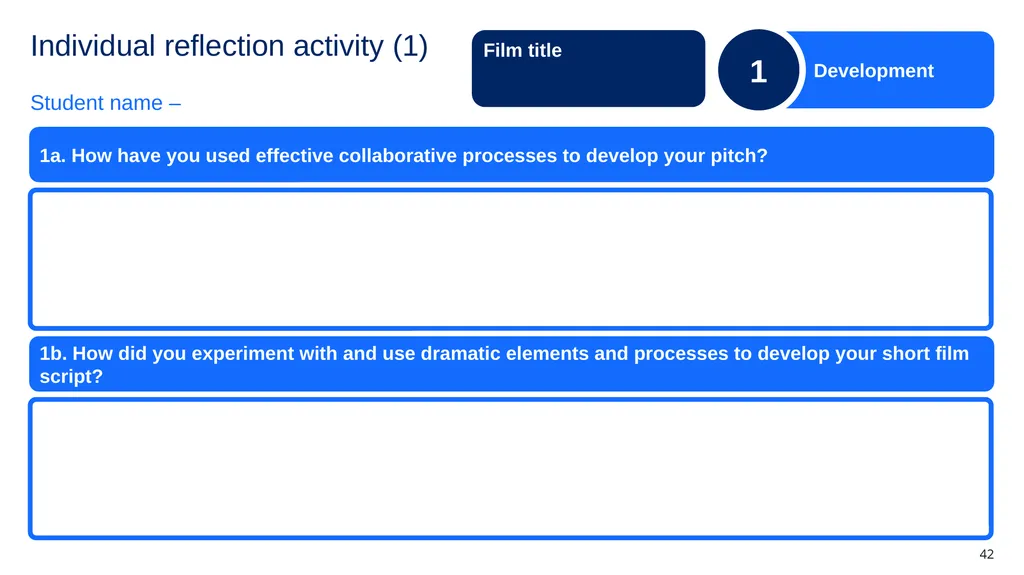
Individual reflection activity (1) Student name – Film title 1a. How have you used effective collaborative processes to develop your pitch? 1b. How did you experiment with and use dramatic elements and processes to develop your short film script? 42<br>
43
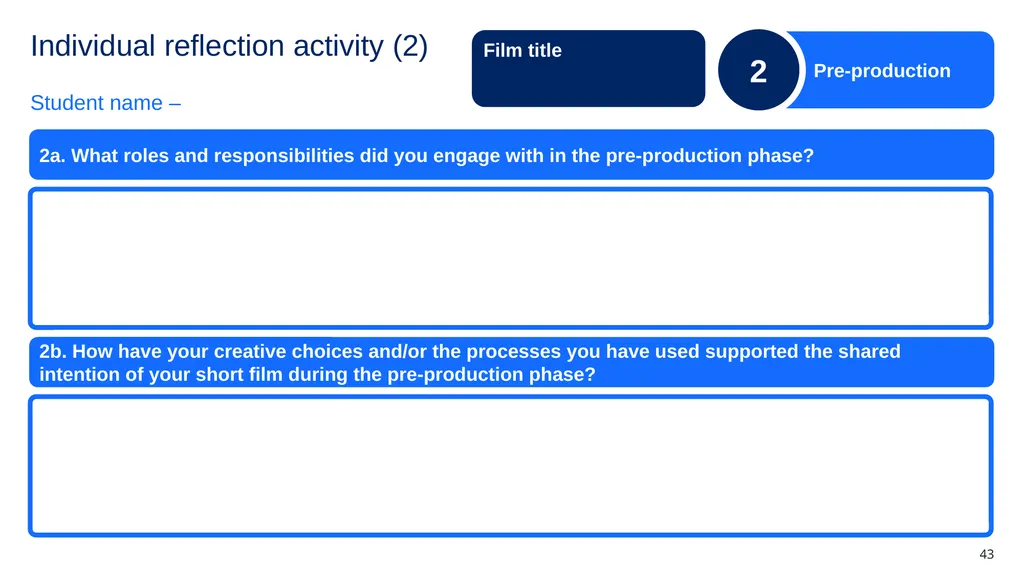
Individual reflection activity (2) Student name – Film title 2a. What roles and responsibilities did you engage with in the pre-production phase? 2b. How have your creative choices and/or the processes you have used supported the shared intention of your short film during the pre-production phase? 43<br>
44
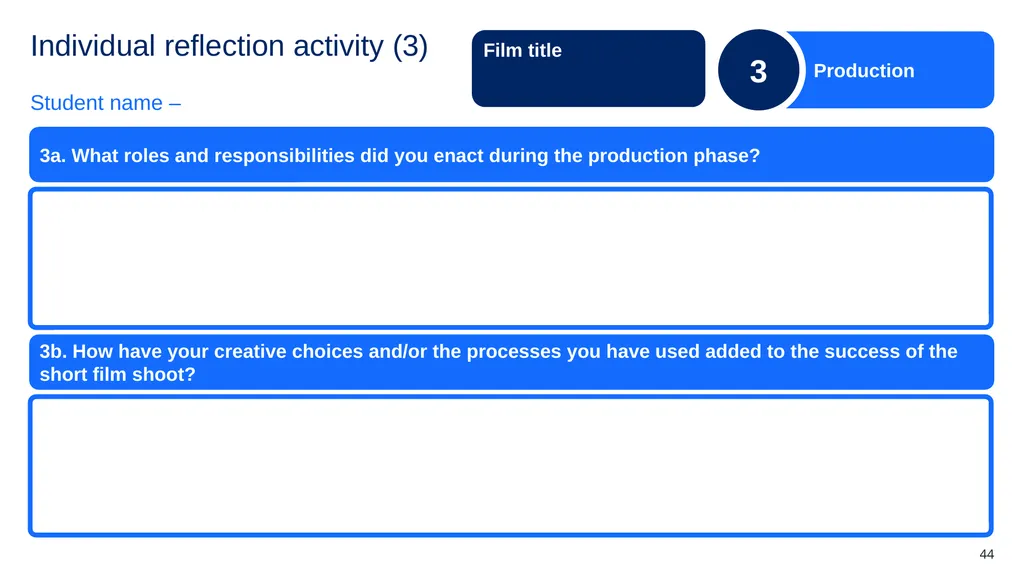
Individual reflection activity (3) Student name – Film title 3a. What roles and responsibilities did you enact during the production phase? 3b. How have your creative choices and/or the processes you have used added to the success of the short film shoot? 44<br>
45
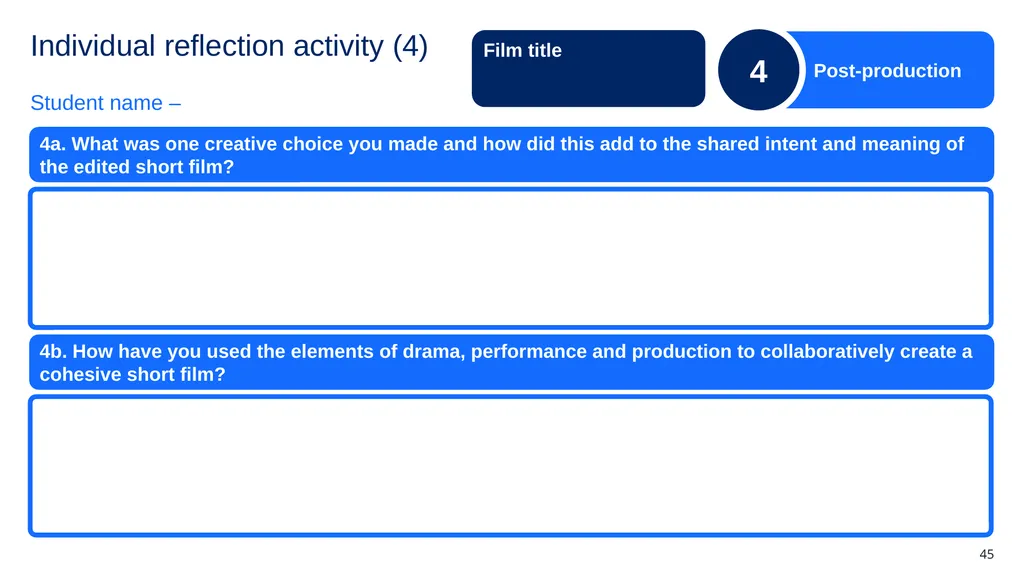
Individual reflection activity (4) Student name – Film title 4a. What was one creative choice you made and how did this add to the shared intent and meaning of the edited short film? 4b. How have you used the elements of drama, performance and production to collaboratively create a cohesive short film? 45<br>
46
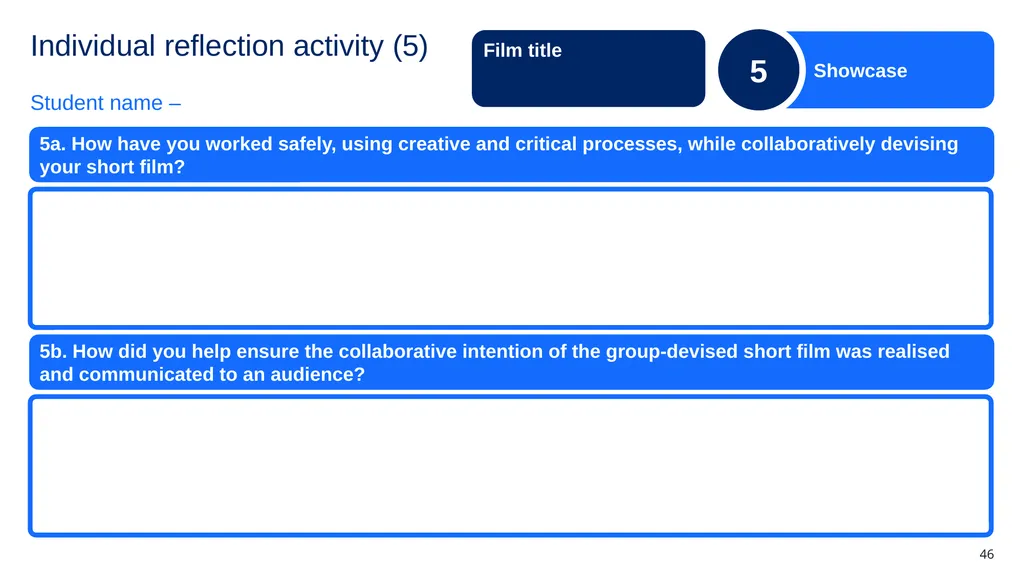
Individual reflection activity (5) Student name – Film title 5a. How have you worked safely, using creative and critical processes, while collaboratively devising your short film? 5b. How did you help ensure the collaborative intention of the group-devised short film was realised and communicated to an audience? 46<br>
47
References Drama 7–10 Syllabus © NSW Education Standards Authority (NESA) for and on behalf of the Crown in right of the State of New South Wales, 2023.
State of New South Wales (Department of Education) (2024a) CApture [website], accessed 13 September 2024.
State of New South Wales (Department of Education) (2024b) CApture Film Festival, The Arts Unit website, accessed 13 September 2024. This presentation contains NSW Curriculum and syllabus content. The NSW Curriculum is developed by the NSW Education Standards Authority. This content is prepared by NESA for and on behalf of the Crown in the right of the State of New South Wales. The material is protected by Crown copyright.
Please refer to the NESA Copyright Disclaimer for more information https://educationstandards.nsw.edu.au/wps/portal/nesa/mini-footer/copyright.
NESA holds the only official and up-to-date versions of the NSW Curriculum and syllabus documents. Please visit the NSW Education Standards Authority (NESA) website https://educationstandards.nsw.edu.au/ and the NSW Curriculum website https://curriculum.nsw.edu.au. 47<br>
State of New South Wales (Department of Education) (2024a) CApture [website], accessed 13 September 2024.
State of New South Wales (Department of Education) (2024b) CApture Film Festival, The Arts Unit website, accessed 13 September 2024. This presentation contains NSW Curriculum and syllabus content. The NSW Curriculum is developed by the NSW Education Standards Authority. This content is prepared by NESA for and on behalf of the Crown in the right of the State of New South Wales. The material is protected by Crown copyright.
Please refer to the NESA Copyright Disclaimer for more information https://educationstandards.nsw.edu.au/wps/portal/nesa/mini-footer/copyright.
NESA holds the only official and up-to-date versions of the NSW Curriculum and syllabus documents. Please visit the NSW Education Standards Authority (NESA) website https://educationstandards.nsw.edu.au/ and the NSW Curriculum website https://curriculum.nsw.edu.au. 47<br>
48
Copyright © State of New South Wales (Department of Education), 2024 The copyright material published in this resource is subject to the Copyright Act 1968 (Cth) and is owned by the NSW Department of Education or, where indicated, by a party other than the NSW Department of Education (third-party material).
Copyright material available in this resource and owned by the NSW Department of Education is licensed under a Creative Commons Attribution 4.0 International (CC BY 4.0) license.
This license allows you to share and adapt the material for any purpose, even commercially.
Attribution should be given to © State of New South Wales (Department of Education), 2024.
Material in this resource not available under a Creative Commons license:
the NSW Department of Education logo, other logos and trademark-protected material
Material owned by a third party that has been reproduced with permission. You will need to obtain permission from the third party to reuse its material.
Links to third-party material and websites
Please note that the provided (reading/viewing material/list/links/texts) are a suggestion only and implies no endorsement, by the New South Wales Department of Education, of any author, publisher, or book title. School principals and teachers are best placed to assess the suitability of resources that would complement the curriculum and reflect the needs and interests of their students.
If you use the links provided in this document to access a third-party’s website, you acknowledge that the terms of use, including licence terms set out on the third-party’s website apply to the use which may be made of the materials on that third-party website or where permitted by the Copyright Act 1968 (Cth). The department accepts no responsibility for content on third-party websites.<br>
Copyright material available in this resource and owned by the NSW Department of Education is licensed under a Creative Commons Attribution 4.0 International (CC BY 4.0) license.
This license allows you to share and adapt the material for any purpose, even commercially.
Attribution should be given to © State of New South Wales (Department of Education), 2024.
Material in this resource not available under a Creative Commons license:
the NSW Department of Education logo, other logos and trademark-protected material
Material owned by a third party that has been reproduced with permission. You will need to obtain permission from the third party to reuse its material.
Links to third-party material and websites
Please note that the provided (reading/viewing material/list/links/texts) are a suggestion only and implies no endorsement, by the New South Wales Department of Education, of any author, publisher, or book title. School principals and teachers are best placed to assess the suitability of resources that would complement the curriculum and reflect the needs and interests of their students.
If you use the links provided in this document to access a third-party’s website, you acknowledge that the terms of use, including licence terms set out on the third-party’s website apply to the use which may be made of the materials on that third-party website or where permitted by the Copyright Act 1968 (Cth). The department accepts no responsibility for content on third-party websites.<br>