Instructions For Use This presentation has been created as template for staff education The general content may be edited and rearranged to best meet the needs of your facility Please add your facility specific code alert procedure Delete
"Instructions For Use This presentation has been" is the property of its rightful owner. Permission is granted to
download and print the materials on this website for personal, non-commercial use only, and to display it
on your personal computer provided you do not modify the materials and that you retain all copyright
notices contained in the materials. By downloading content from our website, you accept the terms of this
agreement.
Presentation Transcript
01
Instructions For Use This presentation has been created as template for staff education
The general content may be edited and rearranged to best meet the needs of your facility
Please add your facility specific code alert procedure
Delete this slide before posting/presenting<br>
02
Emergency Alerts: The Change to Plain Language An initiative of the NC State Legislature, NCHA, and NCHEMC<br>
03
Why the Change? Legislation requiring hospitals to standardize emergency alerts was introduced during the 2013 regular session of the NC General Assembly as bill H634. The bill was tabled during session to allow the North Carolina Hospital Emergency Management Council to develop and to provide guidance on how to implement the process.
A subcommittee of the NC Hospital Emergency Management Council, in conjunction with the North Carolina Hospital Association, developed a proposed set of standardized emergency alerts. The alerts are based on plain language communications, with three well-known codes as acceptable options (Code Red, Code Blue and Code Pink).
Several other states have already made the move to standardized emergency codes, including Missouri, Minnesota, Wisconsin, California and Oregon.<br>
04
What Will It Do For Us? Increase staff, patient, physician, visitor and public safety within hospitals by reducing the variation of emergency alerts among North Carolina hospitals
Reduce confusion for health care professionals, patients, physicians, visitors and the public within hospitals regarding emergency alerts, which could lead to potential delays in safety or responses
Promote transparency of safety procedures<br>
05
Plain Language The alerts are based on plain language communications, with three well-known color codes remaining as options. The categories address three types of events that occur in hospitals:
Facility alerts (i.e. hazardous material spills and fires),
Security alerts (i.e. active shooters and mass casualties) and
Medical alerts (i.e. patient falls, cardiac or respiratory arrest).<br>
06
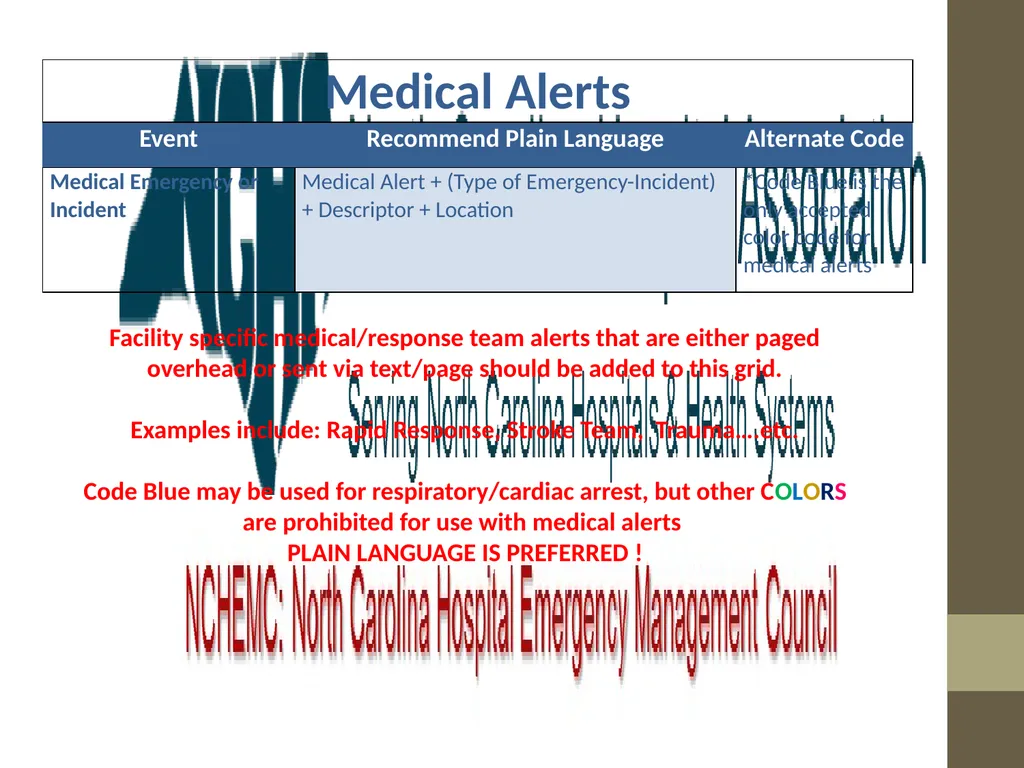
Facility specific medical/response team alerts that are either paged overhead or sent via text/page should be added to this grid.
Code Blue may be used for respiratory/cardiac arrest, but other COLORS are prohibited for use with medical alerts
plain language is preferred !<br>
07
How Would That Sound? Imagine the page you currently hear for a fire:
“Code Red – 2nd Floor”
Now you would hear:
“Facility Alert – 2nd Floor– Fire Alarm Activation”
No guessing needed! It says what it is!
Note: Code RED remains an acceptable color code<br>
08
What Would That Look Like? This will cross over to all message paging!
The same format for overhead paging will be used to convey emergency alerts in text paging formats
What you hear is what you will see!<br>
09
Do Patients Really Want to Hear This? Several states did consumer surveys, patient/visitor responses revealed:
67% to 94% of patients and visitors questioned, indeed wanted to know!
With comments like:
“If I were in the hospital I would want to know what was going on!”
“It's best to be as clear and straight forward as possible.”
“I’d like to know the emergency affecting me.”<br>
10
What About HIPAA? If policy implementation adheres to principles of privacy and HIPAA, use of plain language should not adversely affect patient privacy.
Note: Current codes can often be deciphered by the general public and do not violate any privacy laws. 12<br>
11
Initiating the Code This process will remain the same Use this placeholder to reiterate your current procedure!<br>