
INSTRUCTIONS Slide 3: Introducing Anti-Bullying
MJ
Published · 15 slides · 0 views

1 / 1

Description
INSTRUCTIONS Slide 3: Introducing Anti-Bullying Week Slide 4: Linked UNCRC articles Slide 5: Exploring Anti-Bullying Week Slide 6: Some possible answers Slide 7, 8 9: Primary activities Slide 10, 11 12: Secondary activities Slide 13:
Related Topics
Share
Embed code
Download this presentation From Below
"INSTRUCTIONS Slide 3: Introducing Anti-Bullying" is the property of its rightful owner. Permission is granted to download and print the materials on this website for personal, non-commercial use only, and to display it on your personal computer provided you do not modify the materials and that you retain all copyright notices contained in the materials. By downloading content from our website, you accept the terms of this agreement.
Presentation Transcript
01
INSTRUCTIONS Slide 3: Introducing Anti-Bullying Week
Slide 4: Linked UNCRC articles
Slide 5: Exploring Anti-Bullying Week
Slide 6: Some possible answers
Slide 7, 8 & 9: Primary activities
Slide 10, 11 & 12: Secondary activities
Slide 13: Reflection<br>
Slide 4: Linked UNCRC articles
Slide 5: Exploring Anti-Bullying Week
Slide 6: Some possible answers
Slide 7, 8 & 9: Primary activities
Slide 10, 11 & 12: Secondary activities
Slide 13: Reflection<br>
02
INTRODUCING ANTI-BULLYING WEEK Anti-Bullying Week Anti-bullying Week is held each year in November and is a time for all of us to think about how we can develop positive relationships in school based on dignity and respect, take a proactive approach to preventing bullying and also support people who have faced or are facing bullying.
There are a number of articles from the CRC that link to Anti-Bullying Week including Article 2, which states that the convention applies to all children without discrimination, Article 12 which says that children’s views should be taken seriously in all decisions that affect them, Article 13 which says that children have the right to express their thoughts and opinions and Article 19 which says that all children should be protected from violence and abuse. Hellen Trivers, RRSA Professional Adviser, introduces Anti-Bullying Week Click here to watch on YouTube<br>
There are a number of articles from the CRC that link to Anti-Bullying Week including Article 2, which states that the convention applies to all children without discrimination, Article 12 which says that children’s views should be taken seriously in all decisions that affect them, Article 13 which says that children have the right to express their thoughts and opinions and Article 19 which says that all children should be protected from violence and abuse. Hellen Trivers, RRSA Professional Adviser, introduces Anti-Bullying Week Click here to watch on YouTube<br>
03
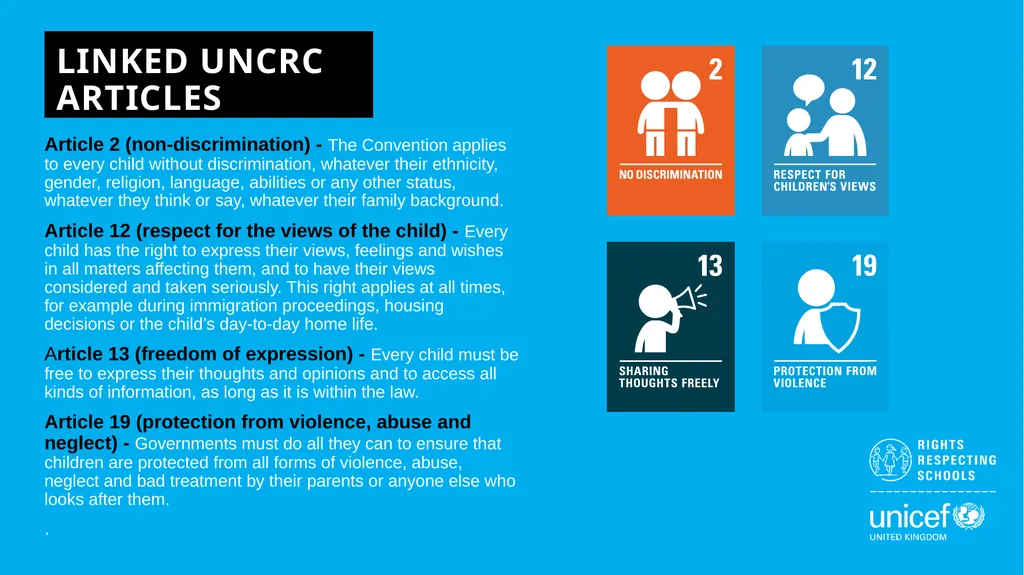
LINKED UNCRC ARTICLES Article 2 (non-discrimination) - The Convention applies to every child without discrimination, whatever their ethnicity, gender, religion, language, abilities or any other status, whatever they think or say, whatever their family background.
Article 12 (respect for the views of the child) - Every child has the right to express their views, feelings and wishes in all matters affecting them, and to have their views considered and taken seriously. This right applies at all times, for example during immigration proceedings, housing decisions or the child’s day-to-day home life.
Article 13 (freedom of expression) - Every child must be free to express their thoughts and opinions and to access all kinds of information, as long as it is within the law.
Article 19 (protection from violence, abuse and neglect) - Governments must do all they can to ensure that children are protected from all forms of violence, abuse, neglect and bad treatment by their parents or anyone else who looks after them.
.<br>
Article 12 (respect for the views of the child) - Every child has the right to express their views, feelings and wishes in all matters affecting them, and to have their views considered and taken seriously. This right applies at all times, for example during immigration proceedings, housing decisions or the child’s day-to-day home life.
Article 13 (freedom of expression) - Every child must be free to express their thoughts and opinions and to access all kinds of information, as long as it is within the law.
Article 19 (protection from violence, abuse and neglect) - Governments must do all they can to ensure that children are protected from all forms of violence, abuse, neglect and bad treatment by their parents or anyone else who looks after them.
.<br>
04
EXPLORING ANTI-BULLYING WEEK Have a think and write down some answers. What does bullying mean to you?
What different kinds of bullying can you think of?<br>
What different kinds of bullying can you think of?<br>
05
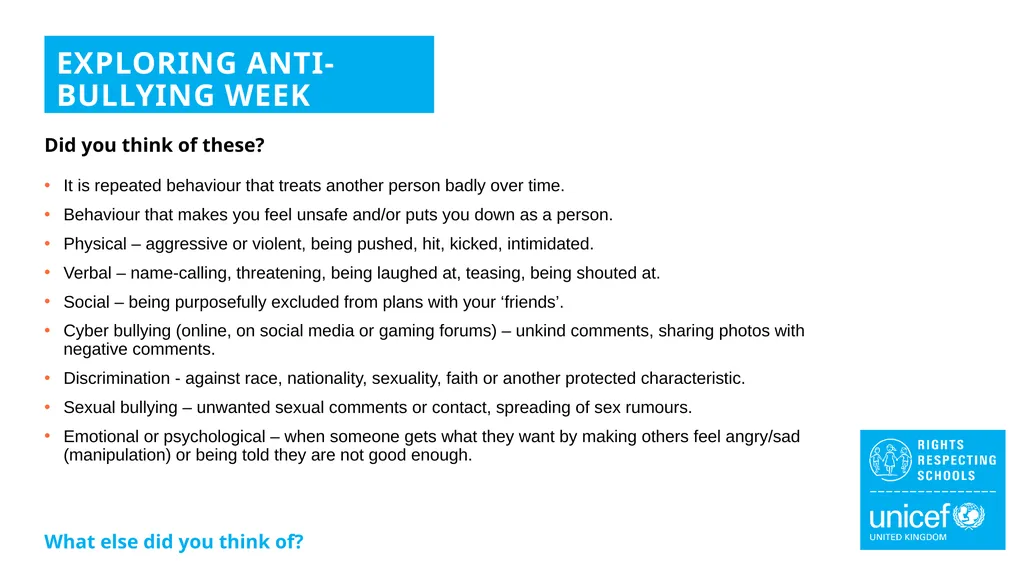
EXPLORING ANTI-BULLYING WEEK What else did you think of? Did you think of these? It is repeated behaviour that treats another person badly over time.
Behaviour that makes you feel unsafe and/or puts you down as a person.
Physical – aggressive or violent, being pushed, hit, kicked, intimidated.
Verbal – name-calling, threatening, being laughed at, teasing, being shouted at.
Social – being purposefully excluded from plans with your ‘friends’.
Cyber bullying (online, on social media or gaming forums) – unkind comments, sharing photos with negative comments.
Discrimination - against race, nationality, sexuality, faith or another protected characteristic.
Sexual bullying – unwanted sexual comments or contact, spreading of sex rumours.
Emotional or psychological – when someone gets what they want by making others feel angry/sad (manipulation) or being told they are not good enough.<br>
Behaviour that makes you feel unsafe and/or puts you down as a person.
Physical – aggressive or violent, being pushed, hit, kicked, intimidated.
Verbal – name-calling, threatening, being laughed at, teasing, being shouted at.
Social – being purposefully excluded from plans with your ‘friends’.
Cyber bullying (online, on social media or gaming forums) – unkind comments, sharing photos with negative comments.
Discrimination - against race, nationality, sexuality, faith or another protected characteristic.
Sexual bullying – unwanted sexual comments or contact, spreading of sex rumours.
Emotional or psychological – when someone gets what they want by making others feel angry/sad (manipulation) or being told they are not good enough.<br>
06
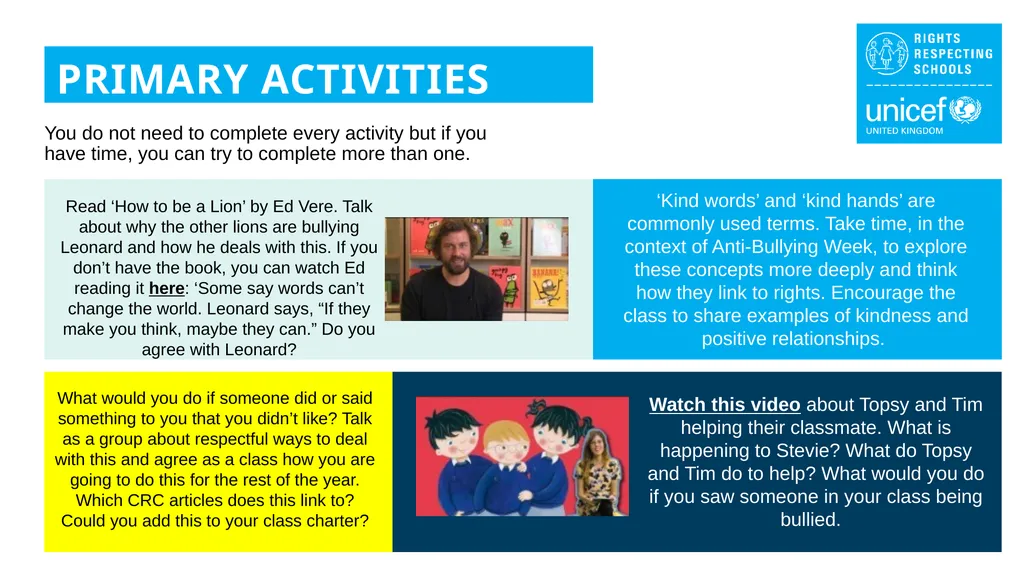
PRIMARY ACTIVITIES You do not need to complete every activity but if you have time, you can try to complete more than one. ‘Kind words’ and ‘kind hands’ are commonly used terms. Take time, in the context of Anti-Bullying Week, to explore these concepts more deeply and think how they link to rights. Encourage the class to share examples of kindness and positive relationships. Read ‘How to be a Lion’ by Ed Vere. Talk about why the other lions are bullying Leonard and how he deals with this. If you don’t have the book, you can watch Ed reading it here: ‘Some say words can’t change the world. Leonard says, “If they make you think, maybe they can.” Do you agree with Leonard? What would you do if someone did or said something to you that you didn’t like? Talk as a group about respectful ways to deal with this and agree as a class how you are going to do this for the rest of the year. Which CRC articles does this link to? Could you add this to your class charter? Watch this video about Topsy and Tim helping their classmate. What is happening to Stevie? What do Topsy and Tim do to help? What would you do if you saw someone in your class being bullied.<br>
07
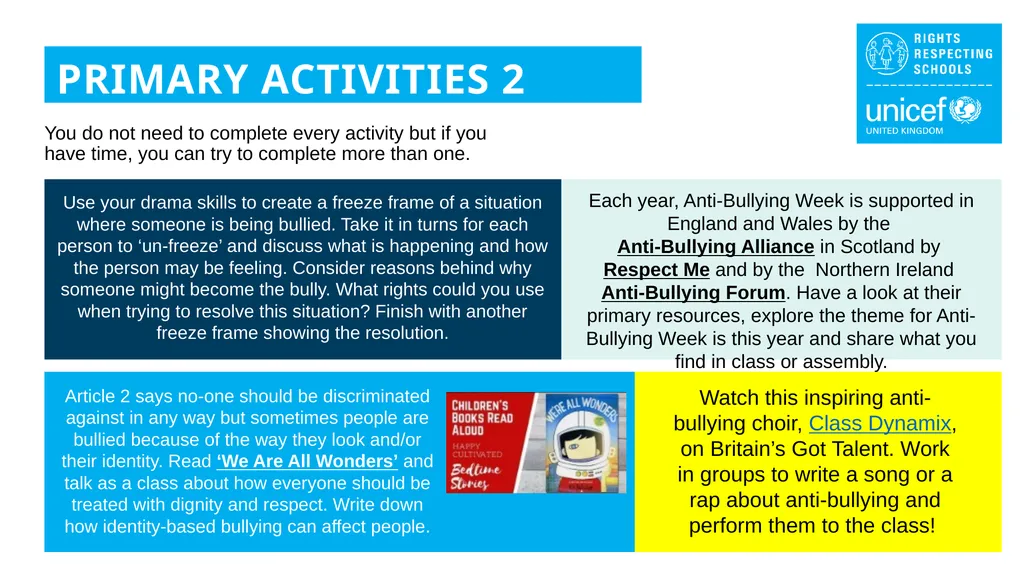
PRIMARY ACTIVITIES 2 You do not need to complete every activity but if you have time, you can try to complete more than one. Each year, Anti-Bullying Week is supported in England and Wales by the Anti-Bullying Alliance in Scotland by Respect Me and by the Northern Ireland Anti-Bullying Forum. Have a look at their primary resources, explore the theme for Anti-Bullying Week is this year and share what you find in class or assembly. Article 2 says no-one should be discriminated against in any way but sometimes people are bullied because of the way they look and/or their identity. Read ‘We Are All Wonders’ and talk as a class about how everyone should be treated with dignity and respect. Write down how identity-based bullying can affect people. Watch this inspiring anti-bullying choir, Class Dynamix, on Britain’s Got Talent. Work in groups to write a song or a rap about anti-bullying and perform them to the class! Use your drama skills to create a freeze frame of a situation where someone is being bullied. Take it in turns for each person to ‘un-freeze’ and discuss what is happening and how the person may be feeling. Consider reasons behind why someone might become the bully. What rights could you use when trying to resolve this situation? Finish with another freeze frame showing the resolution.<br>
08
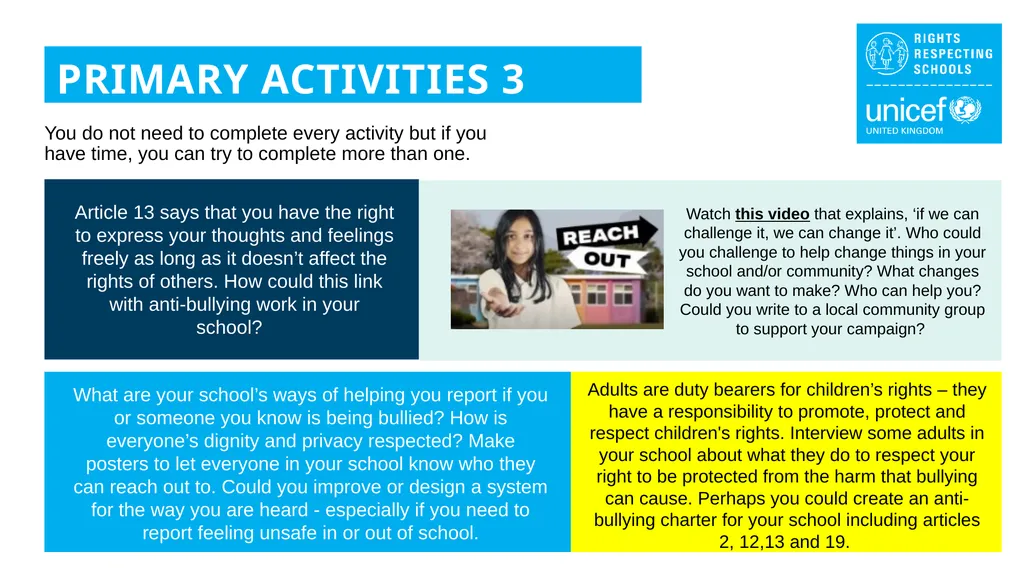
PRIMARY ACTIVITIES 3 You do not need to complete every activity but if you have time, you can try to complete more than one. What are your school’s ways of helping you report if you or someone you know is being bullied? How is everyone’s dignity and privacy respected? Make posters to let everyone in your school know who they can reach out to. Could you improve or design a system for the way you are heard - especially if you need to report feeling unsafe in or out of school. Adults are duty bearers for children’s rights – they have a responsibility to promote, protect and respect children's rights. Interview some adults in your school about what they do to respect your right to be protected from the harm that bullying can cause. Perhaps you could create an anti-bullying charter for your school including articles 2, 12,13 and 19. Watch this video that explains, ‘if we can challenge it, we can change it’. Who could you challenge to help change things in your school and/or community? What changes do you want to make? Who can help you? Could you write to a local community group to support your campaign? Article 13 says that you have the right to express your thoughts and feelings freely as long as it doesn’t affect the rights of others. How could this link with anti-bullying work in your school?<br>
09
SECONDARY ACTIVITIES You do not need to complete every activity but if you have time, you can try to complete more than one. On a large piece of paper write ‘CYBERBULLYING’ in the middle. As a group, write down what you know about this and on which platforms it can happen. Next record actions that can be taken to stop or report cyberbullying, like using an apps report feature or screen-capturing abusive messages. Finally, look at the CRC and map the articles against what you have created. Take a clean A4 piece of paper and ask the class to describe it. Now ask someone to scrunch it up really tight. Then ask them to smooth it out so it is as smooth as it was before. This can’t be done. Explain that when someone is bullied, the effects of the bullying never really go away. Discuss the importance of dignity and children’s rights in relation to bullying. Use the discussion to inspire a piece of creative writing about the impact of bullying behaviours. Watch this video from ‘Respect Me’ or read the information here. Does your school have an anti-bullying policy or maybe a relationships policy? Ask your teachers to see it. Discuss whether your school’s policy links with some of the messages in the video. Article 12 says children and young people have the right to a say on decisions that affect them. Take time to explore your school’s anti-bully statements or policy. Are articles 2, 12, 13 and 19 clearly reflected in the policy. If you don’t have a pupil friendly version of the policy, could you help to create one? Think about what needs to be included and how you will make sure all young people have a voice in what is included.<br>
10
You do not need to complete every activity but if you have time, you can try to complete more than one. SECONDARY ACTIVITIES 2 Watch this video about being connected with friends and family. Can you send someone a message in a creative way to show them how much they mean to you? Use your drama skills to create a freeze frame of a situation where someone is being bullied. Take it in turns for each person to ‘un-freeze’ and discuss what is happening and how the person may be feeling. Explore why someone might become the bully. What rights could help in resolving this situation? Finish with another freeze frame showing the resolution. Each year, Anti-Bullying Week is supported in England and Wales by the Anti-Bullying Alliance in Scotland by Respect Me and by the Northern Ireland Anti-Bullying Forum. Have a look at their secondary resources, explore the theme for Anti-Bullying Week is this year and share what you find in class or assembly.
. It is important to acknowledge that someone who is a bully is expressing negative feelings. Bullies have the same rights as everyone else. Who can a bully go to for help? What can they do to stop their bullying behaviour? Discuss as a group and share with the rest of the class.<br>
. It is important to acknowledge that someone who is a bully is expressing negative feelings. Bullies have the same rights as everyone else. Who can a bully go to for help? What can they do to stop their bullying behaviour? Discuss as a group and share with the rest of the class.<br>
11
SECONDARY ACTIVITIES 3 You do not need to complete every activity but if you have time, you can try to complete more than one. Using the bullying myths on this website to write a true/false quiz about bullying which will make people think and challenge stereotypes. Share the quiz with another group or class. Who can you reach out to (article 12) in your school if you or someone you know is being bullied? Create a display or some content for your school’s newsletter or message screens, to let everyone in your school know who they can reach out to. This video may help. Adults are duty bearers for children’s rights – they have a responsibility to promote, protect and respect children's rights. Interview some adults in your school about what they do to respect your right to be protected from the harm that bullying can cause. Perhaps you could create an anti-bullying charter for your school including articles 2, 12,13 and 19. Choose a video from this selection and recreate your own video to share with your school community and wider. What is your key message about bullying? Try to refer to articles 2, 12,13 and 19. Share this in a short video to help others, raise awareness and don’t forget to mention children’s rights.<br>
12
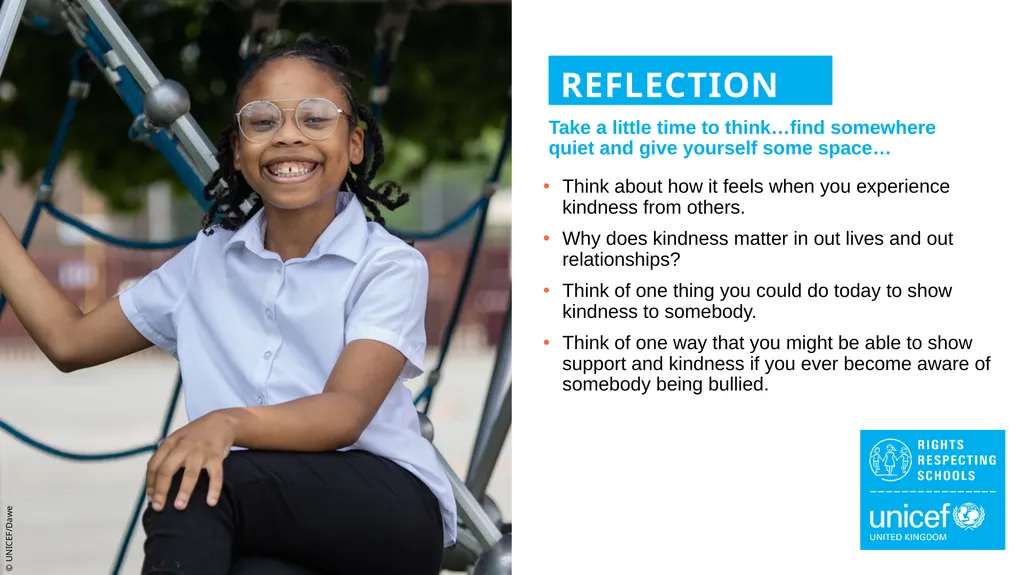
REFLECTION Take a little time to think…find somewhere quiet and give yourself some space… Think about how it feels when you experience kindness from others.
Why does kindness matter in out lives and out relationships?
Think of one thing you could do today to show kindness to somebody.
Think of one way that you might be able to show support and kindness if you ever become aware of somebody being bullied.<br>
Why does kindness matter in out lives and out relationships?
Think of one thing you could do today to show kindness to somebody.
Think of one way that you might be able to show support and kindness if you ever become aware of somebody being bullied.<br>
13
MORE INFO RRSA WEBSITE For more information or to download previous Article of the Week packs please visit the RRSA website by clicking on the link below. CLICK HERE<br>
14
THANK YOU<br>