
Insurance Claims Workshop Financial Lines Claims
TF
Published · 56 slides · 0 views

1 / 1





Description
Insurance Claims Workshop Financial Lines Claims Loss Scenarios Claims Adjustments Part One Causes Trend By: Uzair Mirza Crime Financial Institutions particularly banks are exposed to a variety of crimes ranging from very crude
Related Topics
Share
Embed code
Download this presentation From Below
"Insurance Claims Workshop Financial Lines Claims" is the property of its rightful owner. Permission is granted to download and print the materials on this website for personal, non-commercial use only, and to display it on your personal computer provided you do not modify the materials and that you retain all copyright notices contained in the materials. By downloading content from our website, you accept the terms of this agreement.
Presentation Transcript
01
Insurance Claims Workshop Financial Lines Claims
Loss Scenarios & Claims Adjustments Part One
Causes & Trend
By: Uzair Mirza<br>
Loss Scenarios & Claims Adjustments Part One
Causes & Trend
By: Uzair Mirza<br>
02
Crime Financial Institutions particularly banks are exposed to a variety of crimes ranging from very crude hold-ups/robberies to complex frauds and forgeries
Result – Financial Loss, Litigations, Bad Press etc.<br>
Result – Financial Loss, Litigations, Bad Press etc.<br>
03
Crude Crime Robberies
Hold-ups (Dacoity)
Theft
Generally Violent
Single Attempt
Immediately known
Think<br>
Hold-ups (Dacoity)
Theft
Generally Violent
Single Attempt
Immediately known
Think<br>
04
Complex Crimes Counterfeiting
Forgery
Embezzlement
Computer Fraud
Plastic Card Frauds
Non-Violent
Multiple Attempts
Generally Not Immediately Known
Think<br>
Forgery
Embezzlement
Computer Fraud
Plastic Card Frauds
Non-Violent
Multiple Attempts
Generally Not Immediately Known
Think<br>
05
Key Difference Crude Crime – Loss quantum is known immediately with certainty
Complex (White Collar) Crimes – establishing Loss quantum is not easy and time consuming; generally speaking<br>
Complex (White Collar) Crimes – establishing Loss quantum is not easy and time consuming; generally speaking<br>
06
Types of Crime Crude / Violent Crimes
Small amounts (few thousand rupees) to very large bank heists involving hundreds of millions rupees.
During Business Hours
Off Business Hours
Simple show of weapon to actual shooting spree
Couple of minutes to overnight stay in bank premises
Totally fortuitous without any inside assistance and/or information
Insider’s initiated and/or assisted assault<br>
Small amounts (few thousand rupees) to very large bank heists involving hundreds of millions rupees.
During Business Hours
Off Business Hours
Simple show of weapon to actual shooting spree
Couple of minutes to overnight stay in bank premises
Totally fortuitous without any inside assistance and/or information
Insider’s initiated and/or assisted assault<br>
07
Types of Crime Complex Crimes
Rarely involve small amounts; generally bigger than average robbery claim
Generally perpetrated by an insider (Employee) alone or in connivance with an outsider
Not very often also by someone well versed with “loop holes” in internal control if not assisted or connived by an insider
Generally multiple incidents where an employee or a well versed outsider involved
Most common cause of third party fraud is breach of SoPs and guidelines<br>
Rarely involve small amounts; generally bigger than average robbery claim
Generally perpetrated by an insider (Employee) alone or in connivance with an outsider
Not very often also by someone well versed with “loop holes” in internal control if not assisted or connived by an insider
Generally multiple incidents where an employee or a well versed outsider involved
Most common cause of third party fraud is breach of SoPs and guidelines<br>
08
Key Factors MACRO
Both type of Crimes have roots in
Condition of Economy
Political / Law & Order Situation
MICRO
Branch Network
Physical Security
Operational Controls<br>
Both type of Crimes have roots in
Condition of Economy
Political / Law & Order Situation
MICRO
Branch Network
Physical Security
Operational Controls<br>
09
Macro Factors Criminologists tend to say that tough economic times lead to more property crimes and robberies.
Economists tend to argue the opposite, that better economic times increase crime.
Both Correct<br>
Economists tend to argue the opposite, that better economic times increase crime.
Both Correct<br>
10
Both Correct Crude and violent Crime generally on the rise during the periods of economic distress coupled with political instability and deteriorated law and order
Incidents of Frauds and forgeries increase during periods economic growth but not-that-effective law enforcement<br>
Incidents of Frauds and forgeries increase during periods economic growth but not-that-effective law enforcement<br>
11
Macro Factors Crime is episodic and there is no singular effect of the economy on crime. It is necessary to understand what type of period we are in.
The presence of gangs, weapons availability, the availability and level of protection of potential targets etc., and the effectiveness of law enforcement activity all play a significant role in enabling or restraining overall crime levels.<br>
The presence of gangs, weapons availability, the availability and level of protection of potential targets etc., and the effectiveness of law enforcement activity all play a significant role in enabling or restraining overall crime levels.<br>
12
Macro Factors Further criminological factors such as
shift from ‘traditional’ property crimes to new types of acquisitive crime such as computer fraud,
the impact of government policy aimed at reducing crime.
complex interplay of gradually changing socio-economic factors.<br>
shift from ‘traditional’ property crimes to new types of acquisitive crime such as computer fraud,
the impact of government policy aimed at reducing crime.
complex interplay of gradually changing socio-economic factors.<br>
13
Macro Factors There is a lag time between changes in the economic variable and resultant impact on crime levels. The average lag time could vary from couple of months to years.<br>
14
Micro Factors Branch Network
Financial Institutions with extended branch networks are more exposed to violent crimes and frauds
Physical Security
Less Security – More Chances of Crime
Operational Controls
Most Important in restraining Frauds and Complex Crimes<br>
Financial Institutions with extended branch networks are more exposed to violent crimes and frauds
Physical Security
Less Security – More Chances of Crime
Operational Controls
Most Important in restraining Frauds and Complex Crimes<br>
15
Internal Control The word CRIME is an acronym for internal control components:
Control
Policies and procedures
proper segregation of duties,
safeguarded computer systems,
proper review and approval process etc.
Risk
periodic identification and assessment of risk arising from both internal and external sources,
Formulation and implementation of processes to minimize identified risks.<br>
Control
Policies and procedures
proper segregation of duties,
safeguarded computer systems,
proper review and approval process etc.
Risk
periodic identification and assessment of risk arising from both internal and external sources,
Formulation and implementation of processes to minimize identified risks.<br>
16
Internal Control Information Systems
procedures for capturing and communicating critical data effectively to designated employees,
ensuring good password and other computer security processes
authorization procedures, etc.
Monitoring
continual process of evaluating, assessing and updating the systems of internal controls for ensuring consistent application of procedures .
Environment
corporate culture setting and promoting a zero tolerance policy for abused or misused internal controls .<br>
procedures for capturing and communicating critical data effectively to designated employees,
ensuring good password and other computer security processes
authorization procedures, etc.
Monitoring
continual process of evaluating, assessing and updating the systems of internal controls for ensuring consistent application of procedures .
Environment
corporate culture setting and promoting a zero tolerance policy for abused or misused internal controls .<br>
17
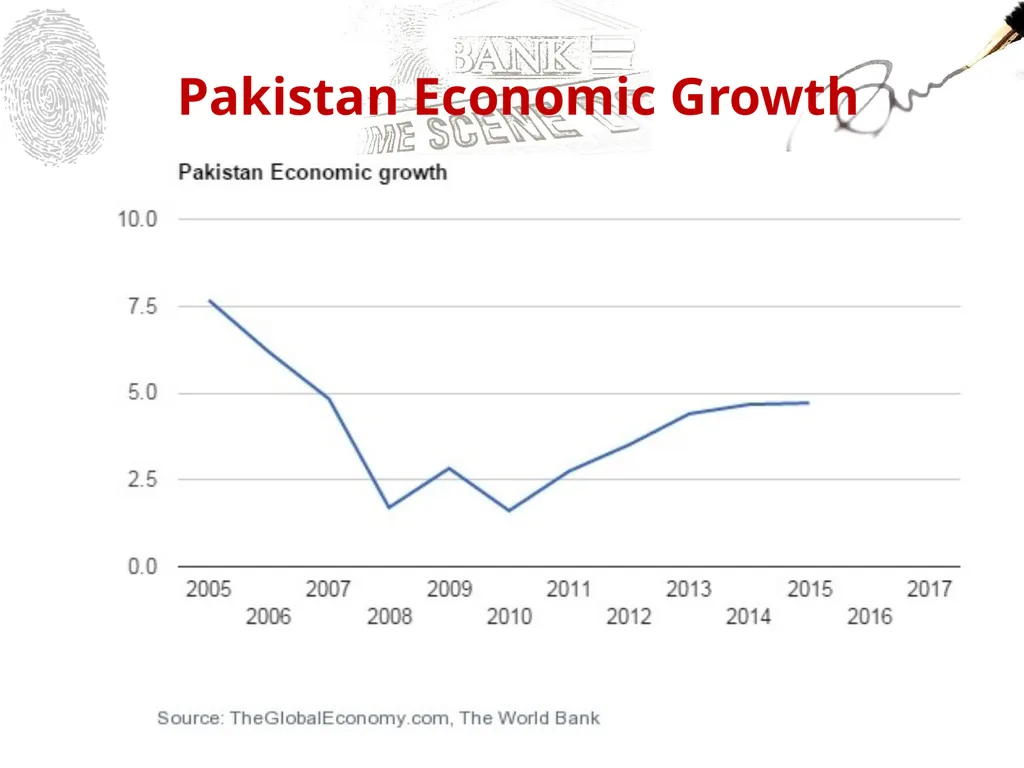
Pakistan Economic Growth<br>
18
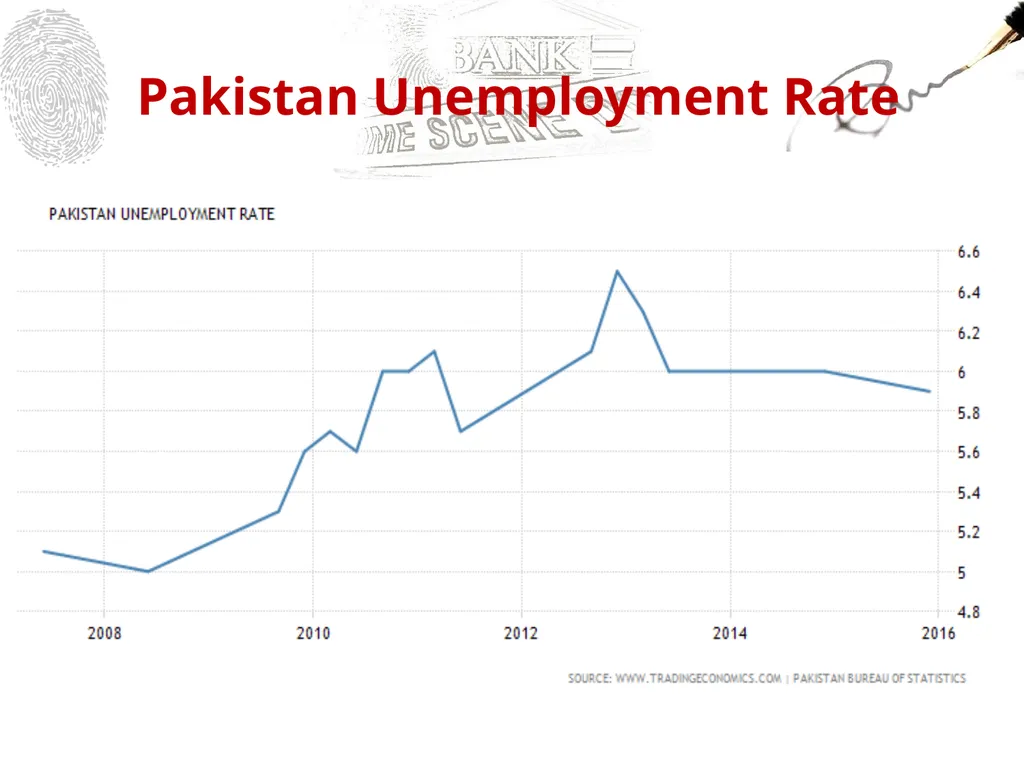
Pakistan Unemployment Rate<br>
19
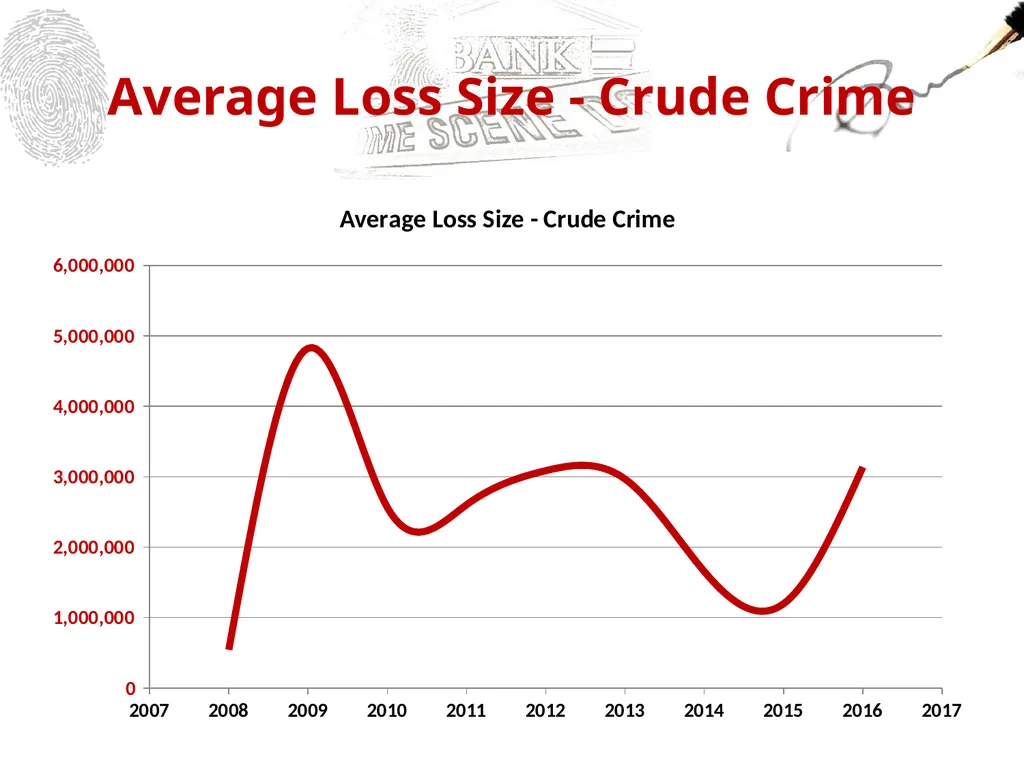
Average Loss Size - Crude Crime<br>
20
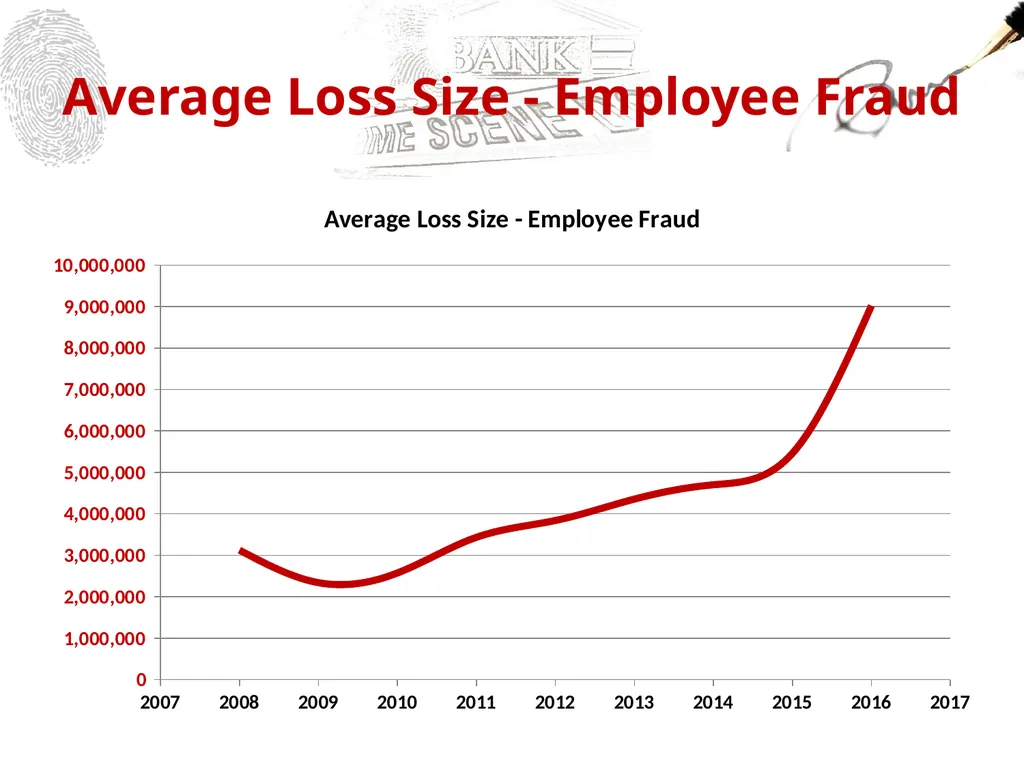
Average Loss Size - Employee Fraud<br>
21
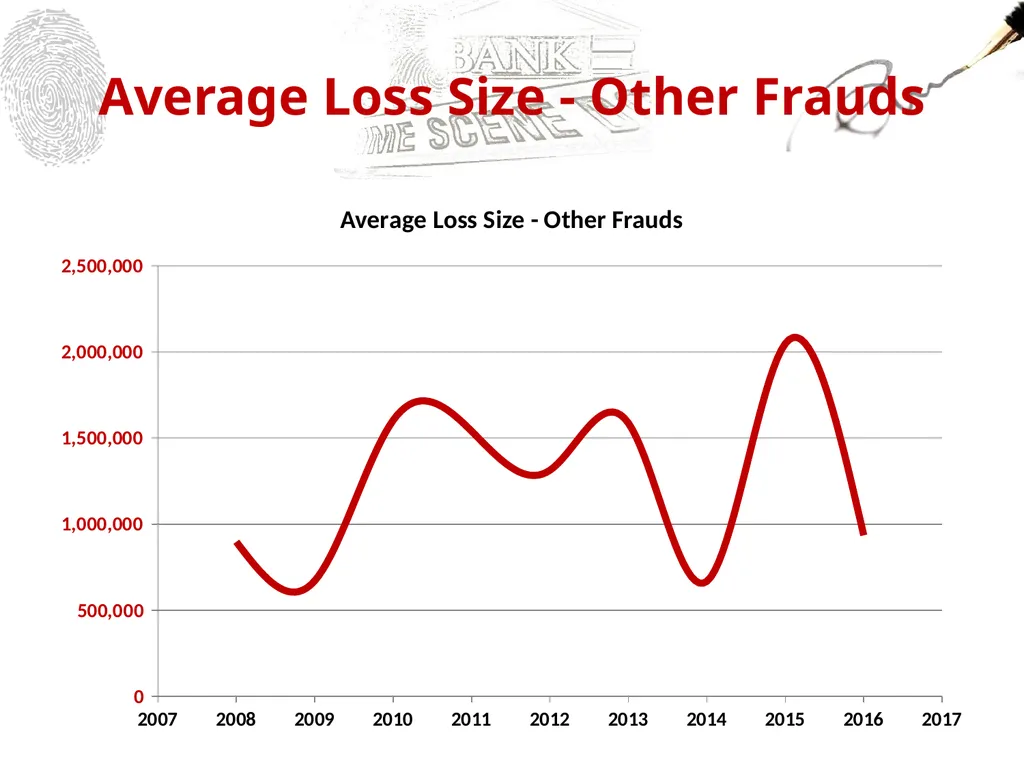
Average Loss Size - Other Frauds<br>
22
Average Loss Size - All Types<br>
23
Year Wise Number of Incidents Composition<br>
24
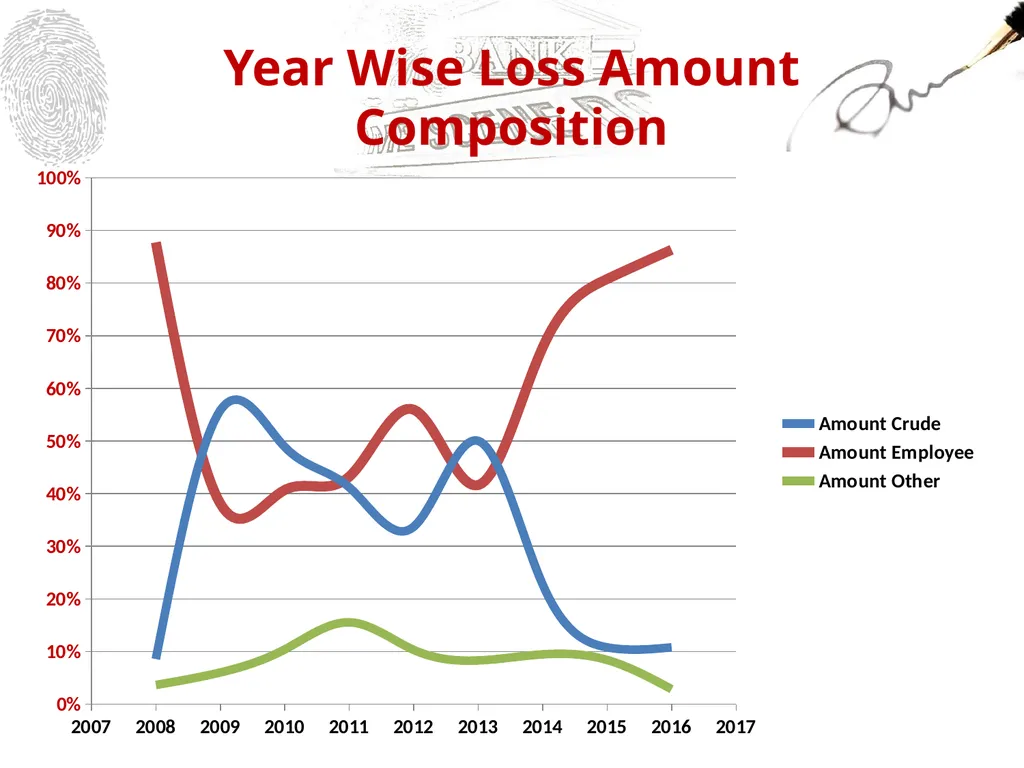
Year Wise Loss Amount Composition<br>
25
Financial Lines Part 2: Continued
By:
Khurram Nasim Ghuman<br>
By:
Khurram Nasim Ghuman<br>
26
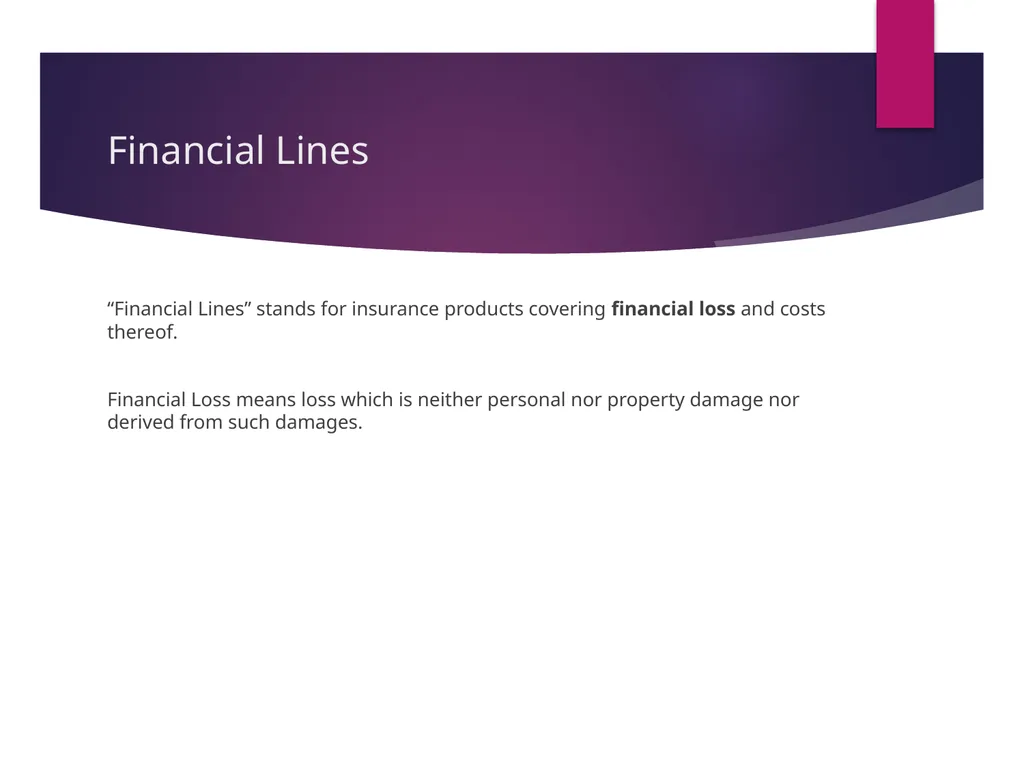
Financial Lines “Financial Lines” stands for insurance products covering financial loss and costs thereof.
Financial Loss means loss which is neither personal nor property damage nor derived from such damages.<br>
Financial Loss means loss which is neither personal nor property damage nor derived from such damages.<br>
27
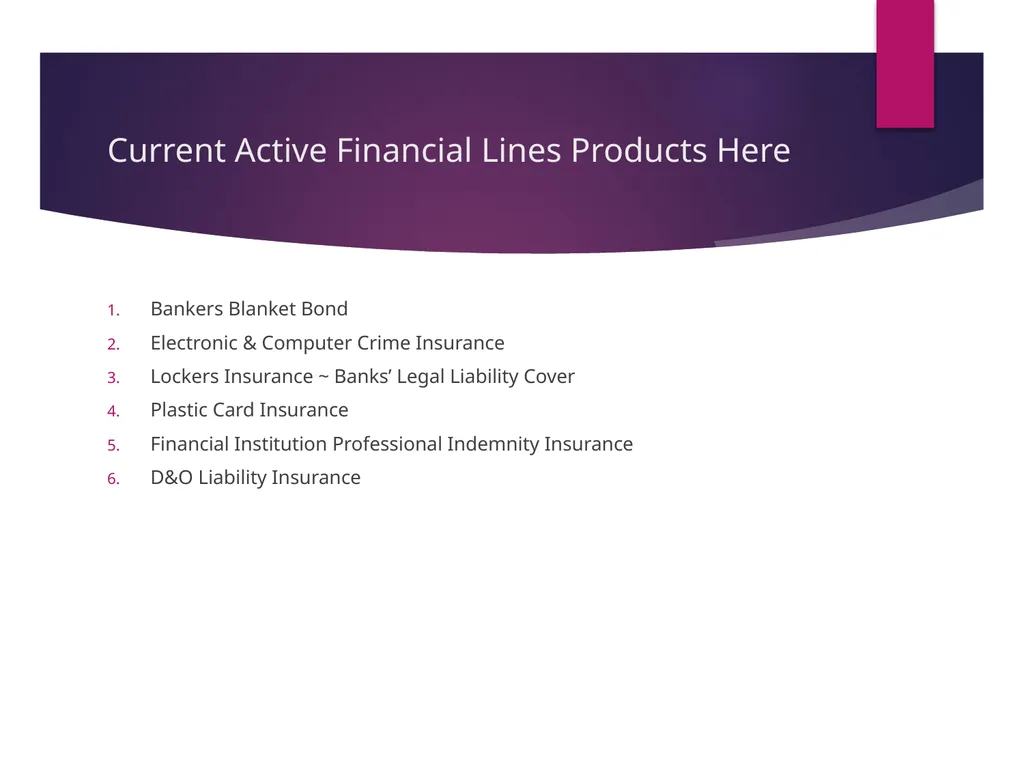
Current Active Financial Lines Products Here Bankers Blanket Bond
Electronic & Computer Crime Insurance
Lockers Insurance ~ Banks’ Legal Liability Cover
Plastic Card Insurance
Financial Institution Professional Indemnity Insurance
D&O Liability Insurance<br>
Electronic & Computer Crime Insurance
Lockers Insurance ~ Banks’ Legal Liability Cover
Plastic Card Insurance
Financial Institution Professional Indemnity Insurance
D&O Liability Insurance<br>
28
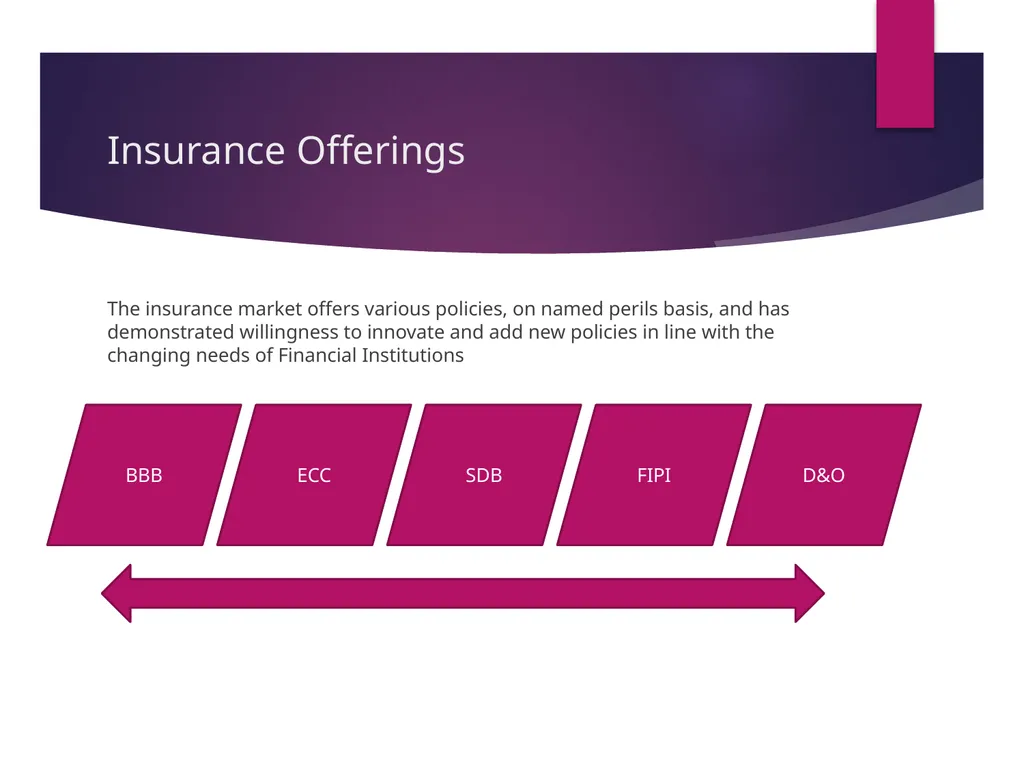
Insurance Offerings The insurance market offers various policies, on named perils basis, and has demonstrated willingness to innovate and add new policies in line with the changing needs of Financial Institutions BBB ECC SDB FIPI D&O<br>
29
Financial Lines Products First party loss
(direct financial loss sustained by the policyholder)<br>
(direct financial loss sustained by the policyholder)<br>
30
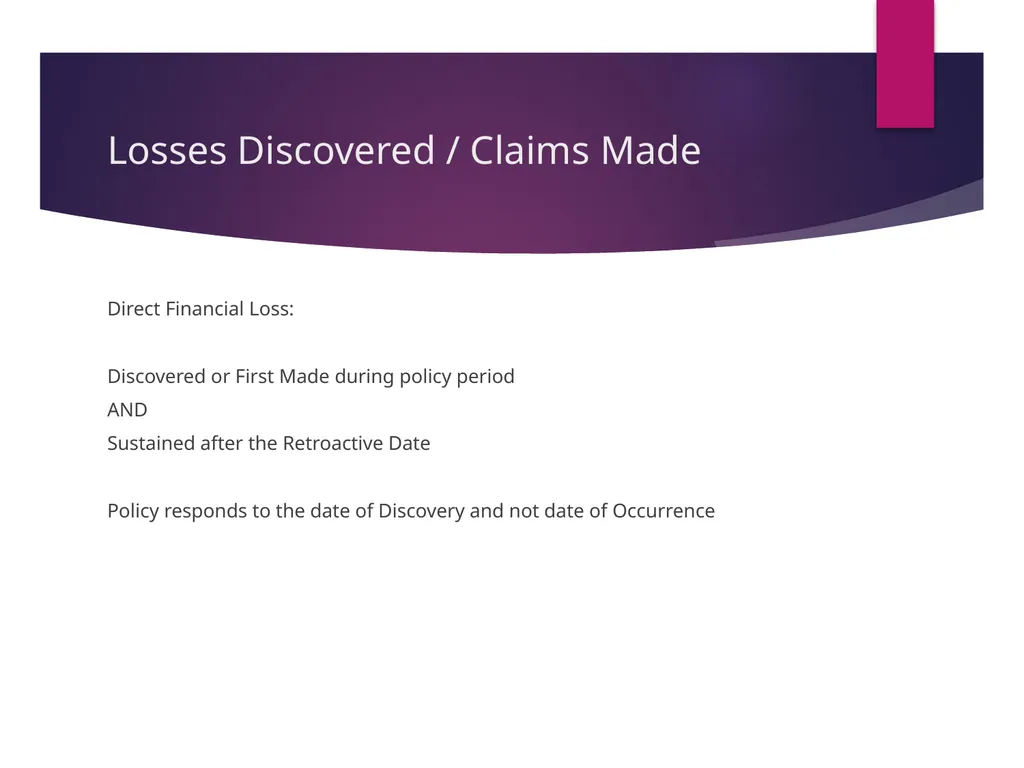
Losses Discovered / Claims Made Direct Financial Loss:
Discovered or First Made during policy period
AND
Sustained after the Retroactive Date
Policy responds to the date of Discovery and not date of Occurrence<br>
Discovered or First Made during policy period
AND
Sustained after the Retroactive Date
Policy responds to the date of Discovery and not date of Occurrence<br>
31
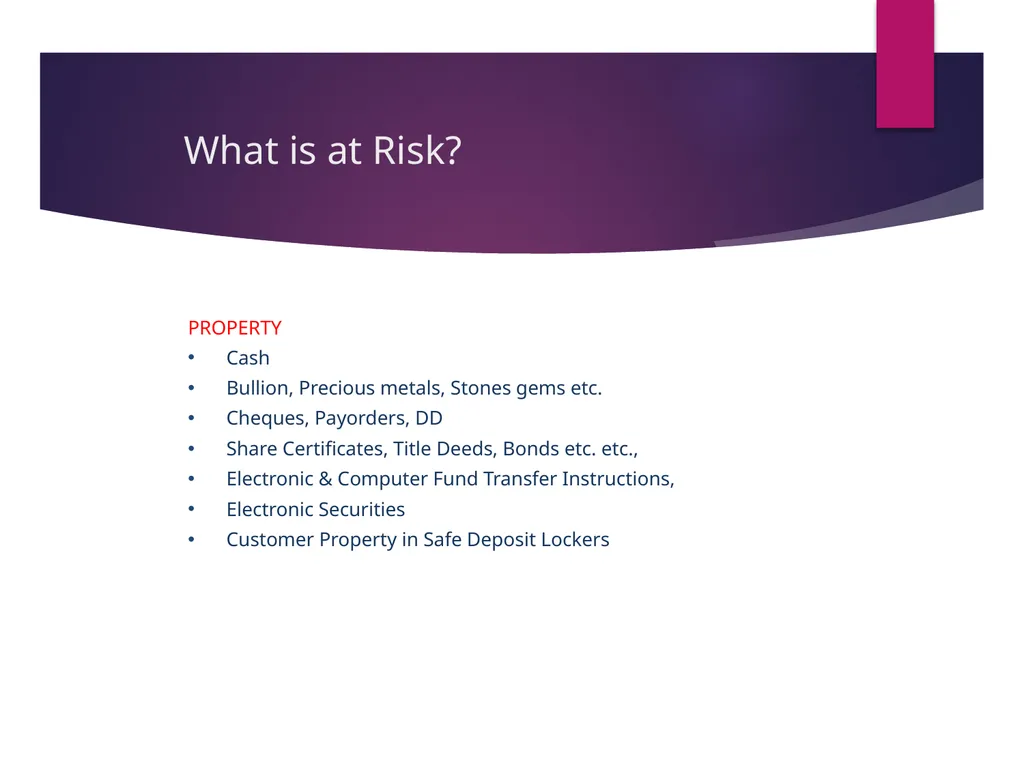
What is at Risk? PROPERTY
Cash
Bullion, Precious metals, Stones gems etc.
Cheques, Payorders, DD
Share Certificates, Title Deeds, Bonds etc. etc.,
Electronic & Computer Fund Transfer Instructions,
Electronic Securities
Customer Property in Safe Deposit Lockers<br>
Cash
Bullion, Precious metals, Stones gems etc.
Cheques, Payorders, DD
Share Certificates, Title Deeds, Bonds etc. etc.,
Electronic & Computer Fund Transfer Instructions,
Electronic Securities
Customer Property in Safe Deposit Lockers<br>
32
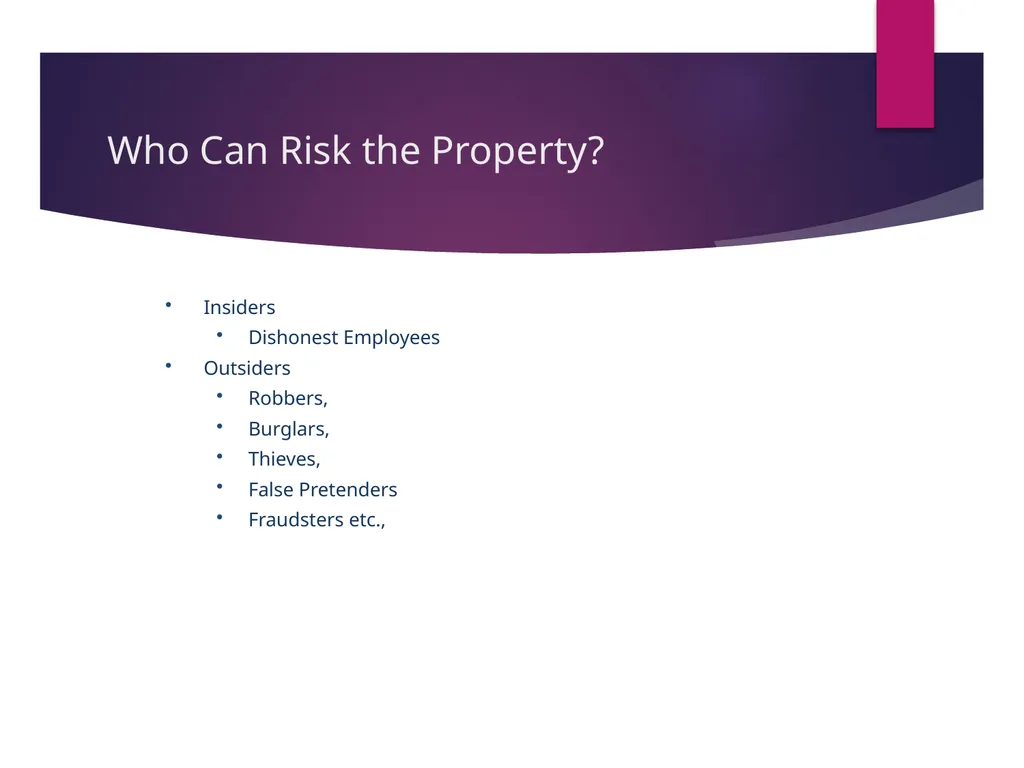
Who Can Risk the Property? Insiders
Dishonest Employees
Outsiders
Robbers,
Burglars,
Thieves,
False Pretenders
Fraudsters etc.,<br>
Dishonest Employees
Outsiders
Robbers,
Burglars,
Thieves,
False Pretenders
Fraudsters etc.,<br>
33
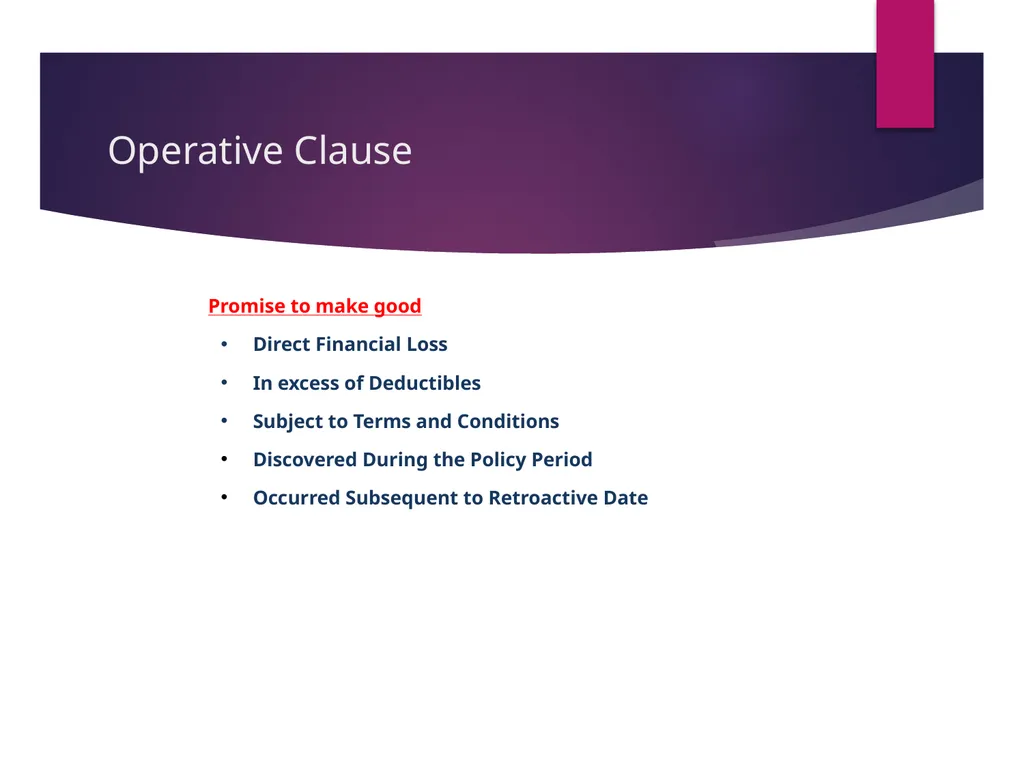
Operative Clause Promise to make good
Direct Financial Loss
In excess of Deductibles
Subject to Terms and Conditions
Discovered During the Policy Period
Occurred Subsequent to Retroactive Date<br>
Direct Financial Loss
In excess of Deductibles
Subject to Terms and Conditions
Discovered During the Policy Period
Occurred Subsequent to Retroactive Date<br>
34
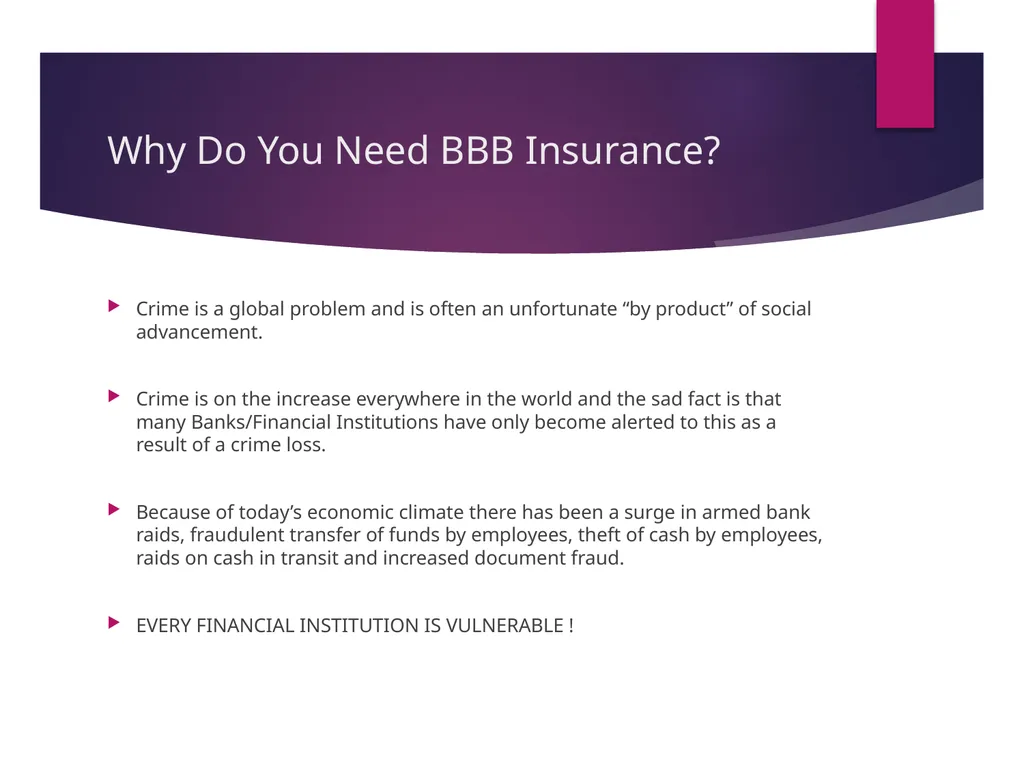
Why Do You Need BBB Insurance? Crime is a global problem and is often an unfortunate “by product” of social advancement.
Crime is on the increase everywhere in the world and the sad fact is that many Banks/Financial Institutions have only become alerted to this as a result of a crime loss.
Because of today’s economic climate there has been a surge in armed bank raids, fraudulent transfer of funds by employees, theft of cash by employees, raids on cash in transit and increased document fraud.
EVERY FINANCIAL INSTITUTION IS VULNERABLE !<br>
Crime is on the increase everywhere in the world and the sad fact is that many Banks/Financial Institutions have only become alerted to this as a result of a crime loss.
Because of today’s economic climate there has been a surge in armed bank raids, fraudulent transfer of funds by employees, theft of cash by employees, raids on cash in transit and increased document fraud.
EVERY FINANCIAL INSTITUTION IS VULNERABLE !<br>
35
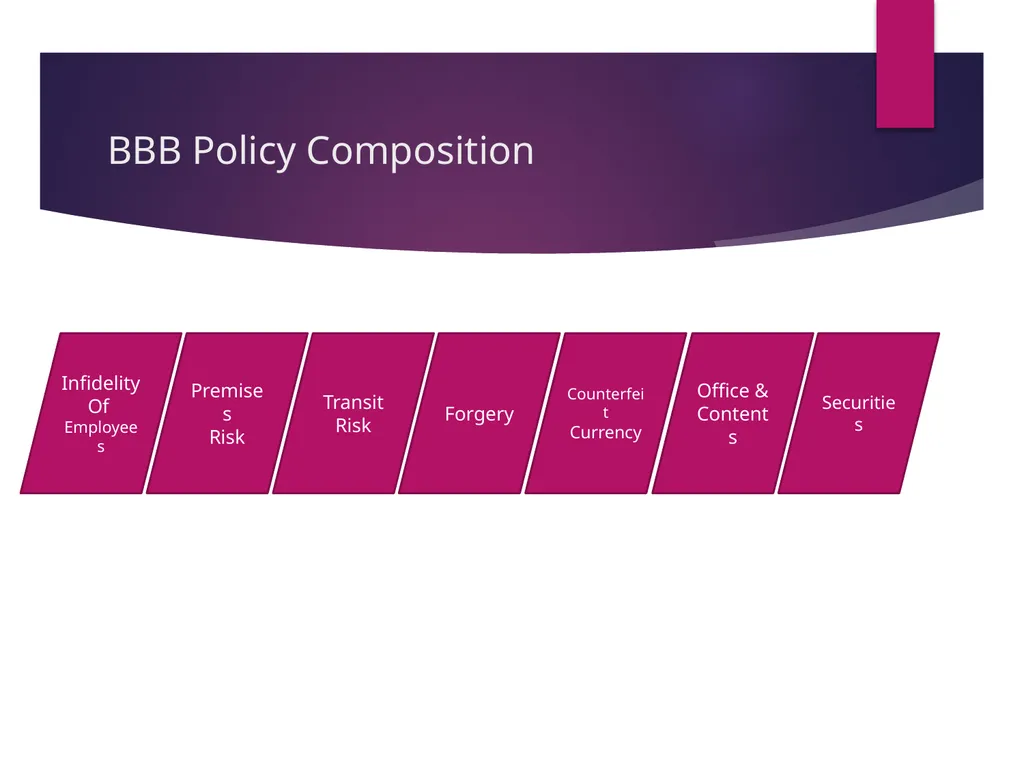
BBB Policy Composition Infidelity
Of
Employees Premises
Risk Transit
Risk Forgery Counterfeit
Currency Office &
Contents Securities<br>
Of
Employees Premises
Risk Transit
Risk Forgery Counterfeit
Currency Office &
Contents Securities<br>
36
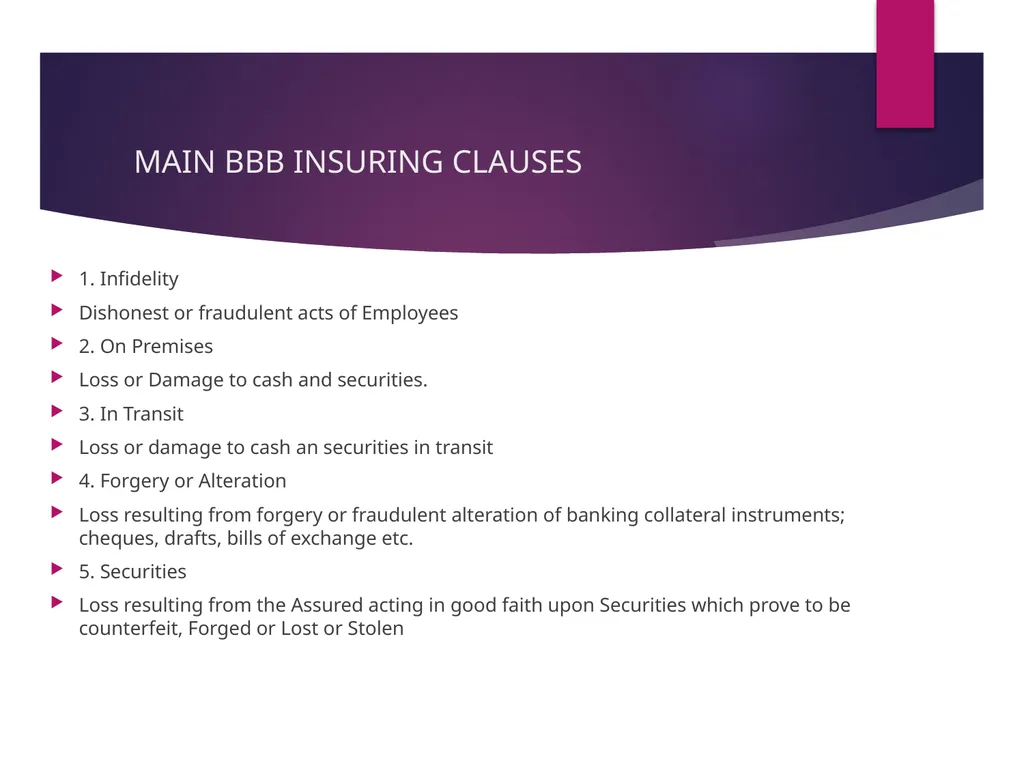
MAIN BBB INSURING CLAUSES 1. Infidelity
Dishonest or fraudulent acts of Employees
2. On Premises
Loss or Damage to cash and securities.
3. In Transit
Loss or damage to cash an securities in transit
4. Forgery or Alteration
Loss resulting from forgery or fraudulent alteration of banking collateral instruments; cheques, drafts, bills of exchange etc.
5. Securities
Loss resulting from the Assured acting in good faith upon Securities which prove to be counterfeit, Forged or Lost or Stolen<br>
Dishonest or fraudulent acts of Employees
2. On Premises
Loss or Damage to cash and securities.
3. In Transit
Loss or damage to cash an securities in transit
4. Forgery or Alteration
Loss resulting from forgery or fraudulent alteration of banking collateral instruments; cheques, drafts, bills of exchange etc.
5. Securities
Loss resulting from the Assured acting in good faith upon Securities which prove to be counterfeit, Forged or Lost or Stolen<br>
37
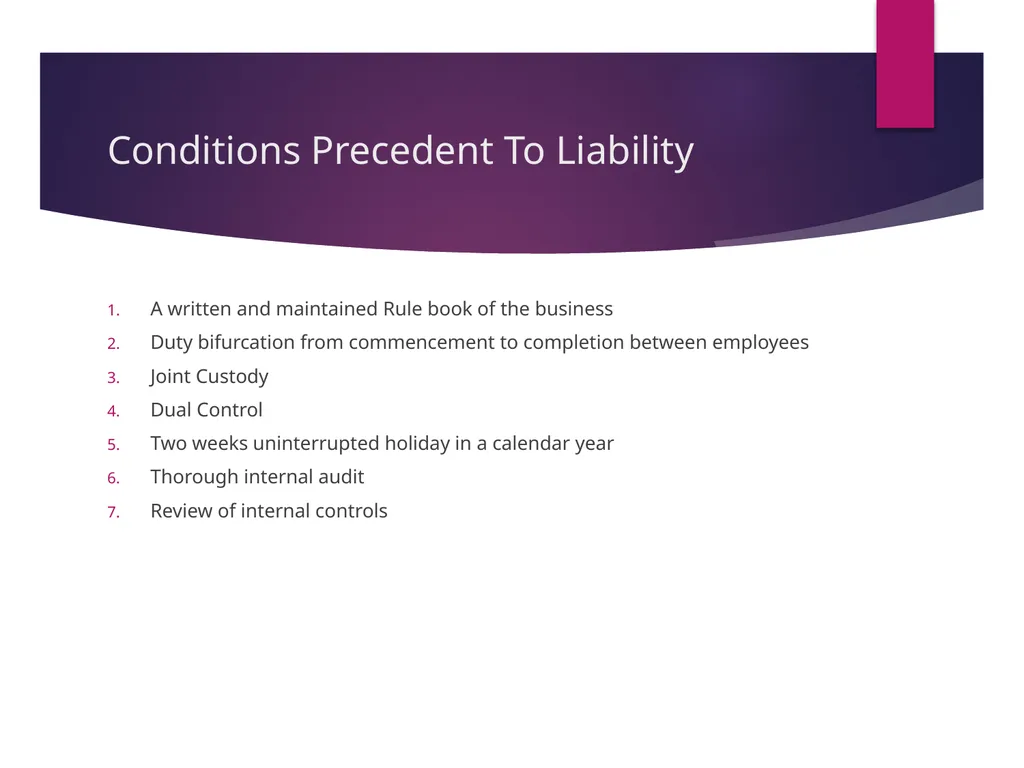
Conditions Precedent To Liability A written and maintained Rule book of the business
Duty bifurcation from commencement to completion between employees
Joint Custody
Dual Control
Two weeks uninterrupted holiday in a calendar year
Thorough internal audit
Review of internal controls<br>
Duty bifurcation from commencement to completion between employees
Joint Custody
Dual Control
Two weeks uninterrupted holiday in a calendar year
Thorough internal audit
Review of internal controls<br>
38
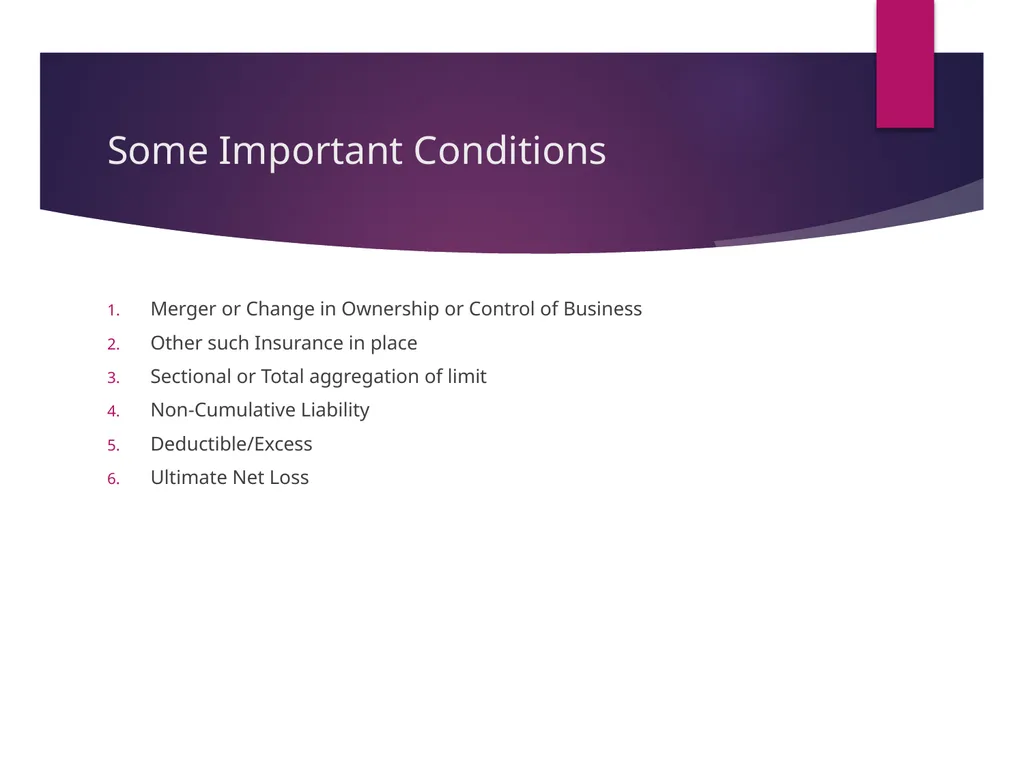
Some Important Conditions Merger or Change in Ownership or Control of Business
Other such Insurance in place
Sectional or Total aggregation of limit
Non-Cumulative Liability
Deductible/Excess
Ultimate Net Loss<br>
Other such Insurance in place
Sectional or Total aggregation of limit
Non-Cumulative Liability
Deductible/Excess
Ultimate Net Loss<br>
39
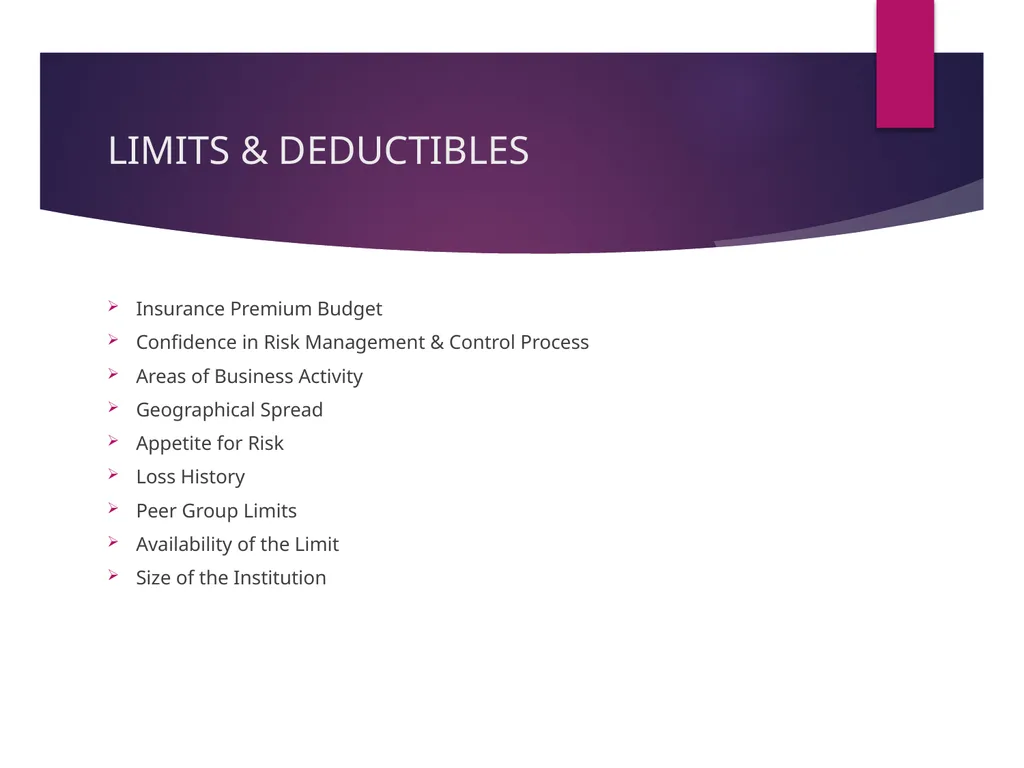
LIMITS & DEDUCTIBLES Insurance Premium Budget
Confidence in Risk Management & Control Process
Areas of Business Activity
Geographical Spread
Appetite for Risk
Loss History
Peer Group Limits
Availability of the Limit
Size of the Institution<br>
Confidence in Risk Management & Control Process
Areas of Business Activity
Geographical Spread
Appetite for Risk
Loss History
Peer Group Limits
Availability of the Limit
Size of the Institution<br>
40
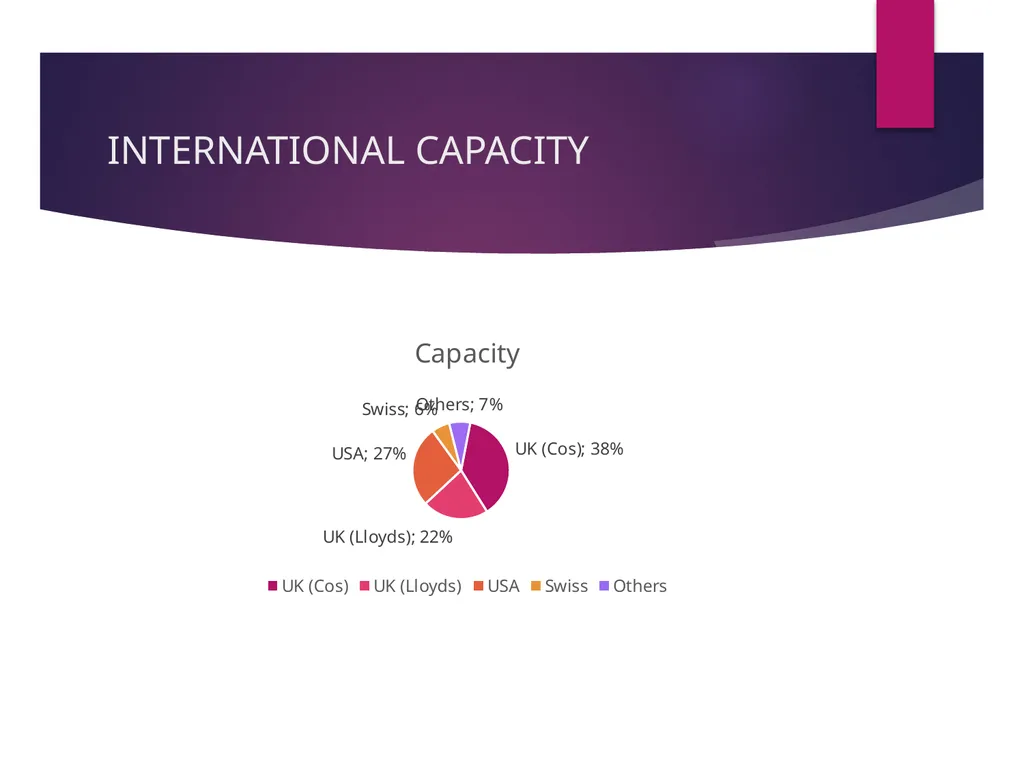
INTERNATIONAL CAPACITY<br>
41
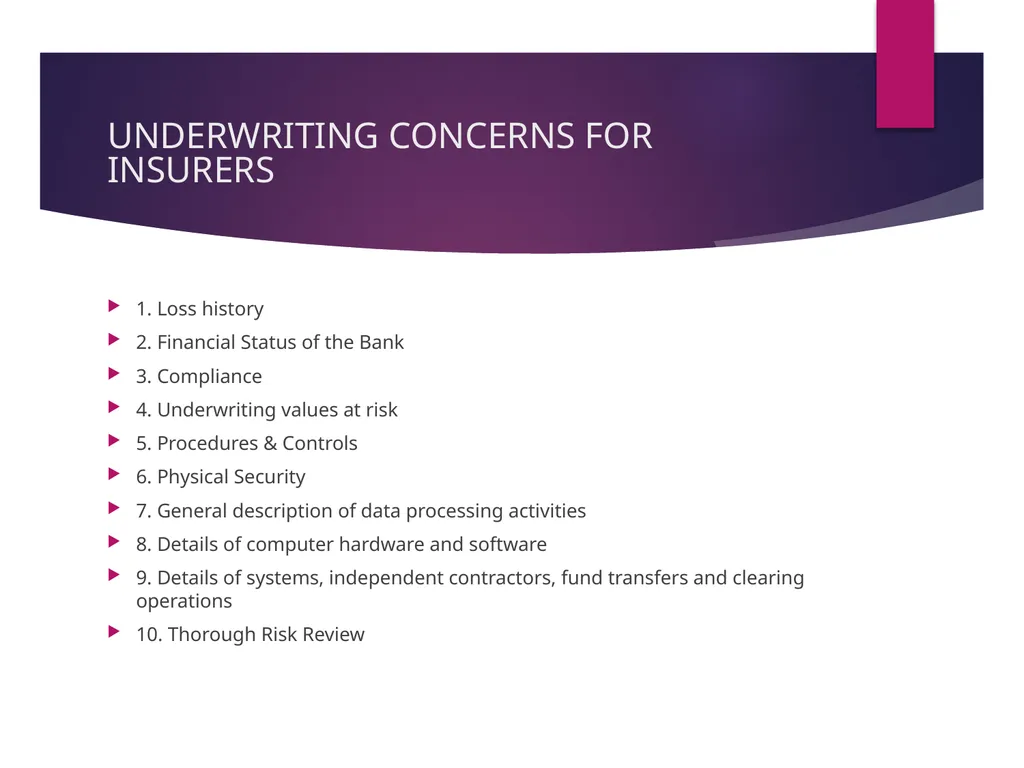
UNDERWRITING CONCERNS FOR INSURERS 1. Loss history
2. Financial Status of the Bank
3. Compliance
4. Underwriting values at risk
5. Procedures & Controls
6. Physical Security
7. General description of data processing activities
8. Details of computer hardware and software
9. Details of systems, independent contractors, fund transfers and clearing operations
10. Thorough Risk Review<br>
2. Financial Status of the Bank
3. Compliance
4. Underwriting values at risk
5. Procedures & Controls
6. Physical Security
7. General description of data processing activities
8. Details of computer hardware and software
9. Details of systems, independent contractors, fund transfers and clearing operations
10. Thorough Risk Review<br>
42
Limits/Sub-limits & Deductibles Overall Policy Aggregate
BBB
Section Aggregate Sub Limit
Individual Clause wise Sub Limits & Deductibles
Branch Wise Sub Limits & Deductibles
Computer Crime
Section Aggregate Sub Limit
Individual Clause wise Sub Limits & Deductibles
Lockers
Section Per Event & Aggregate Sub Limit
Locker Size Wise Per Event Limit<br>
BBB
Section Aggregate Sub Limit
Individual Clause wise Sub Limits & Deductibles
Branch Wise Sub Limits & Deductibles
Computer Crime
Section Aggregate Sub Limit
Individual Clause wise Sub Limits & Deductibles
Lockers
Section Per Event & Aggregate Sub Limit
Locker Size Wise Per Event Limit<br>
43
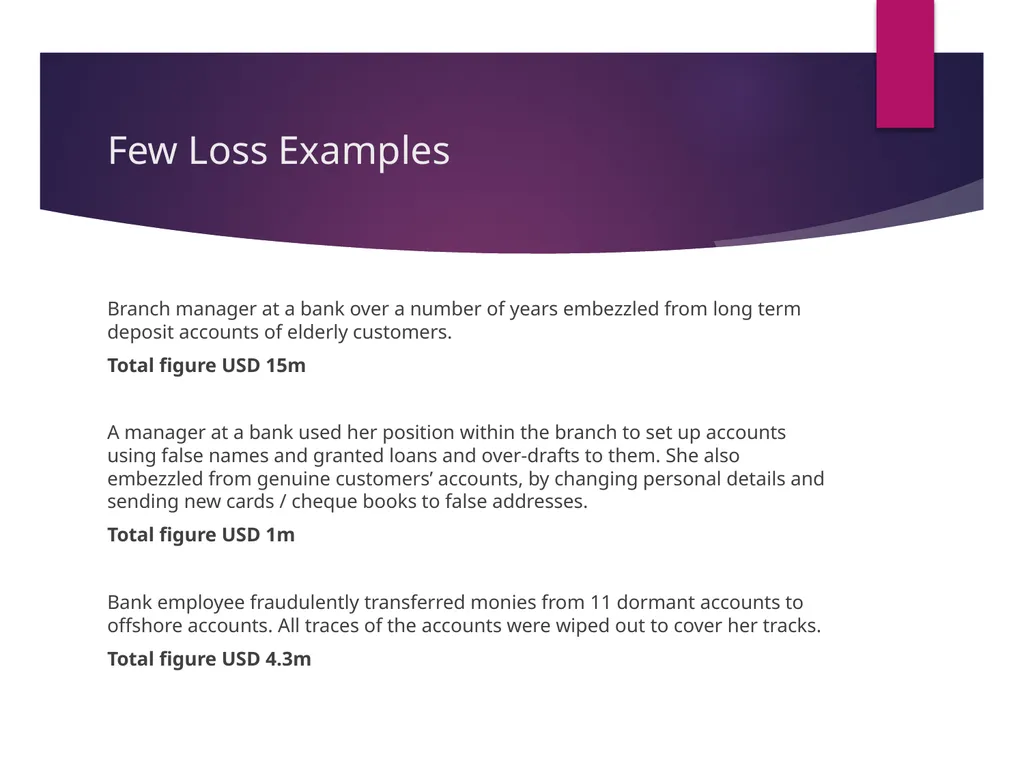
Few Loss Examples Branch manager at a bank over a number of years embezzled from long term deposit accounts of elderly customers.
Total figure USD 15m
A manager at a bank used her position within the branch to set up accounts using false names and granted loans and over-drafts to them. She also embezzled from genuine customers’ accounts, by changing personal details and sending new cards / cheque books to false addresses.
Total figure USD 1m
Bank employee fraudulently transferred monies from 11 dormant accounts to offshore accounts. All traces of the accounts were wiped out to cover her tracks.
Total figure USD 4.3m<br>
Total figure USD 15m
A manager at a bank used her position within the branch to set up accounts using false names and granted loans and over-drafts to them. She also embezzled from genuine customers’ accounts, by changing personal details and sending new cards / cheque books to false addresses.
Total figure USD 1m
Bank employee fraudulently transferred monies from 11 dormant accounts to offshore accounts. All traces of the accounts were wiped out to cover her tracks.
Total figure USD 4.3m<br>
44
Loss Examples
continued… A commercial bank issued unsecured personal loans to customers on the basis of Salary Certificates and 3 months of Bank Statements. The bank began to review their loan files after a number of loan defaults and discovered that they had acted upon forged Salary Certificate letters for individuals that were not employees of the company purporting to issue the letters as well as falsified Bank Statements. The loan process had proven to be weak and no actual verification of the Salary Certificates had been conducted leaving the bank with a significant financial loss.
Total figure USD 1.75m<br>
Total figure USD 1.75m<br>
45
Loss Examples
continued… A bank became the target of a well organised criminal group who managed to obtain forged passports for several account holders, as well as duplicated mobile telephone SIM cards. This enabled the criminals to change sensitive account information including call-back verification numbers and then make fraudulent withdrawals from customer accounts.
Total figure USD 1.34m<br>
Total figure USD 1.34m<br>
46
Loss Examples
continued… A Bank had its Credit Card systems hacked by a fraud gang. The cards were all Pre-Paid Credit Cards. Once the banks’ systems were amended the fraud gang used the cards to withdraw money via various ATM machines around the world. In a 24hour period the bank had lost in excess of USD40m. Other banks have also been targeted, using a similar means to get in to the banks systems which have resulted in further losses of around USD5m. It come to light that the hackers amended the card limits and security coding which allowed the gang to get away with these large sums of money without the standard security measures being activated.
Total figure USD 45m<br>
Total figure USD 45m<br>
47
Add on Cover Computer Crime:
Added on to a Banker's Blanket Bond Policy,
Computer Crime Insurance attempts to provide, under one insurance contract, protection for “electronic funds” against Crime Risks perpetrated by unidentified employees or other persons through the Banks/Financial Institutions computer system(s).<br>
Added on to a Banker's Blanket Bond Policy,
Computer Crime Insurance attempts to provide, under one insurance contract, protection for “electronic funds” against Crime Risks perpetrated by unidentified employees or other persons through the Banks/Financial Institutions computer system(s).<br>
48
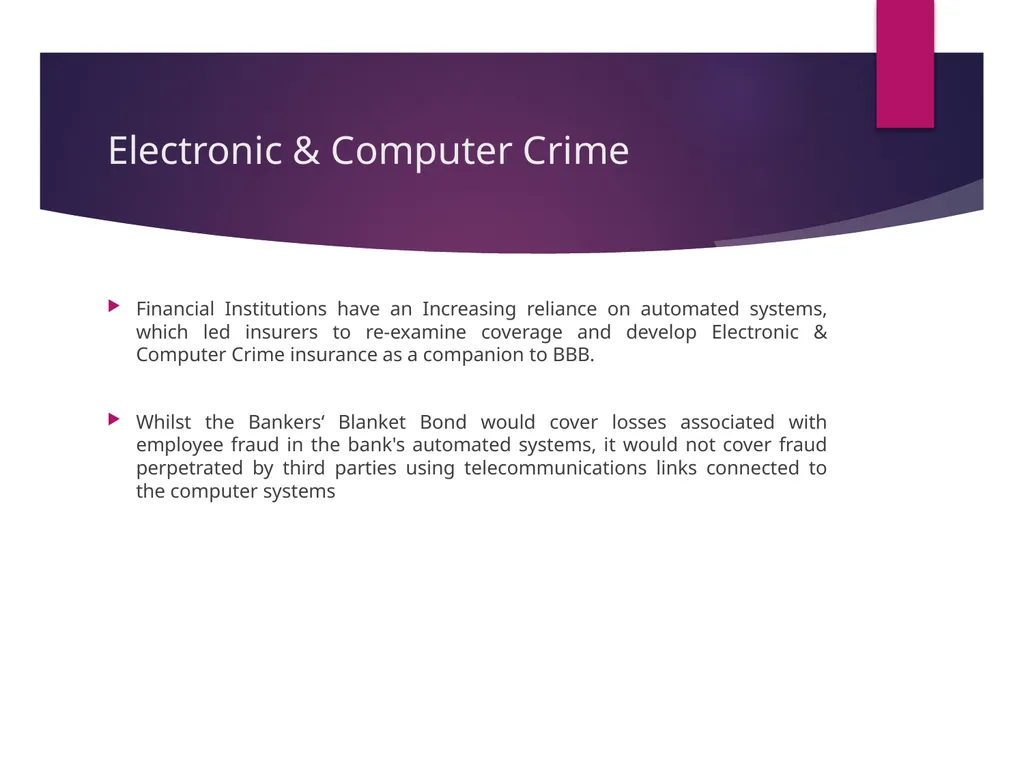
Electronic & Computer Crime Financial Institutions have an Increasing reliance on automated systems, which led insurers to re-examine coverage and develop Electronic & Computer Crime insurance as a companion to BBB.
Whilst the Bankers‘ Blanket Bond would cover losses associated with employee fraud in the bank's automated systems, it would not cover fraud perpetrated by third parties using telecommunications links connected to the computer systems<br>
Whilst the Bankers‘ Blanket Bond would cover losses associated with employee fraud in the bank's automated systems, it would not cover fraud perpetrated by third parties using telecommunications links connected to the computer systems<br>
49
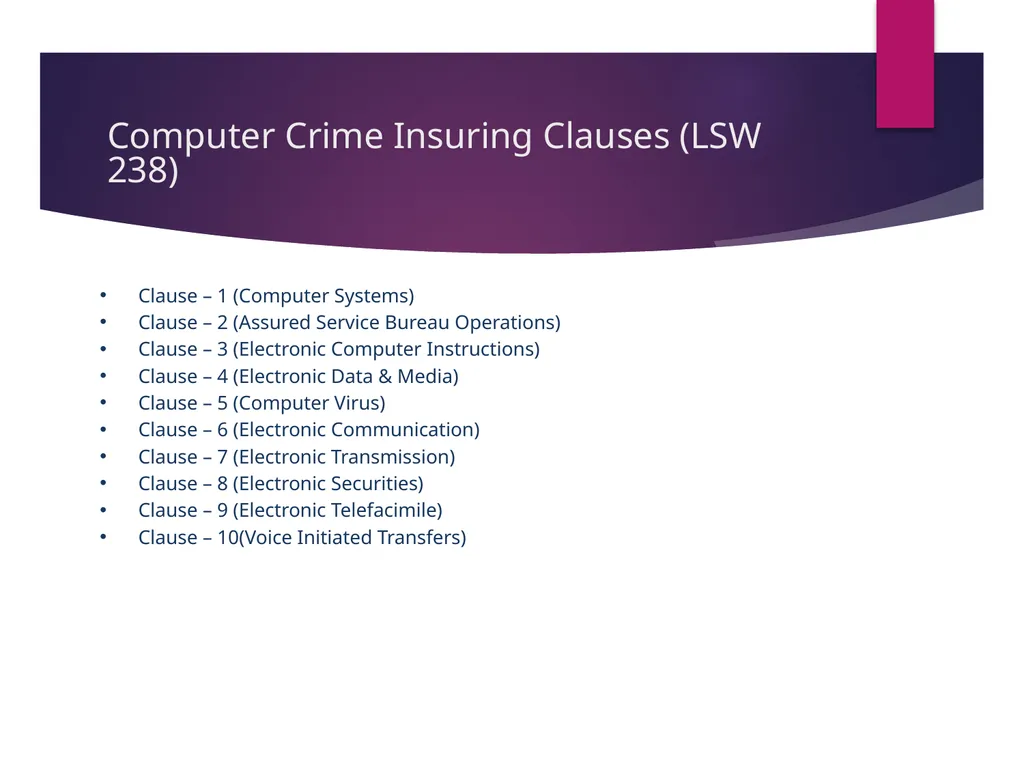
Computer Crime Insuring Clauses (LSW 238) Clause – 1 (Computer Systems)
Clause – 2 (Assured Service Bureau Operations)
Clause – 3 (Electronic Computer Instructions)
Clause – 4 (Electronic Data & Media)
Clause – 5 (Computer Virus)
Clause – 6 (Electronic Communication)
Clause – 7 (Electronic Transmission)
Clause – 8 (Electronic Securities)
Clause – 9 (Electronic Telefacimile)
Clause – 10(Voice Initiated Transfers)<br>
Clause – 2 (Assured Service Bureau Operations)
Clause – 3 (Electronic Computer Instructions)
Clause – 4 (Electronic Data & Media)
Clause – 5 (Computer Virus)
Clause – 6 (Electronic Communication)
Clause – 7 (Electronic Transmission)
Clause – 8 (Electronic Securities)
Clause – 9 (Electronic Telefacimile)
Clause – 10(Voice Initiated Transfers)<br>
50
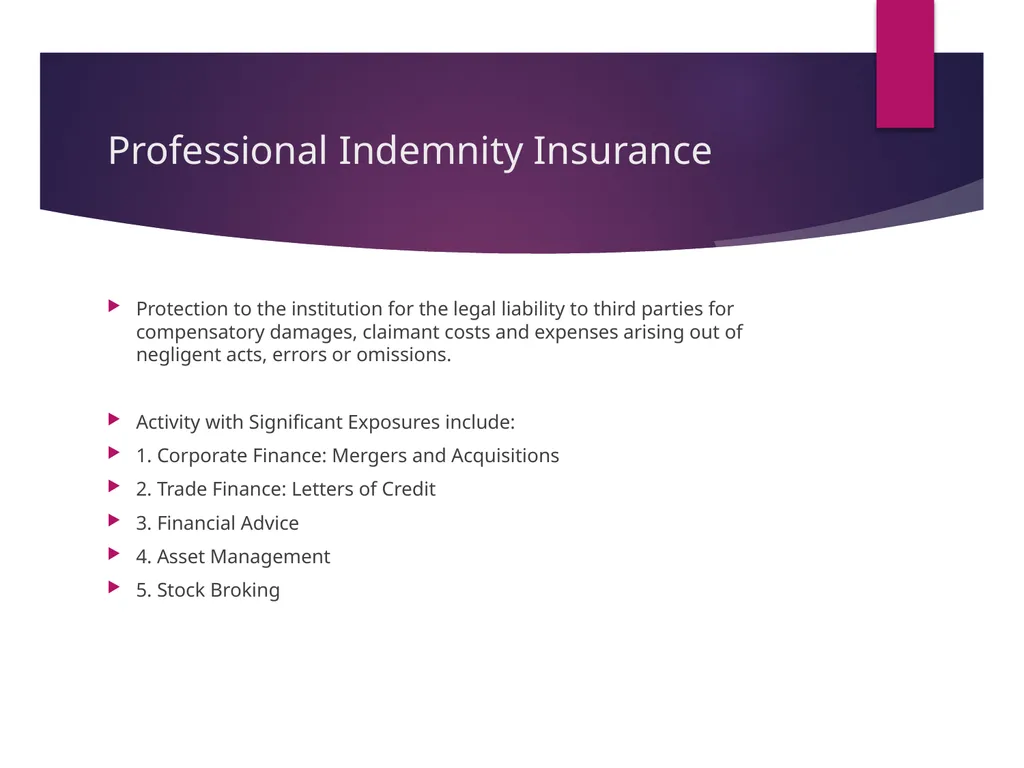
Professional Indemnity Insurance Protection to the institution for the legal liability to third parties for compensatory damages, claimant costs and expenses arising out of negligent acts, errors or omissions.
Activity with Significant Exposures include:
1. Corporate Finance: Mergers and Acquisitions
2. Trade Finance: Letters of Credit
3. Financial Advice
4. Asset Management
5. Stock Broking<br>
Activity with Significant Exposures include:
1. Corporate Finance: Mergers and Acquisitions
2. Trade Finance: Letters of Credit
3. Financial Advice
4. Asset Management
5. Stock Broking<br>
51
Safe Deposit Lockers
(NMA 1790) Customer Property (of intrinsic value) placed inside Lockers (inside a secured and guarded premises)
Excluding Cash and items with no commercial value<br>
Excluding Cash and items with no commercial value<br>
52
Cyber Risk (An Emerging Topic) Cyber risk now ranks as one of the top enterprise wide risks facing organisations today.
Cyber-attacks, operational errors or technical failures have the ability to paralyse an organisation leading to significant financial loss, regulatory issues and lasting reputational damage.<br>
Cyber-attacks, operational errors or technical failures have the ability to paralyse an organisation leading to significant financial loss, regulatory issues and lasting reputational damage.<br>
53
Response To Cyber Risk CYBER INSURANCE
Cyber liability insurance policies have been developed to address the first and third party impacts which can result from a cyber-incident whether malicious or accidental.
Traditional insurance policies may not respond to these new risks. They were developed to protect against physical triggers (e.g. fire, explosion, theft, flood etc.) leading to physical outcomes (e.g. property damage, bodily injury) rather than data, networks and intangible assets.<br>
Cyber liability insurance policies have been developed to address the first and third party impacts which can result from a cyber-incident whether malicious or accidental.
Traditional insurance policies may not respond to these new risks. They were developed to protect against physical triggers (e.g. fire, explosion, theft, flood etc.) leading to physical outcomes (e.g. property damage, bodily injury) rather than data, networks and intangible assets.<br>
54
SCOPE OF CYBER INSURANCE Personal data liability
Corporate data liability
Outsourcing liability
Data security liability
Data administrative investigations
Data administrative fines
Repair of the company’s reputation
Defence costs
Media content
Network interruption.<br>
Corporate data liability
Outsourcing liability
Data security liability
Data administrative investigations
Data administrative fines
Repair of the company’s reputation
Defence costs
Media content
Network interruption.<br>
55
THANK YOU<br>