INTEGRATED APPROACH TO MASTERS PROGRAMME DELIVERY
Description: INTEGRATED APPROACH TO MASTERS PROGRAMME DELIVERY IN MANUFACTURING AND DESIGN ENGINEERING AT UTT Natalie Persadie, Nadine Sangster, Aaron Ameerali, Dinesh Soodeen, Aatma Maharajh, and Aneil Ramkhalawan Design and Manufacturing Engineering,
Related Topics
Download Presentation
"INTEGRATED APPROACH TO MASTERS PROGRAMME DELIVERY" is the property of its rightful owner. Permission is granted to download and print the materials on this website for personal, non-commercial use only, and to display it on your personal computer provided you do not modify the materials and that you retain all copyright notices contained in the materials. By downloading content from our website, you accept the terms of this agreement.
Presentation Transcript
slide1. INTEGRATED APPROACH TO MASTERS PROGRAMME DELIVERY IN MANUFACTURING AND DESIGN ENGINEERING AT UTT Natalie Persadie, Nadine Sangster, Aaron Ameerali, Dinesh Soodeen, Aatma Maharajh, and Aneil Ramkhalawan Design and Manufacturing Engineering,
The University of Trinidad and Tobago IConETech-2020, Faculty of Engineering, The UWI, St. Augustine, Trinidad and Tobago<br>
slide2. INTRODUCTION Employers want work-ready graduates.
Theory and practice gap with entry-level graduates.
University students’ challenge: translating theory into practice
Learning theory by rote and repeating for assessments IConETech-2020, Faculty of Engineering, The UWI, St. Augustine, Trinidad and Tobago<br>
slide3. BACKGROUND UTT’s Masters programmes:
Innovation, Manufacturing Management and Entrepreneurship (IMME);
Innovative Design and Entrepreneurship (IDE).
Learning outcomes:
fostering entrepreneurial spirit;
developing management capabilities;
real-time, problem-based industry immersion and;
nurturing engineering design capabilities. IConETech-2020, Faculty of Engineering, The UWI, St. Augustine, Trinidad and Tobago<br>
slide4. OBJECTIVES To determine if the intended learning outcomes of the Design and Manufacturing Engineering (DME) Masters Programme were achieved using an integrated delivery approach. IConETech-2020, Faculty of Engineering, The UWI, St. Augustine, Trinidad and Tobago<br>
slide5. LITERATURE REVIEW Meredith & Burkle, 2008:
Theory that is supported by practice makes understanding and learning far more likely
Martínez, 2019:
Problem-based learning (PBL) strategies provides for greater student experience
Fraser, Tseng, & Deng, 2018:
University-industry partnerships enhance knowledge transfer and practical experience
Wang et al. 2015:
Project-based assignments simulate the characteristics of real-world problems
Improvement or development of soft skills attributes
Experiential learning and cooperative education indicative of future working environment IConETech-2020, Faculty of Engineering, The UWI, St. Augustine, Trinidad and Tobago<br>
slide6. LITERATURE REVIEW In a case study conducted at a Chinese university for a joint educational project between China and Germany:
Lecturing alone is not sufficient.
Students benefit from interactive hands-on experiences.
Experiential, team-based learning involving student, faculty and industrial participation enriches the educational process and provides tangible benefits to all.
Simulations and experiential learning require context and it is for this reason that formal learning in the classroom is important because it gives students the structures, concepts and theories that support the real-life experience and learning.
Experiential learning is effective and reinforces formal learning because it becomes personal. IConETech-2020, Faculty of Engineering, The UWI, St. Augustine, Trinidad and Tobago<br>
slide7. METHODOLOGY Reviewed common courses descriptors;
Interviewed staff, students, industry practitioners;
Reviewed student evaluation of teaching reports
Reviewed examiners reports IConETech-2020, Faculty of Engineering, The UWI, St. Augustine, Trinidad and Tobago<br>
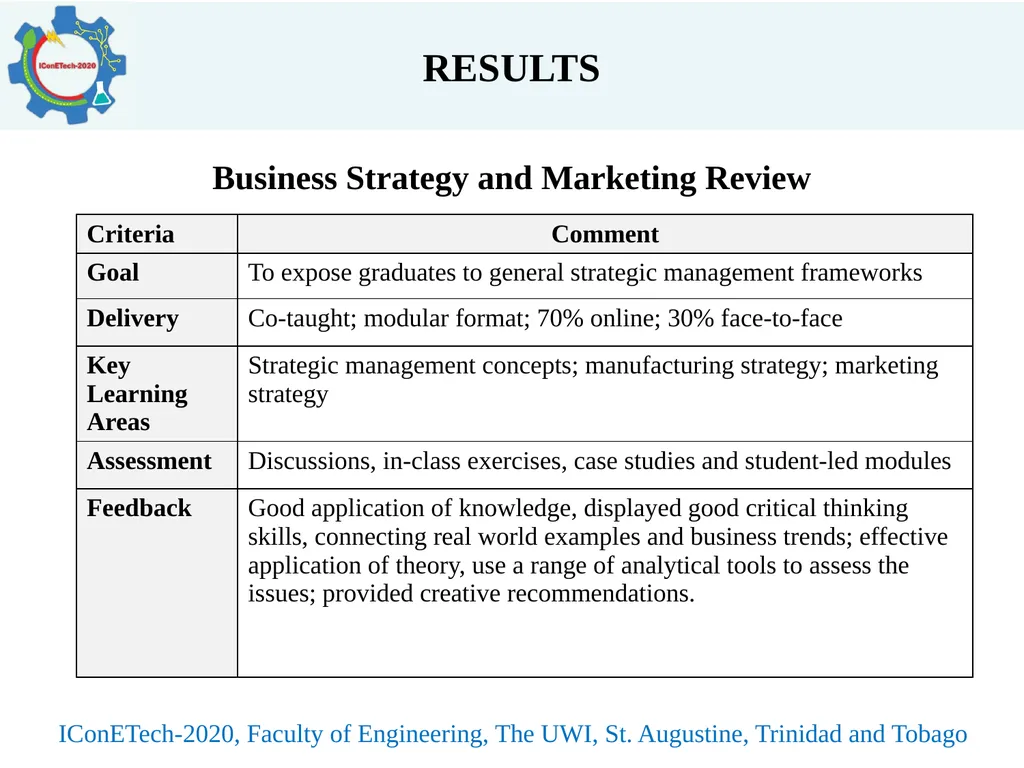
slide8. RESULTS Business Strategy and Marketing Review IConETech-2020, Faculty of Engineering, The UWI, St. Augustine, Trinidad and Tobago<br>
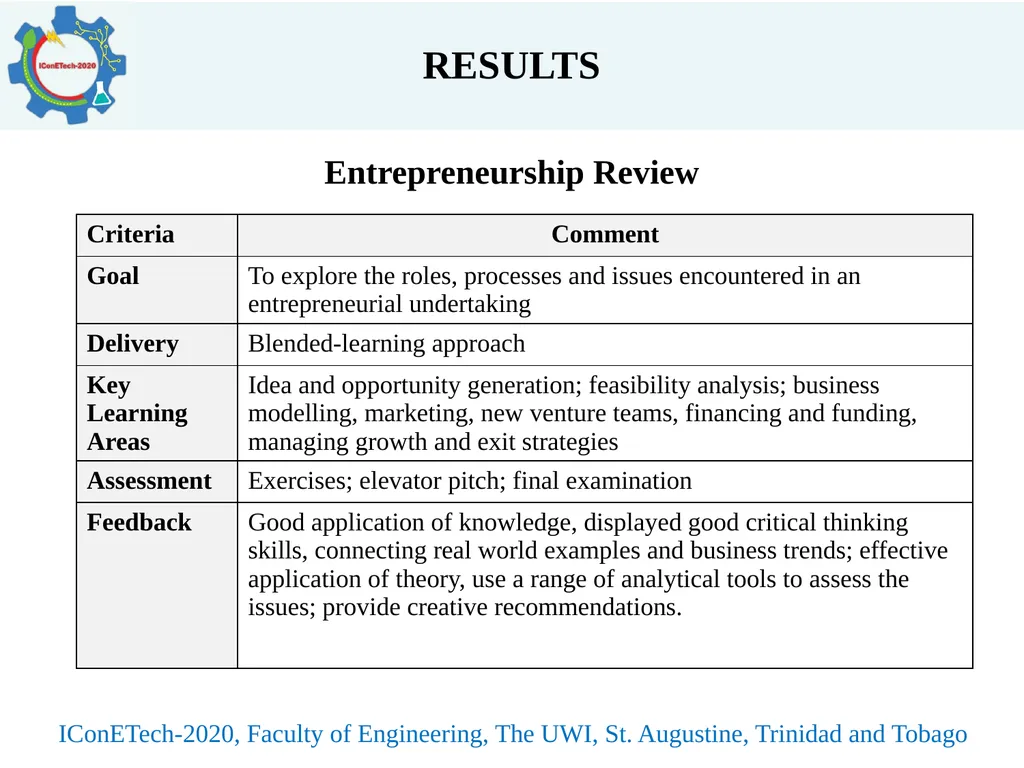
slide9. RESULTS Entrepreneurship Review IConETech-2020, Faculty of Engineering, The UWI, St. Augustine, Trinidad and Tobago<br>
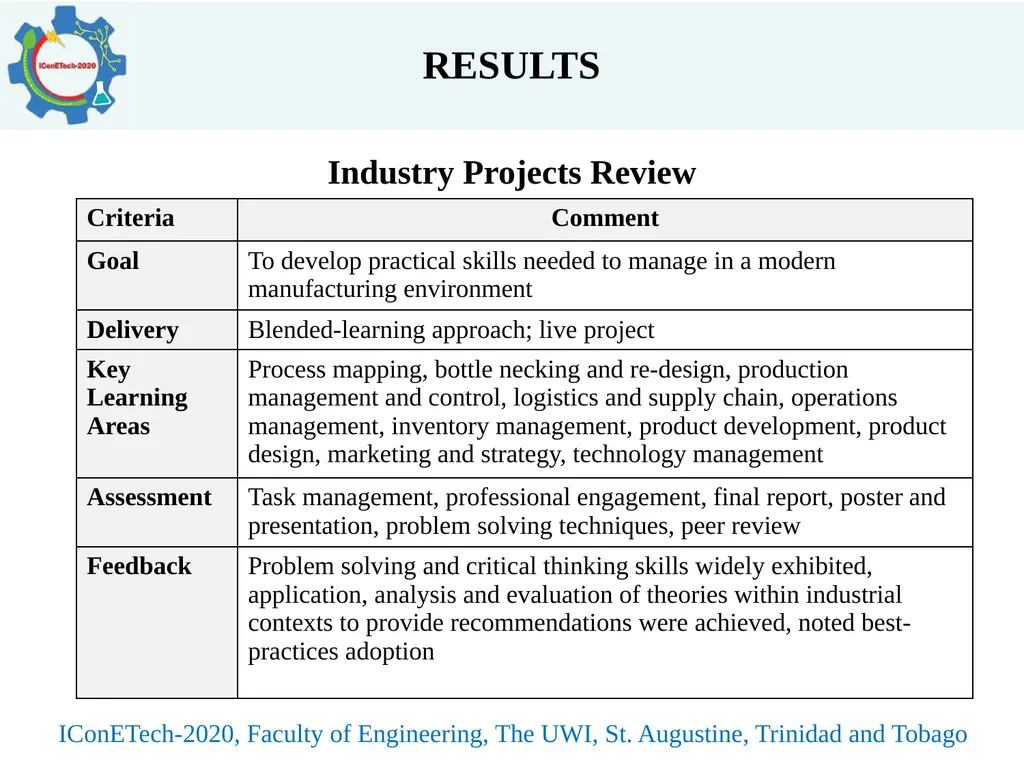
slide10. RESULTS Industry Projects Review IConETech-2020, Faculty of Engineering, The UWI, St. Augustine, Trinidad and Tobago<br>
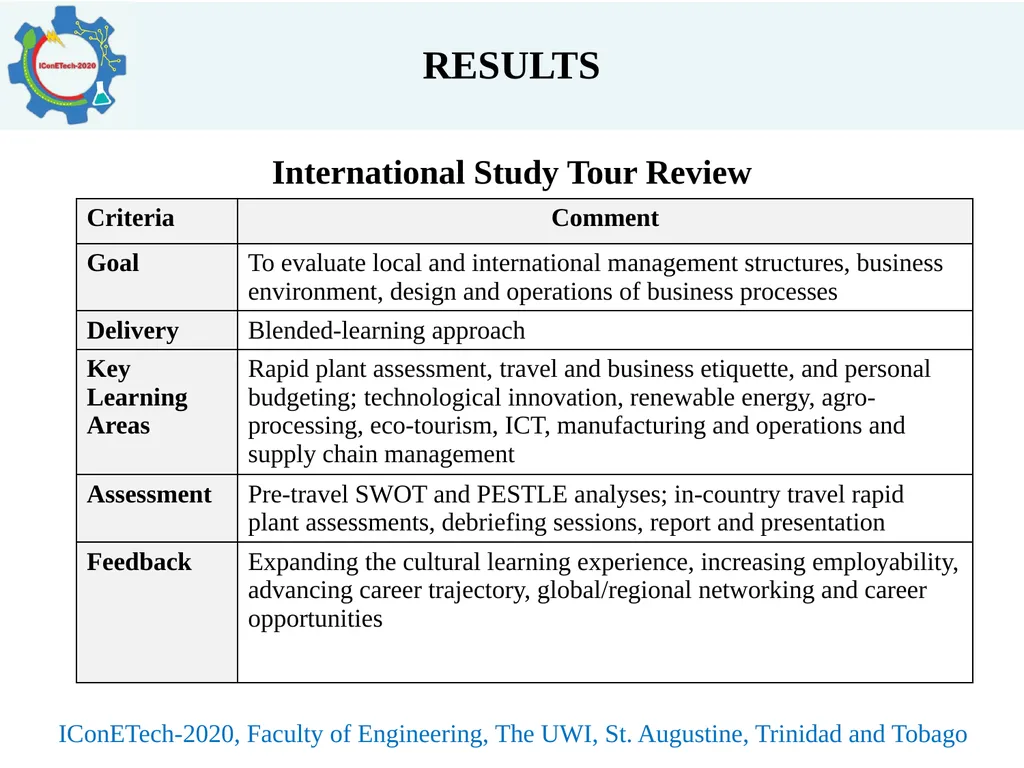
slide11. RESULTS International Study Tour Review IConETech-2020, Faculty of Engineering, The UWI, St. Augustine, Trinidad and Tobago<br>
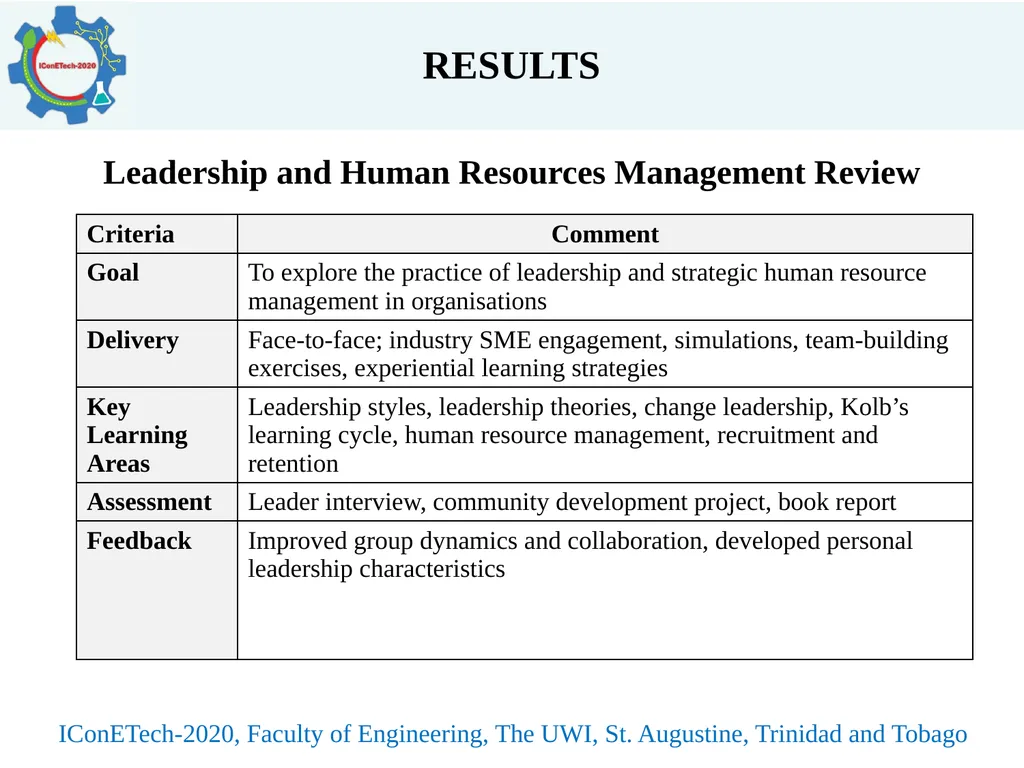
slide12. RESULTS Leadership and Human Resources Management Review IConETech-2020, Faculty of Engineering, The UWI, St. Augustine, Trinidad and Tobago<br>
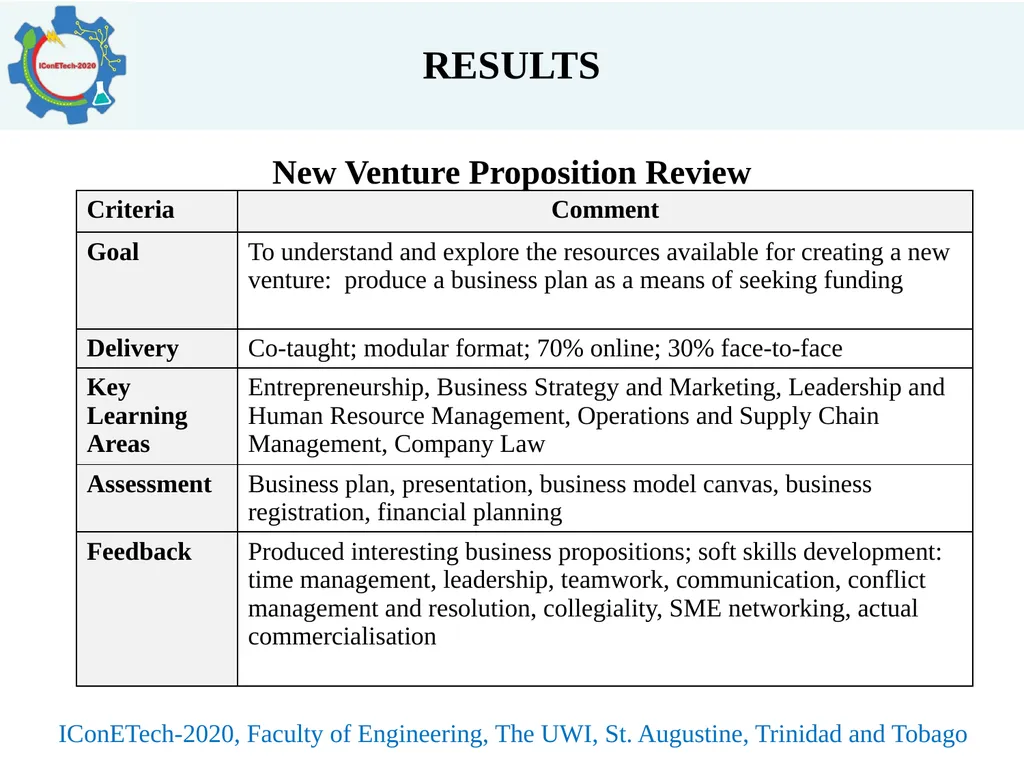
slide13. RESULTS New Venture Proposition Review IConETech-2020, Faculty of Engineering, The UWI, St. Augustine, Trinidad and Tobago<br>
slide14. DISCUSSION Reinforced learning: constant (re)application of taught concepts and theories
Engineering practitioners noted the need for closer engagement between industry and academia
Using the project-based assessments illustrated students’ true understanding of the classroom learning
Programmes enhanced students’ preparedness for work environments: requirement for collaborative, negotiating, planning, research, data-driven and organisational skills
Successful achievement of learning outcomes IConETech-2020, Faculty of Engineering, The UWI, St. Augustine, Trinidad and Tobago<br>
slide15. CONCLUSION The application of integrated approach to educational programme delivery has yielded positive results for the graduates, the university and industry
Further investigation to produce empirical data
Assessments reinforced concepts and theories learnt in the formal classroom setting
Application of knowledge to real contexts or simulated scenarios permit experiential learning by the students
Produce work-ready and management-ready graduates IConETech-2020, Faculty of Engineering, The UWI, St. Augustine, Trinidad and Tobago<br>
slide16. REFERENCES S. Meredith, M. Burkle. Building bridges between university and industry: theory and practice. Education + Training 50 no. 3, (2008) 199-215. http://dx.doi.org/10.1108/00400910810873982.
H. C. Martínez León. Bridging theory and practice with Lean Six Sigma capstone design projects. Quality Assurance in Education 27 no. 1, (2019).41-55, https://doi.org/10.1108/QAE-07-2018-0079.
Y. Wang, Y. Zhu, Y. Yu, X. Zhang, C. Xie. Simulating Industry: A Holistic Approach for Bridging the Gap between Engineering Education and Industry. Part II: Practice in Mechatronics Engineering. International Journal of Engineering Education 31 no. 1(A) (2015) pp. 174-180. IConETech-2020, Faculty of Engineering, The UWI, St. Augustine, Trinidad and Tobago<br>
slide17. REFERENCES K. Fraser, T. Tseng, X. Deng. The ongoing education of engineering practitioners: how do they perceive the usefulness of academic research? European Journal of Engineering Education, DOI: 10.1080/03043797.2018.1450847.
Y. Wang, Y. Yu, Y. Zhu, X. Zhang, H. Wiedmann, X. Feng. Simulating Industry: A Holistic Approach for Bridging the Gap between Engineering Education and Industry. Part I: A Conceptual Framework and Methodology. International Journal of Engineering Education 31 no. 1(A) (2015) pp. 165–173.
S. H. Ulanoff, J. C. Fingon, D. Beltrán. Using Case Studies to Assess Candidates’ Knowledge and Skills in a Graduate Reading Program. Teacher Education Quarterly (2009). IConETech-2020, Faculty of Engineering, The UWI, St. Augustine, Trinidad and Tobago<br>
slide18. REFERENCES C. Davis, E. Wilcock. Teaching Materials using Case Studies. UK Centre for Materials Education. Retrieved 02 January 2020, from http://www.materials.ac.uk/guides/casestudies.asp.
Business Strategy and Marketing, https://utt.instructure.com/courses/12197.
Entrepreneurship, https://utt.instructure.com/courses/15593.
Industry Design Project, https://utt.instructure.com/courses/15625.
Industry Project, https://utt.instructure.com/courses/15621.
Industry Management Project, https://utt.instructure.com/courses/473.
International Study Tour, https://utt.instructure.com/courses/15972.
Leadership and Human Resource Management, https://utt.instructure.com/courses/12086.
New Venture Proposition, https://utt.instructure.com/courses/15598. IConETech-2020, Faculty of Engineering, The UWI, St. Augustine, Trinidad and Tobago<br>
slide19. THANK YOU! IConETech-2020, Faculty of Engineering, The UWI, St. Augustine, Trinidad and Tobago<br>

The University of Trinidad and Tobago IConETech-2020, Faculty of Engineering, The UWI, St. Augustine, Trinidad and Tobago<br>
slide2. INTRODUCTION Employers want work-ready graduates.
Theory and practice gap with entry-level graduates.
University students’ challenge: translating theory into practice
Learning theory by rote and repeating for assessments IConETech-2020, Faculty of Engineering, The UWI, St. Augustine, Trinidad and Tobago<br>
slide3. BACKGROUND UTT’s Masters programmes:
Innovation, Manufacturing Management and Entrepreneurship (IMME);
Innovative Design and Entrepreneurship (IDE).
Learning outcomes:
fostering entrepreneurial spirit;
developing management capabilities;
real-time, problem-based industry immersion and;
nurturing engineering design capabilities. IConETech-2020, Faculty of Engineering, The UWI, St. Augustine, Trinidad and Tobago<br>
slide4. OBJECTIVES To determine if the intended learning outcomes of the Design and Manufacturing Engineering (DME) Masters Programme were achieved using an integrated delivery approach. IConETech-2020, Faculty of Engineering, The UWI, St. Augustine, Trinidad and Tobago<br>
slide5. LITERATURE REVIEW Meredith & Burkle, 2008:
Theory that is supported by practice makes understanding and learning far more likely
Martínez, 2019:
Problem-based learning (PBL) strategies provides for greater student experience
Fraser, Tseng, & Deng, 2018:
University-industry partnerships enhance knowledge transfer and practical experience
Wang et al. 2015:
Project-based assignments simulate the characteristics of real-world problems
Improvement or development of soft skills attributes
Experiential learning and cooperative education indicative of future working environment IConETech-2020, Faculty of Engineering, The UWI, St. Augustine, Trinidad and Tobago<br>
slide6. LITERATURE REVIEW In a case study conducted at a Chinese university for a joint educational project between China and Germany:
Lecturing alone is not sufficient.
Students benefit from interactive hands-on experiences.
Experiential, team-based learning involving student, faculty and industrial participation enriches the educational process and provides tangible benefits to all.
Simulations and experiential learning require context and it is for this reason that formal learning in the classroom is important because it gives students the structures, concepts and theories that support the real-life experience and learning.
Experiential learning is effective and reinforces formal learning because it becomes personal. IConETech-2020, Faculty of Engineering, The UWI, St. Augustine, Trinidad and Tobago<br>
slide7. METHODOLOGY Reviewed common courses descriptors;
Interviewed staff, students, industry practitioners;
Reviewed student evaluation of teaching reports
Reviewed examiners reports IConETech-2020, Faculty of Engineering, The UWI, St. Augustine, Trinidad and Tobago<br>
slide8. RESULTS Business Strategy and Marketing Review IConETech-2020, Faculty of Engineering, The UWI, St. Augustine, Trinidad and Tobago<br>
slide9. RESULTS Entrepreneurship Review IConETech-2020, Faculty of Engineering, The UWI, St. Augustine, Trinidad and Tobago<br>
slide10. RESULTS Industry Projects Review IConETech-2020, Faculty of Engineering, The UWI, St. Augustine, Trinidad and Tobago<br>
slide11. RESULTS International Study Tour Review IConETech-2020, Faculty of Engineering, The UWI, St. Augustine, Trinidad and Tobago<br>
slide12. RESULTS Leadership and Human Resources Management Review IConETech-2020, Faculty of Engineering, The UWI, St. Augustine, Trinidad and Tobago<br>
slide13. RESULTS New Venture Proposition Review IConETech-2020, Faculty of Engineering, The UWI, St. Augustine, Trinidad and Tobago<br>
slide14. DISCUSSION Reinforced learning: constant (re)application of taught concepts and theories
Engineering practitioners noted the need for closer engagement between industry and academia
Using the project-based assessments illustrated students’ true understanding of the classroom learning
Programmes enhanced students’ preparedness for work environments: requirement for collaborative, negotiating, planning, research, data-driven and organisational skills
Successful achievement of learning outcomes IConETech-2020, Faculty of Engineering, The UWI, St. Augustine, Trinidad and Tobago<br>
slide15. CONCLUSION The application of integrated approach to educational programme delivery has yielded positive results for the graduates, the university and industry
Further investigation to produce empirical data
Assessments reinforced concepts and theories learnt in the formal classroom setting
Application of knowledge to real contexts or simulated scenarios permit experiential learning by the students
Produce work-ready and management-ready graduates IConETech-2020, Faculty of Engineering, The UWI, St. Augustine, Trinidad and Tobago<br>
slide16. REFERENCES S. Meredith, M. Burkle. Building bridges between university and industry: theory and practice. Education + Training 50 no. 3, (2008) 199-215. http://dx.doi.org/10.1108/00400910810873982.
H. C. Martínez León. Bridging theory and practice with Lean Six Sigma capstone design projects. Quality Assurance in Education 27 no. 1, (2019).41-55, https://doi.org/10.1108/QAE-07-2018-0079.
Y. Wang, Y. Zhu, Y. Yu, X. Zhang, C. Xie. Simulating Industry: A Holistic Approach for Bridging the Gap between Engineering Education and Industry. Part II: Practice in Mechatronics Engineering. International Journal of Engineering Education 31 no. 1(A) (2015) pp. 174-180. IConETech-2020, Faculty of Engineering, The UWI, St. Augustine, Trinidad and Tobago<br>
slide17. REFERENCES K. Fraser, T. Tseng, X. Deng. The ongoing education of engineering practitioners: how do they perceive the usefulness of academic research? European Journal of Engineering Education, DOI: 10.1080/03043797.2018.1450847.
Y. Wang, Y. Yu, Y. Zhu, X. Zhang, H. Wiedmann, X. Feng. Simulating Industry: A Holistic Approach for Bridging the Gap between Engineering Education and Industry. Part I: A Conceptual Framework and Methodology. International Journal of Engineering Education 31 no. 1(A) (2015) pp. 165–173.
S. H. Ulanoff, J. C. Fingon, D. Beltrán. Using Case Studies to Assess Candidates’ Knowledge and Skills in a Graduate Reading Program. Teacher Education Quarterly (2009). IConETech-2020, Faculty of Engineering, The UWI, St. Augustine, Trinidad and Tobago<br>
slide18. REFERENCES C. Davis, E. Wilcock. Teaching Materials using Case Studies. UK Centre for Materials Education. Retrieved 02 January 2020, from http://www.materials.ac.uk/guides/casestudies.asp.
Business Strategy and Marketing, https://utt.instructure.com/courses/12197.
Entrepreneurship, https://utt.instructure.com/courses/15593.
Industry Design Project, https://utt.instructure.com/courses/15625.
Industry Project, https://utt.instructure.com/courses/15621.
Industry Management Project, https://utt.instructure.com/courses/473.
International Study Tour, https://utt.instructure.com/courses/15972.
Leadership and Human Resource Management, https://utt.instructure.com/courses/12086.
New Venture Proposition, https://utt.instructure.com/courses/15598. IConETech-2020, Faculty of Engineering, The UWI, St. Augustine, Trinidad and Tobago<br>
slide19. THANK YOU! IConETech-2020, Faculty of Engineering, The UWI, St. Augustine, Trinidad and Tobago<br>