
Integrating Patient Values into Clinical Trials

Description: Integrating Patient Values into Clinical Trials Using a Patient-Centered Composite Endpoint: A Case Study Using the Control of Hypertension in Pregnancy Study (CHIPS) Trial Rebecca Metcalfe1,2, Nick Bansback1,2, Mark Harrison1,2, Mary
Related Topics
Download Presentation
"Integrating Patient Values into Clinical Trials" is the property of its rightful owner. Permission is granted to download and print the materials on this website for personal, non-commercial use only, and to display it on your personal computer provided you do not modify the materials and that you retain all copyright notices contained in the materials. By downloading content from our website, you accept the terms of this agreement.
Presentation Transcript
slide1. Integrating Patient Values into Clinical Trials Using a Patient-Centered Composite Endpoint:
A Case Study Using the Control of Hypertension in Pregnancy Study (CHIPS) Trial Rebecca Metcalfe1,2, Nick Bansback1,2, Mark Harrison1,2, Mary Lewisch3, Terry Lee2, Joel Singer 1,2, Laura Magee4, Peter von Dadelszen4
1. University of British Columbia, Vancouver, Canada; 2. Centre for Health Evaluation and Outcome Sciences Vancouver, Canada; 3. Patient Partner; 4. King’s College London<br>
slide2. Disclosures and Acknowledgments None of the authors have any disclosures
This work would not have been possible without a large team of patient partners, and other researchers
The study was funded by the BC SUPPORT Unit, and the Canadian Institutes of Health Research (CIHR) both federally funded organizations
Colleagues have critically reviewed previous versions of slides to mitigate potential bias 2 The work was conducted on the traditional and unceded territory of the Coast Salish Peoples, including the territories of the xwməθkwəy̓əm (Musqueam), Skwxwú7mesh (Squamish), Stó:lō and Səl̓ílwətaʔ/Selilwitulh (Tsleil- Waututh) Nations<br>
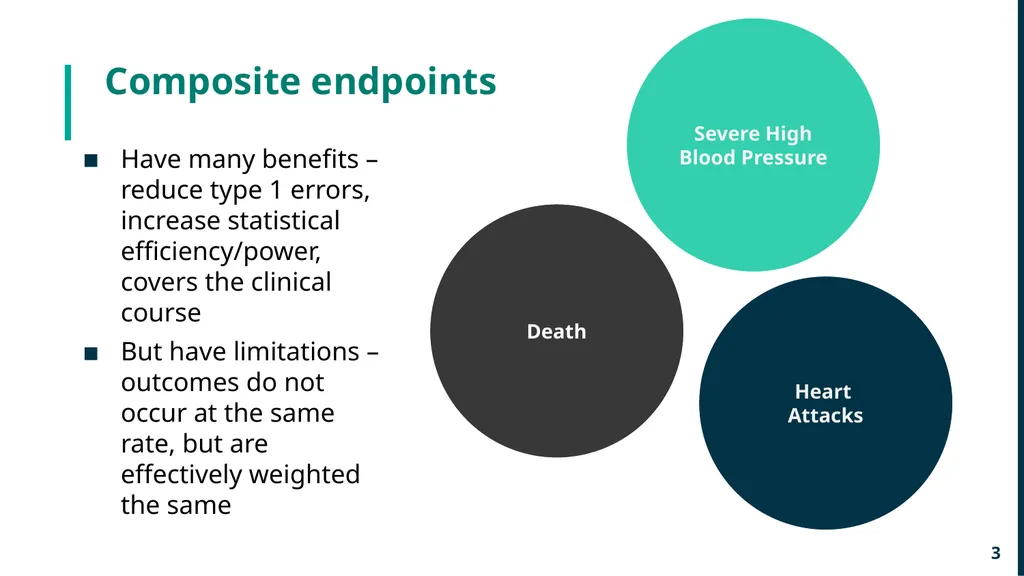
slide3. Composite endpoints Have many benefits – reduce type 1 errors, increase statistical efficiency/power, covers the clinical course
But have limitations – outcomes do not occur at the same rate, but are effectively weighted the same 3 Heart
Attacks Severe High Blood Pressure Death<br>
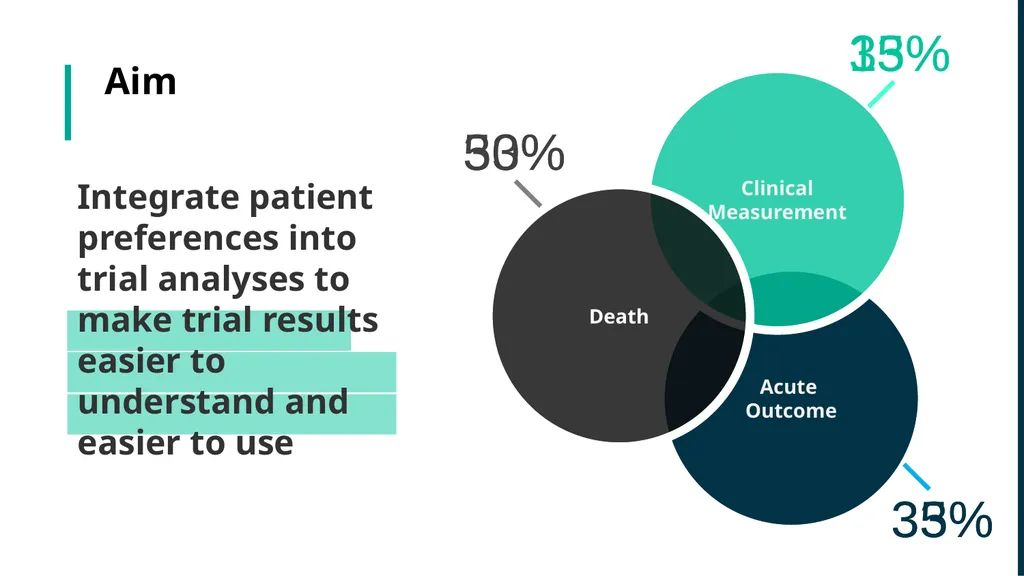
slide4. Aim Integrate patient preferences into trial analyses to make trial results easier to understand and easier to use Acute
Outcome Clinical Measurement Death<br>
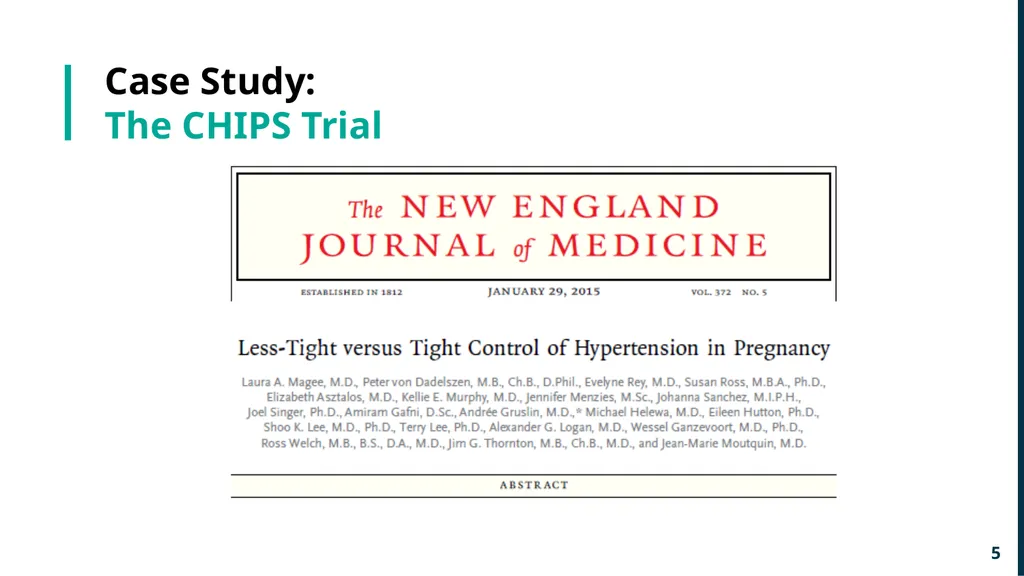
slide5. Case Study: The CHIPS Trial International, open, pragmatic RCT
~1000 individuals
Comparing two treatment approaches 5<br>
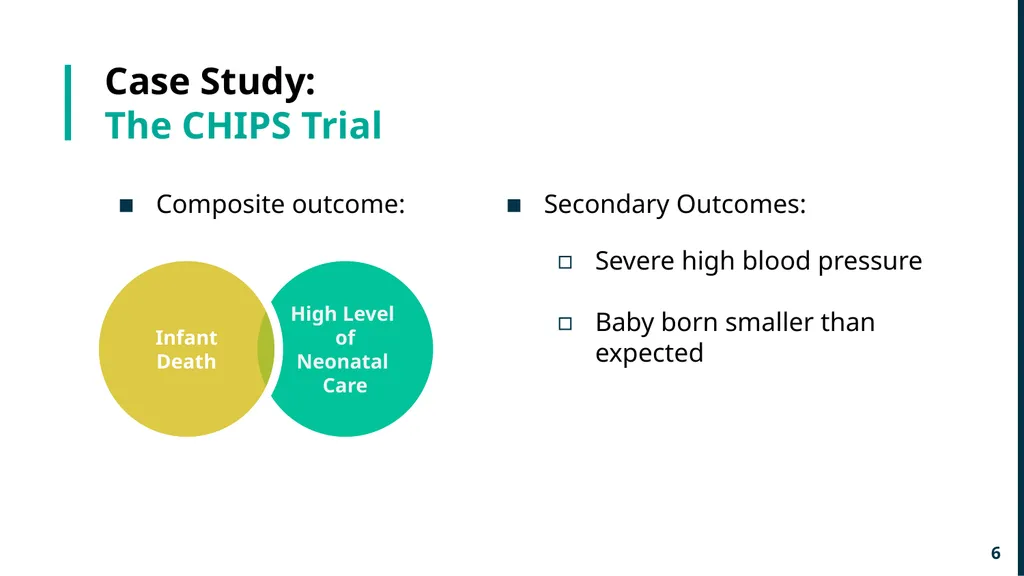
slide6. Case Study: The CHIPS Trial Composite outcome: Secondary Outcomes:
Severe high blood pressure
Baby born smaller than expected 6 High Level
of
Neonatal
Care Infant
Death<br>
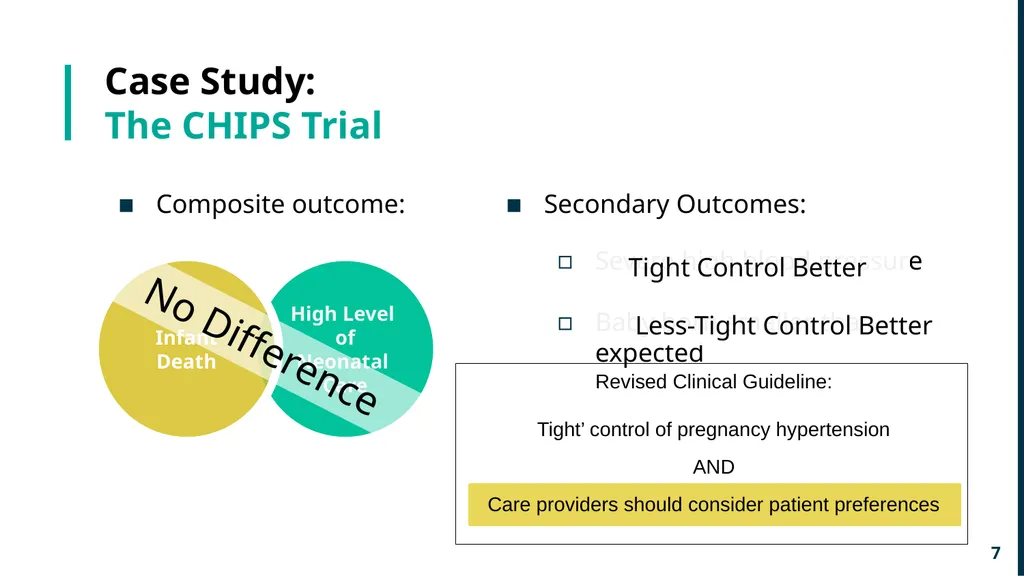
slide7. Case Study: The CHIPS Trial Composite outcome: Secondary Outcomes:
Severe high blood pressure
Baby born smaller than expected 7 High Level
of
Neonatal
Care Infant
Death No Difference Tight Control Better Less-Tight Control Better Revised Clinical Guideline:
Tight’ control of pregnancy hypertension
AND
Care providers should consider patient preferences<br>
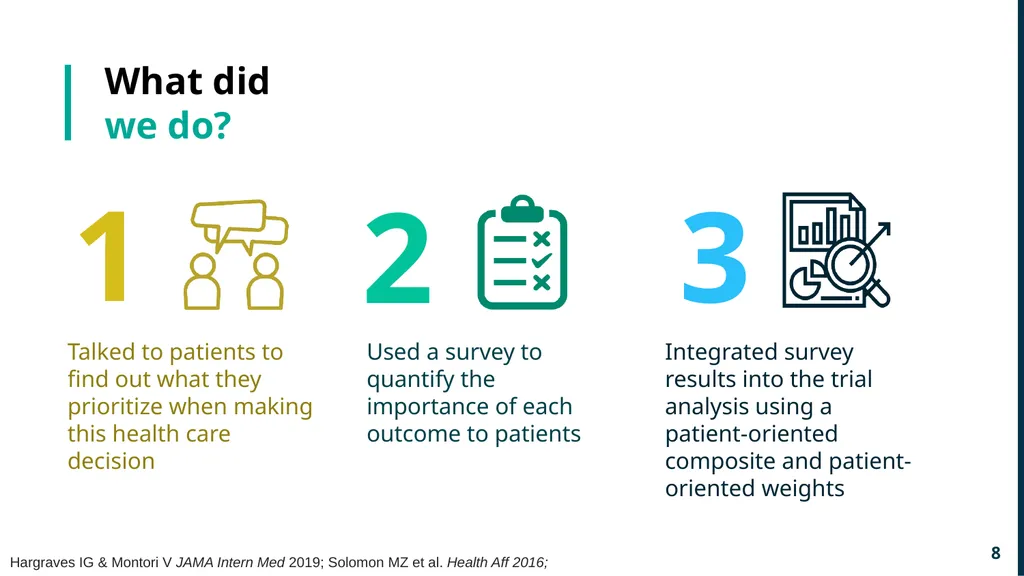
slide8. What did we do? 8 Hargraves IG & Montori V JAMA Intern Med 2019; Solomon MZ et al. Health Aff 2016;<br>
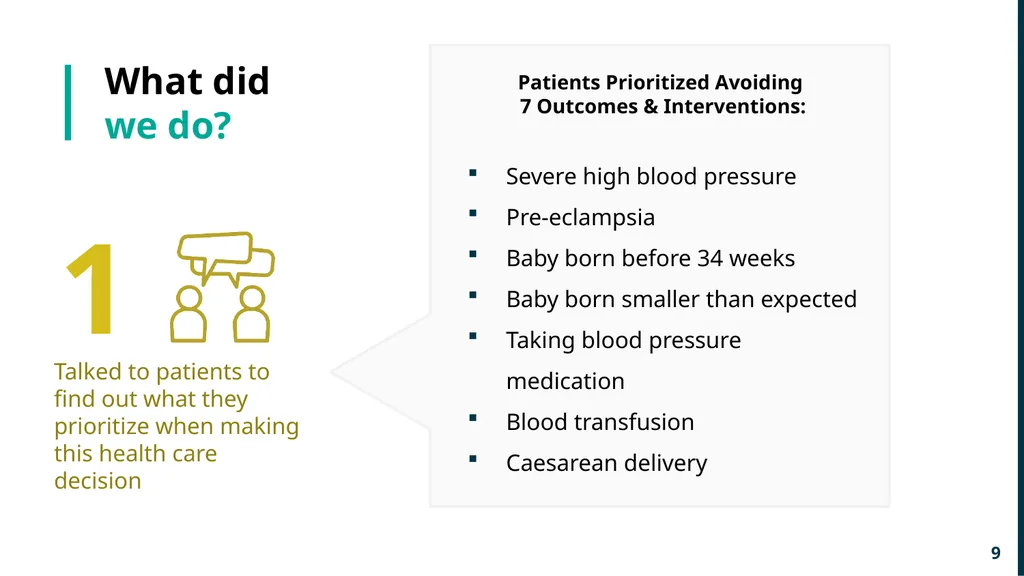
slide9. What did we do? 9 Severe high blood pressure
Pre-eclampsia
Baby born before 34 weeks
Baby born smaller than expected
Taking blood pressure medication
Blood transfusion
Caesarean delivery Patients Prioritized Avoiding
7 Outcomes & Interventions:<br>
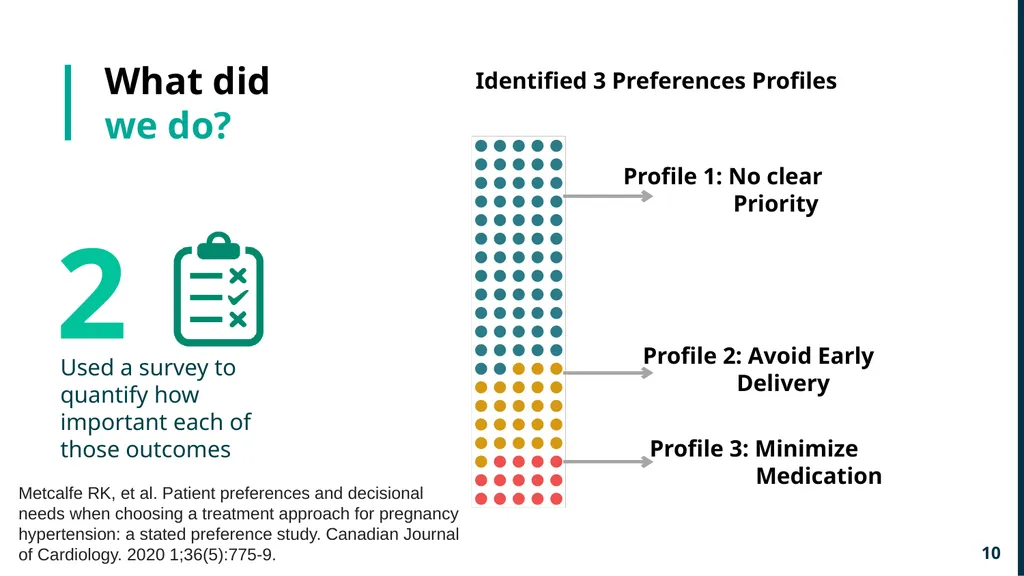
slide10. Profile 1: No clear
Priority Profile 2: Avoid Early
Delivery Profile 3: Minimize
Medication What did we do? 10 Identified 3 Preferences Profiles Metcalfe RK, et al. Patient preferences and decisional needs when choosing a treatment approach for pregnancy hypertension: a stated preference study. Canadian Journal of Cardiology. 2020 1;36(5):775-9.<br>
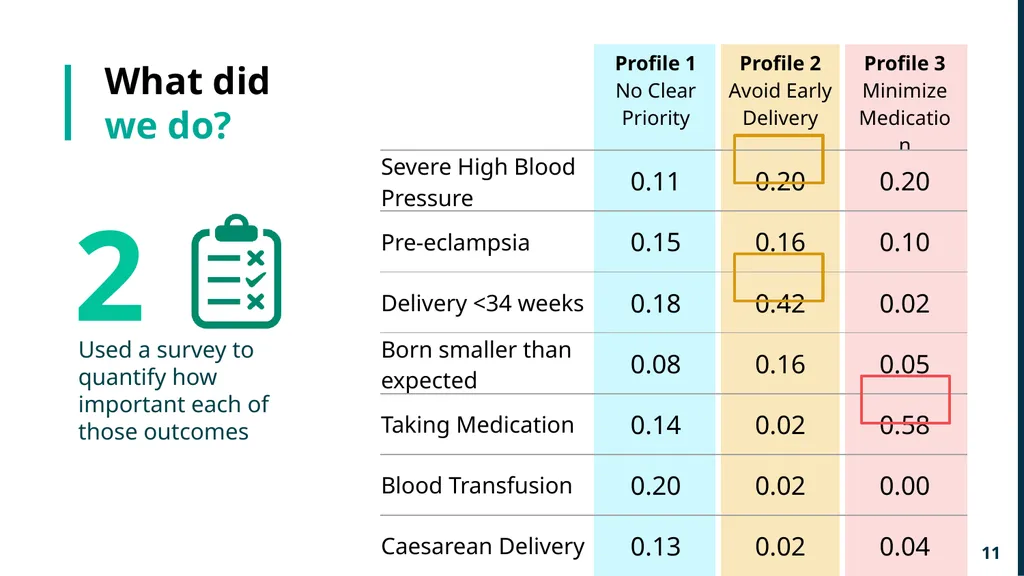
slide11. What did we do? 11<br>
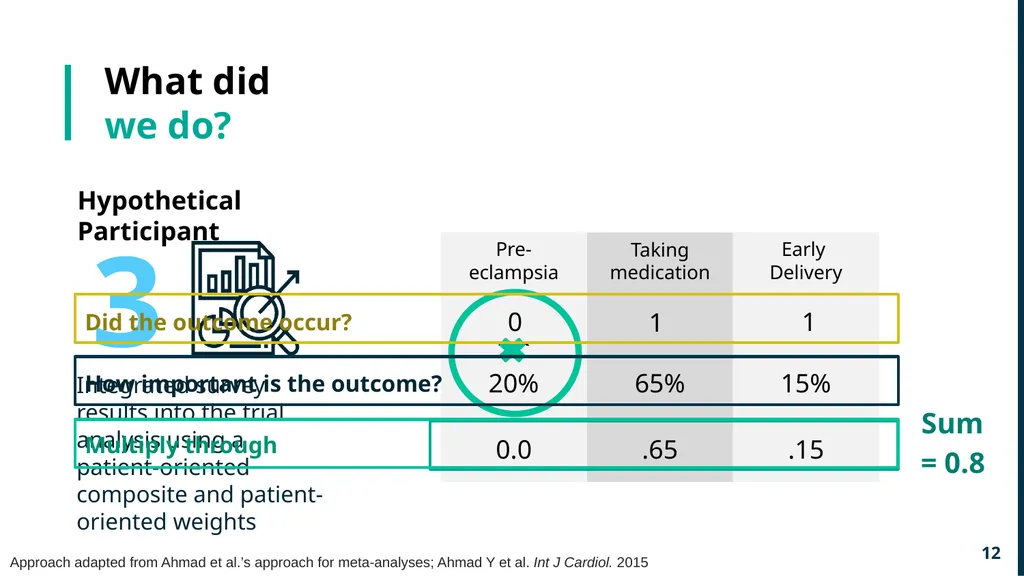
slide12. What did we do? 12 Taking medication
Yes Early
Delivery
Yes Pre-eclampsia
No 0 1 1 20% 0.0 65% .65 15% .15 Multiply through Sum How important is the outcome? Did the outcome occur? = 0.8 Hypothetical Participant Approach adapted from Ahmad et al.’s approach for meta-analyses; Ahmad Y et al. Int J Cardiol. 2015<br>
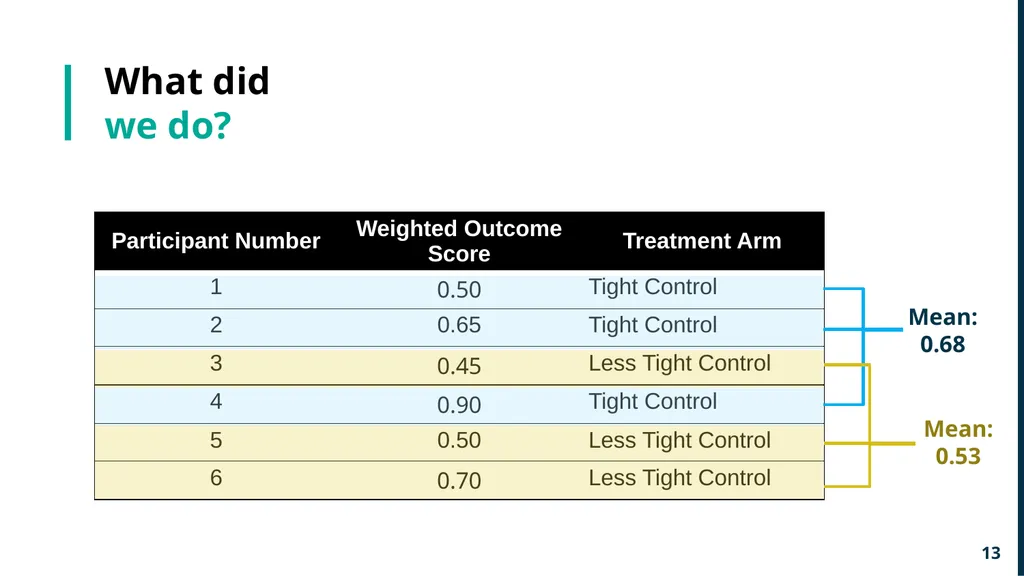
slide13. What did we do? 13 Mean:
0.68 Mean:
0.53<br>
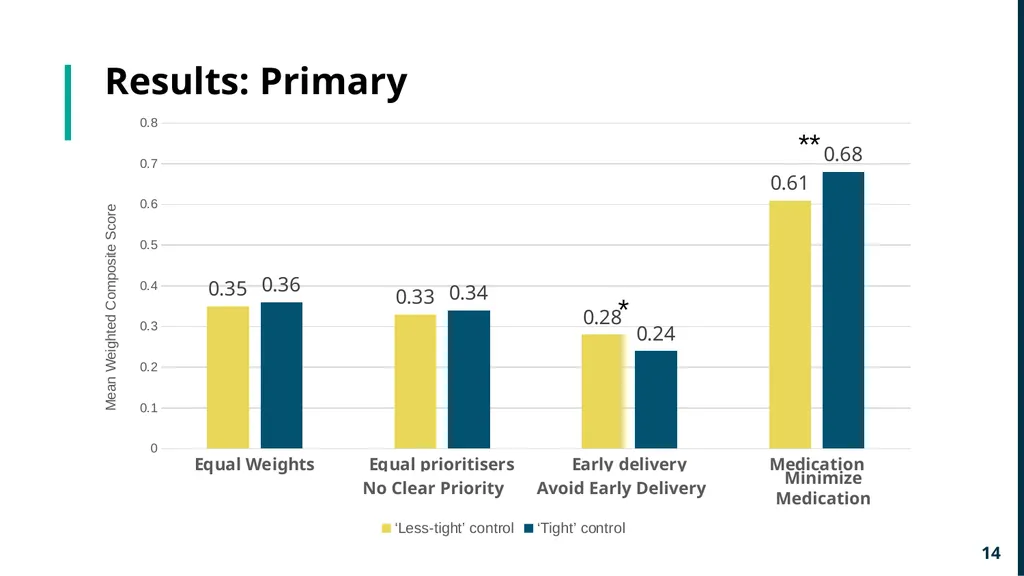
slide14. Results: Primary 14 No Clear Priority Avoid Early Delivery Minimize Medication<br>
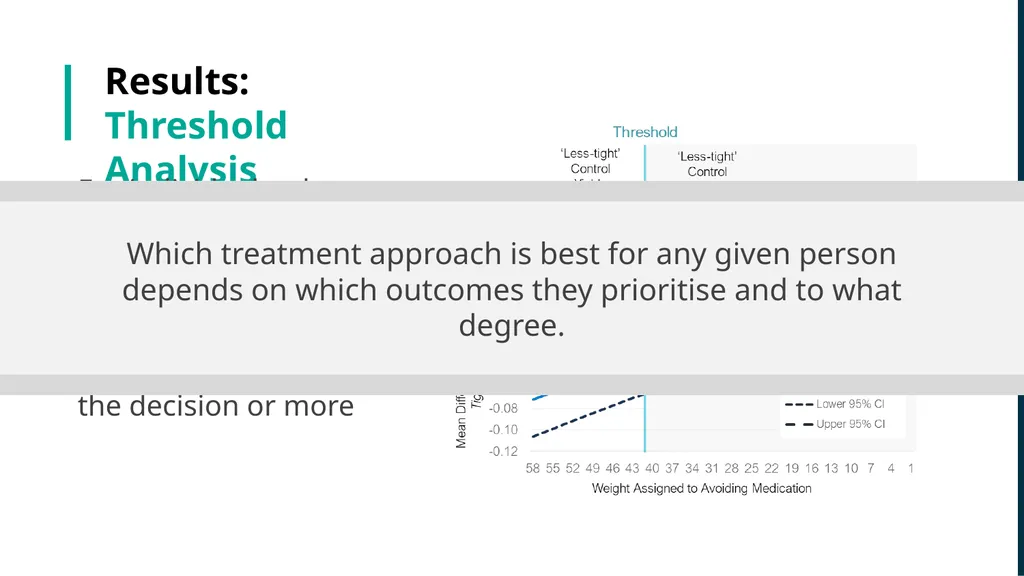
slide15. Results: Threshold Analysis For individuals who prioritize avoiding medication, ‘less-tight’ control yields better outcomes as long as avoiding medication makes up two fifths of the decision or more<br>
slide16. Discussion: Strengths This is the first study in pregnancy to integrate patient value weights into individual-level trial data
Used patient weights and a patient-oriented composite
Allowed the inclusion of treatment requirements not just outcomes
Addresses issues with traditional composite endpoints and aids in interpretation
Relatively simple statistical analysis
Can accommodate covariates; robust; parametric test 16<br>
slide17. Discussion: Limitations Implications for trial design and particularly power are unclear
May be best as a sensitivity analysis
May lose statistical efficiency that is gained by composite endpoints
Study done post-hoc
Did not use values of women in the trial 17<br>
slide18. Future Directions Need to stop treating composite endpoints with equal weights as value neutral
Future studies should consider how patient values can inform their analysis
Selection of outcomes
Weight of outcomes
Both? 18<br>
slide19. Thank you None of the authors have any disclosures
This work would not have been possible without a large team of patient partners, and other researchers
The study was funded by the BC SUPPORT Unit, and the Canadian Institutes of Health Research (CIHR) both federally funded organizations
Colleagues have critically reviewed previous versions of slides to mitigate potential bias 19 The work was conducted on the traditional and unceded territory of the Coast Salish Peoples, including the territories of the xwməθkwəy̓əm (Musqueam), Skwxwú7mesh (Squamish), Stó:lō and Səl̓ílwətaʔ/Selilwitulh (Tsleil- Waututh) Nations<br>
1. University of British Columbia, Vancouver, Canada; 2. Centre for Health Evaluation and Outcome Sciences Vancouver, Canada; 3. Patient Partner; 4. King’s College London<br>
slide2. Disclosures and Acknowledgments None of the authors have any disclosures
This work would not have been possible without a large team of patient partners, and other researchers
The study was funded by the BC SUPPORT Unit, and the Canadian Institutes of Health Research (CIHR) both federally funded organizations
Colleagues have critically reviewed previous versions of slides to mitigate potential bias 2 The work was conducted on the traditional and unceded territory of the Coast Salish Peoples, including the territories of the xwməθkwəy̓əm (Musqueam), Skwxwú7mesh (Squamish), Stó:lō and Səl̓ílwətaʔ/Selilwitulh (Tsleil- Waututh) Nations<br>
slide3. Composite endpoints Have many benefits – reduce type 1 errors, increase statistical efficiency/power, covers the clinical course
But have limitations – outcomes do not occur at the same rate, but are effectively weighted the same 3 Heart
Attacks Severe High Blood Pressure Death<br>
slide4. Aim Integrate patient preferences into trial analyses to make trial results easier to understand and easier to use Acute
Outcome Clinical Measurement Death<br>
slide5. Case Study: The CHIPS Trial International, open, pragmatic RCT
~1000 individuals
Comparing two treatment approaches 5<br>
slide6. Case Study: The CHIPS Trial Composite outcome: Secondary Outcomes:
Severe high blood pressure
Baby born smaller than expected 6 High Level
of
Neonatal
Care Infant
Death<br>
slide7. Case Study: The CHIPS Trial Composite outcome: Secondary Outcomes:
Severe high blood pressure
Baby born smaller than expected 7 High Level
of
Neonatal
Care Infant
Death No Difference Tight Control Better Less-Tight Control Better Revised Clinical Guideline:
Tight’ control of pregnancy hypertension
AND
Care providers should consider patient preferences<br>
slide8. What did we do? 8 Hargraves IG & Montori V JAMA Intern Med 2019; Solomon MZ et al. Health Aff 2016;<br>
slide9. What did we do? 9 Severe high blood pressure
Pre-eclampsia
Baby born before 34 weeks
Baby born smaller than expected
Taking blood pressure medication
Blood transfusion
Caesarean delivery Patients Prioritized Avoiding
7 Outcomes & Interventions:<br>
slide10. Profile 1: No clear
Priority Profile 2: Avoid Early
Delivery Profile 3: Minimize
Medication What did we do? 10 Identified 3 Preferences Profiles Metcalfe RK, et al. Patient preferences and decisional needs when choosing a treatment approach for pregnancy hypertension: a stated preference study. Canadian Journal of Cardiology. 2020 1;36(5):775-9.<br>
slide11. What did we do? 11<br>
slide12. What did we do? 12 Taking medication
Yes Early
Delivery
Yes Pre-eclampsia
No 0 1 1 20% 0.0 65% .65 15% .15 Multiply through Sum How important is the outcome? Did the outcome occur? = 0.8 Hypothetical Participant Approach adapted from Ahmad et al.’s approach for meta-analyses; Ahmad Y et al. Int J Cardiol. 2015<br>
slide13. What did we do? 13 Mean:
0.68 Mean:
0.53<br>
slide14. Results: Primary 14 No Clear Priority Avoid Early Delivery Minimize Medication<br>
slide15. Results: Threshold Analysis For individuals who prioritize avoiding medication, ‘less-tight’ control yields better outcomes as long as avoiding medication makes up two fifths of the decision or more<br>
slide16. Discussion: Strengths This is the first study in pregnancy to integrate patient value weights into individual-level trial data
Used patient weights and a patient-oriented composite
Allowed the inclusion of treatment requirements not just outcomes
Addresses issues with traditional composite endpoints and aids in interpretation
Relatively simple statistical analysis
Can accommodate covariates; robust; parametric test 16<br>
slide17. Discussion: Limitations Implications for trial design and particularly power are unclear
May be best as a sensitivity analysis
May lose statistical efficiency that is gained by composite endpoints
Study done post-hoc
Did not use values of women in the trial 17<br>
slide18. Future Directions Need to stop treating composite endpoints with equal weights as value neutral
Future studies should consider how patient values can inform their analysis
Selection of outcomes
Weight of outcomes
Both? 18<br>
slide19. Thank you None of the authors have any disclosures
This work would not have been possible without a large team of patient partners, and other researchers
The study was funded by the BC SUPPORT Unit, and the Canadian Institutes of Health Research (CIHR) both federally funded organizations
Colleagues have critically reviewed previous versions of slides to mitigate potential bias 19 The work was conducted on the traditional and unceded territory of the Coast Salish Peoples, including the territories of the xwməθkwəy̓əm (Musqueam), Skwxwú7mesh (Squamish), Stó:lō and Səl̓ílwətaʔ/Selilwitulh (Tsleil- Waututh) Nations<br>