
Interdisciplinary Morbidity and Mortality


Description: Interdisciplinary Morbidity and Mortality Conference 10142021 Morbidity Mortality Conference Thursday, May 9, 2024 Moderator: Adewale Ajumobi, MD, MBA, FACP, FACG, AGAF, FASGE Presenters: Nicholas Newell, MD Learning Objectives: Analyze
Related Topics
Download Presentation
"Interdisciplinary Morbidity and Mortality" is the property of its rightful owner. Permission is granted to download and print the materials on this website for personal, non-commercial use only, and to display it on your personal computer provided you do not modify the materials and that you retain all copyright notices contained in the materials. By downloading content from our website, you accept the terms of this agreement.
Presentation Transcript
slide1. Interdisciplinary Morbidity and Mortality Conference 10/14/2021<br>
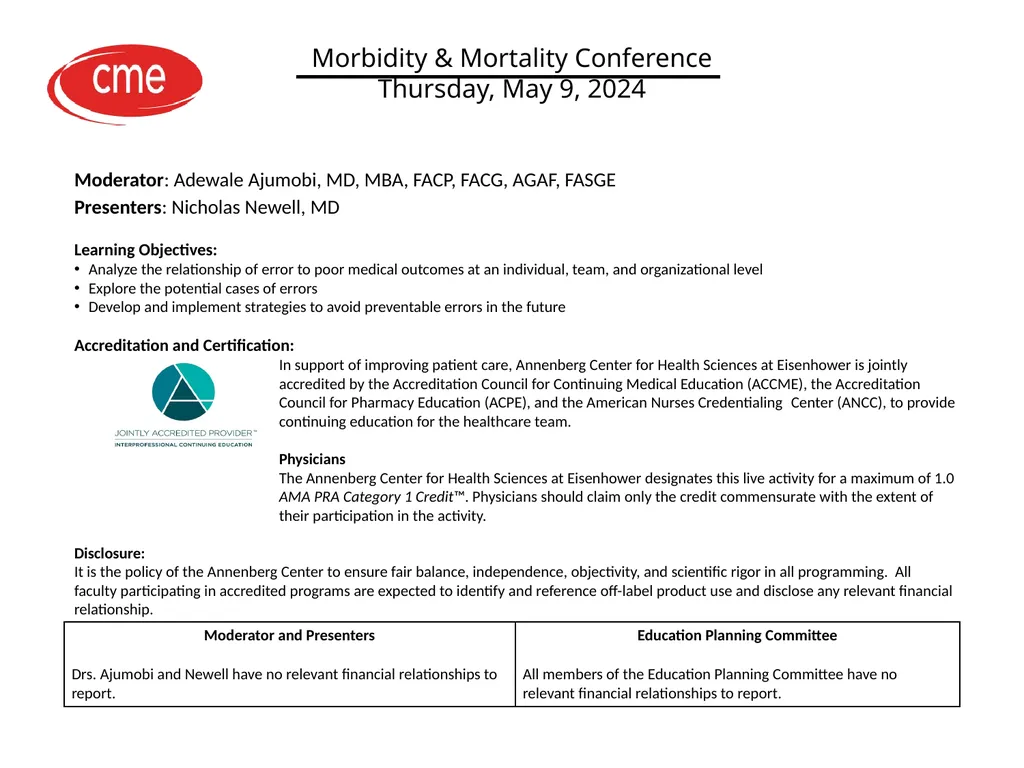
slide2. Morbidity & Mortality Conference Thursday, May 9, 2024 Moderator: Adewale Ajumobi, MD, MBA, FACP, FACG, AGAF, FASGE
Presenters: Nicholas Newell, MD
Learning Objectives:
Analyze the relationship of error to poor medical outcomes at an individual, team, and organizational level
Explore the potential cases of errors
Develop and implement strategies to avoid preventable errors in the future
Accreditation and Certification:
In support of improving patient care, Annenberg Center for Health Sciences at Eisenhower is jointly accredited by the Accreditation Council for Continuing Medical Education (ACCME), the Accreditation Council for Pharmacy Education (ACPE), and the American Nurses Credentialing Center (ANCC), to provide continuing education for the healthcare team.
Physicians The Annenberg Center for Health Sciences at Eisenhower designates this live activity for a maximum of 1.0 AMA PRA Category 1 Credit™. Physicians should claim only the credit commensurate with the extent of their participation in the activity. Disclosure:
It is the policy of the Annenberg Center to ensure fair balance, independence, objectivity, and scientific rigor in all programming. All faculty participating in accredited programs are expected to identify and reference off-label product use and disclose any relevant financial relationship.<br>
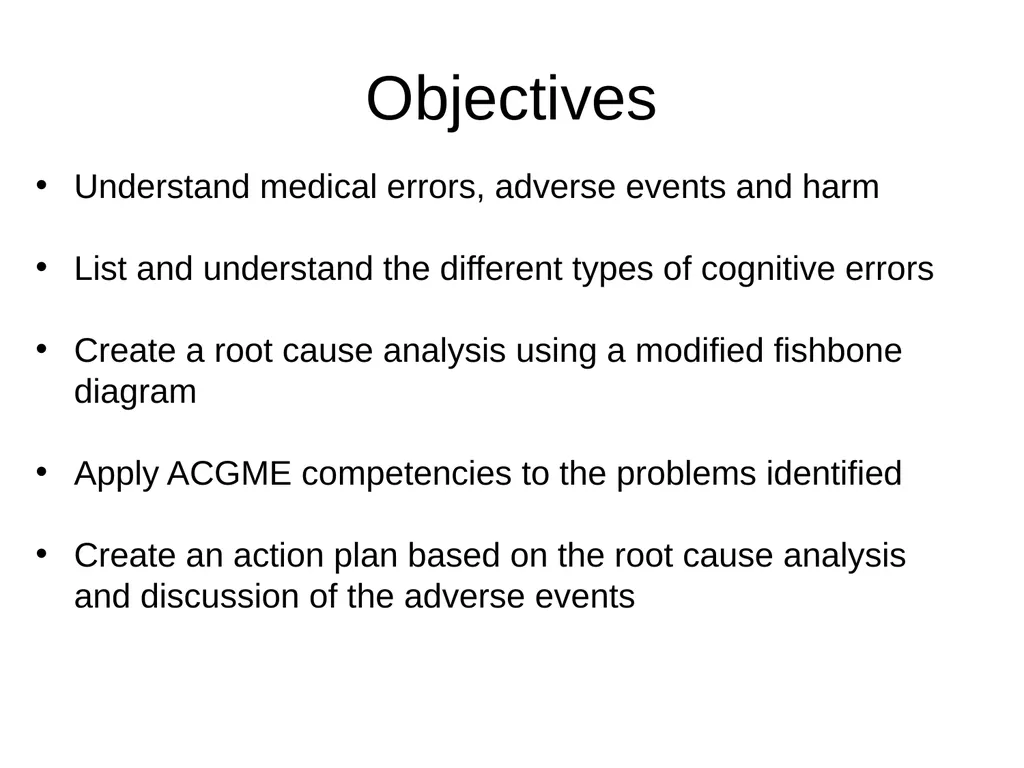
slide3. Objectives Understand medical errors, adverse events and harm
List and understand the different types of cognitive errors
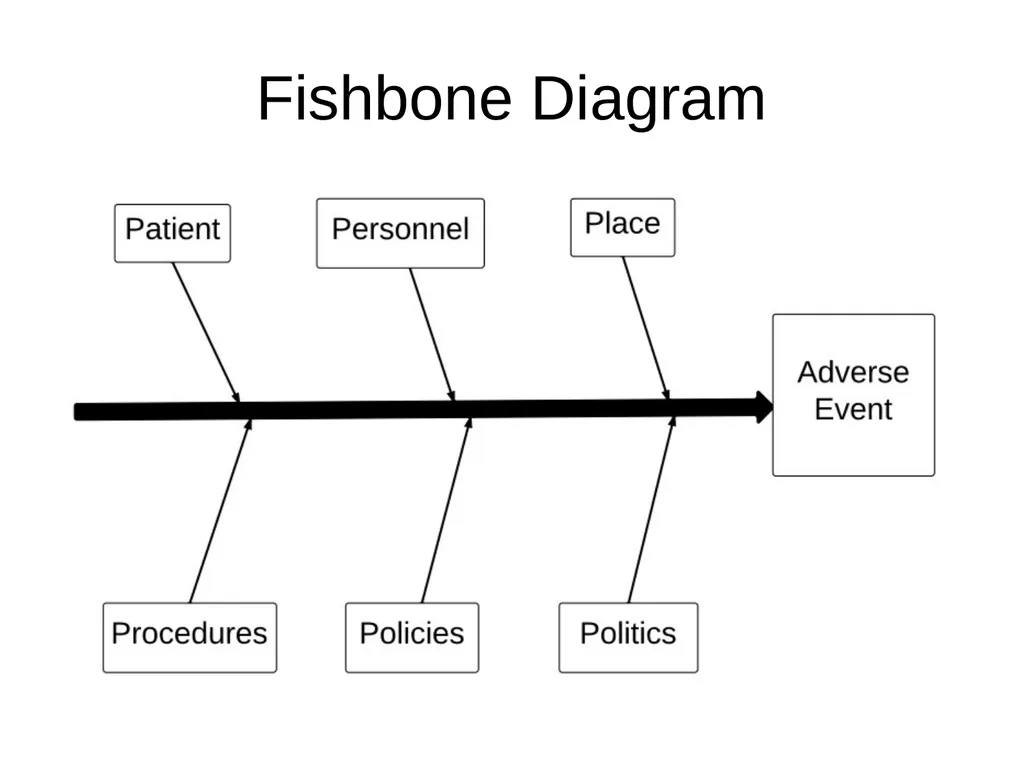
Create a root cause analysis using a modified fishbone diagram
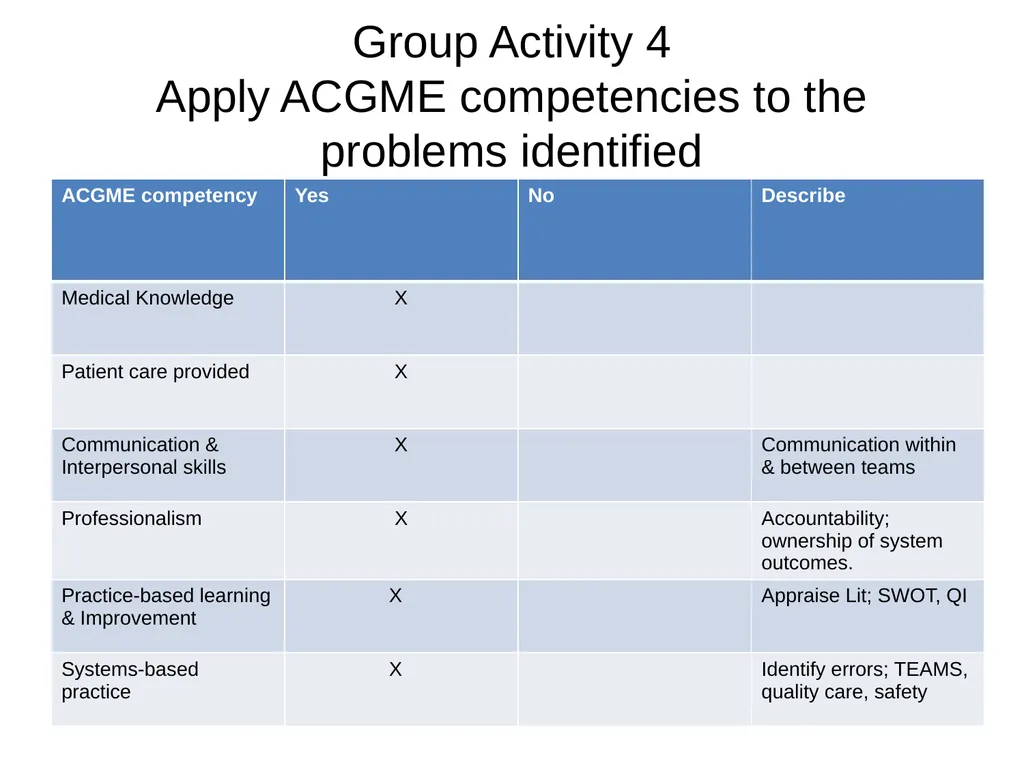
Apply ACGME competencies to the problems identified
Create an action plan based on the root cause analysis and discussion of the adverse events<br>
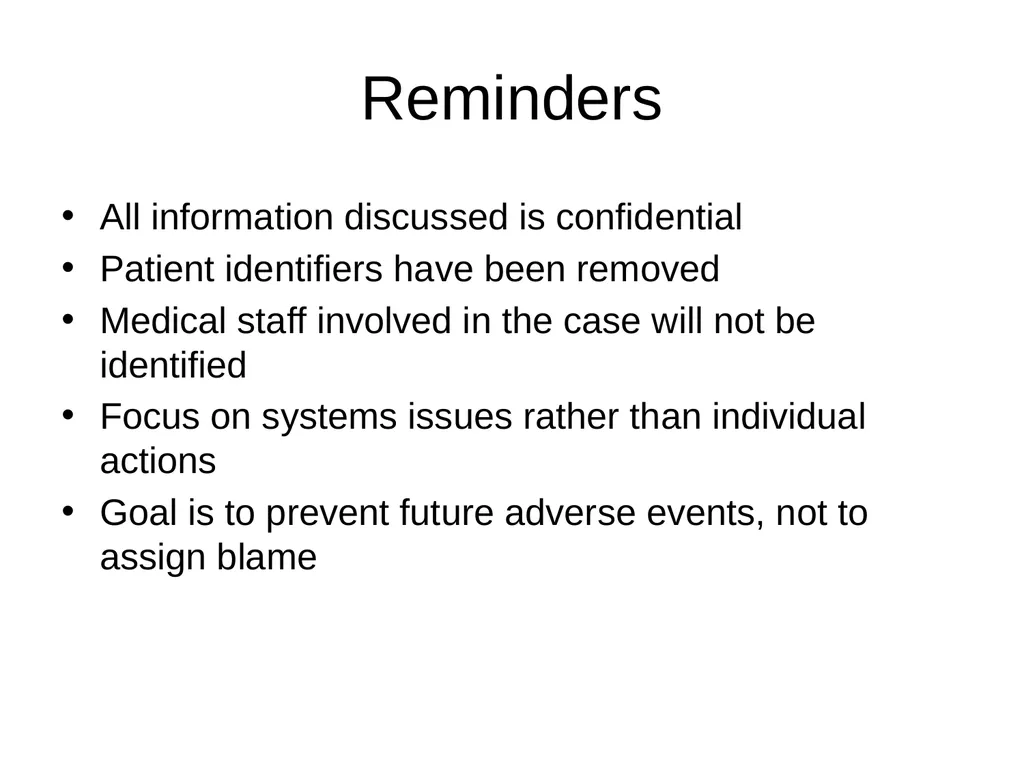
slide4. Reminders All information discussed is confidential
Patient identifiers have been removed
Medical staff involved in the case will not be identified
Focus on systems issues rather than individual actions
Goal is to prevent future adverse events, not to assign blame<br>
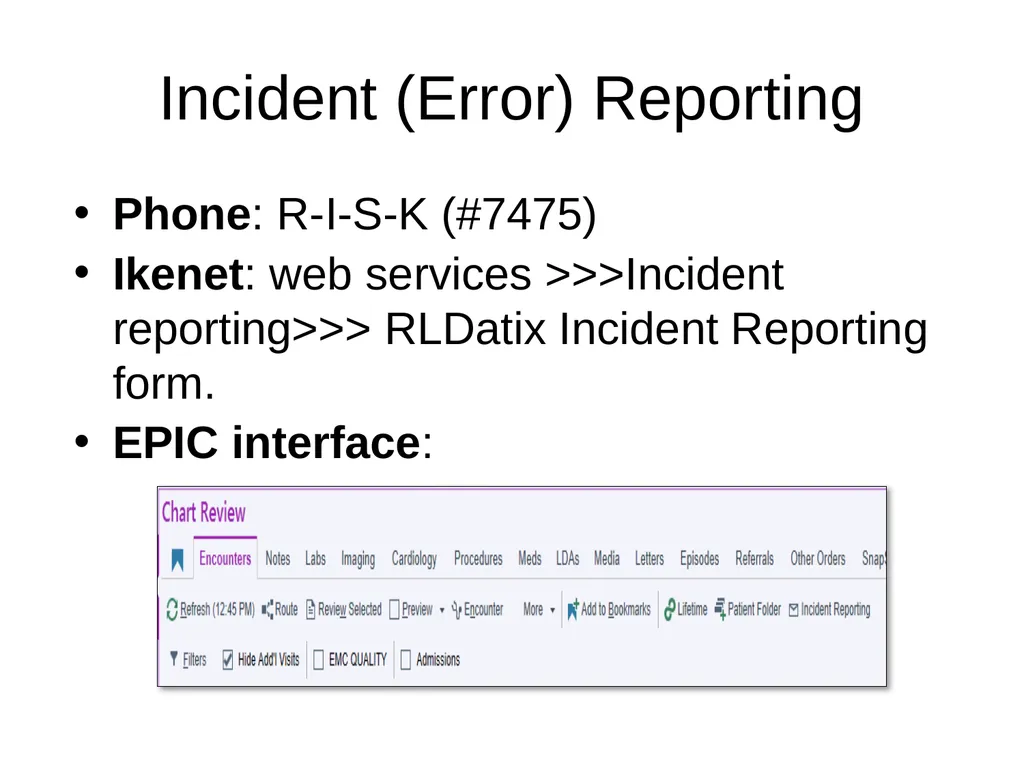
slide5. Incident (Error) Reporting Phone: R-I-S-K (#7475)
Ikenet: web services >>>Incident reporting>>> RLDatix Incident Reporting form.
EPIC interface:<br>
slide6. DSAFD Remarks<br>
slide7. Case Presentation Trainee<br>
slide8. Presentation Chief Complaint History of Present Illness<br>
slide9. Past Medical History<br>
slide10. Social History Home Medication<br>
slide11. Physical Exam Vitals:
General:
HEENT:
Neck:
Pulmonary:
Circulatory:
Abdominal:
Neurologic:
Musculoskeletal:
Skin:<br>
slide12. Labs<br>
slide13. Hospital Course<br>
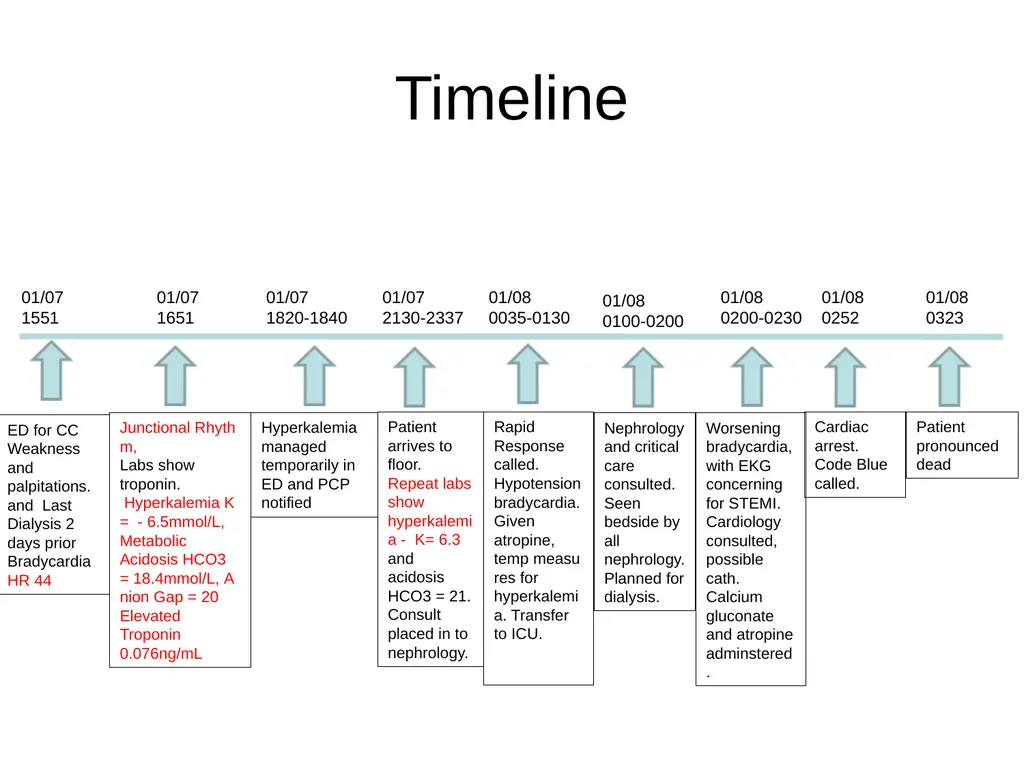
slide14. Timeline ED for CC Weakness and palpitations. and Last Dialysis 2 days prior Bradycardia
HR 44 01/07
1551 01/07
1651 Junctional Rhythm,
Labs show troponin.
Hyperkalemia K = - 6.5mmol/L,
Metabolic Acidosis HCO3 = 18.4mmol/L, Anion Gap = 20
Elevated Troponin 0.076ng/mL Hyperkalemia managed temporarily in ED and PCP notified 01/07
1820-1840 01/07
2130-2337 Patient arrives to floor.
Repeat labs show hyperkalemia - K= 6.3 and acidosis
HCO3 = 21.
Consult placed in to nephrology. 01/08
0035-0130 Rapid Response called.
Hypotension bradycardia. Given atropine, temp measures for hyperkalemia. Transfer to ICU. 01/08
0100-0200 Nephrology and critical care consulted. Seen bedside by all nephrology. Planned for dialysis. 01/08
0200-0230 Worsening bradycardia, with EKG concerning for STEMI. Cardiology consulted, possible cath.
Calcium gluconate and atropine adminstered. 01/08
0252 Cardiac arrest.
Code Blue called. 01/08
0323 Patient pronounced dead<br>
slide15. What Happened?<br>
slide16. Problems Identified<br>
slide17. Group Activity 1 Medical Errors Moderator<br>
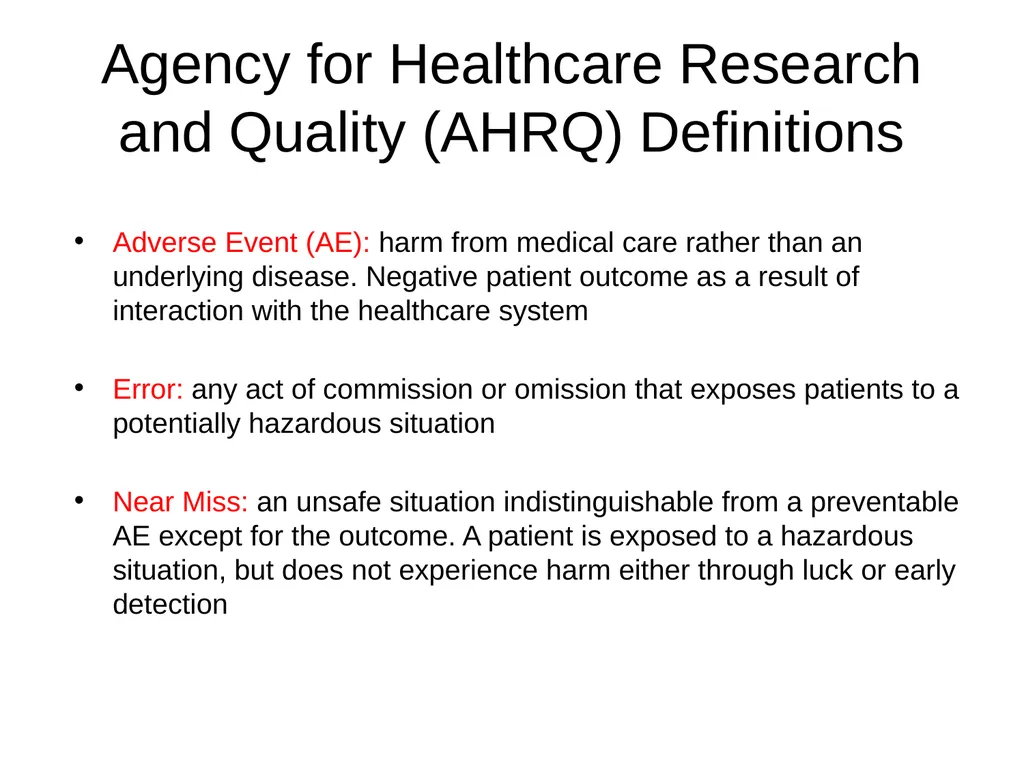
slide18. Agency for Healthcare Research and Quality (AHRQ) Definitions Adverse Event (AE): harm from medical care rather than an underlying disease. Negative patient outcome as a result of interaction with the healthcare system
Error: any act of commission or omission that exposes patients to a potentially hazardous situation
Near Miss: an unsafe situation indistinguishable from a preventable AE except for the outcome. A patient is exposed to a hazardous situation, but does not experience harm either through luck or early detection<br>
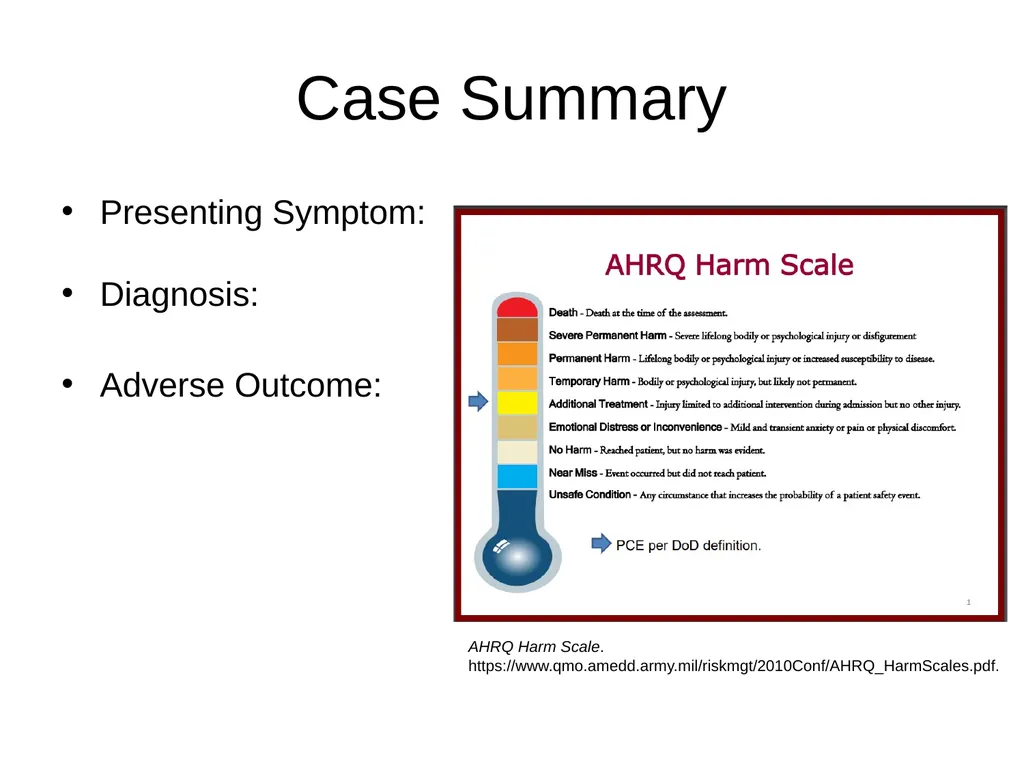
slide19. Case Summary Presenting Symptom:
Diagnosis:
Adverse Outcome: AHRQ Harm Scale. https://www.qmo.amedd.army.mil/riskmgt/2010Conf/AHRQ_HarmScales.pdf.<br>
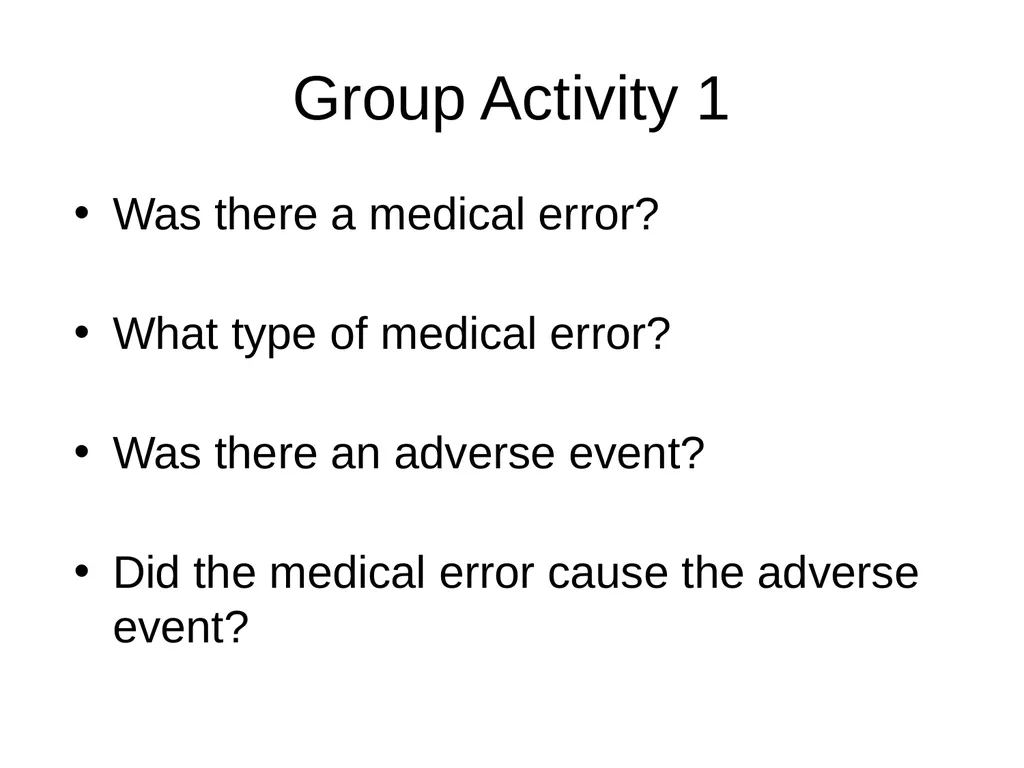
slide20. Group Activity 1 Was there a medical error?
What type of medical error?
Was there an adverse event?
Did the medical error cause the adverse event?<br>
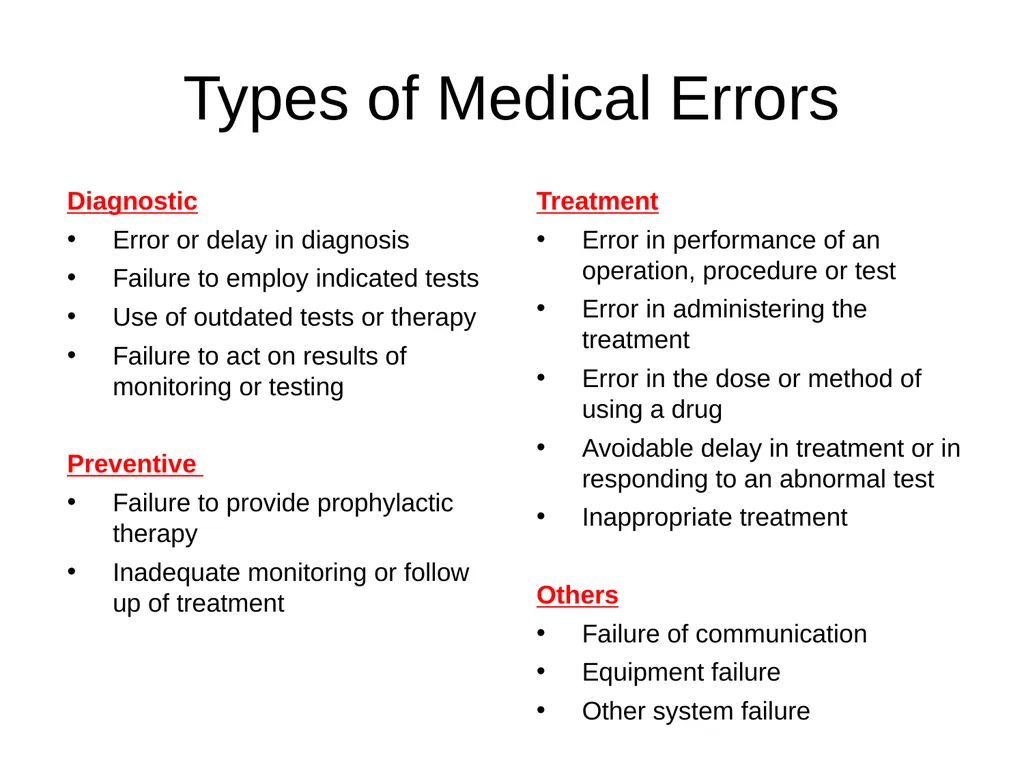
slide21. Types of Medical Errors Diagnostic
Error or delay in diagnosis
Failure to employ indicated tests
Use of outdated tests or therapy
Failure to act on results of monitoring or testing
Preventive
Failure to provide prophylactic therapy
Inadequate monitoring or follow up of treatment Treatment
Error in performance of an operation, procedure or test
Error in administering the treatment
Error in the dose or method of using a drug
Avoidable delay in treatment or in responding to an abnormal test
Inappropriate treatment
Others
Failure of communication
Equipment failure
Other system failure<br>
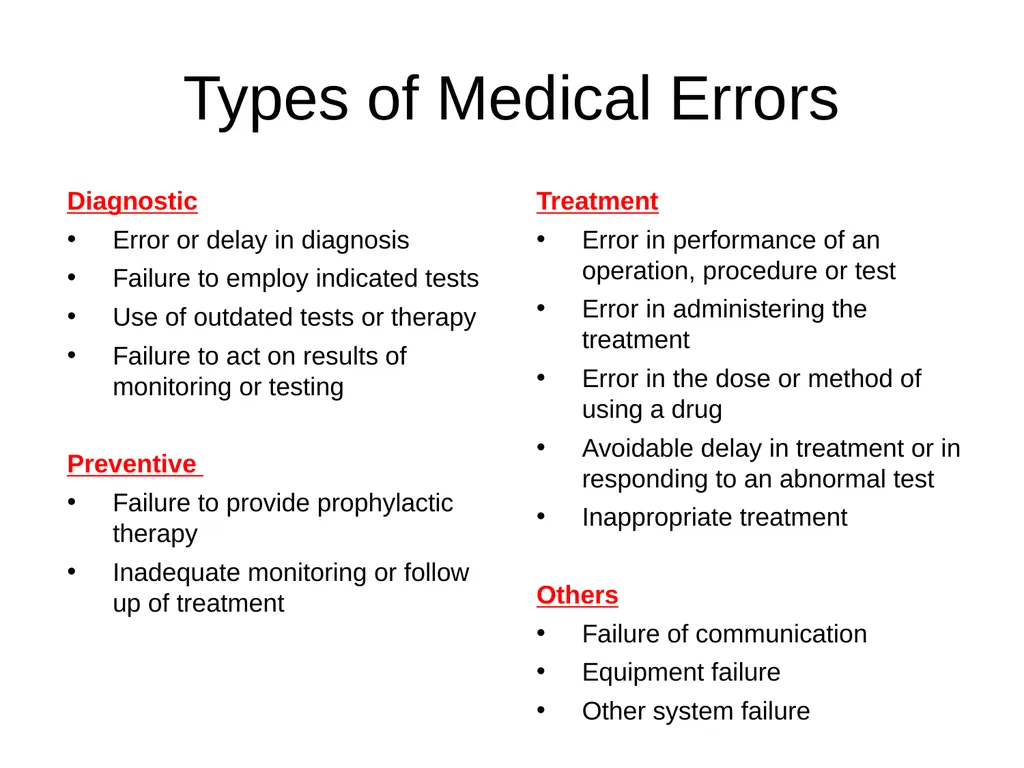
slide22. Types of Medical Errors Diagnostic
Error or delay in diagnosis
Failure to employ indicated tests
Use of outdated tests or therapy
Failure to act on results of monitoring or testing
Preventive
Failure to provide prophylactic therapy
Inadequate monitoring or follow up of treatment Treatment
Error in performance of an operation, procedure or test
Error in administering the treatment
Error in the dose or method of using a drug
Avoidable delay in treatment or in responding to an abnormal test
Inappropriate treatment
Others
Failure of communication
Equipment failure
Other system failure<br>
slide23. Group Activity 2 (Decision Heuristics or Cognitive Biases) Moderator<br>
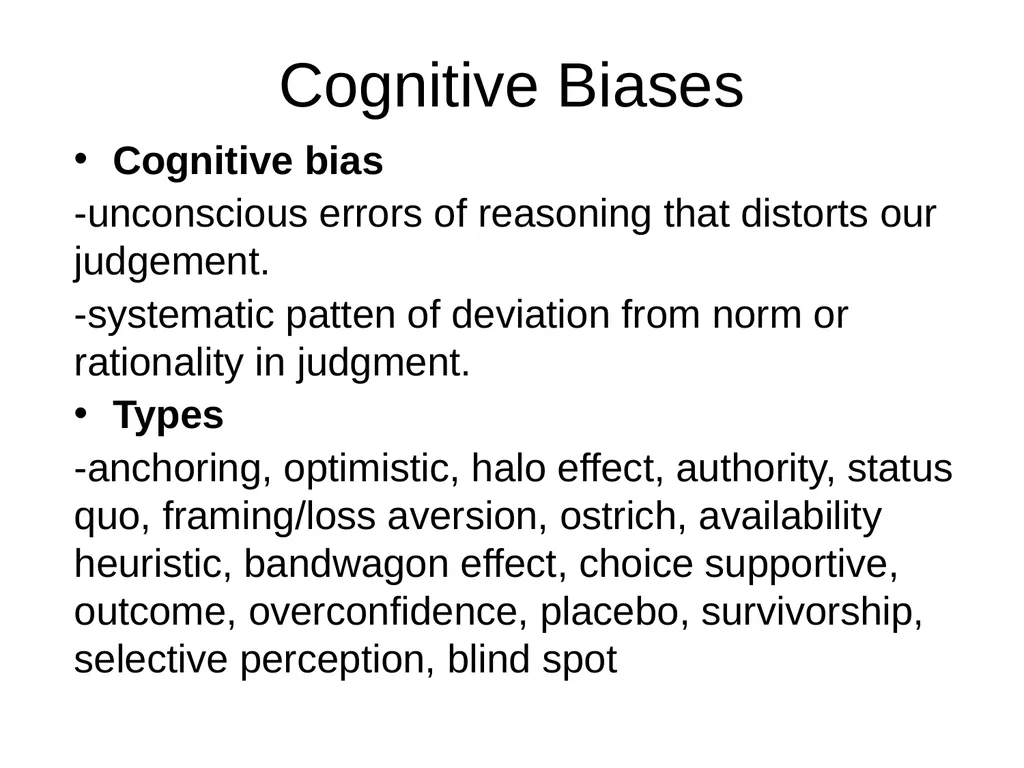
slide24. Cognitive Biases Cognitive bias
-unconscious errors of reasoning that distorts our judgement.
-systematic patten of deviation from norm or rationality in judgment.
Types
-anchoring, optimistic, halo effect, authority, status quo, framing/loss aversion, ostrich, availability heuristic, bandwagon effect, choice supportive, outcome, overconfidence, placebo, survivorship, selective perception, blind spot<br>
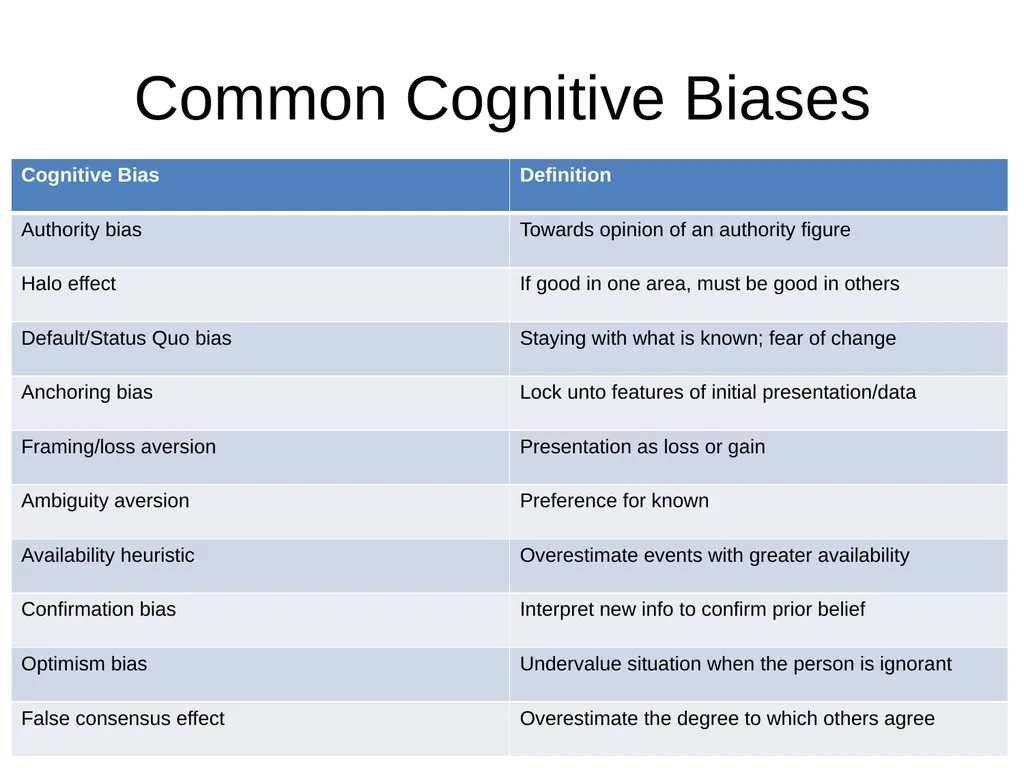
slide25. Common Cognitive Biases<br>
slide26. Group Activity 3 Root Cause Analysis (RCA) Moderator<br>
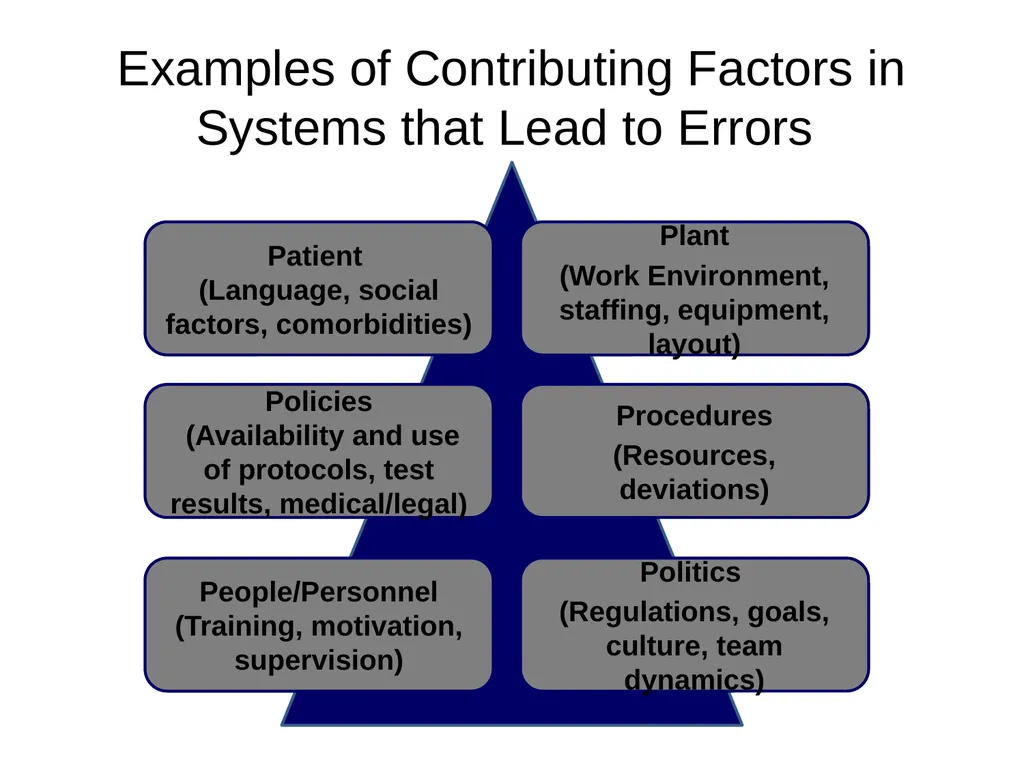
slide27. Examples of Contributing Factors in Systems that Lead to Errors Patient
(Language, social factors, comorbidities) Policies
(Availability and use of protocols, test results, medical/legal) People/Personnel
(Training, motivation, supervision) Plant
(Work Environment, staffing, equipment, layout) Procedures
(Resources, deviations) Politics
(Regulations, goals, culture, team dynamics)<br>
slide28. Fishbone Diagram<br>
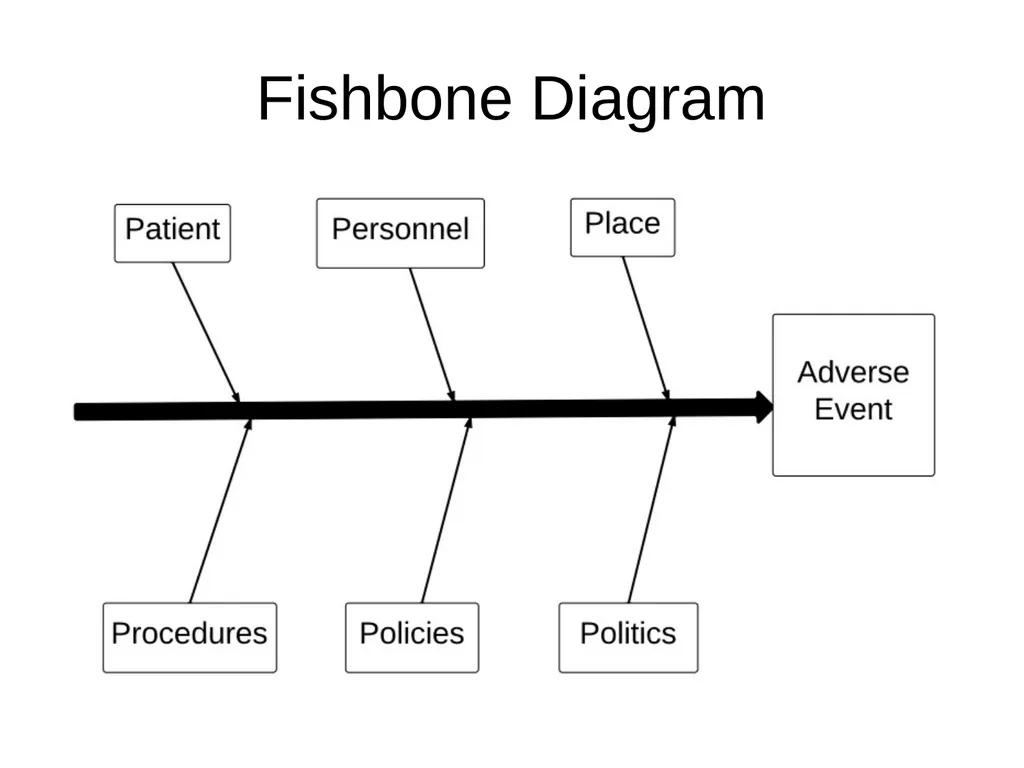
slide29. Fishbone Diagram<br>
slide30. Group Activity 4 Apply ACGME competencies to the problems identified<br>
slide31. Literature Review Trainee<br>
slide32. Group Activity 5 Action Plan How do we prevent this from happening again?
Moderator<br>
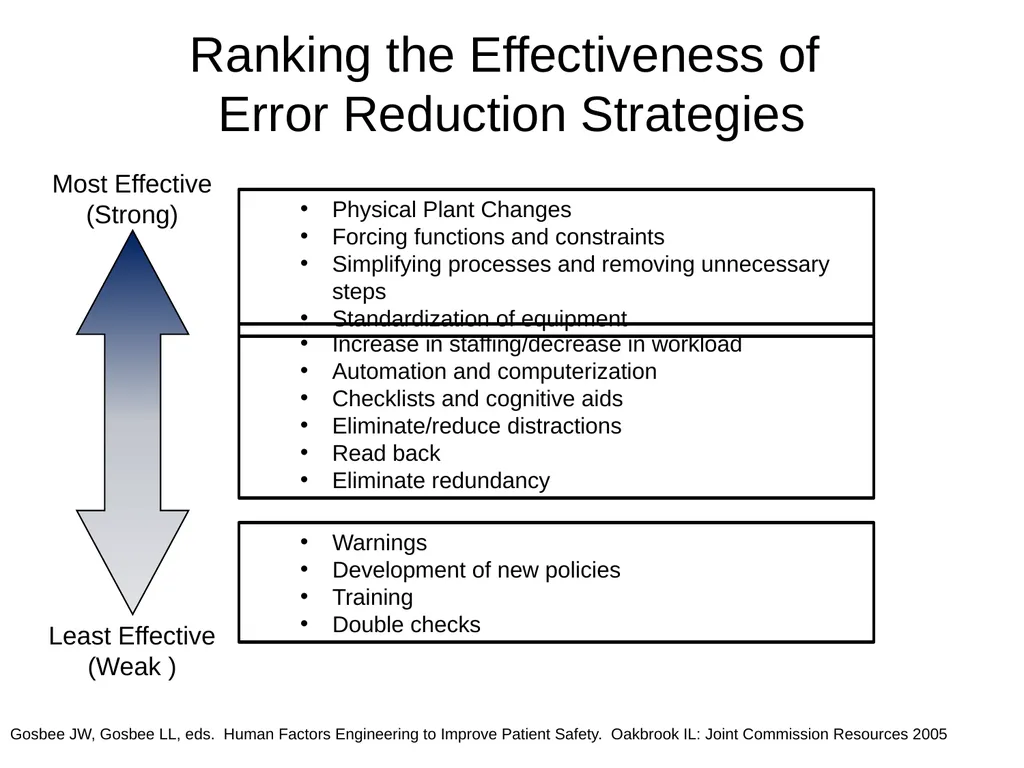
slide33. Ranking the Effectiveness of Error Reduction Strategies Gosbee JW, Gosbee LL, eds. Human Factors Engineering to Improve Patient Safety. Oakbrook IL: Joint Commission Resources 2005 Most Effective (Strong) Least Effective (Weak ) Physical Plant Changes
Forcing functions and constraints
Simplifying processes and removing unnecessary steps
Standardization of equipment Increase in staffing/decrease in workload
Automation and computerization
Checklists and cognitive aids
Eliminate/reduce distractions
Read back
Eliminate redundancy Warnings
Development of new policies
Training
Double checks<br>
slide34. Take Home Points<br>
slide35. References<br>
slide36. Thank You! Questions?<br>
slide2. Morbidity & Mortality Conference Thursday, May 9, 2024 Moderator: Adewale Ajumobi, MD, MBA, FACP, FACG, AGAF, FASGE
Presenters: Nicholas Newell, MD
Learning Objectives:
Analyze the relationship of error to poor medical outcomes at an individual, team, and organizational level
Explore the potential cases of errors
Develop and implement strategies to avoid preventable errors in the future
Accreditation and Certification:
In support of improving patient care, Annenberg Center for Health Sciences at Eisenhower is jointly accredited by the Accreditation Council for Continuing Medical Education (ACCME), the Accreditation Council for Pharmacy Education (ACPE), and the American Nurses Credentialing Center (ANCC), to provide continuing education for the healthcare team.
Physicians The Annenberg Center for Health Sciences at Eisenhower designates this live activity for a maximum of 1.0 AMA PRA Category 1 Credit™. Physicians should claim only the credit commensurate with the extent of their participation in the activity. Disclosure:
It is the policy of the Annenberg Center to ensure fair balance, independence, objectivity, and scientific rigor in all programming. All faculty participating in accredited programs are expected to identify and reference off-label product use and disclose any relevant financial relationship.<br>
slide3. Objectives Understand medical errors, adverse events and harm
List and understand the different types of cognitive errors
Create a root cause analysis using a modified fishbone diagram
Apply ACGME competencies to the problems identified
Create an action plan based on the root cause analysis and discussion of the adverse events<br>
slide4. Reminders All information discussed is confidential
Patient identifiers have been removed
Medical staff involved in the case will not be identified
Focus on systems issues rather than individual actions
Goal is to prevent future adverse events, not to assign blame<br>
slide5. Incident (Error) Reporting Phone: R-I-S-K (#7475)
Ikenet: web services >>>Incident reporting>>> RLDatix Incident Reporting form.
EPIC interface:<br>
slide6. DSAFD Remarks<br>
slide7. Case Presentation Trainee<br>
slide8. Presentation Chief Complaint History of Present Illness<br>
slide9. Past Medical History<br>
slide10. Social History Home Medication<br>
slide11. Physical Exam Vitals:
General:
HEENT:
Neck:
Pulmonary:
Circulatory:
Abdominal:
Neurologic:
Musculoskeletal:
Skin:<br>
slide12. Labs<br>
slide13. Hospital Course<br>
slide14. Timeline ED for CC Weakness and palpitations. and Last Dialysis 2 days prior Bradycardia
HR 44 01/07
1551 01/07
1651 Junctional Rhythm,
Labs show troponin.
Hyperkalemia K = - 6.5mmol/L,
Metabolic Acidosis HCO3 = 18.4mmol/L, Anion Gap = 20
Elevated Troponin 0.076ng/mL Hyperkalemia managed temporarily in ED and PCP notified 01/07
1820-1840 01/07
2130-2337 Patient arrives to floor.
Repeat labs show hyperkalemia - K= 6.3 and acidosis
HCO3 = 21.
Consult placed in to nephrology. 01/08
0035-0130 Rapid Response called.
Hypotension bradycardia. Given atropine, temp measures for hyperkalemia. Transfer to ICU. 01/08
0100-0200 Nephrology and critical care consulted. Seen bedside by all nephrology. Planned for dialysis. 01/08
0200-0230 Worsening bradycardia, with EKG concerning for STEMI. Cardiology consulted, possible cath.
Calcium gluconate and atropine adminstered. 01/08
0252 Cardiac arrest.
Code Blue called. 01/08
0323 Patient pronounced dead<br>
slide15. What Happened?<br>
slide16. Problems Identified<br>
slide17. Group Activity 1 Medical Errors Moderator<br>
slide18. Agency for Healthcare Research and Quality (AHRQ) Definitions Adverse Event (AE): harm from medical care rather than an underlying disease. Negative patient outcome as a result of interaction with the healthcare system
Error: any act of commission or omission that exposes patients to a potentially hazardous situation
Near Miss: an unsafe situation indistinguishable from a preventable AE except for the outcome. A patient is exposed to a hazardous situation, but does not experience harm either through luck or early detection<br>
slide19. Case Summary Presenting Symptom:
Diagnosis:
Adverse Outcome: AHRQ Harm Scale. https://www.qmo.amedd.army.mil/riskmgt/2010Conf/AHRQ_HarmScales.pdf.<br>
slide20. Group Activity 1 Was there a medical error?
What type of medical error?
Was there an adverse event?
Did the medical error cause the adverse event?<br>
slide21. Types of Medical Errors Diagnostic
Error or delay in diagnosis
Failure to employ indicated tests
Use of outdated tests or therapy
Failure to act on results of monitoring or testing
Preventive
Failure to provide prophylactic therapy
Inadequate monitoring or follow up of treatment Treatment
Error in performance of an operation, procedure or test
Error in administering the treatment
Error in the dose or method of using a drug
Avoidable delay in treatment or in responding to an abnormal test
Inappropriate treatment
Others
Failure of communication
Equipment failure
Other system failure<br>
slide22. Types of Medical Errors Diagnostic
Error or delay in diagnosis
Failure to employ indicated tests
Use of outdated tests or therapy
Failure to act on results of monitoring or testing
Preventive
Failure to provide prophylactic therapy
Inadequate monitoring or follow up of treatment Treatment
Error in performance of an operation, procedure or test
Error in administering the treatment
Error in the dose or method of using a drug
Avoidable delay in treatment or in responding to an abnormal test
Inappropriate treatment
Others
Failure of communication
Equipment failure
Other system failure<br>
slide23. Group Activity 2 (Decision Heuristics or Cognitive Biases) Moderator<br>
slide24. Cognitive Biases Cognitive bias
-unconscious errors of reasoning that distorts our judgement.
-systematic patten of deviation from norm or rationality in judgment.
Types
-anchoring, optimistic, halo effect, authority, status quo, framing/loss aversion, ostrich, availability heuristic, bandwagon effect, choice supportive, outcome, overconfidence, placebo, survivorship, selective perception, blind spot<br>
slide25. Common Cognitive Biases<br>
slide26. Group Activity 3 Root Cause Analysis (RCA) Moderator<br>
slide27. Examples of Contributing Factors in Systems that Lead to Errors Patient
(Language, social factors, comorbidities) Policies
(Availability and use of protocols, test results, medical/legal) People/Personnel
(Training, motivation, supervision) Plant
(Work Environment, staffing, equipment, layout) Procedures
(Resources, deviations) Politics
(Regulations, goals, culture, team dynamics)<br>
slide28. Fishbone Diagram<br>
slide29. Fishbone Diagram<br>
slide30. Group Activity 4 Apply ACGME competencies to the problems identified<br>
slide31. Literature Review Trainee<br>
slide32. Group Activity 5 Action Plan How do we prevent this from happening again?
Moderator<br>
slide33. Ranking the Effectiveness of Error Reduction Strategies Gosbee JW, Gosbee LL, eds. Human Factors Engineering to Improve Patient Safety. Oakbrook IL: Joint Commission Resources 2005 Most Effective (Strong) Least Effective (Weak ) Physical Plant Changes
Forcing functions and constraints
Simplifying processes and removing unnecessary steps
Standardization of equipment Increase in staffing/decrease in workload
Automation and computerization
Checklists and cognitive aids
Eliminate/reduce distractions
Read back
Eliminate redundancy Warnings
Development of new policies
Training
Double checks<br>
slide34. Take Home Points<br>
slide35. References<br>
slide36. Thank You! Questions?<br>