
INTEREST RATES AND BOND VALUATION CHAPTER 7
DP
Published · 55 slides · 0 views
1 / 1
















Description
INTEREST RATES AND BOND VALUATION CHAPTER 7 Copyright 2023 McGraw-Hill Education. All rights reserved. No reproduction or distribution without the prior written consent of McGraw-Hill Education. Define important bond features and types of
Related Topics
Share
Embed code
Download this presentation From Below
"INTEREST RATES AND BOND VALUATION CHAPTER 7" is the property of its rightful owner. Permission is granted to download and print the materials on this website for personal, non-commercial use only, and to display it on your personal computer provided you do not modify the materials and that you retain all copyright notices contained in the materials. By downloading content from our website, you accept the terms of this agreement.
Presentation Transcript
01
INTEREST RATES AND BOND VALUATION CHAPTER 7 Copyright © 2023 McGraw-Hill Education. All rights reserved. No reproduction or distribution without the prior written consent of McGraw-Hill Education.<br>
02
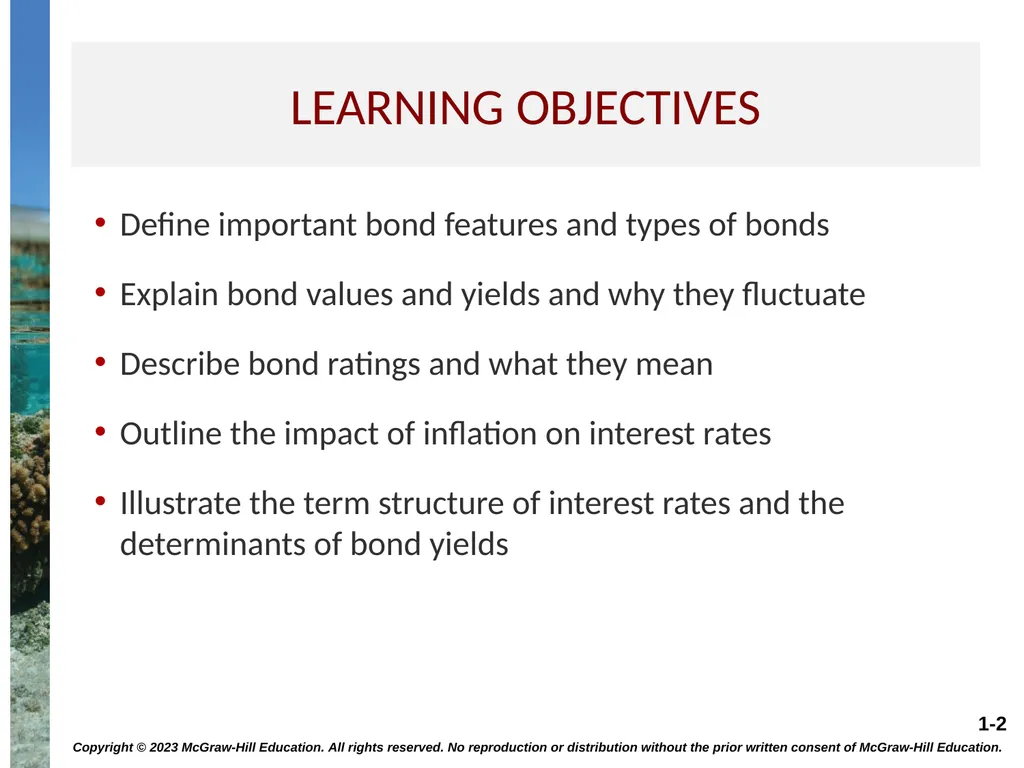
Define important bond features and types of bonds
Explain bond values and yields and why they fluctuate
Describe bond ratings and what they mean
Outline the impact of inflation on interest rates
Illustrate the term structure of interest rates and the determinants of bond yields Copyright © 2023 McGraw-Hill Education. All rights reserved. No reproduction or distribution without the prior written consent of McGraw-Hill Education. Learning objectives<br>
Explain bond values and yields and why they fluctuate
Describe bond ratings and what they mean
Outline the impact of inflation on interest rates
Illustrate the term structure of interest rates and the determinants of bond yields Copyright © 2023 McGraw-Hill Education. All rights reserved. No reproduction or distribution without the prior written consent of McGraw-Hill Education. Learning objectives<br>
03
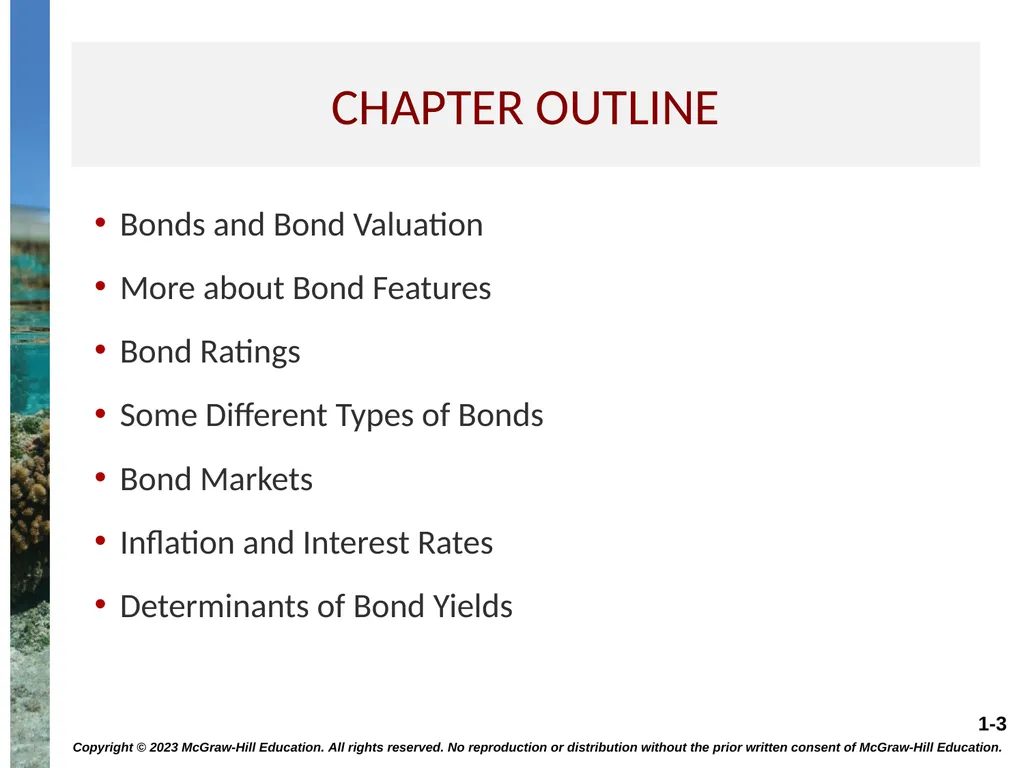
Bonds and Bond Valuation
More about Bond Features
Bond Ratings
Some Different Types of Bonds
Bond Markets
Inflation and Interest Rates
Determinants of Bond Yields Copyright © 2023 McGraw-Hill Education. All rights reserved. No reproduction or distribution without the prior written consent of McGraw-Hill Education. Chapter Outline<br>
More about Bond Features
Bond Ratings
Some Different Types of Bonds
Bond Markets
Inflation and Interest Rates
Determinants of Bond Yields Copyright © 2023 McGraw-Hill Education. All rights reserved. No reproduction or distribution without the prior written consent of McGraw-Hill Education. Chapter Outline<br>
04
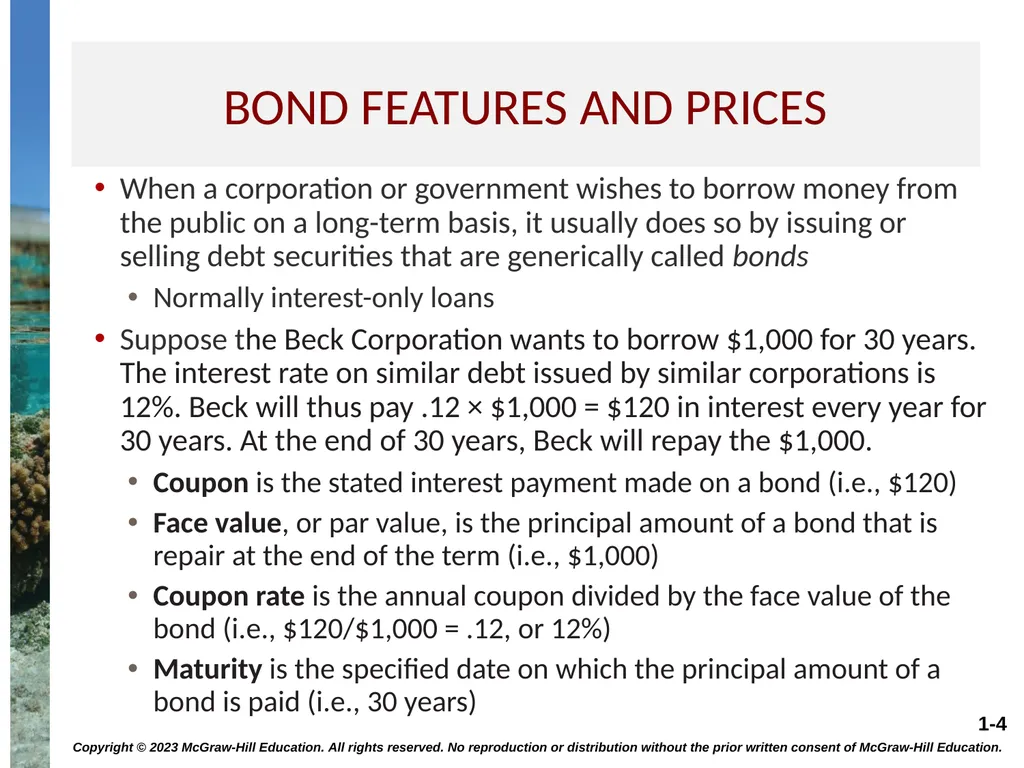
When a corporation or government wishes to borrow money from the public on a long-term basis, it usually does so by issuing or selling debt securities that are generically called bonds
Normally interest-only loans
Suppose the Beck Corporation wants to borrow $1,000 for 30 years. The interest rate on similar debt issued by similar corporations is 12%. Beck will thus pay .12 × $1,000 = $120 in interest every year for 30 years. At the end of 30 years, Beck will repay the $1,000.
Coupon is the stated interest payment made on a bond (i.e., $120)
Face value, or par value, is the principal amount of a bond that is repair at the end of the term (i.e., $1,000)
Coupon rate is the annual coupon divided by the face value of the bond (i.e., $120/$1,000 = .12, or 12%)
Maturity is the specified date on which the principal amount of a bond is paid (i.e., 30 years) Copyright © 2023 McGraw-Hill Education. All rights reserved. No reproduction or distribution without the prior written consent of McGraw-Hill Education. Bond features and prices<br>
Normally interest-only loans
Suppose the Beck Corporation wants to borrow $1,000 for 30 years. The interest rate on similar debt issued by similar corporations is 12%. Beck will thus pay .12 × $1,000 = $120 in interest every year for 30 years. At the end of 30 years, Beck will repay the $1,000.
Coupon is the stated interest payment made on a bond (i.e., $120)
Face value, or par value, is the principal amount of a bond that is repair at the end of the term (i.e., $1,000)
Coupon rate is the annual coupon divided by the face value of the bond (i.e., $120/$1,000 = .12, or 12%)
Maturity is the specified date on which the principal amount of a bond is paid (i.e., 30 years) Copyright © 2023 McGraw-Hill Education. All rights reserved. No reproduction or distribution without the prior written consent of McGraw-Hill Education. Bond features and prices<br>
05
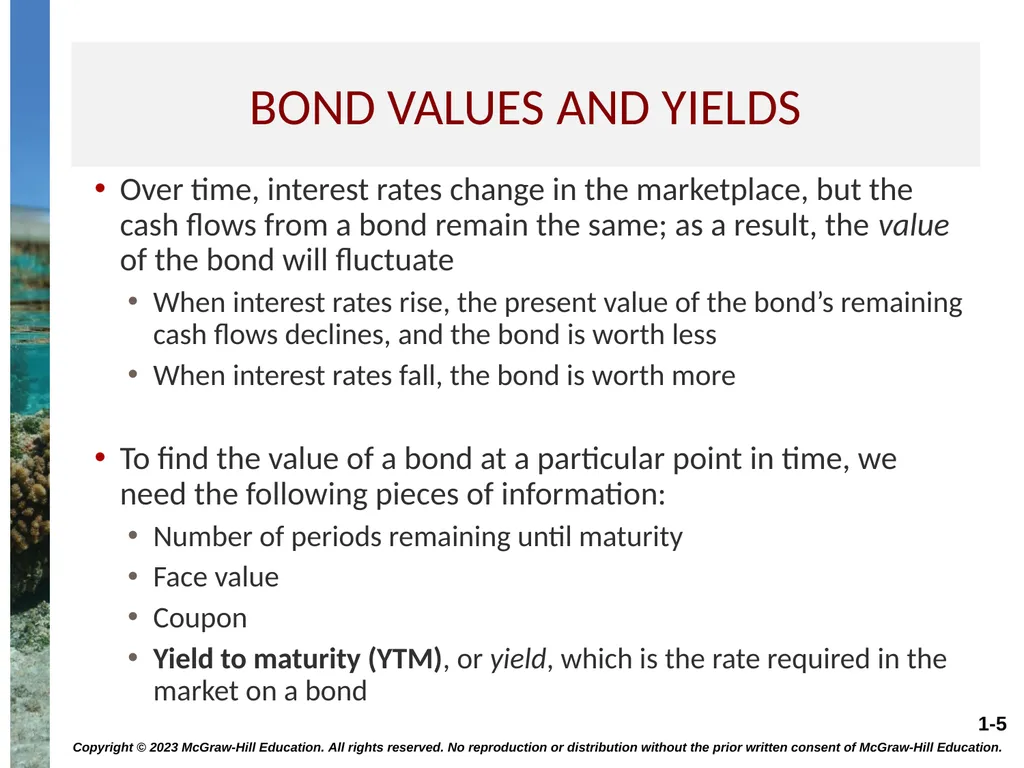
Over time, interest rates change in the marketplace, but the cash flows from a bond remain the same; as a result, the value of the bond will fluctuate
When interest rates rise, the present value of the bond’s remaining cash flows declines, and the bond is worth less
When interest rates fall, the bond is worth more
To find the value of a bond at a particular point in time, we need the following pieces of information:
Number of periods remaining until maturity
Face value
Coupon
Yield to maturity (YTM), or yield, which is the rate required in the market on a bond Copyright © 2023 McGraw-Hill Education. All rights reserved. No reproduction or distribution without the prior written consent of McGraw-Hill Education. Bond values and yields<br>
When interest rates rise, the present value of the bond’s remaining cash flows declines, and the bond is worth less
When interest rates fall, the bond is worth more
To find the value of a bond at a particular point in time, we need the following pieces of information:
Number of periods remaining until maturity
Face value
Coupon
Yield to maturity (YTM), or yield, which is the rate required in the market on a bond Copyright © 2023 McGraw-Hill Education. All rights reserved. No reproduction or distribution without the prior written consent of McGraw-Hill Education. Bond values and yields<br>
06
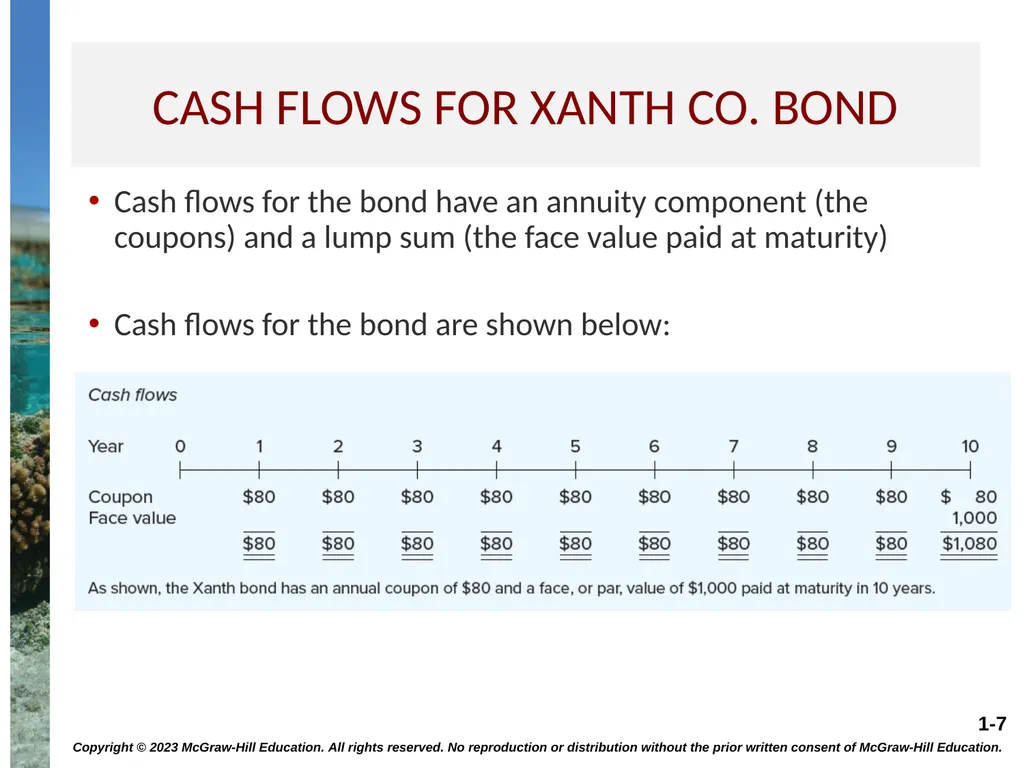
Suppose Xanth Co. were to issue a bond with 10 years to maturity. The Xanth bond has an annual coupon of $80. Similar bonds have a yield to maturity of 8 percent. What would this bond sell for?
Bond will pay $80 per year for the next 10 years in coupon interest. In 10 years, Xanth will pay $1,000 to the bond owner.
At the going rate of 8%, the PV of the $1,000 paid in 10 years is:
Present value = $1,000/1.0810 = $1,000/2.1589 = $463.19
Bond offers $80 per year for 10 years; PV of this annuity stream is:
Annuity present value = $80 × (1 − 1/1.0810) /.08
= $80 × (1 − 1/2.1589) /.08
= $80 × 6.7101
= $536.81
Add the values for the two parts together to get the bond’s value:
Total bond value = $463.19 + 536.81 = $1,000
This bond sells for exactly the face value, so it is a par value bond Copyright © 2023 McGraw-Hill Education. All rights reserved. No reproduction or distribution without the prior written consent of McGraw-Hill Education. Bond values and yields: an example (par value bond)<br>
Bond will pay $80 per year for the next 10 years in coupon interest. In 10 years, Xanth will pay $1,000 to the bond owner.
At the going rate of 8%, the PV of the $1,000 paid in 10 years is:
Present value = $1,000/1.0810 = $1,000/2.1589 = $463.19
Bond offers $80 per year for 10 years; PV of this annuity stream is:
Annuity present value = $80 × (1 − 1/1.0810) /.08
= $80 × (1 − 1/2.1589) /.08
= $80 × 6.7101
= $536.81
Add the values for the two parts together to get the bond’s value:
Total bond value = $463.19 + 536.81 = $1,000
This bond sells for exactly the face value, so it is a par value bond Copyright © 2023 McGraw-Hill Education. All rights reserved. No reproduction or distribution without the prior written consent of McGraw-Hill Education. Bond values and yields: an example (par value bond)<br>
07
Cash flows for the bond have an annuity component (the coupons) and a lump sum (the face value paid at maturity)
Cash flows for the bond are shown below: Copyright © 2023 McGraw-Hill Education. All rights reserved. No reproduction or distribution without the prior written consent of McGraw-Hill Education. Cash flows for xanth co. bond<br>
Cash flows for the bond are shown below: Copyright © 2023 McGraw-Hill Education. All rights reserved. No reproduction or distribution without the prior written consent of McGraw-Hill Education. Cash flows for xanth co. bond<br>
08
Suppose a year has gone by. The Xanth bond now has nine years to maturity. If the interest rate in the market has risen to 10%, what will the bond be worth?
Present value of the $1,000 paid in nine years at 10 percent is:
Present value = $1,000/1.109 = $1,000/2.3579 = $424.10
Bond now offers $80 per year for nine years; the present value of this annuity stream at 10% is:
Annuity present value = $80 × (1 − 1/1.109) /.10
= $80 × (1 − 1/2.3579) /.10
= $80 × 5.7590
= $460.72
Add the values for the two parts together to get the bond’s value:
Total bond value = $424.10 + 460.72 = $884.82
This bond sells for less than face value, so it is a discount bond Copyright © 2023 McGraw-Hill Education. All rights reserved. No reproduction or distribution without the prior written consent of McGraw-Hill Education. Bond values and yields: an example (discount bond)<br>
Present value of the $1,000 paid in nine years at 10 percent is:
Present value = $1,000/1.109 = $1,000/2.3579 = $424.10
Bond now offers $80 per year for nine years; the present value of this annuity stream at 10% is:
Annuity present value = $80 × (1 − 1/1.109) /.10
= $80 × (1 − 1/2.3579) /.10
= $80 × 5.7590
= $460.72
Add the values for the two parts together to get the bond’s value:
Total bond value = $424.10 + 460.72 = $884.82
This bond sells for less than face value, so it is a discount bond Copyright © 2023 McGraw-Hill Education. All rights reserved. No reproduction or distribution without the prior written consent of McGraw-Hill Education. Bond values and yields: an example (discount bond)<br>
09
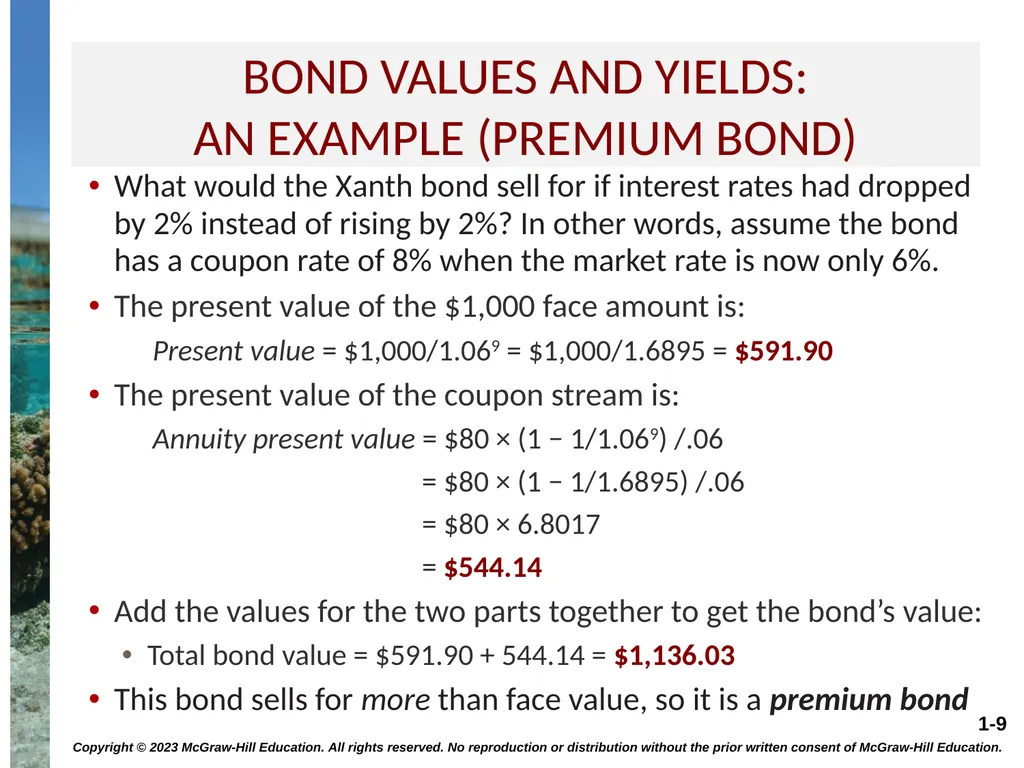
What would the Xanth bond sell for if interest rates had dropped by 2% instead of rising by 2%? In other words, assume the bond has a coupon rate of 8% when the market rate is now only 6%.
The present value of the $1,000 face amount is:
Present value = $1,000/1.069 = $1,000/1.6895 = $591.90
The present value of the coupon stream is:
Annuity present value = $80 × (1 − 1/1.069) /.06
= $80 × (1 − 1/1.6895) /.06
= $80 × 6.8017
= $544.14
Add the values for the two parts together to get the bond’s value:
Total bond value = $591.90 + 544.14 = $1,136.03
This bond sells for more than face value, so it is a premium bond Copyright © 2023 McGraw-Hill Education. All rights reserved. No reproduction or distribution without the prior written consent of McGraw-Hill Education. Bond values and yields: an example (premium bond)<br>
The present value of the $1,000 face amount is:
Present value = $1,000/1.069 = $1,000/1.6895 = $591.90
The present value of the coupon stream is:
Annuity present value = $80 × (1 − 1/1.069) /.06
= $80 × (1 − 1/1.6895) /.06
= $80 × 6.8017
= $544.14
Add the values for the two parts together to get the bond’s value:
Total bond value = $591.90 + 544.14 = $1,136.03
This bond sells for more than face value, so it is a premium bond Copyright © 2023 McGraw-Hill Education. All rights reserved. No reproduction or distribution without the prior written consent of McGraw-Hill Education. Bond values and yields: an example (premium bond)<br>
10
If a bond has the following:
A face value of F paid at maturity;
A coupon of C paid per period;
t periods to maturity; and
A yield of r per period
Its value is calculated as follows: Copyright © 2023 McGraw-Hill Education. All rights reserved. No reproduction or distribution without the prior written consent of McGraw-Hill Education. General expression for value of a bond<br>
A face value of F paid at maturity;
A coupon of C paid per period;
t periods to maturity; and
A yield of r per period
Its value is calculated as follows: Copyright © 2023 McGraw-Hill Education. All rights reserved. No reproduction or distribution without the prior written consent of McGraw-Hill Education. General expression for value of a bond<br>
11
Copyright © 2023 McGraw-Hill Education. All rights reserved. No reproduction or distribution without the prior written consent of McGraw-Hill Education. Semiannual coupons<br>
12
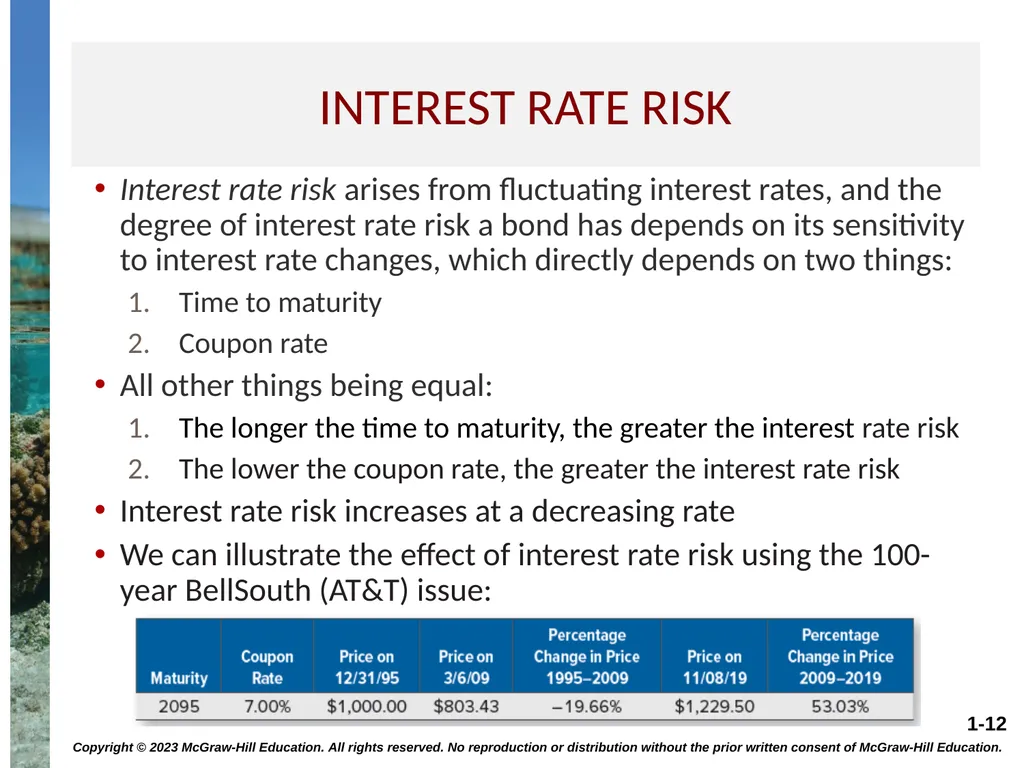
Interest rate risk arises from fluctuating interest rates, and the degree of interest rate risk a bond has depends on its sensitivity to interest rate changes, which directly depends on two things:
Time to maturity
Coupon rate
All other things being equal:
The longer the time to maturity, the greater the interest rate risk
The lower the coupon rate, the greater the interest rate risk
Interest rate risk increases at a decreasing rate
We can illustrate the effect of interest rate risk using the 100-year BellSouth (AT&T) issue: Copyright © 2023 McGraw-Hill Education. All rights reserved. No reproduction or distribution without the prior written consent of McGraw-Hill Education. Interest Rate Risk<br>
Time to maturity
Coupon rate
All other things being equal:
The longer the time to maturity, the greater the interest rate risk
The lower the coupon rate, the greater the interest rate risk
Interest rate risk increases at a decreasing rate
We can illustrate the effect of interest rate risk using the 100-year BellSouth (AT&T) issue: Copyright © 2023 McGraw-Hill Education. All rights reserved. No reproduction or distribution without the prior written consent of McGraw-Hill Education. Interest Rate Risk<br>
13
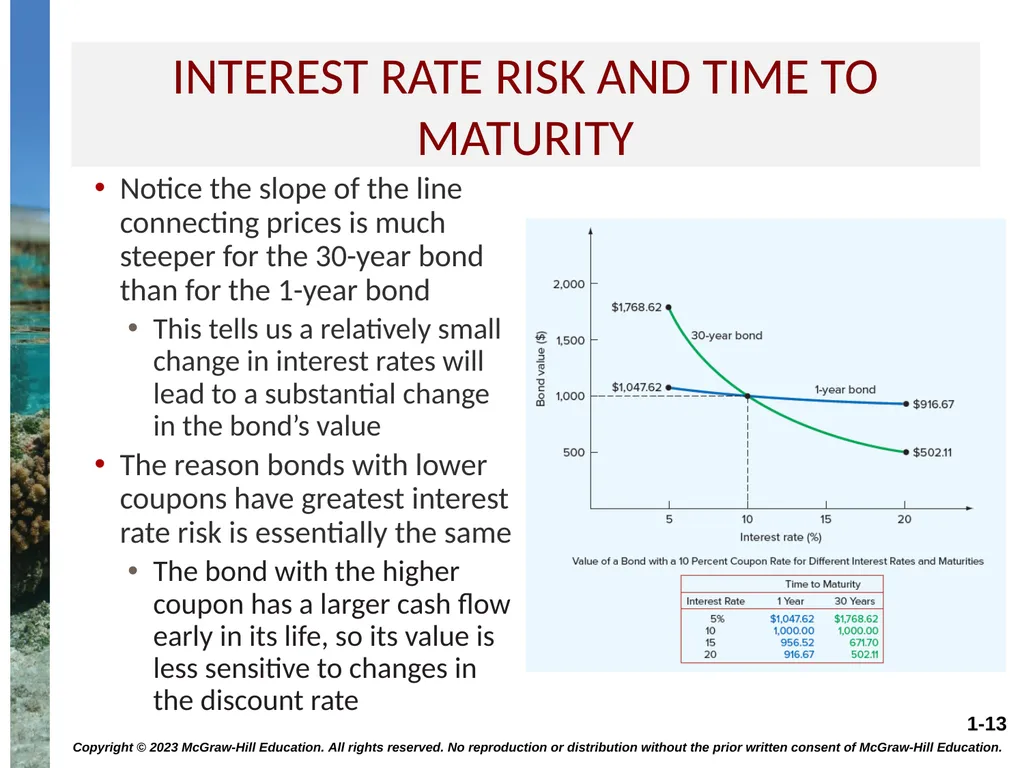
Notice the slope of the line connecting prices is much steeper for the 30-year bond than for the 1-year bond
This tells us a relatively small change in interest rates will lead to a substantial change in the bond’s value
The reason bonds with lower coupons have greatest interest rate risk is essentially the same
The bond with the higher coupon has a larger cash flow early in its life, so its value is less sensitive to changes in the discount rate Copyright © 2023 McGraw-Hill Education. All rights reserved. No reproduction or distribution without the prior written consent of McGraw-Hill Education. Interest rate risk and time to maturity<br>
This tells us a relatively small change in interest rates will lead to a substantial change in the bond’s value
The reason bonds with lower coupons have greatest interest rate risk is essentially the same
The bond with the higher coupon has a larger cash flow early in its life, so its value is less sensitive to changes in the discount rate Copyright © 2023 McGraw-Hill Education. All rights reserved. No reproduction or distribution without the prior written consent of McGraw-Hill Education. Interest rate risk and time to maturity<br>
14
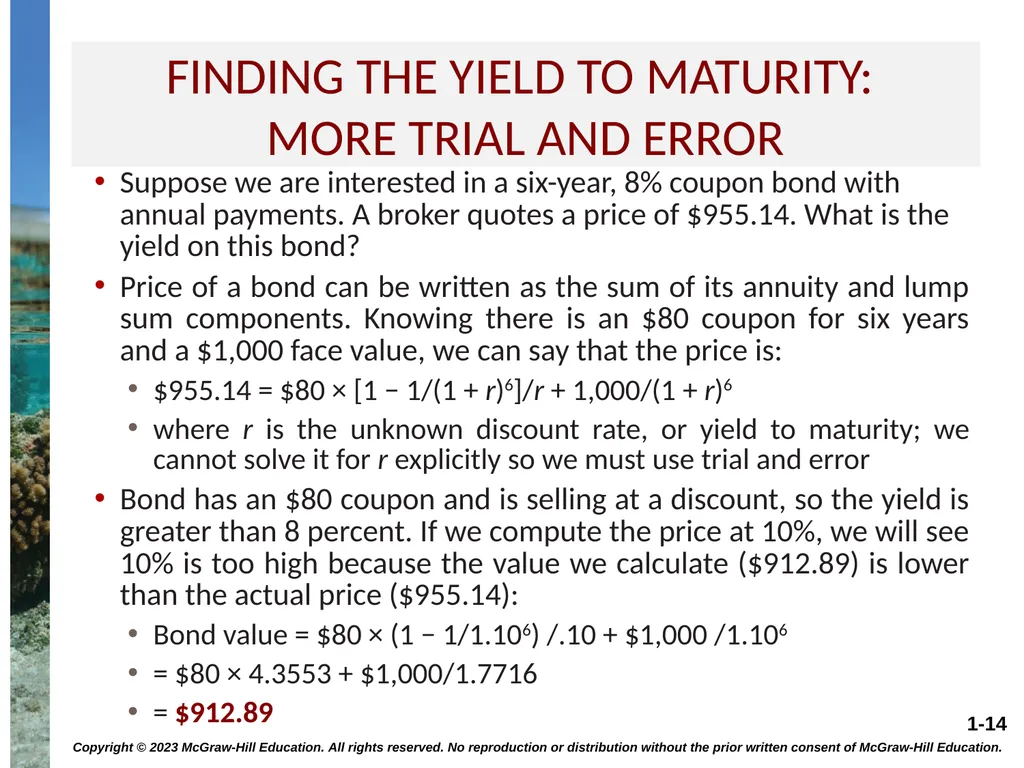
Suppose we are interested in a six-year, 8% coupon bond with annual payments. A broker quotes a price of $955.14. What is the yield on this bond?
Price of a bond can be written as the sum of its annuity and lump sum components. Knowing there is an $80 coupon for six years and a $1,000 face value, we can say that the price is:
$955.14 = $80 × [1 − 1/(1 + r)6]/r + 1,000/(1 + r)6
where r is the unknown discount rate, or yield to maturity; we cannot solve it for r explicitly so we must use trial and error
Bond has an $80 coupon and is selling at a discount, so the yield is greater than 8 percent. If we compute the price at 10%, we will see 10% is too high because the value we calculate ($912.89) is lower than the actual price ($955.14):
Bond value = $80 × (1 − 1/1.106) /.10 + $1,000 /1.106
= $80 × 4.3553 + $1,000/1.7716
= $912.89 Copyright © 2023 McGraw-Hill Education. All rights reserved. No reproduction or distribution without the prior written consent of McGraw-Hill Education. Finding the yield to maturity: more trial and error<br>
Price of a bond can be written as the sum of its annuity and lump sum components. Knowing there is an $80 coupon for six years and a $1,000 face value, we can say that the price is:
$955.14 = $80 × [1 − 1/(1 + r)6]/r + 1,000/(1 + r)6
where r is the unknown discount rate, or yield to maturity; we cannot solve it for r explicitly so we must use trial and error
Bond has an $80 coupon and is selling at a discount, so the yield is greater than 8 percent. If we compute the price at 10%, we will see 10% is too high because the value we calculate ($912.89) is lower than the actual price ($955.14):
Bond value = $80 × (1 − 1/1.106) /.10 + $1,000 /1.106
= $80 × 4.3553 + $1,000/1.7716
= $912.89 Copyright © 2023 McGraw-Hill Education. All rights reserved. No reproduction or distribution without the prior written consent of McGraw-Hill Education. Finding the yield to maturity: more trial and error<br>
15
A bond’s yield to maturity should not be confused with its current yield, which is the bond’s annual coupon divided by its price
In the example we just worked on the previous slide, the bond’s annual coupon was $80, and its price was $955.14
Current yield was $80/$955.14 = .0838, or 8.38 percent
Yield to maturity was 9 percent (found by trial and error) Copyright © 2023 McGraw-Hill Education. All rights reserved. No reproduction or distribution without the prior written consent of McGraw-Hill Education. Finding the yield to maturity: more trial and error (continued)<br>
In the example we just worked on the previous slide, the bond’s annual coupon was $80, and its price was $955.14
Current yield was $80/$955.14 = .0838, or 8.38 percent
Yield to maturity was 9 percent (found by trial and error) Copyright © 2023 McGraw-Hill Education. All rights reserved. No reproduction or distribution without the prior written consent of McGraw-Hill Education. Finding the yield to maturity: more trial and error (continued)<br>
16
Copyright © 2023 McGraw-Hill Education. All rights reserved. No reproduction or distribution without the prior written consent of McGraw-Hill Education. Summary of bond valuation<br>
17
Copyright © 2023 McGraw-Hill Education. All rights reserved. No reproduction or distribution without the prior written consent of McGraw-Hill Education. Current events<br>
18
Copyright © 2023 McGraw-Hill Education. All rights reserved. No reproduction or distribution without the prior written consent of McGraw-Hill Education. Bond yields<br>
19
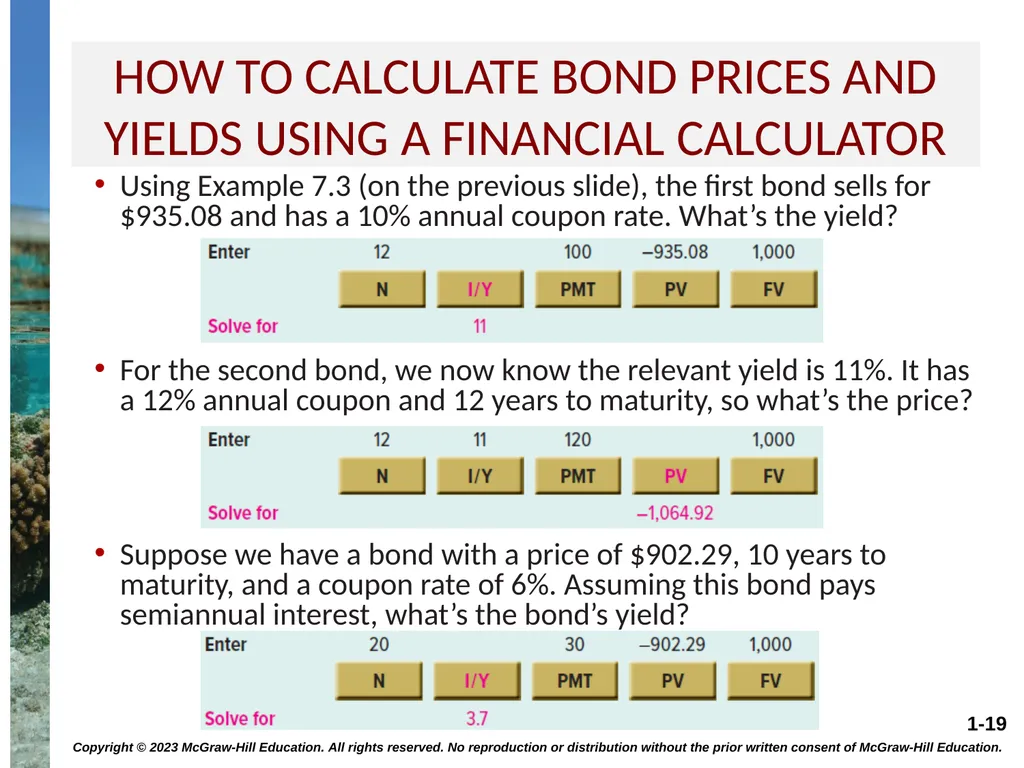
Using Example 7.3 (on the previous slide), the first bond sells for $935.08 and has a 10% annual coupon rate. What’s the yield?
For the second bond, we now know the relevant yield is 11%. It has a 12% annual coupon and 12 years to maturity, so what’s the price?
Suppose we have a bond with a price of $902.29, 10 years to maturity, and a coupon rate of 6%. Assuming this bond pays semiannual interest, what’s the bond’s yield? Copyright © 2023 McGraw-Hill Education. All rights reserved. No reproduction or distribution without the prior written consent of McGraw-Hill Education. How to calculate bond prices and yields using a financial calculator<br>
For the second bond, we now know the relevant yield is 11%. It has a 12% annual coupon and 12 years to maturity, so what’s the price?
Suppose we have a bond with a price of $902.29, 10 years to maturity, and a coupon rate of 6%. Assuming this bond pays semiannual interest, what’s the bond’s yield? Copyright © 2023 McGraw-Hill Education. All rights reserved. No reproduction or distribution without the prior written consent of McGraw-Hill Education. How to calculate bond prices and yields using a financial calculator<br>
20
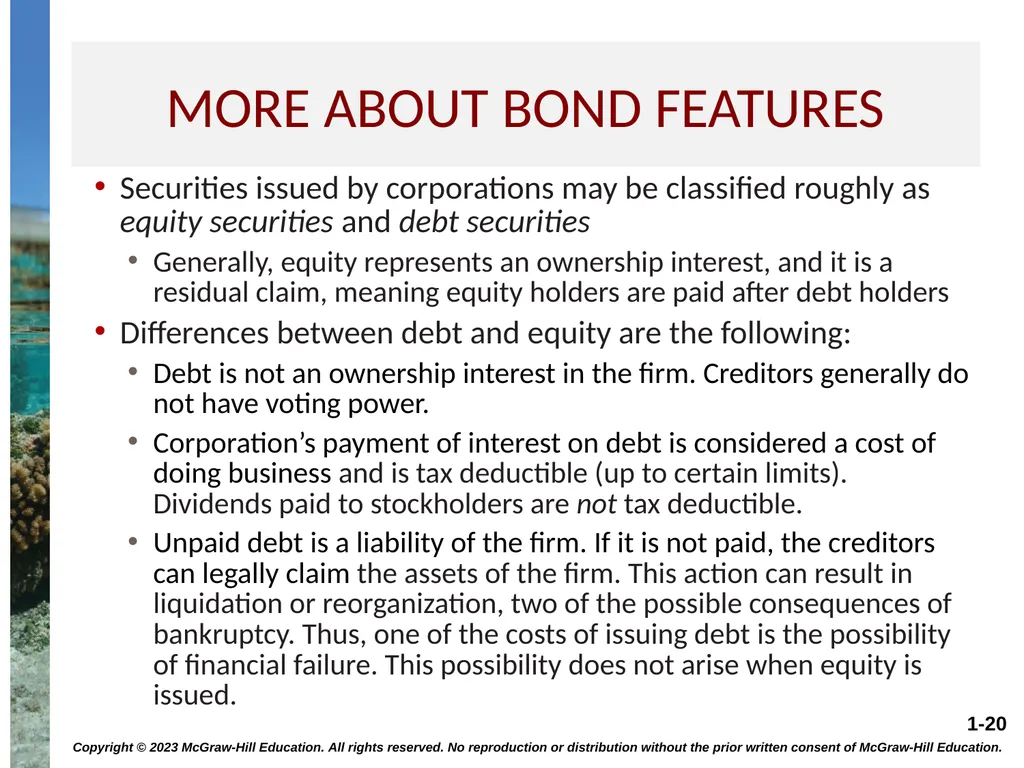
Securities issued by corporations may be classified roughly as equity securities and debt securities
Generally, equity represents an ownership interest, and it is a residual claim, meaning equity holders are paid after debt holders
Differences between debt and equity are the following:
Debt is not an ownership interest in the firm. Creditors generally do not have voting power.
Corporation’s payment of interest on debt is considered a cost of doing business and is tax deductible (up to certain limits). Dividends paid to stockholders are not tax deductible.
Unpaid debt is a liability of the firm. If it is not paid, the creditors can legally claim the assets of the firm. This action can result in liquidation or reorganization, two of the possible consequences of bankruptcy. Thus, one of the costs of issuing debt is the possibility of financial failure. This possibility does not arise when equity is issued. Copyright © 2023 McGraw-Hill Education. All rights reserved. No reproduction or distribution without the prior written consent of McGraw-Hill Education. More about bond features<br>
Generally, equity represents an ownership interest, and it is a residual claim, meaning equity holders are paid after debt holders
Differences between debt and equity are the following:
Debt is not an ownership interest in the firm. Creditors generally do not have voting power.
Corporation’s payment of interest on debt is considered a cost of doing business and is tax deductible (up to certain limits). Dividends paid to stockholders are not tax deductible.
Unpaid debt is a liability of the firm. If it is not paid, the creditors can legally claim the assets of the firm. This action can result in liquidation or reorganization, two of the possible consequences of bankruptcy. Thus, one of the costs of issuing debt is the possibility of financial failure. This possibility does not arise when equity is issued. Copyright © 2023 McGraw-Hill Education. All rights reserved. No reproduction or distribution without the prior written consent of McGraw-Hill Education. More about bond features<br>
21
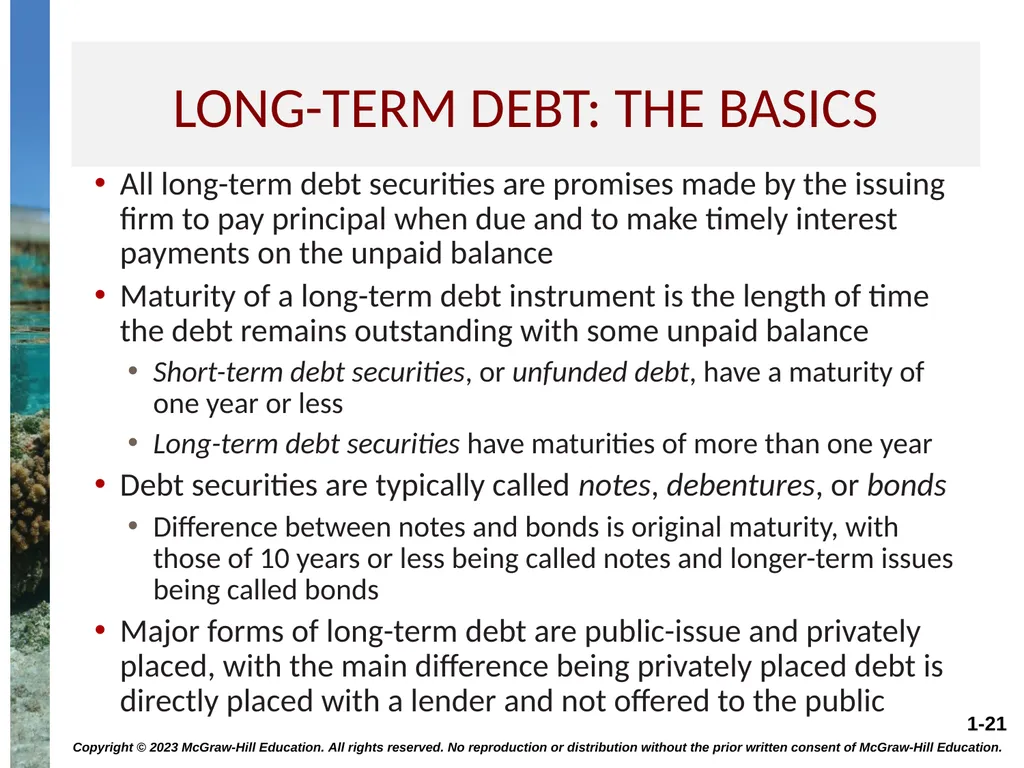
All long-term debt securities are promises made by the issuing firm to pay principal when due and to make timely interest payments on the unpaid balance
Maturity of a long-term debt instrument is the length of time the debt remains outstanding with some unpaid balance
Short-term debt securities, or unfunded debt, have a maturity of one year or less
Long-term debt securities have maturities of more than one year
Debt securities are typically called notes, debentures, or bonds
Difference between notes and bonds is original maturity, with those of 10 years or less being called notes and longer-term issues being called bonds
Major forms of long-term debt are public-issue and privately placed, with the main difference being privately placed debt is directly placed with a lender and not offered to the public Copyright © 2023 McGraw-Hill Education. All rights reserved. No reproduction or distribution without the prior written consent of McGraw-Hill Education. Long-term debt: the basics<br>
Maturity of a long-term debt instrument is the length of time the debt remains outstanding with some unpaid balance
Short-term debt securities, or unfunded debt, have a maturity of one year or less
Long-term debt securities have maturities of more than one year
Debt securities are typically called notes, debentures, or bonds
Difference between notes and bonds is original maturity, with those of 10 years or less being called notes and longer-term issues being called bonds
Major forms of long-term debt are public-issue and privately placed, with the main difference being privately placed debt is directly placed with a lender and not offered to the public Copyright © 2023 McGraw-Hill Education. All rights reserved. No reproduction or distribution without the prior written consent of McGraw-Hill Education. Long-term debt: the basics<br>
22
Copyright © 2023 McGraw-Hill Education. All rights reserved. No reproduction or distribution without the prior written consent of McGraw-Hill Education. Features of an apple bond<br>
23
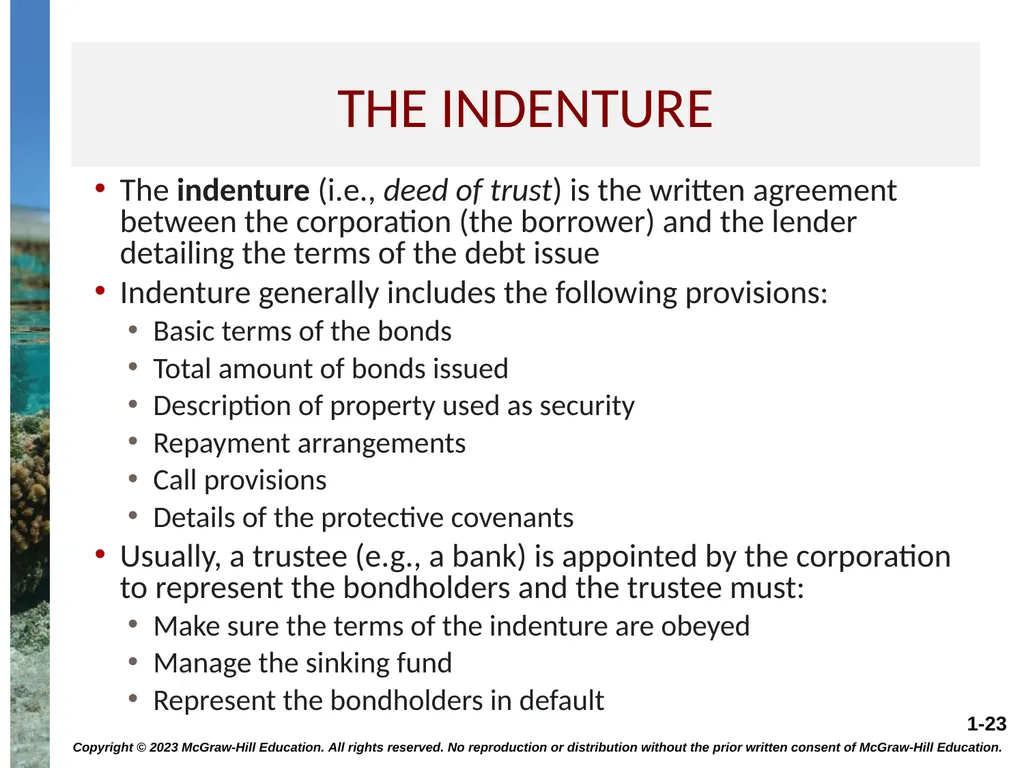
The indenture (i.e., deed of trust) is the written agreement between the corporation (the borrower) and the lender detailing the terms of the debt issue
Indenture generally includes the following provisions:
Basic terms of the bonds
Total amount of bonds issued
Description of property used as security
Repayment arrangements
Call provisions
Details of the protective covenants
Usually, a trustee (e.g., a bank) is appointed by the corporation to represent the bondholders and the trustee must:
Make sure the terms of the indenture are obeyed
Manage the sinking fund
Represent the bondholders in default Copyright © 2023 McGraw-Hill Education. All rights reserved. No reproduction or distribution without the prior written consent of McGraw-Hill Education. The indenture<br>
Indenture generally includes the following provisions:
Basic terms of the bonds
Total amount of bonds issued
Description of property used as security
Repayment arrangements
Call provisions
Details of the protective covenants
Usually, a trustee (e.g., a bank) is appointed by the corporation to represent the bondholders and the trustee must:
Make sure the terms of the indenture are obeyed
Manage the sinking fund
Represent the bondholders in default Copyright © 2023 McGraw-Hill Education. All rights reserved. No reproduction or distribution without the prior written consent of McGraw-Hill Education. The indenture<br>
24
Principal value is stated on bond certificate
Par value of a bond is almost always the same as the face value, with the terms used interchangeably in practice
Corporate bonds historically had a face value of $1,000
Municipal bonds often have par valued of $5,00
Treasury bonds with par values of $10,000 or $100,000 are common
Corporate bonds are usually in registered form, meaning the registrar of the company records ownership of each bond with payment being made directly to the owner of record
Bonds can also be in bearer form, in which case the bond is issued without record of the owner’s name with payment being made to whomever holds the bond
Difficult to recover if bonds are lost or stolen
Because the company does not know who owns its bonds, it cannot notify bondholders of important events Copyright © 2023 McGraw-Hill Education. All rights reserved. No reproduction or distribution without the prior written consent of McGraw-Hill Education. Terms of a bond<br>
Par value of a bond is almost always the same as the face value, with the terms used interchangeably in practice
Corporate bonds historically had a face value of $1,000
Municipal bonds often have par valued of $5,00
Treasury bonds with par values of $10,000 or $100,000 are common
Corporate bonds are usually in registered form, meaning the registrar of the company records ownership of each bond with payment being made directly to the owner of record
Bonds can also be in bearer form, in which case the bond is issued without record of the owner’s name with payment being made to whomever holds the bond
Difficult to recover if bonds are lost or stolen
Because the company does not know who owns its bonds, it cannot notify bondholders of important events Copyright © 2023 McGraw-Hill Education. All rights reserved. No reproduction or distribution without the prior written consent of McGraw-Hill Education. Terms of a bond<br>
25
Debt securities are classified according to the collateral and mortgages used to protect the bondholder
Mortgage securities are secured by a mortgage on the real property of the borrower, with the property involved typically being real estate (e.g., land or buildings)
Legal document that describes the mortgage is called a mortgage trust indenture or trust deed
Sometimes mortgages are on specific property (e.g., railroad car)
Blanket mortgage pledges all real property owned by the company
Bonds usually represent unsecured obligations of the company
A debenture is an unsecured debt, usually with a maturity of 10 years or more
Most public bonds issued in the U.S. by industrial and financial companies are typically debentures
A note is an unsecured debt, usually with a maturity under 10 years Copyright © 2023 McGraw-Hill Education. All rights reserved. No reproduction or distribution without the prior written consent of McGraw-Hill Education. security<br>
Mortgage securities are secured by a mortgage on the real property of the borrower, with the property involved typically being real estate (e.g., land or buildings)
Legal document that describes the mortgage is called a mortgage trust indenture or trust deed
Sometimes mortgages are on specific property (e.g., railroad car)
Blanket mortgage pledges all real property owned by the company
Bonds usually represent unsecured obligations of the company
A debenture is an unsecured debt, usually with a maturity of 10 years or more
Most public bonds issued in the U.S. by industrial and financial companies are typically debentures
A note is an unsecured debt, usually with a maturity under 10 years Copyright © 2023 McGraw-Hill Education. All rights reserved. No reproduction or distribution without the prior written consent of McGraw-Hill Education. security<br>
26
Seniority indicates preference in position over other lenders, with debts sometimes labeled as senior or junior to indicate seniority
Some debt is subordinated (e.g., subordinated debenture), and holders of such debt must give preference to other specified creditors
Debt cannot be subordinated to equity
Bonds can be repaid at maturity, at which time the bondholder will receive the stated, or face, value of the bond; or they may be repaid in part or in entirety before maturity
Early repayment is common and is often handled through a sinking fund, an account managed by the bond trustee for early redemption
There are various types of sinking fund arrangements; for example:
Some sinking funds start about 10 years after the initial issuance
Some sinking funds establish equal payments over the life of the bond
Some high-quality bond issues establish payments to the sinking fund that are not sufficient to redeem the entire issue Copyright © 2023 McGraw-Hill Education. All rights reserved. No reproduction or distribution without the prior written consent of McGraw-Hill Education. Seniority and repayment<br>
Some debt is subordinated (e.g., subordinated debenture), and holders of such debt must give preference to other specified creditors
Debt cannot be subordinated to equity
Bonds can be repaid at maturity, at which time the bondholder will receive the stated, or face, value of the bond; or they may be repaid in part or in entirety before maturity
Early repayment is common and is often handled through a sinking fund, an account managed by the bond trustee for early redemption
There are various types of sinking fund arrangements; for example:
Some sinking funds start about 10 years after the initial issuance
Some sinking funds establish equal payments over the life of the bond
Some high-quality bond issues establish payments to the sinking fund that are not sufficient to redeem the entire issue Copyright © 2023 McGraw-Hill Education. All rights reserved. No reproduction or distribution without the prior written consent of McGraw-Hill Education. Seniority and repayment<br>
27
Call provision is an agreement giving the corporation the option to repurchase a bond at a specified price prior to maturity
Corporate bonds are usually callable
Call price is usually above the bond’s stated value (i.e., par value), with the difference between the call price and the stated value being the call premium
Deferred call provisions prohibit the company from redeeming a bond prior toa certain date
During period of prohibition, the bond is said to be call-protected
“Make-whole” call is a new type of call provision where bondholders receive approximately what the bonds are worth if they are called
To find the make-whole call price, calculate the PV of the remaining interest and principal payments at a rate specified in the indenture Copyright © 2023 McGraw-Hill Education. All rights reserved. No reproduction or distribution without the prior written consent of McGraw-Hill Education. The call provision<br>
Corporate bonds are usually callable
Call price is usually above the bond’s stated value (i.e., par value), with the difference between the call price and the stated value being the call premium
Deferred call provisions prohibit the company from redeeming a bond prior toa certain date
During period of prohibition, the bond is said to be call-protected
“Make-whole” call is a new type of call provision where bondholders receive approximately what the bonds are worth if they are called
To find the make-whole call price, calculate the PV of the remaining interest and principal payments at a rate specified in the indenture Copyright © 2023 McGraw-Hill Education. All rights reserved. No reproduction or distribution without the prior written consent of McGraw-Hill Education. The call provision<br>
28
A protective covenant limits certain actions that might be taken during the loan’s term, usually to protect the lender’s interest
Negative covenant is a “thou shalt not” type of covenant that limits or prohibits actions the company might take; examples include:
Firm must limit amount of dividends paid, according to some formula
Firm cannot pledge any assets to other lenders
Firm cannot merge with another firm
Firm cannot sell or lease any major assets without lender’s approval
Firm cannot issue additional long-term debt
Positive covenant is a “thou shalt” type of covenant that specified an action the company agrees to take or a condition the company must abide by; examples include:
Company must maintain working capital at or above some specified minimum level
Company must periodically furnish audited financials to lender
Firm must maintain any collateral or security in good condition Copyright © 2023 McGraw-Hill Education. All rights reserved. No reproduction or distribution without the prior written consent of McGraw-Hill Education. Protective covenants<br>
Negative covenant is a “thou shalt not” type of covenant that limits or prohibits actions the company might take; examples include:
Firm must limit amount of dividends paid, according to some formula
Firm cannot pledge any assets to other lenders
Firm cannot merge with another firm
Firm cannot sell or lease any major assets without lender’s approval
Firm cannot issue additional long-term debt
Positive covenant is a “thou shalt” type of covenant that specified an action the company agrees to take or a condition the company must abide by; examples include:
Company must maintain working capital at or above some specified minimum level
Company must periodically furnish audited financials to lender
Firm must maintain any collateral or security in good condition Copyright © 2023 McGraw-Hill Education. All rights reserved. No reproduction or distribution without the prior written consent of McGraw-Hill Education. Protective covenants<br>
29
Firms often pay to have their debt rated, with ratings serving as an assessment of the creditworthiness of the corporate issuer
Leading bond-rating firms are Moody’s and Standard & Poor’s (S&P)
Definitions of creditworthiness used by Moody’s and S&P are based on how likely the firm is to default and the protection creditors have in the event of a default
Ratings can change as the issuer’s financial strength changes
Highest rating a firm’s debt can have is AAA or Aaa, and such debt is judged to be the best quality and to have the lowest degree of risk
AA or Aa ratings indicate very good quality debt and are much more common
Investment-grade bonds are rated at least BBB or Baa
Large part of corporate borrowing takes the form “junk” bonds, which are rated below investment grade if rated at all
Rating agencies don’t always agree (e.g., “crossover” bonds) Copyright © 2023 McGraw-Hill Education. All rights reserved. No reproduction or distribution without the prior written consent of McGraw-Hill Education. Bond ratings<br>
Leading bond-rating firms are Moody’s and Standard & Poor’s (S&P)
Definitions of creditworthiness used by Moody’s and S&P are based on how likely the firm is to default and the protection creditors have in the event of a default
Ratings can change as the issuer’s financial strength changes
Highest rating a firm’s debt can have is AAA or Aaa, and such debt is judged to be the best quality and to have the lowest degree of risk
AA or Aa ratings indicate very good quality debt and are much more common
Investment-grade bonds are rated at least BBB or Baa
Large part of corporate borrowing takes the form “junk” bonds, which are rated below investment grade if rated at all
Rating agencies don’t always agree (e.g., “crossover” bonds) Copyright © 2023 McGraw-Hill Education. All rights reserved. No reproduction or distribution without the prior written consent of McGraw-Hill Education. Bond ratings<br>
30
Copyright © 2023 McGraw-Hill Education. All rights reserved. No reproduction or distribution without the prior written consent of McGraw-Hill Education. Bond ratings (continued)<br>
31
Biggest borrower in the world—by a wide margin—is everybody’s favorite family member, Uncle Sam
When the government wishes to borrow money for more than one year, it sells Treasury notes and bonds to the public
U.S. Treasury issues, unlike essentially all other bonds, have no default risk
Treasury issues are exempt from state income taxes
State and local governments also borrow money by selling notes and bonds (i.e., municipal notes and bonds, or “munis”)
Have varying degrees of default risk and are rated much like corporate issues
Almost always callable
Coupons are exempt from federal income taxes; because of the tax break they receive, yields on munis are much lower than yields on taxable bonds Copyright © 2023 McGraw-Hill Education. All rights reserved. No reproduction or distribution without the prior written consent of McGraw-Hill Education. Government bonds<br>
When the government wishes to borrow money for more than one year, it sells Treasury notes and bonds to the public
U.S. Treasury issues, unlike essentially all other bonds, have no default risk
Treasury issues are exempt from state income taxes
State and local governments also borrow money by selling notes and bonds (i.e., municipal notes and bonds, or “munis”)
Have varying degrees of default risk and are rated much like corporate issues
Almost always callable
Coupons are exempt from federal income taxes; because of the tax break they receive, yields on munis are much lower than yields on taxable bonds Copyright © 2023 McGraw-Hill Education. All rights reserved. No reproduction or distribution without the prior written consent of McGraw-Hill Education. Government bonds<br>
32
Copyright © 2023 McGraw-Hill Education. All rights reserved. No reproduction or distribution without the prior written consent of McGraw-Hill Education. Taxable versus municipal bonds<br>
33
Zero coupon bonds, or zeroes, are bonds that make no coupon payments and are thus initially priced at a deep discount
For tax purposes, the issuer of a zero coupon bond deducts interest every year even though no interest is actually paid
Similarly, the owner must pay taxes on interest accrued every year, even though no interest is actually received
Attractive investment for tax-exempt investors with long-term dollar-denominated liabilities (e.g., pension funds) because the future dollar value is known with relative certainty Copyright © 2023 McGraw-Hill Education. All rights reserved. No reproduction or distribution without the prior written consent of McGraw-Hill Education. Zero coupon bonds<br>
For tax purposes, the issuer of a zero coupon bond deducts interest every year even though no interest is actually paid
Similarly, the owner must pay taxes on interest accrued every year, even though no interest is actually received
Attractive investment for tax-exempt investors with long-term dollar-denominated liabilities (e.g., pension funds) because the future dollar value is known with relative certainty Copyright © 2023 McGraw-Hill Education. All rights reserved. No reproduction or distribution without the prior written consent of McGraw-Hill Education. Zero coupon bonds<br>
34
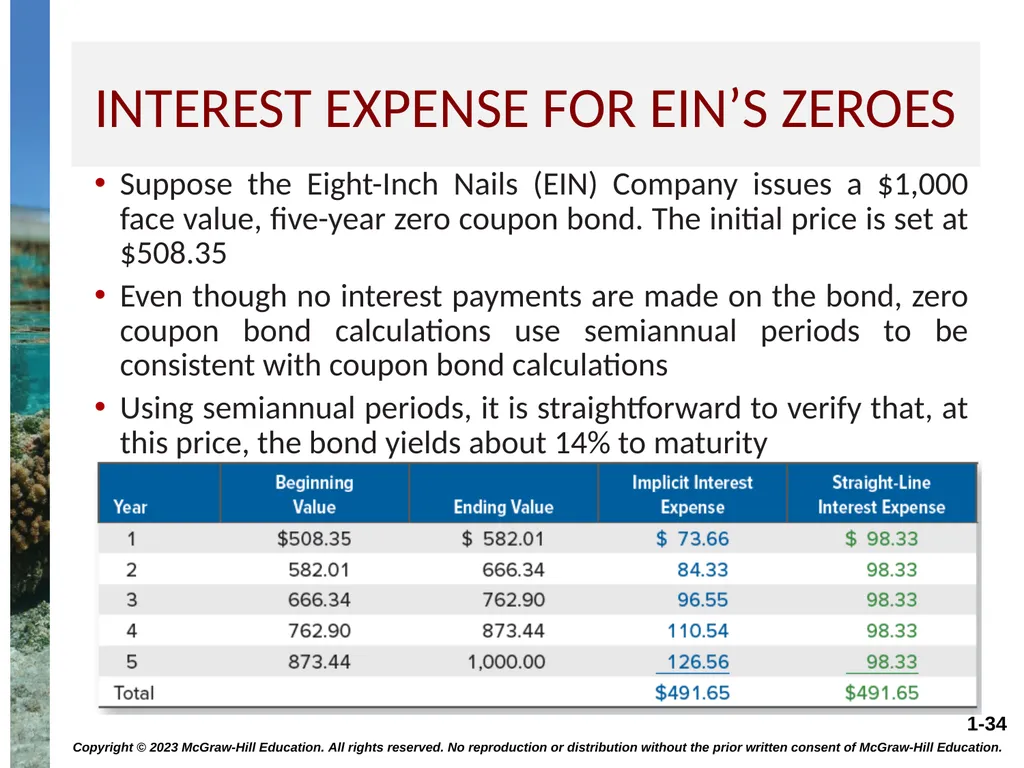
Suppose the Eight-Inch Nails (EIN) Company issues a $1,000 face value, five-year zero coupon bond. The initial price is set at $508.35
Even though no interest payments are made on the bond, zero coupon bond calculations use semiannual periods to be consistent with coupon bond calculations
Using semiannual periods, it is straightforward to verify that, at this price, the bond yields about 14% to maturity
The total interest paid over the life of the bond is $1,000 − 508.35 = $491.65. Copyright © 2023 McGraw-Hill Education. All rights reserved. No reproduction or distribution without the prior written consent of McGraw-Hill Education. Interest expense for ein’s zeroes<br>
Even though no interest payments are made on the bond, zero coupon bond calculations use semiannual periods to be consistent with coupon bond calculations
Using semiannual periods, it is straightforward to verify that, at this price, the bond yields about 14% to maturity
The total interest paid over the life of the bond is $1,000 − 508.35 = $491.65. Copyright © 2023 McGraw-Hill Education. All rights reserved. No reproduction or distribution without the prior written consent of McGraw-Hill Education. Interest expense for ein’s zeroes<br>
35
With floating-rate bonds (floaters), coupon payments are adjustable, with adjustments tied to an interest rate index (e.g., Treasury bill interest rate or 30-year Treasury bond rate)
Value depends on how coupon payment adjustments are defined
In most cases, the coupon adjusts with a lag to some base rate
Most floaters have the following features:
Holder has right to redeem note at par on the coupon payment date after some specified amount of time (i.e., put provision)
Coupon rate has floor and ceiling, meaning the coupon is subject to a minimum and a maximum. In this case, the coupon rate is said to be “capped,” and the upper and lower rates may be called the collar
Inflation-linked bonds have coupons that are adjusted according to the inflation rate (principal amount may be adjusted as well)
May be called “TIPS,” or Treasury Inflation-Protected Securities Copyright © 2023 McGraw-Hill Education. All rights reserved. No reproduction or distribution without the prior written consent of McGraw-Hill Education. Floating-rate bonds<br>
Value depends on how coupon payment adjustments are defined
In most cases, the coupon adjusts with a lag to some base rate
Most floaters have the following features:
Holder has right to redeem note at par on the coupon payment date after some specified amount of time (i.e., put provision)
Coupon rate has floor and ceiling, meaning the coupon is subject to a minimum and a maximum. In this case, the coupon rate is said to be “capped,” and the upper and lower rates may be called the collar
Inflation-linked bonds have coupons that are adjusted according to the inflation rate (principal amount may be adjusted as well)
May be called “TIPS,” or Treasury Inflation-Protected Securities Copyright © 2023 McGraw-Hill Education. All rights reserved. No reproduction or distribution without the prior written consent of McGraw-Hill Education. Floating-rate bonds<br>
36
Catastrophe, or cat, bonds cover U.S.-named storms and earthquakes, with investors losing some or all of their money if one of these triggering events occurs
In 2019, Conservation Capital issued Rhino impact bonds (RIB) designed to increase the population of black rhinos in Kenya and South Africa
Bondholders receive payments based on the “outcome payments” model; in this case, payments will be based on the population of black rhinos in five years
Coronavirus bonds came to market during the COVID-19 pandemic; proceeds were to go toward pandemic-related work
A warrant is a bond feature that gives the buyer of the bond the right to purchase shares of stock in the company at a fixed price
Very valuable feature is the stock price climbs substantially
Bonds with warrants are often issued at a very low coupon rate Copyright © 2023 McGraw-Hill Education. All rights reserved. No reproduction or distribution without the prior written consent of McGraw-Hill Education. Other types of bonds<br>
In 2019, Conservation Capital issued Rhino impact bonds (RIB) designed to increase the population of black rhinos in Kenya and South Africa
Bondholders receive payments based on the “outcome payments” model; in this case, payments will be based on the population of black rhinos in five years
Coronavirus bonds came to market during the COVID-19 pandemic; proceeds were to go toward pandemic-related work
A warrant is a bond feature that gives the buyer of the bond the right to purchase shares of stock in the company at a fixed price
Very valuable feature is the stock price climbs substantially
Bonds with warrants are often issued at a very low coupon rate Copyright © 2023 McGraw-Hill Education. All rights reserved. No reproduction or distribution without the prior written consent of McGraw-Hill Education. Other types of bonds<br>
37
Income bonds are similar to conventional bonds, except that coupon payments depend on company income
Coupons are paid to bondholders only if firm’s income is sufficient
A convertible bond can be swapped for a fixed number of shares of stock anytime before maturity at the holder’s option
A put bond allows the holder to force the issuer to buy back the bond at a stated price; this is the reverse of the call provision
Reverse convertible is a relatively new item
One type generally offers a high coupon rate, but the redemption at maturity can be paid in cash at par value or paid in shares of stock
Death bonds involve companies purchasing life insurance policies from individuals who are expected to die within the next 10 years and then selling bonds that are paid off from the life insurance proceeds when the policyholders pass away
Structured notes are bonds that are based on stocks, bonds, commodities, or currencies Copyright © 2023 McGraw-Hill Education. All rights reserved. No reproduction or distribution without the prior written consent of McGraw-Hill Education. Other types of bonds (continued)<br>
Coupons are paid to bondholders only if firm’s income is sufficient
A convertible bond can be swapped for a fixed number of shares of stock anytime before maturity at the holder’s option
A put bond allows the holder to force the issuer to buy back the bond at a stated price; this is the reverse of the call provision
Reverse convertible is a relatively new item
One type generally offers a high coupon rate, but the redemption at maturity can be paid in cash at par value or paid in shares of stock
Death bonds involve companies purchasing life insurance policies from individuals who are expected to die within the next 10 years and then selling bonds that are paid off from the life insurance proceeds when the policyholders pass away
Structured notes are bonds that are based on stocks, bonds, commodities, or currencies Copyright © 2023 McGraw-Hill Education. All rights reserved. No reproduction or distribution without the prior written consent of McGraw-Hill Education. Other types of bonds (continued)<br>
38
Worldwide demand for assets that comply with sharia, or Islamic law and cultural tradition, has grown dramatically
One of the major differences between Western financial practices and sharia is that Islamic law does not permit charging or paying riba, or interest
To accommodate the restriction on interest payments, Islamic bonds, or sukuk, have been created
There are many possible structures to sukuk, such as partial ownership in a debt (sukuk al-murabaha) or an asset (sukuk al-ijara)
In the case of a sukuk al-ijara, there is a binding promise to repurchase a certain asset by the issuer at maturity
Before the sukuk matures, rent is paid on the asset
Most sukuk are bought and held to maturity; therefore, secondary markets in sukuk are extremely illiquid Copyright © 2023 McGraw-Hill Education. All rights reserved. No reproduction or distribution without the prior written consent of McGraw-Hill Education. sukuk<br>
One of the major differences between Western financial practices and sharia is that Islamic law does not permit charging or paying riba, or interest
To accommodate the restriction on interest payments, Islamic bonds, or sukuk, have been created
There are many possible structures to sukuk, such as partial ownership in a debt (sukuk al-murabaha) or an asset (sukuk al-ijara)
In the case of a sukuk al-ijara, there is a binding promise to repurchase a certain asset by the issuer at maturity
Before the sukuk matures, rent is paid on the asset
Most sukuk are bought and held to maturity; therefore, secondary markets in sukuk are extremely illiquid Copyright © 2023 McGraw-Hill Education. All rights reserved. No reproduction or distribution without the prior written consent of McGraw-Hill Education. sukuk<br>
39
Total volume of trading in bonds far exceeds that in stocks
Most trading in bonds takes place over the counter, or OTC
One reason the bond markets are so big is that the number of bond issues far exceeds the number of stock issues, and there are two reasons for this:
A corporation would typically have only one common stock issue outstanding, whereas a large corporation could easily have a dozen or more note and bond issues outstanding
Federal, state, and local borrowing is enormous
A financial market is transparent if it is possible to easily observe its prices and trading volume
On the New York Stock Exchange, for example, it is possible to see the price and quantity for every single transaction
In the bond market, it is often not possible to observe either, resulting in a lack of transparency Copyright © 2023 McGraw-Hill Education. All rights reserved. No reproduction or distribution without the prior written consent of McGraw-Hill Education. How bonds are bought and sold<br>
Most trading in bonds takes place over the counter, or OTC
One reason the bond markets are so big is that the number of bond issues far exceeds the number of stock issues, and there are two reasons for this:
A corporation would typically have only one common stock issue outstanding, whereas a large corporation could easily have a dozen or more note and bond issues outstanding
Federal, state, and local borrowing is enormous
A financial market is transparent if it is possible to easily observe its prices and trading volume
On the New York Stock Exchange, for example, it is possible to see the price and quantity for every single transaction
In the bond market, it is often not possible to observe either, resulting in a lack of transparency Copyright © 2023 McGraw-Hill Education. All rights reserved. No reproduction or distribution without the prior written consent of McGraw-Hill Education. How bonds are bought and sold<br>
40
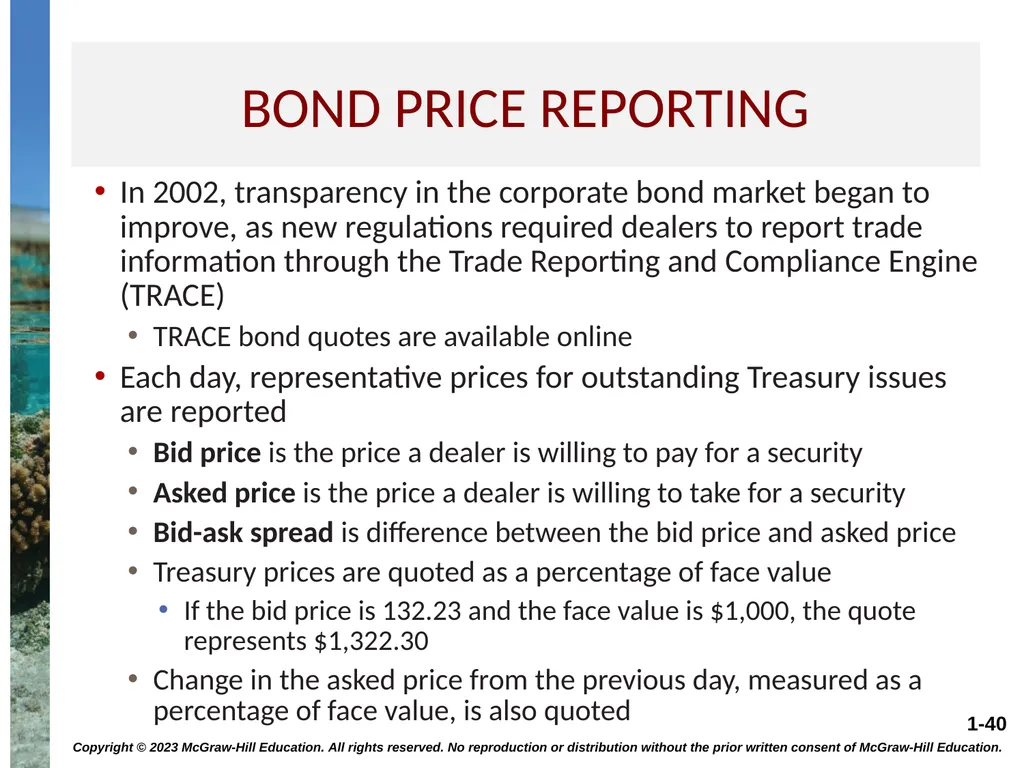
In 2002, transparency in the corporate bond market began to improve, as new regulations required dealers to report trade information through the Trade Reporting and Compliance Engine (TRACE)
TRACE bond quotes are available online
Each day, representative prices for outstanding Treasury issues are reported
Bid price is the price a dealer is willing to pay for a security
Asked price is the price a dealer is willing to take for a security
Bid-ask spread is difference between the bid price and asked price
Treasury prices are quoted as a percentage of face value
If the bid price is 132.23 and the face value is $1,000, the quote represents $1,322.30
Change in the asked price from the previous day, measured as a percentage of face value, is also quoted Copyright © 2023 McGraw-Hill Education. All rights reserved. No reproduction or distribution without the prior written consent of McGraw-Hill Education. Bond price reporting<br>
TRACE bond quotes are available online
Each day, representative prices for outstanding Treasury issues are reported
Bid price is the price a dealer is willing to pay for a security
Asked price is the price a dealer is willing to take for a security
Bid-ask spread is difference between the bid price and asked price
Treasury prices are quoted as a percentage of face value
If the bid price is 132.23 and the face value is $1,000, the quote represents $1,322.30
Change in the asked price from the previous day, measured as a percentage of face value, is also quoted Copyright © 2023 McGraw-Hill Education. All rights reserved. No reproduction or distribution without the prior written consent of McGraw-Hill Education. Bond price reporting<br>
41
Copyright © 2023 McGraw-Hill Education. All rights reserved. No reproduction or distribution without the prior written consent of McGraw-Hill Education. Sample wall street journal u.s. treasury note and bond prices<br>
42
Clean price is the price of a bond net of accrued interest
This is the price that is typically quoted
Dirty price is the price of a bond including accrued interest, also known as the full or invoice price
This is the price the buyer actually pays
Suppose you buy a bond with a 12% annual coupon, payable semiannually. You actually pay $1,080 for this bond, so $1,080 is the dirty, or invoice, price. Further, on the day you buy it, the next coupon is due in four months, so you are between coupon dates. Notice that the next coupon will be $60.
Accrued interest on a bond is calculated by taking the fraction of the coupon period that has passed, in this case two months out of six, and multiplying this fraction by the next coupon, $60
Accrued interest in this example is 2/6 × $60 = $20. The bond’s quoted price (i.e., clean price) would be $1,080 − 20 = $1,060 Copyright © 2023 McGraw-Hill Education. All rights reserved. No reproduction or distribution without the prior written consent of McGraw-Hill Education. A note about bond price quotes<br>
This is the price that is typically quoted
Dirty price is the price of a bond including accrued interest, also known as the full or invoice price
This is the price the buyer actually pays
Suppose you buy a bond with a 12% annual coupon, payable semiannually. You actually pay $1,080 for this bond, so $1,080 is the dirty, or invoice, price. Further, on the day you buy it, the next coupon is due in four months, so you are between coupon dates. Notice that the next coupon will be $60.
Accrued interest on a bond is calculated by taking the fraction of the coupon period that has passed, in this case two months out of six, and multiplying this fraction by the next coupon, $60
Accrued interest in this example is 2/6 × $60 = $20. The bond’s quoted price (i.e., clean price) would be $1,080 − 20 = $1,060 Copyright © 2023 McGraw-Hill Education. All rights reserved. No reproduction or distribution without the prior written consent of McGraw-Hill Education. A note about bond price quotes<br>
43
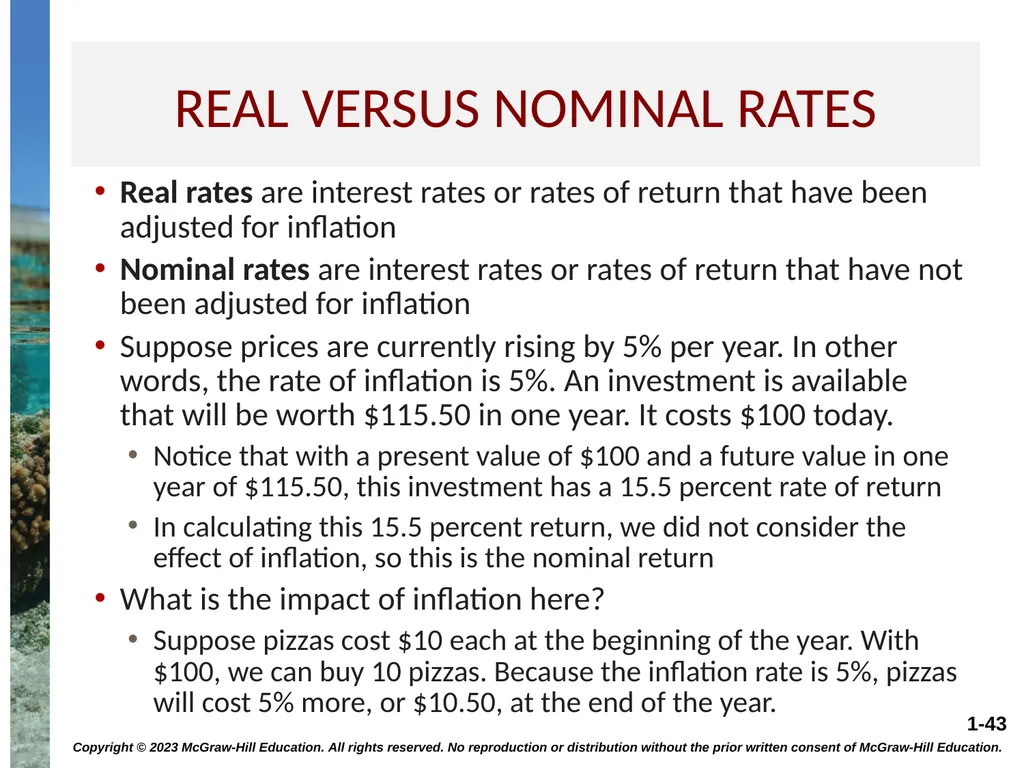
Real rates are interest rates or rates of return that have been adjusted for inflation
Nominal rates are interest rates or rates of return that have not been adjusted for inflation
Suppose prices are currently rising by 5% per year. In other words, the rate of inflation is 5%. An investment is available that will be worth $115.50 in one year. It costs $100 today.
Notice that with a present value of $100 and a future value in one year of $115.50, this investment has a 15.5 percent rate of return
In calculating this 15.5 percent return, we did not consider the effect of inflation, so this is the nominal return
What is the impact of inflation here?
Suppose pizzas cost $10 each at the beginning of the year. With $100, we can buy 10 pizzas. Because the inflation rate is 5%, pizzas will cost 5% more, or $10.50, at the end of the year. Copyright © 2023 McGraw-Hill Education. All rights reserved. No reproduction or distribution without the prior written consent of McGraw-Hill Education. Real versus nominal rates<br>
Nominal rates are interest rates or rates of return that have not been adjusted for inflation
Suppose prices are currently rising by 5% per year. In other words, the rate of inflation is 5%. An investment is available that will be worth $115.50 in one year. It costs $100 today.
Notice that with a present value of $100 and a future value in one year of $115.50, this investment has a 15.5 percent rate of return
In calculating this 15.5 percent return, we did not consider the effect of inflation, so this is the nominal return
What is the impact of inflation here?
Suppose pizzas cost $10 each at the beginning of the year. With $100, we can buy 10 pizzas. Because the inflation rate is 5%, pizzas will cost 5% more, or $10.50, at the end of the year. Copyright © 2023 McGraw-Hill Education. All rights reserved. No reproduction or distribution without the prior written consent of McGraw-Hill Education. Real versus nominal rates<br>
44
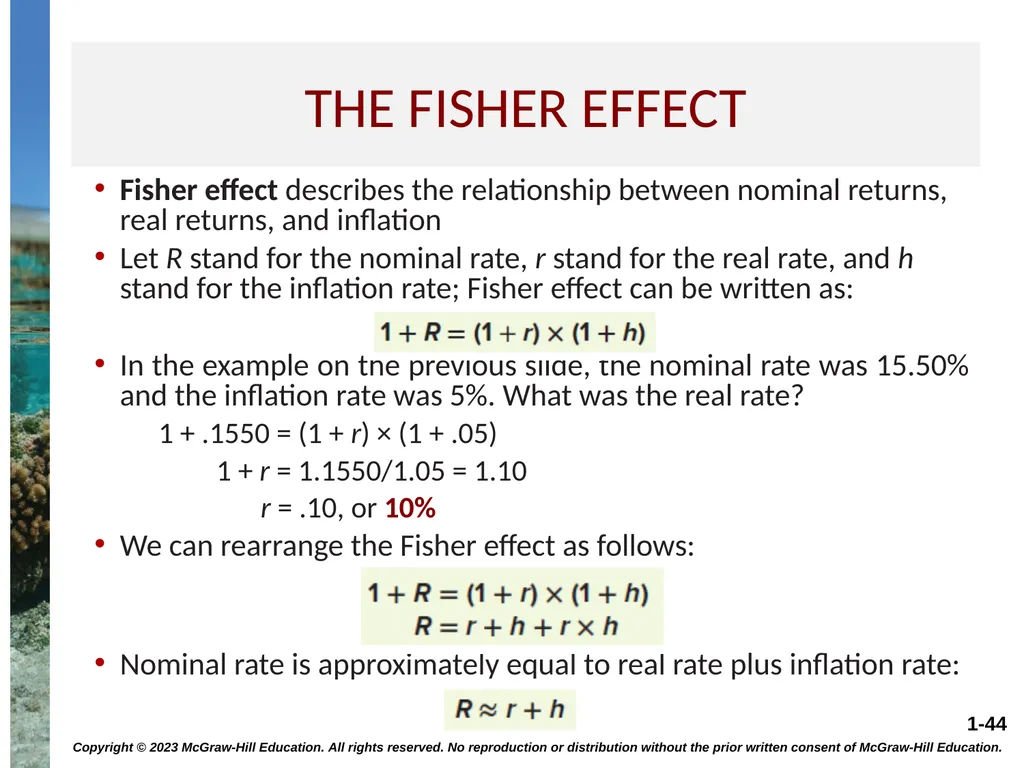
Fisher effect describes the relationship between nominal returns, real returns, and inflation
Let R stand for the nominal rate, r stand for the real rate, and h stand for the inflation rate; Fisher effect can be written as:
In the example on the previous slide, the nominal rate was 15.50% and the inflation rate was 5%. What was the real rate?
1 + .1550 = (1 + r) × (1 + .05)
1 + r = 1.1550/1.05 = 1.10
r = .10, or 10%
We can rearrange the Fisher effect as follows:
Nominal rate is approximately equal to real rate plus inflation rate: Copyright © 2023 McGraw-Hill Education. All rights reserved. No reproduction or distribution without the prior written consent of McGraw-Hill Education. The fisher effect<br>
Let R stand for the nominal rate, r stand for the real rate, and h stand for the inflation rate; Fisher effect can be written as:
In the example on the previous slide, the nominal rate was 15.50% and the inflation rate was 5%. What was the real rate?
1 + .1550 = (1 + r) × (1 + .05)
1 + r = 1.1550/1.05 = 1.10
r = .10, or 10%
We can rearrange the Fisher effect as follows:
Nominal rate is approximately equal to real rate plus inflation rate: Copyright © 2023 McGraw-Hill Education. All rights reserved. No reproduction or distribution without the prior written consent of McGraw-Hill Education. The fisher effect<br>
45
Copyright © 2023 McGraw-Hill Education. All rights reserved. No reproduction or distribution without the prior written consent of McGraw-Hill Education. The fisher effect:
an example<br>
46
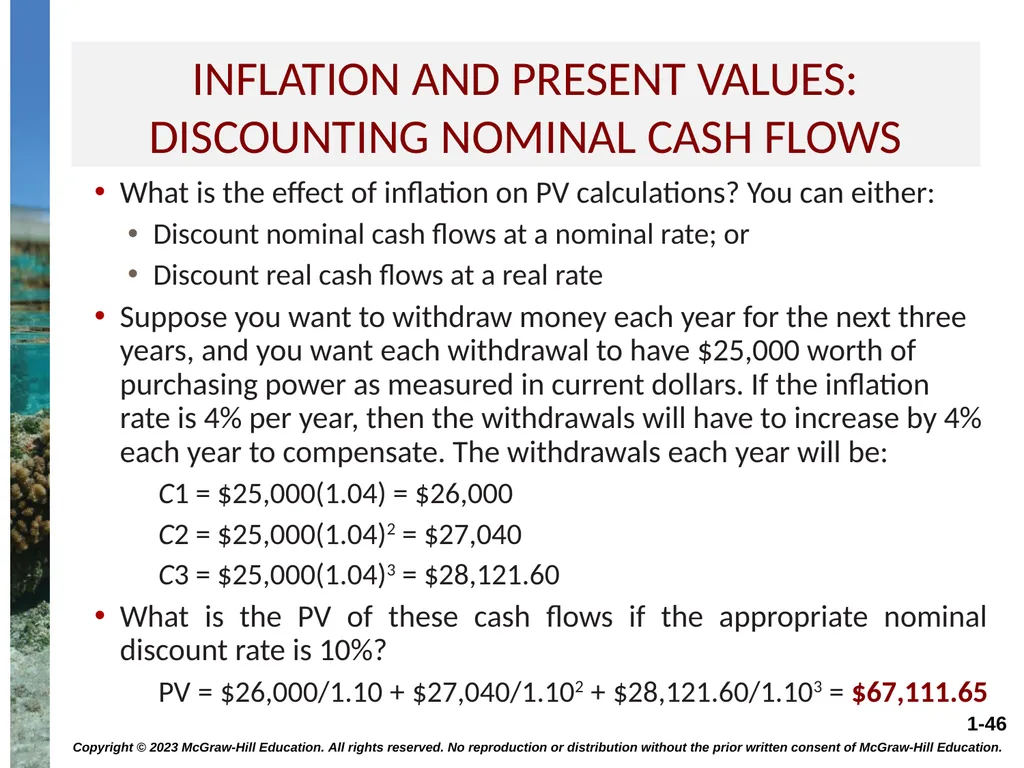
What is the effect of inflation on PV calculations? You can either:
Discount nominal cash flows at a nominal rate; or
Discount real cash flows at a real rate
Suppose you want to withdraw money each year for the next three years, and you want each withdrawal to have $25,000 worth of purchasing power as measured in current dollars. If the inflation rate is 4% per year, then the withdrawals will have to increase by 4% each year to compensate. The withdrawals each year will be:
C1 = $25,000(1.04) = $26,000
C2 = $25,000(1.04)2 = $27,040
C3 = $25,000(1.04)3 = $28,121.60
What is the PV of these cash flows if the appropriate nominal discount rate is 10%?
PV = $26,000/1.10 + $27,040/1.102 + $28,121.60/1.103 = $67,111.65 Copyright © 2023 McGraw-Hill Education. All rights reserved. No reproduction or distribution without the prior written consent of McGraw-Hill Education. Inflation and present values: discounting nominal cash flows<br>
Discount nominal cash flows at a nominal rate; or
Discount real cash flows at a real rate
Suppose you want to withdraw money each year for the next three years, and you want each withdrawal to have $25,000 worth of purchasing power as measured in current dollars. If the inflation rate is 4% per year, then the withdrawals will have to increase by 4% each year to compensate. The withdrawals each year will be:
C1 = $25,000(1.04) = $26,000
C2 = $25,000(1.04)2 = $27,040
C3 = $25,000(1.04)3 = $28,121.60
What is the PV of these cash flows if the appropriate nominal discount rate is 10%?
PV = $26,000/1.10 + $27,040/1.102 + $28,121.60/1.103 = $67,111.65 Copyright © 2023 McGraw-Hill Education. All rights reserved. No reproduction or distribution without the prior written consent of McGraw-Hill Education. Inflation and present values: discounting nominal cash flows<br>
47
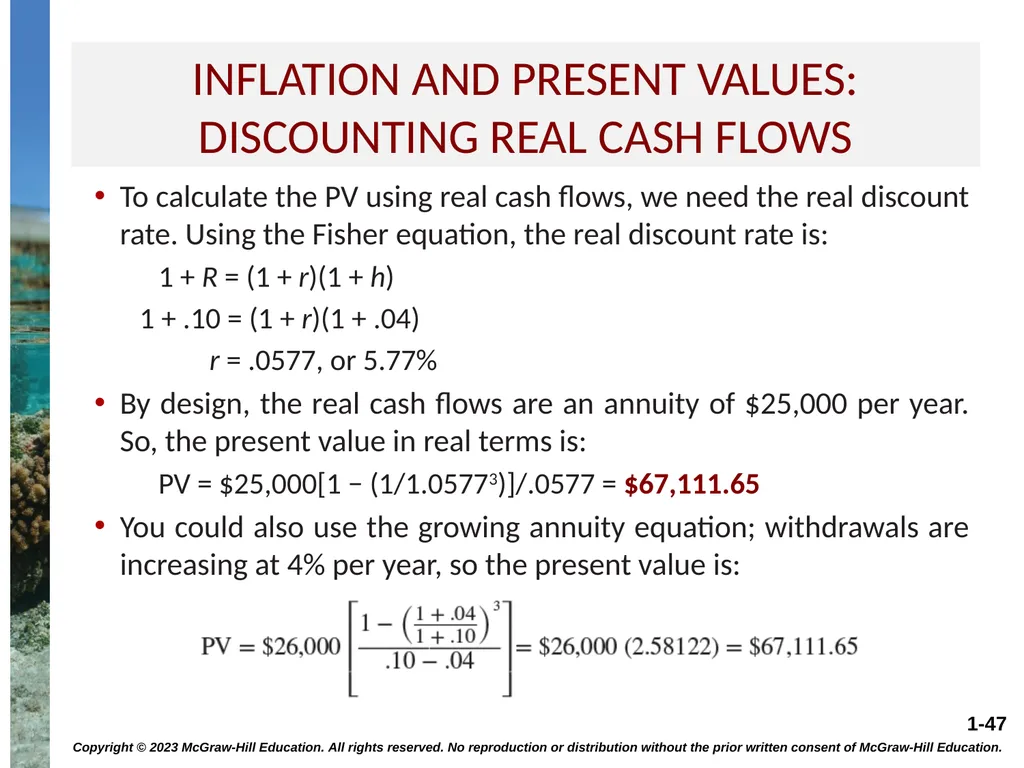
To calculate the PV using real cash flows, we need the real discount rate. Using the Fisher equation, the real discount rate is:
1 + R = (1 + r)(1 + h)
1 + .10 = (1 + r)(1 + .04)
r = .0577, or 5.77%
By design, the real cash flows are an annuity of $25,000 per year. So, the present value in real terms is:
PV = $25,000[1 − (1/1.05773)]/.0577 = $67,111.65
You could also use the growing annuity equation; withdrawals are increasing at 4% per year, so the present value is: Copyright © 2023 McGraw-Hill Education. All rights reserved. No reproduction or distribution without the prior written consent of McGraw-Hill Education. Inflation and present values: discounting real cash flows<br>
1 + R = (1 + r)(1 + h)
1 + .10 = (1 + r)(1 + .04)
r = .0577, or 5.77%
By design, the real cash flows are an annuity of $25,000 per year. So, the present value in real terms is:
PV = $25,000[1 − (1/1.05773)]/.0577 = $67,111.65
You could also use the growing annuity equation; withdrawals are increasing at 4% per year, so the present value is: Copyright © 2023 McGraw-Hill Education. All rights reserved. No reproduction or distribution without the prior written consent of McGraw-Hill Education. Inflation and present values: discounting real cash flows<br>
48
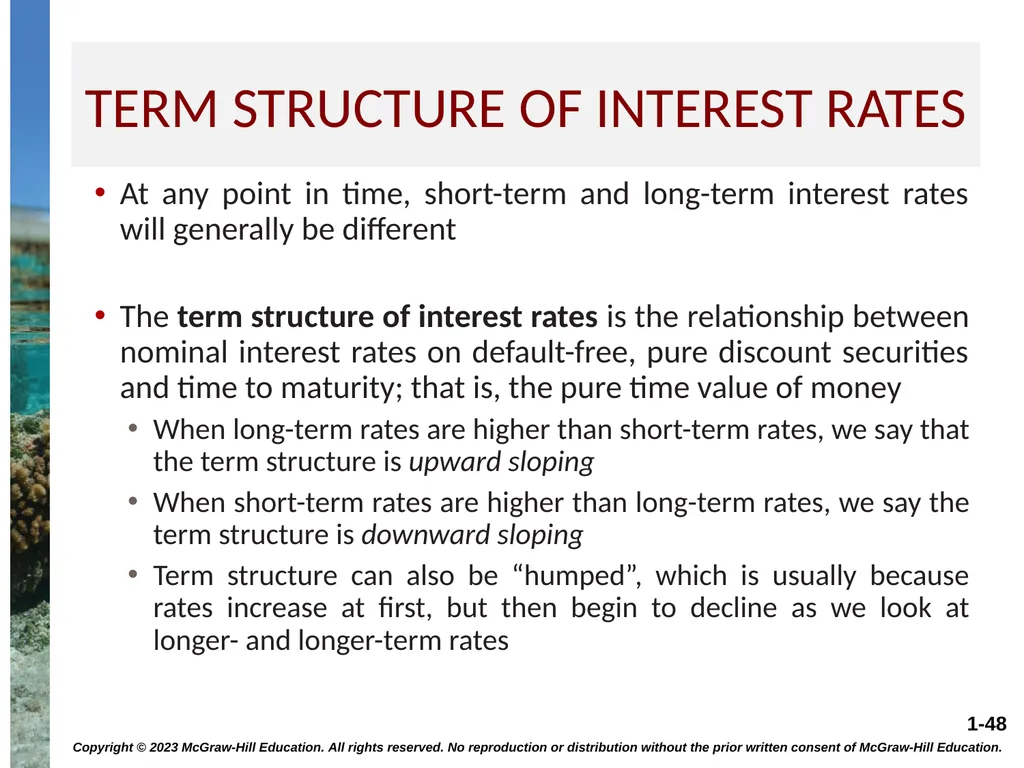
At any point in time, short-term and long-term interest rates will generally be different
The term structure of interest rates is the relationship between nominal interest rates on default-free, pure discount securities and time to maturity; that is, the pure time value of money
When long-term rates are higher than short-term rates, we say that the term structure is upward sloping
When short-term rates are higher than long-term rates, we say the term structure is downward sloping
Term structure can also be “humped”, which is usually because rates increase at first, but then begin to decline as we look at longer- and longer-term rates Copyright © 2023 McGraw-Hill Education. All rights reserved. No reproduction or distribution without the prior written consent of McGraw-Hill Education. Term structure of interest rates<br>
The term structure of interest rates is the relationship between nominal interest rates on default-free, pure discount securities and time to maturity; that is, the pure time value of money
When long-term rates are higher than short-term rates, we say that the term structure is upward sloping
When short-term rates are higher than long-term rates, we say the term structure is downward sloping
Term structure can also be “humped”, which is usually because rates increase at first, but then begin to decline as we look at longer- and longer-term rates Copyright © 2023 McGraw-Hill Education. All rights reserved. No reproduction or distribution without the prior written consent of McGraw-Hill Education. Term structure of interest rates<br>
49
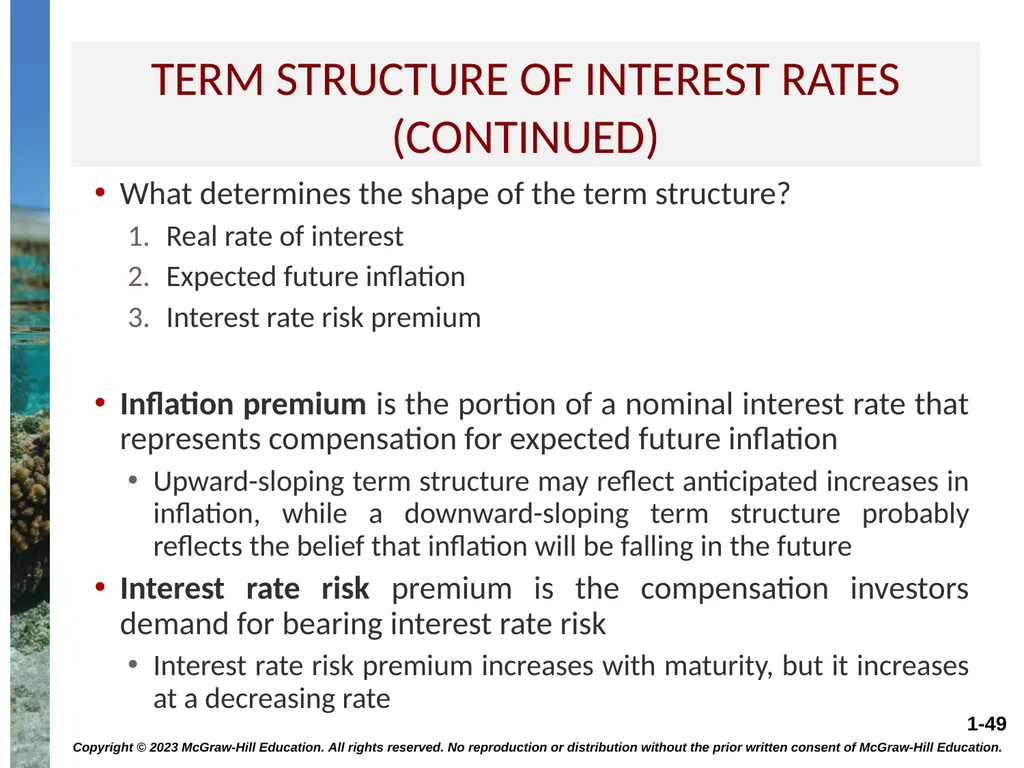
What determines the shape of the term structure?
Real rate of interest
Expected future inflation
Interest rate risk premium
Inflation premium is the portion of a nominal interest rate that represents compensation for expected future inflation
Upward-sloping term structure may reflect anticipated increases in inflation, while a downward-sloping term structure probably reflects the belief that inflation will be falling in the future
Interest rate risk premium is the compensation investors demand for bearing interest rate risk
Interest rate risk premium increases with maturity, but it increases at a decreasing rate Copyright © 2023 McGraw-Hill Education. All rights reserved. No reproduction or distribution without the prior written consent of McGraw-Hill Education. Term structure of interest rates (continued)<br>
Real rate of interest
Expected future inflation
Interest rate risk premium
Inflation premium is the portion of a nominal interest rate that represents compensation for expected future inflation
Upward-sloping term structure may reflect anticipated increases in inflation, while a downward-sloping term structure probably reflects the belief that inflation will be falling in the future
Interest rate risk premium is the compensation investors demand for bearing interest rate risk
Interest rate risk premium increases with maturity, but it increases at a decreasing rate Copyright © 2023 McGraw-Hill Education. All rights reserved. No reproduction or distribution without the prior written consent of McGraw-Hill Education. Term structure of interest rates (continued)<br>
50
Copyright © 2023 McGraw-Hill Education. All rights reserved. No reproduction or distribution without the prior written consent of McGraw-Hill Education. Term structure of interest rates (concluded)<br>
51
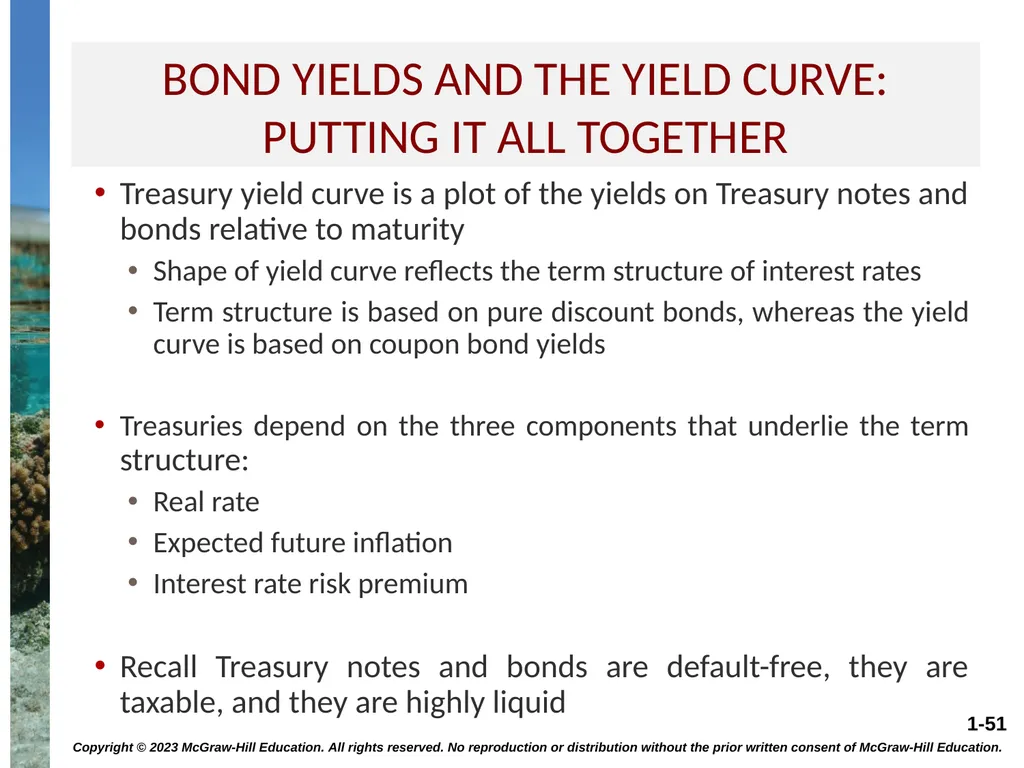
Treasury yield curve is a plot of the yields on Treasury notes and bonds relative to maturity
Shape of yield curve reflects the term structure of interest rates
Term structure is based on pure discount bonds, whereas the yield curve is based on coupon bond yields
Treasuries depend on the three components that underlie the term structure:
Real rate
Expected future inflation
Interest rate risk premium
Recall Treasury notes and bonds are default-free, they are taxable, and they are highly liquid Copyright © 2023 McGraw-Hill Education. All rights reserved. No reproduction or distribution without the prior written consent of McGraw-Hill Education. Bond yields and the yield curve: putting it all together<br>
Shape of yield curve reflects the term structure of interest rates
Term structure is based on pure discount bonds, whereas the yield curve is based on coupon bond yields
Treasuries depend on the three components that underlie the term structure:
Real rate
Expected future inflation
Interest rate risk premium
Recall Treasury notes and bonds are default-free, they are taxable, and they are highly liquid Copyright © 2023 McGraw-Hill Education. All rights reserved. No reproduction or distribution without the prior written consent of McGraw-Hill Education. Bond yields and the yield curve: putting it all together<br>
52
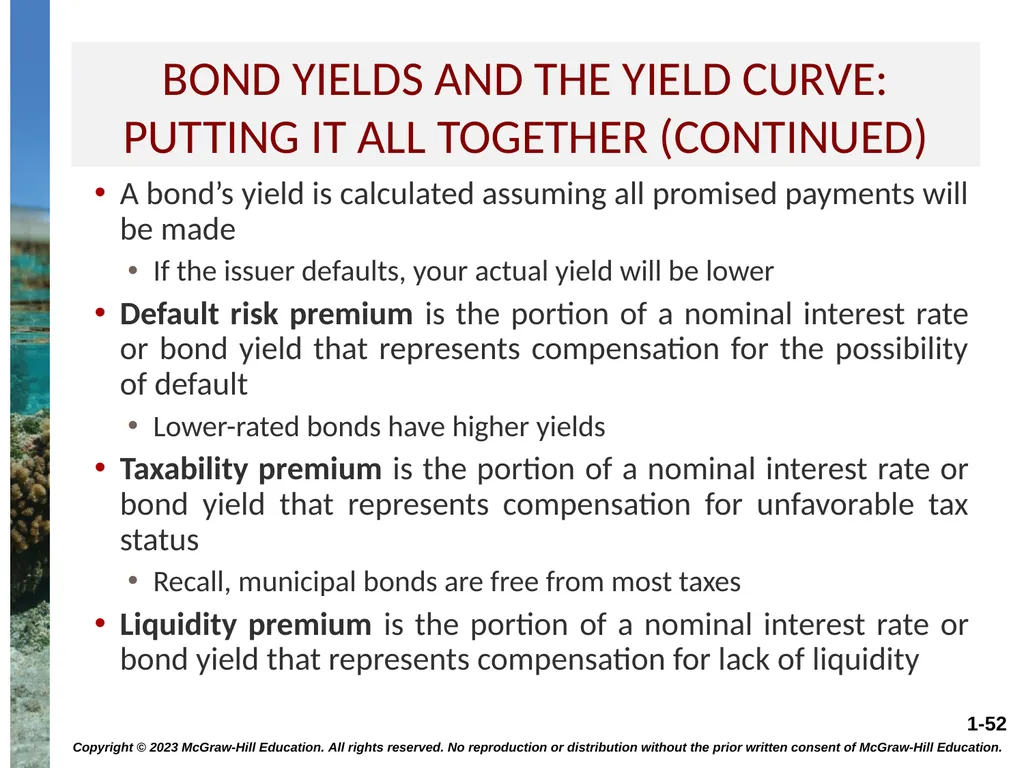
A bond’s yield is calculated assuming all promised payments will be made
If the issuer defaults, your actual yield will be lower
Default risk premium is the portion of a nominal interest rate or bond yield that represents compensation for the possibility of default
Lower-rated bonds have higher yields
Taxability premium is the portion of a nominal interest rate or bond yield that represents compensation for unfavorable tax status
Recall, municipal bonds are free from most taxes
Liquidity premium is the portion of a nominal interest rate or bond yield that represents compensation for lack of liquidity Copyright © 2023 McGraw-Hill Education. All rights reserved. No reproduction or distribution without the prior written consent of McGraw-Hill Education. Bond yields and the yield curve: putting it all together (continued)<br>
If the issuer defaults, your actual yield will be lower
Default risk premium is the portion of a nominal interest rate or bond yield that represents compensation for the possibility of default
Lower-rated bonds have higher yields
Taxability premium is the portion of a nominal interest rate or bond yield that represents compensation for unfavorable tax status
Recall, municipal bonds are free from most taxes
Liquidity premium is the portion of a nominal interest rate or bond yield that represents compensation for lack of liquidity Copyright © 2023 McGraw-Hill Education. All rights reserved. No reproduction or distribution without the prior written consent of McGraw-Hill Education. Bond yields and the yield curve: putting it all together (continued)<br>
53
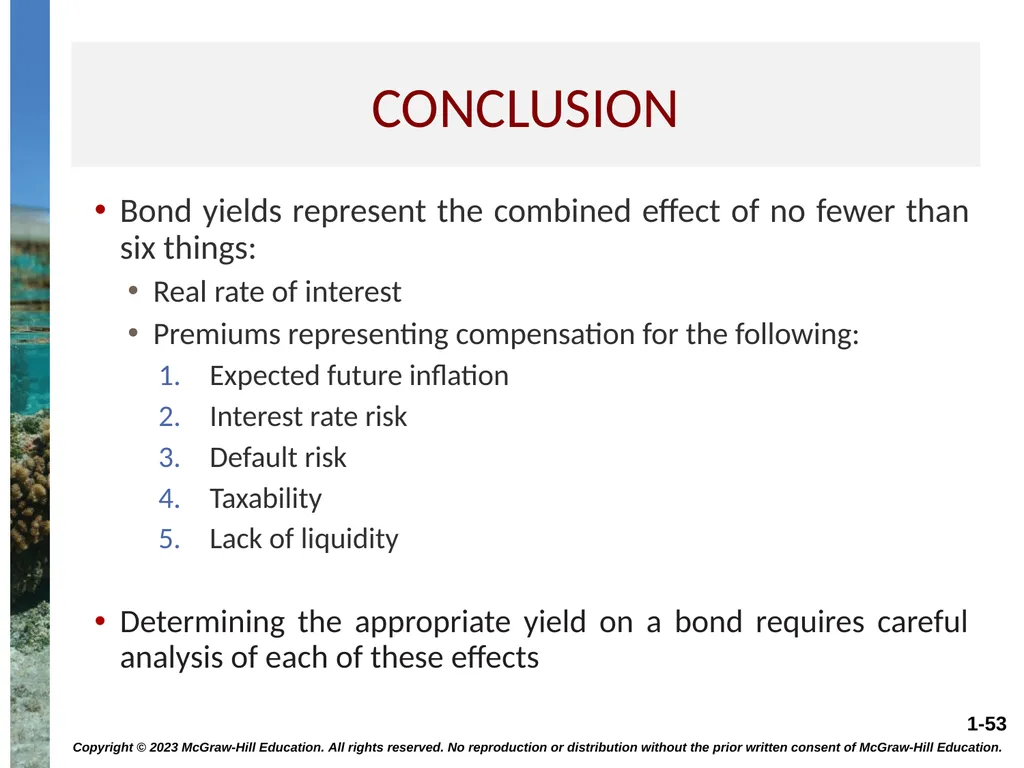
Bond yields represent the combined effect of no fewer than six things:
Real rate of interest
Premiums representing compensation for the following:
Expected future inflation
Interest rate risk
Default risk
Taxability
Lack of liquidity
Determining the appropriate yield on a bond requires careful analysis of each of these effects Copyright © 2023 McGraw-Hill Education. All rights reserved. No reproduction or distribution without the prior written consent of McGraw-Hill Education. conclusion<br>
Real rate of interest
Premiums representing compensation for the following:
Expected future inflation
Interest rate risk
Default risk
Taxability
Lack of liquidity
Determining the appropriate yield on a bond requires careful analysis of each of these effects Copyright © 2023 McGraw-Hill Education. All rights reserved. No reproduction or distribution without the prior written consent of McGraw-Hill Education. conclusion<br>
54
What are the cash flows associated with a bond?
What is the indenture? What are protective covenants? Give some examples.
What is a junk bond?
Why might an income bond be attractive to a corporation with volatile cash flows? Can you think of a reason why income bonds are not more popular?
In general, what are bid and ask prices?
What is the difference between a nominal and a real return? Which is more important to a typical investor?
What is the term structure of interest rates? What determines its shape?
What is the Treasury yield curve? Copyright © 2023 McGraw-Hill Education. All rights reserved. No reproduction or distribution without the prior written consent of McGraw-Hill Education. Selected concept questions<br>
What is the indenture? What are protective covenants? Give some examples.
What is a junk bond?
Why might an income bond be attractive to a corporation with volatile cash flows? Can you think of a reason why income bonds are not more popular?
In general, what are bid and ask prices?
What is the difference between a nominal and a real return? Which is more important to a typical investor?
What is the term structure of interest rates? What determines its shape?
What is the Treasury yield curve? Copyright © 2023 McGraw-Hill Education. All rights reserved. No reproduction or distribution without the prior written consent of McGraw-Hill Education. Selected concept questions<br>
55
End of Chapter Chapter 7 Copyright © 2023 McGraw-Hill Education. All rights reserved. No reproduction or distribution without the prior written consent of McGraw-Hill Education.<br>