
Interfaith Learning and Understanding CRRF







Description: Interfaith Learning and Understanding CRRF Learning about Racism course COURSE DEVELOPED BY: Shari Golberg (Co-ordinator Facilitator, PhD in Religion) Copyright 2020 Canadian Race Relations Foundation All rights reserved. No part of
Related Topics
Download Presentation
"Interfaith Learning and Understanding CRRF" is the property of its rightful owner. Permission is granted to download and print the materials on this website for personal, non-commercial use only, and to display it on your personal computer provided you do not modify the materials and that you retain all copyright notices contained in the materials. By downloading content from our website, you accept the terms of this agreement.
Presentation Transcript
slide1. Interfaith Learning and Understanding CRRF Learning about Racism course
COURSE DEVELOPED BY:
Shari Golberg
(Co-ordinator & Facilitator, PhD in Religion)<br>
slide2. Copyright © 2020 Canadian Race Relations Foundation All rights reserved. No part of this publication may be reproduced in any form or by any means, electronic or mechanical including photocopying or by any information storage or retrieval systems without the permission of the publisher.<br>
slide3. 3 Disclaimer: The learning courses are provided for information and educational purposes only, and does not constitute legal or professional advice. The content published herein represents the belief and work of its authors, and does not necessarily reflect the official policy or positions of the Canadian Race Relations Foundation.<br>
slide4. 4 Interfaith Learning and Understanding Welcome to the Canadian Race Relation Foundations' 7-module e-course on Interfaith Learning and Understanding.
By the end of this series you will have:
An understanding of the relationship between religion and multiculturalism;
A basic understanding of the major faith traditions in Canada;
Some practical tips for managing and discussing interfaith issues in the workplace, schools, and other shared community spaces.<br>
slide5. Three Part Series This series begins with an introduction to the major concepts of pluralism, multicultural, and religion, moves into the tenets, beliefs, practices, and peoples' lived experiences of major faith traditions practiced in Canada today, and finally explores how to manage conflict that may arise from religious traditions in the workplace, in schools, and communities.
Part 1 - Introductory Concepts
Module 1: Pluralism and Multiculturalism
Module 2: What Do We Talk About When We Talk About Religion?<br>
slide6. Three Part Series Continued Part 2 - Major Religions and Spiritual Traditions in Canada
Module 3: Judaism, Christianity, Islam
Module 4: Buddhism, Hinduism, Sikhism
Module 5: Baha'i Faith and Indigenous Spirituality
Part 3 - Navigating Religion in Workplaces, Schools, and Communities
Module 6: Religious Accommodations
Module 7: Competing Rights<br>
slide7. Series Source Materials Much of the content in the first 5 modules has been adapted from The Canadian Race Relations Foundation's 2014 publication, Our Canada: A practical guide to bridging faith with Canadian identity, human rights, belonging and values. Material was revised to include:
more up-to-date content ;
sources speaking to the diversity within each faith; and
videos, articles, and artistic contributions reflecting the lived experiences of practitioners.
Several of the videos in Part 2 are taken from the The Prayer Project, a collaboration between The National Film Board and the Canadian Race Relations Foundation.<br>
slide8. Series Source Materials Content in modules 6 & 7 was adapted from the in-person Cross-Canada Workshops on Faith and Belonging that were offered to diversity and inclusion champions across the country between 2015 and 2016.
All of these initiatives were part of the Department of Citizenship, Immigration and Multiculturalism Canada's Interfaith and Belonging: A Civic Education and Engagement Initiative. This initiative was intended to facilitate a national dialogue on interfaith cooperation and communication, promote civic education and engagement, and provide the necessary tools to strengthen belonging.<br>
slide9. PART 1 Introductory Concepts<br>
slide10. Module 1: Pluralism and Multiculturalism Despite periods of discrimination in Canada’s history, a respect for minorities and relatively open immigration policy has led to increased diversity in religion, faith and spirituality in Canada – especially over the past few decades. While there is a decline in membership and attendance at places of worship, and though many Canadians have only individual spiritual beliefs and commitments – or none at all – there are vibrant communities across Canada that reflect religion, faith and spirituality throughout the world.<br>
slide11. Pluralism and Multiculturalism To begin our conversation about religiosity and interfaith engagement in Canada, it makes sense to address the concepts of pluralism and multiculturalism. In 1971, the Federal government, under the leadership of then Prime Minister Pierre Elliott Trudeau pursued a policy of “multiculturalism within a bilingual framework”. Hence, Canada became the first country in the world to adopt a national multiculturalism policy. The policy was an attempt to reconcile two competing visions of Canada:
the dualistic view, that, in addition to the Indigenous Peoples, Canada is comprised of two principal founding groups (English and French); and
the pluralistic view, which sees Canada as comprised of a wide variety of cultural groups.
The policy encouraged all Canadians to accept cultural pluralism and to participate fully and equally in Canadian society. Multiculturalism remains an integral part of our national identity and, as such, Canada has been unique among western democracies in its commitment to this ideal.<br>
slide12. Pluralism and Multiculturalism By 1981, as Canada’s racial diversity was beginning to grow, more attention was being devoted to racial discrimination, and race relations. In 1982, with the repatriation of the Canadian Constitution, multicultural policies were firmly entrenched in the Charter of Rights and Freedoms guaranteeing, among others, equal protection and benefit of the law, and freedom from discrimination on the basis of, for example, gender, religion, racial and ethnic origin. As such, multiculturalism was recognized in Section 27 of the Canadian Charter in 1982.
An objective of Canada’s multiculturalism policy was to foster a more just society, with early multicultural programs emphasizing cultural pluralism. Over time, the shift in focus to equity and anti-discrimination measures widened the meaning of multiculturalism to include issues relating to anti-racism.<br>
slide13. Pluralism and Multiculturalism These programs, strengthened by policy initiatives, have been effective in bringing about advancements in opportunities for minority groups. In 1988, Bill C-93, The Multiculturalism Act, was passed and became the first formal legislative vehicle for Canada’s multicultural policy. The Multiculturalism Act affirms the policy of the government to ensure that every Canadian receives equal treatment by the government which respects and celebrates diversity. The Act went beyond simply guaranteeing equal opportunity for all Canadians, regardless of origin.
It emphasized the right of Canada’s ethnic, racial [and religious minorities] to preserve and share their unique cultural heritage, and underlined the need to address race relations and eliminate systemic inequalities.<br>
slide14. Provincial Understandings of Multiculturalism Each of Canada’s provinces has a recognized multicultural policy in place. Saskatchewan was the first Canadian province to adopt legislation on multiculturalism, which was called The Saskatchewan Multiculturalism Act of 1974, which has since been replaced by a new, revised Multiculturalism Act (1997). Ontario followed in 1977 by putting in place a policy that promoted cultural activity, which became an Act in 1990, and the final province being Newfoundland and Labrador in 2008.
Quebec differs from the other nine provinces in that its policy focuses on "interculturalism" rather than multiculturalism, wherein diversity is strongly encouraged, but subsumed under the notion that it is within the framework that establishes French as the public language.<br>
slide15. Provincial Understandings of Multiculturalism Quebec’s policy of interculturalism, which was developed in reaction to the federal multiculturalism policy, recognizes the reality of the province’s identity as a distinct Francophone community, where the French language and culture hold paramount importance. For example, immigrant children must attend French language schools and most signage must be in French. In 1990, Quebec released Let’s Build Quebec Together: A Policy Statement on Integration and Immigration, which reinforced the notions of Quebec as a French-speaking society; Quebec as a democratic society wherein each person is expected to contribute to public life, and Quebec as a pluralistic society which respects the diversity of cultures within a democratic framework. In 2005, Quebec developed the Ministry of Immigration and Cultural Communities with the primary function being to foster closer cultural relations among the people of Quebec, and to support cultural communities in their quest to participate fully in Quebec society.<br>
slide16. Quebec and Interculturalism: A Case Study Quebec's distinct understanding of interculturalism has led to come controversial policies in recent years, such as proposed legislation to ban the wearing of religious symbols in the Quebec civil service. The definition of "religious symbols" has changed depending on the political party in power, but versions of proposed ban have extended to hijab and niqab, the headscarf and face veil worn by some Muslim women, the kippah, the skullcap worn by some Jewish men, and the dastaar, the turban worn by some Sikhs. In some cases, it has also applied to the chador, a full-body garment worn by some Muslim women, especially those originating from Iran.<br>
slide17. Quebec and Interculturalism: A Case Study In March 2019, the right-wing nationalist party Coalition Avenir Quebec (CAQ), introduced into the Quebec National Assembly Bill 21, "An Act Respecting the Laicity of the State,” which would ban public workers in positions of authority from wearing religious symbols, regardless of the size of the object. Laïcité, is a French conception of secularity. Dating back to the French Revolution, laïcité discourages religious influence in the affairs of the state. While a grandfather clause would protect those already working in the public service who wear visible religious symbols, Bill 21 would affect new hires, including police officers, government lawyers, prison guards, wildlife officers, judges, school principals, vice principals, and teachers. While the Canadian and Quebec Charters of Rights and Freedoms include clauses to protect freedom of religion, conscience and the right to equality, they also include provisions allowing governments to pass laws overriding those rights. The Coalition Avenir Quebec indicated that they would invoke one of these clauses, Section 33 of the Canadian Charter of Rights and Freedoms, known as the Notwithstanding Clause, to block civil servants from being able to challenge the violations of rights that may arise from Bill 21. The Bill is due to be adopted in June.<br>
slide18. Quebec and Interculturalism: A Case Study Charles Taylor is a philosopher who, together with historian and sociologist Gérard Bouchard, authored a report in 2007 on religious accommodation practices in Quebec at the request of then Premiere Jean Charest. Entitled, Building the Future: A Time for Reconciliation, the report was commissioned in response to public concern that reasonable accommodation practices in the province had gone to far. In the report, Taylor and Bouchard maintained that "the appearance of neutrality is important but we do not believe that it warrants a general rule that would prohibit agents of the State from wearing religious signs...the requirement of the appearance of impartiality imposes itself at the highest level in the case of judges, police officers, and prison guards." (pg. 149, 151). As such they felt that teachers, public servants and doctors should be authorized to wear religious signs (pg. 261).
In the clip below, he explains his own concerns about the CAQ's Bill 21:
https://youtu.be/775F4f-5xKE<br>
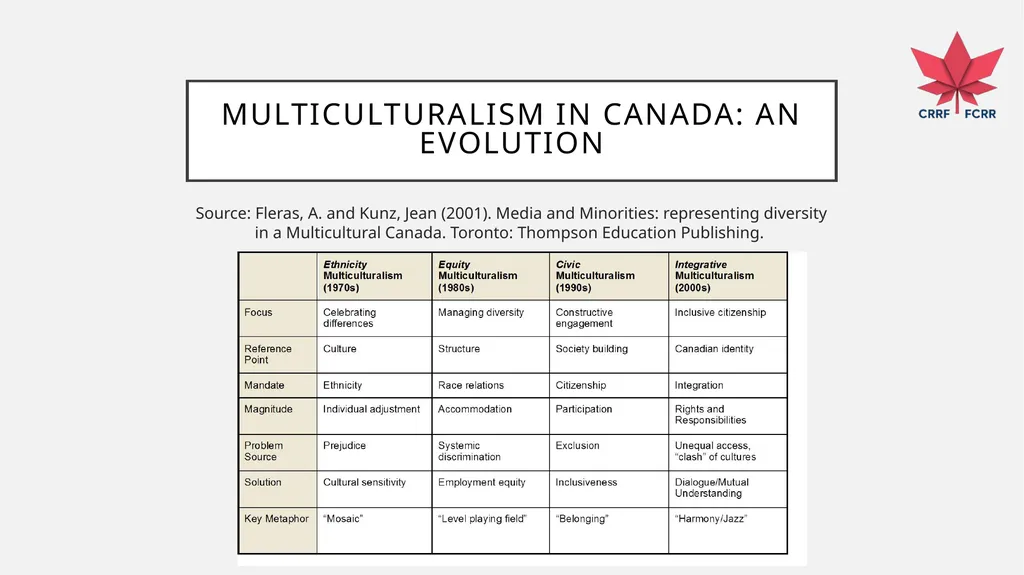
slide19. Multiculturalism in Canada: An Evolution But our notion of multiculturalism is not a static one. See below for changing notions of the focus of multiculturalism.
This image (next slide), developed by scholars Jean Lock Kunz and Augie Fleras in 2001 conveys our evolving understanding of multiculturalism and its focus since it was first introduced into federal policy in 1971. Note the references to "ethnicity", "race relations", "citizenship" and "culture" within this matrix.
But what key dimension of diversity is explicitly missing from these changing areas of focus?<br>
slide20. Multiculturalism in Canada: An Evolution Source: Fleras, A. and Kunz, Jean (2001). Media and Minorities: representing diversity in a Multicultural Canada. Toronto: Thompson Education Publishing.<br>
slide21. Multiculturalism and Religious Diversity If you noted that religion or creed is missing, you are correct. Initially conceived to apply to the preservation of language rights, as well as cultural and racial diversity among groups in Canada, religious diversity, although protected under Section 2 of the Charter of Rights, was never the primary focus of the Multiculturalism Act.
As Canadian political philosopher Will Kymlicka stated in a 2008 lecture, entitled The Three Lives of Multiculturalism, "there remains much uncertainty about the role of religion within the multiculturalism policy, and about the sorts of religious organizations and faith-based claims that should be supported by the policy.“
As such, there have been numerous cases involving religion that have appeared before Canadian courts, testing the limits of the Multiculturalism Act. {R. v. N.S. (2012); Multani v Commission scolaire Marguerite-Bourgeoys (2006); Alberta v Hutterian Brethren of Wilson Colony (2009)} This gap in our policy frameworks -- along with a general lack of literacy about the religious traditions of others -- is part of what accounts for conflict between religious and spiritual groups in our communities and our workplaces. We will come back to this in modules 7 and 8 and discuss some ways to address the gaps. But first, let us tackle some basic elements of the 8 largest faith communities in Canada today. Better understanding the traditions, practices, and beliefs of our neighbours will provide us with more tools to foster and develop more inclusive environments.<br>
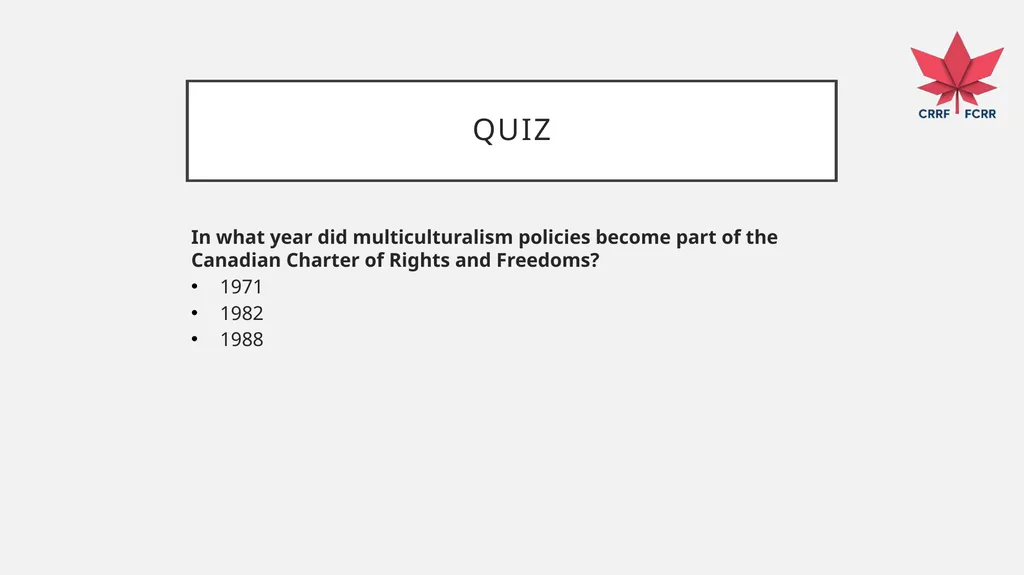
slide22. qUIZ In what year did multiculturalism policies become part of the Canadian Charter of Rights and Freedoms?
1971
1982
1988<br>
slide23. qUIZ The multiculturalism policies became part of the Canadian Charter of Rights and Freedoms in 1982.<br>
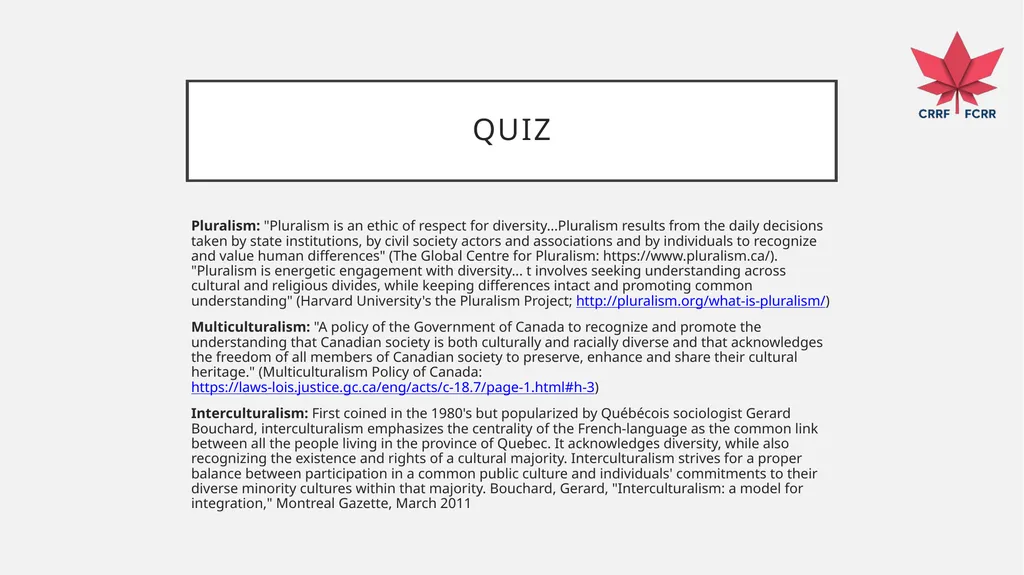
slide24. Quiz Referring to the vocabulary section of this module, explain the differences between multiculturalism, interculturalism, and pluralism?<br>
slide25. Quiz Pluralism: "Pluralism is an ethic of respect for diversity...Pluralism results from the daily decisions taken by state institutions, by civil society actors and associations and by individuals to recognize and value human differences" (The Global Centre for Pluralism: https://www.pluralism.ca/). "Pluralism is energetic engagement with diversity... t involves seeking understanding across cultural and religious divides, while keeping differences intact and promoting common understanding" (Harvard University's the Pluralism Project; http://pluralism.org/what-is-pluralism/)
Multiculturalism: "A policy of the Government of Canada to recognize and promote the understanding that Canadian society is both culturally and racially diverse and that acknowledges the freedom of all members of Canadian society to preserve, enhance and share their cultural heritage." (Multiculturalism Policy of Canada: https://laws-lois.justice.gc.ca/eng/acts/c-18.7/page-1.html#h-3)
Interculturalism: First coined in the 1980's but popularized by Québécois sociologist Gerard Bouchard, interculturalism emphasizes the centrality of the French-language as the common link between all the people living in the province of Quebec. It acknowledges diversity, while also recognizing the existence and rights of a cultural majority. Interculturalism strives for a proper balance between participation in a common public culture and individuals' commitments to their diverse minority cultures within that majority. Bouchard, Gerard, "Interculturalism: a model for integration," Montreal Gazette, March 2011<br>
slide26. Multiculturalism & Religion: Reflection Questions and Further Reading According to scholars Guo and Wong, another way of looking at the evolution of multiculturalism is as follows,
"Using more colloquial terminology Canada’s multiculturalism policy has evolved from song and dance in the 1970s, to anti-racism in the 1980s, to civic participation in the 1990s, and to fitting in in the 2000s."
How might you describe the current decade's approach to multiculturalism?
Shibao Guo and Lloyd Wong eds. Revisiting Multiculturalism in Canada: Theories, Policies, Debates.
Does the attached video help shade light on some possible ways forward? Why or why not?
Multiculturalism: Work in Progress<br>
slide27. Module 2: Religion, Faith, Spirituality: What Do We Talk about When We Talk About Religion? In learning about the diversity of religion, faith and spirituality in Canada, it is helpful to recognize some common features. While there is no universal or uniformly recognized definition of religion, in Amselem v Syndicat Northcrest (2004), the Supreme Court of Canada defined religion as follows:
"...religion typically involves a particular and comprehensive system of faith and worship. Religion also tends to involve the belief in a divine, superhuman or controlling power. In essence, religion is about freely and deeply held personal convictions or beliefs connected to an individual's spiritual faith and integrally linked to one's self-definition and spiritual fulfillment...“
While this definition is strongly rooted in individual notions of 'belief' (we will return to this idiosyncrasy in Module 7), many also understand religion to involve adherence to particular practices, and participation in a distinct community. As such, another attempt at defining some of these other aspects of spiritual life may also be helpful for the purposes of defining what we mean when we talk about religion:
"Religions are systems of discourses, practices, communities, and institutions that draw on human and suprahuman powers to provide adherents access to ultimate meaning" (Scott T. Kline, World Religions, Canadian Perspectives, ed. Doris Jakobsh, Toronto: Nelson Canada, 2013)<br>
slide28. Module 2: Religion, Faith, Spirituality: What Do We Talk about When We Talk About Religion? This definition, loosely based on the work of scholars Bruce Lincoln (2003) and Thomas Tweed (2006), is helpful in that it recognizes some of the social, cultural, historical, and political aspects of spiritual communities, rather than just the theological or philosophical underpinnings of individual beliefs.
While the traditions we will focus on in this course are very diverse, we will open each module with an "At A Glance" page, identifying:
Timing (i.e.,when the founder or founders are thought to have lived), if this is relevant;
Core Texts or Oral Histores;
Core Beliefs or Ideas; and
Central Practices.<br>
slide29. Religion, Faith and Spirituality: Other Common Features The more we try to compare and contrast traditions, the more we see how these comparisons are reductive or are privileging one tradition over the others. In fact, the earliest books comparing religions, usually assumed Christianity was the "correct" or vastly superior tradition, and the analysis of the others was meant to prove that this assumption was correct (Smith, 1998, 275-278). Nonetheless, it might be helpful to discuss some other features that are more or less common to the spiritual traditions we will be examining in this course.
Founders
Where a tradition is understood to have a founder or founders, such people are invariably understood to be great spiritual teachers, prophets, or messengers who declare themselves emissaries of a divine power, and in some cases, can be understood as divine themselves.
Their words and deeds are often collected as central teachings to be preserved and passed down by their followers.
Texts
In cultures with written texts, the practices and principles, traditions and core values are believed to be contained in some authoritative set of sacred writings, either originated by or first systematized in a new way by the founding figures.<br>
slide30. Religion, Faith and Spirituality: Other Common Features Beliefs
Belief in God or the Divine is commonly upheld, although some seek to preserve ethical values and ritual practices without linking them to the Divine.
Many traditions also share a common principle known as the “Golden Rule”, which enjoins believers to treat others as they wish to be treated themselves.
Traditional Indigenous spirituality has its own distinctive character rooted in the cultures of Indigenous nations and influenced by the unique features and relationships found in individual Indigenous communities. Some Elders declare their spirituality not to be religious, but rather a celebration of life and an honouring of natural law. Respect and honouring the gift of life found in everyone unites Indigenous ways of knowing with the similar teachings found in many religions.
Sacred Time & Space
Holy days are associated with history, traditions and accepted ritual practices, as well as a community place of worship, such as a temple, mosque, synagogue, gudwara, church or centre.<br>
slide31. Religion, Faith and Spirituality: Other Common Features No Tradition is Monolithic
The major world religions have communities of believers from diverse ethnic, cultural or linguistic backgrounds, but with a religious identity that provides a sense of allegiance beyond particular national, cultural or linguistic identities. At the same time, the geographical origins of believers can result in distinct cultural and linguistic practices that may be unrecognizable to practitioners of the same tradition who hail from an entirely different part of the globe.
Many of the teachings, practices and institutions of religions remain stable over centuries, but religions also change and evolve over time. Such change, and the diversity of religion, faith and spirituality, make any easy summary difficult, if not misleading. The short summaries in the following modules represent very brief, but hopefully helpful, introductions to faith and spirituality in Canada.<br>
slide32. Highlighting and Sorting Religions Any grouping or classification of religions may be seen as arbitrary. As the late scholar Jonathan Z. Smith noted in a landmark article, "the most common form of classifying religions...is dualistic and can be reduced, regardless of what differentium is employed, to 'theirs' and ours'" (Smith, 1998, 276) In other words, how we choose to group religions, and which religions we include is often dependent on who is doing the sorting and what they value as important.
For the purposes of this module, we will use numbers as our guide. We will focus on the following traditions, as they were the most common responses to the question about religion in the 2011 National Household Survey*: the Baha'i Faith**, Buddhism, Christianity, Hinduism, Indigenous Spirituality, Islam, Judaism, and Sikhism.
It is worthwhile to note that about 7.9 million people claimed to have no religious affiliation at all, and this is more than the number of Muslims, Buddhists, Hindus, Sikhs, and practitioners of Judaism, Indigenous Spirituality, and the Baha'i faith combined. Since the beliefs of people claiming no religion are numerous and diverse, atheism will not be dealt with as a separate tradition in this series.<br>
slide33. Highlighting and Sorting Religions At the same time, it is also important to stress that the beliefs and practices of members of religious traditions are not monolithic either. Not only are there multiple denominations and sects within the 8 religious traditions we will be exploring, but each individual within each of those communities may understand their obligations and spiritual commitments in deeply personal ways.
*This was the last population-wide survey where Canadians were asked about their religious affiliation. The religion question is only asked once a decade, so data on religion will not be collected again until 2021.
** at 18,945 practitioners, the Baha'i faith has been included as having the greatest number of members under the "Other Traditions" category of the survey. While Paganism also had over 25,000 practitioners, this number became smaller when divided into both Pagan and Wiccan affiliations.
https://www150.statcan.gc.ca/n1/pub/91-003-x/2014001/section03/33-eng.htm<br>
slide34. Highlighting and Sorting Religions As for why we are grouping together Judaism, Christianity, and Islam in one module, and Buddhism, Hinduism, and Sikhism in another, in some ways this may be just as arbitrary. Judaism, Christianity, and Islam are often regarded as "Western" traditions, when there are just as many practitioners of these faiths in what we understand as the "East." And today, there are large populations of Buddhists, Hindus, and Sikhs in what we understand to be Western countries. We could have divided the modules into proselytizing traditions vs those that are not seeking additional membership, in which case, Buddhism could be dealt with alongside Christianity and Islam. In this case, we have dealt with Judaism, Christianity and Islam together because they share a set of common narratives and originated in the same part of the world, namely the Middle East. Likewise, Buddhism, Hinduism, and Sikhism all originated in the Indian subcontinent and their communities were, in part, defined by their interactions with one another in this common environment.<br>
slide35. Highlighting and Sorting Religions Indigenous Spirituality in North America developed in an entirely different geographic context, which is why it has also been dealt with separately.
The Baha'i Faith may seem like an odd pairing with Indigenous Spiritualities, but, according to the Canadian Encyclopedia, approximately 18 per cent of the Baha’i community in Canada are Inuit or First Nations people. Five of the faith's 274 elected Local Spiritual Assemblies are on Aboriginal reserves and others, with Inuit members, are in remote Arctic centres.
So with that in mind, we will begin to explore a bit about each of these communities.<br>
slide36. Quiz In terms of numbers, there are more people who self-identify as atheists in Canada than those who identify as:
Christians & Muslims
Muslim, Hindu, Buddhist, Sikh, Jewish, Indigenous, and Baha'i combined
Pagans & Wiccans<br>
slide37. Quiz Answer The answer is Muslim, Hindu, Buddhist, Sikh, Jewish, Indigenous, and Baha'i combined<br>
slide38. The Study of Religion: Reflection Questions and Further Reading Is religion about "deeply held personal convictions or beliefs" or is it a "system of discourses, practices, communities, and institutions"? Which definition better captures your understanding of religion? Think of an example of religious and spiritual practice or beliefs that might fit each definition.<br>
slide39. PART 2 Major Religions and Spiritual Traditions in Canada<br>
slide40. Module 3A: Judaism At A Glance “Love thy neighbour as thyself.” – Leviticus 19:18, The Hebrew Bible
“Hear O Israel, the Lord our God, the Lord is One.” – Deuteronomy 6:4, The Hebrew Bible
Timing: The history of the Jewish people is thought to begin more than 3,000 years ago, in ancient Mesopotamia. According to the tradition, this is when Abraham and his household moved from Ur of the Chaldees to the land of Canaan.
Texts: Derived from a Hebrew word meaning "teaching" or "instruction", the Torah (also known as the Hebrew Bible in English) is the central text of the Jewish people. The Torah contains laws and ethical teachings, poetry and liturgy, and also describes the coming into being of Am Yisrael, the Jewish people. The Torah encompasses the Five Books of Moses, as well as the writings of the Prophets (Nevi’im), and Scriptures (Ktuvim). Collectively, these books are also called the Tanakh (an acronym for Torah, Nevi’im and Ktuvim). Elaborating on the legal material in the Torah, is the Talmud, a series of 63 tractates, organized thematically, which are meant to serve as a guide for daily life. Often referred to as the "sea of Talmud" because of its voluminousness, in standard print it fills approximately 6,200 pages.<br>
slide41. Module 3A: Judaism At A Glance Core beliefs: Judaism is sometimes referred to as an Ethical Monotheism. This means that not only does the tradition have a strict understanding of the divine as a singular, supreme, non-corporeal being, but also that God is the source of all morality, guiding humanity through ethical principles in the form of the law, or halacha. God is believed to have created the world and to have given the Torah to the Jewish people. That having been said, different groups of Jews have varying opinions about just about everything. For instance, more Orthodox Jews understand the Torah as having been dictated directly to Moses by God, while some more liberal Jews may doubt the divinity of the text or even the existence of God altogether.
Core Practices: Traditional Jews commemorate the Sabbath as a day of rest where they refrain from work from sundown on Friday evening until sundown on Saturday night. In addition to this weekly practice, Jews mark 10 festivals as well as 6 fast days in their calendar year, including Rosh Hashana, marking the creation of the world, Yom Kippur, a fast day known as the Day of Atonement, and Passover, commemorating the liberation of the Israelites from slavery in Egypt. The giving of charity, eating food that is kosher, or "fit" according to Jewish law, and being initiated into the community through a coming of age ceremony known as a bar or bat mitzvah are also commonly observed practices.<br>
slide42. Judaism: People of the Book The history of the Jewish people, beginning more than 3,000 years ago, is recounted in the Hebrew Bible (sometimes referred to as the "Old Testament" by Christians), or Tanakh in Hebrew. The Tanakh tells the story of God’s purpose for humanity and the Jewish people, revealing the nature of God’s relationship to the people of Israel through God’s Covenant. Genesis, the first book of the Hebrew Bible, begins with the story of creation, but then pivots to tell us the story of a family, beginning with Abraham, Isaac and Jacob, the three fathers or patriarchs of the Jewish tradition, along with their wives, Sarah, Rebecca, Rachel and Leah, collectively known as the four matriarchs. Through the telling of this family history, the key beliefs and practices of the Jewish tradition are revealed.
The Islamic tradition would later refer to the Jews (along with Christians) as the ahl al-kitab, or 'the people of the book' as communities that had previously been given divinely revealed texts. Jews themselves would adopt this moniker as a point of pride, as in many ways it is the relationship of the Jews with their 'books' and communal narratives as first told in the Tanakh, that have helped keep their traditions alive despite millennia of exile and persecution.
For instance, in the Book of Genesis, we learn about Isaac, the son of Abraham’s elderly wife Sarah – a son whom Abraham believed God wanted him to sacrifice. Because of Abraham's willingness to obey, Isaac was spared. Jews understand this to be part of a covenant – an agreement, promise or contract – that God established with the Jewish people, that if they were obedient to God, they would be protected. Circumcision of all male children, eight days after birth, is the sign of this covenant.<br>
slide43. Judaism: People of the Book Later, Isaac's son Jacob, who receives the name Israel after wrestling with an angel of God, must move his family from Canaan to Egypt to escape the effects of a crippling famine. After several generations of living and thriving in Egypt, the children of Israel (also known as the Israelites) become enslaved under a new Pharaoh. A leader named Moses emerges, and inspired by God’s revelation to him, and with God’s help, he leads the Israelites to freedom. The festival of Passover, marks the story of this exodus or liberation from Egypt. Jewish families gather to remember, during special meals, this momentous, historical event and to celebrate their freedom.
The story continues with the journey, which passed by Mount Sinai where Moses received the revelation of the Torah from God. Shavuot is the holy day commemorating that event. In the Fall, Jews are called upon to build “huts”, or sukkot, and have their meals in them, in memory of the forty years they wandered in the desert before reaching the land of Canaan, promised to Abraham as part of the original covenant with God. The holiday of Sukkot is named after these temporary desert dwellings. It is also a festival of thanksgiving as it coincides with the period of the harvest, just as Shavuot coincides with the period of reaping, and Passover is timed to mark the period of ripening.<br>
slide44. Judaism: People of the Book Other festivals noted in the Hebrew Bible are less about the particular narrative of Am Israel, the Jewish people, and more about universal themes such as forgiveness and our duties and obligations to one another and to God. Rosh Hashanah, one of the most important Jewish Holy Days, commemorates creation and marks the beginning of a new year. It kicks off a period of reflection on one's actions and misdeeds, called the Ten Days of Repentance. This is an opportunity to give charity, ask for forgiveness, and consider how one can do better and improve our interactions with one another in the year ahead. The ten days culminate in Yom Kippur, the Day of Atonement, a 25-hour fast, spent in prayer and contemplation, when traditional Jews believe all are judged by God and their fate for the coming year is determined.<br>
slide45. Judaism: People of the Book The first five books of the Hebrew Bible, sometimes referred to as the "Five Books of Moses" culminate with the death of Moses and the children of Israel reaching the Promised Land. But the narrative continues in subsequent books of the Tanakh, describing the tribal community's relationships with one another, with the land, with neighbouring nations, and with God. Much of the story focuses on the people forgetting the covenant with God and needing its leaders, whether these were judges, prophets, or kings, to help them find their way back to the righteous path. But sometimes it was the kings themselves who led the people astray. Two of the most celebrated kings, best known for their positive contributions, are King David and his son Solomon, who would built a temple in Jerusalem that would become the ritual centre of Jewish life for approximately 500 years.
The temple attributed to Solomon would eventually be destroyed in the 6th century BCE and the people would be exiled to Babylonia. After about 70 years, some of the exiles returned and built the Second Temple in Jerusalem. The Tanach concludes with the newly returned exiles, under the leadership of Ezra and Nehemiah, trying to define the boundaries of their community and learning anew to live their lives according to the dictates of the Torah.<br>
slide46. Judaism: Foreign Rule and Exile But while the official canon of the Tanach ends there, the history of the Jews of the Second Temple period continues to be told through other sources, such as the Book of Macabees, and the writings of the first century historian Josephus. Over time, the priests of the Second Temple began to be influenced by the culture of their Greek conquerors and introduced Greek practices many saw as sacrilegious. A dispute followed and the Seleucid Greek king, Antiochus intervened, banning Jewish practices and ordering the worship of Greek gods in the Temple. Matathias, priest from Modi’in, led an uprising against both Greek foreign rule and the impure Greek practices. His family, the Maccabees, succeeded in their revolt against great odds in 164 BCE, and rededicated the Second Temple. The holiday Chanukah celebrates that victory and the miracle of the oil, when a small amount of oil destined to last for a day, burned for 8 days instead, until a new supply could be found to keep the sacred Menorah burning<br>
slide47. Judaism: Foreign Rule and Exile After the Greeks, the Romans would begin to rule in the land of Israel. Various rebellious and revolutionary movements arose at this time, including a strong belief that a Messiah would come, liberate the land from Roman rule and bring about the end of times. Rome harshly suppressed any movement that seemed to be gathering followers. An all-out revolt broke out in 66 CE, leading the Romans to mount a campaign that would result in the whole country being conquered excepted for Jerusalem and desert fortress at Masada, an hour outside of the capital. In 70 CE, after a terrible seige, the Roman general Titus would breach the walls of Jerusalem and destroy the Temple, leaving only the outer western wall intact. That same outer wall is what stands in the old city of Jerusalem to this day and continues to be a site of prayer, ceremony and pilgrimage for contemporary Jews. However, the destruction of the Temple (first in 587 BCE and then again in 70 CE) remains a central traumatic event in Jewish communal memory and is commemorated by a fast on the Hebrew date of the 9th of Av. After the capture of Jerusalem, Jews were banned from living there, and the Jewish religion was declared illegal in that city. Thus began a dispersion of the Jews and also the development of the life of Jewish diaspora communities around the synagogue, with its reliance on prayer and study.
During this period of Jewish history, the “Mishnah”, known as the oral Torah, was collected around 200 CE from the debates of rabbis on the laws and practices of the Temple, and then later, in the 4th century, the Palestinian Talmud was created out of debates on the Mishna, the collection of laws and commentaries as well as legends and tales. The more extensive Babylonian Talmud, which would become the normative text of Jewish law, known as halacha, was completed in the 6th century CE. This text was the magnum opus of the Jewish community of Babylonia, that had been living there since before the destruction of the first Temple.<br>
slide48. Judaism: Ethnic Divisions & Denominations Babylonia would remain a key centre of Jewish intellectual and economic activity until about the 10th century. However, once the region was beset with political and financial instability due to the fractured nature of the ruling Abbasid empire, Jews would begin to seek their fortunes elsewhere and begin to migrate in greater numbers towards Europe. It is around this time that Jews became split into two major ethnic divisions: Ashkenazi and Sephardi communities. Ashkenazi Jews trace their heritage back to those who settled in Germany between 800 and 1000 CE, whereas Sephardi Jews were those whose ancestors settled in the Iberian peninsula (modern-day Spain and Portugal).
While Ashkenazi and Sephardi communities would develop their own unique customs, languages, and literature in these new lands, they were not always made to feel welcome. Indeed, the dispersal of Jews throughout the Roman Empire and then Europe after the emergence of Christianity, was fraught with peril. Jews experienced frequent periods of persecution in these lands, and were often banished from one country or another, occasionally finding tolerance, but usually under difficult circumstances. Hatred towards them would often culminate in bloodshed in Christian lands, mostly notably during the Crusades, after the Black Death, or during expulsions from Spain in 1492. Jewish communities also experienced persecution under Muslim rule, although the relative periods of peace as an ‘inferior minority’ with dhimmi status lasted longer in Muslim lands, and there were fewer murderous attacks.<br>
slide49. Judaism: Ethnic Divisions & Denominations Following the 15th century, some Jewish thinkers turned to a form of mysticism that became known as the “Kabbalah”. In 18th century Poland, following large-scale murder and violence against Jews, a movement of piety developed that came to be known as “Hasidism”. At its inception, it was a revolutionary spiritual movement, promoting the mystical mission of the Jewish people in the world, as well as music, song and dance as ways of worshiping God. It emphasized the close connection of the Hasidic leader or ‘rebbe’ with the Divine, and thus focused on the passing on of this divine closeness through the family of the leader or through his close disciples. Over time, a number of groups arose, each following their own rebbe, and so today, Hasidic groups can have very different views on issues such as outreach to other Jews, contacts with the non-Jewish world and so on. These movements and their leaders were nevertheless brought back into the ambit of traditional Judaism during the 19th century, and now put as much emphasis on Torah learning as other orthodox groups connected to the Yeshivah movement for the traditional study of Jewish law. Hasidim and their other non-Hasidic counterparts are the fastest growing segment of the Jewish population. It is estimated that they could constitute the majority within the next fifty years. They are collectively viewed by other Jews as socially conservative, but some are wary of the state, including Israel.<br>
slide50. Judaism: Ethnic Divisions & Denominations Enlightened thinking beyond the 18th century gradually led to greater acceptance of Jews in western European countries, though antisemitism remained alive. At the same time, Ashkenazi Judaism evolved into a number of modern branches that enjoy various degrees of interaction with the non-Jewish world: Modern Orthodox, Conservative, Reform, Reconstructionist and Secular. Modern Orthodox Judaism is the most conservative in its approach to the conduct of services, and the observance of the law, yet still promotes participation of its members in modern life.
While all of these movements are generally egalitarian with regard to the education of girls and boys in secular affairs, the Orthodox have been less open to the equal participation of women in services or to their ordination as rabbis or cantors. Of the other movements, Reform and Reconstructionist movements are less tied to halacha than Conservative Judaism, and Secularists who wish to be part of a Jewish community tend to link themselves to cultural and linguistic expressions of Jewishness, rather than to rituals. However, these distinctions are fluid, and it is often a matter of degree from one congregation or group to another. Individuals will often refuse to identify with these labels and prefer to be identified as “Jewish”.<br>
slide51. Judaism: Ethnic Divisions & Denominations For instance, Sephardi Jews, who after the expulsion from Spain would be dispersed throughout Arab lands and the Ottoman Empire did not identify with these labels, as they had always been more integrated with their non-Jewish neighbours. This is equally true of Jewish communities that did not originate in any of the communities of Europe, but remained in the Middle East, or fanned out into Africa and Asia. These communities have a very strong sense of community and are proud of their unique histories and cultures. There are significant numbers of such Jews known as Mizrahim (meaning 'of the East') from around the Mediterranean, from the Caucuses in Central Asia, Jews from India, and Jews from Iraq and Iran in Canada today.<br>
slide52. Judaism: Jews in Canada According to the 2011 census, there are approximately 350,000 Jews in Canada. The community's history in Canada goes back to the 18th century with the first recorded Jewish newcomer settling in Trois-Rivières, Quebec, in 1760. By 1871, there were more than one thousand Jews in Canada, founding synagogues and associations, and eventually establishing communities in Montreal, Toronto and Winnipeg. Between the 1880s and the First World War, another 100,000 or more Jews came to Canada in the waves of immigration occurring in those years. Through the decades, however, antisemitism was prevalent. The failure of Prime Minister William Lyon Mackenzie King’s government to open the doors to Jews fleeing Nazi Germany was one sign of this entrenched antisemitism. According to social scientist Gerald Dirks, the government of the day had an "unwritten policy" to keep Jews out of Canada. King was quoted as saying, "we do not want to take too many Jews, but in the circumstances, we do not want to say so." (Dirks 1977, 58). Historians Abella and Troper have similarly noted that when journalists asked a Canadian official how many Jews would be allowed to enter Canada after the World War II, he famously replied, "None is too many." (2000, xxi). In 1948, Canada adopted a new Immigration Act and things would begin to change slowly for Jews as well as other immigrant communities, but attitudes and systemic antisemitic practices certainly did not change overnight.<br>
slide53. Judaism: Jews in Canada During these years, many Jews were excluded from being hired in many businesses, were limited in access to higher education by quotas, and were discriminated against socially. They founded Jewish clubs, started their own businesses, especially in clothing and other crafts they had learned in their home countries. They ventured into many risky areas such as entertainment and broadcasting, which more established groups often avoided. The children and grandchildren of these earlier immigrants were encouraged to enter professions, which depended on higher education, which gave greater flexibility for Jewish observance, and where the mode was primarily self-employment and thus, less subject to discrimination by others. Doctors, lawyers, pharmacists and dentists became very common professions among Jews, as well as start-up businesses in these and other areas such as real estate. In fact, Jews for many years had the highest rate of self-employment of any ethnic or religious group in Canada. Jews, like other racialized groups that arrived in Canada in the sixties and seventies, were primarily urban and were among the first non-Christians to serve in Parliament, to be elected as mayors, and to serve on the Supreme Court.<br>
slide54. Judaism: Jews in Canada Jews served the country in large numbers in both World Wars, and have long been an essential thread in the fabric of Canadian life, receiving countless honours for their endeavours. Since the 1960s, community organizations and institutions of the Canadian Jewish community have been vital to the interconnectedness of Jewish life in Canada. Traditional Orthodox, a variety of Hasidic groups, Modern Orthodox, the various Conservative, Reform and Reconstructionist congregations, each following their own approach; Sephardic, Moroccan, Iraqi, Iranian, Indian, groups; and secular associations promoting Yiddish or Jewish culture and literature: all of these reflect a wide diversity of Canadian Jewish life that is inclusive of people from different cultures, races and origins. In any of these groups one can find people who share a family seder at Passover, attend synagogue during the High Holy Days, celebrate Hanukkah with the lighting of candles, and hold bar mitzvah and bat mitzvah events for their sons and daughters to sanctify their coming of age.<br>
slide55. Judaism: Lived Expressions Reading about a tradition is the first step towards understanding the history and core tenets of that faith community, but understanding the lived realities of someone who self-identifies as Jewish is not always as accessible through texts alone.
Attached are some articles, videos, and arts-related projects that better explain what it means to be Jewish in Canada today.
Aviva Chernick is a recording, performing and touring musician, a prayer leader and a teacher of voice and prayer at congregations in and around Toronto, Ontario, and as a guest across North America. She anchors her leadership of Jewish worship through private prayers in her home, combining traditional Jewish practice with mindfulness and chanting.
Aviva Chernick Video: https://crrf-fcrr.box.com/s/17bu8s464aemegpmbmllx59a9wafvm5l<br>
slide56. Judaism: Lived Expressions YidLife Crisis is a popular web series written by Montreal Jewish actors Jamie Elman and Eli Battalion. Having attended a Jewish day school in Montreal where they learned English, French, Hebrew, and Yiddish as part of their curriculum, they use their fluency in Yiddish, a dying language often associated with older Jews and ultra-Orthodox Jews as a point of humour. In a recent 2018 Environics Institute Survey of Canadian Jews, a significant number of older Jews found humour to be a core aspect of their Canadian Jewish identity. Indeed, as Elman and Battalion insist, "The ability of Jews to make fun of themselves is one of our greatest strengths." (YidLife Crisis: The First Yiddish Sitcom, The Forward, October 2014)
YidLife Crisis Video: https://www.youtube.com/watch?v=A2QlWFSakaM&feature=emb_logo
For other contributions of Canadian Jews to the arts, knowledge and popular culture, see this synopsis of the last 150 years on the Canadian Jewish Experience website.
Bechol Lashon (meaning 'in every language" in Hebrew) is an organization that raises awareness about the ethnic, racial and cultural diversity of the Jewish experience. In the the attached article, "On Being a Jew of Colour", Jews across Canada who self-identify as racialized or as people of colour speak to their complex experiences negotiating Jewish spaces and dealing with prejudices and discrimination both inside and outside the Jewish community.<br>
slide57. Quiz The Hebrew Bible is the primary sacred text of the Jews. This text may also be referred to as:
The Torah
Tanakh
The Five Books of Moses
All of the above<br>
slide58. Quiz Answer The answer is All the above<br>
slide59. Quiz Which of the following Jewish holidays in NOT mentioned in the Hebrew Bible?
Sukkot
Chanukah
Passover<br>
slide60. Quiz Answer The answer is Chanukah<br>
slide61. Quiz What are the three main Jewish ethnic groups?
Hasidim, Kabbalists, Mitnagdim
Ashkenazi, Sephardi, Mizrahi
Orthodox, Conservative, Reform<br>
slide62. Quiz The answer is Ashkenazi, Sephardi, Mizrahi<br>
slide63. Judaism: Reflection Questions and Further Reading The 2018 Survey of Canadian Jews found humour to be a core aspect of Jewish identity for older Jewish Canadians.
How might you explain the connections between humour and faith and identity? And why might this resonate less for Millennials?
Jaime Weinman, "Oy Vey! That's Not Funny:What Happened to Jewish Comedy? (Macleans, Nov. 23, 2014)<br>
slide64. Module 3B: Christianity At A Glance "In the beginning was the Word , and the Word was with God and the Word was God." -from the Gospel according to John in the New Testament.
Timing: Founded by the followers of Jesus two thousand years ago.
Texts: The sacred book is the Bible, including the Hebrew Bible and the New Testament.
Core beliefs: Christianity is monotheistic, in that practitioners understand the divine as a single, all-powerful creator. At the same time, Christianity is Trinitarian in its conception of God as the Father, Christ the Son or incarnation of God, and the Holy Spirit. Beliefs centre around the virgin birth of Christ, that his death was a sacrifice for the salvation of our souls, and that Christ rose from the dead, appeared to his disciples and ascended to heaven.
Practices: Central practices of most Christians include baptism - a symbolic cleansing from sin and entry into the Christian church, confirmation of baptism on entering adult life and full church membership, and communion – the ceremonial sharing of bread and wine (in some denominations) in memory of Jesus’ Last Supper – and, for Catholics, partaking in the transubstantiation of the bread and wine into the body of Christ.<br>
slide65. Christianity According to the 2011 National Household Survey, the largest religion in Canada was Christianity. About 22.1 million people—or just over two-thirds (67.3%) of the population—reported that they were affiliated with a Christian religion. Catholics were the largest Christian religious group in 2011, at 12.8 million people. (NHS 2011)
Indeed, Christianity is the world’s largest and most widely spread religion. Originating in Galilee in what was called Judea around the time of his birth, Jesus of Nazareth’s life and words were the inspiration for its development. Considered the “Son of God” by Christians, his life, death, resurrection and teachings are recounted in the New Testament of the Bible. Christians believe God was incarnated in the person of Jesus; he was given the title Christos or “messiah” in Greek, who was crucified and then rose from the dead. Christians understand that the sacrifice of his life was meant to save human beings from their sins, and provide a way for eternal salvation.
The life of Jesus is told in the New Testament. Christians believe his mother, Mary, was a virgin, and celebrate his birth as Christmas. He began preaching around the age of 30 in the Galilee, eventually traveling to Jerusalem where, after a “Last Supper” with his disciples, an event later symbolized in the church ceremony as “taking of communion”, he was arrested and crucified on the cross. Now understood by his followers as “the Christ”, his death is commemorated as Good Friday, and his resurrection as Easter, which follows 40 days of Lent – a period of penance, sometimes fasting, and prayer.<br>
slide66. Christianity - Roman Catholicism In modern times, the holding of the Second Vatican Council by Pope John XXIII (23rd) was a signal event marking a greater openness to the world, though conservative tendencies remained alive, and Pope John Paul II (2nd), originating from Poland, expressed both an activist role in modern politics as well as adherence to certain conservative elements of Roman Catholicism.
The Canadian Catholic community today represents the largest proportion of Canadian Christians, though that wasn’t always the case. The granting of freedom of worship to Catholics in the Quebec Act of 1774 was an unusual step at the time, but one which the British felt would assure loyalty against the possibility of an American attack. It was a more positive measure of religious tolerance than the deportation a decade or two earlier, of Roman Catholic Acadians from Nova Scotia. In 1792 England passed the Canadian Constitution Act, dividing British North America into Protestant Upper Canada and Catholic Lower Canada.
French Canadians in Quebec were not the only Catholics in Canada. In the 19th century, many Irish Catholics settled in Newfoundland, a population that spread to other Atlantic provinces and to Lower and Upper Canada. Later, Catholics from Scotland, Germany, the Ukraine, Poland, Hungary, Italy and Portugal immigrated to Canada. Ukrainian Catholics, in union with Rome, settled across the Prairies and established a thriving community of 200,000 by the end of the 20th century, with a smaller number, members of the Ukrainian Orthodox Church, established in 1918. Some 150,000 Italian Catholics lived in Canada by the outset of World War I, and in the years following the Second World War, another 500,000 Italian Catholics came to Canada, many settling in Toronto.<br>
slide67. Christianity - Roman Catholicism Today there are well over a million Italian Catholics in Canada. Portuguese Catholic immigration, much from the Azores, brought that particular population to more than 140,000, the majority in Toronto and Montreal.
Latin American, African and Asian Catholics (especially Filipino, Chinese and Tamil) have added even greater diversity to the pluralistic character of Roman Catholicism in Canada.
The retreat of Catholic institutional life in Quebec during the 1960’s “Revolution Tranquille” (the Quiet Revolution) echoed dramatic changes in Catholicism around the world - much of the spirit of the times articulated in the Second Vatican Council, 1962-65. A less hierarchical structure of the church, greater ecumenical and interfaith relations, more local control, some greater openness to women in the lay church, manifestations of pentecostal Catholicism, but also tensions fueled by the sexual revolution, stories of child and sexual abuse among priests, demands for even more dramatic changes, all have characterized the last few decades of Roman Catholic life in Canada.<br>
slide68. Christianity - Roman Catholicism In recent decades, the Roman Catholic Church has also had to face up to its deeply troubling role in the colonization of Indigenous peoples across Canada. Along with the Anglican Church (see the next section), the Roman Catholic Church was instrumental in the running of residential schools, aimed at separating children from their families, in order to Christianize and assimilate them. The Truth and Reconciliation Commission of Canada (2008-2015) was established with the purpose of documenting the history and lasting impacts of the Canadian residential school on students and their families. According Senator Murray Sinclair, Chief Commissioner of the Truth and Reconciliation Commission of Canada:
"Nearly two thirds of the residential schools operating all across Western Canada were run by the Catholic Church. It administered 54 of the 139 schools covered in the Indian Residential Schools Settlement Agreement, plus numerous other day schools. The Catholic Church, however, is the only party to the settlement agreement that has not formally apologized for its role in what occurred within that system. The Anglican Church of Canada, the United Church in Canada, the Presbyterian Church in Canada, have all issued formal apologies for their participation in the schools and for their efforts at forced assimilation and indoctrination of the children who were taken there." (Hon. Senator Murray Sinclair, "Motion to Call On the Canadian Conference of Catholic Bishops--Debate Continued", March 19, 2019)<br>
slide69. Christianity - Protestantism Protestant Christianity began with the Reformation in the 16th century though, for some Protestant religious communities, their beginnings go back to earlier times.
Common to the Protestant churches was a criticism of the Roman Catholic hierarchy, an insistence on the Bible as central to worship, and the principles “by grace alone, by faith alone and by scripture alone”. Up until the last decade or two, Protestants outnumbered Catholics in Canada, represented by many different Protestant denominations, each varying in the time of their historical emergence as well as in specific features of church doctrine.
The emphasis on individual believers and the lay community explains the diversification and multiplicity of churches considered to be Protestant. Generally, Protestant churches adopted church services that were less elaborate, wherein the liturgical sacrament with bread and wine in the Catholic Church and other Catholic rituals became less important, and church music and hymns, more important. Another consequence was the emergence of many lay organizations loosely associated with the church, and in which political social and economic pursuits could be understood as religious vocations - daily life itself now understood as a religious calling.<br>
slide70. Christianity - Protestantism Related to these historical developments has been the influence of Protestantism on the emergence of modern secularism, and a public sphere from which religion has been largely exiled to the private sphere. Following the early Protestant settlements in Canada made up of Anglicans and French Huguenots, settlers from a wide number of Protestant churches (the Church of Wales, Danish Lutherans, Church of Scotland, Presbyterians, Congregationalists, Quakers, Lutherans from Germany, Calvinists, Moravians in Labrador, Baptists, Methodists and German Mennonites) came to Canada. Unlike the pattern in Britain, where the Church of England dominated, the Anglican Church in Canada did not dominate in a climate of religious freedom that saw the establishment of many Protestant communities.
Protestant immigration to Canada continued into the 20th century with Lutherans from Scandinavia, Pentecostals, Disciples of Christ, Salvation Army, Christian Reform and Free Christian Reformed from the Netherlands; and after 1967, Chinese Independents, Korean Presbyterians, Japanese Anglicans, Christians from India, Presbyterians from Ghana and Pentecostals from Haiti and Latin America.<br>
slide71. Christianity - Protestantism As noted earlier, Indigenous conversions were part of the colonial mechanism, originally with the right to own a firearm, property, or to conduct business, granted only with conversion to Christianity. Today many Indigenous people are members of various Christian churches, with Anglicans and Roman Catholics numbering the most, and then Moravians, Methodists, Presbyterians, Baptists, and the United Church in the 20th century. With the government, many of these churches, as well as the Roman Catholic Church, established residential schools separating Indigenous children from their families and cultures in order to assimilate them into the dominant culture and specific religious identifications. That attempt at cultural assimilation, along with thousands of cases of physical and sexual abuse, represented the worst consequence of this Christianization of Canada’s Indigenous people, leading to the Truth and Reconciliation Commission in the early part of the second decade of the 21st century. (See Module 4a for more on this)<br>
slide72. Christianity - Protestantism While there was a proliferation of denominations within the main churches of Protestant Christianity, Methodists, Presbyterians, Anglicans, Congregationalists and Mennonites gradually unified their churches to a large extent in the late 19th and early 20th century. The United Church of Canada represented an even more ambitious union, bringing together Methodists, Congregationalists, Presbyterians and Local Union Churches in 1925 to become the largest Protestant Church in Canada.
By the end of the 20th century, the Canadian Council of Churches and the Evangelical Fellowship of Canada represented the cooperative and ecumenical sentiments of the many divisions within Protestant Christianity, though there may be as many as 500 separate Christian churches in Canada today.<br>
slide73. Christianity - Protestantism The Christian denominations in Canada became distinct from their European counterparts, and many organizations and associations grew out of these churches and came to dominate Canadian society in the middle years of the 20th century. They had, before that, established schools, colleges and universities though, in the latter decades of the 20th century, almost all of these educational initiatives became public schools, colleges and universities, no longer associated (except in name sometimes) with their religious origins. Meanwhile Protestants played central roles in the social, economic and political life of English-speaking Canada, but that religious identification became less and less prominent in public life towards the end of the 20th century, as Canadian pluralism emerged as an international model of ethnic as well as religious accommodation.<br>
slide74. Christianity - Other Denominations Offshoots of Protestant Christianity include the Mormon, Unitarian and other movements.
The Eastern Orthodox branch of Christianity never considered themselves part of the Roman Catholic Church, though some of the forms of worship in the Eastern Orthodox churches of Greece, Serbia, Ukraine, Russia and Oriental Orthodox churches of Egypt, Ethiopia, Eritrea, Syria, Armenia, Persia and India, are confused with Catholicism despite their origins going back to the early centuries of Christianity. Their numbers are also increasing in Canada.<br>
slide75. Christianity - Lived Expressions Reading about a tradition is the first step towards understanding the history and core tenets of that faith community, but understanding the lived realities of someone who self-identifies as a Christian is not always as accessible through texts alone.
Attached are some articles and videos that better explain what it means to be Christian in Canada today.
Allison Chubb is a chaplain at the University of Manitoba and an ordained priest in the Anglican Church. She “loiters with intent” on campus, counselling students of all backgrounds. She also connects physically with God through the Christian service of Eucharist in the university chapel that is under her stewardship.
Allison Chubb Video: https://crrf-fcrr.box.com/s/j3at4oli2elhh4h89lc692ib8c8iac60<br>
slide76. Christianity - Lived Expressions Christian Hipsters: At a time when church attendance across Canada is down, congregants are aging, and many churches are facing closures, the Pentecostal church C3 in Toronto regularly attracts young people to its services in high numbers.
Changing Face of Faith in Canada: Christianity. This article similarly illustrates how many Christian communities across Canada are addressing the rising rates of atheism and disinterest.
Sen. Terry M. Mercer's comments on the treatment of Indigenous peoples by the Catholic Church. On March 19, 2019, Senator Murray Sinclair addressed the Senate asking them to adopt Motion 325, which among other acts of reconciliation, calls upon the Conference of Catholic Bishops to invite Pope Francis to Canada to apologize to Indigenous peoples for the Catholic Church's role in the residential school system. In response to Senator Sinclair's motion, Senator Terry Mercer of Halifax, Acting Leader of the Senate Liberals, and himself a a practicing Catholic, stood up and shared the sense of shame he feels about the treatment of Indigenous peoples by his church. His remarks, while not a replacement for an apology by the Church itself, are an important example of practicing Catholics publicly grappling with this history.<br>
slide77. Quiz Christmas and Easter commemorate:
The birth and resurrection of Jesus
The Immaculate Conception and Last Supper of Jesus
Pagan winter and spring festivals<br>
slide78. Quiz Answer The answer is The birth and resurrection of Jesus<br>
slide79. Quiz Which of the following is not as important to Protestant Christian practice as it is to Roman Catholics?
An emphasis on ritual
The centrality of the Bible to worship
The importance of the lay community<br>
slide80. Quiz Answer The answer is An emphasis on ritual<br>
slide81. Quiz In what year did The Second Vatican Council (Vatican II) take place?
1957
1962
1959<br>
slide82. Quiz The Second Vatican Council (Vatican II) took place in 1959<br>
slide83. Christianity: Reflection Questions and Further Reading What are some of the biggest challenges facing Christian communities in Canada in the 21st century.
Based on the video clips on slide 74 (2nd Christianity - Lived Expressions Slide), consider how churches responding to these challenges?
Michael Coren, "Cross Purposes: The Battle for Christianity in Canada" (Globe and Mail, March 31, 2018)<br>
slide84. Module 3C: Islam At A Glance) “Recite, in the name of your Lord … Recite by the Most Bountiful One your Lord, who by use of the pen taught man that which he did not know.” – from the Qur’an, Sura 96.1
Timing: Emerges in Arabia 632 CE, after the Prophet Muhammad and followers journey from Mecca to Medina
Texts: The Qu'ran (divine revelation transmitted to the Prophet Muhammad via the angel Gabriel), Hadith (collected reports of the Prophet's actions, words, and directives), Fiqh (books of jurisprudence)
Core Beliefs & Practices: Islam is premised on “five pillars”, which guide the life of believers: (1) The profession of faith recited daily (“There is no God but Allah, and Muhammad is his messenger”, known as the “shahada” or “witness”); (2) Daily obligatory prayer facing the qiblah, or Mecca, (recited five times daily at dawn, noon, mid-afternoon, sunset and after dark, involving ritual purification or washing and prescribed postures of standing, sitting, bowing and prostrating); (3) “Zakat” or alms giving; (4) Fasting between sunrise and sunset during the Muslim month of Ramadan; and (5) Pilgrimage to Mecca, known as a “hajj”.
Different schools of thought or branches in Islam may have slightly different ways of expressing some of these “pillars”. However, the shahada remains paramount and central irrespective of denominational divides.<br>
slide85. Islam Islam is the second largest religion in the world, with more than 1.5 billion believers. According to the 2011 National Household Survey, there were 1,053,945 Muslims in Canada, or about 3.2% of the population. While there is a record of Muslims living in Canada as early as 1851, there were only about 13 Muslims included in the first census taken after Confederation in 1871. Despite these modest numbers in the latter half of the 19th century, immigration since the Second World War has led to a large and diverse Muslim community in Canada.
Muslims believe that Islam is a continuation of Judaism and Christianity, and that the Prophet Muhammad (570-632 CE) is the Messenger of God. The primary source in Islam is the Qur’an (or Koran), believed by Muslims to be the word of God, and ultimate authority concerning all facets of Muslims’ life. Additional sources include the Hadith, Sunnah and consensus of the Muslim community, or ijmāʿ. Each Friday, the Muslim holy day, Muslims face Mecca, the birth place of Islam, to worship and strengthen communal solidarity. Led by an Imam(religious leader), the Friday sermon (khutba) addresses issues of the day, urges Muslims to live by the word of God, and be responsible members of society. There are several main and sub branches of Islam, including Sunni Islam (more than 80% of Muslims), and Shi’ite Islam. Sub-branches include, among others, the Ismailis and Ahmadiyya.<br>
slide86. Islam: Foundations of the Tradition Muslims believe that God (Allah), through Archangel Gabriel, revealed the Qur’an, the holy book of Islam,to the Prophet Muhammad in Arabic. Although Muslims are expected to read and understand the Qur’an as revealed in Arabic, the Quran is translated into most world languages. The Qur’an consists of 114 chapters, or sura, of varying lengths. Each sura was revealed to the Prophet during different periods in his prophecy, and addresses all aspects of human life such as worship, personal conduct, the relationship between believers and God, and civil matters. The Qur’an, and the conduct of the Prophet Muhammad himself, provide the authoritative guidance for Muslim living. An additional source of authority for Muslims is the Hadith, the collection of the “authoritative” sayings of Muhammad.
The word “Islam” means “submission” or “engaged surrender” to God. Others, such as scholar Nevin Reda, have defined the word as coming from the same root as salaam, meaning "wholeness-making, peace-making, well-being-making, and safety-making." (Reda, 2012) Like Judaism and Christianity, Islam is a monotheistic religion. After revealing Islam to the community in Mecca, calling for the destruction of their “idols” and worshipping the one God (Allah), Muhammad was attacked and forced to flee persecution to Medina in 622 CE. He would make this journey with his family, including wife Khadijah, daughter, Fatimah, his cousin and son-in-law, Ali, other wives including Aisha Bint Abu Bakr, and other early believers, known as the Companions, or ṣaḥābah. The journey to Medina, known in Islamic history as the hijra, marks the beginning of the Islamic calendar and the formation of the first Islamic state, where a small community emerged around the mosque (masjid), and governed by Islamic teachings.<br>
slide87. Islam: Foundations of the Tradition Following the Prophet’s death in 632, Muslims debated his succession. Community elders announced the death of the Prophet, and sought to arrange succession to the community’s leadership. A minority of followers believed that Muhammad’s cousin and son-in-law, Ali Ibn Abi Talib (599-661), was the proper leader. A majority, however, felt that the leader should be elected through consensus of the community. Community elders selected Abu Bakr (573-634), one of Muhammad’s companions, as the first successor or caliph (khalifa), a position of military and political leadership. After his passing and the passing of his successors, Umar Ibn al-Khattab, and Uthman ibn Affan, Ali became the fourth caliph. However, a power struggle emerged, leading to a civil war and the assassination of Ali in 661. Over the years, theological differences emerged and the Muslim community became divided into Sunni and Shi’i sects.
While much of Islamic history focuses on the life of the Prophet and his male successors, there were also several women among the generation of the Companions who followed him and his teachings and would also shape the Islamic tradition in important ways. Prominent women include those alluded to above: Khadijah, his first wife, who was a successful businesswoman in her own right before she married the Prophet, their daughter Fatimah, who was known for her humility and would become a central figure for Shi'a Muslims in particular, and his wife Aisha, who has many narrations about the practice of the Prophet associated with her in the Sunni tradition.<br>
slide88. Islam: Expansion, Key Doctrines, Schools and Branches Following Ali’s assassination, and with the expansion of Islam from the Arabian Peninsula to neighboring regions in the Middle East and North Africa, the Ummayads, established their capital in Damascus, extended their rule to the north of India and as far as the Iberian Peninsula (present-day Spain and Portugal). Succeeded by the Abbasid caliphs (750-1258), who established their capital in Baghdad. Under the two caliphates, Muslims lived in what is described as the golden age, where Islamic law, arts, philosophy and science flourished.
With regard to religious doctrine, there are six main areas of belief: the transcendent reality of God; that God has revealed his will through a line of prophets, with Noah, Abraham, Moses, Jesus and Muhammad being the most important - Muhammad being the final prophet (any claim that an individual following Muhammad has prophetic status is strongly rejected by mainstream Islam); that there are spiritual beings, including archangels, between the visible and invisible worlds; that the Torah, the Psalms of David and the Gospel of Jesus are early revelations of God; and, in some interpretations, that on the Day of Resurrection, God will judge the living and the dead, with the good entering paradise and the bad, hell. The sixth main area of belief concerns divine destiny, which means that nothing happens beyond God’s will.<br>
slide89. Islam: Sects, Schools, and Sub-groups Today, more than 80% of Muslims belong to the Sunni tradition, within which various schools of interpretation have arisen over time, giving different emphases to various aspects of the tradition. More than 15% belong to the Shi’i tradition, which emphasizes the role of imams as the key religious leaders of their groups. Historically, and within Shi’i Islam, there are different sub-groups and interpretations concerning which Imam in line of descent from Hussein, the son of Ali, have received the original authority to lead the community. The largest of these groups is the Twelvers, who believe that authority lies in the Twelfth Imam following Hussein. Other Shi’i groups includes the Zaidi (Fivers), and the Ismaili (Seveners). There are now approximately 80,000 Ismailis in Canada, which include Rahim Jaffer, Canada’s first Muslim member of Parliament, the former Rogers CEO Nadir Mohamed, the Mayor of Calgary, Naheed Nenshi, Malala Fund CEO Farah Mohamed, and the Giller-Prize-winning novelist M.G. Vassanji. A number of other offshoots include the Alawis (who are located in Syria, Lebanon and Turkey), and the Ahmadiyya, which emerged in the late 19th century in the Indian sub-continent.<br>
slide90. Islam: Sects, Schools, and Sub-groups The emergence of different sects and schools of thought in Islam is the outcome of a number of factors including theological and political differences. The historical schism within the community was accompanied by religious wars in some Muslim countries. Religious fanaticism fueled the exclusion of religious minorities from main-stream Islam, and enabled the persecution of these minorities. These tensions affected relations among members of the Muslim community in the Diaspora, some of whom ostracize “the other” for not being a “genuine” Muslim. In recent decades, more extremist groups emerged calling for jihad (holy war) against what they have described as “heretical” Muslims and the non-Muslims-- all those who disagreed with their fanatical beliefs. Muslim leaders in Muslim countries and the Diaspora have denounced these fanatical and terrorist groups, because they do not represent the teachings and values of Islam. Although Muslims share a core of common beliefs, Muslim practices vary from community to community, depending on local influences. Generally, all Muslims follow the practice of burying the deceased as quickly as possible after death. Most communities hold the Friday sermon, while differences between the place of women and men in worship varies between more progressive communities and more conservative communities. In addition to the holy festivals of Eid al-Fitr and Eid al-Adha, Muslims celebrate the birth of Muhammad on Mawlid al-Nabi and have many other observances depending on the particular community. Shi’is, for example, commemorate Ashura, the tenth day of the first month Muharram, when Hussein, the son of Ali, was killed, thus ending what Shi’is believe was the rightful line of succession to the Prophet Muhammad.<br>
slide91. Islam: Sects, Schools, and Sub-groups Muslims’ personal and community life is guided by the shari’a, which is a collection of legal and ethical principles. The shari’a prescribes what is “halal” (permitted or allowed), and what is “haram” (forbidden). Although there is agreement among scholars on the main issues, jurists provided different interpretations on various matters related to Muslim life. The compilation of the different interpretations are expressed through six schools of Islamic Jurisprudence stemming from the two main traditions of Sunni and Shi’I Islam. In the Sunni tradition, we find the schools of Hanbali, Hanafi, Maliki, Shafi’i and Zahiri. In the Shi’i tradition, there are the Ja’fari and Batini schools.<br>
slide92. Islam: Muslims in Canada The Muslim community in Canada traces its presence to the 19th century, with Lebanese and Syrian immigrants among the first, settling in Edmonton, Alberta, and establishing the first mosque in 1938. By 1962, a larger number of Muslim immigrants and refugees settled in other parts of Canada, particularly Quebec and Ontario. In the recent decades, Muslim immigration to Canada originated mostly from the Middle East, North Africa, Western Asia (Pakistan, India and Bangladesh) and, in the 1990’s from Africa (Ethiopia, Eritrea, Somalia and the Sudan), some from the Caribbean countries of Trinidad and Guyana, and others from Turkey and the Balkans. Among Muslim Canadians, the Ismaili community is one of the most successful immigrant communities in the country. Community members came from East Africa, Kenya, Uganda and Tanzania and have adapted themselves well to all aspects of Canadian life.
Over the past twenty years, individual Muslim Canadians have been elected to federal and provincial legislatures, appointed to the Senate, elected as mayor of one of Canada’s largest cities, received the Order of Canada, play NHL hockey, and have become actively involved throughout Canadian society. Some have adopted more Western ways of living, while others give more importance to the maintenance of tradition and shari’a.<br>
slide93. Islam: Lived Expressions Reading about a tradition is the first step towards understanding the history and core tenets of that faith community, but understanding the lived realities of someone who self-identifies as a Muslim is not always as accessible through texts alone.
Attached are some articles, videos, and art-related projects that better explain what it means to be Muslim in Canada today.
Kashif Pashta is a recent university graduate and a filmmaker from Surrey, British Columbia, a suburb of Vancouver. As a young Muslim studying in downtown Vancouver, Kashif struggles to find time and space to perform his daily prayers. He manages to find a quiet spot in a secluded stairwell on campus, even though his focus is interrupted by the occasional passerby.
Kashif Pashta Video: https://crrf-fcrr.box.com/s/kon8tvvw4f0epvhmpnhizmfdfko0hddd
30 Mosques in 30 Days follows the efforts of blogger Himy Syed to discover if there is such a thing as a common Canadian Muslim identity. On his website 30masjids.ca, he visits 30 different mosques during the month of Ramadan, hiking, biking, taking buses and trains to see how different communities across the country experience the holy month.<br>
slide94. Islam: Lived Expressions The Sisters Project & Why I Wear Hijab explore the experiences of Muslim women in Canada as well as the many meanings behind veiling for the women who wear hijab. The Sisters Project was created by artist Alia Youssef in the interest of giving texture to the diverse lives and voices of Canadian Muslim Women. The 2018 "Why I Wear Hijab" article in the Montreal Gazette shares the perspectives of five Muslim Montrealers: a teacher, a journalist, a political candidate, an activist and an aspiring police officer. Each of them expound on what hijab means for them.
El-Tawhid Juma Circle: Toronto's LGBTQ+ Mosque is an article about the Unity Mosque, a queer inclusive community co-founded by El-Farouk Khaki and his husband Troy Jackson. The mosque's egalitarian practices and non-hierarchical approach have provided a much-needed refuge for Muslims who have not felt welcomed in other more traditional community spaces.<br>
slide95. Quiz What is not one of the five pillars of Islam?
Alms-giving
Eating halal food
Fasting during Ramadan<br>
slide96. Quiz Answer The answer is Eating halal food<br>
slide97. Quiz Who were the first four Caliphs in Islam after the death of the Prophet Muhammad?
Abu Bakr, Umar ibn Al-Khattab, Uthman ibn Affan, Ali ibn Abi Talib
Muawiya ibn Abi Sufyan, Yazid ibn Muawiya, Hasan ibn Ali, Husayn ibn Ali,
Ummayad, Abbasid, Fatimid, Ottoman<br>
slide98. Quiz Answer The answer is Abu Bakr, Umar ibn Al-Khattab, Uthman ibn Affan, Ali ibn Abi Talib<br>
slide99. Quiz While 80% of Muslims identify as Sunni, there is a sizeable group of Shi'a Muslims in Canada as well. One of the largest group of Shi'as in Canada are:
Ahmadiyya
Zaidi (or Fivers)
Ismaillis (or Seveners)<br>
slide100. Quiz Answer The answer is Ismaillis (or Seveners)<br>
slide101. Islam: Reflection Question and Further Readings Modesty is an important value in Islam for both men and women. Several texts speak of the importance of the believers "lowering their gaze" and behaving with respect and dignity towards one another. While modesty goes well beyond dress code, discussions about modesty, especially for non-Muslims, are often overly focused on hijab or niqab, the head and face coverings worn by some Muslim women.
Based on the links in The Sisters Project, or the videos in the Montreal Gazette, does veiling mean the same thing to all Muslim women? Reflect on some of the different meanings that Muslim women attribute to "hijab".
Lynda Clarke, "Women in Niqab Speak: A Study of the Niqab in Canada“ Canadian Council of Muslim Women, 2013.
Alia Hogben, "Talking About Identity and Veiling with the Canadian Council of Muslim Women" Canadian Women's Foundation, March 14, 2018<br>
slide102. Module 3 Reflection You have reached the end of Module 3 on Judaism, Christianity and Islam. These traditions that are sometimes referred to as the "Abrahamic religions", since Judaism, Christianity, and Islam all understand their spiritual practices and the belief in a one true God as stemming from the Biblical and Quranic figure of Abraham. On your own, name two other features that these three traditions share.<br>
slide103. Module 4A: Buddhism At A Glance “Bhikkhus, the middle way, as taught by the Buddha, after avoiding the two extremes, gives knowledge and wisdom and leads to calm higher knowledge, enlightenment, nirvana.”
– from the Pali Canon
Timing: Founded by Siddhartha Gautama, the Buddha, in the sixth century BCE in Nepal to the north of India.
Texts: The Sutras, aphorisms or words associated with the Buddha (also known as "buddhavacana"). In Theravada Buddhism, the Tripitaka (or Pali Canon), are thought to be buddhavacana or "words of the Buddha". Mahayana Sutras, and the Tibetan Book of the Dead are also considered central Buddhist texts in the Mahayana and Vajrayana communities.<br>
slide104. Module 4A: Buddhism At A Glance Central Beliefs: Centred on the “Three Jewels” of Buddhism (Buddha, the ideal model; Dharma, the overall way of life, and Sangha, the community of Buddhist monks and nuns), teachings involve an understanding of the “Four Noble Truths”, that: (1) all life involves suffering (2) suffering is caused by desire, but (3) desire can be overcome through (4) following the “Noble Eight-fold Path.
Practices: Meditation and mindfulness are key practices of the mind. All Buddhist traditions also celebrate Wesak or Vaiśākha, a commemoration of the Buddha's birthday, enlightenment, and death (celebrated by different communities between April and May)<br>
slide105. Buddhism: The Life of the Buddha Born around 563 BC in southern Nepal, close to the border with India, Sidhartha Gautuma became known as the Buddha, or “the Enlightened
Born around 563 BC in southern Nepal, close to the border with India, Siddhartha Gautuma became known as the Buddha, or “the Enlightened One”. Legend tells of his miraculous birth, how he lived a comfortable life in a noble family, protected by his father from seeing any suffering in the world. Eventually he saw the four sights of illness, old age, death and a holy man. This prompted him to leave his life of luxury and seek understanding. After living a life of extreme wealth, Siddhartha adopted the life of an ascetic and studied the practices of meditation and self-denial. However, these rigorous ascetic experiences did not enable Siddhartha to understand and respond to the condition of human suffering. He eventually chose a “middle way”—a path balanced between excess and asceticism.<br>
slide106. Buddhism: The Life of the Buddha One day in Bodhgaya, India, beneath a Bodhi tree, Siddhartha became absorbed in meditation and reflection. He vowed to sit beneath this “tree of awakening” until he gained insight into the cause and cessation of suffering. He meditated through the night; when the morning star appeared, Siddhartha had gained the liberating insight that severed the causes of suffering and become “the Buddha,” or the awakened one. This state of awakening or enlightenment, called nirvana, implies the release from all sources of suffering. Upon attainment of nirvana, the compassionate Buddha began to teach others about the path toward liberation. He taught in the cities and villages of North India for 45 years and died in 483 BCE in Kushinigar, India. The community of followers called the Sangha, preserved his teachings.
Buddhism eventually spread from Northern India to the rest of India, and to Sri Lanka, China and beyond, including Korea, and Japan, which today has an active Buddhist community. The Buddha’s discourses are known collectively as the Sutra. Buddha’s first sermon, called “Setting in Motion the Wheel of Dharma”, outlines the Four Noble Truths and Eight-fold Path, the foundation of Buddhist teachings known as the Dharma, written down 400 years after the Buddha’s death.<br>
slide107. Buddhism: End of Life Care Because of Siddhartha Gautuma's journey, and that the sight of a dead body, in part, led him to his understanding of impermanence, suffering and attachment, death is a prominent theme in Buddhist scriptures and and an important part of Buddhist practice. The Buddha taught that death is natural and inevitable and should be understood as just one more change in never-ending cycle of changes.
According to Buddhism scholar Matthew King, "Dying in a particular way, in a particular environment, with particular supports and preparation, is one of the most important religious experiences of one’s life, and effectively constitutes a central religious practice for laity and clerics alike. Importantly, the Buddhist construction of the death process is one that extends far beyond biological death as it is defined by our medical sciences. For Buddhists, it is vital to not disturb or even touch a corpse for some time, ideally as long as a day or two, in order to ensure a positive transition to the next life. " (Matthew King, "On Canadian Buddhist engagement with religious rights discourse and the law", Ontario Human Rights Commission, 2012).<br>
slide108. Buddhism: End of Life Care Buddhists believe that the human body is only a temporary composite of skhandas or aggregates, which include the physical form, sensations, perceptions, mental formation, and consciousness. It is believed that all these aggregates will dissolve at the time of death, although some stream of consciousness undergoes rebirth.
Most Buddhists believe that the mind must be as alert as possible at the time of death in order to reflect on the true nature of reality, suffering, and the impermanence of self. As a result, many will decline sedation and pain medications or limit their use, preferring meditation and other mind-training practices to manage their pain. Being alert allows the Buddhist to continue their mindfulness practices to reach Enlightenment.<br>
slide109. Buddhist Communities in Canada Buddhism was brought to Canada in the 19th century by Chinese and Japanese immigrant workers, arriving first in British Columbia. Many of the children and grandchildren of these new Canadians moved across the country, and other Buddhists arrived from East, Southeast and Central Asia so that today there are Buddhist temples across Canada. Some Buddhists call themselves Confucians or Daoists. Approximately, 367,000 Buddhists were counted in the 2011 Canadian census, making up roughly 1% of the Canadian population.
In recent decades, Buddhists in Canada have come not just from Japan and China, but from Taiwan, Hong Kong, Vietnam, Cambodia, Laos, South Africa, the Caribbean, Korea, Thailand and Sri Lanka, as well as India, many with greater knowledge of the moral values and traditions but less precise knowledge of the religion of Buddhism itself. Theravada, Mahayana and Vajrayana Buddhist congregations have emerged, creating a diversity of Buddhist communities. Temples, meditation rooms, shrine rooms, and a variety of celebrations, meditation classes, chanting, learning forest traditions, and other activities are found throughout Canada, often each with different features of Buddhism emphasized.<br>
slide110. Buddhist Communities in Canada About 50% of the Buddhists in Canada are of Chinese background with temples built in the pagoda style, with considerable attention to beautiful architecture, landscaping, altars, silk paintings and ornate carvings. There is less attention to distinctions between the Tiantai, Huayan, Chan and Pure Land schools and greater emphasis on community, vegetarian practices and charity, than any exclusive attention given chanting and meditation. There is a challenge in describing the many diverse groups and communities, the different national and ethnic backgrounds of Buddhists, the mix of Asian and non-Asian adherents, the difference between refugee communities, like Tibetan Buddhists, and immigrant communities, and changes in second-generation children of Buddhists towards mixing Zen-like practices or other meditation approaches. This makes for a varied and complex character to the overall Buddhist community of Canada.<br>
slide111. Buddhist Communities in Canada In recent years Tibetan Buddhism, though not a large community in Canada, has been profiled more in the media. Much of this is due to the popularity of Tenzin Gyatso, the 14th Dalai Lama, leader and head monk of the Tibetan Buddhist community, who has been leading his community in exile in India since the Chinese government took control of Tibet in 1959. Due in part to the Dalai Lama's active engagement with the West in support of the Tibetan resistance movement, Buddhism generally has become a fascination for many non-Asians, and has been popularized in many English-language films and books. Notable international personalities like Vietnamese Zen master and peace activist Thích Nhất Hạnh, Zen Peacemaker and teacher Bernie Glassman, as well as celebrities such as Tina Turner, George Takei, and Canadians like k.d. lang and Leonard Cohen also have increased interest in Buddhist traditions in North America.<br>
slide112. Buddhism: Lived Expressions Reading about a tradition is the first step towards understanding the history and core tenets of that faith community, but understanding the lived realities of someone who self-identifies as a Buddhist is not always as accessible through texts alone.
The following slide has some articles, videos, and art-related projects that better explain what it means to be a Buddhist in Canada today.<br>
slide113. Buddhism: Lived Expressions Sonam Tsering is a freelance DJ and community organizer in Toronto, Ontario. Despite his frantic schedule—working in the family store and volunteering in the Tibetan community—he quietly recites Buddhist mantras in the bus with his prayer beads, and makes time to visit the neighbourhood monastery. Sonam is one of Ontario’s 164,000 Buddhists. The province’s Buddhist population is the largest in Canada, representing about 45% of the national Buddhist population.
Sonam Tsering Video: https://vimeo.com/121490649
Learning to Fit In: They started as a small group of 13 Buddhist nuns from Taiwan, but now the small province of P.E.I is home to 134 Buddhist nuns. In this 2016 article, the nuns describe the appeal of P.E.I. and how they are adjusting to the new homes.
There is a long tradition of calligraphy and painting among Buddhist monks, especially in China. When several Chinese Buddhist immigrated to Canada in the mid-1900's, they brought their unique skills and techniques with them. To showcase these talents, The International Buddhist Temple in Richmond, B.C. holds a monthly art exhibit called The Karma of the Brush, featuring the work of several master artists and calligraphers in the Greater Vancouver area.<br>
slide114. Quiz Which form of Buddhism is more commonly found in Canada?
Mahayana
Theravada
Vajrayana<br>
slide115. Quiz Answer The answer is Mahayana<br>
slide116. Quiz What is the relationship between the Four Noble Truths and the Eight-fold Path in Buddhism?
Enlightenment comes from meditating on both the Four Noble Truths and the Eight-fold Path.
The Four Noble Truths will lead you an awareness of the Eight-fold Path.
By following the Eight-fold Path you can relieve suffering, which is the basis of the Four Noble Truths.<br>
slide117. Quiz Answer The answer is By following the Eight-fold Path you can relieve suffering, which is the basis of the Four Noble Truths.<br>
slide118. Quiz The Buddhist festival of Wesak commemorates what?
The birth, enlightenment, and passing of the Buddha
The full moon in the spring
The Four Noble Truths<br>
slide119. Quiz The answer is The birth, enlightenment, and passing of the Buddha<br>
slide120. Buddhism: Reflection Question and Further Readings Buddhism scholar Matthew King has discussed the ways in which palliative care practices in North America may conflict with Buddhist understanding of death.
Consider the challenges that Buddhists face in hospital settings. How do you think this experience might be improved for Buddhists who are dying?
Bruce Matthews, A Handful of Leaves: Buddhism in Canada (London: Routledge, 2006)<br>
slide121. Module 4B: Hinduism At A Glance Timing: While archeological evidence of Hindu religious practices dates back to the Bronze Age (second millennium BCE), Hinduism does not originate with a single founder, a single book, or a single point in time.
Texts: The Vedas, believed to be God's creation for humankind, contain sacred verses, mantras, and hymns. Other scriptures include the Upanishads, philosophical thoughts on Vedas by the great sages of the past, and the Bhagavad Gita, a series of dialogues between the prince Arjuna and his charioteer, Lord Krishna. The Bhagavad Gita, is part of the larger Hindu epic the Mahabharata, and describes many fundamental Hindu beliefs about the soul (atman), the cycle of life, death and rebirth (samsara), right action/ethics (dharma), and devotion to a personal deity (bhakti).<br>
slide122. Module 4B: Hinduism At A Glance Core Beliefs: Hinduism contains many different beliefs, philosophies and viewpoints, not always consistent with each other. Still, most Hindus believe that there is an underlying principle of divinity or spirit in the universe, known as Brahman. The three most important representations of Brahman are: Brahma, the creator of the universe, Vishnu - the preserver of the universe and Shiva - the destroyer of the universe. Hindus believe in a continuous cycle of reincarnation and rebirth of the soul after death, that the conditions of one's present life are due to good or bad deeds (Karma) of this life and in past lives.
Core Practices: Rites and rituals differ greatly among Hindus and are often dependent upon local, regional, family, caste, sectarian, and devotional differences. Some common festivals include Diwali, a harvest festival which celebrates the victory of light over darkness, and Holi, a spring festival, usually dedicated to Lord Krishna, featuring bright colours, bonfires, and pilgrimages.<br>
slide123. Hinduism: Introduction According to the 2011 census, there are 497,965 Hindus in Canada. Hinduism is the third largest religion after Christianity and Islam. The word "Hindu" was used to identify people who elected to settle on the banks of “Sindhu” river, and formed what historians started calling the Indus valley civilization. Hinduism is therefore the way of life. Unlike other religions in the world, Hinduism does not claim to have any one Prophet, it does not worship any one God, it does not believe in any one philosophic concept, it does not follow any particular act of religious rites or performances. It is neither “structured” nor “organized” in the truest sense and is therefore individualistic to a great extent, albeit, there is a commonality of beliefs and acceptable, time-consistent code of behavior in the society.<br>
slide124. Hinduism: Introduction Hindus believe that there is an underlying principle of divinity or spirit and the entire Universe is ‘superimposed’ on it. This is Brahman. It lives in the body of every living being as Atman (the Soul), which provides energy for its activities – an abstract concept not easily understood. As Hinduism evolved over several thousands of years, people created deities made of metals, stone, wood, etc. and by invoking Brahman in them, they could focus and pray to the Divine Power (Brahman) in these multi-form man-made deities. They resort to various types and forms of rituals for praying. The three most important representations of Brahman are Brahma - the creator of the universe, Vishnu - the preserver of the universe, and Shiva - the destroyer of the universe. This Trinity provides the ‘administration’ required for running this world on behalf of Brahman. Hindus believe in a continuous cycle of reincarnation and rebirth of the soul after death, that the conditions of one's present life are due to good or bad deeds (Karma) of this life and in past lives. The soul will achieve Moksha or freedom from the cycle of births and death and eventually merge with Brahman. This is, they say, the ultimate objective for every human being.<br>
slide125. Hinduism: Pathways to Salvation In order to achieve Moksha (Nirvana or Salvation), the Hindu scriptures (the oldest being the four Vedas, followed by the Upanishads and the Bhagavad Gita) have provided guidance as to different ways to follow and the roads to salvation -- the Margas (paths) or Yogas. There are four main paths one can follow:
• Karma Marga or KarmaYog – performing social obligations and offering selfless service.
• Jnana Marga or JnanaYog – studying and cultivating an intellectual understanding of one's identity with Brahman.
• Bhakti Marga – devotion to one's personal god (Deity with the invocation of Vishnu, Mahesh (Shiva), Ganesh or any other God or Goddess form of one’s choice).
• Dhyana Marga – not as widely recognized as the three above, this path uses meditation to gain insight into the Atman that resides within one's self.<br>
slide126. Hinduism: Pathways to Salvation All the guidelines to follow these paths have been written in Sanskrit, one of the oldest languages of the world, and are difficult to understand for a lay person. However, since Bhakti Marga entails devotion to one's personal god, it is considered to be the simplest and therefore easier to follow. While following the Bhakti Marg, people started performing rituals specific to their choice of the deity as a part of their praying for mercy and help from the Almighty. As such, one sees thousands of rituals, collectively grouped under the banner of Hinduism, which are also dependent on the various regions, communities, languages and traditions of India.<br>
slide127. Hinduism: Texts, Teachings, and Social Groups There are multiple sects, schools of thought and beliefs in Hinduism, and there are many books or doctrines. It is an inclusive religious group (believes in Monism, i.e., only one God for the entire universe and humanity), allowing for much diversity. The Hindu philosophy is primarily based on the triad of sacred scriptures. The first among them are Vedas containing sacred verses and hymns. There is no known author of the Vedas, and Hindus believe these to be God’s creation for mankind. Rig Veda was the first of the four Vedas. The Samaveda, Yajurveda and Atharvaveda followed later. The other two scriptures are the Upanishads and the Bhagavad Gita. Upanishads are the philosophical thoughts on Vedas by the great sages of the past and noted down by their disciples. As Upanishads came after Vedas, they are also called Vedant. The best known Hindu text to non-Hindus, the Bhagavad Gita is a philosophical song of Lord Krishna’s teachings to his warrior disciple Arjuna on the principles of KarmaYog, and describes many fundamental Hindu beliefs including those concerning the soul, and how release from the cycle of reincarnation is possible through knowledge, good actions and devotion to a god or goddess. The teaching is on the backdrop of the story of one of the two prominent epics of India, the Mahabharata, the longest epic in the world; the other being the Ramayana. The latter entails the life story of King Rama, an ideal king, with philosophical teachings.<br>
slide128. Hinduism: Texts, Teachings, and Social Groups Hinduism guided the then Indian society to divide into four major divisions called Varnas, primarily to perform the four important functions needed by a society, namely: (1) that of the priests and teachers by the Brahmans; (2) that of the warriors and defenders to provide protection from the invaders by the Kshatriyas; (3) that of the farmers and those involved in commerce by the Vaishyas; and (4) that of laborers, artisans and other servants by the Shudras. No single Varna was considered to be of lower class, and people of all classes carried out their prescribed duties loyally. The intent was to provide development and organization of the society as a whole from all aspects. Never intended to be restrictive, this Varna system nevertheless developed over the past thousands of years into a hereditary ‘caste’ system, which is still prevalent to a certain extent in India, although the ‘practice’ of it is forbidden by Indian Constitution. Each caste has its own set of values, rules, dietary beliefs, etc. Many do not marry outside their castes.<br>
slide129. Hinduism: Pilgrimage and Festivals Pilgrimages and festivals are common in Hinduism. The major festivals are Diwali (between mid-October and mid-November) and Holi (in February or early March). Holi, the Festival of Colors, marks the arrival of spring each year, recalling the pranks of Lord Krishna. It is a happy, fun-loving celebration of bonfires and tricks where coloured water is often thrown on people indiscriminately. Diwali celebrates the return of King Rama, his rescue of his wife Sita from the evil demon Ravana in the epic the Ramayana. It is also associated with the goddess of wealth, Lakshmi, or the goddess Kali, in eastern India. Diwali is both a festival of lights and new year’s celebration, entailing features such as gift exchanges, buying new clothes, lighting of ceremonial lamps and cooking and eating sweet meats.<br>
slide130. Hinduism: Pilgrimage and Festivals Of the many deities, Shiva and Vishnu have been among the most popular, and over the centuries many local temples were constructed in India dedicated to them. Many became places of pilgrimage, often with specific rituals associated with each temple according to geographical area and language, with different associations with the many gods, including Ganesha, the elephant-headed son of Shiva, or Parvati, the universal female. Krishna and Rama are among the several incarnations of Vishnu, and Hanuman, the monkey-god, figures in Ramayana, in Rama’s efforts to rescue his wife, Sita.
With the arrival of Islam in the 12th century and then Christianity in the 17th Century in India, different methods were followed by the new religions to take over the Indian populace. However, various Saints and philosophical preachers emerged in most of the regions of India, to guide and re-emphasize the Hindu values among the people. The Bhakti Marg preached by these Saints proved to be the strongest influence that helped Hinduism survive in its pure form.<br>
slide131. Hindu Immigration to Canada Hindu immigration to Canada started in the early 20th century, and in the mid-1960s included many people from the Caribbean, who had come from India in earlier decades as indentured labourers.
Two and three decades later, thousands of Tamil Sri Lankans emigrated to Canada and make up the largest Hindu population group in Canada, with as many as two-thirds of this group living in Ontario, and centred in Toronto. The Canadian context encouraged Hindus to develop ways of organizing Hindu communities and Societies, to reflect a religious community. It also inspired the Hindus to construct Hindu temples of various deities, to make decisions about what styles of worship to perform, and most importantly, to inculcate and teach Hindu values of ‘universal brotherhood’ to their children born and raised in Canada. This was focused primarily on the second and third-generation of Hindu-Canadian youth. Although the Canadian Hindu population is now close to half a million according to the 2011 census, a single Hindu organization or voice does not formally exist at the national level; however, efforts are being made to fill this void, with organizations such as the Canadian Council of Hindus and the Hindu Federation. Nonetheless and given the diverse practices and beliefs held by Hindus, Hinduism in Canada has remained largely decentralized.<br>
slide132. Hindu Spirituality: Lived Expressions Reading about a tradition is the first step towards understanding the history and core tenets of that faith community, but understanding the lived realities of someone who self-identifies as a Hindu is not always as accessible through texts alone.
Attached are some articles, videos, and arts-related projects that better explain what it means to be Hindu in Canada today.
Jetan Mistry is a mechanical engineer who has grown up in the Swaminarayan Hindu community in the Greater Toronto area in Ontario. The opulent temple near his home is the focal point in his life. In its halls of carved marble, he softens and lays down before sacred images of deities and gurus.
Jetan Mistry Video: https://crrf-fcrr.box.com/s/l7kv9pemqbz25497angl1oh9xqyoc57k
Nearly 90% of the province’s Hindu population of 367,000 lives in the Greater Toronto area, and 74% of the nation’s overall Hindu population resides in Ontario. With a national population of 498,000, Hindus make up 1.5% of Canadians.<br>
slide133. Hindu Spirituality: Lived Expressions In the attached article, Political Science grad student Ajay Parsram talks about growing up Hindu in Halifax, where the majority of students were either Black or White, and his hero Mohandas Gandhi was relatively unknown, even to the grown-ups around him
Montreal-based Vasantha Krishnan is a choreographer and dancer trained in the art of Bharatanatyam, a form of classical Indian dance, dating back to the 2nd century CE. Bharatanatyam is often a medium for re-telling the Hindu epics, like the Ramayana and Mahabharata. Inspired by the #MeToo movement, Krishnan explains how her latest production, Adharma, uses three Hindu epics to illustrate that the abuse of women by powerful men is as ancient as it is pernicious.<br>
slide134. Quiz What are the three manifestations of Brahman, the divine essence and ultimate reality in the universe?
Kali, Parvati, and Lakshmi
Brahma, Shiva, and Vishnu
Atman, Karma, and Samsara<br>
slide135. Quiz Answer The correct answer is Brahma, Shiva, and Vishnu<br>
slide136. Quiz The four pathways to Moksha, or salvation, include:
Social obligations, intellectual contemplation, devotion to a personal deity, and meditation (karma marga, jnana marga, bhakti marga, and dhyana marga)
Yoga, Karma, Atman, and Brahman
Right knowledge, right intention, right speech, and right conduct<br>
slide137. Quiz Answer The answer is Social obligations, intellectual contemplation, devotion to a personal deity, and meditation (karma marga, jnana marga, bhakti marga, and dhyana marga)<br>
slide138. Quiz The festival of Diwali is:
Associated with Rama defeating Ravana in the epic the Ramayana
Dedicated to the goddess of wealth, Lakshmi,
A festival of lights
All of the above<br>
slide139. Quiz Answer The answer is All of the above<br>
slide140. Hinduism: Reflection Question and Further Readings Based on the videos and short articles in the previous slides, what are some of the challenges associated with negotiating Hindu identities in a Canadian context?
H. Coward and S. Banerjee, "Hindus in Canada: Negotiating Identity in a 'Different' Homeland," in Religion and Ethnicity in Canada, eds. Paul Bramadat and David Seljak (Toronto, ON: Pearson Education, 2005).
Nancy Auer Falk, Living Hinduisms: An Explorer's Guide (Belmont, CA: Wadsworth, 2006)<br>
slide141. Module 4C: Sikhism At A Glance “Though in calm silence I sit I cannot end my search. No mound of earthly pleasures can satisfy my longing for God.” – The Guru Granth Sahib
Timing: Founded by Guru Nanak in the late 15th/early 16th century in Punjab.
Texts: The sacred text is the “Guru Granth Sahib” (Collection of Sacred Wisdom).
Core Beliefs: As monotheists, Sikhs believe in the oneness of God and that service to humanity is a way of serving God. They also believe in the complete equality of all humanity. Sikhs place importance on the search for eternal truth, belief in reincarnation, and that ethical action and truthful living are more important than automatic performance of ritual
Other Practices: Sikhs have four principal ceremonies (naming, initiation, marriage and death), as well as daily observances: morning bath, meditation on the Name of God and remembering God at all times (Nam Japna), recitation of hymns and prayers three times each day. Other significant duties include: earning an honest living (Kirt Karna); and sharing one’s wealth and caring for others (Vand Chhakna). The founding of the Khalsa, or Sikh community, is celebrated annually during the spring festival of Vaisakhi.<br>
slide142. Sikhism: The Life of Guru Nanak One of the youngest of the world’s religions, the Sikh faith was founded by Guru Nanak in the Punjab in the late 15th and early 16th centuries as an independent religion following mystical experiences in 1499. Guru Nanak’s life and teachings are the foundation for the religion of the Sikhs (literally meaning “learners”).
Guru Nanak was born to an upper-caste Hindu family in 1469. He travelled from his home in the Punjab as far east as China and as far west as the Middle East, discussing his own religious ideas, returning to the Punjab to establish the village of Kartarpur (“Creator’s Abode”) where he remained as the founder of a new religious community. His teachings, considered divinely inspired, gave expression to a direct relationship to God, involving a daily routine of a threefold discipline: “the divine Name, charity and purity”. It addressed a balanced development of self and society, with fellowship or spiritual fraternity also being taken into consideration. His teachings also stressed hard work, including agricultural work, service, self-respect, honesty, humility, and taking one’s proper share. Guru Nanak’s devotional practices of morning meditations or recitations, and adorations sung in the evening became accepted Sikh practices.
Before dying, Guru Nanak appointed Lehna, a devout follower, with a new name Angad to lead the community after him. Angad would become the second of ten human gurus, or leaders, who would lead the Sikh community, from 1504 to 1708.<br>
slide143. Sikhism: The 10 Gurus and their Contributions Each subsequent guru would build on Guru Nanak's foundation to develop the Sikh tradition.
The fifth guru, Arjan, completed the Sikh scripture, “Adi Granth” (“original book”). Guru Arjan’s execution by Mughal authorities in Lahore in 1606 was the beginning of conflict between Sikhs and the Mughals. These tensions also intensified after the execution of the ninth Guru, Tegh Bahadur in 1675 in Delhi.<br>
slide144. Sikhism: The 10 Gurus and their Contributions The founding of the Order of Sikhs in 1699, known as the “Khalsa” (“pure or sovereign”), by Guru Gobind Singh, the tenth guru, was a major event in Sikh history, and is celebrated annually during the spring festival of Vaisakhi.
To be a Khalsa Sikh involves wearing five Articles of Faith (kakaar) as reminders of their commitment to the tenets of their faith, including justice, charity, morality, humility and equality. The five kakaar, also known as "the 5 K's" include uncut hair (kesh) covered with a turban, a small wooden comb (kangha), a short sword (kirpan), an iron or steel wrist ring or bracelet (kara), and cotton undergarments (kachhera).
The addition of Guru Tegh Bahadur’s writings to the Adi Granth completed the Sikh scriptures or “Guru Granth Sahib”. The last guru, Gobind Singh, told the Sikhs to hold the Sikh scripture, Sri Guru Granth Sahib, as their eternal Guru.<br>
slide145. Sikh Scripture: The Sri Guru Granth Sahib & Core Beliefs The Sri Guru Granth Sahib is composed of the writings of the Sikh Gurus as well as those of saints and devotees of various backgrounds and castes. This is the guide for Sikh life, and the central feature of any Sikh place of worship, called the gurdwara (meaning “door of the Guru”). Sikh festivals consist of reading the book in its entirety, lasting two days. Prayers from the Guru Granth Sahib are recited in the home. This is the authority for the community of Sikhs and is deeply revered.
The Sikh code of conduct and daily discipline is called the “Sikh Rahit Maryada” and is published by the “Akal Takht”, the highest Sikh authority located in Amritsar, Punjab. The opening verse of the Guru Granth Sahib asserts, “One Universal Creator God. The Name is Truth. Creative Being Personified. No Fear. No Hatred. Image Of The Undying. Beyond Birth. Self-Existent. By Guru’s Grace.”<br>
slide146. Sikh Scripture: The Sri Guru Granth Sahib & Core Beliefs Sikhs believe in the concept of karma and the cycle of reincarnation. Sikhs believe that the goal of human life is to become one with God through meditation on naam (God’s name). Meditation on naam frees the soul from the bonds of karma and materialism. In Sikh teaching, our self-centredness can prevent us from perceiving the universal manifestation of God in all reality. In Sikh terminology, the word “guru” is used as a term for the voice of God, expressed within the human heart, mind and soul. Sikh communities prefer consensus along democratic lines in decision-making, but consider all ten official gurus and the scriptures as authoritative. This doctrine upholds discipline in Sikh personal life that has inspired Sikh entrepreneurship around the world, including in Sikh communities in Canada where great respect for everyday labour is a part of spiritual discipline.<br>
slide147. Sikhs in Canada Sikhs have been in Canada for more than a century, first arriving in 1897 as part of the army regiments travelling through Canada in celebration of Queen Victoria’s Diamond Jubilee. Subsequently, some 5,000 Sikh labourers arrived in the 1904-08 period, settling in British Columbia where they contributed to the development of that province. In reaction to those early Sikh immigrants, discriminatory immigration policy and attitudes slowed Sikh immigration until after the Second World War. A particularly dark episode for the Sikh community took place in 1914, when the Japanese steamship the Komagata Maru, attempted to enter Canada. The steamship was carrying a group of British Raj citizens from Punjab, India, among them several Hindus, and Muslims, but mostly Sikhs, who wished to emigrate to Canada. While 24 were allowed to disembark in Vancouver, the remaining 352 passengers were denied entry due to exclusion laws that sought to limit the number of Asians entering Canada. The ship was forced to return to India, where they were fired upon by Indian Imperial Police, resulting in the deaths of approximately 20 Sikhs.<br>
slide148. Sikhs in Canada Despite official discrimination in early years, the first Sikh Gurdwara (known as the Vancouver Sikh temple) was built in 1908 in Vancouver. By 1920, there were approximately 7 other gurdwaras in British Columbia and organized in the Khalsa Diwan Society. Immigration accelerated in the 1950s, 60s, 70s, and again in the late 80s and 90s, the result of more liberal policies, and conflicts in India. Today, the 2011 census counts more than 450,000 Sikhs in Canada with a majority living in British Columbia. In fact, 77% of the province of British Columbia’s Sikh population of 156,000 resides around Vancouver. Sikhs represent about 1.4% of Canada’s population.
Sikh devotional life calls for early morning and evening prayers, singing, meditation and readings – a challenge in Canadian life, resulting in some Sikhs moving to more nominal identification with Sikh practices, some abandoning the practice of not cutting their hair or wearing a kirpan, while others adhering to the stricter Sikh devotions and observances. Most retain their Sikh surnames, Singh (or “lion”) for men, Kaur (or “princess”) for women.<br>
slide149. Sikhs in Canada Sunday services at the Gurdwara, unlike the daily services in India, have become the norm due to pressures of contemporary Canadian life. While the gurdwara remains important for lifecycle events, it also functions as a community centre, providing important social supports to members of the Sikh community. These services include teaching the Punjabi language and religious education, holding blood donor clinics, providing programs for seniors, youth, and women, as well as exercise classes and sports activities. A important pillar of the gurdwara is the langar, the free communal meal offered at gurdwaras worldwide, which ensures that no member of the community ever goes hungry.<br>
slide150. Sikhs in Canada For rites of passage – naming, initiation, marriage and death – the Guru Granth Sahib plays a central role. At death, the body is cremated in a ceremony that can include the reading of the entire Guru Granth Sahib. The ashes are spread in the nearest river or sea, though many Canadian Sikhs will take the ashes to Punjab. Canadian Sikhs have, over the decades, become an inseparable part of the Canadian fabric, and are very active in Canadian economic, social, military and political life, with Sikh Members of Parliament, a Sikh provincial premier and Sikh federal Cabinet ministers. In October 2017, Sikh lawyer and politician Jagmeet Singh became the leader of the federal New Democratic Party, making him not only the first Sikh to lead a federal party, but also the first racialized person to lead a political party on a permanent basis. The World Sikh Organization of Canada has also recently set up an initiative called KaursVote, to help increase the participation and visibility of Sikh women in Canadian politics, and to improve accountability of politicians to Sikh women’s issues.<br>
slide151. Sikhism: Lived Expressions Reading about a tradition is the first step towards understanding the history and core tenets of that faith community, but understanding the lived realities of someone who self-identifies as a Sikh is not always as accessible through texts alone.
Attached below and on the next slide are some articles, videos, and arts-related projects that better explain what it means to be Sikh in Canada today.
Preetinder Narang
Preetinder Narang is a behaviour specialist for children with autism, and a Sikh living in the metropolitan area of Vancouver, British Columbia. Preetinder and her husband, Manpreet, perform daily prayers together every evening in the family home her mother designed, a home that was built around their family prayer room.
Preetinder Narang Video: https://crrf-fcrr.box.com/s/q14om1bxshy2v1npviiv838hxuqxrzz0<br>
slide152. Sikhism: Lived Expressions Rooh by Rupi Kaur
Rupi Kaur is a best-selling author, illustrator, performer and photographer, who was born in India, grew up in Brampton, Ontario, and now resides in Toronto. Her poetry explores themes of loss, trauma, migration, and revolution. The attached poem, Rooh, is a meditation on the anti-Sikh riots that took place in India after the assassination of Indira Ghandi in 1984: https://youtu.be/MdJSqnQW-Zk
Tiger is a film based on the story of Canadian amateur boxer Pardeep Nagra who fought to wear his facial hair in the ring. Listen to the story behind this film on he CBC podcast Day 6.<br>
slide153. Quiz Which of the ten gurus established the Order of Sikhs, known as the Khalsa?
Guru Gobind Singh
Guru Nanak
Guru Arjan
Guru Tegh Bahadur<br>
slide154. Quiz Answer The answer is Guru Gobind Singh<br>
slide155. Quiz The Guru Granth Sahib is:
Read in its entirety for 48 hours to mark special occasions
The highest religious and spiritual authority for Sikhs
The eternal living guru for Sikhs
All of the above<br>
slide156. Quiz Answer The answer is All of the above<br>
slide157. Quiz The 5 K's are:
A comb, iron bracelet, uncut hair, small dagger, and cotton undergarment
Symbols worn by initiated Sikhs
Kangha, Kara, Kesh, Kirpan, and Kachera
All of the Above<br>
slide158. Quiz Answer The answer is All of the Above<br>
slide159. Sikhism: Reflection Question and Further Readings Places of worship often double as community centres in North America. This is especially true of Sikh gurdwaras. Based on your readings in the previous slides, consider why the gurdwara is such an important part of Sikh communal culture in Canada.
Gurdwaras FAQ on the World Sikh Organization of Canada website
G.S. Basran, The Sikhs in Canada: Migration, Race Class and Gender (Delhi: Oxford University Press, 2003)<br>
slide160. Reflection on Module 4 You have now reached the end of Module 4 on Hinduism, Buddhism, and Sikhism. All three of these traditions have a common – albeit slightly different – belief in karma (accumulated action), and samsara/sansara (the cycle of life, matter, birth, death and rebirth).
On your own and based on your reading, what are 2 key ways that these traditions differ from one another?<br>
slide161. Module 5A: Indigenous Spirituality At A Glance "Long before the world was created, there was an island in the sky inhabited by sky people. One day a pregnant sky woman drops through a hole created by an uprooted tree and begins to fall for what seems like eternity. Coming out of darkness, she eventually sees oceans. The animals from this world congregate, trying to understand what they see in the sky. A flock of birds is sent to help her. The birds catch her and gently guide her down onto the back of Great Turtle..."
- From one version of the Haudenosaunee creation story of Sky Woman. Shelley Niro, Kanien'kehaka, 1999,Keller George, Oneida Haudenosaunee, 2001, and Alan Brant, Tyendinaga, 2001 (Canadian Museum of History website)<br>
slide162. Module 5A: Indigenous Spirituality At A Glance "Before there was anything, before the great flood had covered the earth and receded, before the animals walked the earth or the trees covered the land or the birds flew between the trees, even before the fish and the whales and seals swam in the sea, an old man lived in a house on the bank of a river with his only child, a daughter...At that time the whole world was dark. Inky, pitchy, all-consuming dark, blacker than a thousand stormy winter midnights, blacker than anything anywhere has been since.The reason for all this blackness has to do with the old man in the house by the river, who had had a box which contained an infinite number of boxes each nestled in a box slightly larger than itself until finally there was a box so small all it could contain was all the light in the universe.The Raven, who of course existed at that time, because he had always existed and always would, was somewhat less than satisfied with this state of affairs, since it led to an awful lot of blundering around and bumping into things."
-from one version of the Haida story of the Raven. from
Bill Reid and Robert Bringhurst, The Raven Steals the Light, Vancouver: Douglas & McIntyre, 1984.<br>
slide163. Module 5A: Indigenous Spirituality At A Glance Timing: The history of Indigenous Peoples on the territory now known as Canada goes back thousands of years. Evidence of human activity in North America goes back approximately 14,000 years. (Fagan and Durani, 2016)
Key terms: Indigenous is used here as an inclusive term intended to encompass all Indigenous peoples and identities, including status, non-status, Indian, Aboriginal, Native, First Nation, Métis and Inuit. According to the Ontario Human Rights Commission's Policy on Preventing Discrimination based on Creed, Indigenous Spirituality refers to "the spiritual beliefs and practices that Indigenous peoples identify as being 'traditional' or 'customary' among Indigenous peoples. This may sometimes include and be practiced in combination with other faith traditions, such as Christianity."<br>
slide164. Indigenous Spirituality: Introduction According to the 2016 Census, there were 1,673,785 Indigenous people in Canada, accounting for 4.9% of the total population. Indigenous Peoples are the original inhabitants of the land we refer to as Canada. Inuit and First Nations history extends well before the arrival of Europeans colonial settlers in Canada, while the Métis emerged as a distinct culture after intermarriage between European settlers and First Nations people. There are over 600 distinct First Nations in Canada and they speak over 60 different languages. Inuit and Metis while smaller groups also have different and unique cultures, core beliefs and ways of life.<br>
slide165. Indigenous Spirituality: Introduction While Indigenous people were essential to the development of Canada as a nation, their important history and contributions are not often recognized in our origin stories and founding documents. Although Indigenous people were often trading partners and military allies to both the British and the French, they faced persecution at the hands of colonial governments and the spread of unfamiliar European diseases resulted in significant population declines in Indigenous communities. Destructive legislation, broken treaties, and racism resulted in further indignities, including displacement, starvation, land seizure, and cultural genocide through residential schools. In the later case, these schools were government-run religious schools operated by representatives of Anglican, Roman Catholic, Presbyterian, and other churches, with the purposes of assimilating Indigenous children into Euro-Canadian culture. The schools sought to separate children from their families and destroy the social, political, linguistic, and cultural institutions of Indigenous communities. Many children suffered physical, psychological, and sexual abuse in these schools, and an estimated 6,000 children died due to the mistreatment they suffered. The impact of these systemic harms can still very much be felt today.<br>
slide166. Indigenous Spirituality: Introduction Heritage Minutes Video: Chanie Wenjack – https://youtu.be/v_tcCpKtoU0
Indigenous people today live throughout Canada and continue to strive to reinvigorate traditional culture and ways of life. According to the 2016 Census, the population of Indigenous youth in increasing, as is the number of Indigenous people who reported being able to speak an Indigenous language.<br>
slide167. Indigenous Spirituality: Oral Traditions Indigenous spiritual traditions have been transferred through oral instructions and personal experience for millennia. With the arrival of European colonial settlers to the land occupied by Indigenous people, attitudes of superiority were behind laws which proscribed Indigenous spirituality, prevented the holding of sacred ceremonies, and established patterns of cultural dominance that aimed to replace Indigenous spiritual beliefs and practices. Despite such oppression, Indigenous spirituality was safeguarded, often in the wisdom, example and oral tradition of Elders. Important to Indigenous spirituality is respect for all of creation, both animate and what is perceived as inanimate. The understanding that humans are inextricably part of the web of life – and what we do to that web we do to ourselves – is also fundamental to most Indigenous ways of knowing.
Specific responsibilities and beliefs are associated with specific clans or bands (or tribes), and vary in their details. Concepts like salvation, preaching or proselytizing are absent in such traditions. Though there is no clergy or priestly class, some individuals become known as gifted in a spiritual sense, and their dreams and visions inspire others. Elders are accorded respect, and oral history identifies some spiritual teachers in some Indigenous traditions.<br>
slide168. Indigenous Spirituality: Practices In Canada, among many Indigenous traditions, tobacco is used as a sacred item, sometimes burned, as are other sacred herbs such as sage, sweet grass or cedar, depending on the region. The circle is given importance as a way of meeting without placing anyone above another, and can be found in the medicine wheel used in many traditions. Sometimes a “spirit lodge” or other structure or places of heightened sacred power reflect a respect for sacred space, with the four directions, or four winds, also given respect and significant symbolic meaning.
Ceremonies are important, sometimes understood in ways similar to how other religious traditions understand prayer. Fasting, a feature common to all the great religions, sometimes features in ceremonies or rituals. Ceremonial life varies across nations, but is traditionally related to the cycle of the year and changes in nature, to hunting and harvesting, to offering thanks to the spirit world, to the spirits of animals, fish and plants, sacrificed for the benefit of people. Rich and complex creation myths are other features of Indigenous spiritual traditions, as are dreams and visions. Following a spiritual quest at the time of adolescence, guardian spirits, referred to sometimes as relatives, are often adopted by individuals with a spiritual attachment to a particular set of skills, whether hunting, healing or leading others.<br>
slide169. Indigenous Spirituality: Regional Differences Across different Indigenous groups, there are several common practices. The Spirit Lodge (sometimes known as the “Sweat Lodge”) involves particular rituals that can last several days, and the Sacred Pipe ceremony and pow wows involve specific dress and dances with spiritual significance. In the past thirty to forty years, there has been a renaissance in Indigenous spirituality. This has included the re-emergence of such practices or rituals as the Dream Dance drum, the shaking tent ritual among the descendants of the peoples who spoke Algonkian dialects, or the Anishinaabek (Algonquin, Ojibwe, Odawa and Potowatami) of the central-western Great Lakes, as well as the revival of the Midéwiwin religious movement. However, examples of spiritual oppression still occur in a variety of circumstances. In some cases, intolerance, directed at Indigenous youth, has even surfaced in the school systems by people in authority.<br>
slide170. Indigenous Spirituality: Regional Differences Among the Haudenosaunee (Cayuga, Mohawk, Oneida, Onondaga, Seneca and Tuscarora), the Great Law of Peace is the oral constitution that serves as the spiritual, political, social and cultural framework. It is linked closely with the powerful role of women in their societies, and is based on matrilineal kinship. The roles of the various clans are directed by clan mothers. Spiritual ceremonies are celebrated through the “thanksgiving cycle” expressed at designated times through the year. The Niitsitapi religion of the Blackfoot Confederacy, including the Siksika (Blackfeet), Kainai (Blood), and Piikani (Peigan), are Algonkian-speaking peoples who live on the western Prairies, and whose spirituality involves traditionally-held one or more large gatherings. One example is the summer Okan (known popularly as the “Sun Dance”), which brings together many tribes in ritual dances involving fasting and other ceremonies lasting as long as four days and nights. The Sun Dance, or Okan, was banned by government law through much of the 20th century but has reemerged, adjusting to modern life.<br>
slide171. Indigenous Spirituality: Regional Differences On the north-western coast of Canada, Kwakwaka’wakw spiritual practices are similar to other coastal Indigenous traditions. These Indigenous Peoples, with rich, natural endowments of food and moderate climate, developed a vivid ceremonial culture that included degrees of hierarchy unknown in other Indigenous communities. The potlatch (from the Chinook word for giving, “patshatl”) involves feasting, dances, singing, masks, costumes, drums, and practices that involve giving away one’s wealth. The spiritual practices of the west coast Indigenous Peoples have re-emerged more recently than the Niitsitapi and Asnishinaabek practices, and long after the early 19th century adaptations associated with the Longhouse Tradition of the Haudenosaunee (Six Nations).
Much of the vitality of Indigenous spirituality is today related to concerns about the first responsibility to the Creator, that is to protect the capacity of Mother Earth to host all forms of life. Younger Indigenous Canadians, and the development of study programs in schools and at universities, as well as a recovery of the rich Elder traditions, have helped to make Indigenous spirituality an important factor in Canadian religious life. Reference to Indigenous spirituality through prayer or ceremonies are increasingly part of Canadian political and public life.<br>
slide172. Indigenous Spirituality: Lived Expressions Reading about a tradition is the first step towards understanding the history and core tenets of that faith community, but understanding the lived realities of someone who self-identifies as a Indigenous is not always as accessible through texts alone.
Attached are some articles, videos, and arts-related projects that better explain what it means to be Indigenous in Canada today.
Ivana Yellowback is a student and youth mentor in Winnipeg, Manitoba. As a Cree woman living in the city and away from her land, she struggles to maintain her spiritual identity. Knowing that other Aboriginal youth struggle as she does, she helps them find balance by re-engaging with traditional practices that have been suppressed for centuries.
Ivana Yellowback Video: https://crrf-fcrr.box.com/s/6lqoorje8fjyyxc5e3bej7d1wgujefdh<br>
slide173. Indigenous Spirituality: Lived Expressions According to their website, The Indigenous band The Jerry Cans creates music "inspired by their hometown of Iqaluit, Nunavut, and life in the Canadian Arctic. With a unique mix of traditional Inuit throat singing and roots-rock sung in the Indigenous language of Inuktitut, The Jerry Cans are a distinctly Northern sound. The band is passionate about helping to preserve the Inuktitut language and are committed to challenging common misconceptions about life in the North." Attached is a piece called "Ukiuq" sung in Inuktitut: https://youtu.be/5neft4S0nr0
Kiley May is a Mohawk and Haudenosaunee artist who self-identifies as Two-Spirit, a term used by some Indigenous people to describe their sexual, spiritual, or gender identities. In the attached video, Kiley May describes the relationship between her art and her various identities.
Red Sky is a dance troupe based in Toronto. Its mission is to create, produce, and disseminate new artistic creations and events that illuminate themes, aesthetics, and values of importance to Indigenous peoples: https://www.youtube.com/watch?v=A6pXEZcstkM&feature=emb_logo<br>
slide174. Quiz How many First Nations are there in Canada?
250
900
600<br>
slide175. Quiz Answer The answer is 600<br>
slide176. Quiz Government-run residential schools for the purposes of assimilating Indigenous youth were run by which churches?
Anglican
Roman Catholic
Presbyterian
All of the above<br>
slide177. Quiz Answer The answer is All of the above<br>
slide178. Indigenous Spirituality Reflection Question and Further Readings The new J.S. McLean Centre for Indigenous and Canadian Art at the Art Gallery of Ontario seeks to showcase contemporary Indigenous art and to "highlight critical discussions about identity, the environment, history and sovereignty."
A large part of the new gallery spaces bring Indigenous and Canadian depictions of water and land into conversation with one another. Based on your readings in the previous slides, consider why this is important.
"Honouring Water" Assembly of First Nations website
Derek G. Smith, Zach Parrott, and Michelle Filice, "Religion and Spirituality of Aboriginal People in Canada" in the Canadian Encylopedia website, updated 2018<br>
slide179. Module 5B: The Baha'i Faith At A Glance “Blessed and happy is he that ariseth to promote the best interests of the peoples and kindreds of the earth … The earth is but one country, and mankind its citizens.” – from “Tablets of Baha'u'llah”
Timing: Emerging in Persia in the mid-1800's, the two key founders were Bab ( Siyyid `Alí Muhammad Shírází) and Baha'u'llah (Mirza Husayn-‘Ali).
Texts: The writings of the Bab and Baha'u'llah are considered divine revelation. The writings of Baha'u'llah's son, Abdu'l-Baha are also considered sacred, as are the teachings and writings of previous Manifestations of God, including Buddha, Moses, Jesus, Mohammad, Krishna.<br>
slide180. Module 5B: The Baha'i Faith At A Glance Core Beliefs: Key teachings include the oneness of God, the oneness and unity of the human family, equality of women and men, harmony of science and religion, importance of eliminating prejudice of all kinds, establishing justice and supporting universal education.
Core Practices: Personal laws include daily obligatory prayer, a 19-day fasting period, March 2 to 20, prohibition against alcohol and intoxicants, backbiting and gambling. There are no Baha’i clergy. The community is administered by democratically elected local, national and international councils or Spiritual Assemblies.<br>
slide181. The Baha'i Faith: Introduction The Baha’i Faith is considered by Baha’is to be the fourth of the Abrahamic, monotheistic religions after Judaism, Christianity and Islam, each of whose founders, Moses, Jesus, and Muhammad, are considered by Baha’is to be messengers or “manifestations” of God. Krishna, Buddha, and Zoroaster are likewise considered to be manifestations of God.
The series of messengers of God, represented by these universal educators of humanity, are understood by Baha’is to be an historical process known as the “progressive revelation” of God’s will and purpose to humanity. Each of the world’s religions is a part of what is essentially one religion of God and humankind.
The Baha’i Faith now numbers about five million followers worldwide, with communities in virtually every country of the world. Emerging in Iran, or Persia as it was then called, in the mid 1800s, the Baha’i Faith had two Founders, both considered prophets or messengers of God: the Bab (meaning the Gate) and Baha’u’llah (meaning the Glory of God).<br>
slide182. Baha'i History The Bab (1819-1850) was a merchant in Shiraz, Qajar Iran, who, at the age of twenty-four, claimed to be a messenger of God and announced that humanity was entering a new era in history, one that will be characterized by the unity of humankind. He also heralded the imminent appearance of a second manifestation of God, Baha’u’llah, 1817-1892. After announcing his mission in 1844, the Bab was imprisoned and executed in Tabriz in 1850. Historians estimate that as many as 20,000 followers of the Bab were executed in the years before and after his execution.
Baha’u’llah, whose given name was Mirza Husayn-‘Ali, was a member of a noble family, his father serving in the court of the Persian Shah. Choosing a life devoted to God, rather than accepting a position at the court, he became a follower of the Bab. Baha’is believe God revealed Himself to Baha’u’llah as the most recent of God's manifestations while Baha'u'llah was imprisoned in Tehran in 1852. Baha’u’llah and his family were exiled to the Ottoman Empire, first in 1853 to Baghdad in what is now known as Iraq, then in 1863 to Istanbul and Adrianople, and finally he was incarcerated in the prison-city of Akka (Acre) in the Holy Land, in what is now northern Israel. Baha’u’llah died in 1892, still under house arrest.<br>
slide183. Baha'i Centres, Community, and Observances Having spent his final years in Akka and the surrounding area, including nearby Haifa, Baha'u'llah would declare these twin cities to be the spiritual and administrative centres of the Baha’i Faith.
Baha’u’llah’s son, ‘Abdu’l-Baha, was named the authorized interpreter of the Baha’i Faith. The writings of all three central figures of the Baha’i Faith – the Bab, Baha’u’llah and ‘Abdu’l-Baha – are considered authoritative for Baha’is.
Baha'is have no Baha’i clergy. Rather, community affairs are governed by democratically elected councils locally, nationally and internationally. Annual elections are held for the local and national councils, known as Spiritual Assemblies, while the the members of the international council and supreme governing body, known as the Universal House of Justice, are elected every five years. The Universal House of Justice has its headquarters on Mount Carmel in Haifa, Israel. The Baha'i International Community (BIC), represents the international interests of the Baha'i community on the world stage. This body holds consultative status as one of the non-governmental organizations at the United Nations, playing an active role in humanitarian and educational causes.<br>
slide184. Baha'i Centres, Community, and Observances Other than daily prayers, reciting a prayer for the dead at funerals, and a simple marriage rite, Baha'is have very few regular rituals.
Baha'is do observe a local community gathering, known as the “Feast”, every 19 days. The Baha’i calendar year is divided into 19 months of 19 days each (361 days in total), with the four remaining days considered as Intercalary Days (or Ayyam-i-Ha), set aside for visits with friends, the sick and gift-giving.
There are also nine Holy Days on which work is suspended should employers agree:
March 21, the Baha’i New Year (at the time of the vernal equinox, and known as Naw-Ruz);
April 21, 29 and May 2, three Holy Days in the 12-day period known as Ridvan marking the anniversary of Baha’u’llah’s public announcement of his mission;
May 23, the Declaration of the Bab, marking the anniversary of the Bab’s announcement of his mission;
May 29, the Ascension of Baha’u’llah;
July 9, the Martyrdom of the Bab (the day the Bab was executed);
October 20, the Birth of the Bab; and
November 12, the Birth of Baha’u’llah.<br>
slide185. Other Baha'i Practices and Beliefs In addition to those Holy Days, there is a Fast, during which there is no eating or drinking between sunrise and sunset. This takes place on the last month of the Baha’i calendar year. The Fast and the daily obligatory prayer(s) are considered the most important Baha’i laws, and are compared by Baha’u’llah to the sun and the moon of the Baha’i Revelation. A Baha’i chooses to say either one short obligatory prayer or a long obligatory prayer each day, or else a medium prayer, said three times each day. Other laws consist of restrictions on alcohol and illegal drugs, the importance of avoiding backbiting and gossip, gambling, promiscuity and lying, while doing one’s best to uphold the virtues of honesty, trustworthiness, reliability, courage, compassion and a host of other virtues. Baha’i marriage requires the consent of the couple, a man and a woman, and the consent of their parents.<br>
slide186. Other Baha'i Practices and Beliefs While service to humanity is prized by all Baha’is, other principles include the equality of women and men, the harmony of science and religion, the importance of obedience to government, and the need for universal education and the elimination of extremes of wealth and poverty. Science and religion are both considered systems of knowledge that should not contradict each other, and that if a religious view contradicts science it should be set aside as superstition. Human beings have an eternal soul, and the reality of this life consists of both material and spiritual dimensions - both of which should be respected as human beings learn how to advance materially as well as spiritually towards a global civilization that is peaceful, prosperous, just and united.<br>
slide187. Baha'is in Canada The Baha’i Community of Canada began in 1898, with a small Baha’i community established in Montreal in 1902. ‘Abdu’l-Baha visited Montreal in 1912, and would later write, “The future of Canada, whether from a material or spiritual standpoint, is very great.” In 1948, the first National Spiritual Assembly of Canada was elected in the same manner that Local Baha’i Assemblies are elected, and in 1949 the National Spiritual Assembly was incorporated by a special Act of Parliament.
Between 1971 and 2011, just under 19,000 Baha'is immigrated to Canada. Today, more than 30,000 Baha’is live in Canada in over 1,200 localities.
Canadian Baha'is are particularly notable for some of the contributions they have made to Baha'i spiritual centres. Montreal-based Baha'i architect William Sutherland Maxwell was responsible for building the Shrine of the Báb (the final resting place of the Bab) on Mount Carmel in Haifa, Israel and Vancouver-based Hossein Amanat, is responsible for the design of the nearby administrative centre, an impressive complex of monumental marble structures serving as Baha'i international headquarters. Toronto's Siamak Hariri also recently completed the Bahá’i Temple of South America based in Santiago, Chile.<br>
slide188. Baha'i Spirituality: Lived Expressions Reading about a tradition is the first step towards understanding the history and core tenets of that faith community, but understanding the lived realities of someone who self-identifies as a Baha'i is not always as accessible through texts alone.
Attached are some articles, videos, and arts-related projects that better explain what it means to be Baha'i in Canada today.
Spirit in the Sky: Baha' i Architect Siamak Hariri
Siamak Hariri is an Iranian Canadian architect who always wanted a way to unite religion and technology in his work. The attached article describes his grand vision for the recently completed Baha'i temple in Santiago, Chile, which his firm undertook after winning a global design competition.<br>
slide189. Baha'i Spirituality: Lived Expressions The Baha'is, is a documentary that looks at the experiences of 6 different Baha'i Canadians: https://youtu.be/tH_fnBZ6lSw
Dr. Gerald Filson answers the question: How does your Baha'i faith inform your day-to-day life: https://youtu.be/7rDq4eNlut0<br>
slide190. Quiz The spiritual centres of the Baha'i faith are:
Shiraz and Tabriz
Akka and Haifa
Tehran and Baghdad<br>
slide191. Quiz Answer The answer is Akka and Haifa<br>
slide192. Quiz Which practices are considered the "sun and moon" of Baha'i revelation?
The feast and intercalcary days
The 9 Holy Days
The annual fast and obligatory daily prayers<br>
slide193. Quiz Answer The answer is The annual fast and obligatory daily prayers<br>
slide194. Quiz Which Baha'i body has consultative status as a non-governmental organization at the United Nations?
The Baha'i International Council
Spiritual Assembly
The Universal House of Justice<br>
slide195. Quiz Answer The answer is The Baha'i International Council<br>
slide196. The Baha'i Faith: Reflection Question and Further Readings Some of the greatest architectural works in history have been places of worship, intentionally designed to inspire awe, quiet reflection, and reverence. Based on the readings in this module, reflect on what makes a space "sacred" and why religious architecture might be of particular importance to the Baha'i community.
Daniel Hautinger, "What the Baha'i Temple Reveals About the Baha'i Faith" WTTW Chicago website, August 15, 2018.
Fariburz Sahba, "Art and Architecture: A Baha'i Perspective" in the Journal of Baha'i Studies, Vol 7, number 3 (1988)<br>
slide197. PART 3 Navigating Religion in Workplaces, Schools, and Communities<br>
slide198. Module 6: Religious Accommodations Under Article 2 of the Canadian Charter of Rights and Freedoms, all Canadians have the right to freedom of religion. But how does this play itself out in our workplaces, schools, and communities especially in a country as religiously diverse as Canada? Provincial human rights legislation and the courts recognize that no rights are absolute and no one right is more important than another. At the same time, the law also recognizes that rights have limits in some situations where they substantially interfere with the rights of others.
This section will examine key legal principles, the concept of religious accommodation, and ways to ensure we are considering solutions and interventions that could result in the best possible outcome for all parties.<br>
slide199. Is Religion Public or Private? What does accommodation mean? What does it look like in our workplaces, schools, and communities? Before we examine our obligations around accommodating people's religious practices and beliefs, it might help to examine a basic assumption that many Canadians may have about religion.
This diagram below, which is taken from a popular social studies curriculum meant for Canadian high school students, does a good job of illustrating how private aspects of our identity may intersect with what we understand to be our more public obligations. However, it might be worthwhile to disrupt this neat division of private and public a little bit.<br>
slide200. Is Religion Public or Private? You will note that "faith" has been relegated to the private sphere in the picture above. Religious beliefs and practices in the west are often understood as something done only in private, in our homes or in our places of worship. This idea can be traced back to Immanuel Kant and other Enlightenment thinkers, but is quite prevalent in contemporary political discourse in Canada as well. As Bramadat and Seljack have noted, in Canada, there is a "virtual exclusion of religion from public discourse, (including its absence from,or awkward presence in, national ceremonies, media coverage, and most public schools)" (Bramadat and Seljak, 2004). But for those whose religious traditions have strict guidelines pertaining to what one should eat, how one should dress, and even govern how one should conduct their interpersonal relationships, to suggest that religion is something done in private seems strange if not absurd.
In fact, it is not that religiosity occasionally bursts into the public realm, forcing us to deal with it through our accommodation policies. Rather, we need to start becoming aware of the ways in which it is already a part of our everyday fabric and how people with religious commitments are already trying to adapt themselves and their practices to fit into existing workplace cultures, schools, and other shared community spaces. As in any relationship, clearer communication about employer and employee needs will allow for an environment where tensions can be resolved before they escalate.<br>
slide201. Duty to Accommodate In all Canadian jurisdictions, employers, service providers, unions and housing providers have a legal duty to accommodate people’s beliefs and practices when these beliefs and practices are:
Adversely affected by a standard,
rule or requirement of the organization
Sincerely held
Connected to a creed (religion or spiritual belief).
The most appropriate accommodation is the one that most:
Respects a person’s dignity
Responds to a person’s individualized needs
Allows for integration and full participation.
Courtesy of the Ontario Human Rights Commission<br>
slide202. Examples of Religious Accommodation What are some examples you can think of that might require accommodation?
Here are some situations that you may have heard of or that you or someone you know may even have experienced:
What if a store has a new policy that prohibits its employees from having tatoos, piercings or body art? And what if one of their employees is a Hindu woman who wears a bindi (a decorative mark worn in the middle of the forehead by some Hindu women)? *
What if a Sikh lawyer who wears a kirpan, a small stylized sword or dagger that is one of the five articles of the Sikh faith, is told that he must remove 'his weapon' before he is able to enter a courthouse?
What if a group of Orthodox Jewish, and Muslim women approach the director of their local public pool and ask that one hour a week be for "women-only" swim classes so that they can make use of the facility in accordance with their understanding of modesty prescriptions in their respective traditions?*<br>
slide203. Examples of Religious Accommodation In all the cases above, a sincerely held religious belief on the part of a religious practitioner might necessitate a change to an otherwise taken for granted policy.
Employees may ask for time off for religious observances, for food that accommodates their dietary needs, for exemptions from duties or dress codes that conflict with their religious beliefs. In all these cases, employers may need to adapt their workplace cultures to meet the needs of their employees.
Watch the faith panel in this video from the Cross-Canada Workshop that took place in Hamilton, Ontario in March 2016 to hear some first-hand experiences of religious accommodations and how members of different communities manage barriers they may face in their workplaces.
*examples adapted from section 10 of the Ontario Human Rights Commission's Policy on Preventing Discrimination based on Creed<br>
slide204. Undue Hardship In all the cases outlined in the previous slides, is an employer, landlord, or service-provider obligated to provide the accommodation?
Not always. There are some exceptional circumstances when a request for accommodation may not be met. Accommodation need not be
provided if it causes undue or excessive hardship.
But the bar is high. The Human Rights Act prescribes only three considerations when assessing whether an accommodation would cause undue hardship:
cost
outside sources of funding
health and safety requirements
It is the employer’s responsibility to prove undue hardship.The evidence the employer brings must be objective, direct, and quantifiable (e.g., it is not enough to say “the cost will be high”).<br>
slide205. The Advantages of Inclusive Design The language of "accommodation" is not ideal, as it implies that the changes being made to adapt to the needs of a person of faith are an exception. It suggests that the person requesting the change is 'difficult', 'unable to go with the flow', or 'fit in to the way we do things here'. The accommodation often leaves the over-arching biased system intact, while making a small allowance to change things for one person or a small group of people. Instead of waiting for an employee, student, teacher, or community member to complain and ask for changes that are within their rights, consider more holistic approaches to creating policies and guidelines. Inclusive design principles may help prevent conflicts and misunderstandings by considering everyone's needs right from the start.
Designing your workplace with inclusive design principles means creating systems, policies, services, and programs that have everyone and their specific needs in mind at the outset of a project. Ensuring that your project design team has multiple perspectives and different types of lived experiences at the table will help to ensure that unequal practices and biases are not "baked into" your systems. Thinking about who may be left out in a way that removes barriers up front is preferable to removing barriers after the fact or making accommodations on an ad hoc basis. The "one-off" approach assumes that existing structures are fine the way they are or only need slight modifications to make them acceptable.<br>
slide206. The Advantages of Inclusive Design The Supreme Court of Canada has affirmed organizations’ obligations to be aware of differences between individuals and groups, including based on creed, and wherever possible to build in concepts of equality into standards, rules or requirements.
The duty to accommodate is about more than providing the most appropriate accommodation in the circumstances (the substantive component). It is also about engaging in a meaningful, good-faith process to assess needs and find appropriate solutions (the procedural component). Failing to carry out either component appropriately may be discriminatory.<br>
slide207. The Futures Wheel Take a minute to think of an issue related to religious diversity that you or someone you know has experienced at their workplace.
A Futures Wheel is a visual decision-making tool, developed by futurist Jerome Glenn in 1972, that helps you brainstorm the direct and indirect consequences of particular action. We will give you an example of how this works.
Example:
Should we allow a Christmas tree in the
office?
3 Possible Options
Yes
No
Maybe<br>
slide208. Should We Allow A Christmas Tree in the Office? “Yes” Option Look at this decision from the perspectives of both those who self-identify as Christians, and those who do not.
Yes = Non-Christians feel their opinions and traditions are not valued = These staff feel they are not part of the team =morale goes down and so does productivity
Yes = Some Christian employees feel they get to share their traditions = improved morale/holiday spirit = improved productivity = pride in workplace
So this may be a good outcome for some employees, but others may feel excluded.<br>
slide209. Should We Allow A Christmas Tree in the Office? “No” Option So maybe this is a "fairer" option?
• No = Non-Christians feel their workplace is a neutral space where all are welcome = may not feel they can share their own holiday traditions = unsure if this is a general policy about a ‘religion-free’ workspace = may lead to uncertainty about workplace expectations.
• No = Some Christian staff may view this as a “War on Christmas” = These staff feel singled out = may expect that a policy should outline this as a guideline applying to everyone = may impact people’s impression of the workplace as a team environment.
But this may just make some very unhappy, and leave others feeling uncertain and confused.<br>
slide210. Should We Allow A Christmas Tree in the Office? “Yes + Other Decorations” This sounds like the best of both worlds. Or does it?
•Allow a tree + other decorations = All workers feel that they and their traditions are valued == better morale = better work dynamics = increased productivity.
•Allow a tree + other decorations = some Christian staff may still view this as a war on Christmas – why can’t their tradition stand on its own? = Morale takes a nosedive
•Allow a tree + other decorations = some non-Christian staff may simply see this as a token effort to recognize their holidays, but that Christmas is the main focus = see management as insincere in valuing the practices of others = staff not sure of their place on the team = work suffers.
This definitely satisfies some employees, but for others it feels arbitrary, discriminatory, or tokenistic.
What might be another option?
Now try it with a scenario of your own<br>
slide211. Quiz The duty to accommodate applies to:
Landlords
Employers
Service-providers
All of the above<br>
slide212. Quiz Answer The answer is All of the above<br>
slide213. Quiz Inclusive design:
Takes everyone's needs into account
Helps prevent misunderstanding and conflicts
Is best undertaken at the beginning of project
All of the above<br>
slide214. Quiz Answer The answer is All of the above<br>
slide215. Module 7: Competing Rights Competing human rights situations arise when the rights of an individual or group come into conflict with the rights of others in housing, services, work situations, or other areas protected by the Code.
Keep in mind:
• No right is absolute.
• All rights may be limited where they
interfere with the rights of others.
• There is no hierarchy of rights.
• There are no “one size fits all”
solutions.
What are some competing rights cases that you can think of involving religion?
Here are a few that have made the news in recent years:
Woman denied service by barber, York University student refuses group work with female students, Law Society of British Columbia v. Trinity Western, Porter Airlines passenger asked to switch seats<br>
slide216. Module 7: Competing Rights While the cases where gender rights and religion come into conflict tend to get the most media attention, they are not the most prevalent human rights cases.
According to an Ontario Human Rights Commission report on creed, in 2010 to 2011, only 6% of all claims that came before the Tribunal involved religion as a ground, compared to 53% that claimed discrimination based on disability. So while claims based on religion are not as pervasive as we might think, they tend to create a lot of noise around them.<br>
slide217. OHRC Competing Rights Tool The Ontario Human Rights Commission has developed a sophisticated tool that is meant to help workplaces and communities resolve complicated cases without the need of the intervention of the courts. Their Competing Rights Policy, developed in 2012, involves a 3-step process in which first asks the parties involved to determine what the opposing claims are and whether the rights being contested have equal weight – in other words, are these both Charter rights, or human rights, which may have a higher legal status than others, or is one right based on case law or common law, for example. It then asks the organization to consider solutions that could result in the best possible outcome for all parties, and finally suggests a mechanism, whether an informal arrangement or an alternative dispute resolution process such a mediation to reach a decision.<br>
slide218. Competing Rights Case Studies Below and on the next slide are two competing rights scenarios. In each case, use the approach of the Competing Rights Policy in the previous slides and identify:
Who are the parties that are affected?
What rights need to be negotiated?
What are the implications of the decisions you have made?
Scenario A
A mid-sized storage room at your office has recently been cleared out. As part of an effort to promote work-life balance, the Human Resources department has suggested that it could be used as an exercise room for staff over lunch. Several Indigenous employees ask if they can use the space for smudging purposes. Other employees object, claiming they have a scent-free policy in the workplace.<br>
slide219. Competing Rights Case Studies Scenario B
Alexandra is an Evangelical Christian who has begun working as an ultrasound technician at a hospital. Due to Alexandra’s religious beliefs, she is strongly opposed to abortions. Furthermore, she believes her religion requires her to pray with patients considering abortions, to encourage them not to go through with the procedure, and to provide them with her pastor’s phone number. Her employer advises her that she may not proselytize to patients, or attempt to provide pastoral counseling. As an alternative, the employer tells her that she could leave the room if she feels that her religious beliefs would not allow her to examine the patient seeking the abortion. Alexandra continues to proselytize to patients seeking abortions, and her employment is subsequently terminated. Alexandra then sues her employer for wrongful termination.
In each case identify:
Who are the parties that are affected?
What rights need to be negotiated?
What are the implications of the decisions you have made?<br>
slide220. Competing Rights Case Studies: Things to Consider There are no perfect solutions to any competing rights situation. We can only do our best to see that the solution results in the best outcomes, and broadest enjoyment of rights, for all parties.
When tackling the complex situations in the previous slides, here are some items to consider:
Considerations for Scenario A
In the case Moore v. B.C. (Ministry of Social Services) (1992), 17 C.H.R.R. D/426 (B.C.C.H.R.), Moore, a Roman Catholic probationary employee, worked as a financial aid worker in the BC Ministry of Social Services. Because of her own religious beliefs, Moore refused to authorize medical coverage for a client who needed an abortion. Her supervisor had ordered her to authorize coverage, and when she refused on the basis that her religion did not allow her to do so, she was dismissed from her job. The Human Rights Council determined that the Ministry failed to prove that accommodation was impossible by either exempting her from dealing with such situations or by assigning other files to her. As a result, the council awarded her $7,700 for lost wages and $1,000 in damages for humiliation. (See George Vuicic, "Religious Accommodation in the Workplace: A Management Perspective' in Labour Arbitration Yearbook, 2012-2013 eds. Allen Ponak, Jeffrey Sack, Brian Burkett and Boris Bohuslawsky (Toronto: Lancaster House, 2013)<br>
slide221. Competing Rights Case Studies: Things to Consider How is this situation similar to and different from Scenario A?
Considerations for Scenario B
Indigenous Practices
"The smudging ceremony is a common purification rite...that involves burning one or more sacred medicines, such as sweetgrass, sage, cedar and tobacco. There are many variations on how a smudge is done. The OHRC heard that people often faced barriers when seeking to smudge. This was often due to a lack of clear protocols and inclusive design measures to facilitate the practice in a timely and appropriate way....Smudging may sometimes be required at unpredictable times – for example, at a time of death in a hospital, or a moment of crisis during the school or work day. Where smudging accommodation needs are known to potentially exist, organizations should take proactive steps to facilitate the practice in a dignified and timely way...Failure to accommodate a person’s Indigenous spiritual belief or practice in a timely and appropriate way may be discriminatory." "Indigenous Spiritual Practices" in the Ontario Human Rights Commission's Policy on Preventing Discrimination Based on Creed.<br>
slide222. Competing Rights Case Studies: Things to Consider Environmental Sensitivities
"The Canadian Human Rights Act recognizes environmental sensitivities as a disability, therefore, they must be considered as any other medical condition. More and more employees report having adverse reactions to substances commonly found in the workplace environment. Products such as perfumes, certain foods, certain cleaning or latex products, can trigger reactions in some people from mild to serious.
Under the Canada Labour Code, Part II, managers and employees alike are responsible collaboratively for the health and safety of others in the workplace and are expected to work together in finding solutions to reduce/eliminate or prevent incidents from occurring in the workplace." Public Service Alliance of Canada website
Is there a way for these two human rights to be reconciled? How can spaces be shared respectfully -- and ventilated appropriately -- so that no one is adversely affected at work?
Failure to accommodate a person’s Indigenous spiritual belief or practice in a timely and appropriate way may be discriminatory under the Code.<br>
slide223. Creating More Inclusive Work Environments Part of the reason that we have these situations of competing rights is that often, we really just do not know that much about one another. There is a huge lack of literacy in this area, and there are not a lot of avenues for speaking about them in our workplaces. Chances are though, that if
you are going to meet and have to get along with a person of another faith or ethno-cultural background, it is going to happen at work. This is especially the case for those of us who grew up in, or went to school in,more homogeneous environments. So it behooves us to learn more about one another, because when we understand another person’s worldview, life experiences, and daily practices, we are less likely to have conflicts with them. But even if challenges do arise, we are more willing to try to find a reasonable resolution to the situation that tries to meet the needs of everyone involved.
What are some concrete things we can do to increase our knowledge in this area and create more inclusive workplaces?<br>
slide224. Revisiting Religious Accommodation: Concrete Actions to Consider Here are a few concrete actions you can take in your schools and workplaces to increase literacy on religious/spiritual practices and beliefs:
Establish a Quiet Room; ensure terms of use are understood by everyone.
Ensure that any corporate-wide events:
Include diverse panelists and speakers;
Are held in accessible spaces;
Are not being held on days of significance/religious holidays of any particular ethnocultural group; and
Include food that accommodates a variety of dietary needs.
Establish, join, or become an executive champion of an Employee Network or Resource Group.
Become a mentor or informally sponsor one or two staff from under-represented groups, including those from a different religious/spiritual backgrounds.
Hold lunch and learns, informational sessions, or lived experience panels involving people of faith.<br>
slide225. Reflection Question and Further Reading What else can we do to ensure our workplace, schools, and community spaces are inclusive, considering the needs of people with religious and spiritual commitments? How can be go beyond accommodation?
The film below was developed by the Canadian youth Interfaith Network, and produced by the Armenian Diocese of Canada with Lights and Shadows Productions, with funding from the Government of Canada. The film brought faith and community leaders in four cities across the country together to grapple with shared questions of identity, youth engagement, and reconciliation and to consider ow to better work collaboratively on these issues:
D I V E R S I T Y Documentary Film: https://youtu.be/EymhfjW2sKA
David Rosen, "The Challenge of Interfaith Dialogue " Berkeley Centre for Religion, Peace, World Affairs, Georgetown University June 27, 2016<br>
slide226. Reflection Question and Further Reading Interfaith Youth Core is a Chicago-based not-for-profit committed to making interfaith cooperation a social norm. It has created a course on the importance of interfaith engagement for faith leaders, including a module that reviews the history of the interfaith movement in the United States.
The Parliament of World Religions seeks to promote inter-religious harmony and holds multi-day gatherings every 3-5 years in cities across the globe that attract academics, artists, activists, not-for-profit workers, and other community leaders. In 2018, the Parliament was held in Canada for the first time in Toronto, recognized as one of the world's most diverse cities. For more on the Parliament and interfaith work happening both locally and globally, checkout the Parliament website.<br>
slide227. Thank You! Thank you for engaging in this online module! We hope you have gained a deeper understanding and learning of Interfaith, how it operates in public and private spaces as well as ways you can apply your new understanding in real life situations to work towards respect, tolerance, and acceptance of different beliefs no matter your own.<br>
COURSE DEVELOPED BY:
Shari Golberg
(Co-ordinator & Facilitator, PhD in Religion)<br>
slide2. Copyright © 2020 Canadian Race Relations Foundation All rights reserved. No part of this publication may be reproduced in any form or by any means, electronic or mechanical including photocopying or by any information storage or retrieval systems without the permission of the publisher.<br>
slide3. 3 Disclaimer: The learning courses are provided for information and educational purposes only, and does not constitute legal or professional advice. The content published herein represents the belief and work of its authors, and does not necessarily reflect the official policy or positions of the Canadian Race Relations Foundation.<br>
slide4. 4 Interfaith Learning and Understanding Welcome to the Canadian Race Relation Foundations' 7-module e-course on Interfaith Learning and Understanding.
By the end of this series you will have:
An understanding of the relationship between religion and multiculturalism;
A basic understanding of the major faith traditions in Canada;
Some practical tips for managing and discussing interfaith issues in the workplace, schools, and other shared community spaces.<br>
slide5. Three Part Series This series begins with an introduction to the major concepts of pluralism, multicultural, and religion, moves into the tenets, beliefs, practices, and peoples' lived experiences of major faith traditions practiced in Canada today, and finally explores how to manage conflict that may arise from religious traditions in the workplace, in schools, and communities.
Part 1 - Introductory Concepts
Module 1: Pluralism and Multiculturalism
Module 2: What Do We Talk About When We Talk About Religion?<br>
slide6. Three Part Series Continued Part 2 - Major Religions and Spiritual Traditions in Canada
Module 3: Judaism, Christianity, Islam
Module 4: Buddhism, Hinduism, Sikhism
Module 5: Baha'i Faith and Indigenous Spirituality
Part 3 - Navigating Religion in Workplaces, Schools, and Communities
Module 6: Religious Accommodations
Module 7: Competing Rights<br>
slide7. Series Source Materials Much of the content in the first 5 modules has been adapted from The Canadian Race Relations Foundation's 2014 publication, Our Canada: A practical guide to bridging faith with Canadian identity, human rights, belonging and values. Material was revised to include:
more up-to-date content ;
sources speaking to the diversity within each faith; and
videos, articles, and artistic contributions reflecting the lived experiences of practitioners.
Several of the videos in Part 2 are taken from the The Prayer Project, a collaboration between The National Film Board and the Canadian Race Relations Foundation.<br>
slide8. Series Source Materials Content in modules 6 & 7 was adapted from the in-person Cross-Canada Workshops on Faith and Belonging that were offered to diversity and inclusion champions across the country between 2015 and 2016.
All of these initiatives were part of the Department of Citizenship, Immigration and Multiculturalism Canada's Interfaith and Belonging: A Civic Education and Engagement Initiative. This initiative was intended to facilitate a national dialogue on interfaith cooperation and communication, promote civic education and engagement, and provide the necessary tools to strengthen belonging.<br>
slide9. PART 1 Introductory Concepts<br>
slide10. Module 1: Pluralism and Multiculturalism Despite periods of discrimination in Canada’s history, a respect for minorities and relatively open immigration policy has led to increased diversity in religion, faith and spirituality in Canada – especially over the past few decades. While there is a decline in membership and attendance at places of worship, and though many Canadians have only individual spiritual beliefs and commitments – or none at all – there are vibrant communities across Canada that reflect religion, faith and spirituality throughout the world.<br>
slide11. Pluralism and Multiculturalism To begin our conversation about religiosity and interfaith engagement in Canada, it makes sense to address the concepts of pluralism and multiculturalism. In 1971, the Federal government, under the leadership of then Prime Minister Pierre Elliott Trudeau pursued a policy of “multiculturalism within a bilingual framework”. Hence, Canada became the first country in the world to adopt a national multiculturalism policy. The policy was an attempt to reconcile two competing visions of Canada:
the dualistic view, that, in addition to the Indigenous Peoples, Canada is comprised of two principal founding groups (English and French); and
the pluralistic view, which sees Canada as comprised of a wide variety of cultural groups.
The policy encouraged all Canadians to accept cultural pluralism and to participate fully and equally in Canadian society. Multiculturalism remains an integral part of our national identity and, as such, Canada has been unique among western democracies in its commitment to this ideal.<br>
slide12. Pluralism and Multiculturalism By 1981, as Canada’s racial diversity was beginning to grow, more attention was being devoted to racial discrimination, and race relations. In 1982, with the repatriation of the Canadian Constitution, multicultural policies were firmly entrenched in the Charter of Rights and Freedoms guaranteeing, among others, equal protection and benefit of the law, and freedom from discrimination on the basis of, for example, gender, religion, racial and ethnic origin. As such, multiculturalism was recognized in Section 27 of the Canadian Charter in 1982.
An objective of Canada’s multiculturalism policy was to foster a more just society, with early multicultural programs emphasizing cultural pluralism. Over time, the shift in focus to equity and anti-discrimination measures widened the meaning of multiculturalism to include issues relating to anti-racism.<br>
slide13. Pluralism and Multiculturalism These programs, strengthened by policy initiatives, have been effective in bringing about advancements in opportunities for minority groups. In 1988, Bill C-93, The Multiculturalism Act, was passed and became the first formal legislative vehicle for Canada’s multicultural policy. The Multiculturalism Act affirms the policy of the government to ensure that every Canadian receives equal treatment by the government which respects and celebrates diversity. The Act went beyond simply guaranteeing equal opportunity for all Canadians, regardless of origin.
It emphasized the right of Canada’s ethnic, racial [and religious minorities] to preserve and share their unique cultural heritage, and underlined the need to address race relations and eliminate systemic inequalities.<br>
slide14. Provincial Understandings of Multiculturalism Each of Canada’s provinces has a recognized multicultural policy in place. Saskatchewan was the first Canadian province to adopt legislation on multiculturalism, which was called The Saskatchewan Multiculturalism Act of 1974, which has since been replaced by a new, revised Multiculturalism Act (1997). Ontario followed in 1977 by putting in place a policy that promoted cultural activity, which became an Act in 1990, and the final province being Newfoundland and Labrador in 2008.
Quebec differs from the other nine provinces in that its policy focuses on "interculturalism" rather than multiculturalism, wherein diversity is strongly encouraged, but subsumed under the notion that it is within the framework that establishes French as the public language.<br>
slide15. Provincial Understandings of Multiculturalism Quebec’s policy of interculturalism, which was developed in reaction to the federal multiculturalism policy, recognizes the reality of the province’s identity as a distinct Francophone community, where the French language and culture hold paramount importance. For example, immigrant children must attend French language schools and most signage must be in French. In 1990, Quebec released Let’s Build Quebec Together: A Policy Statement on Integration and Immigration, which reinforced the notions of Quebec as a French-speaking society; Quebec as a democratic society wherein each person is expected to contribute to public life, and Quebec as a pluralistic society which respects the diversity of cultures within a democratic framework. In 2005, Quebec developed the Ministry of Immigration and Cultural Communities with the primary function being to foster closer cultural relations among the people of Quebec, and to support cultural communities in their quest to participate fully in Quebec society.<br>
slide16. Quebec and Interculturalism: A Case Study Quebec's distinct understanding of interculturalism has led to come controversial policies in recent years, such as proposed legislation to ban the wearing of religious symbols in the Quebec civil service. The definition of "religious symbols" has changed depending on the political party in power, but versions of proposed ban have extended to hijab and niqab, the headscarf and face veil worn by some Muslim women, the kippah, the skullcap worn by some Jewish men, and the dastaar, the turban worn by some Sikhs. In some cases, it has also applied to the chador, a full-body garment worn by some Muslim women, especially those originating from Iran.<br>
slide17. Quebec and Interculturalism: A Case Study In March 2019, the right-wing nationalist party Coalition Avenir Quebec (CAQ), introduced into the Quebec National Assembly Bill 21, "An Act Respecting the Laicity of the State,” which would ban public workers in positions of authority from wearing religious symbols, regardless of the size of the object. Laïcité, is a French conception of secularity. Dating back to the French Revolution, laïcité discourages religious influence in the affairs of the state. While a grandfather clause would protect those already working in the public service who wear visible religious symbols, Bill 21 would affect new hires, including police officers, government lawyers, prison guards, wildlife officers, judges, school principals, vice principals, and teachers. While the Canadian and Quebec Charters of Rights and Freedoms include clauses to protect freedom of religion, conscience and the right to equality, they also include provisions allowing governments to pass laws overriding those rights. The Coalition Avenir Quebec indicated that they would invoke one of these clauses, Section 33 of the Canadian Charter of Rights and Freedoms, known as the Notwithstanding Clause, to block civil servants from being able to challenge the violations of rights that may arise from Bill 21. The Bill is due to be adopted in June.<br>
slide18. Quebec and Interculturalism: A Case Study Charles Taylor is a philosopher who, together with historian and sociologist Gérard Bouchard, authored a report in 2007 on religious accommodation practices in Quebec at the request of then Premiere Jean Charest. Entitled, Building the Future: A Time for Reconciliation, the report was commissioned in response to public concern that reasonable accommodation practices in the province had gone to far. In the report, Taylor and Bouchard maintained that "the appearance of neutrality is important but we do not believe that it warrants a general rule that would prohibit agents of the State from wearing religious signs...the requirement of the appearance of impartiality imposes itself at the highest level in the case of judges, police officers, and prison guards." (pg. 149, 151). As such they felt that teachers, public servants and doctors should be authorized to wear religious signs (pg. 261).
In the clip below, he explains his own concerns about the CAQ's Bill 21:
https://youtu.be/775F4f-5xKE<br>
slide19. Multiculturalism in Canada: An Evolution But our notion of multiculturalism is not a static one. See below for changing notions of the focus of multiculturalism.
This image (next slide), developed by scholars Jean Lock Kunz and Augie Fleras in 2001 conveys our evolving understanding of multiculturalism and its focus since it was first introduced into federal policy in 1971. Note the references to "ethnicity", "race relations", "citizenship" and "culture" within this matrix.
But what key dimension of diversity is explicitly missing from these changing areas of focus?<br>
slide20. Multiculturalism in Canada: An Evolution Source: Fleras, A. and Kunz, Jean (2001). Media and Minorities: representing diversity in a Multicultural Canada. Toronto: Thompson Education Publishing.<br>
slide21. Multiculturalism and Religious Diversity If you noted that religion or creed is missing, you are correct. Initially conceived to apply to the preservation of language rights, as well as cultural and racial diversity among groups in Canada, religious diversity, although protected under Section 2 of the Charter of Rights, was never the primary focus of the Multiculturalism Act.
As Canadian political philosopher Will Kymlicka stated in a 2008 lecture, entitled The Three Lives of Multiculturalism, "there remains much uncertainty about the role of religion within the multiculturalism policy, and about the sorts of religious organizations and faith-based claims that should be supported by the policy.“
As such, there have been numerous cases involving religion that have appeared before Canadian courts, testing the limits of the Multiculturalism Act. {R. v. N.S. (2012); Multani v Commission scolaire Marguerite-Bourgeoys (2006); Alberta v Hutterian Brethren of Wilson Colony (2009)} This gap in our policy frameworks -- along with a general lack of literacy about the religious traditions of others -- is part of what accounts for conflict between religious and spiritual groups in our communities and our workplaces. We will come back to this in modules 7 and 8 and discuss some ways to address the gaps. But first, let us tackle some basic elements of the 8 largest faith communities in Canada today. Better understanding the traditions, practices, and beliefs of our neighbours will provide us with more tools to foster and develop more inclusive environments.<br>
slide22. qUIZ In what year did multiculturalism policies become part of the Canadian Charter of Rights and Freedoms?
1971
1982
1988<br>
slide23. qUIZ The multiculturalism policies became part of the Canadian Charter of Rights and Freedoms in 1982.<br>
slide24. Quiz Referring to the vocabulary section of this module, explain the differences between multiculturalism, interculturalism, and pluralism?<br>
slide25. Quiz Pluralism: "Pluralism is an ethic of respect for diversity...Pluralism results from the daily decisions taken by state institutions, by civil society actors and associations and by individuals to recognize and value human differences" (The Global Centre for Pluralism: https://www.pluralism.ca/). "Pluralism is energetic engagement with diversity... t involves seeking understanding across cultural and religious divides, while keeping differences intact and promoting common understanding" (Harvard University's the Pluralism Project; http://pluralism.org/what-is-pluralism/)
Multiculturalism: "A policy of the Government of Canada to recognize and promote the understanding that Canadian society is both culturally and racially diverse and that acknowledges the freedom of all members of Canadian society to preserve, enhance and share their cultural heritage." (Multiculturalism Policy of Canada: https://laws-lois.justice.gc.ca/eng/acts/c-18.7/page-1.html#h-3)
Interculturalism: First coined in the 1980's but popularized by Québécois sociologist Gerard Bouchard, interculturalism emphasizes the centrality of the French-language as the common link between all the people living in the province of Quebec. It acknowledges diversity, while also recognizing the existence and rights of a cultural majority. Interculturalism strives for a proper balance between participation in a common public culture and individuals' commitments to their diverse minority cultures within that majority. Bouchard, Gerard, "Interculturalism: a model for integration," Montreal Gazette, March 2011<br>
slide26. Multiculturalism & Religion: Reflection Questions and Further Reading According to scholars Guo and Wong, another way of looking at the evolution of multiculturalism is as follows,
"Using more colloquial terminology Canada’s multiculturalism policy has evolved from song and dance in the 1970s, to anti-racism in the 1980s, to civic participation in the 1990s, and to fitting in in the 2000s."
How might you describe the current decade's approach to multiculturalism?
Shibao Guo and Lloyd Wong eds. Revisiting Multiculturalism in Canada: Theories, Policies, Debates.
Does the attached video help shade light on some possible ways forward? Why or why not?
Multiculturalism: Work in Progress<br>
slide27. Module 2: Religion, Faith, Spirituality: What Do We Talk about When We Talk About Religion? In learning about the diversity of religion, faith and spirituality in Canada, it is helpful to recognize some common features. While there is no universal or uniformly recognized definition of religion, in Amselem v Syndicat Northcrest (2004), the Supreme Court of Canada defined religion as follows:
"...religion typically involves a particular and comprehensive system of faith and worship. Religion also tends to involve the belief in a divine, superhuman or controlling power. In essence, religion is about freely and deeply held personal convictions or beliefs connected to an individual's spiritual faith and integrally linked to one's self-definition and spiritual fulfillment...“
While this definition is strongly rooted in individual notions of 'belief' (we will return to this idiosyncrasy in Module 7), many also understand religion to involve adherence to particular practices, and participation in a distinct community. As such, another attempt at defining some of these other aspects of spiritual life may also be helpful for the purposes of defining what we mean when we talk about religion:
"Religions are systems of discourses, practices, communities, and institutions that draw on human and suprahuman powers to provide adherents access to ultimate meaning" (Scott T. Kline, World Religions, Canadian Perspectives, ed. Doris Jakobsh, Toronto: Nelson Canada, 2013)<br>
slide28. Module 2: Religion, Faith, Spirituality: What Do We Talk about When We Talk About Religion? This definition, loosely based on the work of scholars Bruce Lincoln (2003) and Thomas Tweed (2006), is helpful in that it recognizes some of the social, cultural, historical, and political aspects of spiritual communities, rather than just the theological or philosophical underpinnings of individual beliefs.
While the traditions we will focus on in this course are very diverse, we will open each module with an "At A Glance" page, identifying:
Timing (i.e.,when the founder or founders are thought to have lived), if this is relevant;
Core Texts or Oral Histores;
Core Beliefs or Ideas; and
Central Practices.<br>
slide29. Religion, Faith and Spirituality: Other Common Features The more we try to compare and contrast traditions, the more we see how these comparisons are reductive or are privileging one tradition over the others. In fact, the earliest books comparing religions, usually assumed Christianity was the "correct" or vastly superior tradition, and the analysis of the others was meant to prove that this assumption was correct (Smith, 1998, 275-278). Nonetheless, it might be helpful to discuss some other features that are more or less common to the spiritual traditions we will be examining in this course.
Founders
Where a tradition is understood to have a founder or founders, such people are invariably understood to be great spiritual teachers, prophets, or messengers who declare themselves emissaries of a divine power, and in some cases, can be understood as divine themselves.
Their words and deeds are often collected as central teachings to be preserved and passed down by their followers.
Texts
In cultures with written texts, the practices and principles, traditions and core values are believed to be contained in some authoritative set of sacred writings, either originated by or first systematized in a new way by the founding figures.<br>
slide30. Religion, Faith and Spirituality: Other Common Features Beliefs
Belief in God or the Divine is commonly upheld, although some seek to preserve ethical values and ritual practices without linking them to the Divine.
Many traditions also share a common principle known as the “Golden Rule”, which enjoins believers to treat others as they wish to be treated themselves.
Traditional Indigenous spirituality has its own distinctive character rooted in the cultures of Indigenous nations and influenced by the unique features and relationships found in individual Indigenous communities. Some Elders declare their spirituality not to be religious, but rather a celebration of life and an honouring of natural law. Respect and honouring the gift of life found in everyone unites Indigenous ways of knowing with the similar teachings found in many religions.
Sacred Time & Space
Holy days are associated with history, traditions and accepted ritual practices, as well as a community place of worship, such as a temple, mosque, synagogue, gudwara, church or centre.<br>
slide31. Religion, Faith and Spirituality: Other Common Features No Tradition is Monolithic
The major world religions have communities of believers from diverse ethnic, cultural or linguistic backgrounds, but with a religious identity that provides a sense of allegiance beyond particular national, cultural or linguistic identities. At the same time, the geographical origins of believers can result in distinct cultural and linguistic practices that may be unrecognizable to practitioners of the same tradition who hail from an entirely different part of the globe.
Many of the teachings, practices and institutions of religions remain stable over centuries, but religions also change and evolve over time. Such change, and the diversity of religion, faith and spirituality, make any easy summary difficult, if not misleading. The short summaries in the following modules represent very brief, but hopefully helpful, introductions to faith and spirituality in Canada.<br>
slide32. Highlighting and Sorting Religions Any grouping or classification of religions may be seen as arbitrary. As the late scholar Jonathan Z. Smith noted in a landmark article, "the most common form of classifying religions...is dualistic and can be reduced, regardless of what differentium is employed, to 'theirs' and ours'" (Smith, 1998, 276) In other words, how we choose to group religions, and which religions we include is often dependent on who is doing the sorting and what they value as important.
For the purposes of this module, we will use numbers as our guide. We will focus on the following traditions, as they were the most common responses to the question about religion in the 2011 National Household Survey*: the Baha'i Faith**, Buddhism, Christianity, Hinduism, Indigenous Spirituality, Islam, Judaism, and Sikhism.
It is worthwhile to note that about 7.9 million people claimed to have no religious affiliation at all, and this is more than the number of Muslims, Buddhists, Hindus, Sikhs, and practitioners of Judaism, Indigenous Spirituality, and the Baha'i faith combined. Since the beliefs of people claiming no religion are numerous and diverse, atheism will not be dealt with as a separate tradition in this series.<br>
slide33. Highlighting and Sorting Religions At the same time, it is also important to stress that the beliefs and practices of members of religious traditions are not monolithic either. Not only are there multiple denominations and sects within the 8 religious traditions we will be exploring, but each individual within each of those communities may understand their obligations and spiritual commitments in deeply personal ways.
*This was the last population-wide survey where Canadians were asked about their religious affiliation. The religion question is only asked once a decade, so data on religion will not be collected again until 2021.
** at 18,945 practitioners, the Baha'i faith has been included as having the greatest number of members under the "Other Traditions" category of the survey. While Paganism also had over 25,000 practitioners, this number became smaller when divided into both Pagan and Wiccan affiliations.
https://www150.statcan.gc.ca/n1/pub/91-003-x/2014001/section03/33-eng.htm<br>
slide34. Highlighting and Sorting Religions As for why we are grouping together Judaism, Christianity, and Islam in one module, and Buddhism, Hinduism, and Sikhism in another, in some ways this may be just as arbitrary. Judaism, Christianity, and Islam are often regarded as "Western" traditions, when there are just as many practitioners of these faiths in what we understand as the "East." And today, there are large populations of Buddhists, Hindus, and Sikhs in what we understand to be Western countries. We could have divided the modules into proselytizing traditions vs those that are not seeking additional membership, in which case, Buddhism could be dealt with alongside Christianity and Islam. In this case, we have dealt with Judaism, Christianity and Islam together because they share a set of common narratives and originated in the same part of the world, namely the Middle East. Likewise, Buddhism, Hinduism, and Sikhism all originated in the Indian subcontinent and their communities were, in part, defined by their interactions with one another in this common environment.<br>
slide35. Highlighting and Sorting Religions Indigenous Spirituality in North America developed in an entirely different geographic context, which is why it has also been dealt with separately.
The Baha'i Faith may seem like an odd pairing with Indigenous Spiritualities, but, according to the Canadian Encyclopedia, approximately 18 per cent of the Baha’i community in Canada are Inuit or First Nations people. Five of the faith's 274 elected Local Spiritual Assemblies are on Aboriginal reserves and others, with Inuit members, are in remote Arctic centres.
So with that in mind, we will begin to explore a bit about each of these communities.<br>
slide36. Quiz In terms of numbers, there are more people who self-identify as atheists in Canada than those who identify as:
Christians & Muslims
Muslim, Hindu, Buddhist, Sikh, Jewish, Indigenous, and Baha'i combined
Pagans & Wiccans<br>
slide37. Quiz Answer The answer is Muslim, Hindu, Buddhist, Sikh, Jewish, Indigenous, and Baha'i combined<br>
slide38. The Study of Religion: Reflection Questions and Further Reading Is religion about "deeply held personal convictions or beliefs" or is it a "system of discourses, practices, communities, and institutions"? Which definition better captures your understanding of religion? Think of an example of religious and spiritual practice or beliefs that might fit each definition.<br>
slide39. PART 2 Major Religions and Spiritual Traditions in Canada<br>
slide40. Module 3A: Judaism At A Glance “Love thy neighbour as thyself.” – Leviticus 19:18, The Hebrew Bible
“Hear O Israel, the Lord our God, the Lord is One.” – Deuteronomy 6:4, The Hebrew Bible
Timing: The history of the Jewish people is thought to begin more than 3,000 years ago, in ancient Mesopotamia. According to the tradition, this is when Abraham and his household moved from Ur of the Chaldees to the land of Canaan.
Texts: Derived from a Hebrew word meaning "teaching" or "instruction", the Torah (also known as the Hebrew Bible in English) is the central text of the Jewish people. The Torah contains laws and ethical teachings, poetry and liturgy, and also describes the coming into being of Am Yisrael, the Jewish people. The Torah encompasses the Five Books of Moses, as well as the writings of the Prophets (Nevi’im), and Scriptures (Ktuvim). Collectively, these books are also called the Tanakh (an acronym for Torah, Nevi’im and Ktuvim). Elaborating on the legal material in the Torah, is the Talmud, a series of 63 tractates, organized thematically, which are meant to serve as a guide for daily life. Often referred to as the "sea of Talmud" because of its voluminousness, in standard print it fills approximately 6,200 pages.<br>
slide41. Module 3A: Judaism At A Glance Core beliefs: Judaism is sometimes referred to as an Ethical Monotheism. This means that not only does the tradition have a strict understanding of the divine as a singular, supreme, non-corporeal being, but also that God is the source of all morality, guiding humanity through ethical principles in the form of the law, or halacha. God is believed to have created the world and to have given the Torah to the Jewish people. That having been said, different groups of Jews have varying opinions about just about everything. For instance, more Orthodox Jews understand the Torah as having been dictated directly to Moses by God, while some more liberal Jews may doubt the divinity of the text or even the existence of God altogether.
Core Practices: Traditional Jews commemorate the Sabbath as a day of rest where they refrain from work from sundown on Friday evening until sundown on Saturday night. In addition to this weekly practice, Jews mark 10 festivals as well as 6 fast days in their calendar year, including Rosh Hashana, marking the creation of the world, Yom Kippur, a fast day known as the Day of Atonement, and Passover, commemorating the liberation of the Israelites from slavery in Egypt. The giving of charity, eating food that is kosher, or "fit" according to Jewish law, and being initiated into the community through a coming of age ceremony known as a bar or bat mitzvah are also commonly observed practices.<br>
slide42. Judaism: People of the Book The history of the Jewish people, beginning more than 3,000 years ago, is recounted in the Hebrew Bible (sometimes referred to as the "Old Testament" by Christians), or Tanakh in Hebrew. The Tanakh tells the story of God’s purpose for humanity and the Jewish people, revealing the nature of God’s relationship to the people of Israel through God’s Covenant. Genesis, the first book of the Hebrew Bible, begins with the story of creation, but then pivots to tell us the story of a family, beginning with Abraham, Isaac and Jacob, the three fathers or patriarchs of the Jewish tradition, along with their wives, Sarah, Rebecca, Rachel and Leah, collectively known as the four matriarchs. Through the telling of this family history, the key beliefs and practices of the Jewish tradition are revealed.
The Islamic tradition would later refer to the Jews (along with Christians) as the ahl al-kitab, or 'the people of the book' as communities that had previously been given divinely revealed texts. Jews themselves would adopt this moniker as a point of pride, as in many ways it is the relationship of the Jews with their 'books' and communal narratives as first told in the Tanakh, that have helped keep their traditions alive despite millennia of exile and persecution.
For instance, in the Book of Genesis, we learn about Isaac, the son of Abraham’s elderly wife Sarah – a son whom Abraham believed God wanted him to sacrifice. Because of Abraham's willingness to obey, Isaac was spared. Jews understand this to be part of a covenant – an agreement, promise or contract – that God established with the Jewish people, that if they were obedient to God, they would be protected. Circumcision of all male children, eight days after birth, is the sign of this covenant.<br>
slide43. Judaism: People of the Book Later, Isaac's son Jacob, who receives the name Israel after wrestling with an angel of God, must move his family from Canaan to Egypt to escape the effects of a crippling famine. After several generations of living and thriving in Egypt, the children of Israel (also known as the Israelites) become enslaved under a new Pharaoh. A leader named Moses emerges, and inspired by God’s revelation to him, and with God’s help, he leads the Israelites to freedom. The festival of Passover, marks the story of this exodus or liberation from Egypt. Jewish families gather to remember, during special meals, this momentous, historical event and to celebrate their freedom.
The story continues with the journey, which passed by Mount Sinai where Moses received the revelation of the Torah from God. Shavuot is the holy day commemorating that event. In the Fall, Jews are called upon to build “huts”, or sukkot, and have their meals in them, in memory of the forty years they wandered in the desert before reaching the land of Canaan, promised to Abraham as part of the original covenant with God. The holiday of Sukkot is named after these temporary desert dwellings. It is also a festival of thanksgiving as it coincides with the period of the harvest, just as Shavuot coincides with the period of reaping, and Passover is timed to mark the period of ripening.<br>
slide44. Judaism: People of the Book Other festivals noted in the Hebrew Bible are less about the particular narrative of Am Israel, the Jewish people, and more about universal themes such as forgiveness and our duties and obligations to one another and to God. Rosh Hashanah, one of the most important Jewish Holy Days, commemorates creation and marks the beginning of a new year. It kicks off a period of reflection on one's actions and misdeeds, called the Ten Days of Repentance. This is an opportunity to give charity, ask for forgiveness, and consider how one can do better and improve our interactions with one another in the year ahead. The ten days culminate in Yom Kippur, the Day of Atonement, a 25-hour fast, spent in prayer and contemplation, when traditional Jews believe all are judged by God and their fate for the coming year is determined.<br>
slide45. Judaism: People of the Book The first five books of the Hebrew Bible, sometimes referred to as the "Five Books of Moses" culminate with the death of Moses and the children of Israel reaching the Promised Land. But the narrative continues in subsequent books of the Tanakh, describing the tribal community's relationships with one another, with the land, with neighbouring nations, and with God. Much of the story focuses on the people forgetting the covenant with God and needing its leaders, whether these were judges, prophets, or kings, to help them find their way back to the righteous path. But sometimes it was the kings themselves who led the people astray. Two of the most celebrated kings, best known for their positive contributions, are King David and his son Solomon, who would built a temple in Jerusalem that would become the ritual centre of Jewish life for approximately 500 years.
The temple attributed to Solomon would eventually be destroyed in the 6th century BCE and the people would be exiled to Babylonia. After about 70 years, some of the exiles returned and built the Second Temple in Jerusalem. The Tanach concludes with the newly returned exiles, under the leadership of Ezra and Nehemiah, trying to define the boundaries of their community and learning anew to live their lives according to the dictates of the Torah.<br>
slide46. Judaism: Foreign Rule and Exile But while the official canon of the Tanach ends there, the history of the Jews of the Second Temple period continues to be told through other sources, such as the Book of Macabees, and the writings of the first century historian Josephus. Over time, the priests of the Second Temple began to be influenced by the culture of their Greek conquerors and introduced Greek practices many saw as sacrilegious. A dispute followed and the Seleucid Greek king, Antiochus intervened, banning Jewish practices and ordering the worship of Greek gods in the Temple. Matathias, priest from Modi’in, led an uprising against both Greek foreign rule and the impure Greek practices. His family, the Maccabees, succeeded in their revolt against great odds in 164 BCE, and rededicated the Second Temple. The holiday Chanukah celebrates that victory and the miracle of the oil, when a small amount of oil destined to last for a day, burned for 8 days instead, until a new supply could be found to keep the sacred Menorah burning<br>
slide47. Judaism: Foreign Rule and Exile After the Greeks, the Romans would begin to rule in the land of Israel. Various rebellious and revolutionary movements arose at this time, including a strong belief that a Messiah would come, liberate the land from Roman rule and bring about the end of times. Rome harshly suppressed any movement that seemed to be gathering followers. An all-out revolt broke out in 66 CE, leading the Romans to mount a campaign that would result in the whole country being conquered excepted for Jerusalem and desert fortress at Masada, an hour outside of the capital. In 70 CE, after a terrible seige, the Roman general Titus would breach the walls of Jerusalem and destroy the Temple, leaving only the outer western wall intact. That same outer wall is what stands in the old city of Jerusalem to this day and continues to be a site of prayer, ceremony and pilgrimage for contemporary Jews. However, the destruction of the Temple (first in 587 BCE and then again in 70 CE) remains a central traumatic event in Jewish communal memory and is commemorated by a fast on the Hebrew date of the 9th of Av. After the capture of Jerusalem, Jews were banned from living there, and the Jewish religion was declared illegal in that city. Thus began a dispersion of the Jews and also the development of the life of Jewish diaspora communities around the synagogue, with its reliance on prayer and study.
During this period of Jewish history, the “Mishnah”, known as the oral Torah, was collected around 200 CE from the debates of rabbis on the laws and practices of the Temple, and then later, in the 4th century, the Palestinian Talmud was created out of debates on the Mishna, the collection of laws and commentaries as well as legends and tales. The more extensive Babylonian Talmud, which would become the normative text of Jewish law, known as halacha, was completed in the 6th century CE. This text was the magnum opus of the Jewish community of Babylonia, that had been living there since before the destruction of the first Temple.<br>
slide48. Judaism: Ethnic Divisions & Denominations Babylonia would remain a key centre of Jewish intellectual and economic activity until about the 10th century. However, once the region was beset with political and financial instability due to the fractured nature of the ruling Abbasid empire, Jews would begin to seek their fortunes elsewhere and begin to migrate in greater numbers towards Europe. It is around this time that Jews became split into two major ethnic divisions: Ashkenazi and Sephardi communities. Ashkenazi Jews trace their heritage back to those who settled in Germany between 800 and 1000 CE, whereas Sephardi Jews were those whose ancestors settled in the Iberian peninsula (modern-day Spain and Portugal).
While Ashkenazi and Sephardi communities would develop their own unique customs, languages, and literature in these new lands, they were not always made to feel welcome. Indeed, the dispersal of Jews throughout the Roman Empire and then Europe after the emergence of Christianity, was fraught with peril. Jews experienced frequent periods of persecution in these lands, and were often banished from one country or another, occasionally finding tolerance, but usually under difficult circumstances. Hatred towards them would often culminate in bloodshed in Christian lands, mostly notably during the Crusades, after the Black Death, or during expulsions from Spain in 1492. Jewish communities also experienced persecution under Muslim rule, although the relative periods of peace as an ‘inferior minority’ with dhimmi status lasted longer in Muslim lands, and there were fewer murderous attacks.<br>
slide49. Judaism: Ethnic Divisions & Denominations Following the 15th century, some Jewish thinkers turned to a form of mysticism that became known as the “Kabbalah”. In 18th century Poland, following large-scale murder and violence against Jews, a movement of piety developed that came to be known as “Hasidism”. At its inception, it was a revolutionary spiritual movement, promoting the mystical mission of the Jewish people in the world, as well as music, song and dance as ways of worshiping God. It emphasized the close connection of the Hasidic leader or ‘rebbe’ with the Divine, and thus focused on the passing on of this divine closeness through the family of the leader or through his close disciples. Over time, a number of groups arose, each following their own rebbe, and so today, Hasidic groups can have very different views on issues such as outreach to other Jews, contacts with the non-Jewish world and so on. These movements and their leaders were nevertheless brought back into the ambit of traditional Judaism during the 19th century, and now put as much emphasis on Torah learning as other orthodox groups connected to the Yeshivah movement for the traditional study of Jewish law. Hasidim and their other non-Hasidic counterparts are the fastest growing segment of the Jewish population. It is estimated that they could constitute the majority within the next fifty years. They are collectively viewed by other Jews as socially conservative, but some are wary of the state, including Israel.<br>
slide50. Judaism: Ethnic Divisions & Denominations Enlightened thinking beyond the 18th century gradually led to greater acceptance of Jews in western European countries, though antisemitism remained alive. At the same time, Ashkenazi Judaism evolved into a number of modern branches that enjoy various degrees of interaction with the non-Jewish world: Modern Orthodox, Conservative, Reform, Reconstructionist and Secular. Modern Orthodox Judaism is the most conservative in its approach to the conduct of services, and the observance of the law, yet still promotes participation of its members in modern life.
While all of these movements are generally egalitarian with regard to the education of girls and boys in secular affairs, the Orthodox have been less open to the equal participation of women in services or to their ordination as rabbis or cantors. Of the other movements, Reform and Reconstructionist movements are less tied to halacha than Conservative Judaism, and Secularists who wish to be part of a Jewish community tend to link themselves to cultural and linguistic expressions of Jewishness, rather than to rituals. However, these distinctions are fluid, and it is often a matter of degree from one congregation or group to another. Individuals will often refuse to identify with these labels and prefer to be identified as “Jewish”.<br>
slide51. Judaism: Ethnic Divisions & Denominations For instance, Sephardi Jews, who after the expulsion from Spain would be dispersed throughout Arab lands and the Ottoman Empire did not identify with these labels, as they had always been more integrated with their non-Jewish neighbours. This is equally true of Jewish communities that did not originate in any of the communities of Europe, but remained in the Middle East, or fanned out into Africa and Asia. These communities have a very strong sense of community and are proud of their unique histories and cultures. There are significant numbers of such Jews known as Mizrahim (meaning 'of the East') from around the Mediterranean, from the Caucuses in Central Asia, Jews from India, and Jews from Iraq and Iran in Canada today.<br>
slide52. Judaism: Jews in Canada According to the 2011 census, there are approximately 350,000 Jews in Canada. The community's history in Canada goes back to the 18th century with the first recorded Jewish newcomer settling in Trois-Rivières, Quebec, in 1760. By 1871, there were more than one thousand Jews in Canada, founding synagogues and associations, and eventually establishing communities in Montreal, Toronto and Winnipeg. Between the 1880s and the First World War, another 100,000 or more Jews came to Canada in the waves of immigration occurring in those years. Through the decades, however, antisemitism was prevalent. The failure of Prime Minister William Lyon Mackenzie King’s government to open the doors to Jews fleeing Nazi Germany was one sign of this entrenched antisemitism. According to social scientist Gerald Dirks, the government of the day had an "unwritten policy" to keep Jews out of Canada. King was quoted as saying, "we do not want to take too many Jews, but in the circumstances, we do not want to say so." (Dirks 1977, 58). Historians Abella and Troper have similarly noted that when journalists asked a Canadian official how many Jews would be allowed to enter Canada after the World War II, he famously replied, "None is too many." (2000, xxi). In 1948, Canada adopted a new Immigration Act and things would begin to change slowly for Jews as well as other immigrant communities, but attitudes and systemic antisemitic practices certainly did not change overnight.<br>
slide53. Judaism: Jews in Canada During these years, many Jews were excluded from being hired in many businesses, were limited in access to higher education by quotas, and were discriminated against socially. They founded Jewish clubs, started their own businesses, especially in clothing and other crafts they had learned in their home countries. They ventured into many risky areas such as entertainment and broadcasting, which more established groups often avoided. The children and grandchildren of these earlier immigrants were encouraged to enter professions, which depended on higher education, which gave greater flexibility for Jewish observance, and where the mode was primarily self-employment and thus, less subject to discrimination by others. Doctors, lawyers, pharmacists and dentists became very common professions among Jews, as well as start-up businesses in these and other areas such as real estate. In fact, Jews for many years had the highest rate of self-employment of any ethnic or religious group in Canada. Jews, like other racialized groups that arrived in Canada in the sixties and seventies, were primarily urban and were among the first non-Christians to serve in Parliament, to be elected as mayors, and to serve on the Supreme Court.<br>
slide54. Judaism: Jews in Canada Jews served the country in large numbers in both World Wars, and have long been an essential thread in the fabric of Canadian life, receiving countless honours for their endeavours. Since the 1960s, community organizations and institutions of the Canadian Jewish community have been vital to the interconnectedness of Jewish life in Canada. Traditional Orthodox, a variety of Hasidic groups, Modern Orthodox, the various Conservative, Reform and Reconstructionist congregations, each following their own approach; Sephardic, Moroccan, Iraqi, Iranian, Indian, groups; and secular associations promoting Yiddish or Jewish culture and literature: all of these reflect a wide diversity of Canadian Jewish life that is inclusive of people from different cultures, races and origins. In any of these groups one can find people who share a family seder at Passover, attend synagogue during the High Holy Days, celebrate Hanukkah with the lighting of candles, and hold bar mitzvah and bat mitzvah events for their sons and daughters to sanctify their coming of age.<br>
slide55. Judaism: Lived Expressions Reading about a tradition is the first step towards understanding the history and core tenets of that faith community, but understanding the lived realities of someone who self-identifies as Jewish is not always as accessible through texts alone.
Attached are some articles, videos, and arts-related projects that better explain what it means to be Jewish in Canada today.
Aviva Chernick is a recording, performing and touring musician, a prayer leader and a teacher of voice and prayer at congregations in and around Toronto, Ontario, and as a guest across North America. She anchors her leadership of Jewish worship through private prayers in her home, combining traditional Jewish practice with mindfulness and chanting.
Aviva Chernick Video: https://crrf-fcrr.box.com/s/17bu8s464aemegpmbmllx59a9wafvm5l<br>
slide56. Judaism: Lived Expressions YidLife Crisis is a popular web series written by Montreal Jewish actors Jamie Elman and Eli Battalion. Having attended a Jewish day school in Montreal where they learned English, French, Hebrew, and Yiddish as part of their curriculum, they use their fluency in Yiddish, a dying language often associated with older Jews and ultra-Orthodox Jews as a point of humour. In a recent 2018 Environics Institute Survey of Canadian Jews, a significant number of older Jews found humour to be a core aspect of their Canadian Jewish identity. Indeed, as Elman and Battalion insist, "The ability of Jews to make fun of themselves is one of our greatest strengths." (YidLife Crisis: The First Yiddish Sitcom, The Forward, October 2014)
YidLife Crisis Video: https://www.youtube.com/watch?v=A2QlWFSakaM&feature=emb_logo
For other contributions of Canadian Jews to the arts, knowledge and popular culture, see this synopsis of the last 150 years on the Canadian Jewish Experience website.
Bechol Lashon (meaning 'in every language" in Hebrew) is an organization that raises awareness about the ethnic, racial and cultural diversity of the Jewish experience. In the the attached article, "On Being a Jew of Colour", Jews across Canada who self-identify as racialized or as people of colour speak to their complex experiences negotiating Jewish spaces and dealing with prejudices and discrimination both inside and outside the Jewish community.<br>
slide57. Quiz The Hebrew Bible is the primary sacred text of the Jews. This text may also be referred to as:
The Torah
Tanakh
The Five Books of Moses
All of the above<br>
slide58. Quiz Answer The answer is All the above<br>
slide59. Quiz Which of the following Jewish holidays in NOT mentioned in the Hebrew Bible?
Sukkot
Chanukah
Passover<br>
slide60. Quiz Answer The answer is Chanukah<br>
slide61. Quiz What are the three main Jewish ethnic groups?
Hasidim, Kabbalists, Mitnagdim
Ashkenazi, Sephardi, Mizrahi
Orthodox, Conservative, Reform<br>
slide62. Quiz The answer is Ashkenazi, Sephardi, Mizrahi<br>
slide63. Judaism: Reflection Questions and Further Reading The 2018 Survey of Canadian Jews found humour to be a core aspect of Jewish identity for older Jewish Canadians.
How might you explain the connections between humour and faith and identity? And why might this resonate less for Millennials?
Jaime Weinman, "Oy Vey! That's Not Funny:What Happened to Jewish Comedy? (Macleans, Nov. 23, 2014)<br>
slide64. Module 3B: Christianity At A Glance "In the beginning was the Word , and the Word was with God and the Word was God." -from the Gospel according to John in the New Testament.
Timing: Founded by the followers of Jesus two thousand years ago.
Texts: The sacred book is the Bible, including the Hebrew Bible and the New Testament.
Core beliefs: Christianity is monotheistic, in that practitioners understand the divine as a single, all-powerful creator. At the same time, Christianity is Trinitarian in its conception of God as the Father, Christ the Son or incarnation of God, and the Holy Spirit. Beliefs centre around the virgin birth of Christ, that his death was a sacrifice for the salvation of our souls, and that Christ rose from the dead, appeared to his disciples and ascended to heaven.
Practices: Central practices of most Christians include baptism - a symbolic cleansing from sin and entry into the Christian church, confirmation of baptism on entering adult life and full church membership, and communion – the ceremonial sharing of bread and wine (in some denominations) in memory of Jesus’ Last Supper – and, for Catholics, partaking in the transubstantiation of the bread and wine into the body of Christ.<br>
slide65. Christianity According to the 2011 National Household Survey, the largest religion in Canada was Christianity. About 22.1 million people—or just over two-thirds (67.3%) of the population—reported that they were affiliated with a Christian religion. Catholics were the largest Christian religious group in 2011, at 12.8 million people. (NHS 2011)
Indeed, Christianity is the world’s largest and most widely spread religion. Originating in Galilee in what was called Judea around the time of his birth, Jesus of Nazareth’s life and words were the inspiration for its development. Considered the “Son of God” by Christians, his life, death, resurrection and teachings are recounted in the New Testament of the Bible. Christians believe God was incarnated in the person of Jesus; he was given the title Christos or “messiah” in Greek, who was crucified and then rose from the dead. Christians understand that the sacrifice of his life was meant to save human beings from their sins, and provide a way for eternal salvation.
The life of Jesus is told in the New Testament. Christians believe his mother, Mary, was a virgin, and celebrate his birth as Christmas. He began preaching around the age of 30 in the Galilee, eventually traveling to Jerusalem where, after a “Last Supper” with his disciples, an event later symbolized in the church ceremony as “taking of communion”, he was arrested and crucified on the cross. Now understood by his followers as “the Christ”, his death is commemorated as Good Friday, and his resurrection as Easter, which follows 40 days of Lent – a period of penance, sometimes fasting, and prayer.<br>
slide66. Christianity - Roman Catholicism In modern times, the holding of the Second Vatican Council by Pope John XXIII (23rd) was a signal event marking a greater openness to the world, though conservative tendencies remained alive, and Pope John Paul II (2nd), originating from Poland, expressed both an activist role in modern politics as well as adherence to certain conservative elements of Roman Catholicism.
The Canadian Catholic community today represents the largest proportion of Canadian Christians, though that wasn’t always the case. The granting of freedom of worship to Catholics in the Quebec Act of 1774 was an unusual step at the time, but one which the British felt would assure loyalty against the possibility of an American attack. It was a more positive measure of religious tolerance than the deportation a decade or two earlier, of Roman Catholic Acadians from Nova Scotia. In 1792 England passed the Canadian Constitution Act, dividing British North America into Protestant Upper Canada and Catholic Lower Canada.
French Canadians in Quebec were not the only Catholics in Canada. In the 19th century, many Irish Catholics settled in Newfoundland, a population that spread to other Atlantic provinces and to Lower and Upper Canada. Later, Catholics from Scotland, Germany, the Ukraine, Poland, Hungary, Italy and Portugal immigrated to Canada. Ukrainian Catholics, in union with Rome, settled across the Prairies and established a thriving community of 200,000 by the end of the 20th century, with a smaller number, members of the Ukrainian Orthodox Church, established in 1918. Some 150,000 Italian Catholics lived in Canada by the outset of World War I, and in the years following the Second World War, another 500,000 Italian Catholics came to Canada, many settling in Toronto.<br>
slide67. Christianity - Roman Catholicism Today there are well over a million Italian Catholics in Canada. Portuguese Catholic immigration, much from the Azores, brought that particular population to more than 140,000, the majority in Toronto and Montreal.
Latin American, African and Asian Catholics (especially Filipino, Chinese and Tamil) have added even greater diversity to the pluralistic character of Roman Catholicism in Canada.
The retreat of Catholic institutional life in Quebec during the 1960’s “Revolution Tranquille” (the Quiet Revolution) echoed dramatic changes in Catholicism around the world - much of the spirit of the times articulated in the Second Vatican Council, 1962-65. A less hierarchical structure of the church, greater ecumenical and interfaith relations, more local control, some greater openness to women in the lay church, manifestations of pentecostal Catholicism, but also tensions fueled by the sexual revolution, stories of child and sexual abuse among priests, demands for even more dramatic changes, all have characterized the last few decades of Roman Catholic life in Canada.<br>
slide68. Christianity - Roman Catholicism In recent decades, the Roman Catholic Church has also had to face up to its deeply troubling role in the colonization of Indigenous peoples across Canada. Along with the Anglican Church (see the next section), the Roman Catholic Church was instrumental in the running of residential schools, aimed at separating children from their families, in order to Christianize and assimilate them. The Truth and Reconciliation Commission of Canada (2008-2015) was established with the purpose of documenting the history and lasting impacts of the Canadian residential school on students and their families. According Senator Murray Sinclair, Chief Commissioner of the Truth and Reconciliation Commission of Canada:
"Nearly two thirds of the residential schools operating all across Western Canada were run by the Catholic Church. It administered 54 of the 139 schools covered in the Indian Residential Schools Settlement Agreement, plus numerous other day schools. The Catholic Church, however, is the only party to the settlement agreement that has not formally apologized for its role in what occurred within that system. The Anglican Church of Canada, the United Church in Canada, the Presbyterian Church in Canada, have all issued formal apologies for their participation in the schools and for their efforts at forced assimilation and indoctrination of the children who were taken there." (Hon. Senator Murray Sinclair, "Motion to Call On the Canadian Conference of Catholic Bishops--Debate Continued", March 19, 2019)<br>
slide69. Christianity - Protestantism Protestant Christianity began with the Reformation in the 16th century though, for some Protestant religious communities, their beginnings go back to earlier times.
Common to the Protestant churches was a criticism of the Roman Catholic hierarchy, an insistence on the Bible as central to worship, and the principles “by grace alone, by faith alone and by scripture alone”. Up until the last decade or two, Protestants outnumbered Catholics in Canada, represented by many different Protestant denominations, each varying in the time of their historical emergence as well as in specific features of church doctrine.
The emphasis on individual believers and the lay community explains the diversification and multiplicity of churches considered to be Protestant. Generally, Protestant churches adopted church services that were less elaborate, wherein the liturgical sacrament with bread and wine in the Catholic Church and other Catholic rituals became less important, and church music and hymns, more important. Another consequence was the emergence of many lay organizations loosely associated with the church, and in which political social and economic pursuits could be understood as religious vocations - daily life itself now understood as a religious calling.<br>
slide70. Christianity - Protestantism Related to these historical developments has been the influence of Protestantism on the emergence of modern secularism, and a public sphere from which religion has been largely exiled to the private sphere. Following the early Protestant settlements in Canada made up of Anglicans and French Huguenots, settlers from a wide number of Protestant churches (the Church of Wales, Danish Lutherans, Church of Scotland, Presbyterians, Congregationalists, Quakers, Lutherans from Germany, Calvinists, Moravians in Labrador, Baptists, Methodists and German Mennonites) came to Canada. Unlike the pattern in Britain, where the Church of England dominated, the Anglican Church in Canada did not dominate in a climate of religious freedom that saw the establishment of many Protestant communities.
Protestant immigration to Canada continued into the 20th century with Lutherans from Scandinavia, Pentecostals, Disciples of Christ, Salvation Army, Christian Reform and Free Christian Reformed from the Netherlands; and after 1967, Chinese Independents, Korean Presbyterians, Japanese Anglicans, Christians from India, Presbyterians from Ghana and Pentecostals from Haiti and Latin America.<br>
slide71. Christianity - Protestantism As noted earlier, Indigenous conversions were part of the colonial mechanism, originally with the right to own a firearm, property, or to conduct business, granted only with conversion to Christianity. Today many Indigenous people are members of various Christian churches, with Anglicans and Roman Catholics numbering the most, and then Moravians, Methodists, Presbyterians, Baptists, and the United Church in the 20th century. With the government, many of these churches, as well as the Roman Catholic Church, established residential schools separating Indigenous children from their families and cultures in order to assimilate them into the dominant culture and specific religious identifications. That attempt at cultural assimilation, along with thousands of cases of physical and sexual abuse, represented the worst consequence of this Christianization of Canada’s Indigenous people, leading to the Truth and Reconciliation Commission in the early part of the second decade of the 21st century. (See Module 4a for more on this)<br>
slide72. Christianity - Protestantism While there was a proliferation of denominations within the main churches of Protestant Christianity, Methodists, Presbyterians, Anglicans, Congregationalists and Mennonites gradually unified their churches to a large extent in the late 19th and early 20th century. The United Church of Canada represented an even more ambitious union, bringing together Methodists, Congregationalists, Presbyterians and Local Union Churches in 1925 to become the largest Protestant Church in Canada.
By the end of the 20th century, the Canadian Council of Churches and the Evangelical Fellowship of Canada represented the cooperative and ecumenical sentiments of the many divisions within Protestant Christianity, though there may be as many as 500 separate Christian churches in Canada today.<br>
slide73. Christianity - Protestantism The Christian denominations in Canada became distinct from their European counterparts, and many organizations and associations grew out of these churches and came to dominate Canadian society in the middle years of the 20th century. They had, before that, established schools, colleges and universities though, in the latter decades of the 20th century, almost all of these educational initiatives became public schools, colleges and universities, no longer associated (except in name sometimes) with their religious origins. Meanwhile Protestants played central roles in the social, economic and political life of English-speaking Canada, but that religious identification became less and less prominent in public life towards the end of the 20th century, as Canadian pluralism emerged as an international model of ethnic as well as religious accommodation.<br>
slide74. Christianity - Other Denominations Offshoots of Protestant Christianity include the Mormon, Unitarian and other movements.
The Eastern Orthodox branch of Christianity never considered themselves part of the Roman Catholic Church, though some of the forms of worship in the Eastern Orthodox churches of Greece, Serbia, Ukraine, Russia and Oriental Orthodox churches of Egypt, Ethiopia, Eritrea, Syria, Armenia, Persia and India, are confused with Catholicism despite their origins going back to the early centuries of Christianity. Their numbers are also increasing in Canada.<br>
slide75. Christianity - Lived Expressions Reading about a tradition is the first step towards understanding the history and core tenets of that faith community, but understanding the lived realities of someone who self-identifies as a Christian is not always as accessible through texts alone.
Attached are some articles and videos that better explain what it means to be Christian in Canada today.
Allison Chubb is a chaplain at the University of Manitoba and an ordained priest in the Anglican Church. She “loiters with intent” on campus, counselling students of all backgrounds. She also connects physically with God through the Christian service of Eucharist in the university chapel that is under her stewardship.
Allison Chubb Video: https://crrf-fcrr.box.com/s/j3at4oli2elhh4h89lc692ib8c8iac60<br>
slide76. Christianity - Lived Expressions Christian Hipsters: At a time when church attendance across Canada is down, congregants are aging, and many churches are facing closures, the Pentecostal church C3 in Toronto regularly attracts young people to its services in high numbers.
Changing Face of Faith in Canada: Christianity. This article similarly illustrates how many Christian communities across Canada are addressing the rising rates of atheism and disinterest.
Sen. Terry M. Mercer's comments on the treatment of Indigenous peoples by the Catholic Church. On March 19, 2019, Senator Murray Sinclair addressed the Senate asking them to adopt Motion 325, which among other acts of reconciliation, calls upon the Conference of Catholic Bishops to invite Pope Francis to Canada to apologize to Indigenous peoples for the Catholic Church's role in the residential school system. In response to Senator Sinclair's motion, Senator Terry Mercer of Halifax, Acting Leader of the Senate Liberals, and himself a a practicing Catholic, stood up and shared the sense of shame he feels about the treatment of Indigenous peoples by his church. His remarks, while not a replacement for an apology by the Church itself, are an important example of practicing Catholics publicly grappling with this history.<br>
slide77. Quiz Christmas and Easter commemorate:
The birth and resurrection of Jesus
The Immaculate Conception and Last Supper of Jesus
Pagan winter and spring festivals<br>
slide78. Quiz Answer The answer is The birth and resurrection of Jesus<br>
slide79. Quiz Which of the following is not as important to Protestant Christian practice as it is to Roman Catholics?
An emphasis on ritual
The centrality of the Bible to worship
The importance of the lay community<br>
slide80. Quiz Answer The answer is An emphasis on ritual<br>
slide81. Quiz In what year did The Second Vatican Council (Vatican II) take place?
1957
1962
1959<br>
slide82. Quiz The Second Vatican Council (Vatican II) took place in 1959<br>
slide83. Christianity: Reflection Questions and Further Reading What are some of the biggest challenges facing Christian communities in Canada in the 21st century.
Based on the video clips on slide 74 (2nd Christianity - Lived Expressions Slide), consider how churches responding to these challenges?
Michael Coren, "Cross Purposes: The Battle for Christianity in Canada" (Globe and Mail, March 31, 2018)<br>
slide84. Module 3C: Islam At A Glance) “Recite, in the name of your Lord … Recite by the Most Bountiful One your Lord, who by use of the pen taught man that which he did not know.” – from the Qur’an, Sura 96.1
Timing: Emerges in Arabia 632 CE, after the Prophet Muhammad and followers journey from Mecca to Medina
Texts: The Qu'ran (divine revelation transmitted to the Prophet Muhammad via the angel Gabriel), Hadith (collected reports of the Prophet's actions, words, and directives), Fiqh (books of jurisprudence)
Core Beliefs & Practices: Islam is premised on “five pillars”, which guide the life of believers: (1) The profession of faith recited daily (“There is no God but Allah, and Muhammad is his messenger”, known as the “shahada” or “witness”); (2) Daily obligatory prayer facing the qiblah, or Mecca, (recited five times daily at dawn, noon, mid-afternoon, sunset and after dark, involving ritual purification or washing and prescribed postures of standing, sitting, bowing and prostrating); (3) “Zakat” or alms giving; (4) Fasting between sunrise and sunset during the Muslim month of Ramadan; and (5) Pilgrimage to Mecca, known as a “hajj”.
Different schools of thought or branches in Islam may have slightly different ways of expressing some of these “pillars”. However, the shahada remains paramount and central irrespective of denominational divides.<br>
slide85. Islam Islam is the second largest religion in the world, with more than 1.5 billion believers. According to the 2011 National Household Survey, there were 1,053,945 Muslims in Canada, or about 3.2% of the population. While there is a record of Muslims living in Canada as early as 1851, there were only about 13 Muslims included in the first census taken after Confederation in 1871. Despite these modest numbers in the latter half of the 19th century, immigration since the Second World War has led to a large and diverse Muslim community in Canada.
Muslims believe that Islam is a continuation of Judaism and Christianity, and that the Prophet Muhammad (570-632 CE) is the Messenger of God. The primary source in Islam is the Qur’an (or Koran), believed by Muslims to be the word of God, and ultimate authority concerning all facets of Muslims’ life. Additional sources include the Hadith, Sunnah and consensus of the Muslim community, or ijmāʿ. Each Friday, the Muslim holy day, Muslims face Mecca, the birth place of Islam, to worship and strengthen communal solidarity. Led by an Imam(religious leader), the Friday sermon (khutba) addresses issues of the day, urges Muslims to live by the word of God, and be responsible members of society. There are several main and sub branches of Islam, including Sunni Islam (more than 80% of Muslims), and Shi’ite Islam. Sub-branches include, among others, the Ismailis and Ahmadiyya.<br>
slide86. Islam: Foundations of the Tradition Muslims believe that God (Allah), through Archangel Gabriel, revealed the Qur’an, the holy book of Islam,to the Prophet Muhammad in Arabic. Although Muslims are expected to read and understand the Qur’an as revealed in Arabic, the Quran is translated into most world languages. The Qur’an consists of 114 chapters, or sura, of varying lengths. Each sura was revealed to the Prophet during different periods in his prophecy, and addresses all aspects of human life such as worship, personal conduct, the relationship between believers and God, and civil matters. The Qur’an, and the conduct of the Prophet Muhammad himself, provide the authoritative guidance for Muslim living. An additional source of authority for Muslims is the Hadith, the collection of the “authoritative” sayings of Muhammad.
The word “Islam” means “submission” or “engaged surrender” to God. Others, such as scholar Nevin Reda, have defined the word as coming from the same root as salaam, meaning "wholeness-making, peace-making, well-being-making, and safety-making." (Reda, 2012) Like Judaism and Christianity, Islam is a monotheistic religion. After revealing Islam to the community in Mecca, calling for the destruction of their “idols” and worshipping the one God (Allah), Muhammad was attacked and forced to flee persecution to Medina in 622 CE. He would make this journey with his family, including wife Khadijah, daughter, Fatimah, his cousin and son-in-law, Ali, other wives including Aisha Bint Abu Bakr, and other early believers, known as the Companions, or ṣaḥābah. The journey to Medina, known in Islamic history as the hijra, marks the beginning of the Islamic calendar and the formation of the first Islamic state, where a small community emerged around the mosque (masjid), and governed by Islamic teachings.<br>
slide87. Islam: Foundations of the Tradition Following the Prophet’s death in 632, Muslims debated his succession. Community elders announced the death of the Prophet, and sought to arrange succession to the community’s leadership. A minority of followers believed that Muhammad’s cousin and son-in-law, Ali Ibn Abi Talib (599-661), was the proper leader. A majority, however, felt that the leader should be elected through consensus of the community. Community elders selected Abu Bakr (573-634), one of Muhammad’s companions, as the first successor or caliph (khalifa), a position of military and political leadership. After his passing and the passing of his successors, Umar Ibn al-Khattab, and Uthman ibn Affan, Ali became the fourth caliph. However, a power struggle emerged, leading to a civil war and the assassination of Ali in 661. Over the years, theological differences emerged and the Muslim community became divided into Sunni and Shi’i sects.
While much of Islamic history focuses on the life of the Prophet and his male successors, there were also several women among the generation of the Companions who followed him and his teachings and would also shape the Islamic tradition in important ways. Prominent women include those alluded to above: Khadijah, his first wife, who was a successful businesswoman in her own right before she married the Prophet, their daughter Fatimah, who was known for her humility and would become a central figure for Shi'a Muslims in particular, and his wife Aisha, who has many narrations about the practice of the Prophet associated with her in the Sunni tradition.<br>
slide88. Islam: Expansion, Key Doctrines, Schools and Branches Following Ali’s assassination, and with the expansion of Islam from the Arabian Peninsula to neighboring regions in the Middle East and North Africa, the Ummayads, established their capital in Damascus, extended their rule to the north of India and as far as the Iberian Peninsula (present-day Spain and Portugal). Succeeded by the Abbasid caliphs (750-1258), who established their capital in Baghdad. Under the two caliphates, Muslims lived in what is described as the golden age, where Islamic law, arts, philosophy and science flourished.
With regard to religious doctrine, there are six main areas of belief: the transcendent reality of God; that God has revealed his will through a line of prophets, with Noah, Abraham, Moses, Jesus and Muhammad being the most important - Muhammad being the final prophet (any claim that an individual following Muhammad has prophetic status is strongly rejected by mainstream Islam); that there are spiritual beings, including archangels, between the visible and invisible worlds; that the Torah, the Psalms of David and the Gospel of Jesus are early revelations of God; and, in some interpretations, that on the Day of Resurrection, God will judge the living and the dead, with the good entering paradise and the bad, hell. The sixth main area of belief concerns divine destiny, which means that nothing happens beyond God’s will.<br>
slide89. Islam: Sects, Schools, and Sub-groups Today, more than 80% of Muslims belong to the Sunni tradition, within which various schools of interpretation have arisen over time, giving different emphases to various aspects of the tradition. More than 15% belong to the Shi’i tradition, which emphasizes the role of imams as the key religious leaders of their groups. Historically, and within Shi’i Islam, there are different sub-groups and interpretations concerning which Imam in line of descent from Hussein, the son of Ali, have received the original authority to lead the community. The largest of these groups is the Twelvers, who believe that authority lies in the Twelfth Imam following Hussein. Other Shi’i groups includes the Zaidi (Fivers), and the Ismaili (Seveners). There are now approximately 80,000 Ismailis in Canada, which include Rahim Jaffer, Canada’s first Muslim member of Parliament, the former Rogers CEO Nadir Mohamed, the Mayor of Calgary, Naheed Nenshi, Malala Fund CEO Farah Mohamed, and the Giller-Prize-winning novelist M.G. Vassanji. A number of other offshoots include the Alawis (who are located in Syria, Lebanon and Turkey), and the Ahmadiyya, which emerged in the late 19th century in the Indian sub-continent.<br>
slide90. Islam: Sects, Schools, and Sub-groups The emergence of different sects and schools of thought in Islam is the outcome of a number of factors including theological and political differences. The historical schism within the community was accompanied by religious wars in some Muslim countries. Religious fanaticism fueled the exclusion of religious minorities from main-stream Islam, and enabled the persecution of these minorities. These tensions affected relations among members of the Muslim community in the Diaspora, some of whom ostracize “the other” for not being a “genuine” Muslim. In recent decades, more extremist groups emerged calling for jihad (holy war) against what they have described as “heretical” Muslims and the non-Muslims-- all those who disagreed with their fanatical beliefs. Muslim leaders in Muslim countries and the Diaspora have denounced these fanatical and terrorist groups, because they do not represent the teachings and values of Islam. Although Muslims share a core of common beliefs, Muslim practices vary from community to community, depending on local influences. Generally, all Muslims follow the practice of burying the deceased as quickly as possible after death. Most communities hold the Friday sermon, while differences between the place of women and men in worship varies between more progressive communities and more conservative communities. In addition to the holy festivals of Eid al-Fitr and Eid al-Adha, Muslims celebrate the birth of Muhammad on Mawlid al-Nabi and have many other observances depending on the particular community. Shi’is, for example, commemorate Ashura, the tenth day of the first month Muharram, when Hussein, the son of Ali, was killed, thus ending what Shi’is believe was the rightful line of succession to the Prophet Muhammad.<br>
slide91. Islam: Sects, Schools, and Sub-groups Muslims’ personal and community life is guided by the shari’a, which is a collection of legal and ethical principles. The shari’a prescribes what is “halal” (permitted or allowed), and what is “haram” (forbidden). Although there is agreement among scholars on the main issues, jurists provided different interpretations on various matters related to Muslim life. The compilation of the different interpretations are expressed through six schools of Islamic Jurisprudence stemming from the two main traditions of Sunni and Shi’I Islam. In the Sunni tradition, we find the schools of Hanbali, Hanafi, Maliki, Shafi’i and Zahiri. In the Shi’i tradition, there are the Ja’fari and Batini schools.<br>
slide92. Islam: Muslims in Canada The Muslim community in Canada traces its presence to the 19th century, with Lebanese and Syrian immigrants among the first, settling in Edmonton, Alberta, and establishing the first mosque in 1938. By 1962, a larger number of Muslim immigrants and refugees settled in other parts of Canada, particularly Quebec and Ontario. In the recent decades, Muslim immigration to Canada originated mostly from the Middle East, North Africa, Western Asia (Pakistan, India and Bangladesh) and, in the 1990’s from Africa (Ethiopia, Eritrea, Somalia and the Sudan), some from the Caribbean countries of Trinidad and Guyana, and others from Turkey and the Balkans. Among Muslim Canadians, the Ismaili community is one of the most successful immigrant communities in the country. Community members came from East Africa, Kenya, Uganda and Tanzania and have adapted themselves well to all aspects of Canadian life.
Over the past twenty years, individual Muslim Canadians have been elected to federal and provincial legislatures, appointed to the Senate, elected as mayor of one of Canada’s largest cities, received the Order of Canada, play NHL hockey, and have become actively involved throughout Canadian society. Some have adopted more Western ways of living, while others give more importance to the maintenance of tradition and shari’a.<br>
slide93. Islam: Lived Expressions Reading about a tradition is the first step towards understanding the history and core tenets of that faith community, but understanding the lived realities of someone who self-identifies as a Muslim is not always as accessible through texts alone.
Attached are some articles, videos, and art-related projects that better explain what it means to be Muslim in Canada today.
Kashif Pashta is a recent university graduate and a filmmaker from Surrey, British Columbia, a suburb of Vancouver. As a young Muslim studying in downtown Vancouver, Kashif struggles to find time and space to perform his daily prayers. He manages to find a quiet spot in a secluded stairwell on campus, even though his focus is interrupted by the occasional passerby.
Kashif Pashta Video: https://crrf-fcrr.box.com/s/kon8tvvw4f0epvhmpnhizmfdfko0hddd
30 Mosques in 30 Days follows the efforts of blogger Himy Syed to discover if there is such a thing as a common Canadian Muslim identity. On his website 30masjids.ca, he visits 30 different mosques during the month of Ramadan, hiking, biking, taking buses and trains to see how different communities across the country experience the holy month.<br>
slide94. Islam: Lived Expressions The Sisters Project & Why I Wear Hijab explore the experiences of Muslim women in Canada as well as the many meanings behind veiling for the women who wear hijab. The Sisters Project was created by artist Alia Youssef in the interest of giving texture to the diverse lives and voices of Canadian Muslim Women. The 2018 "Why I Wear Hijab" article in the Montreal Gazette shares the perspectives of five Muslim Montrealers: a teacher, a journalist, a political candidate, an activist and an aspiring police officer. Each of them expound on what hijab means for them.
El-Tawhid Juma Circle: Toronto's LGBTQ+ Mosque is an article about the Unity Mosque, a queer inclusive community co-founded by El-Farouk Khaki and his husband Troy Jackson. The mosque's egalitarian practices and non-hierarchical approach have provided a much-needed refuge for Muslims who have not felt welcomed in other more traditional community spaces.<br>
slide95. Quiz What is not one of the five pillars of Islam?
Alms-giving
Eating halal food
Fasting during Ramadan<br>
slide96. Quiz Answer The answer is Eating halal food<br>
slide97. Quiz Who were the first four Caliphs in Islam after the death of the Prophet Muhammad?
Abu Bakr, Umar ibn Al-Khattab, Uthman ibn Affan, Ali ibn Abi Talib
Muawiya ibn Abi Sufyan, Yazid ibn Muawiya, Hasan ibn Ali, Husayn ibn Ali,
Ummayad, Abbasid, Fatimid, Ottoman<br>
slide98. Quiz Answer The answer is Abu Bakr, Umar ibn Al-Khattab, Uthman ibn Affan, Ali ibn Abi Talib<br>
slide99. Quiz While 80% of Muslims identify as Sunni, there is a sizeable group of Shi'a Muslims in Canada as well. One of the largest group of Shi'as in Canada are:
Ahmadiyya
Zaidi (or Fivers)
Ismaillis (or Seveners)<br>
slide100. Quiz Answer The answer is Ismaillis (or Seveners)<br>
slide101. Islam: Reflection Question and Further Readings Modesty is an important value in Islam for both men and women. Several texts speak of the importance of the believers "lowering their gaze" and behaving with respect and dignity towards one another. While modesty goes well beyond dress code, discussions about modesty, especially for non-Muslims, are often overly focused on hijab or niqab, the head and face coverings worn by some Muslim women.
Based on the links in The Sisters Project, or the videos in the Montreal Gazette, does veiling mean the same thing to all Muslim women? Reflect on some of the different meanings that Muslim women attribute to "hijab".
Lynda Clarke, "Women in Niqab Speak: A Study of the Niqab in Canada“ Canadian Council of Muslim Women, 2013.
Alia Hogben, "Talking About Identity and Veiling with the Canadian Council of Muslim Women" Canadian Women's Foundation, March 14, 2018<br>
slide102. Module 3 Reflection You have reached the end of Module 3 on Judaism, Christianity and Islam. These traditions that are sometimes referred to as the "Abrahamic religions", since Judaism, Christianity, and Islam all understand their spiritual practices and the belief in a one true God as stemming from the Biblical and Quranic figure of Abraham. On your own, name two other features that these three traditions share.<br>
slide103. Module 4A: Buddhism At A Glance “Bhikkhus, the middle way, as taught by the Buddha, after avoiding the two extremes, gives knowledge and wisdom and leads to calm higher knowledge, enlightenment, nirvana.”
– from the Pali Canon
Timing: Founded by Siddhartha Gautama, the Buddha, in the sixth century BCE in Nepal to the north of India.
Texts: The Sutras, aphorisms or words associated with the Buddha (also known as "buddhavacana"). In Theravada Buddhism, the Tripitaka (or Pali Canon), are thought to be buddhavacana or "words of the Buddha". Mahayana Sutras, and the Tibetan Book of the Dead are also considered central Buddhist texts in the Mahayana and Vajrayana communities.<br>
slide104. Module 4A: Buddhism At A Glance Central Beliefs: Centred on the “Three Jewels” of Buddhism (Buddha, the ideal model; Dharma, the overall way of life, and Sangha, the community of Buddhist monks and nuns), teachings involve an understanding of the “Four Noble Truths”, that: (1) all life involves suffering (2) suffering is caused by desire, but (3) desire can be overcome through (4) following the “Noble Eight-fold Path.
Practices: Meditation and mindfulness are key practices of the mind. All Buddhist traditions also celebrate Wesak or Vaiśākha, a commemoration of the Buddha's birthday, enlightenment, and death (celebrated by different communities between April and May)<br>
slide105. Buddhism: The Life of the Buddha Born around 563 BC in southern Nepal, close to the border with India, Sidhartha Gautuma became known as the Buddha, or “the Enlightened
Born around 563 BC in southern Nepal, close to the border with India, Siddhartha Gautuma became known as the Buddha, or “the Enlightened One”. Legend tells of his miraculous birth, how he lived a comfortable life in a noble family, protected by his father from seeing any suffering in the world. Eventually he saw the four sights of illness, old age, death and a holy man. This prompted him to leave his life of luxury and seek understanding. After living a life of extreme wealth, Siddhartha adopted the life of an ascetic and studied the practices of meditation and self-denial. However, these rigorous ascetic experiences did not enable Siddhartha to understand and respond to the condition of human suffering. He eventually chose a “middle way”—a path balanced between excess and asceticism.<br>
slide106. Buddhism: The Life of the Buddha One day in Bodhgaya, India, beneath a Bodhi tree, Siddhartha became absorbed in meditation and reflection. He vowed to sit beneath this “tree of awakening” until he gained insight into the cause and cessation of suffering. He meditated through the night; when the morning star appeared, Siddhartha had gained the liberating insight that severed the causes of suffering and become “the Buddha,” or the awakened one. This state of awakening or enlightenment, called nirvana, implies the release from all sources of suffering. Upon attainment of nirvana, the compassionate Buddha began to teach others about the path toward liberation. He taught in the cities and villages of North India for 45 years and died in 483 BCE in Kushinigar, India. The community of followers called the Sangha, preserved his teachings.
Buddhism eventually spread from Northern India to the rest of India, and to Sri Lanka, China and beyond, including Korea, and Japan, which today has an active Buddhist community. The Buddha’s discourses are known collectively as the Sutra. Buddha’s first sermon, called “Setting in Motion the Wheel of Dharma”, outlines the Four Noble Truths and Eight-fold Path, the foundation of Buddhist teachings known as the Dharma, written down 400 years after the Buddha’s death.<br>
slide107. Buddhism: End of Life Care Because of Siddhartha Gautuma's journey, and that the sight of a dead body, in part, led him to his understanding of impermanence, suffering and attachment, death is a prominent theme in Buddhist scriptures and and an important part of Buddhist practice. The Buddha taught that death is natural and inevitable and should be understood as just one more change in never-ending cycle of changes.
According to Buddhism scholar Matthew King, "Dying in a particular way, in a particular environment, with particular supports and preparation, is one of the most important religious experiences of one’s life, and effectively constitutes a central religious practice for laity and clerics alike. Importantly, the Buddhist construction of the death process is one that extends far beyond biological death as it is defined by our medical sciences. For Buddhists, it is vital to not disturb or even touch a corpse for some time, ideally as long as a day or two, in order to ensure a positive transition to the next life. " (Matthew King, "On Canadian Buddhist engagement with religious rights discourse and the law", Ontario Human Rights Commission, 2012).<br>
slide108. Buddhism: End of Life Care Buddhists believe that the human body is only a temporary composite of skhandas or aggregates, which include the physical form, sensations, perceptions, mental formation, and consciousness. It is believed that all these aggregates will dissolve at the time of death, although some stream of consciousness undergoes rebirth.
Most Buddhists believe that the mind must be as alert as possible at the time of death in order to reflect on the true nature of reality, suffering, and the impermanence of self. As a result, many will decline sedation and pain medications or limit their use, preferring meditation and other mind-training practices to manage their pain. Being alert allows the Buddhist to continue their mindfulness practices to reach Enlightenment.<br>
slide109. Buddhist Communities in Canada Buddhism was brought to Canada in the 19th century by Chinese and Japanese immigrant workers, arriving first in British Columbia. Many of the children and grandchildren of these new Canadians moved across the country, and other Buddhists arrived from East, Southeast and Central Asia so that today there are Buddhist temples across Canada. Some Buddhists call themselves Confucians or Daoists. Approximately, 367,000 Buddhists were counted in the 2011 Canadian census, making up roughly 1% of the Canadian population.
In recent decades, Buddhists in Canada have come not just from Japan and China, but from Taiwan, Hong Kong, Vietnam, Cambodia, Laos, South Africa, the Caribbean, Korea, Thailand and Sri Lanka, as well as India, many with greater knowledge of the moral values and traditions but less precise knowledge of the religion of Buddhism itself. Theravada, Mahayana and Vajrayana Buddhist congregations have emerged, creating a diversity of Buddhist communities. Temples, meditation rooms, shrine rooms, and a variety of celebrations, meditation classes, chanting, learning forest traditions, and other activities are found throughout Canada, often each with different features of Buddhism emphasized.<br>
slide110. Buddhist Communities in Canada About 50% of the Buddhists in Canada are of Chinese background with temples built in the pagoda style, with considerable attention to beautiful architecture, landscaping, altars, silk paintings and ornate carvings. There is less attention to distinctions between the Tiantai, Huayan, Chan and Pure Land schools and greater emphasis on community, vegetarian practices and charity, than any exclusive attention given chanting and meditation. There is a challenge in describing the many diverse groups and communities, the different national and ethnic backgrounds of Buddhists, the mix of Asian and non-Asian adherents, the difference between refugee communities, like Tibetan Buddhists, and immigrant communities, and changes in second-generation children of Buddhists towards mixing Zen-like practices or other meditation approaches. This makes for a varied and complex character to the overall Buddhist community of Canada.<br>
slide111. Buddhist Communities in Canada In recent years Tibetan Buddhism, though not a large community in Canada, has been profiled more in the media. Much of this is due to the popularity of Tenzin Gyatso, the 14th Dalai Lama, leader and head monk of the Tibetan Buddhist community, who has been leading his community in exile in India since the Chinese government took control of Tibet in 1959. Due in part to the Dalai Lama's active engagement with the West in support of the Tibetan resistance movement, Buddhism generally has become a fascination for many non-Asians, and has been popularized in many English-language films and books. Notable international personalities like Vietnamese Zen master and peace activist Thích Nhất Hạnh, Zen Peacemaker and teacher Bernie Glassman, as well as celebrities such as Tina Turner, George Takei, and Canadians like k.d. lang and Leonard Cohen also have increased interest in Buddhist traditions in North America.<br>
slide112. Buddhism: Lived Expressions Reading about a tradition is the first step towards understanding the history and core tenets of that faith community, but understanding the lived realities of someone who self-identifies as a Buddhist is not always as accessible through texts alone.
The following slide has some articles, videos, and art-related projects that better explain what it means to be a Buddhist in Canada today.<br>
slide113. Buddhism: Lived Expressions Sonam Tsering is a freelance DJ and community organizer in Toronto, Ontario. Despite his frantic schedule—working in the family store and volunteering in the Tibetan community—he quietly recites Buddhist mantras in the bus with his prayer beads, and makes time to visit the neighbourhood monastery. Sonam is one of Ontario’s 164,000 Buddhists. The province’s Buddhist population is the largest in Canada, representing about 45% of the national Buddhist population.
Sonam Tsering Video: https://vimeo.com/121490649
Learning to Fit In: They started as a small group of 13 Buddhist nuns from Taiwan, but now the small province of P.E.I is home to 134 Buddhist nuns. In this 2016 article, the nuns describe the appeal of P.E.I. and how they are adjusting to the new homes.
There is a long tradition of calligraphy and painting among Buddhist monks, especially in China. When several Chinese Buddhist immigrated to Canada in the mid-1900's, they brought their unique skills and techniques with them. To showcase these talents, The International Buddhist Temple in Richmond, B.C. holds a monthly art exhibit called The Karma of the Brush, featuring the work of several master artists and calligraphers in the Greater Vancouver area.<br>
slide114. Quiz Which form of Buddhism is more commonly found in Canada?
Mahayana
Theravada
Vajrayana<br>
slide115. Quiz Answer The answer is Mahayana<br>
slide116. Quiz What is the relationship between the Four Noble Truths and the Eight-fold Path in Buddhism?
Enlightenment comes from meditating on both the Four Noble Truths and the Eight-fold Path.
The Four Noble Truths will lead you an awareness of the Eight-fold Path.
By following the Eight-fold Path you can relieve suffering, which is the basis of the Four Noble Truths.<br>
slide117. Quiz Answer The answer is By following the Eight-fold Path you can relieve suffering, which is the basis of the Four Noble Truths.<br>
slide118. Quiz The Buddhist festival of Wesak commemorates what?
The birth, enlightenment, and passing of the Buddha
The full moon in the spring
The Four Noble Truths<br>
slide119. Quiz The answer is The birth, enlightenment, and passing of the Buddha<br>
slide120. Buddhism: Reflection Question and Further Readings Buddhism scholar Matthew King has discussed the ways in which palliative care practices in North America may conflict with Buddhist understanding of death.
Consider the challenges that Buddhists face in hospital settings. How do you think this experience might be improved for Buddhists who are dying?
Bruce Matthews, A Handful of Leaves: Buddhism in Canada (London: Routledge, 2006)<br>
slide121. Module 4B: Hinduism At A Glance Timing: While archeological evidence of Hindu religious practices dates back to the Bronze Age (second millennium BCE), Hinduism does not originate with a single founder, a single book, or a single point in time.
Texts: The Vedas, believed to be God's creation for humankind, contain sacred verses, mantras, and hymns. Other scriptures include the Upanishads, philosophical thoughts on Vedas by the great sages of the past, and the Bhagavad Gita, a series of dialogues between the prince Arjuna and his charioteer, Lord Krishna. The Bhagavad Gita, is part of the larger Hindu epic the Mahabharata, and describes many fundamental Hindu beliefs about the soul (atman), the cycle of life, death and rebirth (samsara), right action/ethics (dharma), and devotion to a personal deity (bhakti).<br>
slide122. Module 4B: Hinduism At A Glance Core Beliefs: Hinduism contains many different beliefs, philosophies and viewpoints, not always consistent with each other. Still, most Hindus believe that there is an underlying principle of divinity or spirit in the universe, known as Brahman. The three most important representations of Brahman are: Brahma, the creator of the universe, Vishnu - the preserver of the universe and Shiva - the destroyer of the universe. Hindus believe in a continuous cycle of reincarnation and rebirth of the soul after death, that the conditions of one's present life are due to good or bad deeds (Karma) of this life and in past lives.
Core Practices: Rites and rituals differ greatly among Hindus and are often dependent upon local, regional, family, caste, sectarian, and devotional differences. Some common festivals include Diwali, a harvest festival which celebrates the victory of light over darkness, and Holi, a spring festival, usually dedicated to Lord Krishna, featuring bright colours, bonfires, and pilgrimages.<br>
slide123. Hinduism: Introduction According to the 2011 census, there are 497,965 Hindus in Canada. Hinduism is the third largest religion after Christianity and Islam. The word "Hindu" was used to identify people who elected to settle on the banks of “Sindhu” river, and formed what historians started calling the Indus valley civilization. Hinduism is therefore the way of life. Unlike other religions in the world, Hinduism does not claim to have any one Prophet, it does not worship any one God, it does not believe in any one philosophic concept, it does not follow any particular act of religious rites or performances. It is neither “structured” nor “organized” in the truest sense and is therefore individualistic to a great extent, albeit, there is a commonality of beliefs and acceptable, time-consistent code of behavior in the society.<br>
slide124. Hinduism: Introduction Hindus believe that there is an underlying principle of divinity or spirit and the entire Universe is ‘superimposed’ on it. This is Brahman. It lives in the body of every living being as Atman (the Soul), which provides energy for its activities – an abstract concept not easily understood. As Hinduism evolved over several thousands of years, people created deities made of metals, stone, wood, etc. and by invoking Brahman in them, they could focus and pray to the Divine Power (Brahman) in these multi-form man-made deities. They resort to various types and forms of rituals for praying. The three most important representations of Brahman are Brahma - the creator of the universe, Vishnu - the preserver of the universe, and Shiva - the destroyer of the universe. This Trinity provides the ‘administration’ required for running this world on behalf of Brahman. Hindus believe in a continuous cycle of reincarnation and rebirth of the soul after death, that the conditions of one's present life are due to good or bad deeds (Karma) of this life and in past lives. The soul will achieve Moksha or freedom from the cycle of births and death and eventually merge with Brahman. This is, they say, the ultimate objective for every human being.<br>
slide125. Hinduism: Pathways to Salvation In order to achieve Moksha (Nirvana or Salvation), the Hindu scriptures (the oldest being the four Vedas, followed by the Upanishads and the Bhagavad Gita) have provided guidance as to different ways to follow and the roads to salvation -- the Margas (paths) or Yogas. There are four main paths one can follow:
• Karma Marga or KarmaYog – performing social obligations and offering selfless service.
• Jnana Marga or JnanaYog – studying and cultivating an intellectual understanding of one's identity with Brahman.
• Bhakti Marga – devotion to one's personal god (Deity with the invocation of Vishnu, Mahesh (Shiva), Ganesh or any other God or Goddess form of one’s choice).
• Dhyana Marga – not as widely recognized as the three above, this path uses meditation to gain insight into the Atman that resides within one's self.<br>
slide126. Hinduism: Pathways to Salvation All the guidelines to follow these paths have been written in Sanskrit, one of the oldest languages of the world, and are difficult to understand for a lay person. However, since Bhakti Marga entails devotion to one's personal god, it is considered to be the simplest and therefore easier to follow. While following the Bhakti Marg, people started performing rituals specific to their choice of the deity as a part of their praying for mercy and help from the Almighty. As such, one sees thousands of rituals, collectively grouped under the banner of Hinduism, which are also dependent on the various regions, communities, languages and traditions of India.<br>
slide127. Hinduism: Texts, Teachings, and Social Groups There are multiple sects, schools of thought and beliefs in Hinduism, and there are many books or doctrines. It is an inclusive religious group (believes in Monism, i.e., only one God for the entire universe and humanity), allowing for much diversity. The Hindu philosophy is primarily based on the triad of sacred scriptures. The first among them are Vedas containing sacred verses and hymns. There is no known author of the Vedas, and Hindus believe these to be God’s creation for mankind. Rig Veda was the first of the four Vedas. The Samaveda, Yajurveda and Atharvaveda followed later. The other two scriptures are the Upanishads and the Bhagavad Gita. Upanishads are the philosophical thoughts on Vedas by the great sages of the past and noted down by their disciples. As Upanishads came after Vedas, they are also called Vedant. The best known Hindu text to non-Hindus, the Bhagavad Gita is a philosophical song of Lord Krishna’s teachings to his warrior disciple Arjuna on the principles of KarmaYog, and describes many fundamental Hindu beliefs including those concerning the soul, and how release from the cycle of reincarnation is possible through knowledge, good actions and devotion to a god or goddess. The teaching is on the backdrop of the story of one of the two prominent epics of India, the Mahabharata, the longest epic in the world; the other being the Ramayana. The latter entails the life story of King Rama, an ideal king, with philosophical teachings.<br>
slide128. Hinduism: Texts, Teachings, and Social Groups Hinduism guided the then Indian society to divide into four major divisions called Varnas, primarily to perform the four important functions needed by a society, namely: (1) that of the priests and teachers by the Brahmans; (2) that of the warriors and defenders to provide protection from the invaders by the Kshatriyas; (3) that of the farmers and those involved in commerce by the Vaishyas; and (4) that of laborers, artisans and other servants by the Shudras. No single Varna was considered to be of lower class, and people of all classes carried out their prescribed duties loyally. The intent was to provide development and organization of the society as a whole from all aspects. Never intended to be restrictive, this Varna system nevertheless developed over the past thousands of years into a hereditary ‘caste’ system, which is still prevalent to a certain extent in India, although the ‘practice’ of it is forbidden by Indian Constitution. Each caste has its own set of values, rules, dietary beliefs, etc. Many do not marry outside their castes.<br>
slide129. Hinduism: Pilgrimage and Festivals Pilgrimages and festivals are common in Hinduism. The major festivals are Diwali (between mid-October and mid-November) and Holi (in February or early March). Holi, the Festival of Colors, marks the arrival of spring each year, recalling the pranks of Lord Krishna. It is a happy, fun-loving celebration of bonfires and tricks where coloured water is often thrown on people indiscriminately. Diwali celebrates the return of King Rama, his rescue of his wife Sita from the evil demon Ravana in the epic the Ramayana. It is also associated with the goddess of wealth, Lakshmi, or the goddess Kali, in eastern India. Diwali is both a festival of lights and new year’s celebration, entailing features such as gift exchanges, buying new clothes, lighting of ceremonial lamps and cooking and eating sweet meats.<br>
slide130. Hinduism: Pilgrimage and Festivals Of the many deities, Shiva and Vishnu have been among the most popular, and over the centuries many local temples were constructed in India dedicated to them. Many became places of pilgrimage, often with specific rituals associated with each temple according to geographical area and language, with different associations with the many gods, including Ganesha, the elephant-headed son of Shiva, or Parvati, the universal female. Krishna and Rama are among the several incarnations of Vishnu, and Hanuman, the monkey-god, figures in Ramayana, in Rama’s efforts to rescue his wife, Sita.
With the arrival of Islam in the 12th century and then Christianity in the 17th Century in India, different methods were followed by the new religions to take over the Indian populace. However, various Saints and philosophical preachers emerged in most of the regions of India, to guide and re-emphasize the Hindu values among the people. The Bhakti Marg preached by these Saints proved to be the strongest influence that helped Hinduism survive in its pure form.<br>
slide131. Hindu Immigration to Canada Hindu immigration to Canada started in the early 20th century, and in the mid-1960s included many people from the Caribbean, who had come from India in earlier decades as indentured labourers.
Two and three decades later, thousands of Tamil Sri Lankans emigrated to Canada and make up the largest Hindu population group in Canada, with as many as two-thirds of this group living in Ontario, and centred in Toronto. The Canadian context encouraged Hindus to develop ways of organizing Hindu communities and Societies, to reflect a religious community. It also inspired the Hindus to construct Hindu temples of various deities, to make decisions about what styles of worship to perform, and most importantly, to inculcate and teach Hindu values of ‘universal brotherhood’ to their children born and raised in Canada. This was focused primarily on the second and third-generation of Hindu-Canadian youth. Although the Canadian Hindu population is now close to half a million according to the 2011 census, a single Hindu organization or voice does not formally exist at the national level; however, efforts are being made to fill this void, with organizations such as the Canadian Council of Hindus and the Hindu Federation. Nonetheless and given the diverse practices and beliefs held by Hindus, Hinduism in Canada has remained largely decentralized.<br>
slide132. Hindu Spirituality: Lived Expressions Reading about a tradition is the first step towards understanding the history and core tenets of that faith community, but understanding the lived realities of someone who self-identifies as a Hindu is not always as accessible through texts alone.
Attached are some articles, videos, and arts-related projects that better explain what it means to be Hindu in Canada today.
Jetan Mistry is a mechanical engineer who has grown up in the Swaminarayan Hindu community in the Greater Toronto area in Ontario. The opulent temple near his home is the focal point in his life. In its halls of carved marble, he softens and lays down before sacred images of deities and gurus.
Jetan Mistry Video: https://crrf-fcrr.box.com/s/l7kv9pemqbz25497angl1oh9xqyoc57k
Nearly 90% of the province’s Hindu population of 367,000 lives in the Greater Toronto area, and 74% of the nation’s overall Hindu population resides in Ontario. With a national population of 498,000, Hindus make up 1.5% of Canadians.<br>
slide133. Hindu Spirituality: Lived Expressions In the attached article, Political Science grad student Ajay Parsram talks about growing up Hindu in Halifax, where the majority of students were either Black or White, and his hero Mohandas Gandhi was relatively unknown, even to the grown-ups around him
Montreal-based Vasantha Krishnan is a choreographer and dancer trained in the art of Bharatanatyam, a form of classical Indian dance, dating back to the 2nd century CE. Bharatanatyam is often a medium for re-telling the Hindu epics, like the Ramayana and Mahabharata. Inspired by the #MeToo movement, Krishnan explains how her latest production, Adharma, uses three Hindu epics to illustrate that the abuse of women by powerful men is as ancient as it is pernicious.<br>
slide134. Quiz What are the three manifestations of Brahman, the divine essence and ultimate reality in the universe?
Kali, Parvati, and Lakshmi
Brahma, Shiva, and Vishnu
Atman, Karma, and Samsara<br>
slide135. Quiz Answer The correct answer is Brahma, Shiva, and Vishnu<br>
slide136. Quiz The four pathways to Moksha, or salvation, include:
Social obligations, intellectual contemplation, devotion to a personal deity, and meditation (karma marga, jnana marga, bhakti marga, and dhyana marga)
Yoga, Karma, Atman, and Brahman
Right knowledge, right intention, right speech, and right conduct<br>
slide137. Quiz Answer The answer is Social obligations, intellectual contemplation, devotion to a personal deity, and meditation (karma marga, jnana marga, bhakti marga, and dhyana marga)<br>
slide138. Quiz The festival of Diwali is:
Associated with Rama defeating Ravana in the epic the Ramayana
Dedicated to the goddess of wealth, Lakshmi,
A festival of lights
All of the above<br>
slide139. Quiz Answer The answer is All of the above<br>
slide140. Hinduism: Reflection Question and Further Readings Based on the videos and short articles in the previous slides, what are some of the challenges associated with negotiating Hindu identities in a Canadian context?
H. Coward and S. Banerjee, "Hindus in Canada: Negotiating Identity in a 'Different' Homeland," in Religion and Ethnicity in Canada, eds. Paul Bramadat and David Seljak (Toronto, ON: Pearson Education, 2005).
Nancy Auer Falk, Living Hinduisms: An Explorer's Guide (Belmont, CA: Wadsworth, 2006)<br>
slide141. Module 4C: Sikhism At A Glance “Though in calm silence I sit I cannot end my search. No mound of earthly pleasures can satisfy my longing for God.” – The Guru Granth Sahib
Timing: Founded by Guru Nanak in the late 15th/early 16th century in Punjab.
Texts: The sacred text is the “Guru Granth Sahib” (Collection of Sacred Wisdom).
Core Beliefs: As monotheists, Sikhs believe in the oneness of God and that service to humanity is a way of serving God. They also believe in the complete equality of all humanity. Sikhs place importance on the search for eternal truth, belief in reincarnation, and that ethical action and truthful living are more important than automatic performance of ritual
Other Practices: Sikhs have four principal ceremonies (naming, initiation, marriage and death), as well as daily observances: morning bath, meditation on the Name of God and remembering God at all times (Nam Japna), recitation of hymns and prayers three times each day. Other significant duties include: earning an honest living (Kirt Karna); and sharing one’s wealth and caring for others (Vand Chhakna). The founding of the Khalsa, or Sikh community, is celebrated annually during the spring festival of Vaisakhi.<br>
slide142. Sikhism: The Life of Guru Nanak One of the youngest of the world’s religions, the Sikh faith was founded by Guru Nanak in the Punjab in the late 15th and early 16th centuries as an independent religion following mystical experiences in 1499. Guru Nanak’s life and teachings are the foundation for the religion of the Sikhs (literally meaning “learners”).
Guru Nanak was born to an upper-caste Hindu family in 1469. He travelled from his home in the Punjab as far east as China and as far west as the Middle East, discussing his own religious ideas, returning to the Punjab to establish the village of Kartarpur (“Creator’s Abode”) where he remained as the founder of a new religious community. His teachings, considered divinely inspired, gave expression to a direct relationship to God, involving a daily routine of a threefold discipline: “the divine Name, charity and purity”. It addressed a balanced development of self and society, with fellowship or spiritual fraternity also being taken into consideration. His teachings also stressed hard work, including agricultural work, service, self-respect, honesty, humility, and taking one’s proper share. Guru Nanak’s devotional practices of morning meditations or recitations, and adorations sung in the evening became accepted Sikh practices.
Before dying, Guru Nanak appointed Lehna, a devout follower, with a new name Angad to lead the community after him. Angad would become the second of ten human gurus, or leaders, who would lead the Sikh community, from 1504 to 1708.<br>
slide143. Sikhism: The 10 Gurus and their Contributions Each subsequent guru would build on Guru Nanak's foundation to develop the Sikh tradition.
The fifth guru, Arjan, completed the Sikh scripture, “Adi Granth” (“original book”). Guru Arjan’s execution by Mughal authorities in Lahore in 1606 was the beginning of conflict between Sikhs and the Mughals. These tensions also intensified after the execution of the ninth Guru, Tegh Bahadur in 1675 in Delhi.<br>
slide144. Sikhism: The 10 Gurus and their Contributions The founding of the Order of Sikhs in 1699, known as the “Khalsa” (“pure or sovereign”), by Guru Gobind Singh, the tenth guru, was a major event in Sikh history, and is celebrated annually during the spring festival of Vaisakhi.
To be a Khalsa Sikh involves wearing five Articles of Faith (kakaar) as reminders of their commitment to the tenets of their faith, including justice, charity, morality, humility and equality. The five kakaar, also known as "the 5 K's" include uncut hair (kesh) covered with a turban, a small wooden comb (kangha), a short sword (kirpan), an iron or steel wrist ring or bracelet (kara), and cotton undergarments (kachhera).
The addition of Guru Tegh Bahadur’s writings to the Adi Granth completed the Sikh scriptures or “Guru Granth Sahib”. The last guru, Gobind Singh, told the Sikhs to hold the Sikh scripture, Sri Guru Granth Sahib, as their eternal Guru.<br>
slide145. Sikh Scripture: The Sri Guru Granth Sahib & Core Beliefs The Sri Guru Granth Sahib is composed of the writings of the Sikh Gurus as well as those of saints and devotees of various backgrounds and castes. This is the guide for Sikh life, and the central feature of any Sikh place of worship, called the gurdwara (meaning “door of the Guru”). Sikh festivals consist of reading the book in its entirety, lasting two days. Prayers from the Guru Granth Sahib are recited in the home. This is the authority for the community of Sikhs and is deeply revered.
The Sikh code of conduct and daily discipline is called the “Sikh Rahit Maryada” and is published by the “Akal Takht”, the highest Sikh authority located in Amritsar, Punjab. The opening verse of the Guru Granth Sahib asserts, “One Universal Creator God. The Name is Truth. Creative Being Personified. No Fear. No Hatred. Image Of The Undying. Beyond Birth. Self-Existent. By Guru’s Grace.”<br>
slide146. Sikh Scripture: The Sri Guru Granth Sahib & Core Beliefs Sikhs believe in the concept of karma and the cycle of reincarnation. Sikhs believe that the goal of human life is to become one with God through meditation on naam (God’s name). Meditation on naam frees the soul from the bonds of karma and materialism. In Sikh teaching, our self-centredness can prevent us from perceiving the universal manifestation of God in all reality. In Sikh terminology, the word “guru” is used as a term for the voice of God, expressed within the human heart, mind and soul. Sikh communities prefer consensus along democratic lines in decision-making, but consider all ten official gurus and the scriptures as authoritative. This doctrine upholds discipline in Sikh personal life that has inspired Sikh entrepreneurship around the world, including in Sikh communities in Canada where great respect for everyday labour is a part of spiritual discipline.<br>
slide147. Sikhs in Canada Sikhs have been in Canada for more than a century, first arriving in 1897 as part of the army regiments travelling through Canada in celebration of Queen Victoria’s Diamond Jubilee. Subsequently, some 5,000 Sikh labourers arrived in the 1904-08 period, settling in British Columbia where they contributed to the development of that province. In reaction to those early Sikh immigrants, discriminatory immigration policy and attitudes slowed Sikh immigration until after the Second World War. A particularly dark episode for the Sikh community took place in 1914, when the Japanese steamship the Komagata Maru, attempted to enter Canada. The steamship was carrying a group of British Raj citizens from Punjab, India, among them several Hindus, and Muslims, but mostly Sikhs, who wished to emigrate to Canada. While 24 were allowed to disembark in Vancouver, the remaining 352 passengers were denied entry due to exclusion laws that sought to limit the number of Asians entering Canada. The ship was forced to return to India, where they were fired upon by Indian Imperial Police, resulting in the deaths of approximately 20 Sikhs.<br>
slide148. Sikhs in Canada Despite official discrimination in early years, the first Sikh Gurdwara (known as the Vancouver Sikh temple) was built in 1908 in Vancouver. By 1920, there were approximately 7 other gurdwaras in British Columbia and organized in the Khalsa Diwan Society. Immigration accelerated in the 1950s, 60s, 70s, and again in the late 80s and 90s, the result of more liberal policies, and conflicts in India. Today, the 2011 census counts more than 450,000 Sikhs in Canada with a majority living in British Columbia. In fact, 77% of the province of British Columbia’s Sikh population of 156,000 resides around Vancouver. Sikhs represent about 1.4% of Canada’s population.
Sikh devotional life calls for early morning and evening prayers, singing, meditation and readings – a challenge in Canadian life, resulting in some Sikhs moving to more nominal identification with Sikh practices, some abandoning the practice of not cutting their hair or wearing a kirpan, while others adhering to the stricter Sikh devotions and observances. Most retain their Sikh surnames, Singh (or “lion”) for men, Kaur (or “princess”) for women.<br>
slide149. Sikhs in Canada Sunday services at the Gurdwara, unlike the daily services in India, have become the norm due to pressures of contemporary Canadian life. While the gurdwara remains important for lifecycle events, it also functions as a community centre, providing important social supports to members of the Sikh community. These services include teaching the Punjabi language and religious education, holding blood donor clinics, providing programs for seniors, youth, and women, as well as exercise classes and sports activities. A important pillar of the gurdwara is the langar, the free communal meal offered at gurdwaras worldwide, which ensures that no member of the community ever goes hungry.<br>
slide150. Sikhs in Canada For rites of passage – naming, initiation, marriage and death – the Guru Granth Sahib plays a central role. At death, the body is cremated in a ceremony that can include the reading of the entire Guru Granth Sahib. The ashes are spread in the nearest river or sea, though many Canadian Sikhs will take the ashes to Punjab. Canadian Sikhs have, over the decades, become an inseparable part of the Canadian fabric, and are very active in Canadian economic, social, military and political life, with Sikh Members of Parliament, a Sikh provincial premier and Sikh federal Cabinet ministers. In October 2017, Sikh lawyer and politician Jagmeet Singh became the leader of the federal New Democratic Party, making him not only the first Sikh to lead a federal party, but also the first racialized person to lead a political party on a permanent basis. The World Sikh Organization of Canada has also recently set up an initiative called KaursVote, to help increase the participation and visibility of Sikh women in Canadian politics, and to improve accountability of politicians to Sikh women’s issues.<br>
slide151. Sikhism: Lived Expressions Reading about a tradition is the first step towards understanding the history and core tenets of that faith community, but understanding the lived realities of someone who self-identifies as a Sikh is not always as accessible through texts alone.
Attached below and on the next slide are some articles, videos, and arts-related projects that better explain what it means to be Sikh in Canada today.
Preetinder Narang
Preetinder Narang is a behaviour specialist for children with autism, and a Sikh living in the metropolitan area of Vancouver, British Columbia. Preetinder and her husband, Manpreet, perform daily prayers together every evening in the family home her mother designed, a home that was built around their family prayer room.
Preetinder Narang Video: https://crrf-fcrr.box.com/s/q14om1bxshy2v1npviiv838hxuqxrzz0<br>
slide152. Sikhism: Lived Expressions Rooh by Rupi Kaur
Rupi Kaur is a best-selling author, illustrator, performer and photographer, who was born in India, grew up in Brampton, Ontario, and now resides in Toronto. Her poetry explores themes of loss, trauma, migration, and revolution. The attached poem, Rooh, is a meditation on the anti-Sikh riots that took place in India after the assassination of Indira Ghandi in 1984: https://youtu.be/MdJSqnQW-Zk
Tiger is a film based on the story of Canadian amateur boxer Pardeep Nagra who fought to wear his facial hair in the ring. Listen to the story behind this film on he CBC podcast Day 6.<br>
slide153. Quiz Which of the ten gurus established the Order of Sikhs, known as the Khalsa?
Guru Gobind Singh
Guru Nanak
Guru Arjan
Guru Tegh Bahadur<br>
slide154. Quiz Answer The answer is Guru Gobind Singh<br>
slide155. Quiz The Guru Granth Sahib is:
Read in its entirety for 48 hours to mark special occasions
The highest religious and spiritual authority for Sikhs
The eternal living guru for Sikhs
All of the above<br>
slide156. Quiz Answer The answer is All of the above<br>
slide157. Quiz The 5 K's are:
A comb, iron bracelet, uncut hair, small dagger, and cotton undergarment
Symbols worn by initiated Sikhs
Kangha, Kara, Kesh, Kirpan, and Kachera
All of the Above<br>
slide158. Quiz Answer The answer is All of the Above<br>
slide159. Sikhism: Reflection Question and Further Readings Places of worship often double as community centres in North America. This is especially true of Sikh gurdwaras. Based on your readings in the previous slides, consider why the gurdwara is such an important part of Sikh communal culture in Canada.
Gurdwaras FAQ on the World Sikh Organization of Canada website
G.S. Basran, The Sikhs in Canada: Migration, Race Class and Gender (Delhi: Oxford University Press, 2003)<br>
slide160. Reflection on Module 4 You have now reached the end of Module 4 on Hinduism, Buddhism, and Sikhism. All three of these traditions have a common – albeit slightly different – belief in karma (accumulated action), and samsara/sansara (the cycle of life, matter, birth, death and rebirth).
On your own and based on your reading, what are 2 key ways that these traditions differ from one another?<br>
slide161. Module 5A: Indigenous Spirituality At A Glance "Long before the world was created, there was an island in the sky inhabited by sky people. One day a pregnant sky woman drops through a hole created by an uprooted tree and begins to fall for what seems like eternity. Coming out of darkness, she eventually sees oceans. The animals from this world congregate, trying to understand what they see in the sky. A flock of birds is sent to help her. The birds catch her and gently guide her down onto the back of Great Turtle..."
- From one version of the Haudenosaunee creation story of Sky Woman. Shelley Niro, Kanien'kehaka, 1999,Keller George, Oneida Haudenosaunee, 2001, and Alan Brant, Tyendinaga, 2001 (Canadian Museum of History website)<br>
slide162. Module 5A: Indigenous Spirituality At A Glance "Before there was anything, before the great flood had covered the earth and receded, before the animals walked the earth or the trees covered the land or the birds flew between the trees, even before the fish and the whales and seals swam in the sea, an old man lived in a house on the bank of a river with his only child, a daughter...At that time the whole world was dark. Inky, pitchy, all-consuming dark, blacker than a thousand stormy winter midnights, blacker than anything anywhere has been since.The reason for all this blackness has to do with the old man in the house by the river, who had had a box which contained an infinite number of boxes each nestled in a box slightly larger than itself until finally there was a box so small all it could contain was all the light in the universe.The Raven, who of course existed at that time, because he had always existed and always would, was somewhat less than satisfied with this state of affairs, since it led to an awful lot of blundering around and bumping into things."
-from one version of the Haida story of the Raven. from
Bill Reid and Robert Bringhurst, The Raven Steals the Light, Vancouver: Douglas & McIntyre, 1984.<br>
slide163. Module 5A: Indigenous Spirituality At A Glance Timing: The history of Indigenous Peoples on the territory now known as Canada goes back thousands of years. Evidence of human activity in North America goes back approximately 14,000 years. (Fagan and Durani, 2016)
Key terms: Indigenous is used here as an inclusive term intended to encompass all Indigenous peoples and identities, including status, non-status, Indian, Aboriginal, Native, First Nation, Métis and Inuit. According to the Ontario Human Rights Commission's Policy on Preventing Discrimination based on Creed, Indigenous Spirituality refers to "the spiritual beliefs and practices that Indigenous peoples identify as being 'traditional' or 'customary' among Indigenous peoples. This may sometimes include and be practiced in combination with other faith traditions, such as Christianity."<br>
slide164. Indigenous Spirituality: Introduction According to the 2016 Census, there were 1,673,785 Indigenous people in Canada, accounting for 4.9% of the total population. Indigenous Peoples are the original inhabitants of the land we refer to as Canada. Inuit and First Nations history extends well before the arrival of Europeans colonial settlers in Canada, while the Métis emerged as a distinct culture after intermarriage between European settlers and First Nations people. There are over 600 distinct First Nations in Canada and they speak over 60 different languages. Inuit and Metis while smaller groups also have different and unique cultures, core beliefs and ways of life.<br>
slide165. Indigenous Spirituality: Introduction While Indigenous people were essential to the development of Canada as a nation, their important history and contributions are not often recognized in our origin stories and founding documents. Although Indigenous people were often trading partners and military allies to both the British and the French, they faced persecution at the hands of colonial governments and the spread of unfamiliar European diseases resulted in significant population declines in Indigenous communities. Destructive legislation, broken treaties, and racism resulted in further indignities, including displacement, starvation, land seizure, and cultural genocide through residential schools. In the later case, these schools were government-run religious schools operated by representatives of Anglican, Roman Catholic, Presbyterian, and other churches, with the purposes of assimilating Indigenous children into Euro-Canadian culture. The schools sought to separate children from their families and destroy the social, political, linguistic, and cultural institutions of Indigenous communities. Many children suffered physical, psychological, and sexual abuse in these schools, and an estimated 6,000 children died due to the mistreatment they suffered. The impact of these systemic harms can still very much be felt today.<br>
slide166. Indigenous Spirituality: Introduction Heritage Minutes Video: Chanie Wenjack – https://youtu.be/v_tcCpKtoU0
Indigenous people today live throughout Canada and continue to strive to reinvigorate traditional culture and ways of life. According to the 2016 Census, the population of Indigenous youth in increasing, as is the number of Indigenous people who reported being able to speak an Indigenous language.<br>
slide167. Indigenous Spirituality: Oral Traditions Indigenous spiritual traditions have been transferred through oral instructions and personal experience for millennia. With the arrival of European colonial settlers to the land occupied by Indigenous people, attitudes of superiority were behind laws which proscribed Indigenous spirituality, prevented the holding of sacred ceremonies, and established patterns of cultural dominance that aimed to replace Indigenous spiritual beliefs and practices. Despite such oppression, Indigenous spirituality was safeguarded, often in the wisdom, example and oral tradition of Elders. Important to Indigenous spirituality is respect for all of creation, both animate and what is perceived as inanimate. The understanding that humans are inextricably part of the web of life – and what we do to that web we do to ourselves – is also fundamental to most Indigenous ways of knowing.
Specific responsibilities and beliefs are associated with specific clans or bands (or tribes), and vary in their details. Concepts like salvation, preaching or proselytizing are absent in such traditions. Though there is no clergy or priestly class, some individuals become known as gifted in a spiritual sense, and their dreams and visions inspire others. Elders are accorded respect, and oral history identifies some spiritual teachers in some Indigenous traditions.<br>
slide168. Indigenous Spirituality: Practices In Canada, among many Indigenous traditions, tobacco is used as a sacred item, sometimes burned, as are other sacred herbs such as sage, sweet grass or cedar, depending on the region. The circle is given importance as a way of meeting without placing anyone above another, and can be found in the medicine wheel used in many traditions. Sometimes a “spirit lodge” or other structure or places of heightened sacred power reflect a respect for sacred space, with the four directions, or four winds, also given respect and significant symbolic meaning.
Ceremonies are important, sometimes understood in ways similar to how other religious traditions understand prayer. Fasting, a feature common to all the great religions, sometimes features in ceremonies or rituals. Ceremonial life varies across nations, but is traditionally related to the cycle of the year and changes in nature, to hunting and harvesting, to offering thanks to the spirit world, to the spirits of animals, fish and plants, sacrificed for the benefit of people. Rich and complex creation myths are other features of Indigenous spiritual traditions, as are dreams and visions. Following a spiritual quest at the time of adolescence, guardian spirits, referred to sometimes as relatives, are often adopted by individuals with a spiritual attachment to a particular set of skills, whether hunting, healing or leading others.<br>
slide169. Indigenous Spirituality: Regional Differences Across different Indigenous groups, there are several common practices. The Spirit Lodge (sometimes known as the “Sweat Lodge”) involves particular rituals that can last several days, and the Sacred Pipe ceremony and pow wows involve specific dress and dances with spiritual significance. In the past thirty to forty years, there has been a renaissance in Indigenous spirituality. This has included the re-emergence of such practices or rituals as the Dream Dance drum, the shaking tent ritual among the descendants of the peoples who spoke Algonkian dialects, or the Anishinaabek (Algonquin, Ojibwe, Odawa and Potowatami) of the central-western Great Lakes, as well as the revival of the Midéwiwin religious movement. However, examples of spiritual oppression still occur in a variety of circumstances. In some cases, intolerance, directed at Indigenous youth, has even surfaced in the school systems by people in authority.<br>
slide170. Indigenous Spirituality: Regional Differences Among the Haudenosaunee (Cayuga, Mohawk, Oneida, Onondaga, Seneca and Tuscarora), the Great Law of Peace is the oral constitution that serves as the spiritual, political, social and cultural framework. It is linked closely with the powerful role of women in their societies, and is based on matrilineal kinship. The roles of the various clans are directed by clan mothers. Spiritual ceremonies are celebrated through the “thanksgiving cycle” expressed at designated times through the year. The Niitsitapi religion of the Blackfoot Confederacy, including the Siksika (Blackfeet), Kainai (Blood), and Piikani (Peigan), are Algonkian-speaking peoples who live on the western Prairies, and whose spirituality involves traditionally-held one or more large gatherings. One example is the summer Okan (known popularly as the “Sun Dance”), which brings together many tribes in ritual dances involving fasting and other ceremonies lasting as long as four days and nights. The Sun Dance, or Okan, was banned by government law through much of the 20th century but has reemerged, adjusting to modern life.<br>
slide171. Indigenous Spirituality: Regional Differences On the north-western coast of Canada, Kwakwaka’wakw spiritual practices are similar to other coastal Indigenous traditions. These Indigenous Peoples, with rich, natural endowments of food and moderate climate, developed a vivid ceremonial culture that included degrees of hierarchy unknown in other Indigenous communities. The potlatch (from the Chinook word for giving, “patshatl”) involves feasting, dances, singing, masks, costumes, drums, and practices that involve giving away one’s wealth. The spiritual practices of the west coast Indigenous Peoples have re-emerged more recently than the Niitsitapi and Asnishinaabek practices, and long after the early 19th century adaptations associated with the Longhouse Tradition of the Haudenosaunee (Six Nations).
Much of the vitality of Indigenous spirituality is today related to concerns about the first responsibility to the Creator, that is to protect the capacity of Mother Earth to host all forms of life. Younger Indigenous Canadians, and the development of study programs in schools and at universities, as well as a recovery of the rich Elder traditions, have helped to make Indigenous spirituality an important factor in Canadian religious life. Reference to Indigenous spirituality through prayer or ceremonies are increasingly part of Canadian political and public life.<br>
slide172. Indigenous Spirituality: Lived Expressions Reading about a tradition is the first step towards understanding the history and core tenets of that faith community, but understanding the lived realities of someone who self-identifies as a Indigenous is not always as accessible through texts alone.
Attached are some articles, videos, and arts-related projects that better explain what it means to be Indigenous in Canada today.
Ivana Yellowback is a student and youth mentor in Winnipeg, Manitoba. As a Cree woman living in the city and away from her land, she struggles to maintain her spiritual identity. Knowing that other Aboriginal youth struggle as she does, she helps them find balance by re-engaging with traditional practices that have been suppressed for centuries.
Ivana Yellowback Video: https://crrf-fcrr.box.com/s/6lqoorje8fjyyxc5e3bej7d1wgujefdh<br>
slide173. Indigenous Spirituality: Lived Expressions According to their website, The Indigenous band The Jerry Cans creates music "inspired by their hometown of Iqaluit, Nunavut, and life in the Canadian Arctic. With a unique mix of traditional Inuit throat singing and roots-rock sung in the Indigenous language of Inuktitut, The Jerry Cans are a distinctly Northern sound. The band is passionate about helping to preserve the Inuktitut language and are committed to challenging common misconceptions about life in the North." Attached is a piece called "Ukiuq" sung in Inuktitut: https://youtu.be/5neft4S0nr0
Kiley May is a Mohawk and Haudenosaunee artist who self-identifies as Two-Spirit, a term used by some Indigenous people to describe their sexual, spiritual, or gender identities. In the attached video, Kiley May describes the relationship between her art and her various identities.
Red Sky is a dance troupe based in Toronto. Its mission is to create, produce, and disseminate new artistic creations and events that illuminate themes, aesthetics, and values of importance to Indigenous peoples: https://www.youtube.com/watch?v=A6pXEZcstkM&feature=emb_logo<br>
slide174. Quiz How many First Nations are there in Canada?
250
900
600<br>
slide175. Quiz Answer The answer is 600<br>
slide176. Quiz Government-run residential schools for the purposes of assimilating Indigenous youth were run by which churches?
Anglican
Roman Catholic
Presbyterian
All of the above<br>
slide177. Quiz Answer The answer is All of the above<br>
slide178. Indigenous Spirituality Reflection Question and Further Readings The new J.S. McLean Centre for Indigenous and Canadian Art at the Art Gallery of Ontario seeks to showcase contemporary Indigenous art and to "highlight critical discussions about identity, the environment, history and sovereignty."
A large part of the new gallery spaces bring Indigenous and Canadian depictions of water and land into conversation with one another. Based on your readings in the previous slides, consider why this is important.
"Honouring Water" Assembly of First Nations website
Derek G. Smith, Zach Parrott, and Michelle Filice, "Religion and Spirituality of Aboriginal People in Canada" in the Canadian Encylopedia website, updated 2018<br>
slide179. Module 5B: The Baha'i Faith At A Glance “Blessed and happy is he that ariseth to promote the best interests of the peoples and kindreds of the earth … The earth is but one country, and mankind its citizens.” – from “Tablets of Baha'u'llah”
Timing: Emerging in Persia in the mid-1800's, the two key founders were Bab ( Siyyid `Alí Muhammad Shírází) and Baha'u'llah (Mirza Husayn-‘Ali).
Texts: The writings of the Bab and Baha'u'llah are considered divine revelation. The writings of Baha'u'llah's son, Abdu'l-Baha are also considered sacred, as are the teachings and writings of previous Manifestations of God, including Buddha, Moses, Jesus, Mohammad, Krishna.<br>
slide180. Module 5B: The Baha'i Faith At A Glance Core Beliefs: Key teachings include the oneness of God, the oneness and unity of the human family, equality of women and men, harmony of science and religion, importance of eliminating prejudice of all kinds, establishing justice and supporting universal education.
Core Practices: Personal laws include daily obligatory prayer, a 19-day fasting period, March 2 to 20, prohibition against alcohol and intoxicants, backbiting and gambling. There are no Baha’i clergy. The community is administered by democratically elected local, national and international councils or Spiritual Assemblies.<br>
slide181. The Baha'i Faith: Introduction The Baha’i Faith is considered by Baha’is to be the fourth of the Abrahamic, monotheistic religions after Judaism, Christianity and Islam, each of whose founders, Moses, Jesus, and Muhammad, are considered by Baha’is to be messengers or “manifestations” of God. Krishna, Buddha, and Zoroaster are likewise considered to be manifestations of God.
The series of messengers of God, represented by these universal educators of humanity, are understood by Baha’is to be an historical process known as the “progressive revelation” of God’s will and purpose to humanity. Each of the world’s religions is a part of what is essentially one religion of God and humankind.
The Baha’i Faith now numbers about five million followers worldwide, with communities in virtually every country of the world. Emerging in Iran, or Persia as it was then called, in the mid 1800s, the Baha’i Faith had two Founders, both considered prophets or messengers of God: the Bab (meaning the Gate) and Baha’u’llah (meaning the Glory of God).<br>
slide182. Baha'i History The Bab (1819-1850) was a merchant in Shiraz, Qajar Iran, who, at the age of twenty-four, claimed to be a messenger of God and announced that humanity was entering a new era in history, one that will be characterized by the unity of humankind. He also heralded the imminent appearance of a second manifestation of God, Baha’u’llah, 1817-1892. After announcing his mission in 1844, the Bab was imprisoned and executed in Tabriz in 1850. Historians estimate that as many as 20,000 followers of the Bab were executed in the years before and after his execution.
Baha’u’llah, whose given name was Mirza Husayn-‘Ali, was a member of a noble family, his father serving in the court of the Persian Shah. Choosing a life devoted to God, rather than accepting a position at the court, he became a follower of the Bab. Baha’is believe God revealed Himself to Baha’u’llah as the most recent of God's manifestations while Baha'u'llah was imprisoned in Tehran in 1852. Baha’u’llah and his family were exiled to the Ottoman Empire, first in 1853 to Baghdad in what is now known as Iraq, then in 1863 to Istanbul and Adrianople, and finally he was incarcerated in the prison-city of Akka (Acre) in the Holy Land, in what is now northern Israel. Baha’u’llah died in 1892, still under house arrest.<br>
slide183. Baha'i Centres, Community, and Observances Having spent his final years in Akka and the surrounding area, including nearby Haifa, Baha'u'llah would declare these twin cities to be the spiritual and administrative centres of the Baha’i Faith.
Baha’u’llah’s son, ‘Abdu’l-Baha, was named the authorized interpreter of the Baha’i Faith. The writings of all three central figures of the Baha’i Faith – the Bab, Baha’u’llah and ‘Abdu’l-Baha – are considered authoritative for Baha’is.
Baha'is have no Baha’i clergy. Rather, community affairs are governed by democratically elected councils locally, nationally and internationally. Annual elections are held for the local and national councils, known as Spiritual Assemblies, while the the members of the international council and supreme governing body, known as the Universal House of Justice, are elected every five years. The Universal House of Justice has its headquarters on Mount Carmel in Haifa, Israel. The Baha'i International Community (BIC), represents the international interests of the Baha'i community on the world stage. This body holds consultative status as one of the non-governmental organizations at the United Nations, playing an active role in humanitarian and educational causes.<br>
slide184. Baha'i Centres, Community, and Observances Other than daily prayers, reciting a prayer for the dead at funerals, and a simple marriage rite, Baha'is have very few regular rituals.
Baha'is do observe a local community gathering, known as the “Feast”, every 19 days. The Baha’i calendar year is divided into 19 months of 19 days each (361 days in total), with the four remaining days considered as Intercalary Days (or Ayyam-i-Ha), set aside for visits with friends, the sick and gift-giving.
There are also nine Holy Days on which work is suspended should employers agree:
March 21, the Baha’i New Year (at the time of the vernal equinox, and known as Naw-Ruz);
April 21, 29 and May 2, three Holy Days in the 12-day period known as Ridvan marking the anniversary of Baha’u’llah’s public announcement of his mission;
May 23, the Declaration of the Bab, marking the anniversary of the Bab’s announcement of his mission;
May 29, the Ascension of Baha’u’llah;
July 9, the Martyrdom of the Bab (the day the Bab was executed);
October 20, the Birth of the Bab; and
November 12, the Birth of Baha’u’llah.<br>
slide185. Other Baha'i Practices and Beliefs In addition to those Holy Days, there is a Fast, during which there is no eating or drinking between sunrise and sunset. This takes place on the last month of the Baha’i calendar year. The Fast and the daily obligatory prayer(s) are considered the most important Baha’i laws, and are compared by Baha’u’llah to the sun and the moon of the Baha’i Revelation. A Baha’i chooses to say either one short obligatory prayer or a long obligatory prayer each day, or else a medium prayer, said three times each day. Other laws consist of restrictions on alcohol and illegal drugs, the importance of avoiding backbiting and gossip, gambling, promiscuity and lying, while doing one’s best to uphold the virtues of honesty, trustworthiness, reliability, courage, compassion and a host of other virtues. Baha’i marriage requires the consent of the couple, a man and a woman, and the consent of their parents.<br>
slide186. Other Baha'i Practices and Beliefs While service to humanity is prized by all Baha’is, other principles include the equality of women and men, the harmony of science and religion, the importance of obedience to government, and the need for universal education and the elimination of extremes of wealth and poverty. Science and religion are both considered systems of knowledge that should not contradict each other, and that if a religious view contradicts science it should be set aside as superstition. Human beings have an eternal soul, and the reality of this life consists of both material and spiritual dimensions - both of which should be respected as human beings learn how to advance materially as well as spiritually towards a global civilization that is peaceful, prosperous, just and united.<br>
slide187. Baha'is in Canada The Baha’i Community of Canada began in 1898, with a small Baha’i community established in Montreal in 1902. ‘Abdu’l-Baha visited Montreal in 1912, and would later write, “The future of Canada, whether from a material or spiritual standpoint, is very great.” In 1948, the first National Spiritual Assembly of Canada was elected in the same manner that Local Baha’i Assemblies are elected, and in 1949 the National Spiritual Assembly was incorporated by a special Act of Parliament.
Between 1971 and 2011, just under 19,000 Baha'is immigrated to Canada. Today, more than 30,000 Baha’is live in Canada in over 1,200 localities.
Canadian Baha'is are particularly notable for some of the contributions they have made to Baha'i spiritual centres. Montreal-based Baha'i architect William Sutherland Maxwell was responsible for building the Shrine of the Báb (the final resting place of the Bab) on Mount Carmel in Haifa, Israel and Vancouver-based Hossein Amanat, is responsible for the design of the nearby administrative centre, an impressive complex of monumental marble structures serving as Baha'i international headquarters. Toronto's Siamak Hariri also recently completed the Bahá’i Temple of South America based in Santiago, Chile.<br>
slide188. Baha'i Spirituality: Lived Expressions Reading about a tradition is the first step towards understanding the history and core tenets of that faith community, but understanding the lived realities of someone who self-identifies as a Baha'i is not always as accessible through texts alone.
Attached are some articles, videos, and arts-related projects that better explain what it means to be Baha'i in Canada today.
Spirit in the Sky: Baha' i Architect Siamak Hariri
Siamak Hariri is an Iranian Canadian architect who always wanted a way to unite religion and technology in his work. The attached article describes his grand vision for the recently completed Baha'i temple in Santiago, Chile, which his firm undertook after winning a global design competition.<br>
slide189. Baha'i Spirituality: Lived Expressions The Baha'is, is a documentary that looks at the experiences of 6 different Baha'i Canadians: https://youtu.be/tH_fnBZ6lSw
Dr. Gerald Filson answers the question: How does your Baha'i faith inform your day-to-day life: https://youtu.be/7rDq4eNlut0<br>
slide190. Quiz The spiritual centres of the Baha'i faith are:
Shiraz and Tabriz
Akka and Haifa
Tehran and Baghdad<br>
slide191. Quiz Answer The answer is Akka and Haifa<br>
slide192. Quiz Which practices are considered the "sun and moon" of Baha'i revelation?
The feast and intercalcary days
The 9 Holy Days
The annual fast and obligatory daily prayers<br>
slide193. Quiz Answer The answer is The annual fast and obligatory daily prayers<br>
slide194. Quiz Which Baha'i body has consultative status as a non-governmental organization at the United Nations?
The Baha'i International Council
Spiritual Assembly
The Universal House of Justice<br>
slide195. Quiz Answer The answer is The Baha'i International Council<br>
slide196. The Baha'i Faith: Reflection Question and Further Readings Some of the greatest architectural works in history have been places of worship, intentionally designed to inspire awe, quiet reflection, and reverence. Based on the readings in this module, reflect on what makes a space "sacred" and why religious architecture might be of particular importance to the Baha'i community.
Daniel Hautinger, "What the Baha'i Temple Reveals About the Baha'i Faith" WTTW Chicago website, August 15, 2018.
Fariburz Sahba, "Art and Architecture: A Baha'i Perspective" in the Journal of Baha'i Studies, Vol 7, number 3 (1988)<br>
slide197. PART 3 Navigating Religion in Workplaces, Schools, and Communities<br>
slide198. Module 6: Religious Accommodations Under Article 2 of the Canadian Charter of Rights and Freedoms, all Canadians have the right to freedom of religion. But how does this play itself out in our workplaces, schools, and communities especially in a country as religiously diverse as Canada? Provincial human rights legislation and the courts recognize that no rights are absolute and no one right is more important than another. At the same time, the law also recognizes that rights have limits in some situations where they substantially interfere with the rights of others.
This section will examine key legal principles, the concept of religious accommodation, and ways to ensure we are considering solutions and interventions that could result in the best possible outcome for all parties.<br>
slide199. Is Religion Public or Private? What does accommodation mean? What does it look like in our workplaces, schools, and communities? Before we examine our obligations around accommodating people's religious practices and beliefs, it might help to examine a basic assumption that many Canadians may have about religion.
This diagram below, which is taken from a popular social studies curriculum meant for Canadian high school students, does a good job of illustrating how private aspects of our identity may intersect with what we understand to be our more public obligations. However, it might be worthwhile to disrupt this neat division of private and public a little bit.<br>
slide200. Is Religion Public or Private? You will note that "faith" has been relegated to the private sphere in the picture above. Religious beliefs and practices in the west are often understood as something done only in private, in our homes or in our places of worship. This idea can be traced back to Immanuel Kant and other Enlightenment thinkers, but is quite prevalent in contemporary political discourse in Canada as well. As Bramadat and Seljack have noted, in Canada, there is a "virtual exclusion of religion from public discourse, (including its absence from,or awkward presence in, national ceremonies, media coverage, and most public schools)" (Bramadat and Seljak, 2004). But for those whose religious traditions have strict guidelines pertaining to what one should eat, how one should dress, and even govern how one should conduct their interpersonal relationships, to suggest that religion is something done in private seems strange if not absurd.
In fact, it is not that religiosity occasionally bursts into the public realm, forcing us to deal with it through our accommodation policies. Rather, we need to start becoming aware of the ways in which it is already a part of our everyday fabric and how people with religious commitments are already trying to adapt themselves and their practices to fit into existing workplace cultures, schools, and other shared community spaces. As in any relationship, clearer communication about employer and employee needs will allow for an environment where tensions can be resolved before they escalate.<br>
slide201. Duty to Accommodate In all Canadian jurisdictions, employers, service providers, unions and housing providers have a legal duty to accommodate people’s beliefs and practices when these beliefs and practices are:
Adversely affected by a standard,
rule or requirement of the organization
Sincerely held
Connected to a creed (religion or spiritual belief).
The most appropriate accommodation is the one that most:
Respects a person’s dignity
Responds to a person’s individualized needs
Allows for integration and full participation.
Courtesy of the Ontario Human Rights Commission<br>
slide202. Examples of Religious Accommodation What are some examples you can think of that might require accommodation?
Here are some situations that you may have heard of or that you or someone you know may even have experienced:
What if a store has a new policy that prohibits its employees from having tatoos, piercings or body art? And what if one of their employees is a Hindu woman who wears a bindi (a decorative mark worn in the middle of the forehead by some Hindu women)? *
What if a Sikh lawyer who wears a kirpan, a small stylized sword or dagger that is one of the five articles of the Sikh faith, is told that he must remove 'his weapon' before he is able to enter a courthouse?
What if a group of Orthodox Jewish, and Muslim women approach the director of their local public pool and ask that one hour a week be for "women-only" swim classes so that they can make use of the facility in accordance with their understanding of modesty prescriptions in their respective traditions?*<br>
slide203. Examples of Religious Accommodation In all the cases above, a sincerely held religious belief on the part of a religious practitioner might necessitate a change to an otherwise taken for granted policy.
Employees may ask for time off for religious observances, for food that accommodates their dietary needs, for exemptions from duties or dress codes that conflict with their religious beliefs. In all these cases, employers may need to adapt their workplace cultures to meet the needs of their employees.
Watch the faith panel in this video from the Cross-Canada Workshop that took place in Hamilton, Ontario in March 2016 to hear some first-hand experiences of religious accommodations and how members of different communities manage barriers they may face in their workplaces.
*examples adapted from section 10 of the Ontario Human Rights Commission's Policy on Preventing Discrimination based on Creed<br>
slide204. Undue Hardship In all the cases outlined in the previous slides, is an employer, landlord, or service-provider obligated to provide the accommodation?
Not always. There are some exceptional circumstances when a request for accommodation may not be met. Accommodation need not be
provided if it causes undue or excessive hardship.
But the bar is high. The Human Rights Act prescribes only three considerations when assessing whether an accommodation would cause undue hardship:
cost
outside sources of funding
health and safety requirements
It is the employer’s responsibility to prove undue hardship.The evidence the employer brings must be objective, direct, and quantifiable (e.g., it is not enough to say “the cost will be high”).<br>
slide205. The Advantages of Inclusive Design The language of "accommodation" is not ideal, as it implies that the changes being made to adapt to the needs of a person of faith are an exception. It suggests that the person requesting the change is 'difficult', 'unable to go with the flow', or 'fit in to the way we do things here'. The accommodation often leaves the over-arching biased system intact, while making a small allowance to change things for one person or a small group of people. Instead of waiting for an employee, student, teacher, or community member to complain and ask for changes that are within their rights, consider more holistic approaches to creating policies and guidelines. Inclusive design principles may help prevent conflicts and misunderstandings by considering everyone's needs right from the start.
Designing your workplace with inclusive design principles means creating systems, policies, services, and programs that have everyone and their specific needs in mind at the outset of a project. Ensuring that your project design team has multiple perspectives and different types of lived experiences at the table will help to ensure that unequal practices and biases are not "baked into" your systems. Thinking about who may be left out in a way that removes barriers up front is preferable to removing barriers after the fact or making accommodations on an ad hoc basis. The "one-off" approach assumes that existing structures are fine the way they are or only need slight modifications to make them acceptable.<br>
slide206. The Advantages of Inclusive Design The Supreme Court of Canada has affirmed organizations’ obligations to be aware of differences between individuals and groups, including based on creed, and wherever possible to build in concepts of equality into standards, rules or requirements.
The duty to accommodate is about more than providing the most appropriate accommodation in the circumstances (the substantive component). It is also about engaging in a meaningful, good-faith process to assess needs and find appropriate solutions (the procedural component). Failing to carry out either component appropriately may be discriminatory.<br>
slide207. The Futures Wheel Take a minute to think of an issue related to religious diversity that you or someone you know has experienced at their workplace.
A Futures Wheel is a visual decision-making tool, developed by futurist Jerome Glenn in 1972, that helps you brainstorm the direct and indirect consequences of particular action. We will give you an example of how this works.
Example:
Should we allow a Christmas tree in the
office?
3 Possible Options
Yes
No
Maybe<br>
slide208. Should We Allow A Christmas Tree in the Office? “Yes” Option Look at this decision from the perspectives of both those who self-identify as Christians, and those who do not.
Yes = Non-Christians feel their opinions and traditions are not valued = These staff feel they are not part of the team =morale goes down and so does productivity
Yes = Some Christian employees feel they get to share their traditions = improved morale/holiday spirit = improved productivity = pride in workplace
So this may be a good outcome for some employees, but others may feel excluded.<br>
slide209. Should We Allow A Christmas Tree in the Office? “No” Option So maybe this is a "fairer" option?
• No = Non-Christians feel their workplace is a neutral space where all are welcome = may not feel they can share their own holiday traditions = unsure if this is a general policy about a ‘religion-free’ workspace = may lead to uncertainty about workplace expectations.
• No = Some Christian staff may view this as a “War on Christmas” = These staff feel singled out = may expect that a policy should outline this as a guideline applying to everyone = may impact people’s impression of the workplace as a team environment.
But this may just make some very unhappy, and leave others feeling uncertain and confused.<br>
slide210. Should We Allow A Christmas Tree in the Office? “Yes + Other Decorations” This sounds like the best of both worlds. Or does it?
•Allow a tree + other decorations = All workers feel that they and their traditions are valued == better morale = better work dynamics = increased productivity.
•Allow a tree + other decorations = some Christian staff may still view this as a war on Christmas – why can’t their tradition stand on its own? = Morale takes a nosedive
•Allow a tree + other decorations = some non-Christian staff may simply see this as a token effort to recognize their holidays, but that Christmas is the main focus = see management as insincere in valuing the practices of others = staff not sure of their place on the team = work suffers.
This definitely satisfies some employees, but for others it feels arbitrary, discriminatory, or tokenistic.
What might be another option?
Now try it with a scenario of your own<br>
slide211. Quiz The duty to accommodate applies to:
Landlords
Employers
Service-providers
All of the above<br>
slide212. Quiz Answer The answer is All of the above<br>
slide213. Quiz Inclusive design:
Takes everyone's needs into account
Helps prevent misunderstanding and conflicts
Is best undertaken at the beginning of project
All of the above<br>
slide214. Quiz Answer The answer is All of the above<br>
slide215. Module 7: Competing Rights Competing human rights situations arise when the rights of an individual or group come into conflict with the rights of others in housing, services, work situations, or other areas protected by the Code.
Keep in mind:
• No right is absolute.
• All rights may be limited where they
interfere with the rights of others.
• There is no hierarchy of rights.
• There are no “one size fits all”
solutions.
What are some competing rights cases that you can think of involving religion?
Here are a few that have made the news in recent years:
Woman denied service by barber, York University student refuses group work with female students, Law Society of British Columbia v. Trinity Western, Porter Airlines passenger asked to switch seats<br>
slide216. Module 7: Competing Rights While the cases where gender rights and religion come into conflict tend to get the most media attention, they are not the most prevalent human rights cases.
According to an Ontario Human Rights Commission report on creed, in 2010 to 2011, only 6% of all claims that came before the Tribunal involved religion as a ground, compared to 53% that claimed discrimination based on disability. So while claims based on religion are not as pervasive as we might think, they tend to create a lot of noise around them.<br>
slide217. OHRC Competing Rights Tool The Ontario Human Rights Commission has developed a sophisticated tool that is meant to help workplaces and communities resolve complicated cases without the need of the intervention of the courts. Their Competing Rights Policy, developed in 2012, involves a 3-step process in which first asks the parties involved to determine what the opposing claims are and whether the rights being contested have equal weight – in other words, are these both Charter rights, or human rights, which may have a higher legal status than others, or is one right based on case law or common law, for example. It then asks the organization to consider solutions that could result in the best possible outcome for all parties, and finally suggests a mechanism, whether an informal arrangement or an alternative dispute resolution process such a mediation to reach a decision.<br>
slide218. Competing Rights Case Studies Below and on the next slide are two competing rights scenarios. In each case, use the approach of the Competing Rights Policy in the previous slides and identify:
Who are the parties that are affected?
What rights need to be negotiated?
What are the implications of the decisions you have made?
Scenario A
A mid-sized storage room at your office has recently been cleared out. As part of an effort to promote work-life balance, the Human Resources department has suggested that it could be used as an exercise room for staff over lunch. Several Indigenous employees ask if they can use the space for smudging purposes. Other employees object, claiming they have a scent-free policy in the workplace.<br>
slide219. Competing Rights Case Studies Scenario B
Alexandra is an Evangelical Christian who has begun working as an ultrasound technician at a hospital. Due to Alexandra’s religious beliefs, she is strongly opposed to abortions. Furthermore, she believes her religion requires her to pray with patients considering abortions, to encourage them not to go through with the procedure, and to provide them with her pastor’s phone number. Her employer advises her that she may not proselytize to patients, or attempt to provide pastoral counseling. As an alternative, the employer tells her that she could leave the room if she feels that her religious beliefs would not allow her to examine the patient seeking the abortion. Alexandra continues to proselytize to patients seeking abortions, and her employment is subsequently terminated. Alexandra then sues her employer for wrongful termination.
In each case identify:
Who are the parties that are affected?
What rights need to be negotiated?
What are the implications of the decisions you have made?<br>
slide220. Competing Rights Case Studies: Things to Consider There are no perfect solutions to any competing rights situation. We can only do our best to see that the solution results in the best outcomes, and broadest enjoyment of rights, for all parties.
When tackling the complex situations in the previous slides, here are some items to consider:
Considerations for Scenario A
In the case Moore v. B.C. (Ministry of Social Services) (1992), 17 C.H.R.R. D/426 (B.C.C.H.R.), Moore, a Roman Catholic probationary employee, worked as a financial aid worker in the BC Ministry of Social Services. Because of her own religious beliefs, Moore refused to authorize medical coverage for a client who needed an abortion. Her supervisor had ordered her to authorize coverage, and when she refused on the basis that her religion did not allow her to do so, she was dismissed from her job. The Human Rights Council determined that the Ministry failed to prove that accommodation was impossible by either exempting her from dealing with such situations or by assigning other files to her. As a result, the council awarded her $7,700 for lost wages and $1,000 in damages for humiliation. (See George Vuicic, "Religious Accommodation in the Workplace: A Management Perspective' in Labour Arbitration Yearbook, 2012-2013 eds. Allen Ponak, Jeffrey Sack, Brian Burkett and Boris Bohuslawsky (Toronto: Lancaster House, 2013)<br>
slide221. Competing Rights Case Studies: Things to Consider How is this situation similar to and different from Scenario A?
Considerations for Scenario B
Indigenous Practices
"The smudging ceremony is a common purification rite...that involves burning one or more sacred medicines, such as sweetgrass, sage, cedar and tobacco. There are many variations on how a smudge is done. The OHRC heard that people often faced barriers when seeking to smudge. This was often due to a lack of clear protocols and inclusive design measures to facilitate the practice in a timely and appropriate way....Smudging may sometimes be required at unpredictable times – for example, at a time of death in a hospital, or a moment of crisis during the school or work day. Where smudging accommodation needs are known to potentially exist, organizations should take proactive steps to facilitate the practice in a dignified and timely way...Failure to accommodate a person’s Indigenous spiritual belief or practice in a timely and appropriate way may be discriminatory." "Indigenous Spiritual Practices" in the Ontario Human Rights Commission's Policy on Preventing Discrimination Based on Creed.<br>
slide222. Competing Rights Case Studies: Things to Consider Environmental Sensitivities
"The Canadian Human Rights Act recognizes environmental sensitivities as a disability, therefore, they must be considered as any other medical condition. More and more employees report having adverse reactions to substances commonly found in the workplace environment. Products such as perfumes, certain foods, certain cleaning or latex products, can trigger reactions in some people from mild to serious.
Under the Canada Labour Code, Part II, managers and employees alike are responsible collaboratively for the health and safety of others in the workplace and are expected to work together in finding solutions to reduce/eliminate or prevent incidents from occurring in the workplace." Public Service Alliance of Canada website
Is there a way for these two human rights to be reconciled? How can spaces be shared respectfully -- and ventilated appropriately -- so that no one is adversely affected at work?
Failure to accommodate a person’s Indigenous spiritual belief or practice in a timely and appropriate way may be discriminatory under the Code.<br>
slide223. Creating More Inclusive Work Environments Part of the reason that we have these situations of competing rights is that often, we really just do not know that much about one another. There is a huge lack of literacy in this area, and there are not a lot of avenues for speaking about them in our workplaces. Chances are though, that if
you are going to meet and have to get along with a person of another faith or ethno-cultural background, it is going to happen at work. This is especially the case for those of us who grew up in, or went to school in,more homogeneous environments. So it behooves us to learn more about one another, because when we understand another person’s worldview, life experiences, and daily practices, we are less likely to have conflicts with them. But even if challenges do arise, we are more willing to try to find a reasonable resolution to the situation that tries to meet the needs of everyone involved.
What are some concrete things we can do to increase our knowledge in this area and create more inclusive workplaces?<br>
slide224. Revisiting Religious Accommodation: Concrete Actions to Consider Here are a few concrete actions you can take in your schools and workplaces to increase literacy on religious/spiritual practices and beliefs:
Establish a Quiet Room; ensure terms of use are understood by everyone.
Ensure that any corporate-wide events:
Include diverse panelists and speakers;
Are held in accessible spaces;
Are not being held on days of significance/religious holidays of any particular ethnocultural group; and
Include food that accommodates a variety of dietary needs.
Establish, join, or become an executive champion of an Employee Network or Resource Group.
Become a mentor or informally sponsor one or two staff from under-represented groups, including those from a different religious/spiritual backgrounds.
Hold lunch and learns, informational sessions, or lived experience panels involving people of faith.<br>
slide225. Reflection Question and Further Reading What else can we do to ensure our workplace, schools, and community spaces are inclusive, considering the needs of people with religious and spiritual commitments? How can be go beyond accommodation?
The film below was developed by the Canadian youth Interfaith Network, and produced by the Armenian Diocese of Canada with Lights and Shadows Productions, with funding from the Government of Canada. The film brought faith and community leaders in four cities across the country together to grapple with shared questions of identity, youth engagement, and reconciliation and to consider ow to better work collaboratively on these issues:
D I V E R S I T Y Documentary Film: https://youtu.be/EymhfjW2sKA
David Rosen, "The Challenge of Interfaith Dialogue " Berkeley Centre for Religion, Peace, World Affairs, Georgetown University June 27, 2016<br>
slide226. Reflection Question and Further Reading Interfaith Youth Core is a Chicago-based not-for-profit committed to making interfaith cooperation a social norm. It has created a course on the importance of interfaith engagement for faith leaders, including a module that reviews the history of the interfaith movement in the United States.
The Parliament of World Religions seeks to promote inter-religious harmony and holds multi-day gatherings every 3-5 years in cities across the globe that attract academics, artists, activists, not-for-profit workers, and other community leaders. In 2018, the Parliament was held in Canada for the first time in Toronto, recognized as one of the world's most diverse cities. For more on the Parliament and interfaith work happening both locally and globally, checkout the Parliament website.<br>
slide227. Thank You! Thank you for engaging in this online module! We hope you have gained a deeper understanding and learning of Interfaith, how it operates in public and private spaces as well as ways you can apply your new understanding in real life situations to work towards respect, tolerance, and acceptance of different beliefs no matter your own.<br>