
Interferon Alpha 2B in the SANDF Presentation to
TF
Published · 35 slides · 0 views
1 / 1
Description
Interferon Alpha 2B in the SANDF Presentation to the Portfolio Committee on Defence and Military Veterans Wednesday, 26 January 2022 2 Problem Statement Maj-Gen LC Ford, in a classified internal memorandum, accused the SANDF of irregular
Related Topics
Share
Embed code
Download this presentation From Below
"Interferon Alpha 2B in the SANDF Presentation to" is the property of its rightful owner. Permission is granted to download and print the materials on this website for personal, non-commercial use only, and to display it on your personal computer provided you do not modify the materials and that you retain all copyright notices contained in the materials. By downloading content from our website, you accept the terms of this agreement.
Presentation Transcript
01
Interferon Alpha 2B in the SANDF Presentation to the Portfolio Committee on Defence and Military Veterans
Wednesday, 26 January 2022<br>
Wednesday, 26 January 2022<br>
02
2<br>
03
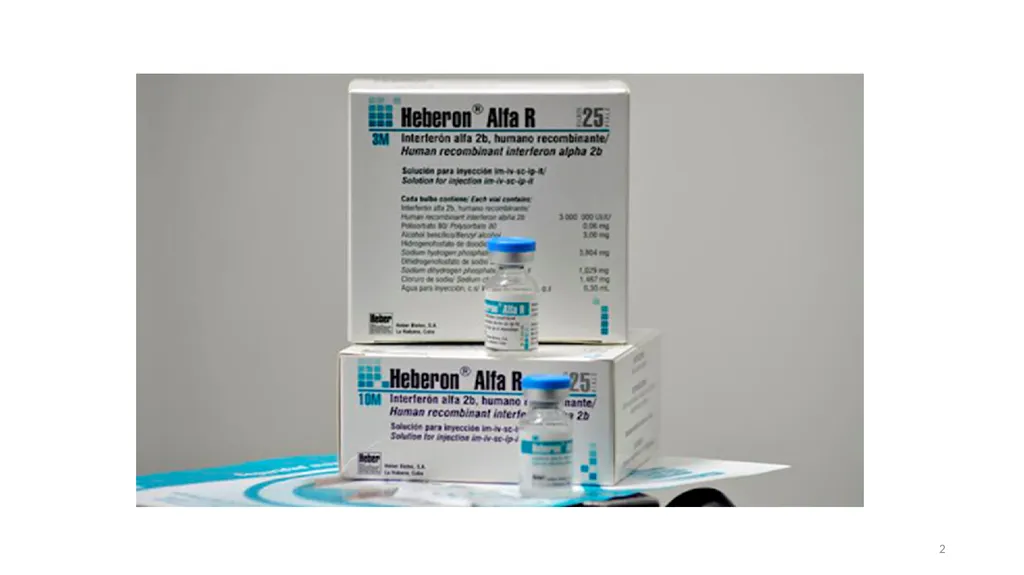
Problem Statement Maj-Gen LC Ford, in a classified internal memorandum, accused the SANDF of irregular processes during the procurement of Heberon® Alpha R 2B (Human Recombinant Alpha 2B Interferon)
Maj-Gen Ford questioned whether there was any need identified to procure the Interferon, the period in which this was decided, the period in which the Interferon was actually procured, the approval of the use of Interferon, the processes followed during the procurement of Interferon, the delivery and storage of the interferon, the payment for the Interferon, and whether or not the procurement of Interferon was conducted within the relevant prescripts. 3<br>
Maj-Gen Ford questioned whether there was any need identified to procure the Interferon, the period in which this was decided, the period in which the Interferon was actually procured, the approval of the use of Interferon, the processes followed during the procurement of Interferon, the delivery and storage of the interferon, the payment for the Interferon, and whether or not the procurement of Interferon was conducted within the relevant prescripts. 3<br>
04
Purpose of the Report The purpose of the report was:
to give a history of the procurement of Interferon Alpha 2B for the SANDF
to make findings and comment on the matters raised by Maj-Gen Ford, SAHPRA, and the AGSA
to identify the key role players
to assess the mischief faced by the SANDF and the DoD; and
to make recommendations for consideration by the Minister of Defence and Military Veterans. 4<br>
to give a history of the procurement of Interferon Alpha 2B for the SANDF
to make findings and comment on the matters raised by Maj-Gen Ford, SAHPRA, and the AGSA
to identify the key role players
to assess the mischief faced by the SANDF and the DoD; and
to make recommendations for consideration by the Minister of Defence and Military Veterans. 4<br>
05
The Ministerial Task Team The Ministerial Task Team (MTT) was appointed in February 2021 to investigate a raft of allegations against the DoD, in particular the SANDF, including allegations on the procurement of the Interferon.
The MTT is constituted by:
Members: Mr Zolile Ngcakani (Chairperson); Mr Billy Masetlha; and Dr Cassius Lubisi
The MTT is supported by a secretariat and a legal resource person 5<br>
The MTT is constituted by:
Members: Mr Zolile Ngcakani (Chairperson); Mr Billy Masetlha; and Dr Cassius Lubisi
The MTT is supported by a secretariat and a legal resource person 5<br>
06
Methodology Inquisitorial approach (vis-à-vis adversarial approach)
Document review
Interviews with key stakeholders
Statements and/or sworn affidavits (one such submitted) 6<br>
Document review
Interviews with key stakeholders
Statements and/or sworn affidavits (one such submitted) 6<br>
07
Context – A 100 Year Spectre Hits the Globe Dr Zhang Jixian treats three patients with a novel manifestation of pneumonia in Wuhan City, Hebei Province of the People’s Republic of China on 26 and 27 December 2019, and sounds the alarm bells.
COVID-19, caused by the novel virus SARS-Cov-2, had landed!
The World Health Organisation (WHO) is caught off guard:
30 January 2020: Declares COVID-19 as “a public health emergency of international concern”
11 March 2020: Declares COVID-19 “a global pandemic”
WHO DG Dr Tedros Ghebreyesus gives a four-point strategy for nations to follow, and calling on nations to “innovate”
A global war against an unknown enemy is declared.
When assessing strategies and tactics adopted during this period, it is best to caution against evaluating war time actions against peace time criteria – this is a very DIFFICULT balance to strike 7<br>
COVID-19, caused by the novel virus SARS-Cov-2, had landed!
The World Health Organisation (WHO) is caught off guard:
30 January 2020: Declares COVID-19 as “a public health emergency of international concern”
11 March 2020: Declares COVID-19 “a global pandemic”
WHO DG Dr Tedros Ghebreyesus gives a four-point strategy for nations to follow, and calling on nations to “innovate”
A global war against an unknown enemy is declared.
When assessing strategies and tactics adopted during this period, it is best to caution against evaluating war time actions against peace time criteria – this is a very DIFFICULT balance to strike 7<br>
08
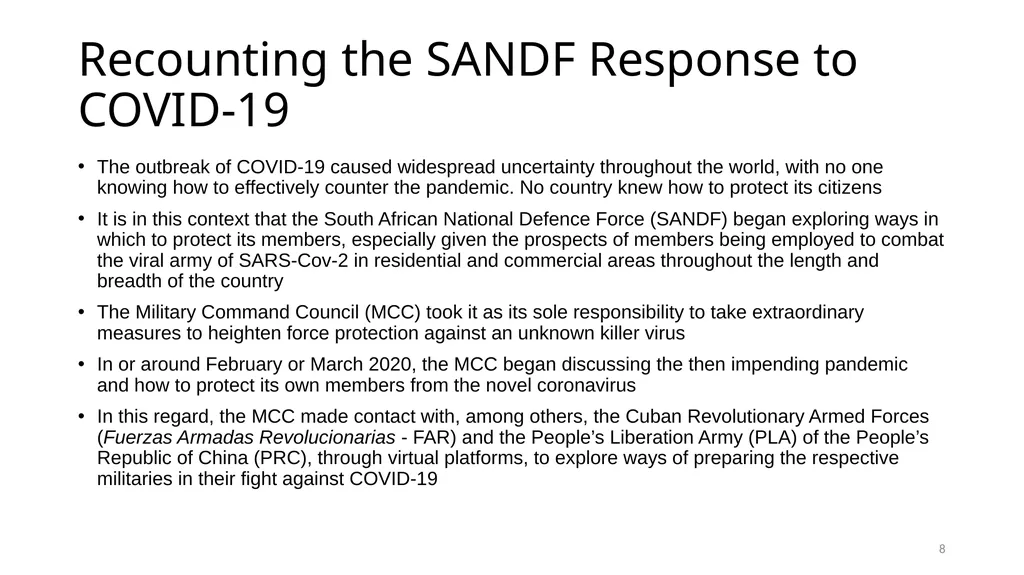
Recounting the SANDF Response to COVID-19 The outbreak of COVID-19 caused widespread uncertainty throughout the world, with no one knowing how to effectively counter the pandemic. No country knew how to protect its citizens
It is in this context that the South African National Defence Force (SANDF) began exploring ways in which to protect its members, especially given the prospects of members being employed to combat the viral army of SARS-Cov-2 in residential and commercial areas throughout the length and breadth of the country
The Military Command Council (MCC) took it as its sole responsibility to take extraordinary measures to heighten force protection against an unknown killer virus
In or around February or March 2020, the MCC began discussing the then impending pandemic and how to protect its own members from the novel coronavirus
In this regard, the MCC made contact with, among others, the Cuban Revolutionary Armed Forces (Fuerzas Armadas Revolucionarias - FAR) and the People’s Liberation Army (PLA) of the People’s Republic of China (PRC), through virtual platforms, to explore ways of preparing the respective militaries in their fight against COVID-19 8<br>
It is in this context that the South African National Defence Force (SANDF) began exploring ways in which to protect its members, especially given the prospects of members being employed to combat the viral army of SARS-Cov-2 in residential and commercial areas throughout the length and breadth of the country
The Military Command Council (MCC) took it as its sole responsibility to take extraordinary measures to heighten force protection against an unknown killer virus
In or around February or March 2020, the MCC began discussing the then impending pandemic and how to protect its own members from the novel coronavirus
In this regard, the MCC made contact with, among others, the Cuban Revolutionary Armed Forces (Fuerzas Armadas Revolucionarias - FAR) and the People’s Liberation Army (PLA) of the People’s Republic of China (PRC), through virtual platforms, to explore ways of preparing the respective militaries in their fight against COVID-19 8<br>
09
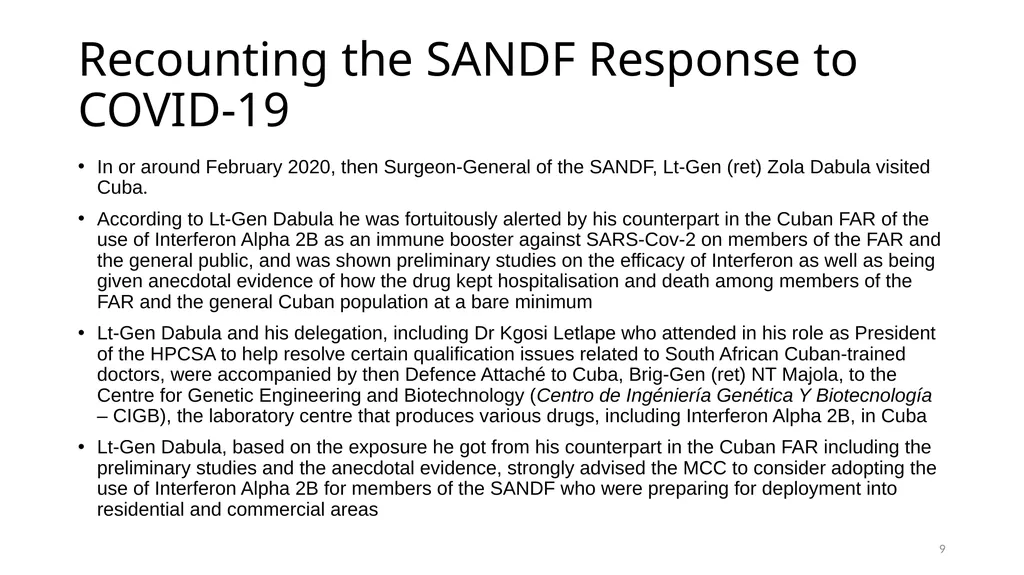
Recounting the SANDF Response to COVID-19 In or around February 2020, then Surgeon-General of the SANDF, Lt-Gen (ret) Zola Dabula visited Cuba.
According to Lt-Gen Dabula he was fortuitously alerted by his counterpart in the Cuban FAR of the use of Interferon Alpha 2B as an immune booster against SARS-Cov-2 on members of the FAR and the general public, and was shown preliminary studies on the efficacy of Interferon as well as being given anecdotal evidence of how the drug kept hospitalisation and death among members of the FAR and the general Cuban population at a bare minimum
Lt-Gen Dabula and his delegation, including Dr Kgosi Letlape who attended in his role as President of the HPCSA to help resolve certain qualification issues related to South African Cuban-trained doctors, were accompanied by then Defence Attaché to Cuba, Brig-Gen (ret) NT Majola, to the Centre for Genetic Engineering and Biotechnology (Centro de Ingéniería Genética Y Biotecnología – CIGB), the laboratory centre that produces various drugs, including Interferon Alpha 2B, in Cuba
Lt-Gen Dabula, based on the exposure he got from his counterpart in the Cuban FAR including the preliminary studies and the anecdotal evidence, strongly advised the MCC to consider adopting the use of Interferon Alpha 2B for members of the SANDF who were preparing for deployment into residential and commercial areas 9<br>
According to Lt-Gen Dabula he was fortuitously alerted by his counterpart in the Cuban FAR of the use of Interferon Alpha 2B as an immune booster against SARS-Cov-2 on members of the FAR and the general public, and was shown preliminary studies on the efficacy of Interferon as well as being given anecdotal evidence of how the drug kept hospitalisation and death among members of the FAR and the general Cuban population at a bare minimum
Lt-Gen Dabula and his delegation, including Dr Kgosi Letlape who attended in his role as President of the HPCSA to help resolve certain qualification issues related to South African Cuban-trained doctors, were accompanied by then Defence Attaché to Cuba, Brig-Gen (ret) NT Majola, to the Centre for Genetic Engineering and Biotechnology (Centro de Ingéniería Genética Y Biotecnología – CIGB), the laboratory centre that produces various drugs, including Interferon Alpha 2B, in Cuba
Lt-Gen Dabula, based on the exposure he got from his counterpart in the Cuban FAR including the preliminary studies and the anecdotal evidence, strongly advised the MCC to consider adopting the use of Interferon Alpha 2B for members of the SANDF who were preparing for deployment into residential and commercial areas 9<br>
10
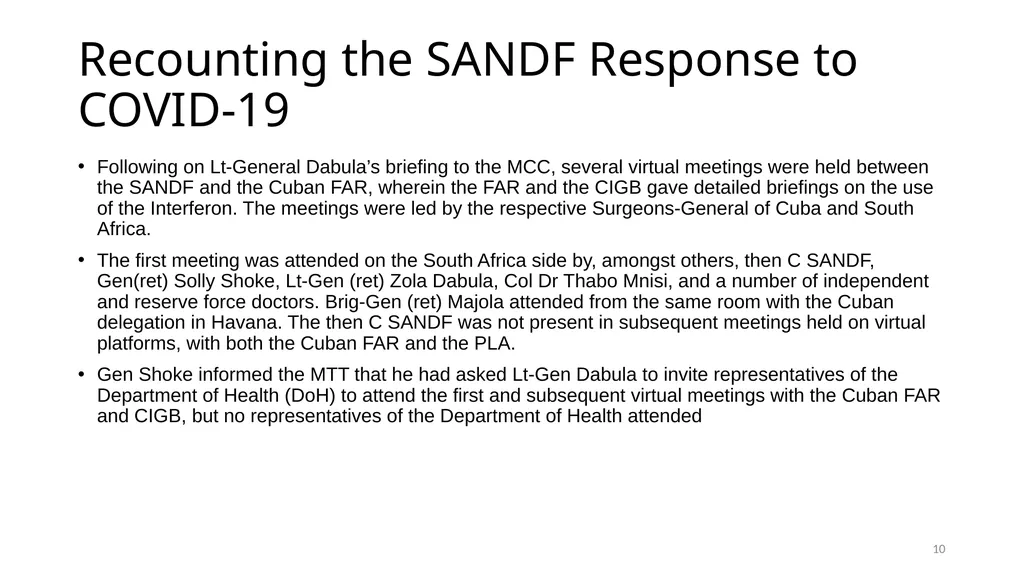
Recounting the SANDF Response to COVID-19 Following on Lt-General Dabula’s briefing to the MCC, several virtual meetings were held between the SANDF and the Cuban FAR, wherein the FAR and the CIGB gave detailed briefings on the use of the Interferon. The meetings were led by the respective Surgeons-General of Cuba and South Africa.
The first meeting was attended on the South Africa side by, amongst others, then C SANDF, Gen(ret) Solly Shoke, Lt-Gen (ret) Zola Dabula, Col Dr Thabo Mnisi, and a number of independent and reserve force doctors. Brig-Gen (ret) Majola attended from the same room with the Cuban delegation in Havana. The then C SANDF was not present in subsequent meetings held on virtual platforms, with both the Cuban FAR and the PLA.
Gen Shoke informed the MTT that he had asked Lt-Gen Dabula to invite representatives of the Department of Health (DoH) to attend the first and subsequent virtual meetings with the Cuban FAR and CIGB, but no representatives of the Department of Health attended 10<br>
The first meeting was attended on the South Africa side by, amongst others, then C SANDF, Gen(ret) Solly Shoke, Lt-Gen (ret) Zola Dabula, Col Dr Thabo Mnisi, and a number of independent and reserve force doctors. Brig-Gen (ret) Majola attended from the same room with the Cuban delegation in Havana. The then C SANDF was not present in subsequent meetings held on virtual platforms, with both the Cuban FAR and the PLA.
Gen Shoke informed the MTT that he had asked Lt-Gen Dabula to invite representatives of the Department of Health (DoH) to attend the first and subsequent virtual meetings with the Cuban FAR and CIGB, but no representatives of the Department of Health attended 10<br>
11
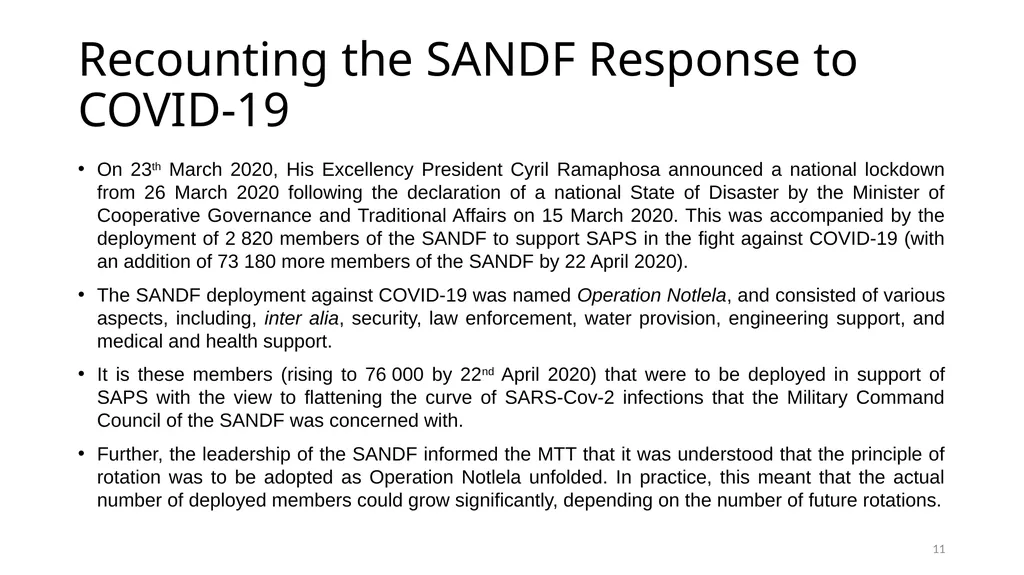
Recounting the SANDF Response to COVID-19 On 23th March 2020, His Excellency President Cyril Ramaphosa announced a national lockdown from 26 March 2020 following the declaration of a national State of Disaster by the Minister of Cooperative Governance and Traditional Affairs on 15 March 2020. This was accompanied by the deployment of 2 820 members of the SANDF to support SAPS in the fight against COVID-19 (with an addition of 73 180 more members of the SANDF by 22 April 2020).
The SANDF deployment against COVID-19 was named Operation Notlela, and consisted of various aspects, including, inter alia, security, law enforcement, water provision, engineering support, and medical and health support.
It is these members (rising to 76 000 by 22nd April 2020) that were to be deployed in support of SAPS with the view to flattening the curve of SARS-Cov-2 infections that the Military Command Council of the SANDF was concerned with.
Further, the leadership of the SANDF informed the MTT that it was understood that the principle of rotation was to be adopted as Operation Notlela unfolded. In practice, this meant that the actual number of deployed members could grow significantly, depending on the number of future rotations. 11<br>
The SANDF deployment against COVID-19 was named Operation Notlela, and consisted of various aspects, including, inter alia, security, law enforcement, water provision, engineering support, and medical and health support.
It is these members (rising to 76 000 by 22nd April 2020) that were to be deployed in support of SAPS with the view to flattening the curve of SARS-Cov-2 infections that the Military Command Council of the SANDF was concerned with.
Further, the leadership of the SANDF informed the MTT that it was understood that the principle of rotation was to be adopted as Operation Notlela unfolded. In practice, this meant that the actual number of deployed members could grow significantly, depending on the number of future rotations. 11<br>
12
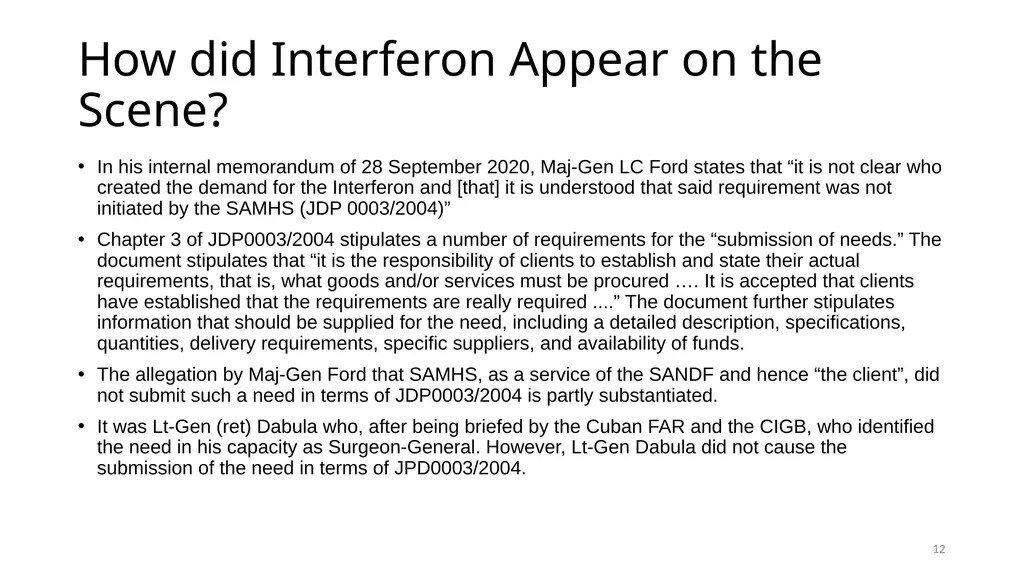
How did Interferon Appear on the Scene? In his internal memorandum of 28 September 2020, Maj-Gen LC Ford states that “it is not clear who created the demand for the Interferon and [that] it is understood that said requirement was not initiated by the SAMHS (JDP 0003/2004)”
Chapter 3 of JDP0003/2004 stipulates a number of requirements for the “submission of needs.” The document stipulates that “it is the responsibility of clients to establish and state their actual requirements, that is, what goods and/or services must be procured …. It is accepted that clients have established that the requirements are really required ....” The document further stipulates information that should be supplied for the need, including a detailed description, specifications, quantities, delivery requirements, specific suppliers, and availability of funds.
The allegation by Maj-Gen Ford that SAMHS, as a service of the SANDF and hence “the client”, did not submit such a need in terms of JDP0003/2004 is partly substantiated.
It was Lt-Gen (ret) Dabula who, after being briefed by the Cuban FAR and the CIGB, who identified the need in his capacity as Surgeon-General. However, Lt-Gen Dabula did not cause the submission of the need in terms of JPD0003/2004. 12<br>
Chapter 3 of JDP0003/2004 stipulates a number of requirements for the “submission of needs.” The document stipulates that “it is the responsibility of clients to establish and state their actual requirements, that is, what goods and/or services must be procured …. It is accepted that clients have established that the requirements are really required ....” The document further stipulates information that should be supplied for the need, including a detailed description, specifications, quantities, delivery requirements, specific suppliers, and availability of funds.
The allegation by Maj-Gen Ford that SAMHS, as a service of the SANDF and hence “the client”, did not submit such a need in terms of JDP0003/2004 is partly substantiated.
It was Lt-Gen (ret) Dabula who, after being briefed by the Cuban FAR and the CIGB, who identified the need in his capacity as Surgeon-General. However, Lt-Gen Dabula did not cause the submission of the need in terms of JPD0003/2004. 12<br>
13
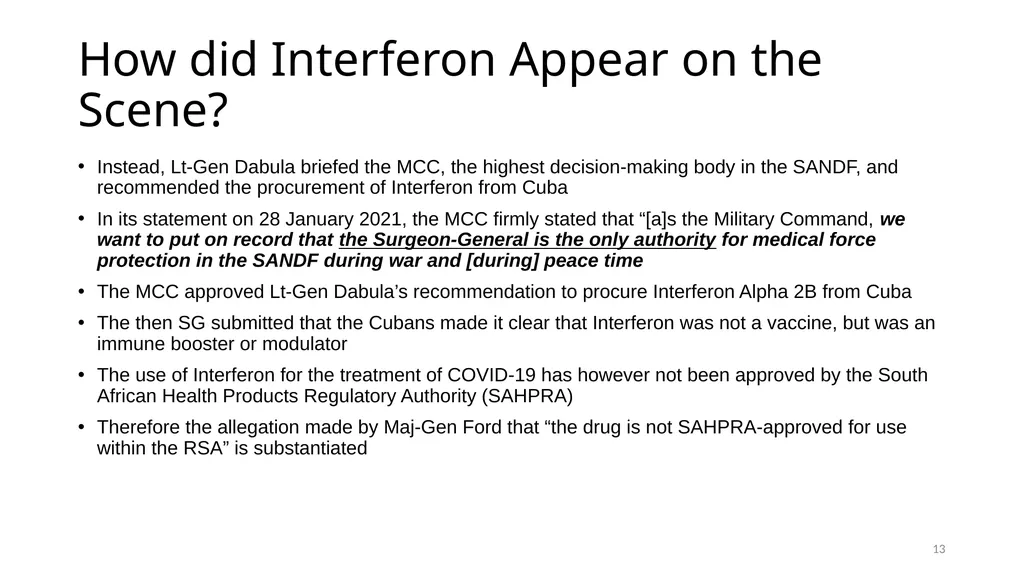
How did Interferon Appear on the Scene? Instead, Lt-Gen Dabula briefed the MCC, the highest decision-making body in the SANDF, and recommended the procurement of Interferon from Cuba
In its statement on 28 January 2021, the MCC firmly stated that “[a]s the Military Command, we want to put on record that the Surgeon-General is the only authority for medical force protection in the SANDF during war and [during] peace time
The MCC approved Lt-Gen Dabula’s recommendation to procure Interferon Alpha 2B from Cuba
The then SG submitted that the Cubans made it clear that Interferon was not a vaccine, but was an immune booster or modulator
The use of Interferon for the treatment of COVID-19 has however not been approved by the South African Health Products Regulatory Authority (SAHPRA)
Therefore the allegation made by Maj-Gen Ford that “the drug is not SAHPRA-approved for use within the RSA” is substantiated 13<br>
In its statement on 28 January 2021, the MCC firmly stated that “[a]s the Military Command, we want to put on record that the Surgeon-General is the only authority for medical force protection in the SANDF during war and [during] peace time
The MCC approved Lt-Gen Dabula’s recommendation to procure Interferon Alpha 2B from Cuba
The then SG submitted that the Cubans made it clear that Interferon was not a vaccine, but was an immune booster or modulator
The use of Interferon for the treatment of COVID-19 has however not been approved by the South African Health Products Regulatory Authority (SAHPRA)
Therefore the allegation made by Maj-Gen Ford that “the drug is not SAHPRA-approved for use within the RSA” is substantiated 13<br>
14
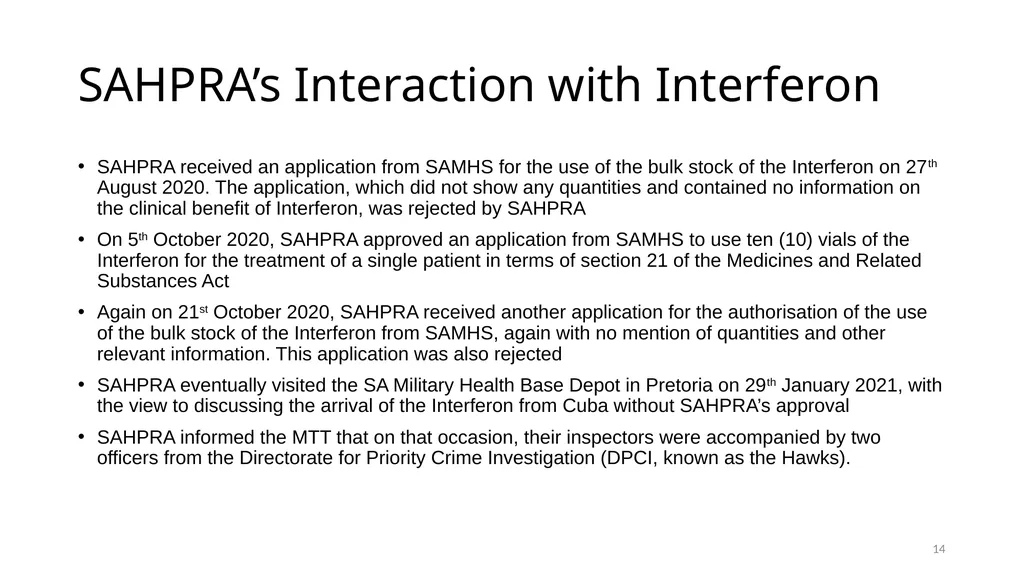
SAHPRA’s Interaction with Interferon SAHPRA received an application from SAMHS for the use of the bulk stock of the Interferon on 27th August 2020. The application, which did not show any quantities and contained no information on the clinical benefit of Interferon, was rejected by SAHPRA
On 5th October 2020, SAHPRA approved an application from SAMHS to use ten (10) vials of the Interferon for the treatment of a single patient in terms of section 21 of the Medicines and Related Substances Act
Again on 21st October 2020, SAHPRA received another application for the authorisation of the use of the bulk stock of the Interferon from SAMHS, again with no mention of quantities and other relevant information. This application was also rejected
SAHPRA eventually visited the SA Military Health Base Depot in Pretoria on 29th January 2021, with the view to discussing the arrival of the Interferon from Cuba without SAHPRA’s approval
SAHPRA informed the MTT that on that occasion, their inspectors were accompanied by two officers from the Directorate for Priority Crime Investigation (DPCI, known as the Hawks). 14<br>
On 5th October 2020, SAHPRA approved an application from SAMHS to use ten (10) vials of the Interferon for the treatment of a single patient in terms of section 21 of the Medicines and Related Substances Act
Again on 21st October 2020, SAHPRA received another application for the authorisation of the use of the bulk stock of the Interferon from SAMHS, again with no mention of quantities and other relevant information. This application was also rejected
SAHPRA eventually visited the SA Military Health Base Depot in Pretoria on 29th January 2021, with the view to discussing the arrival of the Interferon from Cuba without SAHPRA’s approval
SAHPRA informed the MTT that on that occasion, their inspectors were accompanied by two officers from the Directorate for Priority Crime Investigation (DPCI, known as the Hawks). 14<br>
15
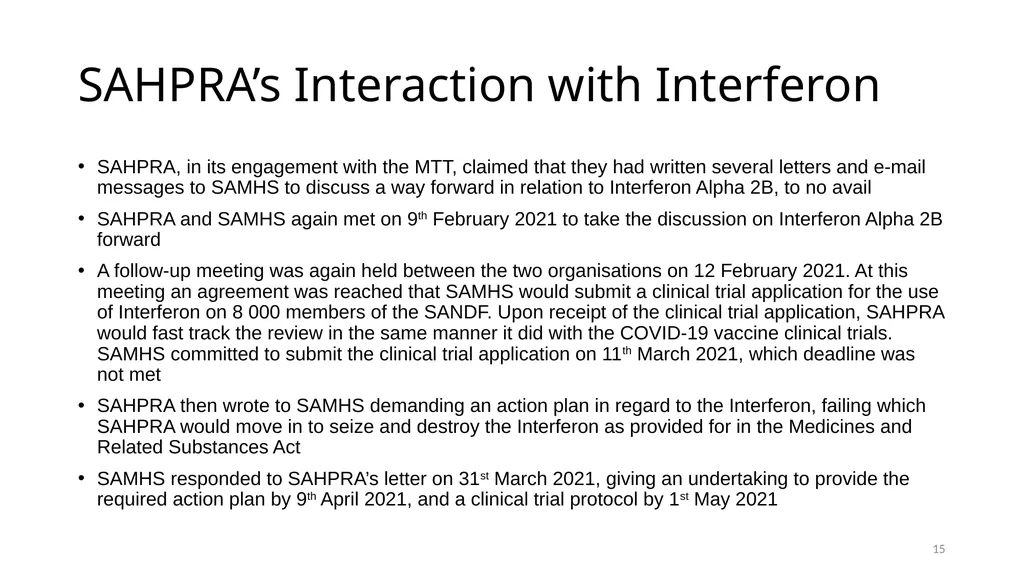
SAHPRA’s Interaction with Interferon SAHPRA, in its engagement with the MTT, claimed that they had written several letters and e-mail messages to SAMHS to discuss a way forward in relation to Interferon Alpha 2B, to no avail
SAHPRA and SAMHS again met on 9th February 2021 to take the discussion on Interferon Alpha 2B forward
A follow-up meeting was again held between the two organisations on 12 February 2021. At this meeting an agreement was reached that SAMHS would submit a clinical trial application for the use of Interferon on 8 000 members of the SANDF. Upon receipt of the clinical trial application, SAHPRA would fast track the review in the same manner it did with the COVID-19 vaccine clinical trials. SAMHS committed to submit the clinical trial application on 11th March 2021, which deadline was not met
SAHPRA then wrote to SAMHS demanding an action plan in regard to the Interferon, failing which SAHPRA would move in to seize and destroy the Interferon as provided for in the Medicines and Related Substances Act
SAMHS responded to SAHPRA’s letter on 31st March 2021, giving an undertaking to provide the required action plan by 9th April 2021, and a clinical trial protocol by 1st May 2021 15<br>
SAHPRA and SAMHS again met on 9th February 2021 to take the discussion on Interferon Alpha 2B forward
A follow-up meeting was again held between the two organisations on 12 February 2021. At this meeting an agreement was reached that SAMHS would submit a clinical trial application for the use of Interferon on 8 000 members of the SANDF. Upon receipt of the clinical trial application, SAHPRA would fast track the review in the same manner it did with the COVID-19 vaccine clinical trials. SAMHS committed to submit the clinical trial application on 11th March 2021, which deadline was not met
SAHPRA then wrote to SAMHS demanding an action plan in regard to the Interferon, failing which SAHPRA would move in to seize and destroy the Interferon as provided for in the Medicines and Related Substances Act
SAMHS responded to SAHPRA’s letter on 31st March 2021, giving an undertaking to provide the required action plan by 9th April 2021, and a clinical trial protocol by 1st May 2021 15<br>
16
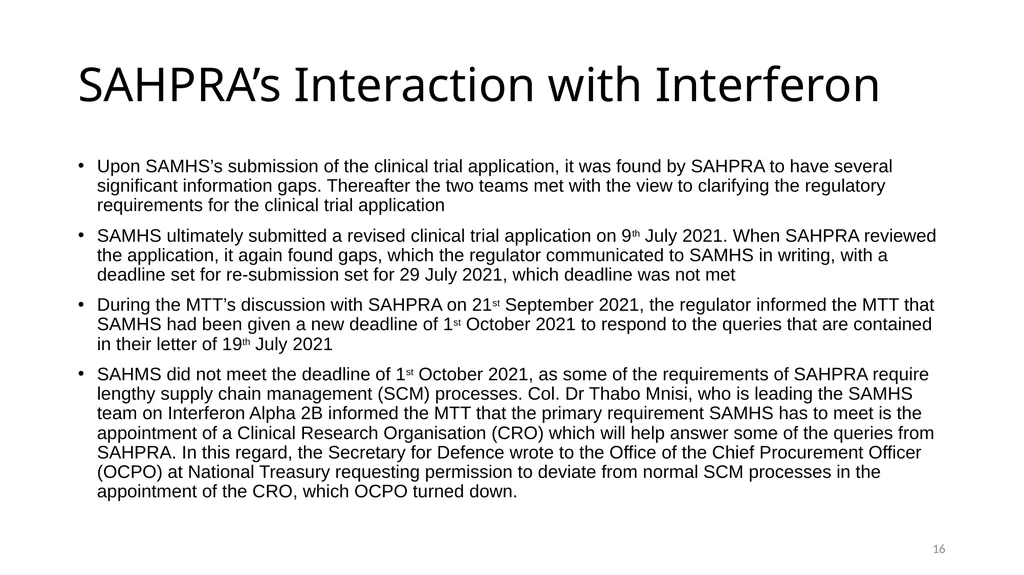
SAHPRA’s Interaction with Interferon Upon SAMHS’s submission of the clinical trial application, it was found by SAHPRA to have several significant information gaps. Thereafter the two teams met with the view to clarifying the regulatory requirements for the clinical trial application
SAMHS ultimately submitted a revised clinical trial application on 9th July 2021. When SAHPRA reviewed the application, it again found gaps, which the regulator communicated to SAMHS in writing, with a deadline set for re-submission set for 29 July 2021, which deadline was not met
During the MTT’s discussion with SAHPRA on 21st September 2021, the regulator informed the MTT that SAMHS had been given a new deadline of 1st October 2021 to respond to the queries that are contained in their letter of 19th July 2021
SAHMS did not meet the deadline of 1st October 2021, as some of the requirements of SAHPRA require lengthy supply chain management (SCM) processes. Col. Dr Thabo Mnisi, who is leading the SAMHS team on Interferon Alpha 2B informed the MTT that the primary requirement SAMHS has to meet is the appointment of a Clinical Research Organisation (CRO) which will help answer some of the queries from SAHPRA. In this regard, the Secretary for Defence wrote to the Office of the Chief Procurement Officer (OCPO) at National Treasury requesting permission to deviate from normal SCM processes in the appointment of the CRO, which OCPO turned down. 16<br>
SAMHS ultimately submitted a revised clinical trial application on 9th July 2021. When SAHPRA reviewed the application, it again found gaps, which the regulator communicated to SAMHS in writing, with a deadline set for re-submission set for 29 July 2021, which deadline was not met
During the MTT’s discussion with SAHPRA on 21st September 2021, the regulator informed the MTT that SAMHS had been given a new deadline of 1st October 2021 to respond to the queries that are contained in their letter of 19th July 2021
SAHMS did not meet the deadline of 1st October 2021, as some of the requirements of SAHPRA require lengthy supply chain management (SCM) processes. Col. Dr Thabo Mnisi, who is leading the SAMHS team on Interferon Alpha 2B informed the MTT that the primary requirement SAMHS has to meet is the appointment of a Clinical Research Organisation (CRO) which will help answer some of the queries from SAHPRA. In this regard, the Secretary for Defence wrote to the Office of the Chief Procurement Officer (OCPO) at National Treasury requesting permission to deviate from normal SCM processes in the appointment of the CRO, which OCPO turned down. 16<br>
17
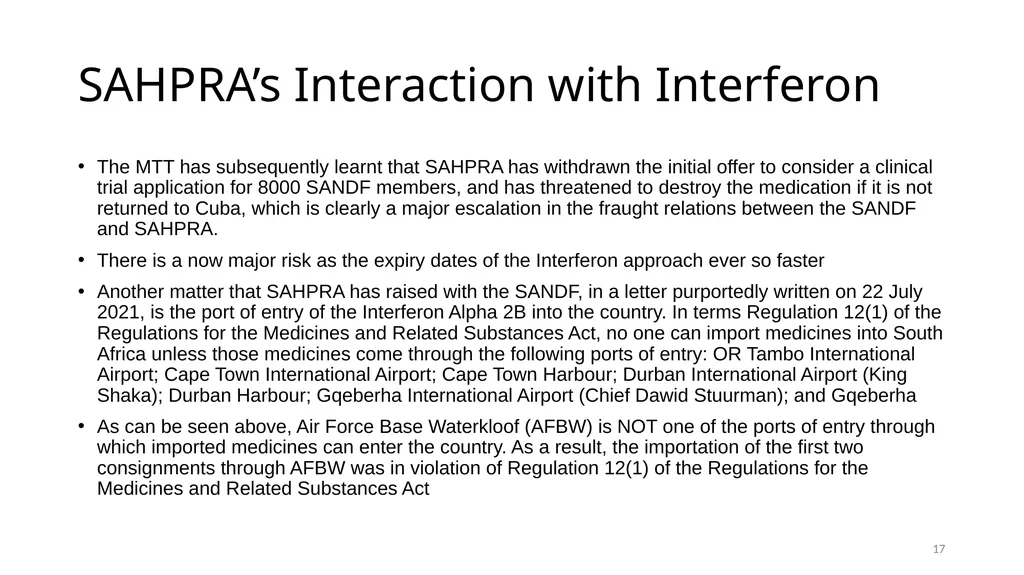
SAHPRA’s Interaction with Interferon The MTT has subsequently learnt that SAHPRA has withdrawn the initial offer to consider a clinical trial application for 8000 SANDF members, and has threatened to destroy the medication if it is not returned to Cuba, which is clearly a major escalation in the fraught relations between the SANDF and SAHPRA.
There is a now major risk as the expiry dates of the Interferon approach ever so faster
Another matter that SAHPRA has raised with the SANDF, in a letter purportedly written on 22 July 2021, is the port of entry of the Interferon Alpha 2B into the country. In terms Regulation 12(1) of the Regulations for the Medicines and Related Substances Act, no one can import medicines into South Africa unless those medicines come through the following ports of entry: OR Tambo International Airport; Cape Town International Airport; Cape Town Harbour; Durban International Airport (King Shaka); Durban Harbour; Gqeberha International Airport (Chief Dawid Stuurman); and Gqeberha
As can be seen above, Air Force Base Waterkloof (AFBW) is NOT one of the ports of entry through which imported medicines can enter the country. As a result, the importation of the first two consignments through AFBW was in violation of Regulation 12(1) of the Regulations for the Medicines and Related Substances Act 17<br>
There is a now major risk as the expiry dates of the Interferon approach ever so faster
Another matter that SAHPRA has raised with the SANDF, in a letter purportedly written on 22 July 2021, is the port of entry of the Interferon Alpha 2B into the country. In terms Regulation 12(1) of the Regulations for the Medicines and Related Substances Act, no one can import medicines into South Africa unless those medicines come through the following ports of entry: OR Tambo International Airport; Cape Town International Airport; Cape Town Harbour; Durban International Airport (King Shaka); Durban Harbour; Gqeberha International Airport (Chief Dawid Stuurman); and Gqeberha
As can be seen above, Air Force Base Waterkloof (AFBW) is NOT one of the ports of entry through which imported medicines can enter the country. As a result, the importation of the first two consignments through AFBW was in violation of Regulation 12(1) of the Regulations for the Medicines and Related Substances Act 17<br>
18
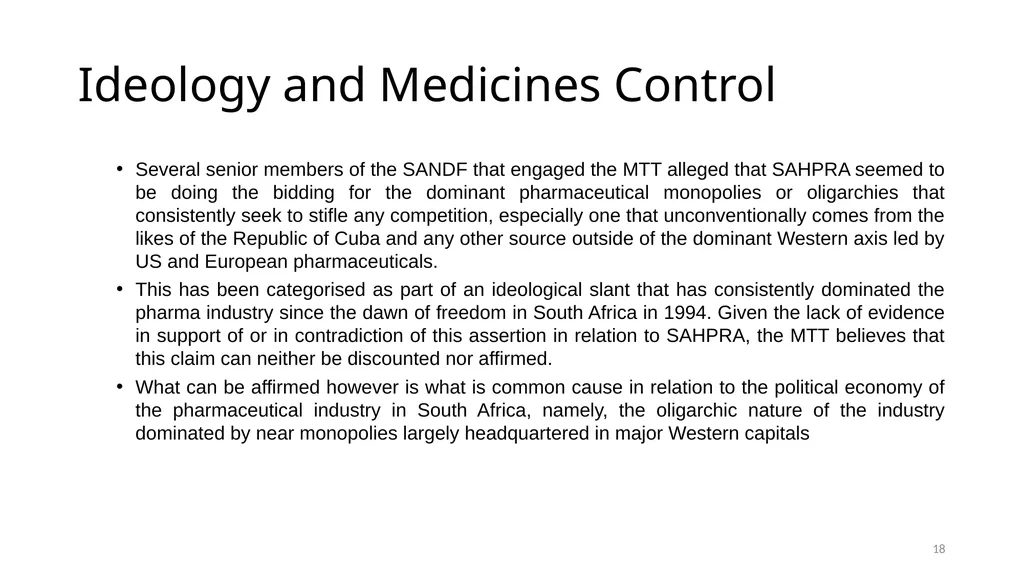
Ideology and Medicines Control Several senior members of the SANDF that engaged the MTT alleged that SAHPRA seemed to be doing the bidding for the dominant pharmaceutical monopolies or oligarchies that consistently seek to stifle any competition, especially one that unconventionally comes from the likes of the Republic of Cuba and any other source outside of the dominant Western axis led by US and European pharmaceuticals.
This has been categorised as part of an ideological slant that has consistently dominated the pharma industry since the dawn of freedom in South Africa in 1994. Given the lack of evidence in support of or in contradiction of this assertion in relation to SAHPRA, the MTT believes that this claim can neither be discounted nor affirmed.
What can be affirmed however is what is common cause in relation to the political economy of the pharmaceutical industry in South Africa, namely, the oligarchic nature of the industry dominated by near monopolies largely headquartered in major Western capitals 18<br>
This has been categorised as part of an ideological slant that has consistently dominated the pharma industry since the dawn of freedom in South Africa in 1994. Given the lack of evidence in support of or in contradiction of this assertion in relation to SAHPRA, the MTT believes that this claim can neither be discounted nor affirmed.
What can be affirmed however is what is common cause in relation to the political economy of the pharmaceutical industry in South Africa, namely, the oligarchic nature of the industry dominated by near monopolies largely headquartered in major Western capitals 18<br>
19
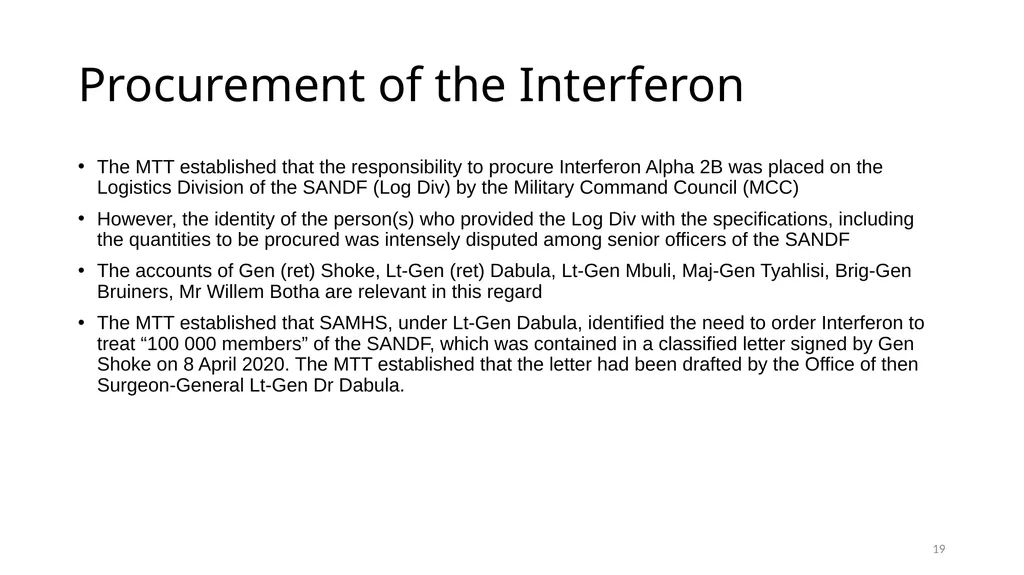
Procurement of the Interferon The MTT established that the responsibility to procure Interferon Alpha 2B was placed on the Logistics Division of the SANDF (Log Div) by the Military Command Council (MCC)
However, the identity of the person(s) who provided the Log Div with the specifications, including the quantities to be procured was intensely disputed among senior officers of the SANDF
The accounts of Gen (ret) Shoke, Lt-Gen (ret) Dabula, Lt-Gen Mbuli, Maj-Gen Tyahlisi, Brig-Gen Bruiners, Mr Willem Botha are relevant in this regard
The MTT established that SAMHS, under Lt-Gen Dabula, identified the need to order Interferon to treat “100 000 members” of the SANDF, which was contained in a classified letter signed by Gen Shoke on 8 April 2020. The MTT established that the letter had been drafted by the Office of then Surgeon-General Lt-Gen Dr Dabula. 19<br>
However, the identity of the person(s) who provided the Log Div with the specifications, including the quantities to be procured was intensely disputed among senior officers of the SANDF
The accounts of Gen (ret) Shoke, Lt-Gen (ret) Dabula, Lt-Gen Mbuli, Maj-Gen Tyahlisi, Brig-Gen Bruiners, Mr Willem Botha are relevant in this regard
The MTT established that SAMHS, under Lt-Gen Dabula, identified the need to order Interferon to treat “100 000 members” of the SANDF, which was contained in a classified letter signed by Gen Shoke on 8 April 2020. The MTT established that the letter had been drafted by the Office of then Surgeon-General Lt-Gen Dr Dabula. 19<br>
20
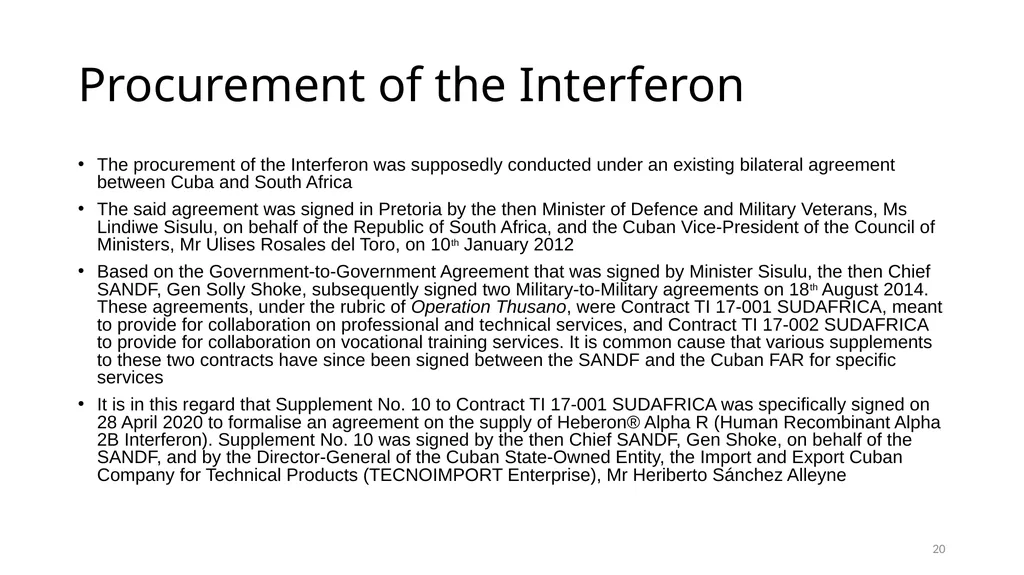
Procurement of the Interferon The procurement of the Interferon was supposedly conducted under an existing bilateral agreement between Cuba and South Africa
The said agreement was signed in Pretoria by the then Minister of Defence and Military Veterans, Ms Lindiwe Sisulu, on behalf of the Republic of South Africa, and the Cuban Vice-President of the Council of Ministers, Mr Ulises Rosales del Toro, on 10th January 2012
Based on the Government-to-Government Agreement that was signed by Minister Sisulu, the then Chief SANDF, Gen Solly Shoke, subsequently signed two Military-to-Military agreements on 18th August 2014. These agreements, under the rubric of Operation Thusano, were Contract TI 17-001 SUDAFRICA, meant to provide for collaboration on professional and technical services, and Contract TI 17-002 SUDAFRICA to provide for collaboration on vocational training services. It is common cause that various supplements to these two contracts have since been signed between the SANDF and the Cuban FAR for specific services
It is in this regard that Supplement No. 10 to Contract TI 17-001 SUDAFRICA was specifically signed on 28 April 2020 to formalise an agreement on the supply of Heberon® Alpha R (Human Recombinant Alpha 2B Interferon). Supplement No. 10 was signed by the then Chief SANDF, Gen Shoke, on behalf of the SANDF, and by the Director-General of the Cuban State-Owned Entity, the Import and Export Cuban Company for Technical Products (TECNOIMPORT Enterprise), Mr Heriberto Sánchez Alleyne 20<br>
The said agreement was signed in Pretoria by the then Minister of Defence and Military Veterans, Ms Lindiwe Sisulu, on behalf of the Republic of South Africa, and the Cuban Vice-President of the Council of Ministers, Mr Ulises Rosales del Toro, on 10th January 2012
Based on the Government-to-Government Agreement that was signed by Minister Sisulu, the then Chief SANDF, Gen Solly Shoke, subsequently signed two Military-to-Military agreements on 18th August 2014. These agreements, under the rubric of Operation Thusano, were Contract TI 17-001 SUDAFRICA, meant to provide for collaboration on professional and technical services, and Contract TI 17-002 SUDAFRICA to provide for collaboration on vocational training services. It is common cause that various supplements to these two contracts have since been signed between the SANDF and the Cuban FAR for specific services
It is in this regard that Supplement No. 10 to Contract TI 17-001 SUDAFRICA was specifically signed on 28 April 2020 to formalise an agreement on the supply of Heberon® Alpha R (Human Recombinant Alpha 2B Interferon). Supplement No. 10 was signed by the then Chief SANDF, Gen Shoke, on behalf of the SANDF, and by the Director-General of the Cuban State-Owned Entity, the Import and Export Cuban Company for Technical Products (TECNOIMPORT Enterprise), Mr Heriberto Sánchez Alleyne 20<br>
21
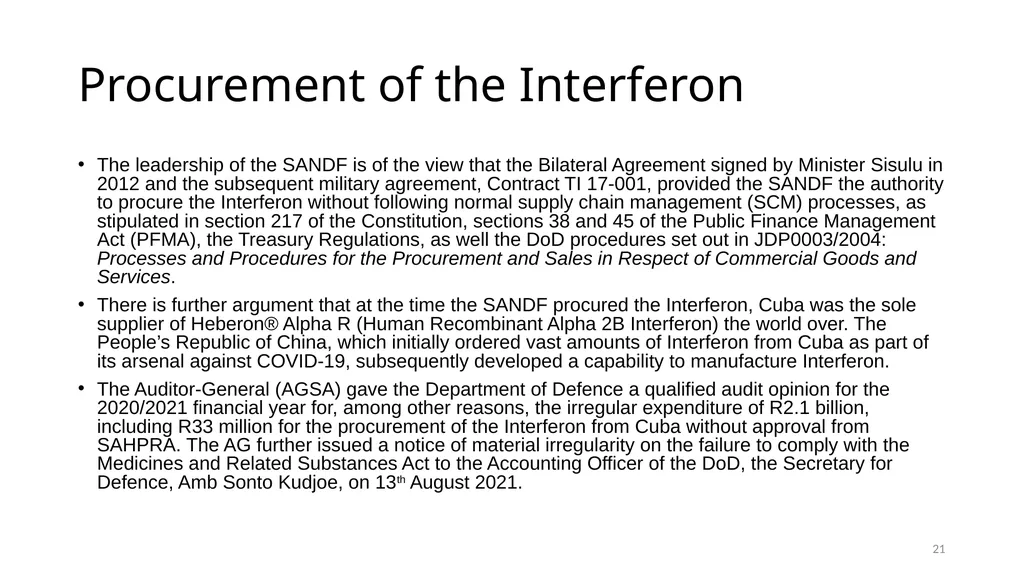
Procurement of the Interferon The leadership of the SANDF is of the view that the Bilateral Agreement signed by Minister Sisulu in 2012 and the subsequent military agreement, Contract TI 17-001, provided the SANDF the authority to procure the Interferon without following normal supply chain management (SCM) processes, as stipulated in section 217 of the Constitution, sections 38 and 45 of the Public Finance Management Act (PFMA), the Treasury Regulations, as well the DoD procedures set out in JDP0003/2004: Processes and Procedures for the Procurement and Sales in Respect of Commercial Goods and Services.
There is further argument that at the time the SANDF procured the Interferon, Cuba was the sole supplier of Heberon® Alpha R (Human Recombinant Alpha 2B Interferon) the world over. The People’s Republic of China, which initially ordered vast amounts of Interferon from Cuba as part of its arsenal against COVID-19, subsequently developed a capability to manufacture Interferon.
The Auditor-General (AGSA) gave the Department of Defence a qualified audit opinion for the 2020/2021 financial year for, among other reasons, the irregular expenditure of R2.1 billion, including R33 million for the procurement of the Interferon from Cuba without approval from SAHPRA. The AG further issued a notice of material irregularity on the failure to comply with the Medicines and Related Substances Act to the Accounting Officer of the DoD, the Secretary for Defence, Amb Sonto Kudjoe, on 13th August 2021. 21<br>
There is further argument that at the time the SANDF procured the Interferon, Cuba was the sole supplier of Heberon® Alpha R (Human Recombinant Alpha 2B Interferon) the world over. The People’s Republic of China, which initially ordered vast amounts of Interferon from Cuba as part of its arsenal against COVID-19, subsequently developed a capability to manufacture Interferon.
The Auditor-General (AGSA) gave the Department of Defence a qualified audit opinion for the 2020/2021 financial year for, among other reasons, the irregular expenditure of R2.1 billion, including R33 million for the procurement of the Interferon from Cuba without approval from SAHPRA. The AG further issued a notice of material irregularity on the failure to comply with the Medicines and Related Substances Act to the Accounting Officer of the DoD, the Secretary for Defence, Amb Sonto Kudjoe, on 13th August 2021. 21<br>
22
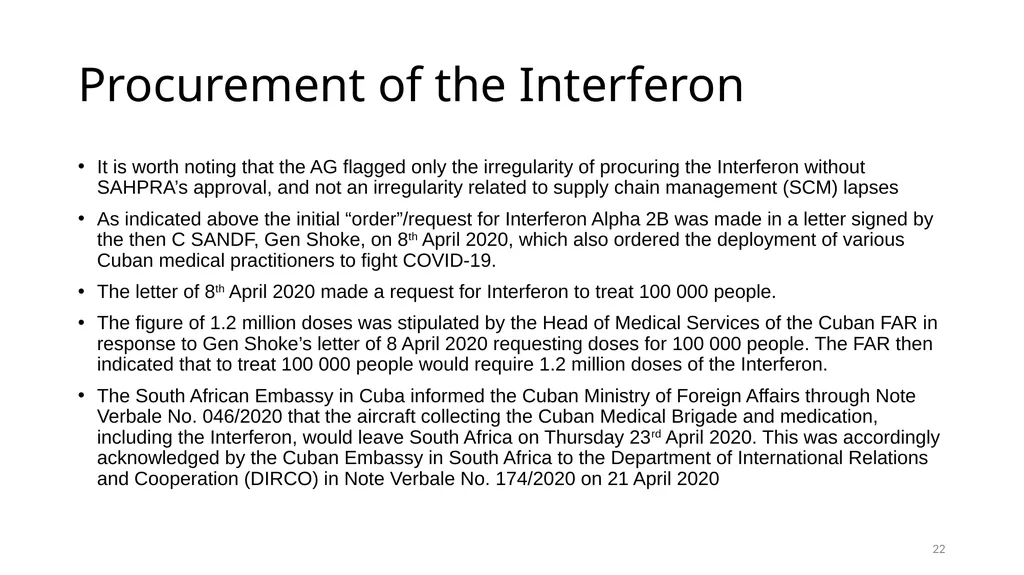
Procurement of the Interferon It is worth noting that the AG flagged only the irregularity of procuring the Interferon without SAHPRA’s approval, and not an irregularity related to supply chain management (SCM) lapses
As indicated above the initial “order”/request for Interferon Alpha 2B was made in a letter signed by the then C SANDF, Gen Shoke, on 8th April 2020, which also ordered the deployment of various Cuban medical practitioners to fight COVID-19.
The letter of 8th April 2020 made a request for Interferon to treat 100 000 people.
The figure of 1.2 million doses was stipulated by the Head of Medical Services of the Cuban FAR in response to Gen Shoke’s letter of 8 April 2020 requesting doses for 100 000 people. The FAR then indicated that to treat 100 000 people would require 1.2 million doses of the Interferon.
The South African Embassy in Cuba informed the Cuban Ministry of Foreign Affairs through Note Verbale No. 046/2020 that the aircraft collecting the Cuban Medical Brigade and medication, including the Interferon, would leave South Africa on Thursday 23rd April 2020. This was accordingly acknowledged by the Cuban Embassy in South Africa to the Department of International Relations and Cooperation (DIRCO) in Note Verbale No. 174/2020 on 21 April 2020 22<br>
As indicated above the initial “order”/request for Interferon Alpha 2B was made in a letter signed by the then C SANDF, Gen Shoke, on 8th April 2020, which also ordered the deployment of various Cuban medical practitioners to fight COVID-19.
The letter of 8th April 2020 made a request for Interferon to treat 100 000 people.
The figure of 1.2 million doses was stipulated by the Head of Medical Services of the Cuban FAR in response to Gen Shoke’s letter of 8 April 2020 requesting doses for 100 000 people. The FAR then indicated that to treat 100 000 people would require 1.2 million doses of the Interferon.
The South African Embassy in Cuba informed the Cuban Ministry of Foreign Affairs through Note Verbale No. 046/2020 that the aircraft collecting the Cuban Medical Brigade and medication, including the Interferon, would leave South Africa on Thursday 23rd April 2020. This was accordingly acknowledged by the Cuban Embassy in South Africa to the Department of International Relations and Cooperation (DIRCO) in Note Verbale No. 174/2020 on 21 April 2020 22<br>
23
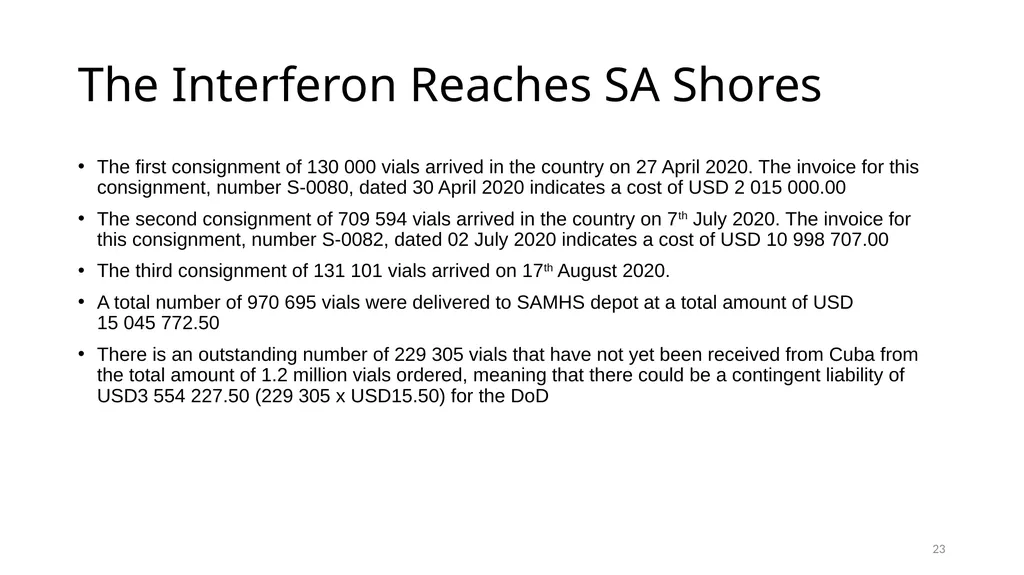
The Interferon Reaches SA Shores The first consignment of 130 000 vials arrived in the country on 27 April 2020. The invoice for this consignment, number S-0080, dated 30 April 2020 indicates a cost of USD 2 015 000.00
The second consignment of 709 594 vials arrived in the country on 7th July 2020. The invoice for this consignment, number S-0082, dated 02 July 2020 indicates a cost of USD 10 998 707.00
The third consignment of 131 101 vials arrived on 17th August 2020.
A total number of 970 695 vials were delivered to SAMHS depot at a total amount of USD 15 045 772.50
There is an outstanding number of 229 305 vials that have not yet been received from Cuba from the total amount of 1.2 million vials ordered, meaning that there could be a contingent liability of USD3 554 227.50 (229 305 x USD15.50) for the DoD 23<br>
The second consignment of 709 594 vials arrived in the country on 7th July 2020. The invoice for this consignment, number S-0082, dated 02 July 2020 indicates a cost of USD 10 998 707.00
The third consignment of 131 101 vials arrived on 17th August 2020.
A total number of 970 695 vials were delivered to SAMHS depot at a total amount of USD 15 045 772.50
There is an outstanding number of 229 305 vials that have not yet been received from Cuba from the total amount of 1.2 million vials ordered, meaning that there could be a contingent liability of USD3 554 227.50 (229 305 x USD15.50) for the DoD 23<br>
24
Delivery, Receipt and Storage of Interferon Then Surgeon-General Lt-Gen (ret) Zola Dabula was asked by Gen Shoke to represent the SANDF in welcoming the Cuban Medical Brigade at Air Force Base Waterkloof.
At around 12:00 noon on 27 April 2020, Col Lorraine May, then Officer Commanding the SA Military Health Base Depot, received a telephone call from a Col Ngomane who informed her to be ready to receive the Interferon for cold storage at the Base Depot.
Col May immediately called Lt-Col EF Osborne to mobilise Base Depot staff to go to the depot to receive the Interferon. According to Col May, Lt-Col EF Osborne managed to find Major Murray to help with the storage of the Interferon at the depot. Other Depot staff were not available as it was a public holiday.
The evidence shows that the team that transported the Interferon from AFBW and ORTIA were fully aware of the temperature requirements of the drugs. The vial boxes were all placed in polystyrene containers and covered with ice bags. Each container was sealed with a lid. 24<br>
At around 12:00 noon on 27 April 2020, Col Lorraine May, then Officer Commanding the SA Military Health Base Depot, received a telephone call from a Col Ngomane who informed her to be ready to receive the Interferon for cold storage at the Base Depot.
Col May immediately called Lt-Col EF Osborne to mobilise Base Depot staff to go to the depot to receive the Interferon. According to Col May, Lt-Col EF Osborne managed to find Major Murray to help with the storage of the Interferon at the depot. Other Depot staff were not available as it was a public holiday.
The evidence shows that the team that transported the Interferon from AFBW and ORTIA were fully aware of the temperature requirements of the drugs. The vial boxes were all placed in polystyrene containers and covered with ice bags. Each container was sealed with a lid. 24<br>
25
Delivery, Receipt and Storage of Interferon The Interferon was counted by the Base Depot staff, led by Lt-Col Osborne, the next day on 28 April 2020 in order to double-check that the number of boxes and vials that had been delivered the previous day matched the quantities that had been shown in the import documentation. The quantities in the import documentation were confirmed by the counting done by Base Deport officers.
There were claims made that the doors of the refrigerator where the Interferon was stored were dysfunctional, thus exposing the Interferon to temperatures outside the required 2-8 degrees Celsius range. The MTT found this claim to be unsubstantiated, and is in fact a figment of a rather fertile imagination.
The refrigerator also had in it other items as standard vaccines and other medication. Due to sensitivities around the Interferon, Col May advised the MTT that she took a decision to move the Interferon to another more secure refrigerator which also had less traffic. This refrigerator is also fully functional and is monitored for temperature twice a day 25<br>
There were claims made that the doors of the refrigerator where the Interferon was stored were dysfunctional, thus exposing the Interferon to temperatures outside the required 2-8 degrees Celsius range. The MTT found this claim to be unsubstantiated, and is in fact a figment of a rather fertile imagination.
The refrigerator also had in it other items as standard vaccines and other medication. Due to sensitivities around the Interferon, Col May advised the MTT that she took a decision to move the Interferon to another more secure refrigerator which also had less traffic. This refrigerator is also fully functional and is monitored for temperature twice a day 25<br>
26
Delivery, Receipt and Storage of Interferon The Auditor-General, using the temperature monitoring gadgets attached to each batch of the Interferon, made a finding that up to 39% of the Interferon could have been exposed to temperatures outside the 2-8 degrees Celsius range for up to 20 hours. When asked about this finding, the AGSA clarified that their finding did not mean that the Interferon’s integrity had been compromised as a result.
This led SAHPRA to randomly take 54 vials from different batches of the Interferon for testing. SAHPRA tested a random sample of three (3) vials. The results from the SAHPRA test clearly indicate that the integrity of the Interferon remains intact.
In this regard, the MTT regards the public discussion on the integrity of the Interferon stored at the Military Health Base Depot as closed and no longer has any merit. 26<br>
This led SAHPRA to randomly take 54 vials from different batches of the Interferon for testing. SAHPRA tested a random sample of three (3) vials. The results from the SAHPRA test clearly indicate that the integrity of the Interferon remains intact.
In this regard, the MTT regards the public discussion on the integrity of the Interferon stored at the Military Health Base Depot as closed and no longer has any merit. 26<br>
27
Payment for the Interferon The Cuban State-Owned Company, TECNOIMPORT, issued the SANDF with three (3) invoices for the three consignments that arrived on our shores from the Republic of Cuba.
The invoices were received by the Operation Thusano office at the Log Div of the SANDF.
Invoice number S-0080 was issued on 30th April 2020 for the first consignment of 130 000 vials at a total amount of USD 2 015 000 00. This invoice was misclassified as payment for vocational training services under Operation Thusano, and was initially recorded as such in the books of the DoD. This was subsequently corrected on 5th October 2020 and correctly classified as drugs under Operation Notlela.
Invoice S-0080 was approved for payment by the C Log Lt-Gen JS Mbuli under Financial Authority (FA) 12298052 on 30th June 2020 after his personal intervention with the Budget Management Office on the same day.
An amount of R33 496 973.60 was ultimately paid for Invoice S-0080 (which was based on the Rand:Dollar exchange rate on the day of payment). 27<br>
The invoices were received by the Operation Thusano office at the Log Div of the SANDF.
Invoice number S-0080 was issued on 30th April 2020 for the first consignment of 130 000 vials at a total amount of USD 2 015 000 00. This invoice was misclassified as payment for vocational training services under Operation Thusano, and was initially recorded as such in the books of the DoD. This was subsequently corrected on 5th October 2020 and correctly classified as drugs under Operation Notlela.
Invoice S-0080 was approved for payment by the C Log Lt-Gen JS Mbuli under Financial Authority (FA) 12298052 on 30th June 2020 after his personal intervention with the Budget Management Office on the same day.
An amount of R33 496 973.60 was ultimately paid for Invoice S-0080 (which was based on the Rand:Dollar exchange rate on the day of payment). 27<br>
28
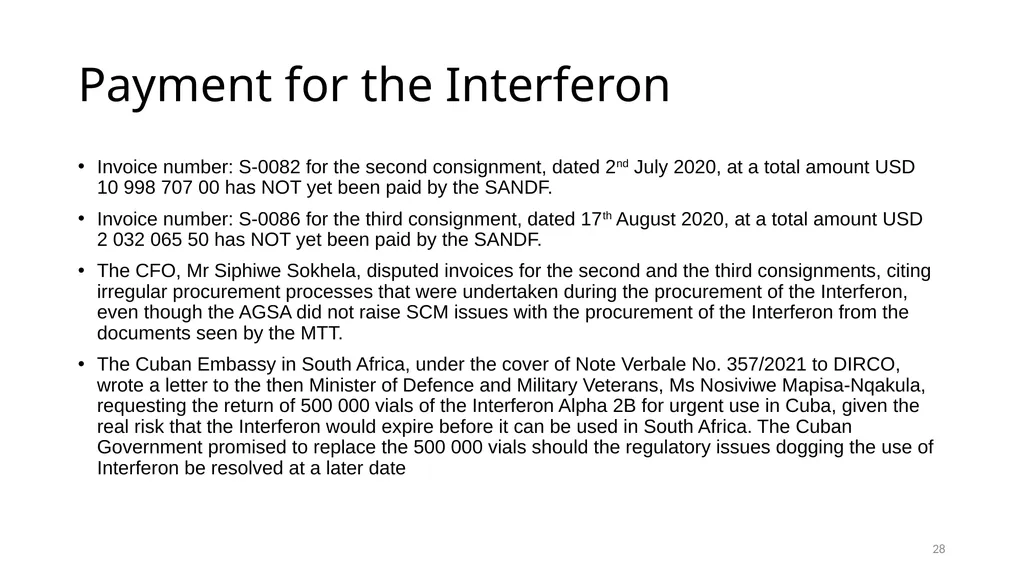
Payment for the Interferon Invoice number: S-0082 for the second consignment, dated 2nd July 2020, at a total amount USD 10 998 707 00 has NOT yet been paid by the SANDF.
Invoice number: S-0086 for the third consignment, dated 17th August 2020, at a total amount USD 2 032 065 50 has NOT yet been paid by the SANDF.
The CFO, Mr Siphiwe Sokhela, disputed invoices for the second and the third consignments, citing irregular procurement processes that were undertaken during the procurement of the Interferon, even though the AGSA did not raise SCM issues with the procurement of the Interferon from the documents seen by the MTT.
The Cuban Embassy in South Africa, under the cover of Note Verbale No. 357/2021 to DIRCO, wrote a letter to the then Minister of Defence and Military Veterans, Ms Nosiviwe Mapisa-Nqakula, requesting the return of 500 000 vials of the Interferon Alpha 2B for urgent use in Cuba, given the real risk that the Interferon would expire before it can be used in South Africa. The Cuban Government promised to replace the 500 000 vials should the regulatory issues dogging the use of Interferon be resolved at a later date 28<br>
Invoice number: S-0086 for the third consignment, dated 17th August 2020, at a total amount USD 2 032 065 50 has NOT yet been paid by the SANDF.
The CFO, Mr Siphiwe Sokhela, disputed invoices for the second and the third consignments, citing irregular procurement processes that were undertaken during the procurement of the Interferon, even though the AGSA did not raise SCM issues with the procurement of the Interferon from the documents seen by the MTT.
The Cuban Embassy in South Africa, under the cover of Note Verbale No. 357/2021 to DIRCO, wrote a letter to the then Minister of Defence and Military Veterans, Ms Nosiviwe Mapisa-Nqakula, requesting the return of 500 000 vials of the Interferon Alpha 2B for urgent use in Cuba, given the real risk that the Interferon would expire before it can be used in South Africa. The Cuban Government promised to replace the 500 000 vials should the regulatory issues dogging the use of Interferon be resolved at a later date 28<br>
29
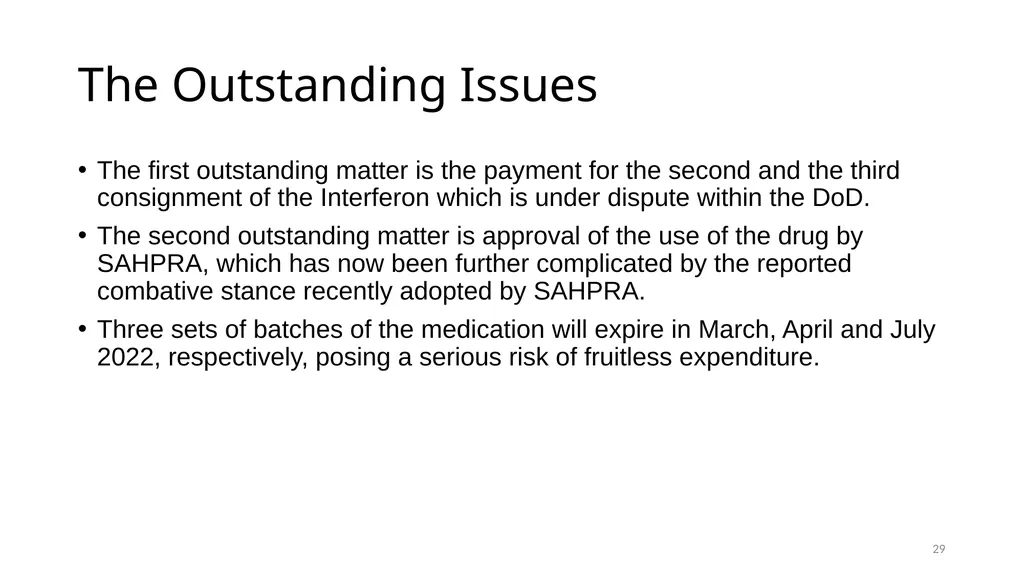
The Outstanding Issues The first outstanding matter is the payment for the second and the third consignment of the Interferon which is under dispute within the DoD.
The second outstanding matter is approval of the use of the drug by SAHPRA, which has now been further complicated by the reported combative stance recently adopted by SAHPRA.
Three sets of batches of the medication will expire in March, April and July 2022, respectively, posing a serious risk of fruitless expenditure. 29<br>
The second outstanding matter is approval of the use of the drug by SAHPRA, which has now been further complicated by the reported combative stance recently adopted by SAHPRA.
Three sets of batches of the medication will expire in March, April and July 2022, respectively, posing a serious risk of fruitless expenditure. 29<br>
30
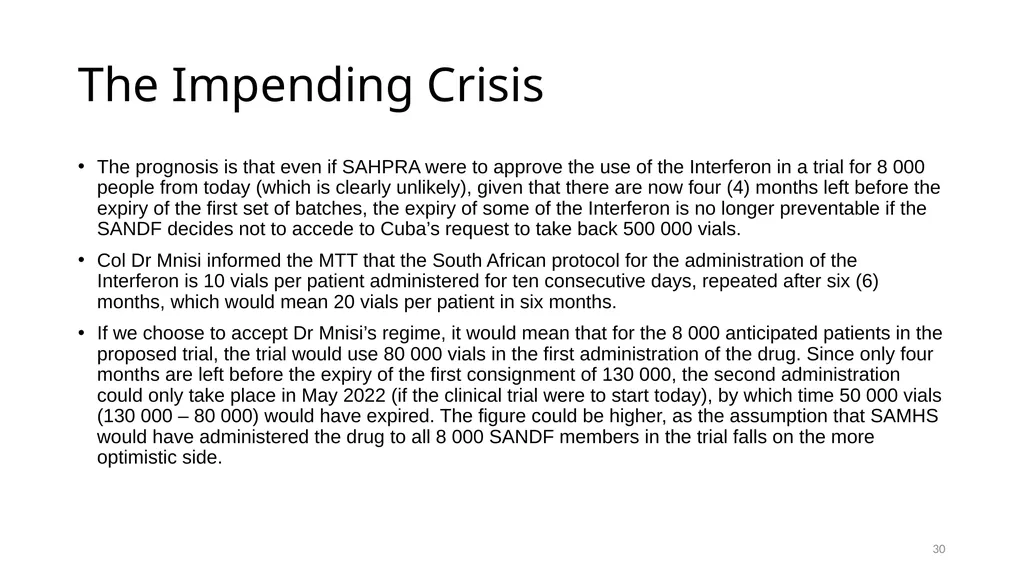
The Impending Crisis The prognosis is that even if SAHPRA were to approve the use of the Interferon in a trial for 8 000 people from today (which is clearly unlikely), given that there are now four (4) months left before the expiry of the first set of batches, the expiry of some of the Interferon is no longer preventable if the SANDF decides not to accede to Cuba’s request to take back 500 000 vials.
Col Dr Mnisi informed the MTT that the South African protocol for the administration of the Interferon is 10 vials per patient administered for ten consecutive days, repeated after six (6) months, which would mean 20 vials per patient in six months.
If we choose to accept Dr Mnisi’s regime, it would mean that for the 8 000 anticipated patients in the proposed trial, the trial would use 80 000 vials in the first administration of the drug. Since only four months are left before the expiry of the first consignment of 130 000, the second administration could only take place in May 2022 (if the clinical trial were to start today), by which time 50 000 vials (130 000 – 80 000) would have expired. The figure could be higher, as the assumption that SAMHS would have administered the drug to all 8 000 SANDF members in the trial falls on the more optimistic side. 30<br>
Col Dr Mnisi informed the MTT that the South African protocol for the administration of the Interferon is 10 vials per patient administered for ten consecutive days, repeated after six (6) months, which would mean 20 vials per patient in six months.
If we choose to accept Dr Mnisi’s regime, it would mean that for the 8 000 anticipated patients in the proposed trial, the trial would use 80 000 vials in the first administration of the drug. Since only four months are left before the expiry of the first consignment of 130 000, the second administration could only take place in May 2022 (if the clinical trial were to start today), by which time 50 000 vials (130 000 – 80 000) would have expired. The figure could be higher, as the assumption that SAMHS would have administered the drug to all 8 000 SANDF members in the trial falls on the more optimistic side. 30<br>
31
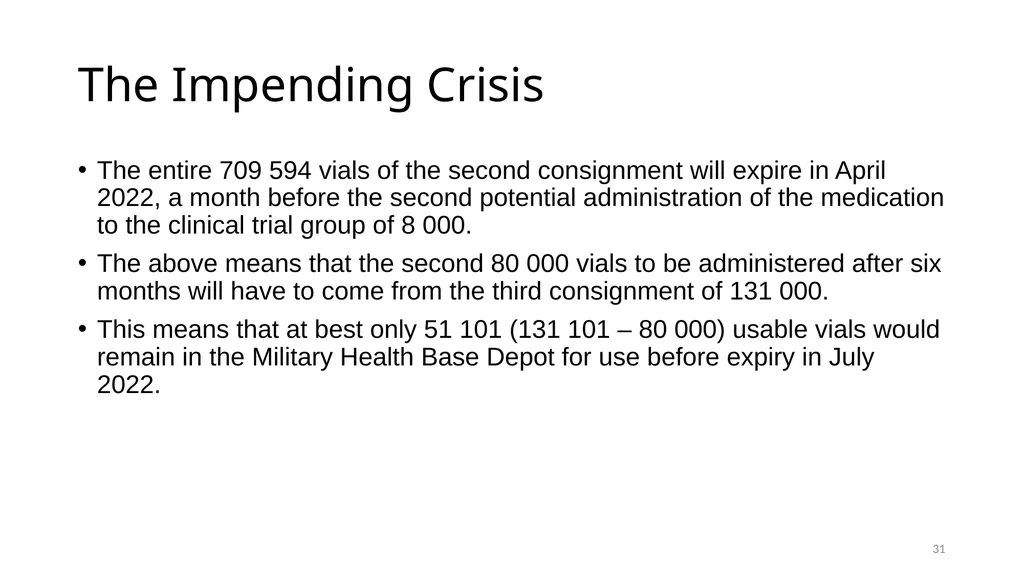
The Impending Crisis The entire 709 594 vials of the second consignment will expire in April 2022, a month before the second potential administration of the medication to the clinical trial group of 8 000.
The above means that the second 80 000 vials to be administered after six months will have to come from the third consignment of 131 000.
This means that at best only 51 101 (131 101 – 80 000) usable vials would remain in the Military Health Base Depot for use before expiry in July 2022. 31<br>
The above means that the second 80 000 vials to be administered after six months will have to come from the third consignment of 131 000.
This means that at best only 51 101 (131 101 – 80 000) usable vials would remain in the Military Health Base Depot for use before expiry in July 2022. 31<br>
32
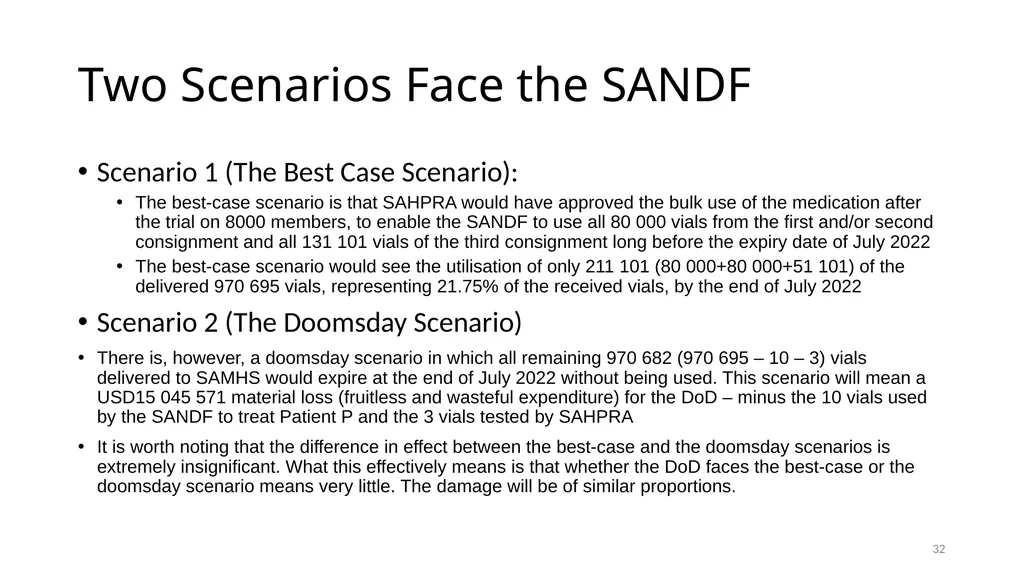
Two Scenarios Face the SANDF Scenario 1 (The Best Case Scenario):
The best-case scenario is that SAHPRA would have approved the bulk use of the medication after the trial on 8000 members, to enable the SANDF to use all 80 000 vials from the first and/or second consignment and all 131 101 vials of the third consignment long before the expiry date of July 2022
The best-case scenario would see the utilisation of only 211 101 (80 000+80 000+51 101) of the delivered 970 695 vials, representing 21.75% of the received vials, by the end of July 2022
Scenario 2 (The Doomsday Scenario)
There is, however, a doomsday scenario in which all remaining 970 682 (970 695 – 10 – 3) vials delivered to SAMHS would expire at the end of July 2022 without being used. This scenario will mean a USD15 045 571 material loss (fruitless and wasteful expenditure) for the DoD – minus the 10 vials used by the SANDF to treat Patient P and the 3 vials tested by SAHPRA
It is worth noting that the difference in effect between the best-case and the doomsday scenarios is extremely insignificant. What this effectively means is that whether the DoD faces the best-case or the doomsday scenario means very little. The damage will be of similar proportions. 32<br>
The best-case scenario is that SAHPRA would have approved the bulk use of the medication after the trial on 8000 members, to enable the SANDF to use all 80 000 vials from the first and/or second consignment and all 131 101 vials of the third consignment long before the expiry date of July 2022
The best-case scenario would see the utilisation of only 211 101 (80 000+80 000+51 101) of the delivered 970 695 vials, representing 21.75% of the received vials, by the end of July 2022
Scenario 2 (The Doomsday Scenario)
There is, however, a doomsday scenario in which all remaining 970 682 (970 695 – 10 – 3) vials delivered to SAMHS would expire at the end of July 2022 without being used. This scenario will mean a USD15 045 571 material loss (fruitless and wasteful expenditure) for the DoD – minus the 10 vials used by the SANDF to treat Patient P and the 3 vials tested by SAHPRA
It is worth noting that the difference in effect between the best-case and the doomsday scenarios is extremely insignificant. What this effectively means is that whether the DoD faces the best-case or the doomsday scenario means very little. The damage will be of similar proportions. 32<br>
33
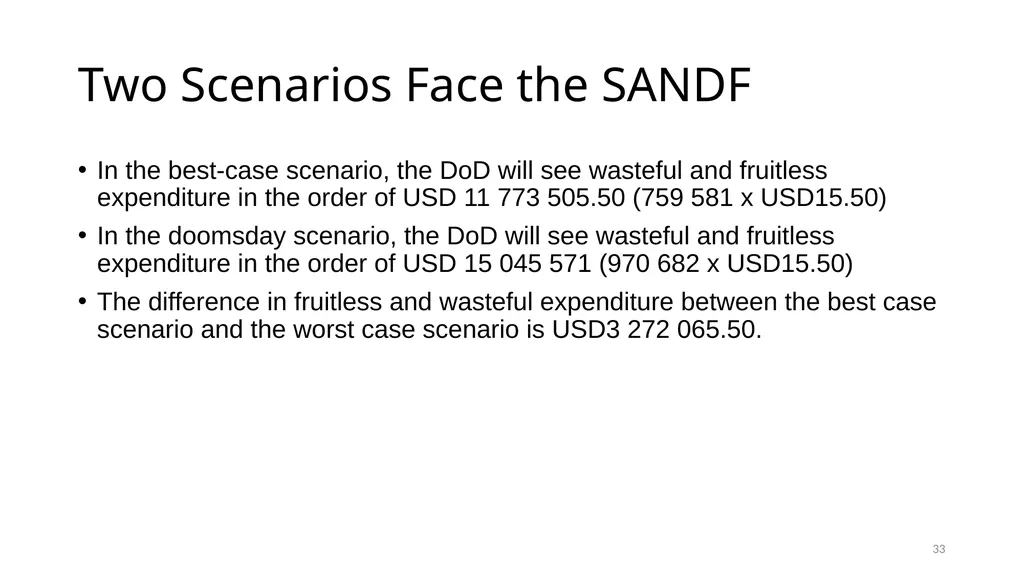
Two Scenarios Face the SANDF In the best-case scenario, the DoD will see wasteful and fruitless expenditure in the order of USD 11 773 505.50 (759 581 x USD15.50)
In the doomsday scenario, the DoD will see wasteful and fruitless expenditure in the order of USD 15 045 571 (970 682 x USD15.50)
The difference in fruitless and wasteful expenditure between the best case scenario and the worst case scenario is USD3 272 065.50. 33<br>
In the doomsday scenario, the DoD will see wasteful and fruitless expenditure in the order of USD 15 045 571 (970 682 x USD15.50)
The difference in fruitless and wasteful expenditure between the best case scenario and the worst case scenario is USD3 272 065.50. 33<br>
34
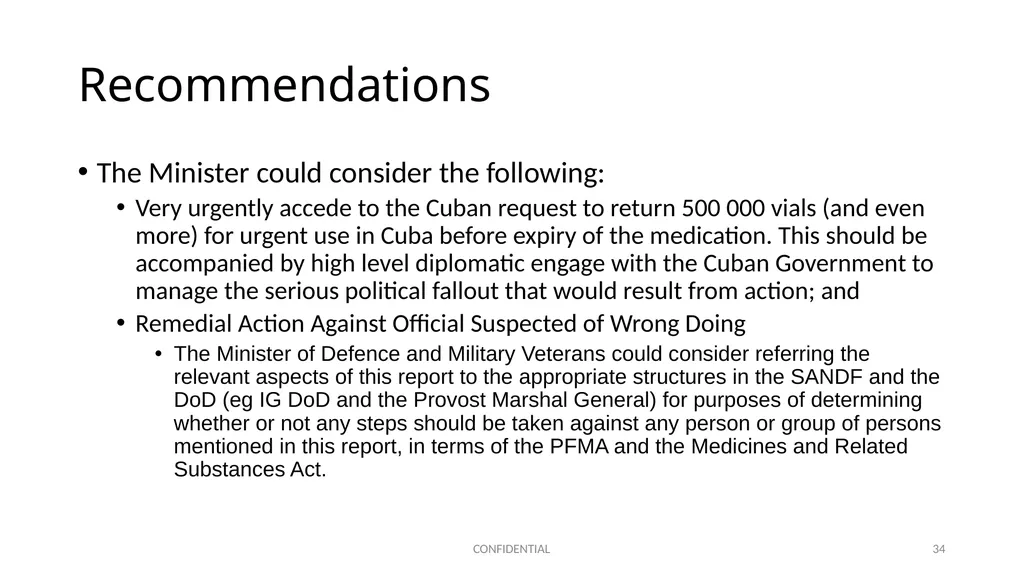
Recommendations The Minister could consider the following:
Very urgently accede to the Cuban request to return 500 000 vials (and even more) for urgent use in Cuba before expiry of the medication. This should be accompanied by high level diplomatic engage with the Cuban Government to manage the serious political fallout that would result from action; and
Remedial Action Against Official Suspected of Wrong Doing
The Minister of Defence and Military Veterans could consider referring the relevant aspects of this report to the appropriate structures in the SANDF and the DoD (eg IG DoD and the Provost Marshal General) for purposes of determining whether or not any steps should be taken against any person or group of persons mentioned in this report, in terms of the PFMA and the Medicines and Related Substances Act. CONFIDENTIAL 34<br>
Very urgently accede to the Cuban request to return 500 000 vials (and even more) for urgent use in Cuba before expiry of the medication. This should be accompanied by high level diplomatic engage with the Cuban Government to manage the serious political fallout that would result from action; and
Remedial Action Against Official Suspected of Wrong Doing
The Minister of Defence and Military Veterans could consider referring the relevant aspects of this report to the appropriate structures in the SANDF and the DoD (eg IG DoD and the Provost Marshal General) for purposes of determining whether or not any steps should be taken against any person or group of persons mentioned in this report, in terms of the PFMA and the Medicines and Related Substances Act. CONFIDENTIAL 34<br>
35
Thank You! CONFIDENTIAL 35<br>