
Intermediate Accounting 14th Edition 10
PT
Published · 34 slides · 0 views
1 / 1


Description
Intermediate Accounting 14th Edition 10 Acquisition and Disposition of Property, Plant, and Equipment Kieso, Weygandt, and Warfield Used in operations and not for resale. Long-term in nature and usually depreciated. Possess physical
Related Topics
Share
Embed code
Download this presentation From Below
"Intermediate Accounting 14th Edition 10" is the property of its rightful owner. Permission is granted to download and print the materials on this website for personal, non-commercial use only, and to display it on your personal computer provided you do not modify the materials and that you retain all copyright notices contained in the materials. By downloading content from our website, you accept the terms of this agreement.
Presentation Transcript
01
Intermediate Accounting
14th Edition 10 Acquisition and Disposition of Property, Plant,
and Equipment Kieso, Weygandt, and Warfield<br>
14th Edition 10 Acquisition and Disposition of Property, Plant,
and Equipment Kieso, Weygandt, and Warfield<br>
02
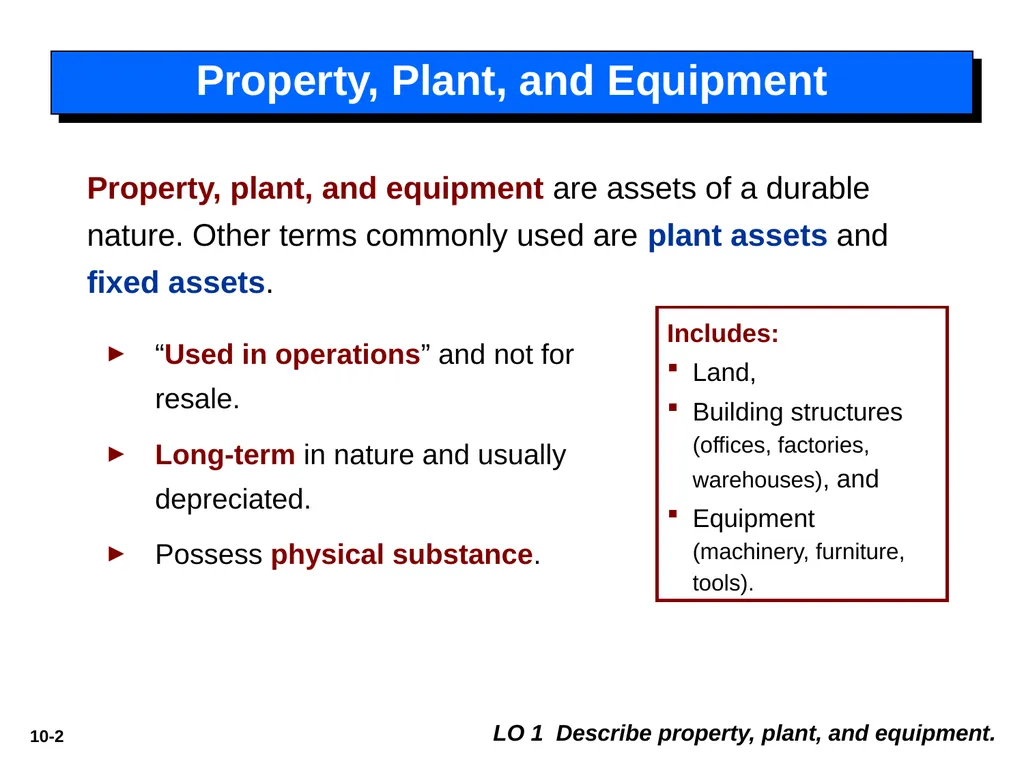
“Used in operations” and not for resale.
Long-term in nature and usually depreciated.
Possess physical substance. Property, plant, and equipment are assets of a durable nature. Other terms commonly used are plant assets and fixed assets. Property, Plant, and Equipment LO 1 Describe property, plant, and equipment. Includes:
Land,
Building structures (offices, factories, warehouses), and
Equipment (machinery, furniture, tools).<br>
Long-term in nature and usually depreciated.
Possess physical substance. Property, plant, and equipment are assets of a durable nature. Other terms commonly used are plant assets and fixed assets. Property, Plant, and Equipment LO 1 Describe property, plant, and equipment. Includes:
Land,
Building structures (offices, factories, warehouses), and
Equipment (machinery, furniture, tools).<br>
03
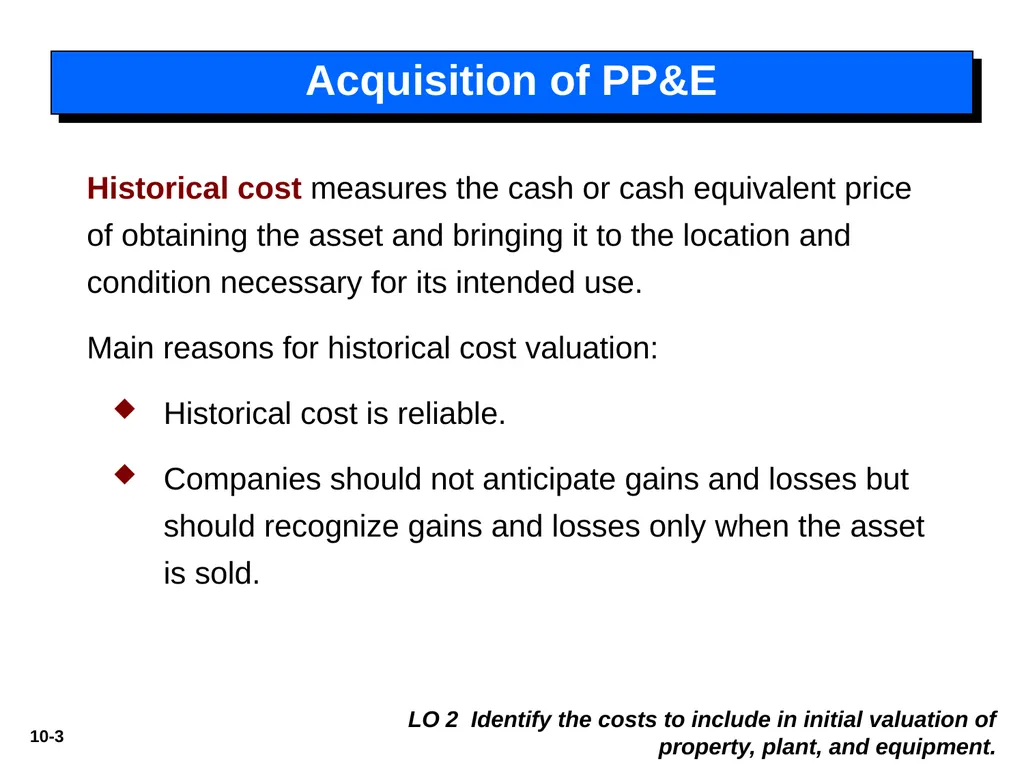
Historical cost measures the cash or cash equivalent price of obtaining the asset and bringing it to the location and condition necessary for its intended use.
Main reasons for historical cost valuation:
Historical cost is reliable.
Companies should not anticipate gains and losses but should recognize gains and losses only when the asset is sold. Acquisition of PP&E LO 2 Identify the costs to include in initial valuation of property, plant, and equipment.<br>
Main reasons for historical cost valuation:
Historical cost is reliable.
Companies should not anticipate gains and losses but should recognize gains and losses only when the asset is sold. Acquisition of PP&E LO 2 Identify the costs to include in initial valuation of property, plant, and equipment.<br>
04
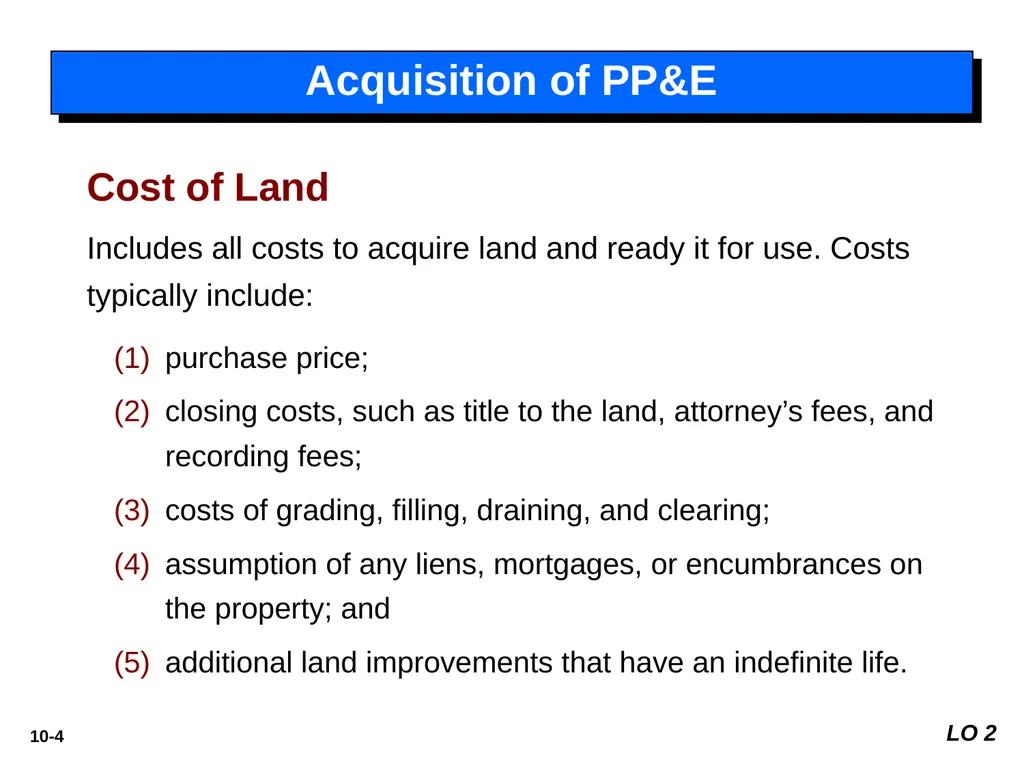
Includes all costs to acquire land and ready it for use. Costs typically include: Cost of Land Acquisition of PP&E LO 2 purchase price;
closing costs, such as title to the land, attorney’s fees, and recording fees;
costs of grading, filling, draining, and clearing;
assumption of any liens, mortgages, or encumbrances on the property; and
additional land improvements that have an indefinite life.<br>
closing costs, such as title to the land, attorney’s fees, and recording fees;
costs of grading, filling, draining, and clearing;
assumption of any liens, mortgages, or encumbrances on the property; and
additional land improvements that have an indefinite life.<br>
05
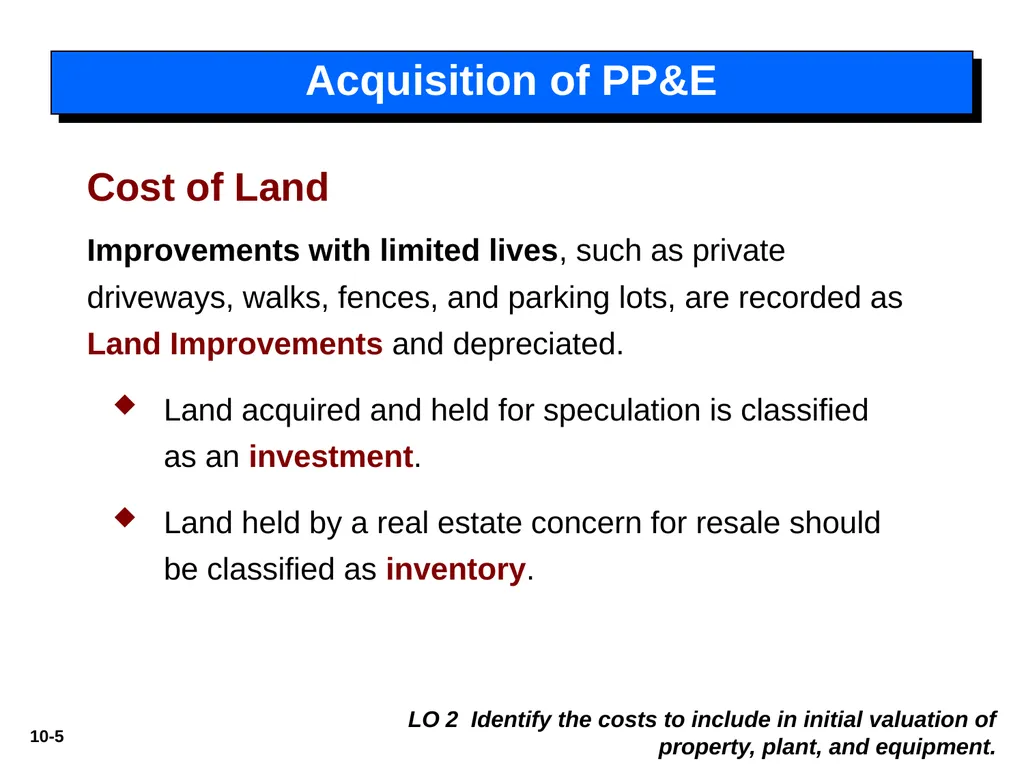
Improvements with limited lives, such as private driveways, walks, fences, and parking lots, are recorded as Land Improvements and depreciated.
Land acquired and held for speculation is classified as an investment.
Land held by a real estate concern for resale should be classified as inventory. Acquisition of PP&E LO 2 Identify the costs to include in initial valuation of property, plant, and equipment. Cost of Land<br>
Land acquired and held for speculation is classified as an investment.
Land held by a real estate concern for resale should be classified as inventory. Acquisition of PP&E LO 2 Identify the costs to include in initial valuation of property, plant, and equipment. Cost of Land<br>
06
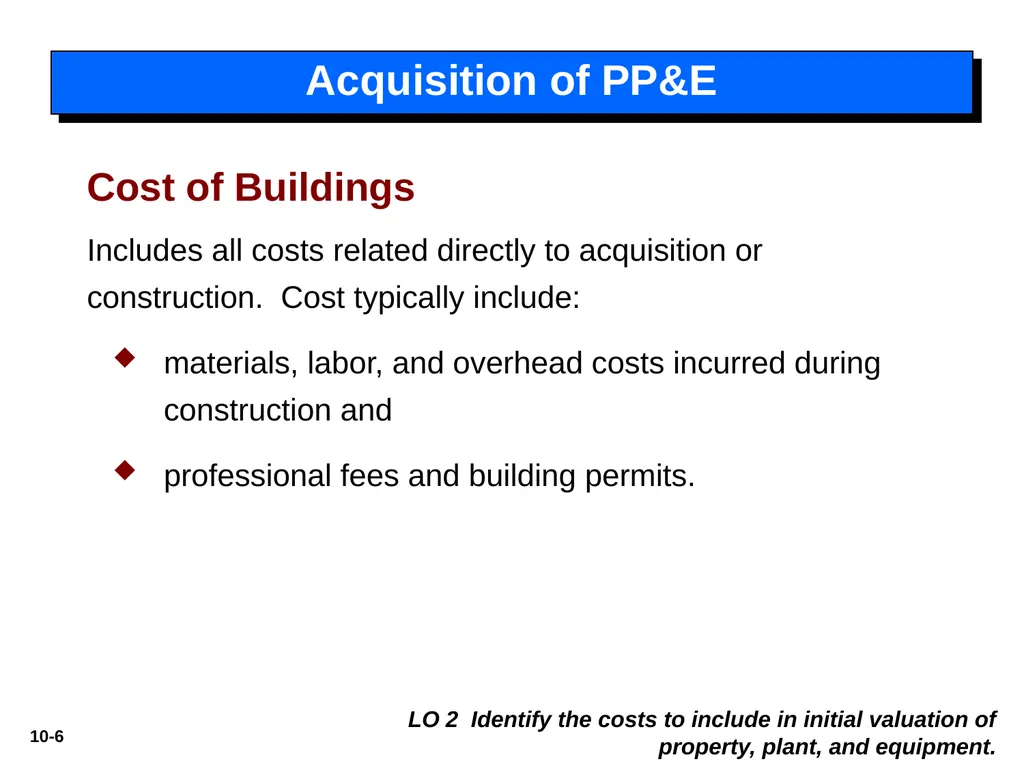
Includes all costs related directly to acquisition or construction. Cost typically include:
materials, labor, and overhead costs incurred during construction and
professional fees and building permits. Cost of Buildings LO 2 Identify the costs to include in initial valuation of property, plant, and equipment. Acquisition of PP&E<br>
materials, labor, and overhead costs incurred during construction and
professional fees and building permits. Cost of Buildings LO 2 Identify the costs to include in initial valuation of property, plant, and equipment. Acquisition of PP&E<br>
07
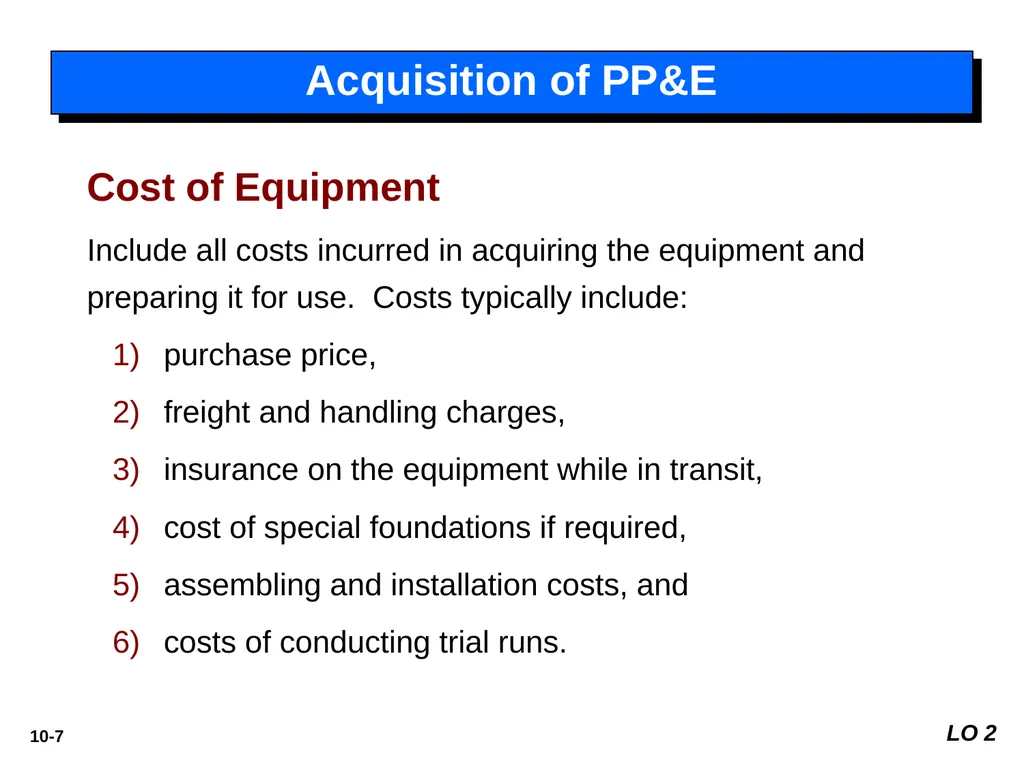
LO 2 Acquisition of PP&E Cost of Equipment Include all costs incurred in acquiring the equipment and preparing it for use. Costs typically include:
purchase price,
freight and handling charges,
insurance on the equipment while in transit,
cost of special foundations if required,
assembling and installation costs, and
costs of conducting trial runs.<br>
purchase price,
freight and handling charges,
insurance on the equipment while in transit,
cost of special foundations if required,
assembling and installation costs, and
costs of conducting trial runs.<br>
08
Acquisition of PP&E Money borrowed to pay building contractor
Payment for construction from note proceeds
Cost of land fill and clearing
Delinquent real estate taxes on property assumed
Premium on 6-month insurance policy during construction
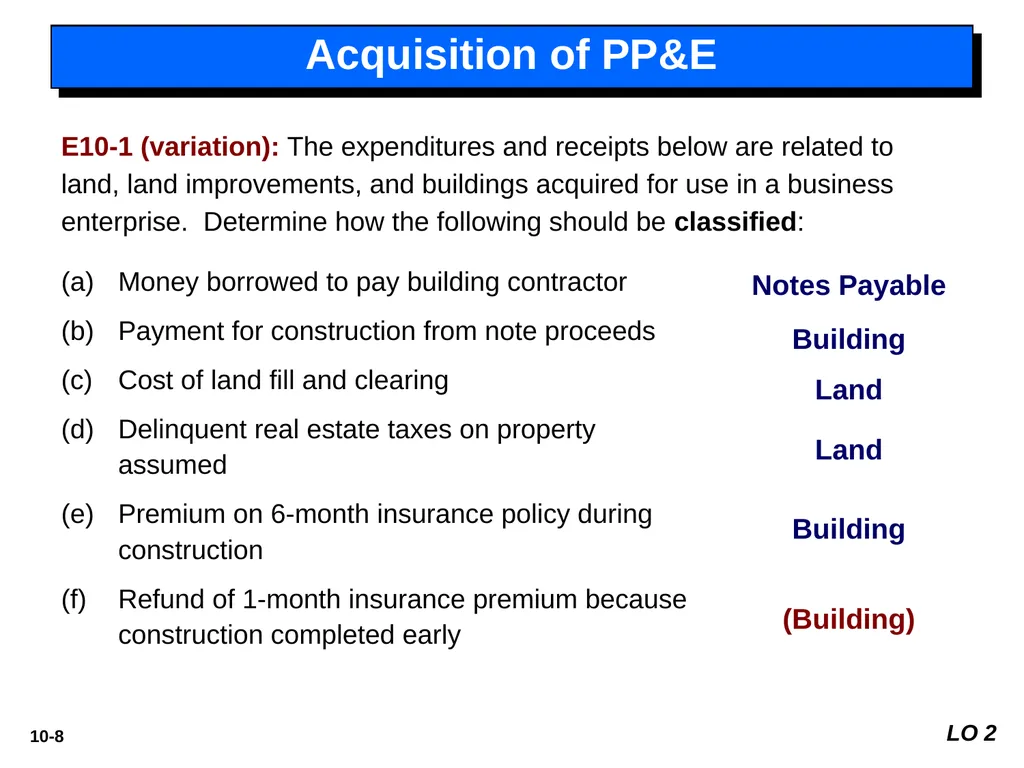
Refund of 1-month insurance premium because construction completed early LO 2 E10-1 (variation): The expenditures and receipts below are related to land, land improvements, and buildings acquired for use in a business enterprise. Determine how the following should be classified: Notes Payable Building Land Land Building (Building)<br>
Payment for construction from note proceeds
Cost of land fill and clearing
Delinquent real estate taxes on property assumed
Premium on 6-month insurance policy during construction
Refund of 1-month insurance premium because construction completed early LO 2 E10-1 (variation): The expenditures and receipts below are related to land, land improvements, and buildings acquired for use in a business enterprise. Determine how the following should be classified: Notes Payable Building Land Land Building (Building)<br>
09
Acquisition of PP&E (g) Architect’s fee on building
(h) Cost of real estate purchased as a plant site (land $200,000 and building $50,000)
(i) Commission fee paid to real estate agency
(j) Installation of fences around property
(k) Cost of razing and removing building
Proceeds from salvage of demolished building
Cost of parking lots and driveways
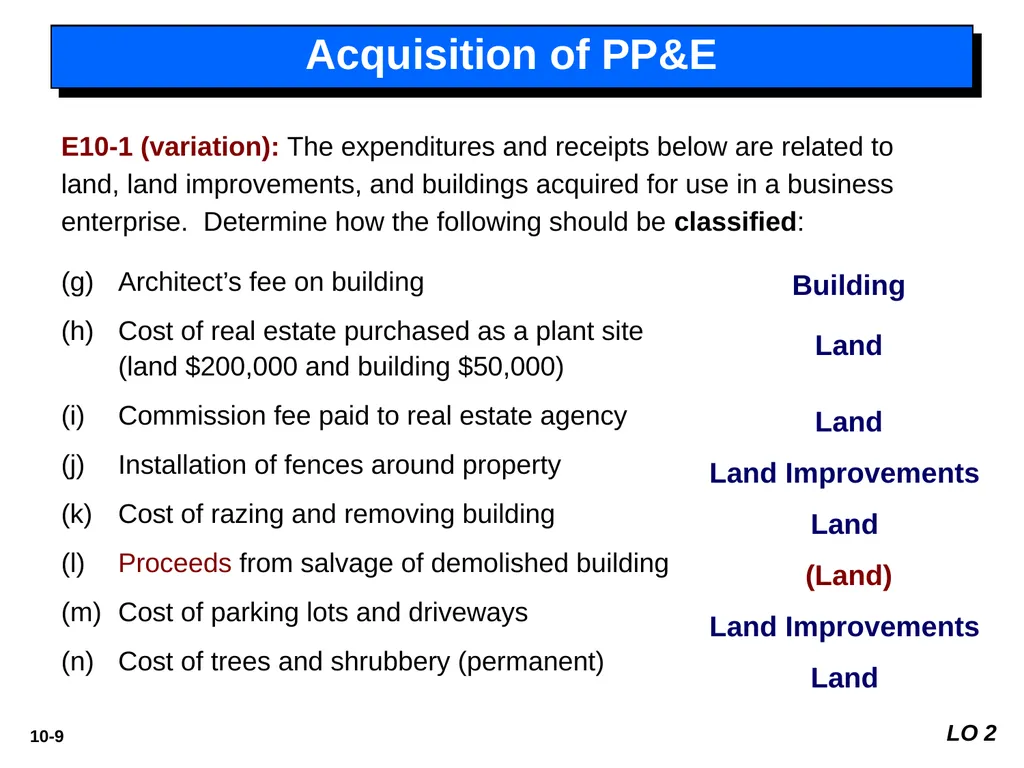
Cost of trees and shrubbery (permanent) Building LO 2 Land Land Land Improvements Land (Land) Land Improvements Land E10-1 (variation): The expenditures and receipts below are related to land, land improvements, and buildings acquired for use in a business enterprise. Determine how the following should be classified:<br>
(h) Cost of real estate purchased as a plant site (land $200,000 and building $50,000)
(i) Commission fee paid to real estate agency
(j) Installation of fences around property
(k) Cost of razing and removing building
Proceeds from salvage of demolished building
Cost of parking lots and driveways
Cost of trees and shrubbery (permanent) Building LO 2 Land Land Land Improvements Land (Land) Land Improvements Land E10-1 (variation): The expenditures and receipts below are related to land, land improvements, and buildings acquired for use in a business enterprise. Determine how the following should be classified:<br>
10
Self-Constructed Assets Acquisition of PP&E Costs typically include:
Materials and direct labor
Overhead can be handled in two ways:
Assign no fixed overhead
Assign a portion of all overhead to the construction process.
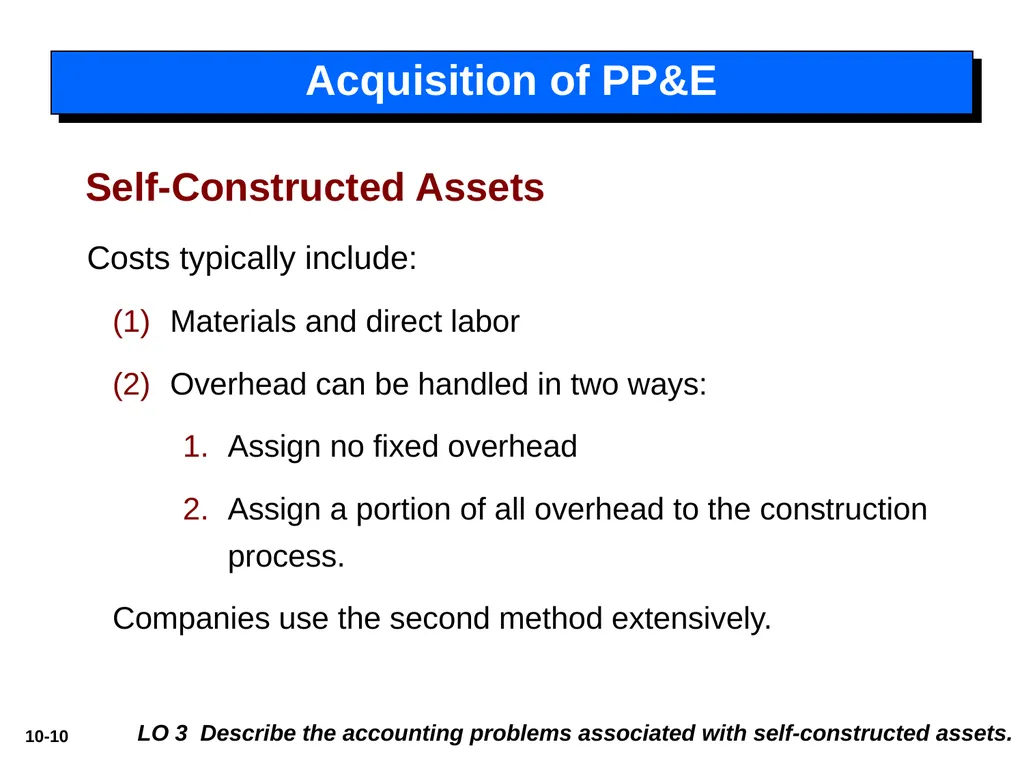
Companies use the second method extensively. LO 3 Describe the accounting problems associated with self-constructed assets.<br>
Materials and direct labor
Overhead can be handled in two ways:
Assign no fixed overhead
Assign a portion of all overhead to the construction process.
Companies use the second method extensively. LO 3 Describe the accounting problems associated with self-constructed assets.<br>
11
Valuation of PP&E LO 5 Understand accounting issues related to acquiring and valuing plant assets. Ordinarily accounted for on the basis of:
the fair value of the asset given up or
the fair value of the asset received,
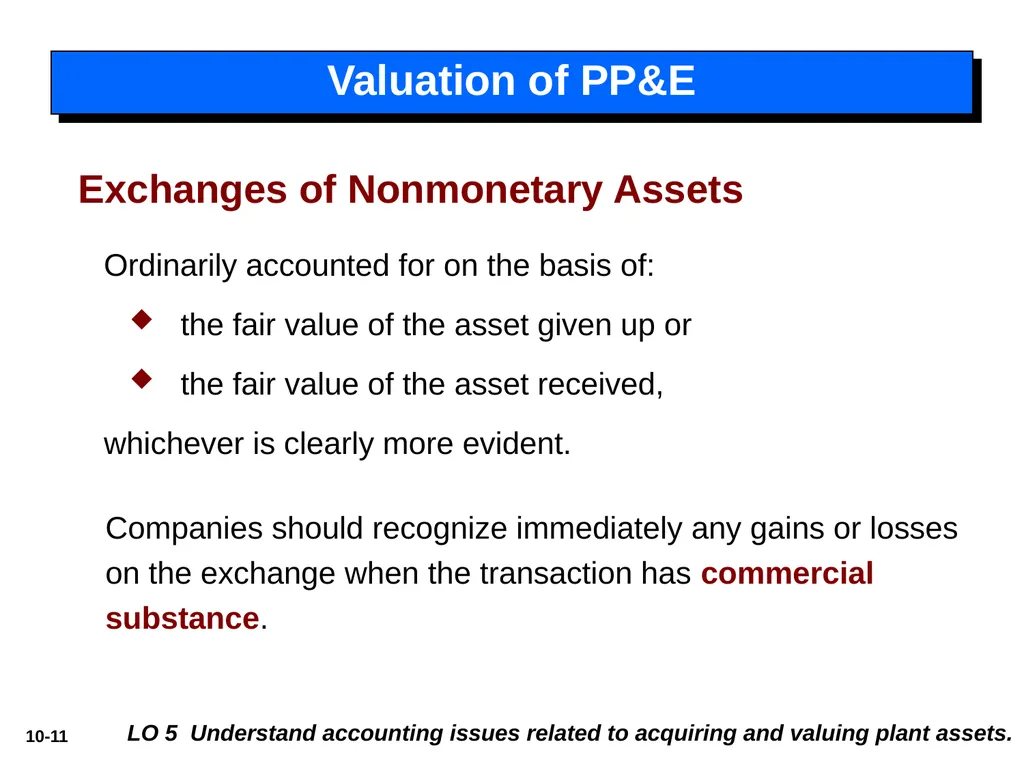
whichever is clearly more evident. Exchanges of Nonmonetary Assets Companies should recognize immediately any gains or losses on the exchange when the transaction has commercial substance.<br>
the fair value of the asset given up or
the fair value of the asset received,
whichever is clearly more evident. Exchanges of Nonmonetary Assets Companies should recognize immediately any gains or losses on the exchange when the transaction has commercial substance.<br>
12
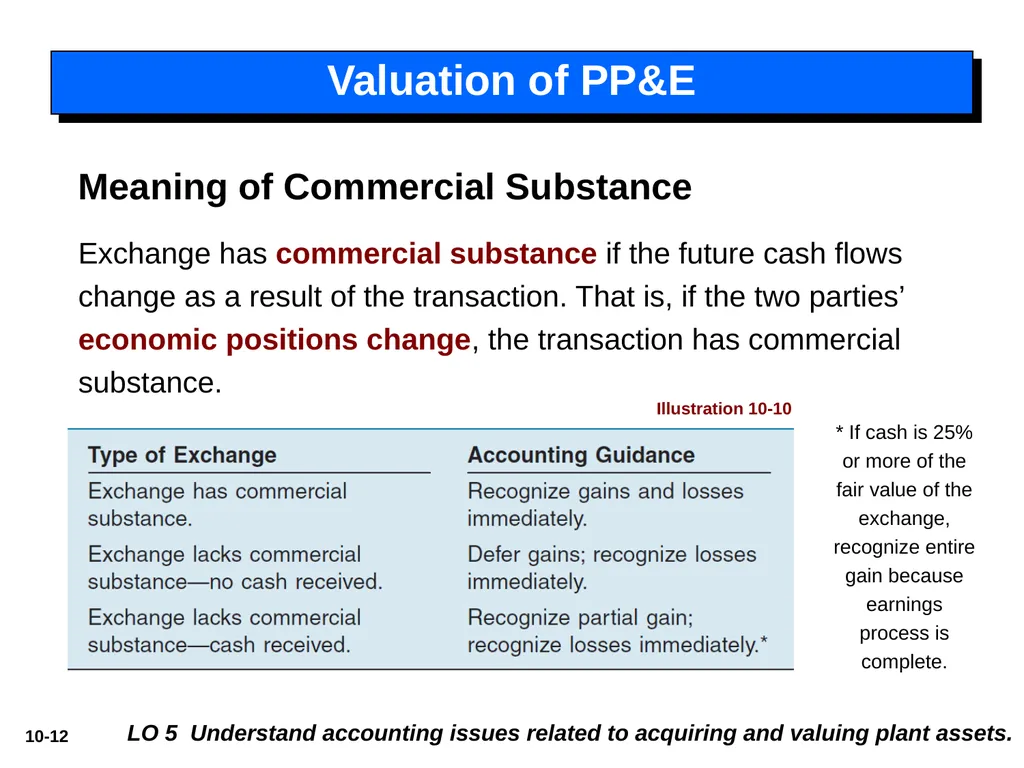
Valuation of PP&E LO 5 Understand accounting issues related to acquiring and valuing plant assets. Meaning of Commercial Substance Exchange has commercial substance if the future cash flows change as a result of the transaction. That is, if the two parties’ economic positions change, the transaction has commercial substance. Illustration 10-10 * If cash is 25% or more of the fair value of the exchange, recognize entire gain because earnings process is complete.<br>
13
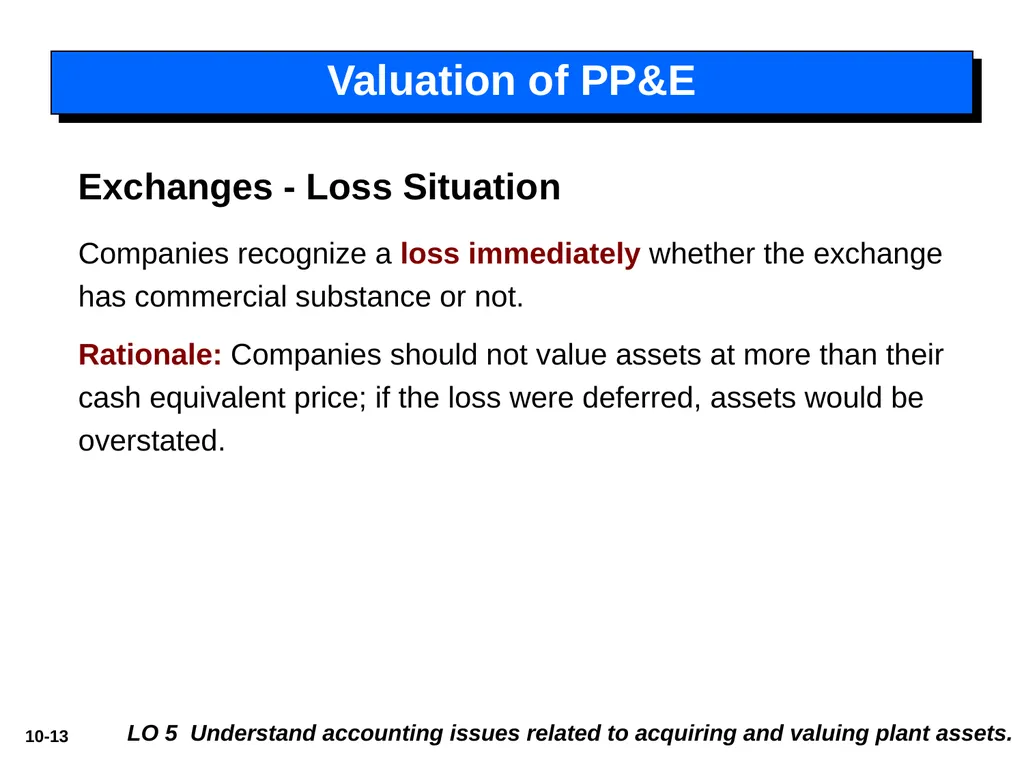
Valuation of PP&E LO 5 Understand accounting issues related to acquiring and valuing plant assets. Companies recognize a loss immediately whether the exchange has commercial substance or not.
Rationale: Companies should not value assets at more than their cash equivalent price; if the loss were deferred, assets would be overstated. Exchanges - Loss Situation<br>
Rationale: Companies should not value assets at more than their cash equivalent price; if the loss were deferred, assets would be overstated. Exchanges - Loss Situation<br>
14
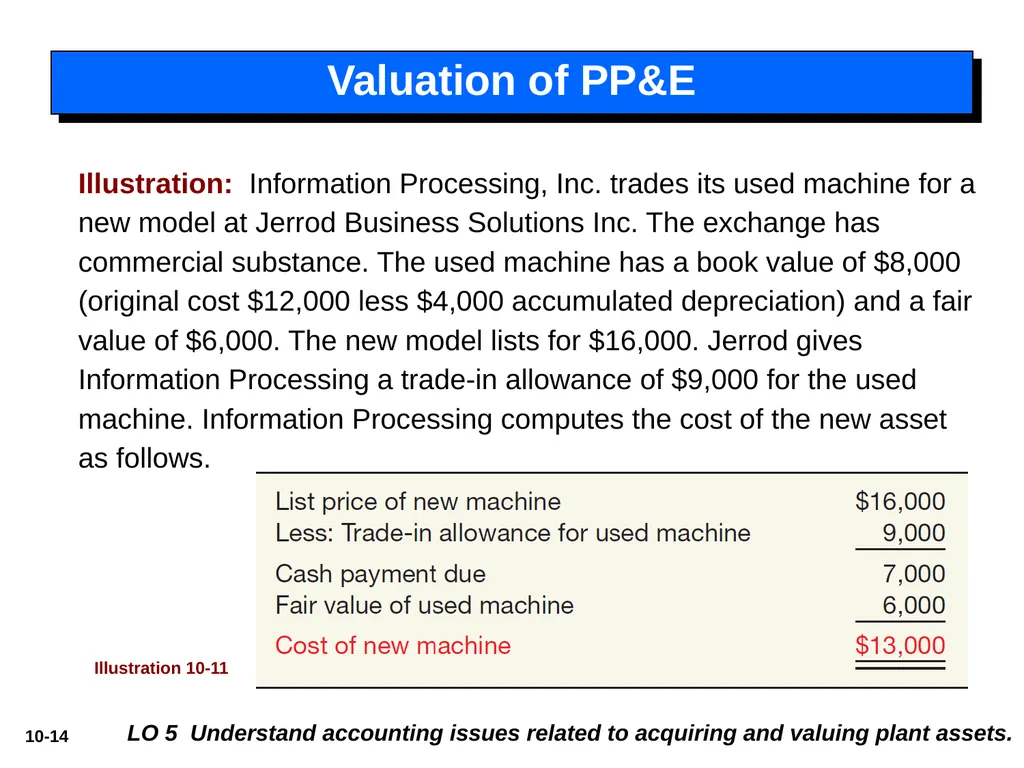
Valuation of PP&E LO 5 Understand accounting issues related to acquiring and valuing plant assets. Illustration: Information Processing, Inc. trades its used machine for a new model at Jerrod Business Solutions Inc. The exchange has commercial substance. The used machine has a book value of $8,000 (original cost $12,000 less $4,000 accumulated depreciation) and a fair value of $6,000. The new model lists for $16,000. Jerrod gives Information Processing a trade-in allowance of $9,000 for the used machine. Information Processing computes the cost of the new asset as follows. Illustration 10-11<br>
15
Equipment 13,000
Accumulated Depreciation—Equipment 4,000
Loss on Disposal of Equipment 2,000
Equipment 12,000
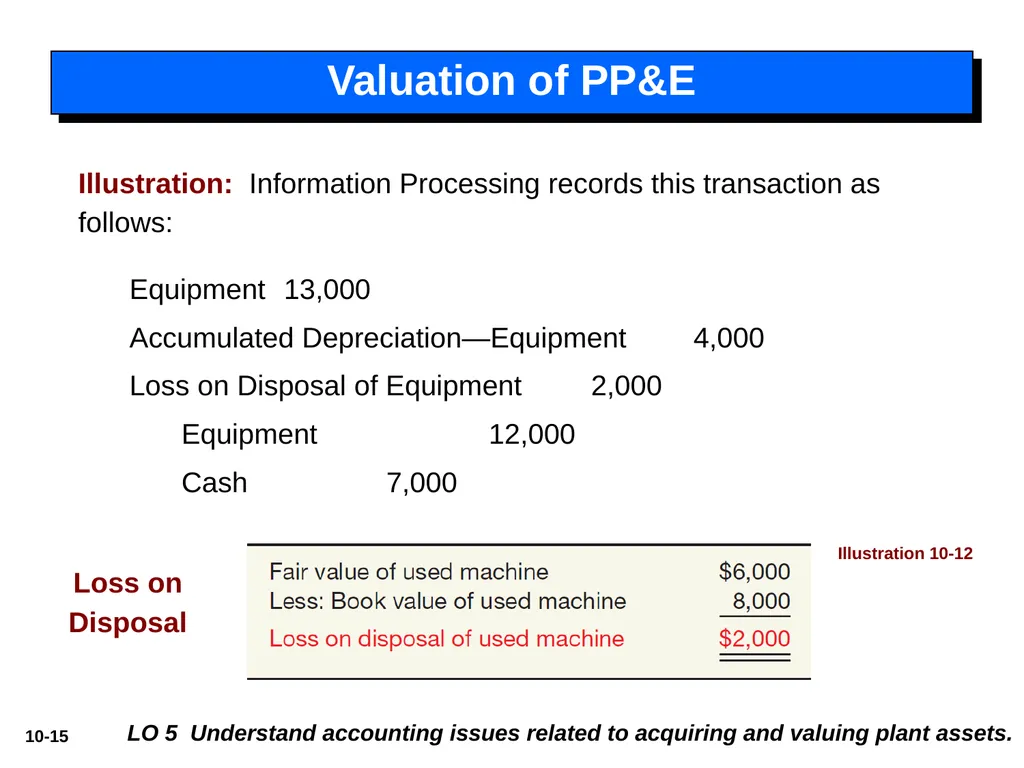
Cash 7,000 Valuation of PP&E LO 5 Understand accounting issues related to acquiring and valuing plant assets. Illustration: Information Processing records this transaction as follows: Illustration 10-12 Loss on Disposal<br>
Accumulated Depreciation—Equipment 4,000
Loss on Disposal of Equipment 2,000
Equipment 12,000
Cash 7,000 Valuation of PP&E LO 5 Understand accounting issues related to acquiring and valuing plant assets. Illustration: Information Processing records this transaction as follows: Illustration 10-12 Loss on Disposal<br>
16
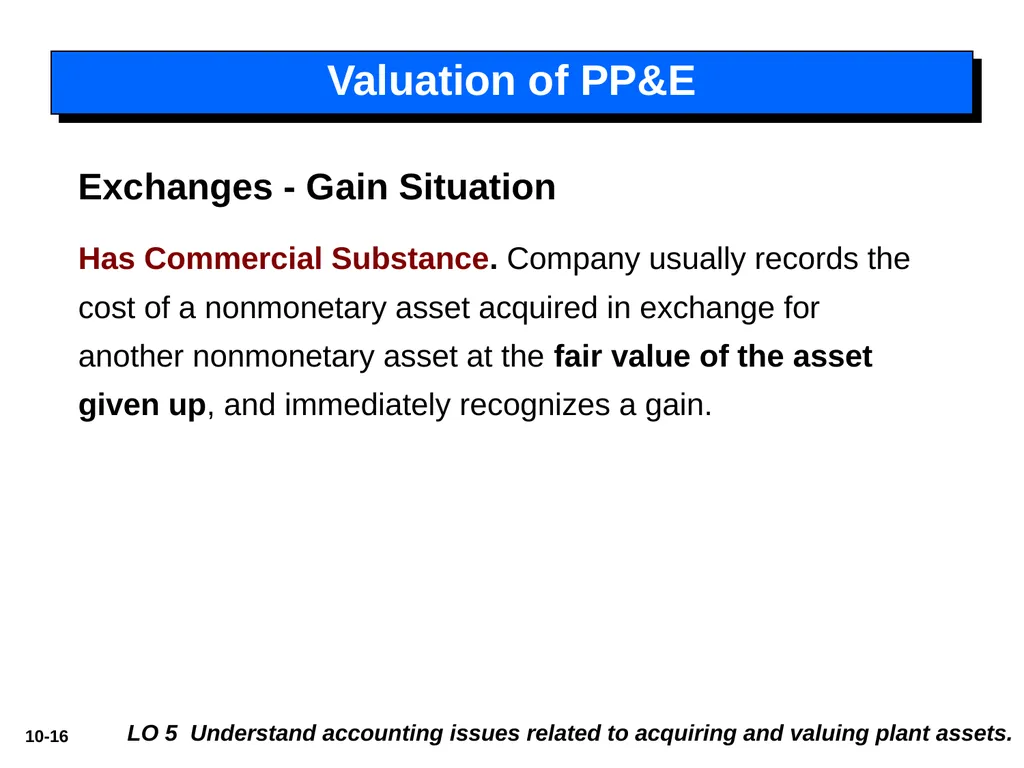
Valuation of PP&E LO 5 Understand accounting issues related to acquiring and valuing plant assets. Exchanges - Gain Situation Has Commercial Substance. Company usually records the cost of a nonmonetary asset acquired in exchange for another nonmonetary asset at the fair value of the asset given up, and immediately recognizes a gain.<br>
17
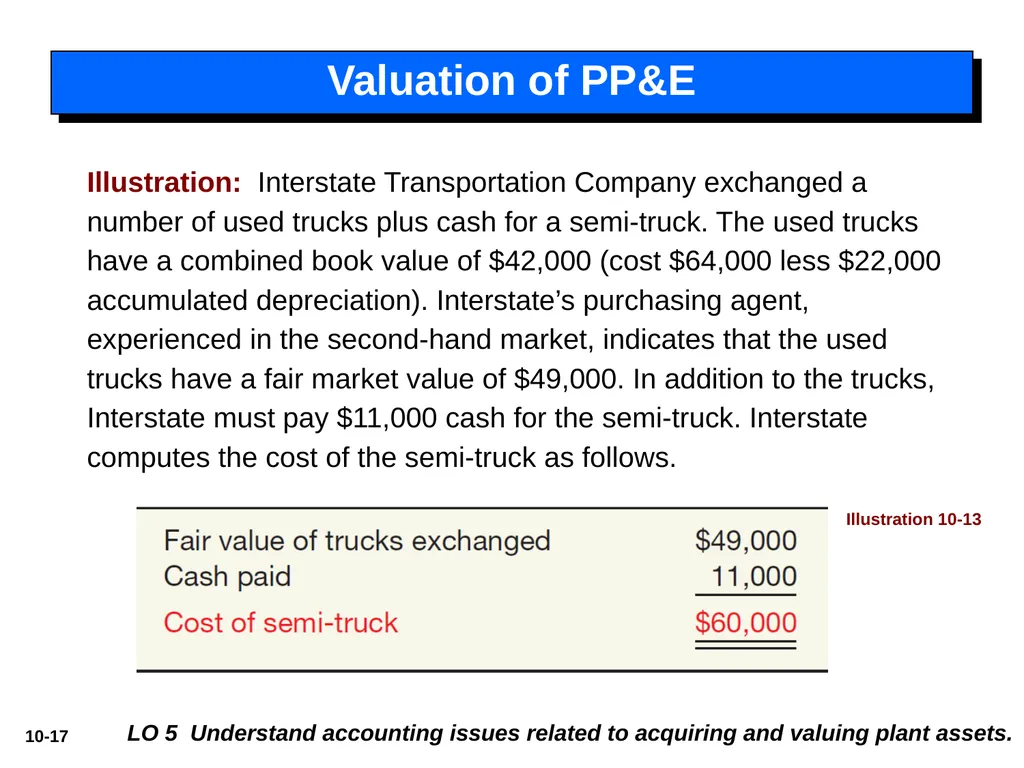
Valuation of PP&E LO 5 Understand accounting issues related to acquiring and valuing plant assets. Illustration: Interstate Transportation Company exchanged a number of used trucks plus cash for a semi-truck. The used trucks have a combined book value of $42,000 (cost $64,000 less $22,000 accumulated depreciation). Interstate’s purchasing agent, experienced in the second-hand market, indicates that the used trucks have a fair market value of $49,000. In addition to the trucks, Interstate must pay $11,000 cash for the semi-truck. Interstate computes the cost of the semi-truck as follows. Illustration 10-13<br>
18
Semi-truck 60,000
Accumulated Depreciation—Trucks 22,000
Trucks (used) 64,000
Gain on disposal of Used Trucks 7,000
Cash 11,000 Valuation of PP&E LO 5 Understand accounting issues related to acquiring and valuing plant assets. Illustration: Interstate records the exchange transaction as follows: Illustration 10-14 Gain on Disposal<br>
Accumulated Depreciation—Trucks 22,000
Trucks (used) 64,000
Gain on disposal of Used Trucks 7,000
Cash 11,000 Valuation of PP&E LO 5 Understand accounting issues related to acquiring and valuing plant assets. Illustration: Interstate records the exchange transaction as follows: Illustration 10-14 Gain on Disposal<br>
19
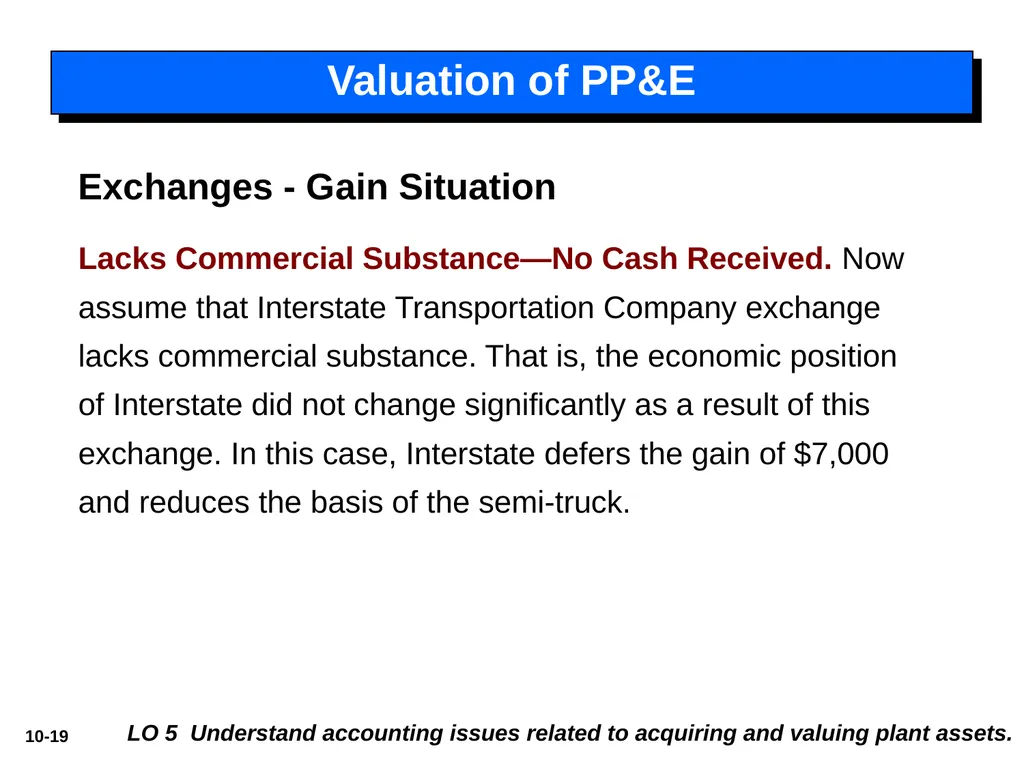
Valuation of PP&E LO 5 Understand accounting issues related to acquiring and valuing plant assets. Exchanges - Gain Situation Lacks Commercial Substance—No Cash Received. Now assume that Interstate Transportation Company exchange lacks commercial substance. That is, the economic position of Interstate did not change significantly as a result of this exchange. In this case, Interstate defers the gain of $7,000 and reduces the basis of the semi-truck.<br>
20
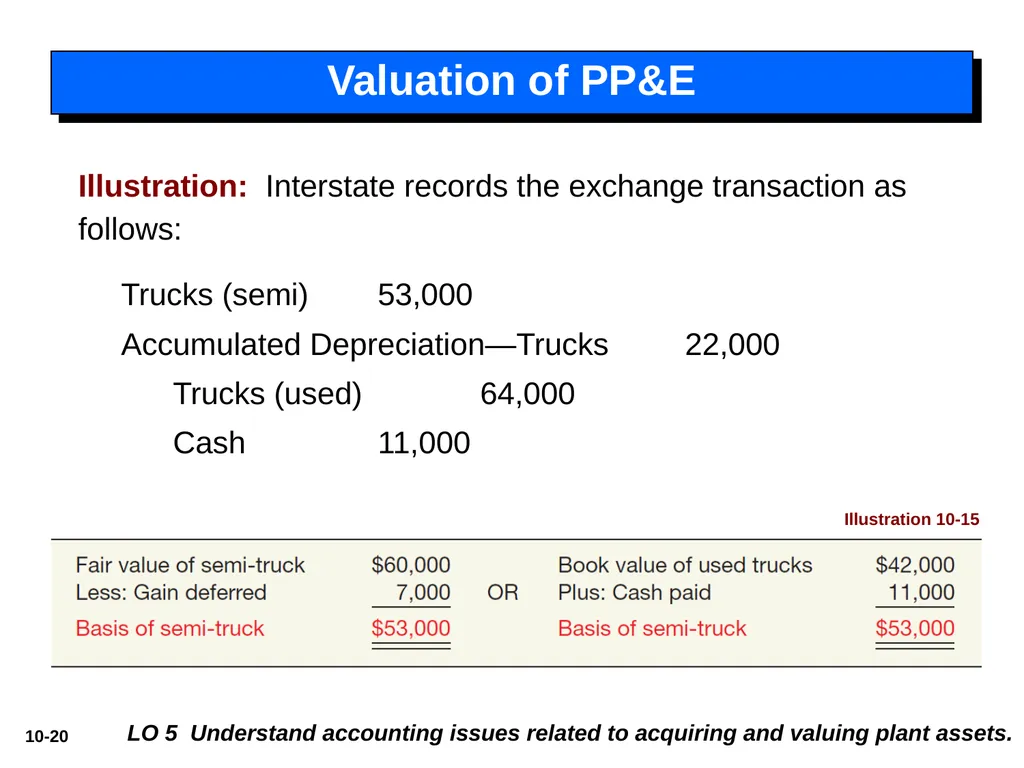
Trucks (semi) 53,000
Accumulated Depreciation—Trucks 22,000
Trucks (used) 64,000
Cash 11,000 Valuation of PP&E LO 5 Understand accounting issues related to acquiring and valuing plant assets. Illustration: Interstate records the exchange transaction as follows: Illustration 10-15<br>
Accumulated Depreciation—Trucks 22,000
Trucks (used) 64,000
Cash 11,000 Valuation of PP&E LO 5 Understand accounting issues related to acquiring and valuing plant assets. Illustration: Interstate records the exchange transaction as follows: Illustration 10-15<br>
21
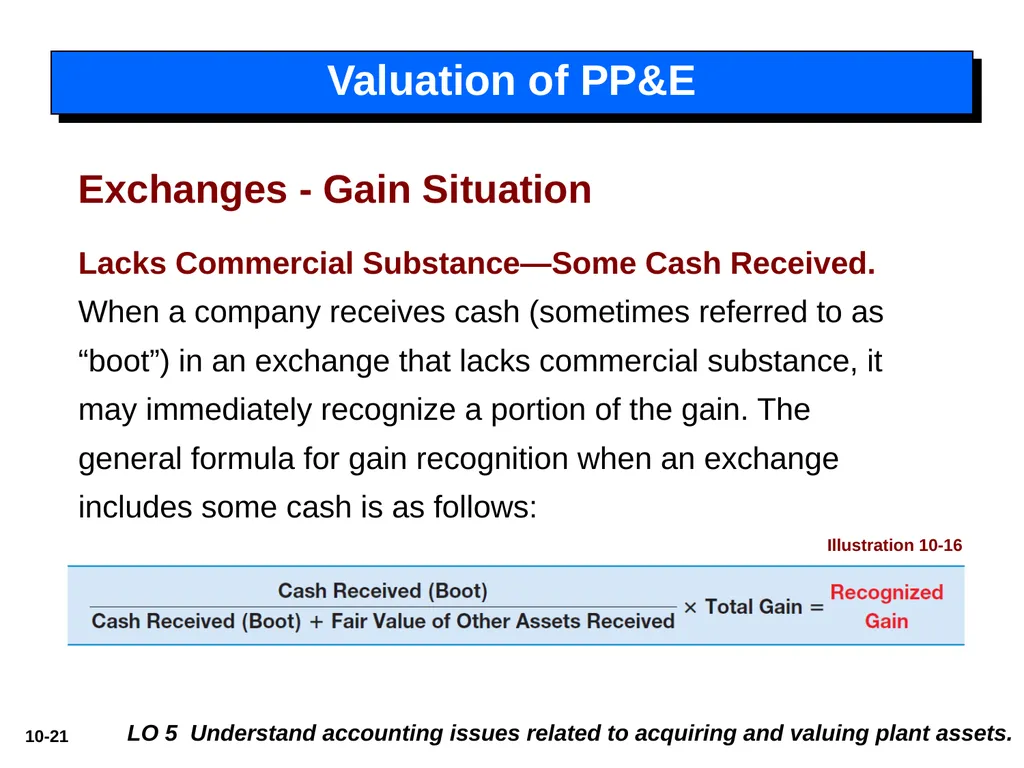
Valuation of PP&E LO 5 Understand accounting issues related to acquiring and valuing plant assets. Exchanges - Gain Situation Lacks Commercial Substance—Some Cash Received. When a company receives cash (sometimes referred to as “boot”) in an exchange that lacks commercial substance, it may immediately recognize a portion of the gain. The general formula for gain recognition when an exchange includes some cash is as follows: Illustration 10-16<br>
22
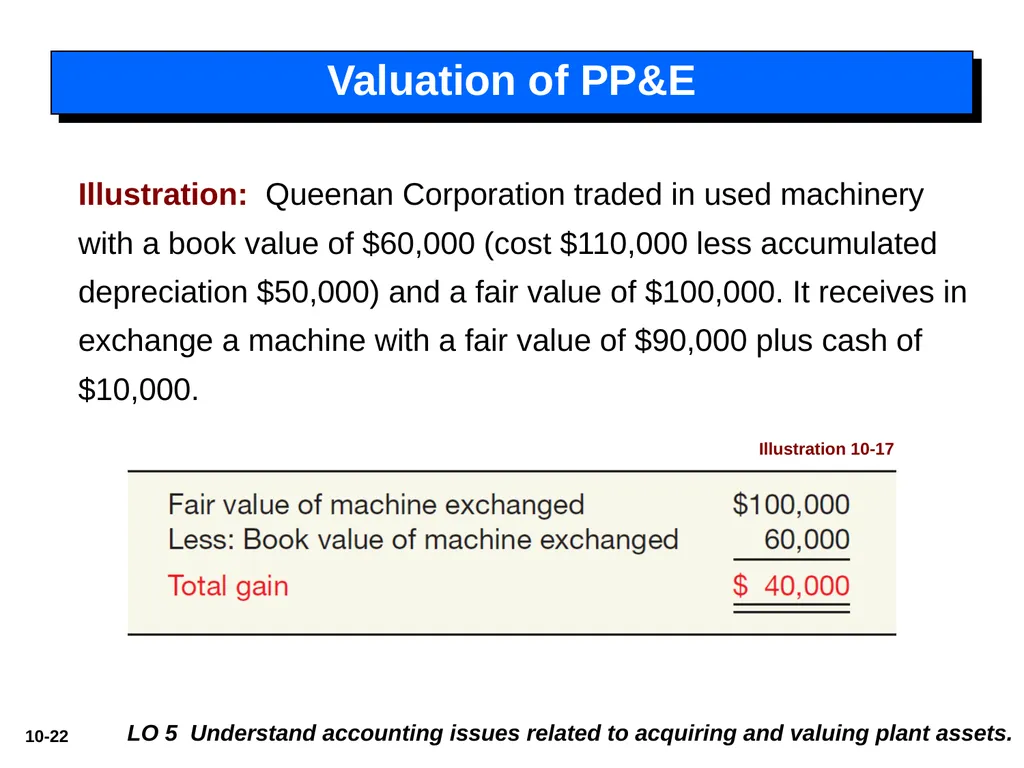
Valuation of PP&E LO 5 Understand accounting issues related to acquiring and valuing plant assets. Illustration: Queenan Corporation traded in used machinery with a book value of $60,000 (cost $110,000 less accumulated depreciation $50,000) and a fair value of $100,000. It receives in exchange a machine with a fair value of $90,000 plus cash of $10,000. Illustration 10-17<br>
23
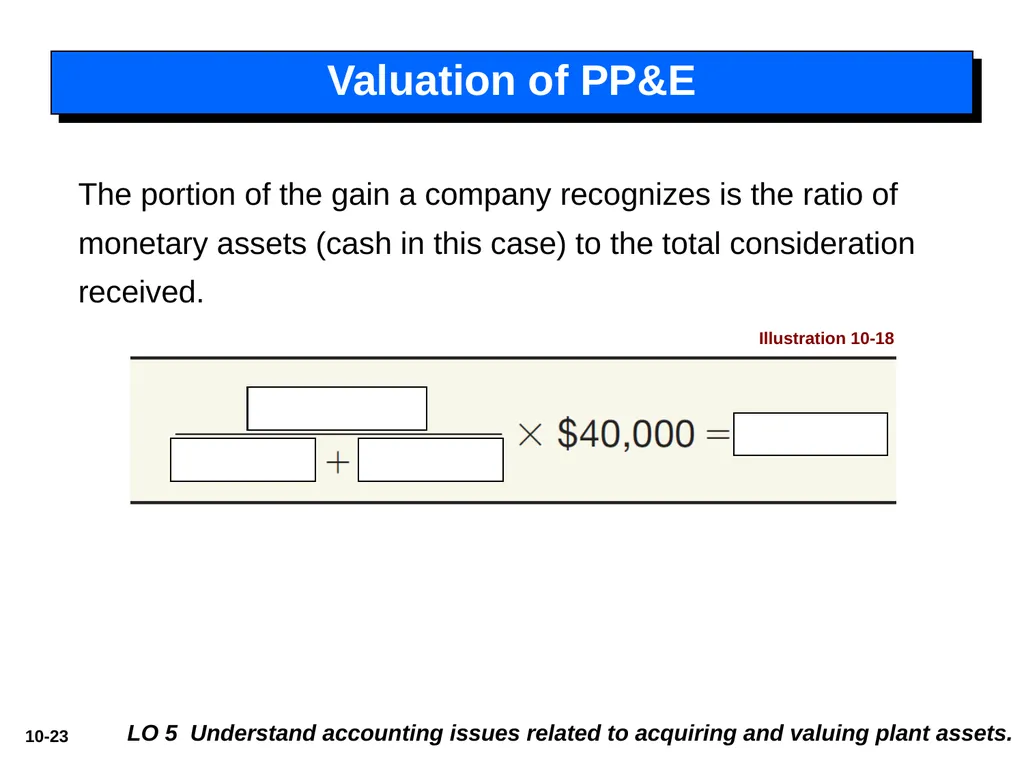
Valuation of PP&E LO 5 Understand accounting issues related to acquiring and valuing plant assets. Illustration 10-18 The portion of the gain a company recognizes is the ratio of monetary assets (cash in this case) to the total consideration received.<br>
24
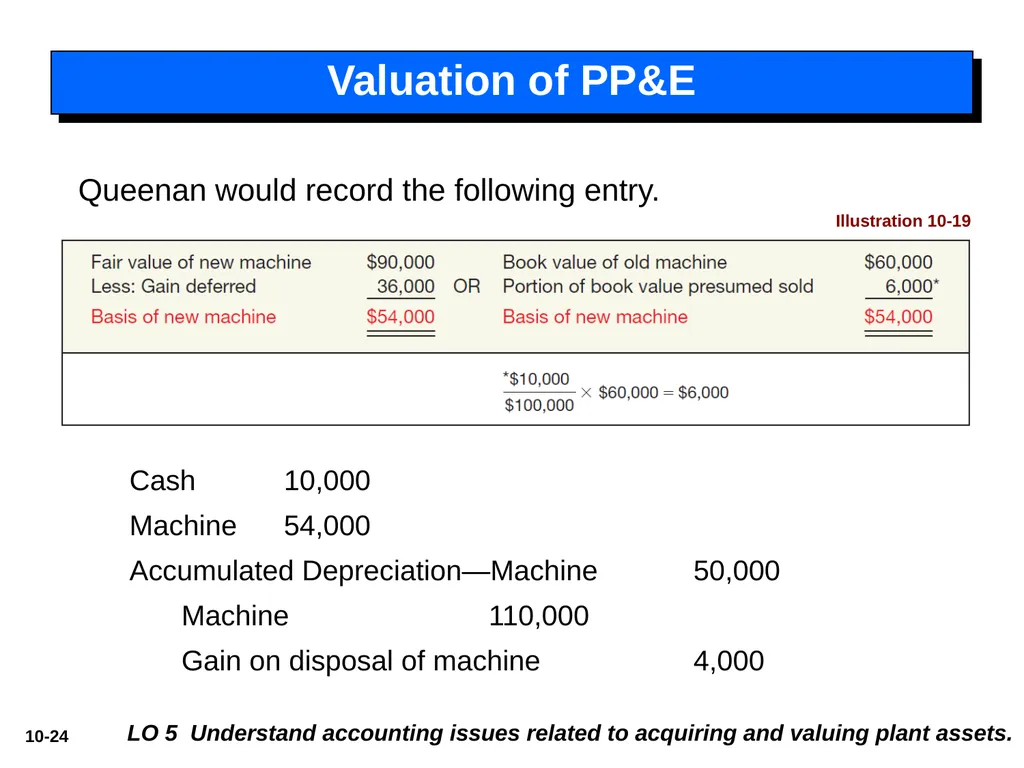
Valuation of PP&E LO 5 Understand accounting issues related to acquiring and valuing plant assets. Queenan would record the following entry. Illustration 10-19 Cash 10,000
Machine 54,000
Accumulated Depreciation—Machine 50,000
Machine 110,000
Gain on disposal of machine 4,000<br>
Machine 54,000
Accumulated Depreciation—Machine 50,000
Machine 110,000
Gain on disposal of machine 4,000<br>
25
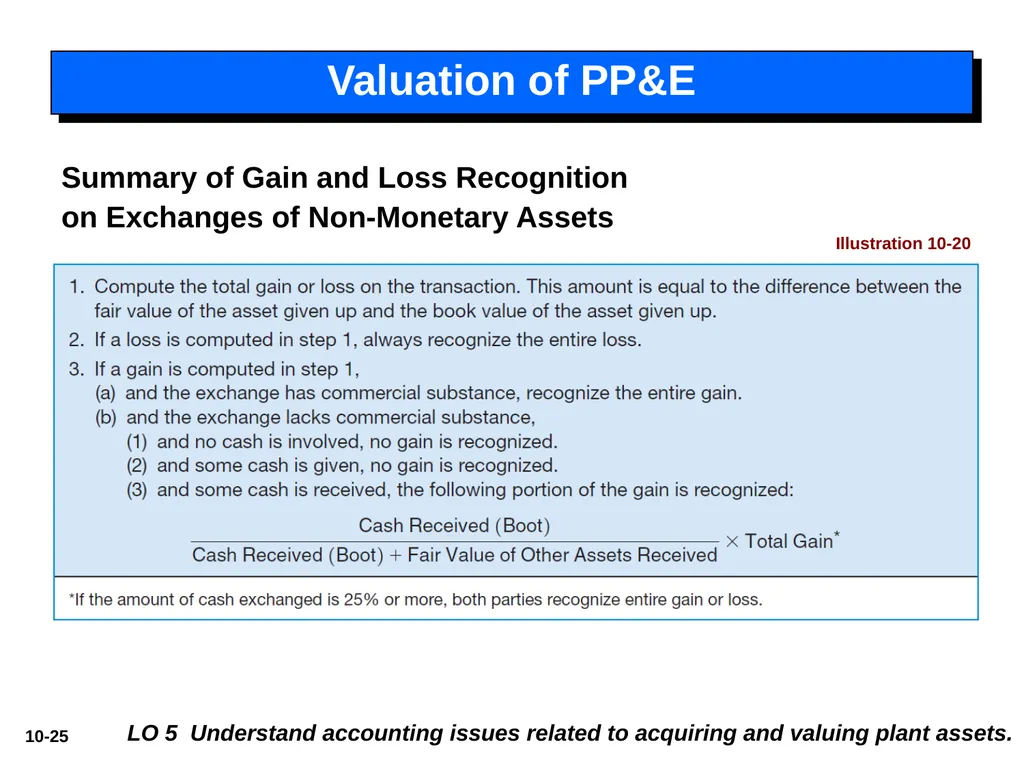
Valuation of PP&E LO 5 Understand accounting issues related to acquiring and valuing plant assets. Summary of Gain and Loss Recognition on Exchanges of Non-Monetary Assets Illustration 10-20<br>
26
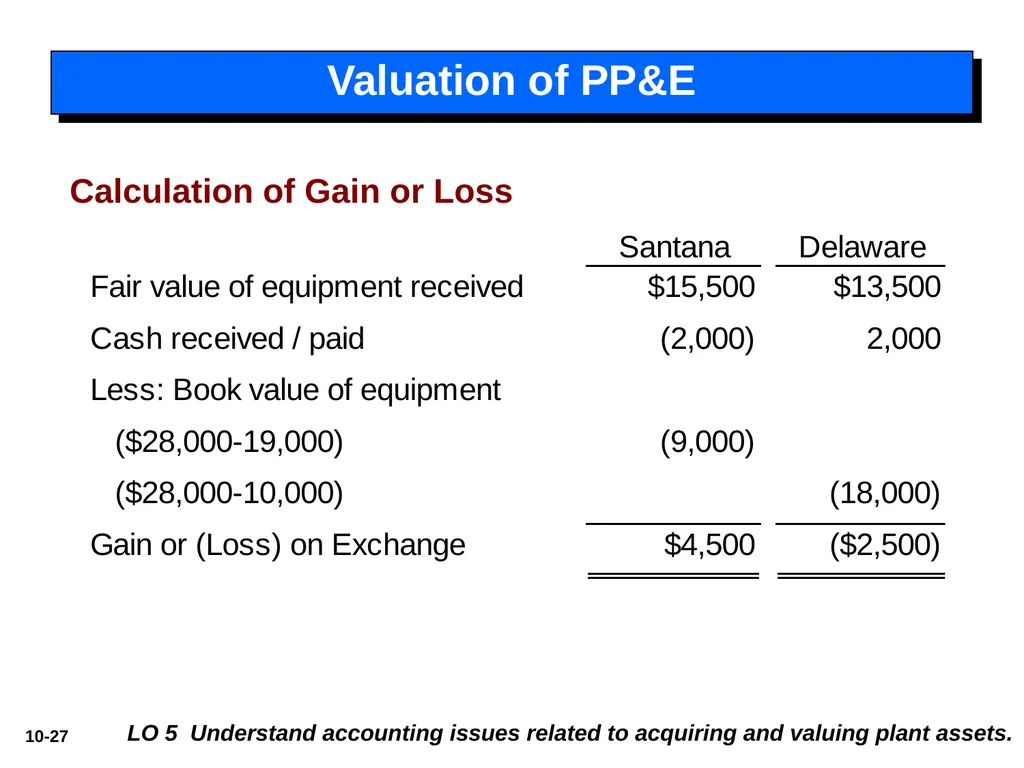
E10-19: Santana Company exchanged equipment used in its manufacturing operations plus $2,000 in cash for similar equipment used in the operations of Delaware Company. The following information pertains to the exchange. LO 5 Understand accounting issues related to acquiring and valuing plant assets. Instructions: Prepare the journal entries to record the exchange on the books of both companies. Valuation of PP&E<br>
27
Calculation of Gain or Loss LO 5 Understand accounting issues related to acquiring and valuing plant assets. Valuation of PP&E<br>
28
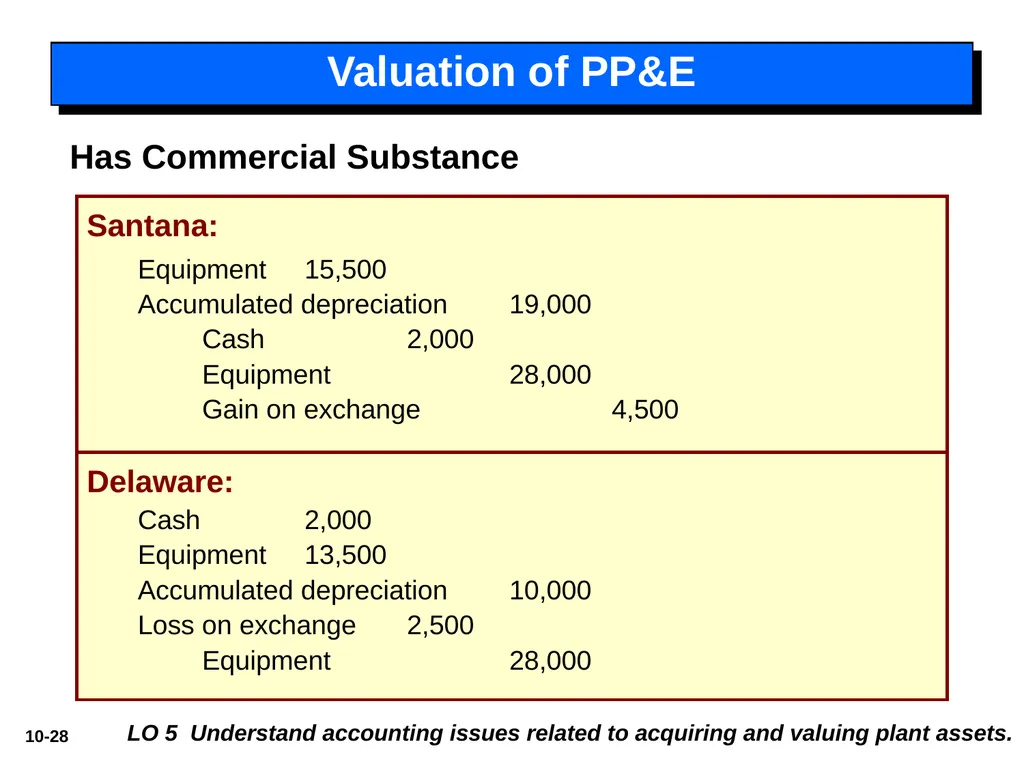
Has Commercial Substance LO 5 Understand accounting issues related to acquiring and valuing plant assets. Santana: Equipment 15,500
Accumulated depreciation 19,000
Cash 2,000
Equipment 28,000
Gain on exchange 4,500 Delaware: Cash 2,000
Equipment 13,500
Accumulated depreciation 10,000
Loss on exchange 2,500
Equipment 28,000 Valuation of PP&E<br>
Accumulated depreciation 19,000
Cash 2,000
Equipment 28,000
Gain on exchange 4,500 Delaware: Cash 2,000
Equipment 13,500
Accumulated depreciation 10,000
Loss on exchange 2,500
Equipment 28,000 Valuation of PP&E<br>
29
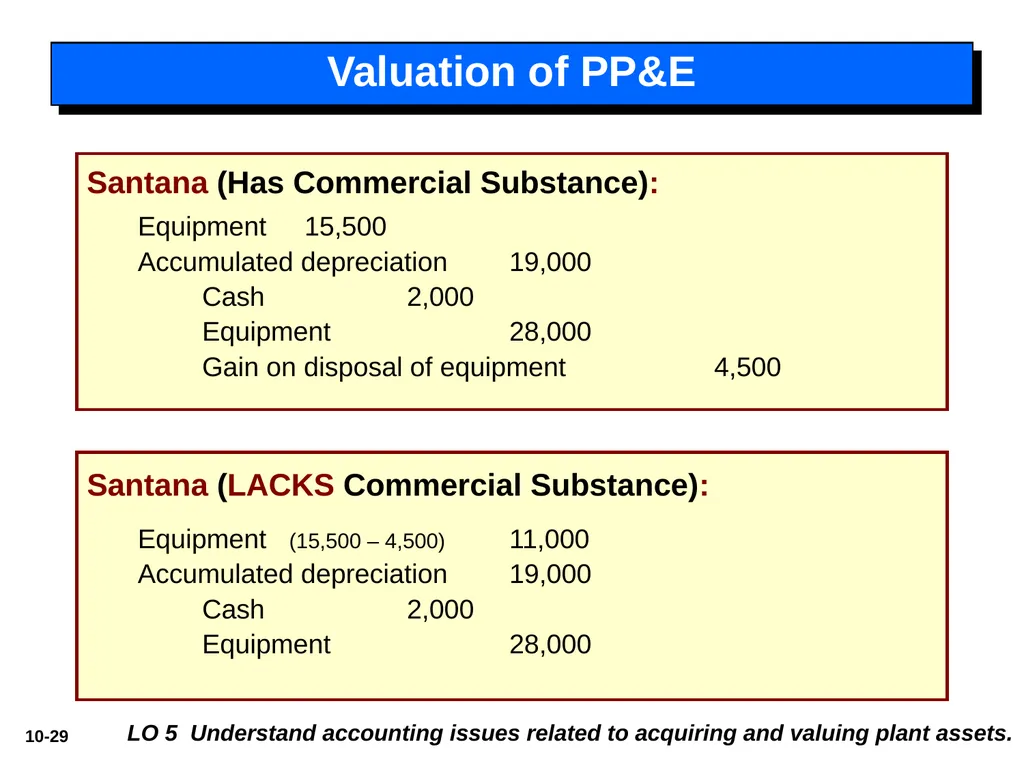
LO 5 Understand accounting issues related to acquiring and valuing plant assets. Santana (Has Commercial Substance): Equipment 15,500
Accumulated depreciation 19,000
Cash 2,000
Equipment 28,000
Gain on disposal of equipment 4,500 Valuation of PP&E Santana (LACKS Commercial Substance): Equipment (15,500 – 4,500) 11,000
Accumulated depreciation 19,000
Cash 2,000
Equipment 28,000<br>
Accumulated depreciation 19,000
Cash 2,000
Equipment 28,000
Gain on disposal of equipment 4,500 Valuation of PP&E Santana (LACKS Commercial Substance): Equipment (15,500 – 4,500) 11,000
Accumulated depreciation 19,000
Cash 2,000
Equipment 28,000<br>
30
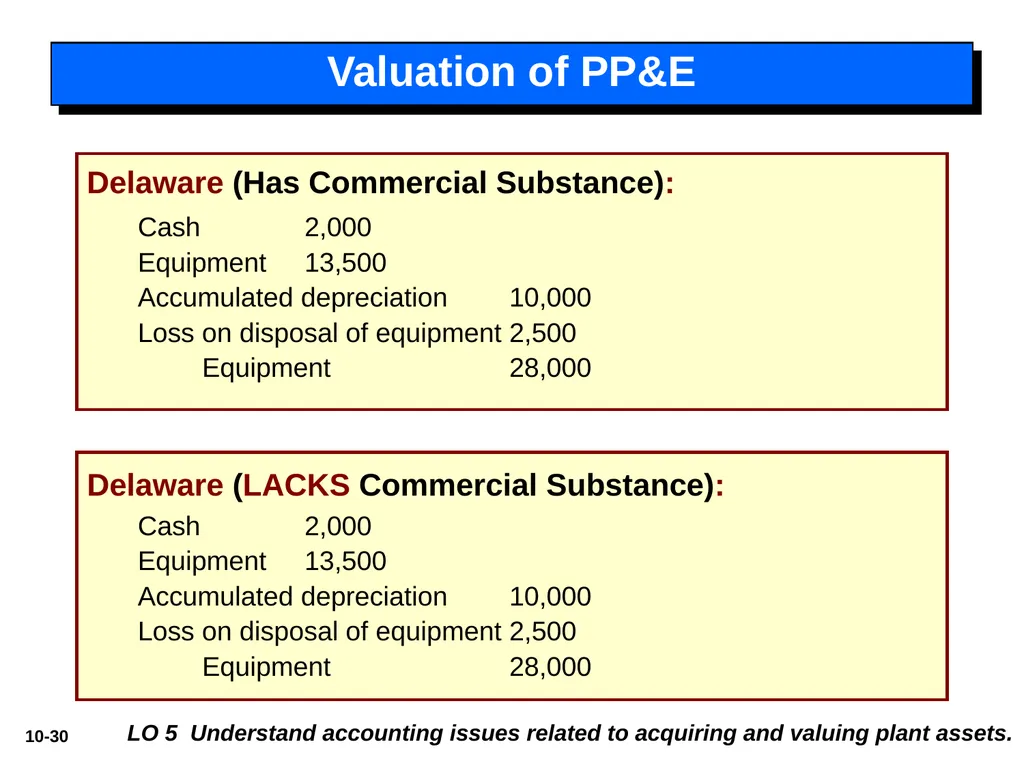
LO 5 Understand accounting issues related to acquiring and valuing plant assets. Delaware (Has Commercial Substance): Valuation of PP&E Delaware (LACKS Commercial Substance): Cash 2,000
Equipment 13,500
Accumulated depreciation 10,000
Loss on disposal of equipment 2,500
Equipment 28,000 Cash 2,000
Equipment 13,500
Accumulated depreciation 10,000
Loss on disposal of equipment 2,500
Equipment 28,000<br>
Equipment 13,500
Accumulated depreciation 10,000
Loss on disposal of equipment 2,500
Equipment 28,000 Cash 2,000
Equipment 13,500
Accumulated depreciation 10,000
Loss on disposal of equipment 2,500
Equipment 28,000<br>
31
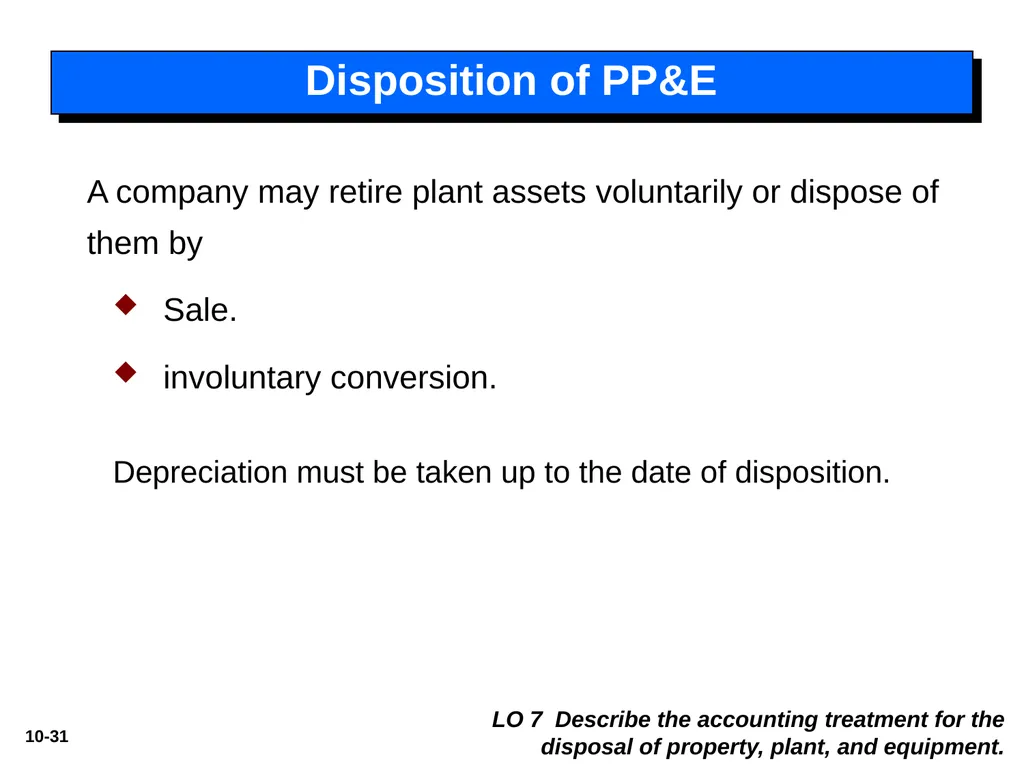
Disposition of PP&E LO 7 Describe the accounting treatment for the disposal of property, plant, and equipment. A company may retire plant assets voluntarily or dispose of them by
Sale.
involuntary conversion. Depreciation must be taken up to the date of disposition.<br>
Sale.
involuntary conversion. Depreciation must be taken up to the date of disposition.<br>
32
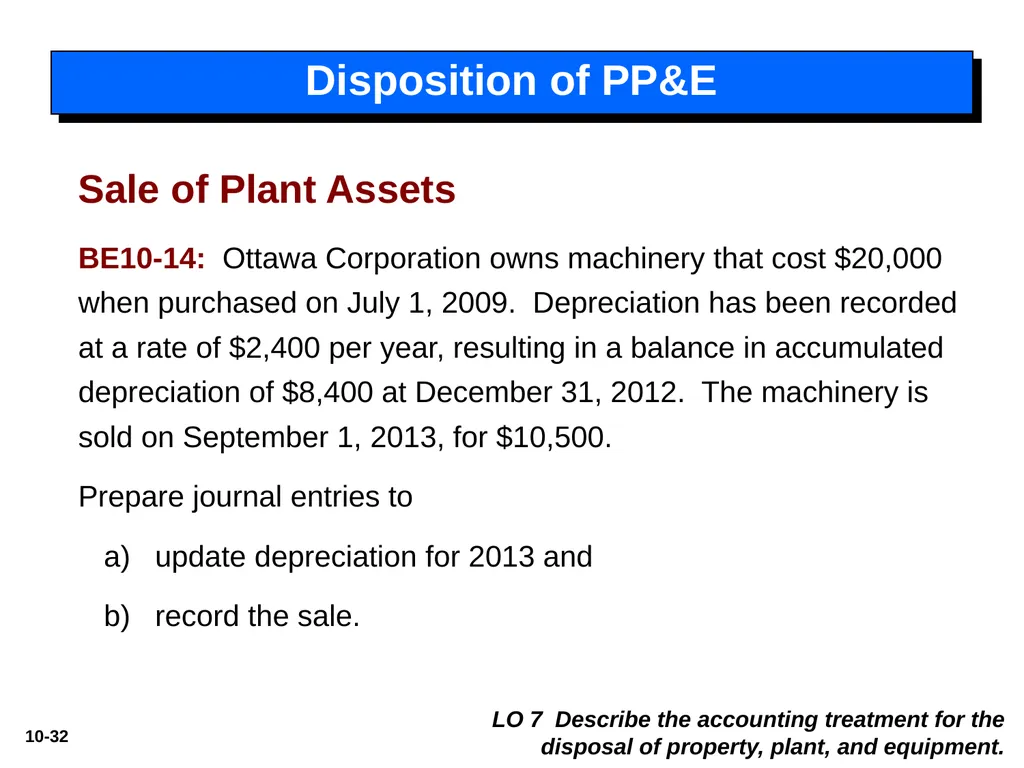
Disposition of PP&E BE10-14: Ottawa Corporation owns machinery that cost $20,000 when purchased on July 1, 2009. Depreciation has been recorded at a rate of $2,400 per year, resulting in a balance in accumulated depreciation of $8,400 at December 31, 2012. The machinery is sold on September 1, 2013, for $10,500.
Prepare journal entries to
update depreciation for 2013 and
record the sale. LO 7 Describe the accounting treatment for the disposal of property, plant, and equipment. Sale of Plant Assets<br>
Prepare journal entries to
update depreciation for 2013 and
record the sale. LO 7 Describe the accounting treatment for the disposal of property, plant, and equipment. Sale of Plant Assets<br>
33
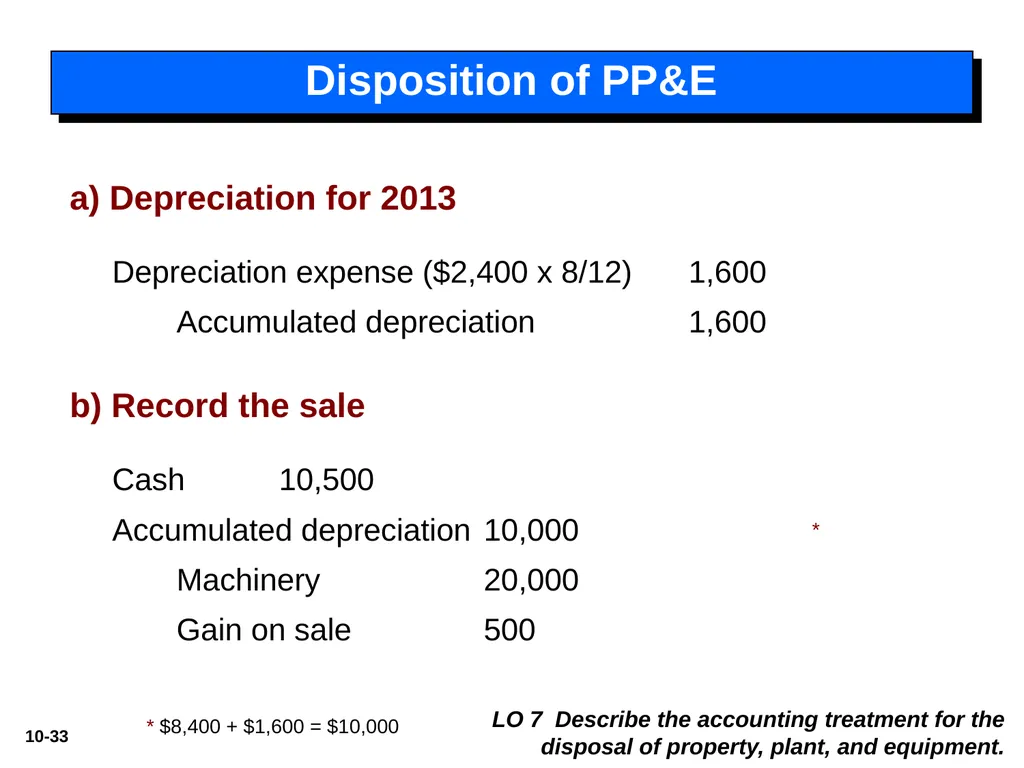
a) Depreciation for 2013 Depreciation expense ($2,400 x 8/12) 1,600
Accumulated depreciation 1,600 b) Record the sale Cash 10,500
Accumulated depreciation 10,000
Machinery 20,000
Gain on sale 500 Disposition of PP&E * $8,400 + $1,600 = $10,000 * LO 7 Describe the accounting treatment for the disposal of property, plant, and equipment.<br>
Accumulated depreciation 1,600 b) Record the sale Cash 10,500
Accumulated depreciation 10,000
Machinery 20,000
Gain on sale 500 Disposition of PP&E * $8,400 + $1,600 = $10,000 * LO 7 Describe the accounting treatment for the disposal of property, plant, and equipment.<br>
34
Sometimes an asset’s service is terminated through some type of involuntary conversion such as fire, flood, theft, or condemnation.
Companies report the difference between the amount recovered (e.g., from a condemnation award or insurance recovery), if any, and the asset’s book value as a gain or loss.
They treat these gains or losses like any other type of disposition. Involuntary Conversion Disposition of PP&E LO 7 Describe the accounting treatment for the disposal of property, plant, and equipment.<br>
Companies report the difference between the amount recovered (e.g., from a condemnation award or insurance recovery), if any, and the asset’s book value as a gain or loss.
They treat these gains or losses like any other type of disposition. Involuntary Conversion Disposition of PP&E LO 7 Describe the accounting treatment for the disposal of property, plant, and equipment.<br>