
International Financial Management Dr. Pravin
DJ
Published · 39 slides · 0 views

1 / 1






Description
International Financial Management Dr. Pravin Kumar Agrawal Ph.D. (Finance) Assistant Professor Department of Business Management INTERNATIONAL FINANCIAL MANAGEMENT It means financial management in an international business environment. It
Related Topics
Download this presentation From Below
"International Financial Management Dr. Pravin" is the property of its rightful owner. Permission is granted to download and print the materials on this website for personal, non-commercial use only, and to display it on your personal computer provided you do not modify the materials and that you retain all copyright notices contained in the materials. By downloading content from our website, you accept the terms of this agreement.
Share
Embed code
Presentation Transcript
01
International Financial Management Dr. Pravin Kumar Agrawal
Ph.D. (Finance)
Assistant Professor
Department of Business Management<br>
Ph.D. (Finance)
Assistant Professor
Department of Business Management<br>
02
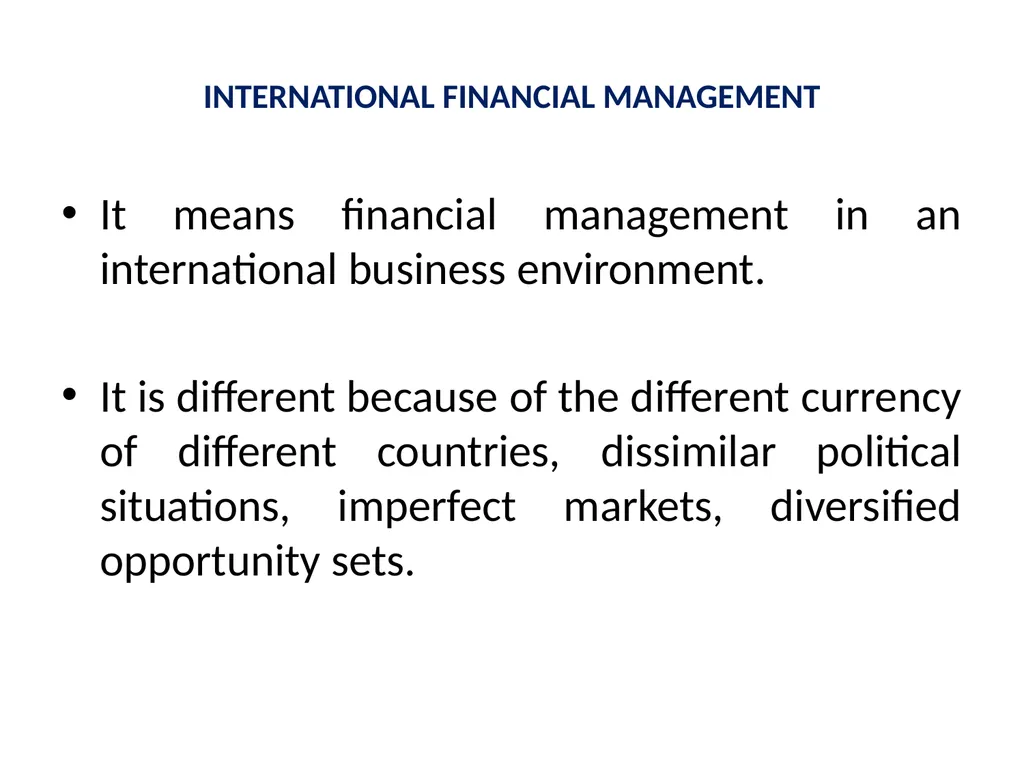
INTERNATIONAL FINANCIAL MANAGEMENT It means financial management in an international business environment.
It is different because of the different currency of different countries, dissimilar political situations, imperfect markets, diversified opportunity sets.<br>
It is different because of the different currency of different countries, dissimilar political situations, imperfect markets, diversified opportunity sets.<br>
03
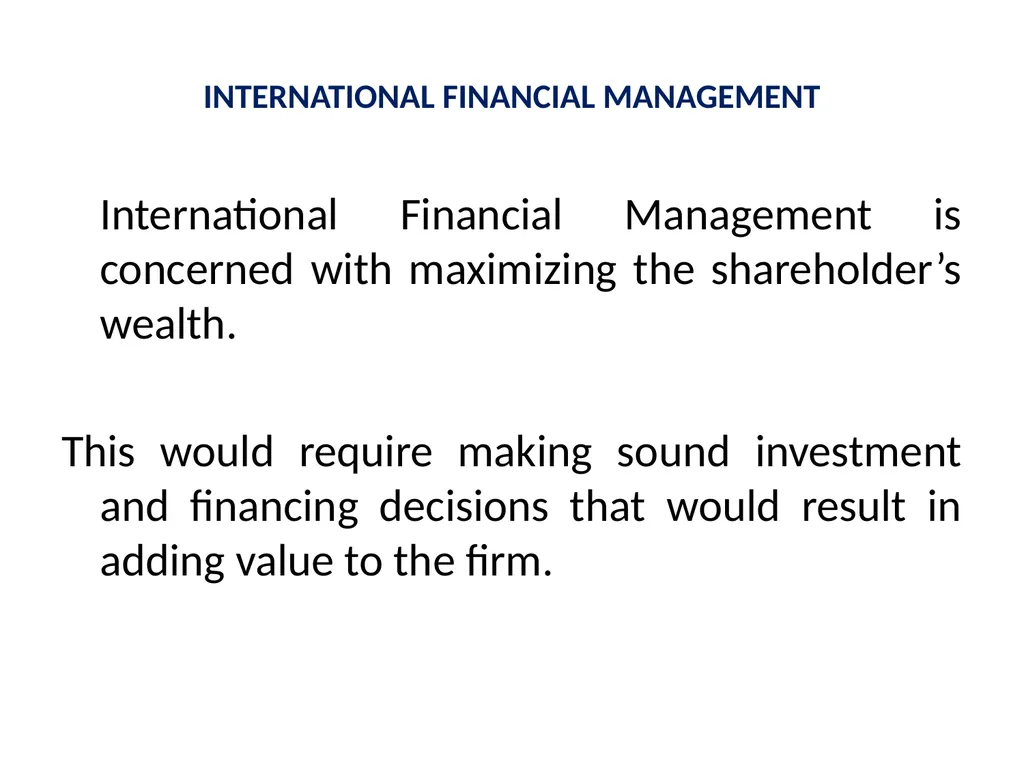
INTERNATIONAL FINANCIAL MANAGEMENT International Financial Management is concerned with maximizing the shareholder’s wealth.
This would require making sound investment and financing decisions that would result in adding value to the firm.<br>
This would require making sound investment and financing decisions that would result in adding value to the firm.<br>
04
Challenges A finance manager in an MNC faces many challenges that his counterpart in a domestic firm does not encounter.
These challenges include political risks, exchange rate risk, control on repatriation of profits, different tax laws, multiple money markets and different interest rates etc.
MNCs and their financial managers have to be look after the changes taking place all the time and develop ways to take advantages of the changes while reducing risks that these changes create. They have operations in different countries.
This gives them opportunity to access segmented capital markets to lower their overall cost of capital.<br>
These challenges include political risks, exchange rate risk, control on repatriation of profits, different tax laws, multiple money markets and different interest rates etc.
MNCs and their financial managers have to be look after the changes taking place all the time and develop ways to take advantages of the changes while reducing risks that these changes create. They have operations in different countries.
This gives them opportunity to access segmented capital markets to lower their overall cost of capital.<br>
05
Challenges They have ability to move people, money and material on a global basis to derive the maximum advantage out of these resources- They are able to practice the economic adage, “Do not put all your eggs in one basket".
International diversification of markets and production facilities reduces their risk.
Operating globally gives MNCs continuous access to information on the latest process technologies and latest R&D activities of their competitors.
They are able to access world's capital markets and thus diversify their funding sources.<br>
International diversification of markets and production facilities reduces their risk.
Operating globally gives MNCs continuous access to information on the latest process technologies and latest R&D activities of their competitors.
They are able to access world's capital markets and thus diversify their funding sources.<br>
06
Challenges International financial management will involve the study of
(a) Exchange rate and currency markets,
(b) Theory and practice of estimating future exchange rate,
(c) Various risks such as political/country risk, exchange rate risk and interest rate risk,
(d) Various risk management techniques,
(e) Cost of capital and capital budgeting in international context,
(f) Working capital management,
(g) Balance of Payment Analysis<br>
(a) Exchange rate and currency markets,
(b) Theory and practice of estimating future exchange rate,
(c) Various risks such as political/country risk, exchange rate risk and interest rate risk,
(d) Various risk management techniques,
(e) Cost of capital and capital budgeting in international context,
(f) Working capital management,
(g) Balance of Payment Analysis<br>
07
Need : International Financial Management We are now living in a highly globalized and integrated world economy.
Indian consumers, for example, routinely purchase oil imported from Saudi Arabia, TV sets Japan, Italy, and wine from France.
Purchase American-made aircraft, software, movies, jeans, and other products.
Continued liberalization of international trade is certain to further internationalize consumption patterns around the world.<br>
Indian consumers, for example, routinely purchase oil imported from Saudi Arabia, TV sets Japan, Italy, and wine from France.
Purchase American-made aircraft, software, movies, jeans, and other products.
Continued liberalization of international trade is certain to further internationalize consumption patterns around the world.<br>
08
Need : International Financial Management Financial markets have also become highly integrated.
This development allows investors to diversify their investment portfolios internationally.
Over the past decade, US investors have poured buckets of money into overseas markets, in the form of FPIs.
At the same time, Japanese investors are investing heavily in US and other foreign financial markets.
IBM, Infosys have their shares cross-listed on foreign stock exchanges, thereby rendering their shares internationally tradable and gaining access to foreign capital as well.<br>
This development allows investors to diversify their investment portfolios internationally.
Over the past decade, US investors have poured buckets of money into overseas markets, in the form of FPIs.
At the same time, Japanese investors are investing heavily in US and other foreign financial markets.
IBM, Infosys have their shares cross-listed on foreign stock exchanges, thereby rendering their shares internationally tradable and gaining access to foreign capital as well.<br>
09
Need : International Financial Management Last few decades a rapid internationalization of business has occurred.
With the increase in demand of goods and services due to opening of borders of countries around world, the requirement of capital, machinery and technological know-how has reached to the topmost level.
No single country can boast of self-sufficiency because in a global village a vast population of multidimensional tastes, preferences and demand exists.<br>
With the increase in demand of goods and services due to opening of borders of countries around world, the requirement of capital, machinery and technological know-how has reached to the topmost level.
No single country can boast of self-sufficiency because in a global village a vast population of multidimensional tastes, preferences and demand exists.<br>
10
Need : International Financial Management All the major economic functions- consumption, production, and investment– are highly globalized.
It is thus essential for financial managers to fully understand vital international dimensions of financial management.<br>
It is thus essential for financial managers to fully understand vital international dimensions of financial management.<br>
11
Need : International Financial Management In order to cater to needs/demand of huge world population, a country can engage itself in multi trading activities among various nations.
In the post WTO regime (after 1999 onwards), it has became pertinent to note that MNCs (Multinational corporations) with their world-wide production and distribution activities have gained momentum.
An understanding of international financial management is quite important in the light of changes in international environment, innovative instruments and institutions to facilitate the international trading activities.<br>
In the post WTO regime (after 1999 onwards), it has became pertinent to note that MNCs (Multinational corporations) with their world-wide production and distribution activities have gained momentum.
An understanding of international financial management is quite important in the light of changes in international environment, innovative instruments and institutions to facilitate the international trading activities.<br>
12
Need : International Financial Management The enormous opportunities of investments, savings, consumption and market accessibility have given rise to big institutions, financial instruments and financial markets.<br>
13
Need : International Financial Management An investor in USA would like to take investment opportunity in offshore markets.
The trade off between risk of investing in global markets and return from these investments is focused to achieve wealth maximization of the stakeholders.
It is important to note that in international financial management, stakeholders are spread all over the world<br>
The trade off between risk of investing in global markets and return from these investments is focused to achieve wealth maximization of the stakeholders.
It is important to note that in international financial management, stakeholders are spread all over the world<br>
14
DISTINGUISHING FEATURES OF INTERNATIONAL FINANCE International Finance is a distinct field of study and certain features set it apart from other fields. The important distinguishing features of international finance from domestic financial management are discussed below:<br>
15
1. Foreign exchange risk An understanding of foreign exchange risk is essential for managers and investors in the modern day environment of unforeseen changes in foreign exchange rates. In a domestic economy this risk is generally ignored because a single national currency serves as the main medium of exchange within a country. When different national currencies are exchanged for each other, there is a definite risk of volatility in foreign exchange rates.
The present International Monetary System set up is characterised by a mix of floating and managed exchange rate policies adopted by each nation keeping in view its interests. In fact, this variability of exchange rates is widely regarded as the most serious international financial problem facing corporate managers and policy makers.<br>
The present International Monetary System set up is characterised by a mix of floating and managed exchange rate policies adopted by each nation keeping in view its interests. In fact, this variability of exchange rates is widely regarded as the most serious international financial problem facing corporate managers and policy makers.<br>
16
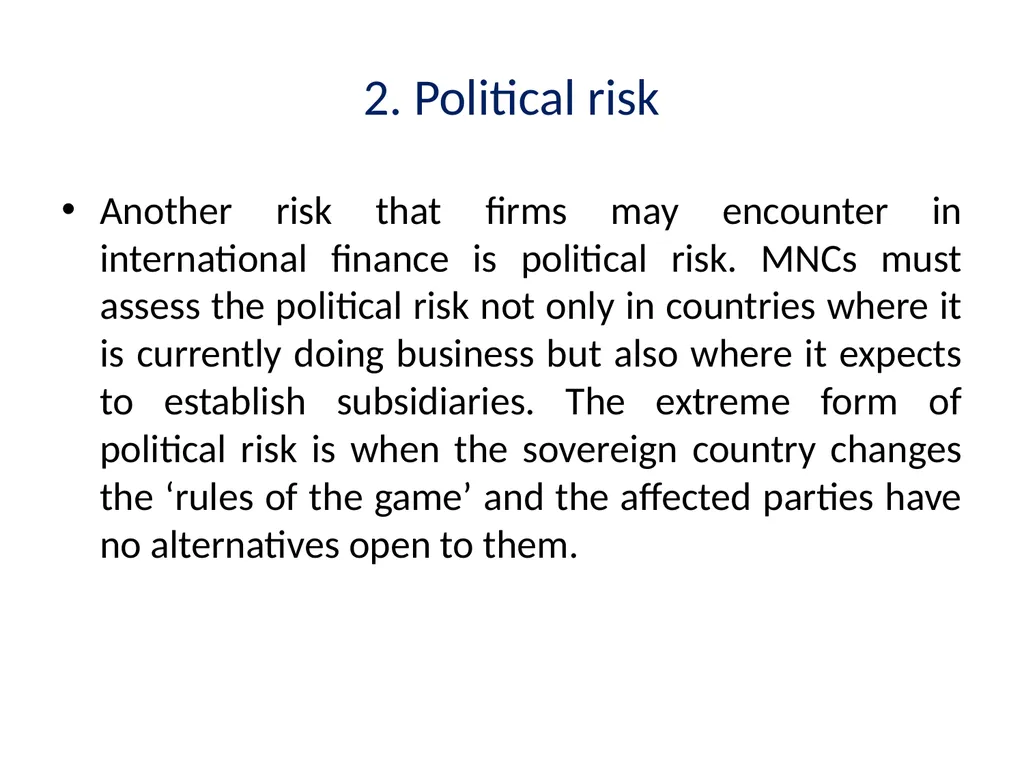
2. Political risk Another risk that firms may encounter in international finance is political risk. MNCs must assess the political risk not only in countries where it is currently doing business but also where it expects to establish subsidiaries. The extreme form of political risk is when the sovereign country changes the ‘rules of the game’ and the affected parties have no alternatives open to them.<br>
17
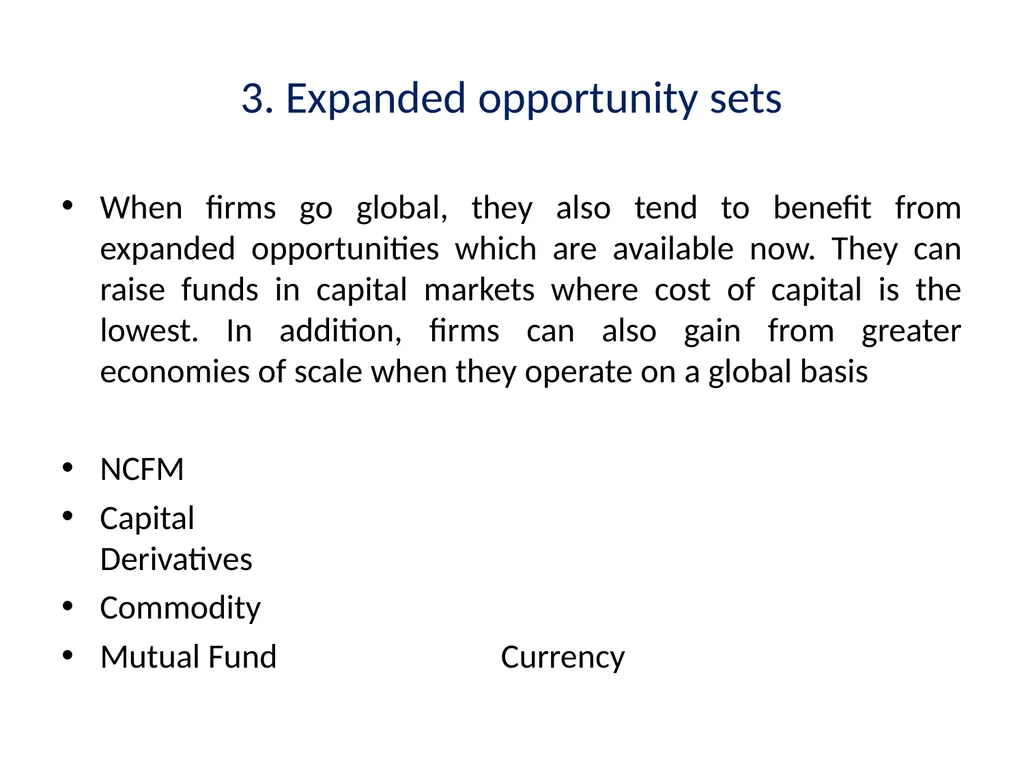
3. Expanded opportunity sets When firms go global, they also tend to benefit from expanded opportunities which are available now. They can raise funds in capital markets where cost of capital is the lowest. In addition, firms can also gain from greater economies of scale when they operate on a global basis
NCFM
Capital Derivatives
Commodity
Mutual Fund Currency<br>
NCFM
Capital Derivatives
Commodity
Mutual Fund Currency<br>
18
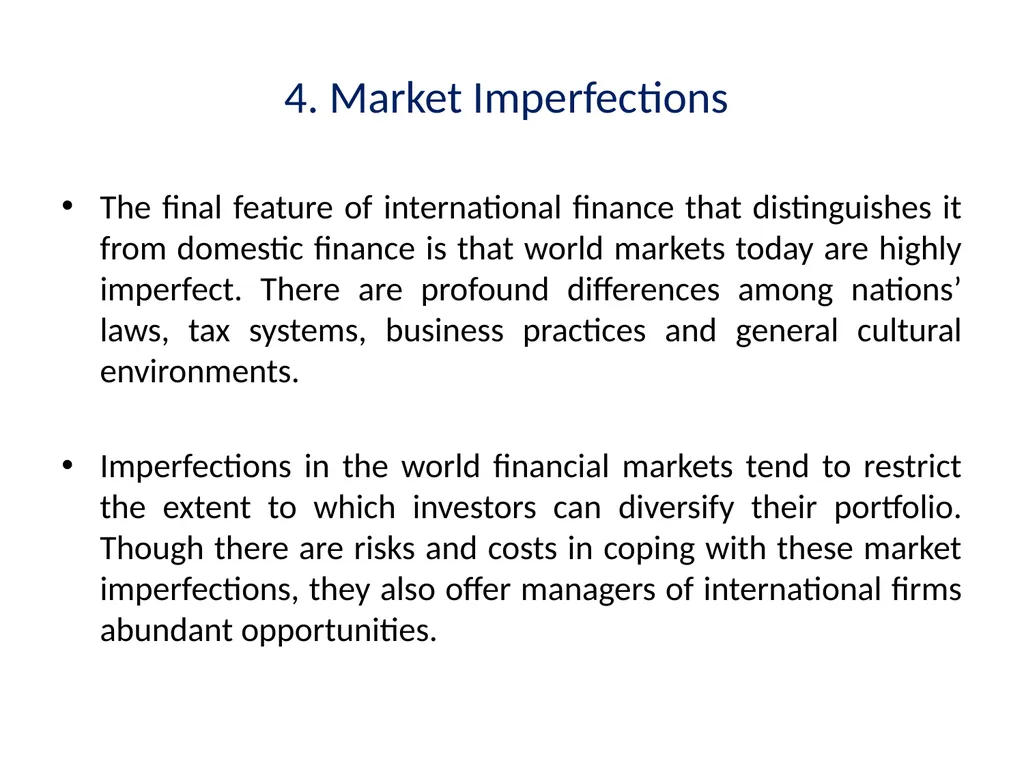
4. Market Imperfections The final feature of international finance that distinguishes it from domestic finance is that world markets today are highly imperfect. There are profound differences among nations’ laws, tax systems, business practices and general cultural environments.
Imperfections in the world financial markets tend to restrict the extent to which investors can diversify their portfolio. Though there are risks and costs in coping with these market imperfections, they also offer managers of international firms abundant opportunities.<br>
Imperfections in the world financial markets tend to restrict the extent to which investors can diversify their portfolio. Though there are risks and costs in coping with these market imperfections, they also offer managers of international firms abundant opportunities.<br>
19
NATURE AND SCOPE OF INTERNATIONAL FINANCIAL MANAGEMENT<br>
20
Nature of the IFM IFM is concerned with financial decisions taken in international business.
IFM is an extension of corporate finance at international level.
IFM set the standard for international tax planning and international accounting
IFM includes management of exchange rate risk.
IFM includes working capital management of multinational enterprises.<br>
IFM is an extension of corporate finance at international level.
IFM set the standard for international tax planning and international accounting
IFM includes management of exchange rate risk.
IFM includes working capital management of multinational enterprises.<br>
21
Scope of the IFM Foreign exchange markets, international accounting, exchange rate risk management etc.
It also includes management of finance functions of international business.
IFM sorts out the issues relating to FDI and foreign portfolio investment.
It manages various risks such as inflation risk, interest rate risks, credit risk and exchange rate risk.
It manages the changes in the foreign exchange market.
It deals with balance of payments in global transactions of nations.<br>
It also includes management of finance functions of international business.
IFM sorts out the issues relating to FDI and foreign portfolio investment.
It manages various risks such as inflation risk, interest rate risks, credit risk and exchange rate risk.
It manages the changes in the foreign exchange market.
It deals with balance of payments in global transactions of nations.<br>
22
NATURE AND SCOPE OF INTERNATIONAL FINANCIAL MANAGEMENT Like any finance function, international finance, the finance function of a multinational firm has two functions namely, treasury and control. The treasurer is responsible for financial planning analysis, fund acquisition, investment financing, cash management, investment decision and risk management. On the other hand, controller deals with the functions related to external reporting, tax planning and management, financial and management accounting, budget planning and control, and accounts receivables etc.<br>
23
NATURE AND SCOPE OF INTERNATIONAL FINANCIAL MANAGEMENT For maximising the returns from investment and to minimise the cost of finance, the firms has to take portfolio decision based on analytical skills required for this purpose.
Since the firm has to raise funds from different financial markets of the world, which needs to actively exploit market imperfections and the firm’s superior forecasting ability to generate purely financial gains.
The complex nature of managing international finance is due to the fact that a wide variety of financial instruments, products, funding options and investment vehicles are available for both reactive and proactive management of corporate finance.<br>
Since the firm has to raise funds from different financial markets of the world, which needs to actively exploit market imperfections and the firm’s superior forecasting ability to generate purely financial gains.
The complex nature of managing international finance is due to the fact that a wide variety of financial instruments, products, funding options and investment vehicles are available for both reactive and proactive management of corporate finance.<br>
24
NATURE AND SCOPE OF INTERNATIONAL FINANCIAL MANAGEMENT Multinational finance is multidisciplinary in nature, while an understanding of economic theories and principles is necessary to estimate and model financial decisions, financial accounting and management accounting help in decision making in financial management at multinational level.<br>
25
NATURE AND SCOPE OF INTERNATIONAL FINANCIAL MANAGEMENT Because of changing nature of environment at international level, the knowledge of latest changes in forex rates, volatility in capital market, interest rate fluctuations, macro level charges, micro level economic indicators, savings, consumption pattern, interest preference, investment behaviour of investors, export and import trends, competition, banking sector performance, inflationary trends, demand and supply conditions etc. is required by the practitioners of international financial management.<br>
26
INTERNATIONAL BUSINESS METHODS The four types of international businesses are:
1. Exporting
2. Licensing
3. Franchising
4. Foreign Direct Investment (FDI)<br>
1. Exporting
2. Licensing
3. Franchising
4. Foreign Direct Investment (FDI)<br>
27
Exporting Exporting is often the first choice when manufacturers decide to expand abroad. Exporting means selling abroad, either directly to target customers or indirectly by retaining foreign sales agents or/and distributors.
Exporting is the practice of shipping goods from the domestic country to a foreign country. This term export is derived from the conceptual meaning as to ship the goods and services out of the port of a country.
The seller of such goods and services is referred to as an ―exporter‖ who is based in the country of export whereas the overseas based buyer is referred to as an ―importer‖. An export‘s counterpart is an import.
In international trade, exporting refers to selling goods and services produced in the home country to other markets. Export of commercial quantities of goods normally requires the involvement of customs authorities in both the country of export and the country of import. Data on international trade in goods is mostly obtained through declarations to customs services.<br>
Exporting is the practice of shipping goods from the domestic country to a foreign country. This term export is derived from the conceptual meaning as to ship the goods and services out of the port of a country.
The seller of such goods and services is referred to as an ―exporter‖ who is based in the country of export whereas the overseas based buyer is referred to as an ―importer‖. An export‘s counterpart is an import.
In international trade, exporting refers to selling goods and services produced in the home country to other markets. Export of commercial quantities of goods normally requires the involvement of customs authorities in both the country of export and the country of import. Data on international trade in goods is mostly obtained through declarations to customs services.<br>
28
Licensing A licensing agreement is a contract between two parties (the licensor and licensee) in which the licensor grants the licensee the right to use the brand name, trademark, patented technology, or ability to produce and sell goods owned by the licensor. In other words, a licensing agreement grants the licensee the ability to use intellectual property owned by the licensor. Licensing agreements are commonly used by the licensor to commercialize their intellectual property.
An example would include Microsoft granting a license to individual users allowing them to use the Windows operating system;<br>
An example would include Microsoft granting a license to individual users allowing them to use the Windows operating system;<br>
29
A license where a drug company that owns the patent to a certain drug, as licensor, grants a license to another drug company, as licensee, allowing them to manufacture and sell a drug that utilizes the patented formula.<br>
30
Licensing Licensing is another way to expand one‘s operations internationally. In case of international licensing, there is an agreement whereby a firm, called licensor, grants a foreign firm the right to use intangible (intellectual) property for a specific period of time, usually in return for a royalty. Licensing of intellectual property such as patents, copyrights, manufacturing processes, or trade names abound across the nations.<br>
31
Franchising A “Franchise means any continuing commercial relationship or arrangement, whatever it may be called, in which the terms of the offer or contract specify, or the franchise seller promises or represents, orally or in writing, that:
(1) The franchisee will obtain the right to operate a business that is identified or associated with the franchisor’s trademark, or to offer, sell, or distribute goods, services, or commodities that are identified or associated with the franchisor’s trademark;
(2) The franchisor will exert or has authority to exert a significant degree of control over the franchisee’s method of operation, or provide significant assistance in the franchisee’s method of operation; and
(3) As a condition of obtaining or commencing operation of the franchise, the franchisee makes a requirement payment or commits to make a required payment to the franchisor.”<br>
(1) The franchisee will obtain the right to operate a business that is identified or associated with the franchisor’s trademark, or to offer, sell, or distribute goods, services, or commodities that are identified or associated with the franchisor’s trademark;
(2) The franchisor will exert or has authority to exert a significant degree of control over the franchisee’s method of operation, or provide significant assistance in the franchisee’s method of operation; and
(3) As a condition of obtaining or commencing operation of the franchise, the franchisee makes a requirement payment or commits to make a required payment to the franchisor.”<br>
32
Franchising Franchising differs from licensing in the sense that it usually requires the franchisee to follow much stricter guidelines in running the business than does licensing. Further, licensing tends to be confined to manufacturers, whereas<br>
33
Franchising Franchisee will take the majority of the risk in opening a new location (e.g. capital investments while gaining the advantage of an already established brand name and operational process. In exchange, the franchisee will pay a certain percentage of the profits of the venture back to the franchiser. The franchiser will also often provide training, advertising, and assistance with products.<br>
34
Franchising Franchising enables organizations a low cost and localized strategy to expanding to international markets, while offering local entrepreneurs the opportunity to run an established business.<br>
35
Difference The difference between licensing and franchising is that licensing is limited to the authorized use of a trademark or technology, whereas franchising is a broader legal relationship that requires a business be developed and operated in compliance with brand standards, specifications, and other requirements designated by the franchisor. Licensing is used to monetize trademarks and technologies for use by other businesses that operate under their own brand. Franchising is used to achieve multi-unit expansion of a singular brand.<br>
36
Example McDonald's
Dominos
KFC
Pizza Hut<br>
Dominos
KFC
Pizza Hut<br>
37
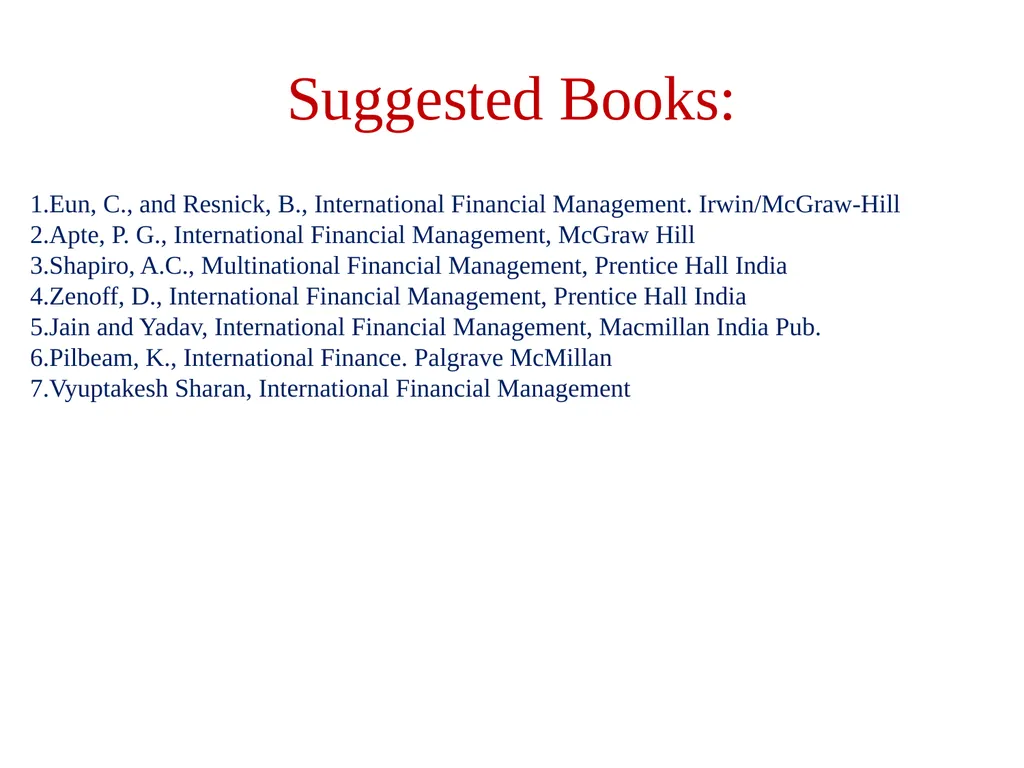
Suggested Books: Eun, C., and Resnick, B., International Financial Management. Irwin/McGraw-Hill
Apte, P. G., International Financial Management, McGraw Hill
Shapiro, A.C., Multinational Financial Management, Prentice Hall India
Zenoff, D., International Financial Management, Prentice Hall India
Jain and Yadav, International Financial Management, Macmillan India Pub.
Pilbeam, K., International Finance. Palgrave McMillan
Vyuptakesh Sharan, International Financial Management<br>
Apte, P. G., International Financial Management, McGraw Hill
Shapiro, A.C., Multinational Financial Management, Prentice Hall India
Zenoff, D., International Financial Management, Prentice Hall India
Jain and Yadav, International Financial Management, Macmillan India Pub.
Pilbeam, K., International Finance. Palgrave McMillan
Vyuptakesh Sharan, International Financial Management<br>