International Perforating Symposium (IPS) 2016 Thermal Decomposition Progress with HMX Explosives Thermal Decomposition Progress with HMX Explosives AGENDAINTRODUCTION Review previous work (SPE 174209) Update on API budget and LLNL testing
"International Perforating Symposium (IPS) 2016" is the property of its rightful owner. Permission is granted to
download and print the materials on this website for personal, non-commercial use only, and to display it
on your personal computer provided you do not modify the materials and that you retain all copyright
notices contained in the materials. By downloading content from our website, you accept the terms of this
agreement.
Presentation Transcript
01
International Perforating Symposium (IPS) 2016 Thermal Decomposition Progress with HMX Explosives<br>
02
Thermal Decomposition Progress with HMX Explosives AGENDA/INTRODUCTION Review previous work (SPE 174209)
Update on API budget and LLNL testing
Detailed results on Perforating Gun/HMX Charge tests
Review of plans for continued work IPS 16-02 1<br>
03
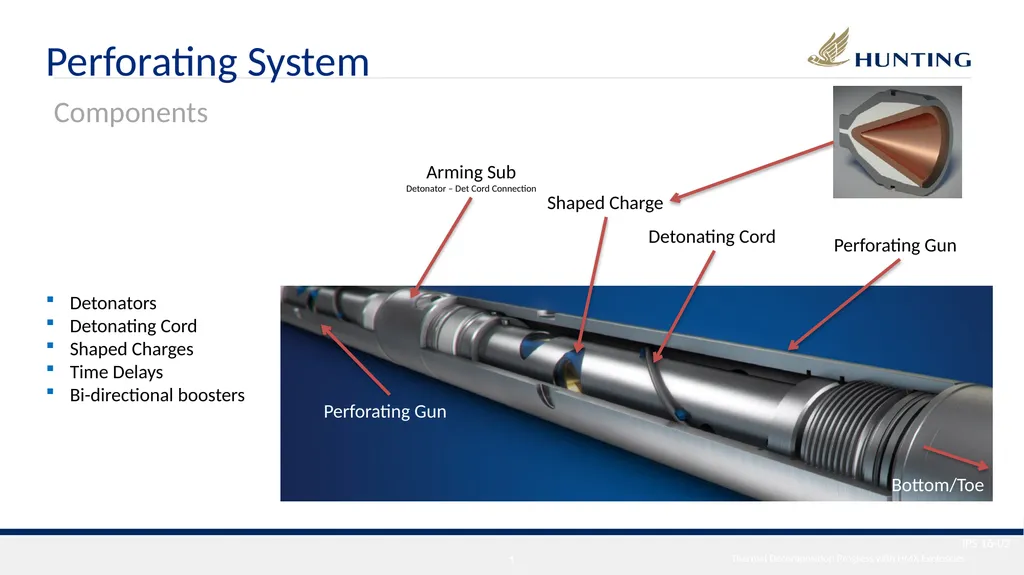
Thermal Decomposition Progress with HMX Explosives Perforating System Components IPS 16-02 1 Perforating Gun Detonating Cord Shaped Charge Arming Sub
Detonator – Det Cord Connection Perforating Gun Bottom/Toe Detonators
Detonating Cord
Shaped Charges
Time Delays
Bi-directional boosters<br>
04
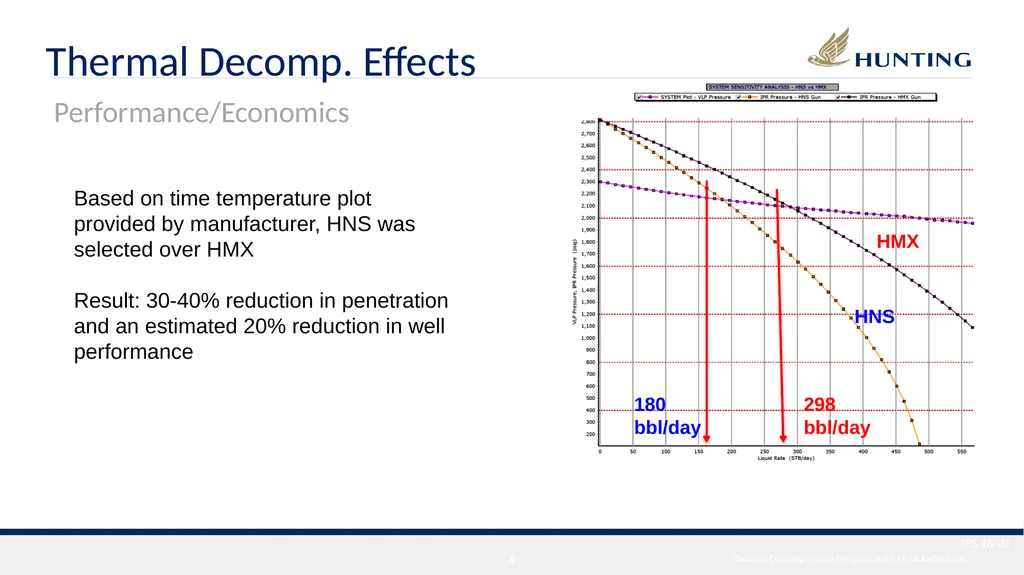
Thermal Decomposition Progress with HMX Explosives Thermal Decomp. Effects 3 IPS 16-02 Based on time temperature plot provided by manufacturer, HNS was selected over HMX
Result: 30-40% reduction in penetration and an estimated 20% reduction in well performance 180 bbl/day 298 bbl/day HMX HNS Performance/Economics<br>
05
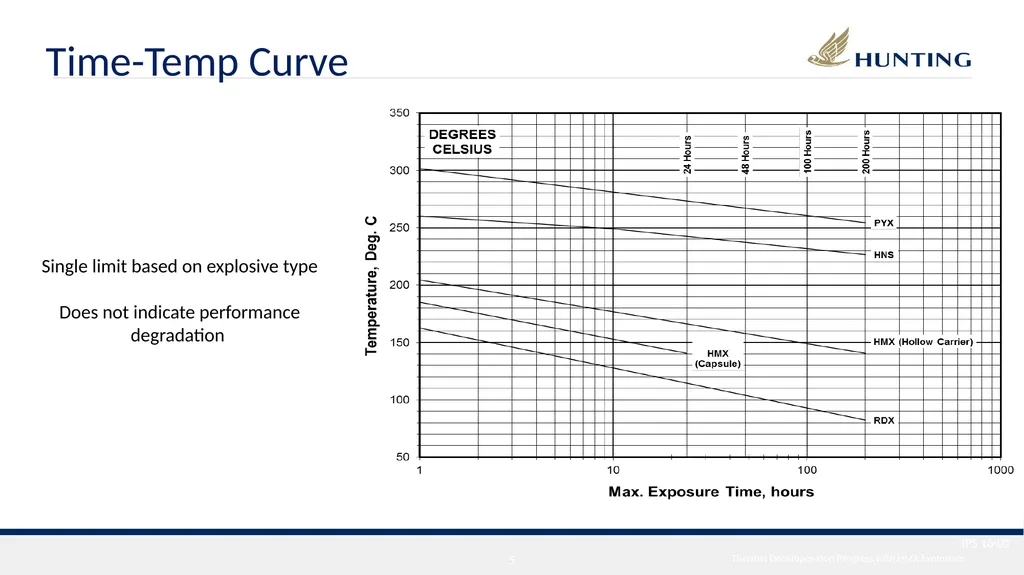
Thermal Decomposition Progress with HMX Explosives Time-Temp Curve 4 IPS 16-02 Single limit based on explosive type
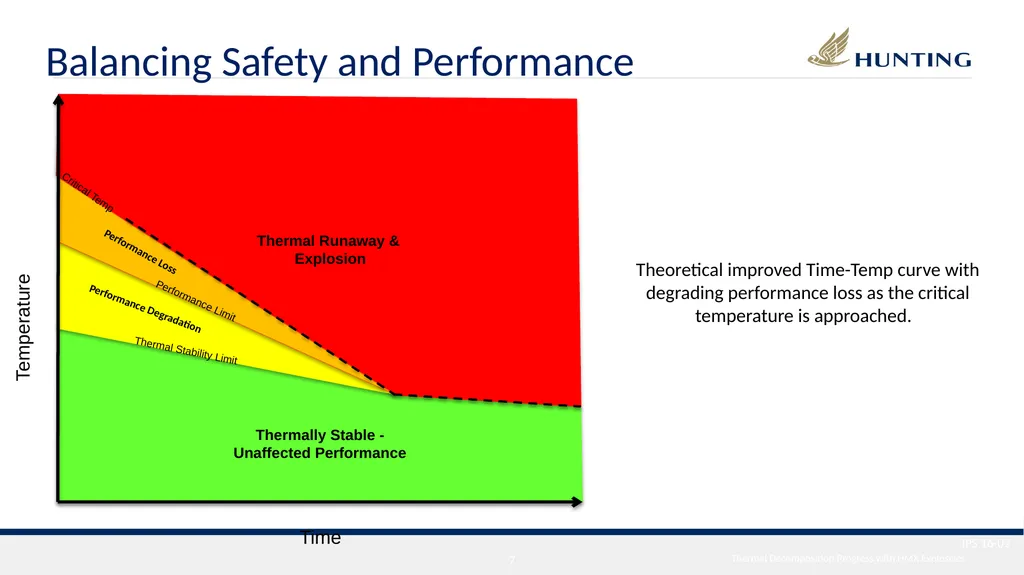
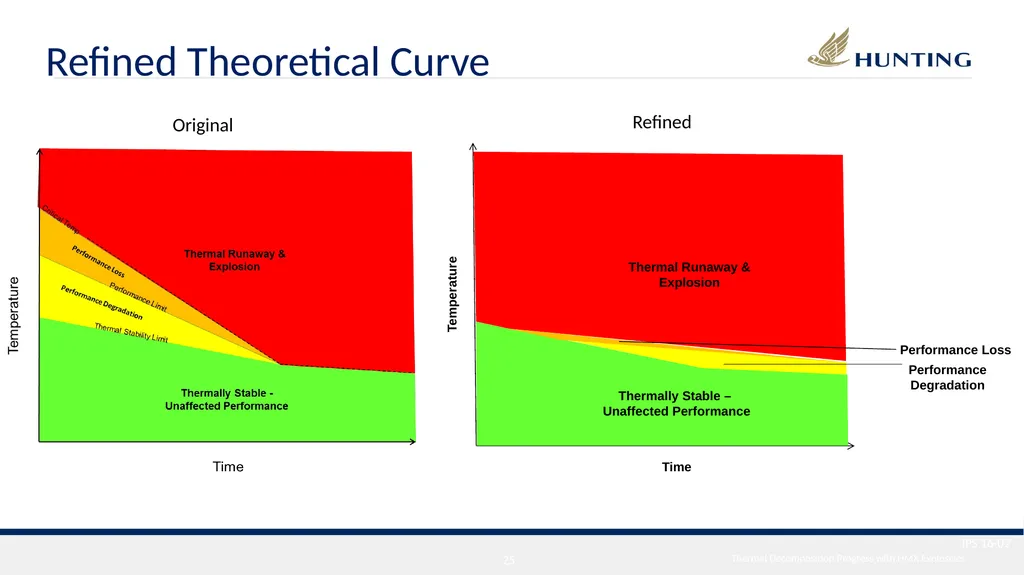
Thermal Decomposition Progress with HMX Explosives Balancing Safety and Performance 6 IPS 16-02 Theoretical improved Time-Temp curve with degrading performance loss as the critical temperature is approached.<br>
08
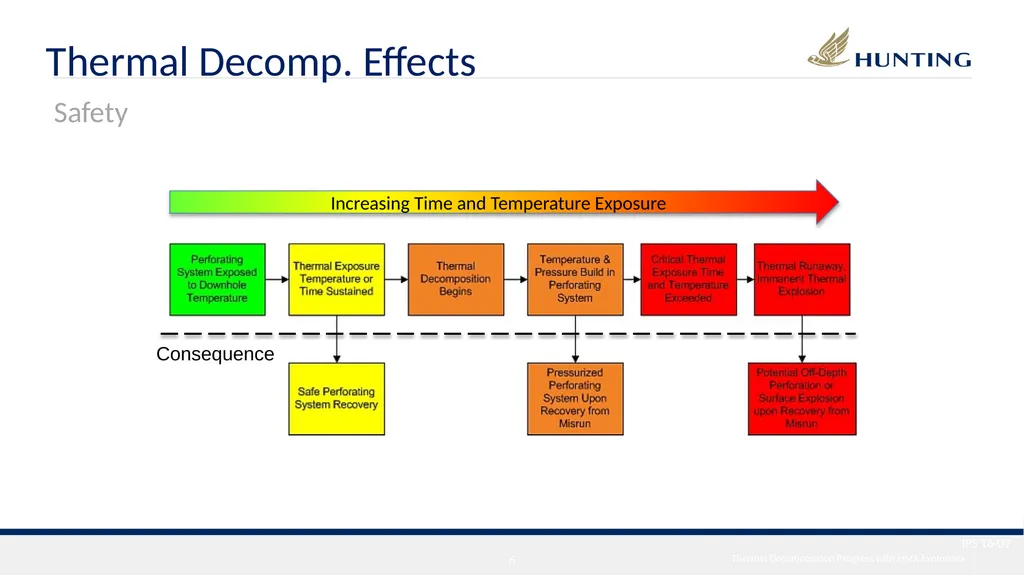
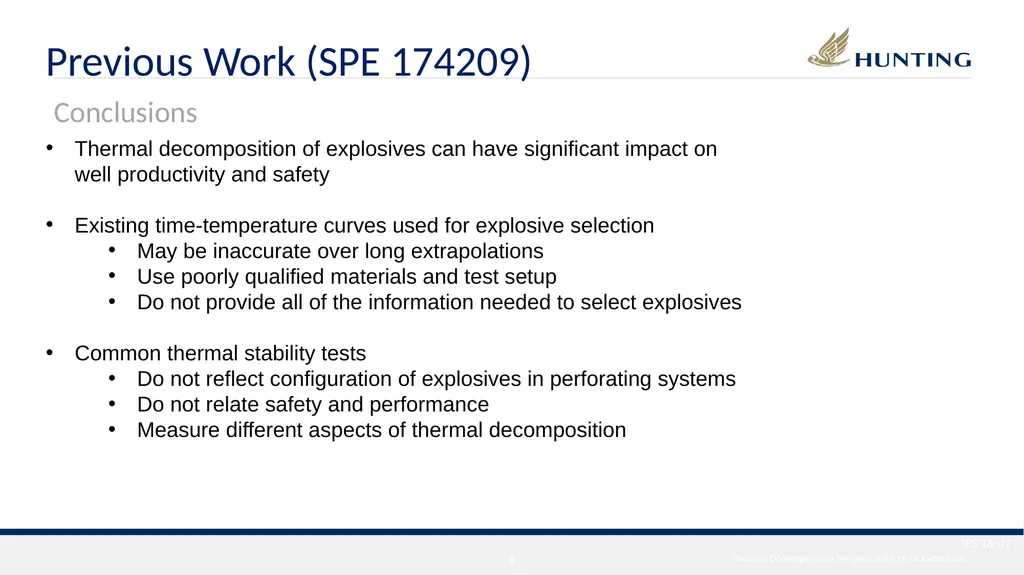
Thermal Decomposition Progress with HMX Explosives Previous Work (SPE 174209) 7 IPS 16-02 Thermal decomposition of explosives can have significant impact on well productivity and safety
Existing time-temperature curves used for explosive selection
May be inaccurate over long extrapolations
Use poorly qualified materials and test setup
Do not provide all of the information needed to select explosives
Common thermal stability tests
Do not reflect configuration of explosives in perforating systems
Do not relate safety and performance
Measure different aspects of thermal decomposition Conclusions<br>
09
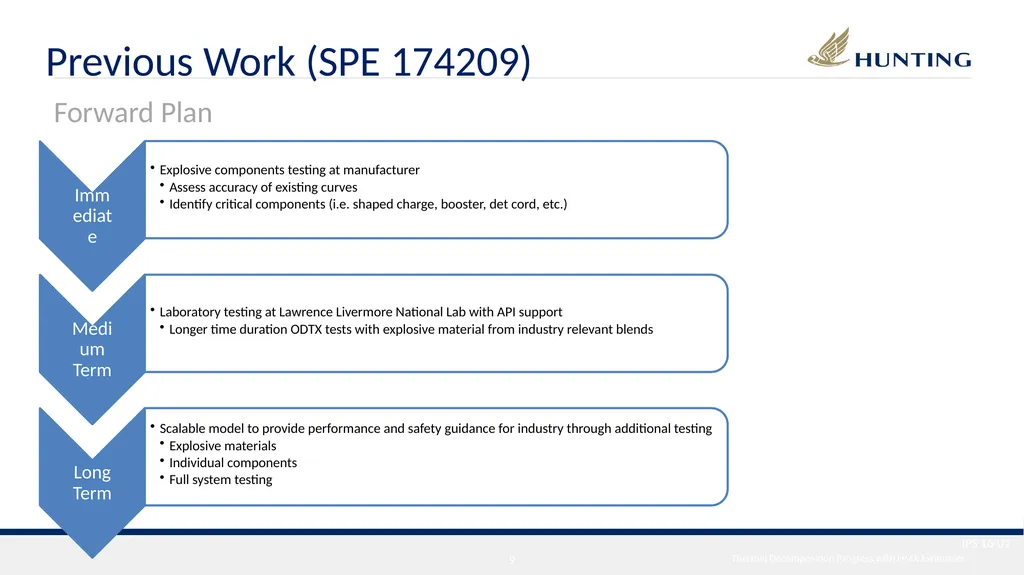
Thermal Decomposition Progress with HMX Explosives Previous Work (SPE 174209) 8 IPS 16-02 Forward Plan<br>
10
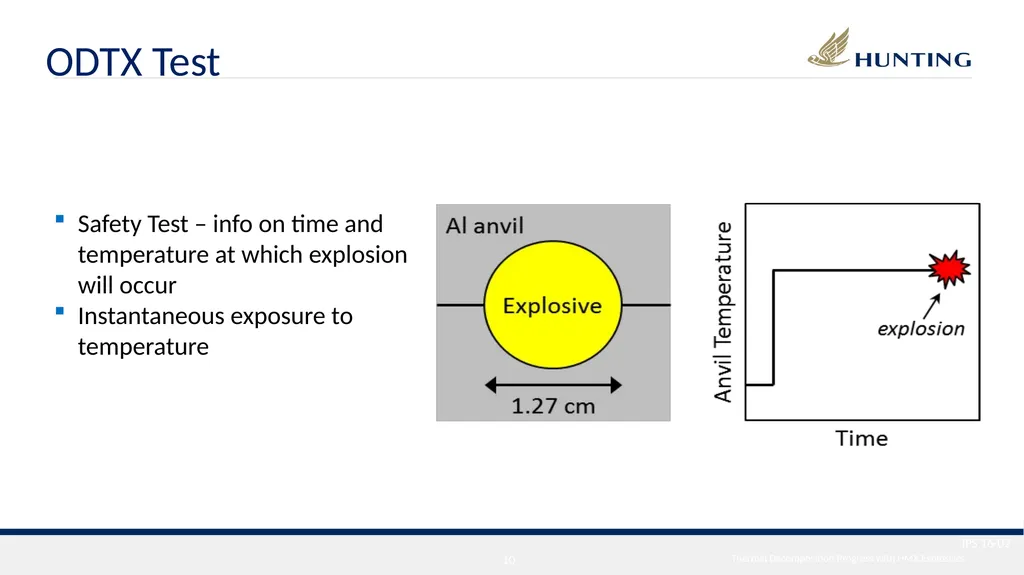
Thermal Decomposition Progress with HMX Explosives ODTX Test Safety Test – info on time and temperature at which explosion will occur
Instantaneous exposure to temperature 9 IPS 16-02<br>
11
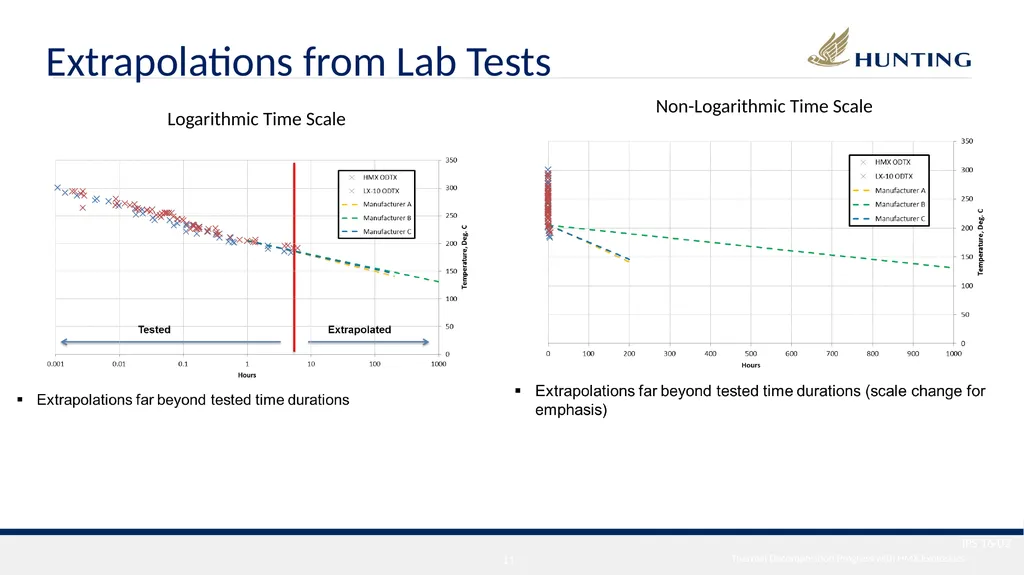
Thermal Decomposition Progress with HMX Explosives Extrapolations from Lab Tests 10 IPS 16-02 Logarithmic Time Scale Non-Logarithmic Time Scale<br>
12
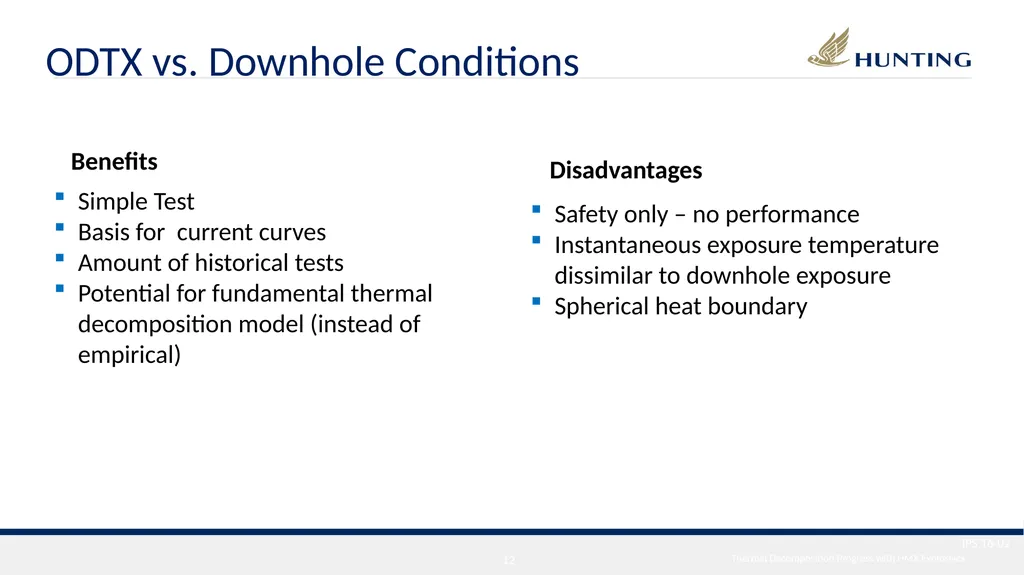
Thermal Decomposition Progress with HMX Explosives ODTX vs. Downhole Conditions Simple Test
Basis for current curves
Amount of historical tests
Potential for fundamental thermal decomposition model (instead of empirical) 11 IPS 16-02 Safety only – no performance
Instantaneous exposure temperature dissimilar to downhole exposure
Spherical heat boundary Benefits Disadvantages<br>
13
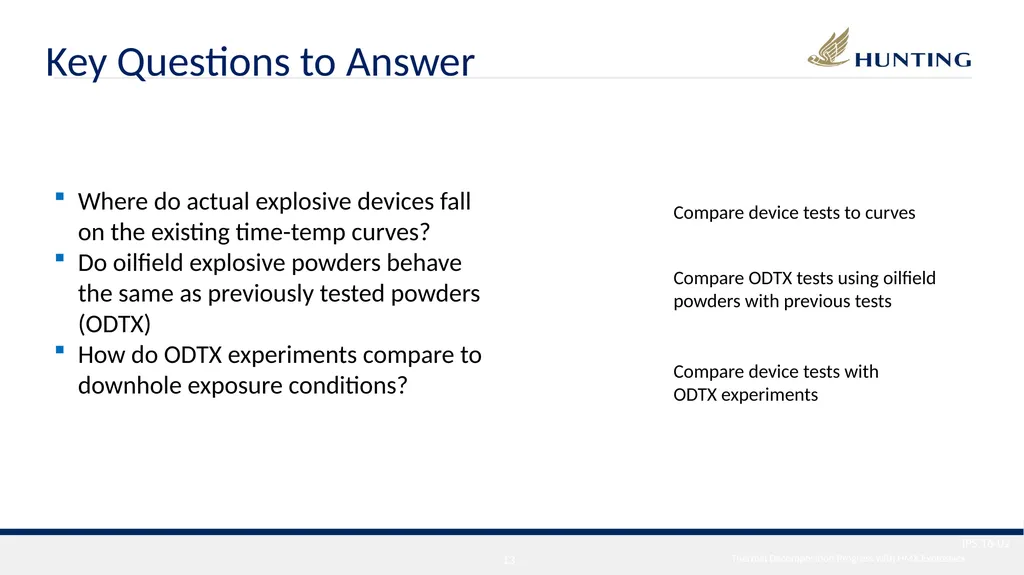
Thermal Decomposition Progress with HMX Explosives Key Questions to Answer Where do actual explosive devices fall on the existing time-temp curves?
Do oilfield explosive powders behave the same as previously tested powders (ODTX)
How do ODTX experiments compare to downhole exposure conditions? 12 IPS 16-02 Compare device tests to curves Compare ODTX tests using oilfield powders with previous tests Compare device tests with ODTX experiments<br>
14
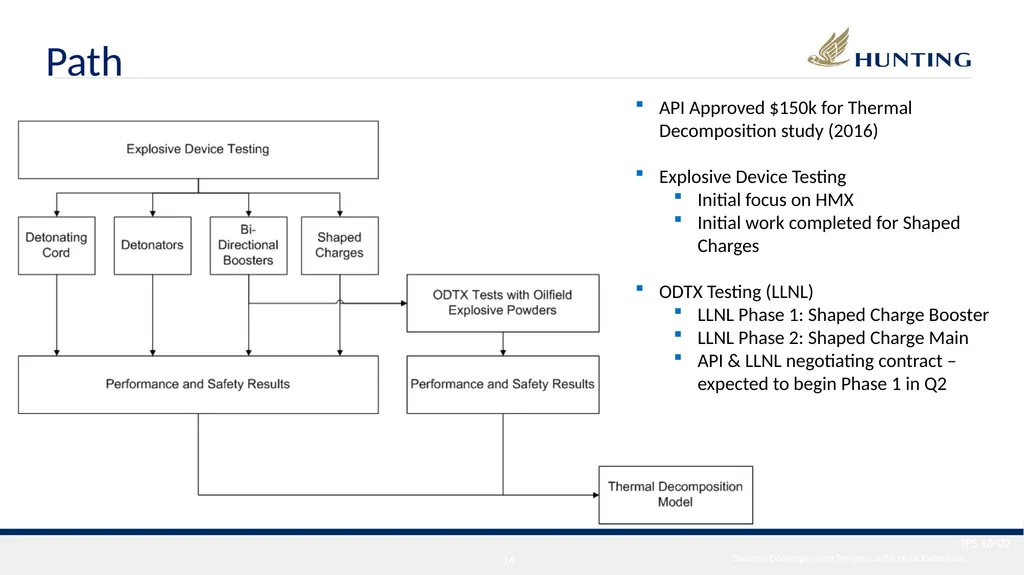
Thermal Decomposition Progress with HMX Explosives Path 13 IPS 16-02 API Approved $150k for Thermal Decomposition study (2016)
Explosive Device Testing
Initial focus on HMX
Initial work completed for Shaped Charges
ODTX Testing (LLNL)
LLNL Phase 1: Shaped Charge Booster
LLNL Phase 2: Shaped Charge Main
API & LLNL negotiating contract – expected to begin Phase 1 in Q2<br>
15
Thermal Decomposition Progress with HMX Explosives Plan Reserve batches of HMX used in shaped charges
Booster – pure, fine HMX
Main – desensitized HMX
Build shaped charges for thermal decomposition experiments under simulated downhole conditions
Supply HMX powders of the same batch for ODTX experiments 14 IPS 16-02<br>
16
Thermal Decomposition Progress with HMX Explosives Device Testing Simulating Downhole Conditions Temperature Exposure: ~1 hr ramp to temp.
Test Conditions:
Loaded in perforating gun (comparable free volume)
Sealed perforating gun
Heat applied externally to perforating gun (comparable to downhole exposure) 15 IPS 16-02<br>
17
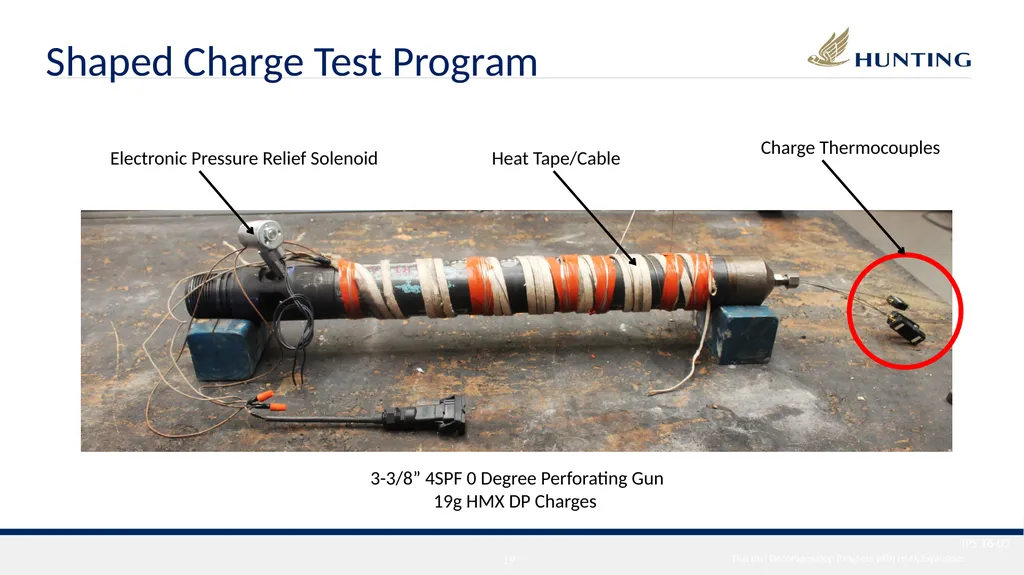
Thermal Decomposition Progress with HMX Explosives Shaped Charge Test Program Thermal exposure
Pre-heat to ~30°F of set temperature (prevent overshoot)
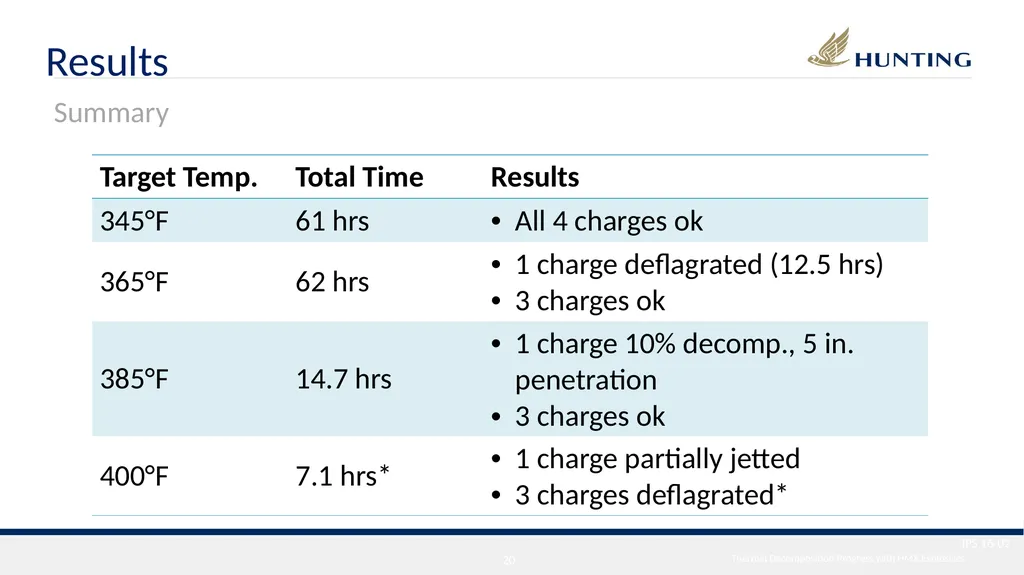
Target temperatures: 345°F, 365°F, 385°F, 400°F
Test stop conditions
Thermal event occurs (indicated by temperature measurement)
Significant time lapse with no thermal event
Conduct standard QC with any remaining shaped charges 16 IPS 16-02<br>
18
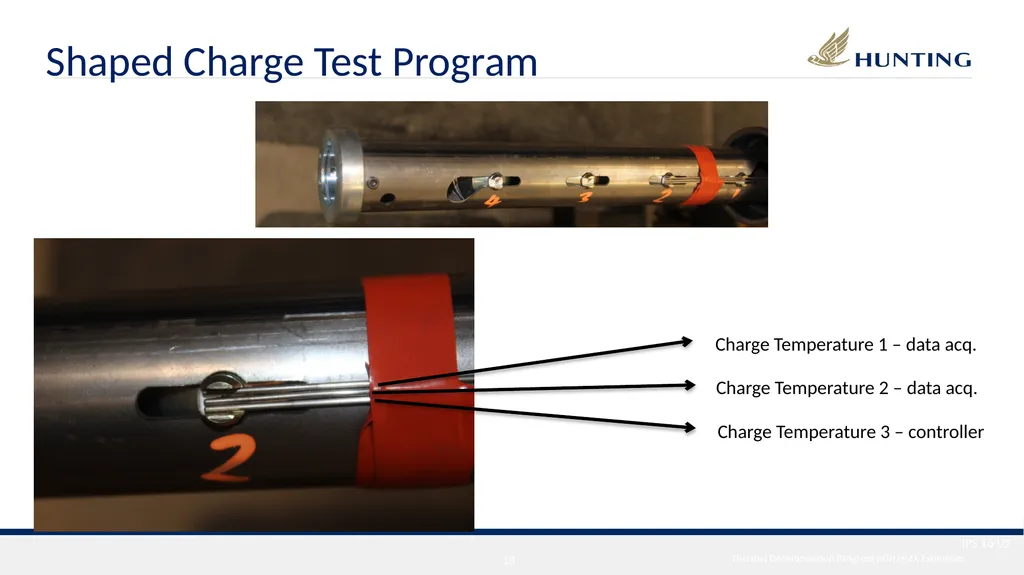
Thermal Decomposition Progress with HMX Explosives Shaped Charge Test Program 17 IPS 16-02 Charge Temperature 1 – data acq. Charge Temperature 2 – data acq. Charge Temperature 3 – controller<br>
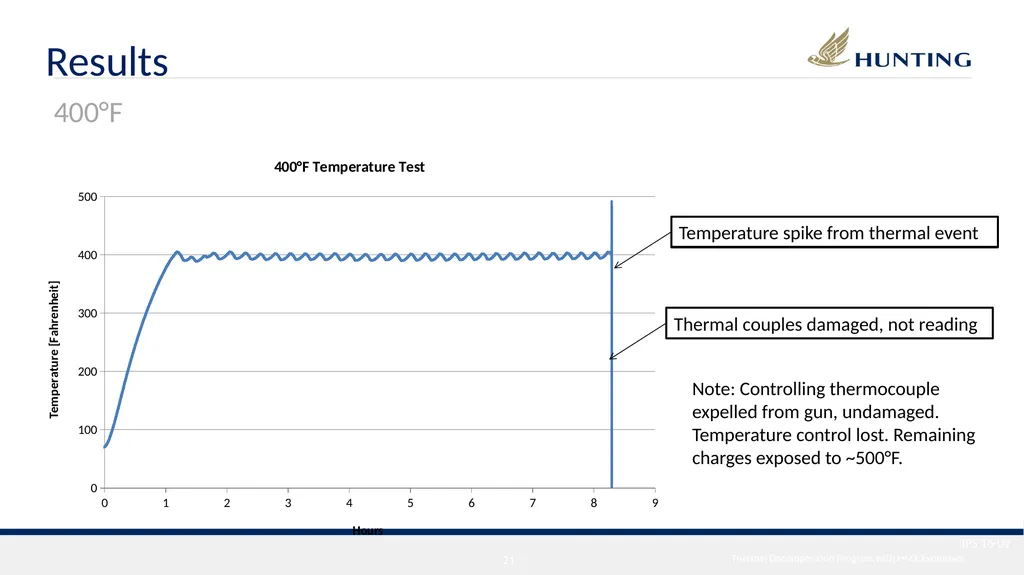
Thermal Decomposition Progress with HMX Explosives Results 400°F 20 IPS 16-02 Temperature spike from thermal event Thermal couples damaged, not reading Note: Controlling thermocouple expelled from gun, undamaged. Temperature control lost. Remaining charges exposed to ~500°F.<br>
22
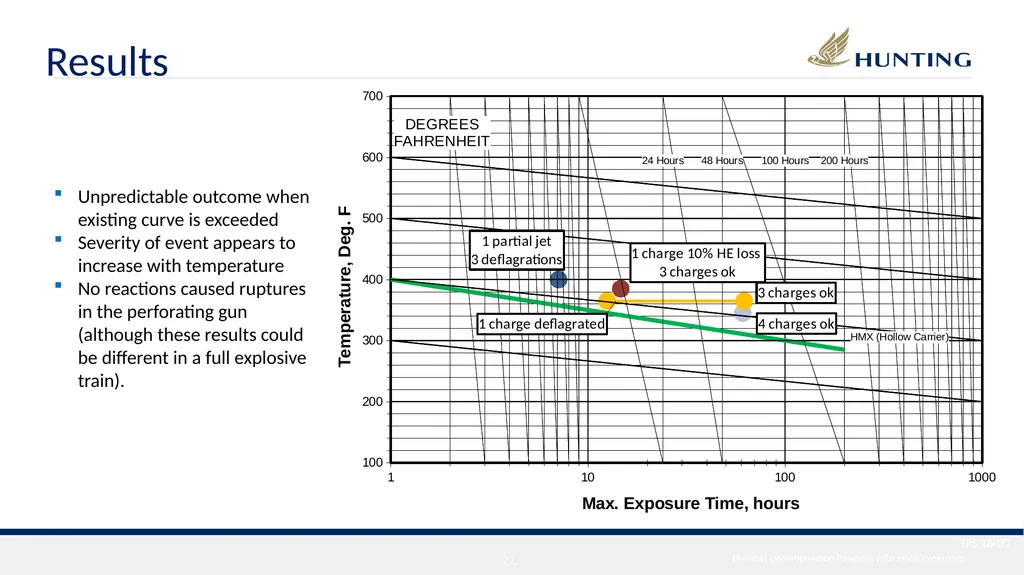
Thermal Decomposition Progress with HMX Explosives Results 21 IPS 16-02 Unpredictable outcome when existing curve is exceeded
Severity of event appears to increase with temperature
No reactions caused ruptures in the perforating gun (although these results could be different in a full explosive train).<br>
23
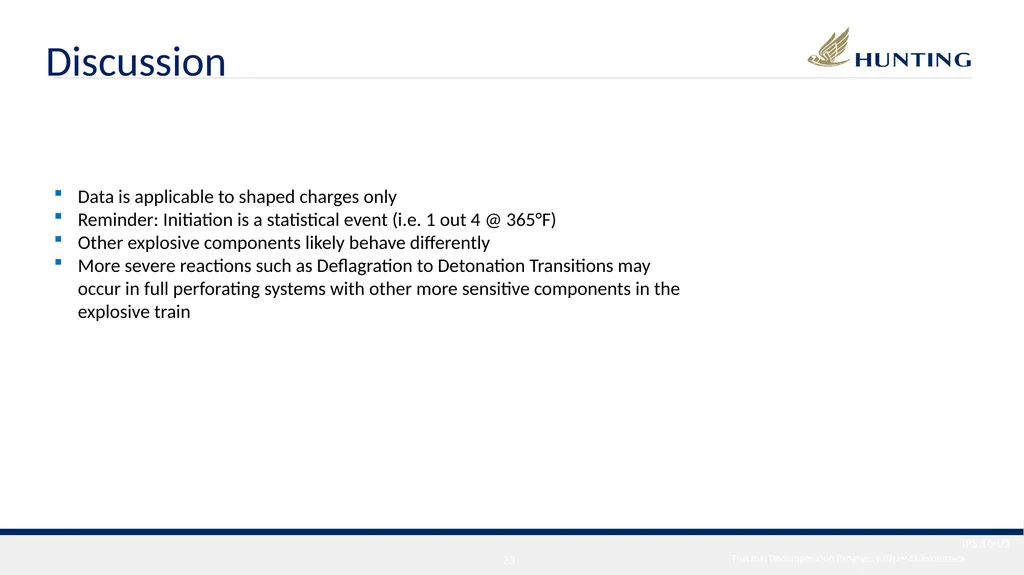
Thermal Decomposition Progress with HMX Explosives Discussion Data is applicable to shaped charges only
Reminder: Initiation is a statistical event (i.e. 1 out 4 @ 365°F)
Other explosive components likely behave differently
More severe reactions such as Deflagration to Detonation Transitions may occur in full perforating systems with other more sensitive components in the explosive train 22 IPS 16-02<br>
24
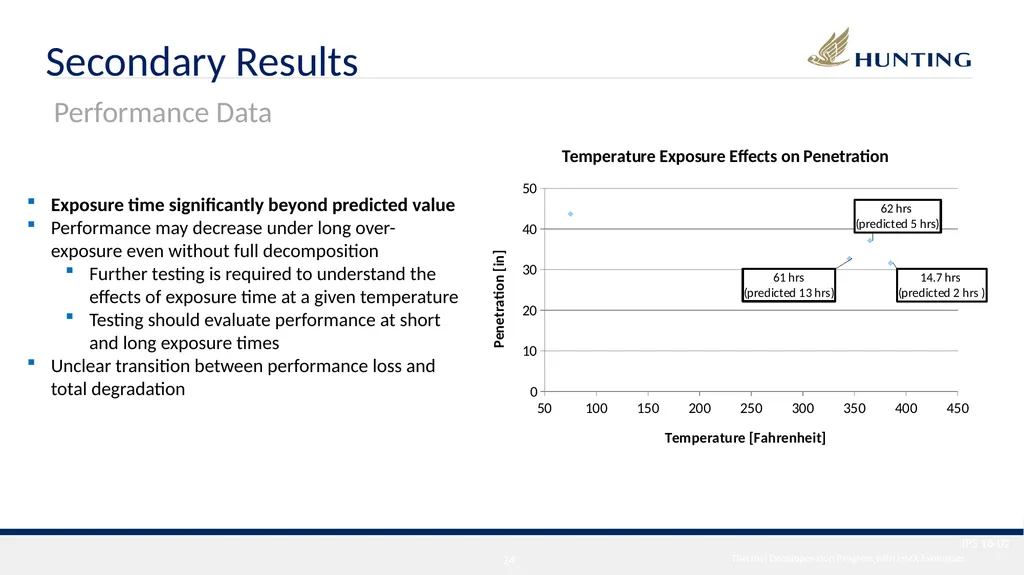
Thermal Decomposition Progress with HMX Explosives Secondary Results Performance Data 23 IPS 16-02 Exposure time significantly beyond predicted value
Performance may decrease under long over-exposure even without full decomposition
Further testing is required to understand the effects of exposure time at a given temperature
Testing should evaluate performance at short and long exposure times
Unclear transition between performance loss and total degradation<br>
25
Thermal Decomposition Progress with HMX Explosives Refined Theoretical Curve 24 IPS 16-02 Temperature Time Thermally Stable –
Unaffected Performance Thermal Runaway & Explosion Performance Loss Performance Degradation Original Refined<br>
26
Thermal Decomposition Progress with HMX Explosives Closing Remarks & Continued Work Premature to draw conclusions from results – existing time-temperature curves should continue to be used!
Expand test range to +400°F and 200+ hours
Compare results with ODTX tests from LLNL
Evaluate exposure time effects on performance
Expand testing to other explosive components
Expand testing to full system for interactions 25 IPS 16-02<br>