
INTERNATIONAL STANDARDS FOR ENTERPRISE RISK
Description: INTERNATIONAL STANDARDS FOR ENTERPRISE RISK MANAGEMENT AND INTERNAL CONTROLS AGENDA Internal Control (COSO Internal Control-Integrated Framework 2013) Risk Management Definitions According to the Standards Risk Management Standards ISO
Related Topics
Download Presentation
"INTERNATIONAL STANDARDS FOR ENTERPRISE RISK" is the property of its rightful owner. Permission is granted to download and print the materials on this website for personal, non-commercial use only, and to display it on your personal computer provided you do not modify the materials and that you retain all copyright notices contained in the materials. By downloading content from our website, you accept the terms of this agreement.
Presentation Transcript
slide1. INTERNATIONAL STANDARDS FOR ENTERPRISE RISK MANAGEMENT AND INTERNAL CONTROLS<br>
slide2. AGENDA Internal Control (COSO Internal Control-Integrated Framework 2013)
Risk Management Definitions According to the Standards
Risk Management Standards
ISO
COBIT
COSO
Differences Between COSO’s Internal Control and ERM<br>
slide3. WHAT IS COSO? The Committee of Sponsoring Organizations of the Treadway Commission COSO) is a joint initiative of the five private sector organizations shown below and dedicated to providing thought leadership through the development of frameworks and guidance on enterprise risk management, internal control and fraud deterrence.
American Accounting Association
American Institute of Certified Public Accountants
Financial Executives International
The Association of Accountants and Financial Professionals in Business
The Institute of Internal Auditors<br>
slide4. INTERNATIONAL STANDARDS FOR INTERNAL CONTROL COSO’s internal control framework is recognized globally and it has stood the test of time.
There was an INTOSAI Guideline for Internal Control Standards for the Public Sector, however it has been withdrawn and there is no replacement so far.
COSO publications regarding Internal Control:
Regarding Internal Control,
In 1992, COSO published Internal Control — Integrated Framework.
This framework was revised and reissued in May 2013. Effective December 15, 2014, the 1992 framework is superseded and no longer available.
Internal Control — Integrated Framework: Executive Summary, Framework and Appendices, and Illustrative Tools for Assessing Effectiveness of a System of Internal Control (3 volume set)
Internal Control — Integrated Framework, Internal Control Over External Financial Reporting: A Compendium of Approaches and Examples<br>
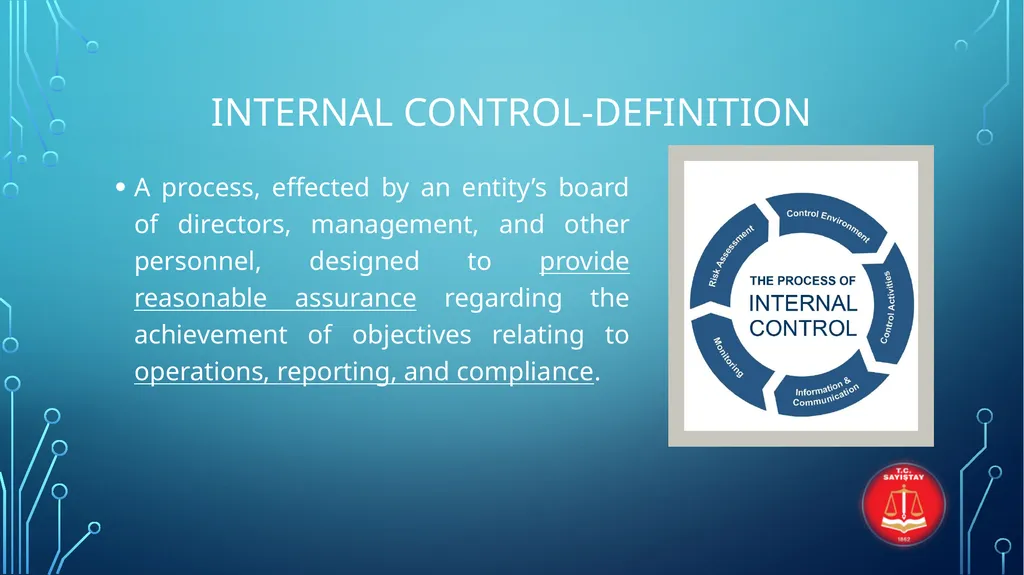
slide5. INTERNAL CONTROL-DEFINITION A process, effected by an entity’s board of directors, management, and other personnel, designed to provide reasonable assurance regarding the achievement of objectives relating to operations, reporting, and compliance.<br>
slide6. UNDERSTANDING INTERNAL CONTROL Internal control is:
Geared to the achievement of objectives
A process consisting of ongoing tasks and activities
Effected by people
Able to provide reasonable assurance (not absolute assurance)
Adaptable to the entity structure<br>
slide7. WHAT CAN BE EXPECTED FROM INTERNAL CONTROL? Internal Control aims at providing reasonable assurance regarding the achievement of 3 objectives:
Operations Objectives
Reporting Objectives
Compliance Objectives
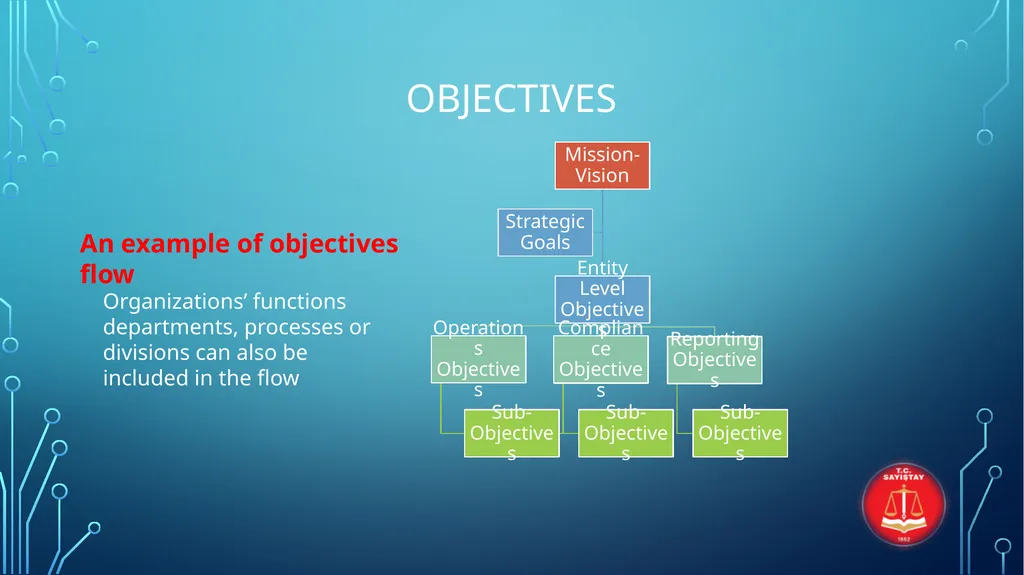
These objectives are pre-set within organizations along with their missions, visions and strategies, which are preconditions for an internal control system.<br>
slide8. OBJECTIVES An example of objectives flow Organizations’ functions departments, processes or divisions can also be included in the flow<br>
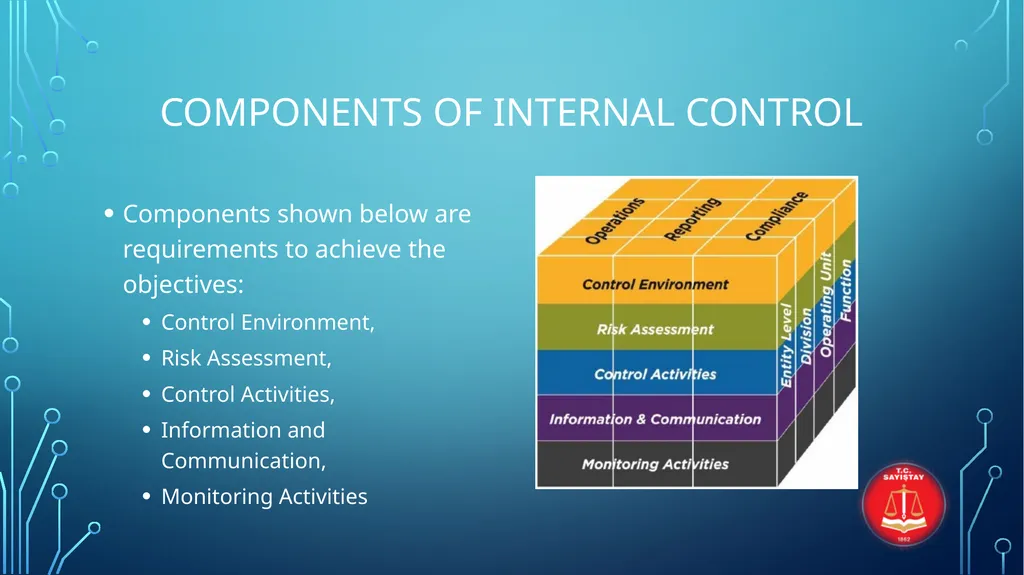
slide9. COMPONENTS OF INTERNAL CONTROL Components shown below are requirements to achieve the objectives:
Control Environment,
Risk Assessment,
Control Activities,
Information and Communication,
Monitoring Activities<br>
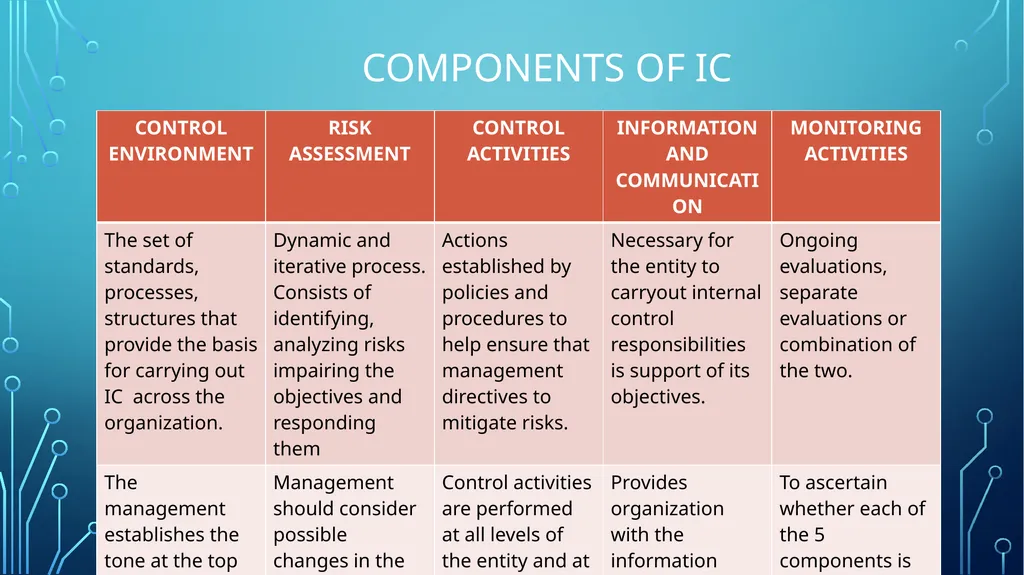
slide10. COMPONENTS OF IC<br>
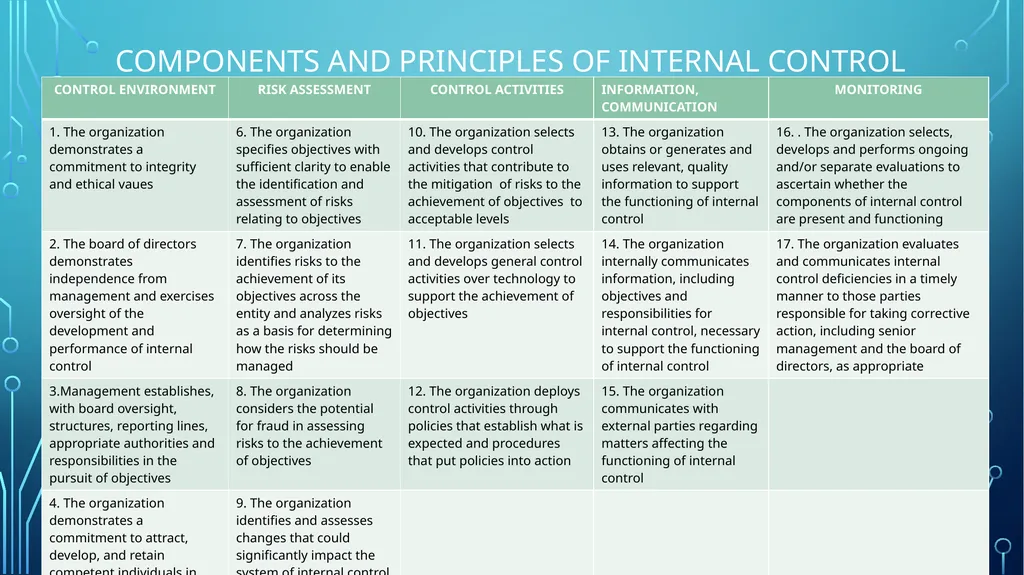
slide11. COMPONENTS AND PRINCIPLES OF INTERNAL CONTROL<br>
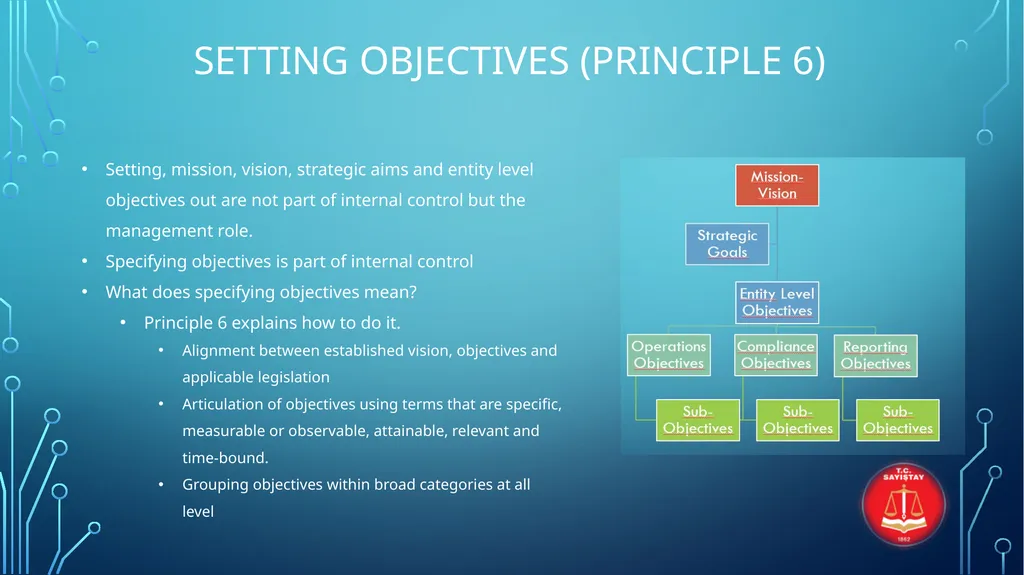
slide12. SETTING OBJECTIVES (PRINCIPLE 6) Setting, mission, vision, strategic aims and entity level objectives out are not part of internal control but the management role.
Specifying objectives is part of internal control
What does specifying objectives mean?
Principle 6 explains how to do it.
Alignment between established vision, objectives and applicable legislation
Articulation of objectives using terms that are specific, measurable or observable, attainable, relevant and time-bound.
Grouping objectives within broad categories at all level<br>
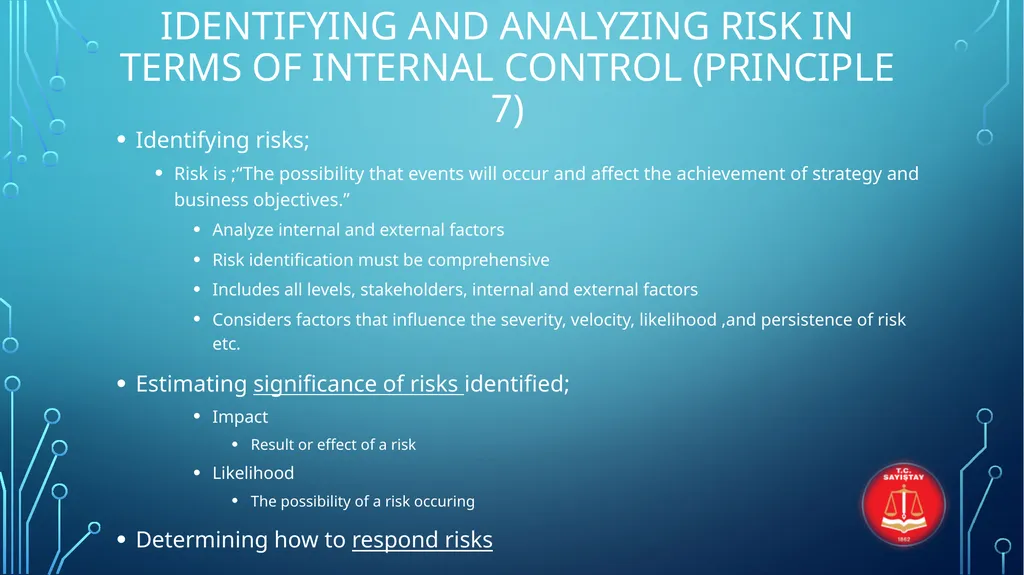
slide13. Identifying AND ANALYZING RISK IN TERMS OF INTERNAL CONTROL (Prıncıple 7) Identifying risks;
Risk is ;“The possibility that events will occur and affect the achievement of strategy and business objectives.”
Analyze internal and external factors
Risk identification must be comprehensive
Includes all levels, stakeholders, internal and external factors
Considers factors that influence the severity, velocity, likelihood ,and persistence of risk etc.
Estimating significance of risks identified;
Impact
Result or effect of a risk
Likelihood
The possibility of a risk occuring
Determining how to respond risks<br>
slide14. PROPER RISK IDENTIFICATION Example 1:
Some auditees might be unwilling to follow audit recommendations, which affects the TCA’s contribution to a better financial management system
“The possibility that events will occur and affect the achievement of strategy and business objectives.”
Event: Unwillingness of auditees to follow the audit recommendation
Affected strategy or business objective: TCA’s contribution to a better financial management system (one of the strategic goals)
Possibility: To be assessed in the risk assessment component of IC<br>
slide15. PROPER RISK IDENTIFICATION Example 2:
Purchasing department might fail to follow procurement procedures resulting in public loss
Event: Failure to follow procurement procedures
Affected business objective: Efficient procurement activities (finding best price)
Possibility: To be assessed in the risk assessment component of IC<br>
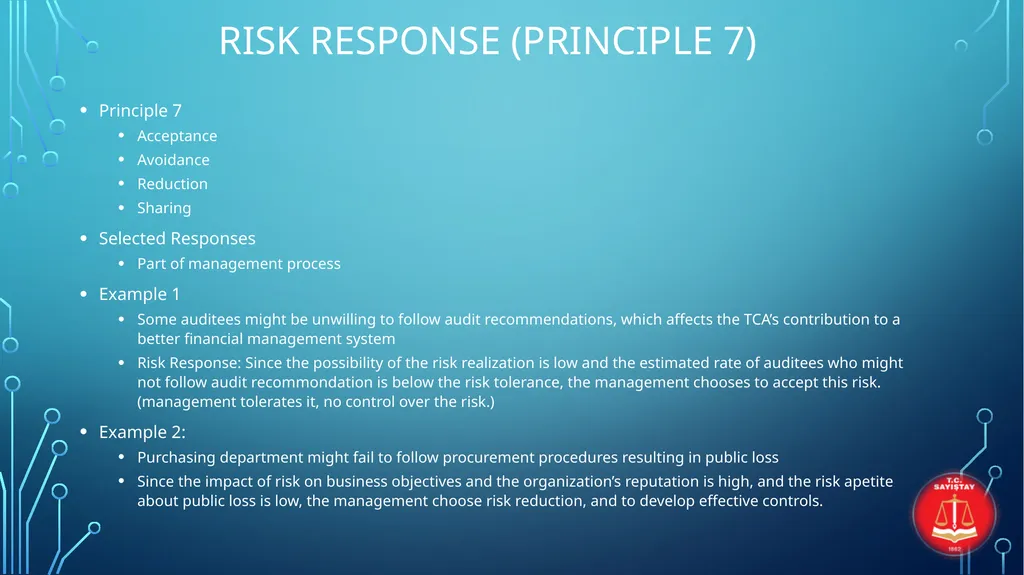
slide16. RISK RESPONSE (PRINCIPLE 7) Principle 7
Acceptance
Avoidance
Reduction
Sharing
Selected Responses
Part of management process
Example 1
Some auditees might be unwilling to follow audit recommendations, which affects the TCA’s contribution to a better financial management system
Risk Response: Since the possibility of the risk realization is low and the estimated rate of auditees who might not follow audit recommondation is below the risk tolerance, the management chooses to accept this risk. (management tolerates it, no control over the risk.)
Example 2:
Purchasing department might fail to follow procurement procedures resulting in public loss
Since the impact of risk on business objectives and the organization’s reputation is high, and the risk apetite about public loss is low, the management choose risk reduction, and to develop effective controls.<br>
slide17. RISK APETITE AND RISK TOLERANCE Concepts of ERM
To be explained in the second part of presentation<br>
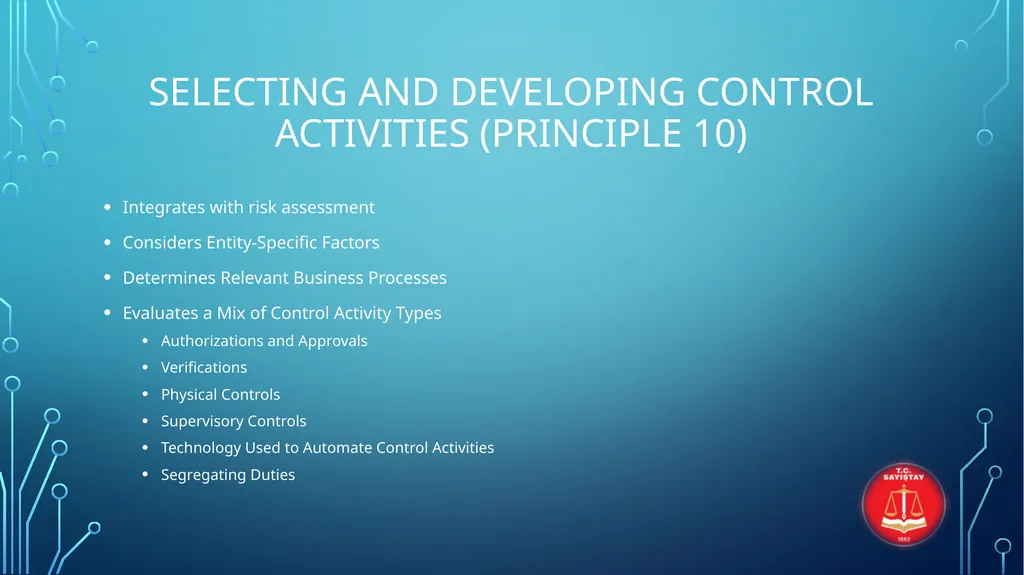
slide18. SELECTING AND DEVELOPING CONTROL ACTIVITIES (PRINCIPLE 10) Integrates with risk assessment
Considers Entity-Specific Factors
Determines Relevant Business Processes
Evaluates a Mix of Control Activity Types
Authorizations and Approvals
Verifications
Physical Controls
Supervisory Controls
Technology Used to Automate Control Activities
Segregating Duties<br>
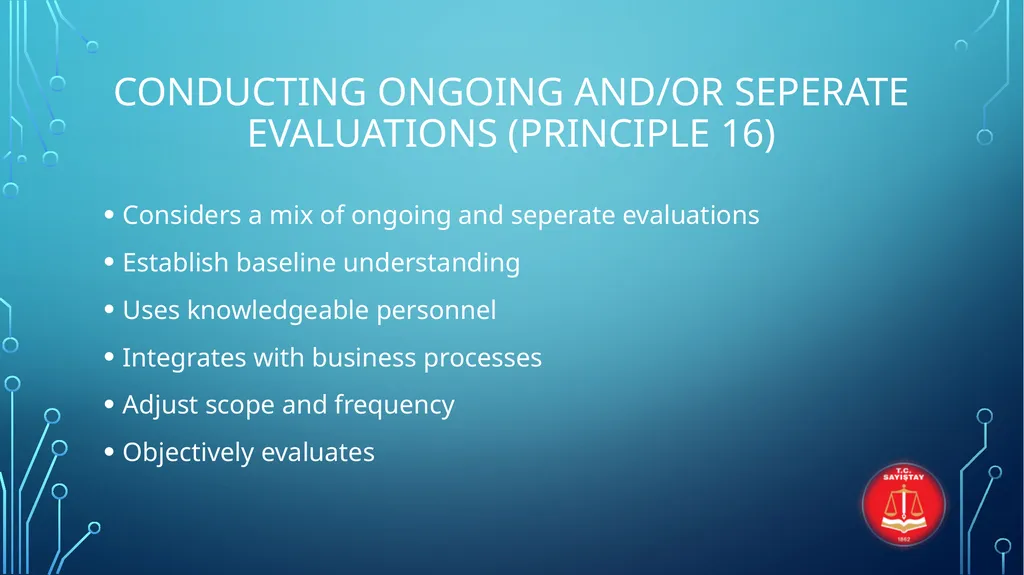
slide19. CONDUCTING ONGOING AND/OR SEPERATE EVALUATIONS (Prıncıple 16) Considers a mix of ongoing and seperate evaluations
Establish baseline understanding
Uses knowledgeable personnel
Integrates with business processes
Adjust scope and frequency
Objectively evaluates<br>
slide20. STANDARDS FOR ENTERPRISE RISK MANAGEMENT<br>
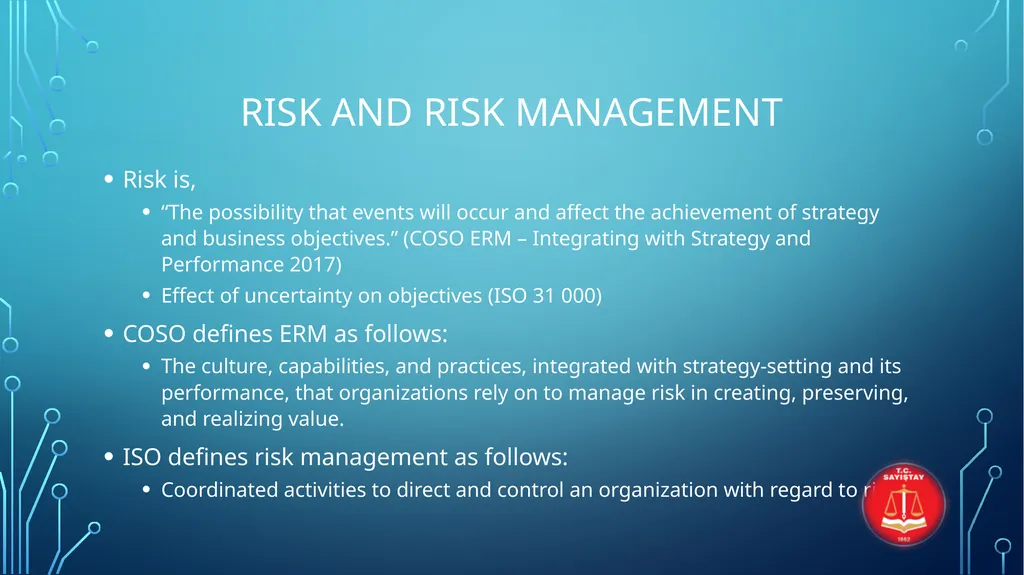
slide21. RISK AND RISK MANAGEMENT Risk is,
“The possibility that events will occur and affect the achievement of strategy and business objectives.” (COSO ERM – Integrating with Strategy and Performance 2017)
Effect of uncertainty on objectives (ISO 31 000)
COSO defines ERM as follows:
The culture, capabilities, and practices, integrated with strategy-setting and its performance, that organizations rely on to manage risk in creating, preserving, and realizing value.
ISO defines risk management as follows:
Coordinated activities to direct and control an organization with regard to risk<br>
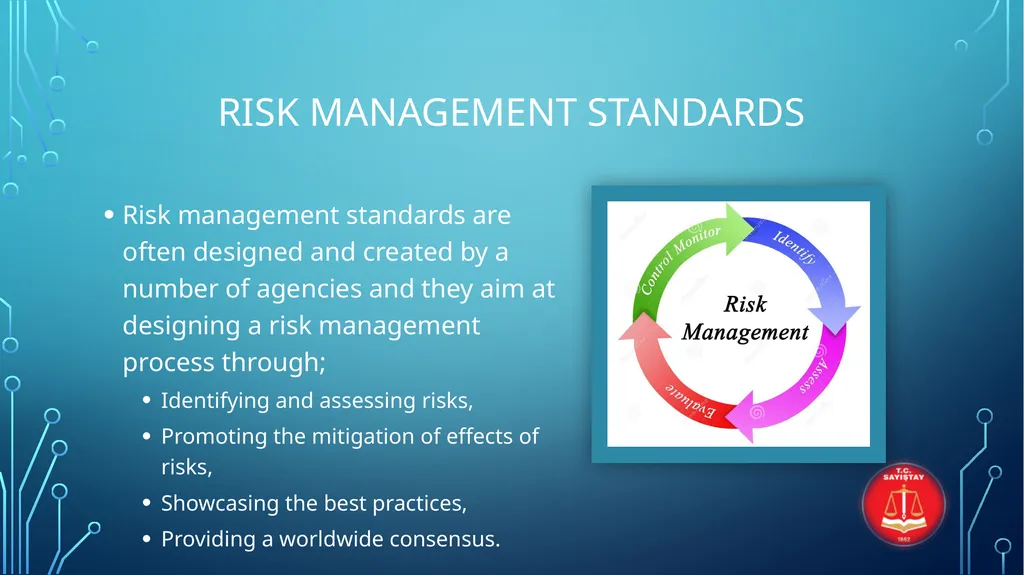
slide22. RISK MANAGEMENT STANDARDS Risk management standards are often designed and created by a number of agencies and they aim at designing a risk management process through;
Identifying and assessing risks,
Promoting the mitigation of effects of risks,
Showcasing the best practices,
Providing a worldwide consensus.<br>
slide23. internationally recognized risk management frameworks (Commonly used) 1) ISO International Standard for Risk Management (31 000: 2018),
2) COBIT 2019
3) COSO ERM – Integrated Framework (2004),
4) COSO ERM Integrating with Strategy and Performance Framework (2017)<br>
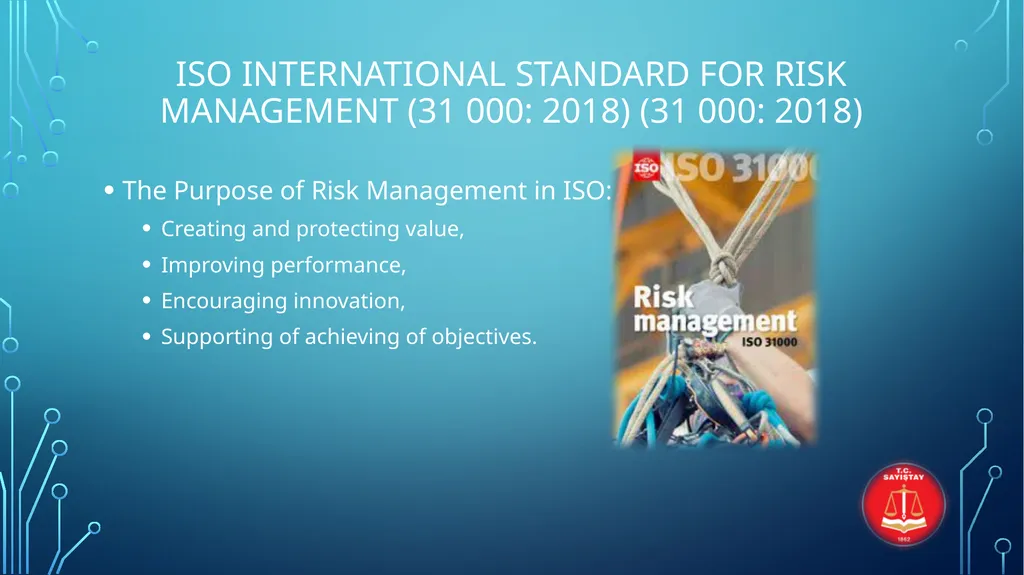
slide24. ISO International Standard for Risk Management (31 000: 2018) (31 000: 2018) The Purpose of Risk Management in ISO:
Creating and protecting value,
Improving performance,
Encouraging innovation,
Supporting of achieving of objectives.<br>
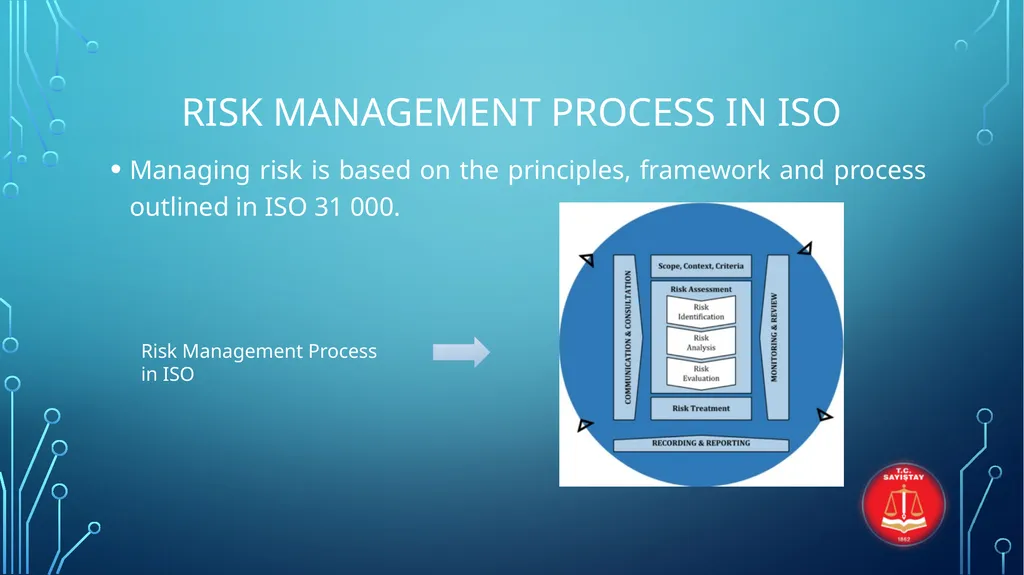
slide25. RISK MANAGEMENT PRocess IN ISO Managing risk is based on the principles, framework and process outlined in ISO 31 000. Risk Management Process in ISO<br>
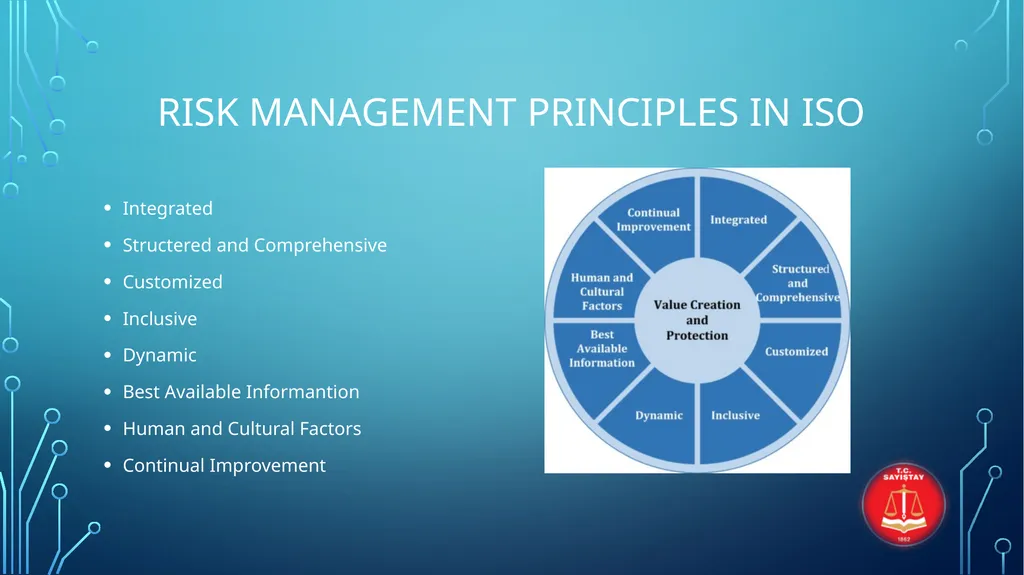
slide26. RISK MANAGEMENT PRINCIPLES IN ISO Integrated
Structered and Comprehensive
Customized
Inclusive
Dynamic
Best Available Informantion
Human and Cultural Factors
Continual Improvement<br>
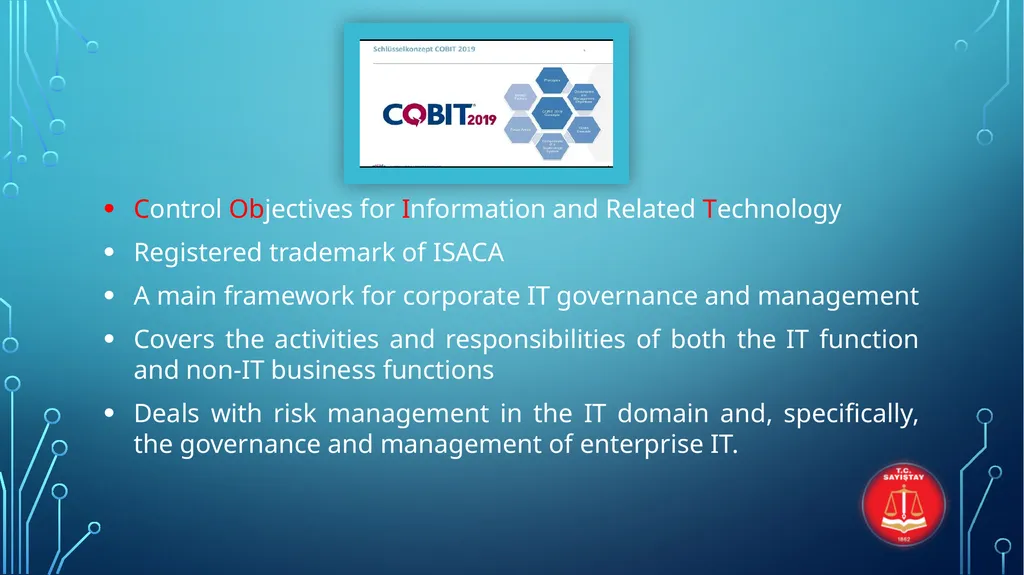
slide27. Control Objectives for Information and Related Technology
Registered trademark of ISACA
A main framework for corporate IT governance and management
Covers the activities and responsibilities of both the IT function and non-IT business functions
Deals with risk management in the IT domain and, specifically, the governance and management of enterprise IT.<br>
slide28. COBIT 2019 Two perspectives on how to use COBIT 5 in a risk context:
Risk function perspective—Describes what is needed in an enterprise to build and sustain efficient and effective core risk governance and management activities
Risk management perspective—Describes how the core risk management process of identifying, analyzing, responding to and reporting on risk can be assisted by the COBIT 5 enablers<br>
slide29. COSO ERM Publications Regarding Regarding ERM
In 2004, COSO issued Enterprise Risk Management — Integrated Framework.
In 2017 of “Enterprise Risk Management–Integrating with Strategy and Performance,”<br>
slide30. Creating and protecting value,
Meeting mission and achieving strategies and business objectives,
Enhanced performance of the organization,
Improved decision making,
Improved performance,
Identifying, assessing and managing the risks.
An integral part of the strategy selection process. WHAT IS THE ROLE AND OBJECTIVES OF ERM?<br>
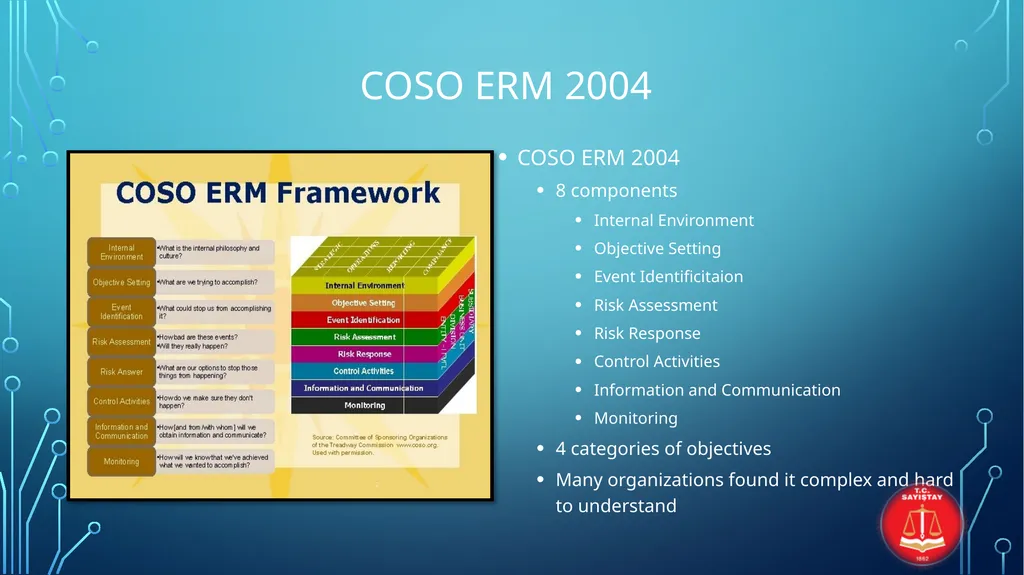
slide31. COSO ERM 2004 COSO ERM 2004
8 components
Internal Environment
Objective Setting
Event Identificitaion
Risk Assessment
Risk Response
Control Activities
Information and Communication
Monitoring
4 categories of objectives
Many organizations found it complex and hard to understand<br>
slide32. COSO ERM 2017 COSO ERM 2017
COSO took criticism into account and updated the previous one,
5 components
Principle based (20 principles)
Promotes to integrate ERM practices throughout an organization,
Aligning with strategy setting and performance,
Focuses on improving decision-making in governance, strategy, objective setting, and day to day operations.
Allocating resources according to predetermined principles<br>
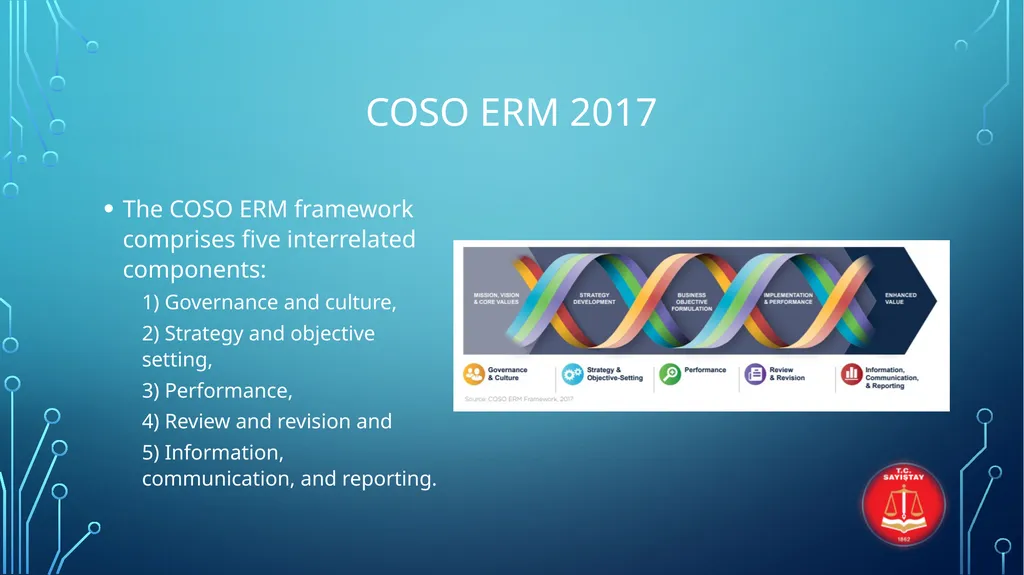
slide33. COSO ERM 2017 The COSO ERM framework comprises five interrelated components:
1) Governance and culture,
2) Strategy and objective setting,
3) Performance,
4) Review and revision and
5) Information, communication, and reporting.<br>
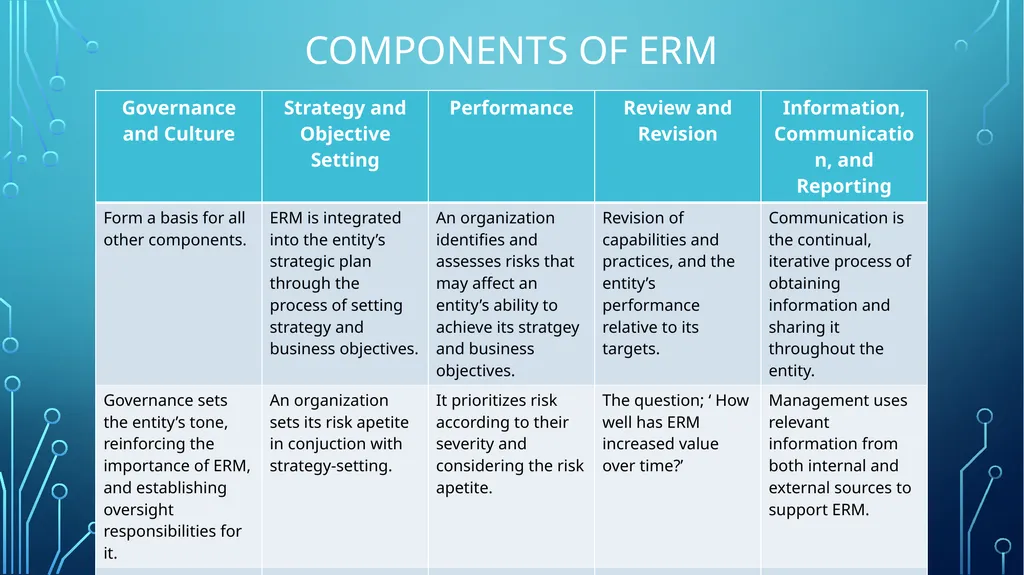
slide34. COMPONENTS OF ERM<br>
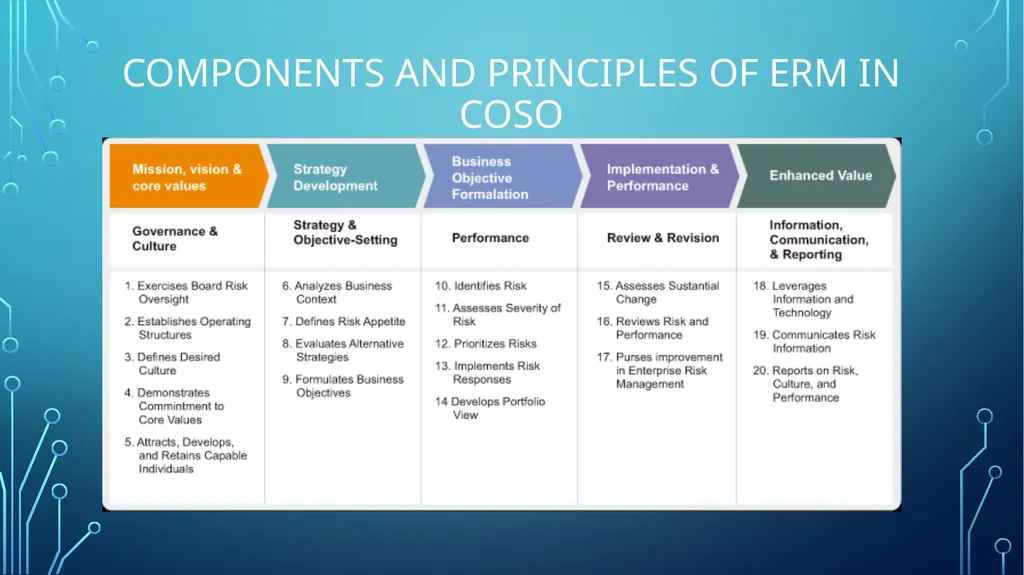
slide35. COMPONENTS AND PRINCIPLES OF ERM IN COSO<br>
slide36. RISK APETITE (PRINCIPLE 7) Risk apetite is the types and amount of risk, the management is willing to accept in its pursuit of value (in short; acceptable amount of risks)
There is no universal risk apetite
It can be defined on the level of
Strategy and business objective that align with the mission and vision
Business objective categories
Performance targets of the entity
How to define?
Discussions
Reviewing past
Internal and external stakeholder expectations<br>
slide37. OBJECTIVE SETTING (PRINCIPLE 8) Objective setting is a function of managements (not internal control).
ERM helps managements in considering risks in the process of evaluating alternative strategies for strategic plans.
Different strategies will expose an entity to different risks or different amounts of similar risks.
The identified risks collectively form a risk profile for each option, that is, different strategies yield different risk profiles.
Management use these risk profiles when deciding on the best strategy to adopt.<br>
slide38. FORMULATING BUSINESS OBJECTIVE (PRINCIPLE 9) Develops objectives that are spesific, measurable or observable, attainable and relevant (remember these ojectives in IC)
Business objectives may cascade throughout the entity (divisions, operating units, functions)
Financial
Operational,
Compliance,
Efficiency
Innovation,
Customer espirations etc.<br>
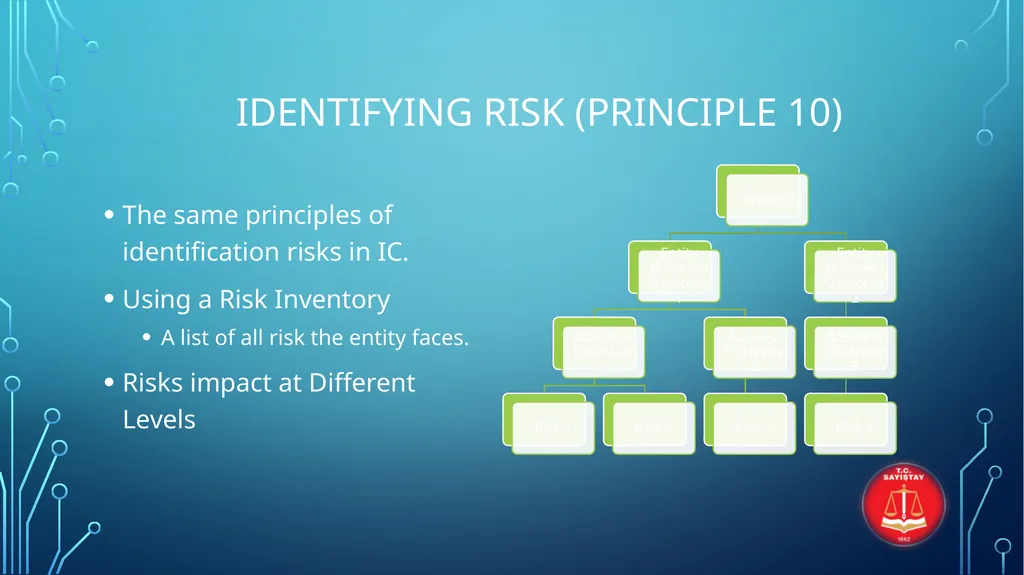
slide39. IDENTIFYING RISK (PRINCIPLE 10) The same principles of identification risks in IC.
Using a Risk Inventory
A list of all risk the entity faces.
Risks impact at Different Levels<br>
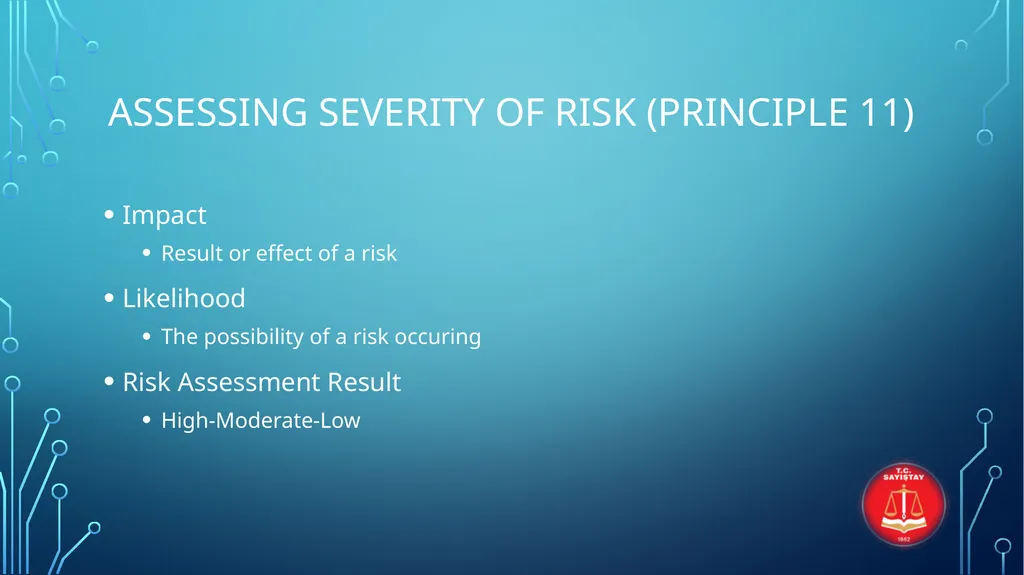
slide40. ASSESSING SEVERITY OF RISK (PRINCIPLE 11) Impact
Result or effect of a risk
Likelihood
The possibility of a risk occuring
Risk Assessment Result
High-Moderate-Low<br>
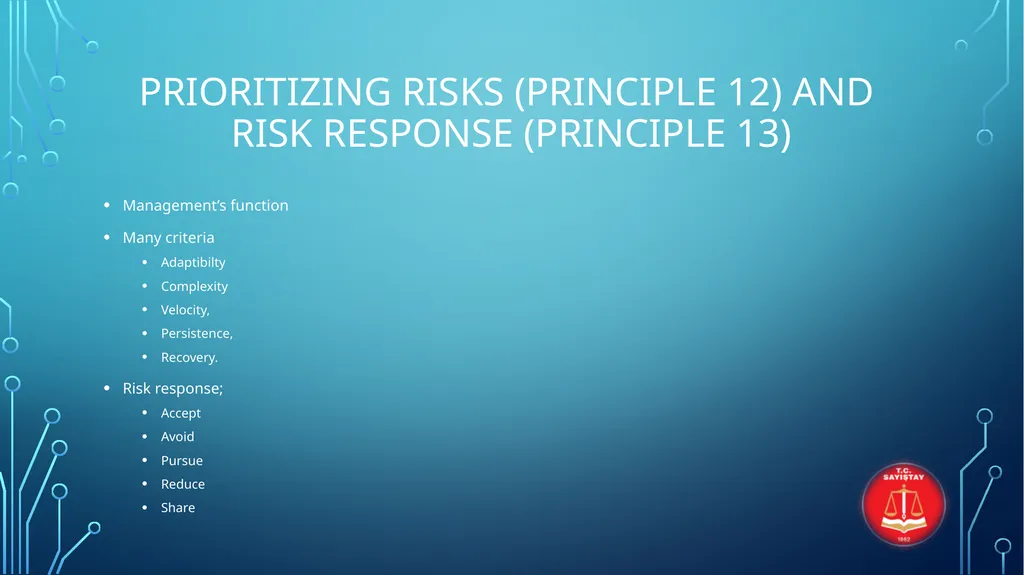
slide41. PRIORITIZING RISKS (PRINCIPLE 12) and rısk response (prıncıple 13) Management’s function
Many criteria
Adaptibilty
Complexity
Velocity,
Persistence,
Recovery.
Risk response;
Accept
Avoid
Pursue
Reduce
Share<br>
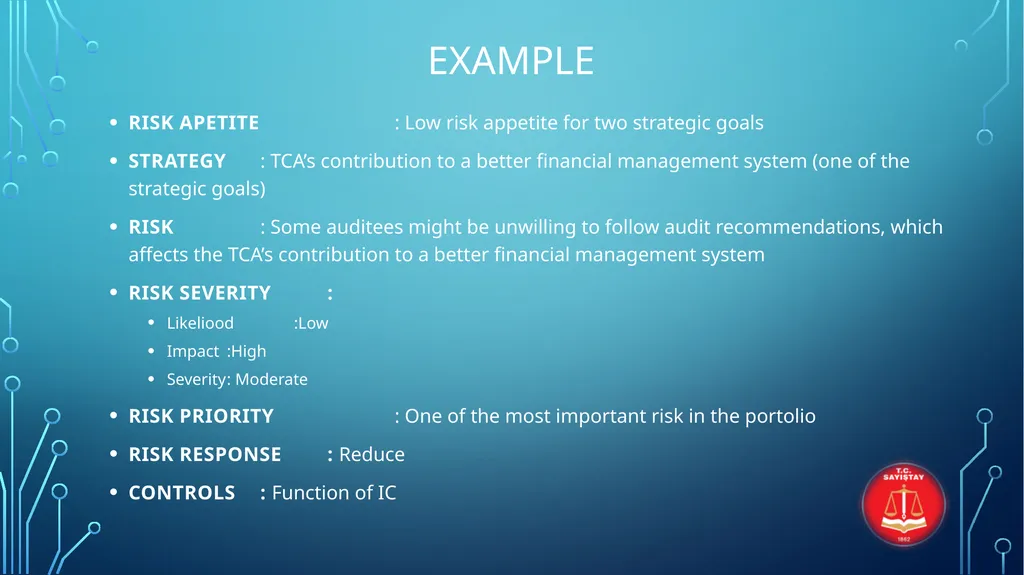
slide42. EXAMPLE RISK APETITE : Low risk appetite for two strategic goals
STRATEGY : TCA’s contribution to a better financial management system (one of the strategic goals)
RISK : Some auditees might be unwilling to follow audit recommendations, which affects the TCA’s contribution to a better financial management system
RISK SEVERITY :
Likeliood :Low
Impact :High
Severity : Moderate
RISK PRIORITY : One of the most important risk in the portolio
RISK RESPONSE : Reduce
CONTROLS : Function of IC<br>
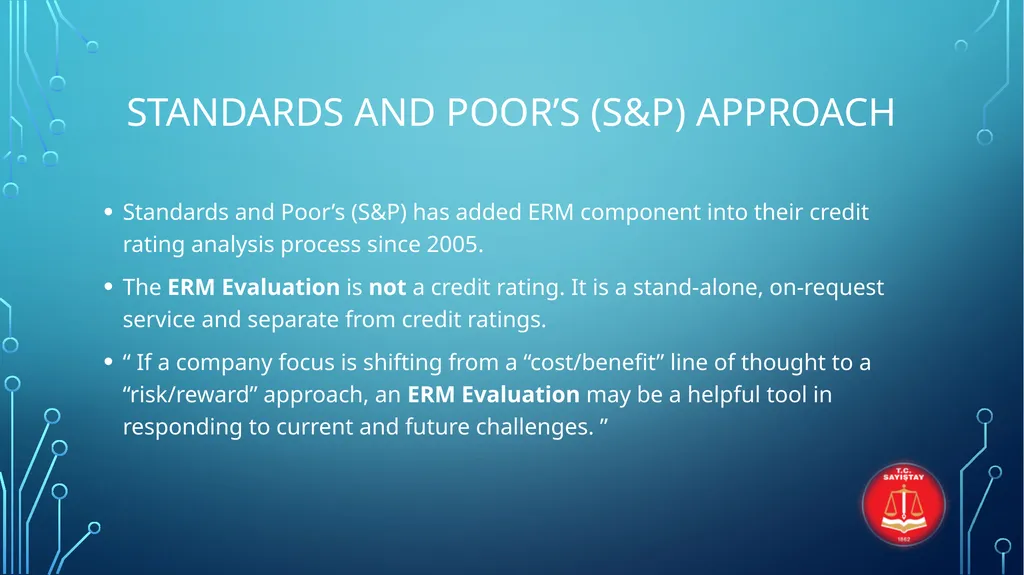
slide43. Standards and Poor’s (S&P) APPROACH Standards and Poor’s (S&P) has added ERM component into their credit rating analysis process since 2005.
The ERM Evaluation is not a credit rating. It is a stand-alone, on-request service and separate from credit ratings.
“ If a company focus is shifting from a “cost/benefit” line of thought to a “risk/reward” approach, an ERM Evaluation may be a helpful tool in responding to current and future challenges. ”<br>
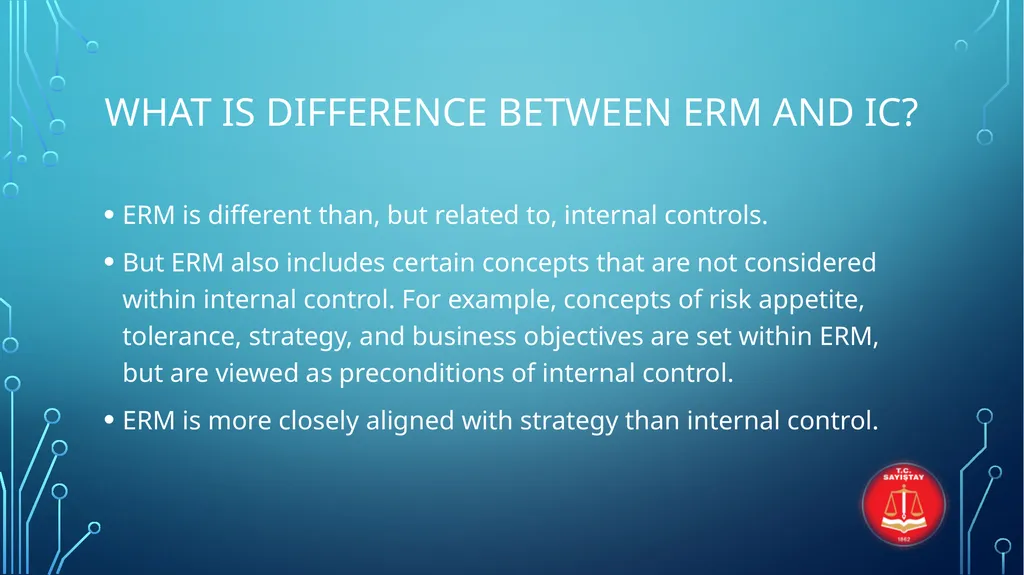
slide44. WHAT IS DIFFERENCE BETWEEN ERM AND IC? ERM is different than, but related to, internal controls.
But ERM also includes certain concepts that are not considered within internal control. For example, concepts of risk appetite, tolerance, strategy, and business objectives are set within ERM, but are viewed as preconditions of internal control.
ERM is more closely aligned with strategy than internal control.<br>
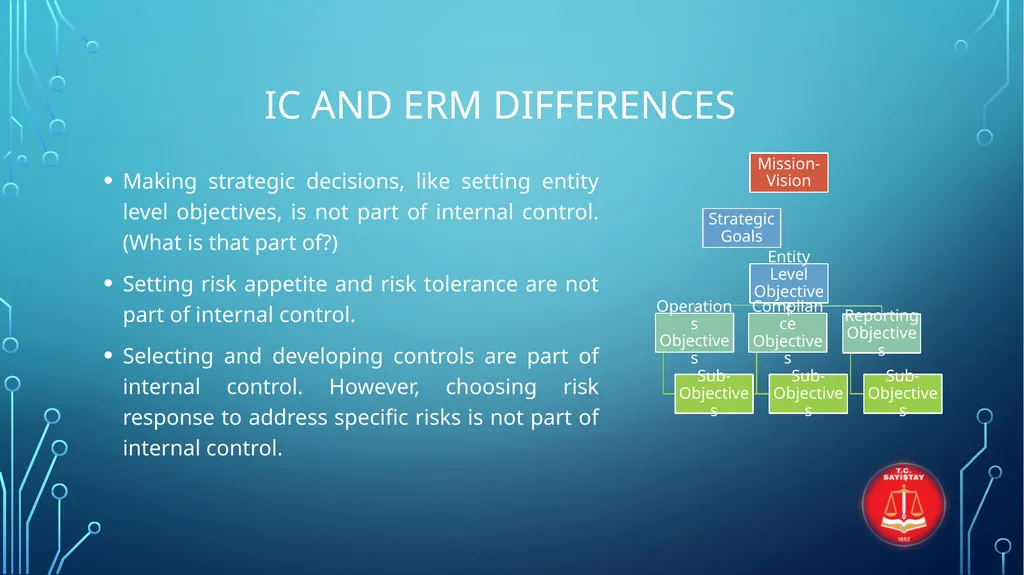
slide45. IC AND ERM DIFFERENCES Making strategic decisions, like setting entity level objectives, is not part of internal control. (What is that part of?)
Setting risk appetite and risk tolerance are not part of internal control.
Selecting and developing controls are part of internal control. However, choosing risk response to address specific risks is not part of internal control.<br>
slide46. THANK YOU!<br>
slide2. AGENDA Internal Control (COSO Internal Control-Integrated Framework 2013)
Risk Management Definitions According to the Standards
Risk Management Standards
ISO
COBIT
COSO
Differences Between COSO’s Internal Control and ERM<br>
slide3. WHAT IS COSO? The Committee of Sponsoring Organizations of the Treadway Commission COSO) is a joint initiative of the five private sector organizations shown below and dedicated to providing thought leadership through the development of frameworks and guidance on enterprise risk management, internal control and fraud deterrence.
American Accounting Association
American Institute of Certified Public Accountants
Financial Executives International
The Association of Accountants and Financial Professionals in Business
The Institute of Internal Auditors<br>
slide4. INTERNATIONAL STANDARDS FOR INTERNAL CONTROL COSO’s internal control framework is recognized globally and it has stood the test of time.
There was an INTOSAI Guideline for Internal Control Standards for the Public Sector, however it has been withdrawn and there is no replacement so far.
COSO publications regarding Internal Control:
Regarding Internal Control,
In 1992, COSO published Internal Control — Integrated Framework.
This framework was revised and reissued in May 2013. Effective December 15, 2014, the 1992 framework is superseded and no longer available.
Internal Control — Integrated Framework: Executive Summary, Framework and Appendices, and Illustrative Tools for Assessing Effectiveness of a System of Internal Control (3 volume set)
Internal Control — Integrated Framework, Internal Control Over External Financial Reporting: A Compendium of Approaches and Examples<br>
slide5. INTERNAL CONTROL-DEFINITION A process, effected by an entity’s board of directors, management, and other personnel, designed to provide reasonable assurance regarding the achievement of objectives relating to operations, reporting, and compliance.<br>
slide6. UNDERSTANDING INTERNAL CONTROL Internal control is:
Geared to the achievement of objectives
A process consisting of ongoing tasks and activities
Effected by people
Able to provide reasonable assurance (not absolute assurance)
Adaptable to the entity structure<br>
slide7. WHAT CAN BE EXPECTED FROM INTERNAL CONTROL? Internal Control aims at providing reasonable assurance regarding the achievement of 3 objectives:
Operations Objectives
Reporting Objectives
Compliance Objectives
These objectives are pre-set within organizations along with their missions, visions and strategies, which are preconditions for an internal control system.<br>
slide8. OBJECTIVES An example of objectives flow Organizations’ functions departments, processes or divisions can also be included in the flow<br>
slide9. COMPONENTS OF INTERNAL CONTROL Components shown below are requirements to achieve the objectives:
Control Environment,
Risk Assessment,
Control Activities,
Information and Communication,
Monitoring Activities<br>
slide10. COMPONENTS OF IC<br>
slide11. COMPONENTS AND PRINCIPLES OF INTERNAL CONTROL<br>
slide12. SETTING OBJECTIVES (PRINCIPLE 6) Setting, mission, vision, strategic aims and entity level objectives out are not part of internal control but the management role.
Specifying objectives is part of internal control
What does specifying objectives mean?
Principle 6 explains how to do it.
Alignment between established vision, objectives and applicable legislation
Articulation of objectives using terms that are specific, measurable or observable, attainable, relevant and time-bound.
Grouping objectives within broad categories at all level<br>
slide13. Identifying AND ANALYZING RISK IN TERMS OF INTERNAL CONTROL (Prıncıple 7) Identifying risks;
Risk is ;“The possibility that events will occur and affect the achievement of strategy and business objectives.”
Analyze internal and external factors
Risk identification must be comprehensive
Includes all levels, stakeholders, internal and external factors
Considers factors that influence the severity, velocity, likelihood ,and persistence of risk etc.
Estimating significance of risks identified;
Impact
Result or effect of a risk
Likelihood
The possibility of a risk occuring
Determining how to respond risks<br>
slide14. PROPER RISK IDENTIFICATION Example 1:
Some auditees might be unwilling to follow audit recommendations, which affects the TCA’s contribution to a better financial management system
“The possibility that events will occur and affect the achievement of strategy and business objectives.”
Event: Unwillingness of auditees to follow the audit recommendation
Affected strategy or business objective: TCA’s contribution to a better financial management system (one of the strategic goals)
Possibility: To be assessed in the risk assessment component of IC<br>
slide15. PROPER RISK IDENTIFICATION Example 2:
Purchasing department might fail to follow procurement procedures resulting in public loss
Event: Failure to follow procurement procedures
Affected business objective: Efficient procurement activities (finding best price)
Possibility: To be assessed in the risk assessment component of IC<br>
slide16. RISK RESPONSE (PRINCIPLE 7) Principle 7
Acceptance
Avoidance
Reduction
Sharing
Selected Responses
Part of management process
Example 1
Some auditees might be unwilling to follow audit recommendations, which affects the TCA’s contribution to a better financial management system
Risk Response: Since the possibility of the risk realization is low and the estimated rate of auditees who might not follow audit recommondation is below the risk tolerance, the management chooses to accept this risk. (management tolerates it, no control over the risk.)
Example 2:
Purchasing department might fail to follow procurement procedures resulting in public loss
Since the impact of risk on business objectives and the organization’s reputation is high, and the risk apetite about public loss is low, the management choose risk reduction, and to develop effective controls.<br>
slide17. RISK APETITE AND RISK TOLERANCE Concepts of ERM
To be explained in the second part of presentation<br>
slide18. SELECTING AND DEVELOPING CONTROL ACTIVITIES (PRINCIPLE 10) Integrates with risk assessment
Considers Entity-Specific Factors
Determines Relevant Business Processes
Evaluates a Mix of Control Activity Types
Authorizations and Approvals
Verifications
Physical Controls
Supervisory Controls
Technology Used to Automate Control Activities
Segregating Duties<br>
slide19. CONDUCTING ONGOING AND/OR SEPERATE EVALUATIONS (Prıncıple 16) Considers a mix of ongoing and seperate evaluations
Establish baseline understanding
Uses knowledgeable personnel
Integrates with business processes
Adjust scope and frequency
Objectively evaluates<br>
slide20. STANDARDS FOR ENTERPRISE RISK MANAGEMENT<br>
slide21. RISK AND RISK MANAGEMENT Risk is,
“The possibility that events will occur and affect the achievement of strategy and business objectives.” (COSO ERM – Integrating with Strategy and Performance 2017)
Effect of uncertainty on objectives (ISO 31 000)
COSO defines ERM as follows:
The culture, capabilities, and practices, integrated with strategy-setting and its performance, that organizations rely on to manage risk in creating, preserving, and realizing value.
ISO defines risk management as follows:
Coordinated activities to direct and control an organization with regard to risk<br>
slide22. RISK MANAGEMENT STANDARDS Risk management standards are often designed and created by a number of agencies and they aim at designing a risk management process through;
Identifying and assessing risks,
Promoting the mitigation of effects of risks,
Showcasing the best practices,
Providing a worldwide consensus.<br>
slide23. internationally recognized risk management frameworks (Commonly used) 1) ISO International Standard for Risk Management (31 000: 2018),
2) COBIT 2019
3) COSO ERM – Integrated Framework (2004),
4) COSO ERM Integrating with Strategy and Performance Framework (2017)<br>
slide24. ISO International Standard for Risk Management (31 000: 2018) (31 000: 2018) The Purpose of Risk Management in ISO:
Creating and protecting value,
Improving performance,
Encouraging innovation,
Supporting of achieving of objectives.<br>
slide25. RISK MANAGEMENT PRocess IN ISO Managing risk is based on the principles, framework and process outlined in ISO 31 000. Risk Management Process in ISO<br>
slide26. RISK MANAGEMENT PRINCIPLES IN ISO Integrated
Structered and Comprehensive
Customized
Inclusive
Dynamic
Best Available Informantion
Human and Cultural Factors
Continual Improvement<br>
slide27. Control Objectives for Information and Related Technology
Registered trademark of ISACA
A main framework for corporate IT governance and management
Covers the activities and responsibilities of both the IT function and non-IT business functions
Deals with risk management in the IT domain and, specifically, the governance and management of enterprise IT.<br>
slide28. COBIT 2019 Two perspectives on how to use COBIT 5 in a risk context:
Risk function perspective—Describes what is needed in an enterprise to build and sustain efficient and effective core risk governance and management activities
Risk management perspective—Describes how the core risk management process of identifying, analyzing, responding to and reporting on risk can be assisted by the COBIT 5 enablers<br>
slide29. COSO ERM Publications Regarding Regarding ERM
In 2004, COSO issued Enterprise Risk Management — Integrated Framework.
In 2017 of “Enterprise Risk Management–Integrating with Strategy and Performance,”<br>
slide30. Creating and protecting value,
Meeting mission and achieving strategies and business objectives,
Enhanced performance of the organization,
Improved decision making,
Improved performance,
Identifying, assessing and managing the risks.
An integral part of the strategy selection process. WHAT IS THE ROLE AND OBJECTIVES OF ERM?<br>
slide31. COSO ERM 2004 COSO ERM 2004
8 components
Internal Environment
Objective Setting
Event Identificitaion
Risk Assessment
Risk Response
Control Activities
Information and Communication
Monitoring
4 categories of objectives
Many organizations found it complex and hard to understand<br>
slide32. COSO ERM 2017 COSO ERM 2017
COSO took criticism into account and updated the previous one,
5 components
Principle based (20 principles)
Promotes to integrate ERM practices throughout an organization,
Aligning with strategy setting and performance,
Focuses on improving decision-making in governance, strategy, objective setting, and day to day operations.
Allocating resources according to predetermined principles<br>
slide33. COSO ERM 2017 The COSO ERM framework comprises five interrelated components:
1) Governance and culture,
2) Strategy and objective setting,
3) Performance,
4) Review and revision and
5) Information, communication, and reporting.<br>
slide34. COMPONENTS OF ERM<br>
slide35. COMPONENTS AND PRINCIPLES OF ERM IN COSO<br>
slide36. RISK APETITE (PRINCIPLE 7) Risk apetite is the types and amount of risk, the management is willing to accept in its pursuit of value (in short; acceptable amount of risks)
There is no universal risk apetite
It can be defined on the level of
Strategy and business objective that align with the mission and vision
Business objective categories
Performance targets of the entity
How to define?
Discussions
Reviewing past
Internal and external stakeholder expectations<br>
slide37. OBJECTIVE SETTING (PRINCIPLE 8) Objective setting is a function of managements (not internal control).
ERM helps managements in considering risks in the process of evaluating alternative strategies for strategic plans.
Different strategies will expose an entity to different risks or different amounts of similar risks.
The identified risks collectively form a risk profile for each option, that is, different strategies yield different risk profiles.
Management use these risk profiles when deciding on the best strategy to adopt.<br>
slide38. FORMULATING BUSINESS OBJECTIVE (PRINCIPLE 9) Develops objectives that are spesific, measurable or observable, attainable and relevant (remember these ojectives in IC)
Business objectives may cascade throughout the entity (divisions, operating units, functions)
Financial
Operational,
Compliance,
Efficiency
Innovation,
Customer espirations etc.<br>
slide39. IDENTIFYING RISK (PRINCIPLE 10) The same principles of identification risks in IC.
Using a Risk Inventory
A list of all risk the entity faces.
Risks impact at Different Levels<br>
slide40. ASSESSING SEVERITY OF RISK (PRINCIPLE 11) Impact
Result or effect of a risk
Likelihood
The possibility of a risk occuring
Risk Assessment Result
High-Moderate-Low<br>
slide41. PRIORITIZING RISKS (PRINCIPLE 12) and rısk response (prıncıple 13) Management’s function
Many criteria
Adaptibilty
Complexity
Velocity,
Persistence,
Recovery.
Risk response;
Accept
Avoid
Pursue
Reduce
Share<br>
slide42. EXAMPLE RISK APETITE : Low risk appetite for two strategic goals
STRATEGY : TCA’s contribution to a better financial management system (one of the strategic goals)
RISK : Some auditees might be unwilling to follow audit recommendations, which affects the TCA’s contribution to a better financial management system
RISK SEVERITY :
Likeliood :Low
Impact :High
Severity : Moderate
RISK PRIORITY : One of the most important risk in the portolio
RISK RESPONSE : Reduce
CONTROLS : Function of IC<br>
slide43. Standards and Poor’s (S&P) APPROACH Standards and Poor’s (S&P) has added ERM component into their credit rating analysis process since 2005.
The ERM Evaluation is not a credit rating. It is a stand-alone, on-request service and separate from credit ratings.
“ If a company focus is shifting from a “cost/benefit” line of thought to a “risk/reward” approach, an ERM Evaluation may be a helpful tool in responding to current and future challenges. ”<br>
slide44. WHAT IS DIFFERENCE BETWEEN ERM AND IC? ERM is different than, but related to, internal controls.
But ERM also includes certain concepts that are not considered within internal control. For example, concepts of risk appetite, tolerance, strategy, and business objectives are set within ERM, but are viewed as preconditions of internal control.
ERM is more closely aligned with strategy than internal control.<br>
slide45. IC AND ERM DIFFERENCES Making strategic decisions, like setting entity level objectives, is not part of internal control. (What is that part of?)
Setting risk appetite and risk tolerance are not part of internal control.
Selecting and developing controls are part of internal control. However, choosing risk response to address specific risks is not part of internal control.<br>
slide46. THANK YOU!<br>