
Internet Presented By Dr. K. Punitha Devi Head &

Description: Internet Presented By Dr. K. Punitha Devi Head Asst. Prof. of Commerce(CA) Bon Secours College for Women, Thanjavur. Why Internet Kavitha transfers money from their savings account to Seethas account in Pondicherry using the computer.
Related Topics
Download Presentation
"Internet Presented By Dr. K. Punitha Devi Head &" is the property of its rightful owner. Permission is granted to download and print the materials on this website for personal, non-commercial use only, and to display it on your personal computer provided you do not modify the materials and that you retain all copyright notices contained in the materials. By downloading content from our website, you accept the terms of this agreement.
Presentation Transcript
slide1. Internet Presented
By
Dr. K. Punitha Devi
Head & Asst. Prof. of Commerce(CA)
Bon Secours College for Women,
Thanjavur.<br>
slide2. Why Internet Kavitha transfers money from their savings account to Seetha’s account in Pondicherry using the computer. Usually this is done once a month. But if Seetha needs cash urgently, she sends an e-mail and the money is immediately transferred irrespective of the time(any time of the day) and place (from office or home).
To pay the Telephone bill, Electricity bill, Places to visit, Hotels to stay, restaurants to eat, shops to go etc.<br>
slide3. History of Internet In 1969, the Department of Defense of United States of America started a network called ARP net (Advanced Research Projects Administration network). This network was set up for the military purpose. It began in a modest way with one computer in California and three in Utah.
The primary goal of ARPANET was to allow multiple users to send and receive information simultaneously over the same communication path. The network operated with a technique called packet switching using TCP.
Later, to share the software and hardware resources, the military allowed universities to join the network from where the students caught up with it and developed much of the software, giving birth to the now so very popular internet.<br>
slide4. This ARPANET was divided into two parts MILNET and ARPANET. MILNET was used for military related sites and ARPANET for non-military sites. These two networks were connected together by using IP Internet Protocol. The combine set op protocol is called TCP/IP.
During the 1970’s networks like the BITNET and the USENET came into being. Around 1980’s NSFNET (National Science Foundation Network) was created. This growing web was the birth of the network.<br>
slide5. Introduction & Meaning of Internet Introduction:
A computer network, often simply referred to as a network, is a collection of computers and devices interconnected by communications channels that facilitate communications among users and allows users to share resources.
Meaning:
Internet is an inter-connection between several computers of different types belonging to various networks all over the globe. It is a network of network.<br>
slide6. The kind of colossal powers that the Internet gives your machine is mind-bogging. To send or receive data within a matter of seconds to someone placed beyond the Pacific was unthinkable before the advent of the Internet. The Internet represents the transformation and evolution of the entire information age. It is due to these factors that people all over the globe have recognized the internet as their latest developmental tool.
The internet unleashes the power to communicate unlike any other novelties. The Internet is making a major impact on the information technology industry. Major companies like Microsoft, AT&T, Intel and IBM have reworked their business strategies vis-a vis the Internet.<br>
slide7. Purpose Computer networks can be used for several purposes:
Facilitating communications.
Using a network, people can communicate efficiently and easily via email, instant messaging, chat rooms, telephone, video telephone calls, and video conferencing.
Sharing hardware.
In a networked environment, each computer on a network may access and use hardware resources on the network, such as printing a document on a shared network printer.
Sharing files, data, and information.
In a network environment, authorized user may access data and information stored on other computers on the network. The capability of providing access to data and information on shared storage devices is an important feature of many networks.
Sharing software.
Users connected to a network may run application programs on remote computers.
Information preservation.<br>
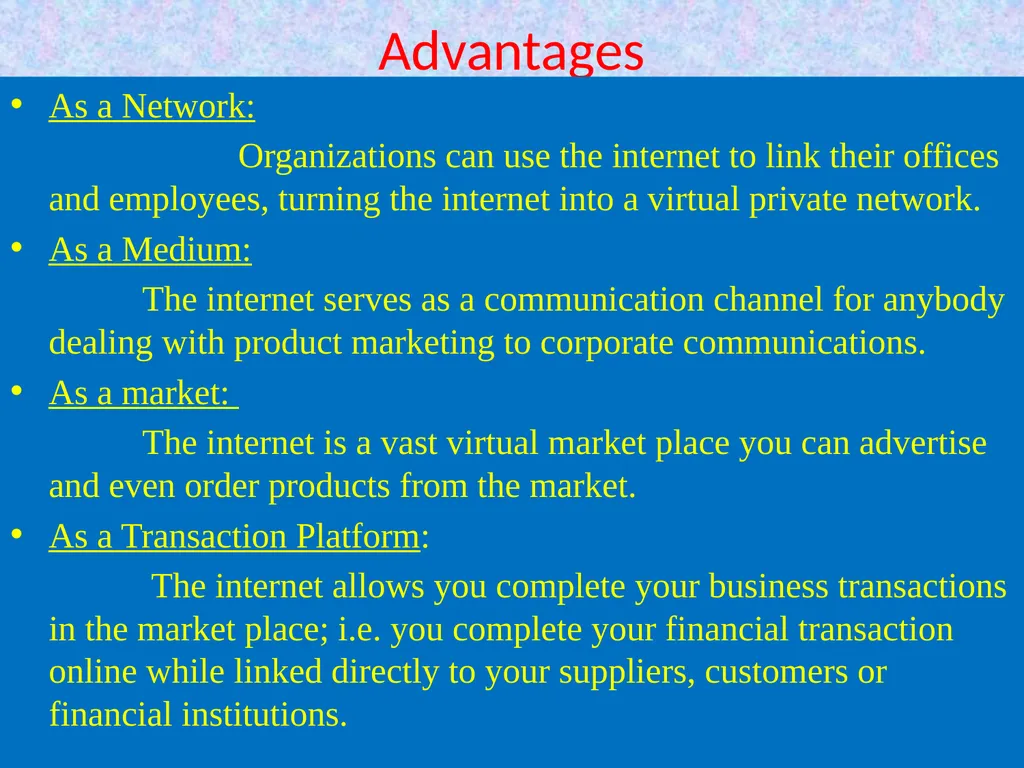
slide8. Advantages As a Network:
Organizations can use the internet to link their offices and employees, turning the internet into a virtual private network.
As a Medium:
The internet serves as a communication channel for anybody dealing with product marketing to corporate communications.
As a market:
The internet is a vast virtual market place you can advertise and even order products from the market.
As a Transaction Platform:
The internet allows you complete your business transactions in the market place; i.e. you complete your financial transaction online while linked directly to your suppliers, customers or financial institutions.<br>
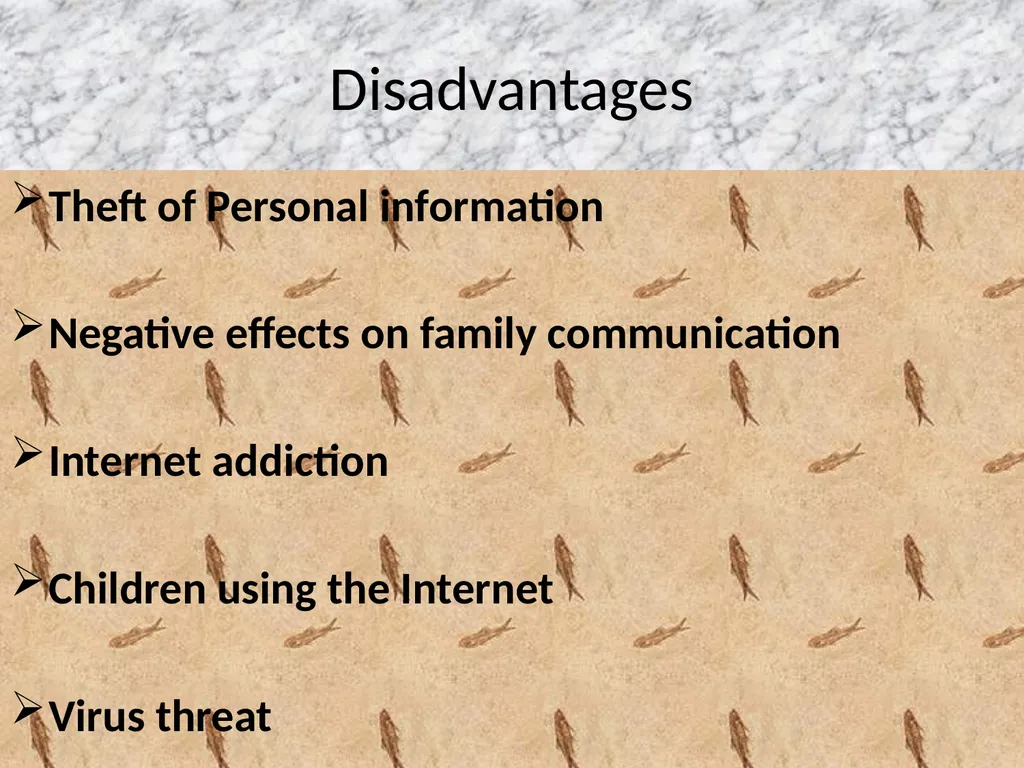
slide9. Disadvantages Theft of Personal information
Negative effects on family communication
Internet addiction
Children using the Internet
Virus threat<br>
slide10. Thank You<br>
By
Dr. K. Punitha Devi
Head & Asst. Prof. of Commerce(CA)
Bon Secours College for Women,
Thanjavur.<br>
slide2. Why Internet Kavitha transfers money from their savings account to Seetha’s account in Pondicherry using the computer. Usually this is done once a month. But if Seetha needs cash urgently, she sends an e-mail and the money is immediately transferred irrespective of the time(any time of the day) and place (from office or home).
To pay the Telephone bill, Electricity bill, Places to visit, Hotels to stay, restaurants to eat, shops to go etc.<br>
slide3. History of Internet In 1969, the Department of Defense of United States of America started a network called ARP net (Advanced Research Projects Administration network). This network was set up for the military purpose. It began in a modest way with one computer in California and three in Utah.
The primary goal of ARPANET was to allow multiple users to send and receive information simultaneously over the same communication path. The network operated with a technique called packet switching using TCP.
Later, to share the software and hardware resources, the military allowed universities to join the network from where the students caught up with it and developed much of the software, giving birth to the now so very popular internet.<br>
slide4. This ARPANET was divided into two parts MILNET and ARPANET. MILNET was used for military related sites and ARPANET for non-military sites. These two networks were connected together by using IP Internet Protocol. The combine set op protocol is called TCP/IP.
During the 1970’s networks like the BITNET and the USENET came into being. Around 1980’s NSFNET (National Science Foundation Network) was created. This growing web was the birth of the network.<br>
slide5. Introduction & Meaning of Internet Introduction:
A computer network, often simply referred to as a network, is a collection of computers and devices interconnected by communications channels that facilitate communications among users and allows users to share resources.
Meaning:
Internet is an inter-connection between several computers of different types belonging to various networks all over the globe. It is a network of network.<br>
slide6. The kind of colossal powers that the Internet gives your machine is mind-bogging. To send or receive data within a matter of seconds to someone placed beyond the Pacific was unthinkable before the advent of the Internet. The Internet represents the transformation and evolution of the entire information age. It is due to these factors that people all over the globe have recognized the internet as their latest developmental tool.
The internet unleashes the power to communicate unlike any other novelties. The Internet is making a major impact on the information technology industry. Major companies like Microsoft, AT&T, Intel and IBM have reworked their business strategies vis-a vis the Internet.<br>
slide7. Purpose Computer networks can be used for several purposes:
Facilitating communications.
Using a network, people can communicate efficiently and easily via email, instant messaging, chat rooms, telephone, video telephone calls, and video conferencing.
Sharing hardware.
In a networked environment, each computer on a network may access and use hardware resources on the network, such as printing a document on a shared network printer.
Sharing files, data, and information.
In a network environment, authorized user may access data and information stored on other computers on the network. The capability of providing access to data and information on shared storage devices is an important feature of many networks.
Sharing software.
Users connected to a network may run application programs on remote computers.
Information preservation.<br>
slide8. Advantages As a Network:
Organizations can use the internet to link their offices and employees, turning the internet into a virtual private network.
As a Medium:
The internet serves as a communication channel for anybody dealing with product marketing to corporate communications.
As a market:
The internet is a vast virtual market place you can advertise and even order products from the market.
As a Transaction Platform:
The internet allows you complete your business transactions in the market place; i.e. you complete your financial transaction online while linked directly to your suppliers, customers or financial institutions.<br>
slide9. Disadvantages Theft of Personal information
Negative effects on family communication
Internet addiction
Children using the Internet
Virus threat<br>
slide10. Thank You<br>