04
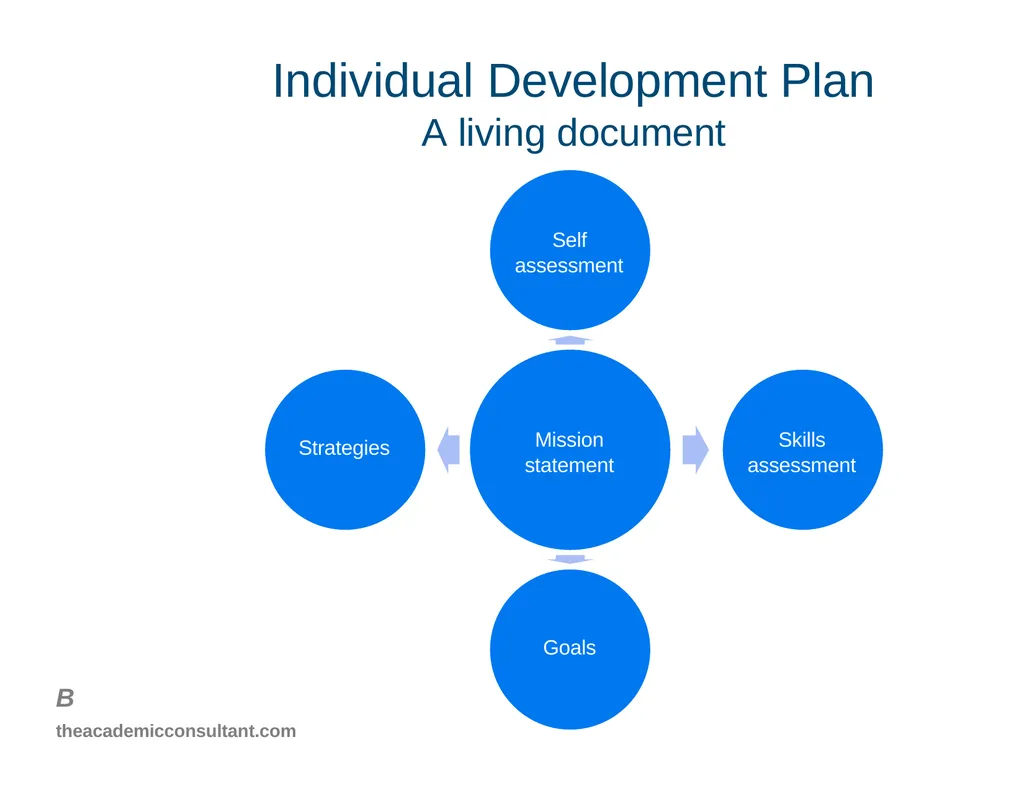
Individual Development Plan
A living document Mission statement Self assessment Skills assessment Goals Strategies B
theacademicconsultant.com<br>
05
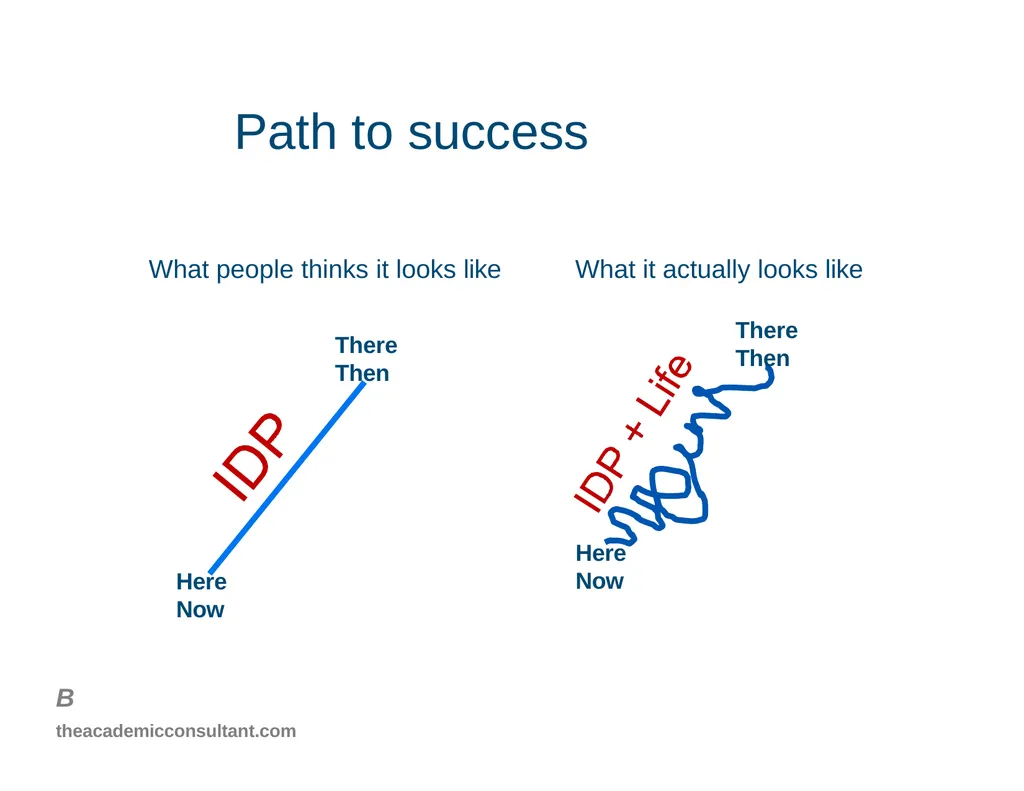
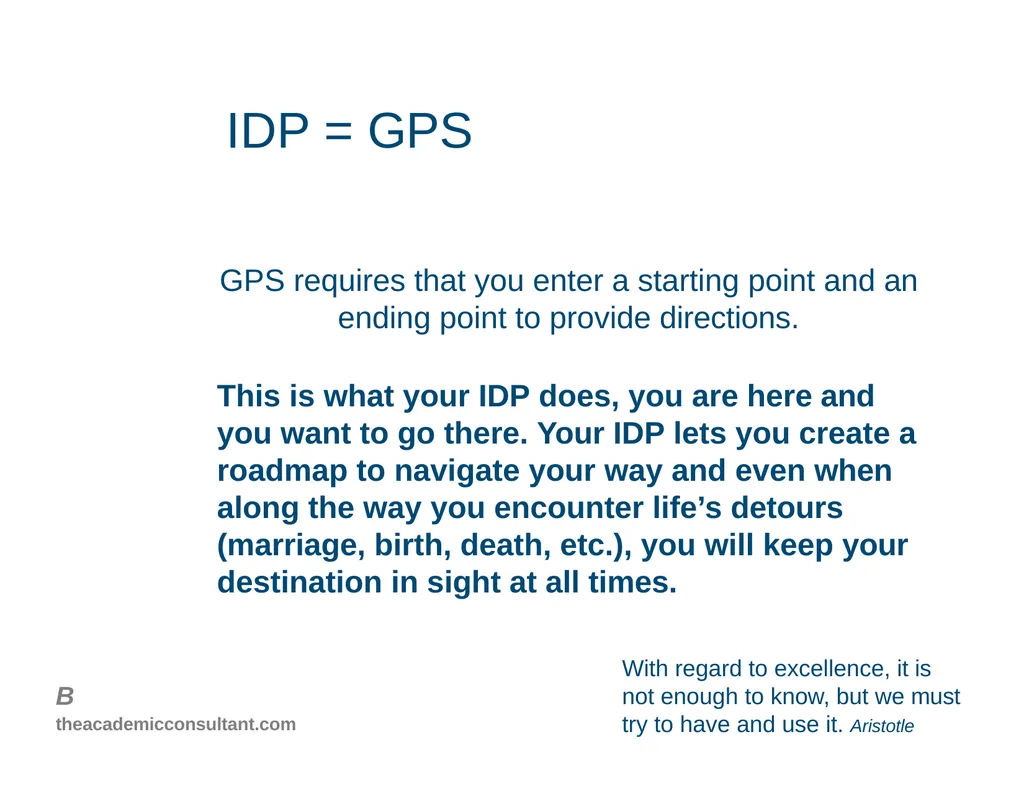
IDP = GPS GPS requires that you enter a starting point and an ending point to provide directions.
This is what your IDP does, you are here and you want to go there. Your IDP lets you create a roadmap to navigate your way and even when along the way you encounter life’s detours (marriage, birth, death, etc.), you will keep your destination in sight at all times. B
theacademicconsultant.com With regard to excellence, it is not enough to know, but we must try to have and use it. Aristotle<br>
06
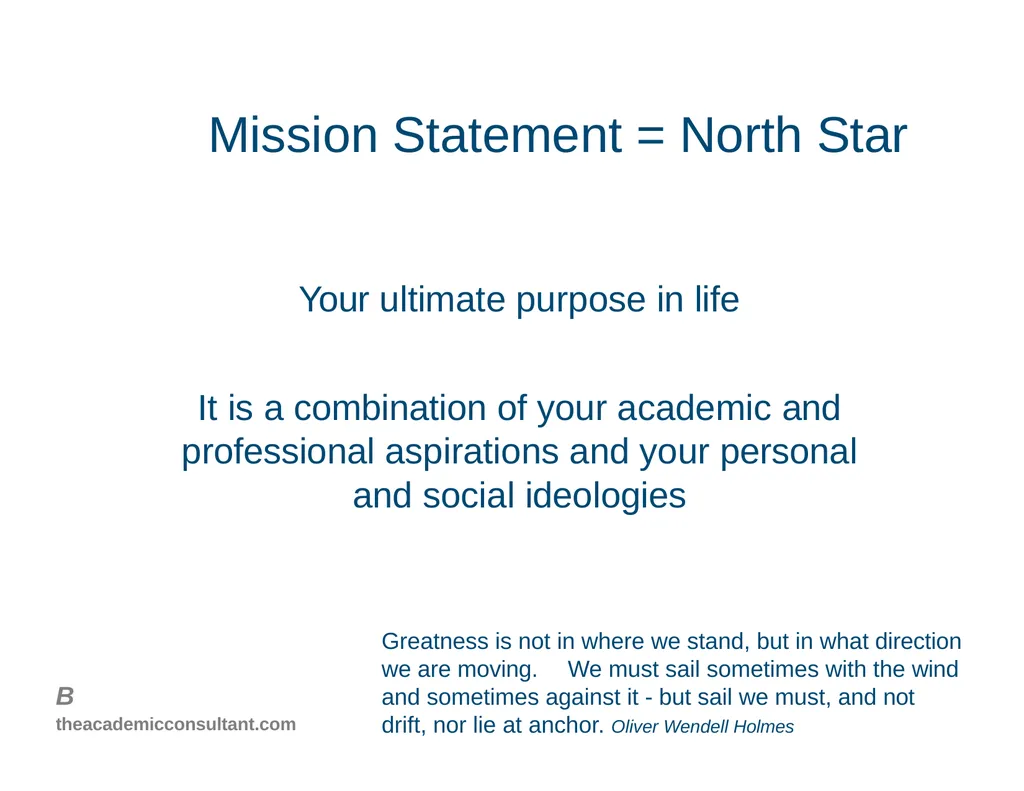
Mission Statement = North Star Your ultimate purpose in life
It is a combination of your academic and professional aspirations and your personal and social ideologies B
theacademicconsultant.com Greatness is not in where we stand, but in what direction we are moving. We must sail sometimes with the wind and sometimes against it - but sail we must, and not drift, nor lie at anchor. Oliver Wendell Holmes<br>
07
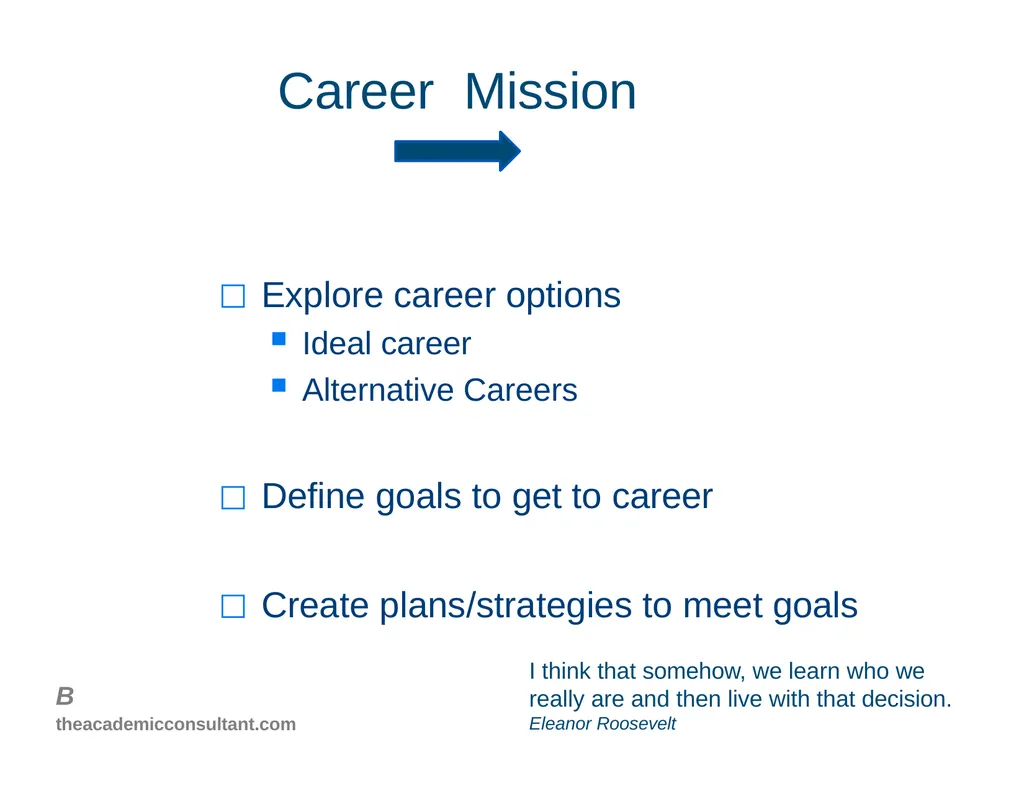
Career Mission Explore career options
Ideal career
Alternative Careers
Define goals to get to career
Create plans/strategies to meet goals B
theacademicconsultant.com I think that somehow, we learn who we really are and then live with that decision.
Eleanor Roosevelt<br>
08
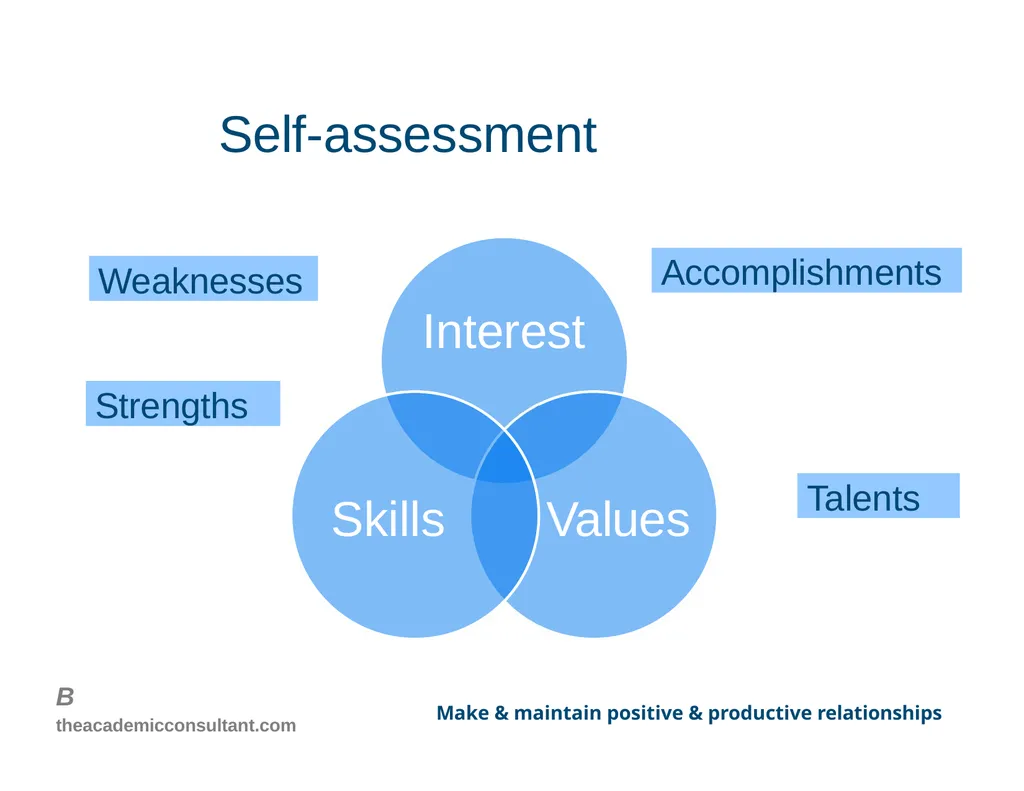
Self-assessment B Interest Values Skills theacademicconsultant.com Make & maintain positive & productive relationships Strengths Weaknesses Accomplishments Talents<br>
09
B
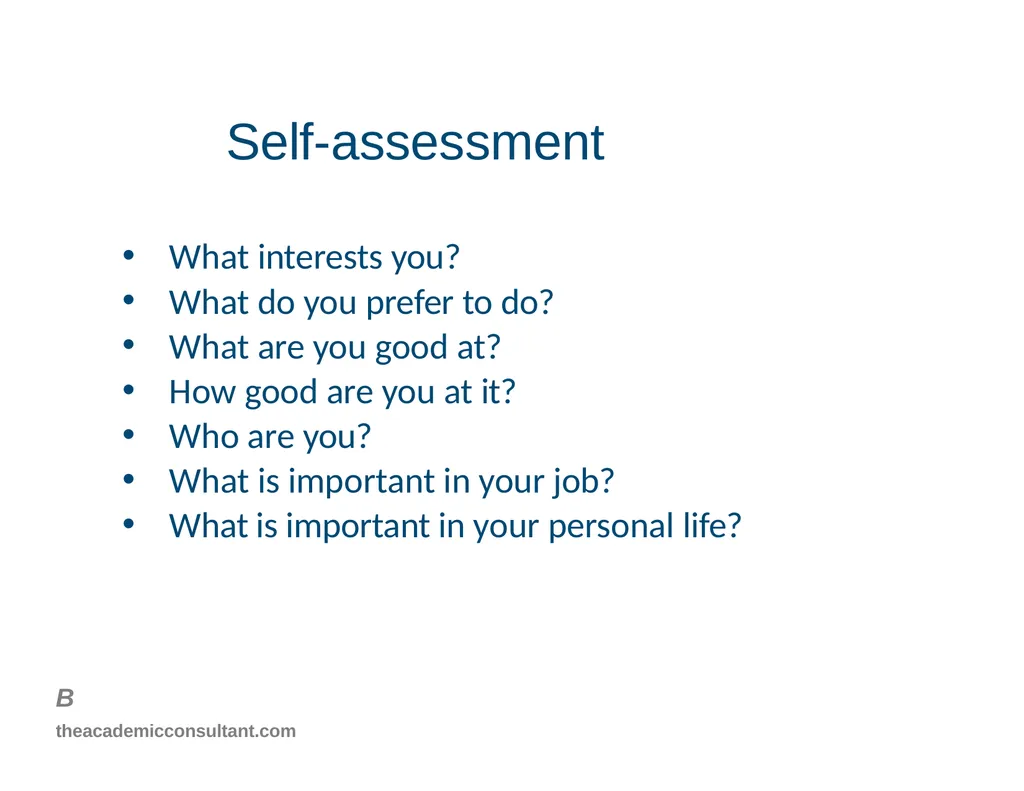
theacademicconsultant.com Self-assessment What interests you?
What do you prefer to do?
What are you good at?
How good are you at it?
Who are you?
What is important in your job?
What is important in your personal life?<br>
10
B
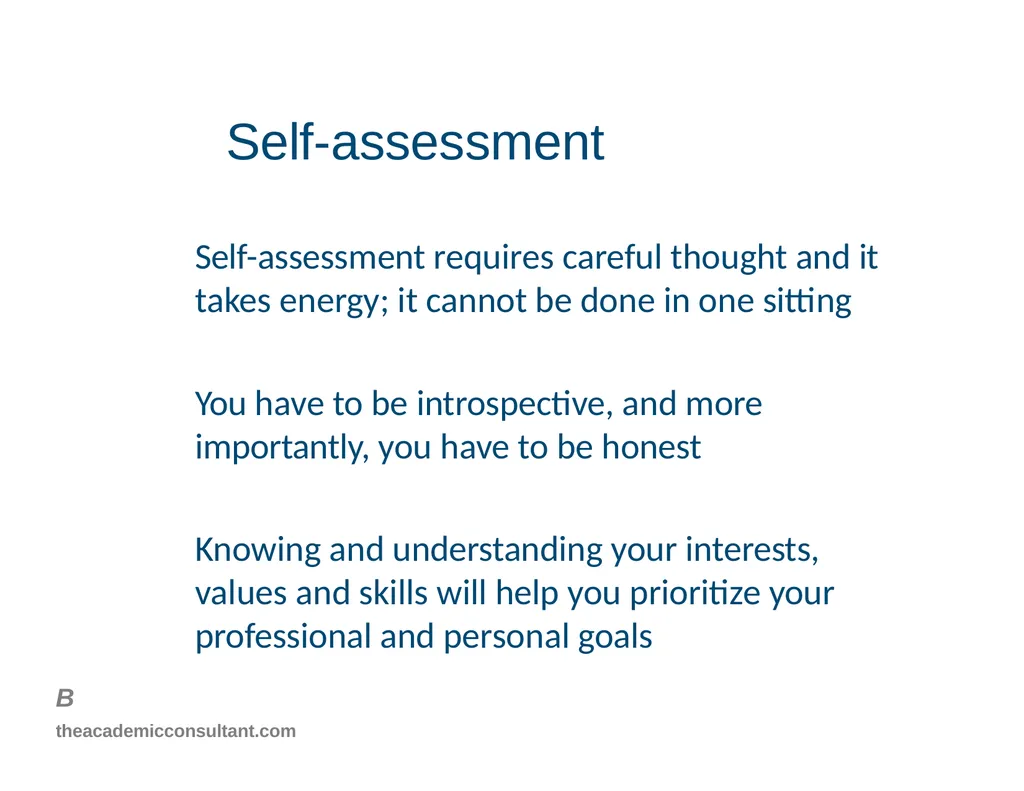
theacademicconsultant.com Self-assessment Self-assessment requires careful thought and it takes energy; it cannot be done in one sitting
You have to be introspective, and more importantly, you have to be honest
Knowing and understanding your interests, values and skills will help you prioritize your professional and personal goals<br>
11
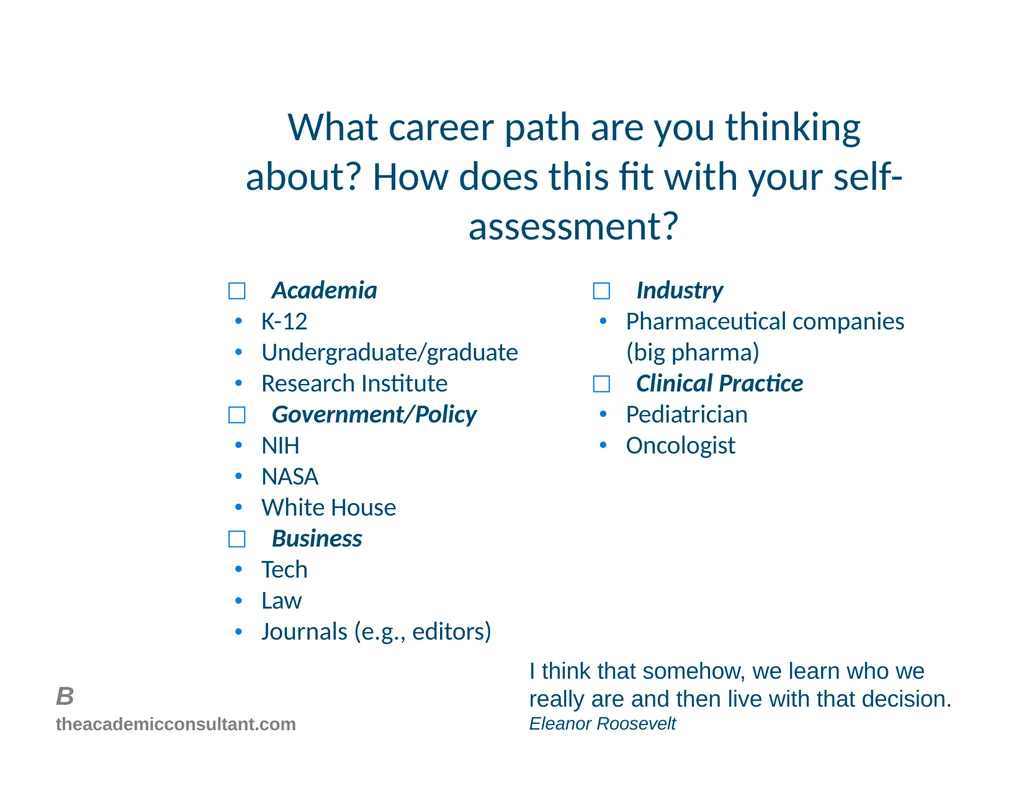
What career path are you thinking about? How does this fit with your self- assessment? Academia
K-12
Undergraduate/graduate
Research Institute
Government/Policy
NIH
NASA
White House
Business
Tech
Law
Journals (e.g., editors) Industry
Pharmaceutical companies (big pharma)
Clinical Practice
Pediatrician
Oncologist B
theacademicconsultant.com I think that somehow, we learn who we really are and then live with that decision.
Eleanor Roosevelt<br>
12
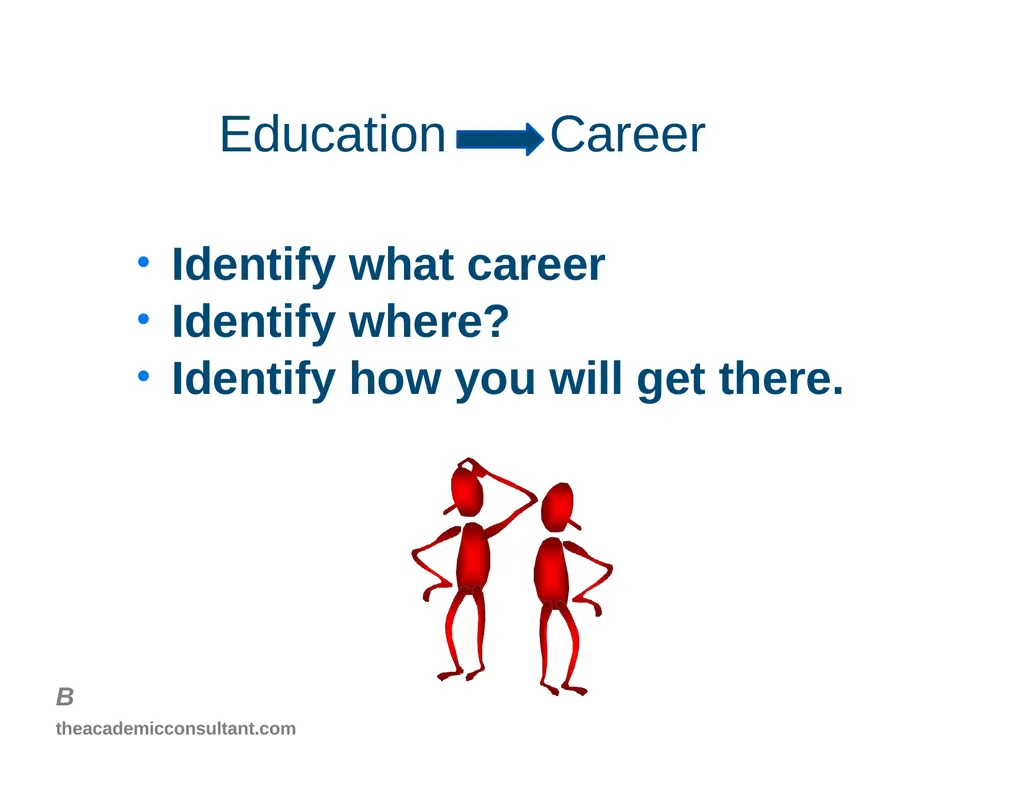
Education Career Identify what career
Identify where?
Identify how you will get there. B theacademicconsultant.com<br>
13
theacademicconsultant.com Trusted mentor to help you identify the skills and steps needed to reach your goals
Seek advice from
Academic and research advisors
Peers
Professors
Others who have followed a similar career/professional path
B Get help from Others<br>
14
Barriers to success Academic and cultural isolation
Low self-esteem
Peers/friends/family who are not emotionally supportive of academic success
Discrimination, whether perceived or real
Stereotype threat = self-defeating prophecy
Low expectations can lead to low performance
Inability to acknowledge that the problem exists
Shame about where they come from B
theacademicconsultant.com “Toward no crime have men shown themselves so cold-bloodedly cruel as in punishing differences of belief.” James Russell Lowell<br>
15
How does mentoring help Personal and professional development
Communications
Financial obstacles
Motivate and give courage & confidence to go on
Removing institutional barriers
Access to informal networks and information
Avoids or decreases alienation
Improves Retention
Shows diversity in disciplines B
theacademicconsultant.com “I never teach my pupils. I only attempt to provide the conditions in which they can learn.” Albert Einstein<br>
16
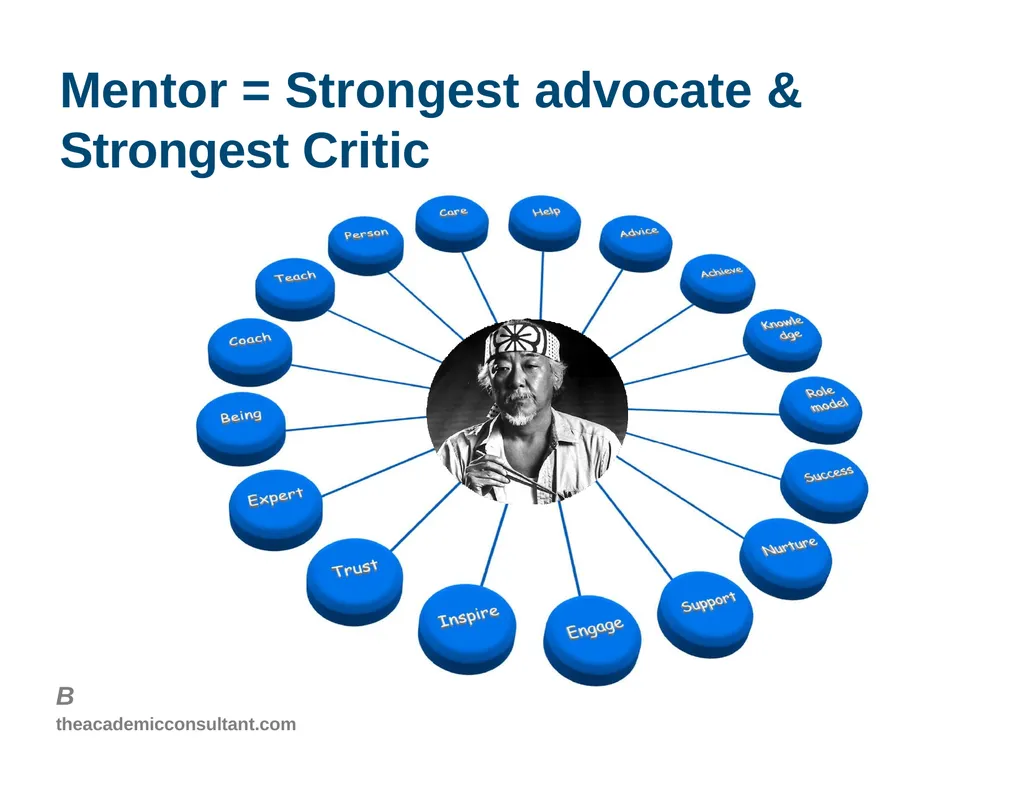
B
theacademicconsultant.com Mentor = Strongest advocate & Strongest Critic<br>
17
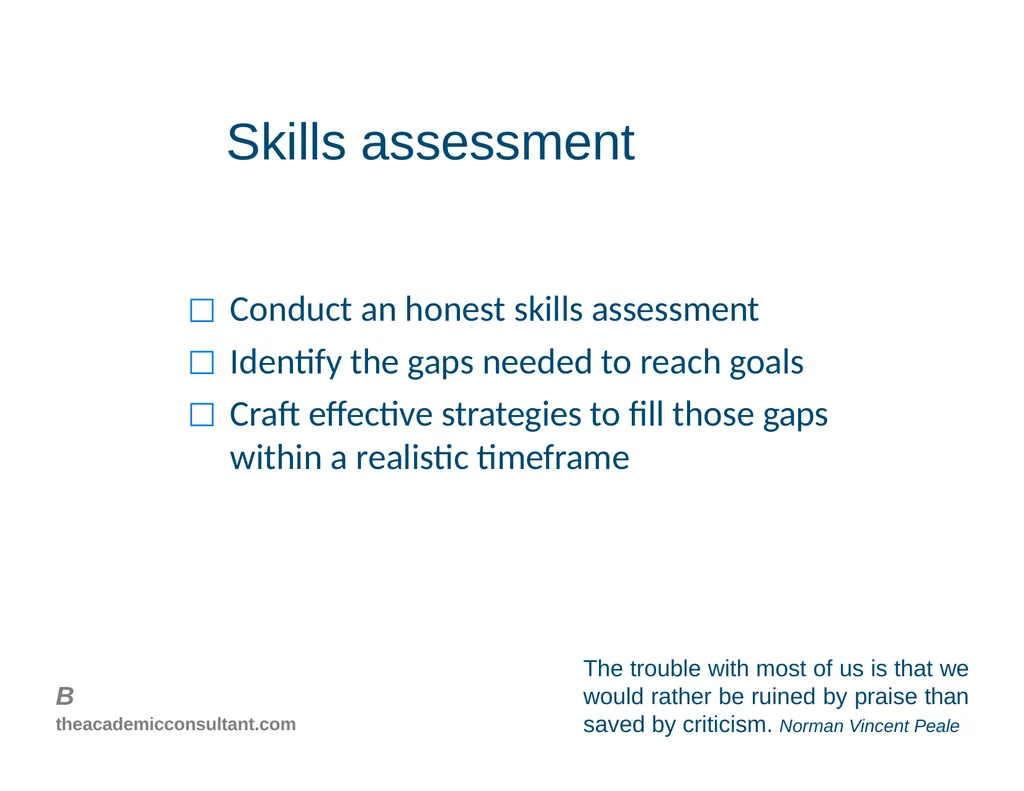
Skills assessment Conduct an honest skills assessment
Identify the gaps needed to reach goals
Craft effective strategies to fill those gaps within a realistic timeframe B
theacademicconsultant.com The trouble with most of us is that we would rather be ruined by praise than saved by criticism. Norman Vincent Peale<br>
18
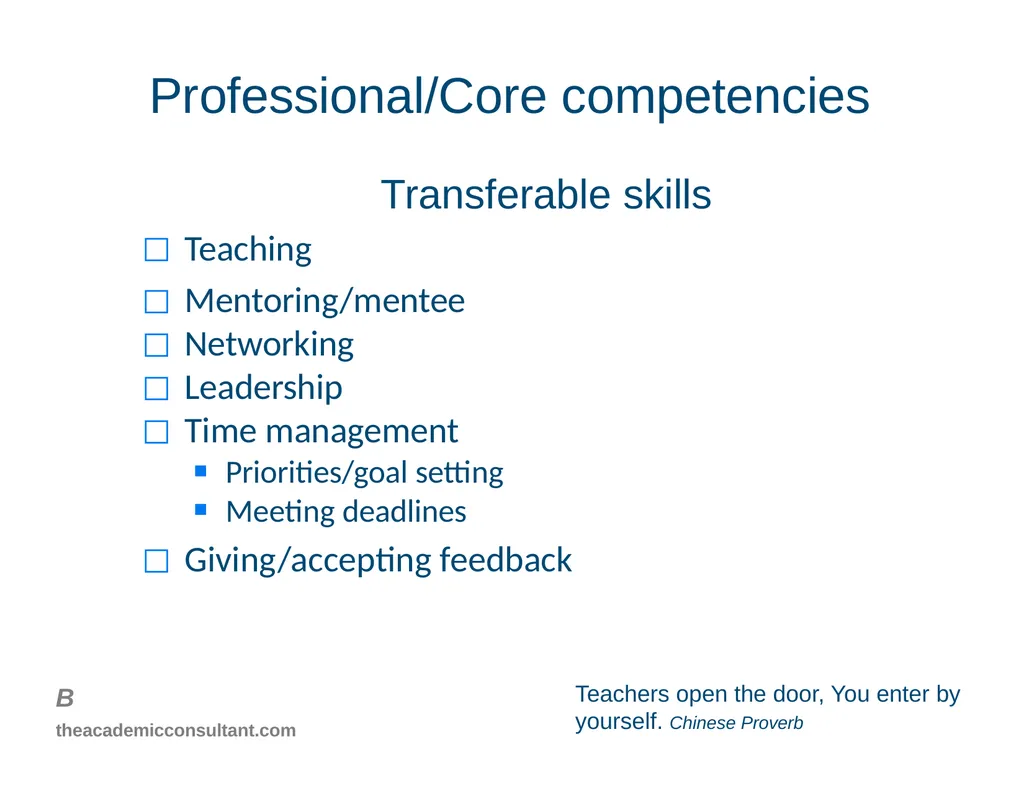
Teachers open the door, You enter by yourself. Chinese Proverb theacademicconsultant.com B Transferable skills
Teaching
Mentoring/mentee
Networking
Leadership
Time management
Priorities/goal setting
Meeting deadlines
Giving/accepting feedback Professional/Core competencies<br>
19
B
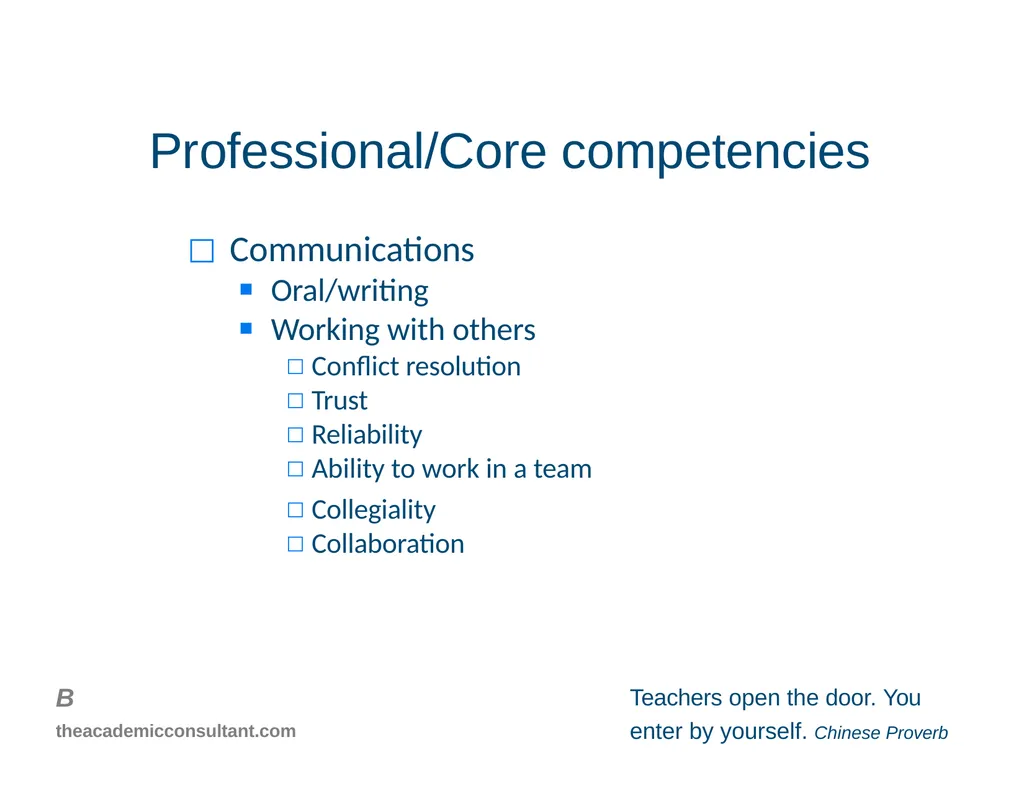
theacademicconsultant.com Teachers open the door. You
enter by yourself. Chinese Proverb Professional/Core competencies Communications
Oral/writing
Working with others
Conflict resolution
Trust
Reliability
Ability to work in a team
Collegiality
Collaboration<br>
20
B
theacademicconsultant.com Teachers open the door. You
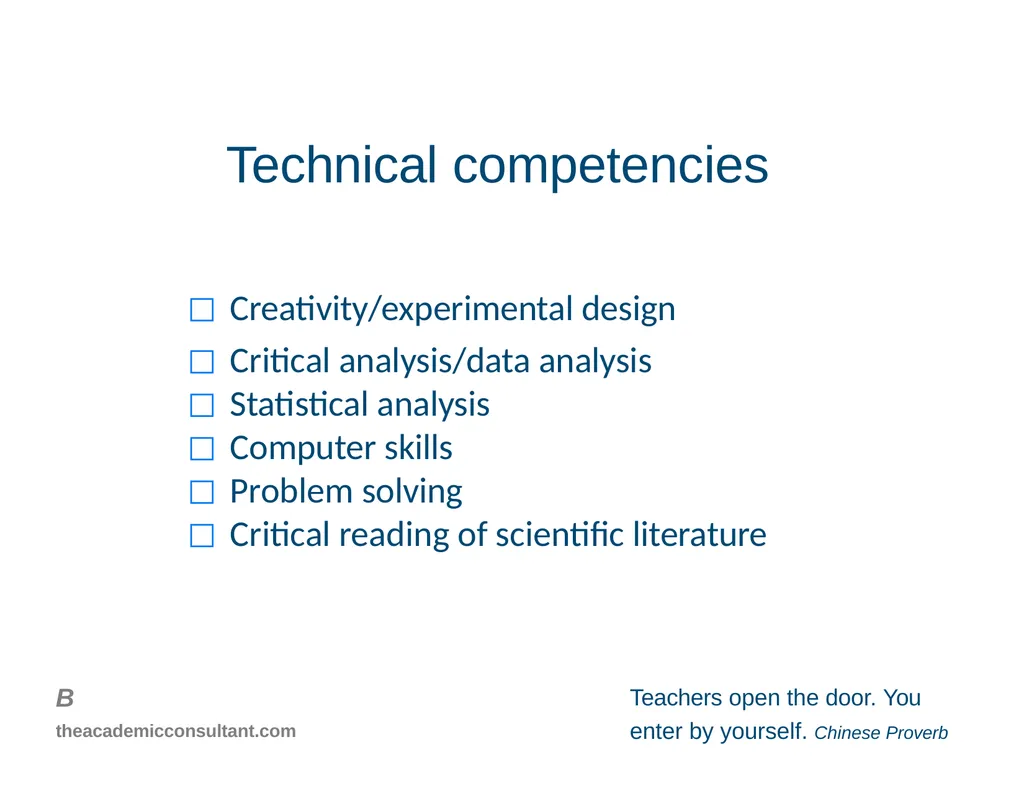
enter by yourself. Chinese Proverb Technical competencies Creativity/experimental design
Critical analysis/data analysis
Statistical analysis
Computer skills
Problem solving
Critical reading of scientific literature<br>
21
B
theacademicconsultant.com Teachers open the door. You
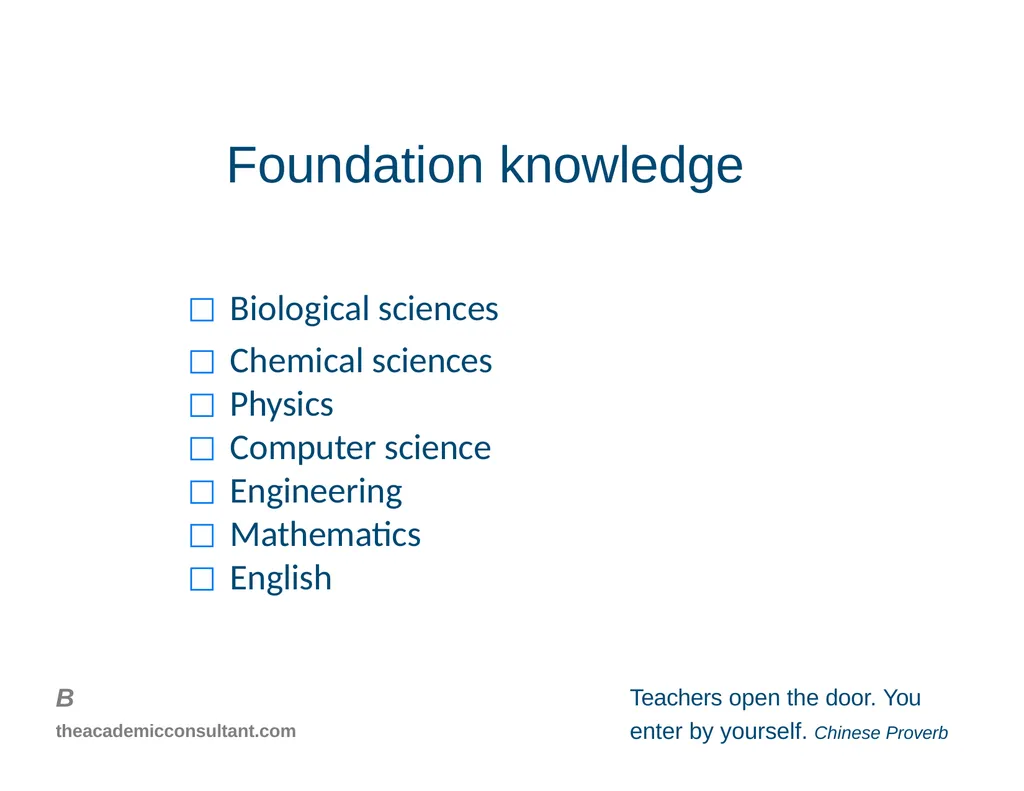
enter by yourself. Chinese Proverb Foundation knowledge Biological sciences
Chemical sciences
Physics
Computer science
Engineering
Mathematics
English<br>
22
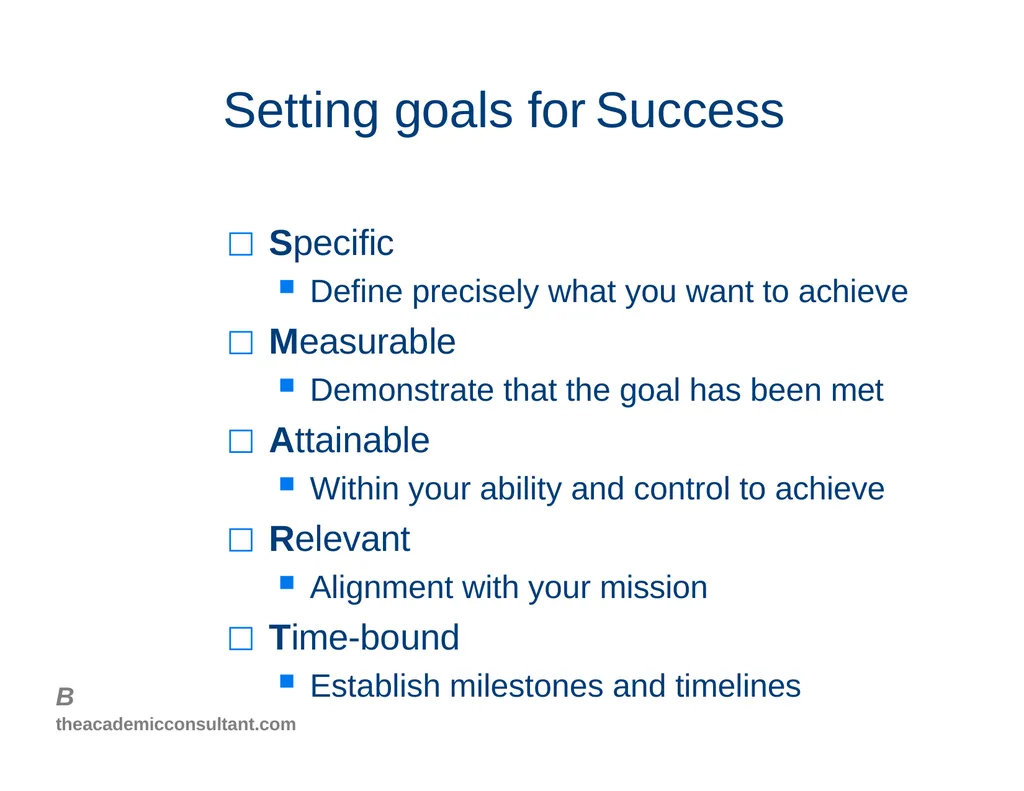
Setting goals for Success Specific
Define precisely what you want to achieve
Measurable
Demonstrate that the goal has been met
Attainable
Within your ability and control to achieve
Relevant
Alignment with your mission
Time-bound
Establish milestones and timelines B theacademicconsultant.com<br>
23
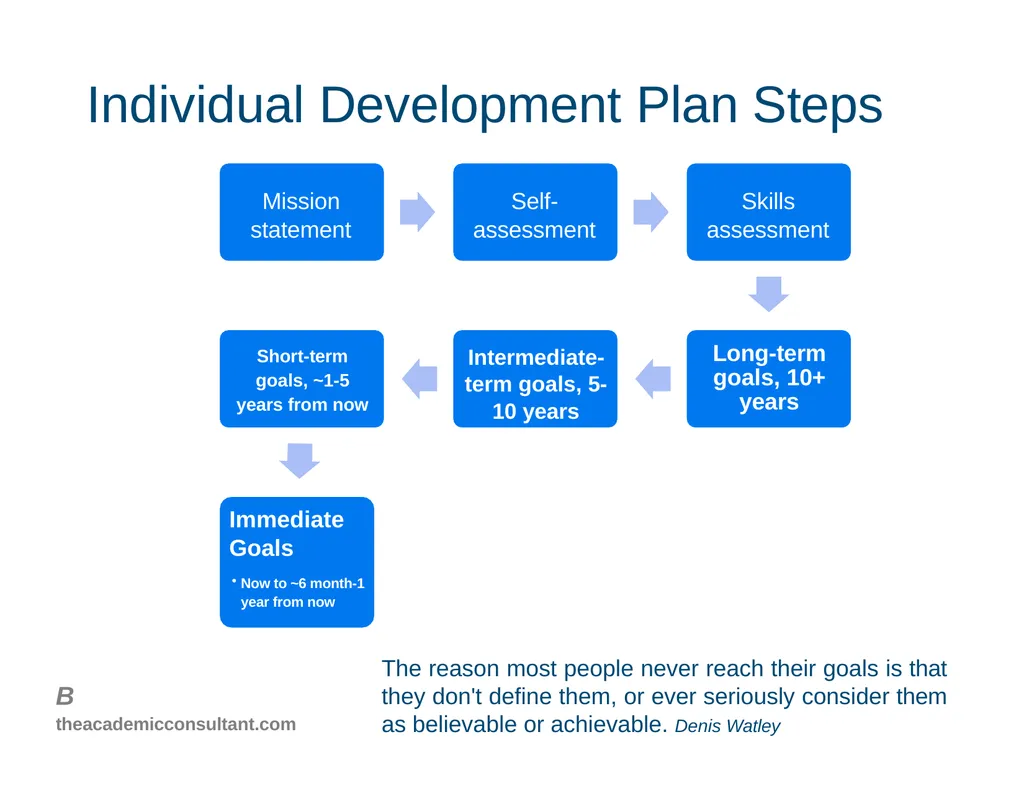
Individual Development Plan Steps B
theacademicconsultant.com The reason most people never reach their goals is that they don't define them, or ever seriously consider them as believable or achievable. Denis Watley Mission statement Self- assessment Skills assessment Long-term goals, 10+ years Intermediate- term goals, 5-
10 years Short-term goals, ~1-5 years from now Immediate Goals
Now to ~6 month-1 year from now<br>
24
B
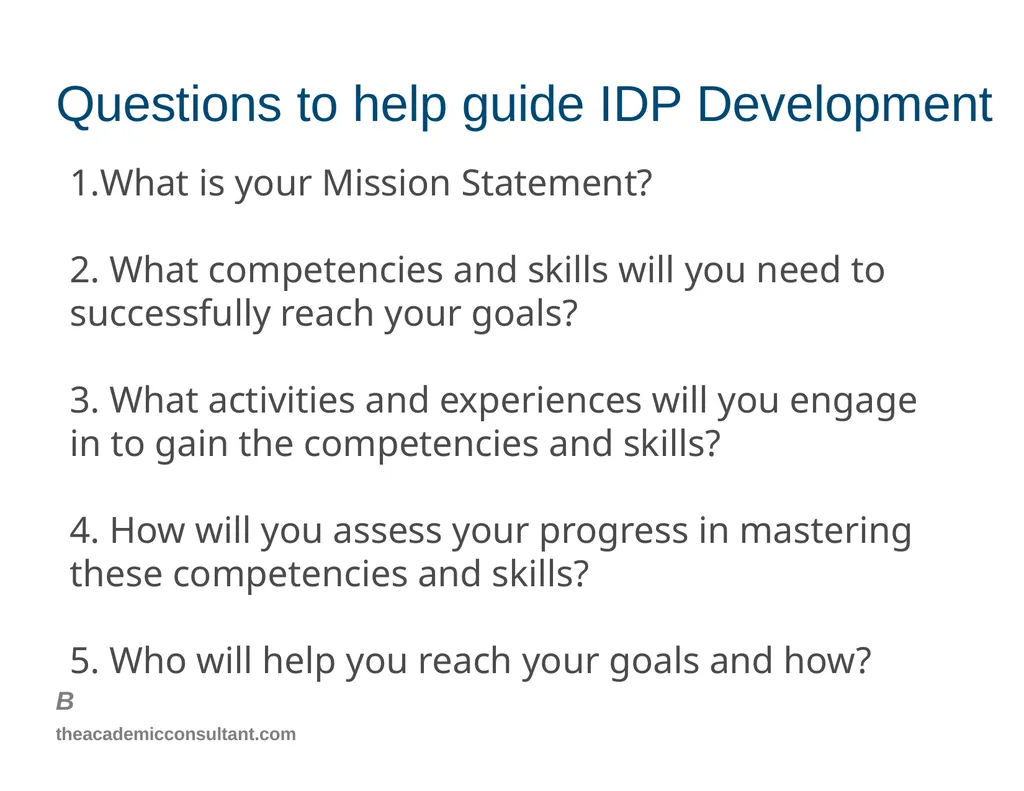
theacademicconsultant.com Questions to help guide IDP Development What is your Mission Statement?
2. What competencies and skills will you need to successfully reach your goals?
3. What activities and experiences will you engage in to gain the competencies and skills?
4. How will you assess your progress in mastering these competencies and skills?
5. Who will help you reach your goals and how?<br>
25
B
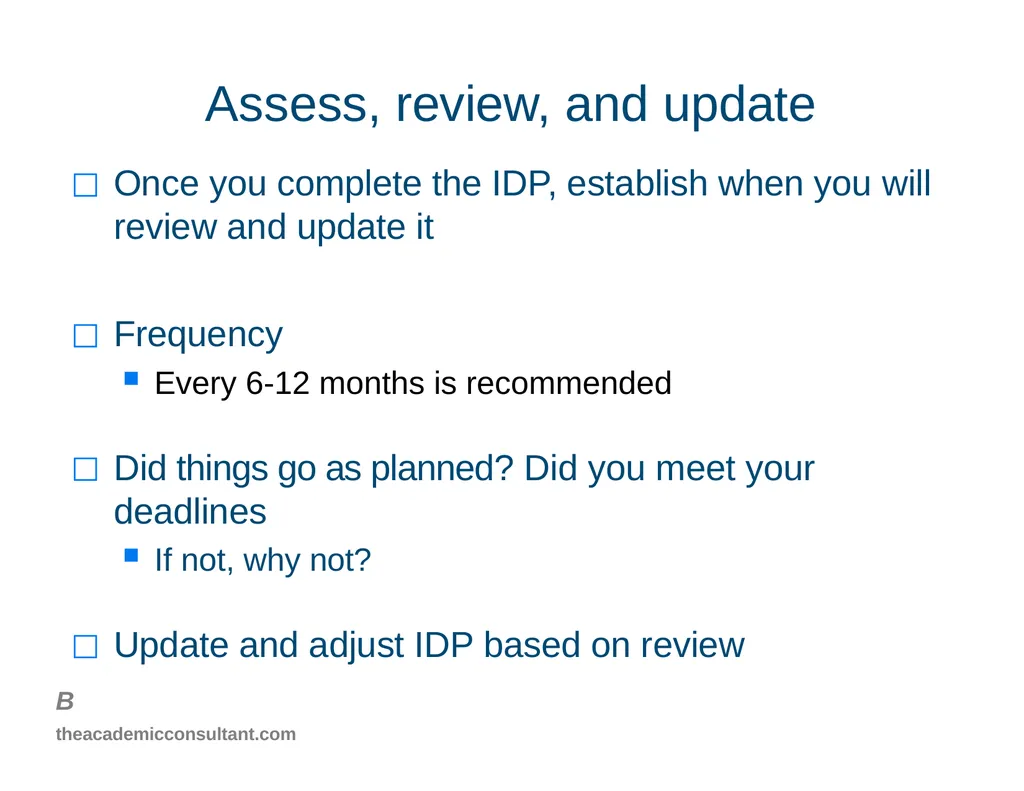
theacademicconsultant.com Assess, review, and update Once you complete the IDP, establish when you will review and update it
Frequency
Every 6-12 months is recommended
Did things go as planned? Did you meet your deadlines
If not, why not?
Update and adjust IDP based on review<br>
26
B
theacademicconsultant.com Do not be a spectator in your life, be the driver; take ownership, responsibility, and accountability for your future. Creating an effective IDP requires you to think about your big audacious goals and how to realistically reach them.<br>