04
Questions What courses should I take
How should I study for the MCAT
What should I put in my personal statement
Who should give me references
How do I get into medical school<br>
05
Sessions Medical history
Physical exams
Suturing
Documentation in medicine
Personal statements
Coursework
MCATs<br>
06
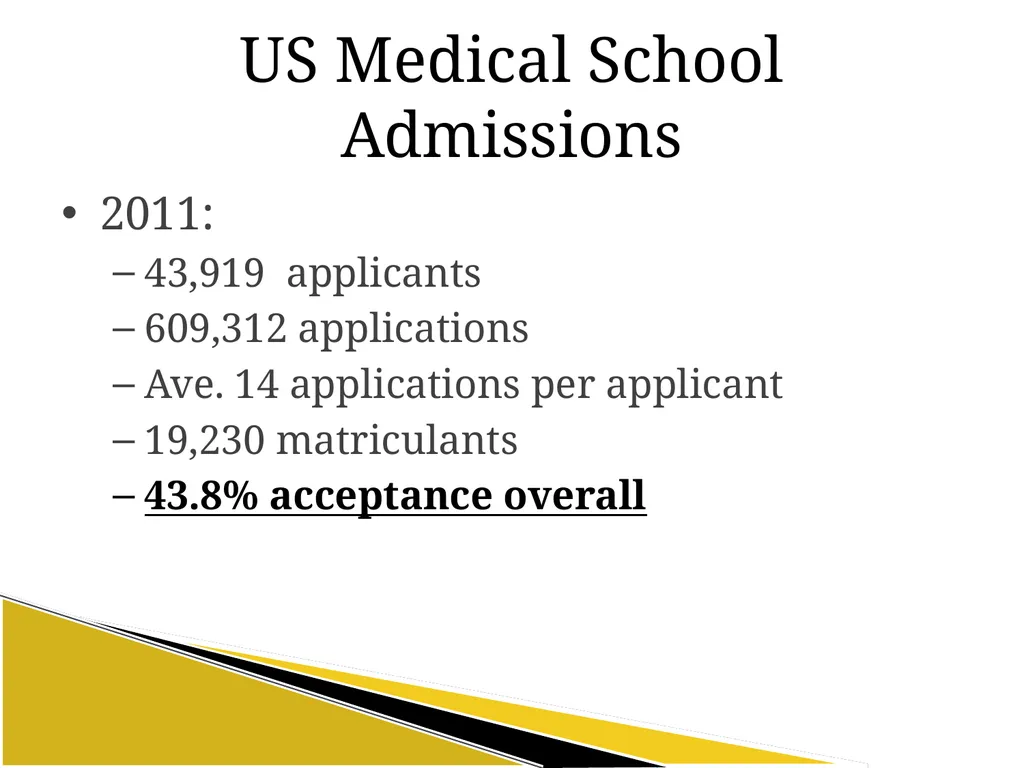
US Medical School Admissions 2011:
43,919 applicants
609,312 applications
Ave. 14 applications per applicant
19,230 matriculants
43.8% acceptance overall<br>
07
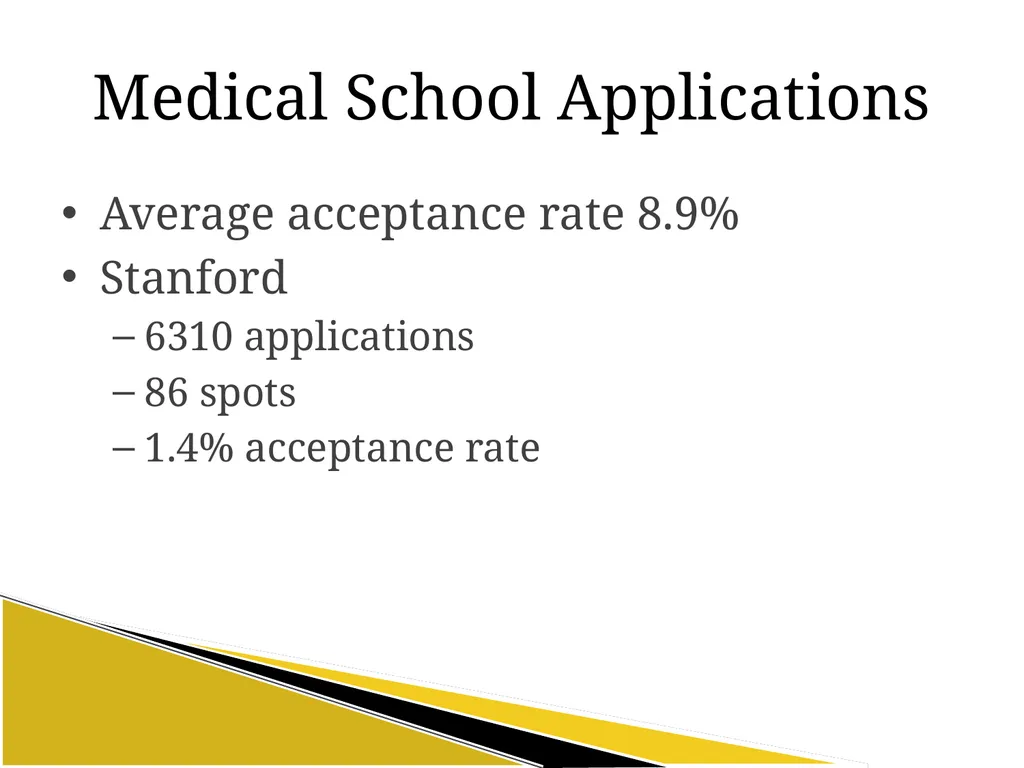
Medical School Applications Average acceptance rate 8.9%
Stanford
6310 applications
86 spots
1.4% acceptance rate<br>
08
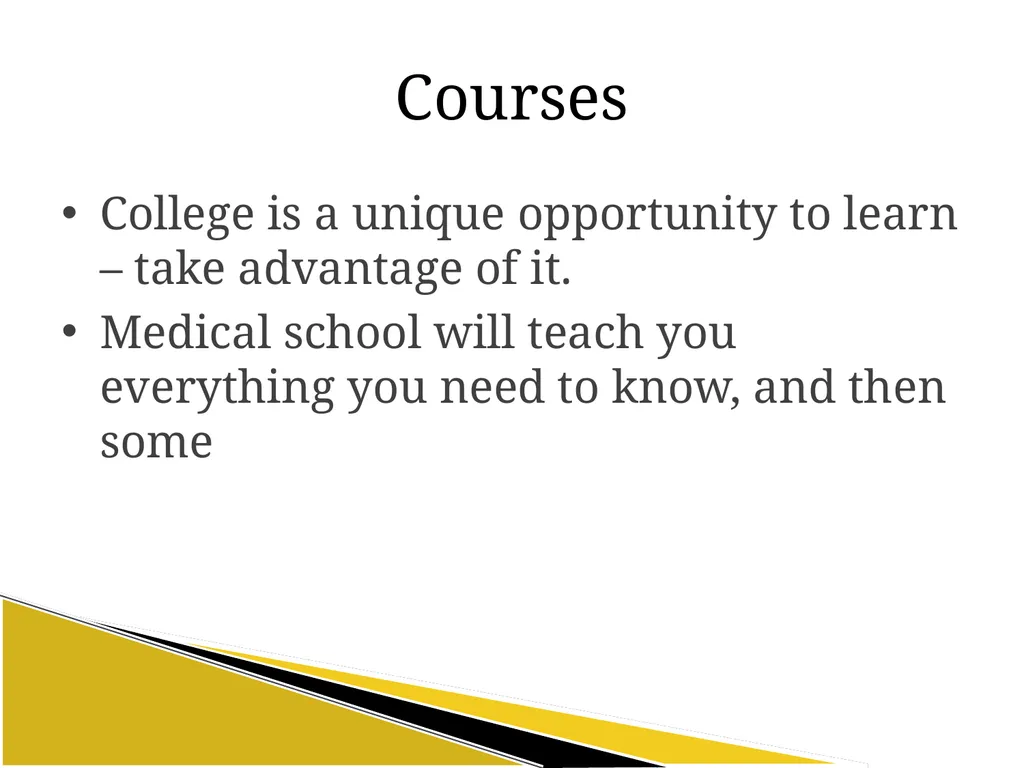
Courses College is a unique opportunity to learn – take advantage of it.
Medical school will teach you everything you need to know, and then some<br>
09
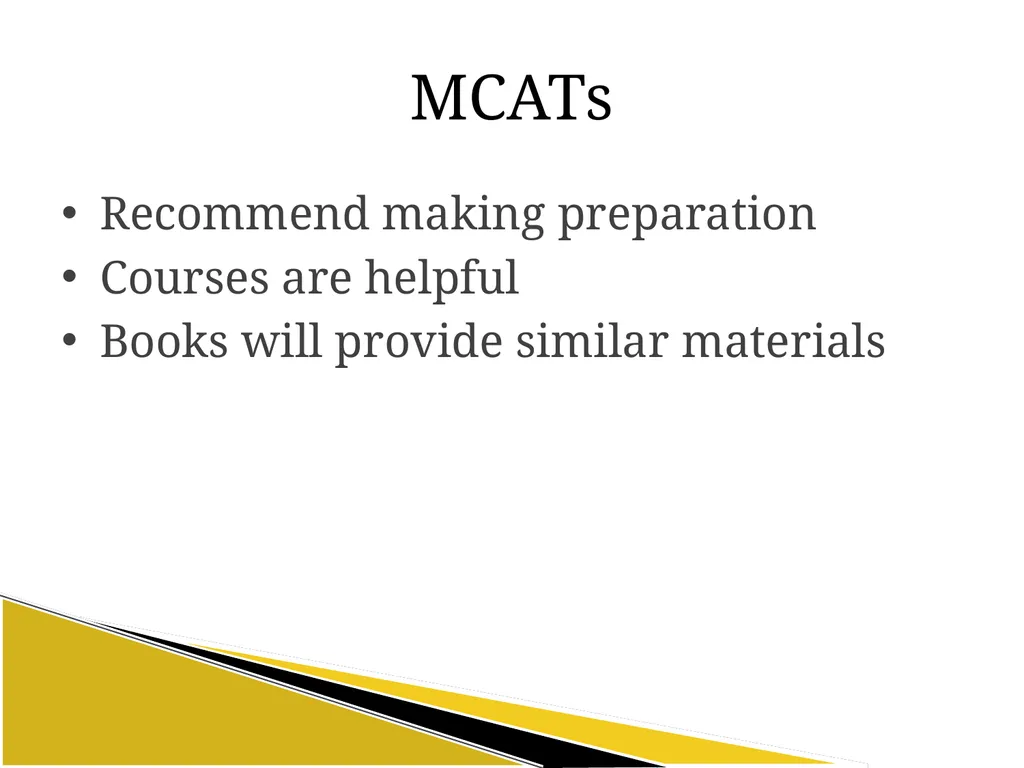
MCATs Recommend making preparation
Courses are helpful
Books will provide similar materials<br>
10
Recommendations People who really know you
Professors/academic credentials
People known to the medical school
Can call or directly speak with admissions
Known entities are a safe bet to schools
Need to develop relationships with people who can help<br>
11
Personal Statements Clearly written documents which tell something special about you
Generalities are not helpful in a competitive environment
Many of you already have stories to tell
Need to stand out with the other smart students<br>
12
Options Clinical Medicine
Academic Medicine
Business
Administration<br>
13
Clinical Medicine Various specialties
Variable experience by region
Practice Environments<br>
14
Academic Medicine Clinical = Patient Care
Basic Science Research<br>
15
Medicine Is Not… A glitzy TV show.
There are no doctors lounging on couches chatting over coffee in their spacious oversized offices in Santa Monica debating when they’ll hit the beach (Private Practice)<br>
16
Doctors Do Not… Doctors do not do every procedure under the sun typically (House)
Residents do not walk around chatting and looking like movie stars (Gray’s Anatomy)<br>
17
Realistic Expectations It’s hard work.
It’s very stressful.
There has been a trend away from longer hours.
The responsiblities of physicians has increased tremendously because of regulations and paperwork.<br>
18
Medical Reality Check At the same time, there has been erosions in the authority of physicians.
You will have limitations placed on your ability to make clinical decisions every day by others.<br>
19
Income Varies substantially between specialties and between regions. Higher in the South and Midwest;lower on the coasts.
MGMA publishes data in detail annually.
Fees based on ‘RVU’s.
Insurance reimbursement typically based off of Medicare rates<br>
20
Medicine is an Art Medicine is not a commodity.
There are some who are better than others
The top 5% are going to run rings around everyone else
Medicine is often regulated as a commodity
Great doctors are not always rewarded appropriately<br>
21
Excellence We must all strive for the best.
All schools are not created equally.
More importantly, there is much greater divergence in the quality of training with resiencies and fellowships. These are not regulated nearly as closely as med schools.<br>
22
Is this the right decision? These are personal and subjective.
Reading gives some insight, eg WSJ
Shadowing gives direct observation
Volunteering modest benefit
My thoughts:
Intelligent.
Care about others
Want to make the world a better place<br>
23
Medical Schools Advantageous at higher ranked schools
Geography is of modest importance;may influence residency where geography is important.
Watch your debt!<br>
24
Admissions Higher rank
Need to qualify with stats
Need to stand out in highly competitive field
Average
Make quantitative rankings on formula, eg GPA, science GPA, MCATs<br>
25
Clinical Medicine Largely providing direct patient care
Settings
Academic Center
Frequently doing clinical research, publishing, teaching
Solo Practice
Single Specialty Group
Multi-specialty Group
Hospital Employee<br>
26
Academic Practice Salaried
Direct patient care
Publishing typically expected
Teaching responsibilities
Residents/fellows
Medical students
Lectures<br>
27
Non-academic Clinical Practice Solo practice
Single Specialty practice
Multi-specialty group
Hospital employment<br>
28
Solo Practice Single physician
Employ staff
Lease office space
Need own furniture/equipment
Good autonomy
Difficult to negotiate fees<br>
29
Single Specialty Group 2 or more physicians in the same specialty
Share costs
Less autonomy as group expands
Shared interests
More negotiating power as group expands<br>
30
Multi-Specialty Group Multiple physicians in different specialties
Less administrative responsibilities
Less autonomy
Divergence of physician interests leads to conflicts, e.g. income formulas.<br>
31
Hospital Employment Minimize administrative responsibilities
Highest level of negotiating power with insurances
Autonomy frequently limited<br>
32
Boutique Medicine Typically primary care. Cardiologists have started, e.g. Santa Monica
Patients will pay a fee to remain on a physician’s patient list.
Patient or physician may still bill insurance
May only accept immediate payment substantially above insurance rates.
Hospitals – e.g. Eisenhower in Rancho Mirage, CA charge patients for extra service<br>
33
Eisenhower Medical Center Platinum members commit to donating $250k to hospital
Concierge service in ED with faster care/service
Special concierge rooms at extra cost to the patient with large rooms, TVs, lounges, etc similar to a 5 star hotel.<br>
34
Pacific Cardiology 3 levels of concierge service
Silver: pacemaker checks no longer covered by Medicare
Gold: Appointments within 3 days
Platinum: Same day appointments, doctors cell phone and email with 24 hour access<br>