
Introducing Information Retrieval and Web Search
SB
Published · 53 slides · 0 views

1 / 1






Description
Introducing Information Retrieval and Web Search Information Retrieval Information Retrieval (IR) is finding material (usually documents) of an unstructured nature (usually text) that satisfies an information need from within large
Related Topics
Share
Embed code
Download this presentation From Below
"Introducing Information Retrieval and Web Search" is the property of its rightful owner. Permission is granted to download and print the materials on this website for personal, non-commercial use only, and to display it on your personal computer provided you do not modify the materials and that you retain all copyright notices contained in the materials. By downloading content from our website, you accept the terms of this agreement.
Presentation Transcript
01
Introducing Information Retrieval
and Web Search<br>
and Web Search<br>
02
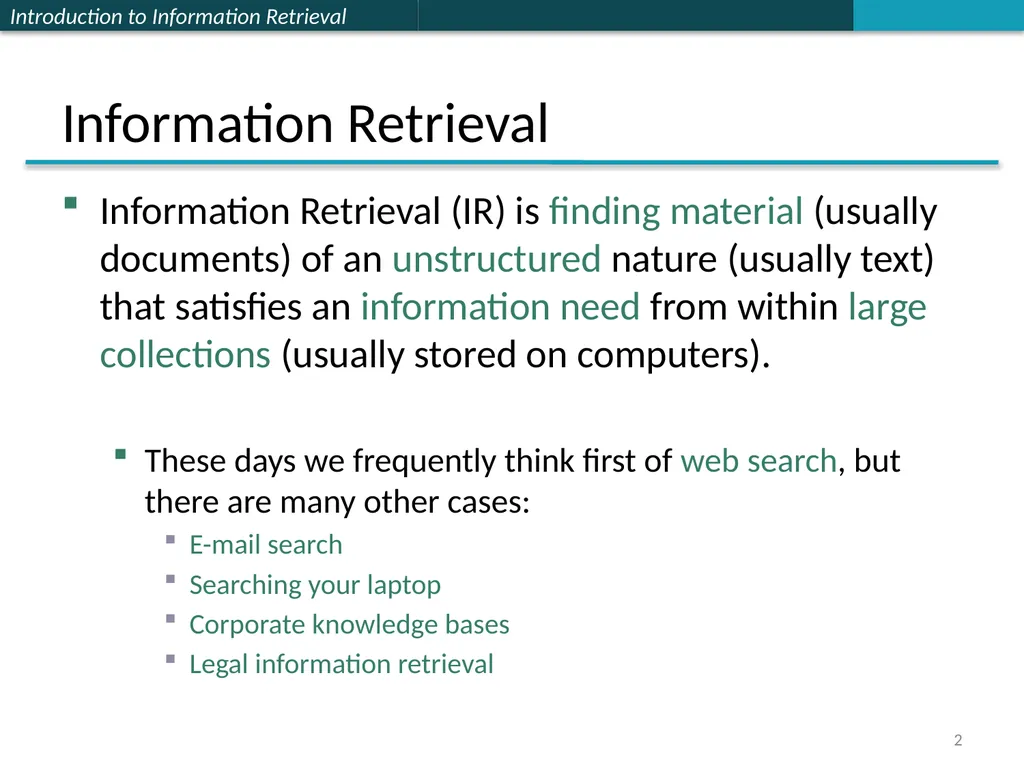
Information Retrieval Information Retrieval (IR) is finding material (usually documents) of an unstructured nature (usually text) that satisfies an information need from within large collections (usually stored on computers).
These days we frequently think first of web search, but there are many other cases:
E-mail search
Searching your laptop
Corporate knowledge bases
Legal information retrieval 2<br>
These days we frequently think first of web search, but there are many other cases:
E-mail search
Searching your laptop
Corporate knowledge bases
Legal information retrieval 2<br>
03
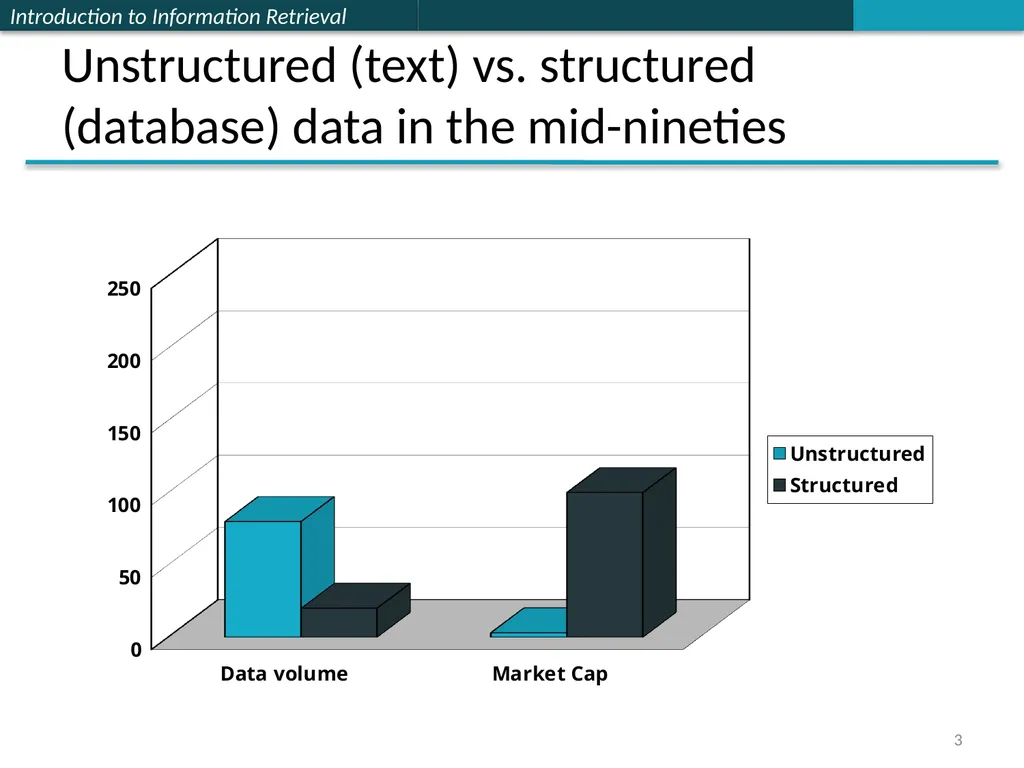
Unstructured (text) vs. structured (database) data in the mid-nineties 3<br>
04
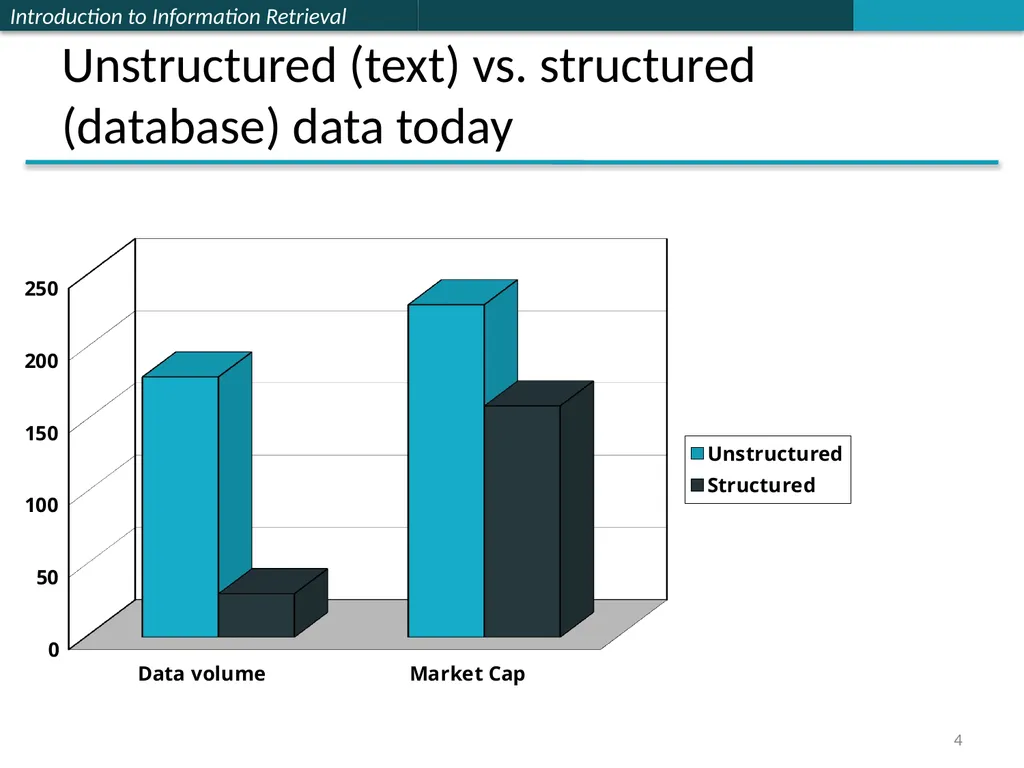
Unstructured (text) vs. structured (database) data today 4<br>
05
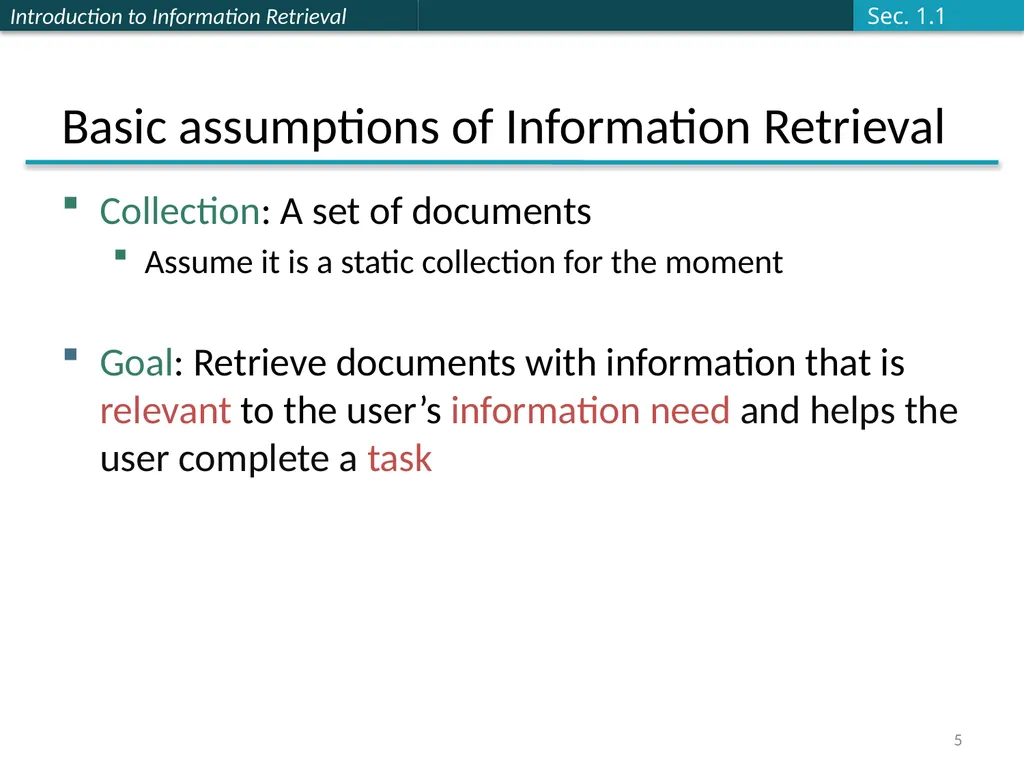
Basic assumptions of Information Retrieval Collection: A set of documents
Assume it is a static collection for the moment
Goal: Retrieve documents with information that is relevant to the user’s information need and helps the user complete a task 5 Sec. 1.1<br>
Assume it is a static collection for the moment
Goal: Retrieve documents with information that is relevant to the user’s information need and helps the user complete a task 5 Sec. 1.1<br>
06
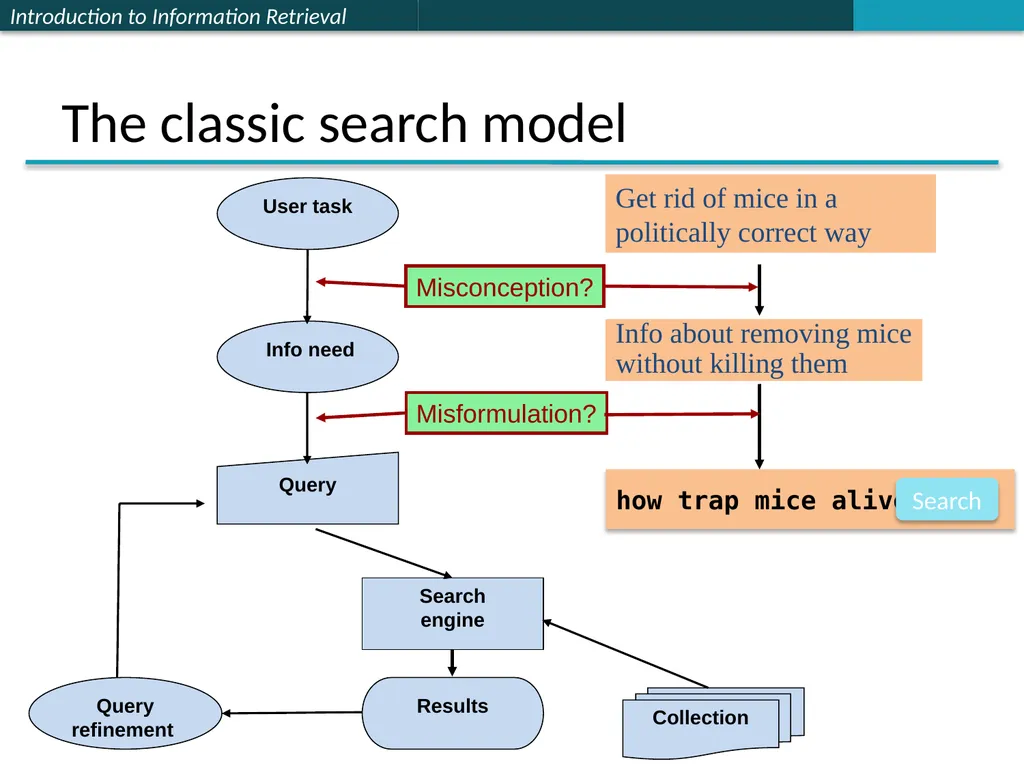
how trap mice alive The classic search model Collection User task Info need Query Results Search
engine Query refinement Get rid of mice in a politically correct way Info about removing mice
without killing them Search<br>
engine Query refinement Get rid of mice in a politically correct way Info about removing mice
without killing them Search<br>
07
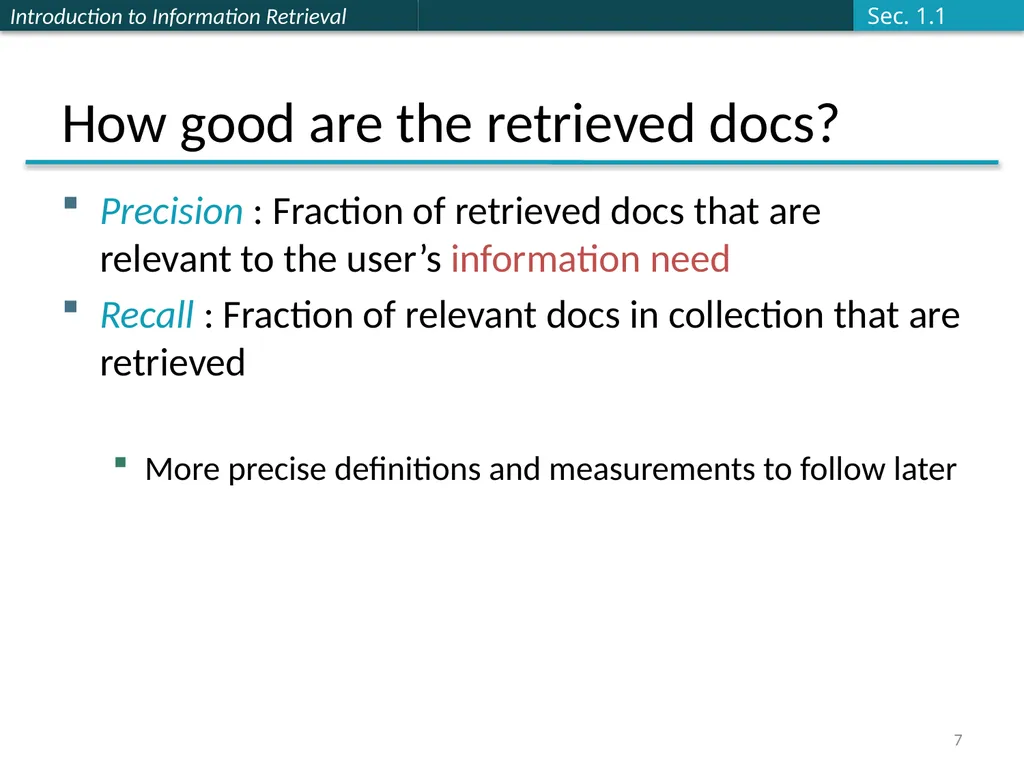
How good are the retrieved docs? Precision : Fraction of retrieved docs that are relevant to the user’s information need
Recall : Fraction of relevant docs in collection that are retrieved
More precise definitions and measurements to follow later 7 Sec. 1.1<br>
Recall : Fraction of relevant docs in collection that are retrieved
More precise definitions and measurements to follow later 7 Sec. 1.1<br>
08
Introducing Information Retrieval
and Web Search<br>
and Web Search<br>
09
Term-document incidence matrices<br>
10
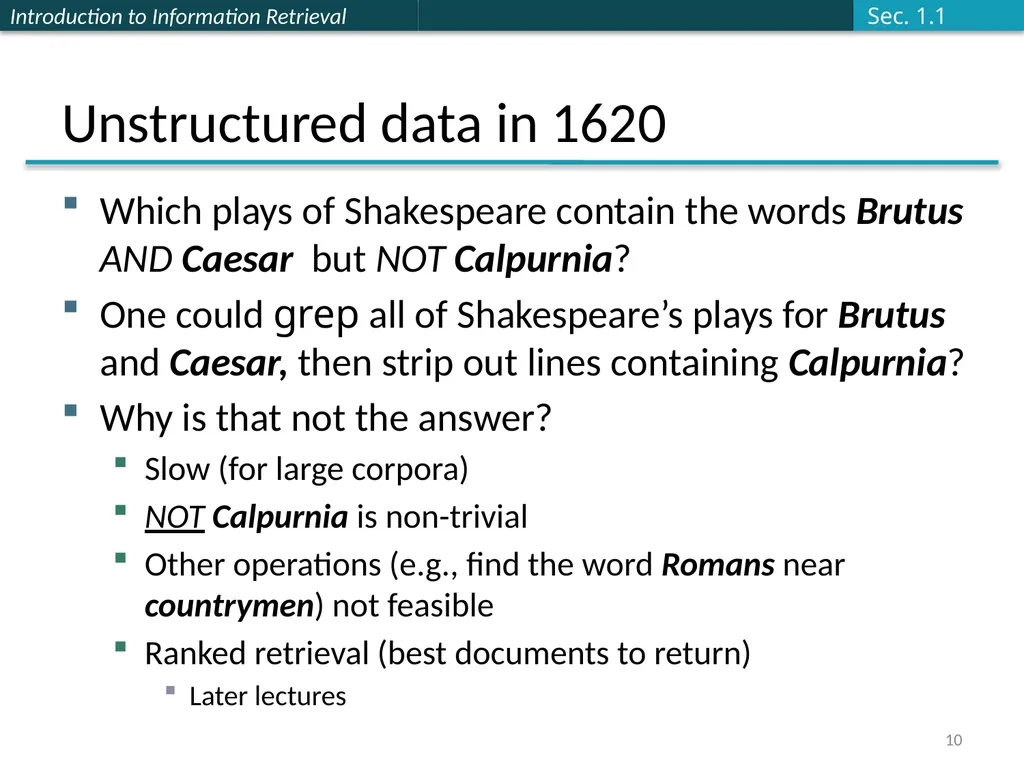
Unstructured data in 1620 Which plays of Shakespeare contain the words Brutus AND Caesar but NOT Calpurnia?
One could grep all of Shakespeare’s plays for Brutus and Caesar, then strip out lines containing Calpurnia?
Why is that not the answer?
Slow (for large corpora)
NOT Calpurnia is non-trivial
Other operations (e.g., find the word Romans near countrymen) not feasible
Ranked retrieval (best documents to return)
Later lectures 10 Sec. 1.1<br>
One could grep all of Shakespeare’s plays for Brutus and Caesar, then strip out lines containing Calpurnia?
Why is that not the answer?
Slow (for large corpora)
NOT Calpurnia is non-trivial
Other operations (e.g., find the word Romans near countrymen) not feasible
Ranked retrieval (best documents to return)
Later lectures 10 Sec. 1.1<br>
11
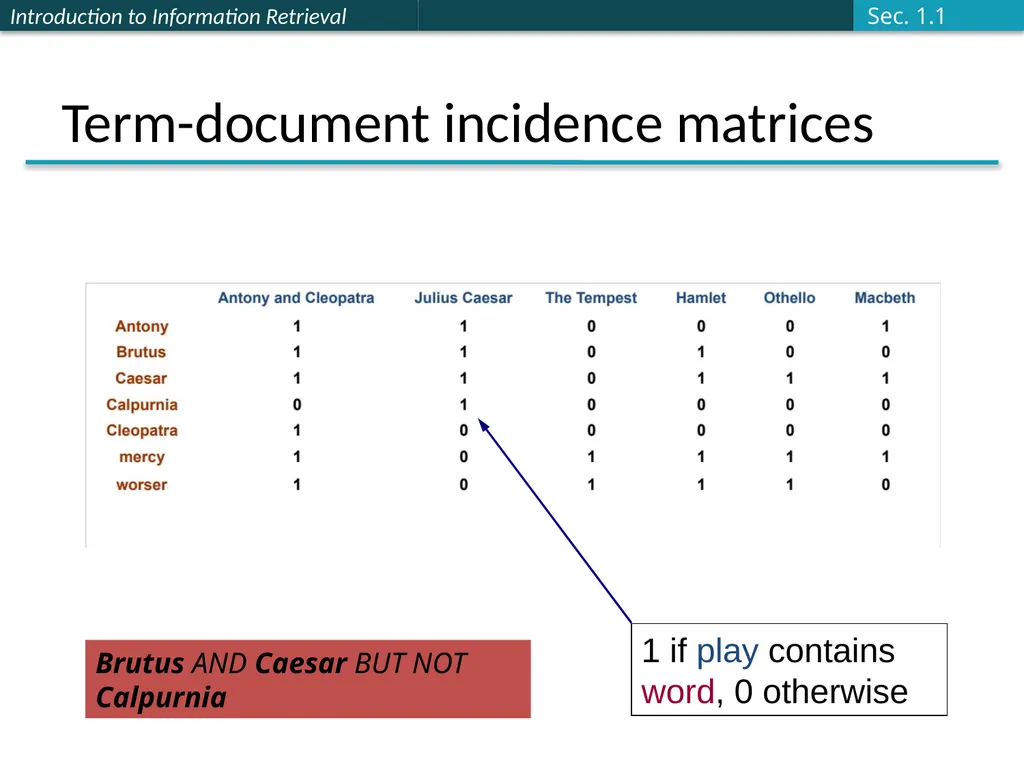
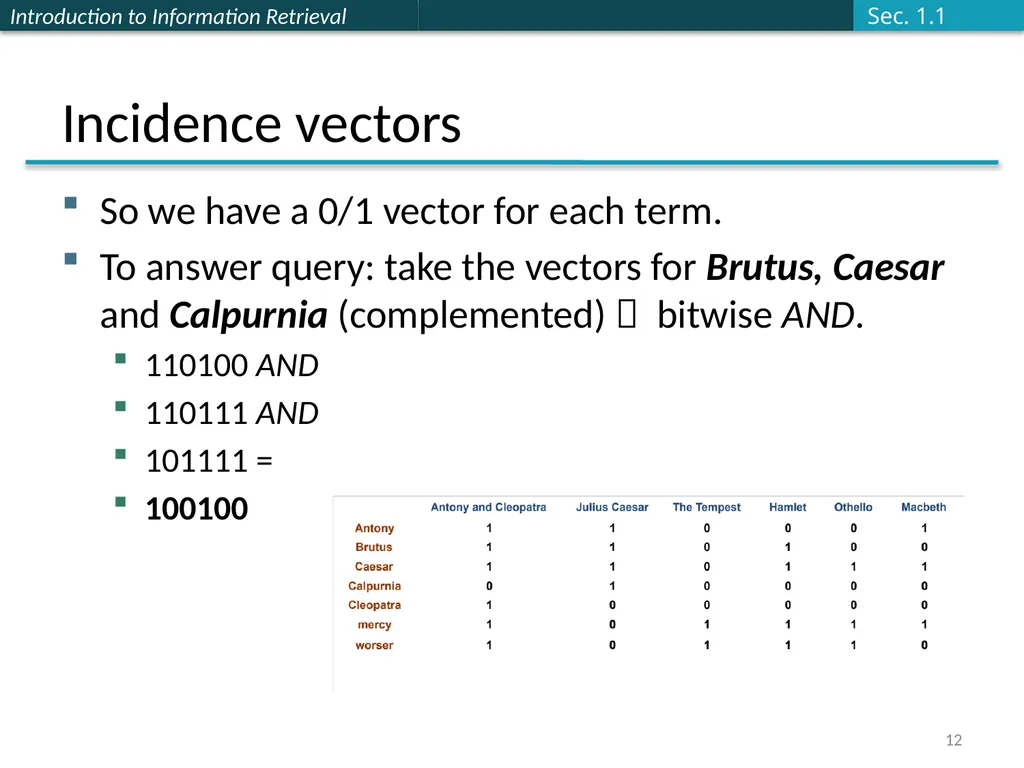
Term-document incidence matrices 1 if play contains word, 0 otherwise Brutus AND Caesar BUT NOT Calpurnia Sec. 1.1<br>
12
Incidence vectors So we have a 0/1 vector for each term.
To answer query: take the vectors for Brutus, Caesar and Calpurnia (complemented) bitwise AND.
110100 AND
110111 AND
101111 =
100100 12 Sec. 1.1<br>
To answer query: take the vectors for Brutus, Caesar and Calpurnia (complemented) bitwise AND.
110100 AND
110111 AND
101111 =
100100 12 Sec. 1.1<br>
13
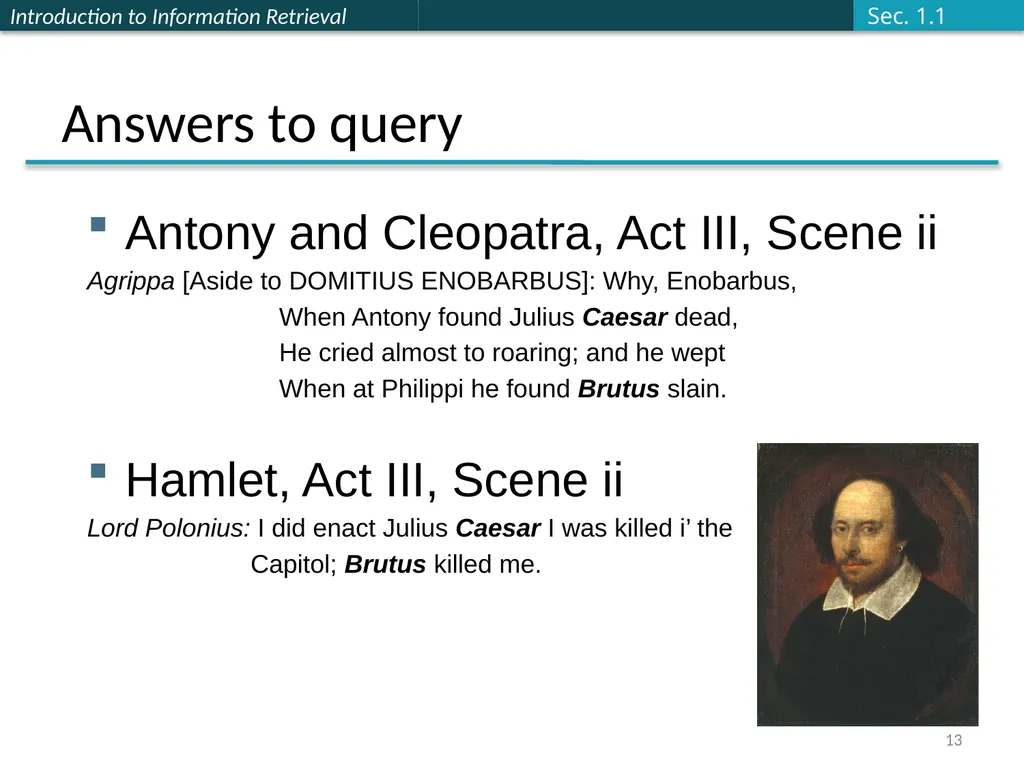
Answers to query Antony and Cleopatra, Act III, Scene ii
Agrippa [Aside to DOMITIUS ENOBARBUS]: Why, Enobarbus,
When Antony found Julius Caesar dead,
He cried almost to roaring; and he wept
When at Philippi he found Brutus slain.
Hamlet, Act III, Scene ii
Lord Polonius: I did enact Julius Caesar I was killed i’ the
Capitol; Brutus killed me. 13 Sec. 1.1<br>
Agrippa [Aside to DOMITIUS ENOBARBUS]: Why, Enobarbus,
When Antony found Julius Caesar dead,
He cried almost to roaring; and he wept
When at Philippi he found Brutus slain.
Hamlet, Act III, Scene ii
Lord Polonius: I did enact Julius Caesar I was killed i’ the
Capitol; Brutus killed me. 13 Sec. 1.1<br>
14
Bigger collections Consider N = 1 million documents, each with about 1000 words.
Avg 6 bytes/word including spaces/punctuation
6GB of data in the documents.
Say there are M = 500K distinct terms among these. 14 Sec. 1.1<br>
Avg 6 bytes/word including spaces/punctuation
6GB of data in the documents.
Say there are M = 500K distinct terms among these. 14 Sec. 1.1<br>
15
Can’t build the matrix 500K x 1M matrix has half-a-trillion 0’s and 1’s.
But it has no more than one billion 1’s.
matrix is extremely sparse.
What’s a better representation?
We only record the 1 positions. 15 Why? Sec. 1.1<br>
But it has no more than one billion 1’s.
matrix is extremely sparse.
What’s a better representation?
We only record the 1 positions. 15 Why? Sec. 1.1<br>
16
Term-document incidence matrices<br>
17
The Inverted Index
The key data structure underlying modern IR<br>
The key data structure underlying modern IR<br>
18
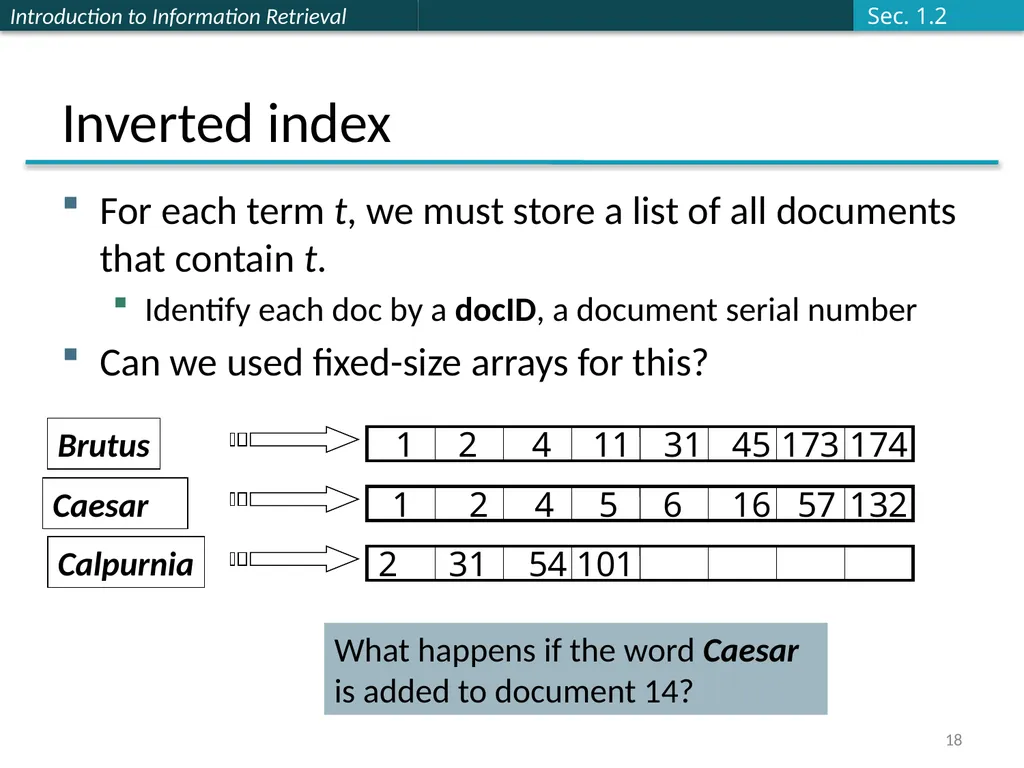
Inverted index For each term t, we must store a list of all documents that contain t.
Identify each doc by a docID, a document serial number
Can we used fixed-size arrays for this? 18 What happens if the word Caesar is added to document 14? Sec. 1.2<br>
Identify each doc by a docID, a document serial number
Can we used fixed-size arrays for this? 18 What happens if the word Caesar is added to document 14? Sec. 1.2<br>
19
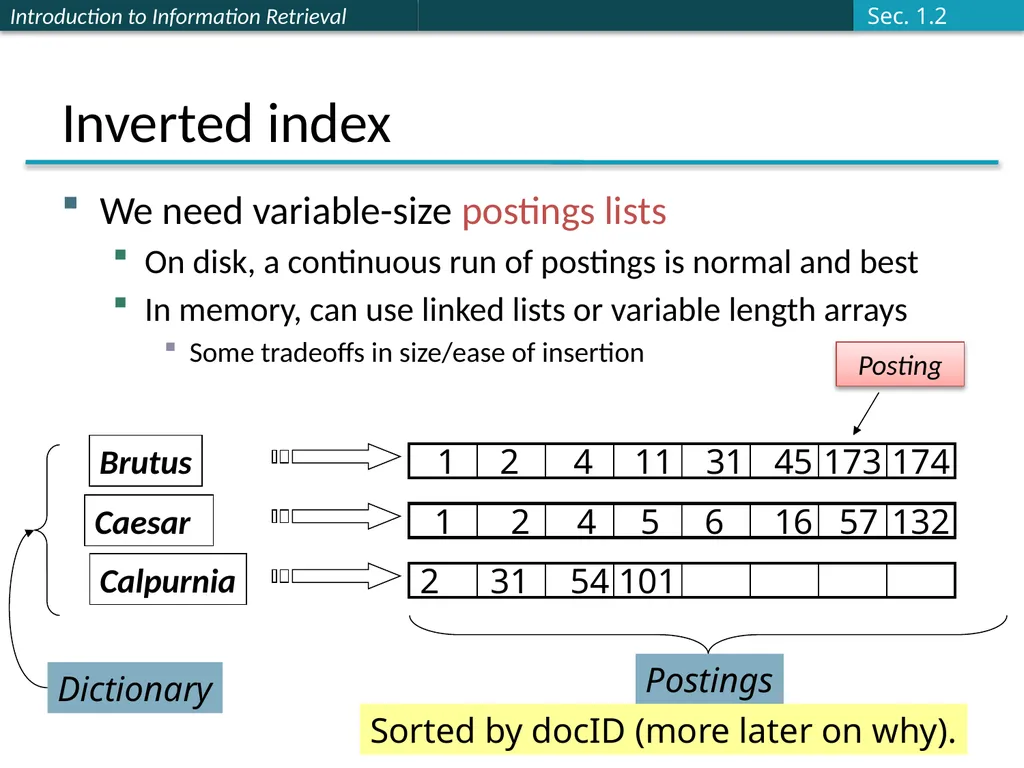
Inverted index We need variable-size postings lists
On disk, a continuous run of postings is normal and best
In memory, can use linked lists or variable length arrays
Some tradeoffs in size/ease of insertion 19 Sorted by docID (more later on why). Sec. 1.2 Brutus Calpurnia Caesar 2 31 174 54 101<br>
On disk, a continuous run of postings is normal and best
In memory, can use linked lists or variable length arrays
Some tradeoffs in size/ease of insertion 19 Sorted by docID (more later on why). Sec. 1.2 Brutus Calpurnia Caesar 2 31 174 54 101<br>
20
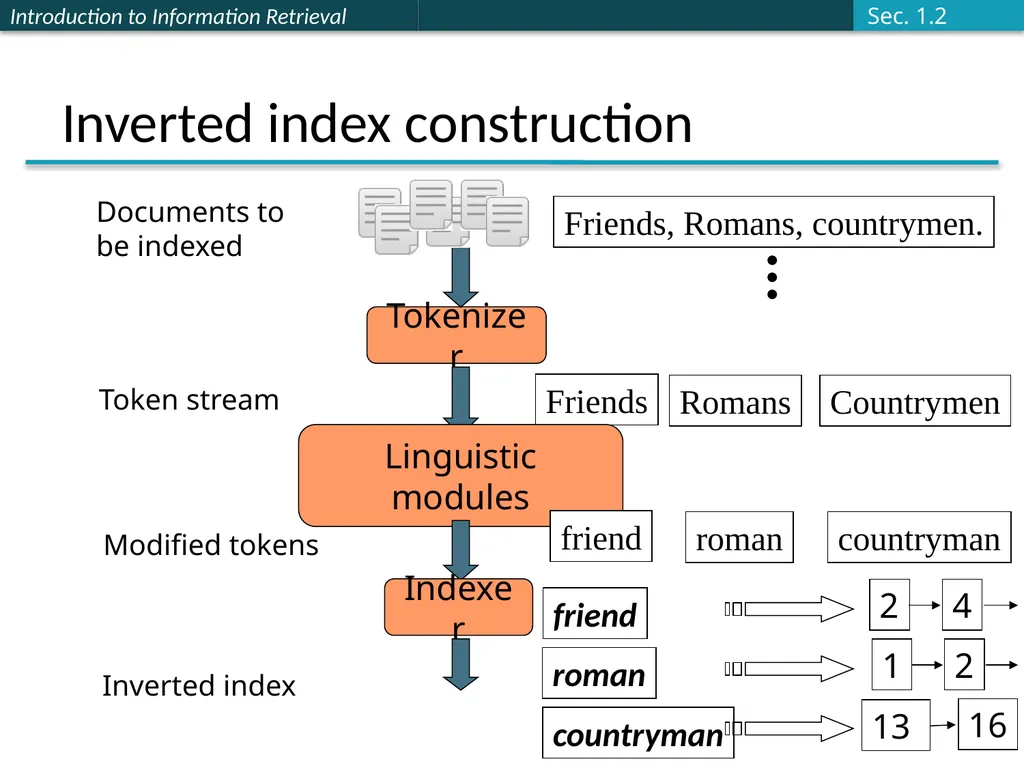
Inverted index construction Documents to
be indexed Friends, Romans, countrymen. Sec. 1.2<br>
be indexed Friends, Romans, countrymen. Sec. 1.2<br>
21
Inverted index construction Documents to
be indexed Friends, Romans, countrymen. Sec. 1.2<br>
be indexed Friends, Romans, countrymen. Sec. 1.2<br>
22
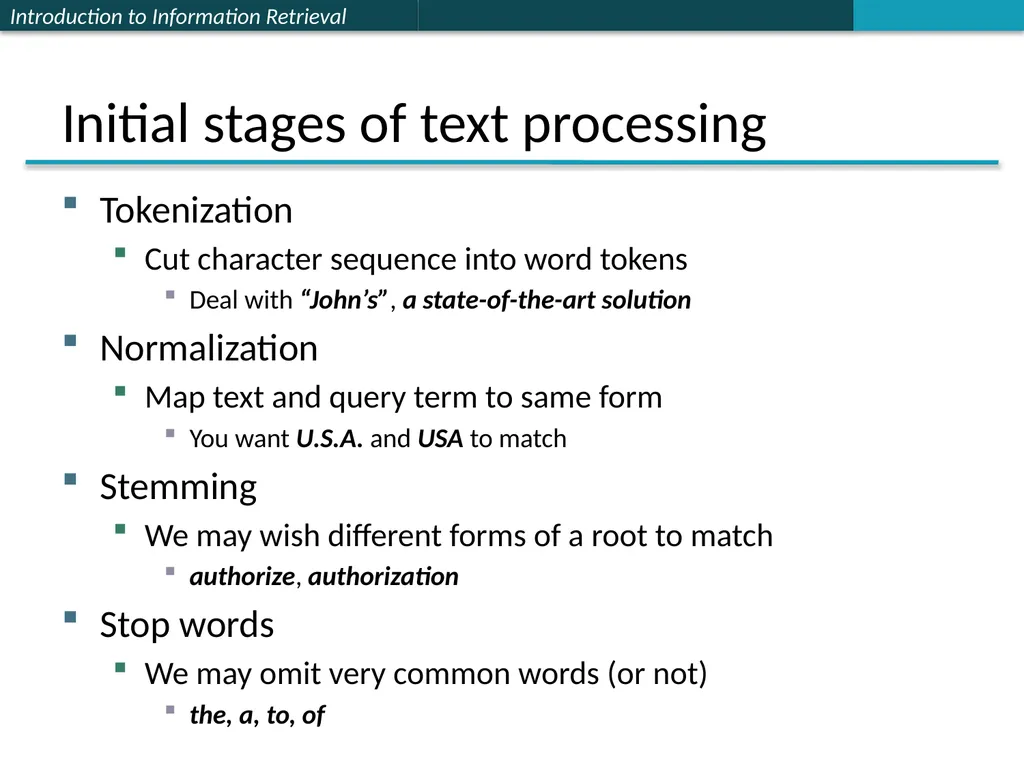
Initial stages of text processing Tokenization
Cut character sequence into word tokens
Deal with “John’s”, a state-of-the-art solution
Normalization
Map text and query term to same form
You want U.S.A. and USA to match
Stemming
We may wish different forms of a root to match
authorize, authorization
Stop words
We may omit very common words (or not)
the, a, to, of<br>
Cut character sequence into word tokens
Deal with “John’s”, a state-of-the-art solution
Normalization
Map text and query term to same form
You want U.S.A. and USA to match
Stemming
We may wish different forms of a root to match
authorize, authorization
Stop words
We may omit very common words (or not)
the, a, to, of<br>
23
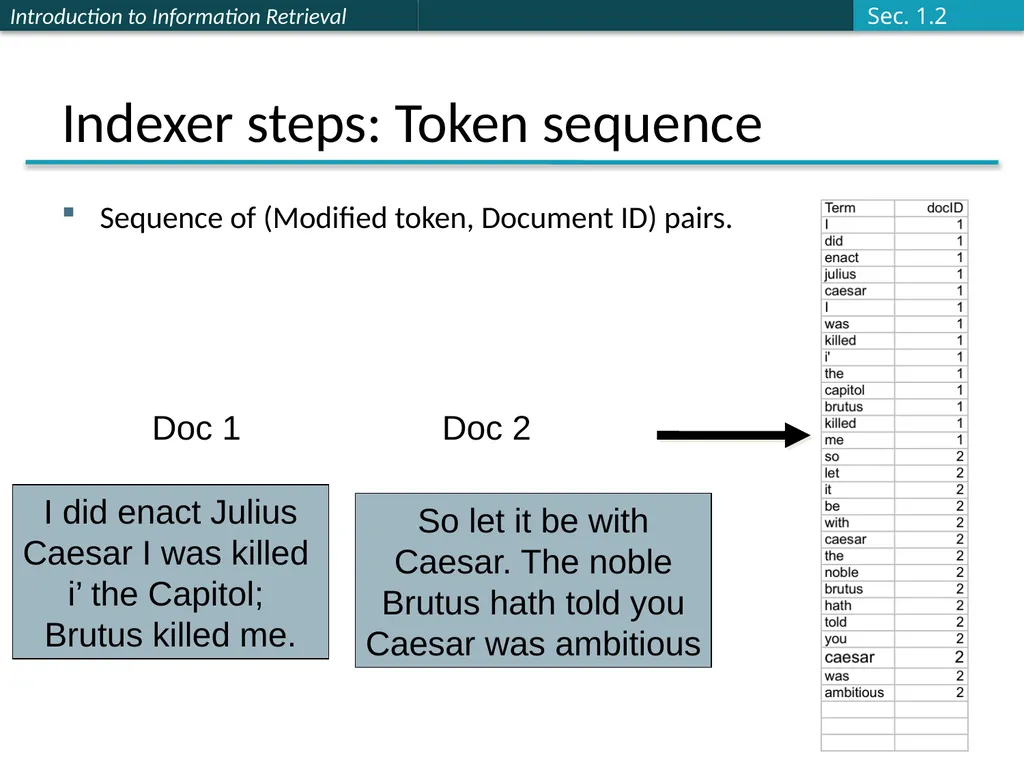
Indexer steps: Token sequence Sequence of (Modified token, Document ID) pairs. I did enact Julius
Caesar I was killed
i’ the Capitol;
Brutus killed me. Doc 1 So let it be with
Caesar. The noble
Brutus hath told you
Caesar was ambitious Doc 2 Sec. 1.2<br>
Caesar I was killed
i’ the Capitol;
Brutus killed me. Doc 1 So let it be with
Caesar. The noble
Brutus hath told you
Caesar was ambitious Doc 2 Sec. 1.2<br>
24
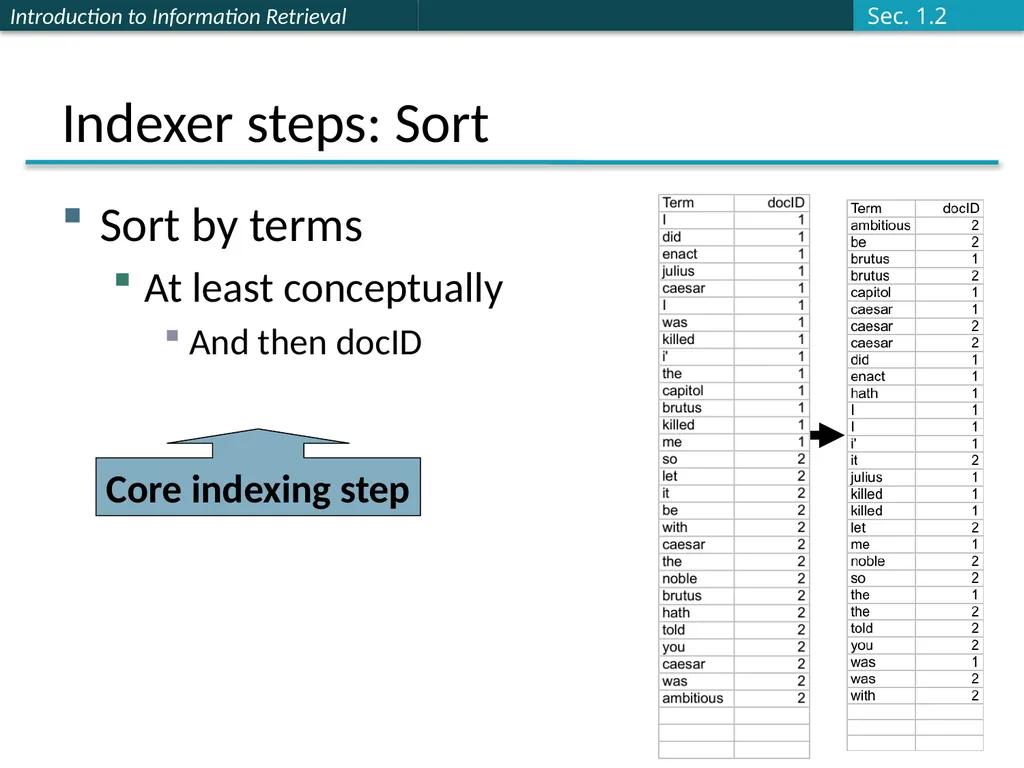
Indexer steps: Sort Sort by terms
At least conceptually
And then docID Core indexing step Sec. 1.2<br>
At least conceptually
And then docID Core indexing step Sec. 1.2<br>
25
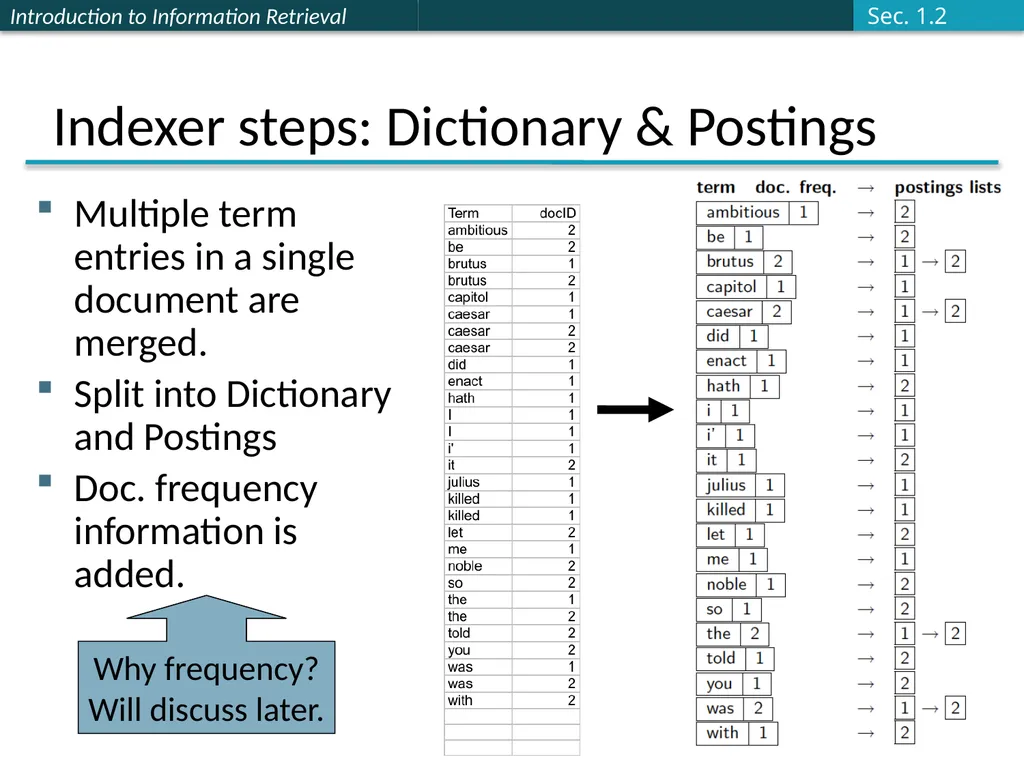
Indexer steps: Dictionary & Postings Multiple term entries in a single document are merged.
Split into Dictionary and Postings
Doc. frequency information is added. Why frequency?
Will discuss later. Sec. 1.2<br>
Split into Dictionary and Postings
Doc. frequency information is added. Why frequency?
Will discuss later. Sec. 1.2<br>
26
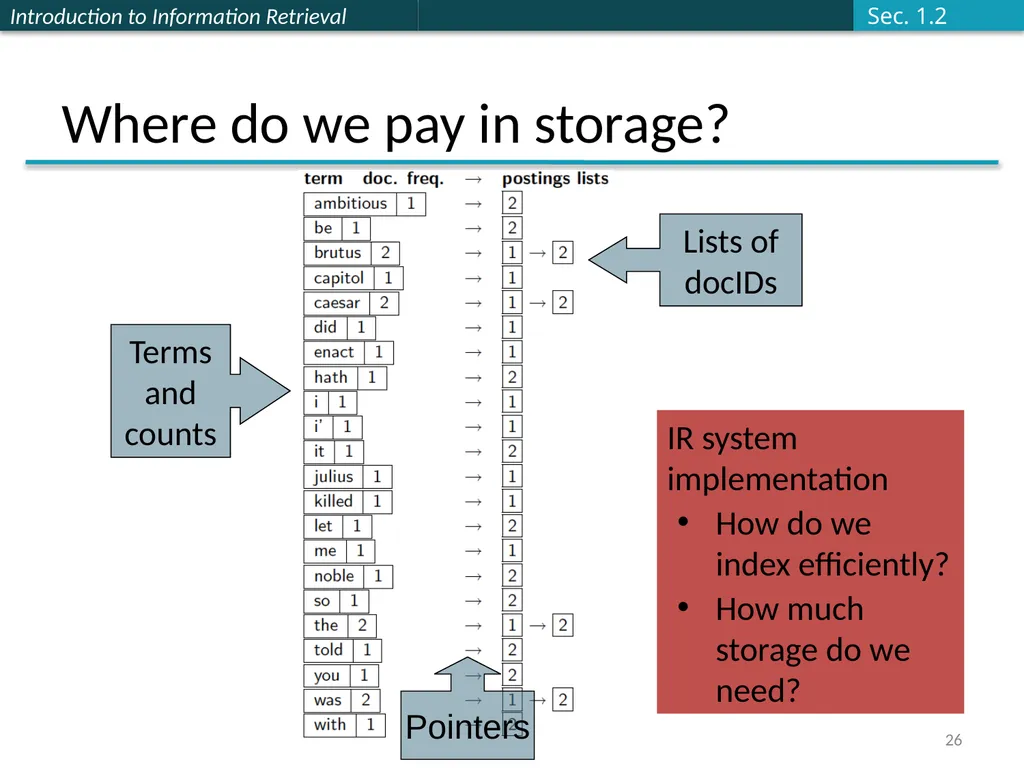
Where do we pay in storage? 26 Pointers Terms and counts IR system implementation
How do we index efficiently?
How much storage do we need? Sec. 1.2 Lists of docIDs<br>
How do we index efficiently?
How much storage do we need? Sec. 1.2 Lists of docIDs<br>
27
The Inverted Index
The key data structure underlying modern IR<br>
The key data structure underlying modern IR<br>
28
Query processing with an inverted index<br>
29
The index we just built How do we process a query?
Later – what kinds of queries can we process? 29 Our focus Sec. 1.3<br>
Later – what kinds of queries can we process? 29 Our focus Sec. 1.3<br>
30
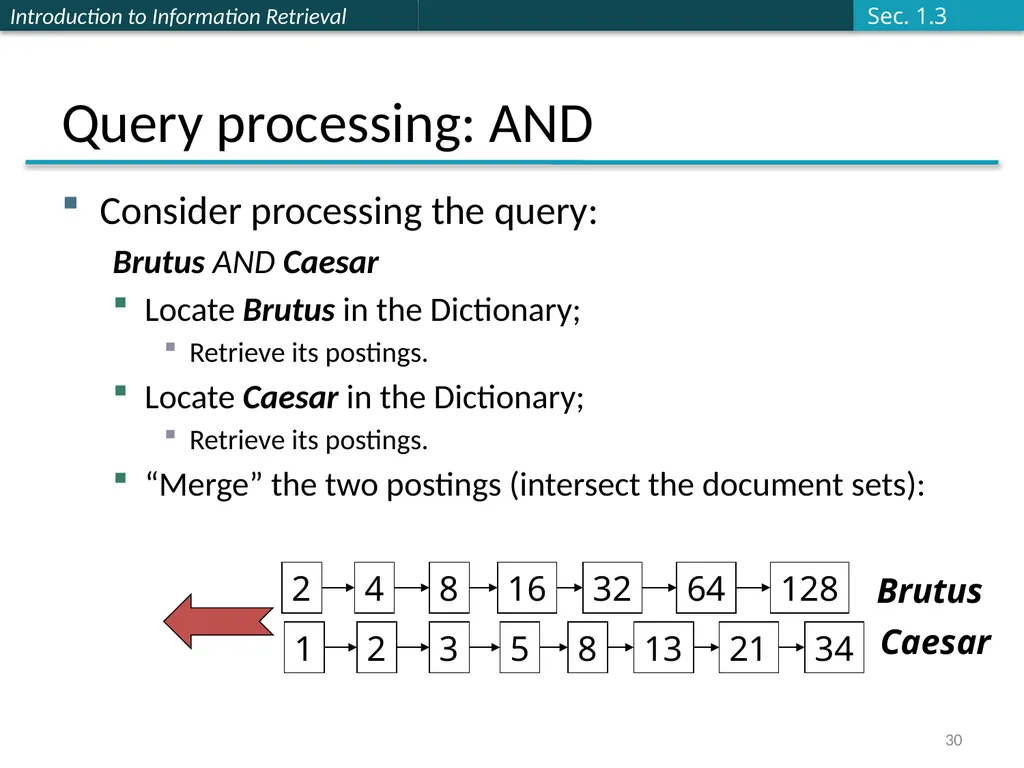
Query processing: AND Consider processing the query:
Brutus AND Caesar
Locate Brutus in the Dictionary;
Retrieve its postings.
Locate Caesar in the Dictionary;
Retrieve its postings.
“Merge” the two postings (intersect the document sets): 30 128 34 Brutus Caesar Sec. 1.3<br>
Brutus AND Caesar
Locate Brutus in the Dictionary;
Retrieve its postings.
Locate Caesar in the Dictionary;
Retrieve its postings.
“Merge” the two postings (intersect the document sets): 30 128 34 Brutus Caesar Sec. 1.3<br>
31
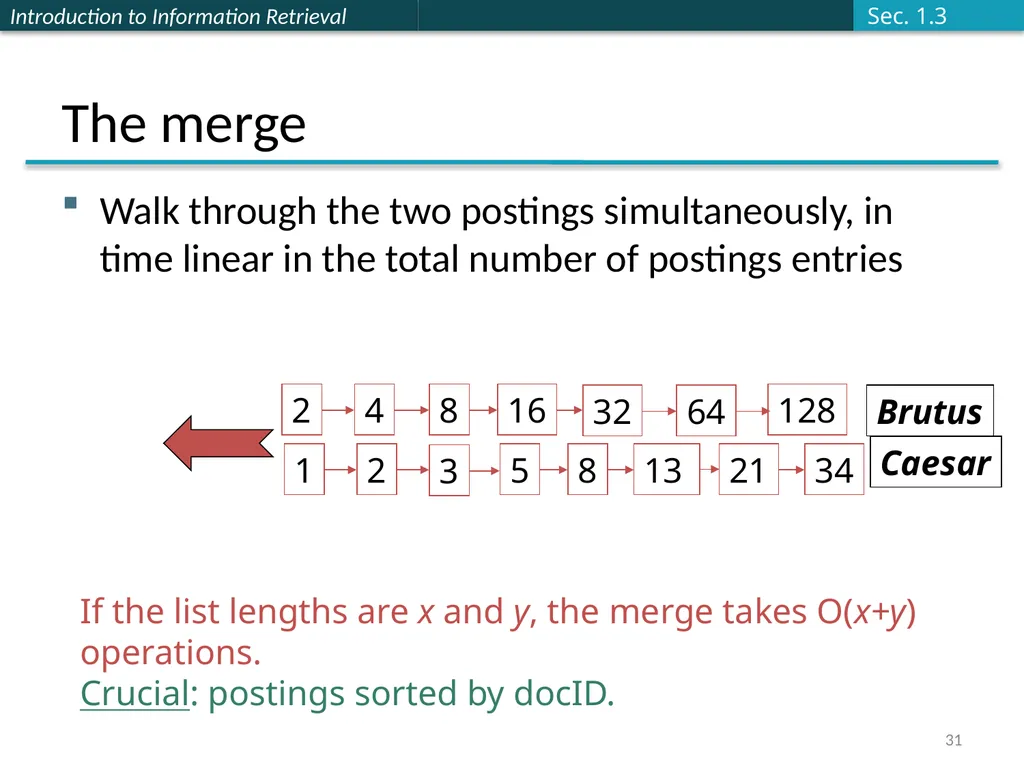
The merge Walk through the two postings simultaneously, in time linear in the total number of postings entries 31 If the list lengths are x and y, the merge takes O(x+y)
operations.
Crucial: postings sorted by docID. Sec. 1.3<br>
operations.
Crucial: postings sorted by docID. Sec. 1.3<br>
32
The merge Walk through the two postings simultaneously, in time linear in the total number of postings entries 32 128 34 2 If the list lengths are x and y, the merge takes O(x+y)
operations.
Crucial: postings sorted by docID. Sec. 1.3<br>
operations.
Crucial: postings sorted by docID. Sec. 1.3<br>
33
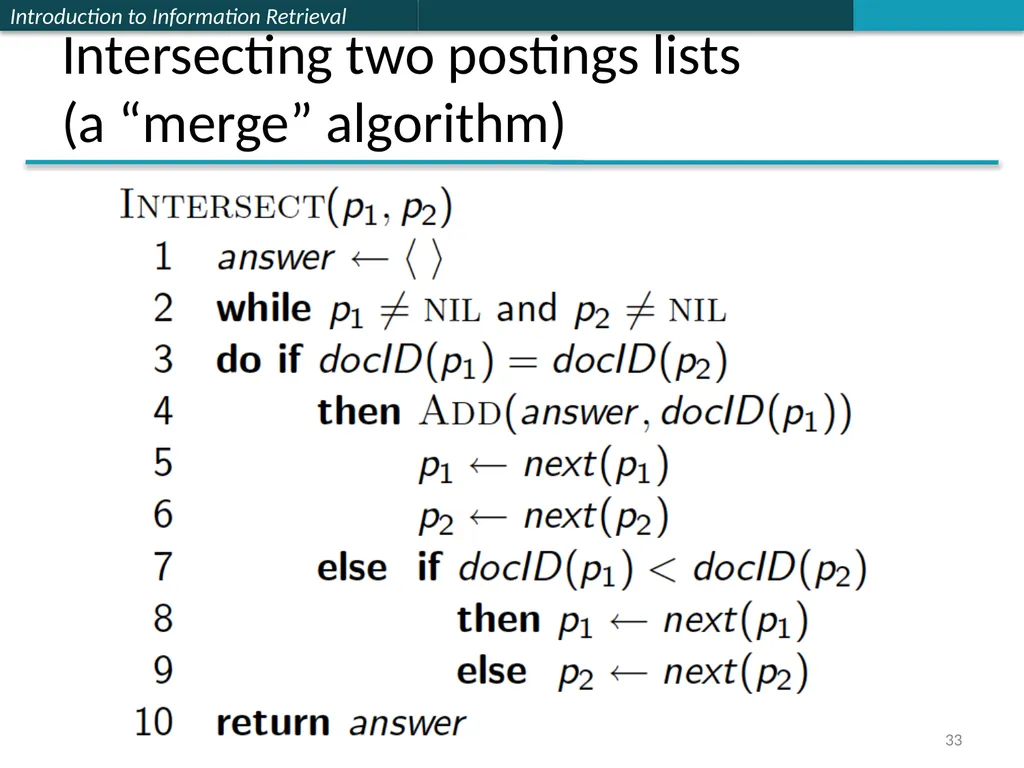
Intersecting two postings lists
(a “merge” algorithm) 33<br>
34
Query processing with an inverted index<br>
35
The Boolean Retrieval Model
& Extended Boolean Models<br>
& Extended Boolean Models<br>
36
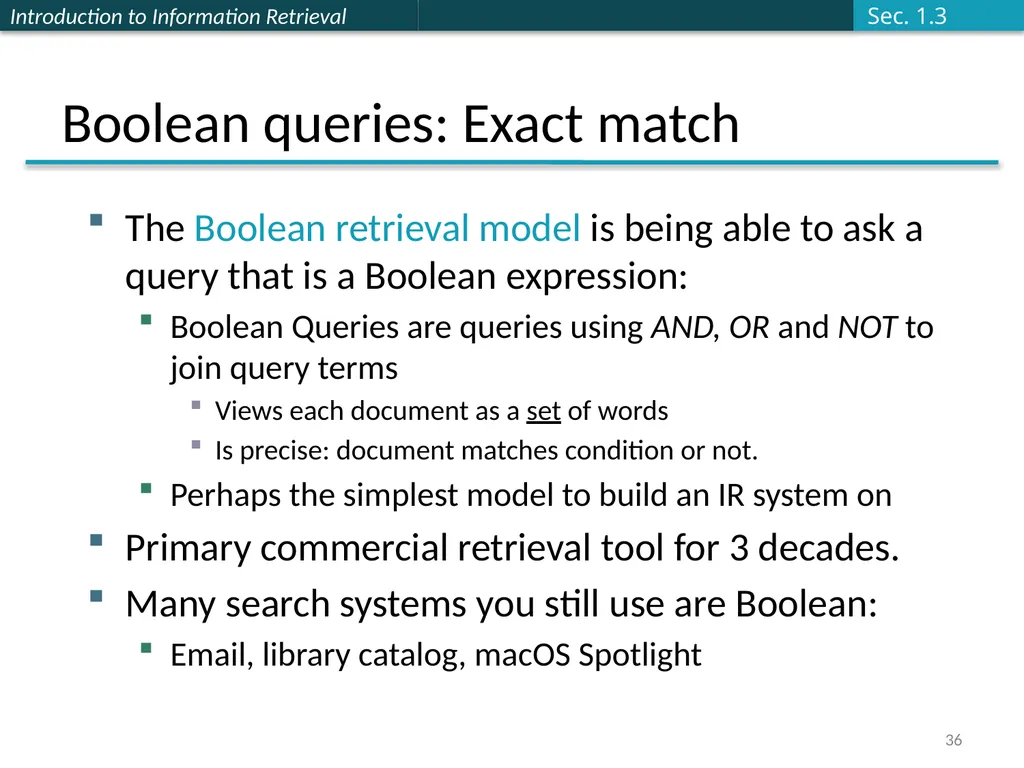
Boolean queries: Exact match The Boolean retrieval model is being able to ask a query that is a Boolean expression:
Boolean Queries are queries using AND, OR and NOT to join query terms
Views each document as a set of words
Is precise: document matches condition or not.
Perhaps the simplest model to build an IR system on
Primary commercial retrieval tool for 3 decades.
Many search systems you still use are Boolean:
Email, library catalog, macOS Spotlight 36 Sec. 1.3<br>
Boolean Queries are queries using AND, OR and NOT to join query terms
Views each document as a set of words
Is precise: document matches condition or not.
Perhaps the simplest model to build an IR system on
Primary commercial retrieval tool for 3 decades.
Many search systems you still use are Boolean:
Email, library catalog, macOS Spotlight 36 Sec. 1.3<br>
37
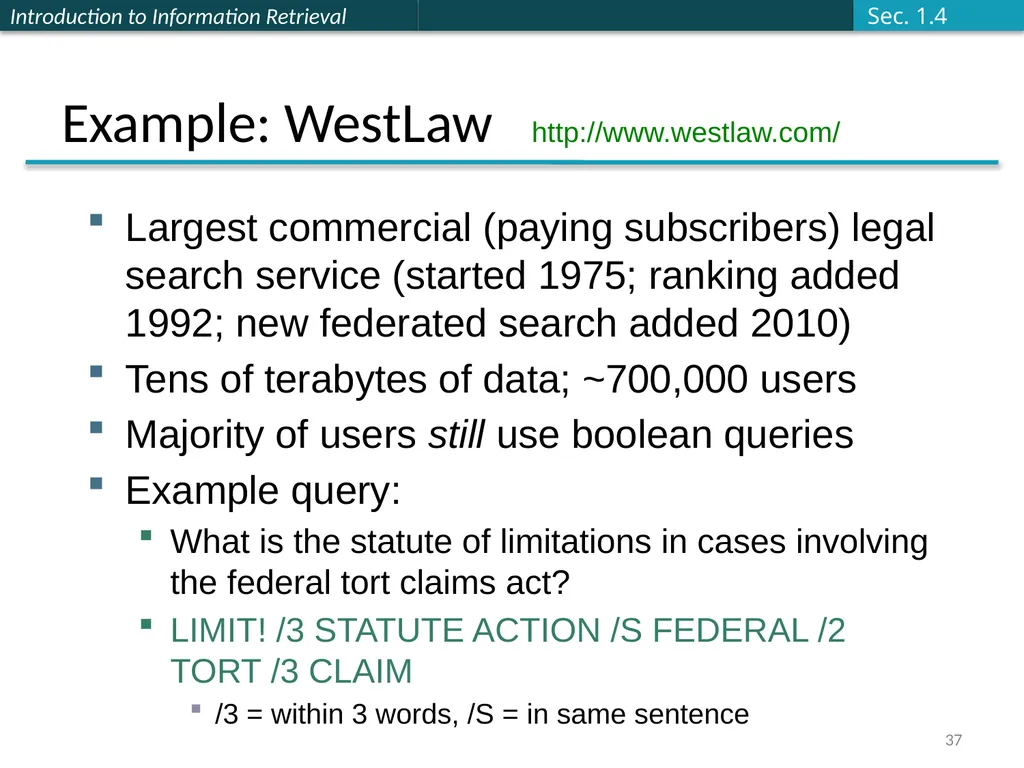
Example: WestLaw http://www.westlaw.com/ Largest commercial (paying subscribers) legal search service (started 1975; ranking added 1992; new federated search added 2010)
Tens of terabytes of data; ~700,000 users
Majority of users still use boolean queries
Example query:
What is the statute of limitations in cases involving the federal tort claims act?
LIMIT! /3 STATUTE ACTION /S FEDERAL /2 TORT /3 CLAIM
/3 = within 3 words, /S = in same sentence 37 Sec. 1.4<br>
Tens of terabytes of data; ~700,000 users
Majority of users still use boolean queries
Example query:
What is the statute of limitations in cases involving the federal tort claims act?
LIMIT! /3 STATUTE ACTION /S FEDERAL /2 TORT /3 CLAIM
/3 = within 3 words, /S = in same sentence 37 Sec. 1.4<br>
38
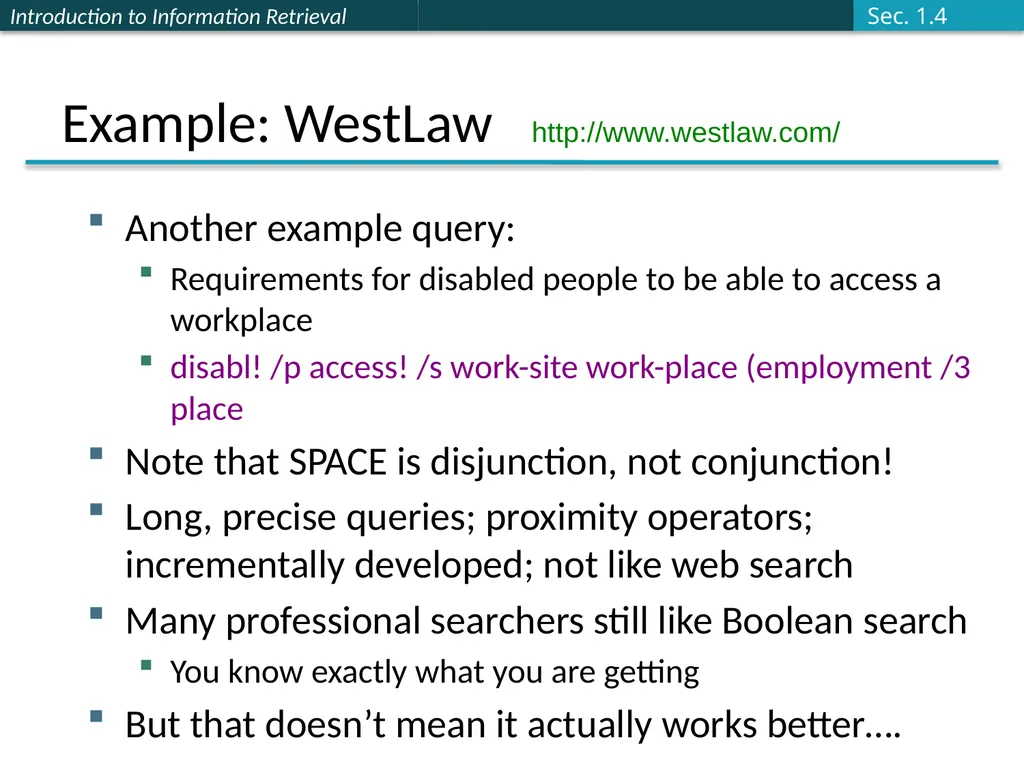
Example: WestLaw http://www.westlaw.com/ Another example query:
Requirements for disabled people to be able to access a workplace
disabl! /p access! /s work-site work-place (employment /3 place
Note that SPACE is disjunction, not conjunction!
Long, precise queries; proximity operators; incrementally developed; not like web search
Many professional searchers still like Boolean search
You know exactly what you are getting
But that doesn’t mean it actually works better…. Sec. 1.4<br>
Requirements for disabled people to be able to access a workplace
disabl! /p access! /s work-site work-place (employment /3 place
Note that SPACE is disjunction, not conjunction!
Long, precise queries; proximity operators; incrementally developed; not like web search
Many professional searchers still like Boolean search
You know exactly what you are getting
But that doesn’t mean it actually works better…. Sec. 1.4<br>
39
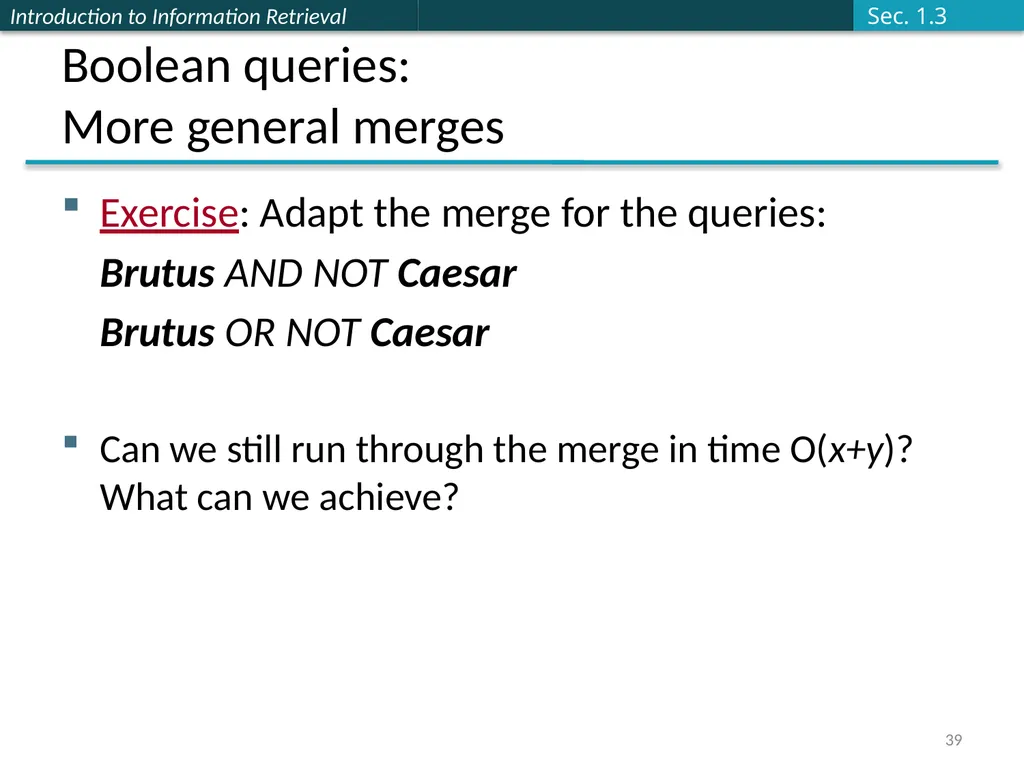
Boolean queries:
More general merges Exercise: Adapt the merge for the queries:
Brutus AND NOT Caesar
Brutus OR NOT Caesar
Can we still run through the merge in time O(x+y)? What can we achieve? 39 Sec. 1.3<br>
Brutus AND NOT Caesar
Brutus OR NOT Caesar
Can we still run through the merge in time O(x+y)? What can we achieve? 39 Sec. 1.3<br>
40
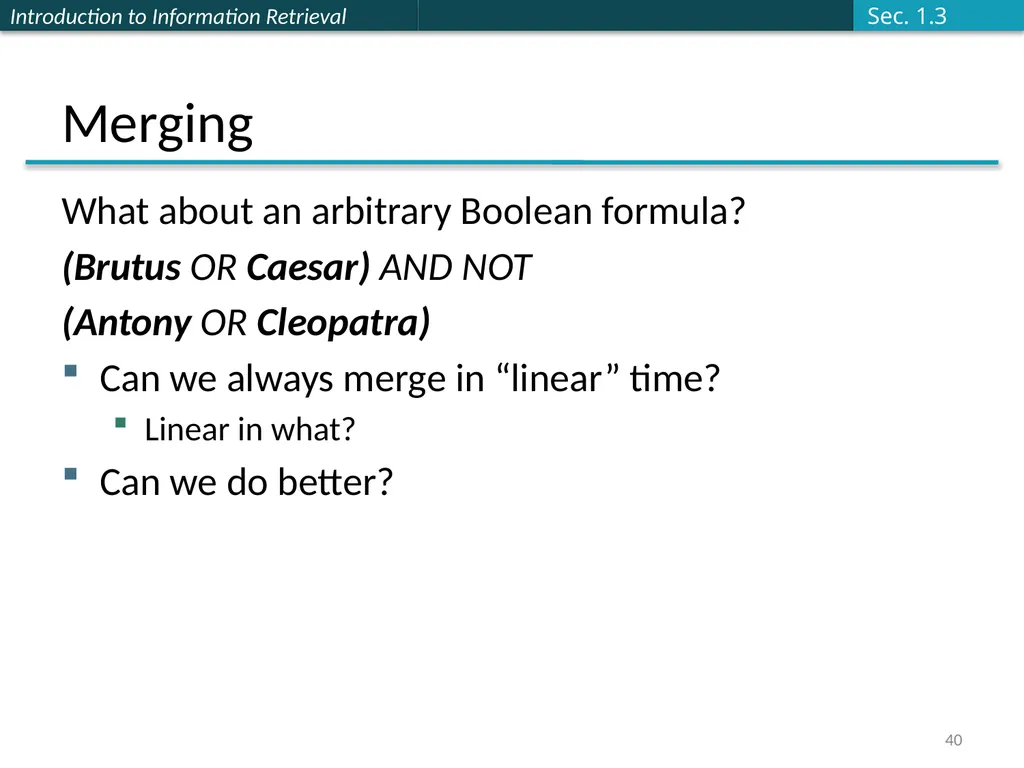
Merging What about an arbitrary Boolean formula?
(Brutus OR Caesar) AND NOT
(Antony OR Cleopatra)
Can we always merge in “linear” time?
Linear in what?
Can we do better? 40 Sec. 1.3<br>
(Brutus OR Caesar) AND NOT
(Antony OR Cleopatra)
Can we always merge in “linear” time?
Linear in what?
Can we do better? 40 Sec. 1.3<br>
41
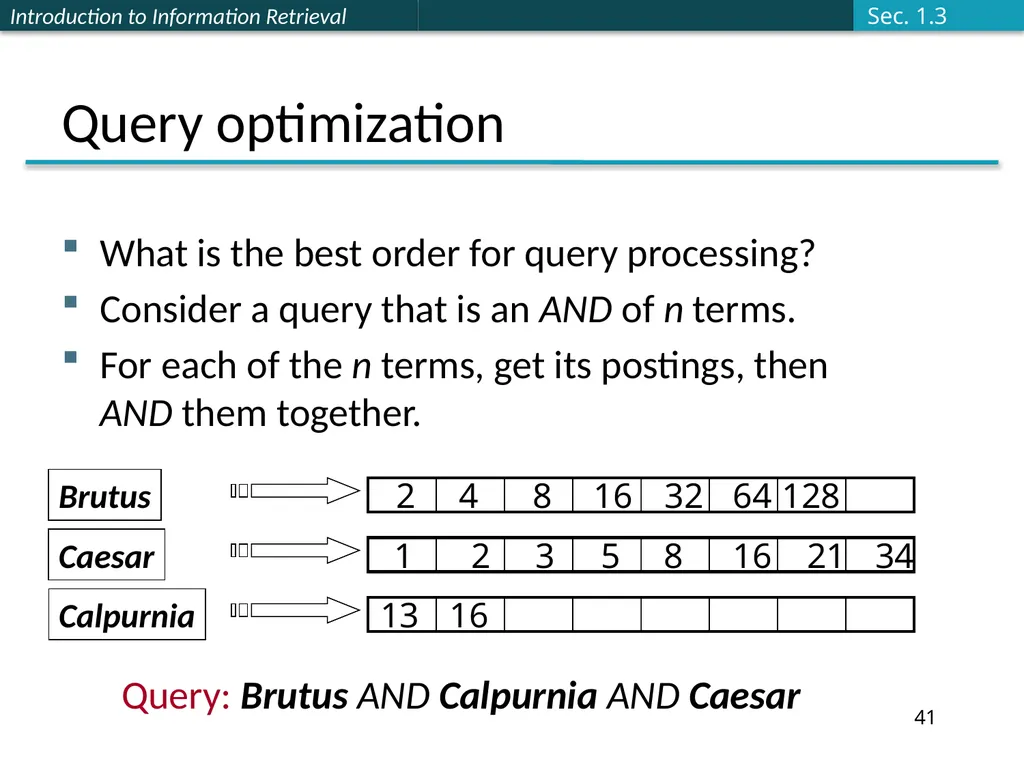
Query optimization What is the best order for query processing?
Consider a query that is an AND of n terms.
For each of the n terms, get its postings, then AND them together. Brutus Caesar Calpurnia 13 16 Query: Brutus AND Calpurnia AND Caesar 41 Sec. 1.3<br>
Consider a query that is an AND of n terms.
For each of the n terms, get its postings, then AND them together. Brutus Caesar Calpurnia 13 16 Query: Brutus AND Calpurnia AND Caesar 41 Sec. 1.3<br>
42
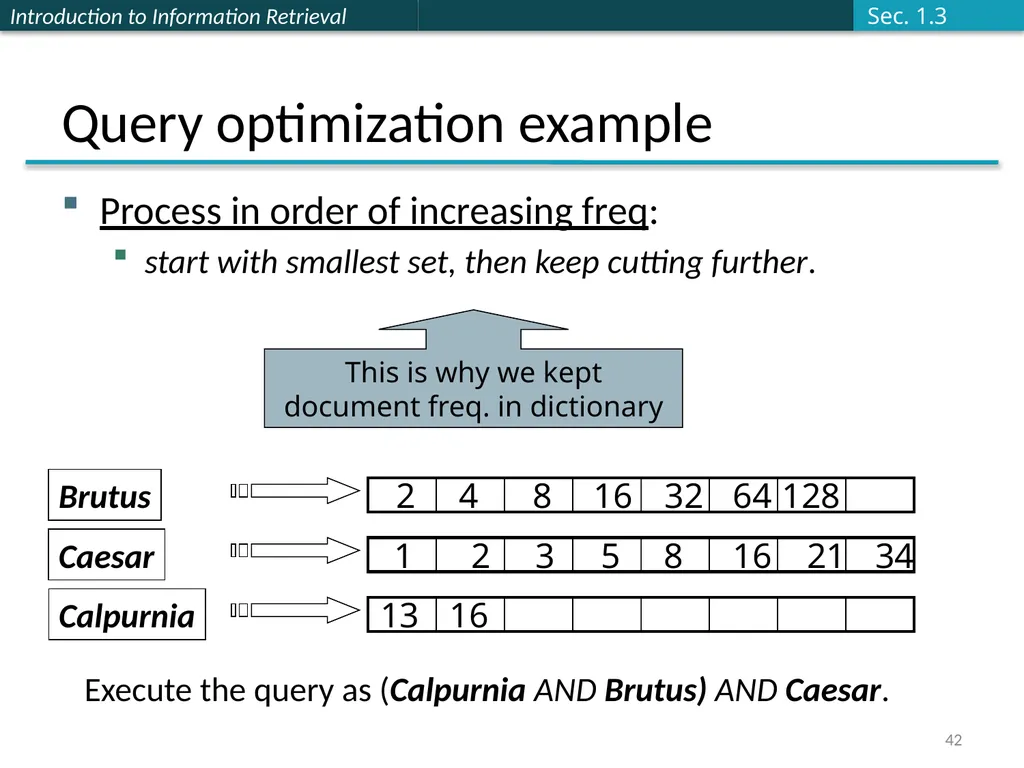
Query optimization example Process in order of increasing freq:
start with smallest set, then keep cutting further. 42 This is why we kept
document freq. in dictionary Execute the query as (Calpurnia AND Brutus) AND Caesar. Sec. 1.3 Brutus Caesar Calpurnia 13 16<br>
start with smallest set, then keep cutting further. 42 This is why we kept
document freq. in dictionary Execute the query as (Calpurnia AND Brutus) AND Caesar. Sec. 1.3 Brutus Caesar Calpurnia 13 16<br>
43
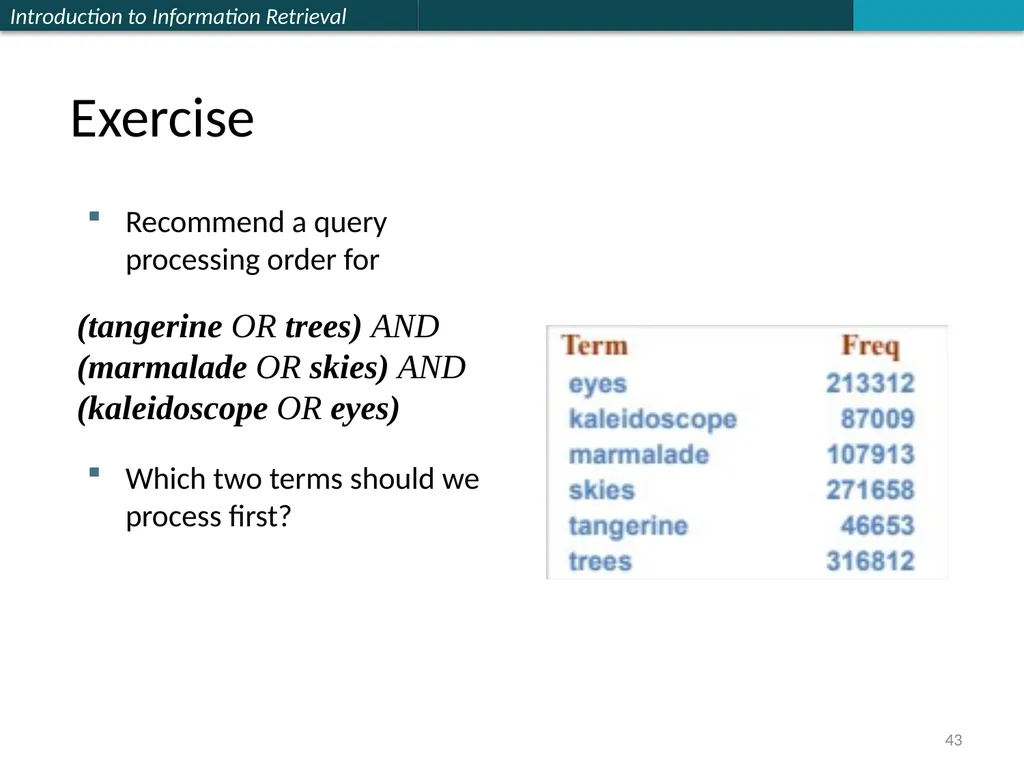
Exercise Recommend a query processing order for
Which two terms should we process first? 43 (tangerine OR trees) AND
(marmalade OR skies) AND
(kaleidoscope OR eyes)<br>
Which two terms should we process first? 43 (tangerine OR trees) AND
(marmalade OR skies) AND
(kaleidoscope OR eyes)<br>
44
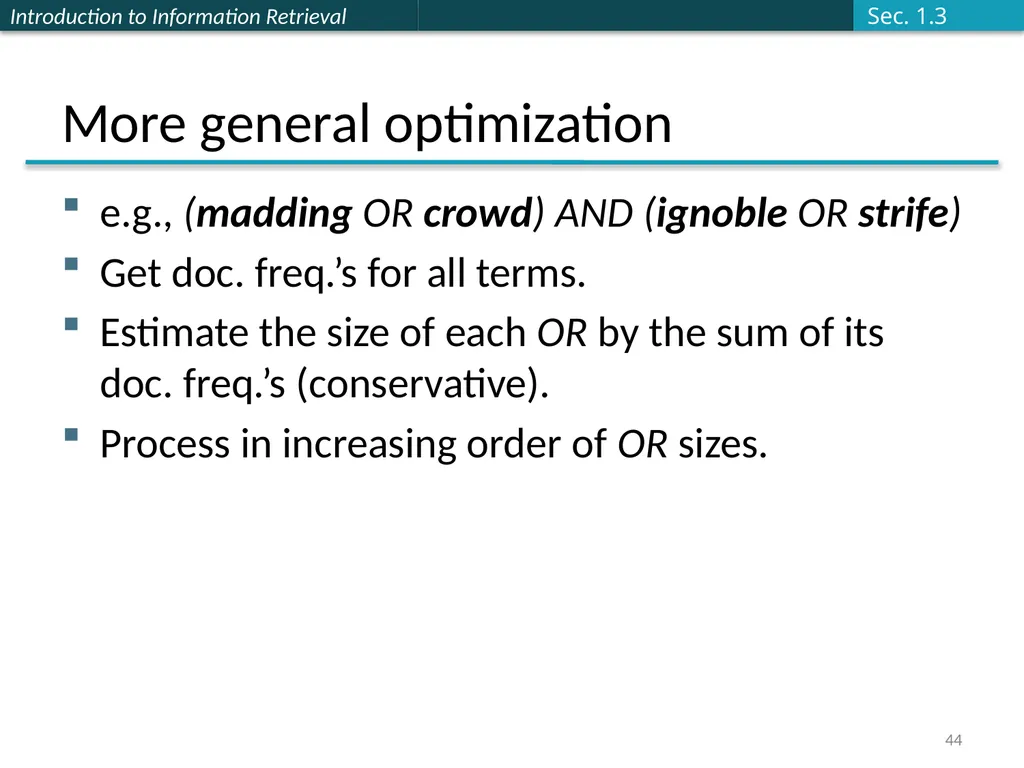
More general optimization e.g., (madding OR crowd) AND (ignoble OR strife)
Get doc. freq.’s for all terms.
Estimate the size of each OR by the sum of its doc. freq.’s (conservative).
Process in increasing order of OR sizes. 44 Sec. 1.3<br>
Get doc. freq.’s for all terms.
Estimate the size of each OR by the sum of its doc. freq.’s (conservative).
Process in increasing order of OR sizes. 44 Sec. 1.3<br>
45
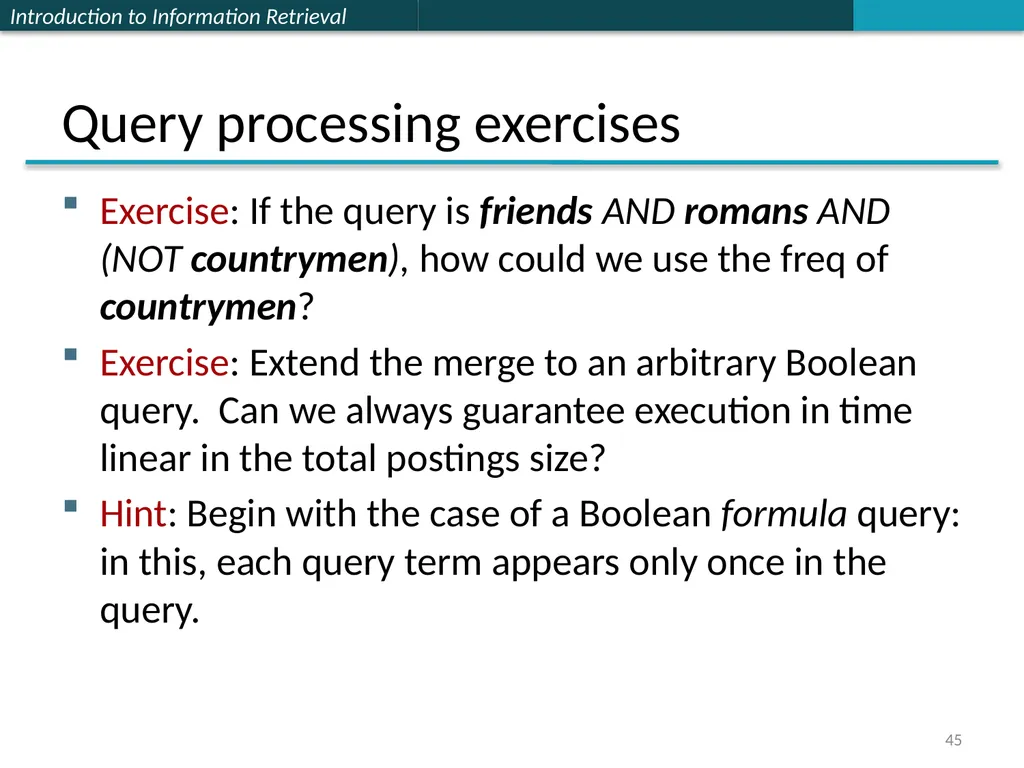
Query processing exercises Exercise: If the query is friends AND romans AND (NOT countrymen), how could we use the freq of countrymen?
Exercise: Extend the merge to an arbitrary Boolean query. Can we always guarantee execution in time linear in the total postings size?
Hint: Begin with the case of a Boolean formula query: in this, each query term appears only once in the query. 45<br>
Exercise: Extend the merge to an arbitrary Boolean query. Can we always guarantee execution in time linear in the total postings size?
Hint: Begin with the case of a Boolean formula query: in this, each query term appears only once in the query. 45<br>
46
Exercise Try the search feature at http://www.rhymezone.com/shakespeare/
Write down five search features you think it could do better 46<br>
Write down five search features you think it could do better 46<br>
47
The Boolean Retrieval Model
& Extended Boolean Models<br>
& Extended Boolean Models<br>
48
Phrase queries and positional indexes<br>
49
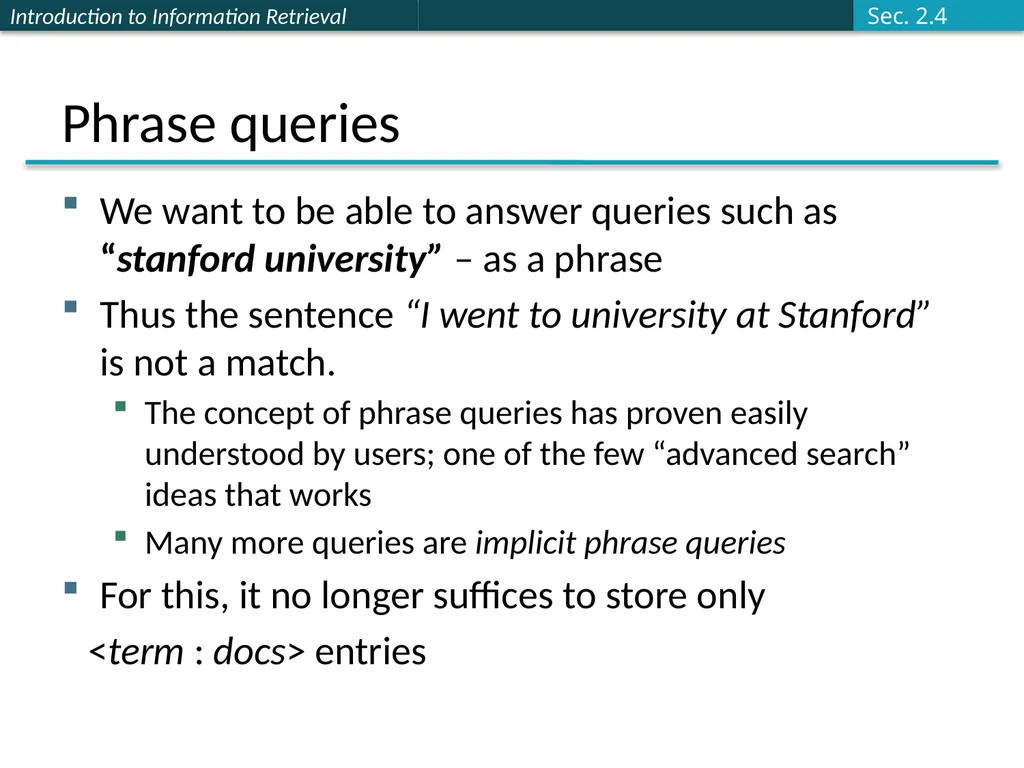
Phrase queries We want to be able to answer queries such as “stanford university” – as a phrase
Thus the sentence “I went to university at Stanford” is not a match.
The concept of phrase queries has proven easily understood by users; one of the few “advanced search” ideas that works
Many more queries are implicit phrase queries
For this, it no longer suffices to store only
<term : docs> entries Sec. 2.4<br>
Thus the sentence “I went to university at Stanford” is not a match.
The concept of phrase queries has proven easily understood by users; one of the few “advanced search” ideas that works
Many more queries are implicit phrase queries
For this, it no longer suffices to store only
<term : docs> entries Sec. 2.4<br>
50
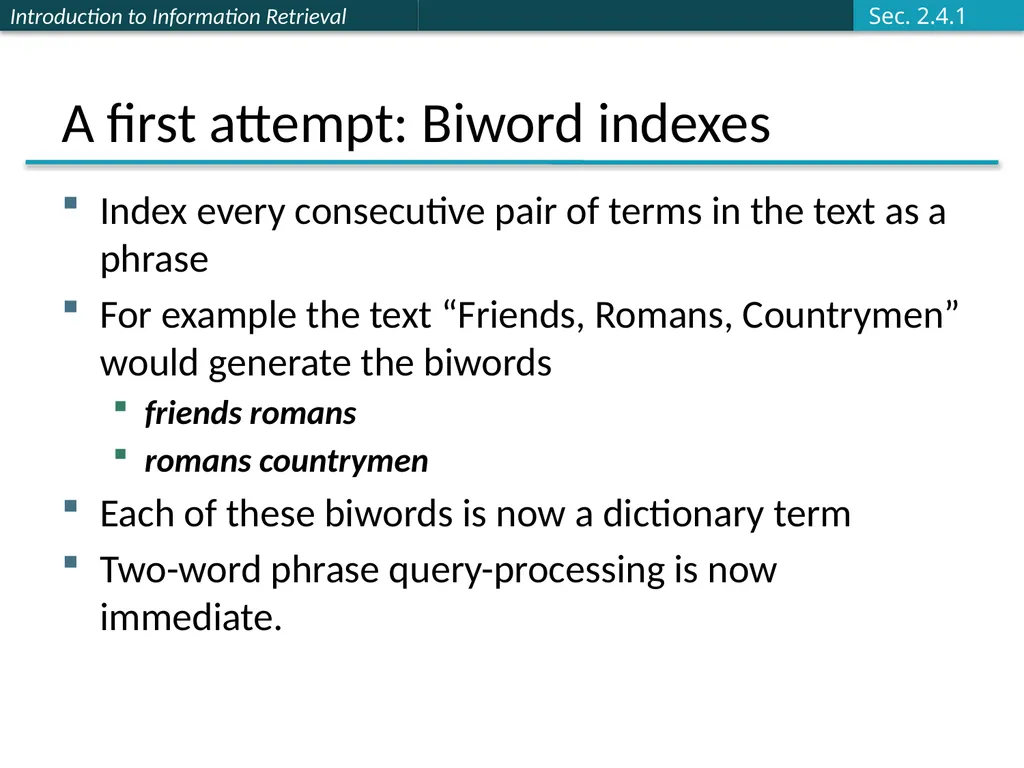
A first attempt: Biword indexes Index every consecutive pair of terms in the text as a phrase
For example the text “Friends, Romans, Countrymen” would generate the biwords
friends romans
romans countrymen
Each of these biwords is now a dictionary term
Two-word phrase query-processing is now immediate. Sec. 2.4.1<br>
For example the text “Friends, Romans, Countrymen” would generate the biwords
friends romans
romans countrymen
Each of these biwords is now a dictionary term
Two-word phrase query-processing is now immediate. Sec. 2.4.1<br>
51
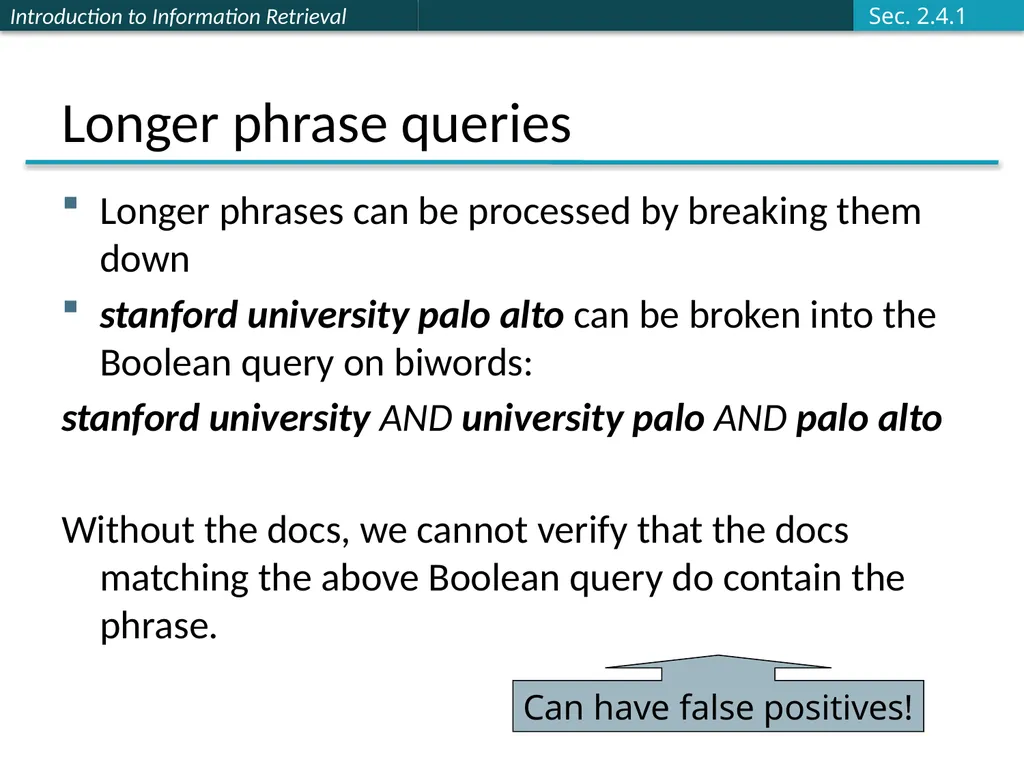
Longer phrase queries Longer phrases can be processed by breaking them down
stanford university palo alto can be broken into the Boolean query on biwords:
stanford university AND university palo AND palo alto
Without the docs, we cannot verify that the docs matching the above Boolean query do contain the phrase. Can have false positives! Sec. 2.4.1<br>
stanford university palo alto can be broken into the Boolean query on biwords:
stanford university AND university palo AND palo alto
Without the docs, we cannot verify that the docs matching the above Boolean query do contain the phrase. Can have false positives! Sec. 2.4.1<br>
52
Extended biwords Parse the indexed text and perform part-of-speech-tagging (POST).
Bucket the terms into (say) Nouns (N) and articles/prepositions (X).
Call any string of terms of the form NX*N an extended biword.
Each such extended biword is now made a term in the dictionary.
Example: catcher in the rye
N X X N
Query processing: parse it into N’s and X’s
Segment query into enhanced biwords
Look up in index: catcher rye Sec. 2.4.1<br>
Bucket the terms into (say) Nouns (N) and articles/prepositions (X).
Call any string of terms of the form NX*N an extended biword.
Each such extended biword is now made a term in the dictionary.
Example: catcher in the rye
N X X N
Query processing: parse it into N’s and X’s
Segment query into enhanced biwords
Look up in index: catcher rye Sec. 2.4.1<br>
53
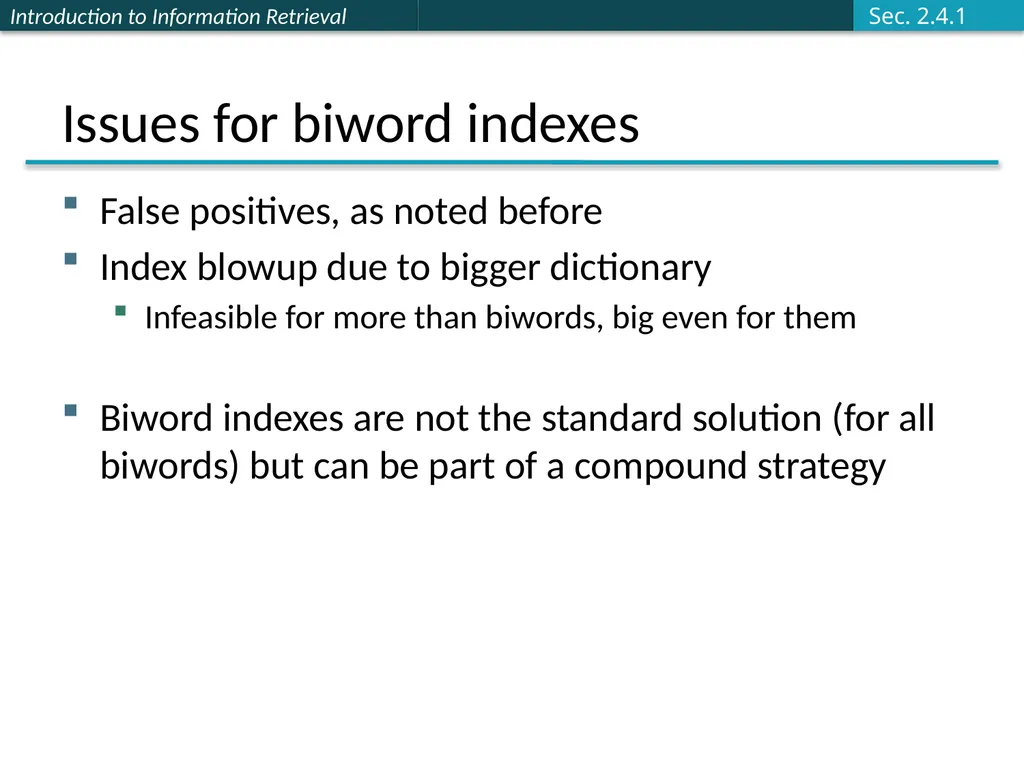
Issues for biword indexes False positives, as noted before
Index blowup due to bigger dictionary
Infeasible for more than biwords, big even for them
Biword indexes are not the standard solution (for all biwords) but can be part of a compound strategy Sec. 2.4.1<br>
Index blowup due to bigger dictionary
Infeasible for more than biwords, big even for them
Biword indexes are not the standard solution (for all biwords) but can be part of a compound strategy Sec. 2.4.1<br>
54
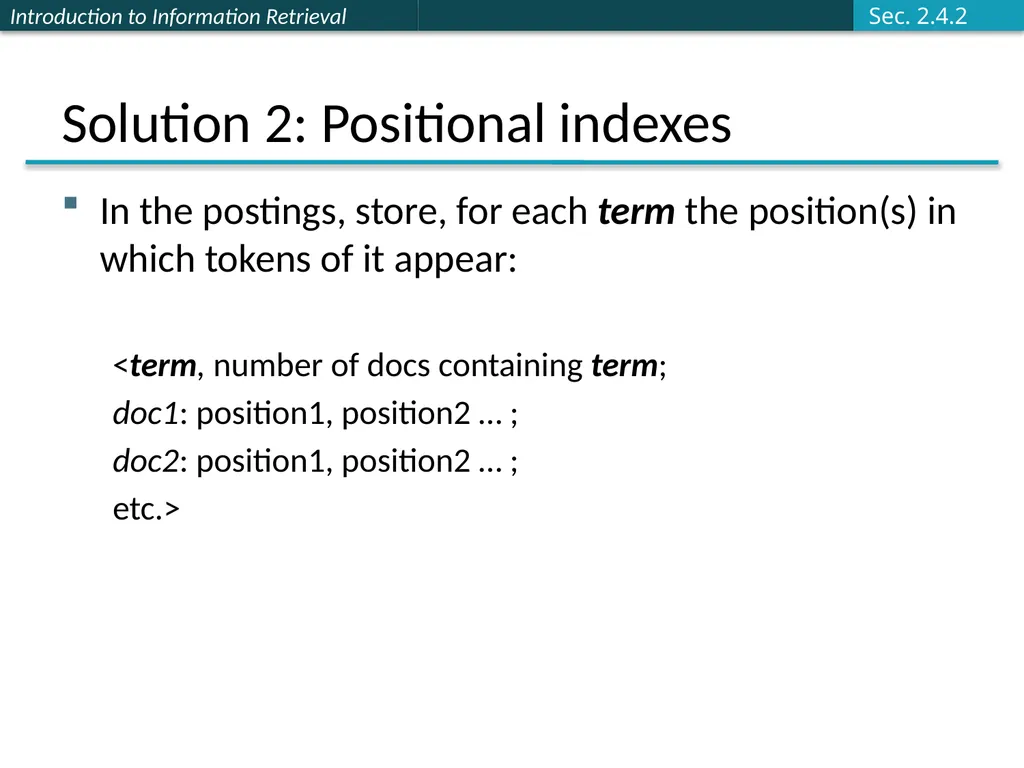
Solution 2: Positional indexes In the postings, store, for each term the position(s) in which tokens of it appear:
<term, number of docs containing term;
doc1: position1, position2 … ;
doc2: position1, position2 … ;
etc.> Sec. 2.4.2<br>
<term, number of docs containing term;
doc1: position1, position2 … ;
doc2: position1, position2 … ;
etc.> Sec. 2.4.2<br>
55
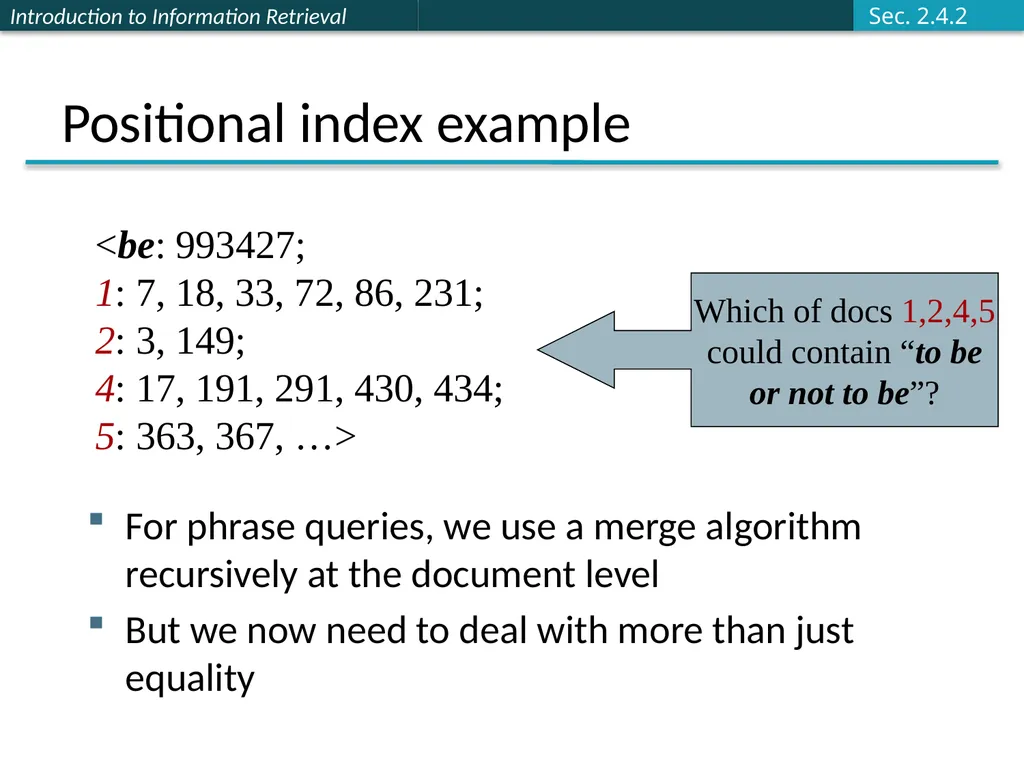
Positional index example For phrase queries, we use a merge algorithm recursively at the document level
But we now need to deal with more than just equality <be: 993427;
1: 7, 18, 33, 72, 86, 231;
2: 3, 149;
4: 17, 191, 291, 430, 434;
5: 363, 367, …> Which of docs 1,2,4,5
could contain “to be
or not to be”? Sec. 2.4.2<br>
But we now need to deal with more than just equality <be: 993427;
1: 7, 18, 33, 72, 86, 231;
2: 3, 149;
4: 17, 191, 291, 430, 434;
5: 363, 367, …> Which of docs 1,2,4,5
could contain “to be
or not to be”? Sec. 2.4.2<br>
56
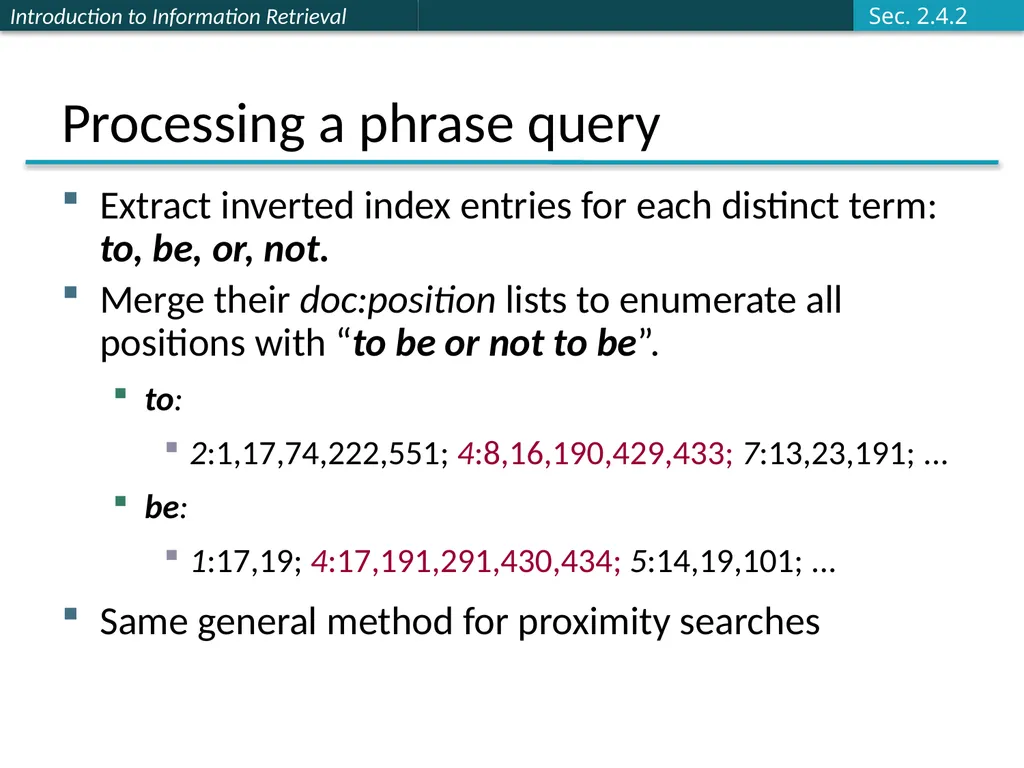
Processing a phrase query Extract inverted index entries for each distinct term: to, be, or, not.
Merge their doc:position lists to enumerate all positions with “to be or not to be”.
to:
2:1,17,74,222,551; 4:8,16,190,429,433; 7:13,23,191; ...
be:
1:17,19; 4:17,191,291,430,434; 5:14,19,101; ...
Same general method for proximity searches Sec. 2.4.2<br>
Merge their doc:position lists to enumerate all positions with “to be or not to be”.
to:
2:1,17,74,222,551; 4:8,16,190,429,433; 7:13,23,191; ...
be:
1:17,19; 4:17,191,291,430,434; 5:14,19,101; ...
Same general method for proximity searches Sec. 2.4.2<br>
57
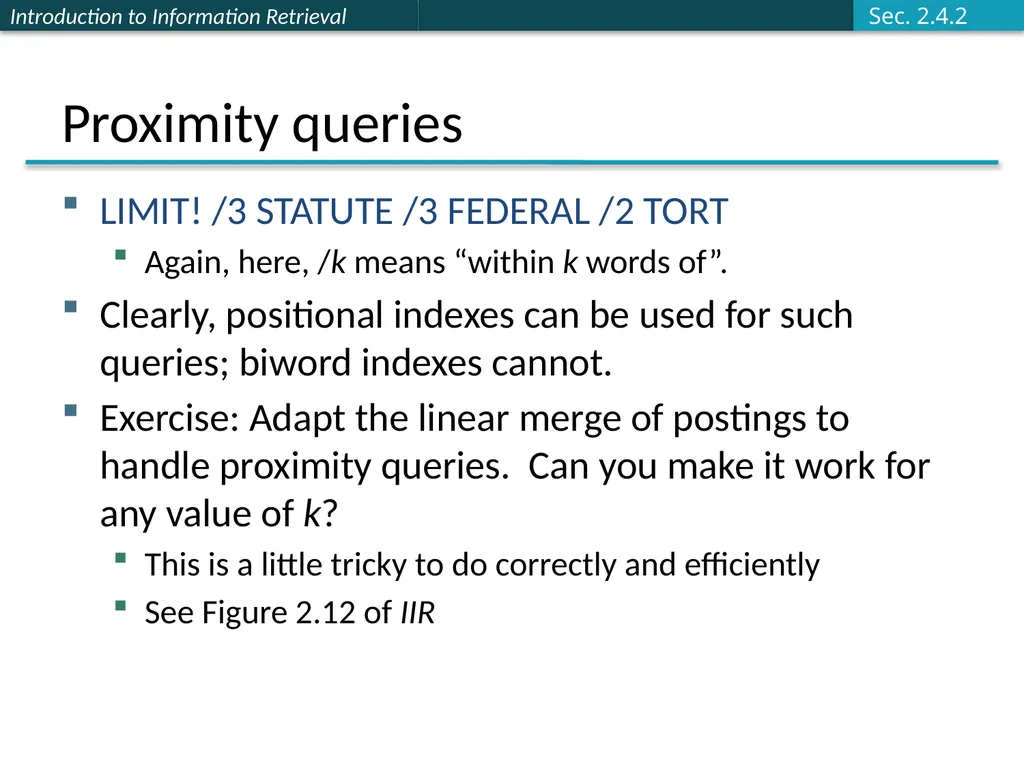
Proximity queries LIMIT! /3 STATUTE /3 FEDERAL /2 TORT
Again, here, /k means “within k words of”.
Clearly, positional indexes can be used for such queries; biword indexes cannot.
Exercise: Adapt the linear merge of postings to handle proximity queries. Can you make it work for any value of k?
This is a little tricky to do correctly and efficiently
See Figure 2.12 of IIR Sec. 2.4.2<br>
Again, here, /k means “within k words of”.
Clearly, positional indexes can be used for such queries; biword indexes cannot.
Exercise: Adapt the linear merge of postings to handle proximity queries. Can you make it work for any value of k?
This is a little tricky to do correctly and efficiently
See Figure 2.12 of IIR Sec. 2.4.2<br>
58
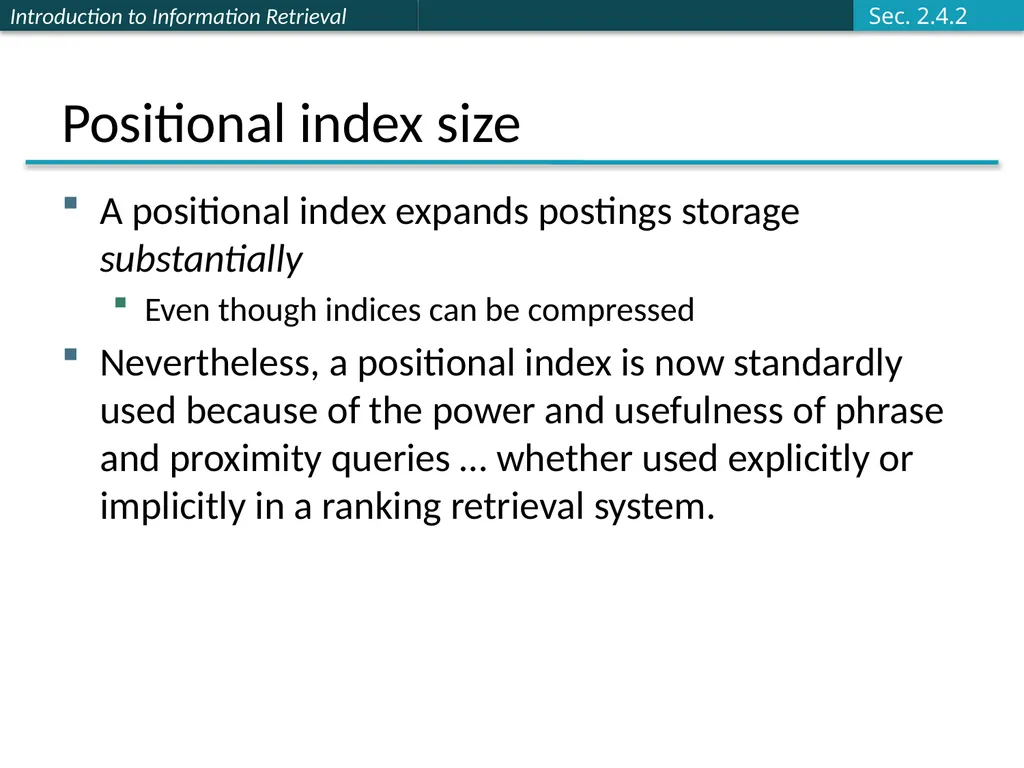
Positional index size A positional index expands postings storage substantially
Even though indices can be compressed
Nevertheless, a positional index is now standardly used because of the power and usefulness of phrase and proximity queries … whether used explicitly or implicitly in a ranking retrieval system. Sec. 2.4.2<br>
Even though indices can be compressed
Nevertheless, a positional index is now standardly used because of the power and usefulness of phrase and proximity queries … whether used explicitly or implicitly in a ranking retrieval system. Sec. 2.4.2<br>
59
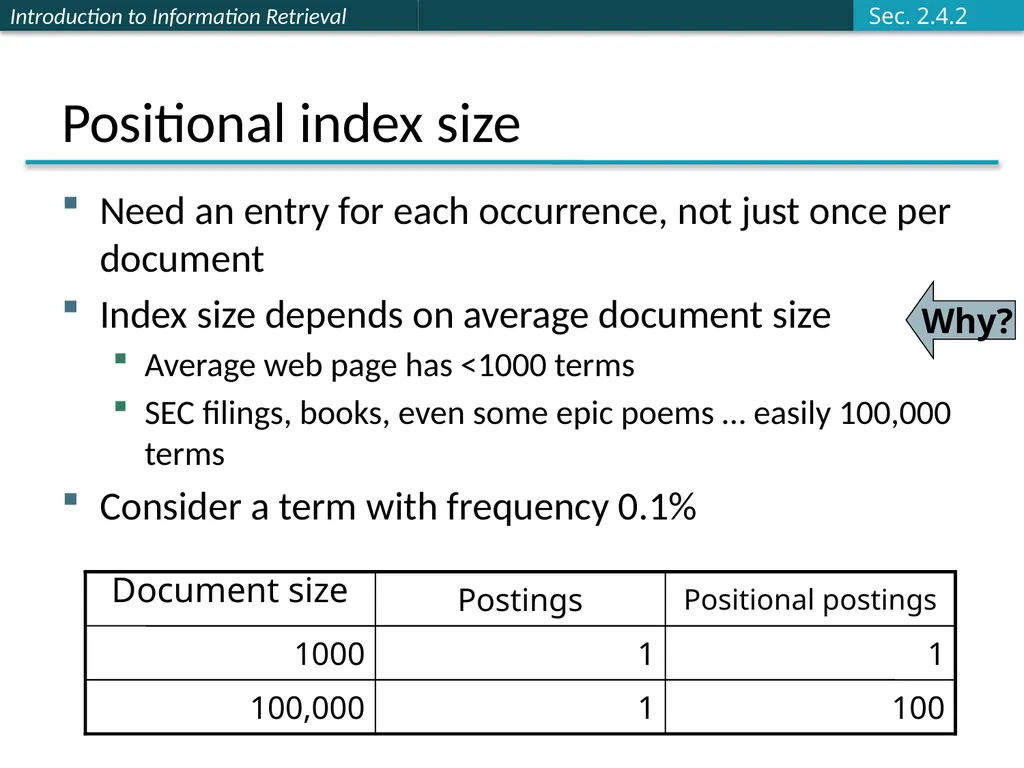
Positional index size Need an entry for each occurrence, not just once per document
Index size depends on average document size
Average web page has <1000 terms
SEC filings, books, even some epic poems … easily 100,000 terms
Consider a term with frequency 0.1% Why? Sec. 2.4.2<br>
Index size depends on average document size
Average web page has <1000 terms
SEC filings, books, even some epic poems … easily 100,000 terms
Consider a term with frequency 0.1% Why? Sec. 2.4.2<br>
60
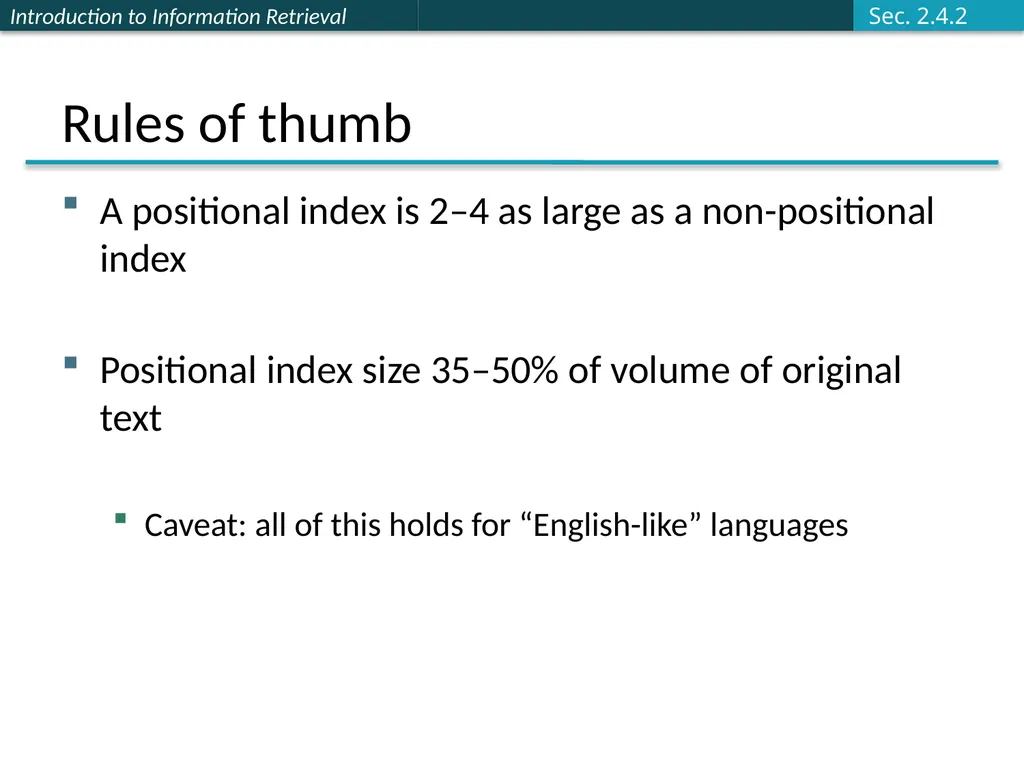
Rules of thumb A positional index is 2–4 as large as a non-positional index
Positional index size 35–50% of volume of original text
Caveat: all of this holds for “English-like” languages Sec. 2.4.2<br>
Positional index size 35–50% of volume of original text
Caveat: all of this holds for “English-like” languages Sec. 2.4.2<br>
61
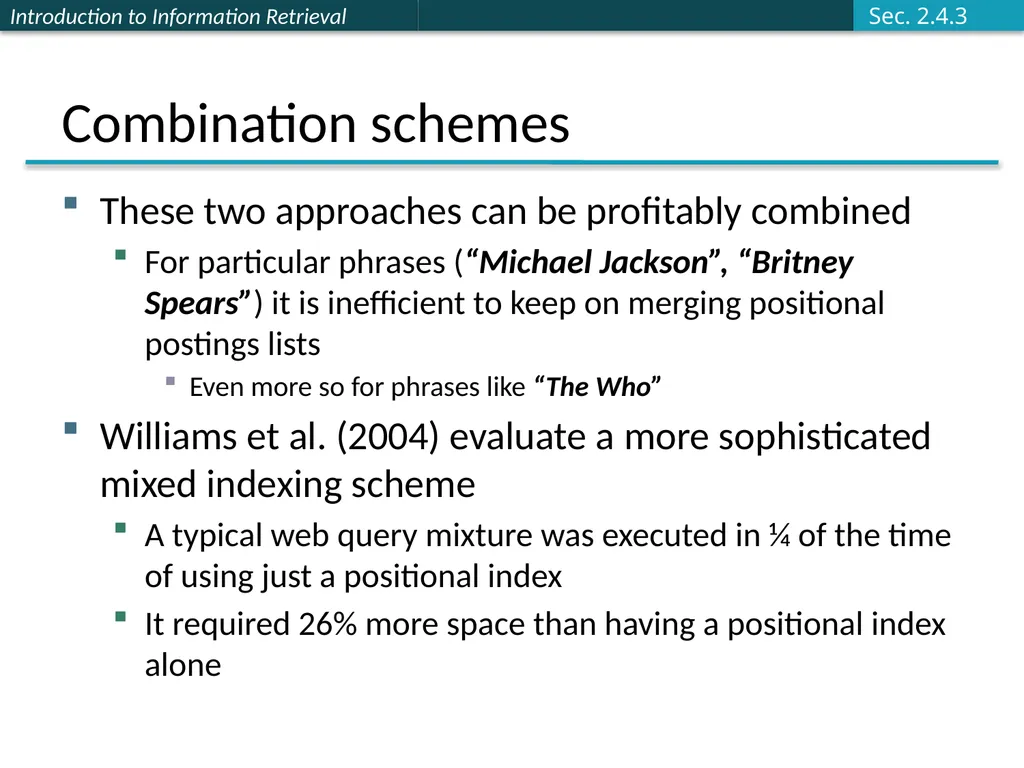
Combination schemes These two approaches can be profitably combined
For particular phrases (“Michael Jackson”, “Britney Spears”) it is inefficient to keep on merging positional postings lists
Even more so for phrases like “The Who”
Williams et al. (2004) evaluate a more sophisticated mixed indexing scheme
A typical web query mixture was executed in ¼ of the time of using just a positional index
It required 26% more space than having a positional index alone Sec. 2.4.3<br>
For particular phrases (“Michael Jackson”, “Britney Spears”) it is inefficient to keep on merging positional postings lists
Even more so for phrases like “The Who”
Williams et al. (2004) evaluate a more sophisticated mixed indexing scheme
A typical web query mixture was executed in ¼ of the time of using just a positional index
It required 26% more space than having a positional index alone Sec. 2.4.3<br>
62
Phrase queries and positional indexes<br>
63
Structured vs. Unstructured Data<br>
64
What’s ahead in IR?
Beyond term search What about phrases?
Stanford University
Proximity: Find Gates NEAR Microsoft.
Need index to capture position information in docs.
Zones in documents: Find documents with (author = Ullman) AND (text contains automata). 64<br>
Stanford University
Proximity: Find Gates NEAR Microsoft.
Need index to capture position information in docs.
Zones in documents: Find documents with (author = Ullman) AND (text contains automata). 64<br>
65
Evidence accumulation 1 vs. 0 occurrence of a search term
2 vs. 1 occurrence
3 vs. 2 occurrences, etc.
Usually more seems better
Need term frequency information in docs 65<br>
2 vs. 1 occurrence
3 vs. 2 occurrences, etc.
Usually more seems better
Need term frequency information in docs 65<br>
66
Ranking search results Boolean queries give inclusion or exclusion of docs.
Often we want to rank/group results
Need to measure proximity from query to each doc.
Need to decide whether docs presented to user are singletons, or a group of docs covering various aspects of the query. 66<br>
Often we want to rank/group results
Need to measure proximity from query to each doc.
Need to decide whether docs presented to user are singletons, or a group of docs covering various aspects of the query. 66<br>
67
IR vs. databases:
Structured vs unstructured data Structured data tends to refer to information in “tables” 67 Employee Manager Salary Smith Jones 50000 Chang Smith 60000 50000 Ivy Smith Typically allows numerical range and exact match
(for text) queries, e.g.,
Salary < 60000 AND Manager = Smith.<br>
(for text) queries, e.g.,
Salary < 60000 AND Manager = Smith.<br>
68
Unstructured data Typically refers to free text
Allows
Keyword queries including operators
More sophisticated “concept” queries e.g.,
find all web pages dealing with drug abuse
Classic model for searching text documents 68<br>
Allows
Keyword queries including operators
More sophisticated “concept” queries e.g.,
find all web pages dealing with drug abuse
Classic model for searching text documents 68<br>
69
Semi-structured data In fact almost no data is “unstructured”
E.g., this slide has distinctly identified zones such as the Title and Bullets
… to say nothing of linguistic structure
Facilitates “semi-structured” search such as
Title contains data AND Bullets contain search
Or even
Title is about Object Oriented Programming AND Author something like stro*rup
where * is the wild-card operator 69<br>
E.g., this slide has distinctly identified zones such as the Title and Bullets
… to say nothing of linguistic structure
Facilitates “semi-structured” search such as
Title contains data AND Bullets contain search
Or even
Title is about Object Oriented Programming AND Author something like stro*rup
where * is the wild-card operator 69<br>
70
Semi-structured data In fact almost no data is “unstructured”
E.g., this slide has distinctly identified zones such as the Title and Bullets
Facilitates “semi-structured” search such as
Title contains data AND Bullets contain search
… to say nothing of linguistic structure 70<br>
E.g., this slide has distinctly identified zones such as the Title and Bullets
Facilitates “semi-structured” search such as
Title contains data AND Bullets contain search
… to say nothing of linguistic structure 70<br>
71
More sophisticated semi-structured search Title is about Object Oriented Programming AND Author something like stro*rup
where * is the wild-card operator
Issues:
how do you process “about”?
how do you rank results?
The focus of XML search (IIR chapter 10) 71<br>
where * is the wild-card operator
Issues:
how do you process “about”?
how do you rank results?
The focus of XML search (IIR chapter 10) 71<br>
72
Structured vs. Unstructured Data<br>