
Introduction – About “peeling the onion” In many
JO
Published · 21 slides · 0 views

1 / 1
Description
Introduction About peeling the onion In many companies, capability-building activities are not aligned with the enterprises strategic intent. This lack of connection between strategy and execution stems in part from the ingrained habit
Related Topics
Share
Embed code
Download this presentation From Below
"Introduction – About “peeling the onion” In many" is the property of its rightful owner. Permission is granted to download and print the materials on this website for personal, non-commercial use only, and to display it on your personal computer provided you do not modify the materials and that you retain all copyright notices contained in the materials. By downloading content from our website, you accept the terms of this agreement.
Presentation Transcript
01
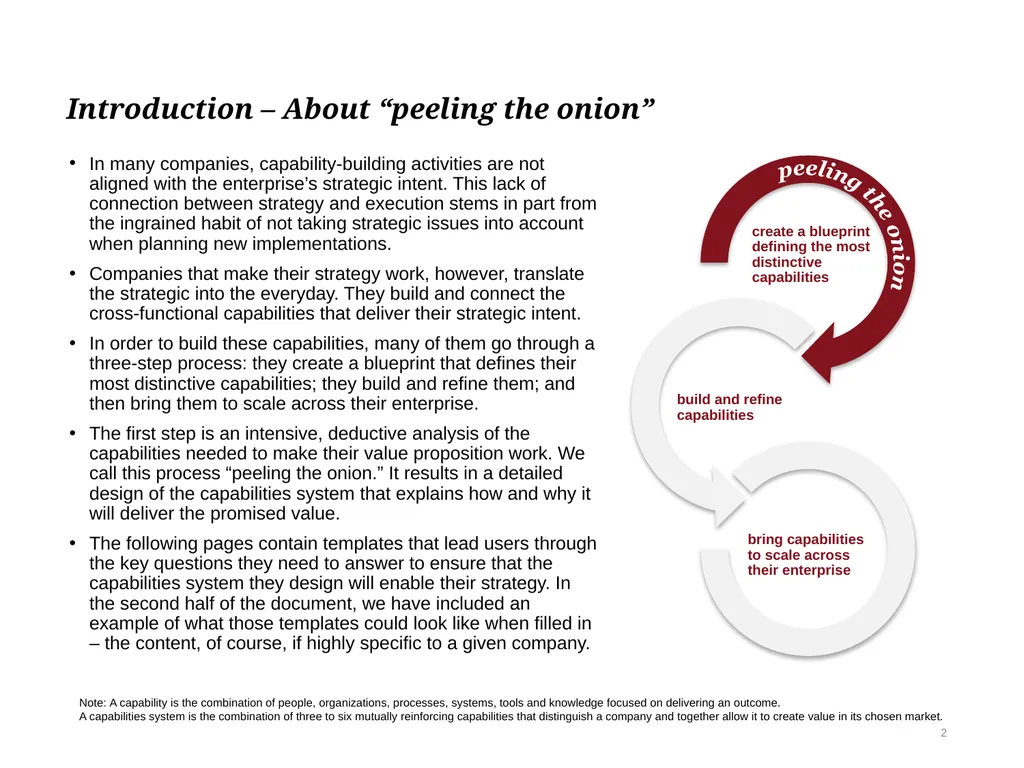
Introduction – About “peeling the onion” In many companies, capability-building activities are not aligned with the enterprise’s strategic intent. This lack of connection between strategy and execution stems in part from the ingrained habit of not taking strategic issues into account when planning new implementations.
Companies that make their strategy work, however, translate the strategic into the everyday. They build and connect the cross-functional capabilities that deliver their strategic intent.
In order to build these capabilities, many of them go through a three-step process: they create a blueprint that defines their most distinctive capabilities; they build and refine them; and then bring them to scale across their enterprise.
The first step is an intensive, deductive analysis of the capabilities needed to make their value proposition work. We call this process “peeling the onion.” It results in a detailed design of the capabilities system that explains how and why it will deliver the promised value.
The following pages contain templates that lead users through the key questions they need to answer to ensure that the capabilities system they design will enable their strategy. In the second half of the document, we have included an example of what those templates could look like when filled in – the content, of course, if highly specific to a given company. create a blueprint defining the most distinctive capabilities build and refine capabilities bring capabilities to scale across their enterprise Note: A capability is the combination of people, organizations, processes, systems, tools and knowledge focused on delivering an outcome.
A capabilities system is the combination of three to six mutually reinforcing capabilities that distinguish a company and together allow it to create value in its chosen market. 1<br>
Companies that make their strategy work, however, translate the strategic into the everyday. They build and connect the cross-functional capabilities that deliver their strategic intent.
In order to build these capabilities, many of them go through a three-step process: they create a blueprint that defines their most distinctive capabilities; they build and refine them; and then bring them to scale across their enterprise.
The first step is an intensive, deductive analysis of the capabilities needed to make their value proposition work. We call this process “peeling the onion.” It results in a detailed design of the capabilities system that explains how and why it will deliver the promised value.
The following pages contain templates that lead users through the key questions they need to answer to ensure that the capabilities system they design will enable their strategy. In the second half of the document, we have included an example of what those templates could look like when filled in – the content, of course, if highly specific to a given company. create a blueprint defining the most distinctive capabilities build and refine capabilities bring capabilities to scale across their enterprise Note: A capability is the combination of people, organizations, processes, systems, tools and knowledge focused on delivering an outcome.
A capabilities system is the combination of three to six mutually reinforcing capabilities that distinguish a company and together allow it to create value in its chosen market. 1<br>
02
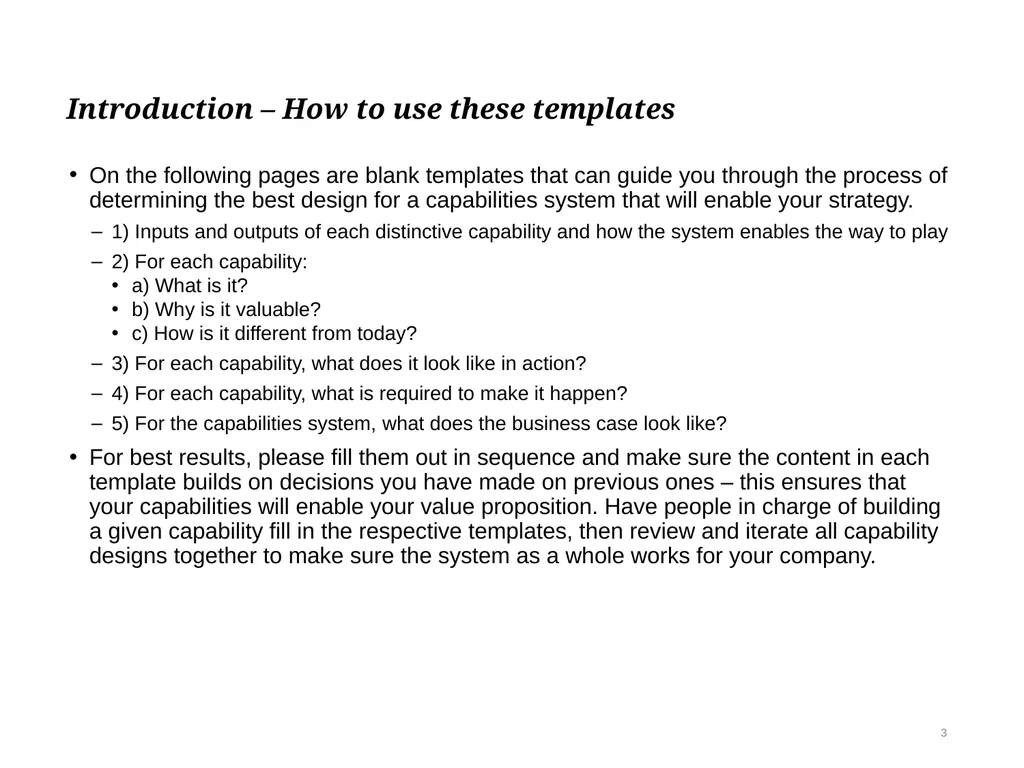
Introduction – How to use these templates On the following pages are blank templates that can guide you through the process of determining the best design for a capabilities system that will enable your strategy.
1) Inputs and outputs of each distinctive capability and how the system enables the way to play
2) For each capability:
a) What is it?
b) Why is it valuable?
c) How is it different from today?
3) For each capability, what does it look like in action?
4) For each capability, what is required to make it happen?
5) For the capabilities system, what does the business case look like?
For best results, please fill them out in sequence and make sure the content in each template builds on decisions you have made on previous ones – this ensures that your capabilities will enable your value proposition. Have people in charge of building a given capability fill in the respective templates, then review and iterate all capability designs together to make sure the system as a whole works for your company. 2<br>
1) Inputs and outputs of each distinctive capability and how the system enables the way to play
2) For each capability:
a) What is it?
b) Why is it valuable?
c) How is it different from today?
3) For each capability, what does it look like in action?
4) For each capability, what is required to make it happen?
5) For the capabilities system, what does the business case look like?
For best results, please fill them out in sequence and make sure the content in each template builds on decisions you have made on previous ones – this ensures that your capabilities will enable your value proposition. Have people in charge of building a given capability fill in the respective templates, then review and iterate all capability designs together to make sure the system as a whole works for your company. 2<br>
03
“Peeling the onion” template
Example: templates filled in 3<br>
Example: templates filled in 3<br>
04
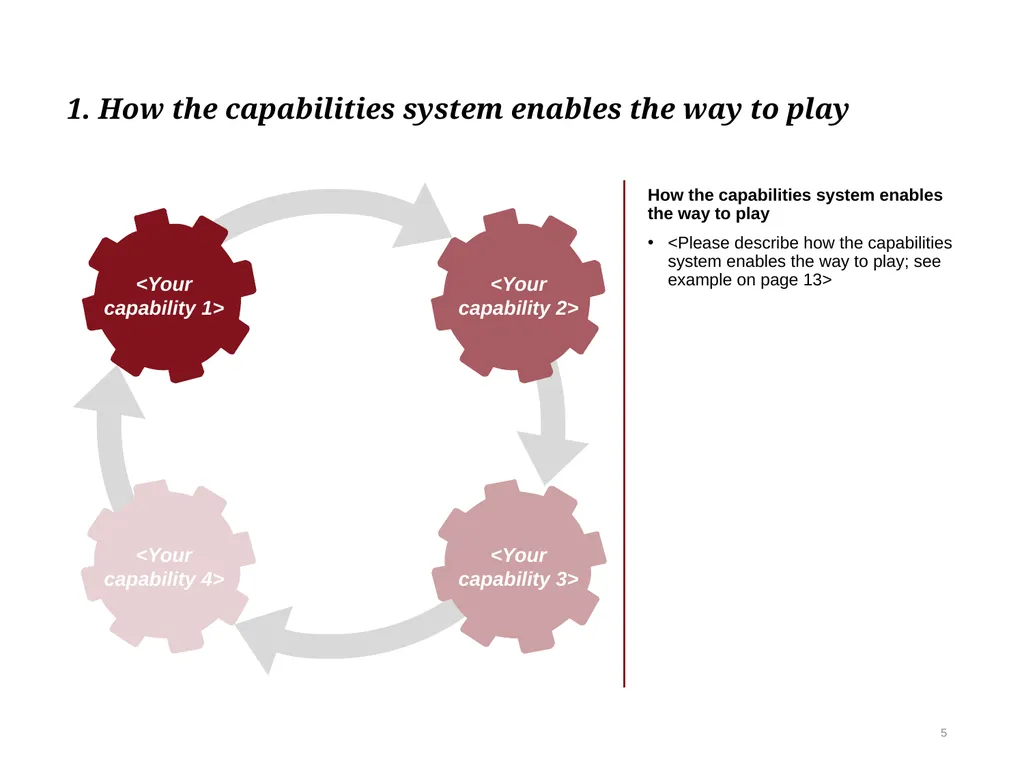
1. How the capabilities system enables the way to play How the capabilities system enables the way to play
<Please describe how the capabilities system enables the way to play; see example on page 13> 4<br>
<Please describe how the capabilities system enables the way to play; see example on page 13> 4<br>
05
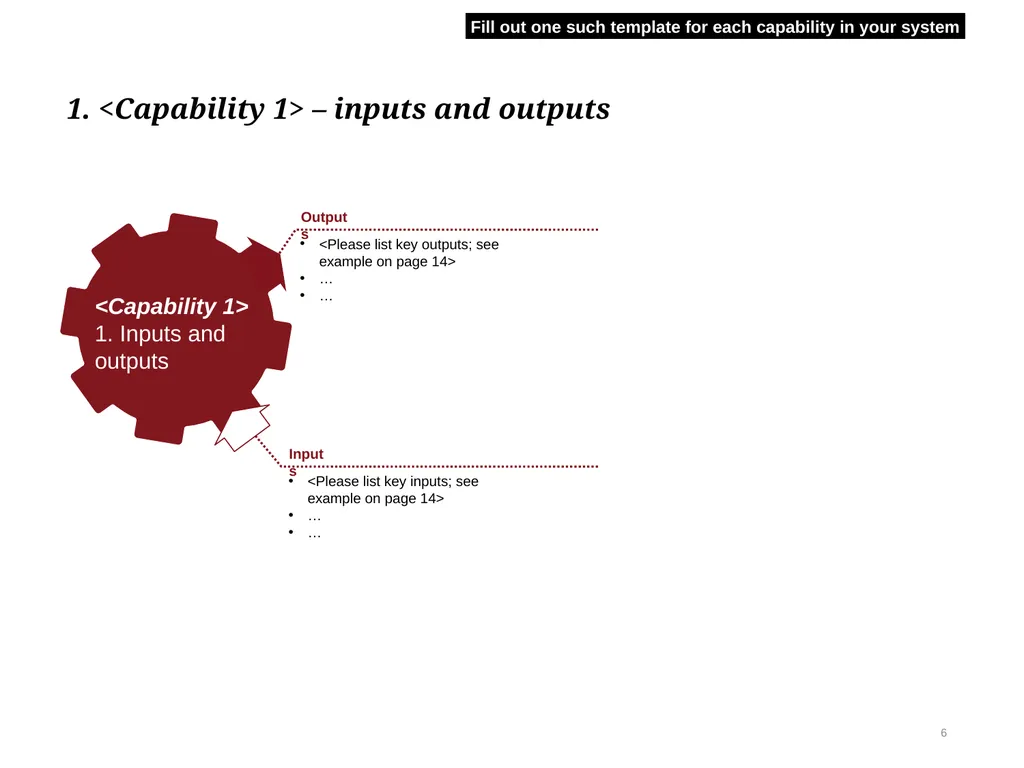
1. <Capability 1> – inputs and outputs Outputs <Please list key outputs; see example on page 14>
…
… Inputs <Please list key inputs; see example on page 14>
…
… Fill out one such template for each capability in your system <Capability 1>
1. Inputs and outputs 5<br>
…
… Inputs <Please list key inputs; see example on page 14>
…
… Fill out one such template for each capability in your system <Capability 1>
1. Inputs and outputs 5<br>
06
2a. <Capability 1> – what is it? <Capability 1>
2. What is it? <Please describe your capability; see example on page 15>
…
… Fill out one such template for each capability in your system 6<br>
2. What is it? <Please describe your capability; see example on page 15>
…
… Fill out one such template for each capability in your system 6<br>
07
2b. <Capability 1> – why is it valuable? <Capability 1>
2. Why is it valuable? <Please describe why this capability is valuable, what impact it has; see example on page 16>
…
… Fill out one such template for each capability in your system 7<br>
2. Why is it valuable? <Please describe why this capability is valuable, what impact it has; see example on page 16>
…
… Fill out one such template for each capability in your system 7<br>
08
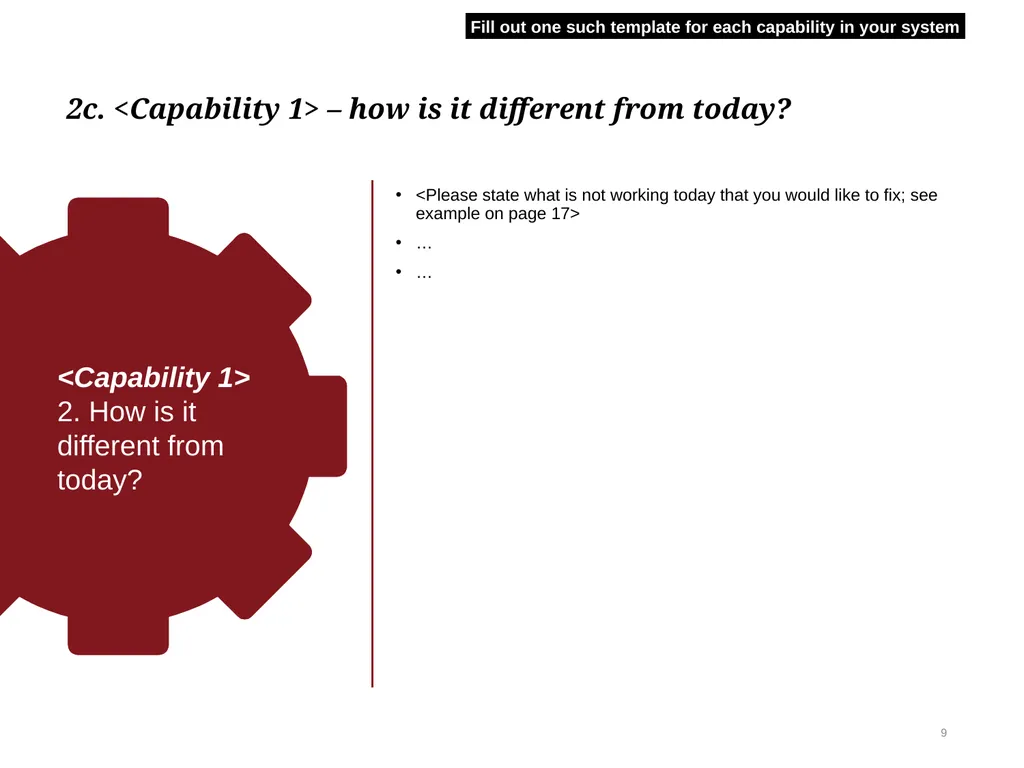
<Please state what is not working today that you would like to fix; see example on page 17>
…
… 2c. <Capability 1> – how is it different from today? <Capability 1>
2. How is it different from today? Fill out one such template for each capability in your system 8<br>
…
… 2c. <Capability 1> – how is it different from today? <Capability 1>
2. How is it different from today? Fill out one such template for each capability in your system 8<br>
09
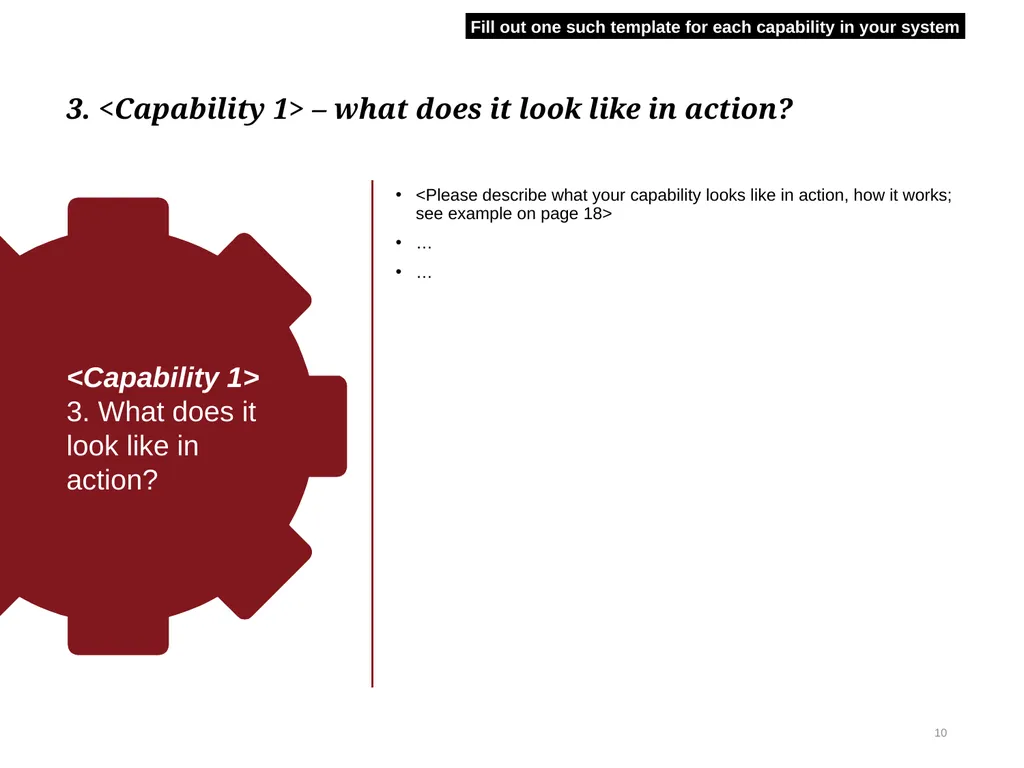
3. <Capability 1> – what does it look like in action? <Capability 1>
3. What does it look like in action? <Please describe what your capability looks like in action, how it works; see example on page 18>
…
… Fill out one such template for each capability in your system 9<br>
3. What does it look like in action? <Please describe what your capability looks like in action, how it works; see example on page 18>
…
… Fill out one such template for each capability in your system 9<br>
10
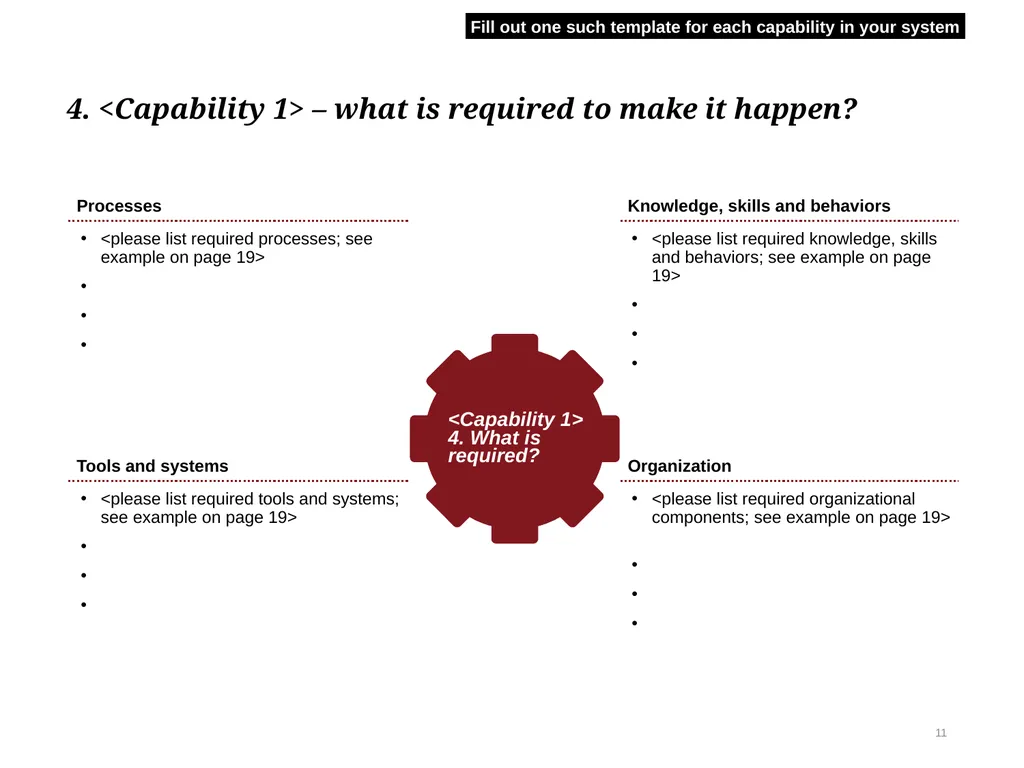
Knowledge, skills and behaviors <please list required knowledge, skills and behaviors; see example on page 19> Organization <please list required organizational components; see example on page 19> Processes <please list required processes; see example on page 19> Tools and systems <please list required tools and systems; see example on page 19> 4. <Capability 1> – what is required to make it happen? <Capability 1>
4. What is required? Fill out one such template for each capability in your system 10<br>
4. What is required? Fill out one such template for each capability in your system 10<br>
11
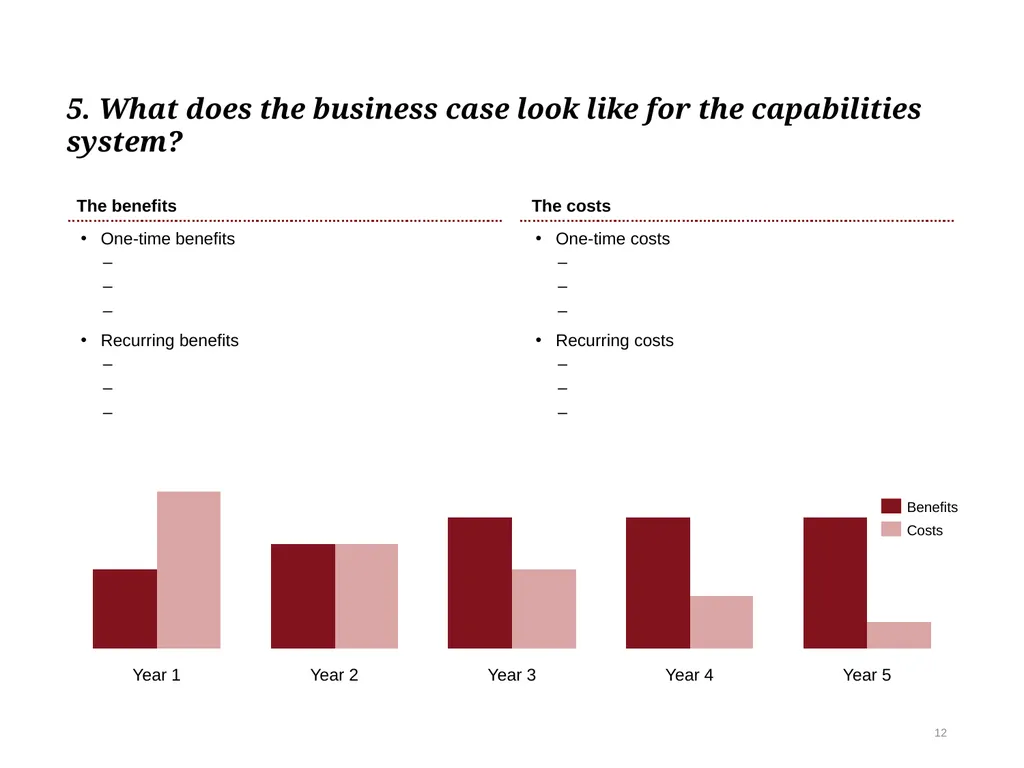
5. What does the business case look like for the capabilities system? Year 1 Year 3 Year 4 Year 5 Year 2 Costs Benefits The benefits One-time benefits
Recurring benefits The costs One-time costs
Recurring costs 11<br>
Recurring benefits The costs One-time costs
Recurring costs 11<br>
12
“Peeling the onion” templates
Example: templates filled in 12<br>
Example: templates filled in 12<br>
13
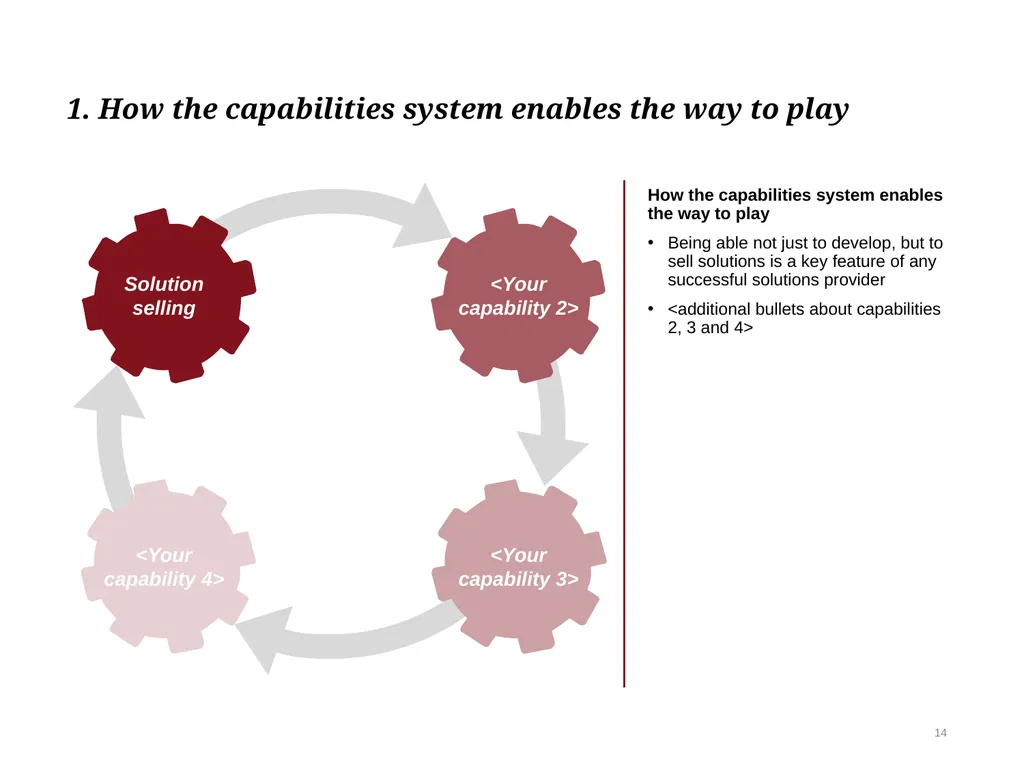
1. How the capabilities system enables the way to play How the capabilities system enables the way to play
Being able not just to develop, but to sell solutions is a key feature of any successful solutions provider
<additional bullets about capabilities 2, 3 and 4> 13<br>
Being able not just to develop, but to sell solutions is a key feature of any successful solutions provider
<additional bullets about capabilities 2, 3 and 4> 13<br>
14
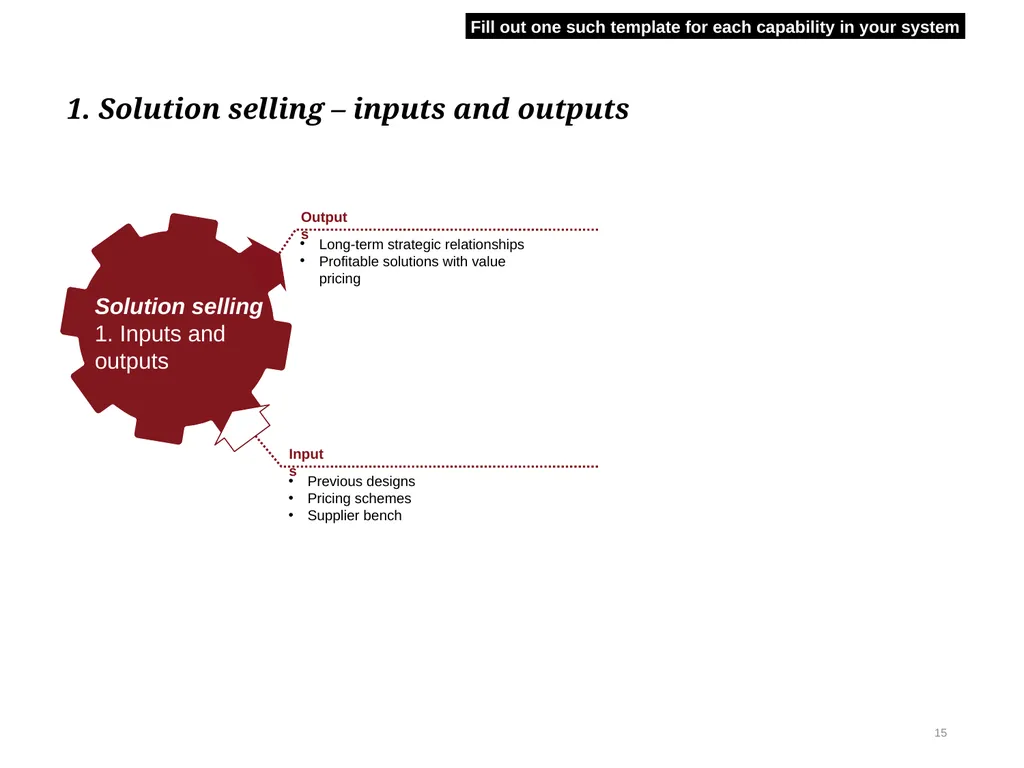
1. Solution selling – inputs and outputs Outputs Long-term strategic relationships
Profitable solutions with value pricing Inputs Previous designs
Pricing schemes
Supplier bench Fill out one such template for each capability in your system Solution selling
1. Inputs and outputs 14<br>
Profitable solutions with value pricing Inputs Previous designs
Pricing schemes
Supplier bench Fill out one such template for each capability in your system Solution selling
1. Inputs and outputs 14<br>
15
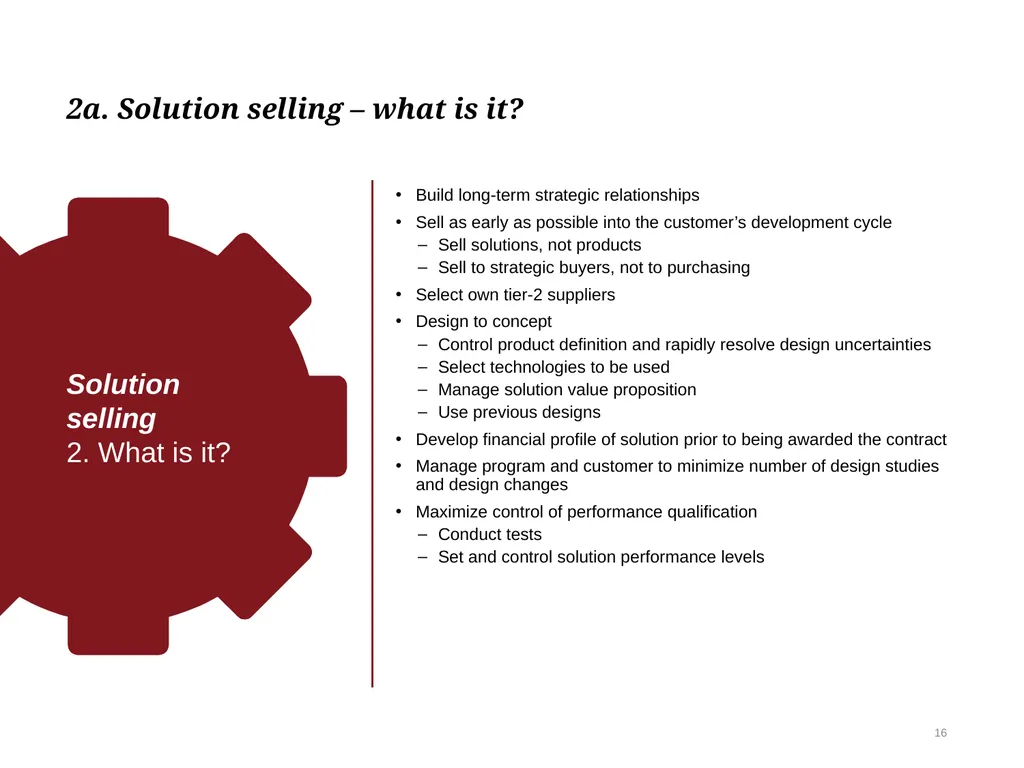
2a. Solution selling – what is it? Solution selling
2. What is it? Build long-term strategic relationships
Sell as early as possible into the customer’s development cycle
Sell solutions, not products
Sell to strategic buyers, not to purchasing
Select own tier-2 suppliers
Design to concept
Control product definition and rapidly resolve design uncertainties
Select technologies to be used
Manage solution value proposition
Use previous designs
Develop financial profile of solution prior to being awarded the contract
Manage program and customer to minimize number of design studies and design changes
Maximize control of performance qualification
Conduct tests
Set and control solution performance levels 15<br>
2. What is it? Build long-term strategic relationships
Sell as early as possible into the customer’s development cycle
Sell solutions, not products
Sell to strategic buyers, not to purchasing
Select own tier-2 suppliers
Design to concept
Control product definition and rapidly resolve design uncertainties
Select technologies to be used
Manage solution value proposition
Use previous designs
Develop financial profile of solution prior to being awarded the contract
Manage program and customer to minimize number of design studies and design changes
Maximize control of performance qualification
Conduct tests
Set and control solution performance levels 15<br>
16
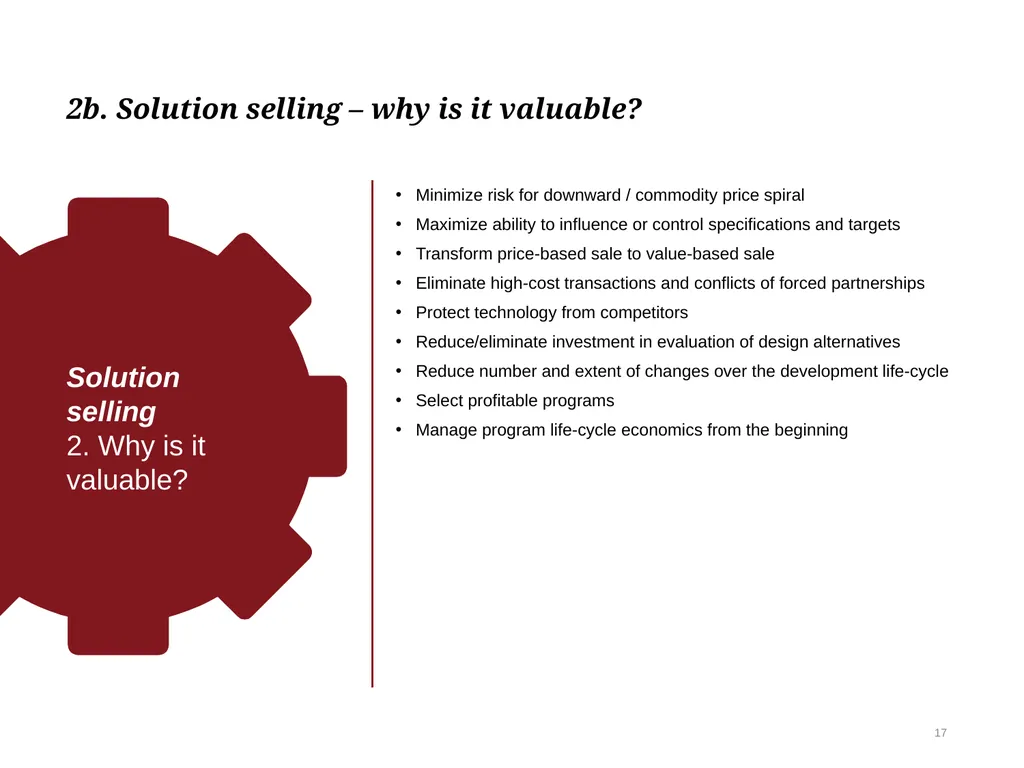
2b. Solution selling – why is it valuable? Solution selling
2. Why is it valuable? Minimize risk for downward / commodity price spiral
Maximize ability to influence or control specifications and targets
Transform price-based sale to value-based sale
Eliminate high-cost transactions and conflicts of forced partnerships
Protect technology from competitors
Reduce/eliminate investment in evaluation of design alternatives
Reduce number and extent of changes over the development life-cycle
Select profitable programs
Manage program life-cycle economics from the beginning 16<br>
2. Why is it valuable? Minimize risk for downward / commodity price spiral
Maximize ability to influence or control specifications and targets
Transform price-based sale to value-based sale
Eliminate high-cost transactions and conflicts of forced partnerships
Protect technology from competitors
Reduce/eliminate investment in evaluation of design alternatives
Reduce number and extent of changes over the development life-cycle
Select profitable programs
Manage program life-cycle economics from the beginning 16<br>
17
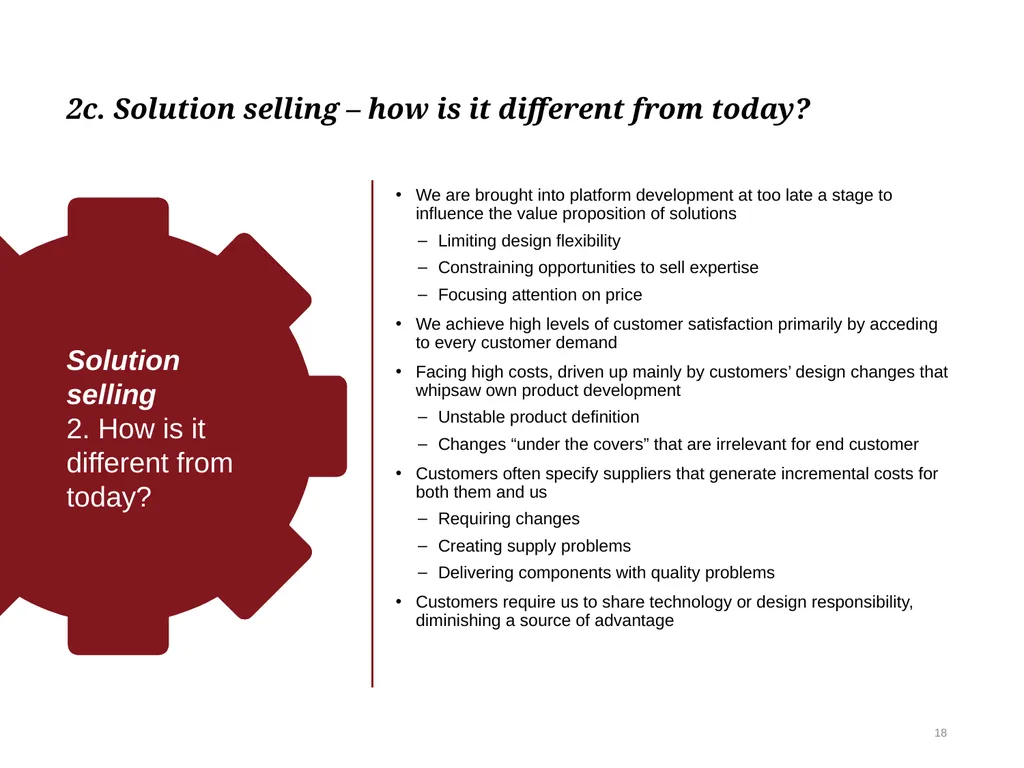
We are brought into platform development at too late a stage to influence the value proposition of solutions
Limiting design flexibility
Constraining opportunities to sell expertise
Focusing attention on price
We achieve high levels of customer satisfaction primarily by acceding to every customer demand
Facing high costs, driven up mainly by customers’ design changes that whipsaw own product development
Unstable product definition
Changes “under the covers” that are irrelevant for end customer
Customers often specify suppliers that generate incremental costs for both them and us
Requiring changes
Creating supply problems
Delivering components with quality problems
Customers require us to share technology or design responsibility, diminishing a source of advantage 2c. Solution selling – how is it different from today? Solution selling
2. How is it different from today? 17<br>
Limiting design flexibility
Constraining opportunities to sell expertise
Focusing attention on price
We achieve high levels of customer satisfaction primarily by acceding to every customer demand
Facing high costs, driven up mainly by customers’ design changes that whipsaw own product development
Unstable product definition
Changes “under the covers” that are irrelevant for end customer
Customers often specify suppliers that generate incremental costs for both them and us
Requiring changes
Creating supply problems
Delivering components with quality problems
Customers require us to share technology or design responsibility, diminishing a source of advantage 2c. Solution selling – how is it different from today? Solution selling
2. How is it different from today? 17<br>
18
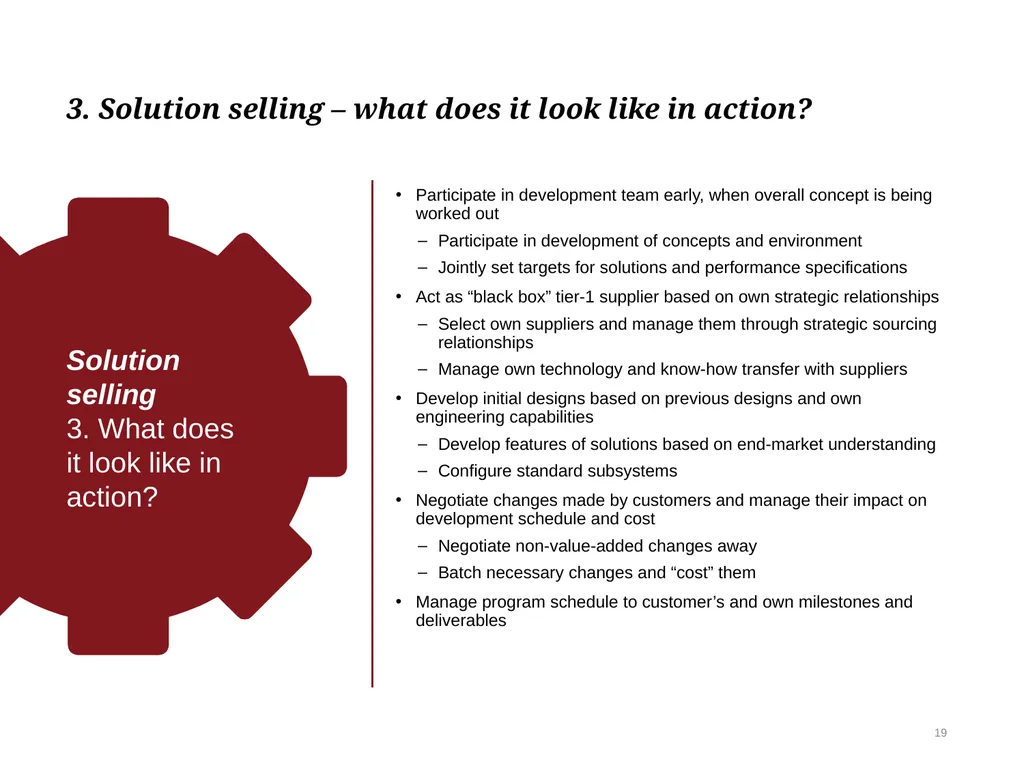
3. Solution selling – what does it look like in action? Solution selling
3. What does it look like in action? Participate in development team early, when overall concept is being worked out
Participate in development of concepts and environment
Jointly set targets for solutions and performance specifications
Act as “black box” tier-1 supplier based on own strategic relationships
Select own suppliers and manage them through strategic sourcing relationships
Manage own technology and know-how transfer with suppliers
Develop initial designs based on previous designs and own engineering capabilities
Develop features of solutions based on end-market understanding
Configure standard subsystems
Negotiate changes made by customers and manage their impact on development schedule and cost
Negotiate non-value-added changes away
Batch necessary changes and “cost” them
Manage program schedule to customer’s and own milestones and deliverables 18<br>
3. What does it look like in action? Participate in development team early, when overall concept is being worked out
Participate in development of concepts and environment
Jointly set targets for solutions and performance specifications
Act as “black box” tier-1 supplier based on own strategic relationships
Select own suppliers and manage them through strategic sourcing relationships
Manage own technology and know-how transfer with suppliers
Develop initial designs based on previous designs and own engineering capabilities
Develop features of solutions based on end-market understanding
Configure standard subsystems
Negotiate changes made by customers and manage their impact on development schedule and cost
Negotiate non-value-added changes away
Batch necessary changes and “cost” them
Manage program schedule to customer’s and own milestones and deliverables 18<br>
19
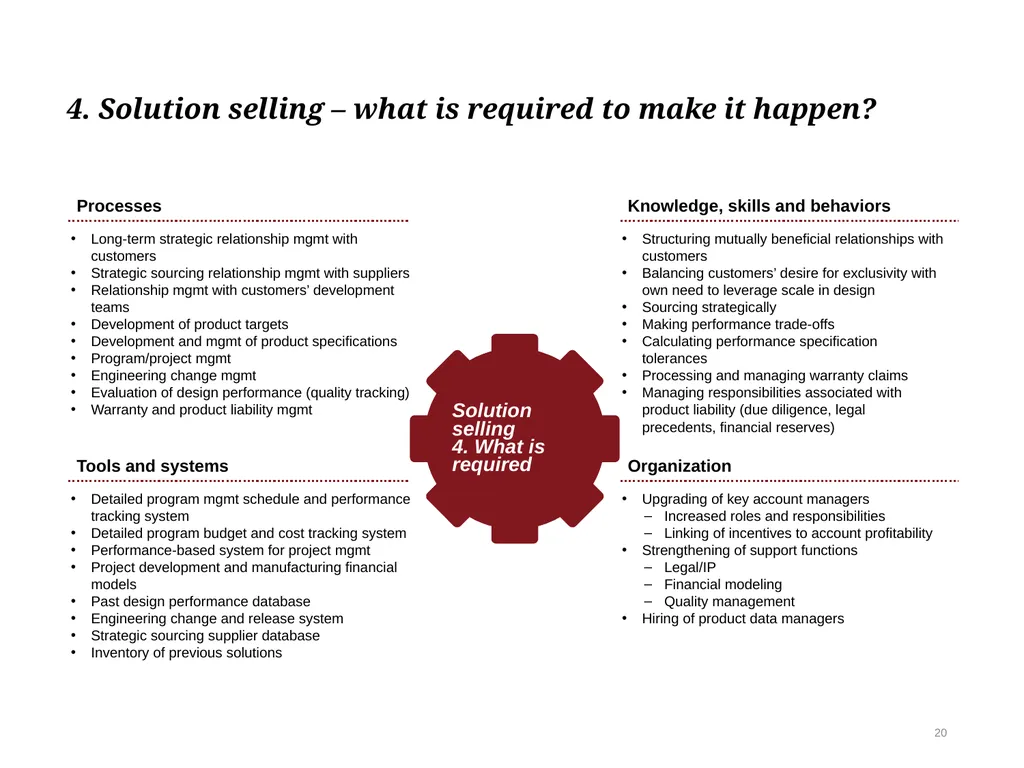
Knowledge, skills and behaviors Structuring mutually beneficial relationships with customers
Balancing customers’ desire for exclusivity with own need to leverage scale in design
Sourcing strategically
Making performance trade-offs
Calculating performance specification tolerances
Processing and managing warranty claims
Managing responsibilities associated with product liability (due diligence, legal precedents, financial reserves) Organization Upgrading of key account managers
Increased roles and responsibilities
Linking of incentives to account profitability
Strengthening of support functions
Legal/IP
Financial modeling
Quality management
Hiring of product data managers Processes Long-term strategic relationship mgmt with customers
Strategic sourcing relationship mgmt with suppliers
Relationship mgmt with customers’ development teams
Development of product targets
Development and mgmt of product specifications
Program/project mgmt
Engineering change mgmt
Evaluation of design performance (quality tracking)
Warranty and product liability mgmt Tools and systems Detailed program mgmt schedule and performance tracking system
Detailed program budget and cost tracking system
Performance-based system for project mgmt
Project development and manufacturing financial models
Past design performance database
Engineering change and release system
Strategic sourcing supplier database
Inventory of previous solutions 4. Solution selling – what is required to make it happen? Solution selling
4. What is required 19<br>
Balancing customers’ desire for exclusivity with own need to leverage scale in design
Sourcing strategically
Making performance trade-offs
Calculating performance specification tolerances
Processing and managing warranty claims
Managing responsibilities associated with product liability (due diligence, legal precedents, financial reserves) Organization Upgrading of key account managers
Increased roles and responsibilities
Linking of incentives to account profitability
Strengthening of support functions
Legal/IP
Financial modeling
Quality management
Hiring of product data managers Processes Long-term strategic relationship mgmt with customers
Strategic sourcing relationship mgmt with suppliers
Relationship mgmt with customers’ development teams
Development of product targets
Development and mgmt of product specifications
Program/project mgmt
Engineering change mgmt
Evaluation of design performance (quality tracking)
Warranty and product liability mgmt Tools and systems Detailed program mgmt schedule and performance tracking system
Detailed program budget and cost tracking system
Performance-based system for project mgmt
Project development and manufacturing financial models
Past design performance database
Engineering change and release system
Strategic sourcing supplier database
Inventory of previous solutions 4. Solution selling – what is required to make it happen? Solution selling
4. What is required 19<br>
20
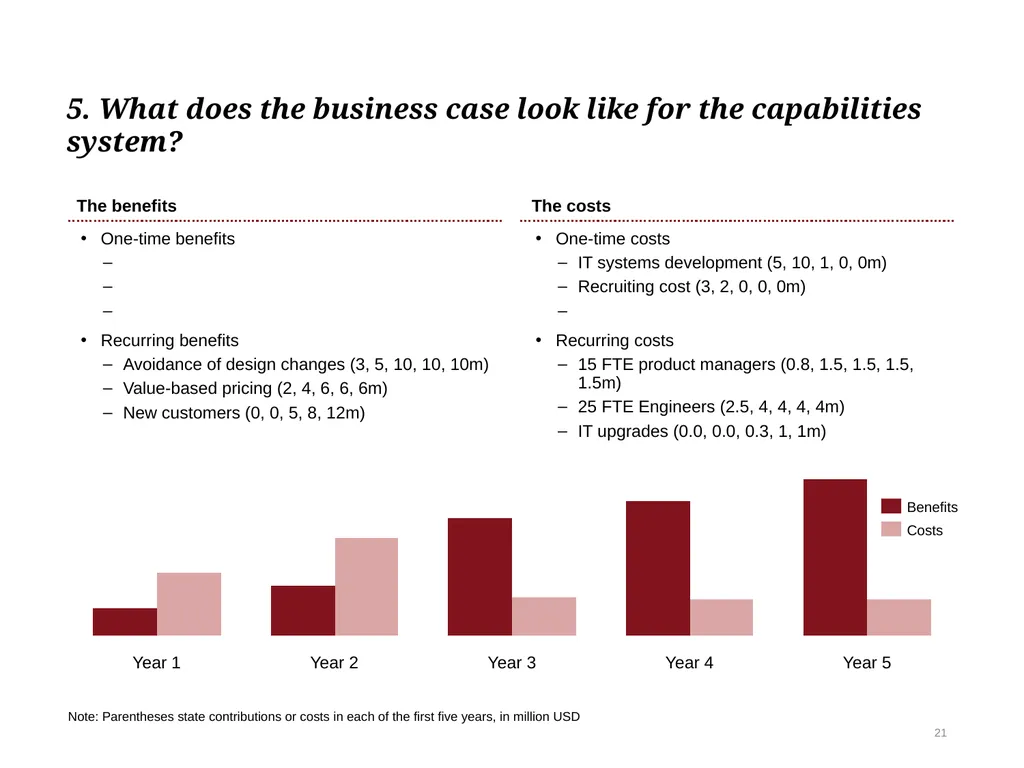
5. What does the business case look like for the capabilities system? Year 1 Year 3 Year 4 Year 5 Year 2 Costs Benefits The benefits One-time benefits
Recurring benefits
Avoidance of design changes (3, 5, 10, 10, 10m)
Value-based pricing (2, 4, 6, 6, 6m)
New customers (0, 0, 5, 8, 12m) The costs One-time costs
IT systems development (5, 10, 1, 0, 0m)
Recruiting cost (3, 2, 0, 0, 0m)
Recurring costs
15 FTE product managers (0.8, 1.5, 1.5, 1.5, 1.5m)
25 FTE Engineers (2.5, 4, 4, 4, 4m)
IT upgrades (0.0, 0.0, 0.3, 1, 1m) Note: Parentheses state contributions or costs in each of the first five years, in million USD 20<br>
Recurring benefits
Avoidance of design changes (3, 5, 10, 10, 10m)
Value-based pricing (2, 4, 6, 6, 6m)
New customers (0, 0, 5, 8, 12m) The costs One-time costs
IT systems development (5, 10, 1, 0, 0m)
Recruiting cost (3, 2, 0, 0, 0m)
Recurring costs
15 FTE product managers (0.8, 1.5, 1.5, 1.5, 1.5m)
25 FTE Engineers (2.5, 4, 4, 4, 4m)
IT upgrades (0.0, 0.0, 0.3, 1, 1m) Note: Parentheses state contributions or costs in each of the first five years, in million USD 20<br>