
Introduction, definitions, philosophy of art,
DP
Published · 30 slides · 0 views

1 / 1



Description
Introduction, definitions, philosophy of art, nature and classification of art ART INTRODUCTION Look around and we will find countless things relating to art. Posters, paintings, murals, portraits and lots more. Art is used by one and all,
Related Topics
Share
Embed code
Download this presentation From Below
"Introduction, definitions, philosophy of art," is the property of its rightful owner. Permission is granted to download and print the materials on this website for personal, non-commercial use only, and to display it on your personal computer provided you do not modify the materials and that you retain all copyright notices contained in the materials. By downloading content from our website, you accept the terms of this agreement.
Presentation Transcript
01
Introduction, definitions, philosophy of art, nature and classification of art ART<br>
02
INTRODUCTION Look around and we will find countless things relating to art. Posters, paintings, murals, portraits and lots more. Art is used by one and all, knowingly or unknowingly. Right from houses that we live in (Architecture) to the movies we see (Theatre) to the books we read (Literature), there exists art in different form.
Though the word ‘art’ is a simple 3-letter term, it is not as easy as its terminology. Drawing and Colouring is art for kids, while the same term means acting and entertaining for celebrities. Art comprises of trend and fashion for designers, while creations of art are artworks for museums.<br>
Though the word ‘art’ is a simple 3-letter term, it is not as easy as its terminology. Drawing and Colouring is art for kids, while the same term means acting and entertaining for celebrities. Art comprises of trend and fashion for designers, while creations of art are artworks for museums.<br>
03
We have Art all around us: in paintings, architecture, pottery, sculpture etc. 0ur architecture, inside our houses, in the way we dress up, the way we display our food, the way we stand, sit or even talk...a personal style statement. Each occasion and festivities in our lives involve the aesthetic expression. The rangolis on our door steps on Diwali, that huge Ravana on Dussehra, and not to miss Goddess Durga statues which have a new personification every year,... the shape , form and style of the divas emerging every day...how can we think of a life untouched by art ?<br>
04
Origin Etymologically ‘Art’ is originated with the Latin word ‘ars’ which means, skill, technique or craft , also conveys a connotation of beauty.<br>
05
Work of art - Visual expression of an idea or experience formed with skill through use of a medium
Media/medium - type of tools used to create the artwork – clay, fibre, stone, wood, paint, video, photography
Some communication can only be expressed through visual form or music...<br>
Media/medium - type of tools used to create the artwork – clay, fibre, stone, wood, paint, video, photography
Some communication can only be expressed through visual form or music...<br>
06
Art is… Art is an expression of our thoughts, emotions, intuitions and desires.
It is the communication of intimate concepts that cannot be portrayed by words alone so we must find some other vehicle to carry our intent.
Art is a component of culture, it transmits ideas and values inherent in every culture across space and time.
Art is a highly diverse range of human activities engaged in creating visual, auditory, or performed artifacts , artworks — that express the author’s imaginative or technical skill and are intended to be appreciated for their beauty or emotional power.<br>
07
Definitions….. According to RabindraNath Tagore “Art is expression of human experiences”.
Plato “Art is imitation of truth”.
Tolstoy “An emotional action or expression which fills the spectator or listener, with the same emotion, is art”.
Tagore “All that is true and beautiful is Art”.<br>
Plato “Art is imitation of truth”.
Tolstoy “An emotional action or expression which fills the spectator or listener, with the same emotion, is art”.
Tagore “All that is true and beautiful is Art”.<br>
08
Definitions… Edgar Degas “Art is not what you see, but what you make others see”.
Jean Sibelius ”Art is the signature of civilizations”.
Thomas Merton “Art enables us to find ourselves and lose ourselves at the same time”.<br>
Jean Sibelius ”Art is the signature of civilizations”.
Thomas Merton “Art enables us to find ourselves and lose ourselves at the same time”.<br>
09
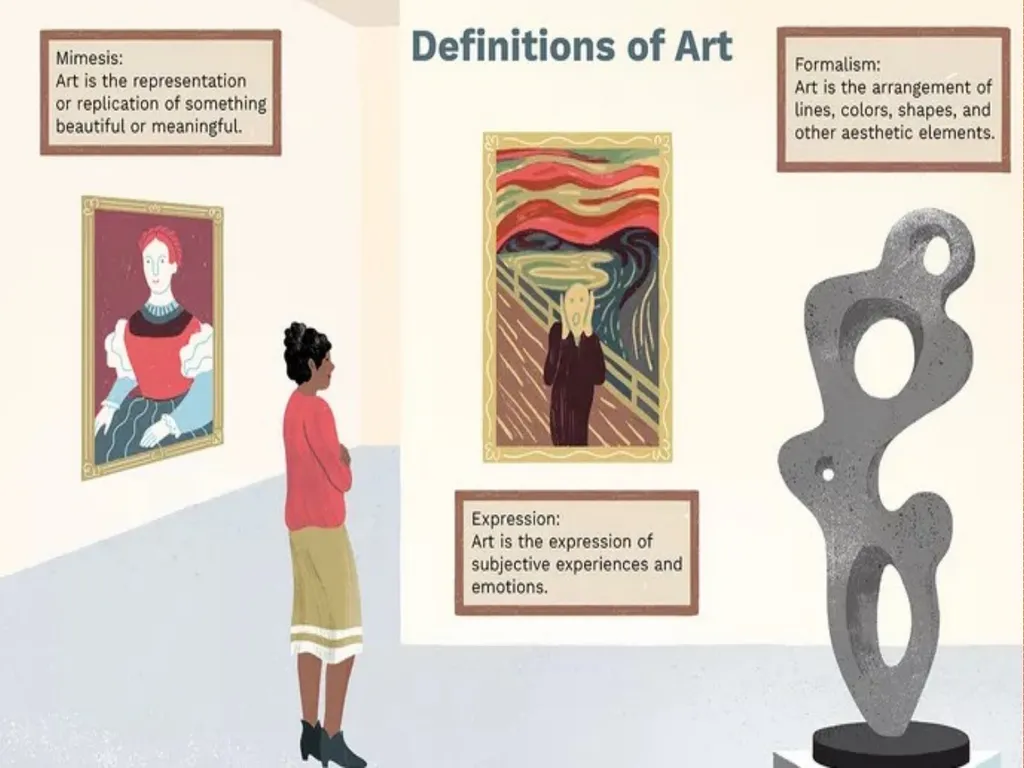
Philosophy of Art The definition of art has been debated for centuries among philosophers. The definition of art has generally fallen into 3 Categories : Representation, Expression and Form.
Art as Representation or Mimesis: Plato first developed the idea of art as “mimesis,” which, in Greek, means copying or imitation. For this reason, the primary meaning of art was, for centuries, defined as the representation or replication of something that is beautiful or meaningful.
Art as Expression of Emotional Content: Expression means expressing a definite feeling, as in the sublime or dramatic. Audience response was important, for the artwork was intended to evoke an emotional response. This definition holds true today, as artists look to connect with and evoke responses from their viewers.<br>
10
3. Art as Form: It says that art should not have a concept but should be judged only on its formal qualities .
Today, all three modes of definition come into play in determining what is art, and its value, depending on the artwork being assessed.<br>
Today, all three modes of definition come into play in determining what is art, and its value, depending on the artwork being assessed.<br>
11
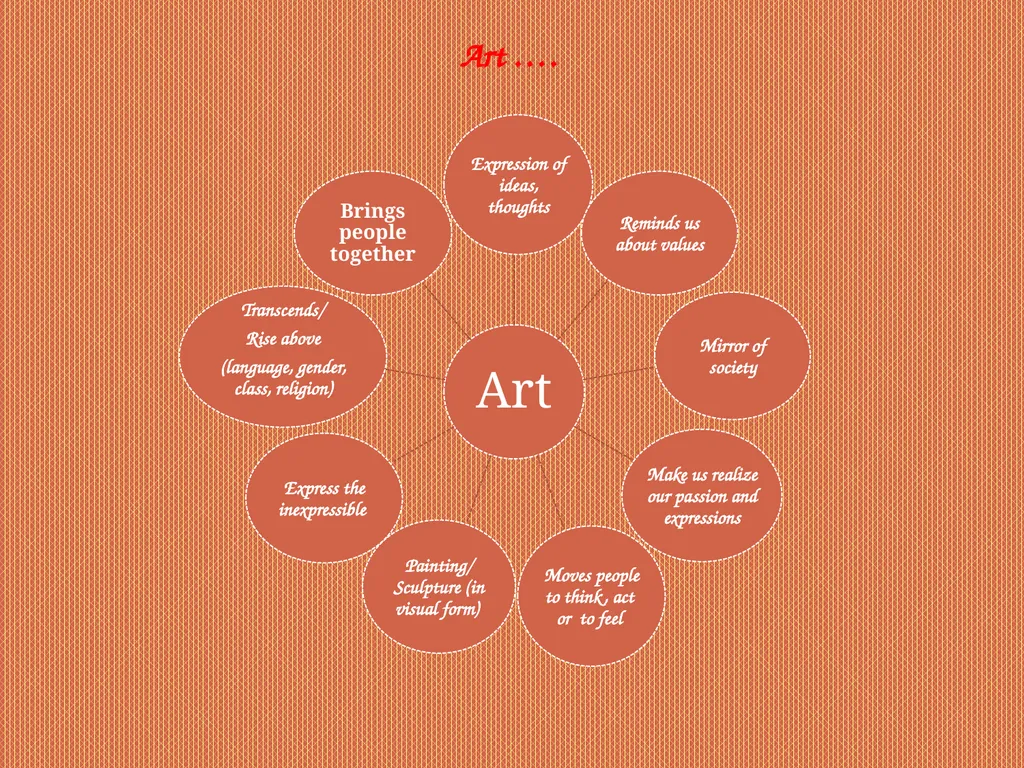
Art ….<br>
12
NATURE OF ART Art is Visual and Auditory : Visual art can be seen such as paintings, cinema, sculpture, architecture etc. and Auditory art can be heard and enjoyed like music, poetry and instrument playing.
Art is Concrete and Abstract: Paintings, sculpture, architecture etc. which we can see is concrete art and art that cannot be seen, but can be enjoyed like poetry, music is Abstract Art.
Art is Subjective and Objective: Subjective art is that which artist brings from his inner self in which the artist peeps into his inner soul and gets inspiration. It is influenced by emotions, feelings and opinion. (just feel and make painting from imagination). Objective art is that which we paint after having a glimpse of it. These are seen and copied. Example Ajanta paintings, picture of real garden/tree.
Art is Everywhere: Art is all around us. We are surrounded by art either natural or made by humans.
Art is Pleasure Giving : Art is the creation of beauty that gives pleasure and peace to our mind, body and soul.<br>
13
Art has no boundaries : Art is the work of imagination inspired from reality and cannot be limited into a boundary. It is free like nature and life.
Art is Spiritual: It helps us to attain oneness with God and explore our inner self. Through the ages people have used art to use for prayer and worship.
Art is Democratic: It gives freedom of expression to a person and it doesn’t discriminate anybody on the basis of caste, color and creed.<br>
Art is Spiritual: It helps us to attain oneness with God and explore our inner self. Through the ages people have used art to use for prayer and worship.
Art is Democratic: It gives freedom of expression to a person and it doesn’t discriminate anybody on the basis of caste, color and creed.<br>
14
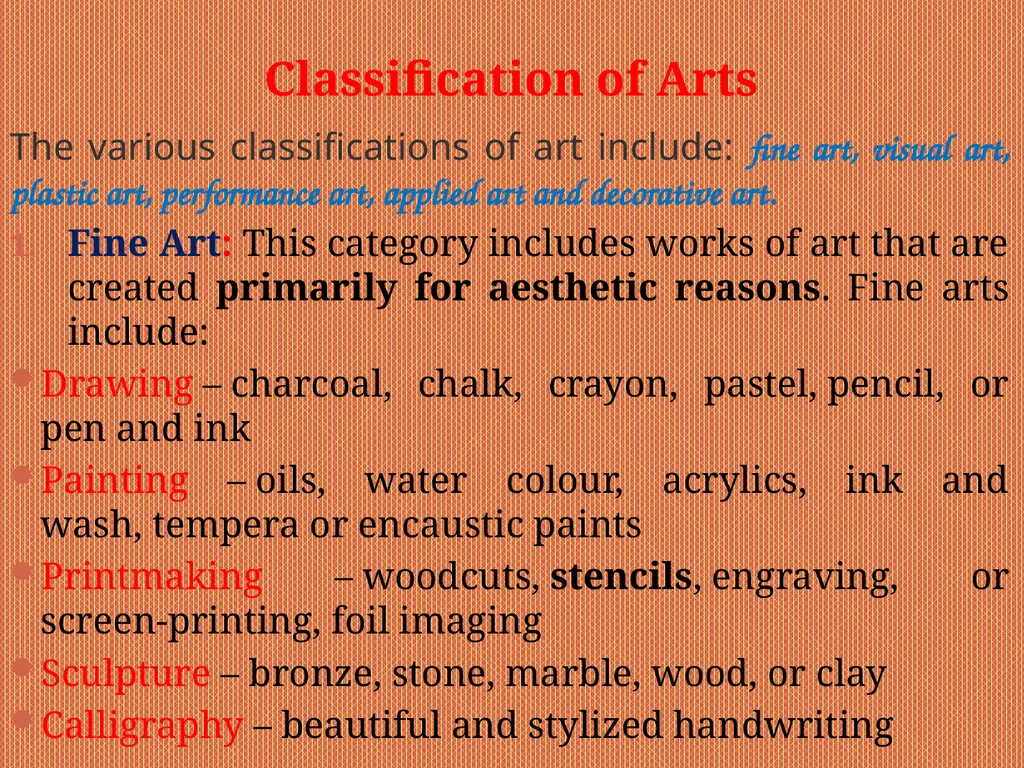
Classification of Arts The various classifications of art include: fine art, visual art, plastic art, performance art, applied art and decorative art.
Fine Art: This category includes works of art that are created primarily for aesthetic reasons. Fine arts include:
Drawing – charcoal, chalk, crayon, pastel, pencil, or pen and ink
Painting – oils, water colour, acrylics, ink and wash, tempera or encaustic paints
Printmaking – woodcuts, stencils, engraving, or screen-printing, foil imaging
Sculpture – bronze, stone, marble, wood, or clay
Calligraphy – beautiful and stylized handwriting<br>
15
2. THE VISUAL art ( Pictorial Activities/ Study of visual resources ) An artist uses paper, canvas, clay, metal, paint etc. which can be moulded or transformed to create some physical or art object. The visual arts include all the fine arts, in addition to the following:
Design (in jewellery, pottery, weaving, fabrics, etc.)
Contemporary topics include video, film, design
New media – digital art, computer graphics, computer animation, virtual art, Internet art, interactive art, video games, computer robotics, 3D printing
Photography art<br>
Design (in jewellery, pottery, weaving, fabrics, etc.)
Contemporary topics include video, film, design
New media – digital art, computer graphics, computer animation, virtual art, Internet art, interactive art, video games, computer robotics, 3D printing
Photography art<br>
16
3. THE PERFORMING/ Performance ARTS: The artist uses their own body, face and presence as a medium. It is something which is performed, seen and heard. So this classification consist of an art form that refers to public performance events which occur mostly in the theatre. Performance arts includes:
Traditional performance art – theatre, opera, music, and ballet
Contemporary performance art – mime
Artists who participate in performing arts in front of an audience are called Performers .They include actors, comedians, dancers, magicians, musicians, singers, puppeteers etc.<br>
Traditional performance art – theatre, opera, music, and ballet
Contemporary performance art – mime
Artists who participate in performing arts in front of an audience are called Performers .They include actors, comedians, dancers, magicians, musicians, singers, puppeteers etc.<br>
17
4.Three-dimensional or Plastic Art: The term plastic art includes art works that are moulded and not necessarily plastic objects. This category consists of three-dimensional works like clay, plaster, stone, metals, wood and, paper (origami).
5. Decorative Art: This classification refers to functional but ornamental art forms such as jewellery, ceramics, mosaic art . It also includes works in glass, clay, wood, metal, textile fabric, furniture, furnishings, stained glass.
6. Applied Art: This category encompasses the application of aesthetic designs to everyday functional objects. Applied arts are intended for the use of a career. It includes architecture, computer art, photography, industrial design, graphic design, fashion design, and interior design.<br>
18
Significance at the secondary level of school Education Art helps in the psychological development of a student: Art follows the rules and regulations of psychology. As in psychology every individual is unique. He has his own interest, feelings, ideas and emotions & psychology gives an outlet to the emotions of the individual. So as in the case of the art. Art also gives outlet or way to the emotions and feelings ideas and views of a person. And it also gives outlet to the creative expansion of a person and his inner ideas and can express his views.
Art helps in moral development: Art develops the quality of patience because he does his work with great patience and comfort. The aesthetic sense to look for beauty etc. is some points where concentration is needed. Art makes a person humble, honest and truthful. Art also develops endurance/tolerance. So all the moral qualities are developed with the help of art, which help him to become a good citizen of society.<br>
Art helps in moral development: Art develops the quality of patience because he does his work with great patience and comfort. The aesthetic sense to look for beauty etc. is some points where concentration is needed. Art makes a person humble, honest and truthful. Art also develops endurance/tolerance. So all the moral qualities are developed with the help of art, which help him to become a good citizen of society.<br>
19
Art helps in social development: Art makes a person socially reliable and self-dependent. In the realm of art, the manual work is of great importance but in one society it was seen as degraded job, but now days, an artist enjoys an equivalent status as a man sitting on the desk and working. Moreover it will break down the existing barriers of prejudice between manual or practical and intellectual workers. Now there is no looking down on each other for the differences of caste, creed, color, wealth, sex or age. All will work together cooperatively.
Moreover, art as a hobby as well as profession is of utmost value. A student when learns some applied arts and makes it a profession later on he enjoys and satisfies his inner appetite and on the same time, gets the reward for his work.<br>
Moreover, art as a hobby as well as profession is of utmost value. A student when learns some applied arts and makes it a profession later on he enjoys and satisfies his inner appetite and on the same time, gets the reward for his work.<br>
20
Arts helps in Spiritual upliftment : As we know that Indian art is derived from the philosophy and nor from the external beauty. Truth, goodness, beauty are the base of all the art. So art is more spiritual in nature. It helps us to attain oneness with God and explore our inner self. It is also considered essential for spiritual upliftment. An artist feels oneness with god and with nature through art.
All Round development: Art is the best way to express one’s views, ideas, emotions and expression. It gives freedom to mind. It gives pleasure and relaxes the man’s mind. It helps economically as a man can earn his living by adopting art as a profession. It makes a person socially reliable. It develops in a student all moral qualities like patience, satisfaction, endurance etc. So it develops a person intellectually when he gets the training of these skills. Art is very much responsible for all round development of a student.<br>
All Round development: Art is the best way to express one’s views, ideas, emotions and expression. It gives freedom to mind. It gives pleasure and relaxes the man’s mind. It helps economically as a man can earn his living by adopting art as a profession. It makes a person socially reliable. It develops in a student all moral qualities like patience, satisfaction, endurance etc. So it develops a person intellectually when he gets the training of these skills. Art is very much responsible for all round development of a student.<br>
21
Art helps in Economical development: Those who utilize leisure time in their hobby or craft, that work will bring them some remuneration also. Art helps an artist to make him financially strong. When he sells his paintings he can earn easily for his living. So by adopting art as a profession his financial condition will become more sound. He will become self-dependent.
Art helps to save and develop culture: without art man is not able to get the knowledge of culture and civilizations. It is the art that preserves the culture and old civilization in the museums. We can see the toys, jewellery, pottery, coins and art pieces of the past. The art is the treasure of the culture of the past civilization. It’s a important medium to pass the knowledge and art of the past to the future. It is the door through which we can see the values, customs, traditions and the art of the past.<br>
Art helps to save and develop culture: without art man is not able to get the knowledge of culture and civilizations. It is the art that preserves the culture and old civilization in the museums. We can see the toys, jewellery, pottery, coins and art pieces of the past. The art is the treasure of the culture of the past civilization. It’s a important medium to pass the knowledge and art of the past to the future. It is the door through which we can see the values, customs, traditions and the art of the past.<br>
22
Students sharpen Critical Intellectual skills: The arts foster higher levels of thinking that carry over to learning other academic subjects as well as to life outside of school. Through the arts, children learn to observe, interpret, see different perspectives, analyze and synthesize. In a world where students must frequently wade through a sea of information to determine which facts are trustworthy and relevant to a particular topic, critical thinking skills are key to lifelong learning.
Art fosters the power of Imagination and Observation: Art is very much responsible for the development of these qualities. Student has to observe the surroundings, environment before drawing/sketching, memorizing dance steps, playing an instrument or to act in a drama. Without sound observation and imagination, it is impossible to create or think about a scene. So they are also learning how to develop new concepts.<br>
Art fosters the power of Imagination and Observation: Art is very much responsible for the development of these qualities. Student has to observe the surroundings, environment before drawing/sketching, memorizing dance steps, playing an instrument or to act in a drama. Without sound observation and imagination, it is impossible to create or think about a scene. So they are also learning how to develop new concepts.<br>
23
It Increases Student Engagement: The arts provide many opportunities for students to demonstrate their skills through their performance. It enables children to grow in confidence and learn how to think positively about themselves and learning. Working together for a common purpose teaches children that their contribution is important, which is perfect for the collaborative nature of the arts. By working collaboratively on a project, students learn to communicate more effectively, compromise when necessary and work hard even if their role may seem small. All of these skills are vital in any work environment where teams come together for a common goal.<br>
24
Arts enhance creativity: Arts education develops creativity. It gives opportunity to create new things. It develops creative emotions in the minds of the children. Imagine classes in which students create original artwork filled with color that displays a creative use of space, developing their own rhythms, or writing and producing their own plays. Example, in a class if we give any topic to students to make a poster then no 2 posters will be same. Every poster will be different from each other because every children is unique and thinks according to his own way of thinking and choice. These type of classes provide a wonderful environment for fostering creativity, which is an important skill to have in a rapidly changing world.
Art develops Aesthetic sense: Art helps in the aesthetic development of a person and along with aesthetic sense, self expression is also developed. With the help of art, a person is able to appreciate and criticize a work of art. With the help of aesthetic sense, we can make things more beautiful. Example without any sculpture we would have no monument, architectural designs of cities would be reduced to logs of cabins only. So it is the aesthetic sense that helps a person to make the things beautiful and attractive.<br>
Art develops Aesthetic sense: Art helps in the aesthetic development of a person and along with aesthetic sense, self expression is also developed. With the help of art, a person is able to appreciate and criticize a work of art. With the help of aesthetic sense, we can make things more beautiful. Example without any sculpture we would have no monument, architectural designs of cities would be reduced to logs of cabins only. So it is the aesthetic sense that helps a person to make the things beautiful and attractive.<br>
25
Children learn positive habits, behaviours and attitudes: Arts education helps foster a positive culture and climate in schools. When schools integrate the arts across the curriculum, effectiveness of instruction and teachers’ ability to meet the needs of all students increase. Learning a musical instrument, creating a painting, learning to dance, or singing in a chorus teaches that taking small steps, practicing to improve, being persistent, and being patient are important for children’s growth and improvement. Students gain confidence as they try to accomplish things that do not come easily. Learning an artistic discipline helps young people develop character. Students learn habits, behaviours and attitudes that are necessary for success in any field of endeavour.<br>
26
Art is helpful in utilization of leisure time: With the help of art one can use his leisure time very accurately. He can develop his hobbies in this free time. And he can make them his profession for his future. With the help of these hobbies, he can earn for his living easily. When a person changes his attitude about his leisure time he will always try to use that time more and more. He can discover new facts and can develop new technique of painting. So there will be no wastage of free time.
Art helps to acquire habit of concentration and application : When a person draws and paints a picture, he first of all concentrates over the scene which he wants to draw. Then he cares for drawing or Sketching i.e. if its similar to the imagination or not. And after drawing a pencil sketch, he concentrates on the colors which he wants to use in his painting. So we can see the concentration first and after that application. Only after concentrating on the things to be drawn, one can apply it in his work of art. Both are very essential steps. Without concentration there will be no imagination and without imagination we will not be able to create a thing and we cannot apply it in our work of art. So to make a good piece of art, we should concentrate and only then it is possible to apply it in art.<br>
Art helps to acquire habit of concentration and application : When a person draws and paints a picture, he first of all concentrates over the scene which he wants to draw. Then he cares for drawing or Sketching i.e. if its similar to the imagination or not. And after drawing a pencil sketch, he concentrates on the colors which he wants to use in his painting. So we can see the concentration first and after that application. Only after concentrating on the things to be drawn, one can apply it in his work of art. Both are very essential steps. Without concentration there will be no imagination and without imagination we will not be able to create a thing and we cannot apply it in our work of art. So to make a good piece of art, we should concentrate and only then it is possible to apply it in art.<br>
27
Arts help to understand other subjects in education and make those subjects more interesting: With the help of art the theoretical subjects can be taught easily. By correlating art with these subjects we can make them more interesting for eg. In maths if we want to make the students learn about addition eg 4+10 we can make 4 chocolates and 10 toffees. The students will immediately count the things. Because they like these things very much. By showing visual aids we can make the lessons very impressive and interesting. And these aids can be made with the help of arts only.
Art helps to save time : When art is correlated with other subjects and two or more subjects are taught collectively then the time of both teacher and student is saved. When the topic is taught with audio-visual aids, students take more interest and understand better. Teacher’s work becomes less and easy. So it saves time while teaching.
Art makes subjects easy: Art is very much responsible to make other theoretical subjects easy to understand. Use of audio-visual aids help the student to clear those facts and concepts which are not so clear to them<br>
28
Art gives us the knowledge of past: Art helps us to know about people who lived in the past. We come to know the art and life of the past. Art is preserved throughout the world, in museums. The people of the Indus valley civilization lived thousand years ago, yet we can see samples of their toys,jewellery, pottery that has been preserved in the national museums New Delhi. By studying their art forms, we can learn how those people lived, dressed and enriched their lives.
Arts makes knowledge interesting : With the help of art, we can make the dull/boring theoretical subject easy and interesting. When we add a visual form with any theoretical topics/subjects it becomes very interesting. Example when we tell a story to the children the effect is less on them. But when we show the picture, it will effect more and they will show more interest and their learning power will increase.
Art helps in achieving better grades in Examination: By making diagrams and illustrations in Examination student can enhance his presentation skills in any subject and make his paper more effective. It leaves a good impression on the mind of examiner and student can get better score by using art in his examination.
.<br>
29
Conclusion Art helps the child to live more graciously in school and out. It provides an outlet for his thoughts and feelings and for his creative imagination. Art education stimulates a growing point in the child’s mental and spiritual make up. Thus the teacher must provide the atmosphere and the material within which his unfolding can take place.
Art as school subject is of great value. It is the centre of all the activities. It develops in the students the aesthetic sense. An appreciation sense enables them to develop socially, physically, intellectually, psychologically and morally. We can say that without art every school subject will become dull and bore. So it is very important to include art as a school subject in school curriculum.<br>
Art as school subject is of great value. It is the centre of all the activities. It develops in the students the aesthetic sense. An appreciation sense enables them to develop socially, physically, intellectually, psychologically and morally. We can say that without art every school subject will become dull and bore. So it is very important to include art as a school subject in school curriculum.<br>