Introduction Discussion Acknowledgements
Description: Introduction Discussion Acknowledgements Individuals who identify as a sexual andor gender minority (LGBTQ) report significantly higher rates of suicide ideation than heterosexuals (Stone et al., 2014). Identifying factors that may lead
Related Topics
Download Presentation
"Introduction Discussion Acknowledgements" is the property of its rightful owner. Permission is granted to download and print the materials on this website for personal, non-commercial use only, and to display it on your personal computer provided you do not modify the materials and that you retain all copyright notices contained in the materials. By downloading content from our website, you accept the terms of this agreement.
Presentation Transcript
slide1. Introduction Discussion Acknowledgements Individuals who identify as a sexual and/or gender minority (LGBTQ+) report significantly higher rates of suicide ideation than heterosexuals (Stone et al., 2014). Identifying factors that may lead to, or protect against, this discrepancy in risk is important for protecting LGBTQ+ youth and preventing suicide in this population.
Minority Stress Theory (Meyer, 2003) argues that individuals in minority groups often face more hostile and stressful social environments which may cause mental health problems and potentially increase risk for suicide. The Interpersonal-Psychological Theory of suicide (Joiner, 2005) argues that suicide ideation emerges from chronic experiences of thwarted belongingness and perceived burdensomeness.
We combined these two theories to examine how expectation of rejection from peers relates to thwarted belonging and burdensomeness, and how these contribute to increased suicidal ideation.
Few studies look at protective factors, but one identified that self-esteem reduced risk among LGBTQ college students (Peter et al., 2014). We aimed to expand existing research by examining a potential protective factor, empowerment, to evaluate whether this factor would change the strength of the associations between our variables and suicide ideation.
Hypotheses: Feelings of burdensomeness and thwarted
belongingness would mediate the relationship between
expectation of rejection and suicidal ideation, and
empowerment would moderate the association between these
interpersonal difficulties and suicidal ideation.
We proposed an alternative model, where empowerment
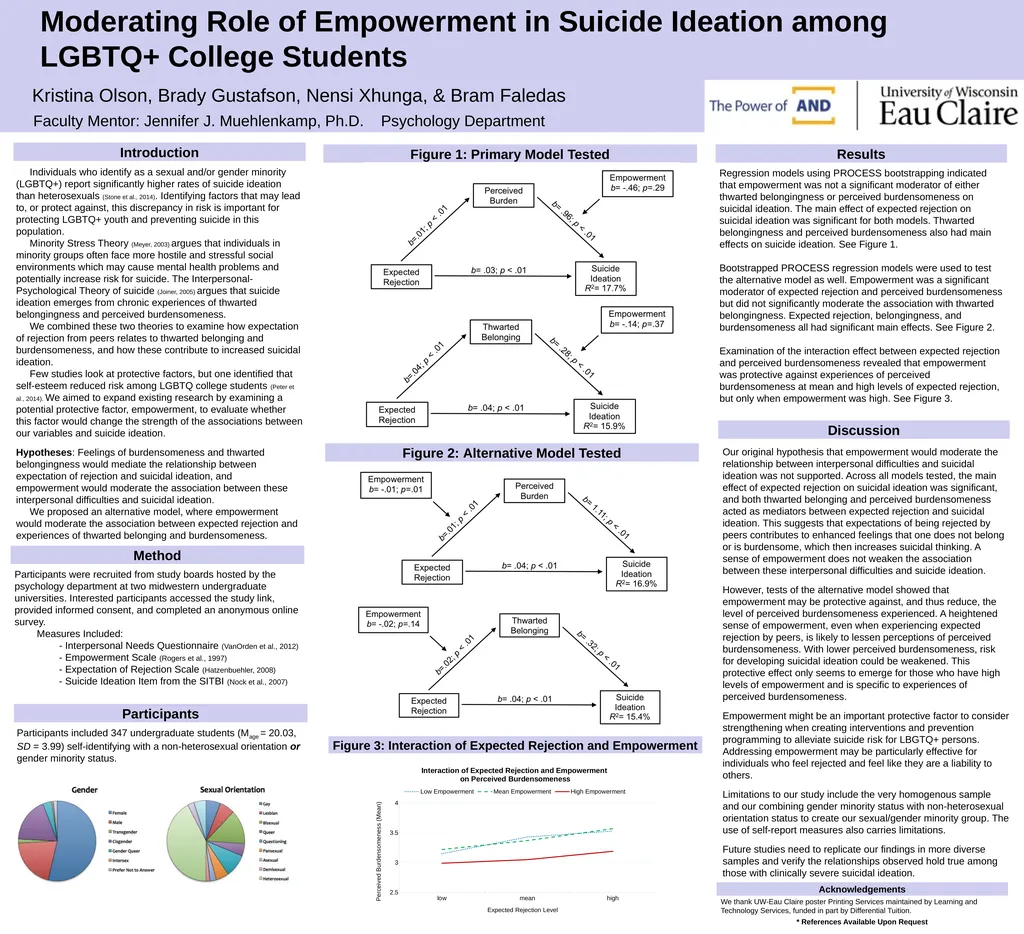
would moderate the association between expected rejection and experiences of thwarted belonging and burdensomeness. Our original hypothesis that empowerment would moderate the relationship between interpersonal difficulties and suicidal ideation was not supported. Across all models tested, the main effect of expected rejection on suicidal ideation was significant, and both thwarted belonging and perceived burdensomeness acted as mediators between expected rejection and suicidal ideation. This suggests that expectations of being rejected by peers contributes to enhanced feelings that one does not belong or is burdensome, which then increases suicidal thinking. A sense of empowerment does not weaken the association between these interpersonal difficulties and suicide ideation.
However, tests of the alternative model showed that empowerment may be protective against, and thus reduce, the level of perceived burdensomeness experienced. A heightened sense of empowerment, even when experiencing expected rejection by peers, is likely to lessen perceptions of perceived burdensomeness. With lower perceived burdensomeness, risk for developing suicidal ideation could be weakened. This protective effect only seems to emerge for those who have high levels of empowerment and is specific to experiences of perceived burdensomeness.
Empowerment might be an important protective factor to consider strengthening when creating interventions and prevention programming to alleviate suicide risk for LBGTQ+ persons. Addressing empowerment may be particularly effective for individuals who feel rejected and feel like they are a liability to others.
Limitations to our study include the very homogenous sample and our combining gender minority status with non-heterosexual orientation status to create our sexual/gender minority group. The use of self-report measures also carries limitations.
Future studies need to replicate our findings in more diverse samples and verify the relationships observed hold true among those with clinically severe suicidal ideation. We thank UW-Eau Claire poster Printing Services maintained by Learning and Technology Services, funded in part by Differential Tuition. * References Available Upon Request Participants Regression models using PROCESS bootstrapping indicated
that empowerment was not a significant moderator of either thwarted belongingness or perceived burdensomeness on suicidal ideation. The main effect of expected rejection on suicidal ideation was significant for both models. Thwarted belongingness and perceived burdensomeness also had main effects on suicide ideation. See Figure 1.
Bootstrapped PROCESS regression models were used to test the alternative model as well. Empowerment was a significant moderator of expected rejection and perceived burdensomeness but did not significantly moderate the association with thwarted belongingness. Expected rejection, belongingness, and burdensomeness all had significant main effects. See Figure 2.
Examination of the interaction effect between expected rejection and perceived burdensomeness revealed that empowerment was protective against experiences of perceived burdensomeness at mean and high levels of expected rejection, but only when empowerment was high. See Figure 3. Figure 1: Primary Model Tested Figure 2: Alternative Model Tested Figure 3: Interaction of Expected Rejection and Empowerment Results Method Participants were recruited from study boards hosted by the psychology department at two midwestern undergraduate universities. Interested participants accessed the study link, provided informed consent, and completed an anonymous online survey.
Measures Included:
- Interpersonal Needs Questionnaire (VanOrden et al., 2012)
- Empowerment Scale (Rogers et al., 1997)
- Expectation of Rejection Scale (Hatzenbuehler, 2008)
- Suicide Ideation Item from the SITBI (Nock et al., 2007) Participants included 347 undergraduate students (Mage = 20.03, SD = 3.99) self-identifying with a non-heterosexual orientation or gender minority status. Moderating Role of Empowerment in Suicide Ideation among LGBTQ+ College Students Kristina Olson, Brady Gustafson, Nensi Xhunga, & Bram Faledas Faculty Mentor: Jennifer J. Muehlenkamp, Ph.D. Psychology Department<br>

Minority Stress Theory (Meyer, 2003) argues that individuals in minority groups often face more hostile and stressful social environments which may cause mental health problems and potentially increase risk for suicide. The Interpersonal-Psychological Theory of suicide (Joiner, 2005) argues that suicide ideation emerges from chronic experiences of thwarted belongingness and perceived burdensomeness.
We combined these two theories to examine how expectation of rejection from peers relates to thwarted belonging and burdensomeness, and how these contribute to increased suicidal ideation.
Few studies look at protective factors, but one identified that self-esteem reduced risk among LGBTQ college students (Peter et al., 2014). We aimed to expand existing research by examining a potential protective factor, empowerment, to evaluate whether this factor would change the strength of the associations between our variables and suicide ideation.
Hypotheses: Feelings of burdensomeness and thwarted
belongingness would mediate the relationship between
expectation of rejection and suicidal ideation, and
empowerment would moderate the association between these
interpersonal difficulties and suicidal ideation.
We proposed an alternative model, where empowerment
would moderate the association between expected rejection and experiences of thwarted belonging and burdensomeness. Our original hypothesis that empowerment would moderate the relationship between interpersonal difficulties and suicidal ideation was not supported. Across all models tested, the main effect of expected rejection on suicidal ideation was significant, and both thwarted belonging and perceived burdensomeness acted as mediators between expected rejection and suicidal ideation. This suggests that expectations of being rejected by peers contributes to enhanced feelings that one does not belong or is burdensome, which then increases suicidal thinking. A sense of empowerment does not weaken the association between these interpersonal difficulties and suicide ideation.
However, tests of the alternative model showed that empowerment may be protective against, and thus reduce, the level of perceived burdensomeness experienced. A heightened sense of empowerment, even when experiencing expected rejection by peers, is likely to lessen perceptions of perceived burdensomeness. With lower perceived burdensomeness, risk for developing suicidal ideation could be weakened. This protective effect only seems to emerge for those who have high levels of empowerment and is specific to experiences of perceived burdensomeness.
Empowerment might be an important protective factor to consider strengthening when creating interventions and prevention programming to alleviate suicide risk for LBGTQ+ persons. Addressing empowerment may be particularly effective for individuals who feel rejected and feel like they are a liability to others.
Limitations to our study include the very homogenous sample and our combining gender minority status with non-heterosexual orientation status to create our sexual/gender minority group. The use of self-report measures also carries limitations.
Future studies need to replicate our findings in more diverse samples and verify the relationships observed hold true among those with clinically severe suicidal ideation. We thank UW-Eau Claire poster Printing Services maintained by Learning and Technology Services, funded in part by Differential Tuition. * References Available Upon Request Participants Regression models using PROCESS bootstrapping indicated
that empowerment was not a significant moderator of either thwarted belongingness or perceived burdensomeness on suicidal ideation. The main effect of expected rejection on suicidal ideation was significant for both models. Thwarted belongingness and perceived burdensomeness also had main effects on suicide ideation. See Figure 1.
Bootstrapped PROCESS regression models were used to test the alternative model as well. Empowerment was a significant moderator of expected rejection and perceived burdensomeness but did not significantly moderate the association with thwarted belongingness. Expected rejection, belongingness, and burdensomeness all had significant main effects. See Figure 2.
Examination of the interaction effect between expected rejection and perceived burdensomeness revealed that empowerment was protective against experiences of perceived burdensomeness at mean and high levels of expected rejection, but only when empowerment was high. See Figure 3. Figure 1: Primary Model Tested Figure 2: Alternative Model Tested Figure 3: Interaction of Expected Rejection and Empowerment Results Method Participants were recruited from study boards hosted by the psychology department at two midwestern undergraduate universities. Interested participants accessed the study link, provided informed consent, and completed an anonymous online survey.
Measures Included:
- Interpersonal Needs Questionnaire (VanOrden et al., 2012)
- Empowerment Scale (Rogers et al., 1997)
- Expectation of Rejection Scale (Hatzenbuehler, 2008)
- Suicide Ideation Item from the SITBI (Nock et al., 2007) Participants included 347 undergraduate students (Mage = 20.03, SD = 3.99) self-identifying with a non-heterosexual orientation or gender minority status. Moderating Role of Empowerment in Suicide Ideation among LGBTQ+ College Students Kristina Olson, Brady Gustafson, Nensi Xhunga, & Bram Faledas Faculty Mentor: Jennifer J. Muehlenkamp, Ph.D. Psychology Department<br>