04
Question 3 Question 3: What is a good explanation?
Example: What makes the drinking of contaminated water a good explanation of certain instances of disease, or the big bang theory a good explanation of the current state of the universe? 4<br>
05
Question 4 Question 4: Can we know about the unobserved world on the basis of what we know about the observed world? Relatedly, can we know that our best scientific theories are true, or at least approximately true?
Example: Can the observed results of experiments and measurements give us good reason to think that there are electrons, or that global warming is occurring? 5<br>
06
Topics of the course There will be 10 2hr seminars covering five topics:
Hume’s problem of induction
The Ravens paradox
The Grue paradox
Explanation
Scientific realism
Each topic will be have required and optional readings
For further administration information, see the course guide 6<br>
07
Topic 1: Hume’s problem of Induction Required reading: ‘The Problem of Induction’, Section I, Chapter 7 of Richard Feldman’s book Epistemology pp 130-141 (on course website)
Optional reading: ‘Popper: Conjectures and Refutation’, Chapter 4 of Peter Godfrey Smith’s book Theory and Reality (which can be downloaded from HKU library) 7<br>
08
Note on required reading In a few sentences, Feldman uses the following terminology introduced in the early chapters: ‘the standard view’, ‘fallibism’, ‘high standards scepticism’, and ‘modest foundationalism’.
‘The standard view’ means roughly the commonsense view of what we know and how we know it.
The sentences containing the other terms can be ignored without loss. 8<br>
09
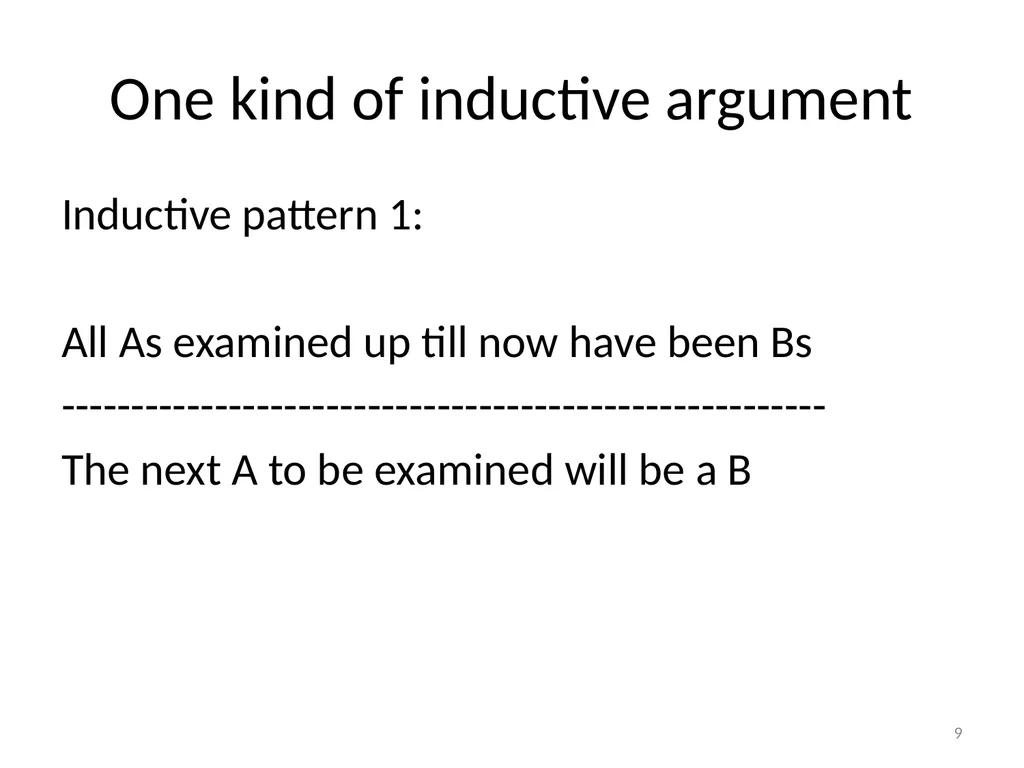
One kind of inductive argument Inductive pattern 1:
All As examined up till now have been Bs
-------------------------------------------------------
The next A to be examined will be a B 9<br>
10
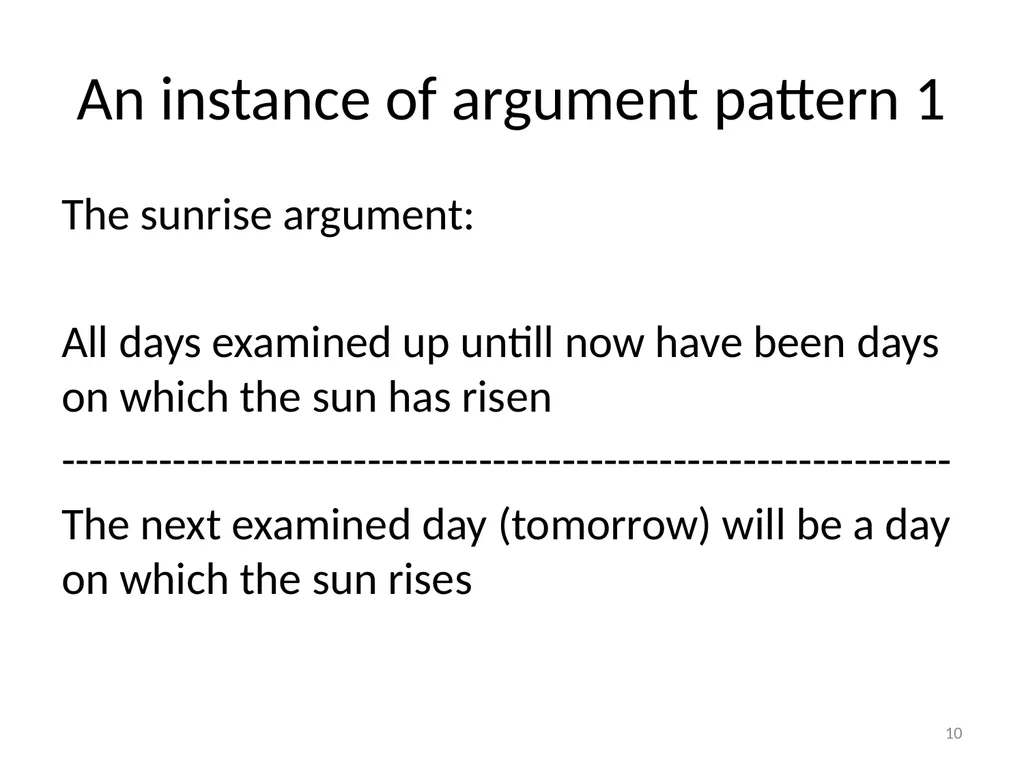
An instance of argument pattern 1 The sunrise argument:
All days examined up untill now have been days on which the sun has risen
----------------------------------------------------------------
The next examined day (tomorrow) will be a day on which the sun rises 10<br>
11
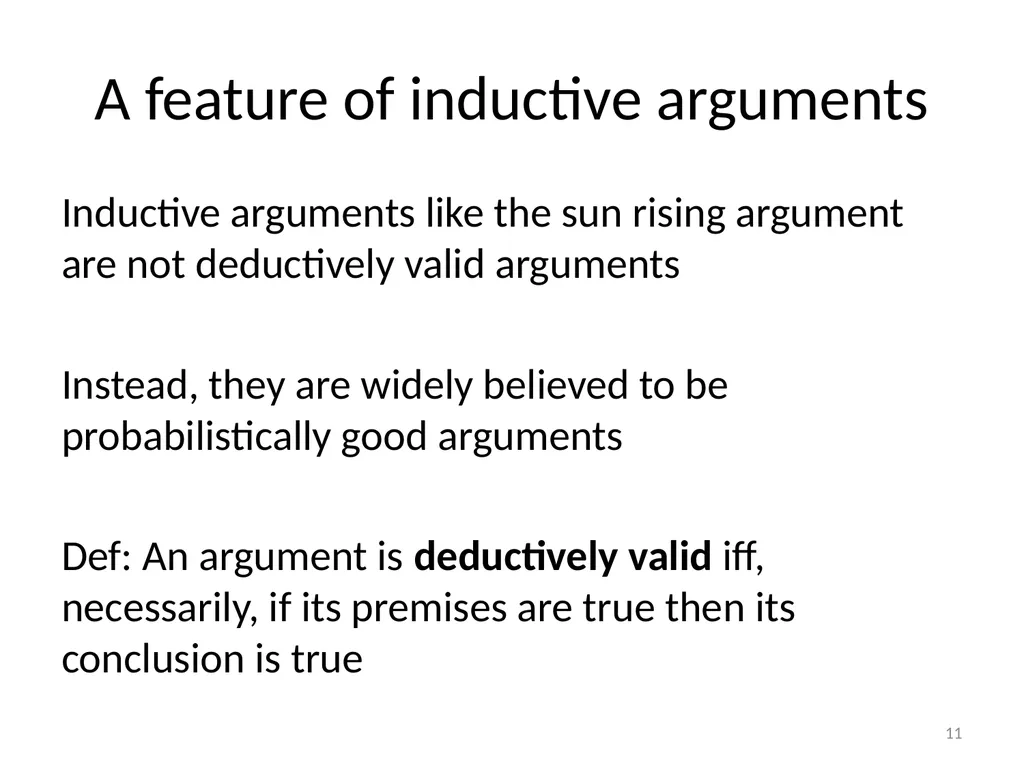
A feature of inductive arguments Inductive arguments like the sun rising argument are not deductively valid arguments
Instead, they are widely believed to be probabilistically good arguments
Def: An argument is deductively valid iff, necessarily, if its premises are true then its conclusion is true 11<br>
12
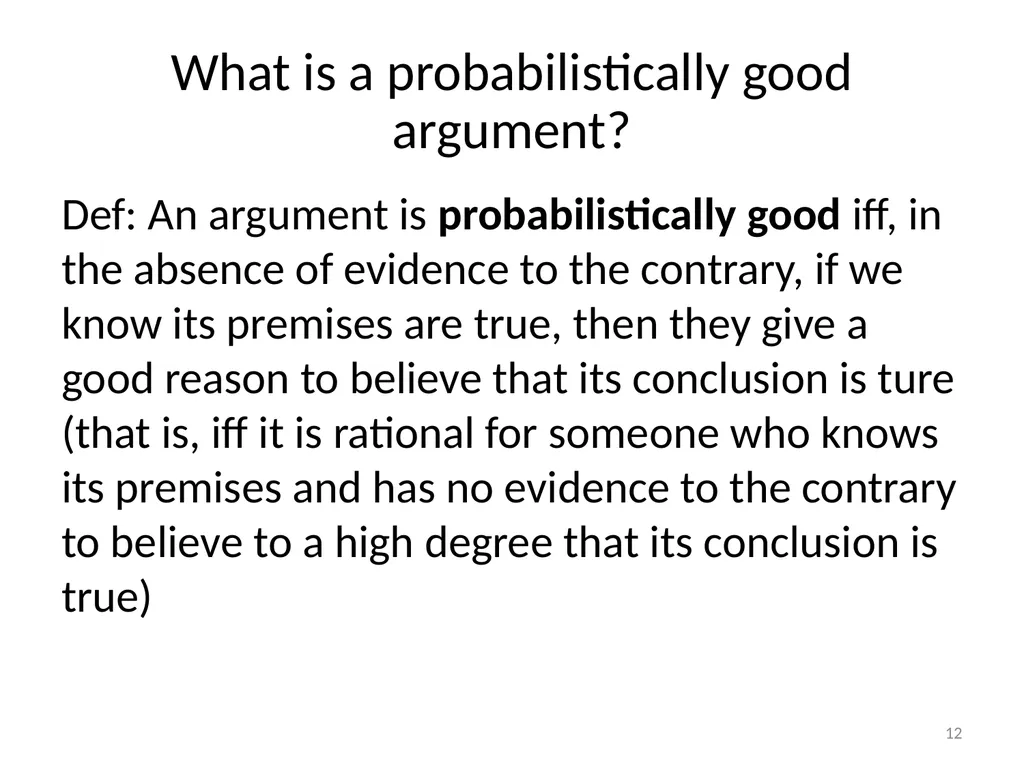
What is a probabilistically good argument? Def: An argument is probabilistically good iff, in the absence of evidence to the contrary, if we know its premises are true, then they give a good reason to believe that its conclusion is ture (that is, iff it is rational for someone who knows its premises and has no evidence to the contrary to believe to a high degree that its conclusion is true) 12<br>
13
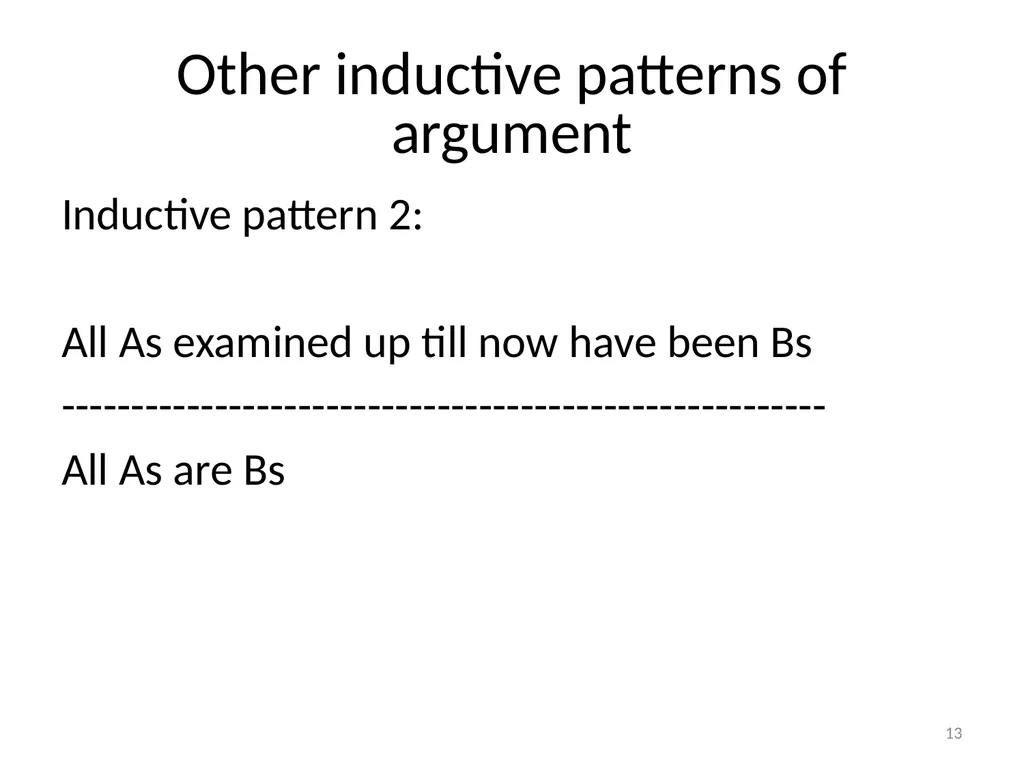
Other inductive patterns of argument Inductive pattern 2:
All As examined up till now have been Bs
-------------------------------------------------------
All As are Bs 13<br>
14
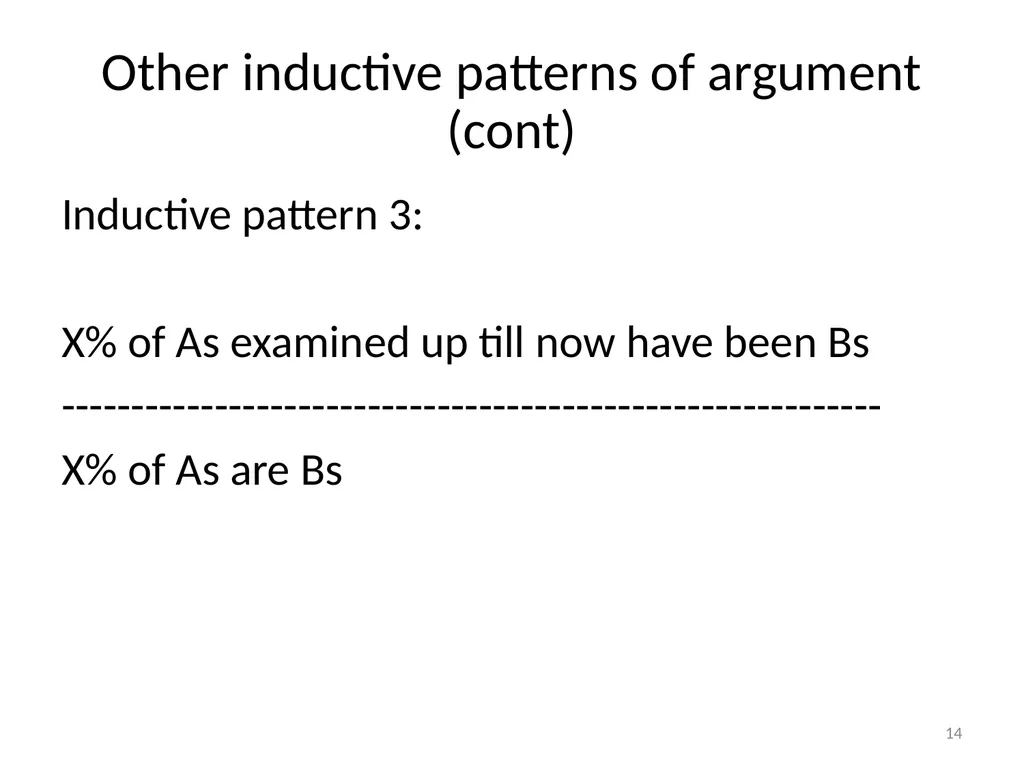
Other inductive patterns of argument (cont) Inductive pattern 3:
X% of As examined up till now have been Bs
-----------------------------------------------------------
X% of As are Bs 14<br>
15
The importance of inductive arguments If inductive arguments were probabilistically good, then many of our beliefs would be unjustified
Examples:
i) beliefs about what restaurants are good,
ii) beliefs about what will happen when a light switch is pressed
iii) beliefs about how to get to uni
iv) the belief that the world will not end tomorrow 15<br>
16
Hume’s problem David Hume (1711-1776) asked: Do we have any good reason to accept the conclusions of inductive arguments? (That is, are inductive arguments probabilistically good?)
Hume argued that the answer is no! 16<br>
17
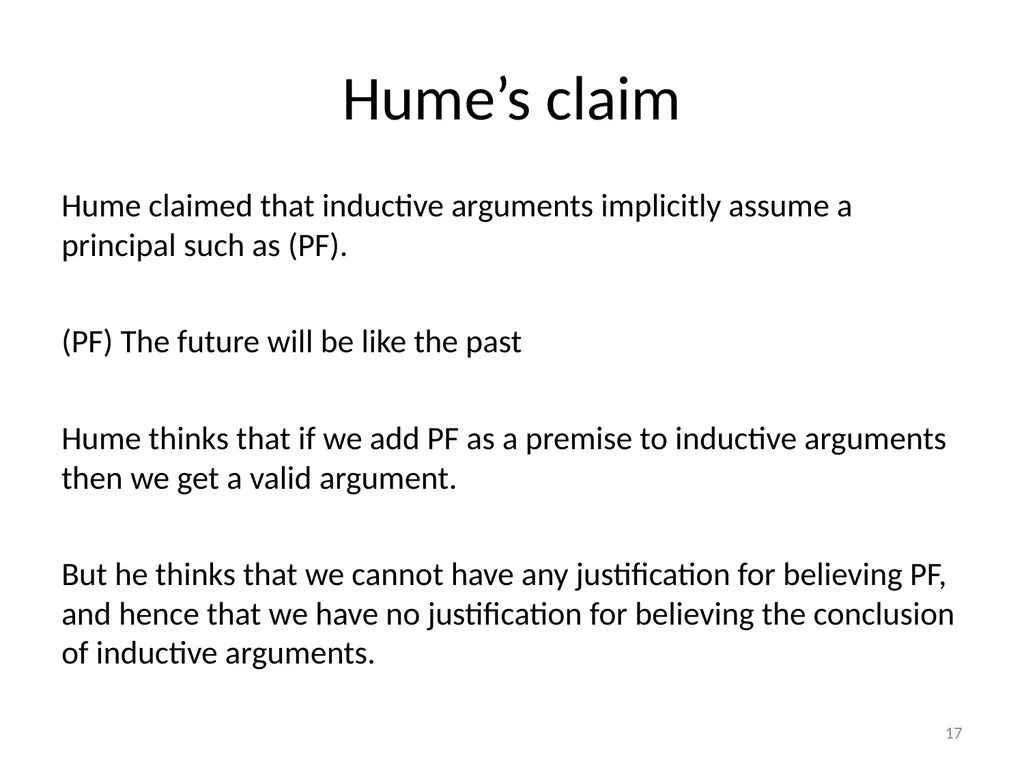
Hume’s claim Hume claimed that inductive arguments implicitly assume a principal such as (PF).
(PF) The future will be like the past
Hume thinks that if we add PF as a premise to inductive arguments then we get a valid argument.
But he thinks that we cannot have any justification for believing PF, and hence that we have no justification for believing the conclusion of inductive arguments. 17<br>
18
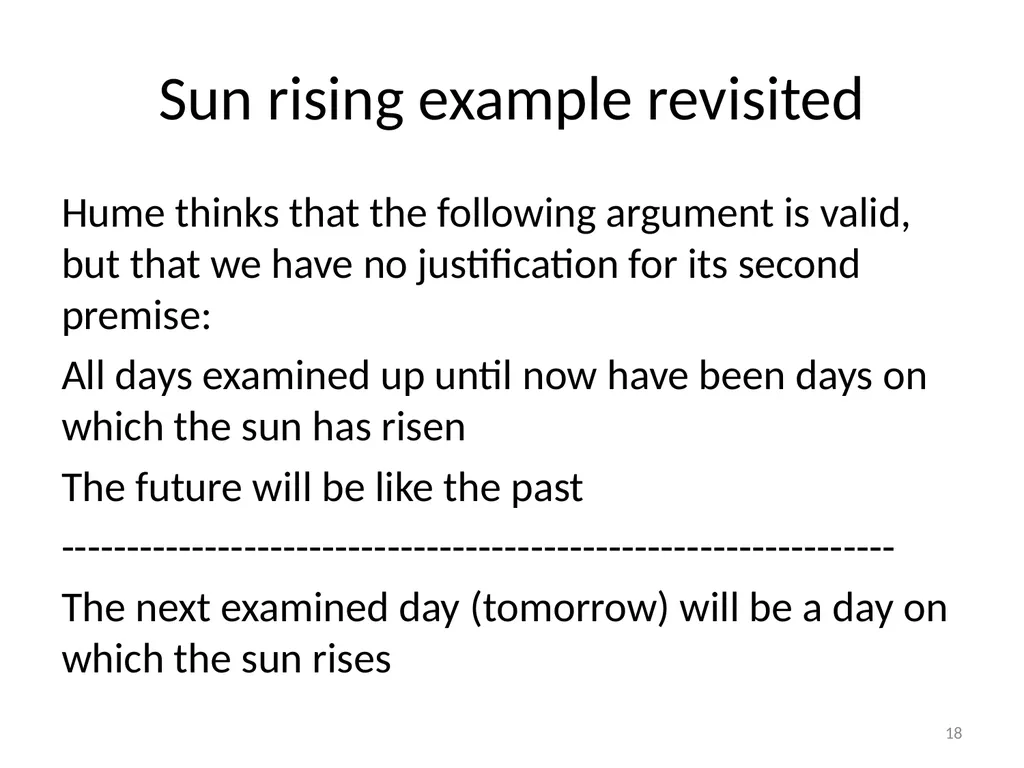
Sun rising example revisited Hume thinks that the following argument is valid, but that we have no justification for its second premise:
All days examined up until now have been days on which the sun has risen
The future will be like the past
----------------------------------------------------------------
The next examined day (tomorrow) will be a day on which the sun rises 18<br>
19
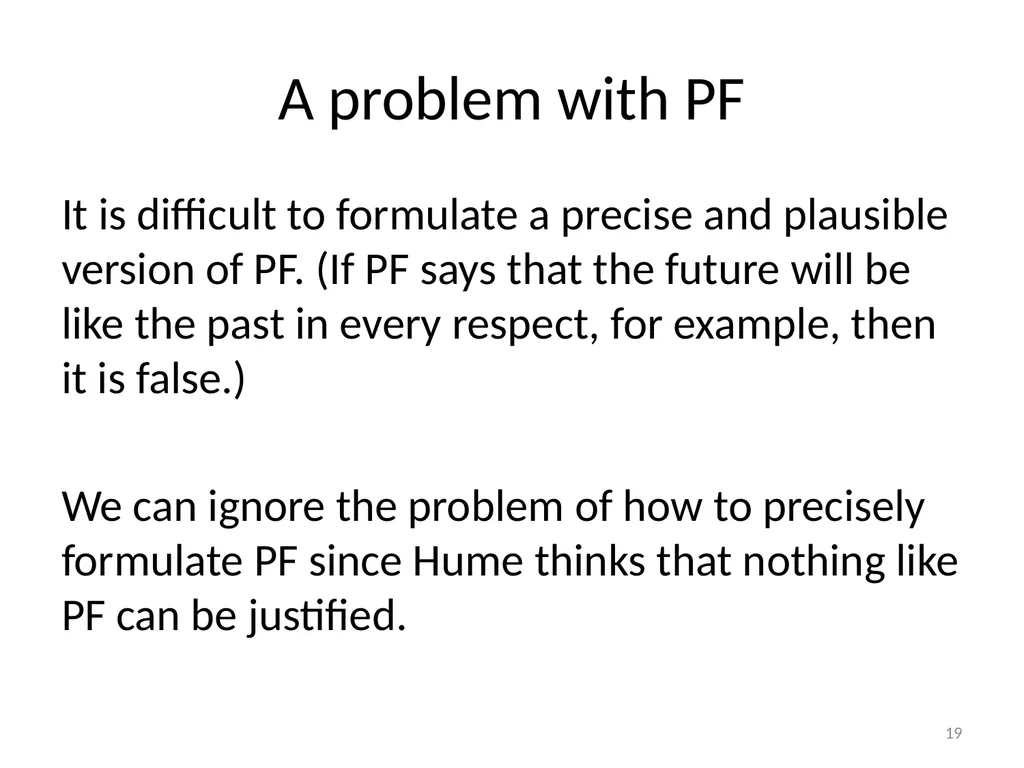
A problem with PF It is difficult to formulate a precise and plausible version of PF. (If PF says that the future will be like the past in every respect, for example, then it is false.)
We can ignore the problem of how to precisely formulate PF since Hume thinks that nothing like PF can be justified. 19<br>
20
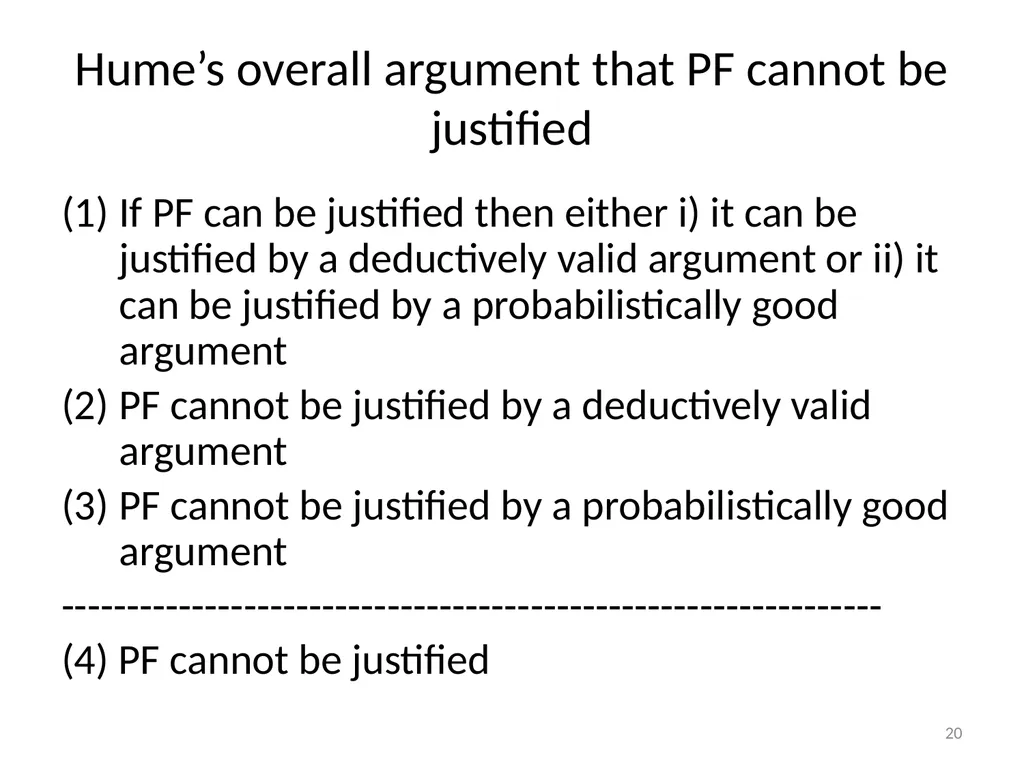
Hume’s overall argument that PF cannot be justified If PF can be justified then either i) it can be justified by a deductively valid argument or ii) it can be justified by a probabilistically good argument
PF cannot be justified by a deductively valid argument
PF cannot be justified by a probabilistically good argument
---------------------------------------------------------------
(4) PF cannot be justified 20<br>
21
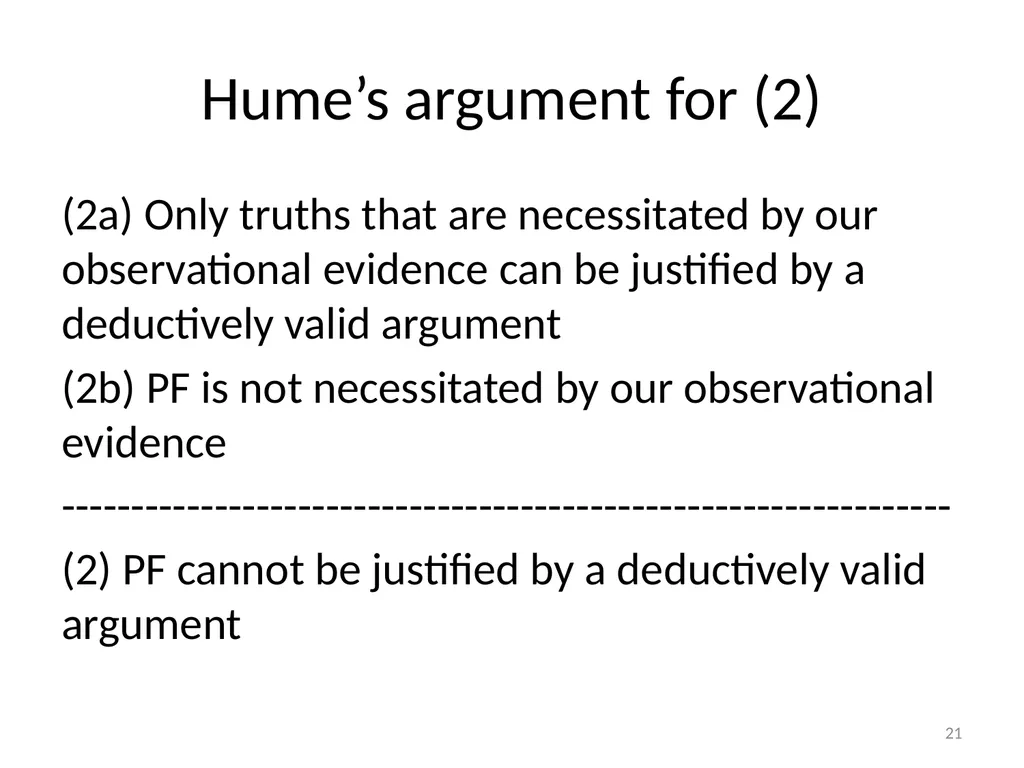
Hume’s argument for (2) (2a) Only truths that are necessitated by our observational evidence can be justified by a deductively valid argument
(2b) PF is not necessitated by our observational evidence
----------------------------------------------------------------
(2) PF cannot be justified by a deductively valid argument 21<br>
22
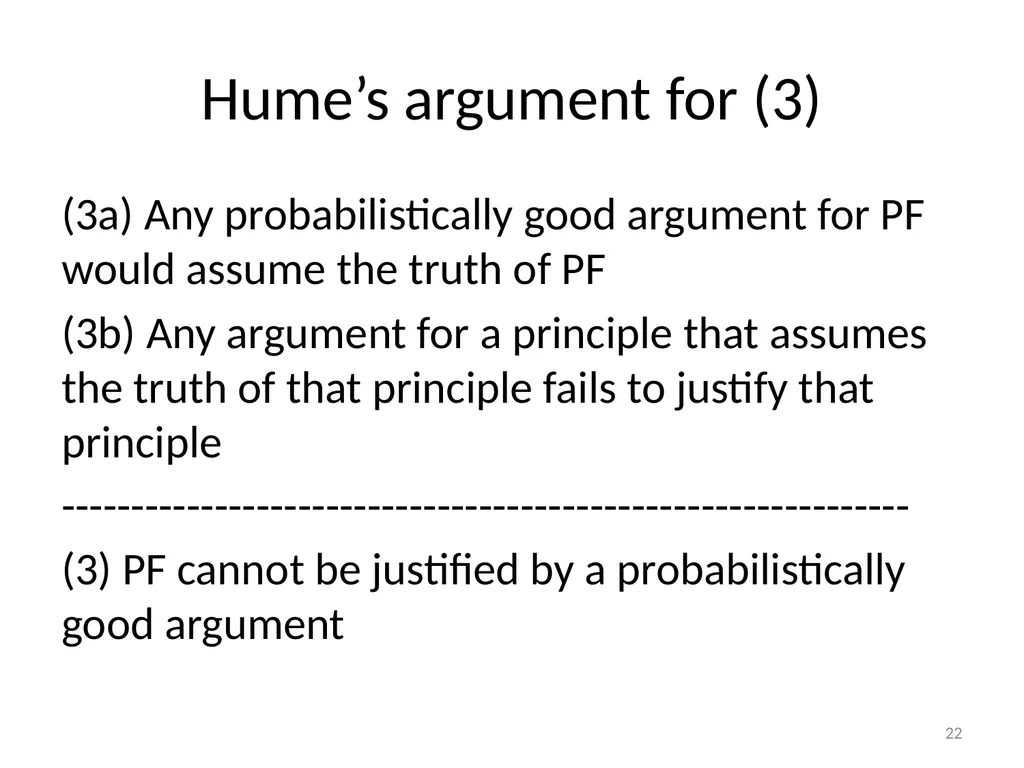
Hume’s argument for (3) (3a) Any probabilistically good argument for PF would assume the truth of PF
(3b) Any argument for a principle that assumes the truth of that principle fails to justify that principle
-------------------------------------------------------------
(3) PF cannot be justified by a probabilistically good argument 22<br>
23
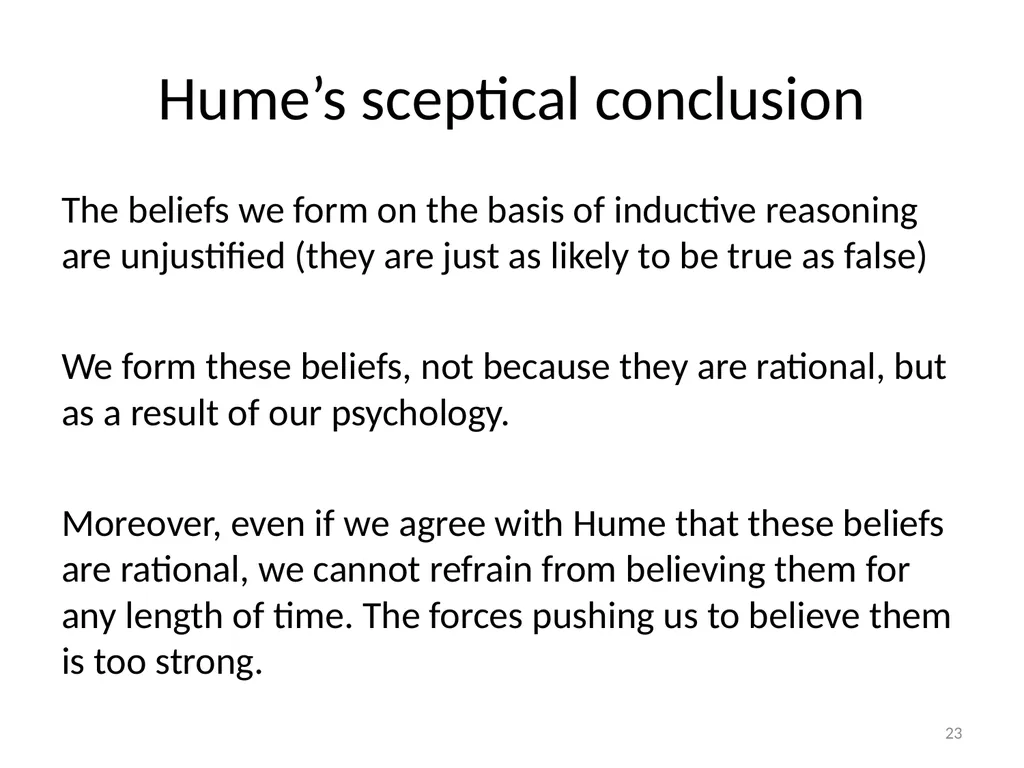
Hume’s sceptical conclusion The beliefs we form on the basis of inductive reasoning are unjustified (they are just as likely to be true as false)
We form these beliefs, not because they are rational, but as a result of our psychology.
Moreover, even if we agree with Hume that these beliefs are rational, we cannot refrain from believing them for any length of time. The forces pushing us to believe them is too strong. 23<br>
24
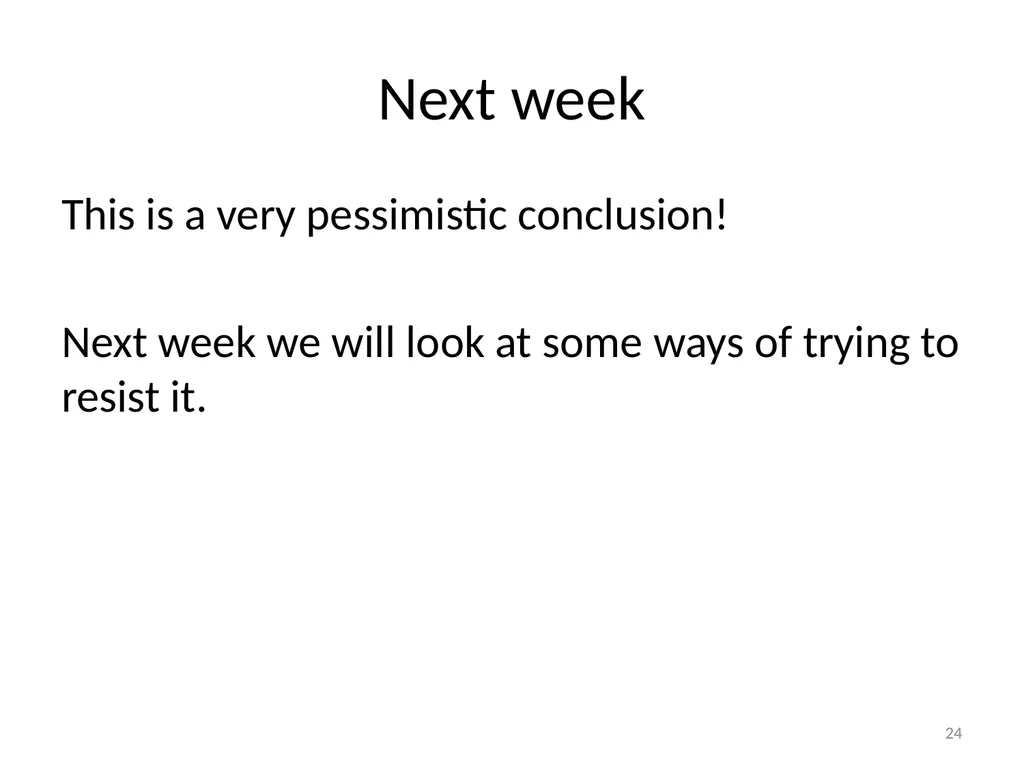
Next week This is a very pessimistic conclusion!
Next week we will look at some ways of trying to resist it. 24<br>