01
Introduction Hypo- and hyperkalaemia are potentially life-threatening electrolyte abnormalities often associated with severe adverse clinical outcomes.
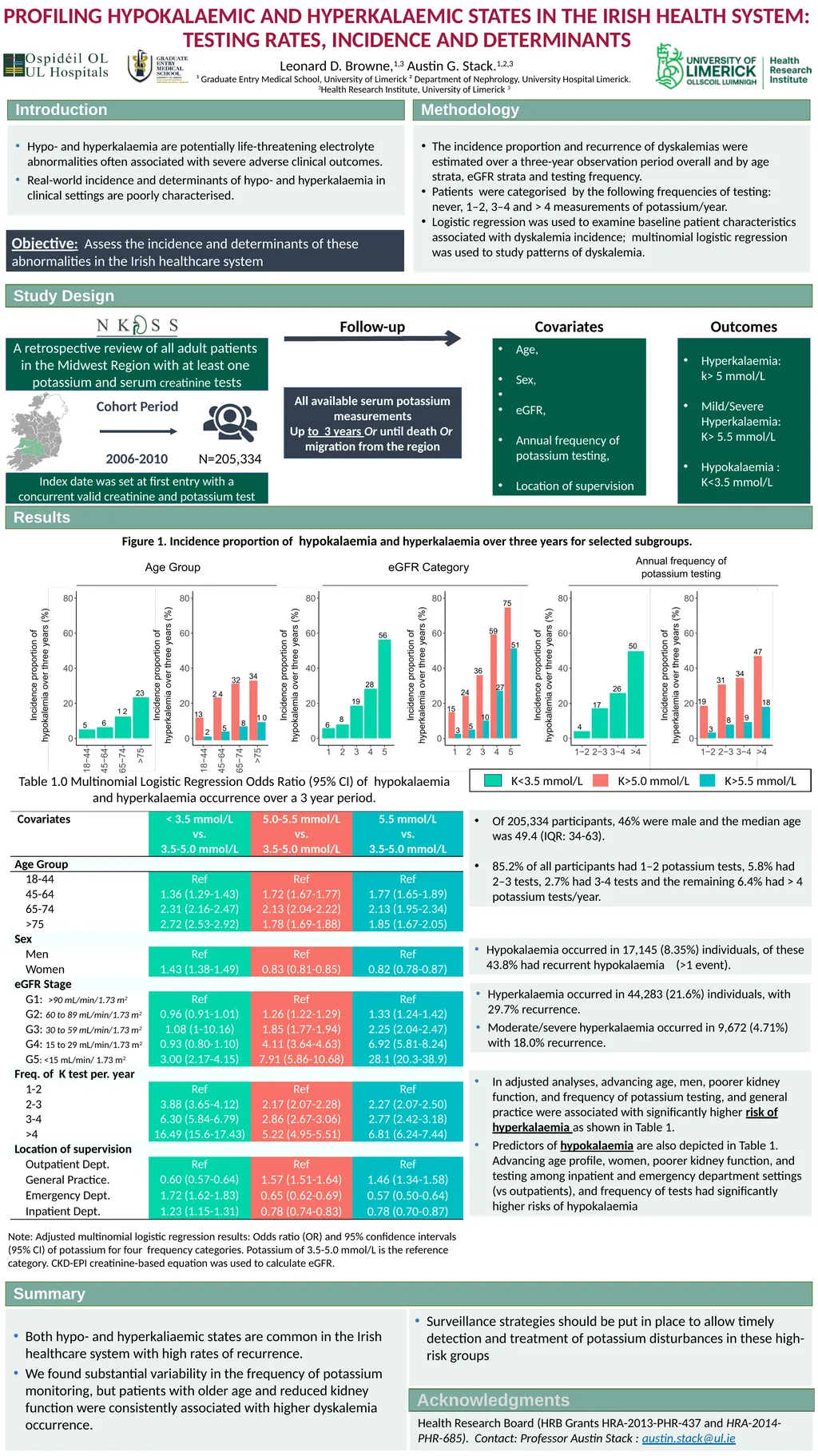
Real-world incidence and determinants of hypo- and hyperkalaemia in clinical settings are poorly characterised. PROFILING HYPOKALAEMIC AND HYPERKALAEMIC STATES IN THE IRISH HEALTH SYSTEM: TESTING RATES, INCIDENCE AND DETERMINANTS Leonard D. Browne,1,3 Austin G. Stack.1,2,3 Figure 1. Incidence proportion of hypokalaemia and hyperkalaemia over three years for selected subgroups. Results Summary Both hypo- and hyperkaliaemic states are common in the Irish healthcare system with high rates of recurrence.
We found substantial variability in the frequency of potassium monitoring, but patients with older age and reduced kidney function were consistently associated with higher dyskalemia occurrence. Methodology The incidence proportion and recurrence of dyskalemias were estimated over a three-year observation period overall and by age strata, eGFR strata and testing frequency.
Patients were categorised by the following frequencies of testing: never, 1–2, 3–4 and > 4 measurements of potassium/year.
Logistic regression was used to examine baseline patient characteristics associated with dyskalemia incidence; multinomial logistic regression was used to study patterns of dyskalemia. Table 1.0 Multinomial Logistic Regression Odds Ratio (95% CI) of hypokalaemia and hyperkalaemia occurrence over a 3 year period. In adjusted analyses, advancing age, men, poorer kidney function, and frequency of potassium testing, and general practice were associated with significantly higher risk of hyperkalaemia as shown in Table 1.
Predictors of hypokalaemia are also depicted in Table 1. Advancing age profile, women, poorer kidney function, and testing among inpatient and emergency department settings (vs outpatients), and frequency of tests had significantly higher risks of hypokalaemia Hyperkalaemia occurred in 44,283 (21.6%) individuals, with 29.7% recurrence.
Moderate/severe hyperkalaemia occurred in 9,672 (4.71%) with 18.0% recurrence. Study Design Age,
Sex,
eGFR,
Annual frequency of potassium testing,
Location of supervision A retrospective review of all adult patients in the Midwest Region with at least one potassium and serum creatinine tests Index date was set at first entry with a concurrent valid creatinine and potassium test Hyperkalaemia: k> 5 mmol/L
Mild/Severe Hyperkalaemia: K> 5.5 mmol/L
Hypokalaemia : K<3.5 mmol/L All available serum potassium measurements
Up to 3 years Or until death Or migration from the region Outcomes Covariates Note: Adjusted multinomial logistic regression results: Odds ratio (OR) and 95% confidence intervals (95% CI) of potassium for four frequency categories. Potassium of 3.5-5.0 mmol/L is the reference category. CKD-EPI creatinine-based equation was used to calculate eGFR. Follow-up N=205,334 2006-2010 Cohort Period Surveillance strategies should be put in place to allow timely detection and treatment of potassium disturbances in these high-risk groups Health Research Board (HRB Grants HRA-2013-PHR-437 and HRA-2014-PHR-685). Contact: Professor Austin Stack : austin.stack@ul.ie Of 205,334 participants, 46% were male and the median age was 49.4 (IQR: 34-63).
85.2% of all participants had 1–2 potassium tests, 5.8% had 2–3 tests, 2.7% had 3-4 tests and the remaining 6.4% had > 4 potassium tests/year. Objective: Assess the incidence and determinants of these abnormalities in the Irish healthcare system Hypokalaemia occurred in 17,145 (8.35%) individuals, of these 43.8% had recurrent hypokalaemia (>1 event). ¹ Graduate Entry Medical School, University of Limerick ² Department of Nephrology, University Hospital Limerick. 3Health Research Institute, University of Limerick 3 Acknowledgments<br>