
INTRODUCTION Name: Experience: Discipline(s)
TF
Published · 31 slides · 0 views

1 / 1



Description
INTRODUCTION Name: Experience: Discipline(s) Content Making the person being assessed comfortable Conduct during the day End of day Follow up recommendationsgiving of decision etc. How to give constructive criticism Points to observe (use
Related Topics
Share
Embed code
Download this presentation From Below
"INTRODUCTION Name: Experience: Discipline(s)" is the property of its rightful owner. Permission is granted to download and print the materials on this website for personal, non-commercial use only, and to display it on your personal computer provided you do not modify the materials and that you retain all copyright notices contained in the materials. By downloading content from our website, you accept the terms of this agreement.
Presentation Transcript
01
INTRODUCTION Name:
Experience:
Discipline(s)<br>
Experience:
Discipline(s)<br>
02
Content Making the person being assessed comfortable
Conduct during the day
End of day
Follow up recommendations/giving of decision etc.
How to give constructive criticism
Points to observe (use handouts from the assessment pages on the MSA web site)<br>
Conduct during the day
End of day
Follow up recommendations/giving of decision etc.
How to give constructive criticism
Points to observe (use handouts from the assessment pages on the MSA web site)<br>
03
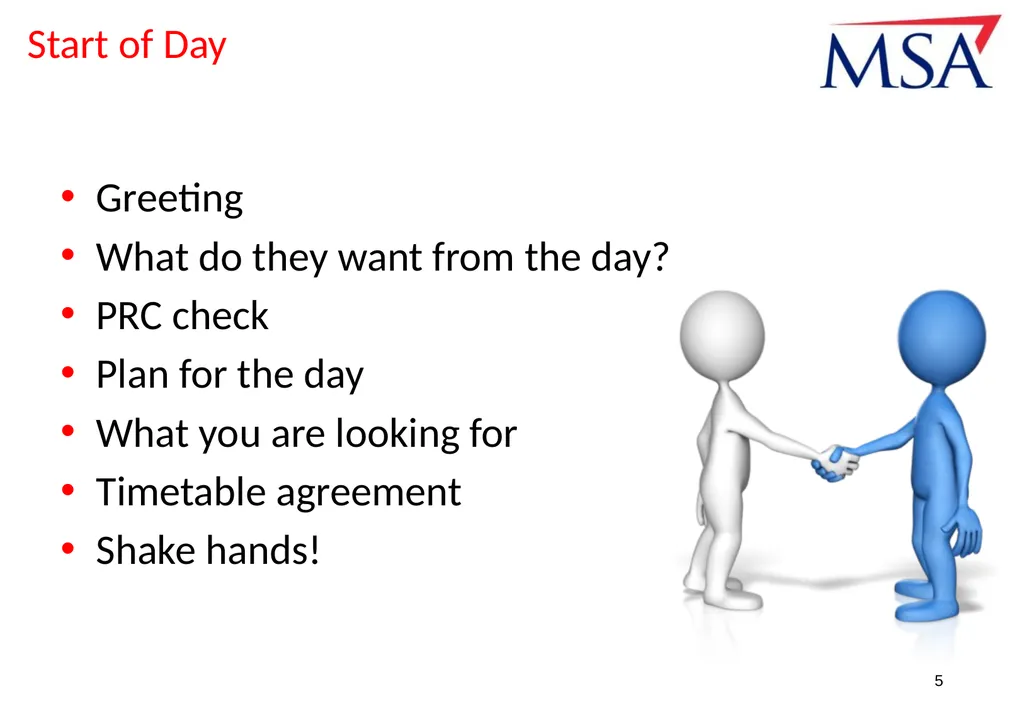
Start of Day Greeting
What do they want from the day?
PRC check
Plan for the day
What you are looking for
Timetable agreement
Shake hands!<br>
What do they want from the day?
PRC check
Plan for the day
What you are looking for
Timetable agreement
Shake hands!<br>
04
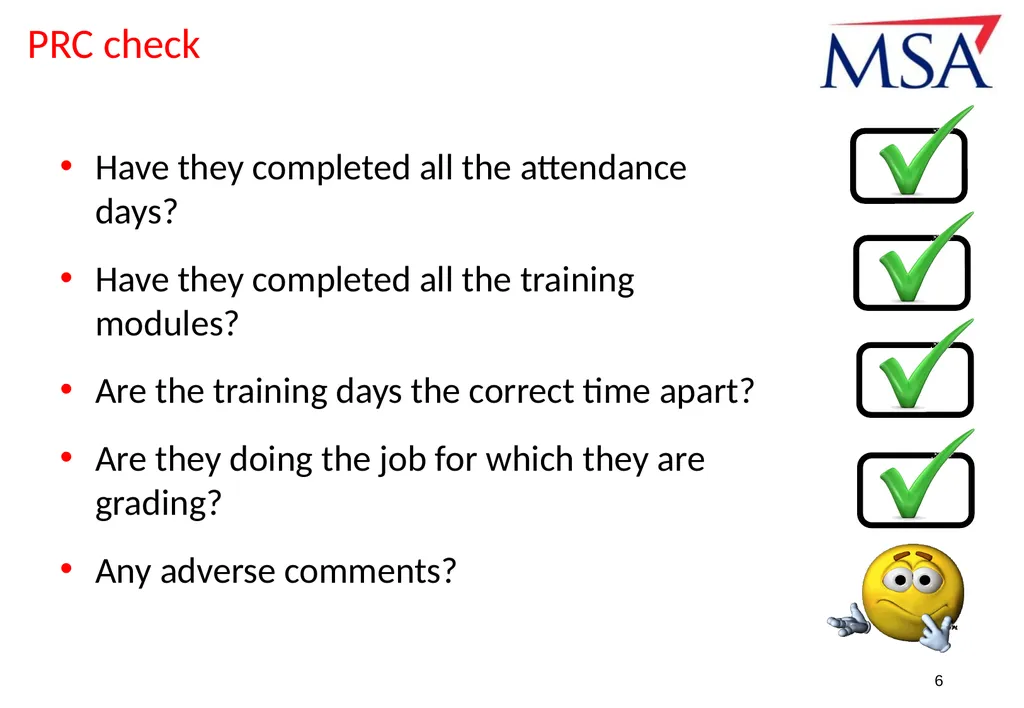
PRC check Have they completed all the attendance days?
Have they completed all the training modules?
Are the training days the correct time apart?
Are they doing the job for which they are grading?
Any adverse comments?<br>
Have they completed all the training modules?
Are the training days the correct time apart?
Are they doing the job for which they are grading?
Any adverse comments?<br>
05
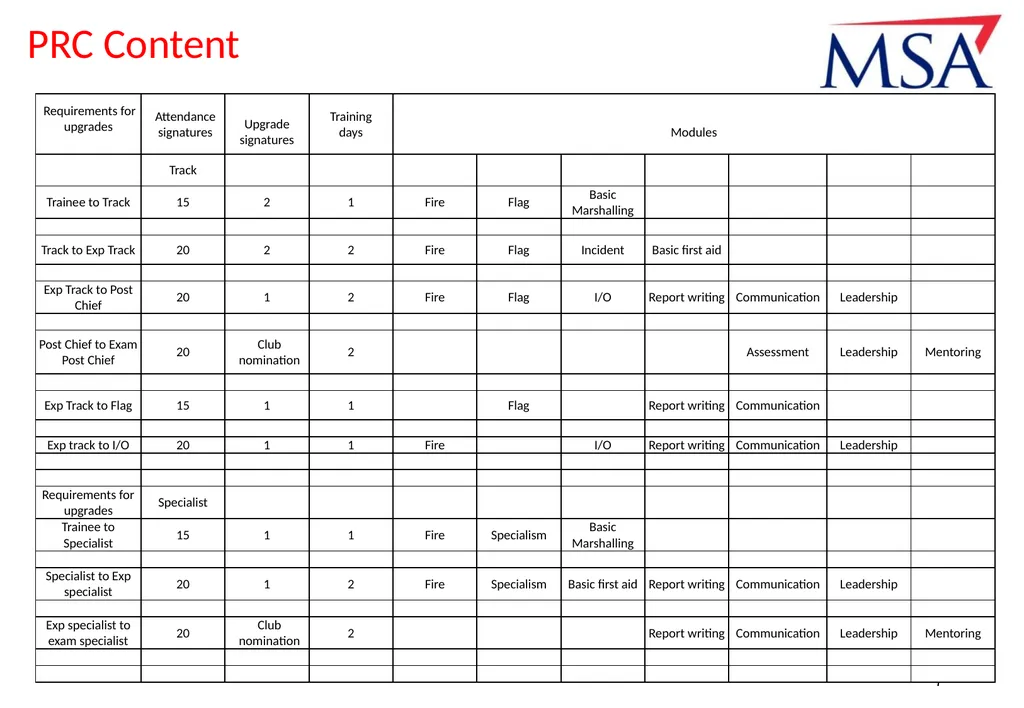
PRC Content<br>
06
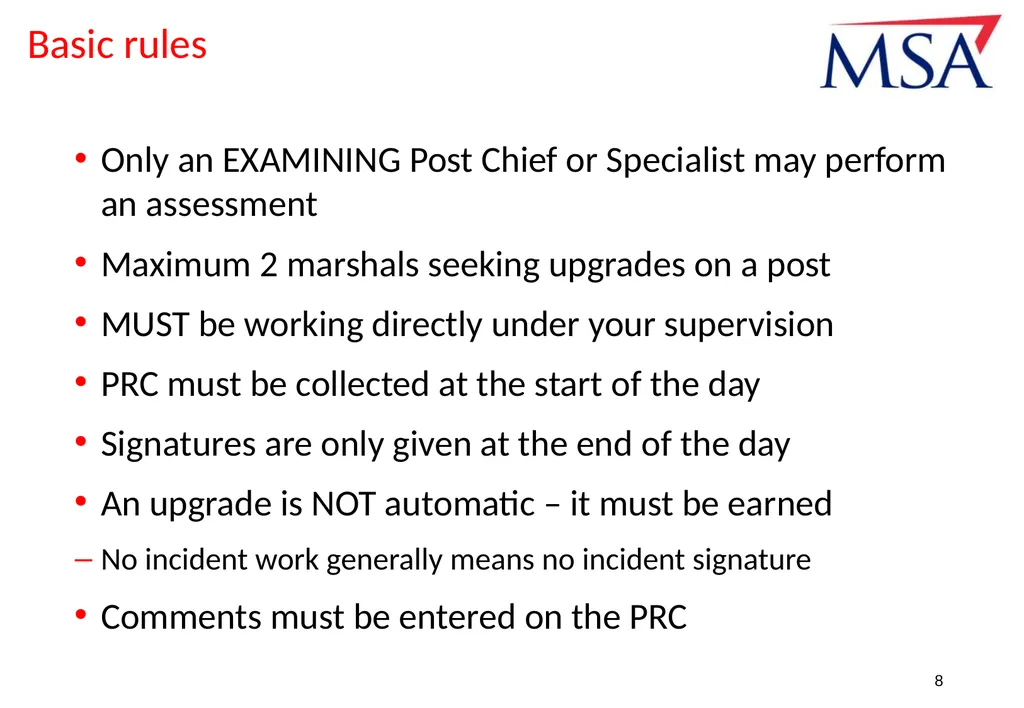
Basic rules Only an EXAMINING Post Chief or Specialist may perform an assessment
Maximum 2 marshals seeking upgrades on a post
MUST be working directly under your supervision
PRC must be collected at the start of the day
Signatures are only given at the end of the day
An upgrade is NOT automatic – it must be earned
No incident work generally means no incident signature
Comments must be entered on the PRC<br>
Maximum 2 marshals seeking upgrades on a post
MUST be working directly under your supervision
PRC must be collected at the start of the day
Signatures are only given at the end of the day
An upgrade is NOT automatic – it must be earned
No incident work generally means no incident signature
Comments must be entered on the PRC<br>
07
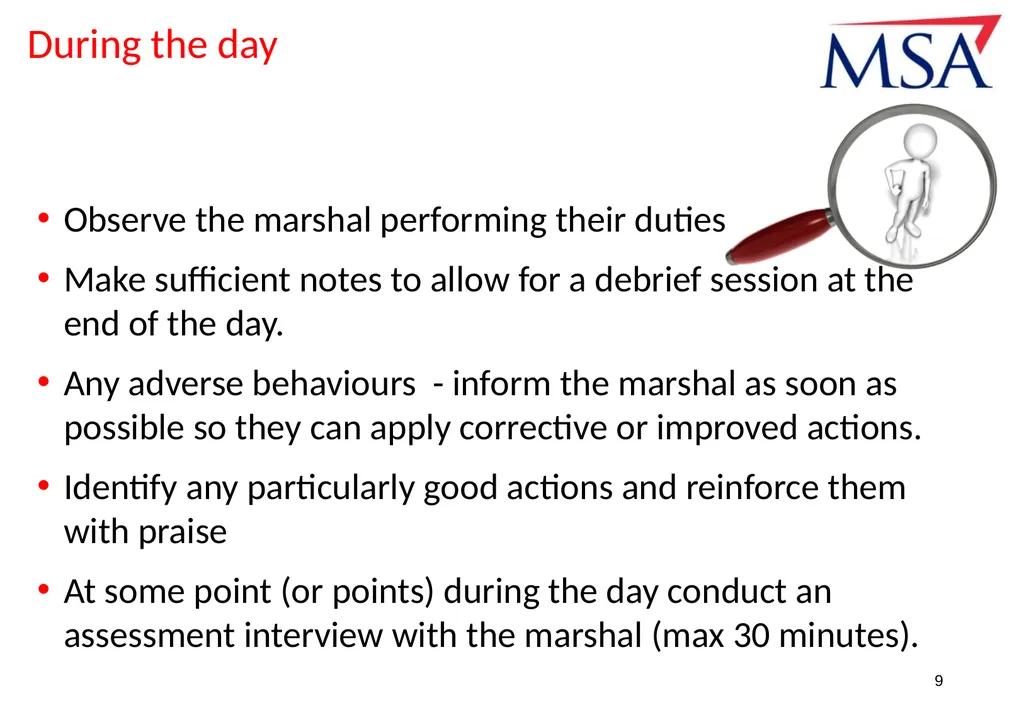
During the day Observe the marshal performing their duties
Make sufficient notes to allow for a debrief session at the end of the day.
Any adverse behaviours - inform the marshal as soon as possible so they can apply corrective or improved actions.
Identify any particularly good actions and reinforce them with praise
At some point (or points) during the day conduct an assessment interview with the marshal (max 30 minutes).<br>
Make sufficient notes to allow for a debrief session at the end of the day.
Any adverse behaviours - inform the marshal as soon as possible so they can apply corrective or improved actions.
Identify any particularly good actions and reinforce them with praise
At some point (or points) during the day conduct an assessment interview with the marshal (max 30 minutes).<br>
08
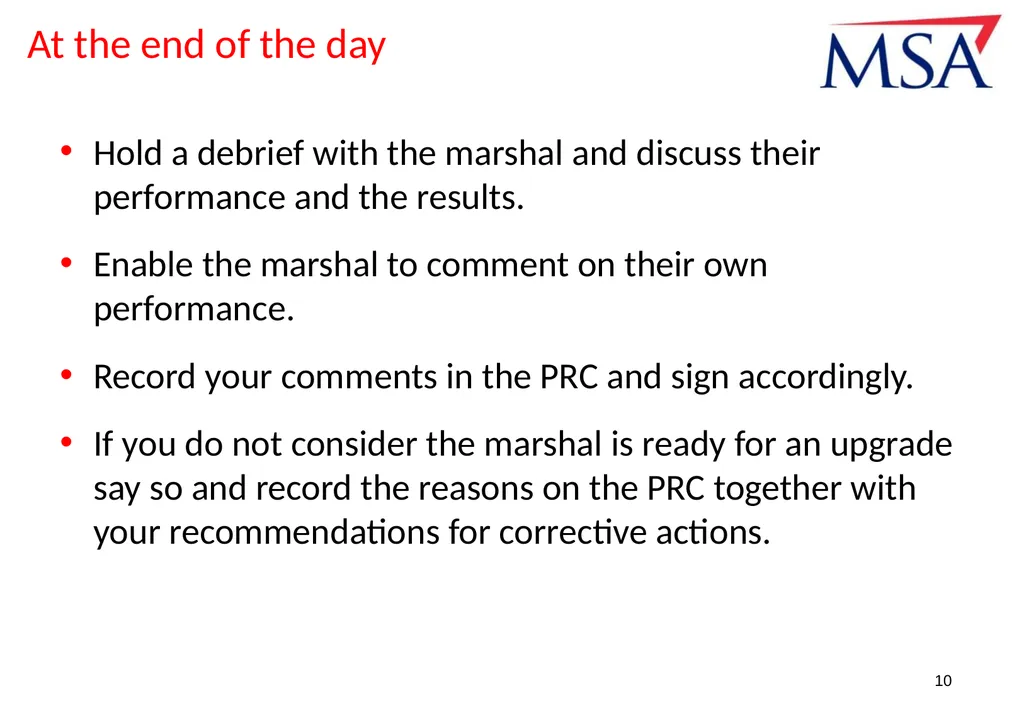
At the end of the day Hold a debrief with the marshal and discuss their performance and the results.
Enable the marshal to comment on their own performance.
Record your comments in the PRC and sign accordingly.
If you do not consider the marshal is ready for an upgrade say so and record the reasons on the PRC together with your recommendations for corrective actions.<br>
Enable the marshal to comment on their own performance.
Record your comments in the PRC and sign accordingly.
If you do not consider the marshal is ready for an upgrade say so and record the reasons on the PRC together with your recommendations for corrective actions.<br>
09
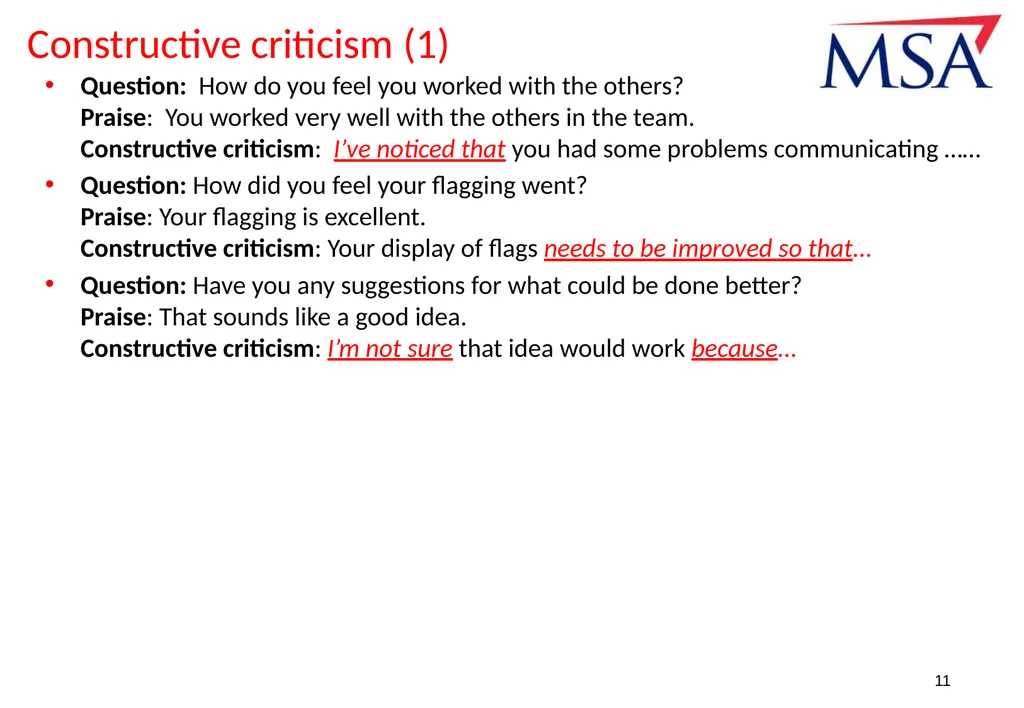
Constructive criticism (1) Question: How do you feel you worked with the others?
Praise: You worked very well with the others in the team.
Constructive criticism: I’ve noticed that you had some problems communicating ……
Question: How did you feel your flagging went? Praise: Your flagging is excellent. Constructive criticism: Your display of flags needs to be improved so that…
Question: Have you any suggestions for what could be done better? Praise: That sounds like a good idea. Constructive criticism: I’m not sure that idea would work because…<br>
Question: How did you feel your flagging went? Praise: Your flagging is excellent. Constructive criticism: Your display of flags needs to be improved so that…
Question: Have you any suggestions for what could be done better? Praise: That sounds like a good idea. Constructive criticism: I’m not sure that idea would work because…<br>
10
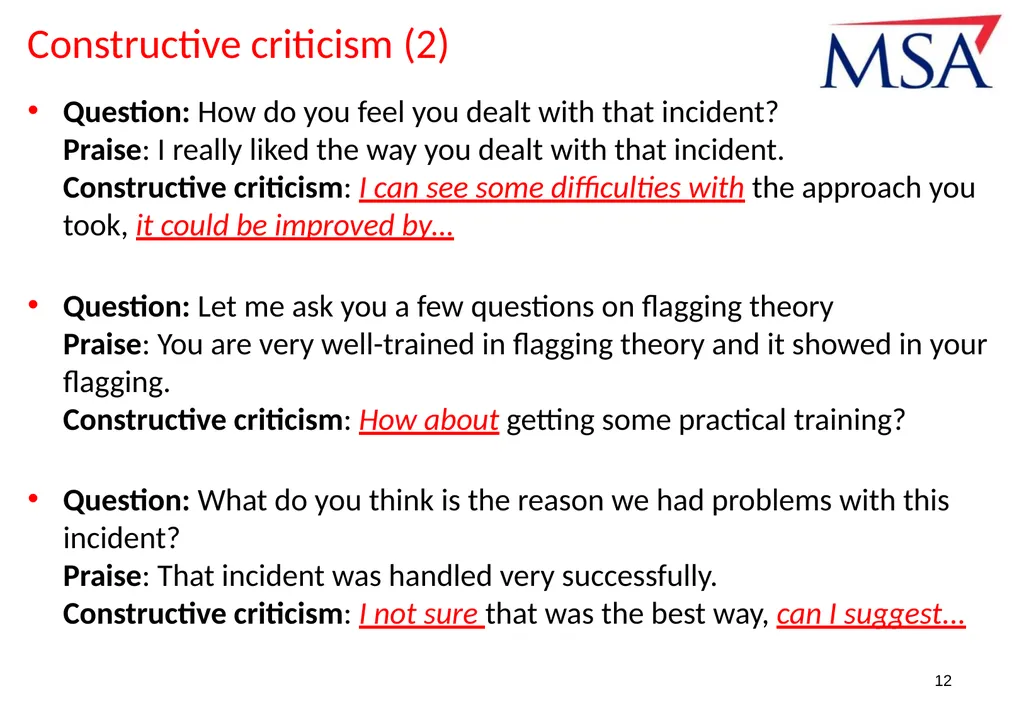
Question: How do you feel you dealt with that incident?
Praise: I really liked the way you dealt with that incident.
Constructive criticism: I can see some difficulties with the approach you took, it could be improved by…
Question: Let me ask you a few questions on flagging theory Praise: You are very well-trained in flagging theory and it showed in your flagging. Constructive criticism: How about getting some practical training?
Question: What do you think is the reason we had problems with this incident? Praise: That incident was handled very successfully. Constructive criticism: I not sure that was the best way, can I suggest... Constructive criticism (2)<br>
Question: Let me ask you a few questions on flagging theory Praise: You are very well-trained in flagging theory and it showed in your flagging. Constructive criticism: How about getting some practical training?
Question: What do you think is the reason we had problems with this incident? Praise: That incident was handled very successfully. Constructive criticism: I not sure that was the best way, can I suggest... Constructive criticism (2)<br>
11
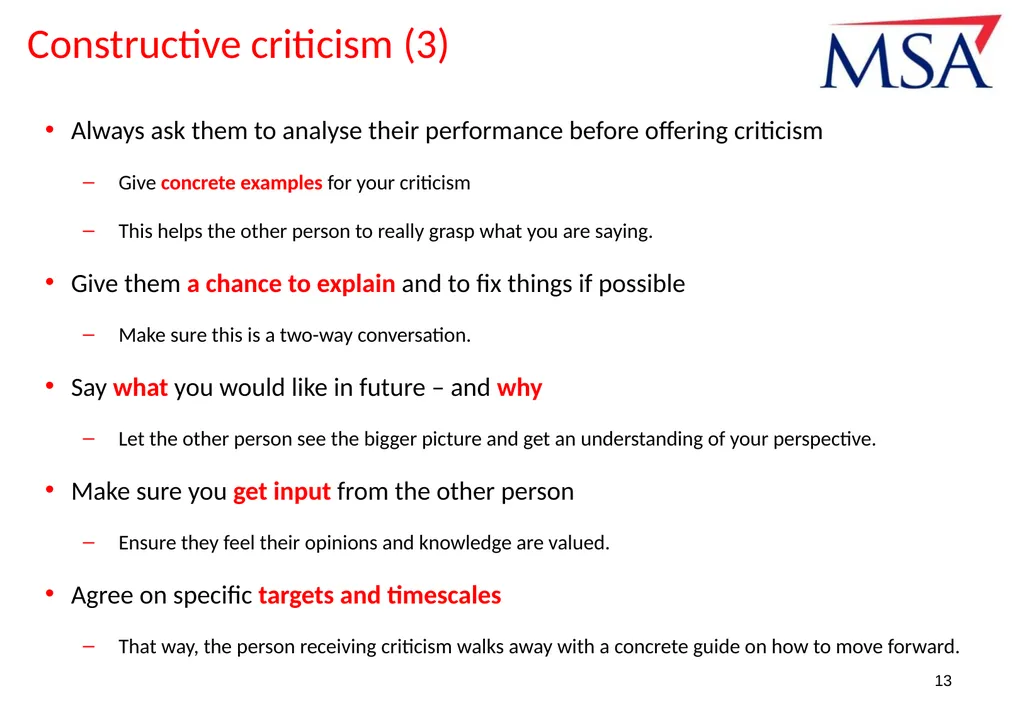
Constructive criticism (3) Always ask them to analyse their performance before offering criticism
Give concrete examples for your criticism
This helps the other person to really grasp what you are saying.
Give them a chance to explain and to fix things if possible
Make sure this is a two-way conversation.
Say what you would like in future – and why
Let the other person see the bigger picture and get an understanding of your perspective.
Make sure you get input from the other person
Ensure they feel their opinions and knowledge are valued.
Agree on specific targets and timescales
That way, the person receiving criticism walks away with a concrete guide on how to move forward.<br>
Give concrete examples for your criticism
This helps the other person to really grasp what you are saying.
Give them a chance to explain and to fix things if possible
Make sure this is a two-way conversation.
Say what you would like in future – and why
Let the other person see the bigger picture and get an understanding of your perspective.
Make sure you get input from the other person
Ensure they feel their opinions and knowledge are valued.
Agree on specific targets and timescales
That way, the person receiving criticism walks away with a concrete guide on how to move forward.<br>
12
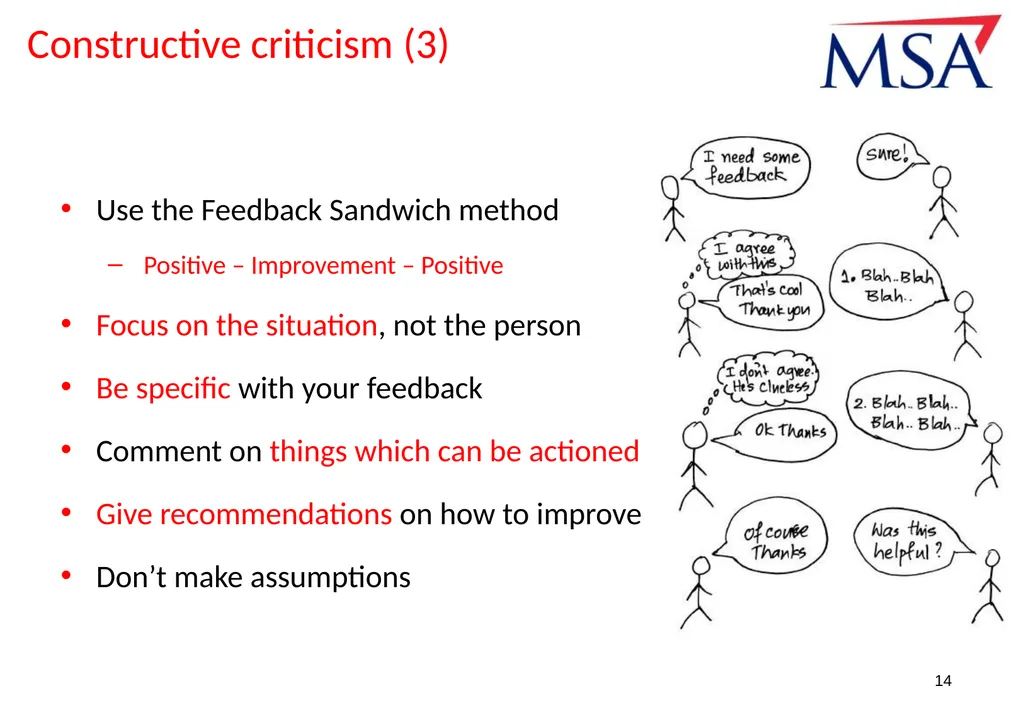
Constructive criticism (3) Use the Feedback Sandwich method
Positive – Improvement – Positive
Focus on the situation, not the person
Be specific with your feedback
Comment on things which can be actioned
Give recommendations on how to improve
Don’t make assumptions<br>
Positive – Improvement – Positive
Focus on the situation, not the person
Be specific with your feedback
Comment on things which can be actioned
Give recommendations on how to improve
Don’t make assumptions<br>
13
Constructive criticism (4) Make it a discussion, not a one-sided rant.
Keep your tone of voice neutral and factual
Take care you do not appear patronising.
Ensure you lead by example
Consider the time and place. Don’t deliver criticism in a group.
Ensure the feedback message is clear; focus on few areas of change.<br>
Keep your tone of voice neutral and factual
Take care you do not appear patronising.
Ensure you lead by example
Consider the time and place. Don’t deliver criticism in a group.
Ensure the feedback message is clear; focus on few areas of change.<br>
14
Advice for the marshal You must have completed all your attendance and training modules before asking for an assessment
Only ask for an assessment if you really think you are ready
Do not try to show off to the assessor
If you have any questions ASK!
If you make a mistake admit it and ask for advice
Do not expect an automatic signature – you have to earn it!<br>
Only ask for an assessment if you really think you are ready
Do not try to show off to the assessor
If you have any questions ASK!
If you make a mistake admit it and ask for advice
Do not expect an automatic signature – you have to earn it!<br>
15
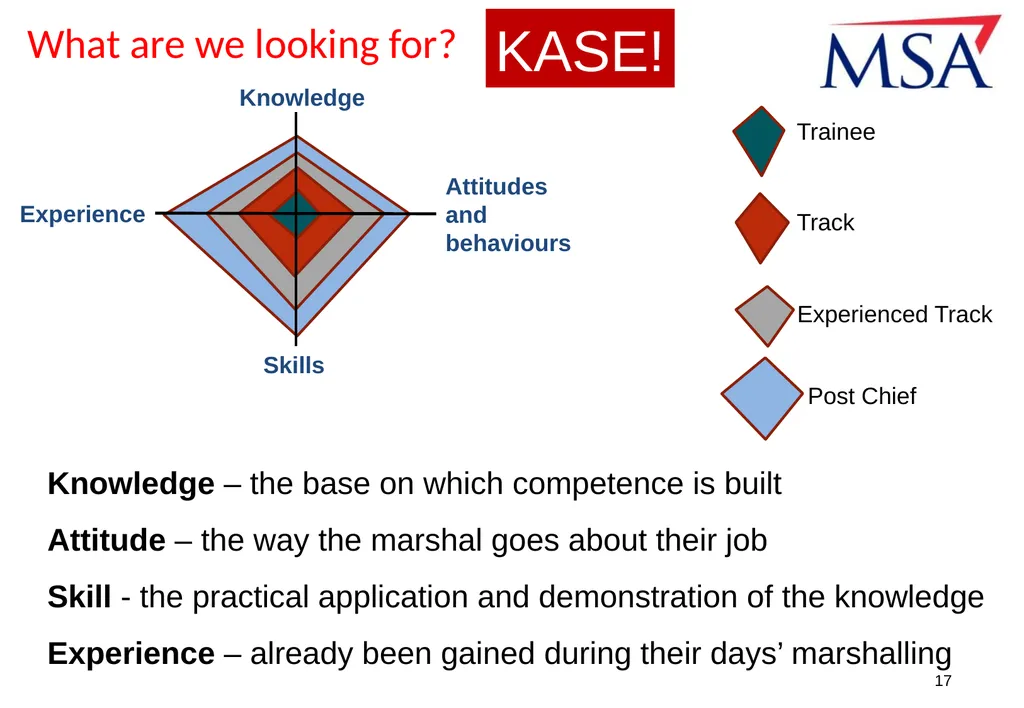
What are we looking for? Knowledge Skills Experience Attitudes and behaviours Knowledge – the base on which competence is built
Attitude – the way the marshal goes about their job
Skill - the practical application and demonstration of the knowledge
Experience – already been gained during their days’ marshalling KASE!<br>
Attitude – the way the marshal goes about their job
Skill - the practical application and demonstration of the knowledge
Experience – already been gained during their days’ marshalling KASE!<br>
16
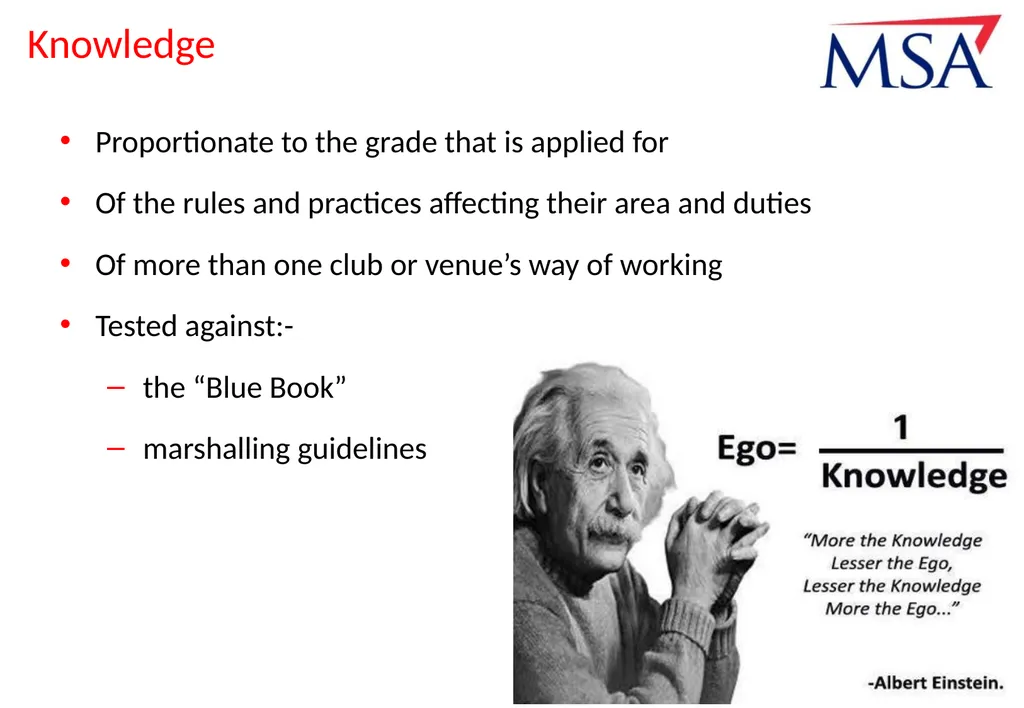
Knowledge Proportionate to the grade that is applied for
Of the rules and practices affecting their area and duties
Of more than one club or venue’s way of working
Tested against:-
the “Blue Book”
marshalling guidelines<br>
Of the rules and practices affecting their area and duties
Of more than one club or venue’s way of working
Tested against:-
the “Blue Book”
marshalling guidelines<br>
17
Attitude Subjective - not everyone will exhibit the same attitude
! - clashes of personality between the assessor and candidate – these must not be allowed to cloud the assessor’s judgement
In all marshals we are looking for the following:
A positive approach to their role
An open mind and willingness to accept others’ ideas
team working attitude
Recognition of the hierarchy of roles, with commensurate willingness to work within their hierarchy.
A supportive approach to their fellow marshals.
A helpful, considerate and respectful approach to competitors, spectators and other officials (an ‘officious’ attitude is an absolute no-no!)<br>
! - clashes of personality between the assessor and candidate – these must not be allowed to cloud the assessor’s judgement
In all marshals we are looking for the following:
A positive approach to their role
An open mind and willingness to accept others’ ideas
team working attitude
Recognition of the hierarchy of roles, with commensurate willingness to work within their hierarchy.
A supportive approach to their fellow marshals.
A helpful, considerate and respectful approach to competitors, spectators and other officials (an ‘officious’ attitude is an absolute no-no!)<br>
18
Skills Practical application and demonstration of knowledge
They may have knowledge of the flagging rules, but do they have the skill to actually put them into effective use?
May be hard to assess for certain disciplines
May be no opportunity for the marshal to directly demonstrate, for example, their fire fighting or incident handling skills
By observing the way in which they carry out their allocated duties we should be able to determine their overall skill level
Devote sufficient time to actually observing the marshal in action
Ensure you are in a position to make those observations at various times during the day
Ask for a demonstration in-between activities.<br>
They may have knowledge of the flagging rules, but do they have the skill to actually put them into effective use?
May be hard to assess for certain disciplines
May be no opportunity for the marshal to directly demonstrate, for example, their fire fighting or incident handling skills
By observing the way in which they carry out their allocated duties we should be able to determine their overall skill level
Devote sufficient time to actually observing the marshal in action
Ensure you are in a position to make those observations at various times during the day
Ask for a demonstration in-between activities.<br>
19
Experience Experience will have been gained before the assessment day
They may not, in fact, have ever had to deal with a major incident or fire
Many marshals may go for years without putting their competency to the test, however, we cannot wait for that “special” incident to happen
We have to make a judgement call, and that is what the assessment is all about
The whole assessment process stands or falls on the assessor’s ability to determine whether the marshal has learnt from their experience and is still learning.<br>
They may not, in fact, have ever had to deal with a major incident or fire
Many marshals may go for years without putting their competency to the test, however, we cannot wait for that “special” incident to happen
We have to make a judgement call, and that is what the assessment is all about
The whole assessment process stands or falls on the assessor’s ability to determine whether the marshal has learnt from their experience and is still learning.<br>
20
Trainee to Track Two days
1 x flagging
1 x incident handling.
No incidents = no signature
Marshal to demonstrate that they:
can work safely trackside,
are familiar with basic marshalling requirements,
are aware of what is going on around them,
know where to seek advice and guidance
appreciate they are still learning.<br>
1 x flagging
1 x incident handling.
No incidents = no signature
Marshal to demonstrate that they:
can work safely trackside,
are familiar with basic marshalling requirements,
are aware of what is going on around them,
know where to seek advice and guidance
appreciate they are still learning.<br>
21
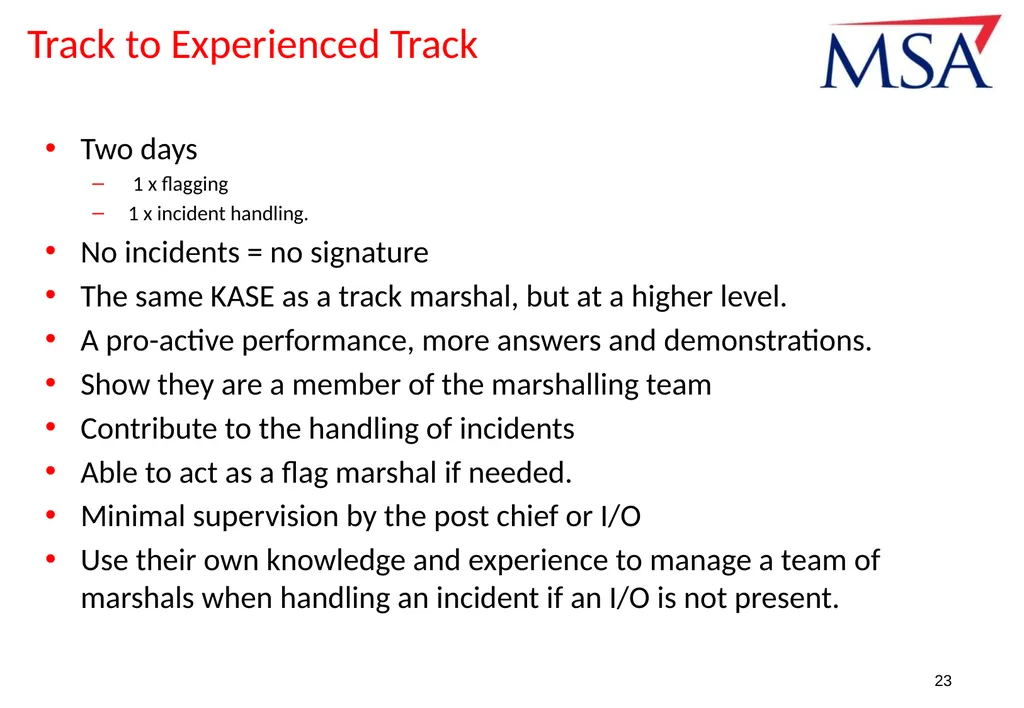
Track to Experienced Track Two days
1 x flagging
1 x incident handling.
No incidents = no signature
The same KASE as a track marshal, but at a higher level.
A pro-active performance, more answers and demonstrations.
Show they are a member of the marshalling team
Contribute to the handling of incidents
Able to act as a flag marshal if needed.
Minimal supervision by the post chief or I/O
Use their own knowledge and experience to manage a team of marshals when handling an incident if an I/O is not present.<br>
1 x flagging
1 x incident handling.
No incidents = no signature
The same KASE as a track marshal, but at a higher level.
A pro-active performance, more answers and demonstrations.
Show they are a member of the marshalling team
Contribute to the handling of incidents
Able to act as a flag marshal if needed.
Minimal supervision by the post chief or I/O
Use their own knowledge and experience to manage a team of marshals when handling an incident if an I/O is not present.<br>
22
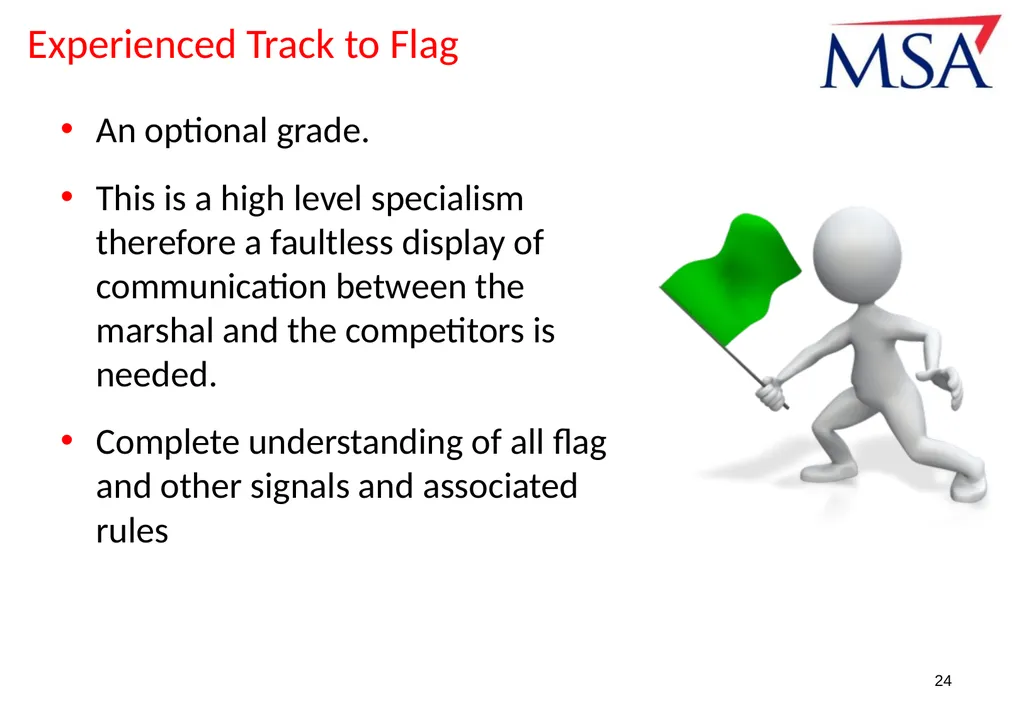
Experienced Track to Flag An optional grade.
This is a high level specialism therefore a faultless display of communication between the marshal and the competitors is needed.
Complete understanding of all flag and other signals and associated rules<br>
This is a high level specialism therefore a faultless display of communication between the marshal and the competitors is needed.
Complete understanding of all flag and other signals and associated rules<br>
23
Experienced Track to Incident Officer Optional grade.
Not all circuits use Incident Officers (I/Os)
The I/O = deputy Post Chief
Able to manage and lead the team of track and experienced track marshals
Interact with recovery, rescue, snatch and medical personnel
In radio contact with race control
KASE as an experienced track marshal, but higher
Pro-active performance
Full answers and demonstrations.<br>
Not all circuits use Incident Officers (I/Os)
The I/O = deputy Post Chief
Able to manage and lead the team of track and experienced track marshals
Interact with recovery, rescue, snatch and medical personnel
In radio contact with race control
KASE as an experienced track marshal, but higher
Pro-active performance
Full answers and demonstrations.<br>
24
Experienced Track Marshal/Incident Officer/Flag Marshal to Post Chief. Represents the Clerk of the Course
Plays a vital role
Act as team leader, coach and mentor
Monitors and reports to the Clerk of the Course
Attitude VERY important
They demonstrate these leadership skills in an assessment.<br>
Plays a vital role
Act as team leader, coach and mentor
Monitors and reports to the Clerk of the Course
Attitude VERY important
They demonstrate these leadership skills in an assessment.<br>
25
Specialists Numerous specialist disciplines
The assessment should cover all the specialisms the marshal will be performing
Select from more than one of the following areas
Pit Lane Specialist
Start Line Specialist
Assembly Area/Paddock Specialist
Communications Specialist Pit and Start Line specialists are, at some circuits, combined into one duty – at others they are two separate duties.<br>
The assessment should cover all the specialisms the marshal will be performing
Select from more than one of the following areas
Pit Lane Specialist
Start Line Specialist
Assembly Area/Paddock Specialist
Communications Specialist Pit and Start Line specialists are, at some circuits, combined into one duty – at others they are two separate duties.<br>
26
Trainee to Specialist The marshal needs to demonstrate that:
they can work safely in their specialist area
they are familiar with the basic marshalling requirements
they are aware of what is going on around them
they know where to seek advice and guidance and appreciate they are still learning.<br>
they can work safely in their specialist area
they are familiar with the basic marshalling requirements
they are aware of what is going on around them
they know where to seek advice and guidance and appreciate they are still learning.<br>
27
Specialist to Experienced Specialist KASE as for specialist marshal, but higher level
An active performance, with full answers and demonstrations.
Act as a member of the marshalling team.
Require minimal supervision
Use their own knowledge and experience to take charge of a team of marshals (if necessary)
All other aspects of the KASE assessment should be as for the appropriate specialist role.<br>
An active performance, with full answers and demonstrations.
Act as a member of the marshalling team.
Require minimal supervision
Use their own knowledge and experience to take charge of a team of marshals (if necessary)
All other aspects of the KASE assessment should be as for the appropriate specialist role.<br>
28
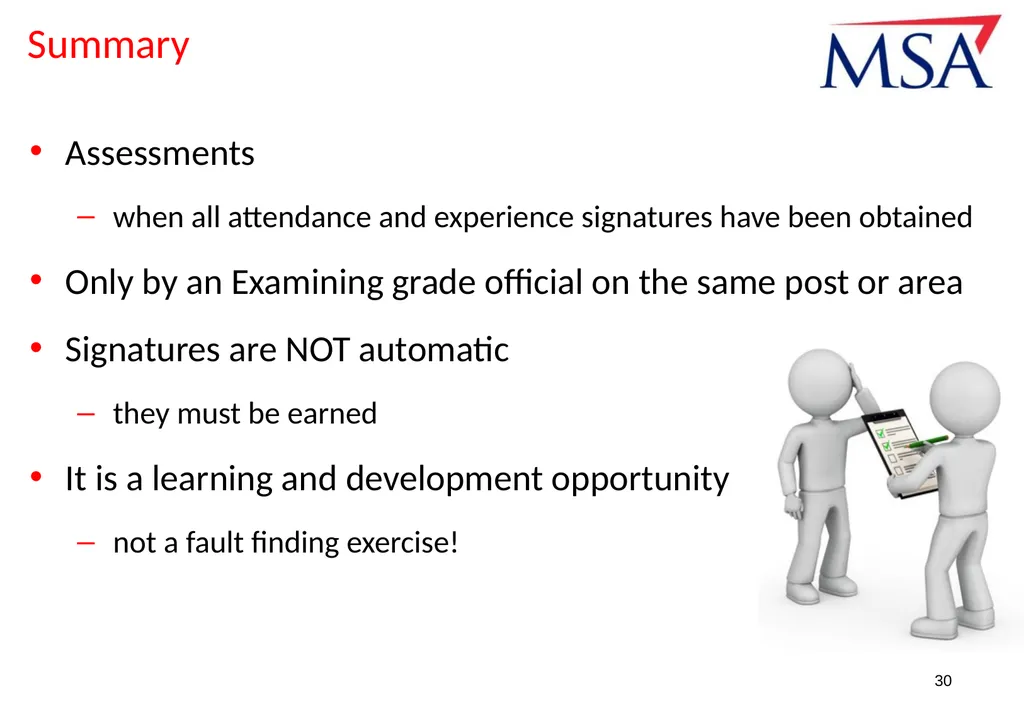
Summary Assessments
when all attendance and experience signatures have been obtained
Only by an Examining grade official on the same post or area
Signatures are NOT automatic
they must be earned
It is a learning and development opportunity
not a fault finding exercise!<br>
when all attendance and experience signatures have been obtained
Only by an Examining grade official on the same post or area
Signatures are NOT automatic
they must be earned
It is a learning and development opportunity
not a fault finding exercise!<br>
29
Any Questions?<br>