
Introduction SE401: Software Quality Assurance and
KL
Published · 94 slides · 0 views
1 / 1

Description
Introduction SE401: Software Quality Assurance and Testing 1 Software is Everywhere 2 Outline Why is testing necessary? What is testing? Testing Myths Software Testing Terminologies Test principles Fundamental test process The psychology of
Related Topics
Share
Embed code
Download this presentation From Below
"Introduction SE401: Software Quality Assurance and" is the property of its rightful owner. Permission is granted to download and print the materials on this website for personal, non-commercial use only, and to display it on your personal computer provided you do not modify the materials and that you retain all copyright notices contained in the materials. By downloading content from our website, you accept the terms of this agreement.
Presentation Transcript
01
Introduction SE401: Software Quality Assurance and Testing 1<br>
02
Software is Everywhere 2<br>
03
Outline Why is testing necessary?
What is testing?
Testing Myths
Software Testing Terminologies
Test principles
Fundamental test process
The psychology of testing
Limitations of Software Testing 3<br>
What is testing?
Testing Myths
Software Testing Terminologies
Test principles
Fundamental test process
The psychology of testing
Limitations of Software Testing 3<br>
04
Why is testing necessary? 4<br>
05
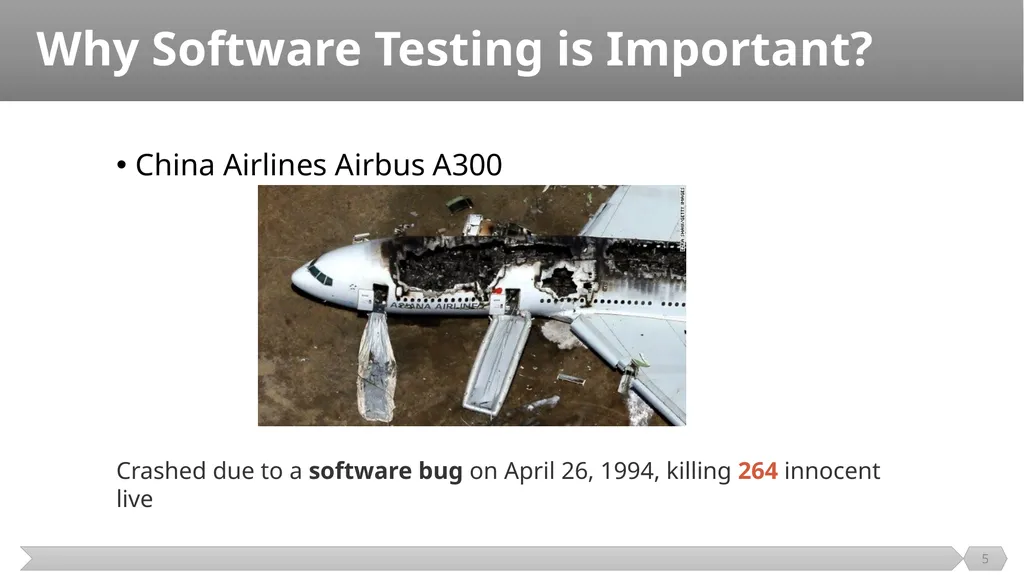
Why Software Testing is Important? China Airlines Airbus A300 5 Crashed due to a software bug on April 26, 1994, killing 264 innocent live<br>
06
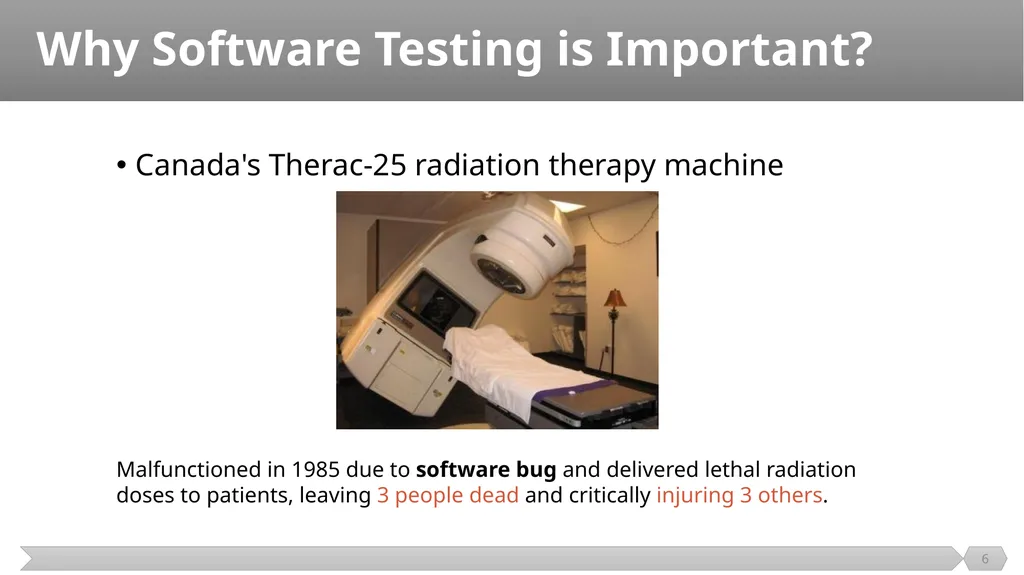
Why Software Testing is Important? Canada's Therac-25 radiation therapy machine 6 Malfunctioned in 1985 due to software bug and delivered lethal radiation doses to patients, leaving 3 people dead and critically injuring 3 others.<br>
07
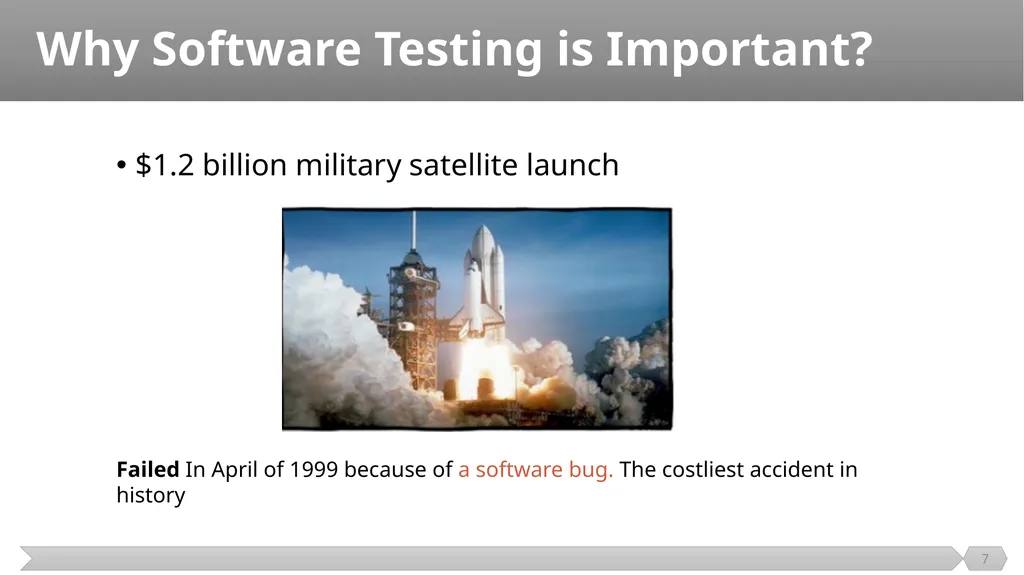
Why Software Testing is Important? $1.2 billion military satellite launch 7 Failed In April of 1999 because of a software bug. The costliest accident in history<br>
08
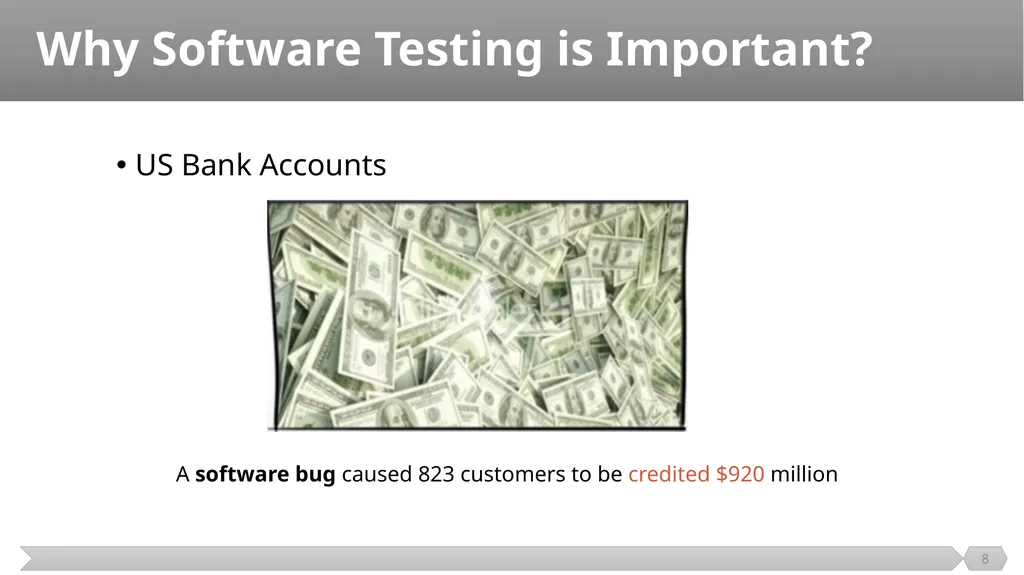
Why Software Testing is Important? US Bank Accounts 8 A software bug caused 823 customers to be credited $920 million<br>
09
Economic Impact The Cost of Poor Software Quality in the US 2020 Report by CISQ Consortium for Information & Software Quality:
The total Cost of Poor Software Quality (CPSQ) in the US is $2.08 trillion
Operational failures 1.56 trillion
Legacy systems 520 billions
We want software systems to be reliable
Testing is how, in most cases, we find out if they are 9<br>
The total Cost of Poor Software Quality (CPSQ) in the US is $2.08 trillion
Operational failures 1.56 trillion
Legacy systems 520 billions
We want software systems to be reliable
Testing is how, in most cases, we find out if they are 9<br>
10
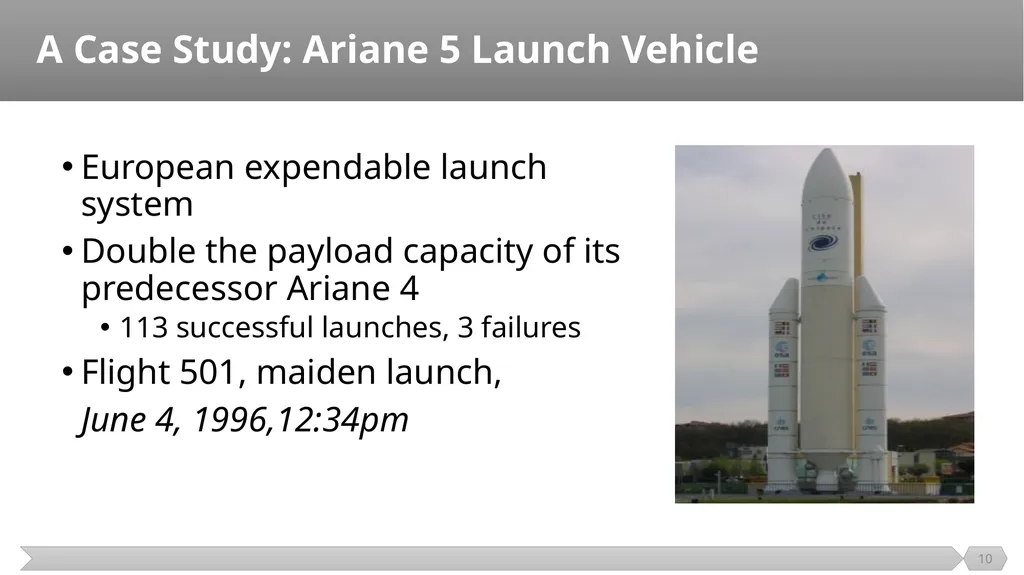
A Case Study: Ariane 5 Launch Vehicle European expendable launch system
Double the payload capacity of its predecessor Ariane 4
113 successful launches, 3 failures
Flight 501, maiden launch,
June 4, 1996,12:34pm 10<br>
Double the payload capacity of its predecessor Ariane 4
113 successful launches, 3 failures
Flight 501, maiden launch,
June 4, 1996,12:34pm 10<br>
11
Case Study Ariane 5: What Happened? T0 - T0 + 36s : normal
Within SRI 2:
BH (Bias Horizontal) > 215
convert_double_to_int(BH) fails!
exception SRI -> crash SRI 2 & 1
OBC disoriented
angle > 20°, huge aerodynamics constraints
boosters separating...
T0 + 39s: self destruction
cost: € 500M 11<br>
Within SRI 2:
BH (Bias Horizontal) > 215
convert_double_to_int(BH) fails!
exception SRI -> crash SRI 2 & 1
OBC disoriented
angle > 20°, huge aerodynamics constraints
boosters separating...
T0 + 39s: self destruction
cost: € 500M 11<br>
12
Case Study Ariane 5: Why Did It Happen? Not a programming error
unprotected conversion = design decision (~1980)
Not a design error
Justified against Ariane 4 trajectory & RT constraints
Problem with integration testing
Theoretically detectable.
But huge test space vs. limited resources
Furthermore, SRI useless at this stage of the flight!
Reuse of a component with a hidden constraint
Precondition : abs(BH) < 32768.0
Valid for Ariane 4, but no longer for Ariane 5
More powerful rocket 12<br>
unprotected conversion = design decision (~1980)
Not a design error
Justified against Ariane 4 trajectory & RT constraints
Problem with integration testing
Theoretically detectable.
But huge test space vs. limited resources
Furthermore, SRI useless at this stage of the flight!
Reuse of a component with a hidden constraint
Precondition : abs(BH) < 32768.0
Valid for Ariane 4, but no longer for Ariane 5
More powerful rocket 12<br>
13
Case Study Ariane 5:
Lessons Learned in Software Eng. Test! Test! Test!
Test! Even when the code is reused.
When reuse, ensure the assumptions are still valid.
When write reusable code, document the assumptions.
Write fail-safe code.
Do not propagate errors. 13<br>
Test! Even when the code is reused.
When reuse, ensure the assumptions are still valid.
When write reusable code, document the assumptions.
Write fail-safe code.
Do not propagate errors. 13<br>
14
Why Software Testing is Important? History is full of such examples. Look for more examples!
Testing is important because software bugs could be expensive or even dangerous.
Software bugs can potentially cause monetary and human loss, 14<br>
Testing is important because software bugs could be expensive or even dangerous.
Software bugs can potentially cause monetary and human loss, 14<br>
15
Why Programs fail Congratulations!
Your code is complete. It compiles. It runs …
Your program fails. How can this be?
There is a defect in the code. When the code is executed, the defect causes bad behavior, which later becomes visible as a failure.
Before a program can be debugged, we must set it up such that it can be tested — that is, executed with the intent to make it fail.
The first step in debugging is to reproduce the problem in question — that is, to create a test case that causes the program to fail in the specified way.
The first reason is to bring it under control, such that it can be observed.
The second reason is to verify the success of the fix.
Now you will have the fun of testing and debugging! 15<br>
Your code is complete. It compiles. It runs …
Your program fails. How can this be?
There is a defect in the code. When the code is executed, the defect causes bad behavior, which later becomes visible as a failure.
Before a program can be debugged, we must set it up such that it can be tested — that is, executed with the intent to make it fail.
The first step in debugging is to reproduce the problem in question — that is, to create a test case that causes the program to fail in the specified way.
The first reason is to bring it under control, such that it can be observed.
The second reason is to verify the success of the fix.
Now you will have the fun of testing and debugging! 15<br>
16
Why Do We Test? Testing is expensive.
So are failures!
What do we gain from that cost?
Finding bugs
Leading to
Fixing bugs
Raising the quality of the program or system we are testing 16<br>
So are failures!
What do we gain from that cost?
Finding bugs
Leading to
Fixing bugs
Raising the quality of the program or system we are testing 16<br>
17
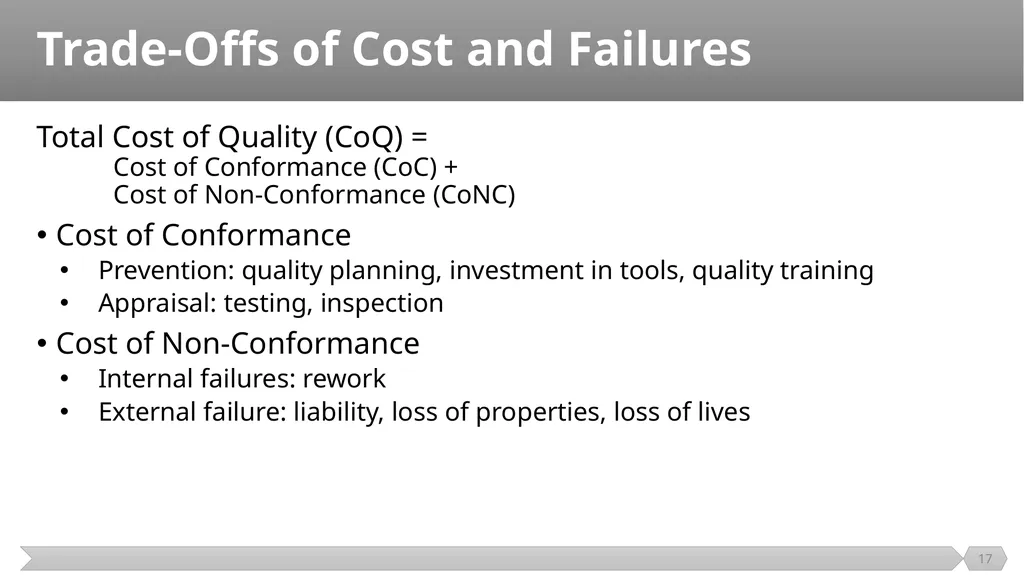
Trade-Offs of Cost and Failures Total Cost of Quality (CoQ) =
Cost of Conformance (CoC) +
Cost of Non-Conformance (CoNC)
Cost of Conformance
Prevention: quality planning, investment in tools, quality training
Appraisal: testing, inspection
Cost of Non-Conformance
Internal failures: rework
External failure: liability, loss of properties, loss of lives 17<br>
Cost of Conformance
Prevention: quality planning, investment in tools, quality training
Appraisal: testing, inspection
Cost of Non-Conformance
Internal failures: rework
External failure: liability, loss of properties, loss of lives 17<br>
18
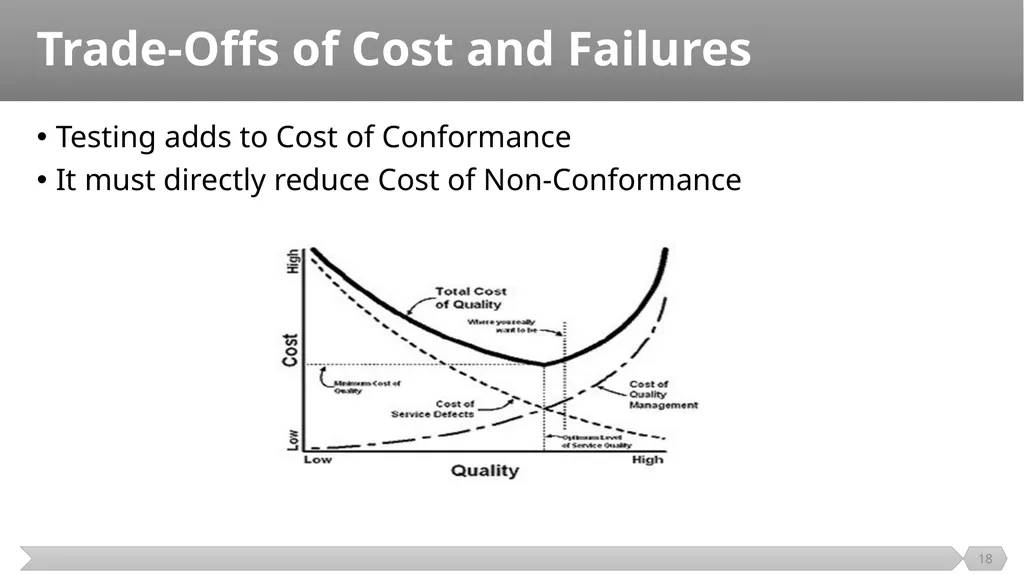
Trade-Offs of Cost and Failures Testing adds to Cost of Conformance
It must directly reduce Cost of Non-Conformance 18<br>
It must directly reduce Cost of Non-Conformance 18<br>
19
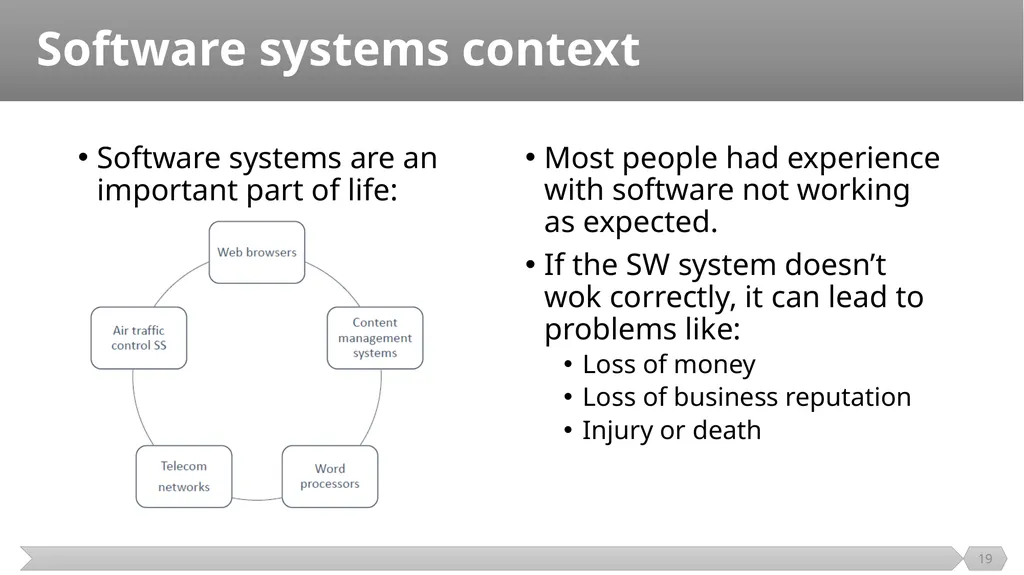
Software systems context Software systems are an important part of life: Most people had experience with software not working as expected.
If the SW system doesn’t wok correctly, it can lead to problems like:
Loss of money
Loss of business reputation
Injury or death 19<br>
If the SW system doesn’t wok correctly, it can lead to problems like:
Loss of money
Loss of business reputation
Injury or death 19<br>
20
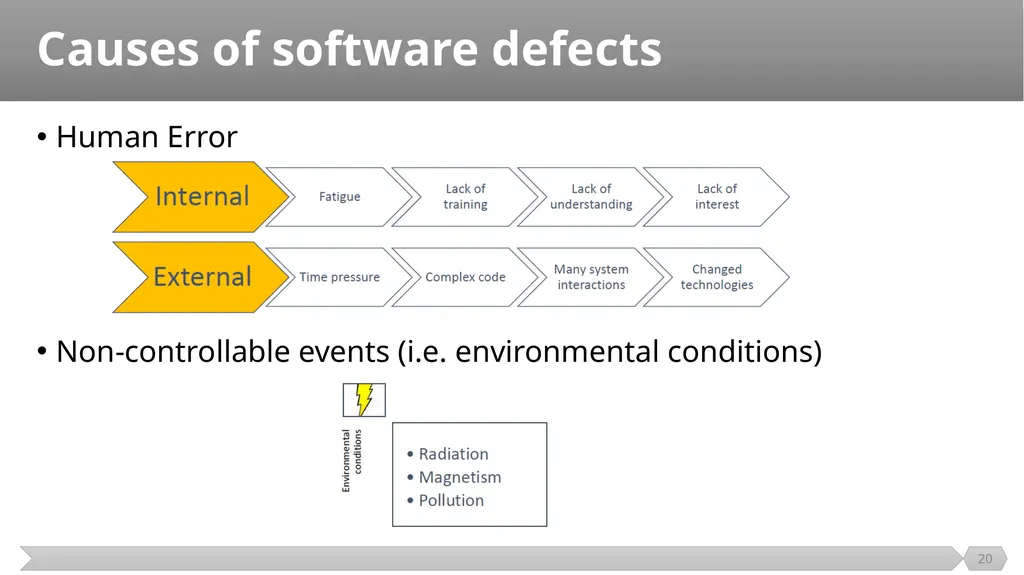
Causes of software defects Human Error
Non-controllable events (i.e. environmental conditions) 20<br>
Non-controllable events (i.e. environmental conditions) 20<br>
21
Causes of software defects Both causes of errors produce defects( = faults, bugs) in the code.
Defects, if executed, may result in failures of the SW system (the system will fail to do what it should).
Failures can affect seriously the users of the SW system, i.e.:
Break pedal not working
Miscalculations in financial SW systems 21<br>
Defects, if executed, may result in failures of the SW system (the system will fail to do what it should).
Failures can affect seriously the users of the SW system, i.e.:
Break pedal not working
Miscalculations in financial SW systems 21<br>
22
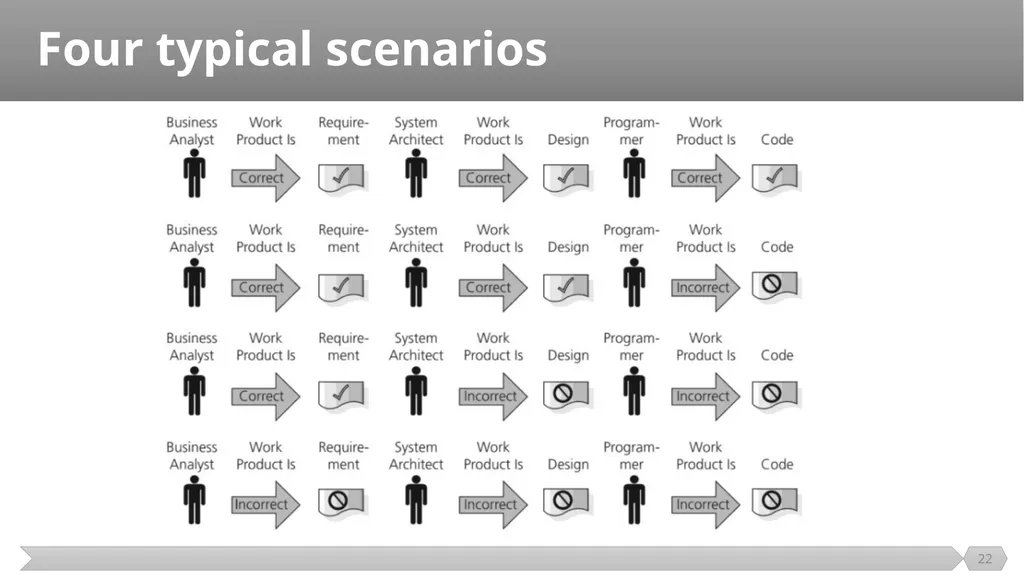
Four typical scenarios 22<br>
23
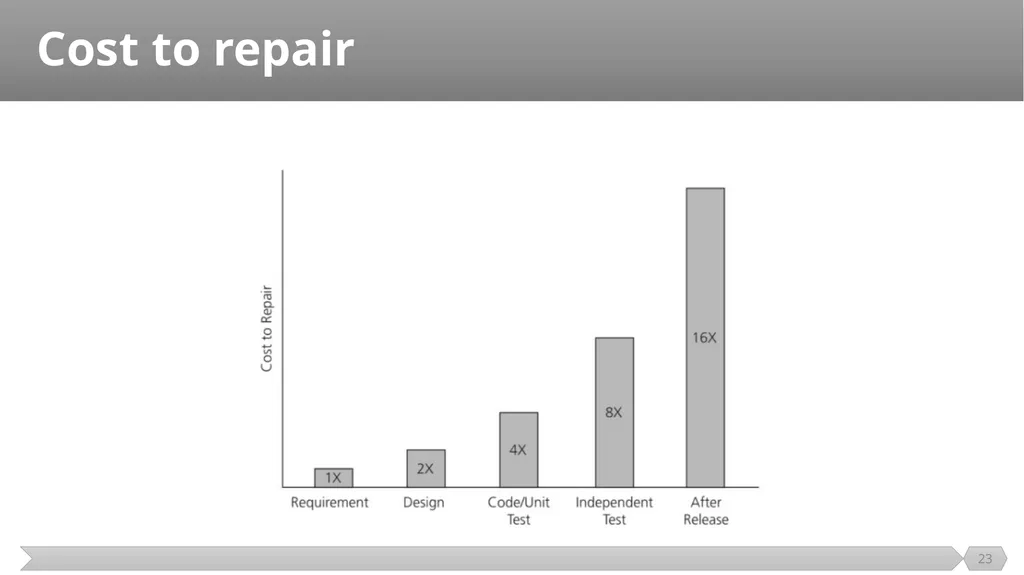
Cost to repair 23<br>
24
Role of testing Testing has an important role in all stages of a SW product’s life cycle:
Planning
Development
Maintenance
Operations 24<br>
Planning
Development
Maintenance
Operations 24<br>
25
Role of testing To reduce the risk of problems occurring during operation
To check if the SW system meets:
legal requirements
Industry specific standards
To learn more about the SW system 25<br>
To check if the SW system meets:
legal requirements
Industry specific standards
To learn more about the SW system 25<br>
26
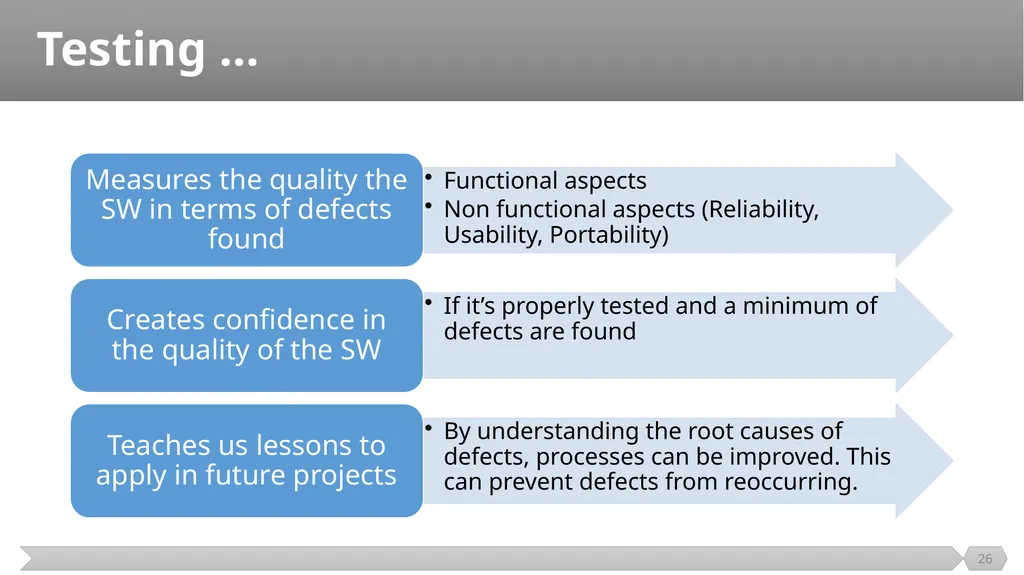
Testing … 26<br>
27
What is testing? 27<br>
28
What is Software Testing? It is a systematic process used to identify the correctness, completeness, and quality of developed software. It includes a set of activities conducted with the intent of finding errors in a software so it can be corrected before the product is released to the end users
In simple words: Software testing is an activity that ensures the software system is defect free.
It can be either done manually or using automated tools. 28<br>
In simple words: Software testing is an activity that ensures the software system is defect free.
It can be either done manually or using automated tools. 28<br>
29
Definition of testing The process of testing all SW life-cycle activities:
both static and dynamic,
concerned with:
planning, preparation and evaluation
of :
software products and related work products
to:
determine that they satisfy specified requirements
demonstrate that they are fit for purpose
detect defects. 29<br>
both static and dynamic,
concerned with:
planning, preparation and evaluation
of :
software products and related work products
to:
determine that they satisfy specified requirements
demonstrate that they are fit for purpose
detect defects. 29<br>
30
Definition of testing Depending on the objectives of the test process, testing can be focused on
Confirming that the SW system meets the requirements
Causing as many failures as possible
Checking that no defects have been introduced during changes
Assessing the quality of the SW (with no intention of finding
Finding defects
reduces the probability of undiscovered defects
Creating confidence in the level of quality
Providing information for decision-making
Preventing defects 30<br>
Confirming that the SW system meets the requirements
Causing as many failures as possible
Checking that no defects have been introduced during changes
Assessing the quality of the SW (with no intention of finding
Finding defects
reduces the probability of undiscovered defects
Creating confidence in the level of quality
Providing information for decision-making
Preventing defects 30<br>
31
Definition of testing Finding defects
reduces the probability of undiscovered defects
Creating confidence in the level of quality
Providing information for decision-making
Preventing defects 31<br>
reduces the probability of undiscovered defects
Creating confidence in the level of quality
Providing information for decision-making
Preventing defects 31<br>
32
Software Testing 32<br>
33
Myth #1 in Software Testing Q: What is the objective of software testing?
A: Testing is to show that there are no
errors/bugs/defects in the software. Fact:
No!! The main objective of testing is to discover defects.
Testing is a destructive activity. 33<br>
A: Testing is to show that there are no
errors/bugs/defects in the software. Fact:
No!! The main objective of testing is to discover defects.
Testing is a destructive activity. 33<br>
34
Myth #2 in Software Testing Q: What is the objective of software testing?
A: Testing is to ensure that the software does what it is supposed to do. Fact:
Only partly true.
Testing is also to ensure the software does not do what it is not supposed to do. 34<br>
A: Testing is to ensure that the software does what it is supposed to do. Fact:
Only partly true.
Testing is also to ensure the software does not do what it is not supposed to do. 34<br>
35
Myth #3 in Software Testing Q: How challenging is software testing?
A: Testing is easier than design and
implementation. Fact:
Must consider all possible scenarios.
Implied and unstated requirements and threats.
Must be imaginative and creative. 35<br>
A: Testing is easier than design and
implementation. Fact:
Must consider all possible scenarios.
Implied and unstated requirements and threats.
Must be imaginative and creative. 35<br>
36
Myth #4 in Software Testing Q: How challenging is software testing?
A: Testing is an extremely creative and
intellectually challenging task. 36<br>
A: Testing is an extremely creative and
intellectually challenging task. 36<br>
37
A Self Assessment Test 37<br>
38
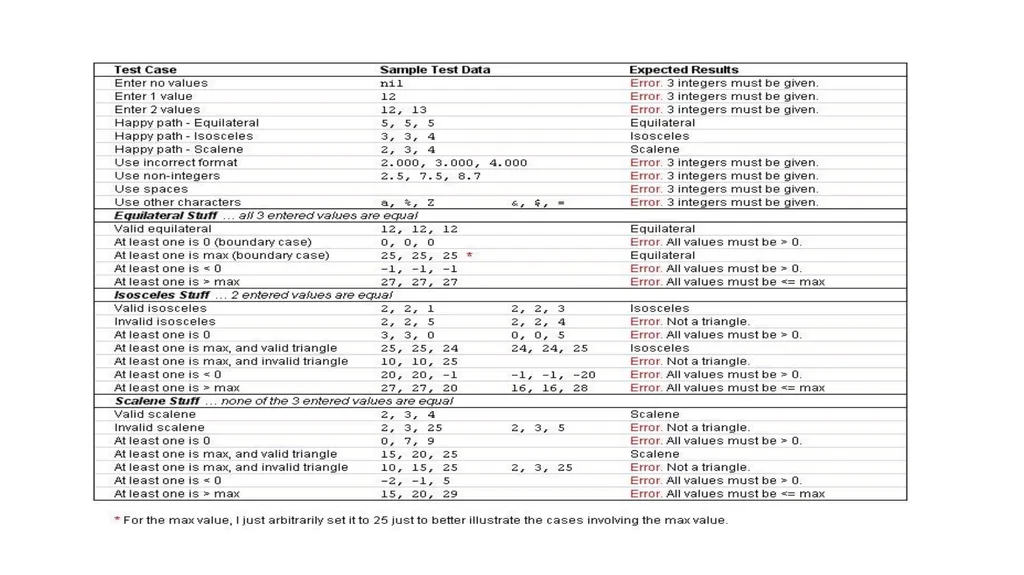
Test the Following Program The program reads in 3 integer values that represent the lengths of the sides of a triangle.
The program prints a message that states whether the triangle is
Equilateral (all 3 sides are equal)
Isosceles (exactly 2 of the 3 sides are equal)
Scalene (all 3 sides are of a different length)
Write a set of test cases that you feel would adequately test this program. 38<br>
The program prints a message that states whether the triangle is
Equilateral (all 3 sides are equal)
Isosceles (exactly 2 of the 3 sides are equal)
Scalene (all 3 sides are of a different length)
Write a set of test cases that you feel would adequately test this program. 38<br>
39
How Will You Do It? Write a set of test cases that you feel would adequately test this program.
How many cases are needed?
How do you plan to test the program?
Run it once and manually enter the values?
Run it many times with different inputs?
Run it with a file containing a set of lines with test values? 40<br>
How many cases are needed?
How do you plan to test the program?
Run it once and manually enter the values?
Run it many times with different inputs?
Run it with a file containing a set of lines with test values? 40<br>
40
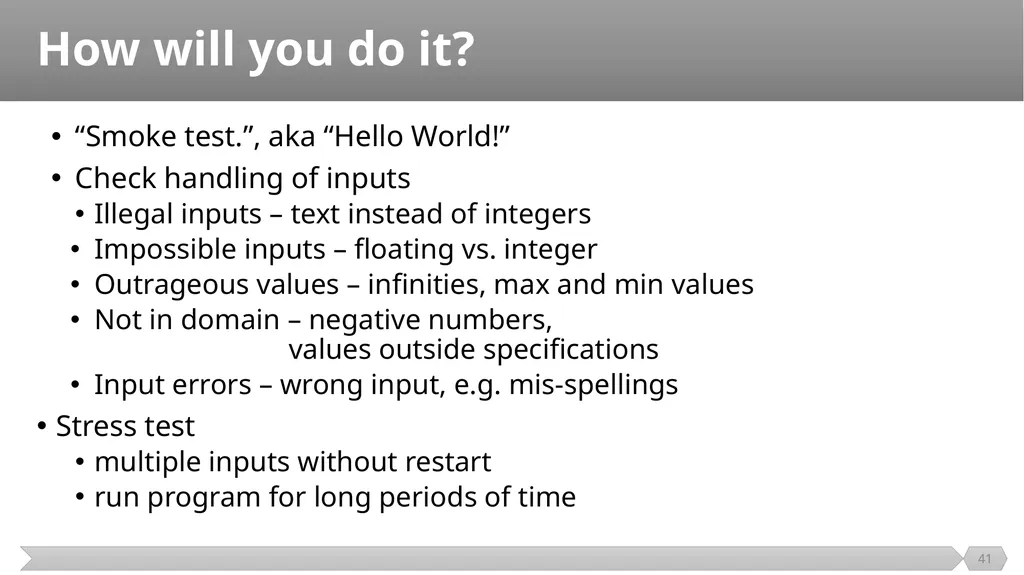
How will you do it? “Smoke test.”, aka “Hello World!”
Check handling of inputs
Illegal inputs – text instead of integers
Impossible inputs – floating vs. integer
Outrageous values – infinities, max and min values
Not in domain – negative numbers, values outside specifications
Input errors – wrong input, e.g. mis-spellings
Stress test
multiple inputs without restart
run program for long periods of time 41<br>
Check handling of inputs
Illegal inputs – text instead of integers
Impossible inputs – floating vs. integer
Outrageous values – infinities, max and min values
Not in domain – negative numbers, values outside specifications
Input errors – wrong input, e.g. mis-spellings
Stress test
multiple inputs without restart
run program for long periods of time 41<br>
41
Software Testing
Terminologies 42<br>
42
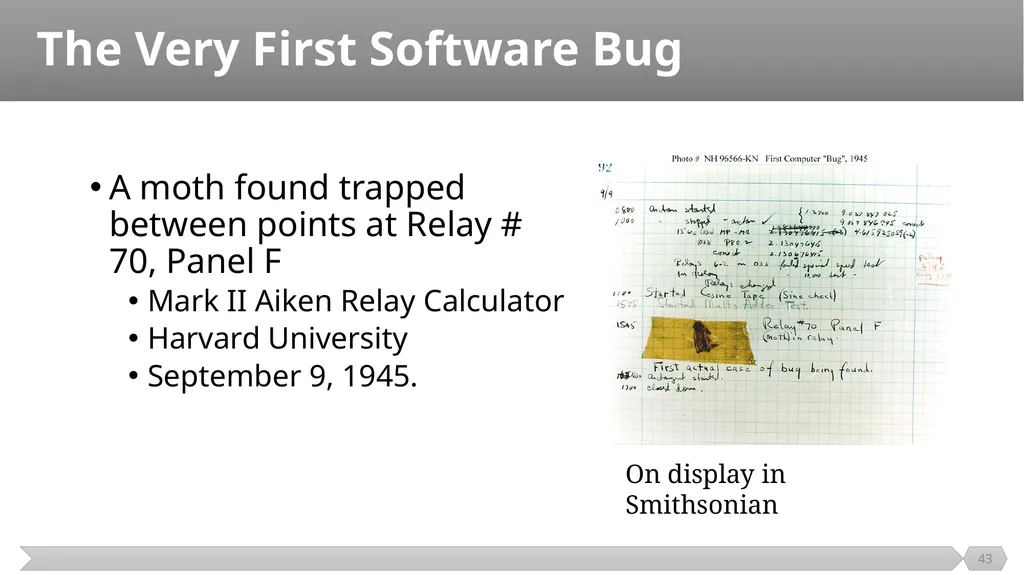
The Very First Software Bug A moth found trapped between points at Relay # 70, Panel F
Mark II Aiken Relay Calculator
Harvard University
September 9, 1945. On display in Smithsonian 43<br>
Mark II Aiken Relay Calculator
Harvard University
September 9, 1945. On display in Smithsonian 43<br>
43
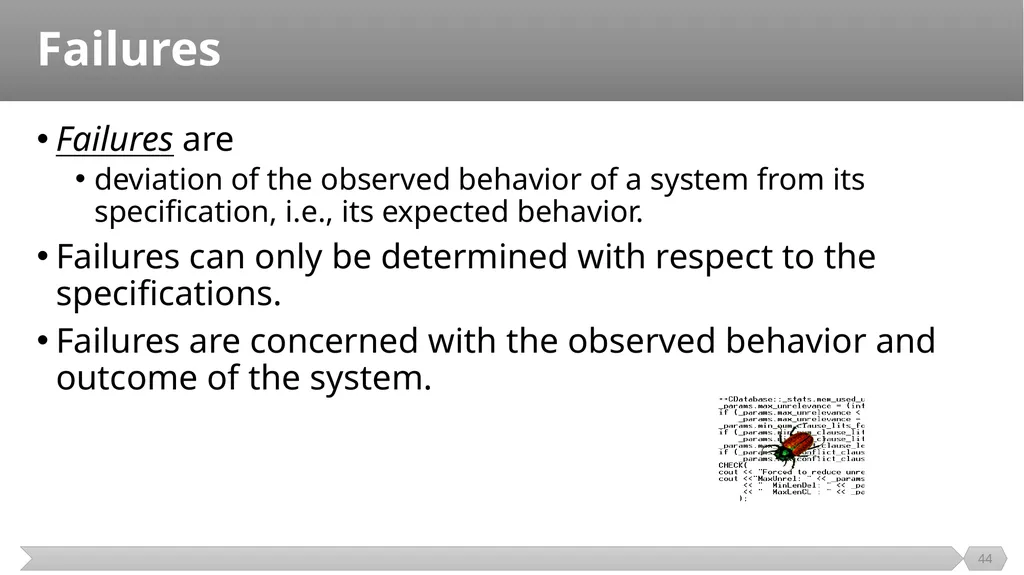
Failures Failures are
deviation of the observed behavior of a system from its specification, i.e., its expected behavior.
Failures can only be determined with respect to the specifications.
Failures are concerned with the observed behavior and outcome of the system. 44<br>
deviation of the observed behavior of a system from its specification, i.e., its expected behavior.
Failures can only be determined with respect to the specifications.
Failures are concerned with the observed behavior and outcome of the system. 44<br>
44
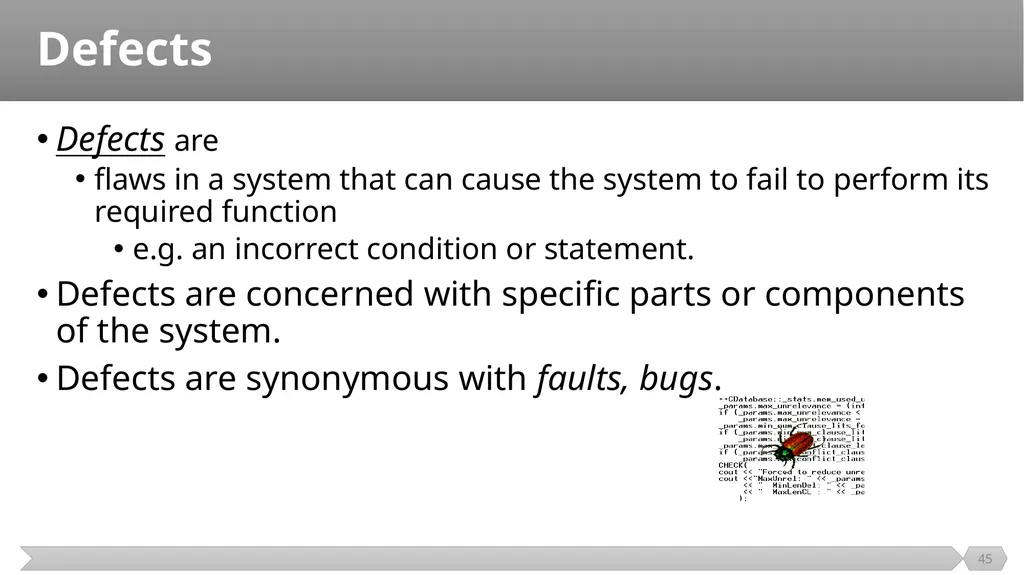
Defects Defects are
flaws in a system that can cause the system to fail to perform its required function
e.g. an incorrect condition or statement.
Defects are concerned with specific parts or components of the system.
Defects are synonymous with faults, bugs. 45<br>
flaws in a system that can cause the system to fail to perform its required function
e.g. an incorrect condition or statement.
Defects are concerned with specific parts or components of the system.
Defects are synonymous with faults, bugs. 45<br>
45
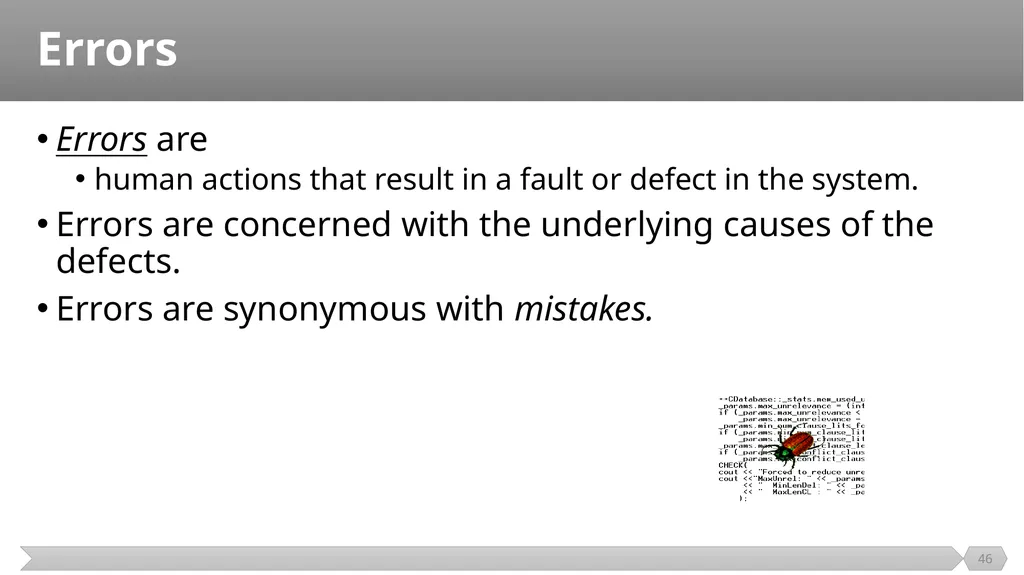
Errors Errors are
human actions that result in a fault or defect in the system.
Errors are concerned with the underlying causes of the defects.
Errors are synonymous with mistakes. 46<br>
human actions that result in a fault or defect in the system.
Errors are concerned with the underlying causes of the defects.
Errors are synonymous with mistakes. 46<br>
46
The Relations among Failures, Defects, and Errors A human being makes an error (mistake)
can occur in design, coding, requirements, even testing.
An error can lead to a defect (fault)
can occur in requirements, design, or program code.
If a defect in code is executed, a failure may occur.
Failures only occur when a defect in the code is executed.
Not all defects cause failures all the time.
Defects occur because human beings are fallible
Failures can be caused by environmental conditions as well. 47<br>
can occur in design, coding, requirements, even testing.
An error can lead to a defect (fault)
can occur in requirements, design, or program code.
If a defect in code is executed, a failure may occur.
Failures only occur when a defect in the code is executed.
Not all defects cause failures all the time.
Defects occur because human beings are fallible
Failures can be caused by environmental conditions as well. 47<br>
47
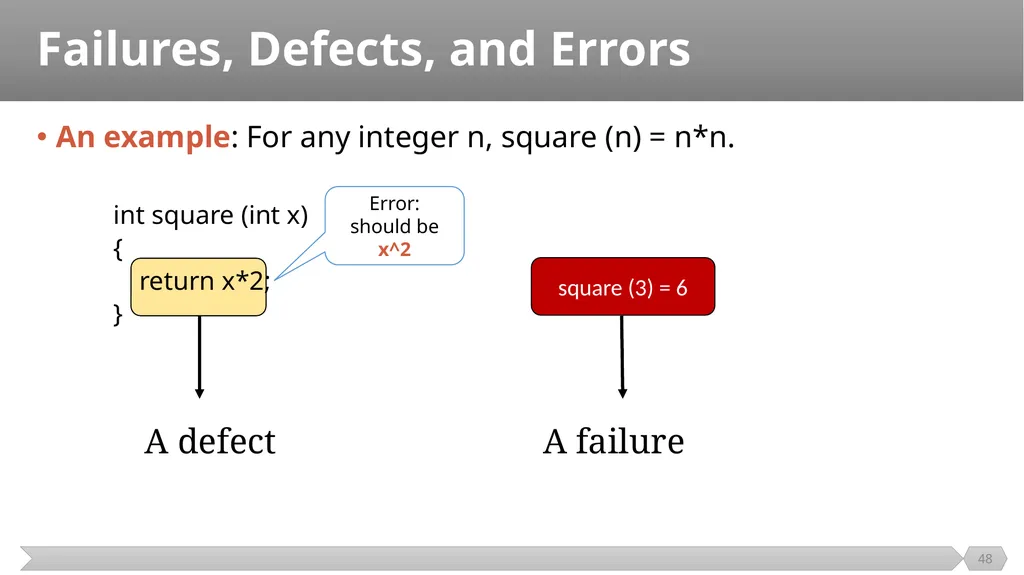
An example: For any integer n, square (n) = n*n.
int square (int x)
{
return x*2;
} Failures, Defects, and Errors 48 A failure A defect square (3) = 6 Error: should be x^2<br>
int square (int x)
{
return x*2;
} Failures, Defects, and Errors 48 A failure A defect square (3) = 6 Error: should be x^2<br>
48
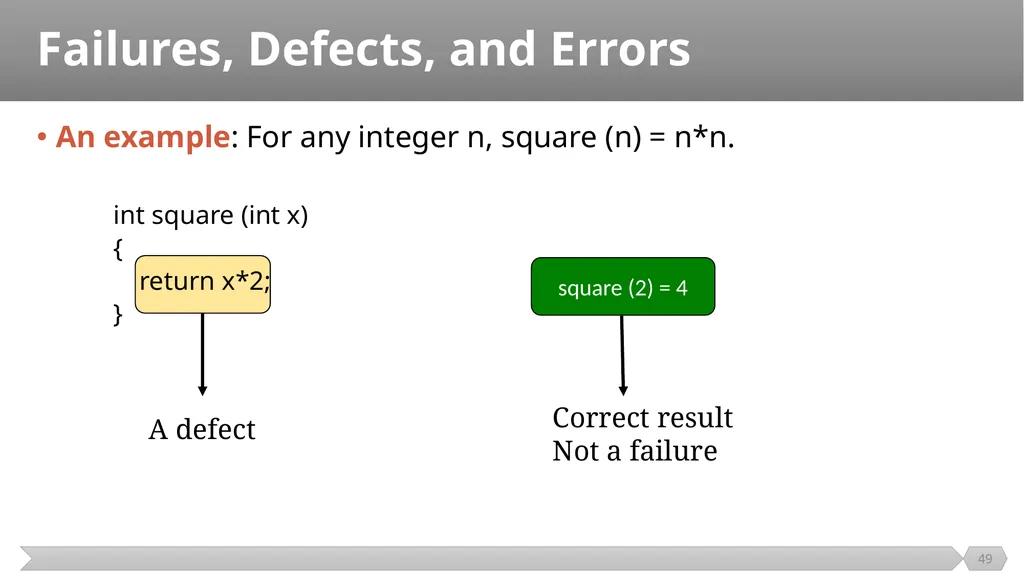
An example: For any integer n, square (n) = n*n.
int square (int x)
{
return x*2;
} Failures, Defects, and Errors 49 Correct result
Not a failure A defect square (2) = 4<br>
int square (int x)
{
return x*2;
} Failures, Defects, and Errors 49 Correct result
Not a failure A defect square (2) = 4<br>
49
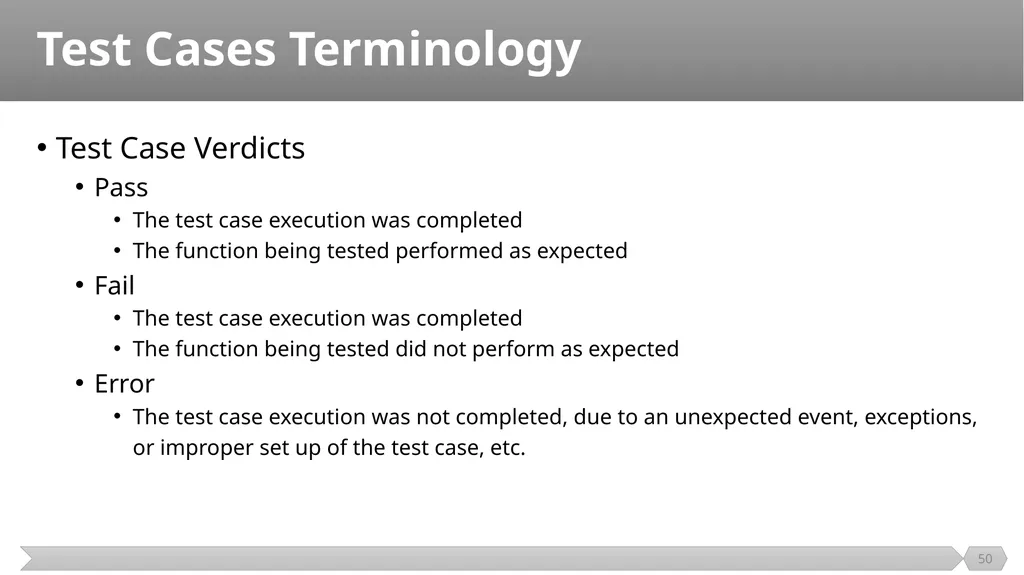
Test Cases Terminology Test Case Verdicts
Pass
The test case execution was completed
The function being tested performed as expected
Fail
The test case execution was completed
The function being tested did not perform as expected
Error
The test case execution was not completed, due to an unexpected event, exceptions, or improper set up of the test case, etc. 50<br>
Pass
The test case execution was completed
The function being tested performed as expected
Fail
The test case execution was completed
The function being tested did not perform as expected
Error
The test case execution was not completed, due to an unexpected event, exceptions, or improper set up of the test case, etc. 50<br>
50
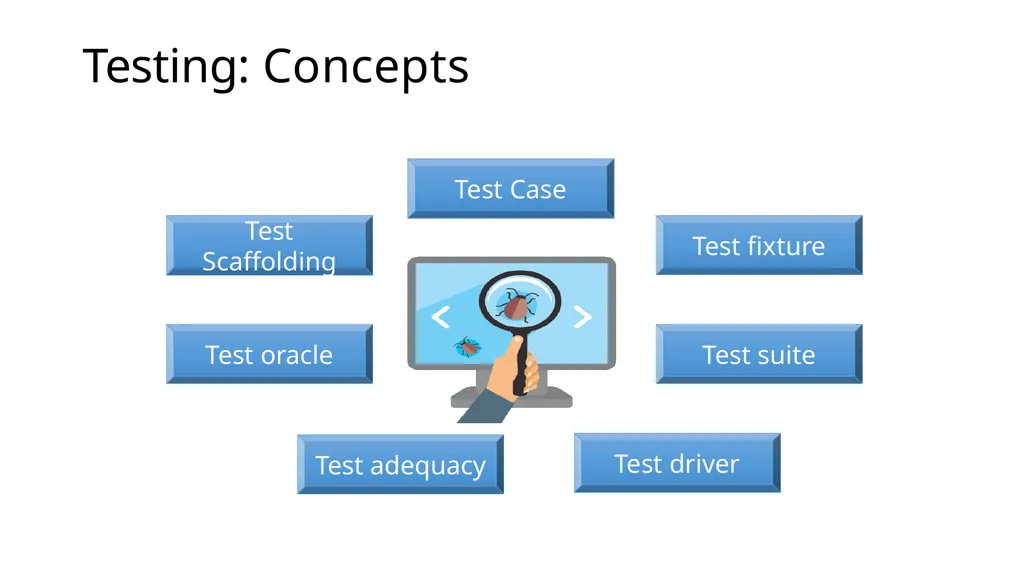
Testing: Concepts Test Case Test fixture Test suite Test driver Test adequacy Test Scaffolding Test oracle<br>
51
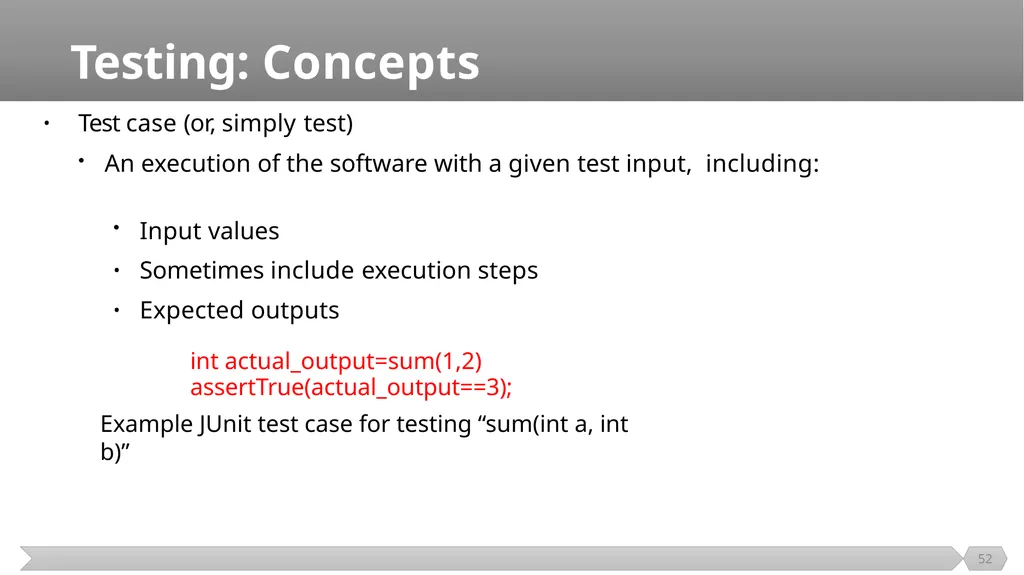
Testing: Concepts • Test case (or, simply test)
An execution of the software with a given test input, including: • • Input values
Sometimes include execution steps
Expected outputs int actual_output=sum(1,2) assertTrue(actual_output==3);
Example JUnit test case for testing “sum(int a, int b)” 52<br>
An execution of the software with a given test input, including: • • Input values
Sometimes include execution steps
Expected outputs int actual_output=sum(1,2) assertTrue(actual_output==3);
Example JUnit test case for testing “sum(int a, int b)” 52<br>
52
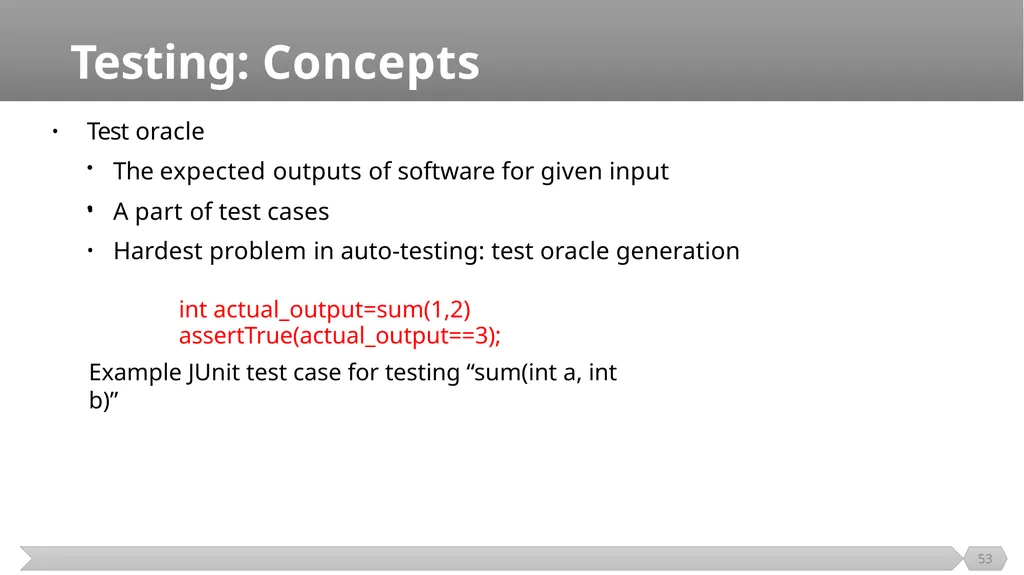
• Test oracle • • The expected outputs of software for given input
A part of test cases
Hardest problem in auto-testing: test oracle generation int actual_output=sum(1,2) assertTrue(actual_output==3);
Example JUnit test case for testing “sum(int a, int b)” 53 Testing: Concepts<br>
A part of test cases
Hardest problem in auto-testing: test oracle generation int actual_output=sum(1,2) assertTrue(actual_output==3);
Example JUnit test case for testing “sum(int a, int b)” 53 Testing: Concepts<br>
53
To do Unit tests, we have to provide replacements for parts of the program that we will omit from the test.
Additional code needed to execute a unit or subsystems in isolation
Not useful in production code
Needs to be removed • Test Scaffolding 54 Testing: Concepts<br>
Additional code needed to execute a unit or subsystems in isolation
Not useful in production code
Needs to be removed • Test Scaffolding 54 Testing: Concepts<br>
54
• Test fixture: a fixed state of the software under test used as a baseline for running tests; also known as the test context, e.g., Loading a database with a specific, known set of data
Preparation of input data and set-up/creation of fake or mock objects 55 Testing: Concepts<br>
Preparation of input data and set-up/creation of fake or mock objects 55 Testing: Concepts<br>
55
Certain platforms, Certain feature, performance, …
Test Script Testing: Concepts • Test suite • • A collection of test cases
Usually these test cases share similar pre-requisites and configuration
Usually can be run together in sequence
Different test suites for different purposes • A script to run a sequence of test cases or a test suite automatically 56 •<br>
Test Script Testing: Concepts • Test suite • • A collection of test cases
Usually these test cases share similar pre-requisites and configuration
Usually can be run together in sequence
Different test suites for different purposes • A script to run a sequence of test cases or a test suite automatically 56 •<br>
56
A software framework that can load a collection of test cases or a test suite
It can also handle the configuration and comparison between expected outputs and actual outputs Testing: Concepts • Test driver • 57<br>
It can also handle the configuration and comparison between expected outputs and actual outputs Testing: Concepts • Test driver • 57<br>
57
Testing: Concepts Test adequacy
We can’t always use all test inputs, so which do we use and when do we stop?
We need a strategy to determine when we have done enough
Adequacy criterion: A rule that lets us judge the sufficiency of a set of test data for a piece of software 58<br>
We can’t always use all test inputs, so which do we use and when do we stop?
We need a strategy to determine when we have done enough
Adequacy criterion: A rule that lets us judge the sufficiency of a set of test data for a piece of software 58<br>
58
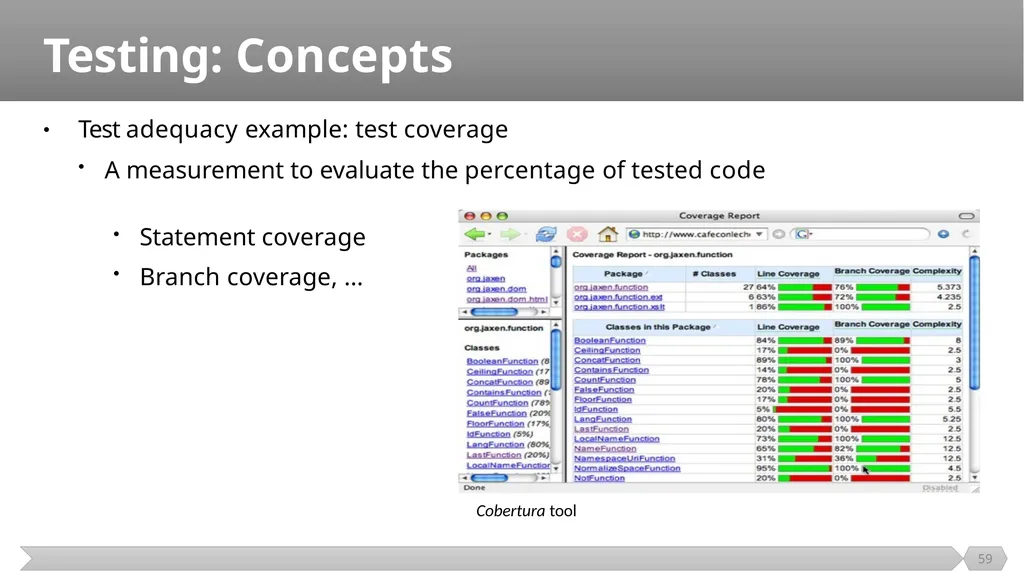
Testing: Concepts • Test adequacy example: test coverage
A measurement to evaluate the percentage of tested code Statement coverage
Branch coverage, ... Cobertura tool 59<br>
A measurement to evaluate the percentage of tested code Statement coverage
Branch coverage, ... Cobertura tool 59<br>
59
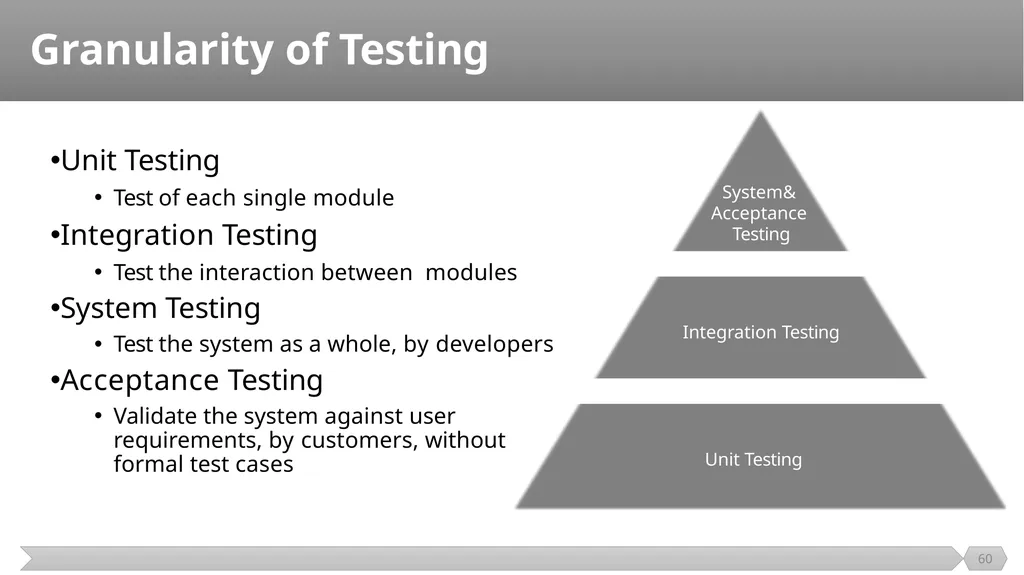
Granularity of Testing Unit Testing
Test of each single module
Integration Testing
Test the interaction between modules
System Testing
Test the system as a whole, by developers
Acceptance Testing
Validate the system against user requirements, by customers, without formal test cases Unit Testing Integration Testing System& Acceptance Testing 60<br>
Test of each single module
Integration Testing
Test the interaction between modules
System Testing
Test the system as a whole, by developers
Acceptance Testing
Validate the system against user requirements, by customers, without formal test cases Unit Testing Integration Testing System& Acceptance Testing 60<br>
60
Testing Purpose The purpose of testing
to find defects.
to discover every conceivable weakness in a software product. Software testing ≠ Debugging.
Software testing ≠ Quality assurance 61<br>
to find defects.
to discover every conceivable weakness in a software product. Software testing ≠ Debugging.
Software testing ≠ Quality assurance 61<br>
61
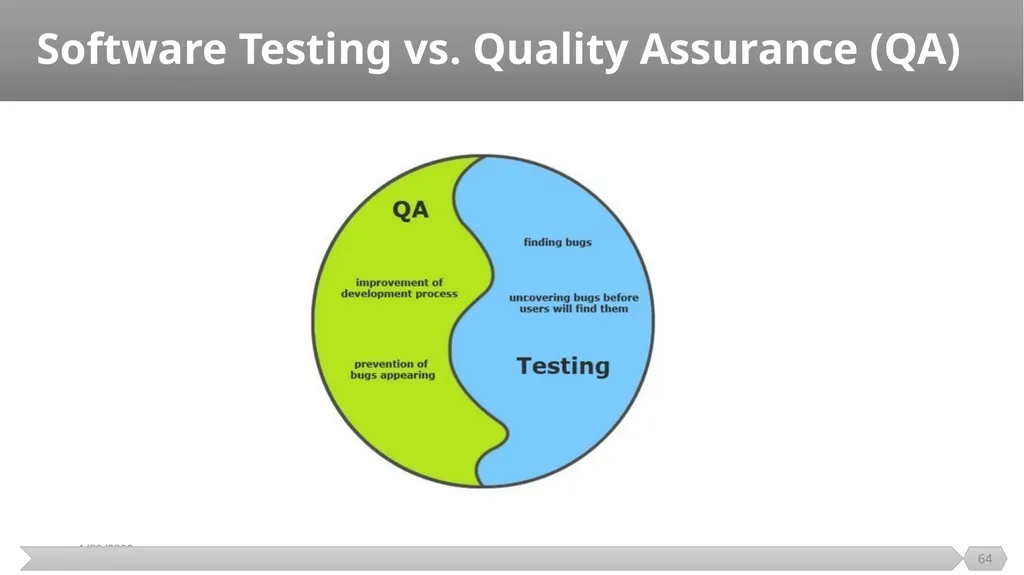
Software Testing vs. Quality Assurance (QA) Software testing is a planned process that is used to identify the correctness, completeness, security and quality of software.
Quality Assurance (QA) is planned and systematic way to evaluate quality of process used to produce a quality product.
The goal of a QA is to provide assurance that a product is meeting customer’s quality expectations. 62<br>
Quality Assurance (QA) is planned and systematic way to evaluate quality of process used to produce a quality product.
The goal of a QA is to provide assurance that a product is meeting customer’s quality expectations. 62<br>
62
Software Testing vs. Quality Assurance (QA) Testing is necessary, but not sufficient for quality assurance
Testing contributes to improve quality by identifying problems.
Quality assurance sets the standards for the team/organization to build better software. 63<br>
Testing contributes to improve quality by identifying problems.
Quality assurance sets the standards for the team/organization to build better software. 63<br>
63
Software Testing vs. Quality Assurance (QA) 64<br>
64
The seven test principles 65<br>
65
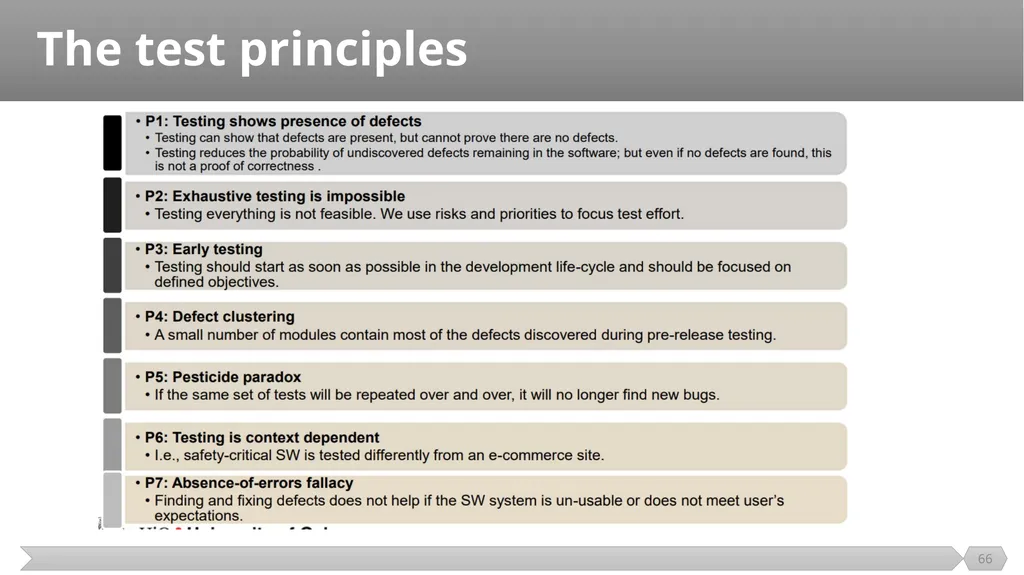
The test principles 66<br>
66
P1: Testing shows the presence of defects, not their absence Testing can show that defects are present, but cannot prove that there are no defects.
Testing reduces the probability of undiscovered defects remaining in the software. However, even if no defects are found, this is not a proof of correctness. 67<br>
Testing reduces the probability of undiscovered defects remaining in the software. However, even if no defects are found, this is not a proof of correctness. 67<br>
67
P2: Exhaustive testing is impossible Testing everything(all combinations of input and preconditions) is not feasible except for specific cases.
We use risks and priorities to focus the testing. 68<br>
We use risks and priorities to focus the testing. 68<br>
68
P3: Early testing saves time and money Testing activities should start as early as possible in the software or system development life cycle and should be focused on defined objectives. 69<br>
69
P4: Defect clustering defects cluster together A small number of modules contains most of the defects discovered during pre release testing. 70<br>
70
P5: Pesticide paradox If the same tests are repeated over and over again, the same set of test cases will no longer find any new bugs.
To overcome this 'pesticide paradox', the test cases need to be regularly reviewed and revised, and new and different tests need to be written to investigate different parts of the software. 71<br>
To overcome this 'pesticide paradox', the test cases need to be regularly reviewed and revised, and new and different tests need to be written to investigate different parts of the software. 71<br>
71
P6: Testing is context dependent Testing is done differently in different contexts.
For example, testing of safety-critical software is different from e-commerce site testing. 72<br>
For example, testing of safety-critical software is different from e-commerce site testing. 72<br>
72
P7: Absence of error fallacy Finding and fixing defects does not help if the software system does not fulfill users' needs and expectations . 73<br>
73
Fundamental Test Processes 74<br>
74
Test Cases and Test Suites Test case
A test case consists of inputs, steps/actions, and expected results, i.e., pass-fail criterion
Test suite
A group of test cases (usually organized around some principles, e.g. smoke test suite) 75<br>
A test case consists of inputs, steps/actions, and expected results, i.e., pass-fail criterion
Test suite
A group of test cases (usually organized around some principles, e.g. smoke test suite) 75<br>
75
Test Plan and Testing Process Test plan
A document that specifies how a system will be tested, including criteria for success, i.e., the exit criteria.
Testing process
The testing process involves developing test plans, designing test cases, running the test cases, and evaluating the results 76<br>
A document that specifies how a system will be tested, including criteria for success, i.e., the exit criteria.
Testing process
The testing process involves developing test plans, designing test cases, running the test cases, and evaluating the results 76<br>
76
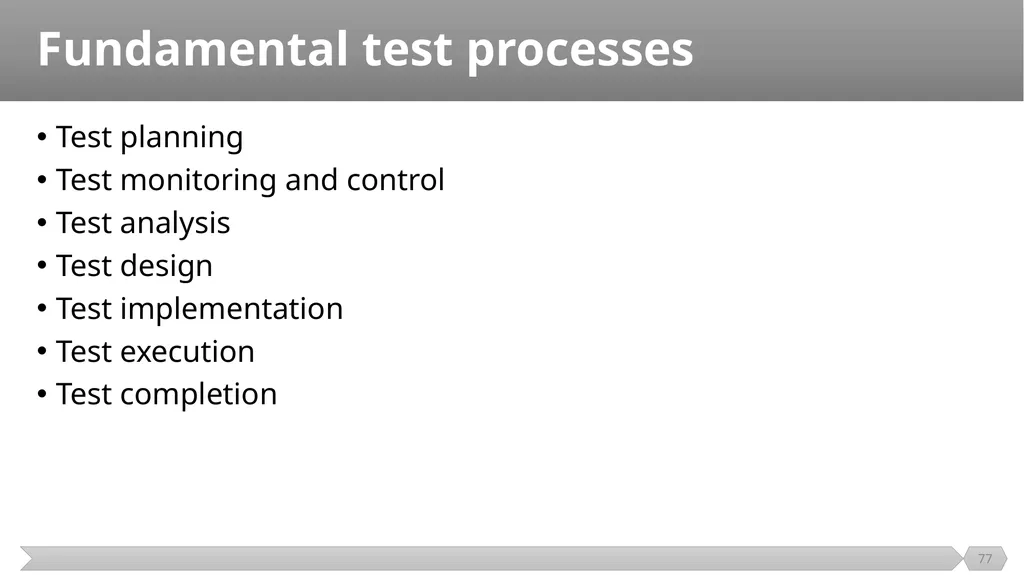
Fundamental test processes Test planning
Test monitoring and control
Test analysis
Test design
Test implementation
Test execution
Test completion 77<br>
Test monitoring and control
Test analysis
Test design
Test implementation
Test execution
Test completion 77<br>
77
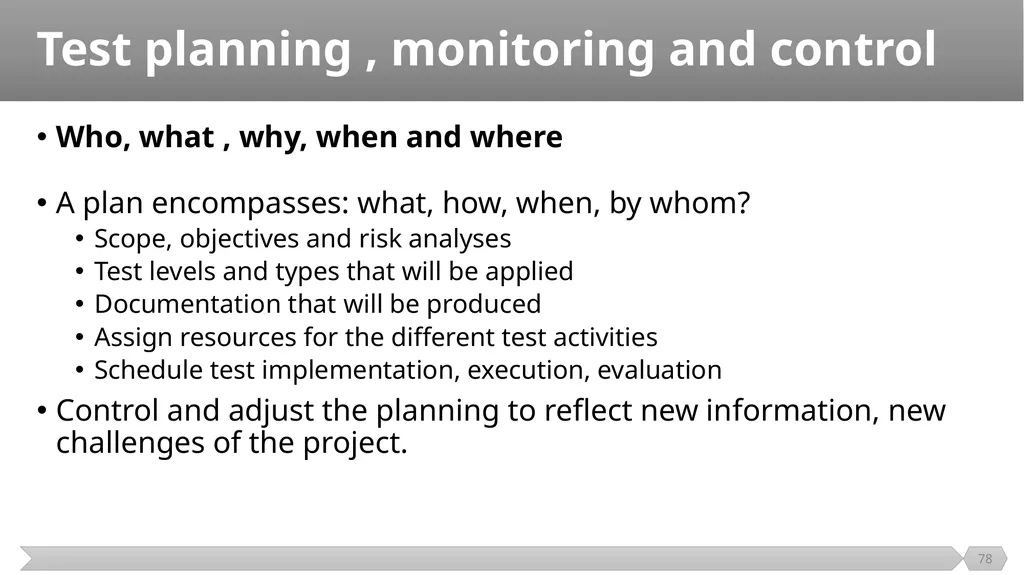
Test planning , monitoring and control Who, what , why, when and where
A plan encompasses: what, how, when, by whom?
Scope, objectives and risk analyses
Test levels and types that will be applied
Documentation that will be produced
Assign resources for the different test activities
Schedule test implementation, execution, evaluation
Control and adjust the planning to reflect new information, new challenges of the project. 78<br>
A plan encompasses: what, how, when, by whom?
Scope, objectives and risk analyses
Test levels and types that will be applied
Documentation that will be produced
Assign resources for the different test activities
Schedule test implementation, execution, evaluation
Control and adjust the planning to reflect new information, new challenges of the project. 78<br>
78
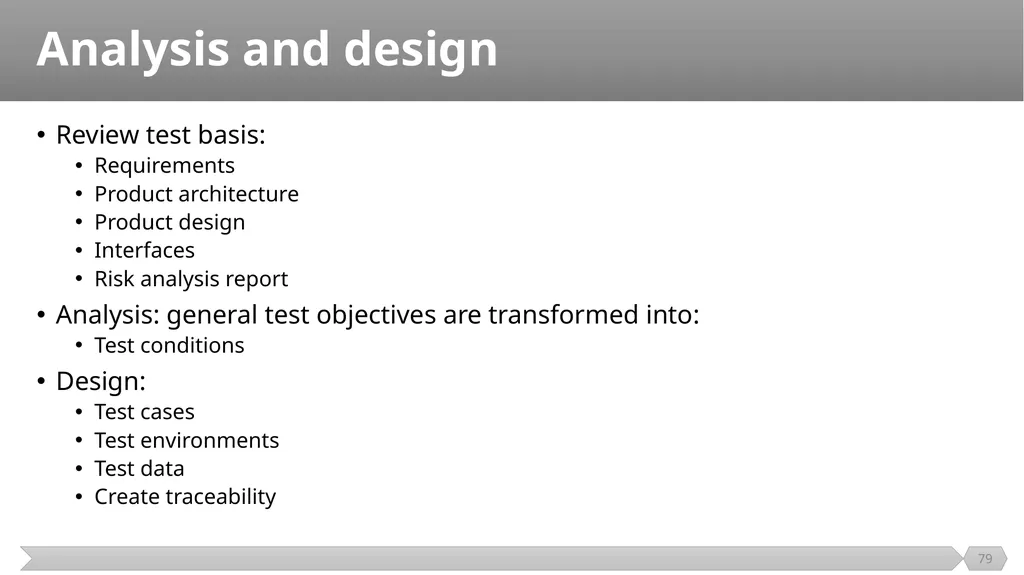
Analysis and design Review test basis:
Requirements
Product architecture
Product design
Interfaces
Risk analysis report
Analysis: general test objectives are transformed into:
Test conditions
Design:
Test cases
Test environments
Test data
Create traceability 79<br>
Requirements
Product architecture
Product design
Interfaces
Risk analysis report
Analysis: general test objectives are transformed into:
Test conditions
Design:
Test cases
Test environments
Test data
Create traceability 79<br>
79
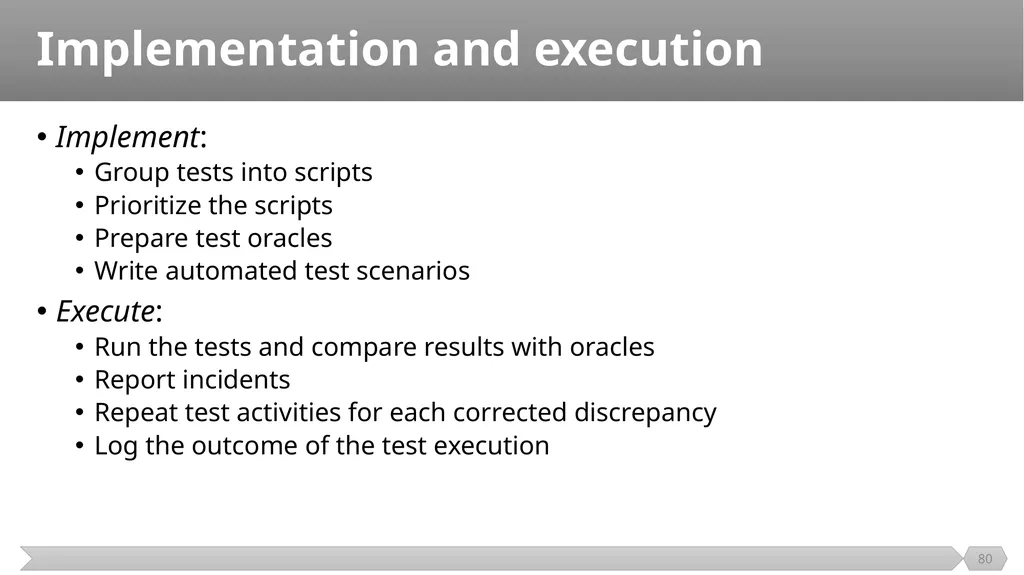
Implementation and execution Implement:
Group tests into scripts
Prioritize the scripts
Prepare test oracles
Write automated test scenarios
Execute:
Run the tests and compare results with oracles
Report incidents
Repeat test activities for each corrected discrepancy
Log the outcome of the test execution 80<br>
Group tests into scripts
Prioritize the scripts
Prepare test oracles
Write automated test scenarios
Execute:
Run the tests and compare results with oracles
Report incidents
Repeat test activities for each corrected discrepancy
Log the outcome of the test execution 80<br>
80
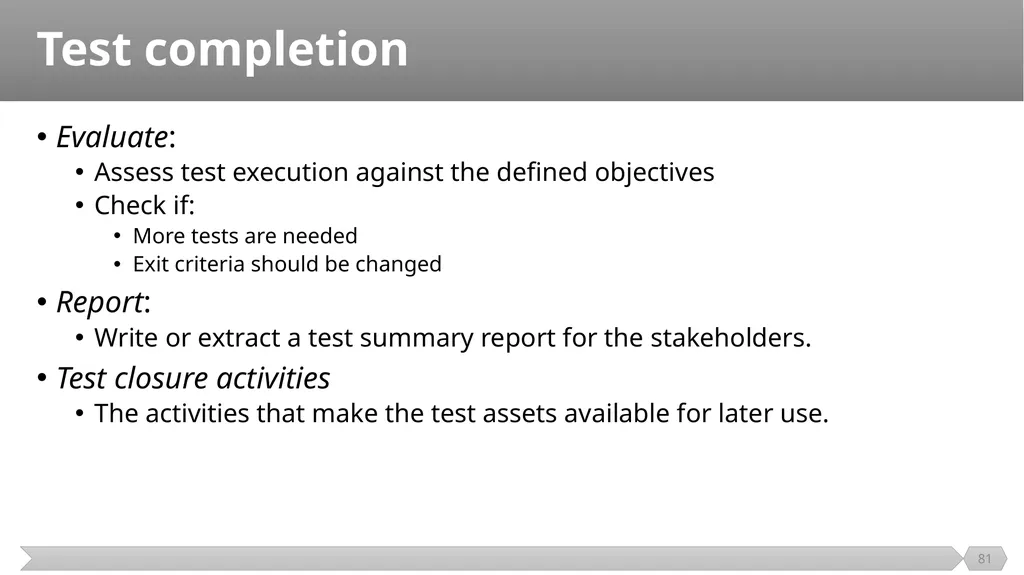
Test completion Evaluate:
Assess test execution against the defined objectives
Check if:
More tests are needed
Exit criteria should be changed
Report:
Write or extract a test summary report for the stakeholders.
Test closure activities
The activities that make the test assets available for later use. 81<br>
Assess test execution against the defined objectives
Check if:
More tests are needed
Exit criteria should be changed
Report:
Write or extract a test summary report for the stakeholders.
Test closure activities
The activities that make the test assets available for later use. 81<br>
81
The psychology of testing 82<br>
82
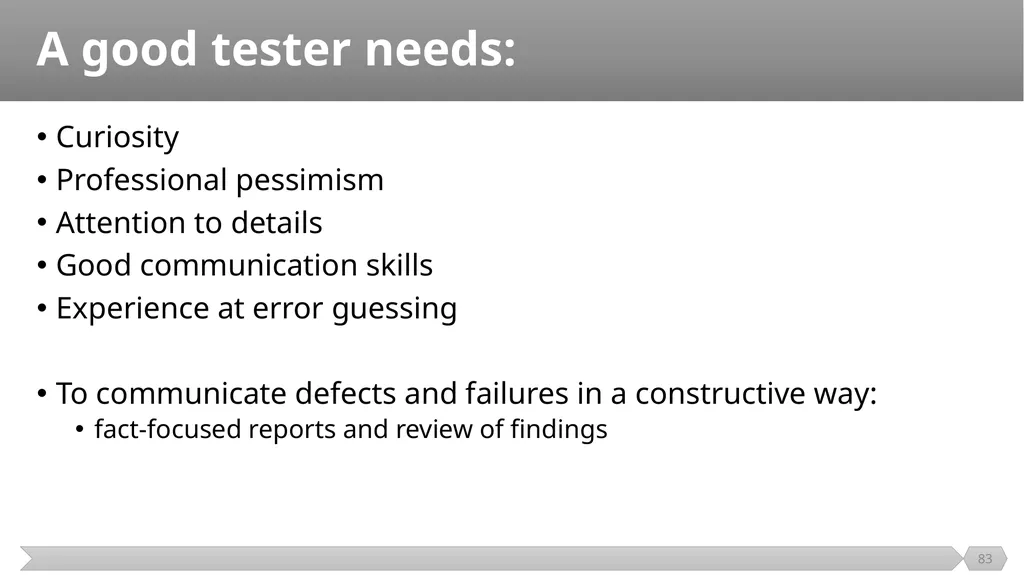
A good tester needs: Curiosity
Professional pessimism
Attention to details
Good communication skills
Experience at error guessing
To communicate defects and failures in a constructive way:
fact-focused reports and review of findings 83<br>
Professional pessimism
Attention to details
Good communication skills
Experience at error guessing
To communicate defects and failures in a constructive way:
fact-focused reports and review of findings 83<br>
83
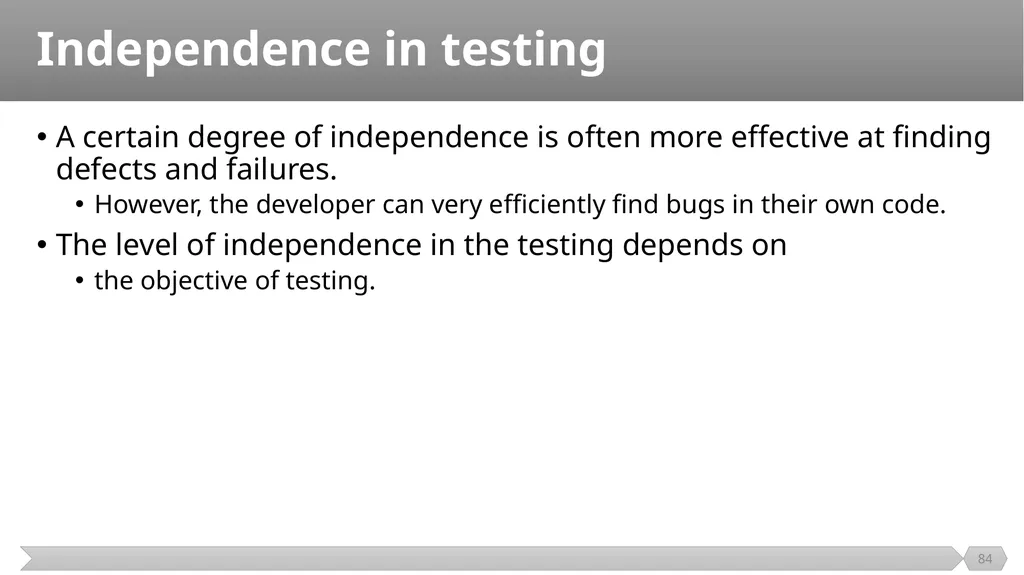
Independence in testing A certain degree of independence is often more effective at finding defects and failures.
However, the developer can very efficiently find bugs in their own code.
The level of independence in the testing depends on
the objective of testing. 84<br>
However, the developer can very efficiently find bugs in their own code.
The level of independence in the testing depends on
the objective of testing. 84<br>
84
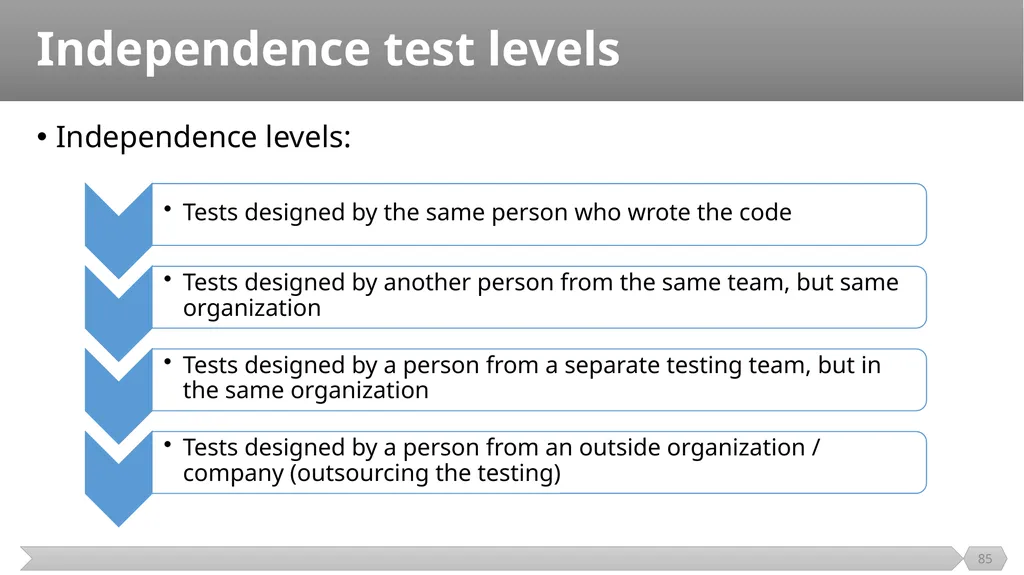
Independence test levels Independence levels: 85<br>
85
Tips and tricks Be clear and objective
Confirm that:
You have understood the requirements
The person that has to fix the bug has understood the problem 86<br>
Confirm that:
You have understood the requirements
The person that has to fix the bug has understood the problem 86<br>
86
Limitations of
Software Testing 87<br>
87
Testing vs. Verification Both, testing and verification attempts to exhibit new failures
Debugging is a systematic process that finds and eliminates the defect that led to an observed failure
Programs without known failures may still contain defects:
If they have not been verified
If they have been verified, but the failure is not covered by the specification 88<br>
Debugging is a systematic process that finds and eliminates the defect that led to an observed failure
Programs without known failures may still contain defects:
If they have not been verified
If they have been verified, but the failure is not covered by the specification 88<br>
88
Fundamental Principles Myth Myth: “Principles are just for reference. I will not use them in practice .”
Fact:
This is so very untrue. Test Principles will help you create an effective Test Strategy and draft error catching test cases.
Experienced testers have internalized these principles to a level that they apply them without even thinking.
Hence the myth that the principles are not used in practice is simply not true. 89<br>
Fact:
This is so very untrue. Test Principles will help you create an effective Test Strategy and draft error catching test cases.
Experienced testers have internalized these principles to a level that they apply them without even thinking.
Hence the myth that the principles are not used in practice is simply not true. 89<br>
89
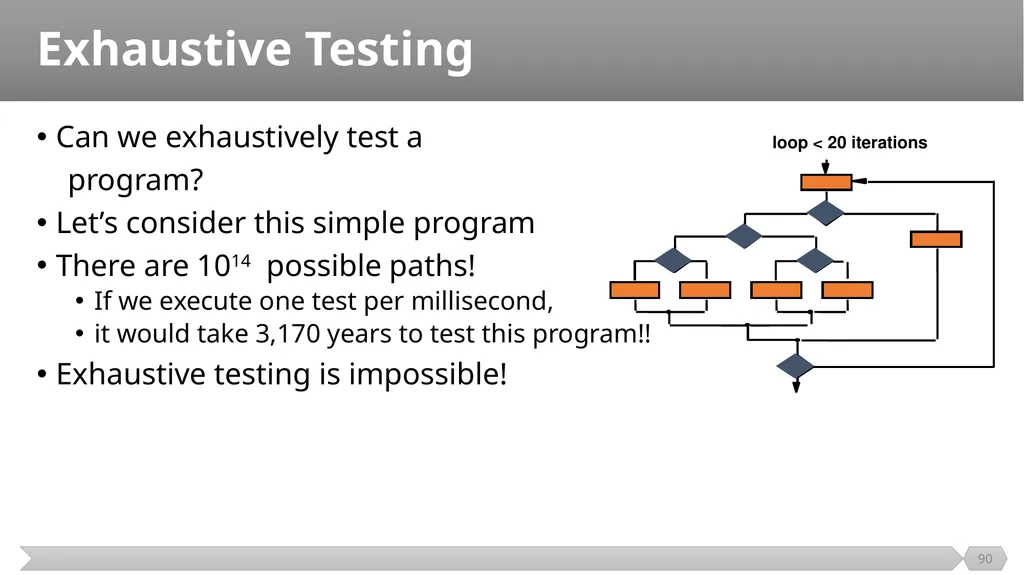
Exhaustive Testing Can we exhaustively test a
program?
Let’s consider this simple program
There are 1014 possible paths!
If we execute one test per millisecond,
it would take 3,170 years to test this program!!
Exhaustive testing is impossible! loop < 20 iterations 90<br>
program?
Let’s consider this simple program
There are 1014 possible paths!
If we execute one test per millisecond,
it would take 3,170 years to test this program!!
Exhaustive testing is impossible! loop < 20 iterations 90<br>
90
Absence of Defects “Program testing can be used to show the presence of bugs, but never their absence.”
(Dijkstra, 1969)
Testing reduces the probability of undiscovered defects remaining in the software but, even if no defects are found, it is not a proof of absence of defects. 91<br>
(Dijkstra, 1969)
Testing reduces the probability of undiscovered defects remaining in the software but, even if no defects are found, it is not a proof of absence of defects. 91<br>
91
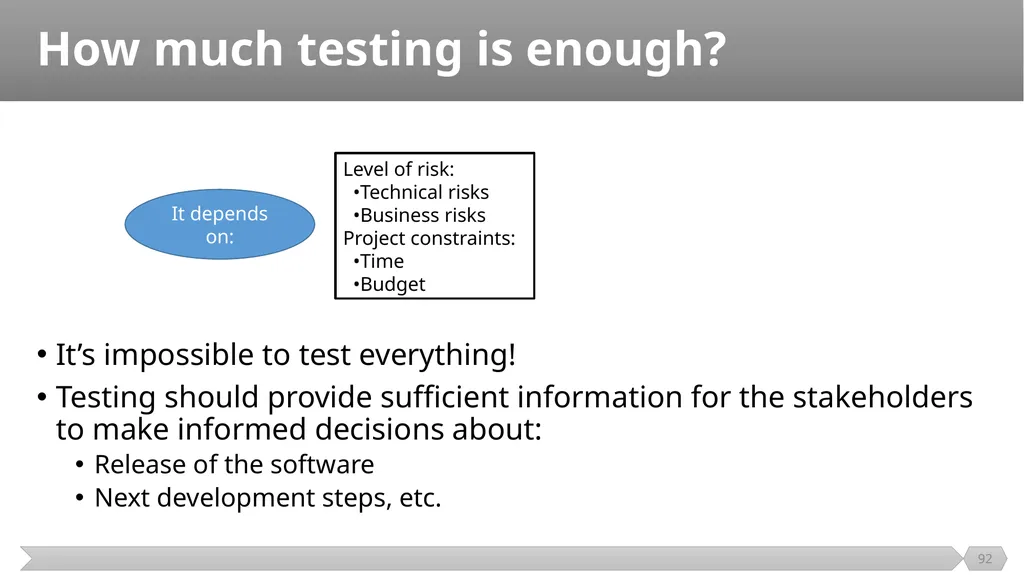
How much testing is enough? It’s impossible to test everything!
Testing should provide sufficient information for the stakeholders to make informed decisions about:
Release of the software
Next development steps, etc. Level of risk:
•Technical risks
•Business risks
Project constraints:
•Time
•Budget It depends on: 92<br>
Testing should provide sufficient information for the stakeholders to make informed decisions about:
Release of the software
Next development steps, etc. Level of risk:
•Technical risks
•Business risks
Project constraints:
•Time
•Budget It depends on: 92<br>
92
When to Stop Testing? One of the most difficult problems in testing is not knowing when to stop.
You can use metrics to make a guess. Keep track of the defect rate. When it goes towards zero you can use it as an indicator. Or, …
Even if you do find the last bug, you’ll never know it. 93<br>
You can use metrics to make a guess. Keep track of the defect rate. When it goes towards zero you can use it as an indicator. Or, …
Even if you do find the last bug, you’ll never know it. 93<br>
93
How Much Testing is Enough? Take into account
the level of risk, including technical, safety, and business risks, and
project constraints such as time and budget.
Testing should provide feedback to stakeholders to make informed decisions
about the release of the software,
for the next development step, or
handover to customers.
Later, we will discuss some techniques for making this decision. 94<br>
the level of risk, including technical, safety, and business risks, and
project constraints such as time and budget.
Testing should provide feedback to stakeholders to make informed decisions
about the release of the software,
for the next development step, or
handover to customers.
Later, we will discuss some techniques for making this decision. 94<br>