
Introduction to After Action Review (online
LO
Published · 38 slides · 0 views

1 / 1
Description
Introduction to After Action Review (online course) Version: 170918 Learning Objectives At the end of this module, you will be able to: Understand the principles of After Action Reviews Explain the working group After Action Review (AAR)
Related Topics
Download this presentation From Below
"Introduction to After Action Review (online" is the property of its rightful owner. Permission is granted to download and print the materials on this website for personal, non-commercial use only, and to display it on your personal computer provided you do not modify the materials and that you retain all copyright notices contained in the materials. By downloading content from our website, you accept the terms of this agreement.
Share
Embed code
Presentation Transcript
01
Introduction to
After Action Review
(online course) Version: 17/09/18<br>
After Action Review
(online course) Version: 17/09/18<br>
02
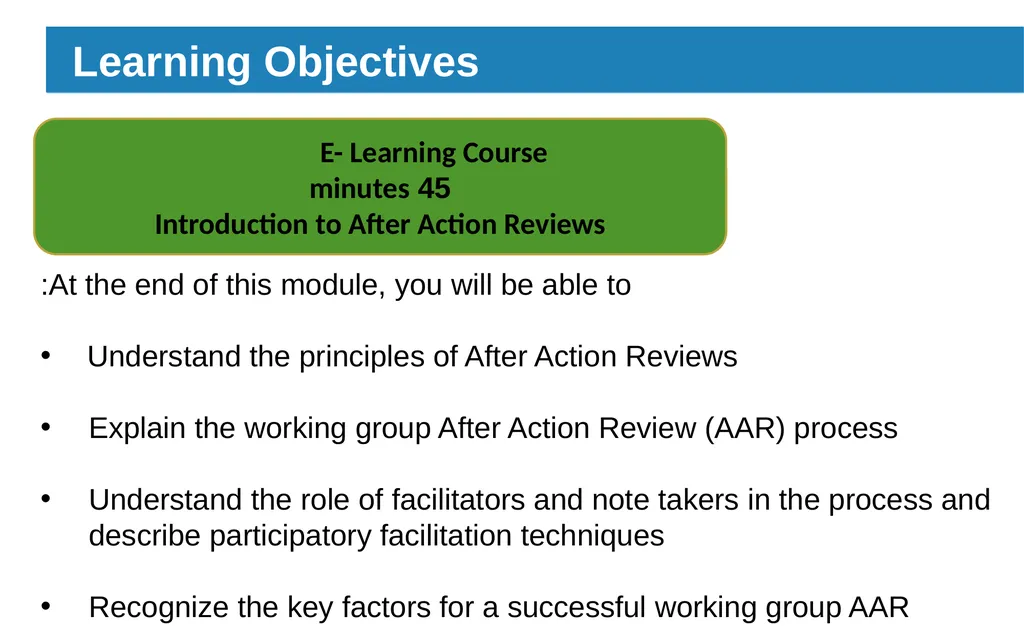
Learning Objectives At the end of this module, you will be able to:
Understand the principles of After Action Reviews
Explain the working group After Action Review (AAR) process
Understand the role of facilitators and note takers in the process and describe participatory facilitation techniques
Recognize the key factors for a successful working group AAR E- Learning Course
45 minutes
Introduction to After Action Reviews<br>
Understand the principles of After Action Reviews
Explain the working group After Action Review (AAR) process
Understand the role of facilitators and note takers in the process and describe participatory facilitation techniques
Recognize the key factors for a successful working group AAR E- Learning Course
45 minutes
Introduction to After Action Reviews<br>
03
Should I take this e- learning course? When should I take this this e- learning?<br>
04
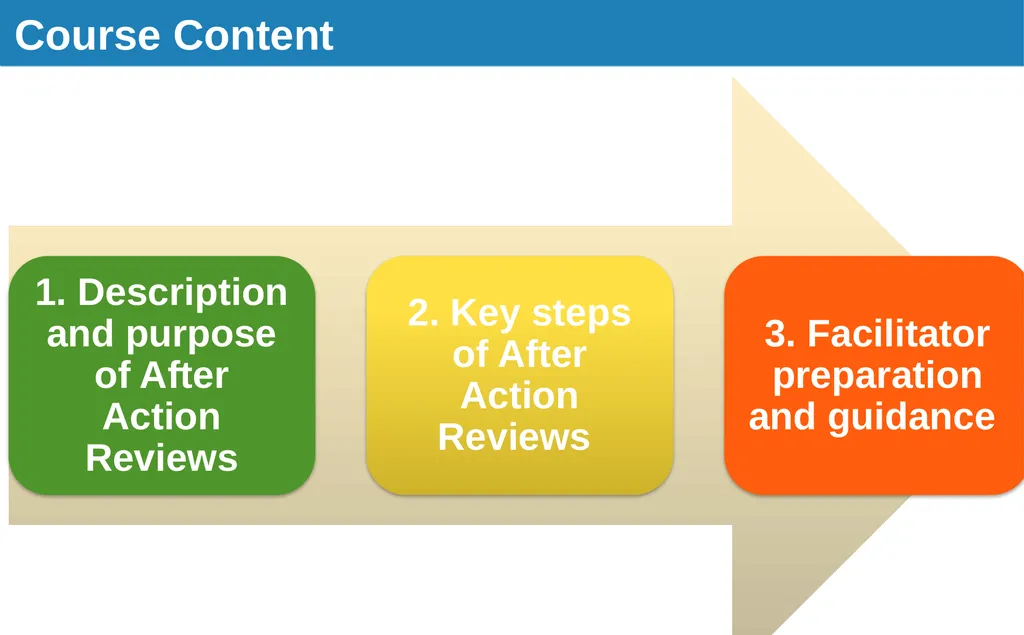
Course Content<br>
05
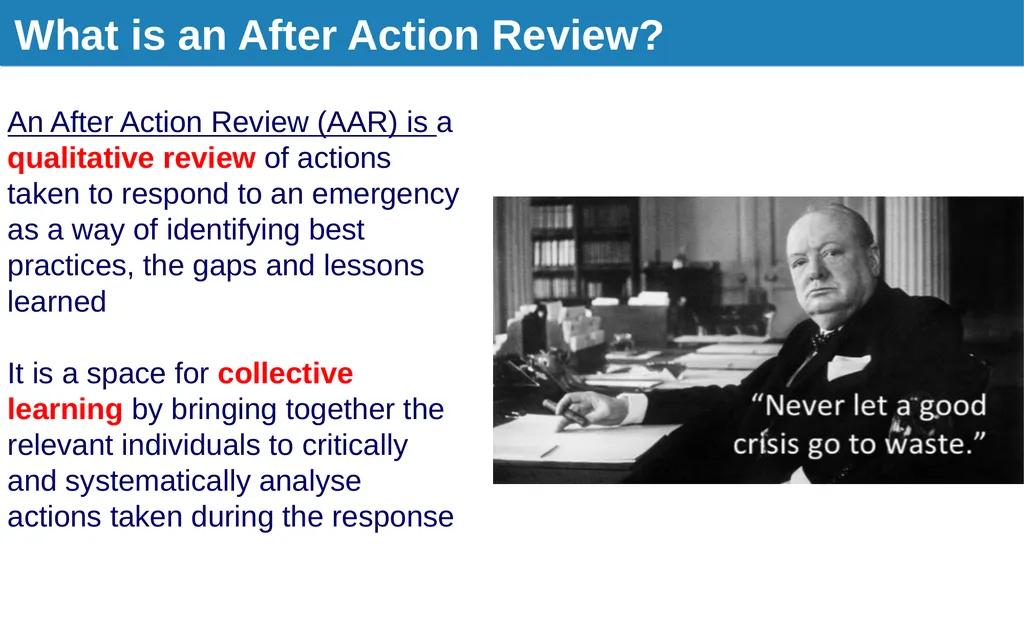
What is an After Action Review? An After Action Review (AAR) is a qualitative review of actions taken to respond to an emergency as a way of identifying best practices, the gaps and lessons learned
It is a space for collective learning by bringing together the relevant individuals to critically and systematically analyse actions taken during the response<br>
It is a space for collective learning by bringing together the relevant individuals to critically and systematically analyse actions taken during the response<br>
06
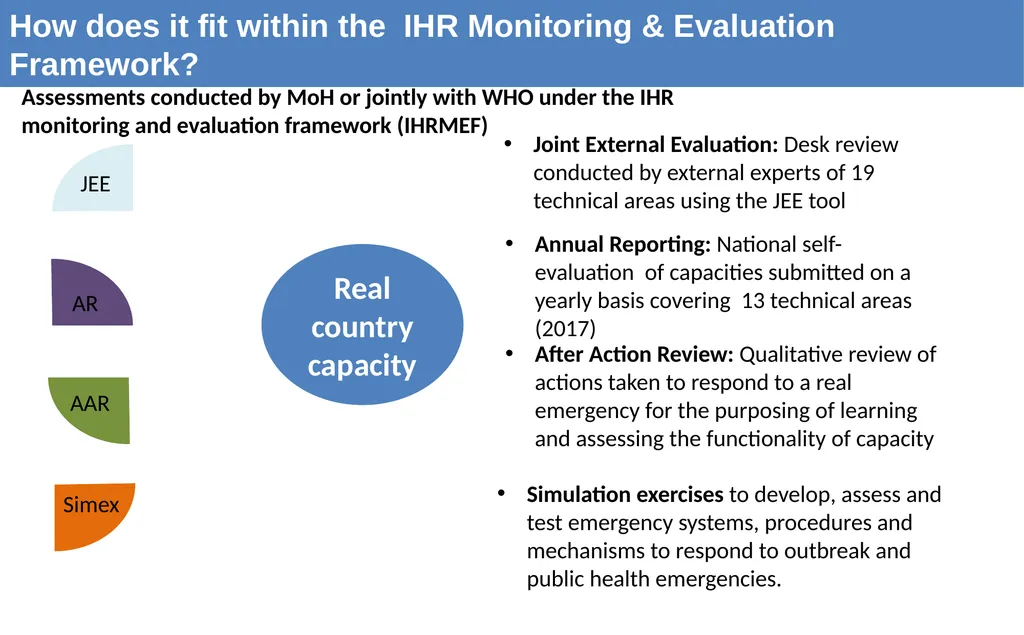
Assessments conducted by MoH or jointly with WHO under the IHR monitoring and evaluation framework (IHRMEF) Joint External Evaluation: Desk review conducted by external experts of 19 technical areas using the JEE tool Annual Reporting: National self-evaluation of capacities submitted on a yearly basis covering 13 technical areas (2017) After Action Review: Qualitative review of actions taken to respond to a real emergency for the purposing of learning and assessing the functionality of capacity Simulation exercises to develop, assess and test emergency systems, procedures and mechanisms to respond to outbreak and public health emergencies. Real country capacity How does it fit within the IHR Monitoring & Evaluation Framework?<br>
07
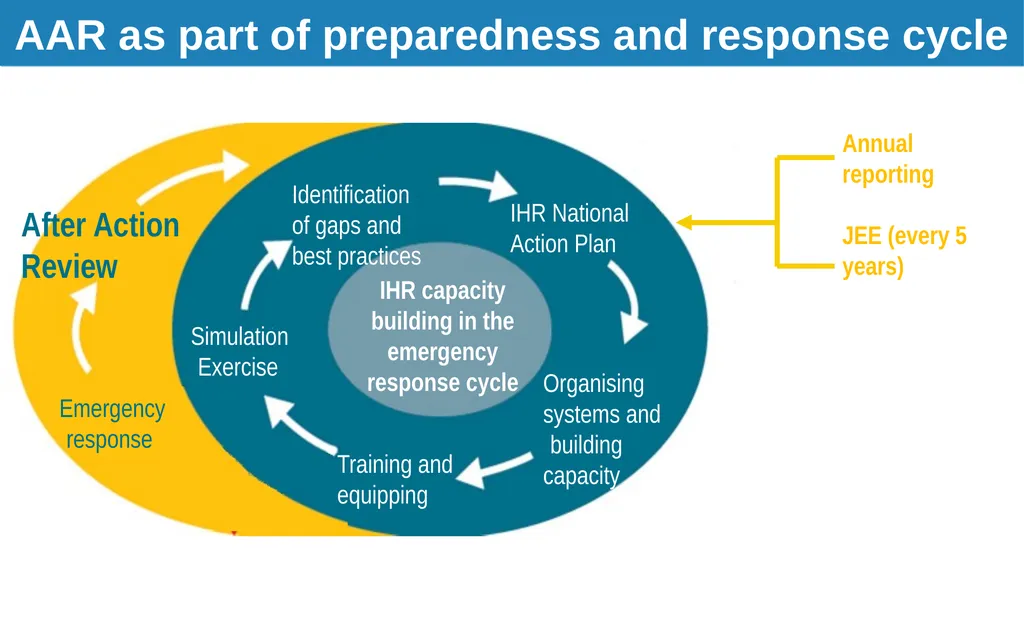
AAR as part of preparedness and response cycle Organising systems and building
capacity Simulation Exercise Identification of gaps and best practices After Action Review IHR capacity building in the emergency response cycle Emergency response Training and equipping<br>
capacity Simulation Exercise Identification of gaps and best practices After Action Review IHR capacity building in the emergency response cycle Emergency response Training and equipping<br>
08
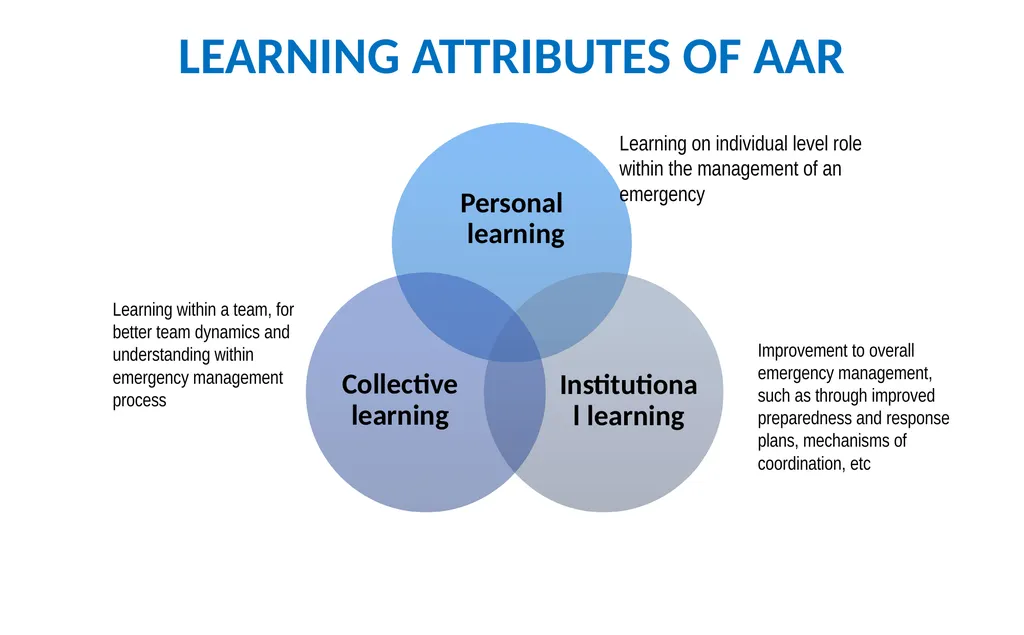
Learning attributes of AAR Learning on individual level role within the management of an emergency Learning within a team, for better team dynamics and understanding within emergency management process Improvement to overall emergency management, such as through improved preparedness and response plans, mechanisms of coordination, etc<br>
09
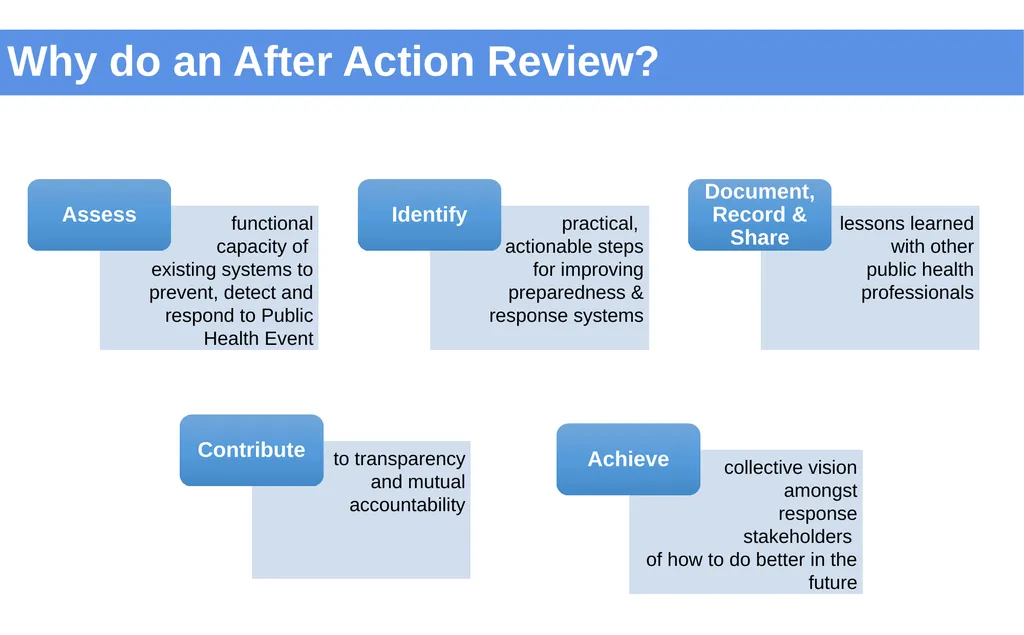
Why do an After Action Review? functional capacity of
existing systems to prevent, detect and respond to Public Health Event Assess practical,
actionable steps
for improving preparedness & response systems Identify lessons learned
with other
public health professionals Document, Record & Share to transparency
and mutual accountability Contribute collective vision amongst
response
stakeholders
of how to do better in the future Achieve<br>
existing systems to prevent, detect and respond to Public Health Event Assess practical,
actionable steps
for improving preparedness & response systems Identify lessons learned
with other
public health professionals Document, Record & Share to transparency
and mutual accountability Contribute collective vision amongst
response
stakeholders
of how to do better in the future Achieve<br>
10
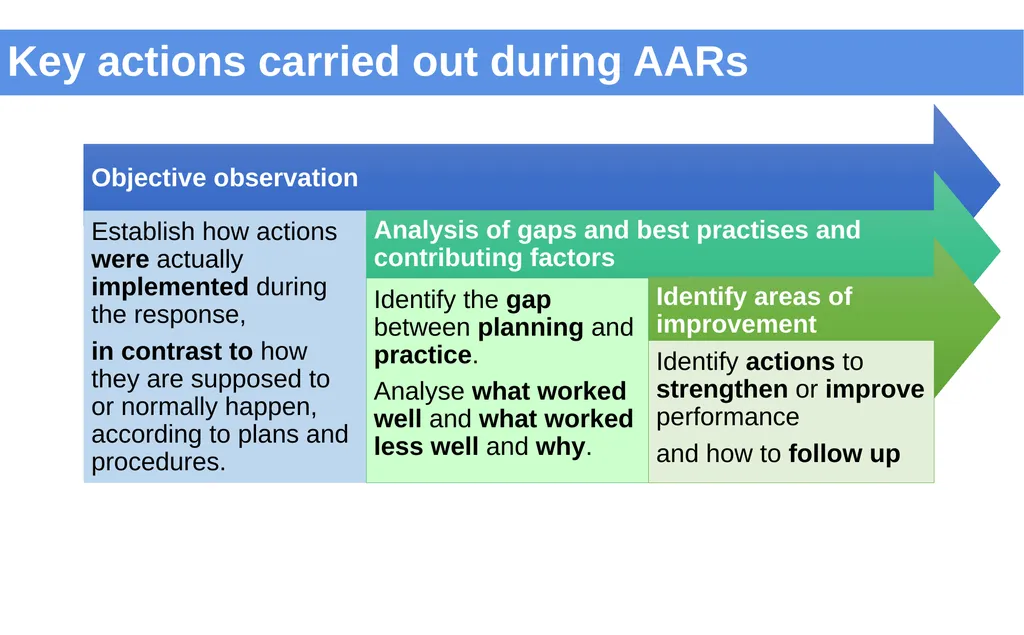
Key actions carried out during AARs Objective observation Establish how actions were actually implemented during the response,
in contrast to how they are supposed to or normally happen, according to plans and procedures. Analysis of gaps and best practises and contributing factors Identify the gap between planning and practice.
Analyse what worked well and what worked less well and why. Identify areas of improvement Identify actions to strengthen or improve performance
and how to follow up<br>
in contrast to how they are supposed to or normally happen, according to plans and procedures. Analysis of gaps and best practises and contributing factors Identify the gap between planning and practice.
Analyse what worked well and what worked less well and why. Identify areas of improvement Identify actions to strengthen or improve performance
and how to follow up<br>
11
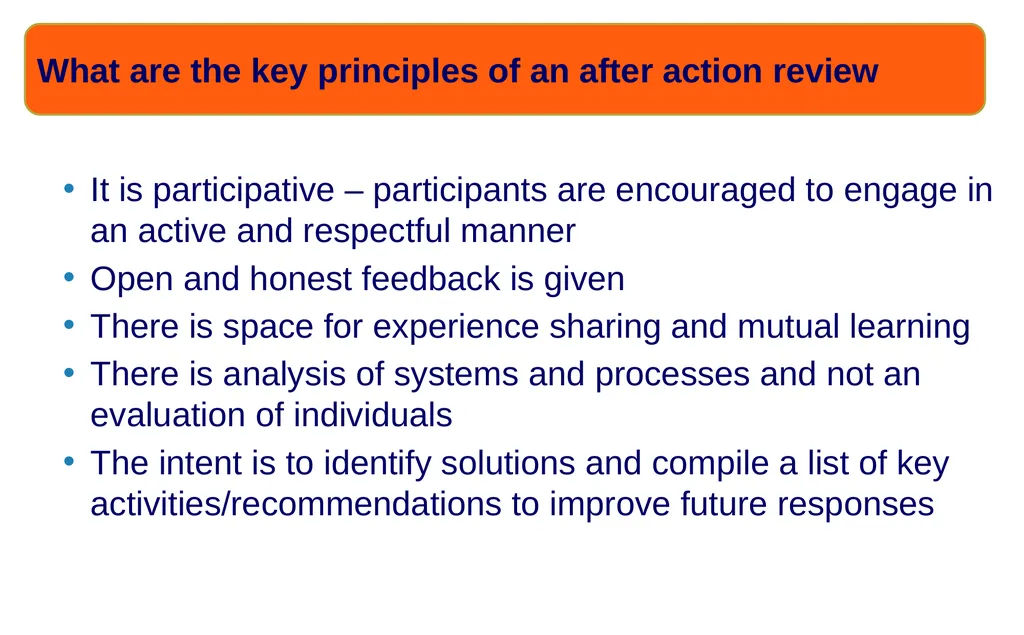
It is participative – participants are encouraged to engage in an active and respectful manner
Open and honest feedback is given
There is space for experience sharing and mutual learning
There is analysis of systems and processes and not an evaluation of individuals
The intent is to identify solutions and compile a list of key activities/recommendations to improve future responses What are the key principles of an after action review<br>
Open and honest feedback is given
There is space for experience sharing and mutual learning
There is analysis of systems and processes and not an evaluation of individuals
The intent is to identify solutions and compile a list of key activities/recommendations to improve future responses What are the key principles of an after action review<br>
12
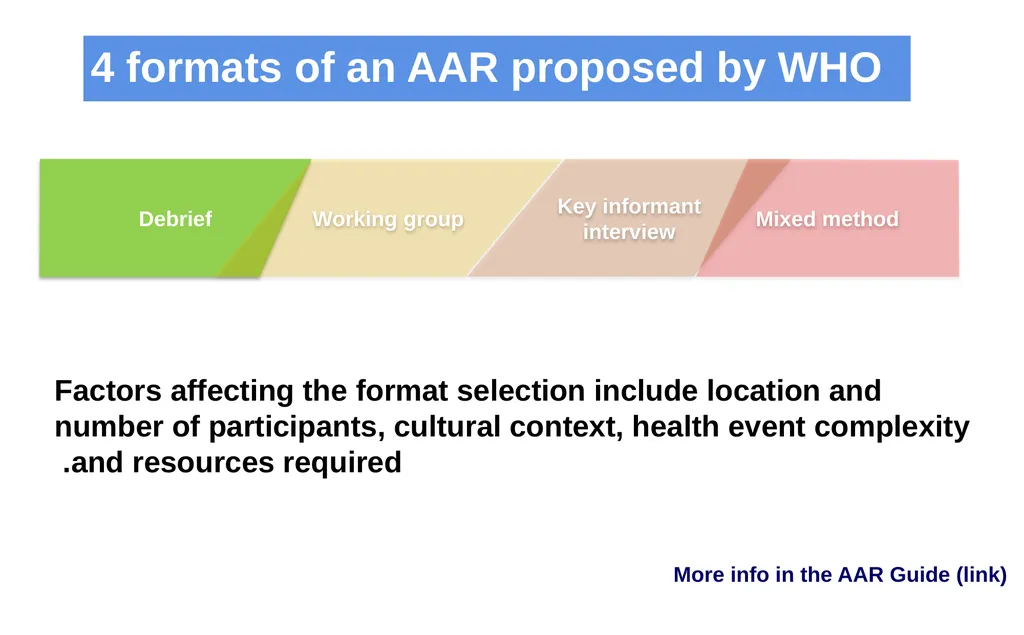
Mixed method 4 formats of an AAR proposed by WHO Debrief Working group Key informant interview Factors affecting the format selection include location and number of participants, cultural context, health event complexity and resources required. More info in the AAR Guide (link)<br>
13
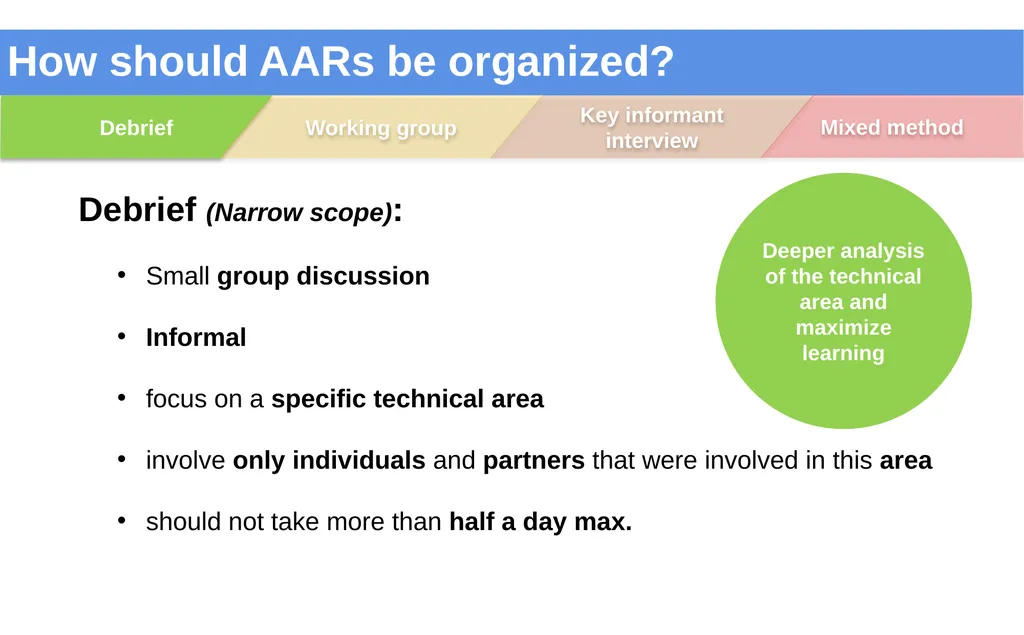
How should AARs be organized? Debrief Working group Key informant interview Mixed method Debrief (Narrow scope):
Small group discussion
Informal
focus on a specific technical area
involve only individuals and partners that were involved in this area
should not take more than half a day max. Deeper analysis of the technical area and maximize learning<br>
Small group discussion
Informal
focus on a specific technical area
involve only individuals and partners that were involved in this area
should not take more than half a day max. Deeper analysis of the technical area and maximize learning<br>
14
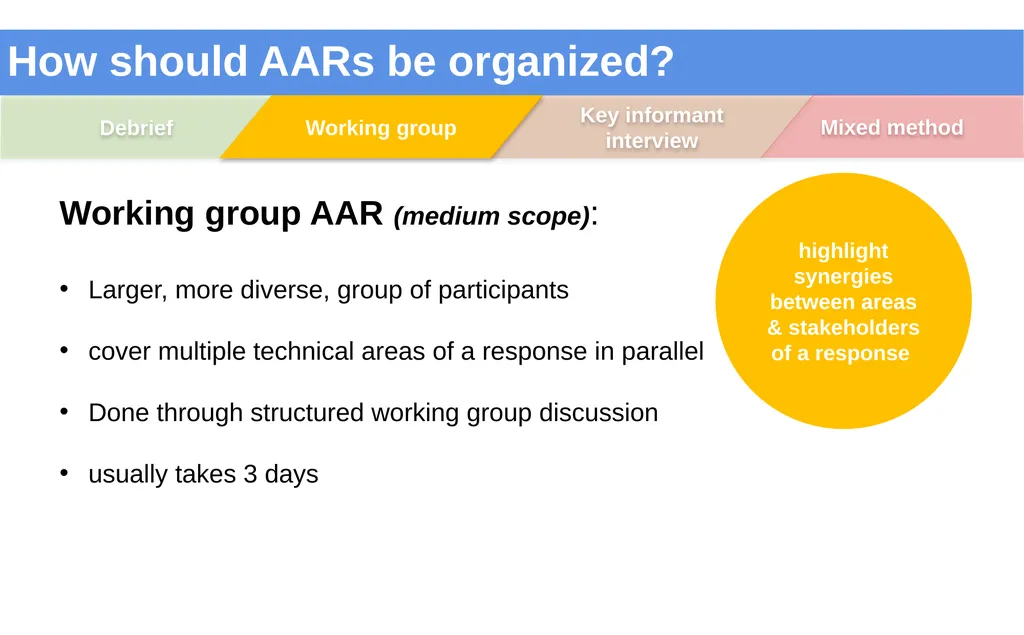
How should AARs be organized? Debrief Working group Key informant interview Mixed method Working group AAR (medium scope):
Larger, more diverse, group of participants
cover multiple technical areas of a response in parallel
Done through structured working group discussion
usually takes 3 days highlight synergies between areas & stakeholders of a response<br>
Larger, more diverse, group of participants
cover multiple technical areas of a response in parallel
Done through structured working group discussion
usually takes 3 days highlight synergies between areas & stakeholders of a response<br>
15
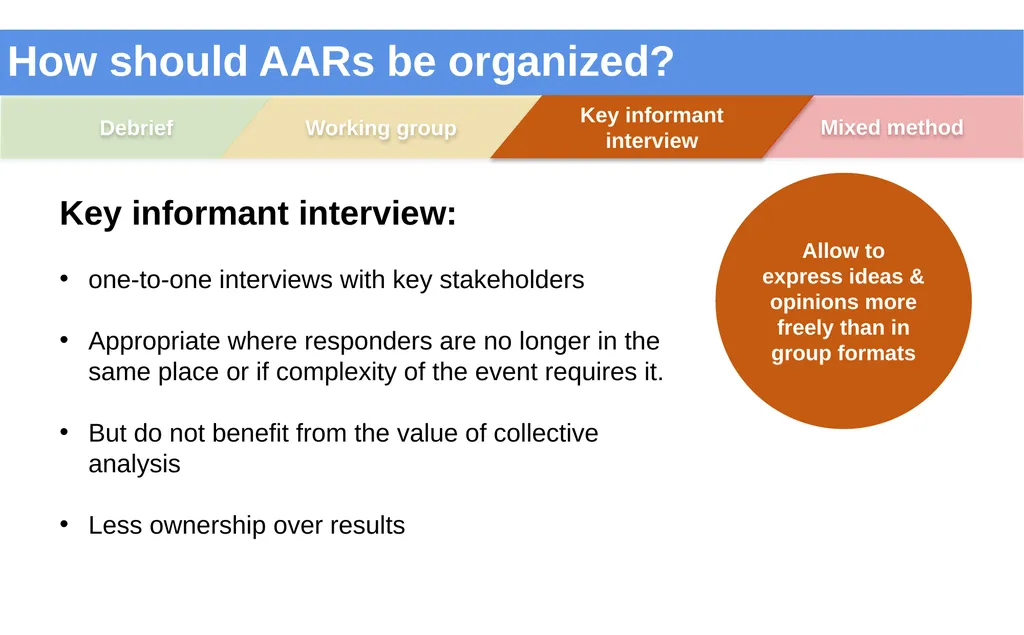
How should AARs be organized? Debrief Working group Key informant interview Mixed method Key informant interview:
one-to-one interviews with key stakeholders
Appropriate where responders are no longer in the same place or if complexity of the event requires it.
But do not benefit from the value of collective analysis
Less ownership over results Allow to express ideas & opinions more freely than in group formats<br>
one-to-one interviews with key stakeholders
Appropriate where responders are no longer in the same place or if complexity of the event requires it.
But do not benefit from the value of collective analysis
Less ownership over results Allow to express ideas & opinions more freely than in group formats<br>
16
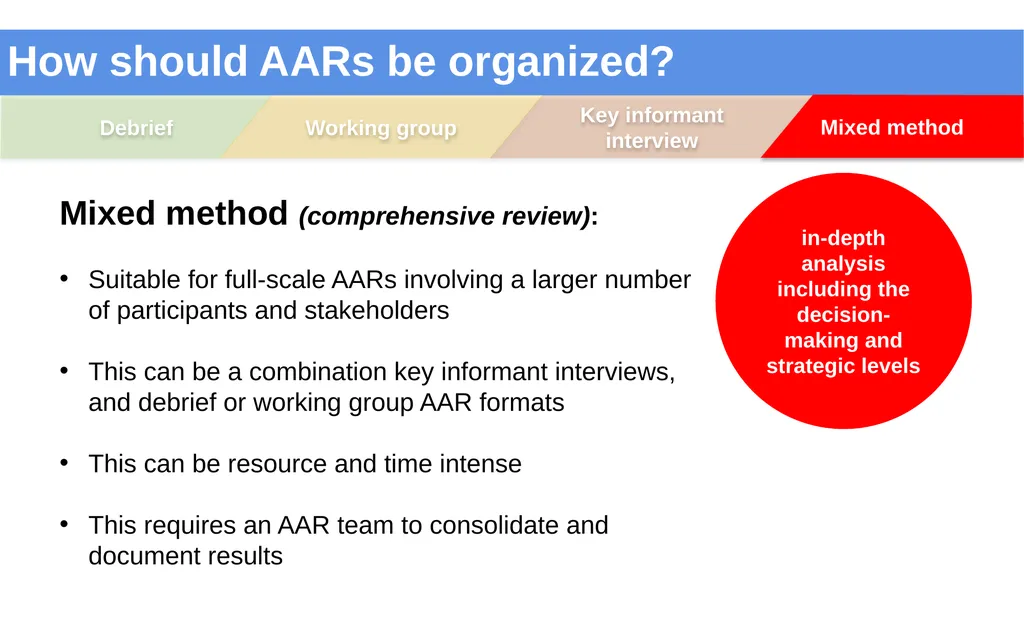
How should AARs be organized? Debrief Working group Key informant interview Mixed method Mixed method (comprehensive review):
Suitable for full-scale AARs involving a larger number of participants and stakeholders
This can be a combination key informant interviews, and debrief or working group AAR formats
This can be resource and time intense
This requires an AAR team to consolidate and document results in-depth analysis including the decision-making and strategic levels<br>
Suitable for full-scale AARs involving a larger number of participants and stakeholders
This can be a combination key informant interviews, and debrief or working group AAR formats
This can be resource and time intense
This requires an AAR team to consolidate and document results in-depth analysis including the decision-making and strategic levels<br>
17
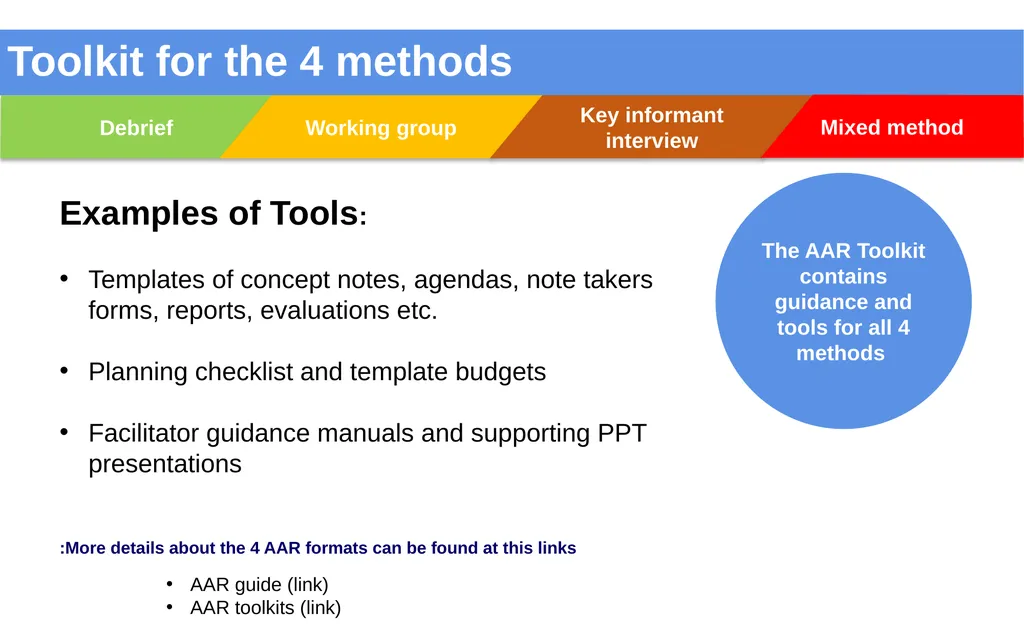
Toolkit for the 4 methods Examples of Tools:
Templates of concept notes, agendas, note takers forms, reports, evaluations etc.
Planning checklist and template budgets
Facilitator guidance manuals and supporting PPT presentations The AAR Toolkit contains guidance and tools for all 4 methods Debrief Working group Key informant interview Mixed method More details about the 4 AAR formats can be found at this links: AAR guide (link)
AAR toolkits (link)<br>
Templates of concept notes, agendas, note takers forms, reports, evaluations etc.
Planning checklist and template budgets
Facilitator guidance manuals and supporting PPT presentations The AAR Toolkit contains guidance and tools for all 4 methods Debrief Working group Key informant interview Mixed method More details about the 4 AAR formats can be found at this links: AAR guide (link)
AAR toolkits (link)<br>
18
Introduction to working group format AAR This e-learning focuses on the facilitation of working group AAR format AAR, for being the most implemented AAR so far.
This AAR format:
involves the analysis of multiple functions of a response such as surveillance, coordination or communications (these will be determined prior to the AAR)
brings together 20-50 participants of the relevant stakeholders in the response
takes 2.5 to 3 days
is used in instances where those involved in a response can be brought together to share learning and experiences in an open and honest environment.<br>
This AAR format:
involves the analysis of multiple functions of a response such as surveillance, coordination or communications (these will be determined prior to the AAR)
brings together 20-50 participants of the relevant stakeholders in the response
takes 2.5 to 3 days
is used in instances where those involved in a response can be brought together to share learning and experiences in an open and honest environment.<br>
19
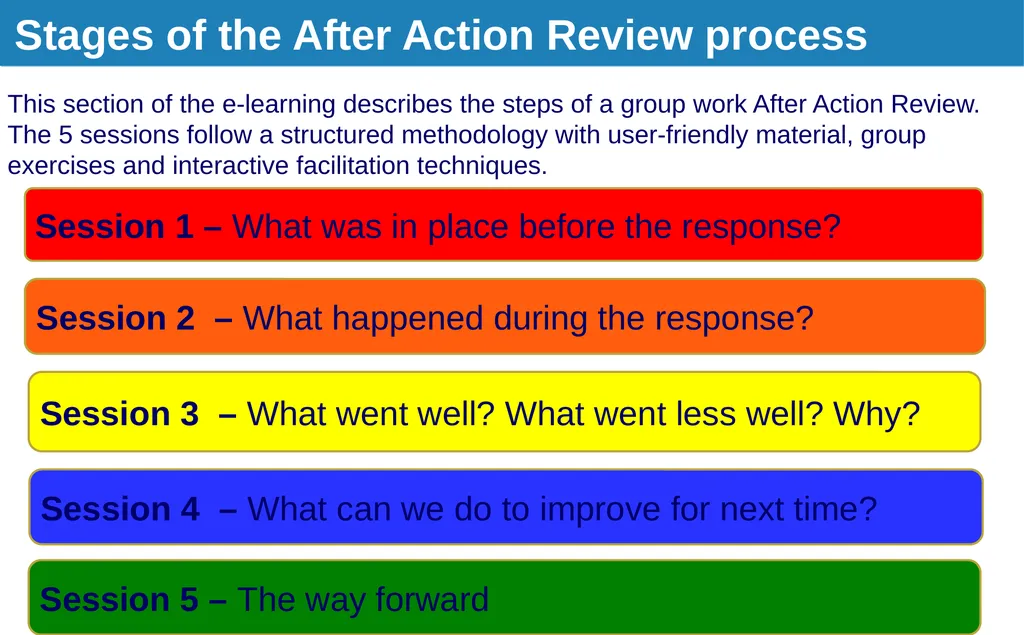
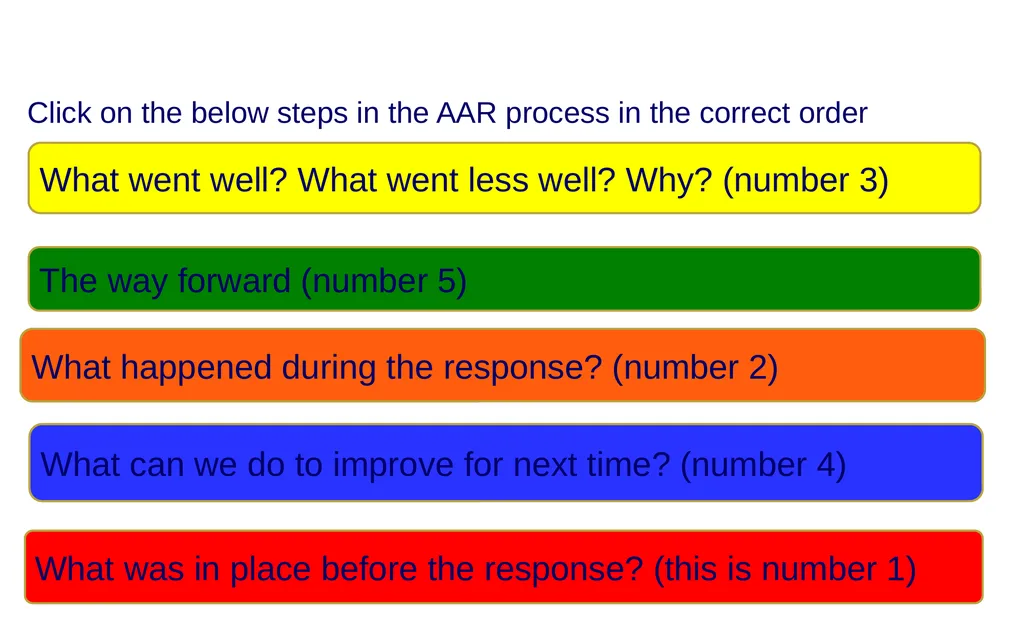
Stages of the After Action Review process This section of the e-learning describes the steps of a group work After Action Review. The 5 sessions follow a structured methodology with user-friendly material, group exercises and interactive facilitation techniques. Session 1 – What was in place before the response? Session 2 – What happened during the response? Session 3 – What went well? What went less well? Why? Session 4 – What can we do to improve for next time? Session 5 – The way forward<br>
20
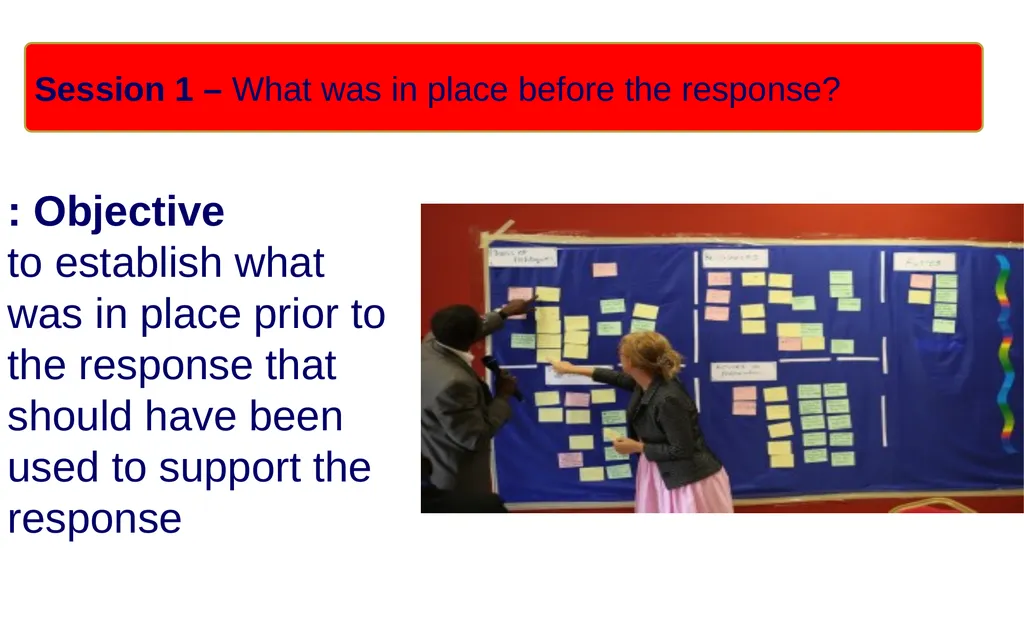
Objective :
to establish what was in place prior to the response that should have been used to support the response Session 1 – What was in place before the response?<br>
to establish what was in place prior to the response that should have been used to support the response Session 1 – What was in place before the response?<br>
21
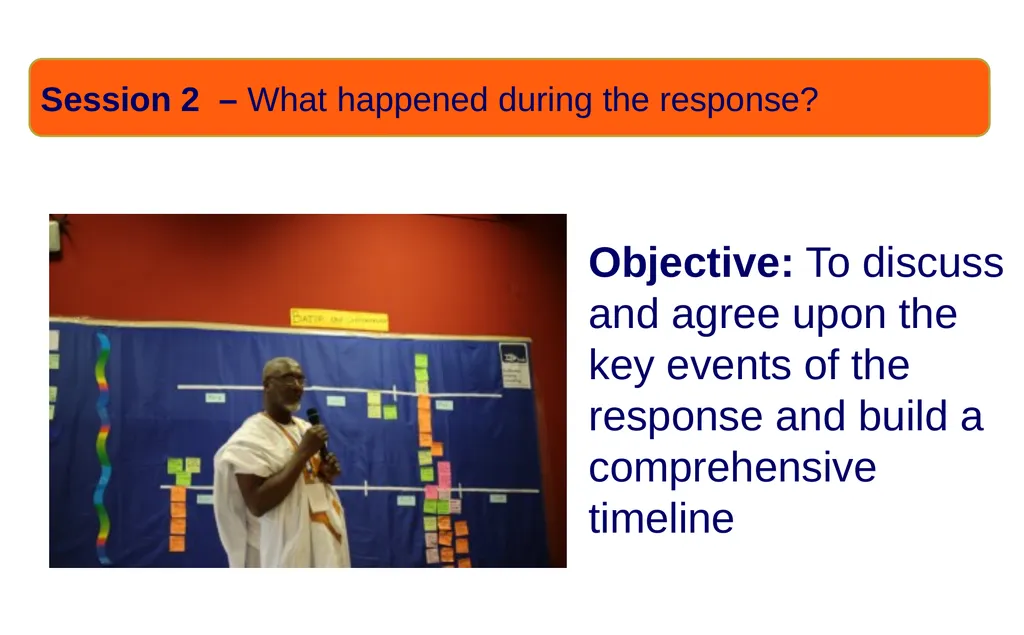
Objective: To discuss and agree upon the key events of the response and build a comprehensive timeline Session 2 – What happened during the response?<br>
22
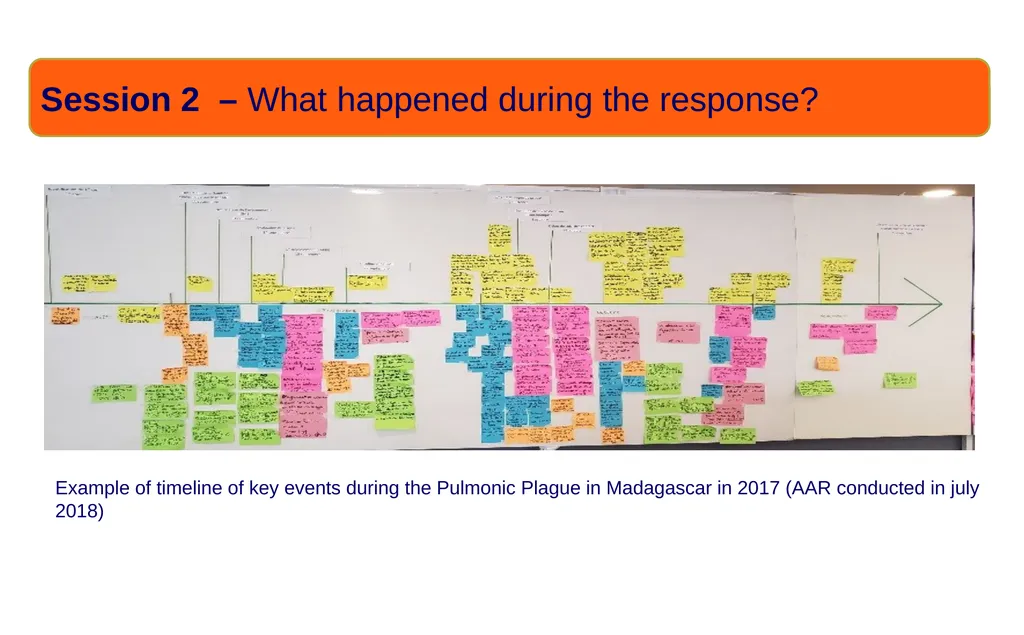
Session 2 – What happened during the response? Example of timeline of key events during the Pulmonic Plague in Madagascar in 2017 (AAR conducted in july 2018)<br>
23
Improved coordination and sharing of information for the early detection of suspected / confirmed cases and for monitoring contacts Relationship had been established prior to the response
Willingness of all stakeholders to undertake regular meetings
Political and financial support from central level Response not coordinated between partners, health authorities and the central level
Duplication of activities and effort
Inefficient use of resources Lack of a plan for district level coordination
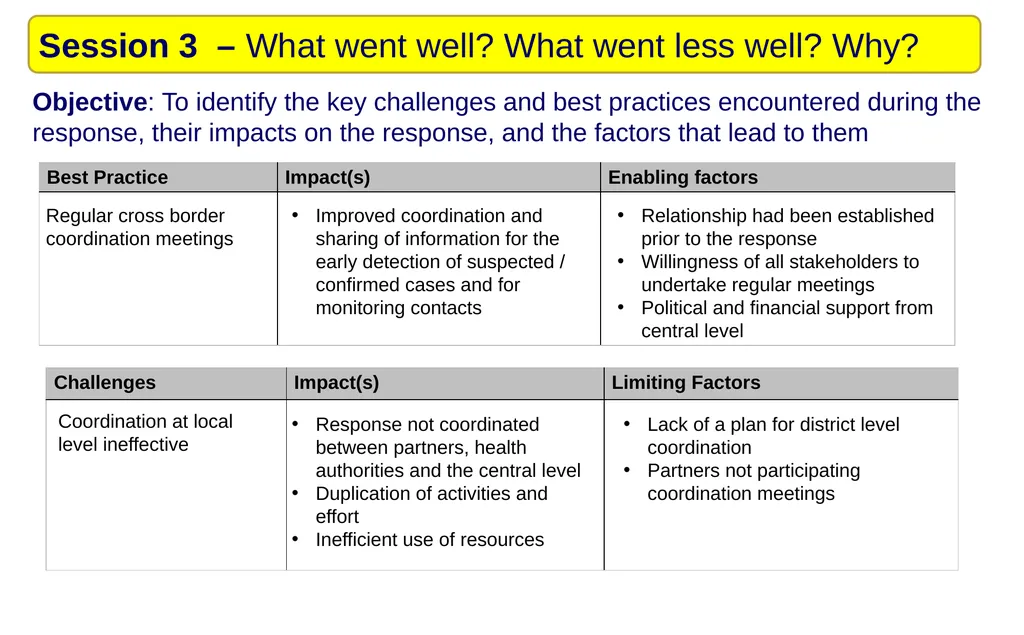
Partners not participating coordination meetings Coordination at local level ineffective Regular cross border coordination meetings Session 3 – What went well? What went less well? Why? Objective: To identify the key challenges and best practices encountered during the response, their impacts on the response, and the factors that lead to them<br>
Willingness of all stakeholders to undertake regular meetings
Political and financial support from central level Response not coordinated between partners, health authorities and the central level
Duplication of activities and effort
Inefficient use of resources Lack of a plan for district level coordination
Partners not participating coordination meetings Coordination at local level ineffective Regular cross border coordination meetings Session 3 – What went well? What went less well? Why? Objective: To identify the key challenges and best practices encountered during the response, their impacts on the response, and the factors that lead to them<br>
24
Improved quality of test results
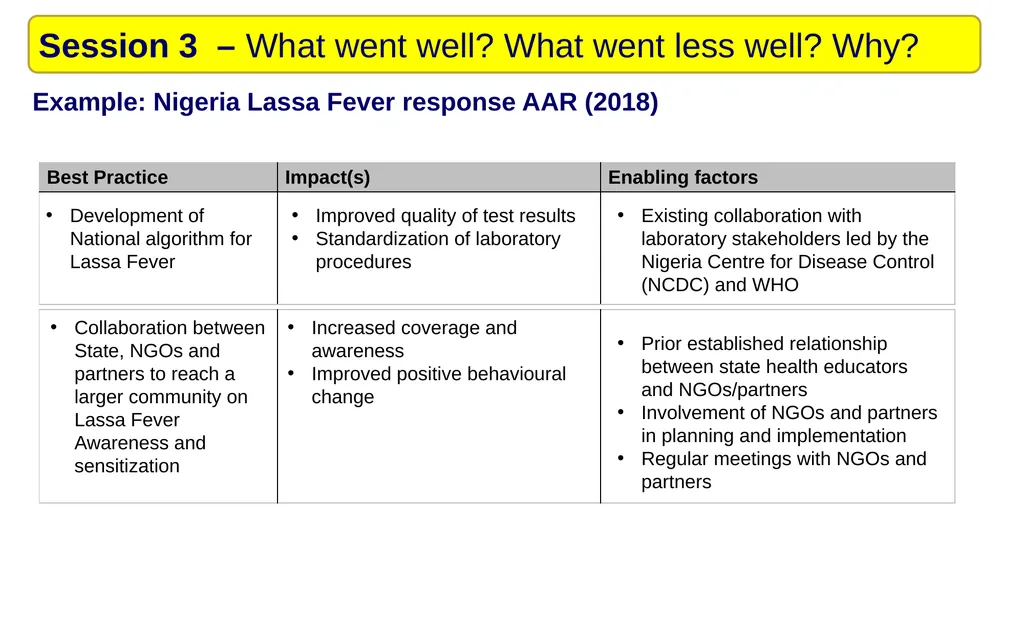
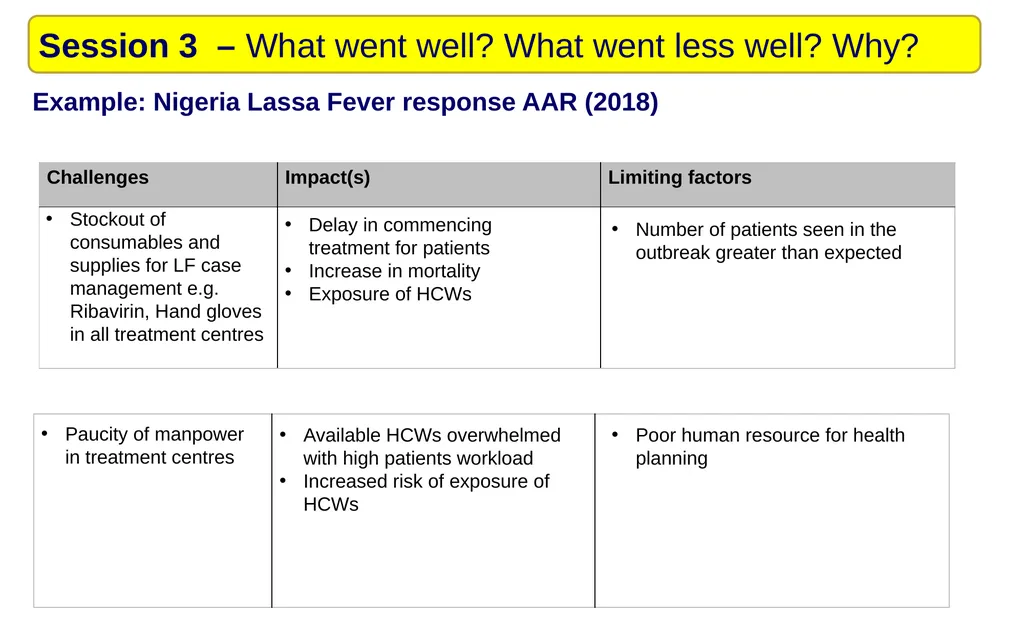
Standardization of laboratory procedures Existing collaboration with laboratory stakeholders led by the Nigeria Centre for Disease Control (NCDC) and WHO Development of National algorithm for Lassa Fever Session 3 – What went well? What went less well? Why? Example: Nigeria Lassa Fever response AAR (2018) Collaboration between State, NGOs and partners to reach a larger community on Lassa Fever Awareness and sensitization Increased coverage and awareness
Improved positive behavioural change Prior established relationship between state health educators and NGOs/partners
Involvement of NGOs and partners in planning and implementation
Regular meetings with NGOs and partners<br>
Standardization of laboratory procedures Existing collaboration with laboratory stakeholders led by the Nigeria Centre for Disease Control (NCDC) and WHO Development of National algorithm for Lassa Fever Session 3 – What went well? What went less well? Why? Example: Nigeria Lassa Fever response AAR (2018) Collaboration between State, NGOs and partners to reach a larger community on Lassa Fever Awareness and sensitization Increased coverage and awareness
Improved positive behavioural change Prior established relationship between state health educators and NGOs/partners
Involvement of NGOs and partners in planning and implementation
Regular meetings with NGOs and partners<br>
25
Delay in commencing treatment for patients
Increase in mortality
Exposure of HCWs Number of patients seen in the outbreak greater than expected Stockout of consumables and supplies for LF case management e.g. Ribavirin, Hand gloves in all treatment centres Session 3 – What went well? What went less well? Why? Example: Nigeria Lassa Fever response AAR (2018) Paucity of manpower in treatment centres Available HCWs overwhelmed with high patients workload
Increased risk of exposure of HCWs Poor human resource for health planning<br>
Increase in mortality
Exposure of HCWs Number of patients seen in the outbreak greater than expected Stockout of consumables and supplies for LF case management e.g. Ribavirin, Hand gloves in all treatment centres Session 3 – What went well? What went less well? Why? Example: Nigeria Lassa Fever response AAR (2018) Paucity of manpower in treatment centres Available HCWs overwhelmed with high patients workload
Increased risk of exposure of HCWs Poor human resource for health planning<br>
26
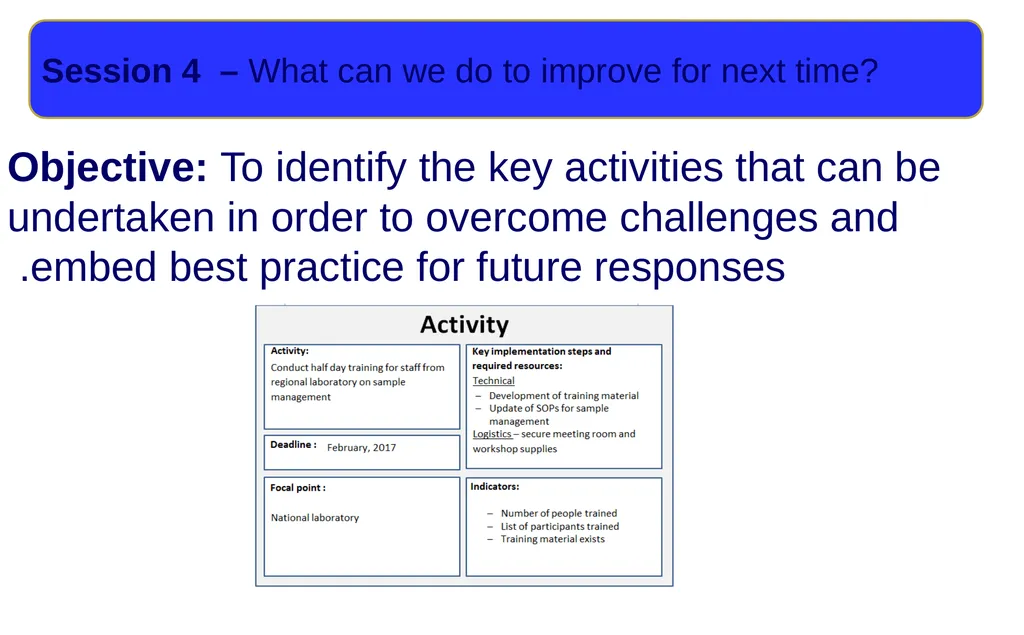
Objective: To identify the key activities that can be undertaken in order to overcome challenges and embed best practice for future responses. Session 4 – What can we do to improve for next time?<br>
27
Objective: To clarify the way forward for activities defined through the workshop and define the final steps in the AAR process Session 5 – The way forward<br>
28
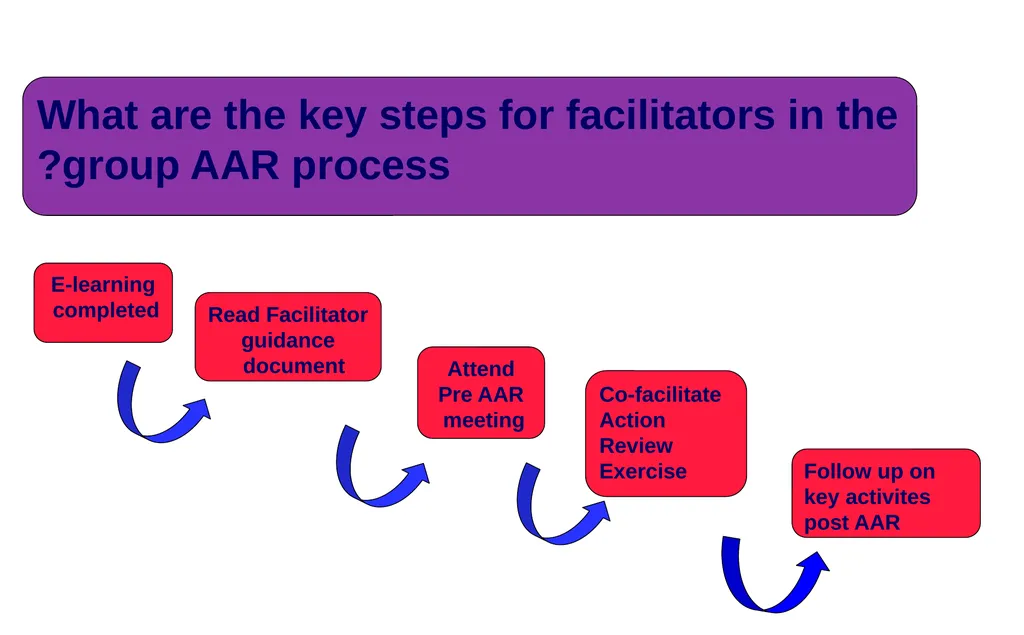
What are the key steps for facilitators in the group AAR process? E-learning completed Read Facilitator guidance document Attend Pre AAR meeting Co-facilitate Action Review Exercise Follow up on key activites post AAR<br>
29
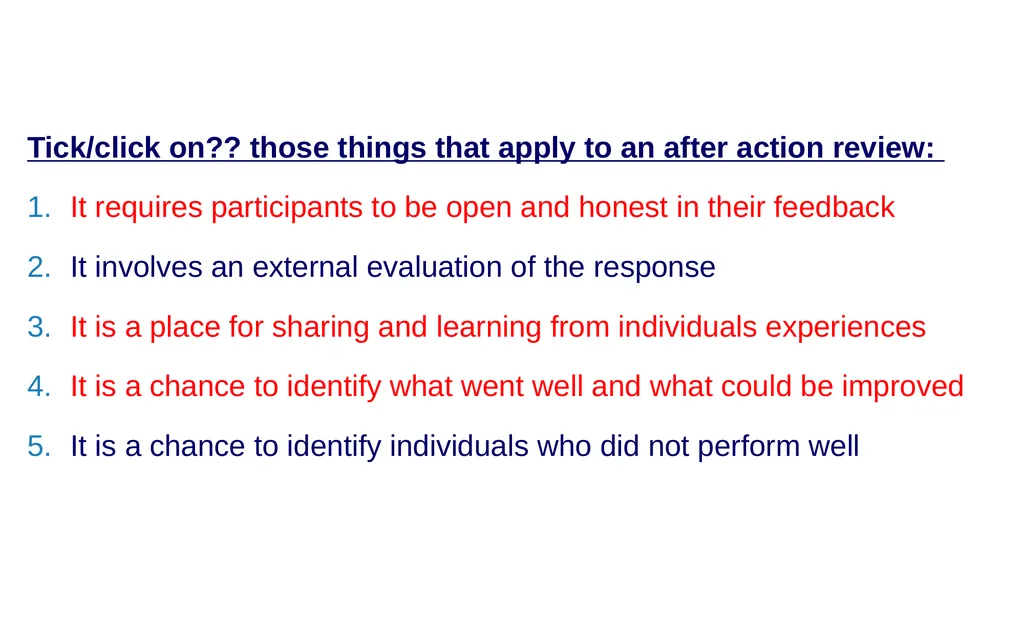
Tick/click on?? those things that apply to an after action review:
It requires participants to be open and honest in their feedback
It involves an external evaluation of the response
It is a place for sharing and learning from individuals experiences
It is a chance to identify what went well and what could be improved
It is a chance to identify individuals who did not perform well<br>
It requires participants to be open and honest in their feedback
It involves an external evaluation of the response
It is a place for sharing and learning from individuals experiences
It is a chance to identify what went well and what could be improved
It is a chance to identify individuals who did not perform well<br>
30
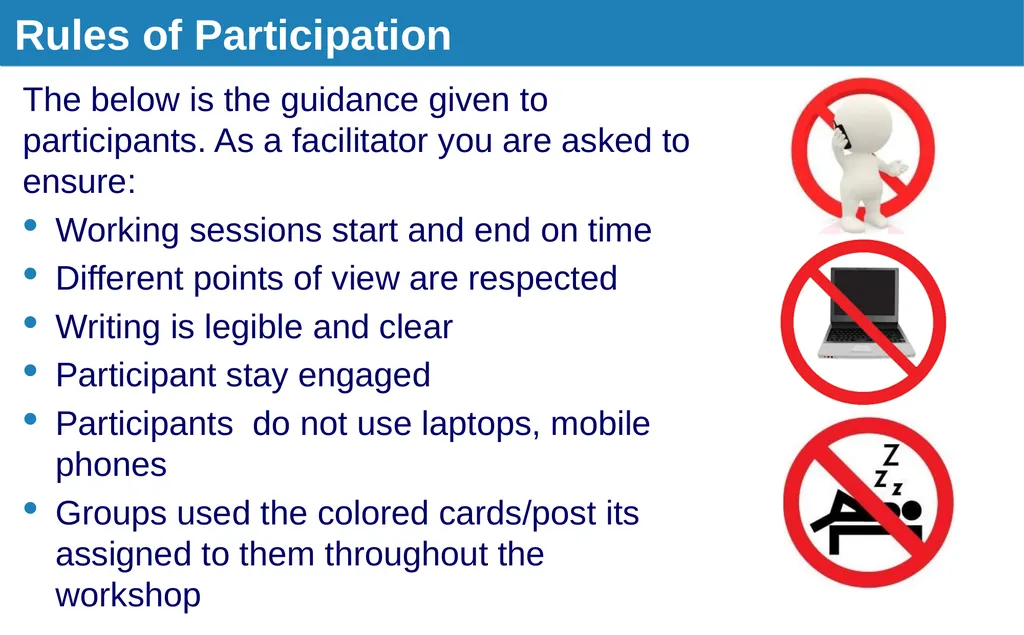
The below is the guidance given to participants. As a facilitator you are asked to ensure:
Working sessions start and end on time
Different points of view are respected
Writing is legible and clear
Participant stay engaged
Participants do not use laptops, mobile phones
Groups used the colored cards/post its assigned to them throughout the workshop Rules of Participation<br>
Working sessions start and end on time
Different points of view are respected
Writing is legible and clear
Participant stay engaged
Participants do not use laptops, mobile phones
Groups used the colored cards/post its assigned to them throughout the workshop Rules of Participation<br>
31
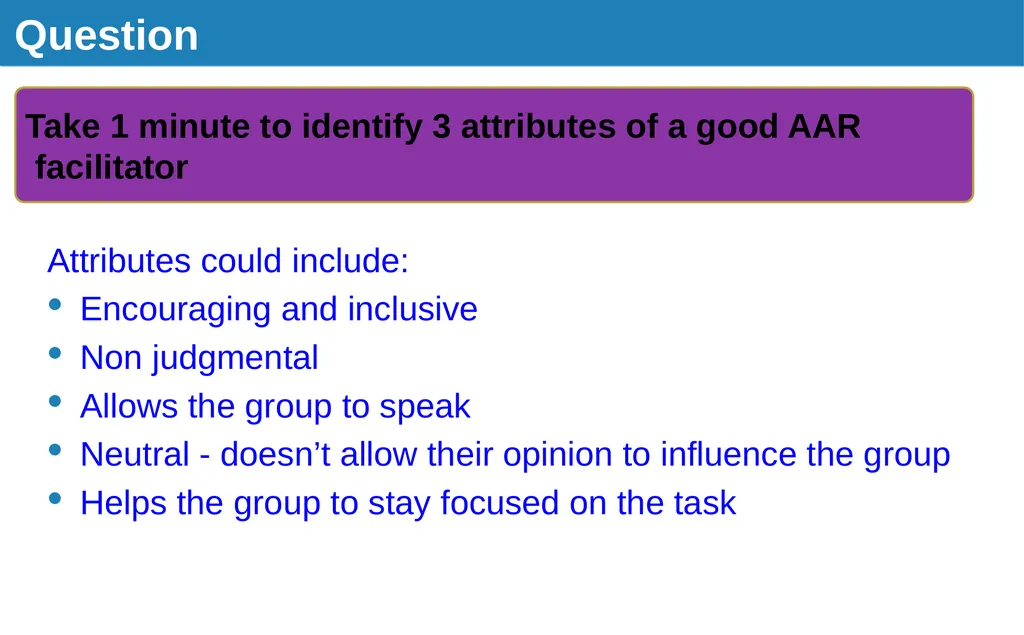
Question Attributes could include:
Encouraging and inclusive
Non judgmental
Allows the group to speak
Neutral - doesn’t allow their opinion to influence the group
Helps the group to stay focused on the task Take 1 minute to identify 3 attributes of a good AAR facilitator<br>
Encouraging and inclusive
Non judgmental
Allows the group to speak
Neutral - doesn’t allow their opinion to influence the group
Helps the group to stay focused on the task Take 1 minute to identify 3 attributes of a good AAR facilitator<br>
32
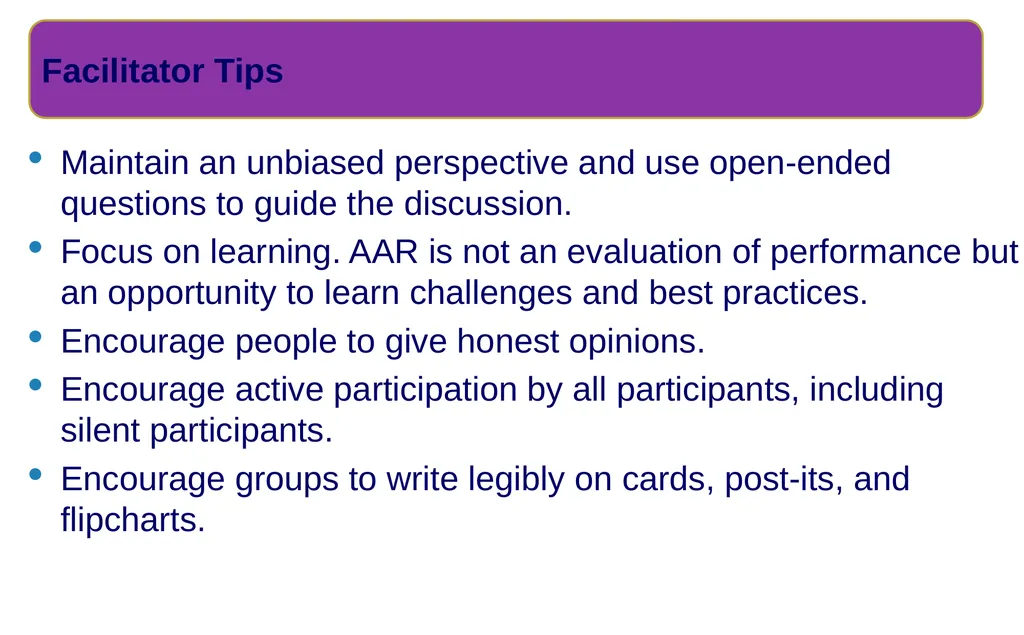
Maintain an unbiased perspective and use open-ended questions to guide the discussion.
Focus on learning. AAR is not an evaluation of performance but an opportunity to learn challenges and best practices.
Encourage people to give honest opinions.
Encourage active participation by all participants, including silent participants.
Encourage groups to write legibly on cards, post-its, and flipcharts. Facilitator Tips<br>
Focus on learning. AAR is not an evaluation of performance but an opportunity to learn challenges and best practices.
Encourage people to give honest opinions.
Encourage active participation by all participants, including silent participants.
Encourage groups to write legibly on cards, post-its, and flipcharts. Facilitator Tips<br>
33
Criticize, blame or judging the feedback
Focusing on the negative. An AAR is as much about recording and analyzing what worked well as about what did not work.
While the AAR is a learning framework, the teaching of participants should be avoided.
Do not allow your own opinion or experience to influence or disrupt the conversation of groups What to avoid as a facilitator<br>
Focusing on the negative. An AAR is as much about recording and analyzing what worked well as about what did not work.
While the AAR is a learning framework, the teaching of participants should be avoided.
Do not allow your own opinion or experience to influence or disrupt the conversation of groups What to avoid as a facilitator<br>
34
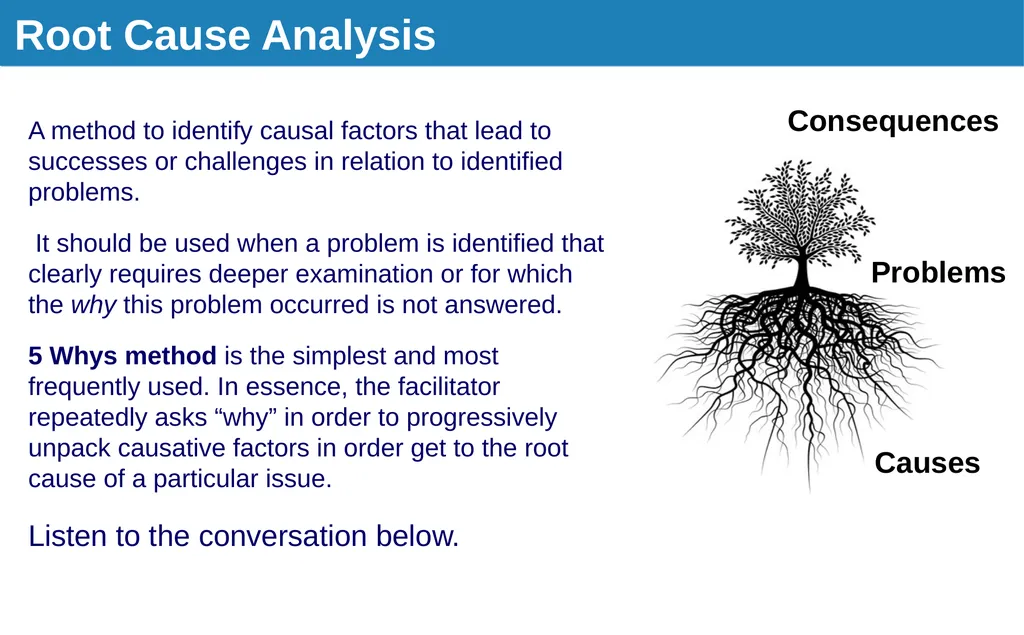
Root Cause Analysis A method to identify causal factors that lead to successes or challenges in relation to identified problems.
It should be used when a problem is identified that clearly requires deeper examination or for which the why this problem occurred is not answered.
5 Whys method is the simplest and most frequently used. In essence, the facilitator repeatedly asks “why” in order to progressively unpack causative factors in order get to the root cause of a particular issue.
Listen to the conversation below.<br>
It should be used when a problem is identified that clearly requires deeper examination or for which the why this problem occurred is not answered.
5 Whys method is the simplest and most frequently used. In essence, the facilitator repeatedly asks “why” in order to progressively unpack causative factors in order get to the root cause of a particular issue.
Listen to the conversation below.<br>
35
Case study You are working with a group who has several dominant participants. You notice that several people have not contributed to the discussion. They appear to have become disengaged from the process and are no longer trying to contribute.
Take a minute to think about what you might do in this situation to help ensure everyone is able to have their say?
They can then click on an arrow/button that leads to this text:
Ideas to encourage participation in this context could include
breaking the group into smaller groups to allow more active participation. Allow them time to work together before feeding into the group.
asking people to discuss with their neighbor their ideas before asking each pair to share
Do an individual reflection session and get participants to write their ideas on post it notes and then invite them to come and bunch them all on the flip chart<br>
Take a minute to think about what you might do in this situation to help ensure everyone is able to have their say?
They can then click on an arrow/button that leads to this text:
Ideas to encourage participation in this context could include
breaking the group into smaller groups to allow more active participation. Allow them time to work together before feeding into the group.
asking people to discuss with their neighbor their ideas before asking each pair to share
Do an individual reflection session and get participants to write their ideas on post it notes and then invite them to come and bunch them all on the flip chart<br>
36
Tips for note takers Transcribe everything written on the cards, flip charts, sticky notes during Sessions 1, 3, 4 and 5 in the provided templates.
Use the template from the lead facilitator for taking notes. This is in the same format as the sessions to enable you to record everything that is written.
When additional information is discussed but not written by the group, be sure to save it for discussion during subsequent sessions.<br>
Use the template from the lead facilitator for taking notes. This is in the same format as the sessions to enable you to record everything that is written.
When additional information is discussed but not written by the group, be sure to save it for discussion during subsequent sessions.<br>
37
Click on the below steps in the AAR process in the correct order What was in place before the response? (this is number 1) What happened during the response? (number 2) What went well? What went less well? Why? (number 3) What can we do to improve for next time? (number 4) The way forward (number 5)<br>
38
Thank you for your time and commitment to the AAR process<br>