
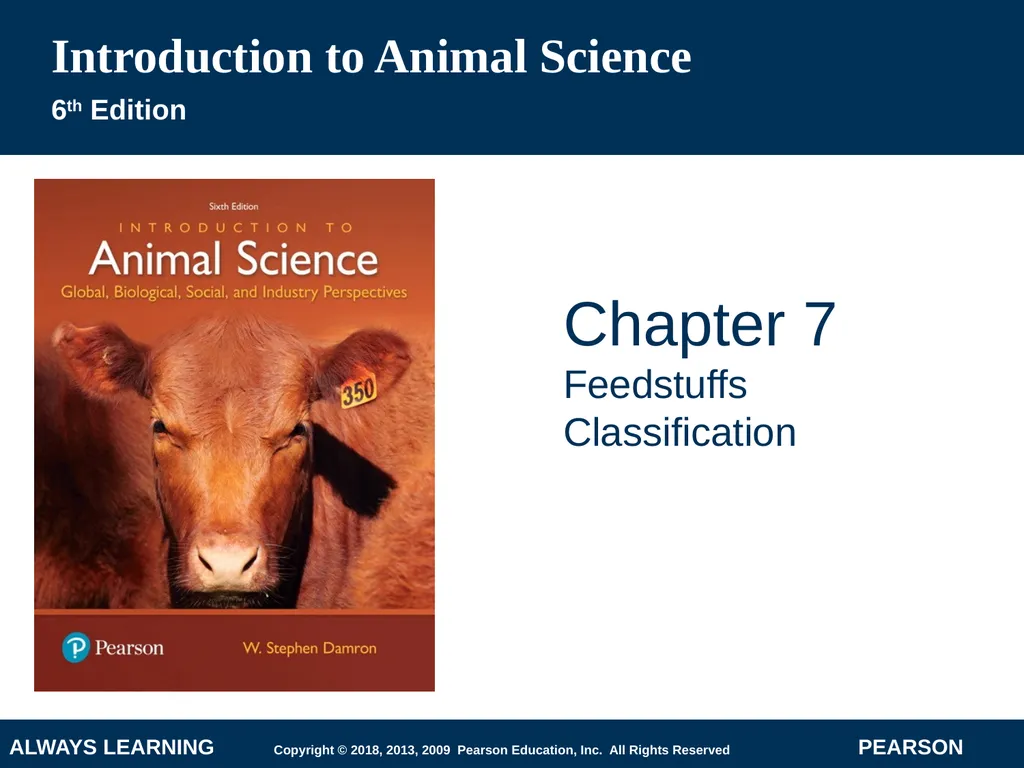
Introduction to Animal Science 6th Edition Chapter
MJ
Published · 33 slides · 0 views

1 / 1
Description
Introduction to Animal Science 6th Edition Chapter 7 Feedstuffs Classification Learning Objectives After studying this chapter, you should be able to: describe feedstuff classification and identify feedstuff categories and characteristics.
Related Topics
Download this presentation From Below
"Introduction to Animal Science 6th Edition Chapter" is the property of its rightful owner. Permission is granted to download and print the materials on this website for personal, non-commercial use only, and to display it on your personal computer provided you do not modify the materials and that you retain all copyright notices contained in the materials. By downloading content from our website, you accept the terms of this agreement.
Share
Embed code
Presentation Transcript
01
Introduction to Animal Science 6th Edition Chapter 7 Feedstuffs Classification<br>
02
Learning Objectives After studying this chapter, you should be able to:
describe feedstuff classification and identify feedstuff categories and characteristics.
identify the nutritive characteristics in various feedstuff categories.<br>
describe feedstuff classification and identify feedstuff categories and characteristics.
identify the nutritive characteristics in various feedstuff categories.<br>
03
Introduction (1 of 2) Feeds of many origins, qualities, and availabilities are used in animal diets and nutritive content varies tremendously among them.
The National Research Council groups feedstuffs with others with similar characteristics.
Feedstuffs within a group generally have similar nutritive values.<br>
The National Research Council groups feedstuffs with others with similar characteristics.
Feedstuffs within a group generally have similar nutritive values.<br>
04
Introduction (2 of 2) Most feeds fall into these categories:
dry forages and roughages;
pasture, range plants, and green forages;
silages;
energy feeds;
protein supplements;
mineral supplements;
vitamin supplements;
and nonnutritive additives.<br>
dry forages and roughages;
pasture, range plants, and green forages;
silages;
energy feeds;
protein supplements;
mineral supplements;
vitamin supplements;
and nonnutritive additives.<br>
05
Feedstuff Categories (1 of 25) Dry Forages and Roughages
Feeds placed in this category contain at least 18% crude fiber, with values ranging up to 50% crude fiber.
Dry forages and roughages are high in cellulose, hemicellulose, and possibly lignin and low in readily digested carbohydrates such as starch and sugars.
Protein content varies from nearly 30% for alfalfa to 2-3% for some straws.<br>
Feeds placed in this category contain at least 18% crude fiber, with values ranging up to 50% crude fiber.
Dry forages and roughages are high in cellulose, hemicellulose, and possibly lignin and low in readily digested carbohydrates such as starch and sugars.
Protein content varies from nearly 30% for alfalfa to 2-3% for some straws.<br>
06
Feedstuff Categories (2 of 25) Dry Forages and Roughages
Examples of feeds in this category are:
legume hay,
grass hays,
wheat straw,
cornstalks,
corncobs,
cottonseed hulls,
peanut hulls,
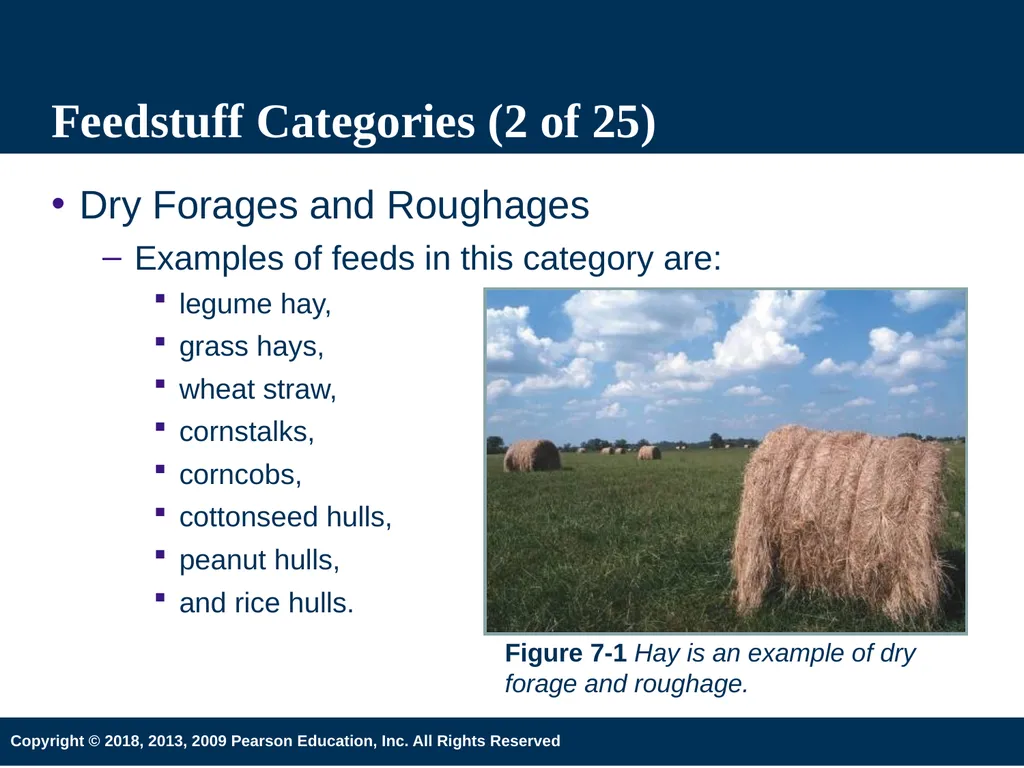
and rice hulls. Figure 7-1 Hay is an example of dry forage and roughage.<br>
Examples of feeds in this category are:
legume hay,
grass hays,
wheat straw,
cornstalks,
corncobs,
cottonseed hulls,
peanut hulls,
and rice hulls. Figure 7-1 Hay is an example of dry forage and roughage.<br>
07
Feedstuff Categories (3 of 25) Pasture, Range Plants, and Green Forages
Many of these feeds could be harvested as dry feeds that would be classed in the previous category.
The moisture content is usually between 50-85% but can be quite variable.
Nutritive quality can be varied as well.
Young, well-fertilized wheat pasture can have high crude protein and be very digestible; late season prairie hay is the opposite.<br>
Many of these feeds could be harvested as dry feeds that would be classed in the previous category.
The moisture content is usually between 50-85% but can be quite variable.
Nutritive quality can be varied as well.
Young, well-fertilized wheat pasture can have high crude protein and be very digestible; late season prairie hay is the opposite.<br>
08
Feedstuff Categories (4 of 25) Examples of feeds in this category are:
Bermuda grass pasture,
sorghum-sudan grass,
tall-grass prairie species,
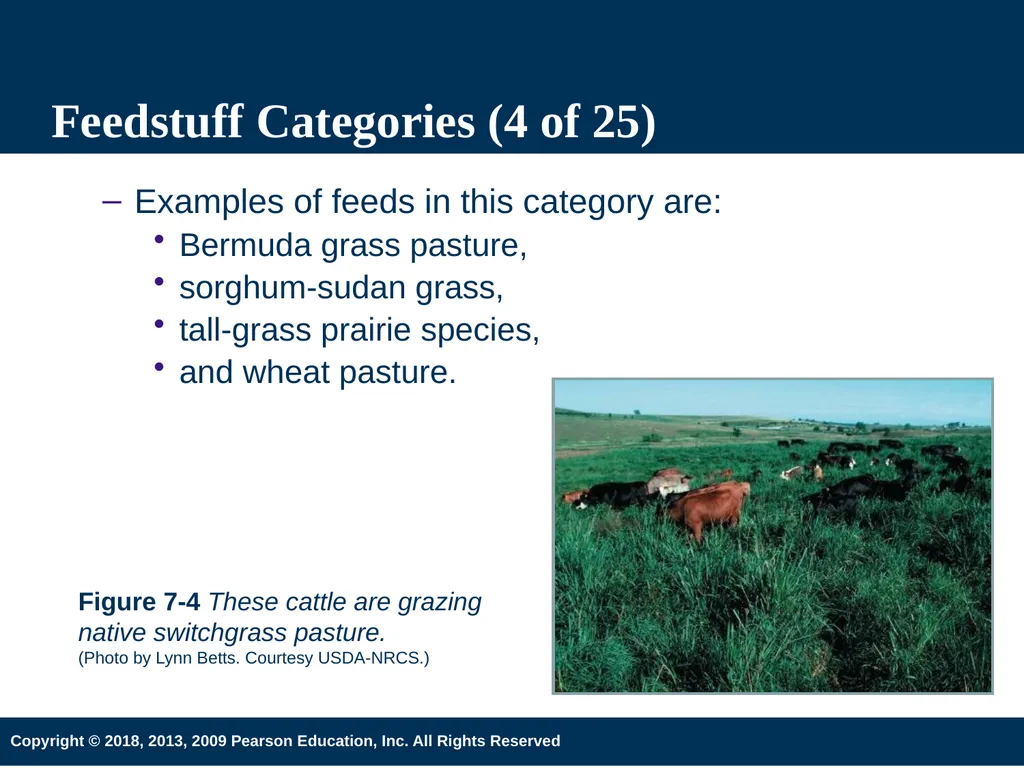
and wheat pasture. Figure 7-4 These cattle are grazing native switchgrass pasture. (Photo by Lynn Betts. Courtesy USDA-NRCS.)<br>
Bermuda grass pasture,
sorghum-sudan grass,
tall-grass prairie species,
and wheat pasture. Figure 7-4 These cattle are grazing native switchgrass pasture. (Photo by Lynn Betts. Courtesy USDA-NRCS.)<br>
09
Feedstuff Categories (5 of 25) Silages
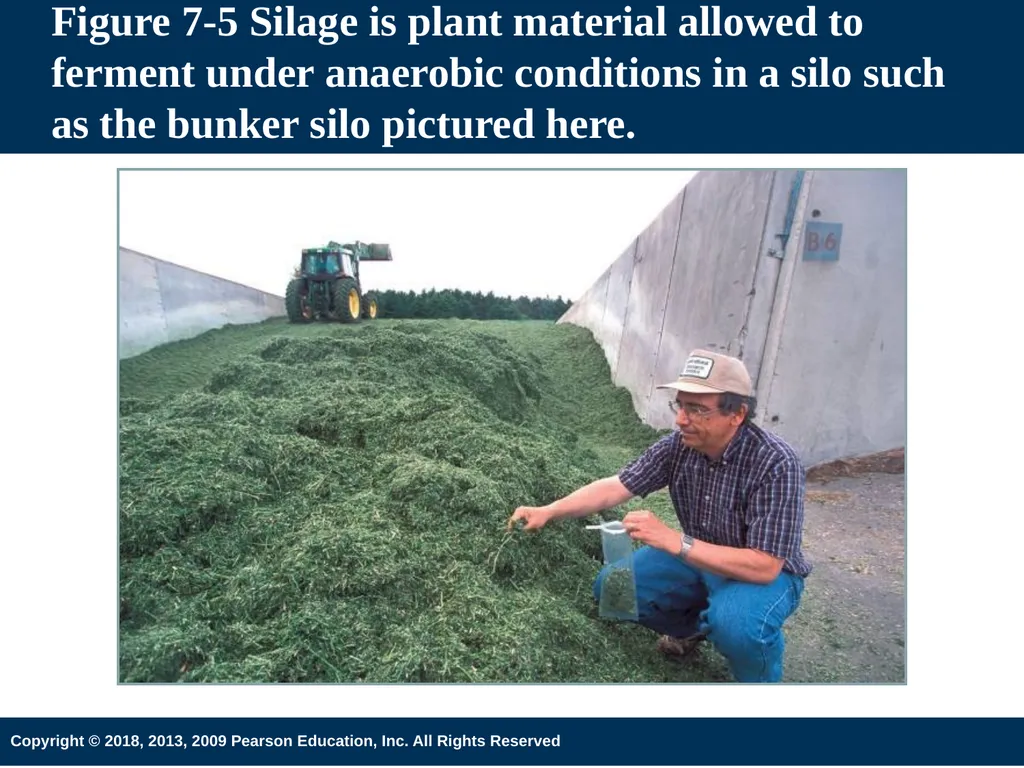
The process of ensiling plant materials under anaerobic conditions produces silage which is a common storage method for livestock feed.
The plant material undergoes a controlled fermentation that produces acids that then kill off bacteria, molds, and other destructive organisms.
One common misconception is that ensiling improves the nutritive content of a feed.
Fermentation uses nutrients and thus reduces nutritive content of the material.<br>
The process of ensiling plant materials under anaerobic conditions produces silage which is a common storage method for livestock feed.
The plant material undergoes a controlled fermentation that produces acids that then kill off bacteria, molds, and other destructive organisms.
One common misconception is that ensiling improves the nutritive content of a feed.
Fermentation uses nutrients and thus reduces nutritive content of the material.<br>
10
Feedstuff Categories (6 of 25) Characteristics
Most of these feeds from these three categories are commonly referred to as either roughages or forages and their nutritive values are similar.
A forage is generally considered to be of higher quality than a roughage.
Feeds in these categories provide the bulk of the diets of herbivorous species (ruminants and cecal fermenters).<br>
Most of these feeds from these three categories are commonly referred to as either roughages or forages and their nutritive values are similar.
A forage is generally considered to be of higher quality than a roughage.
Feeds in these categories provide the bulk of the diets of herbivorous species (ruminants and cecal fermenters).<br>
11
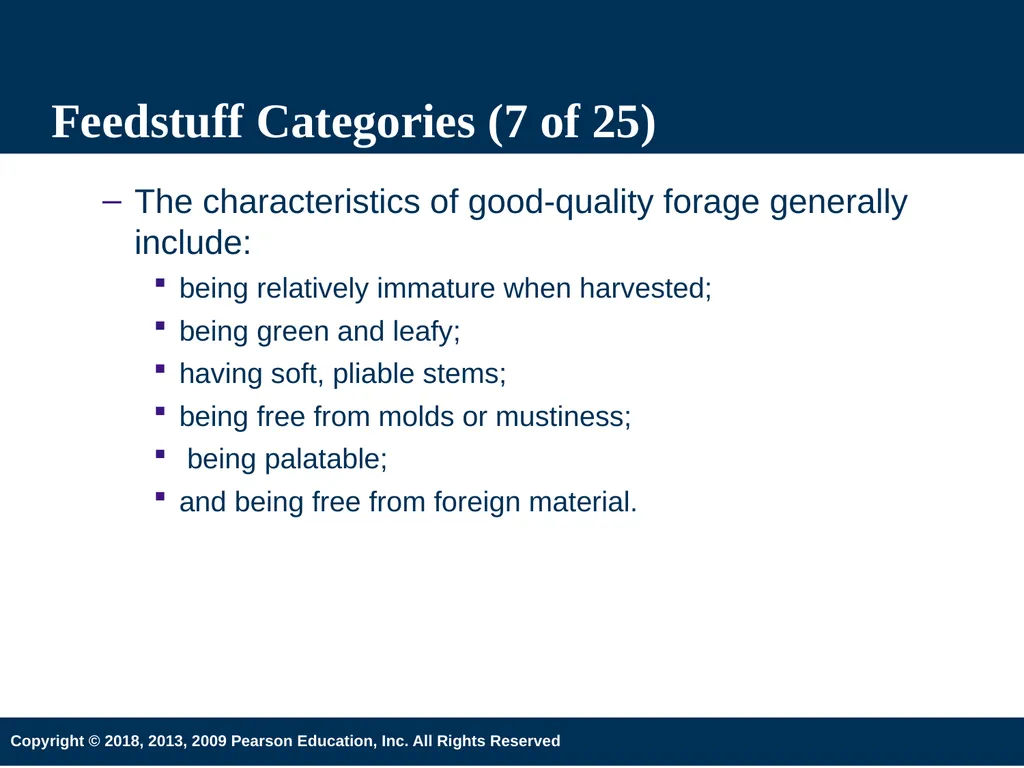
Feedstuff Categories (7 of 25) The characteristics of good-quality forage generally include:
being relatively immature when harvested;
being green and leafy;
having soft, pliable stems;
being free from molds or mustiness;
being palatable;
and being free from foreign material.<br>
being relatively immature when harvested;
being green and leafy;
having soft, pliable stems;
being free from molds or mustiness;
being palatable;
and being free from foreign material.<br>
12
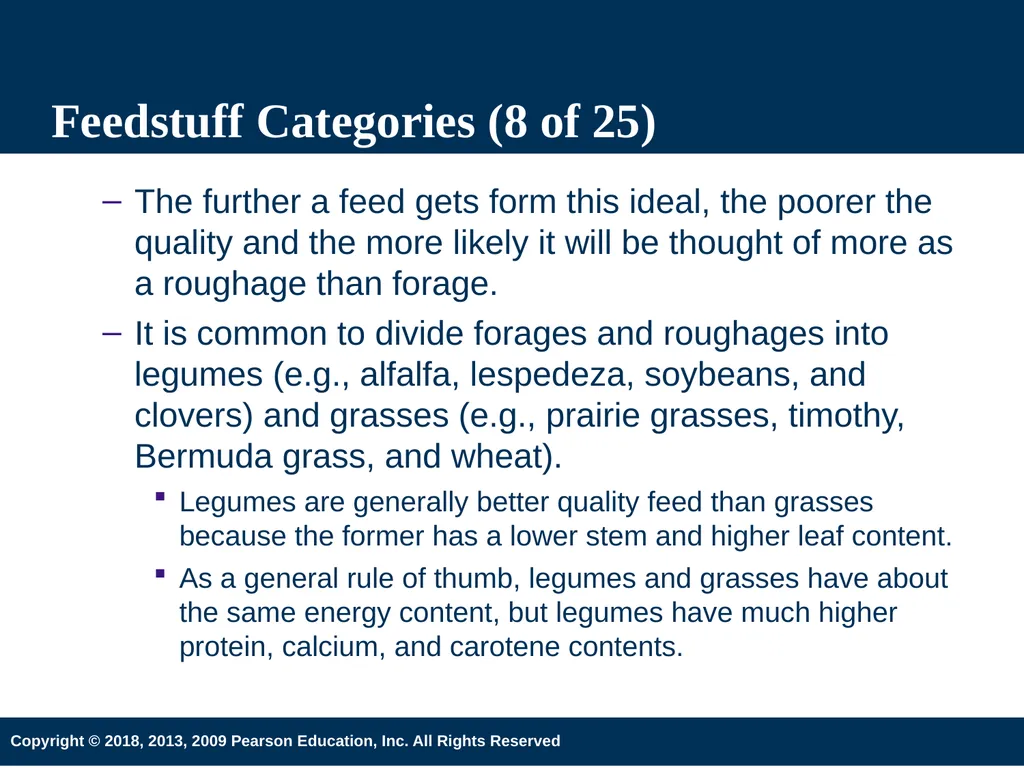
Feedstuff Categories (8 of 25) The further a feed gets form this ideal, the poorer the quality and the more likely it will be thought of more as a roughage than forage.
It is common to divide forages and roughages into legumes (e.g., alfalfa, lespedeza, soybeans, and clovers) and grasses (e.g., prairie grasses, timothy, Bermuda grass, and wheat).
Legumes are generally better quality feed than grasses because the former has a lower stem and higher leaf content.
As a general rule of thumb, legumes and grasses have about the same energy content, but legumes have much higher protein, calcium, and carotene contents.<br>
It is common to divide forages and roughages into legumes (e.g., alfalfa, lespedeza, soybeans, and clovers) and grasses (e.g., prairie grasses, timothy, Bermuda grass, and wheat).
Legumes are generally better quality feed than grasses because the former has a lower stem and higher leaf content.
As a general rule of thumb, legumes and grasses have about the same energy content, but legumes have much higher protein, calcium, and carotene contents.<br>
13
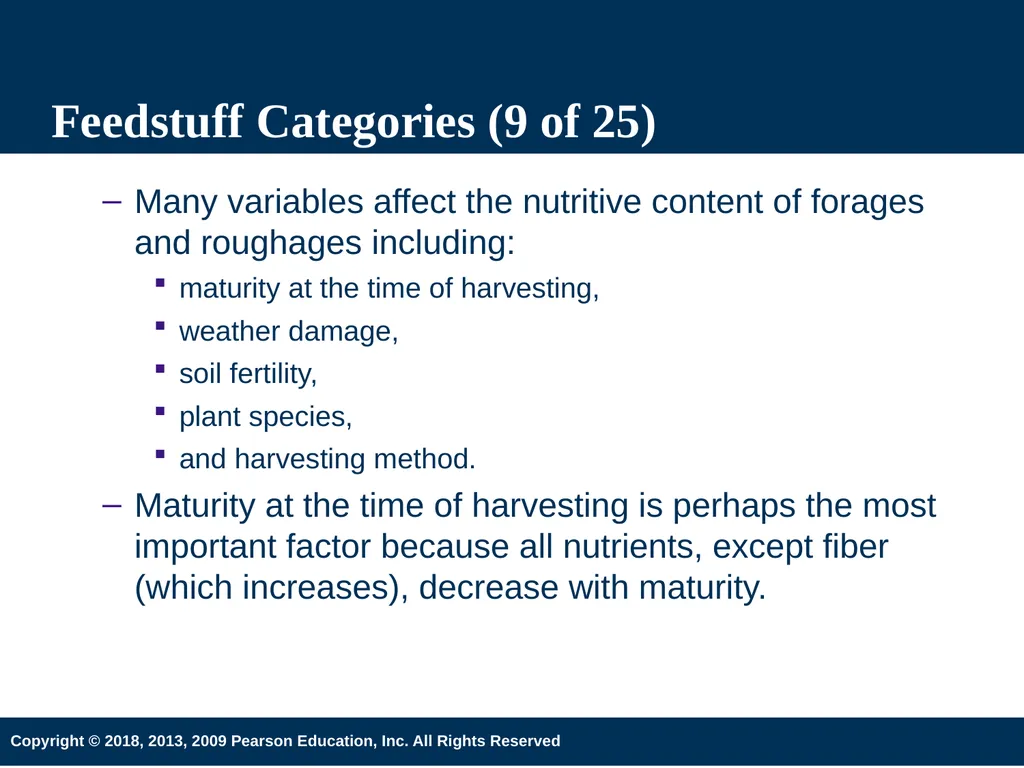
Feedstuff Categories (9 of 25) Many variables affect the nutritive content of forages and roughages including:
maturity at the time of harvesting,
weather damage,
soil fertility,
plant species,
and harvesting method.
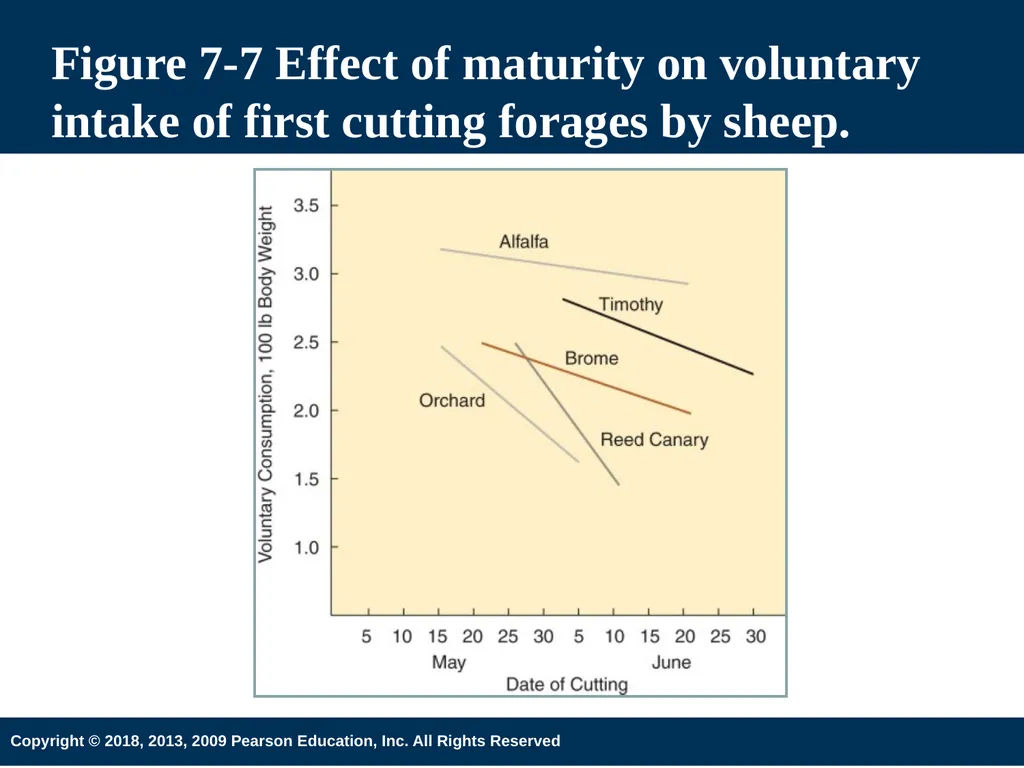
Maturity at the time of harvesting is perhaps the most important factor because all nutrients, except fiber (which increases), decrease with maturity.<br>
maturity at the time of harvesting,
weather damage,
soil fertility,
plant species,
and harvesting method.
Maturity at the time of harvesting is perhaps the most important factor because all nutrients, except fiber (which increases), decrease with maturity.<br>
14
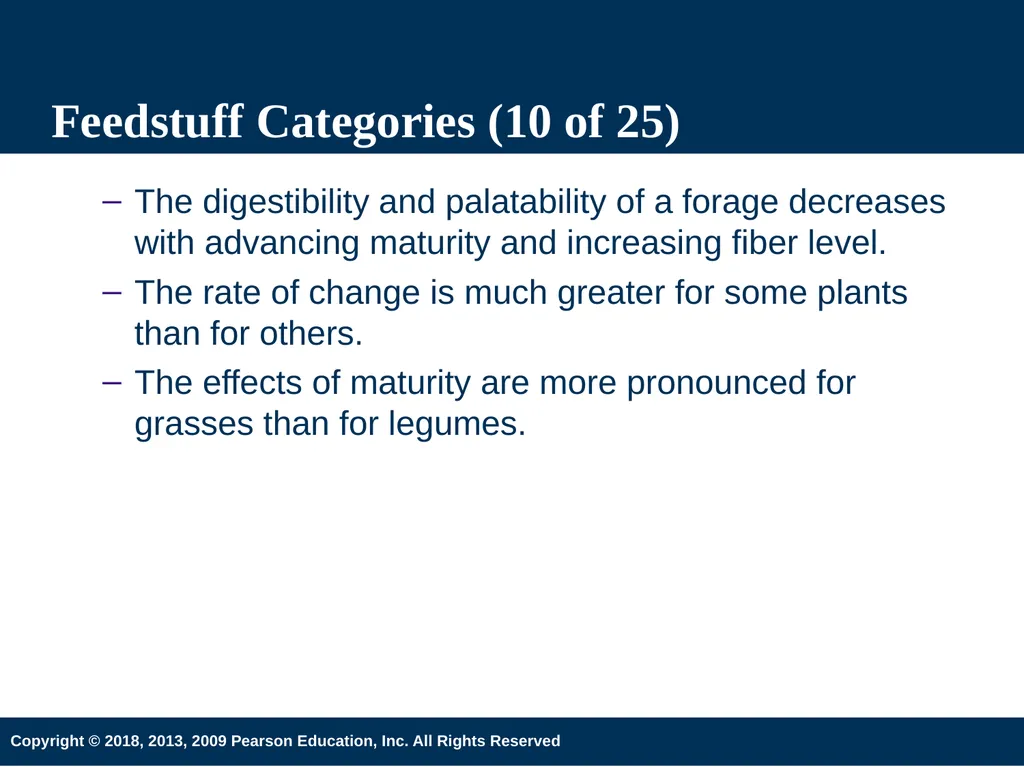
Feedstuff Categories (10 of 25) The digestibility and palatability of a forage decreases with advancing maturity and increasing fiber level.
The rate of change is much greater for some plants than for others.
The effects of maturity are more pronounced for grasses than for legumes.<br>
The rate of change is much greater for some plants than for others.
The effects of maturity are more pronounced for grasses than for legumes.<br>
15
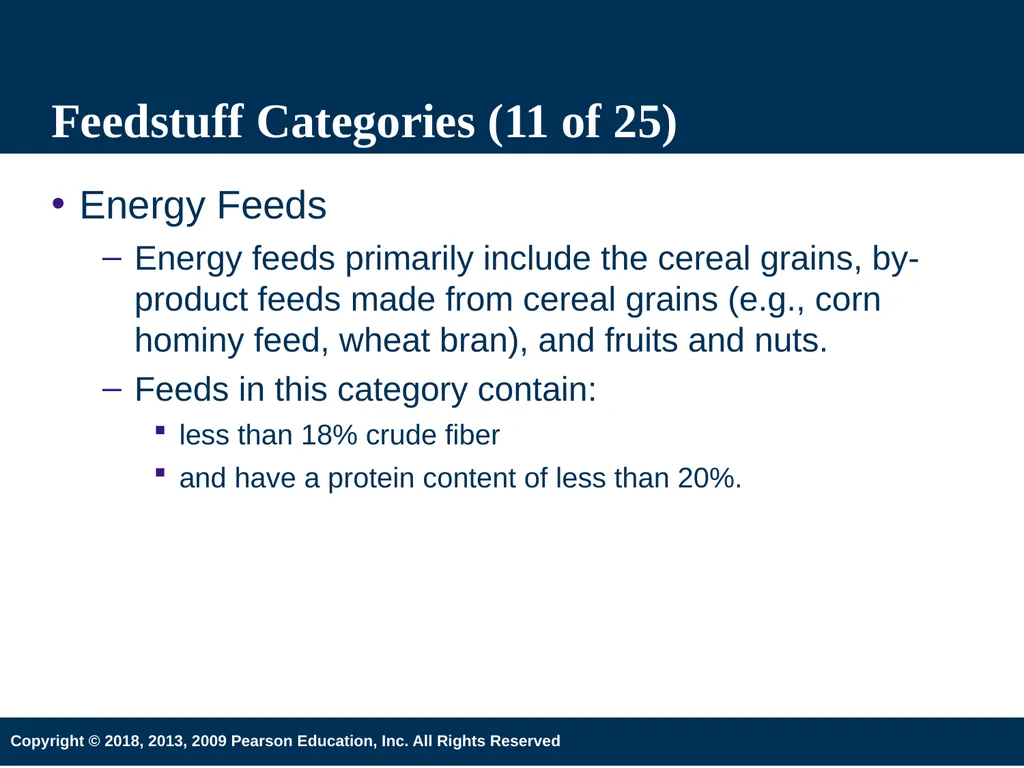
Feedstuff Categories (11 of 25) Energy Feeds
Energy feeds primarily include the cereal grains, by-product feeds made from cereal grains (e.g., corn hominy feed, wheat bran), and fruits and nuts.
Feeds in this category contain:
less than 18% crude fiber
and have a protein content of less than 20%.<br>
Energy feeds primarily include the cereal grains, by-product feeds made from cereal grains (e.g., corn hominy feed, wheat bran), and fruits and nuts.
Feeds in this category contain:
less than 18% crude fiber
and have a protein content of less than 20%.<br>
16
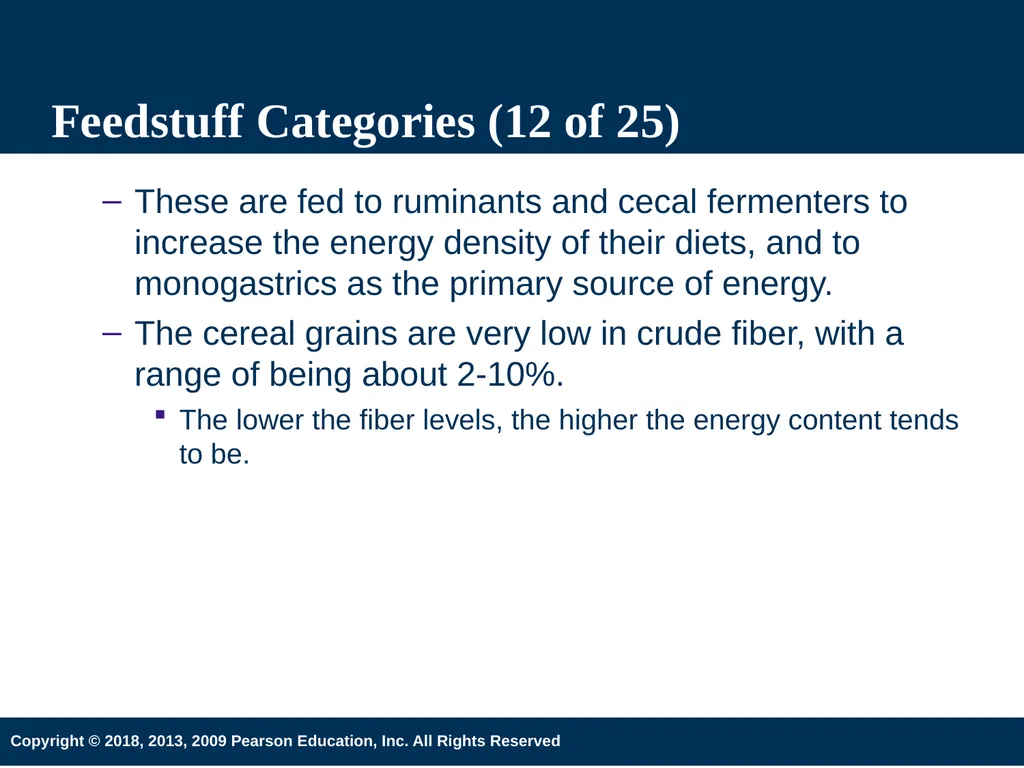
Feedstuff Categories (12 of 25) These are fed to ruminants and cecal fermenters to increase the energy density of their diets, and to monogastrics as the primary source of energy.
The cereal grains are very low in crude fiber, with a range of being about 2-10%.
The lower the fiber levels, the higher the energy content tends to be.<br>
The cereal grains are very low in crude fiber, with a range of being about 2-10%.
The lower the fiber levels, the higher the energy content tends to be.<br>
17
Feedstuff Categories (13 of 25) The energy values of grains is high, with the TDN as high as 90% on a dry-matter basis.
These values are high because of the high starch content, low fiber content, and high digestibility.
Energy feeds are by definition below 20% in crude protein content.<br>
These values are high because of the high starch content, low fiber content, and high digestibility.
Energy feeds are by definition below 20% in crude protein content.<br>
18
Feedstuff Categories (14 of 25) The protein digestibility ranges from 50-80%, but the protein quality is generally poor.
This is because the essential amino acid content is poor in grains.
In general, cereal grains are invariably very low in calcium (Ca), modest in phosphorus (P), and low in most trace minerals.<br>
This is because the essential amino acid content is poor in grains.
In general, cereal grains are invariably very low in calcium (Ca), modest in phosphorus (P), and low in most trace minerals.<br>
19
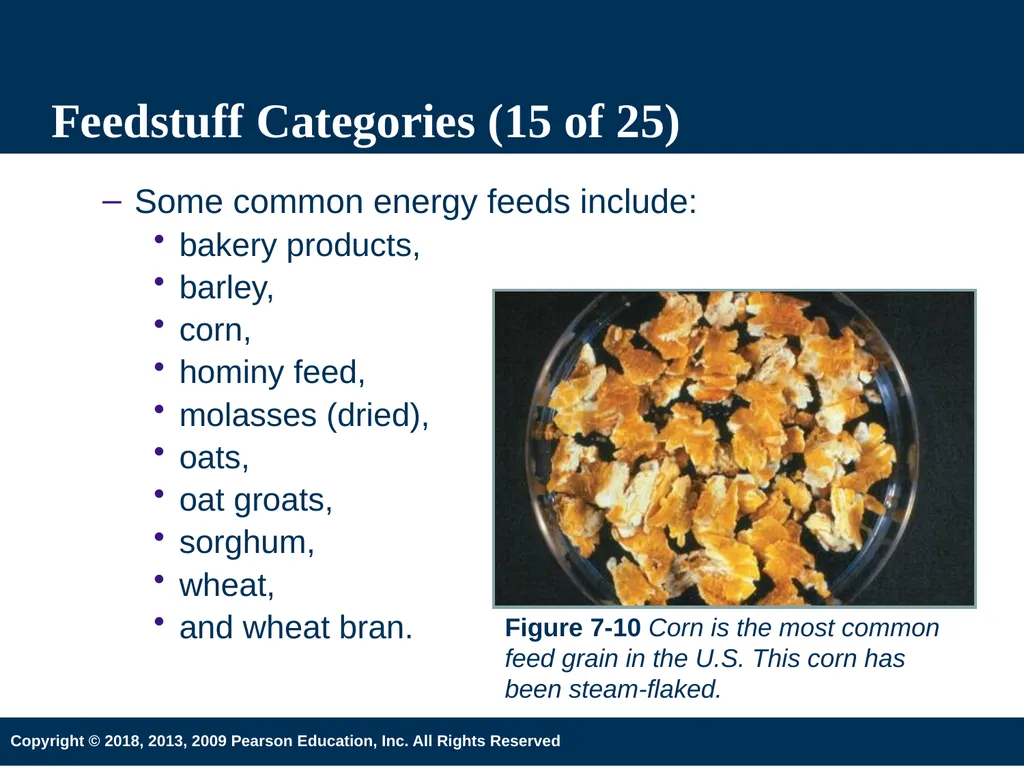
Feedstuff Categories (15 of 25) Some common energy feeds include:
bakery products,
barley,
corn,
hominy feed,
molasses (dried),
oats,
oat groats,
sorghum,
wheat,
and wheat bran. Figure 7-10 Corn is the most common feed grain in the U.S. This corn has been steam-flaked.<br>
bakery products,
barley,
corn,
hominy feed,
molasses (dried),
oats,
oat groats,
sorghum,
wheat,
and wheat bran. Figure 7-10 Corn is the most common feed grain in the U.S. This corn has been steam-flaked.<br>
20
Feedstuff Categories (16 of 25) Protein Supplements
Protein supplements include feed from three major sources. They are either of:
plant origin (e.g., soybean meal, cottonseed meal, and corn gluten meal),
animal origin (e.g., fish meal, dried skim milk, and tankage),
or nonprotein nitrogen (NPN) sources (e.g., urea, purified amino acids, and ammonium salts).
Protein supplements are generally expensive feeds.<br>
Protein supplements include feed from three major sources. They are either of:
plant origin (e.g., soybean meal, cottonseed meal, and corn gluten meal),
animal origin (e.g., fish meal, dried skim milk, and tankage),
or nonprotein nitrogen (NPN) sources (e.g., urea, purified amino acids, and ammonium salts).
Protein supplements are generally expensive feeds.<br>
21
Feedstuff Categories (17 of 25) Feeds placed in this category contain more than 20% crude protein; some have high energy contents as well.
Because ruminants can convert the poorer quality proteins to higher quality microbial protein, an effective cost-reduction strategy is to feed the NPN sources and avoid the higher quality, and thus more expensive protein supplements.<br>
Because ruminants can convert the poorer quality proteins to higher quality microbial protein, an effective cost-reduction strategy is to feed the NPN sources and avoid the higher quality, and thus more expensive protein supplements.<br>
22
Feedstuff Categories (18 of 25) The protein feeds of plant origin are primarily derived as products of the extraction of the oil from a group of seeds referred to as oilseeds because of their high fat content.
These protein sources are thus referred to as oilseed meals.
The most important of these sources are soybeans and cottonseed.
The protein content is generally at least 40% and highly digestible and protein quality is usually good.<br>
These protein sources are thus referred to as oilseed meals.
The most important of these sources are soybeans and cottonseed.
The protein content is generally at least 40% and highly digestible and protein quality is usually good.<br>
23
Feedstuff Categories (19 of 25) The protein feeds of animal origin are primarily derived as end products of the meat packing, dairy processing, and marine industries.
The most important of these are meat meal, bonemeal, blood meal, feather meal, dried milk, and fish meal.
The milk products are the highest quality of the end products and generally the most expensive.
The NPN sources generally refer to urea and other similar products.<br>
The most important of these are meat meal, bonemeal, blood meal, feather meal, dried milk, and fish meal.
The milk products are the highest quality of the end products and generally the most expensive.
The NPN sources generally refer to urea and other similar products.<br>
24
Feedstuff Categories (20 of 25) Urea and similar products must be used with functional ruminants only—and then, very carefully.
The ruminant microbes are able to use substantial amounts of NPN and, because they are frequently of lower cost than proteins, they are often used to cheapen a ration.<br>
The ruminant microbes are able to use substantial amounts of NPN and, because they are frequently of lower cost than proteins, they are often used to cheapen a ration.<br>
25
Feedstuff Categories (21 of 25) Some common protein supplements include:
blood meal,
brewers dried grain,
canola meal,
casein (dried),
cottonseed meal,
feather meal,
fish meal,
meat and bonemeal,
milk, whole dried;
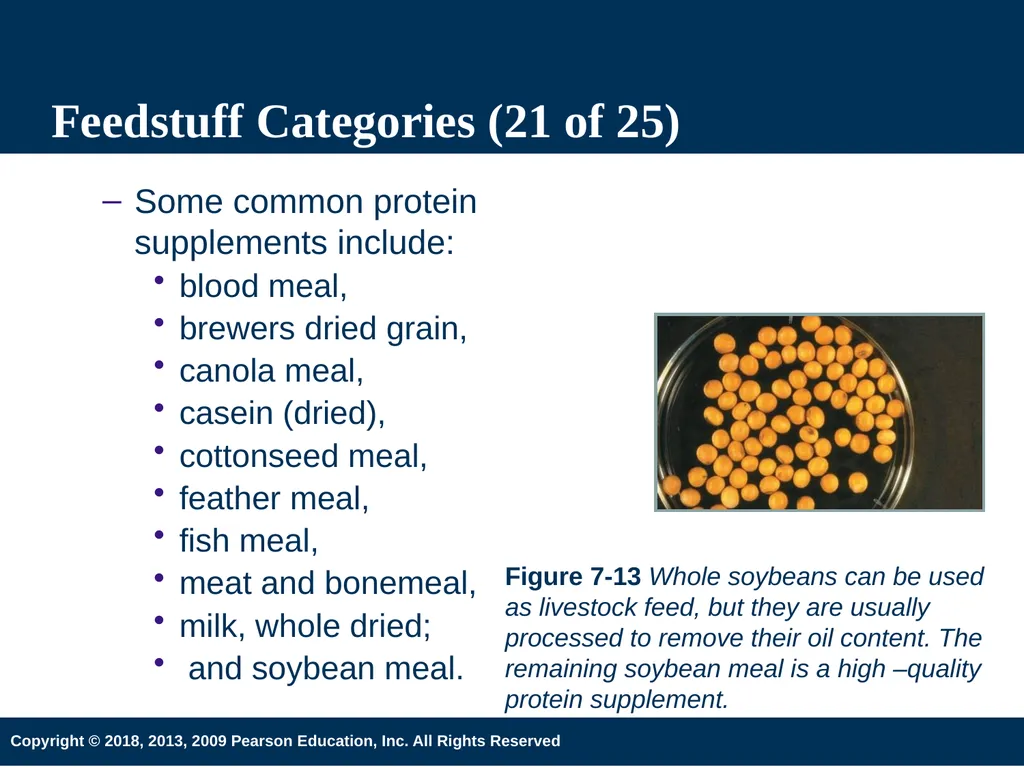
and soybean meal. Figure 7-13 Whole soybeans can be used as livestock feed, but they are usually processed to remove their oil content. The remaining soybean meal is a high –quality protein supplement.<br>
blood meal,
brewers dried grain,
canola meal,
casein (dried),
cottonseed meal,
feather meal,
fish meal,
meat and bonemeal,
milk, whole dried;
and soybean meal. Figure 7-13 Whole soybeans can be used as livestock feed, but they are usually processed to remove their oil content. The remaining soybean meal is a high –quality protein supplement.<br>
26
Feedstuff Categories (22 of 25) Mineral and Vitamin Supplements
Virtually all feeds contain at least some vitamins and minerals.
Animals need these nutrients in much smaller amounts than they do the other nutrients, but dietary needs must be met to achieve good animal performance and economical production.
Depending on the feeds used to balance a ration for the other nutrients, concentrated sources of vitamins and/or minerals may be needed.<br>
Virtually all feeds contain at least some vitamins and minerals.
Animals need these nutrients in much smaller amounts than they do the other nutrients, but dietary needs must be met to achieve good animal performance and economical production.
Depending on the feeds used to balance a ration for the other nutrients, concentrated sources of vitamins and/or minerals may be needed.<br>
27
Feedstuff Categories (23 of 25) Some common mineral supplements include:
salt (often trace mineralized),
bone meal,
oyster shell,
calcium carbonate,
limestone,
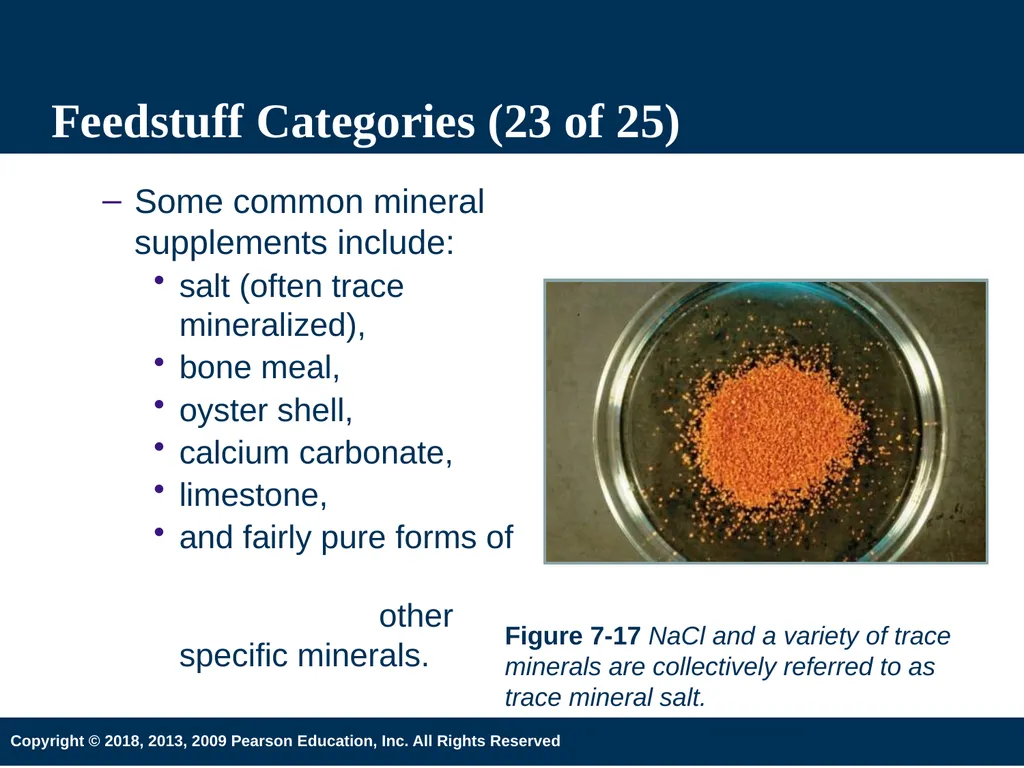
and fairly pure forms of other specific minerals. Figure 7-17 NaCl and a variety of trace minerals are collectively referred to as trace mineral salt.<br>
salt (often trace mineralized),
bone meal,
oyster shell,
calcium carbonate,
limestone,
and fairly pure forms of other specific minerals. Figure 7-17 NaCl and a variety of trace minerals are collectively referred to as trace mineral salt.<br>
28
Feedstuff Categories (24 of 25) Some common vitamin supplements include:
ensiled yeast,
liver meal,
fish oil,
wheat germ oil,
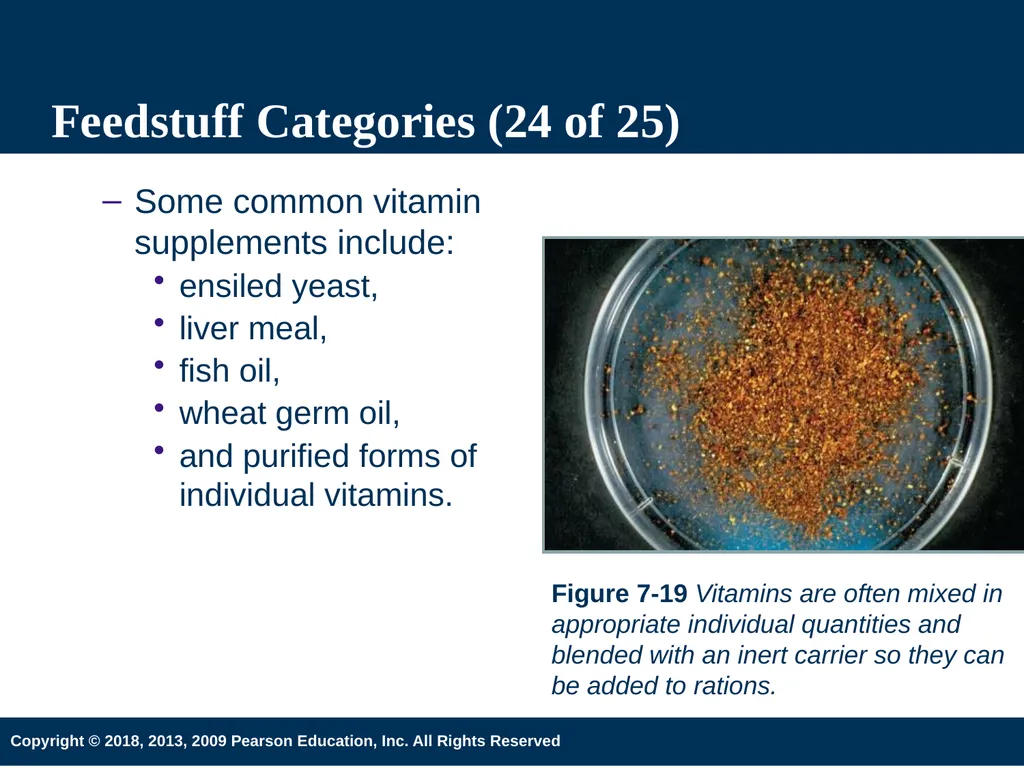
and purified forms of individual vitamins. Figure 7-19 Vitamins are often mixed in appropriate individual quantities and blended with an inert carrier so they can be added to rations.<br>
ensiled yeast,
liver meal,
fish oil,
wheat germ oil,
and purified forms of individual vitamins. Figure 7-19 Vitamins are often mixed in appropriate individual quantities and blended with an inert carrier so they can be added to rations.<br>
29
Feedstuff Categories (25 of 25) Nonnutritive Additives
This is a catchall category for a large group of feed ingredients added to the rations for some reason other than their nutritive value.
They may be used to stimulate growth or some other type of production, improve feed efficiency, enhance health, or alter metabolism.
Feedstuffs in this category include antibiotics, coloring agents, flavors, hormones, and medicants.<br>
This is a catchall category for a large group of feed ingredients added to the rations for some reason other than their nutritive value.
They may be used to stimulate growth or some other type of production, improve feed efficiency, enhance health, or alter metabolism.
Feedstuffs in this category include antibiotics, coloring agents, flavors, hormones, and medicants.<br>
30
Figure 7-5 Silage is plant material allowed to ferment under anaerobic conditions in a silo such as the bunker silo pictured here.<br>
31
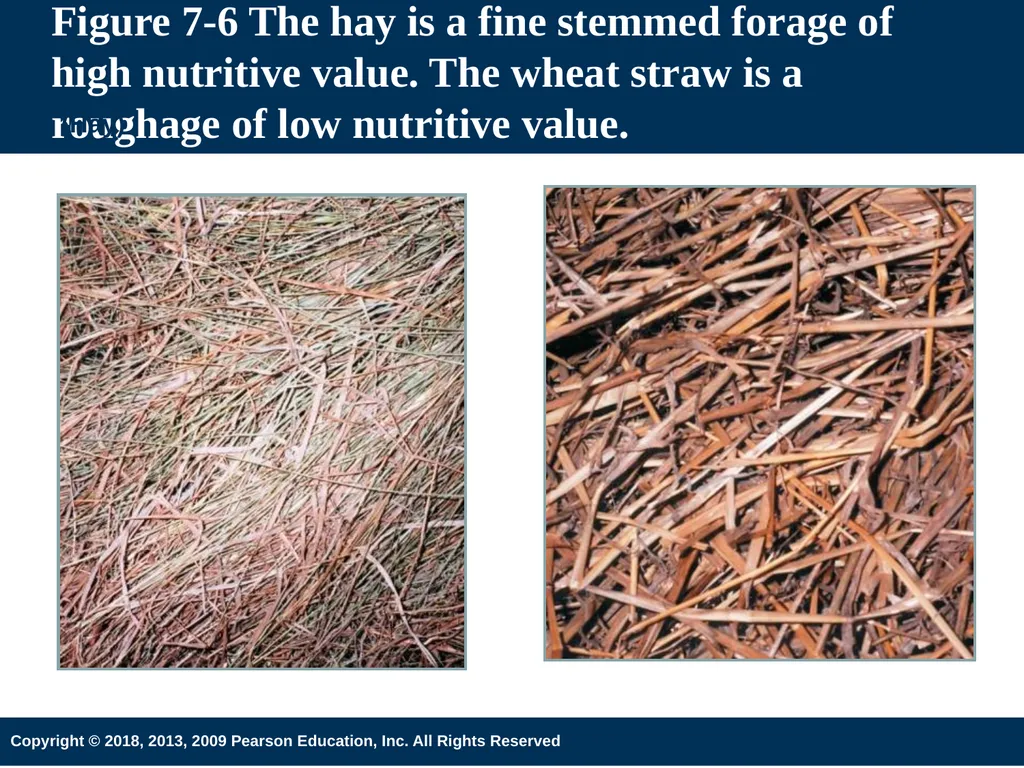
Figure 7-6 The hay is a fine stemmed forage of high nutritive value. The wheat straw is a roughage of low nutritive value. (Hay)<br>
32
Figure 7-7 Effect of maturity on voluntary intake of first cutting forages by sheep.<br>
33
Summary and Conclusion The system of categorizing feedstuffs used in this chapter is the one found in the NRC publications.
Even though generalities about the feeds classifications exist, exceptions are easy to find;
Research is continually telling us more about feeds and their nutrient availabilities.<br>
Even though generalities about the feeds classifications exist, exceptions are easy to find;
Research is continually telling us more about feeds and their nutrient availabilities.<br>