
Introduction to Chabot Services Equity Statement
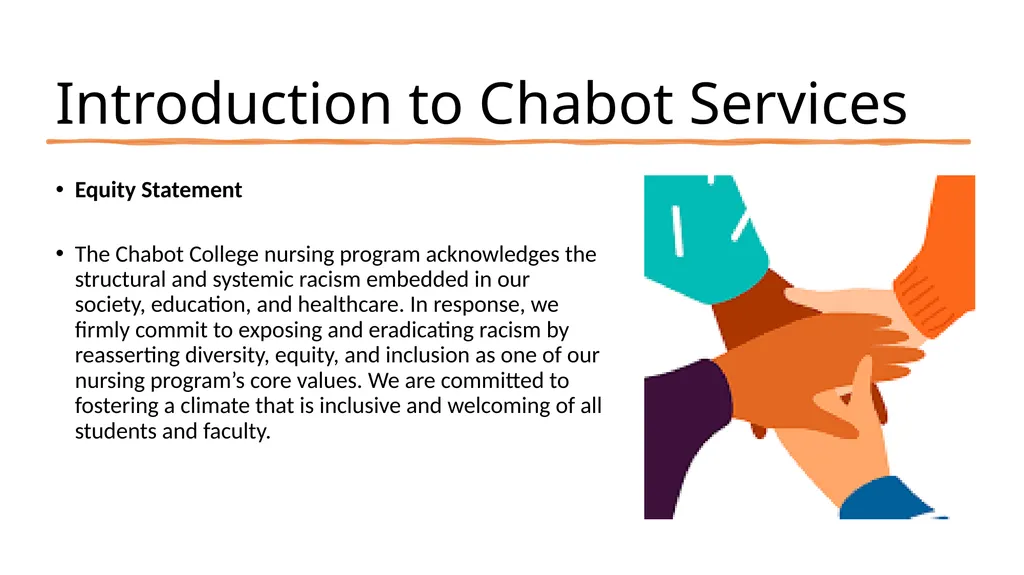


Description: Introduction to Chabot Services Equity Statement The Chabot College nursing program acknowledges the structural and systemic racism embedded in our society, education, and healthcare. In response, we firmly commit to exposing and
Related Topics
Download Presentation
"Introduction to Chabot Services Equity Statement" is the property of its rightful owner. Permission is granted to download and print the materials on this website for personal, non-commercial use only, and to display it on your personal computer provided you do not modify the materials and that you retain all copyright notices contained in the materials. By downloading content from our website, you accept the terms of this agreement.
Presentation Transcript
slide1. Introduction to Chabot Services Equity Statement
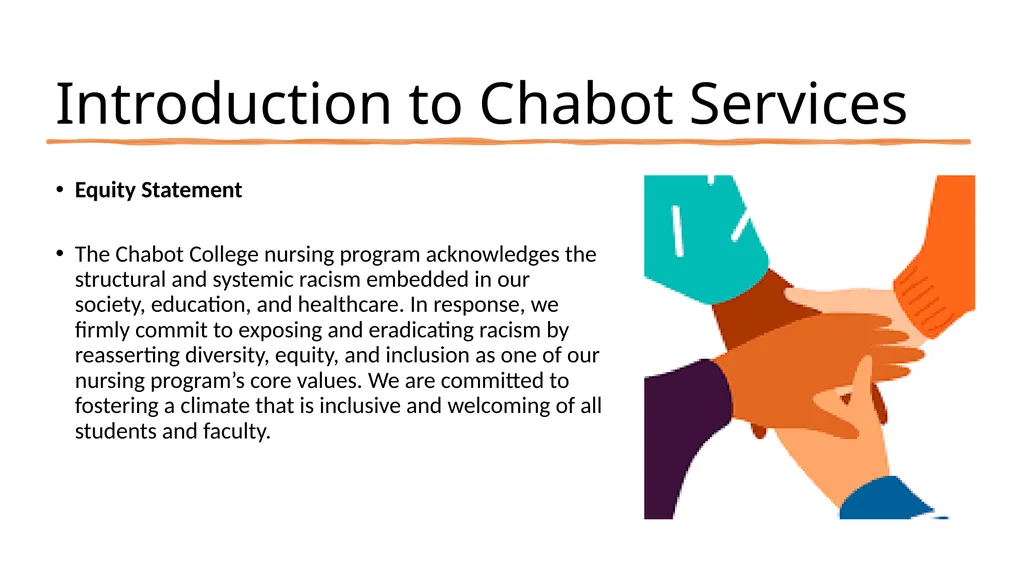
The Chabot College nursing program acknowledges the structural and systemic racism embedded in our society, education, and healthcare. In response, we firmly commit to exposing and eradicating racism by reasserting diversity, equity, and inclusion as one of our nursing program’s core values. We are committed to fostering a climate that is inclusive and welcoming of all students and faculty.<br>
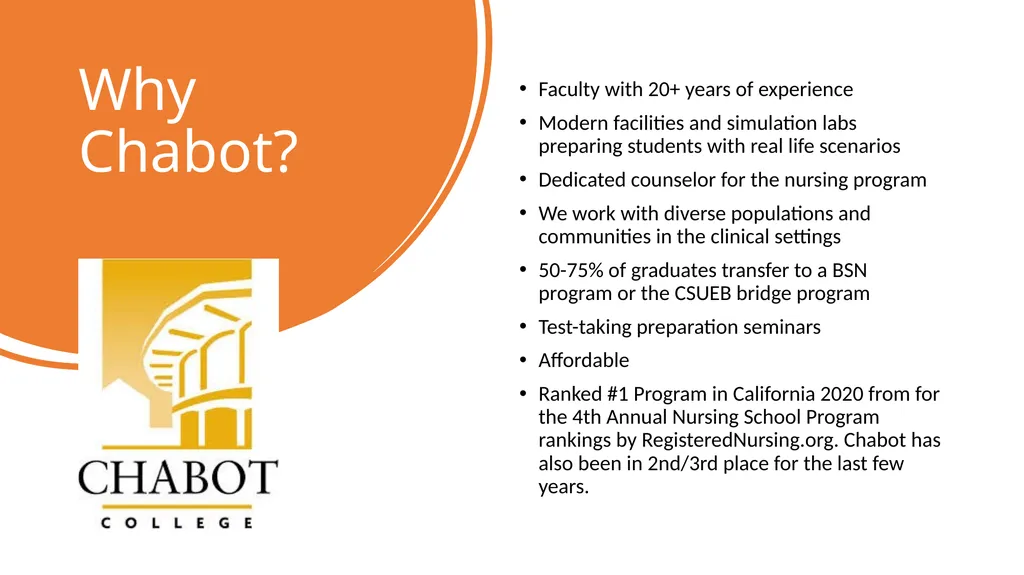
slide2. Why Chabot? Faculty with 20+ years of experience
Modern facilities and simulation labs preparing students with real life scenarios
Dedicated counselor for the nursing program
We work with diverse populations and communities in the clinical settings
50-75% of graduates transfer to a BSN program or the CSUEB bridge program
Test-taking preparation seminars
Affordable
Ranked #1 Program in California 2020 from for the 4th Annual Nursing School Program rankings by RegisteredNursing.org. Chabot has also been in 2nd/3rd place for the last few years.<br>
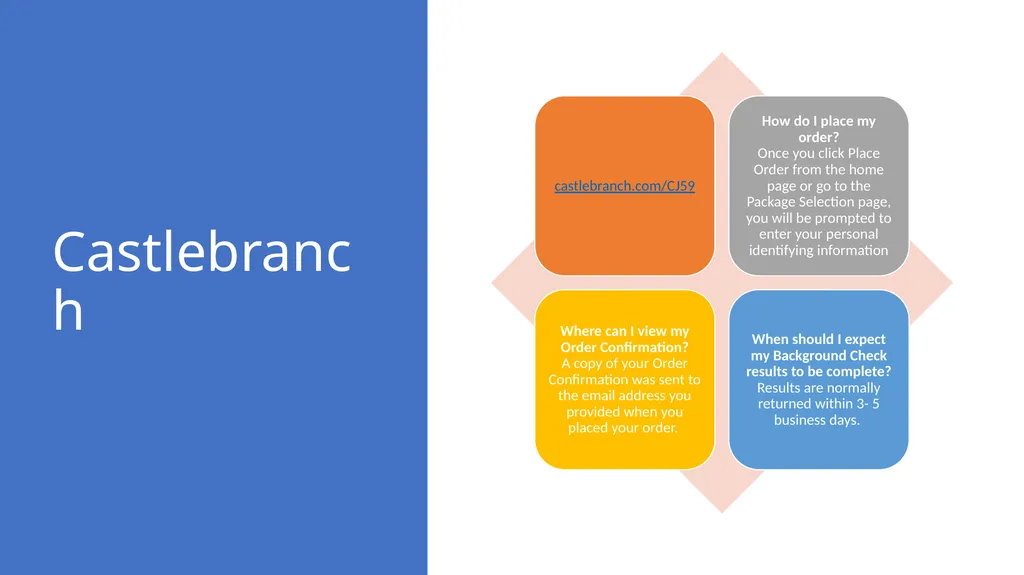
slide3. Castlebranch<br>
slide4. Castle Branch<br>
slide5. HealthStream Online Clinical Orientation Program Required HealthStream modules: You will be required to take each of the following three modules annually.
Allow approximately four hours to complete all the required modules.
• Rapid Regulatory Compliance: Clinical I: Compliance; Ethics; Sexual Harassment; Patient Rights; Informed Consent; Advanced Directives; Emergency Medical Treatment and Labor Act (EMTALA); Grievances; Developmental Appropriate Care; Cultural Competence; Restraint/Seclusion; Patient Abuse/Assault/Neglect<br>
slide6. Health Stream Modules Nursing Program office will create your account.
You will be notified via email when to enter HealthStream and complete the modules. Do NOT create your own account.
HealthStream’s online programs are designed to educate healthcare professionals and health occupations students.
You will need to complete four HealthStream modules* on or before July 30, 2021.
Modules are $3.50 each, you will use a debit/credit card payment for each module separately on HealthStream’s secure website.<br>
slide7. Healthstream (cont) • Rapid Regulatory Compliance: Clinical II: General/Fire/Electric/Back/Radiation/MRI Safety; Ergonomics; Lift/Transport; Slips/Trips/Falls; Latex Allergy; Hazardous Communication; Workplace Violence; Emergency Prep; Infection Control; Hospital Acquired Infections; Hand Hygiene; Bloodborne; Standard Precautions; Airborne/Contact/Droplet Precautions, Personal Protective Equipment
• Hazard Communication •
HIPAA AFTER July 1, 2021<br>
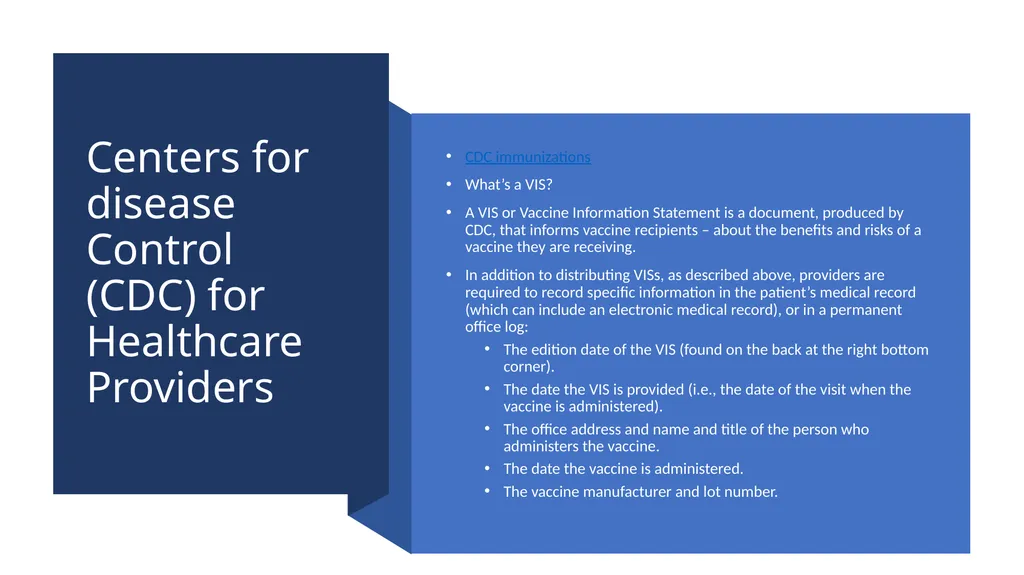
slide8. Centers for disease Control (CDC) for Healthcare Providers CDC immunizations
What’s a VIS?
A VIS or Vaccine Information Statement is a document, produced by CDC, that informs vaccine recipients – about the benefits and risks of a vaccine they are receiving.
In addition to distributing VISs, as described above, providers are required to record specific information in the patient’s medical record (which can include an electronic medical record), or in a permanent office log:
The edition date of the VIS (found on the back at the right bottom corner).
The date the VIS is provided (i.e., the date of the visit when the vaccine is administered).
The office address and name and title of the person who administers the vaccine.
The date the vaccine is administered.
The vaccine manufacturer and lot number.<br>
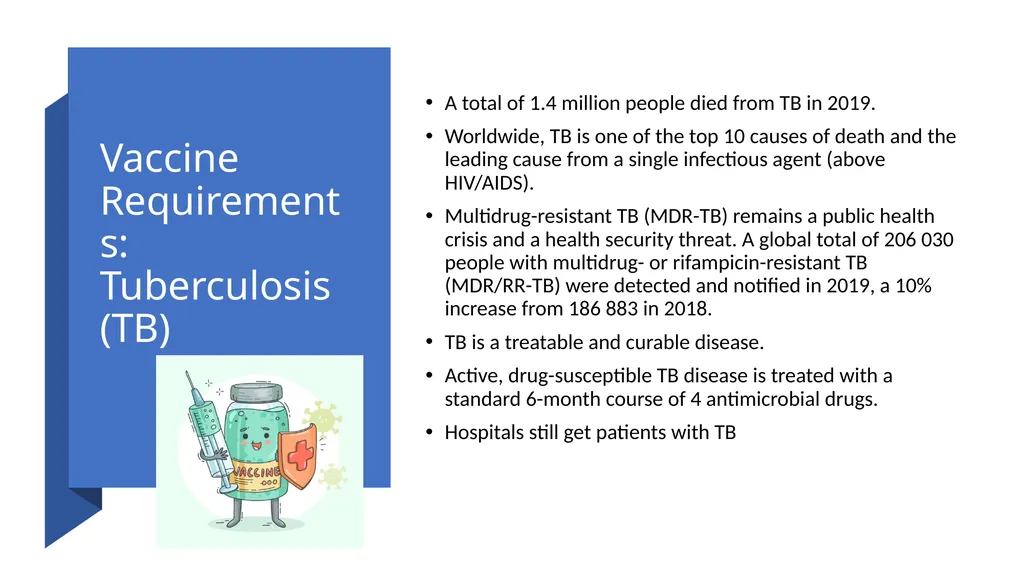
slide9. Vaccine Requirements: Tuberculosis (TB) A total of 1.4 million people died from TB in 2019.
Worldwide, TB is one of the top 10 causes of death and the leading cause from a single infectious agent (above HIV/AIDS).
Multidrug-resistant TB (MDR-TB) remains a public health crisis and a health security threat. A global total of 206 030 people with multidrug- or rifampicin-resistant TB (MDR/RR-TB) were detected and notified in 2019, a 10% increase from 186 883 in 2018.
TB is a treatable and curable disease.
Active, drug-susceptible TB disease is treated with a standard 6-month course of 4 antimicrobial drugs.
Hospitals still get patients with TB<br>
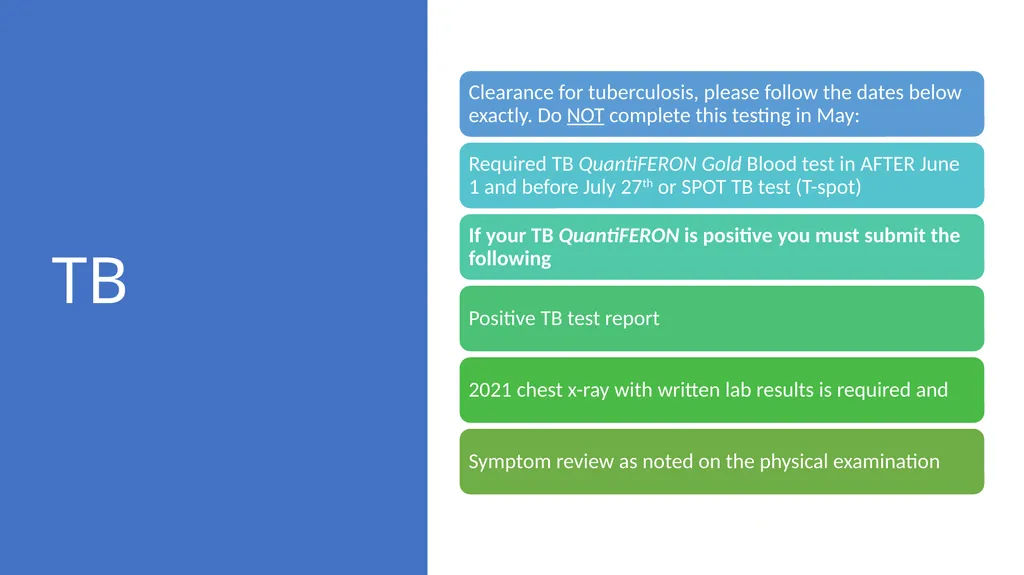
slide10. TB<br>
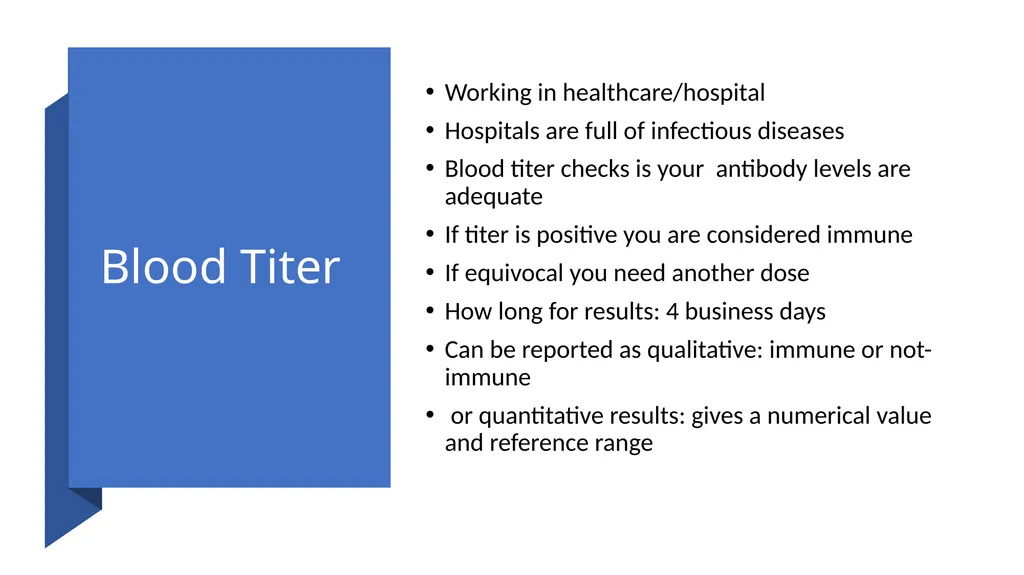
slide11. Blood Titer Working in healthcare/hospital
Hospitals are full of infectious diseases
Blood titer checks is your antibody levels are adequate
If titer is positive you are considered immune
If equivocal you need another dose
How long for results: 4 business days
Can be reported as qualitative: immune or not-immune
or quantitative results: gives a numerical value and reference range<br>
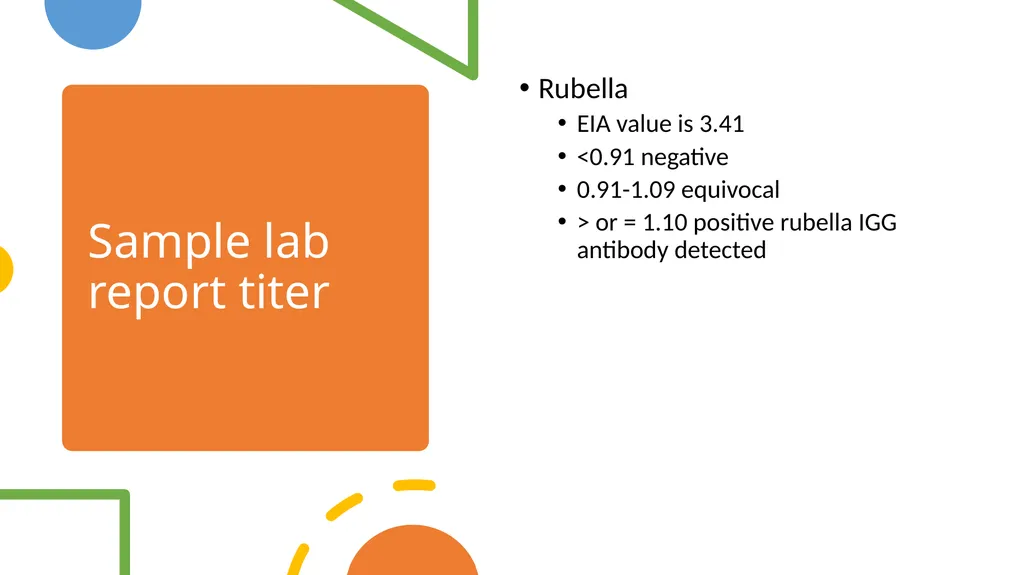
slide12. Sample lab report titer Rubella
EIA value is 3.41
<0.91 negative
0.91-1.09 equivocal
> or = 1.10 positive rubella IGG antibody detected<br>
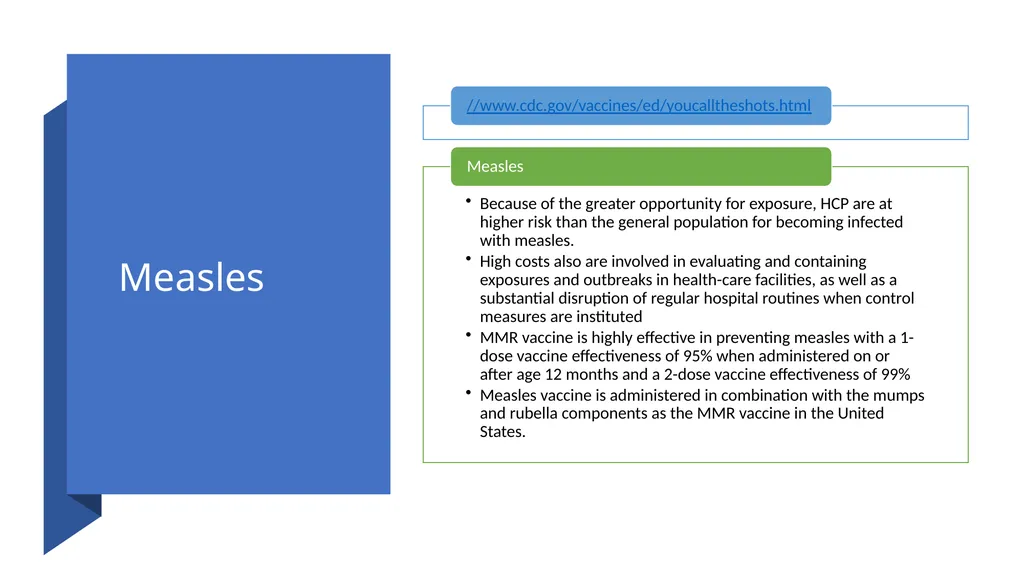
slide13. Measles<br>
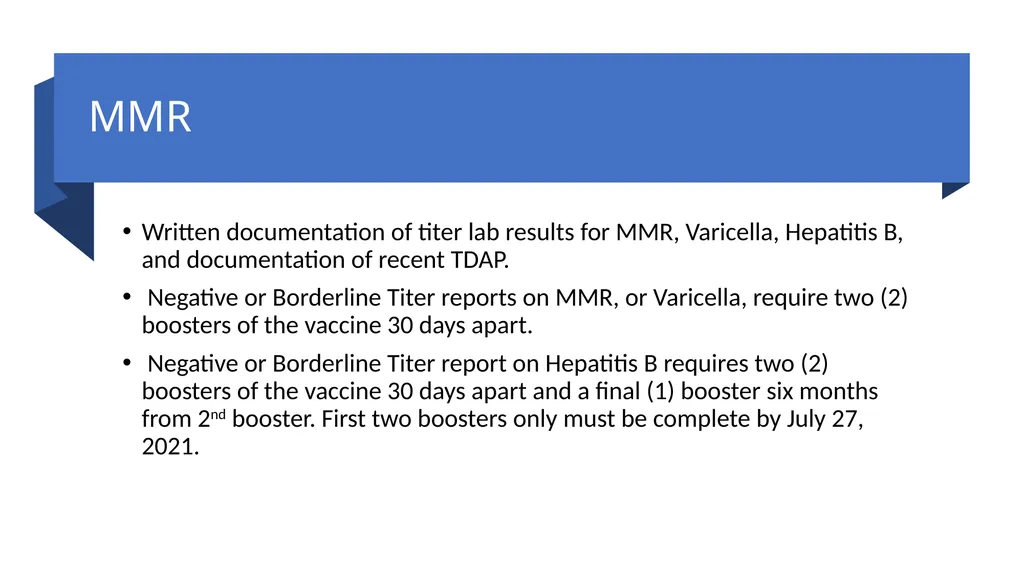
slide14. MMR Written documentation of titer lab results for MMR, Varicella, Hepatitis B, and documentation of recent TDAP.
Negative or Borderline Titer reports on MMR, or Varicella, require two (2) boosters of the vaccine 30 days apart.
Negative or Borderline Titer report on Hepatitis B requires two (2) boosters of the vaccine 30 days apart and a final (1) booster six months from 2nd booster. First two boosters only must be complete by July 27, 2021.<br>
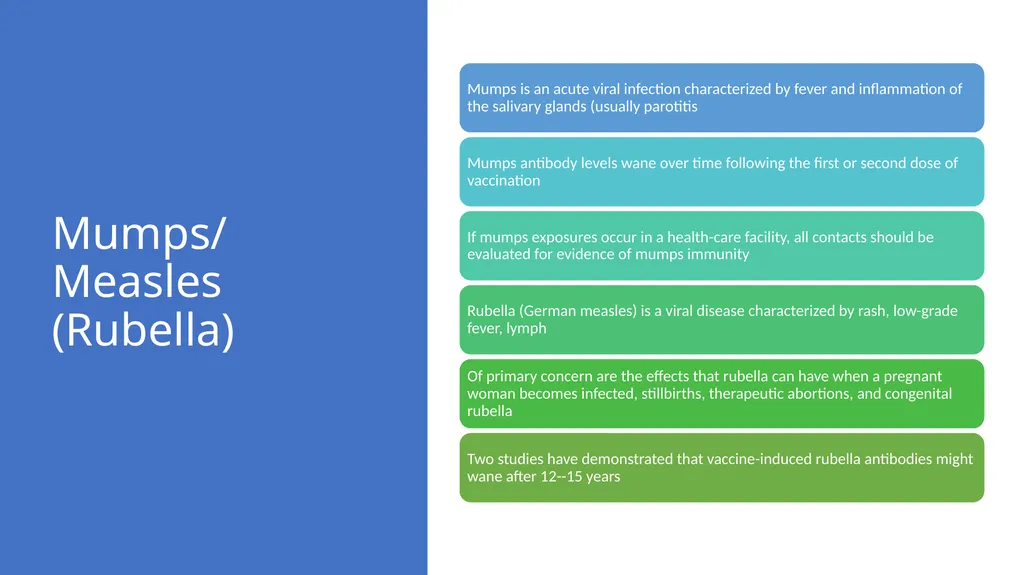
slide15. Mumps/Measles (Rubella)<br>
slide16. Boosters If non-immune to
Measles mumps or rubella get a MMR dose
Varicella get a booster: 2 shots 4-6 weeks apart
Wait 6 weeks after dose to get a titer
What if I am still non-immune after boosters
OK you may not convert
This may happen with hepatis B vaccine
Fill out the Hep B non-responder form<br>
slide17. Varicella<br>
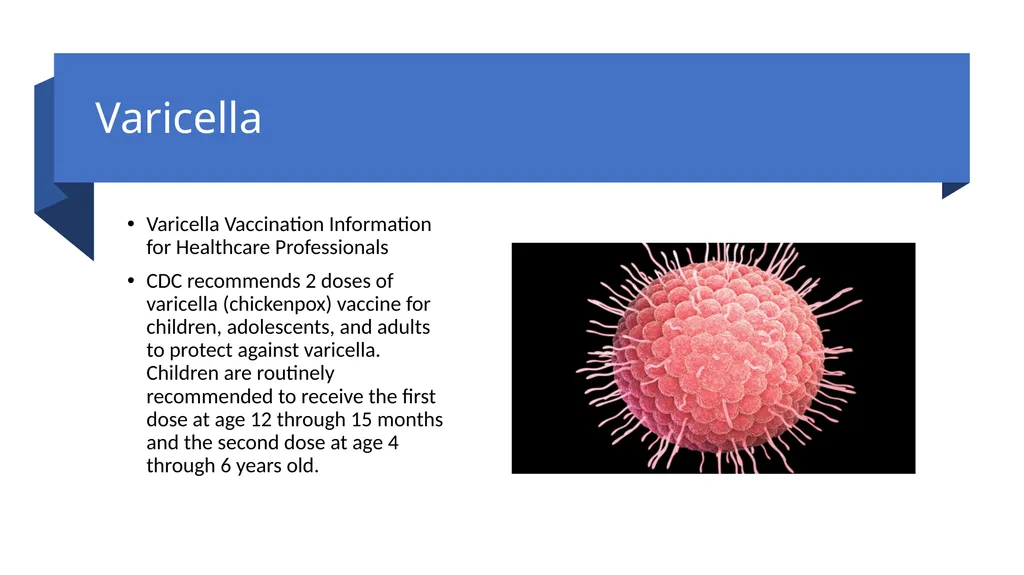
slide18. Varicella Varicella Vaccination Information for Healthcare Professionals
CDC recommends 2 doses of varicella (chickenpox) vaccine for children, adolescents, and adults to protect against varicella. Children are routinely recommended to receive the first dose at age 12 through 15 months and the second dose at age 4 through 6 years old.<br>
slide19. Pertussis Pertussis is a highly contagious bacterial infection. Transmission occurs by direct contact with respiratory secretions.
Infants too young to be vaccinated are at greatest risk for severe pertussis, including hospitalization and death. The disease can be transmitted from adults to close contacts, especially unvaccinated children.
In hospital settings, transmission of pertussis has occurred from hospital visitors to patients, from HCP to patients, and from patients to HCP documented outbreaks were costly and disruptive. In each outbreak, HCP were evaluated for cough illness and required diagnostic testing, prophylactic antibiotics, and exclusion from work.<br>
slide20. Pertussis cont<br>
slide21. TDAP Tetanus, diphtheria, and pertussis (Tdap) vaccination (Routine vaccination
Adolescents age 11–12 years: 1 dose Tdap
Pregnancy: 1 dose Tdap during each pregnancy, preferably during the early part of gestational weeks 27–36
Tdap may be administered regardless of the interval since the last tetanus- and diphtheria-toxoid-containing vaccine.
Catch-up vaccination
Td is tetanus/diphtheria given every 10 years not the same as Tdap
Do not get if life-threatening allergic reaction<br>
slide22. Covid-19 Vaccination vaccine Facts<br>
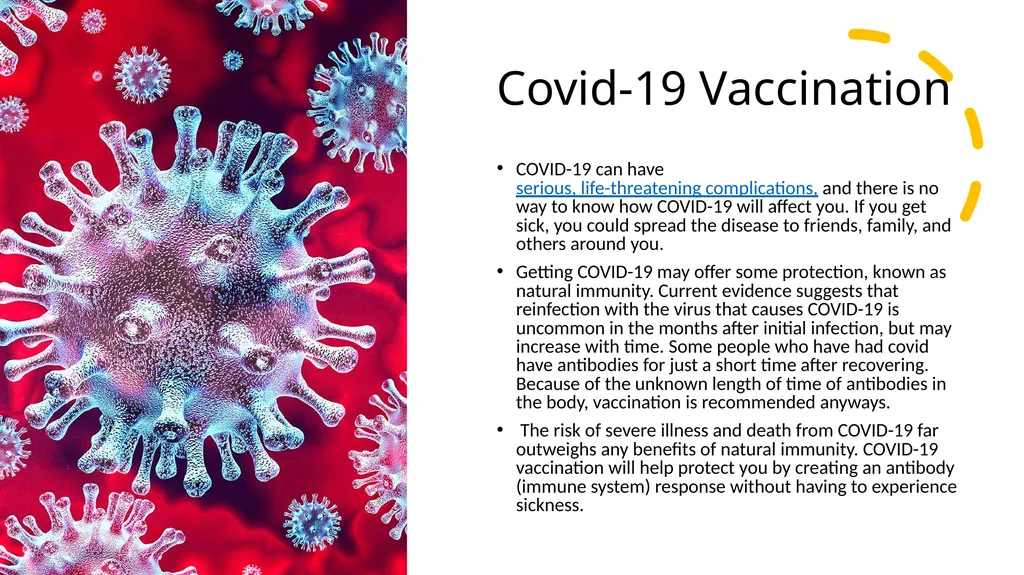
slide23. Covid-19 Vaccination COVID-19 can have serious, life-threatening complications, and there is no way to know how COVID-19 will affect you. If you get sick, you could spread the disease to friends, family, and others around you.
Getting COVID-19 may offer some protection, known as natural immunity. Current evidence suggests that reinfection with the virus that causes COVID-19 is uncommon in the months after initial infection, but may increase with time. Some people who have had covid have antibodies for just a short time after recovering. Because of the unknown length of time of antibodies in the body, vaccination is recommended anyways.
The risk of severe illness and death from COVID-19 far outweighs any benefits of natural immunity. COVID-19 vaccination will help protect you by creating an antibody (immune system) response without having to experience sickness.<br>
slide24. Vaccines will work with your immune system so it will be ready to fight the virus if you are exposed.
A growing body of evidence suggests that fully vaccinated people are less likely to be infected without showing symptoms (called an asymptomatic infection) and potentially less likely to spread the virus that causes COVID-19 to others.
Stopping a pandemic requires using all the tools we have available. As experts learn more about how COVID-19 vaccination may help reduce spread of the virus that causes COVID-19.<br>
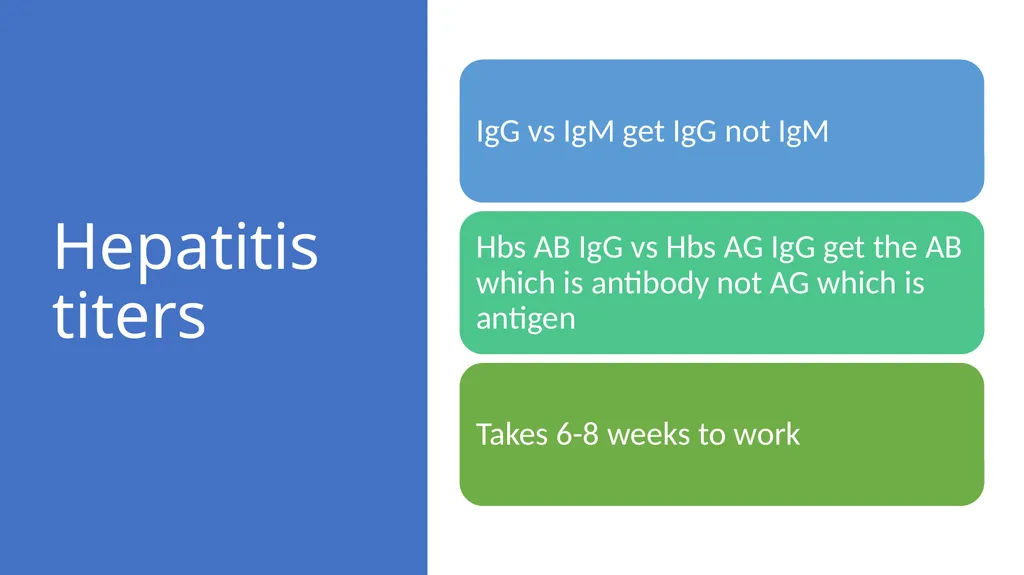
slide25. Hepatitis titers<br>
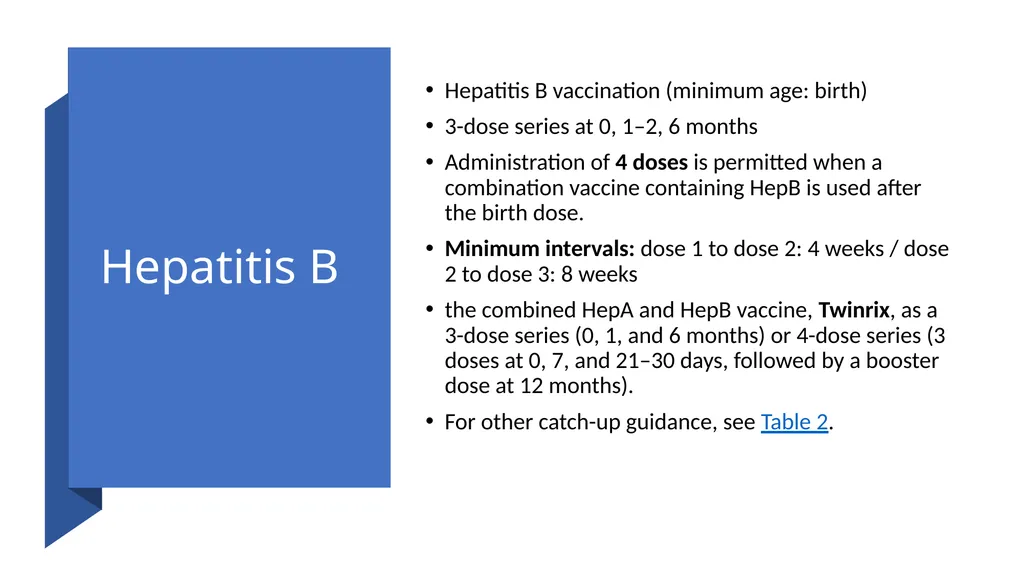
slide26. Hepatitis B Hepatitis B vaccination (minimum age: birth)
3-dose series at 0, 1–2, 6 months
Administration of 4 doses is permitted when a combination vaccine containing HepB is used after the birth dose.
Minimum intervals: dose 1 to dose 2: 4 weeks / dose 2 to dose 3: 8 weeks
the combined HepA and HepB vaccine, Twinrix, as a 3-dose series (0, 1, and 6 months) or 4-dose series (3 doses at 0, 7, and 21–30 days, followed by a booster dose at 12 months).
For other catch-up guidance, see Table 2.<br>
slide27. Flu WAIT! Flu Vaccination will not be completed until the new 2021 flu season vaccine is available in Sept/October 2021.<br>
slide28. Medical Exam<br>
slide29. Background Check Social security Number Trace
Combined OIG/GSA Excluded Parties/Debarment Search
Felony/Misdemeanor Criminal Conviction Record Search o Infractions, Misdemeanor or Felonies convictions:
It is required to meet with the program director if you have any convictions for infractions, misdemeanors or felonies which may impact your ability to obtain a registered nurse license or work in our clinical site.<br>
slide30. 10 Panel Drug Screen<br>
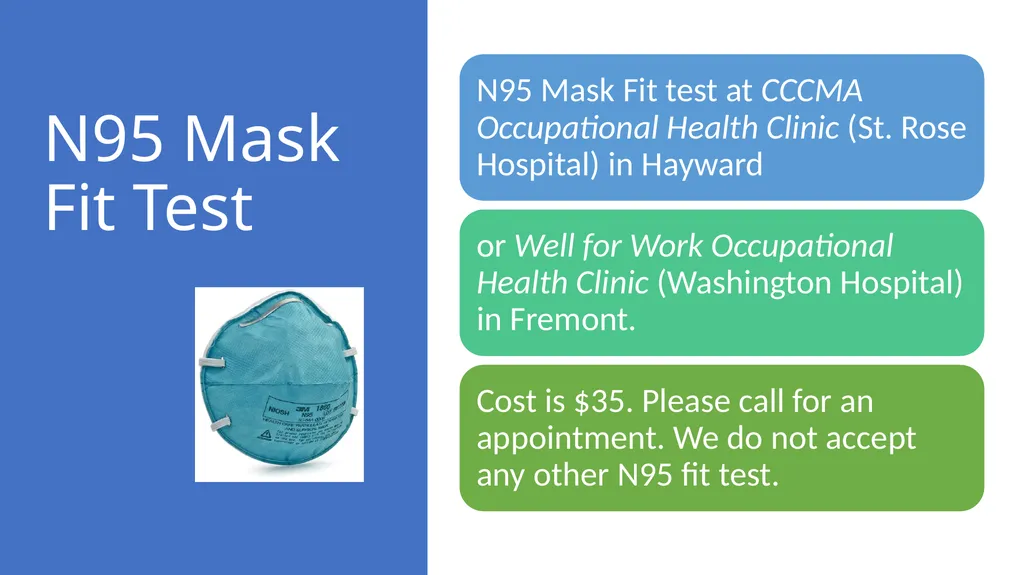
slide31. N95 Mask Fit Test<br>
slide32. First Day of School August 18 Wednesday
September 14th or 21st, First day in the hospital (Clinical):
All students must be prepared for the first day of clinical:
white uniform top, uniform patch, black uniform pants,
official program name tag, lab coat (short coat to waist; not to knees),
stethoscope, and required white shoes<br>
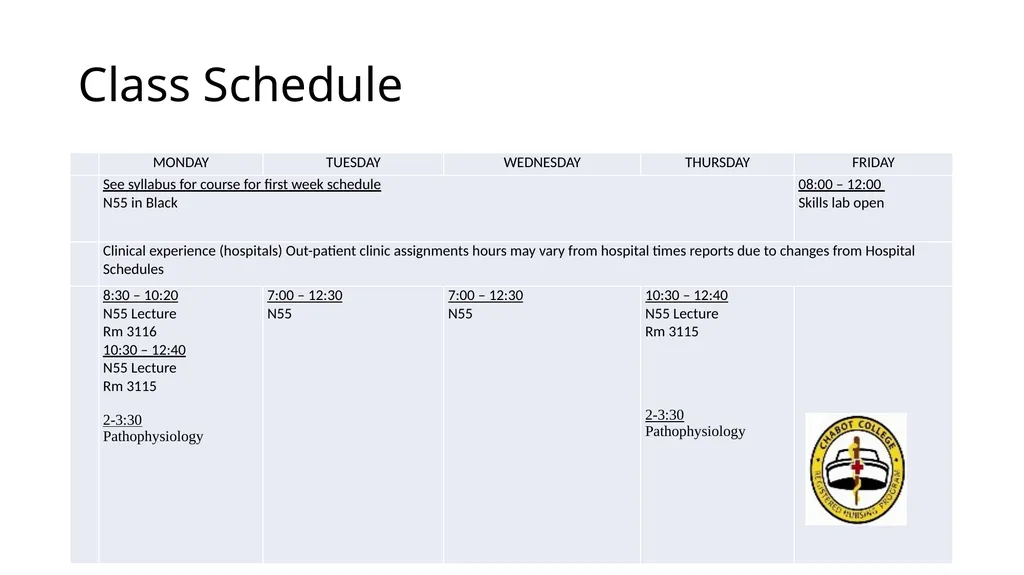
slide33. Class Schedule<br>
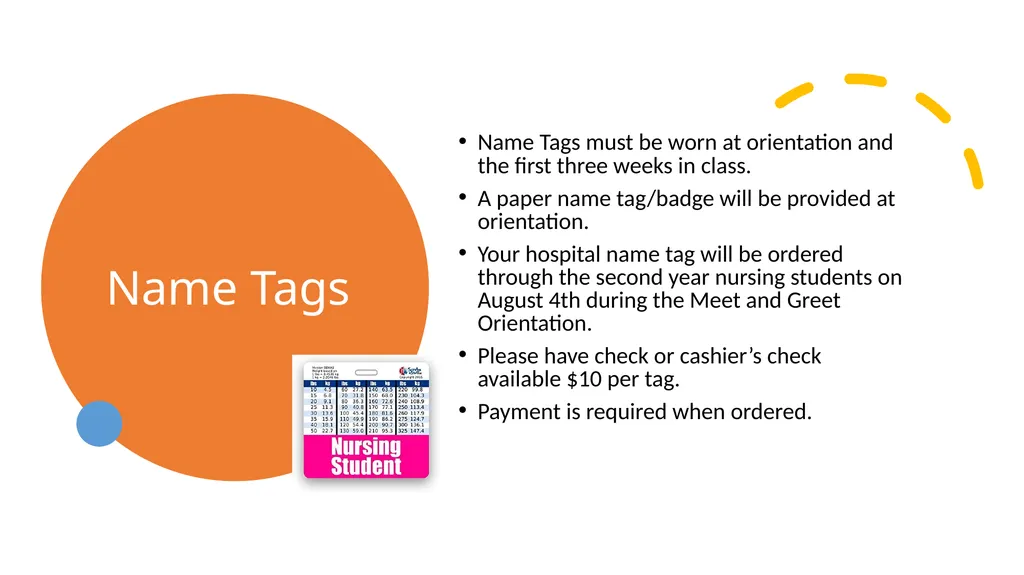
slide34. Name Tags Name Tags must be worn at orientation and the first three weeks in class.
A paper name tag/badge will be provided at orientation.
Your hospital name tag will be ordered through the second year nursing students on August 4th during the Meet and Greet Orientation.
Please have check or cashier’s check available $10 per tag.
Payment is required when ordered.<br>
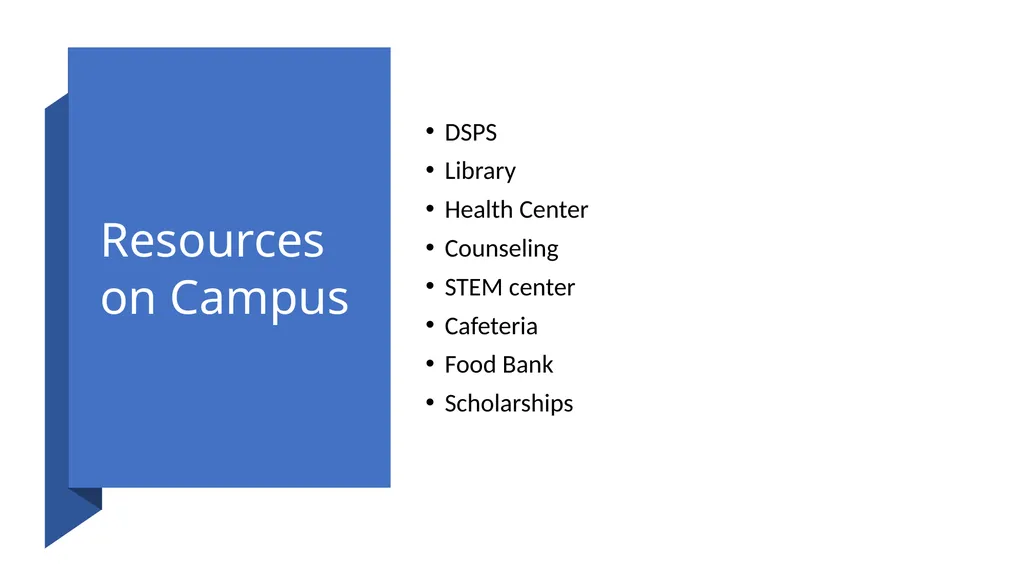
slide35. Resources on Campus DSPS
Library
Health Center
Counseling
STEM center
Cafeteria
Food Bank
Scholarships<br>
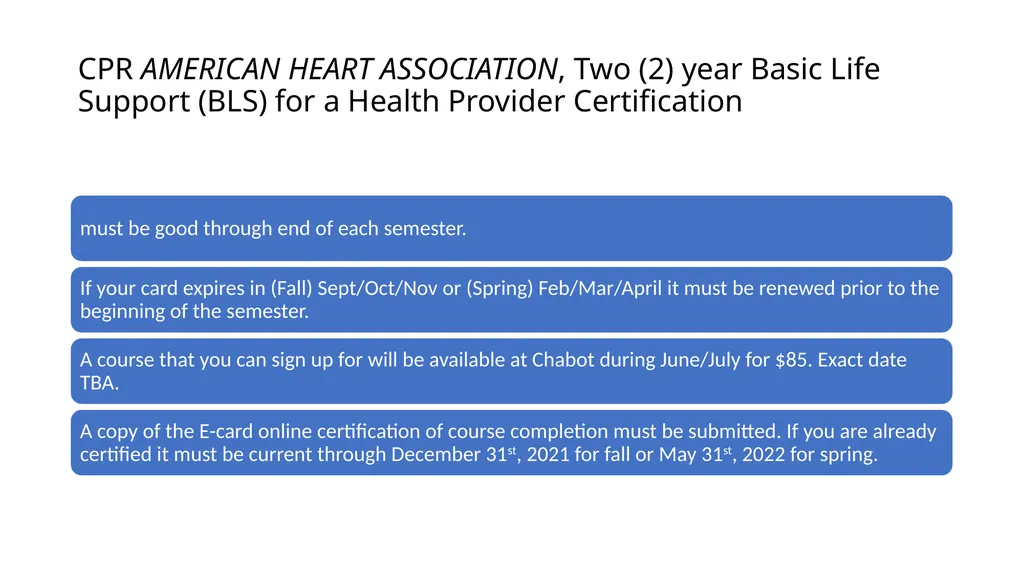
slide36. CPR AMERICAN HEART ASSOCIATION, Two (2) year Basic Life Support (BLS) for a Health Provider Certification<br>
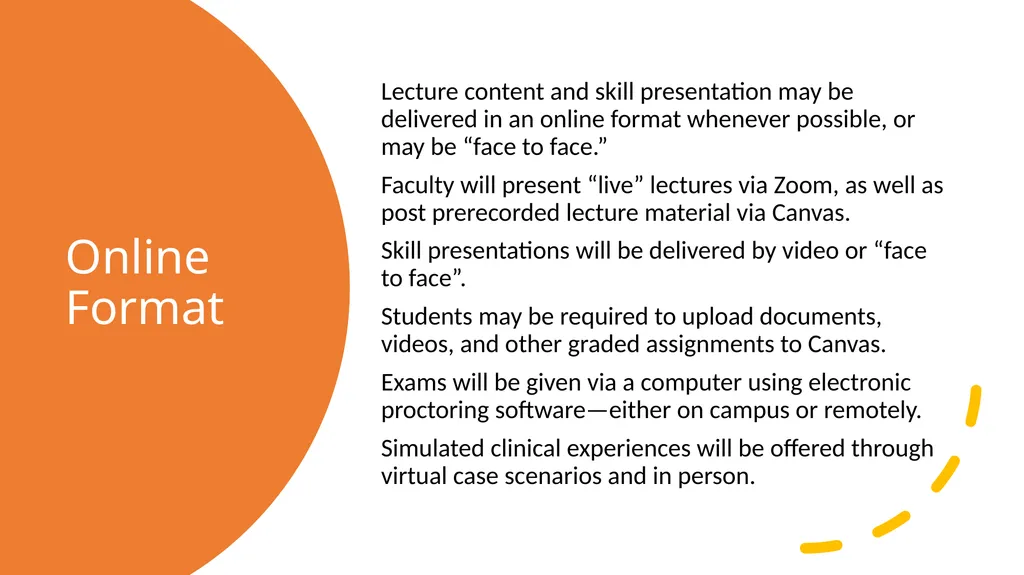
slide37. Online Format Lecture content and skill presentation may be delivered in an online format whenever possible, or may be “face to face.”
Faculty will present “live” lectures via Zoom, as well as post prerecorded lecture material via Canvas.
Skill presentations will be delivered by video or “face to face”.
Students may be required to upload documents, videos, and other graded assignments to Canvas.
Exams will be given via a computer using electronic proctoring software—either on campus or remotely.
Simulated clinical experiences will be offered through virtual case scenarios and in person.<br>
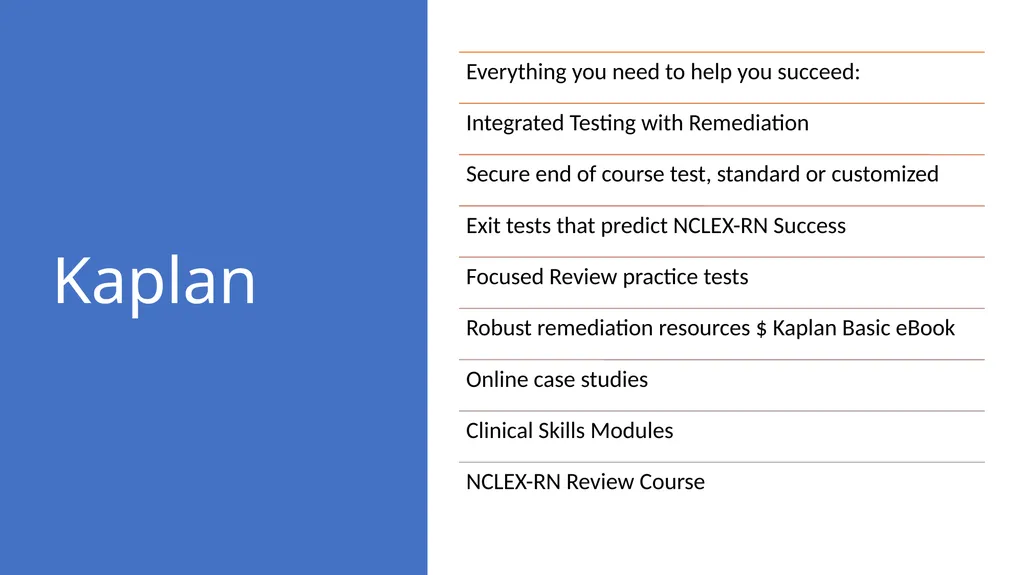
slide38. Kaplan<br>
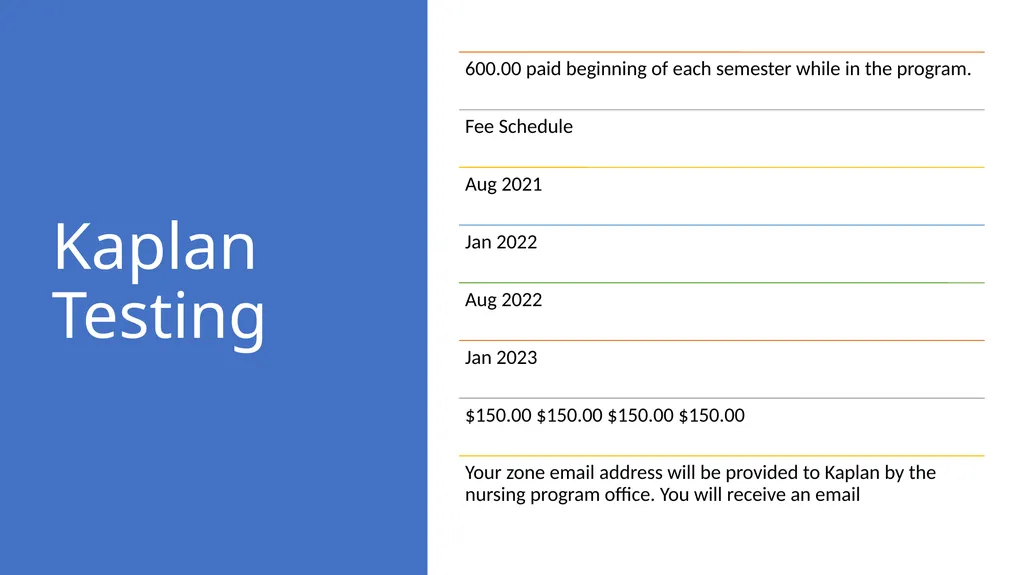
slide39. Kaplan Testing<br>
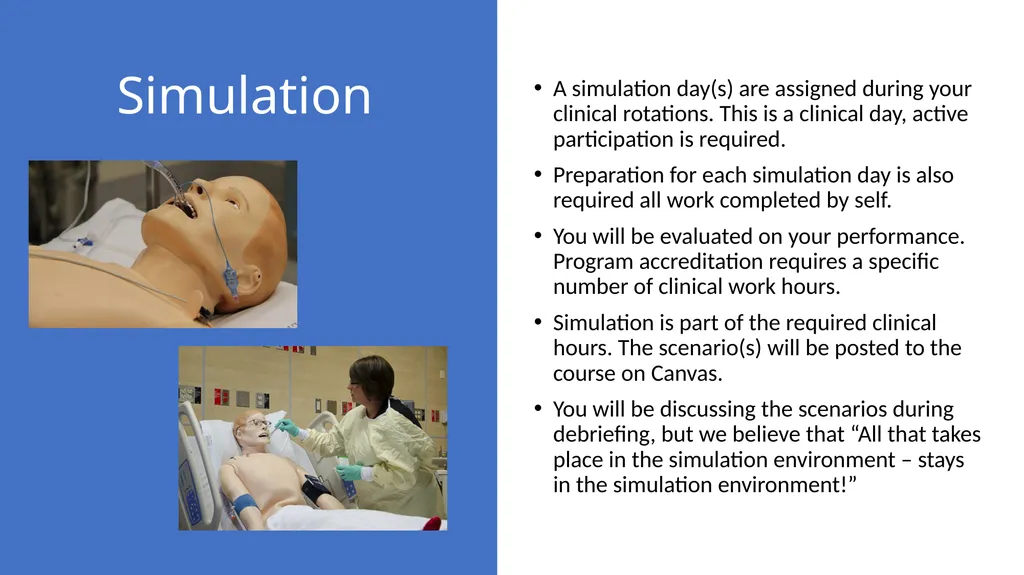
slide40. Simulation A simulation day(s) are assigned during your clinical rotations. This is a clinical day, active participation is required.
Preparation for each simulation day is also required all work completed by self.
You will be evaluated on your performance. Program accreditation requires a specific number of clinical work hours.
Simulation is part of the required clinical hours. The scenario(s) will be posted to the course on Canvas.
You will be discussing the scenarios during debriefing, but we believe that “All that takes place in the simulation environment – stays in the simulation environment!”<br>
slide41. Math 2. Percentages: Calculate the following:
40% of 180 = _____________
25% of 260 = ____________
What percent of 27 is 9?__________
40 is what percent of 160?______________
3. Calculate the following:
5 ÷ 1.25 = ________ b. 5 ÷ 0.25 = _________ c. 200,000 ÷ 150 = __________
d. 75 ÷ 60 = __________ e. 1.25 ÷ 0.5 = __________ f. 25,000 ÷ 50 = __________ g. 625 ÷ 2.5 = __________ h. 95.25 ÷ 2.75 = _____
i. 2.5 ÷ 2 = ________<br>
slide42. Math resources Referral: If you have had difficulty calculating the above problems, you must remediate these basic math skills prior to entering the program.
Suggestions for this remediation include:
1. Enroll in a basic math course at a community college or on line.
2. Purchase a Mathematics for Medications book and use it throughout the program.
3. Contact the Math Tutoring Center on campus for additional assistance.
4. Kaplan Basic Math module is available with your account.
5. https://www.khanacademy.org/<br>
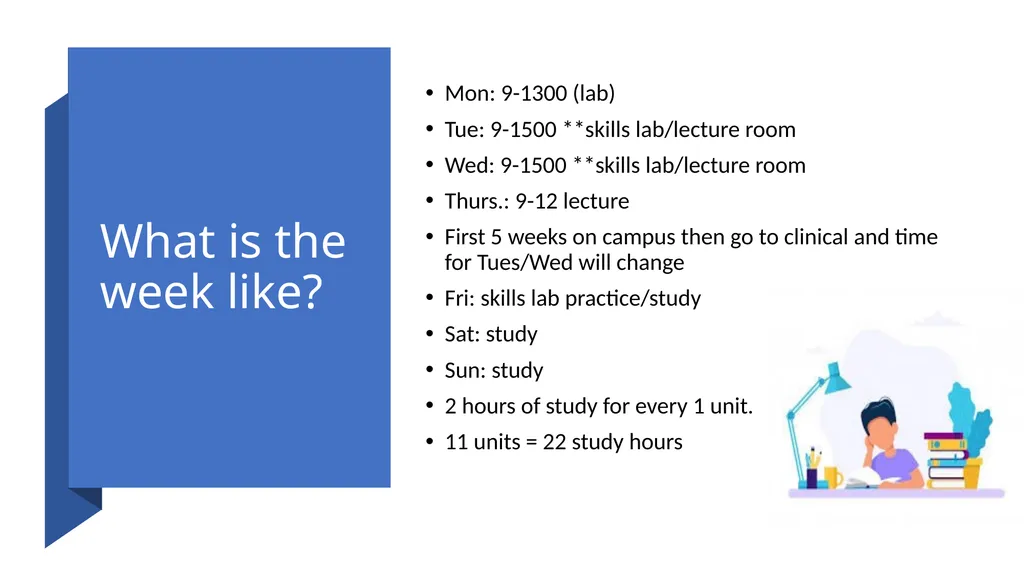
slide43. What is the week like? Mon: 9-1300 (lab)
Tue: 9-1500 **skills lab/lecture room
Wed: 9-1500 **skills lab/lecture room
Thurs.: 9-12 lecture
First 5 weeks on campus then go to clinical and time for Tues/Wed will change
Fri: skills lab practice/study
Sat: study
Sun: study
2 hours of study for every 1 unit.
11 units = 22 study hours<br>
slide44. Bookstore Chabot Bookstore:
Textbooks (NURS 55 and NURS 88) can be purchased at the bookstore (or online through the publishers or Amazon).
*Nursing Skills Lab Kit* (approximately $175.00).
*Nursing Program patches* are required for your white uniform top/jacket
*You must show the Nursing Program Acceptance letter to the Chabot bookstore cashier in order to purchase the supply kit or patches.<br>
slide45. How can my family help Babysit
Pay for a hotel room to get away and study
Cook meals/clean hours
Offer monetary support
Do not pressure student to attend family gatherings
Nursing school is more than a full time job
Stress will happen<br>
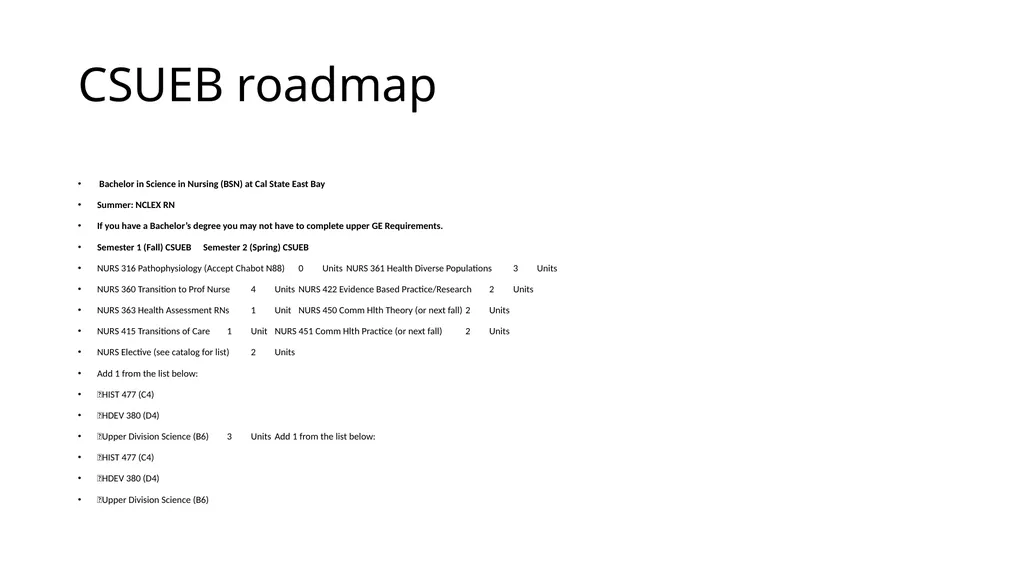
slide46. CSUEB roadmap Bachelor in Science in Nursing (BSN) at Cal State East Bay
Summer: NCLEX RN
If you have a Bachelor’s degree you may not have to complete upper GE Requirements.
Semester 1 (Fall) CSUEB Semester 2 (Spring) CSUEB
NURS 316 Pathophysiology (Accept Chabot N88) 0 Units NURS 361 Health Diverse Populations 3 Units
NURS 360 Transition to Prof Nurse 4 Units NURS 422 Evidence Based Practice/Research 2 Units
NURS 363 Health Assessment RNs 1 Unit NURS 450 Comm Hlth Theory (or next fall) 2 Units
NURS 415 Transitions of Care 1 Unit NURS 451 Comm Hlth Practice (or next fall) 2 Units
NURS Elective (see catalog for list) 2 Units
Add 1 from the list below:
HIST 477 (C4)
HDEV 380 (D4)
Upper Division Science (B6) 3 Units Add 1 from the list below:
HIST 477 (C4)
HDEV 380 (D4)
Upper Division Science (B6)<br>
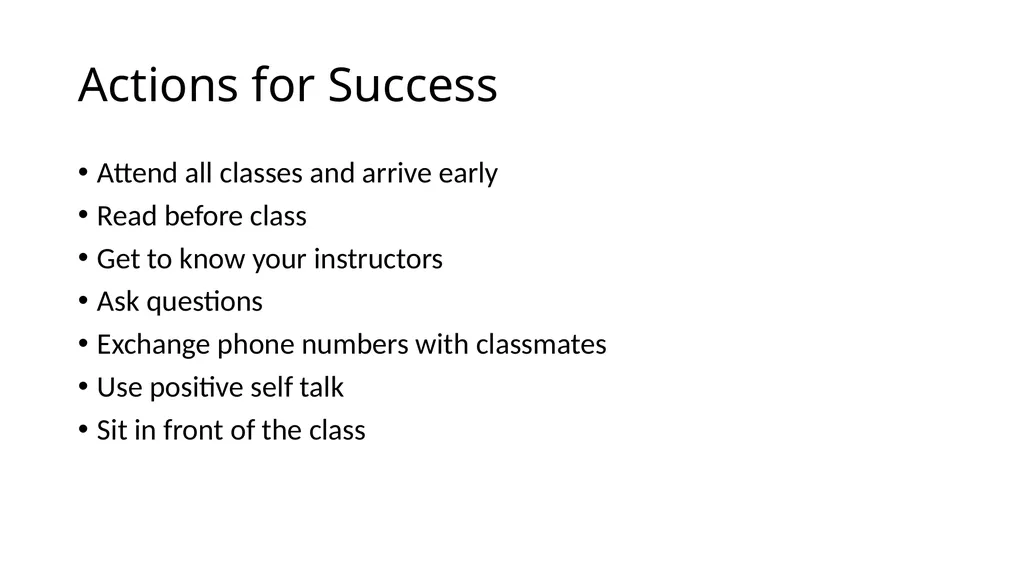
slide47. Actions for Success Attend all classes and arrive early
Read before class
Get to know your instructors
Ask questions
Exchange phone numbers with classmates
Use positive self talk
Sit in front of the class<br>
slide48. Questions ?????
Email
Open door<br>
The Chabot College nursing program acknowledges the structural and systemic racism embedded in our society, education, and healthcare. In response, we firmly commit to exposing and eradicating racism by reasserting diversity, equity, and inclusion as one of our nursing program’s core values. We are committed to fostering a climate that is inclusive and welcoming of all students and faculty.<br>
slide2. Why Chabot? Faculty with 20+ years of experience
Modern facilities and simulation labs preparing students with real life scenarios
Dedicated counselor for the nursing program
We work with diverse populations and communities in the clinical settings
50-75% of graduates transfer to a BSN program or the CSUEB bridge program
Test-taking preparation seminars
Affordable
Ranked #1 Program in California 2020 from for the 4th Annual Nursing School Program rankings by RegisteredNursing.org. Chabot has also been in 2nd/3rd place for the last few years.<br>
slide3. Castlebranch<br>
slide4. Castle Branch<br>
slide5. HealthStream Online Clinical Orientation Program Required HealthStream modules: You will be required to take each of the following three modules annually.
Allow approximately four hours to complete all the required modules.
• Rapid Regulatory Compliance: Clinical I: Compliance; Ethics; Sexual Harassment; Patient Rights; Informed Consent; Advanced Directives; Emergency Medical Treatment and Labor Act (EMTALA); Grievances; Developmental Appropriate Care; Cultural Competence; Restraint/Seclusion; Patient Abuse/Assault/Neglect<br>
slide6. Health Stream Modules Nursing Program office will create your account.
You will be notified via email when to enter HealthStream and complete the modules. Do NOT create your own account.
HealthStream’s online programs are designed to educate healthcare professionals and health occupations students.
You will need to complete four HealthStream modules* on or before July 30, 2021.
Modules are $3.50 each, you will use a debit/credit card payment for each module separately on HealthStream’s secure website.<br>
slide7. Healthstream (cont) • Rapid Regulatory Compliance: Clinical II: General/Fire/Electric/Back/Radiation/MRI Safety; Ergonomics; Lift/Transport; Slips/Trips/Falls; Latex Allergy; Hazardous Communication; Workplace Violence; Emergency Prep; Infection Control; Hospital Acquired Infections; Hand Hygiene; Bloodborne; Standard Precautions; Airborne/Contact/Droplet Precautions, Personal Protective Equipment
• Hazard Communication •
HIPAA AFTER July 1, 2021<br>
slide8. Centers for disease Control (CDC) for Healthcare Providers CDC immunizations
What’s a VIS?
A VIS or Vaccine Information Statement is a document, produced by CDC, that informs vaccine recipients – about the benefits and risks of a vaccine they are receiving.
In addition to distributing VISs, as described above, providers are required to record specific information in the patient’s medical record (which can include an electronic medical record), or in a permanent office log:
The edition date of the VIS (found on the back at the right bottom corner).
The date the VIS is provided (i.e., the date of the visit when the vaccine is administered).
The office address and name and title of the person who administers the vaccine.
The date the vaccine is administered.
The vaccine manufacturer and lot number.<br>
slide9. Vaccine Requirements: Tuberculosis (TB) A total of 1.4 million people died from TB in 2019.
Worldwide, TB is one of the top 10 causes of death and the leading cause from a single infectious agent (above HIV/AIDS).
Multidrug-resistant TB (MDR-TB) remains a public health crisis and a health security threat. A global total of 206 030 people with multidrug- or rifampicin-resistant TB (MDR/RR-TB) were detected and notified in 2019, a 10% increase from 186 883 in 2018.
TB is a treatable and curable disease.
Active, drug-susceptible TB disease is treated with a standard 6-month course of 4 antimicrobial drugs.
Hospitals still get patients with TB<br>
slide10. TB<br>
slide11. Blood Titer Working in healthcare/hospital
Hospitals are full of infectious diseases
Blood titer checks is your antibody levels are adequate
If titer is positive you are considered immune
If equivocal you need another dose
How long for results: 4 business days
Can be reported as qualitative: immune or not-immune
or quantitative results: gives a numerical value and reference range<br>
slide12. Sample lab report titer Rubella
EIA value is 3.41
<0.91 negative
0.91-1.09 equivocal
> or = 1.10 positive rubella IGG antibody detected<br>
slide13. Measles<br>
slide14. MMR Written documentation of titer lab results for MMR, Varicella, Hepatitis B, and documentation of recent TDAP.
Negative or Borderline Titer reports on MMR, or Varicella, require two (2) boosters of the vaccine 30 days apart.
Negative or Borderline Titer report on Hepatitis B requires two (2) boosters of the vaccine 30 days apart and a final (1) booster six months from 2nd booster. First two boosters only must be complete by July 27, 2021.<br>
slide15. Mumps/Measles (Rubella)<br>
slide16. Boosters If non-immune to
Measles mumps or rubella get a MMR dose
Varicella get a booster: 2 shots 4-6 weeks apart
Wait 6 weeks after dose to get a titer
What if I am still non-immune after boosters
OK you may not convert
This may happen with hepatis B vaccine
Fill out the Hep B non-responder form<br>
slide17. Varicella<br>
slide18. Varicella Varicella Vaccination Information for Healthcare Professionals
CDC recommends 2 doses of varicella (chickenpox) vaccine for children, adolescents, and adults to protect against varicella. Children are routinely recommended to receive the first dose at age 12 through 15 months and the second dose at age 4 through 6 years old.<br>
slide19. Pertussis Pertussis is a highly contagious bacterial infection. Transmission occurs by direct contact with respiratory secretions.
Infants too young to be vaccinated are at greatest risk for severe pertussis, including hospitalization and death. The disease can be transmitted from adults to close contacts, especially unvaccinated children.
In hospital settings, transmission of pertussis has occurred from hospital visitors to patients, from HCP to patients, and from patients to HCP documented outbreaks were costly and disruptive. In each outbreak, HCP were evaluated for cough illness and required diagnostic testing, prophylactic antibiotics, and exclusion from work.<br>
slide20. Pertussis cont<br>
slide21. TDAP Tetanus, diphtheria, and pertussis (Tdap) vaccination (Routine vaccination
Adolescents age 11–12 years: 1 dose Tdap
Pregnancy: 1 dose Tdap during each pregnancy, preferably during the early part of gestational weeks 27–36
Tdap may be administered regardless of the interval since the last tetanus- and diphtheria-toxoid-containing vaccine.
Catch-up vaccination
Td is tetanus/diphtheria given every 10 years not the same as Tdap
Do not get if life-threatening allergic reaction<br>
slide22. Covid-19 Vaccination vaccine Facts<br>
slide23. Covid-19 Vaccination COVID-19 can have serious, life-threatening complications, and there is no way to know how COVID-19 will affect you. If you get sick, you could spread the disease to friends, family, and others around you.
Getting COVID-19 may offer some protection, known as natural immunity. Current evidence suggests that reinfection with the virus that causes COVID-19 is uncommon in the months after initial infection, but may increase with time. Some people who have had covid have antibodies for just a short time after recovering. Because of the unknown length of time of antibodies in the body, vaccination is recommended anyways.
The risk of severe illness and death from COVID-19 far outweighs any benefits of natural immunity. COVID-19 vaccination will help protect you by creating an antibody (immune system) response without having to experience sickness.<br>
slide24. Vaccines will work with your immune system so it will be ready to fight the virus if you are exposed.
A growing body of evidence suggests that fully vaccinated people are less likely to be infected without showing symptoms (called an asymptomatic infection) and potentially less likely to spread the virus that causes COVID-19 to others.
Stopping a pandemic requires using all the tools we have available. As experts learn more about how COVID-19 vaccination may help reduce spread of the virus that causes COVID-19.<br>
slide25. Hepatitis titers<br>
slide26. Hepatitis B Hepatitis B vaccination (minimum age: birth)
3-dose series at 0, 1–2, 6 months
Administration of 4 doses is permitted when a combination vaccine containing HepB is used after the birth dose.
Minimum intervals: dose 1 to dose 2: 4 weeks / dose 2 to dose 3: 8 weeks
the combined HepA and HepB vaccine, Twinrix, as a 3-dose series (0, 1, and 6 months) or 4-dose series (3 doses at 0, 7, and 21–30 days, followed by a booster dose at 12 months).
For other catch-up guidance, see Table 2.<br>
slide27. Flu WAIT! Flu Vaccination will not be completed until the new 2021 flu season vaccine is available in Sept/October 2021.<br>
slide28. Medical Exam<br>
slide29. Background Check Social security Number Trace
Combined OIG/GSA Excluded Parties/Debarment Search
Felony/Misdemeanor Criminal Conviction Record Search o Infractions, Misdemeanor or Felonies convictions:
It is required to meet with the program director if you have any convictions for infractions, misdemeanors or felonies which may impact your ability to obtain a registered nurse license or work in our clinical site.<br>
slide30. 10 Panel Drug Screen<br>
slide31. N95 Mask Fit Test<br>
slide32. First Day of School August 18 Wednesday
September 14th or 21st, First day in the hospital (Clinical):
All students must be prepared for the first day of clinical:
white uniform top, uniform patch, black uniform pants,
official program name tag, lab coat (short coat to waist; not to knees),
stethoscope, and required white shoes<br>
slide33. Class Schedule<br>
slide34. Name Tags Name Tags must be worn at orientation and the first three weeks in class.
A paper name tag/badge will be provided at orientation.
Your hospital name tag will be ordered through the second year nursing students on August 4th during the Meet and Greet Orientation.
Please have check or cashier’s check available $10 per tag.
Payment is required when ordered.<br>
slide35. Resources on Campus DSPS
Library
Health Center
Counseling
STEM center
Cafeteria
Food Bank
Scholarships<br>
slide36. CPR AMERICAN HEART ASSOCIATION, Two (2) year Basic Life Support (BLS) for a Health Provider Certification<br>
slide37. Online Format Lecture content and skill presentation may be delivered in an online format whenever possible, or may be “face to face.”
Faculty will present “live” lectures via Zoom, as well as post prerecorded lecture material via Canvas.
Skill presentations will be delivered by video or “face to face”.
Students may be required to upload documents, videos, and other graded assignments to Canvas.
Exams will be given via a computer using electronic proctoring software—either on campus or remotely.
Simulated clinical experiences will be offered through virtual case scenarios and in person.<br>
slide38. Kaplan<br>
slide39. Kaplan Testing<br>
slide40. Simulation A simulation day(s) are assigned during your clinical rotations. This is a clinical day, active participation is required.
Preparation for each simulation day is also required all work completed by self.
You will be evaluated on your performance. Program accreditation requires a specific number of clinical work hours.
Simulation is part of the required clinical hours. The scenario(s) will be posted to the course on Canvas.
You will be discussing the scenarios during debriefing, but we believe that “All that takes place in the simulation environment – stays in the simulation environment!”<br>
slide41. Math 2. Percentages: Calculate the following:
40% of 180 = _____________
25% of 260 = ____________
What percent of 27 is 9?__________
40 is what percent of 160?______________
3. Calculate the following:
5 ÷ 1.25 = ________ b. 5 ÷ 0.25 = _________ c. 200,000 ÷ 150 = __________
d. 75 ÷ 60 = __________ e. 1.25 ÷ 0.5 = __________ f. 25,000 ÷ 50 = __________ g. 625 ÷ 2.5 = __________ h. 95.25 ÷ 2.75 = _____
i. 2.5 ÷ 2 = ________<br>
slide42. Math resources Referral: If you have had difficulty calculating the above problems, you must remediate these basic math skills prior to entering the program.
Suggestions for this remediation include:
1. Enroll in a basic math course at a community college or on line.
2. Purchase a Mathematics for Medications book and use it throughout the program.
3. Contact the Math Tutoring Center on campus for additional assistance.
4. Kaplan Basic Math module is available with your account.
5. https://www.khanacademy.org/<br>
slide43. What is the week like? Mon: 9-1300 (lab)
Tue: 9-1500 **skills lab/lecture room
Wed: 9-1500 **skills lab/lecture room
Thurs.: 9-12 lecture
First 5 weeks on campus then go to clinical and time for Tues/Wed will change
Fri: skills lab practice/study
Sat: study
Sun: study
2 hours of study for every 1 unit.
11 units = 22 study hours<br>
slide44. Bookstore Chabot Bookstore:
Textbooks (NURS 55 and NURS 88) can be purchased at the bookstore (or online through the publishers or Amazon).
*Nursing Skills Lab Kit* (approximately $175.00).
*Nursing Program patches* are required for your white uniform top/jacket
*You must show the Nursing Program Acceptance letter to the Chabot bookstore cashier in order to purchase the supply kit or patches.<br>
slide45. How can my family help Babysit
Pay for a hotel room to get away and study
Cook meals/clean hours
Offer monetary support
Do not pressure student to attend family gatherings
Nursing school is more than a full time job
Stress will happen<br>
slide46. CSUEB roadmap Bachelor in Science in Nursing (BSN) at Cal State East Bay
Summer: NCLEX RN
If you have a Bachelor’s degree you may not have to complete upper GE Requirements.
Semester 1 (Fall) CSUEB Semester 2 (Spring) CSUEB
NURS 316 Pathophysiology (Accept Chabot N88) 0 Units NURS 361 Health Diverse Populations 3 Units
NURS 360 Transition to Prof Nurse 4 Units NURS 422 Evidence Based Practice/Research 2 Units
NURS 363 Health Assessment RNs 1 Unit NURS 450 Comm Hlth Theory (or next fall) 2 Units
NURS 415 Transitions of Care 1 Unit NURS 451 Comm Hlth Practice (or next fall) 2 Units
NURS Elective (see catalog for list) 2 Units
Add 1 from the list below:
HIST 477 (C4)
HDEV 380 (D4)
Upper Division Science (B6) 3 Units Add 1 from the list below:
HIST 477 (C4)
HDEV 380 (D4)
Upper Division Science (B6)<br>
slide47. Actions for Success Attend all classes and arrive early
Read before class
Get to know your instructors
Ask questions
Exchange phone numbers with classmates
Use positive self talk
Sit in front of the class<br>
slide48. Questions ?????
Open door<br>