Introduction to Clay Not Your Ordinary Mud Part I: What is Clay? DEFINITION Clay is . . . . . .a fine mixture of decomposed igneous rock minerals and organic matter Igneous Rock How is clay formed? Melted rock is cooled and solidified
"Introduction to Clay Not Your Ordinary “Mud” Part" is the property of its rightful owner. Permission is granted to
download and print the materials on this website for personal, non-commercial use only, and to display it
on your personal computer provided you do not modify the materials and that you retain all copyright
notices contained in the materials. By downloading content from our website, you accept the terms of this
agreement.
Presentation Transcript
01
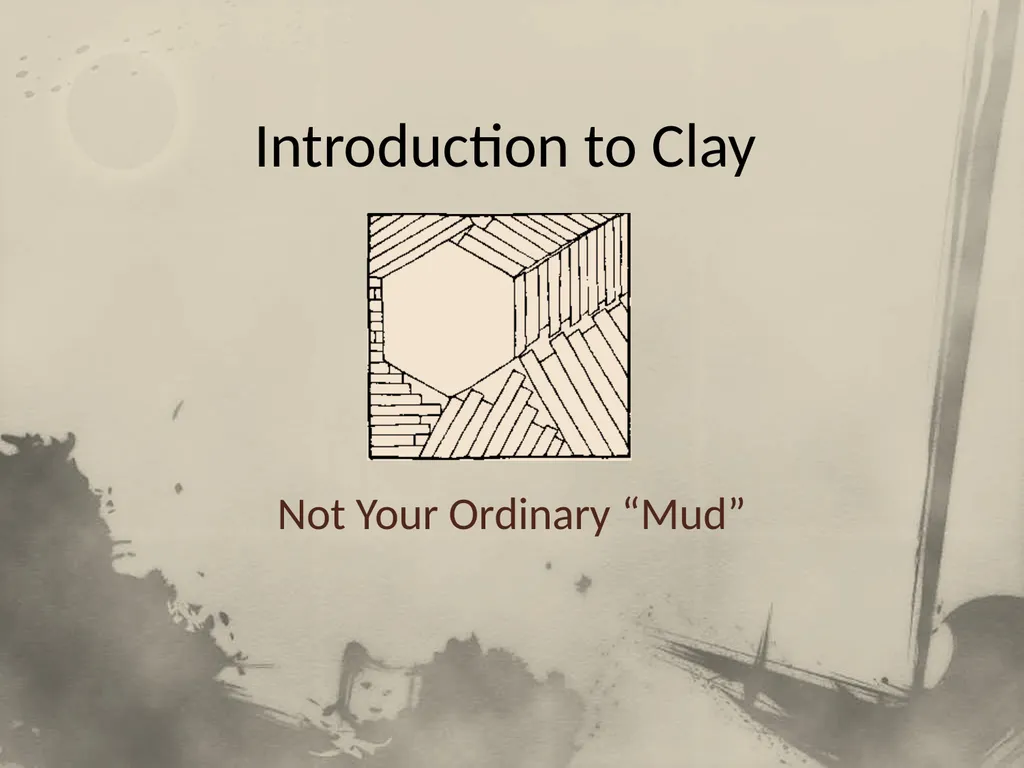
Introduction to Clay Not Your Ordinary “Mud”<br>
02
Part I: What is Clay?<br>
03
DEFINITION Clay is . . .
. . .a fine mixture of decomposed igneous rock minerals and organic matter
Igneous Rock<br>
04
How is clay formed? Melted rock is cooled and solidified into igneous rock (mother rock) which makes up earth’s crust.
Mechanical weathering over millions of years breaks down the rock from boulders into stones, to pebbles to fine, small particles known as platelets.
Weathering<br>
05
Part 2: Clay Properties<br>
06
Clay Terms to Know Plasticity
Shrinkage
Porosity
Aging
Wedging
Vitrification<br>
07
3 Major Properties Plasticity
Shrinkage
Porosity
These 3 properties must be considered before choosing a clay body.<br>
08
PROPERTY #1: PLASTICITY<br>
09
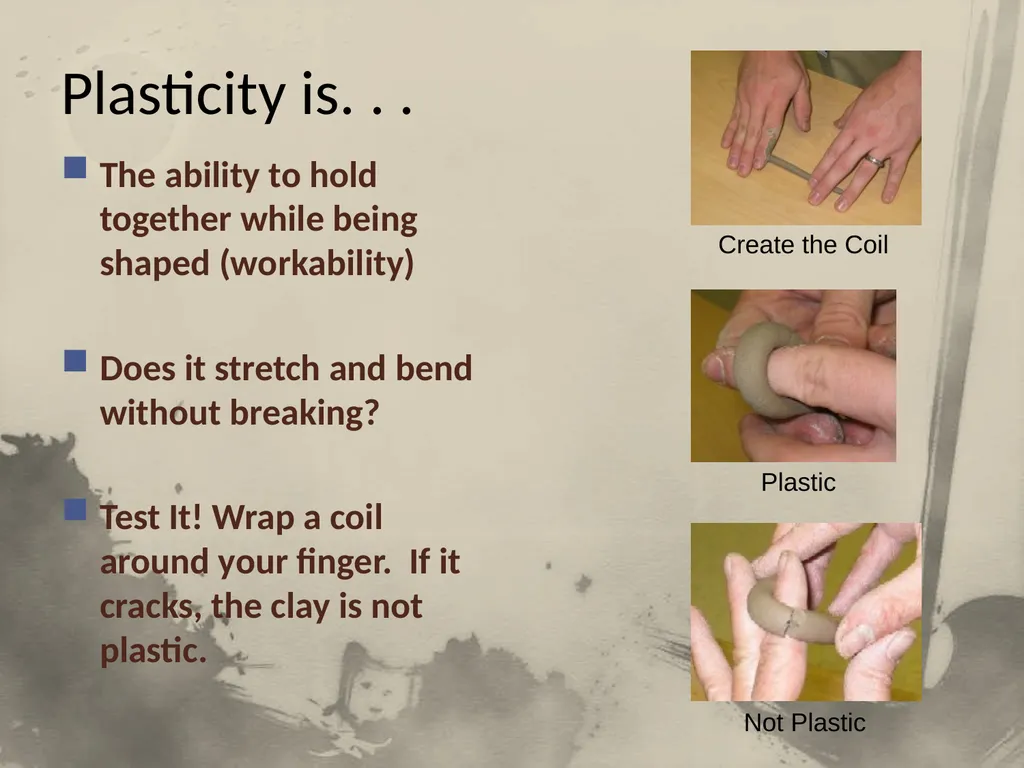
Plasticity is. . . The ability to hold together while being shaped (workability)
Does it stretch and bend without breaking?
Test It! Wrap a coil around your finger. If it cracks, the clay is not plastic.<br>
10
How do you improve clay’s plasticity ? AGING,
WEDGING,
&
ADDING MOISTURE<br>
11
What is aging? Storing well mixed clay for 3 plus weeks which causes a chemical breakdown of the organic matter contained in the clay.
Older is better!
Historical Fact: The Chinese aged clay for whole generations.<br>
12
How does wedging help? Aligns clay particles
Equalizes moisture
Removes air bubbles
Makes clay texture uniform
Tip: You should always wedge first before using your clay.<br>
13
How do I add moisture? All clay contains water.
Clay dehydrates when exposed to air.
Add water to clay to make it more plastic.
Too little or too much water causes clay to become less plastic.
Tip: Mist clay with water bottle or dampen it with a wet sponge. Always wrap your projects with plastic before storing.<br>
14
PROPERTY #2: SHRINKAGE<br>
15
Shrinkage is. . . Contraction of clay (or glaze) during both drying and firing processes.
Clay shrinks 12-15%
Shrinkage depends on the clay body’s composition.
Tip: It is important to understand the shrinkage of your clay body since it has a tendency of cracking and warping during this process.<br>
16
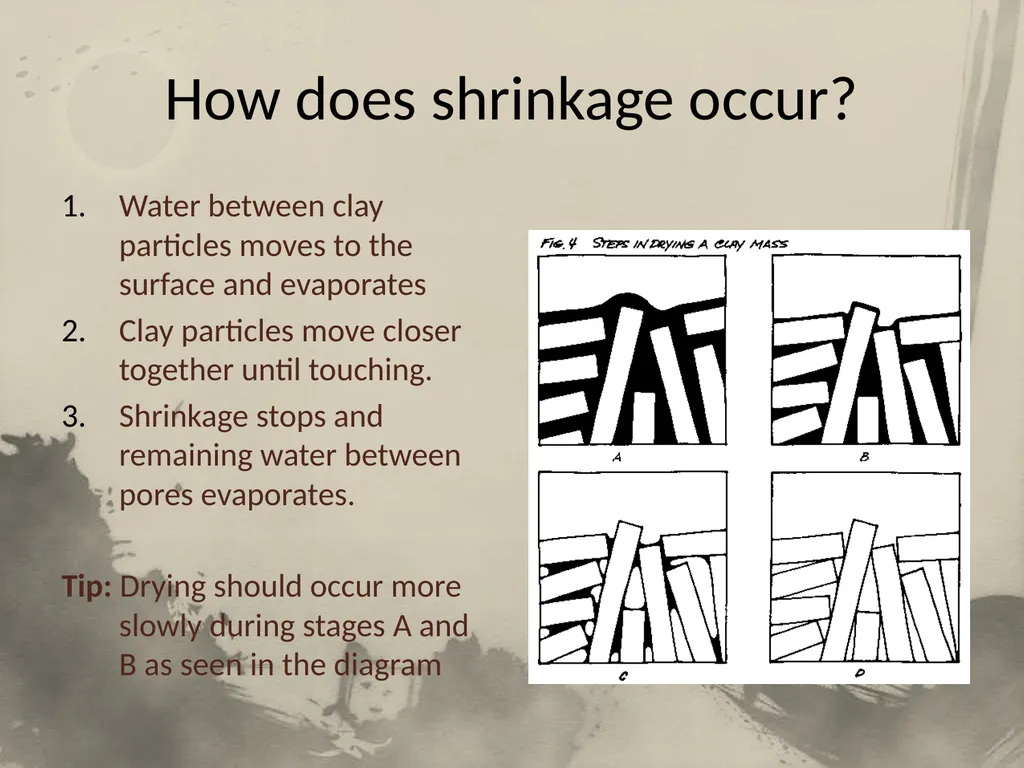
How does shrinkage occur? Water between clay particles moves to the surface and evaporates
Clay particles move closer together until touching.
Shrinkage stops and remaining water between pores evaporates.
Tip: Drying should occur more slowly during stages A and B as seen in the diagram<br>
17
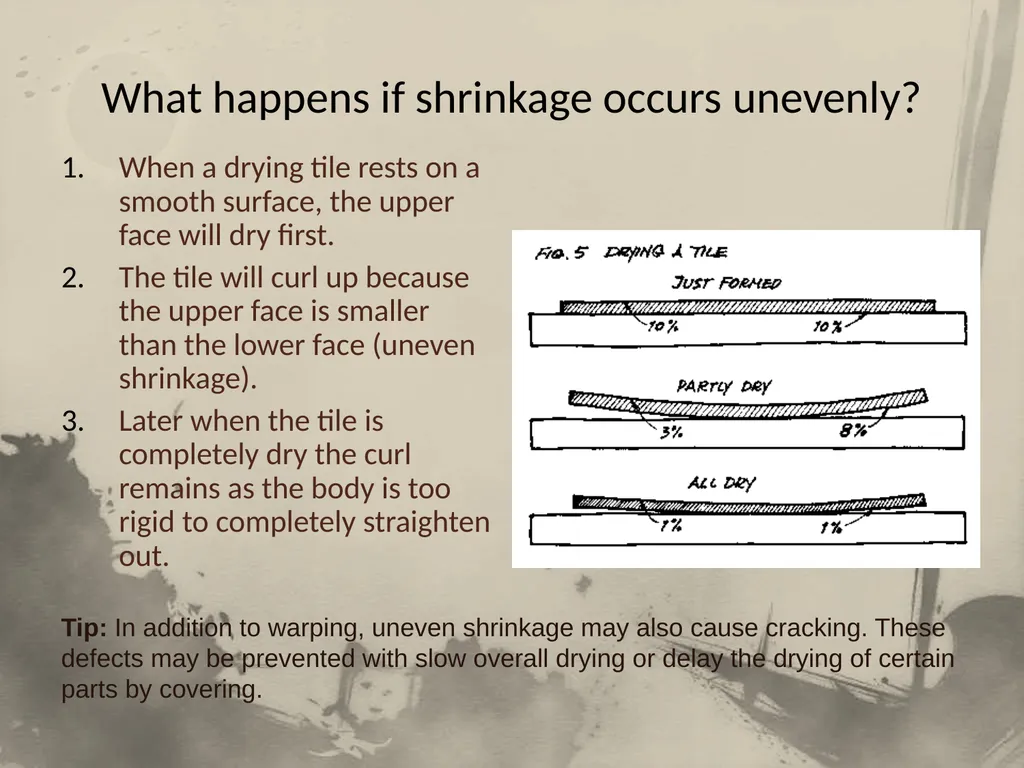
What happens if shrinkage occurs unevenly? When a drying tile rests on a smooth surface, the upper face will dry first.
The tile will curl up because the upper face is smaller than the lower face (uneven shrinkage).
Later when the tile is completely dry the curl remains as the body is too rigid to completely straighten out. Tip: In addition to warping, uneven shrinkage may also cause cracking. These defects may be prevented with slow overall drying or delay the drying of certain parts by covering.<br>
18
PROPERTY #3: POROSITY<br>
19
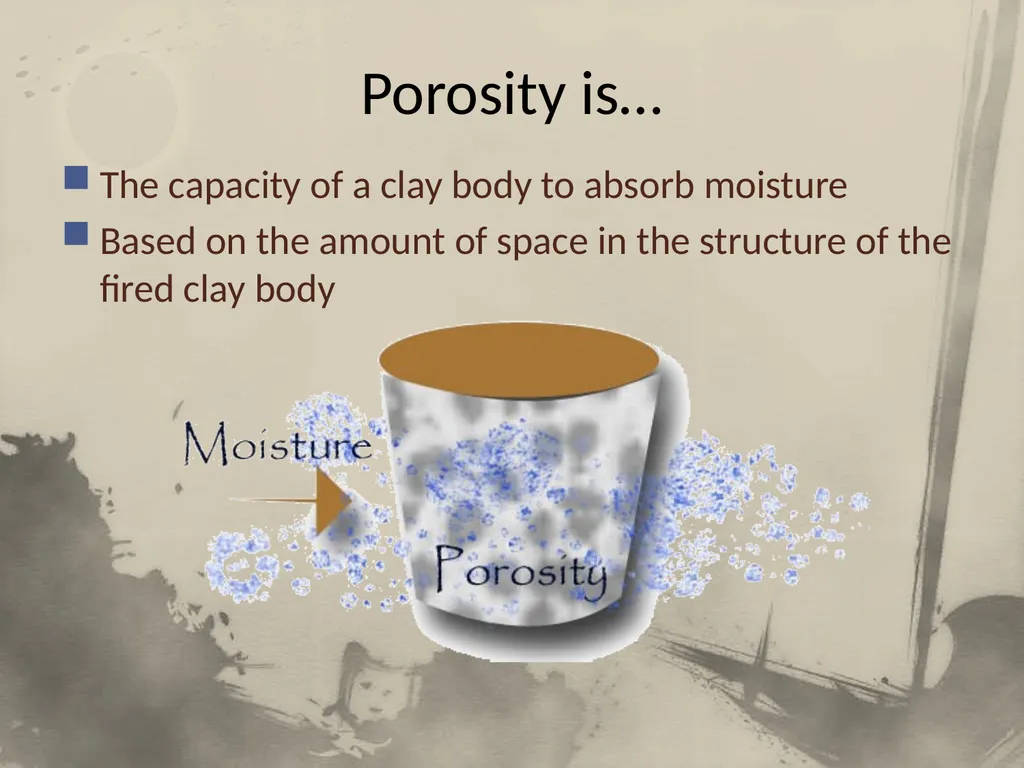
Porosity is… The capacity of a clay body to absorb moisture
Based on the amount of space in the structure of the fired clay body<br>
20
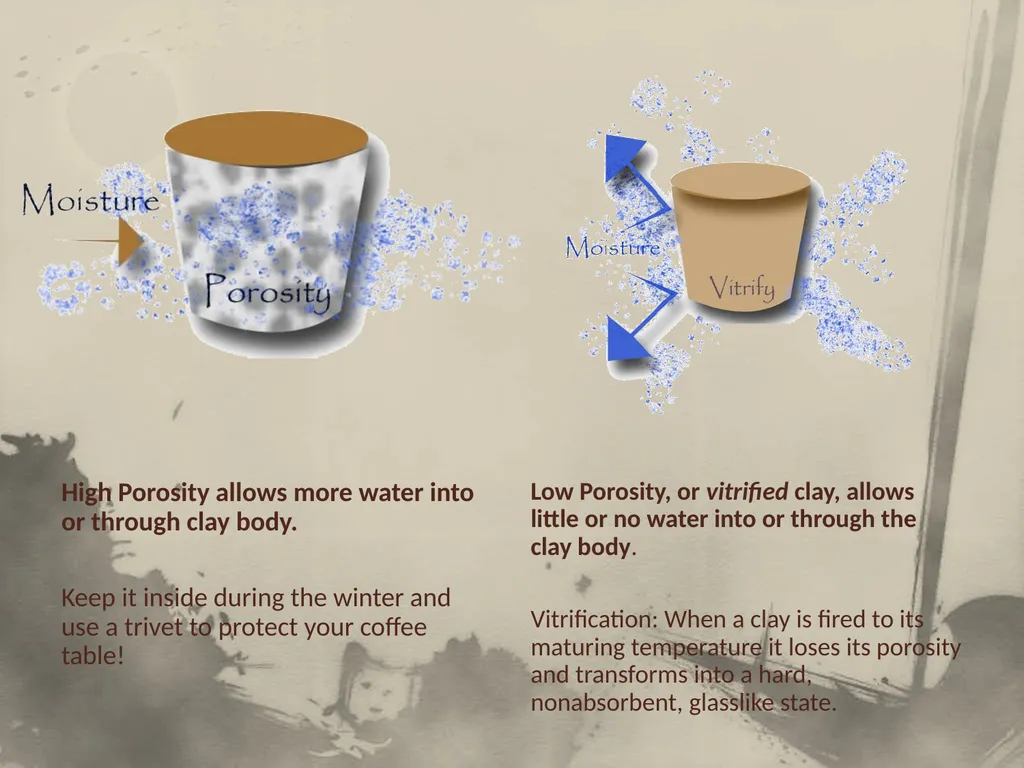
High Porosity allows more water into or through clay body.
Keep it inside during the winter and use a trivet to protect your coffee table! Low Porosity, or vitrified clay, allows little or no water into or through the clay body.
Vitrification: When a clay is fired to its maturing temperature it loses its porosity and transforms into a hard, nonabsorbent, glasslike state.<br>
21
Part 3: Studio Processes Used To Transform Clay<br>
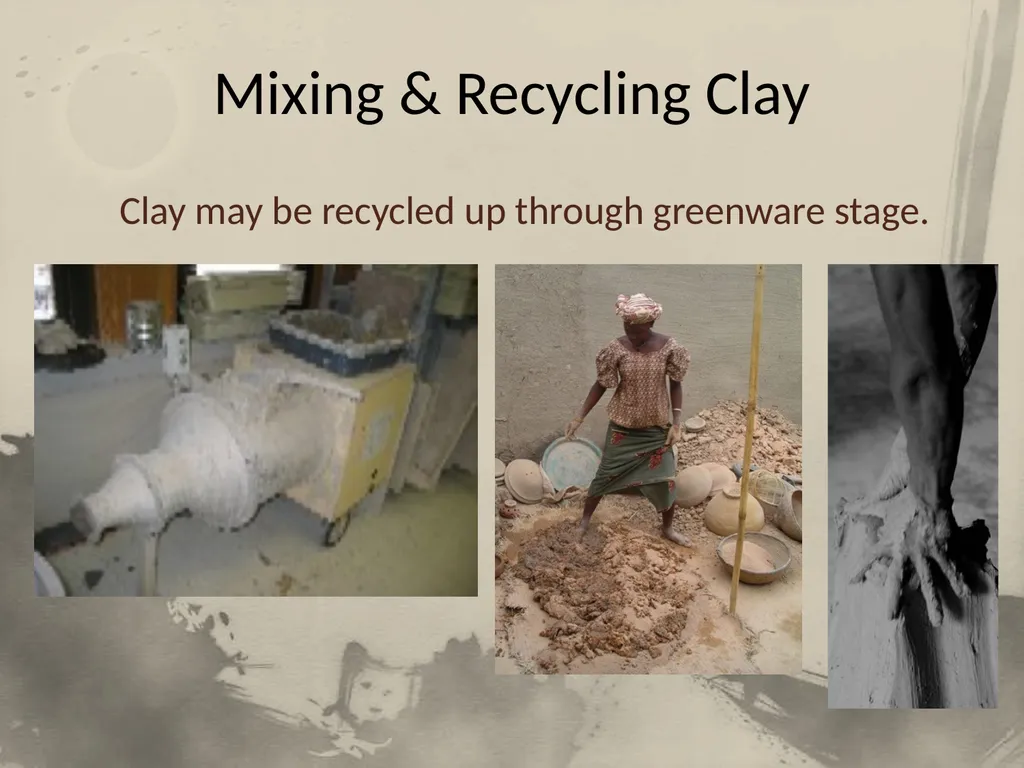
Mixing & Recycling Clay Clay may be recycled up through greenware stage.<br>
24
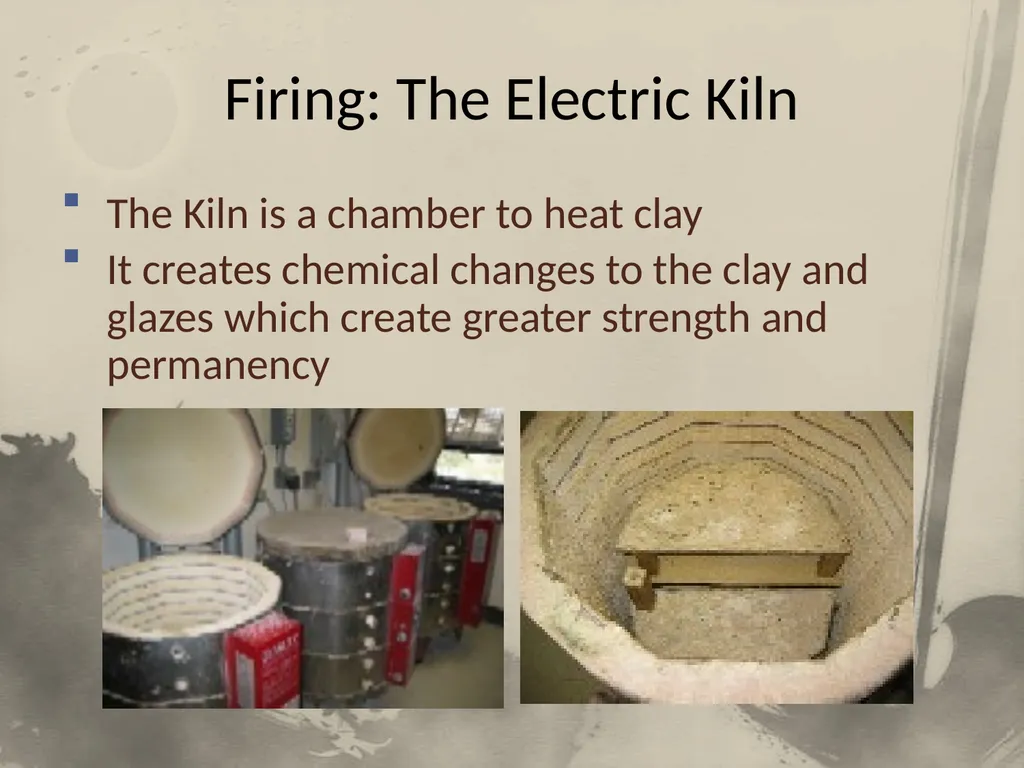
Firing: The Electric Kiln The Kiln is a chamber to heat clay
It creates chemical changes to the clay and glazes which create greater strength and permanency<br>
25
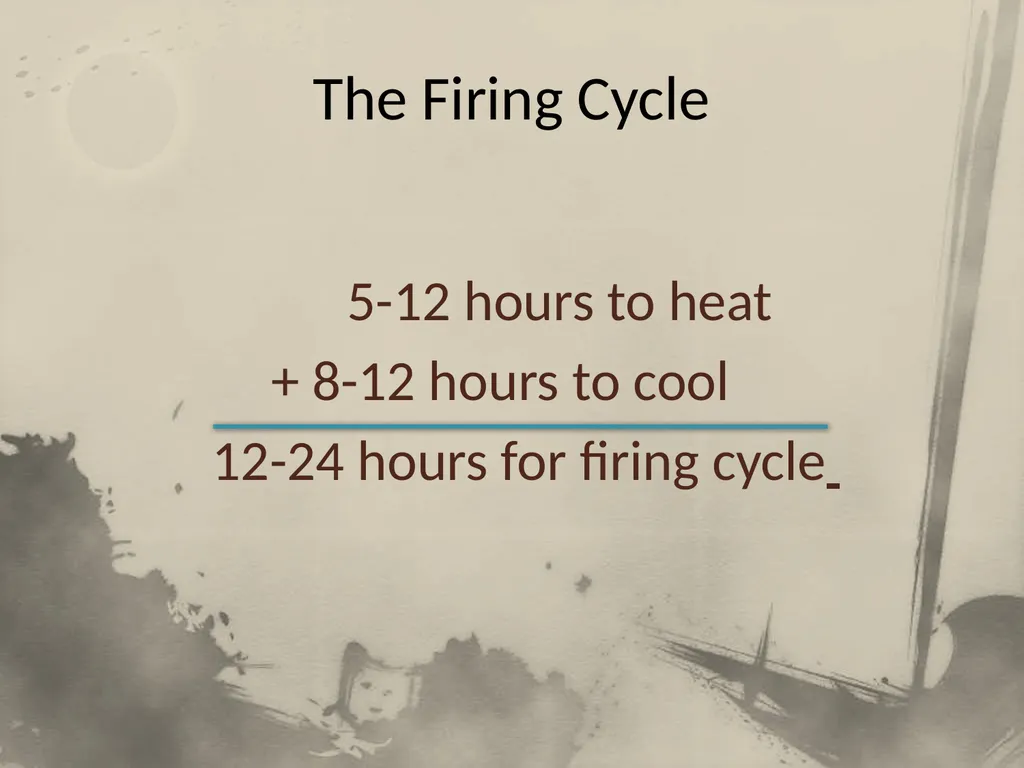
The Firing Cycle 5-12 hours to heat
+ 8-12 hours to cool
12-24 hours for firing cycle<br>
26
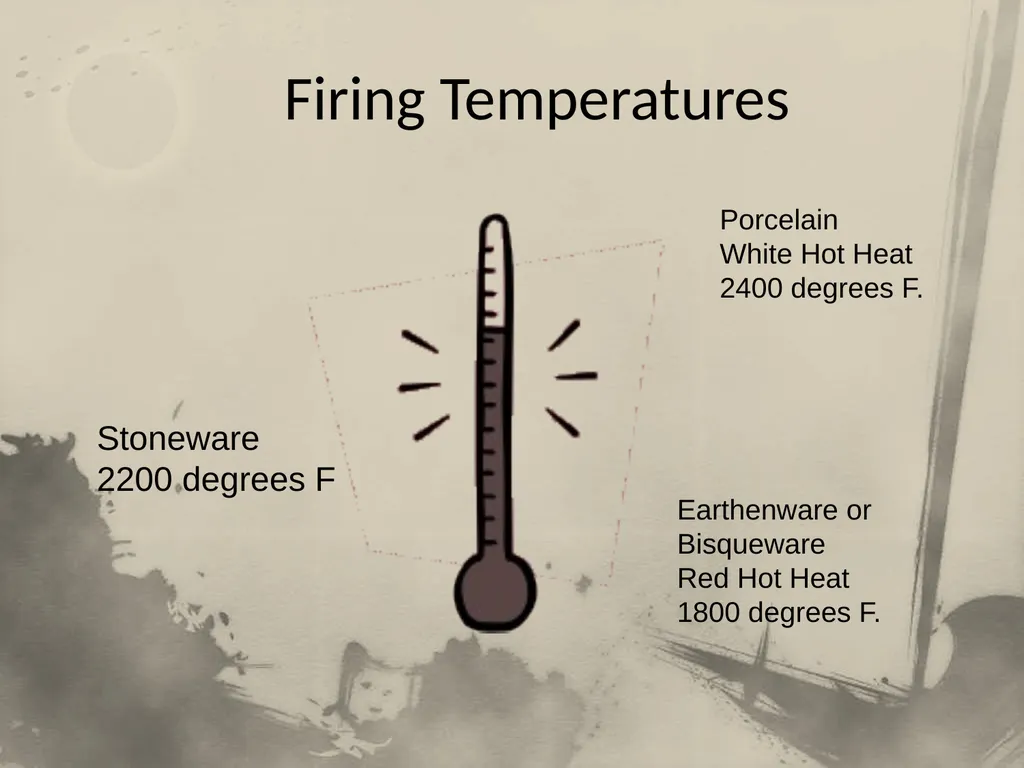
Firing Temperatures<br>
27
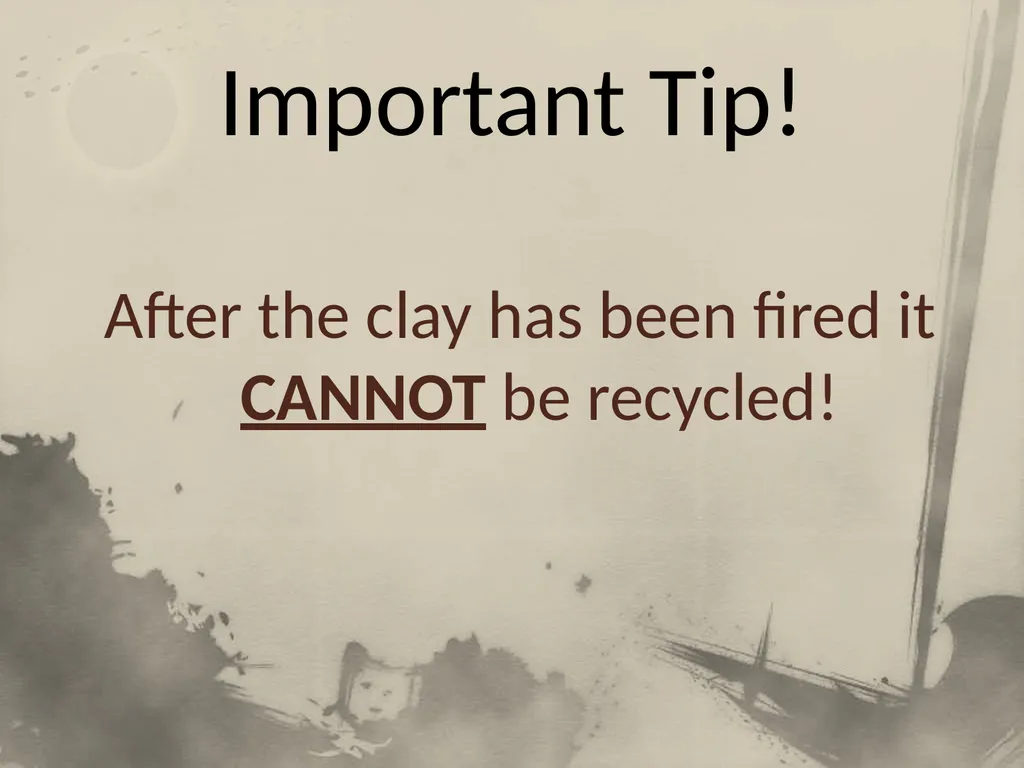
Important Tip! After the clay has been fired it CANNOT be recycled!<br>
28
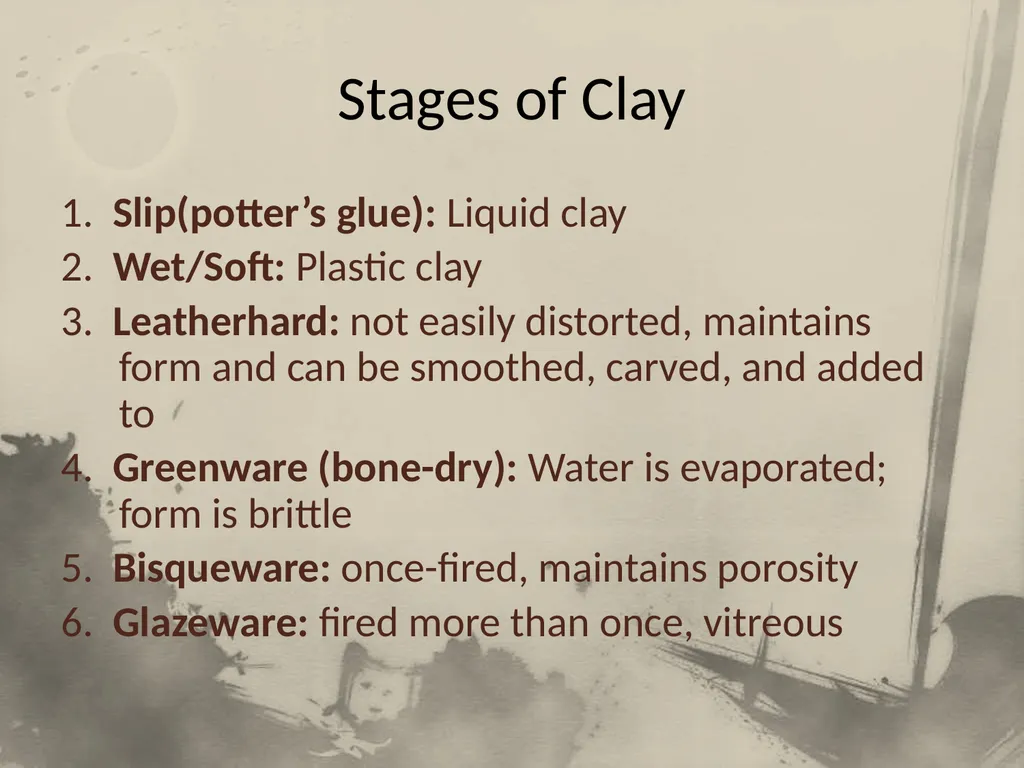
Stages of Clay 1. Slip(potter’s glue): Liquid clay
2. Wet/Soft: Plastic clay
3. Leatherhard: not easily distorted, maintains form and can be smoothed, carved, and added to
4. Greenware (bone-dry): Water is evaporated; form is brittle
5. Bisqueware: once-fired, maintains porosity
6. Glazeware: fired more than once, vitreous<br>
29
Student Activity Materials: Stages of Clay worksheet
Various examples of clay at different stages
Directions: Fill out the Stages of Clay worksheet by Studying the physical characteristics of each stage of clay.<br>