
Introduction to Clinical biochemistry Lecture : 1
AM
Published · 44 slides · 0 views

1 / 1
























Description
Introduction to Clinical biochemistry Lecture : 1 Dr. Shaimaa Munther What is Clinical Biochemistry? How does it fit into clinical medicine? The uses of clinical biochemistry tests? What are the biochemical tests? Samples,
Related Topics
Share
Embed code
Download this presentation From Below
"Introduction to Clinical biochemistry Lecture : 1" is the property of its rightful owner. Permission is granted to download and print the materials on this website for personal, non-commercial use only, and to display it on your personal computer provided you do not modify the materials and that you retain all copyright notices contained in the materials. By downloading content from our website, you accept the terms of this agreement.
Presentation Transcript
01
Introduction to Clinical biochemistry Lecture : 1
////Dr. Shaimaa Munther<br>
////Dr. Shaimaa Munther<br>
02
• What is “Clinical Biochemistry”?
• How does it fit into clinical medicine?
• The uses of clinical biochemistry tests?
• What are the biochemical tests?
• Samples, techniques, instruments
• Result interpretation & factors affect test results? Topics Headlines<br>
• How does it fit into clinical medicine?
• The uses of clinical biochemistry tests?
• What are the biochemical tests?
• Samples, techniques, instruments
• Result interpretation & factors affect test results? Topics Headlines<br>
03
Clinical biochemistry (clinical chemistry or chemical pathology)
Application of chemical, molecular and cellular concepts and techniques to the understanding and evaluation of human health and disease
Disease is frequently caused by, or associated with, changes in the complex biochemistry of the body, and an understanding of these changes is essential to the diagnosis and treatment of patients.
Clinical Biochemistry deals with the detection and measurement of the chemical constituents of body fluids and its excretions. What is Clinical Biochemistry?<br>
Application of chemical, molecular and cellular concepts and techniques to the understanding and evaluation of human health and disease
Disease is frequently caused by, or associated with, changes in the complex biochemistry of the body, and an understanding of these changes is essential to the diagnosis and treatment of patients.
Clinical Biochemistry deals with the detection and measurement of the chemical constituents of body fluids and its excretions. What is Clinical Biochemistry?<br>
04
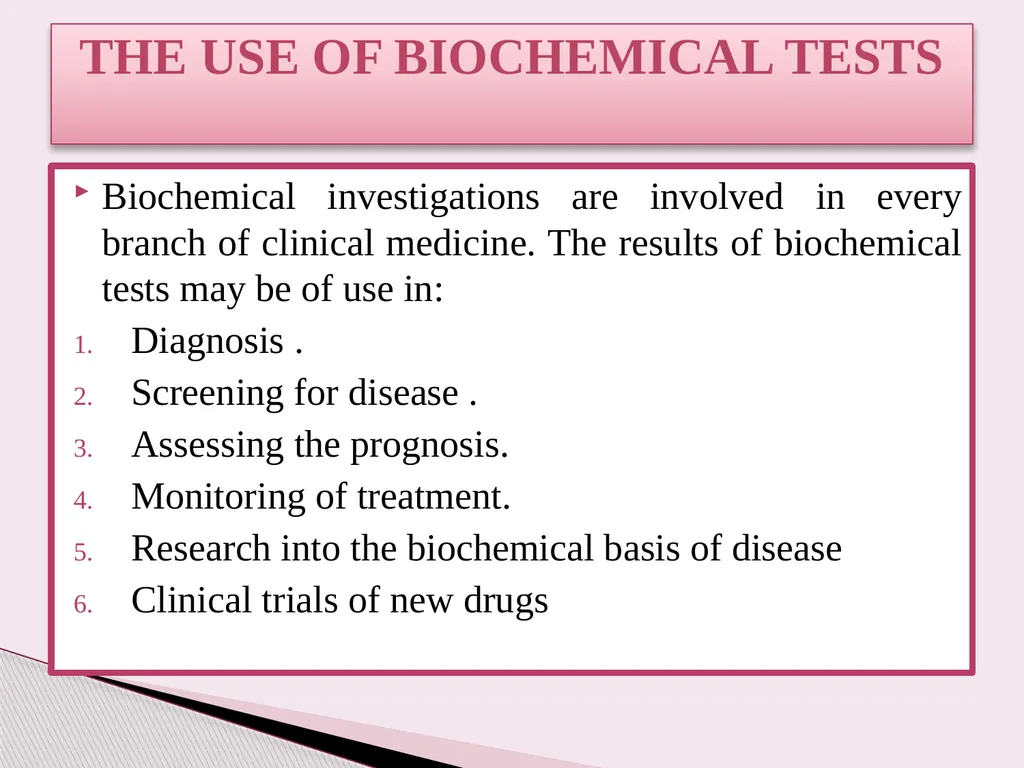
The use of biochemical tests Biochemical investigations are involved in every branch of clinical medicine. The results of biochemical tests may be of use in:
Diagnosis .
Screening for disease .
Assessing the prognosis.
Monitoring of treatment.
Research into the biochemical basis of disease
Clinical trials of new drugs<br>
Diagnosis .
Screening for disease .
Assessing the prognosis.
Monitoring of treatment.
Research into the biochemical basis of disease
Clinical trials of new drugs<br>
05
How biochemical tests are used 5<br>
06
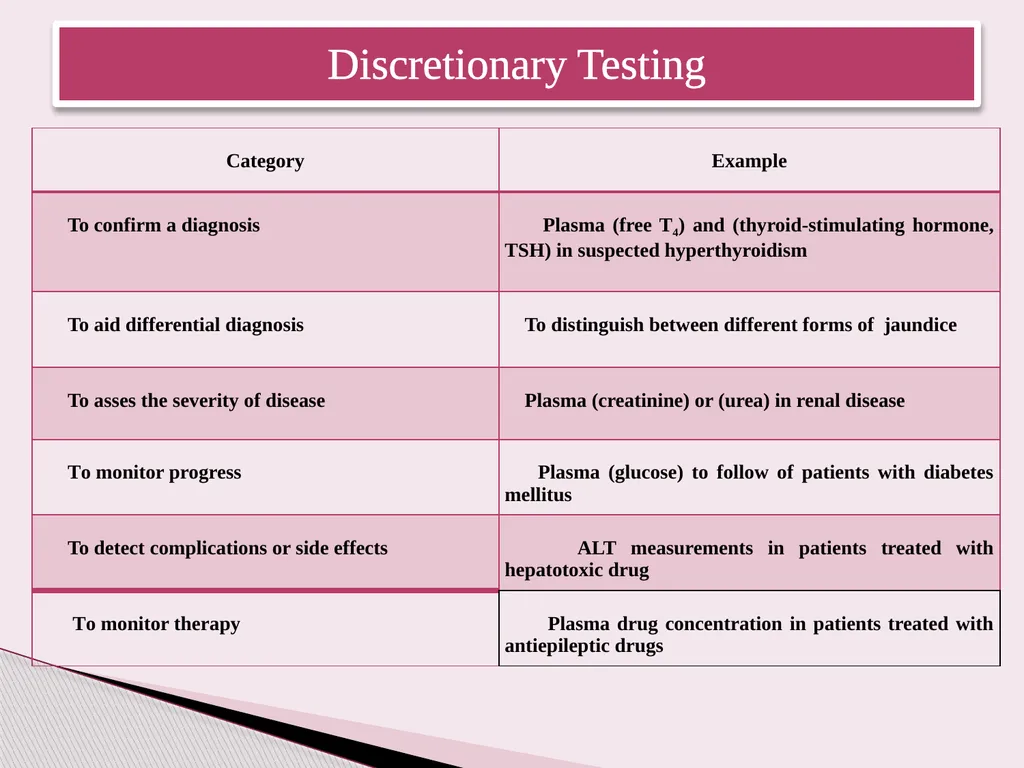
Biochemical Tests In general, biochemical tests can be broadly divided into two groups:
1. Discretionary or Selective requesting:
These tests are carried out on the basis of an individual patient's clinical situation.
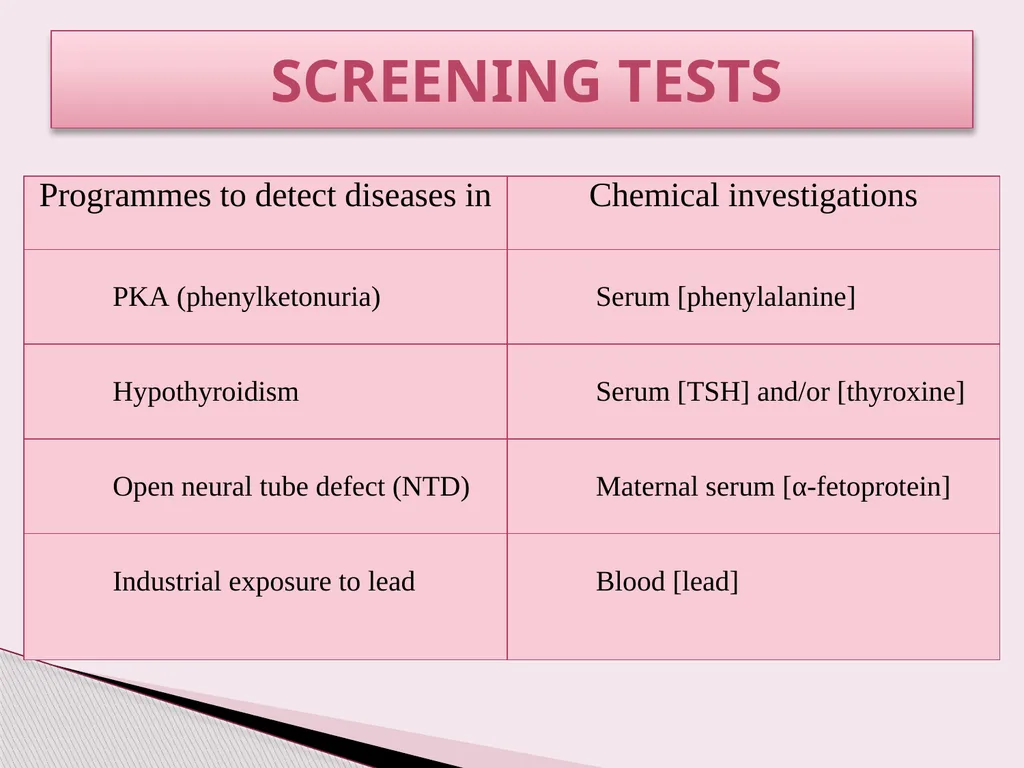
2. Screening tests:
These are used to search for disease without there being any necessary clinical indication that disease is present.<br>
1. Discretionary or Selective requesting:
These tests are carried out on the basis of an individual patient's clinical situation.
2. Screening tests:
These are used to search for disease without there being any necessary clinical indication that disease is present.<br>
07
Discretionary Testing<br>
08
screening tests<br>
09
Clinical biochemical tests Clinical biochemical tests comprise over ⅓ of all hospital laboratory investigations these divided into:
Core biochemistry tests.
Specialized tests .
The emergency lab tests.<br>
Core biochemistry tests.
Specialized tests .
The emergency lab tests.<br>
10
Clinical biochemical tests Core biochemistry: Most biochemistry laboratories provide the "core analyses", commonly requested tests which are of value in many patients, on a frequent basis.
Core biochemical tests include the following:
Sodium, potassium, chloride and bicarbonate
Urea and creatinine
Calcium and phosphate
Total protein and albumin
Bilirubin and alkaline phosphatase
Alanine aminotransferase (ALT) and Aspartate aminotransferase (AST)
Glucose
Amylase…….<br>
Core biochemical tests include the following:
Sodium, potassium, chloride and bicarbonate
Urea and creatinine
Calcium and phosphate
Total protein and albumin
Bilirubin and alkaline phosphatase
Alanine aminotransferase (ALT) and Aspartate aminotransferase (AST)
Glucose
Amylase…….<br>
11
2. Specialized tests:
Not every laboratory is equipped to carry out all possible biochemistry requests. Large departments may act as reference centers where less commonly asked for tests are performed.
Specialized tests include the following :
Hormones
Specific proteins
Trace elements
Vitamins
Drugs
Lipids and lipoproteins
DNA analyses Clinical biochemical tests<br>
Not every laboratory is equipped to carry out all possible biochemistry requests. Large departments may act as reference centers where less commonly asked for tests are performed.
Specialized tests include the following :
Hormones
Specific proteins
Trace elements
Vitamins
Drugs
Lipids and lipoproteins
DNA analyses Clinical biochemical tests<br>
12
3. The emergency lab tests:
All clinical biochemistry laboratories provide facilities for urgent tests. An urgent test is designated as one on which the clinician is likely to take immediate action. The main reason for asking for an analysis to be performed on an urgent basis is that immediate treatment depends on the result. Clinical biochemical tests<br>
All clinical biochemistry laboratories provide facilities for urgent tests. An urgent test is designated as one on which the clinician is likely to take immediate action. The main reason for asking for an analysis to be performed on an urgent basis is that immediate treatment depends on the result. Clinical biochemical tests<br>
13
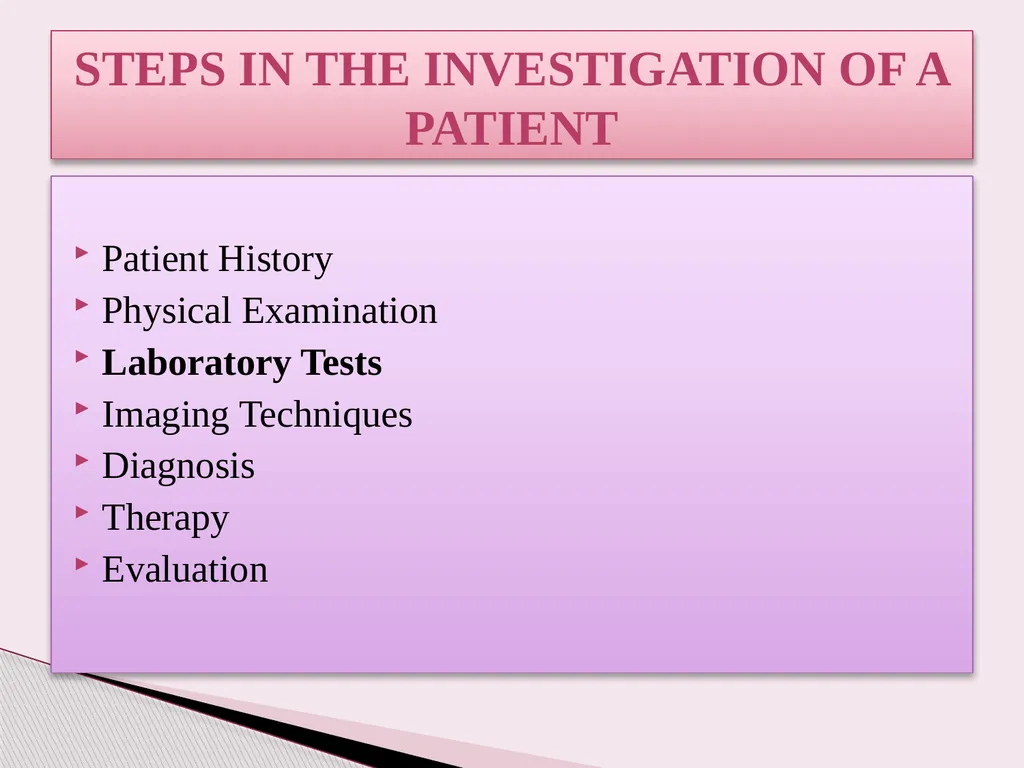
Steps in the Investigation of a Patient Patient History
Physical Examination
Laboratory Tests
Imaging Techniques
Diagnosis
Therapy
Evaluation<br>
Physical Examination
Laboratory Tests
Imaging Techniques
Diagnosis
Therapy
Evaluation<br>
14
Specimens used for biochemical analysis 15<br>
15
16<br>
16
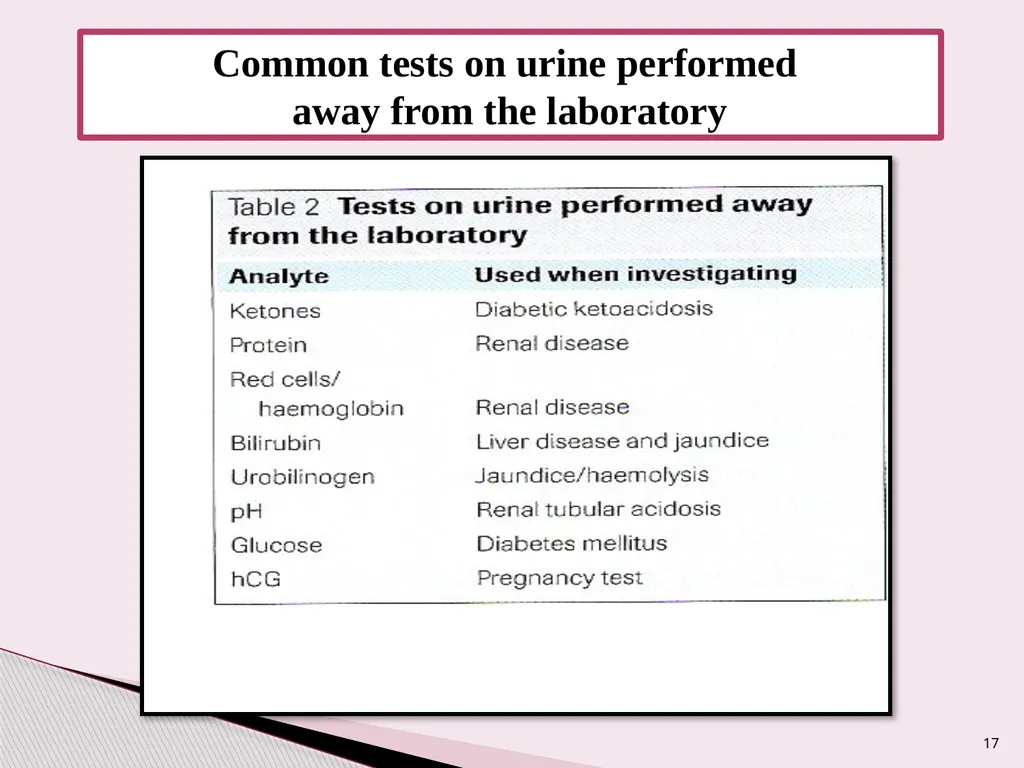
Common tests on urine performed
away from the laboratory 17<br>
17
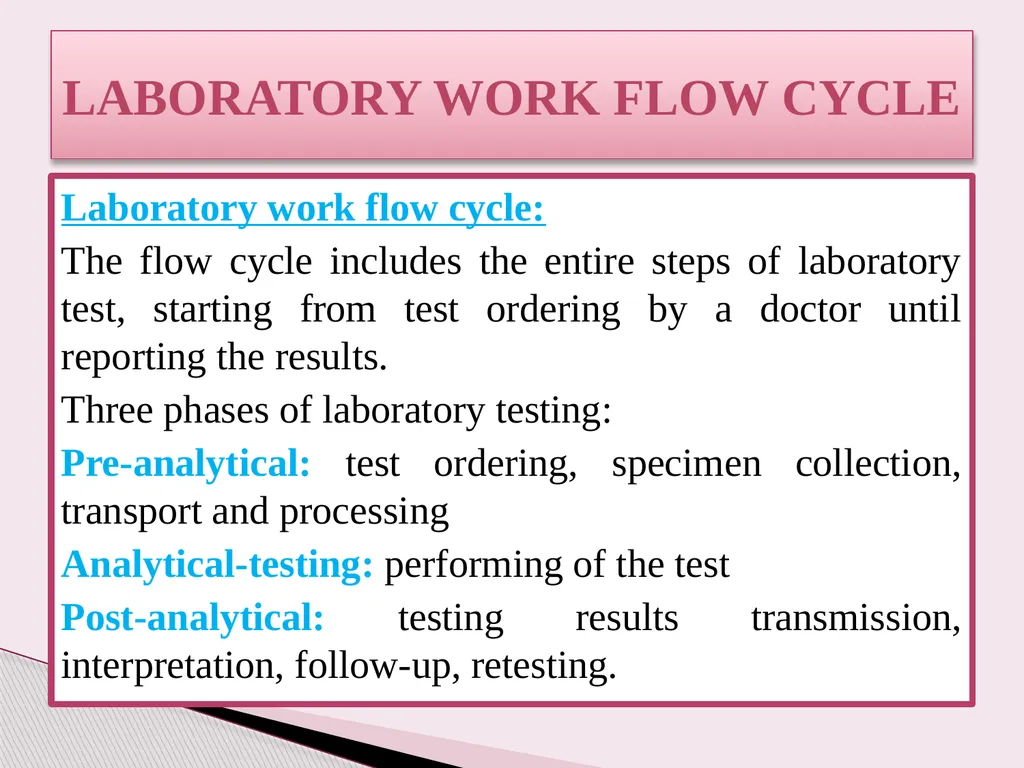
Laboratory work flow cycle:
The flow cycle includes the entire steps of laboratory test, starting from test ordering by a doctor until reporting the results.
Three phases of laboratory testing:
Pre-analytical: test ordering, specimen collection, transport and processing
Analytical-testing: performing of the test
Post-analytical: testing results transmission, interpretation, follow-up, retesting. Laboratory work flow cycle<br>
The flow cycle includes the entire steps of laboratory test, starting from test ordering by a doctor until reporting the results.
Three phases of laboratory testing:
Pre-analytical: test ordering, specimen collection, transport and processing
Analytical-testing: performing of the test
Post-analytical: testing results transmission, interpretation, follow-up, retesting. Laboratory work flow cycle<br>
18
Laboratory work flow cycle<br>
19
Test ordering
Specimen collection
Transport and processing 1- Pre-analytical Phase:<br>
Specimen collection
Transport and processing 1- Pre-analytical Phase:<br>
20
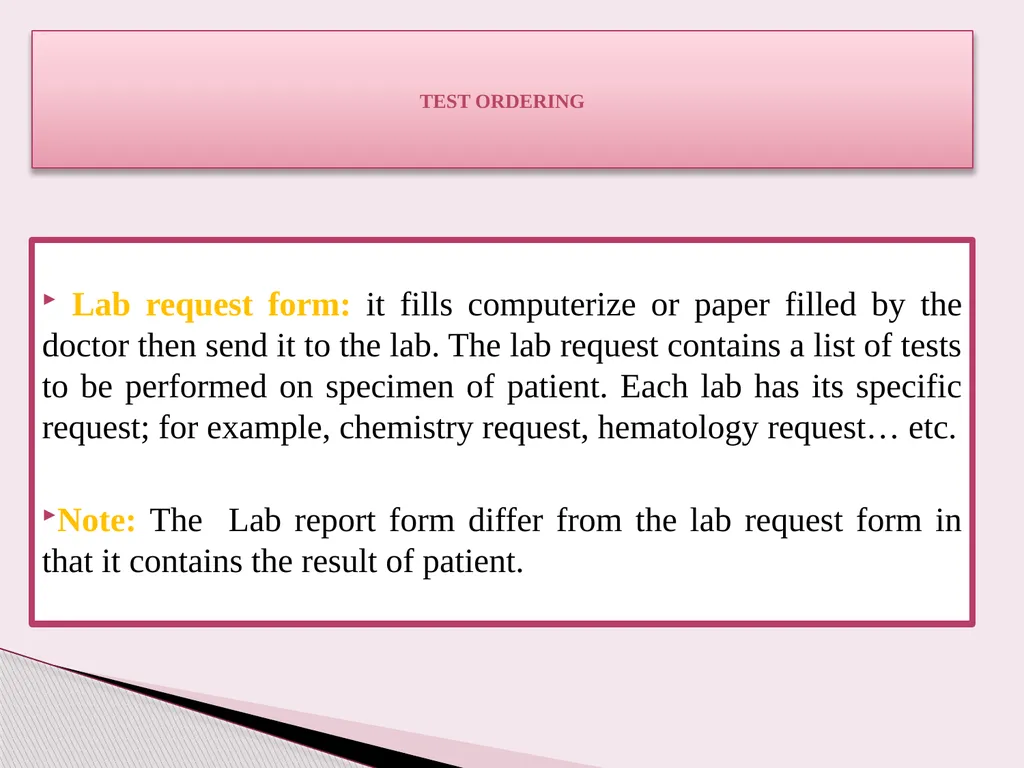
Test ordering Lab request form: it fills computerize or paper filled by the doctor then send it to the lab. The lab request contains a list of tests to be performed on specimen of patient. Each lab has its specific request; for example, chemistry request, hematology request… etc.
Note: The Lab report form differ from the lab request form in that it contains the result of patient.<br>
Note: The Lab report form differ from the lab request form in that it contains the result of patient.<br>
21
Specimen collection The biological fluids employed in the clinical biochemistry laboratory include blood, urine, saliva, sputum, feces, tissue and cells, cerebrospinal fluid, peritoneal fluid, synovial fluid, pleural fluid, stones.
Among these, blood (directly or in the form of plasma or serum) is frequently used for the investigations in the clinical biochemistry laboratory.<br>
Among these, blood (directly or in the form of plasma or serum) is frequently used for the investigations in the clinical biochemistry laboratory.<br>
22
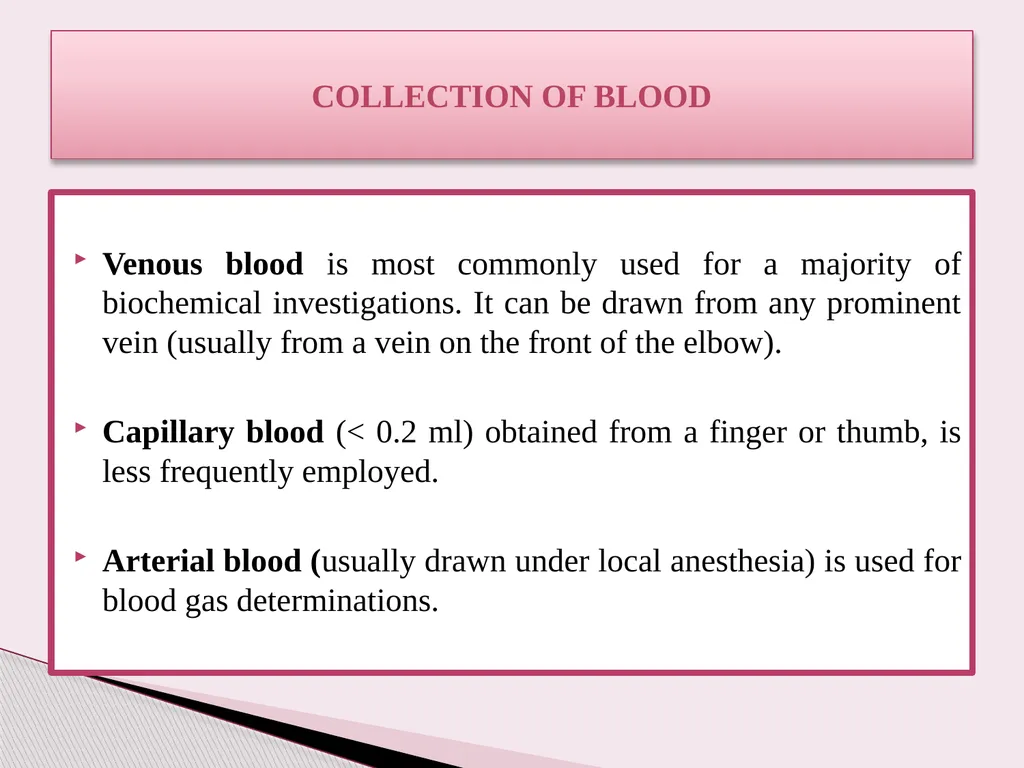
Collection of blood Venous blood is most commonly used for a majority of biochemical investigations. It can be drawn from any prominent vein (usually from a vein on the front of the elbow).
Capillary blood (< 0.2 ml) obtained from a finger or thumb, is less frequently employed.
Arterial blood (usually drawn under local anesthesia) is used for blood gas determinations.<br>
Capillary blood (< 0.2 ml) obtained from a finger or thumb, is less frequently employed.
Arterial blood (usually drawn under local anesthesia) is used for blood gas determinations.<br>
23
Transport and processing Blood specimens should be transported to the laboratory as soon as possible after collection.
Special arrangements are needed for some specimens (e.g. for acid-base measurements, or unstable hormones) because of their lack of stability. Most other analytes are stable for at least 3 h in whole blood, or longer if plasma or serum is first separated from the cells.
As a rule, whole blood specimens for chemical analysis must not be stored in a refrigerator, since ionic pumps that maintain electrolyte gradients across the cell membrane are inactive at low temperatures. Conversely, separated serum or plasma is best refrigerated, to minimize chemical changes or bacterial growth.<br>
Special arrangements are needed for some specimens (e.g. for acid-base measurements, or unstable hormones) because of their lack of stability. Most other analytes are stable for at least 3 h in whole blood, or longer if plasma or serum is first separated from the cells.
As a rule, whole blood specimens for chemical analysis must not be stored in a refrigerator, since ionic pumps that maintain electrolyte gradients across the cell membrane are inactive at low temperatures. Conversely, separated serum or plasma is best refrigerated, to minimize chemical changes or bacterial growth.<br>
24
Analysis is the performance of the test
Large analyzers can do many tests on a single sample tube with <1 mL plasma
Typical test sample volume is 10uL or less
Analysis time vary from 1 min (electrolytes) to 15 minutes (chemistries and immunoassays) 2- Analytical-testing<br>
Large analyzers can do many tests on a single sample tube with <1 mL plasma
Typical test sample volume is 10uL or less
Analysis time vary from 1 min (electrolytes) to 15 minutes (chemistries and immunoassays) 2- Analytical-testing<br>
25
Many methods for analysis are present e.g. :
Ion specific electrodes
Spectrophotometry
Immunoassay
Electrophoresis
Nephelometry …etc. Methods of Analysis<br>
Ion specific electrodes
Spectrophotometry
Immunoassay
Electrophoresis
Nephelometry …etc. Methods of Analysis<br>
26
Post-analytical phase includs:
Testing results transmission
Interpretation
Follow-up
Retesting. 3- Post-analytical Phase:<br>
Testing results transmission
Interpretation
Follow-up
Retesting. 3- Post-analytical Phase:<br>
27
Is Result Normal?
Has it changed?
Does it support the clinical hypothesis?
Is it consistent & support diagnosis, or inconsistent needs explanation
Is there is any Error in sampling, patient labeling, analysis, or reporting.
Is there is any need to Repeat the test? Interpretation<br>
Has it changed?
Does it support the clinical hypothesis?
Is it consistent & support diagnosis, or inconsistent needs explanation
Is there is any Error in sampling, patient labeling, analysis, or reporting.
Is there is any need to Repeat the test? Interpretation<br>
28
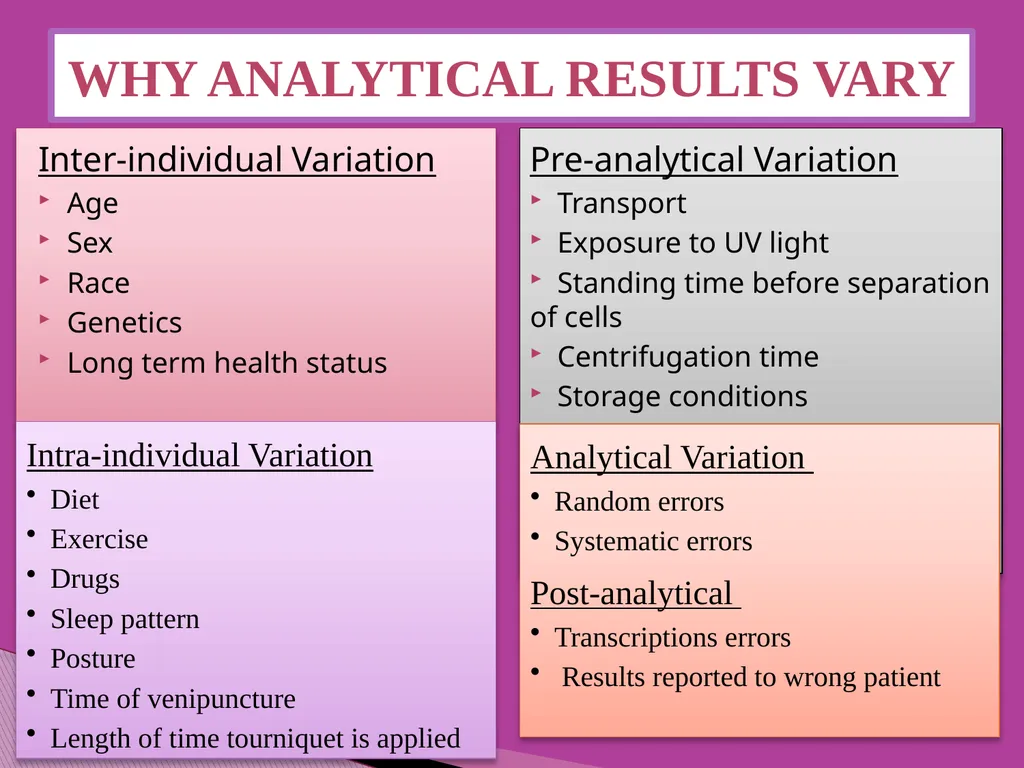
Why Analytical Results Vary Inter-individual Variation
Age
Sex
Race
Genetics
Long term health status Pre-analytical Variation
Transport
Exposure to UV light
Standing time before separation of cells
Centrifugation time
Storage conditions Intra-individual Variation
Diet
Exercise
Drugs
Sleep pattern
Posture
Time of venipuncture
Length of time tourniquet is applied Analytical Variation
Random errors
Systematic errors
Post-analytical
Transcriptions errors
Results reported to wrong patient<br>
Age
Sex
Race
Genetics
Long term health status Pre-analytical Variation
Transport
Exposure to UV light
Standing time before separation of cells
Centrifugation time
Storage conditions Intra-individual Variation
Diet
Exercise
Drugs
Sleep pattern
Posture
Time of venipuncture
Length of time tourniquet is applied Analytical Variation
Random errors
Systematic errors
Post-analytical
Transcriptions errors
Results reported to wrong patient<br>
29
Diet
Dietary constituents may alter the concentrations of analytes in blood significantly (e.g. plasma [glucose] and [triglyceride] are affected by carbohydrate and fat-containing meals, respectively).
Drugs
Many drugs influence the chemical composition of blood. Such effects of drug treatment, for example, antiepileptic drugs.
Diurnal variation
The concentrations of many substances in blood vary considerably at different times of day (e.g. cortisol). Specimens for these analyses must be collected at the times specified by the laboratory, as there may be no reference ranges relating to their concentrations in blood at other times<br>
Dietary constituents may alter the concentrations of analytes in blood significantly (e.g. plasma [glucose] and [triglyceride] are affected by carbohydrate and fat-containing meals, respectively).
Drugs
Many drugs influence the chemical composition of blood. Such effects of drug treatment, for example, antiepileptic drugs.
Diurnal variation
The concentrations of many substances in blood vary considerably at different times of day (e.g. cortisol). Specimens for these analyses must be collected at the times specified by the laboratory, as there may be no reference ranges relating to their concentrations in blood at other times<br>
30
Venous blood specimens should be obtained with minimal stasis
Prolonged stasis can markedly raise the concentrations of plasma proteins and other non-diffusible substances (e.g. protein-bound substances).
Posture should be standardised if possible
When a patient's posture changes from lying to standing, there may be an increase of as much as 13% in the concentration of plasma proteins or protein-bound constituents, due to redistribution of fluid in the extracellular space.
Haemolysis should be avoided
since it renders specimens unsuitable for plasma K+, magnesium and many protein and enzyme activity measurements.<br>
Prolonged stasis can markedly raise the concentrations of plasma proteins and other non-diffusible substances (e.g. protein-bound substances).
Posture should be standardised if possible
When a patient's posture changes from lying to standing, there may be an increase of as much as 13% in the concentration of plasma proteins or protein-bound constituents, due to redistribution of fluid in the extracellular space.
Haemolysis should be avoided
since it renders specimens unsuitable for plasma K+, magnesium and many protein and enzyme activity measurements.<br>
31
What we mean by accuracy & precision?
Why specificity & sensitivity are important?
What we mean by reference ranges?<br>
Why specificity & sensitivity are important?
What we mean by reference ranges?<br>
32
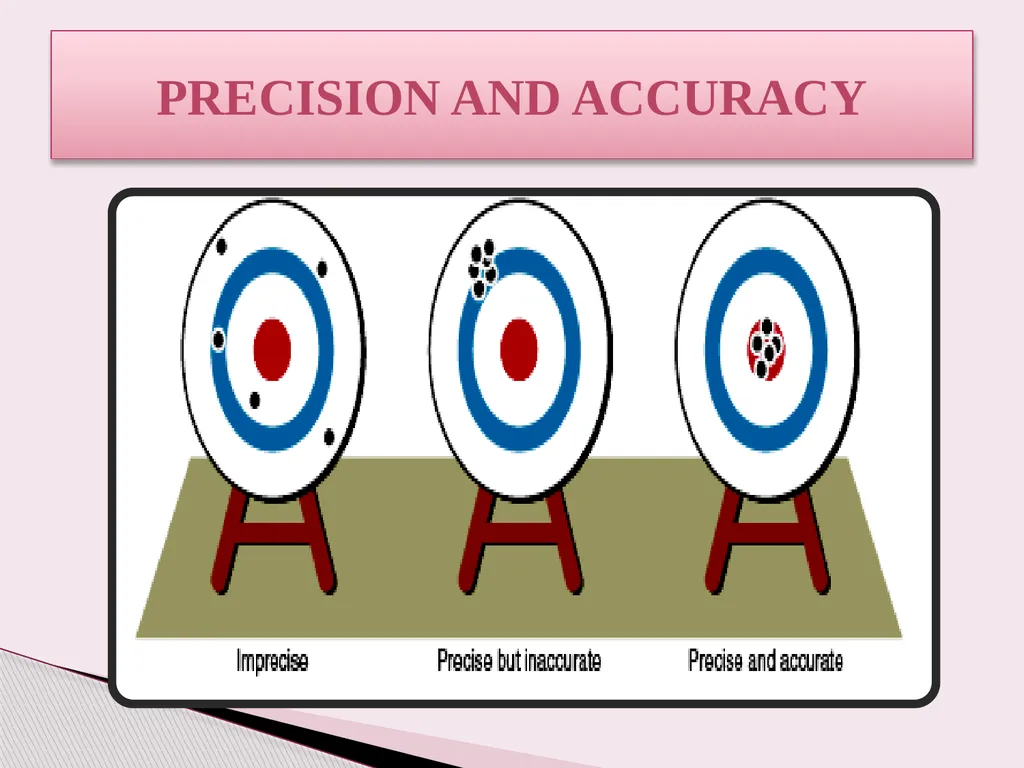
Precision is the reproducibility of an analytical method.
Repeated measurement of an analyte will be close to each other if precise Precision and accuracy<br>
Repeated measurement of an analyte will be close to each other if precise Precision and accuracy<br>
33
Accuracy: defines how close the measured value is to the actual value.
It is the objective in every biochemical method to provide good precision and accuracy.
Automation of analyses has improved precision in most cases. Precision and accuracy<br>
It is the objective in every biochemical method to provide good precision and accuracy.
Automation of analyses has improved precision in most cases. Precision and accuracy<br>
34
35<br>
35
36<br>
36
Precision and Accuracy<br>
37
Sensitivity
The analytical sensitivity of an assay is a measure of how little of the analyte the method can detect to improve the detection limit to help in discrimination normal results and those with suspected disease ( Positivity in disease) .
Specificity
Analytical specificity of an assay relates to how good the assay is at discriminating between the requested analyte and potentially interfering substances. So it measures the negativity in normal results . Analytical sensitivity and specificity<br>
The analytical sensitivity of an assay is a measure of how little of the analyte the method can detect to improve the detection limit to help in discrimination normal results and those with suspected disease ( Positivity in disease) .
Specificity
Analytical specificity of an assay relates to how good the assay is at discriminating between the requested analyte and potentially interfering substances. So it measures the negativity in normal results . Analytical sensitivity and specificity<br>
38
Accurate : it gives a correct result
Precise : it give the same result if repeated
Sensitive : it measure law concentration of the analyte
Specific : is not subjected to interferance by other substance Summary :<br>
Precise : it give the same result if repeated
Sensitive : it measure law concentration of the analyte
Specific : is not subjected to interferance by other substance Summary :<br>
39
Reference ranges make no assumptions about normality.
An abnormal result, i.e. outside a reference interval, does not always indicate presence of pathological processes- Nor a ‘normal’ result its absence.
The more ‘abnormal’ a result, i.e. the greater the difference from the reference interval, the greater the probability that it is related to a pathological process. Interpretation of Results What is “Normal” ?<br>
An abnormal result, i.e. outside a reference interval, does not always indicate presence of pathological processes- Nor a ‘normal’ result its absence.
The more ‘abnormal’ a result, i.e. the greater the difference from the reference interval, the greater the probability that it is related to a pathological process. Interpretation of Results What is “Normal” ?<br>
40
Reference Range (Normal Range) :
Usually established by testing a group of apparently ‘healthy’ individuals, to represent the wider population for which the service is provided.
The range of ‘normals’ is calculated from a Gaussian
distribution curve – 2 SD below and 2 SD above the mean, includes 95% of all values. Reference Range<br>
Usually established by testing a group of apparently ‘healthy’ individuals, to represent the wider population for which the service is provided.
The range of ‘normals’ is calculated from a Gaussian
distribution curve – 2 SD below and 2 SD above the mean, includes 95% of all values. Reference Range<br>
41
The Normal Distribution<br>
42
Specimen rejection criteria Specimen rejection criteria:
Specimen improperly labeled or unlabeled
Specimen improperly collected or preserved
Specimen submitted without properly completed request form
Hemolyzed sample<br>
Specimen improperly labeled or unlabeled
Specimen improperly collected or preserved
Specimen submitted without properly completed request form
Hemolyzed sample<br>