
INTRODUCTION TO COMPOSITE MATERIALS 1 A composite
BR
Published · 82 slides · 0 views
1 / 1
Description
INTRODUCTION TO COMPOSITE MATERIALS 1 A composite is a structural material that consists of two or more combined constituents that are combined at a macroscopic level and are not soluble in each other. One constituent is called the
Related Topics
Share
Embed code
Download this presentation From Below
"INTRODUCTION TO COMPOSITE MATERIALS 1 A composite" is the property of its rightful owner. Permission is granted to download and print the materials on this website for personal, non-commercial use only, and to display it on your personal computer provided you do not modify the materials and that you retain all copyright notices contained in the materials. By downloading content from our website, you accept the terms of this agreement.
Presentation Transcript
01
INTRODUCTION
TO
COMPOSITE MATERIALS 1<br>
TO
COMPOSITE MATERIALS 1<br>
02
A composite is a structural material that consists of two or more combined constituents that are combined at a macroscopic level and are not soluble in each other. One constituent is called the reinforcing phase and the one in which it is embedded is called the matrix . The reinforcing phase material may be in the form of fibers, particles, or flakes. The matrix phase materials are generally continuous. Examples of composite systems include concrete reinforced with steel and epoxy reinforced with graphite fibers, etc. 2<br>
03
Advanced composites are composite materials that are traditionally used in the aerospace industries. These composites have high performance reinforcements of a thin diameter in a matrix material such as epoxy and aluminum. Examples are graphite/epoxy, Kevlar /epoxy, and boron/ aluminum composites. These materials have now found applications in commercial industries as well. Combining two or more materials together to make a composite is more work than just using traditional monolithic metals such as steel and aluminum. 3<br>
04
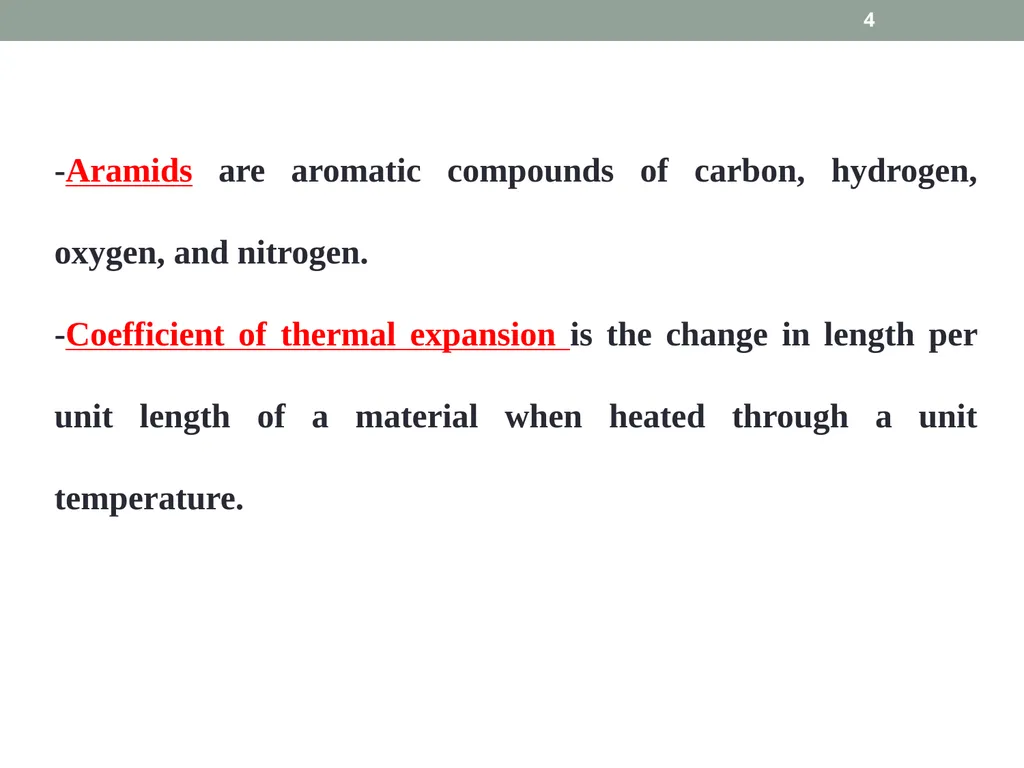
-Aramids are aromatic compounds of carbon, hydrogen, oxygen, and nitrogen.
-Coefficient of thermal expansion is the change in length per unit length of a material when heated through a unit temperature. 4<br>
-Coefficient of thermal expansion is the change in length per unit length of a material when heated through a unit temperature. 4<br>
05
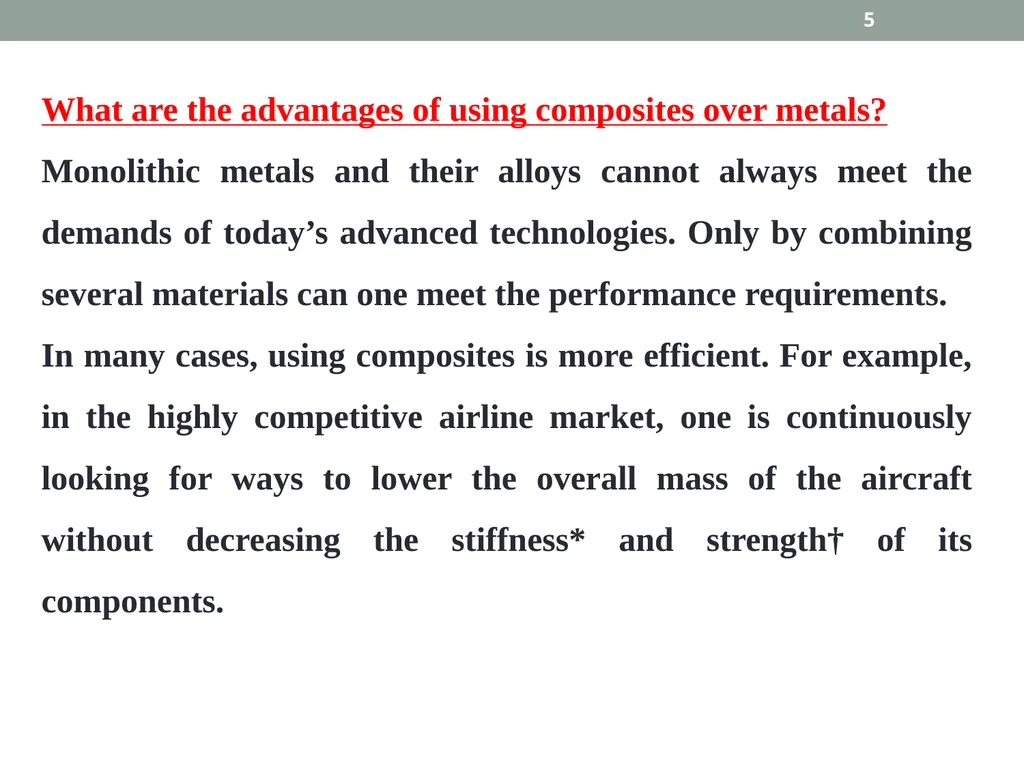
What are the advantages of using composites over metals?
Monolithic metals and their alloys cannot always meet the demands of today’s advanced technologies. Only by combining several materials can one meet the performance requirements.
In many cases, using composites is more efficient. For example, in the highly competitive airline market, one is continuously looking for ways to lower the overall mass of the aircraft without decreasing the stiffness* and strength† of its components. 5<br>
Monolithic metals and their alloys cannot always meet the demands of today’s advanced technologies. Only by combining several materials can one meet the performance requirements.
In many cases, using composites is more efficient. For example, in the highly competitive airline market, one is continuously looking for ways to lower the overall mass of the aircraft without decreasing the stiffness* and strength† of its components. 5<br>
06
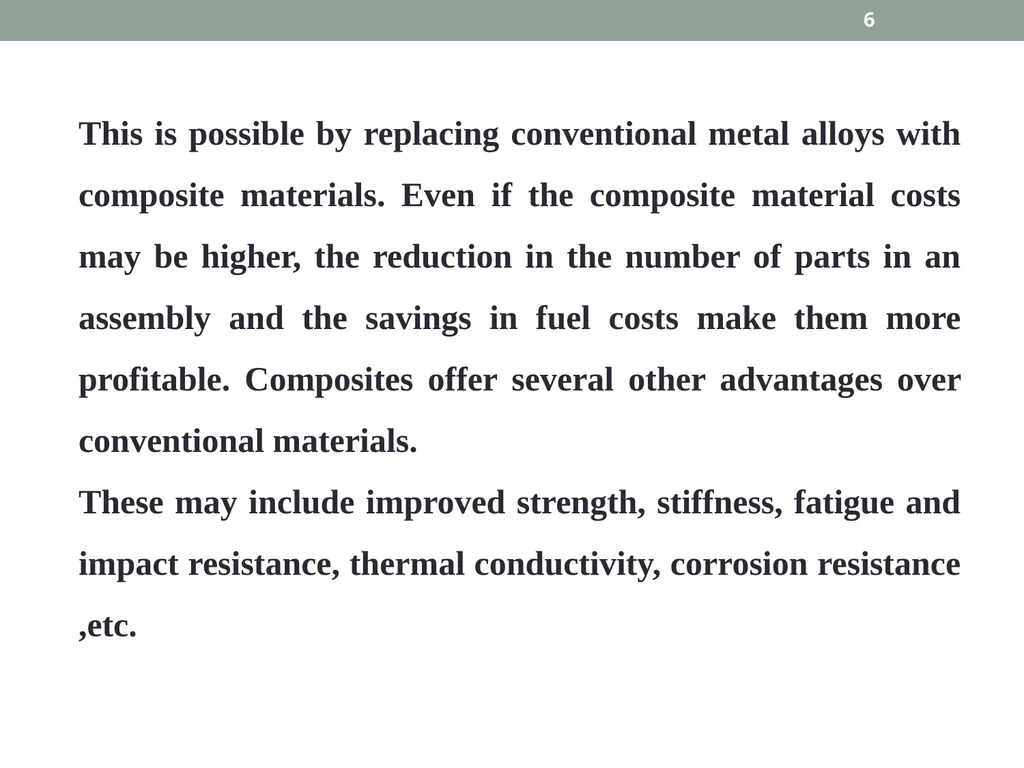
This is possible by replacing conventional metal alloys with composite materials. Even if the composite material costs may be higher, the reduction in the number of parts in an assembly and the savings in fuel costs make them more profitable. Composites offer several other advantages over conventional materials.
These may include improved strength, stiffness, fatigue and impact resistance, thermal conductivity, corrosion resistance ,etc. 6<br>
These may include improved strength, stiffness, fatigue and impact resistance, thermal conductivity, corrosion resistance ,etc. 6<br>
07
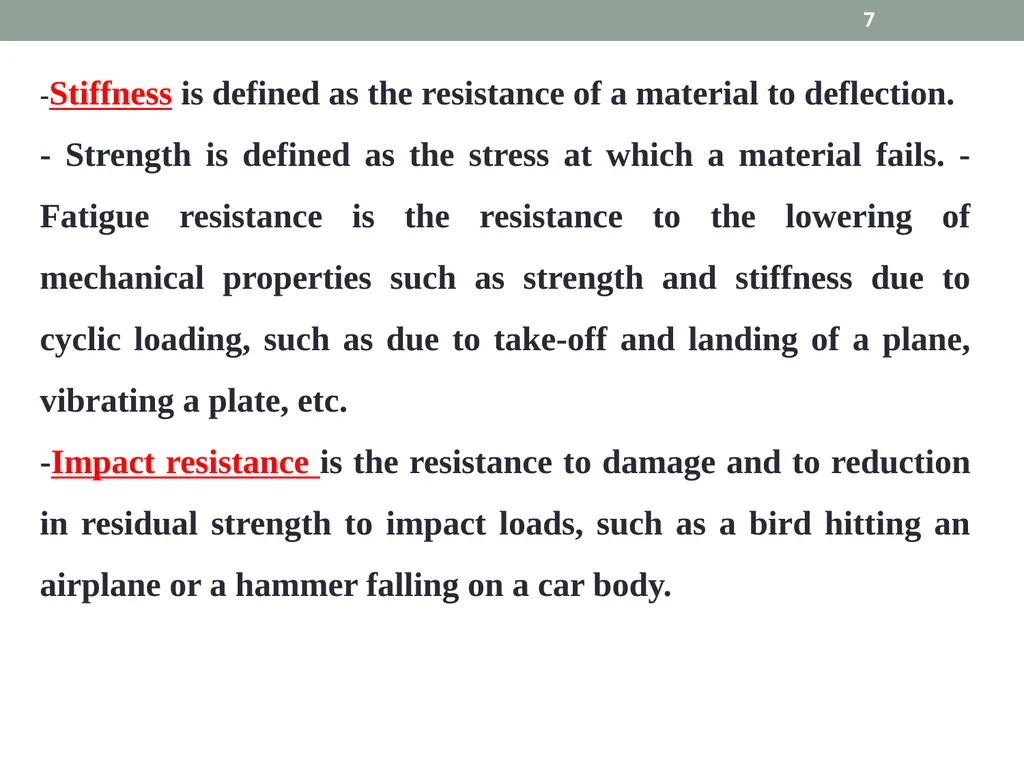
-Stiffness is defined as the resistance of a material to deflection.
- Strength is defined as the stress at which a material fails. -Fatigue resistance is the resistance to the lowering of mechanical properties such as strength and stiffness due to cyclic loading, such as due to take-off and landing of a plane, vibrating a plate, etc.
-Impact resistance is the resistance to damage and to reduction in residual strength to impact loads, such as a bird hitting an airplane or a hammer falling on a car body. 7<br>
- Strength is defined as the stress at which a material fails. -Fatigue resistance is the resistance to the lowering of mechanical properties such as strength and stiffness due to cyclic loading, such as due to take-off and landing of a plane, vibrating a plate, etc.
-Impact resistance is the resistance to damage and to reduction in residual strength to impact loads, such as a bird hitting an airplane or a hammer falling on a car body. 7<br>
08
8 -Thermal conductivity is the rate of heat flow across a unit area of a material in a unit time, when the temperature gradient is unity in the direction perpendicular to the area.
-Corrosion resistance is the resistance to corrosion,<br>
-Corrosion resistance is the resistance to corrosion,<br>
09
Composites Have Distinct Advantages Over Metals. Too, There Are Drawbacks Or Limitations In Using Them.
Drawbacks And Limitations In Use Of Composites Include:
• High cost of fabrication of composites is a critical issue. For example, a part made of graphite/epoxy composite may cost up to 10 to 15 times the material costs.
• Mechanical characterization of a composite structure is more complex than that of a metal structure. Unlike metals, composite materials are not isotropic, that is, their properties are not the same in all directions. 9<br>
Drawbacks And Limitations In Use Of Composites Include:
• High cost of fabrication of composites is a critical issue. For example, a part made of graphite/epoxy composite may cost up to 10 to 15 times the material costs.
• Mechanical characterization of a composite structure is more complex than that of a metal structure. Unlike metals, composite materials are not isotropic, that is, their properties are not the same in all directions. 9<br>
10
Therefore, they require more material parameters. For example, a single layer of a graphite/epoxy composite requires nine stiffness and strength constants for conducting mechanical analysis.
• Repair of composites is not a simple process compared to that for metals. Sometimes critical flaws and cracks in composite structures may go undetected.
• Composites do not have a high combination of strength and fracture toughness compared to metals.
• Composites do not necessarily give higher performance in all the properties used for material selection. 10<br>
• Repair of composites is not a simple process compared to that for metals. Sometimes critical flaws and cracks in composite structures may go undetected.
• Composites do not have a high combination of strength and fracture toughness compared to metals.
• Composites do not necessarily give higher performance in all the properties used for material selection. 10<br>
11
11 The Main Reasons For Using Fibers Of Thin Diameter Are The Following:
• Actual strength of materials is several magnitudes lower than the theoretical strength. This difference is due to the inherent flaws in the material. Removing these flaws can increase the strength of the material. As the fibers become smaller in diameter, the chances of an inherent flaw in the material are reduced.<br>
• Actual strength of materials is several magnitudes lower than the theoretical strength. This difference is due to the inherent flaws in the material. Removing these flaws can increase the strength of the material. As the fibers become smaller in diameter, the chances of an inherent flaw in the material are reduced.<br>
12
• For higher ductility and toughness, and better transfer of loads from the matrix to fiber, composites require larger surface area of the fiber–matrix interface. For the same volume fraction of fibers in a composite, the area of the fiber–matrix interface is inversely proportional to the diameter of the fiber and is proved as follows.
• Fibers able to bend without breaking are required in manufacturing of composite materials, especially for woven fabric composites. Ability to bend increases with a decrease in the fiber diameter and is measured as flexibility. 12<br>
• Fibers able to bend without breaking are required in manufacturing of composite materials, especially for woven fabric composites. Ability to bend increases with a decrease in the fiber diameter and is measured as flexibility. 12<br>
13
13 Flexibility is defined as the inverse of bending stiffness and is proportional to the inverse of the product of the elastic modulus of the fiber and the fourth power of its diameter.
Ductility is the ability of a material to deform without fracturing. It is measured by extending a rod until fracture and measuring the initial (Ai) and final (Af) cross-sectional area. Then ductility is defined as R = 1 – (Af/Ai).<br>
Ductility is the ability of a material to deform without fracturing. It is measured by extending a rod until fracture and measuring the initial (Ai) and final (Af) cross-sectional area. Then ductility is defined as R = 1 – (Af/Ai).<br>
14
What Fiber Factors Contribute To The Mechanical Performance Of A Composite?
Four Fiber Factors Contribute To The Mechanical Performance Of A Composite:
• Length: The fibers can be long or short. Long, continuous fibers are easy to orient and process, but short fibers cannot be controlled fully for proper orientation. Long fibers provide many benefits over short fibers. These include impact resistance, low shrinkage, improved surface finish, and dimensional stability. However, short fibers provide low cost, are easy to work with, and have fast cycle time fabrication procedures. Short fibers have fewer flaws and therefore have higher strength. 14<br>
Four Fiber Factors Contribute To The Mechanical Performance Of A Composite:
• Length: The fibers can be long or short. Long, continuous fibers are easy to orient and process, but short fibers cannot be controlled fully for proper orientation. Long fibers provide many benefits over short fibers. These include impact resistance, low shrinkage, improved surface finish, and dimensional stability. However, short fibers provide low cost, are easy to work with, and have fast cycle time fabrication procedures. Short fibers have fewer flaws and therefore have higher strength. 14<br>
15
15 • Orientation: Fibers oriented in one direction give very high stiffness and strength in that direction. If the fibers are oriented in more than one direction, such as in a mat, there will be high stiffness and strength in the directions of the fiber orientations. However, for the
same volume of fibers per unit volume of the composite, it cannot match the stiffness and strength of unidirectional composites.<br>
same volume of fibers per unit volume of the composite, it cannot match the stiffness and strength of unidirectional composites.<br>
16
• Shape: The most common shape of fibers is circular because handling and manufacturing them is easy. Hexagon and square shaped fibers are possible, but their advantages of strength and high packing factors do not outweigh the difficulty in handling and processing.
• Material: The material of the fiber directly influences the mechanical performance of a composite. Fibers are generally expected to have high elastic moduli and strengths. This expectation and cost have been key factors in the graphite, aramids, and glass dominating the fiber market for composites. 16<br>
• Material: The material of the fiber directly influences the mechanical performance of a composite. Fibers are generally expected to have high elastic moduli and strengths. This expectation and cost have been key factors in the graphite, aramids, and glass dominating the fiber market for composites. 16<br>
17
What are the matrix factors that contribute to the mechanical performance of composites?
Use of fibers by themselves is limited, with the exceptions of ropes and cables. Therefore, fibers are used as reinforcement to matrices. The matrix functions include binding the fibers together, protecting fibers from the environment, shielding from damage due to handling, and distributing the load to fibers. 17<br>
Use of fibers by themselves is limited, with the exceptions of ropes and cables. Therefore, fibers are used as reinforcement to matrices. The matrix functions include binding the fibers together, protecting fibers from the environment, shielding from damage due to handling, and distributing the load to fibers. 17<br>
18
18 Although matrices by themselves generally have low mechanical properties compared to those of fibers, the matrix influences many mechanical properties of the composite. These properties include transverse modulus and strength, shear modulus and strength, compressive strength, interlaminar shear strength, thermal expansion coefficient, thermal resistance, and fatigue strength.<br>
19
Other Than The Fiber And The Matrix, What Other Factors Influence The Mechanical Performance Of A Composite?
Other factors include the fiber–matrix interface. It determines how well the matrix transfers the load to the fibers. Chemical, mechanical, and reaction bonding may form the interface. In most cases, more than one type of bonding occurs. 19<br>
Other factors include the fiber–matrix interface. It determines how well the matrix transfers the load to the fibers. Chemical, mechanical, and reaction bonding may form the interface. In most cases, more than one type of bonding occurs. 19<br>
20
20 • Chemical bonding is formed between the fiber surface and the matrix. Some fibers bond naturally to the matrix and others do not. Coupling agents (Coupling agents are compounds applied to fiber surfaces to improve the bond between the fiber and matrix. For example, saline finish is applied to glass fibers to increase adhesion with epoxy matrix) are often added to form a chemical bond.<br>
21
21 • The natural roughness or etching of the fiber surface causing interlocking may form a mechanical bond between the fiber and matrix. • If the thermal expansion coefficient of the matrix is higher than that of the fiber, and the manufacturing temperatures are higher than the operating temperatures, the matrix will radially shrink more than the fiber. This causes the matrix to compress around the fiber.<br>
22
• Reaction bonding occurs when atoms or molecules of the fiber and the matrix diffuse into each other at the interface. This interdiffusion often creates a distinct interfacial layer, called the interphase, with different properties from that of the fiber or the matrix. Although this thin interfacial layer helps to form a bond, it also forms microcracks in the fiber. These microcracks reduce the strength of the fiber and thus that of the composite. 22<br>
23
Classification How Are Composites Classified?
Composites are classified by the geometry of the reinforcement — particulate, flake, and fibers — or by the type of matrix — polymer, metal, ceramic, and carbon.
• Particulate composites consist of particles immersed in matrices such as alloys and ceramics. They are usually isotropic because the particles are added randomly. Particulate composites have advantages such as improved strength, increased operating temperature, oxidation resistance, etc. Typical examples include use of aluminum particles in rubber; silicon carbide particles in aluminum; and gravel, sand, and cement to make concrete. 23<br>
Composites are classified by the geometry of the reinforcement — particulate, flake, and fibers — or by the type of matrix — polymer, metal, ceramic, and carbon.
• Particulate composites consist of particles immersed in matrices such as alloys and ceramics. They are usually isotropic because the particles are added randomly. Particulate composites have advantages such as improved strength, increased operating temperature, oxidation resistance, etc. Typical examples include use of aluminum particles in rubber; silicon carbide particles in aluminum; and gravel, sand, and cement to make concrete. 23<br>
24
24 • Flake composites consist of flat reinforcements of matrices. Typical flake materials are glass, mica, aluminum, and silver. Flake composites provide advantages such as high out-of-plane flexural modulus, higher strength, and low cost. However, flakes cannot be oriented easily and only a limited number of materials are available for use.<br>
25
• Fiber composites consist of matrices reinforced by short (discontinuous) or long (continuous) fibers. Fibers are generally anisotropic and examples include carbon and aramids. Examples of matrices are resins such as epoxy, metals such as aluminum, and ceramics such as calcium–alumino silicate. Continuous fiber composites are emphasized in this book and are further discussed in this chapter by the types of matrices: polymer, metal, ceramic, and carbon. The fundamental units of continuous fiber matrix composite are unidirectional or woven fiber laminas. Laminas are stacked on top of each other at various angles to form a multidirectional laminate. 25<br>
26
26 • Nanocomposites consist of materials that are of the scale of nanometers (10–9 m). The accepted range to be classified as a nanocomposite is that one of the constituents is less than 100 nm.<br>
27
Polymer Matrix Composites
What Are The Most Common Advanced Composites?
The most common advanced composites are polymer matrix composites (PMCs) consisting of a polymer (e.g., epoxy, polyester, urethane) reinforced by thin diameter fibers (e.g., graphite, aramids, boron). For example, graphite/ epoxy composites are approximately five times stronger than steel on a weight for- weight basis. The reasons why they are the most common composites include their low cost, high strength, and simple manufacturing principles. 27<br>
What Are The Most Common Advanced Composites?
The most common advanced composites are polymer matrix composites (PMCs) consisting of a polymer (e.g., epoxy, polyester, urethane) reinforced by thin diameter fibers (e.g., graphite, aramids, boron). For example, graphite/ epoxy composites are approximately five times stronger than steel on a weight for- weight basis. The reasons why they are the most common composites include their low cost, high strength, and simple manufacturing principles. 27<br>
28
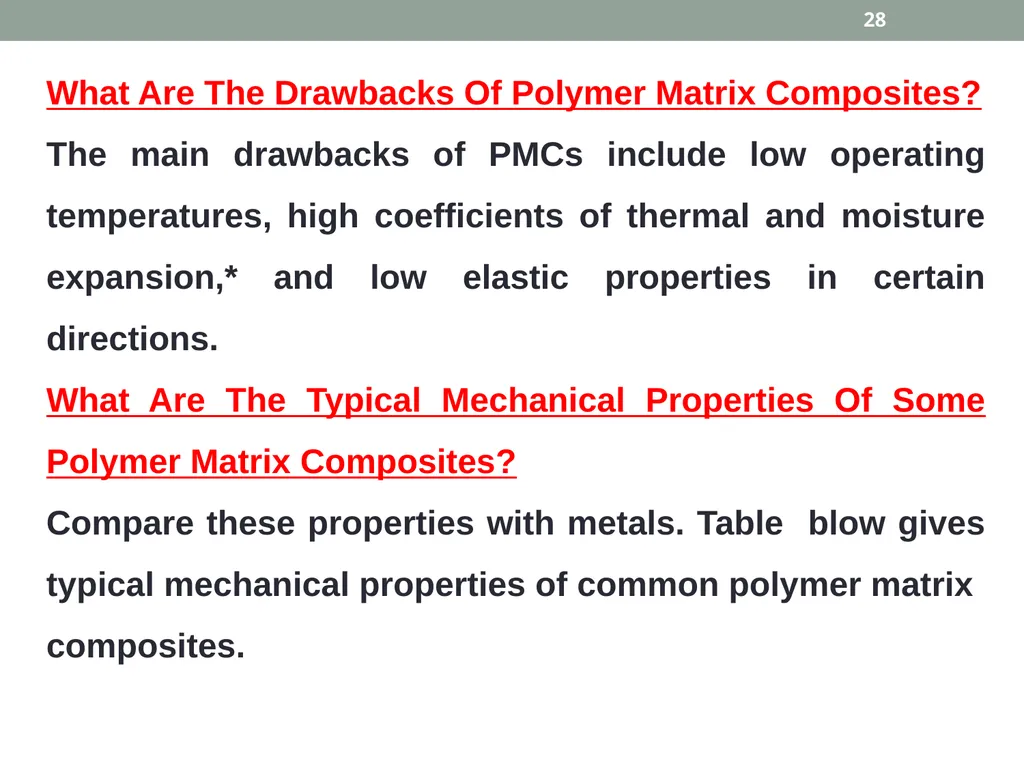
28 What Are The Drawbacks Of Polymer Matrix Composites?
The main drawbacks of PMCs include low operating temperatures, high coefficients of thermal and moisture expansion,* and low elastic properties in certain directions.
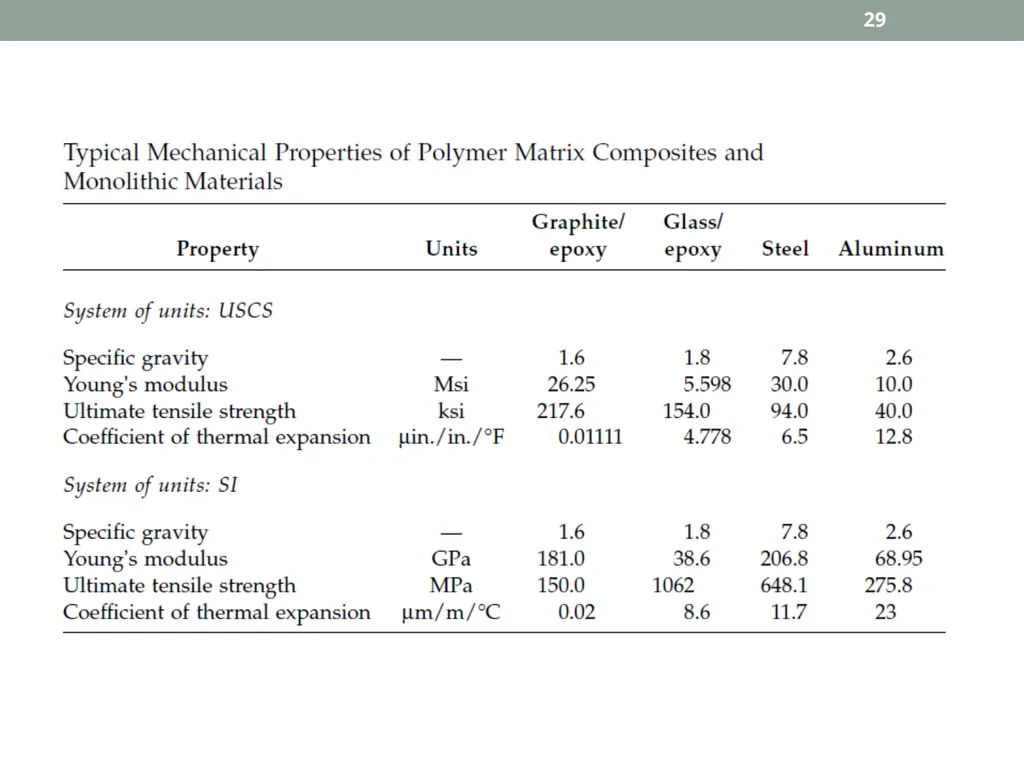
What Are The Typical Mechanical Properties Of Some Polymer Matrix Composites?
Compare these properties with metals. Table blow gives typical mechanical properties of common polymer matrix
composites.<br>
The main drawbacks of PMCs include low operating temperatures, high coefficients of thermal and moisture expansion,* and low elastic properties in certain directions.
What Are The Typical Mechanical Properties Of Some Polymer Matrix Composites?
Compare these properties with metals. Table blow gives typical mechanical properties of common polymer matrix
composites.<br>
29
29<br>
30
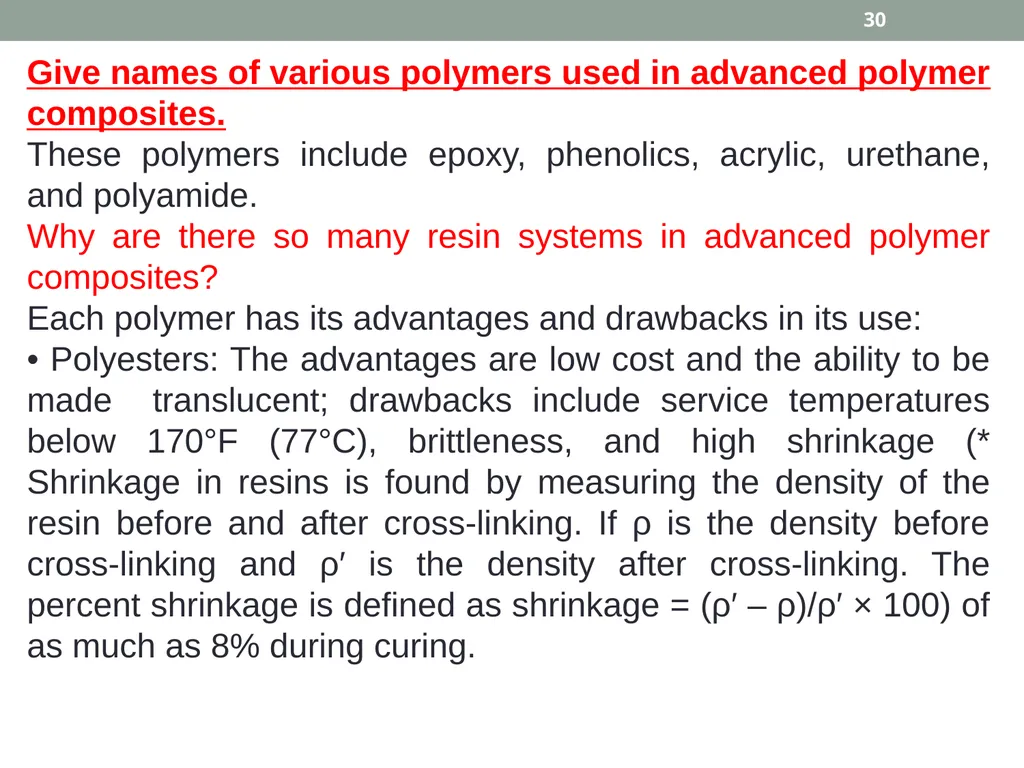
30 Give names of various polymers used in advanced polymer composites.
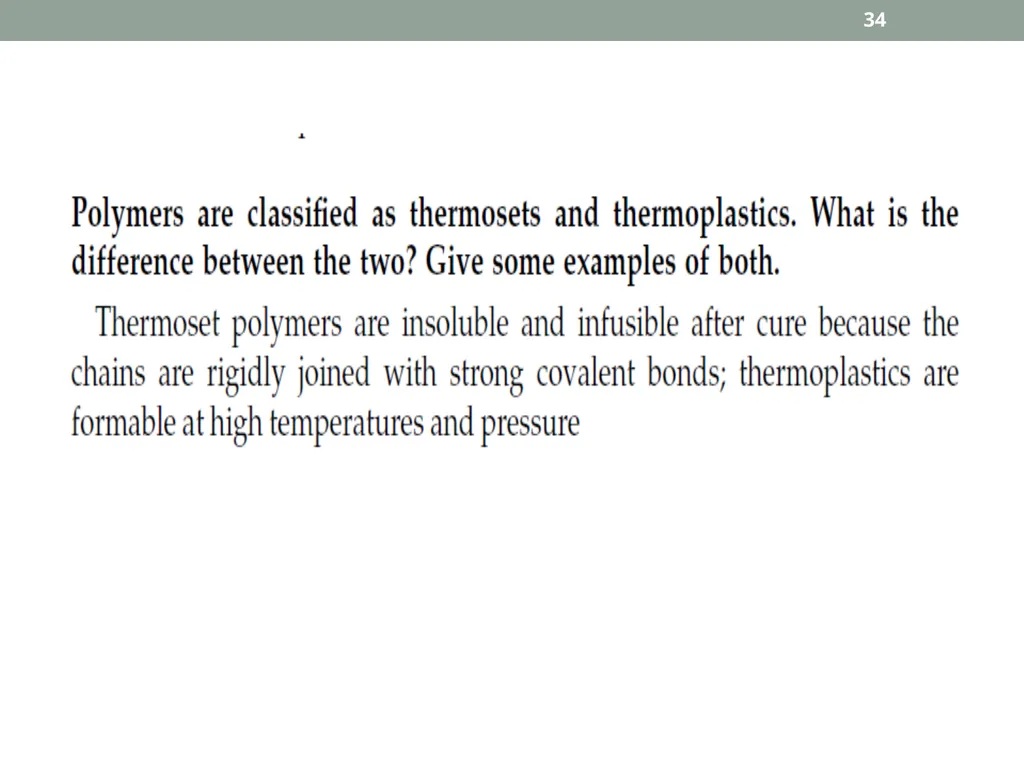
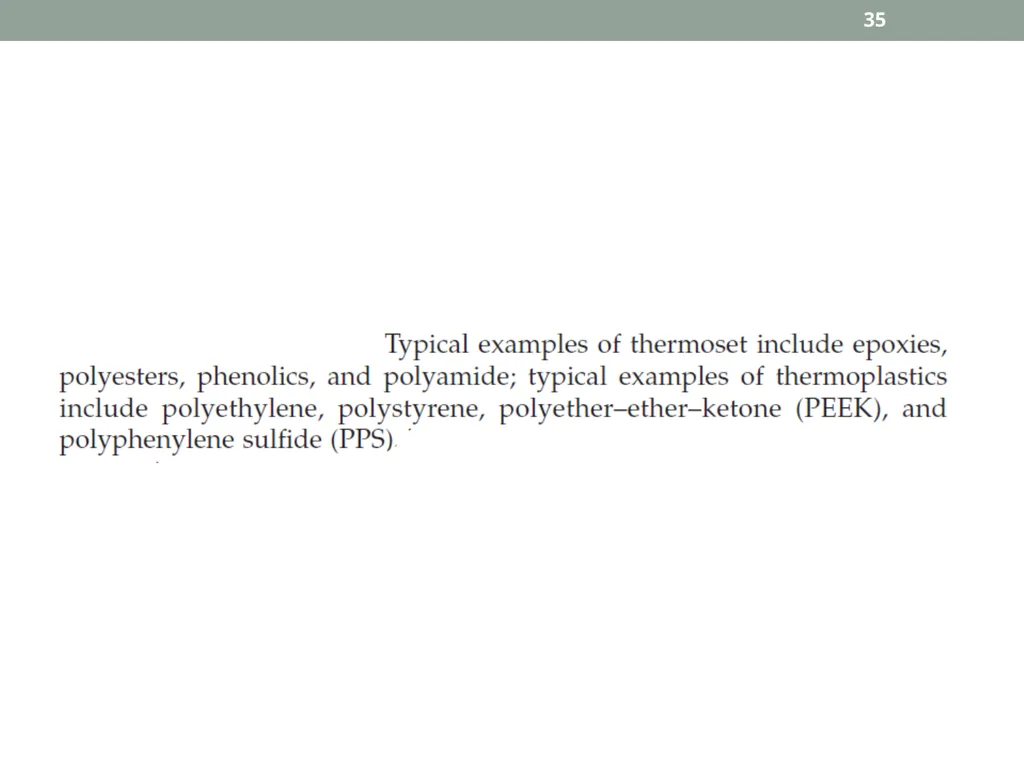
These polymers include epoxy, phenolics, acrylic, urethane, and polyamide.
Why are there so many resin systems in advanced polymer composites?
Each polymer has its advantages and drawbacks in its use:
• Polyesters: The advantages are low cost and the ability to be made translucent; drawbacks include service temperatures below 170°F (77°C), brittleness, and high shrinkage (* Shrinkage in resins is found by measuring the density of the resin before and after cross-linking. If ρ is the density before cross-linking and ρ′ is the density after cross-linking. The percent shrinkage is defined as shrinkage = (ρ′ – ρ)/ρ′ × 100) of as much as 8% during curing.<br>
These polymers include epoxy, phenolics, acrylic, urethane, and polyamide.
Why are there so many resin systems in advanced polymer composites?
Each polymer has its advantages and drawbacks in its use:
• Polyesters: The advantages are low cost and the ability to be made translucent; drawbacks include service temperatures below 170°F (77°C), brittleness, and high shrinkage (* Shrinkage in resins is found by measuring the density of the resin before and after cross-linking. If ρ is the density before cross-linking and ρ′ is the density after cross-linking. The percent shrinkage is defined as shrinkage = (ρ′ – ρ)/ρ′ × 100) of as much as 8% during curing.<br>
31
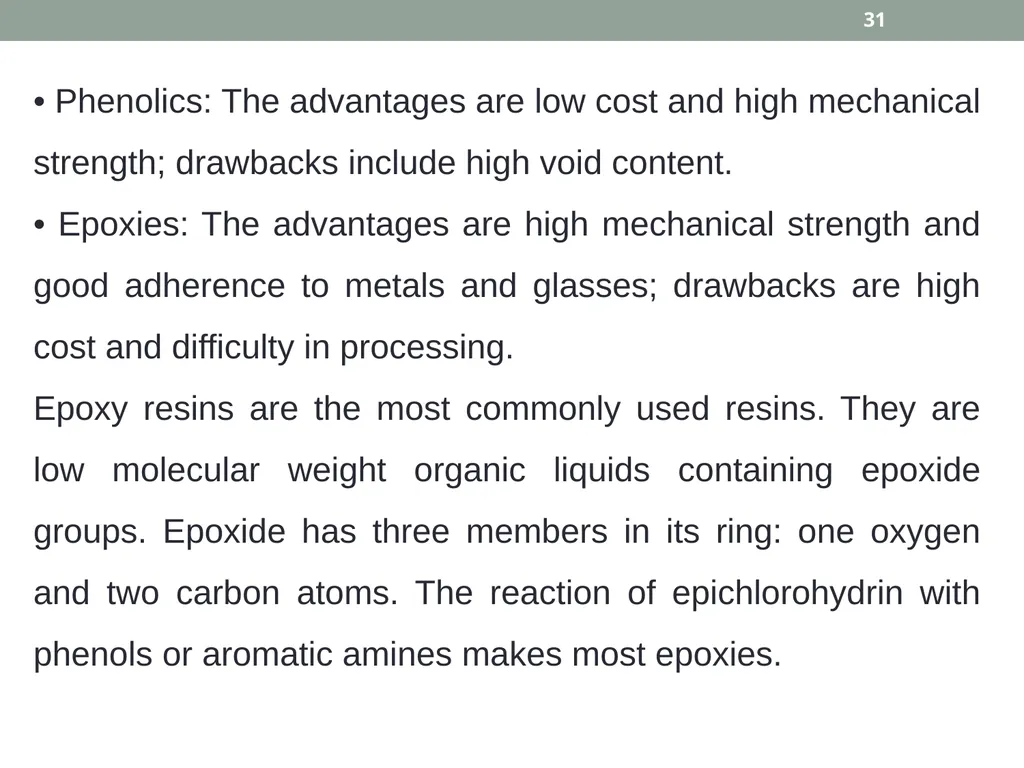
31 • Phenolics: The advantages are low cost and high mechanical strength; drawbacks include high void content.
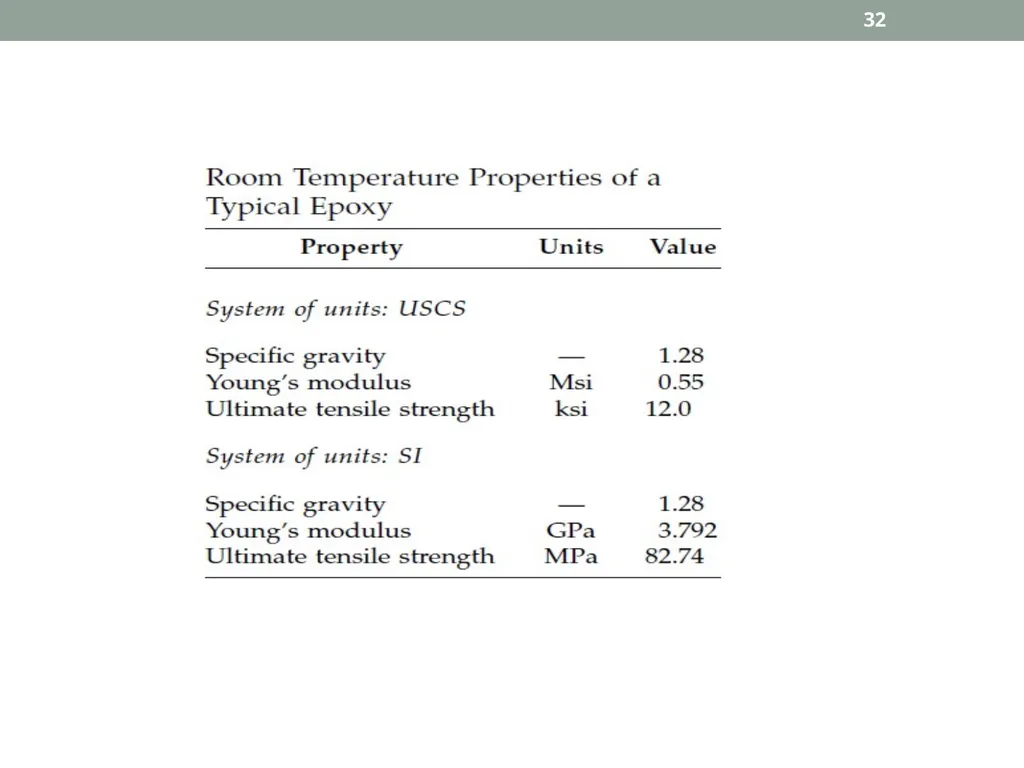
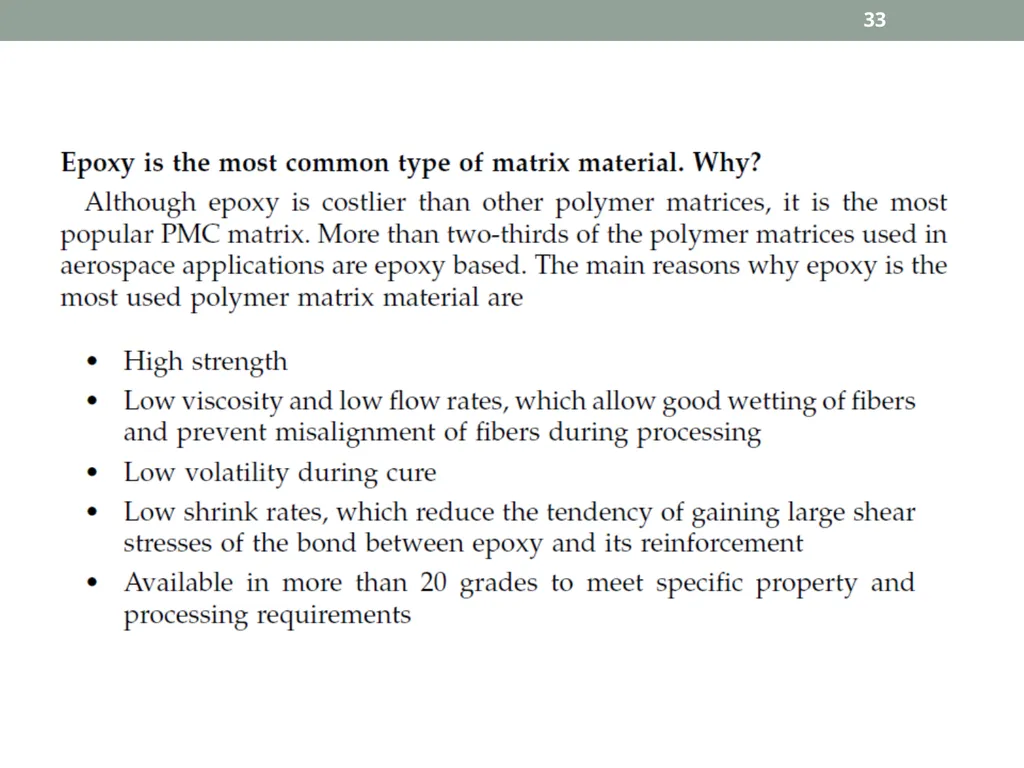
• Epoxies: The advantages are high mechanical strength and good adherence to metals and glasses; drawbacks are high cost and difficulty in processing.
Epoxy resins are the most commonly used resins. They are low molecular weight organic liquids containing epoxide groups. Epoxide has three members in its ring: one oxygen and two carbon atoms. The reaction of epichlorohydrin with phenols or aromatic amines makes most epoxies.<br>
• Epoxies: The advantages are high mechanical strength and good adherence to metals and glasses; drawbacks are high cost and difficulty in processing.
Epoxy resins are the most commonly used resins. They are low molecular weight organic liquids containing epoxide groups. Epoxide has three members in its ring: one oxygen and two carbon atoms. The reaction of epichlorohydrin with phenols or aromatic amines makes most epoxies.<br>
32
32<br>
33
33<br>
34
34<br>
35
35<br>
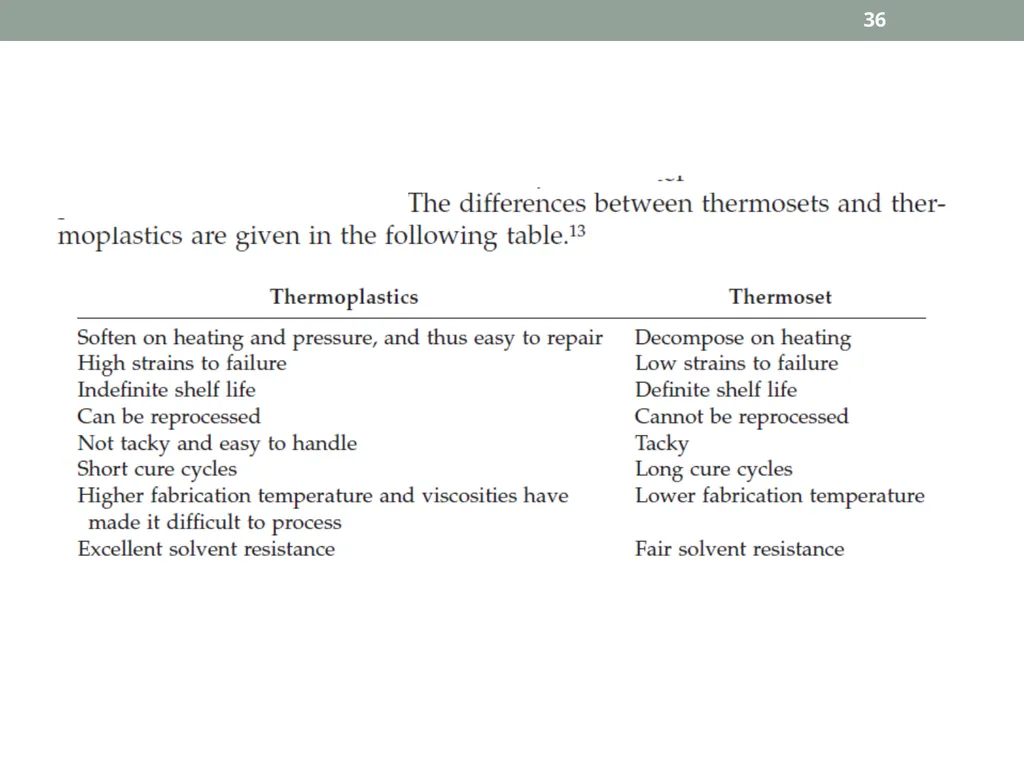
36
36<br>
37
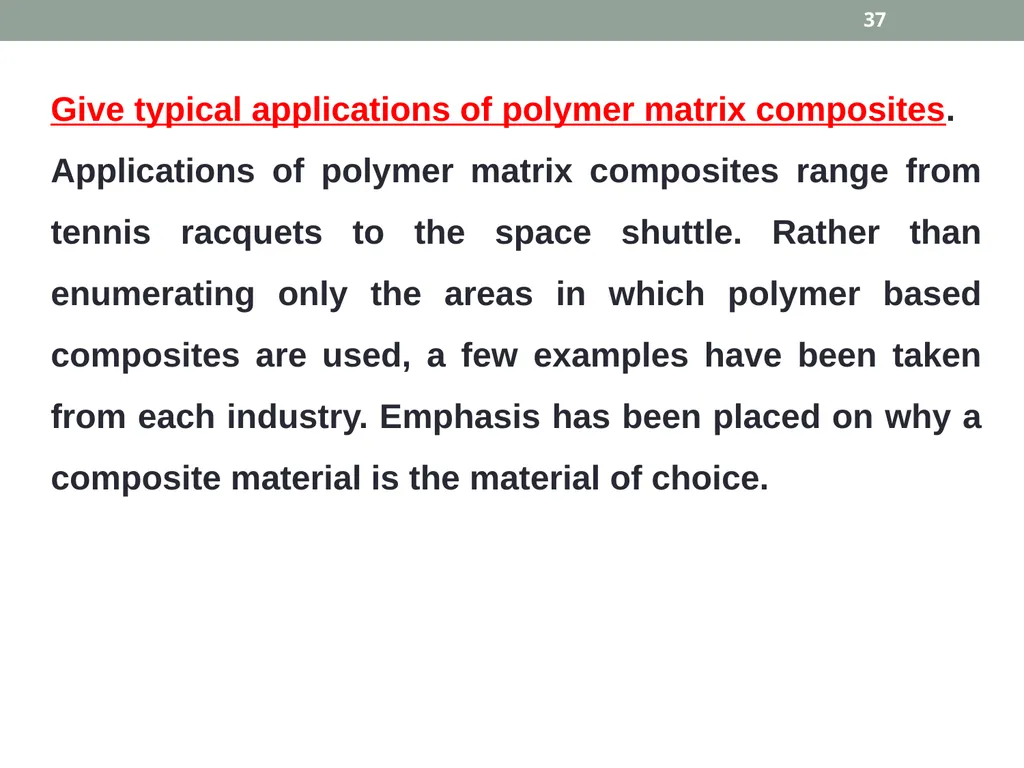
37 Give typical applications of polymer matrix composites.
Applications of polymer matrix composites range from tennis racquets to the space shuttle. Rather than enumerating only the areas in which polymer based composites are used, a few examples have been taken from each industry. Emphasis has been placed on why a composite material is the material of choice.<br>
Applications of polymer matrix composites range from tennis racquets to the space shuttle. Rather than enumerating only the areas in which polymer based composites are used, a few examples have been taken from each industry. Emphasis has been placed on why a composite material is the material of choice.<br>
38
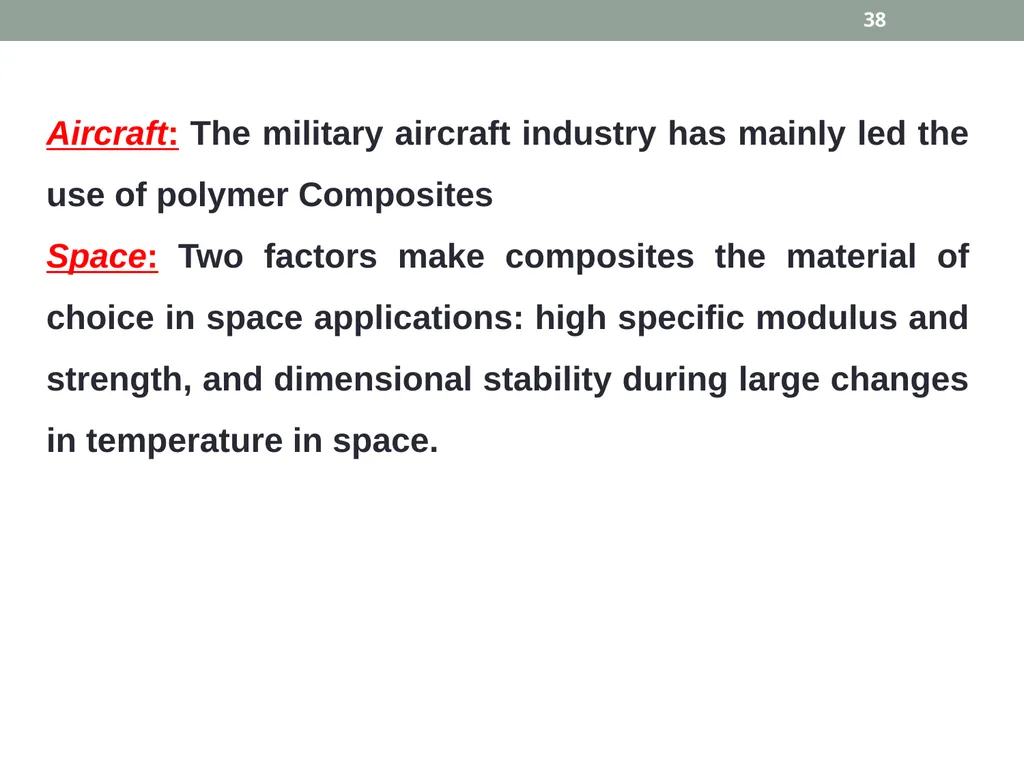
38 Aircraft: The military aircraft industry has mainly led the use of polymer Composites
Space: Two factors make composites the material of choice in space applications: high specific modulus and strength, and dimensional stability during large changes in temperature in space.<br>
Space: Two factors make composites the material of choice in space applications: high specific modulus and strength, and dimensional stability during large changes in temperature in space.<br>
39
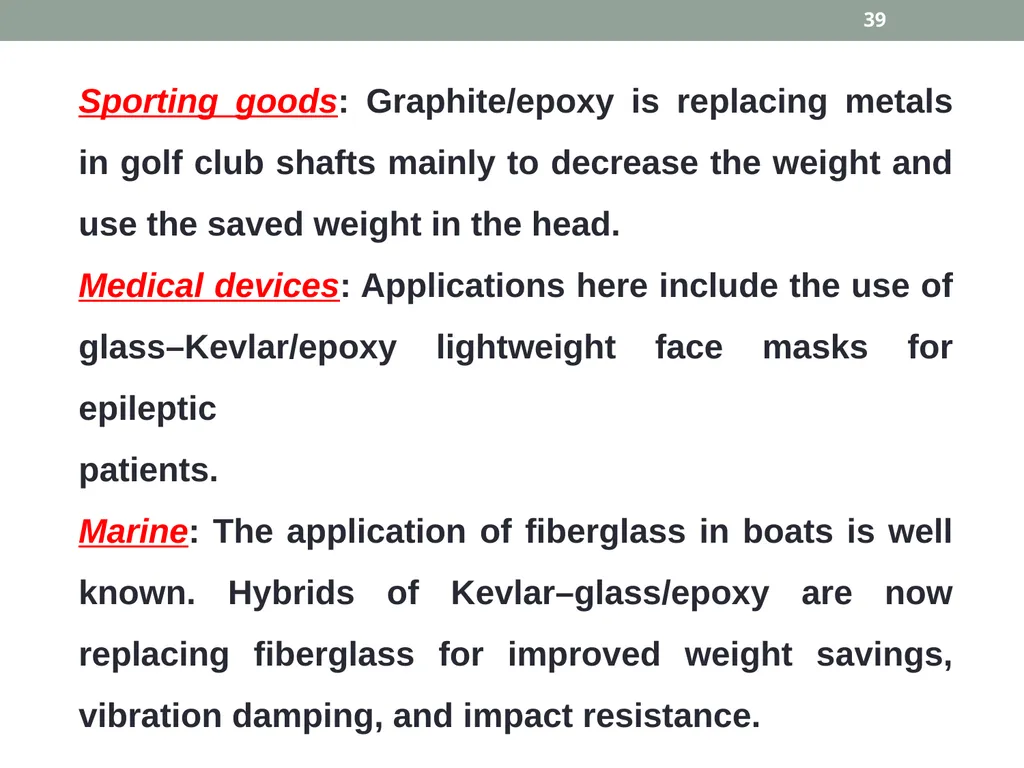
39 Sporting goods: Graphite/epoxy is replacing metals in golf club shafts mainly to decrease the weight and use the saved weight in the head.
Medical devices: Applications here include the use of glass–Kevlar/epoxy lightweight face masks for epileptic
patients.
Marine: The application of fiberglass in boats is well known. Hybrids of Kevlar–glass/epoxy are now replacing fiberglass for improved weight savings, vibration damping, and impact resistance.<br>
Medical devices: Applications here include the use of glass–Kevlar/epoxy lightweight face masks for epileptic
patients.
Marine: The application of fiberglass in boats is well known. Hybrids of Kevlar–glass/epoxy are now replacing fiberglass for improved weight savings, vibration damping, and impact resistance.<br>
40
40 Automotive: The fiberglass body of the CorvetteR comes to mind when considering automotive applications of polymer matrix composites.
Commercial: Fiber-reinforced polymers have many other commercial applications too. Examples include mops with pultruded fiberglass handles<br>
Commercial: Fiber-reinforced polymers have many other commercial applications too. Examples include mops with pultruded fiberglass handles<br>
41
41 Metal Matrix Composites
What are metal matrix composites?
Metal matrix composites (MMCs), as the name implies, have a metal matrix. Examples of matrices in such composites include aluminum, magnesium, and titanium. Typical fibers include carbon and silicon carbide. Metals are mainly reinforced to increase or decrease their properties to suit the needs of design. For example, the elastic stiffness and strength of metals can be increased, and large coefficients of thermal expansion and thermal and electric conductivities of metals can be reduced, by the addition of fibers such as silicon carbide.<br>
What are metal matrix composites?
Metal matrix composites (MMCs), as the name implies, have a metal matrix. Examples of matrices in such composites include aluminum, magnesium, and titanium. Typical fibers include carbon and silicon carbide. Metals are mainly reinforced to increase or decrease their properties to suit the needs of design. For example, the elastic stiffness and strength of metals can be increased, and large coefficients of thermal expansion and thermal and electric conductivities of metals can be reduced, by the addition of fibers such as silicon carbide.<br>
42
42 What are the advantages of metal matrix composites?
Metal matrix composites are mainly used to provide advantages over monolithic metals such as steel and aluminum. These advantages include higher specific strength and modulus by reinforcing low-density metals,
such as aluminum and titanium; lower coefficients of thermal expansion by reinforcing with fibers with low coefficients of thermal expansion, such as graphite; and maintaining properties such as strength at high temperatures.<br>
Metal matrix composites are mainly used to provide advantages over monolithic metals such as steel and aluminum. These advantages include higher specific strength and modulus by reinforcing low-density metals,
such as aluminum and titanium; lower coefficients of thermal expansion by reinforcing with fibers with low coefficients of thermal expansion, such as graphite; and maintaining properties such as strength at high temperatures.<br>
43
43 MMCs have several advantages over polymer matrix composites. These include higher elastic properties; higher service temperature; insensitivity to moisture; higher electric and thermal conductivities; and better wear, fatigue, and flaw resistances. The drawbacks of MMCs over PMCs include higher processing temperatures and higher densities.<br>
44
44 Do any properties degrade when metals are reinforced with fibers?
Yes, reinforcing metals with fibers may reduce ductility and fracture toughness. 26 Ductility of aluminum is 48% and it can decrease to below 10% with simple reinforcements of silicon carbide whiskers.<br>
Yes, reinforcing metals with fibers may reduce ductility and fracture toughness. 26 Ductility of aluminum is 48% and it can decrease to below 10% with simple reinforcements of silicon carbide whiskers.<br>
45
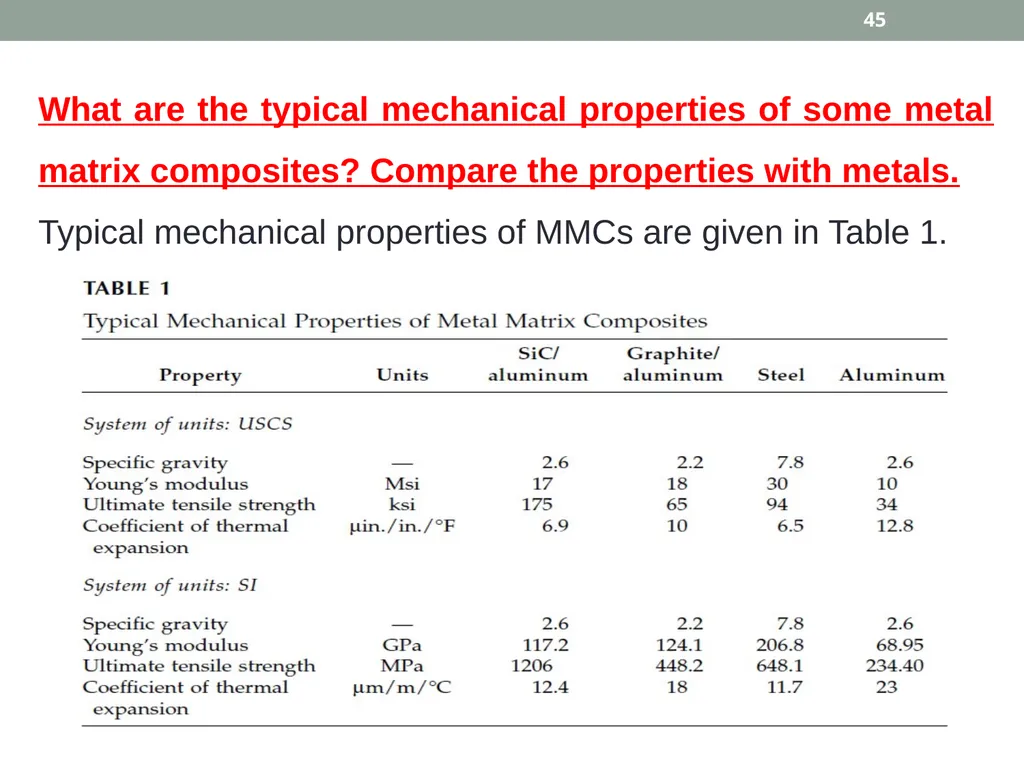
45 What are the typical mechanical properties of some metal matrix composites? Compare the properties with metals.
Typical mechanical properties of MMCs are given in Table 1.<br>
Typical mechanical properties of MMCs are given in Table 1.<br>
46
46 What are some of the applications of metal matrix composites?
Metal matrix composites applications are
• Space: The space shuttle uses boron/aluminum tubes to support its fuselage frame.
• Military: Precision components of missile guidance systems demand dimensional stability — that is, the geometries of the components cannot change during use.
• Transportation: Metal matrix composites are finding use now in automotive engines that are lighter than their metal counterparts<br>
Metal matrix composites applications are
• Space: The space shuttle uses boron/aluminum tubes to support its fuselage frame.
• Military: Precision components of missile guidance systems demand dimensional stability — that is, the geometries of the components cannot change during use.
• Transportation: Metal matrix composites are finding use now in automotive engines that are lighter than their metal counterparts<br>
47
47 Ceramic Matrix Composites What are ceramic matrix composites?
Ceramic matrix composites (CMCs) have a ceramic matrix such as alumina calcium alumino silicate reinforced by fibers such as carbon or silicon carbide.
What are the advantages of ceramic matrix composites?
Advantages of CMCs include high strength, hardness, high service temperature limits* for ceramics, chemical inertness, and low density. However, ceramics by themselves have low fracture toughness. Under tensile or impact loading, they fail catastrophically. Reinforcing ceramics with fibers, such as silicon carbide or carbon, increases their fracture toughness<br>
Ceramic matrix composites (CMCs) have a ceramic matrix such as alumina calcium alumino silicate reinforced by fibers such as carbon or silicon carbide.
What are the advantages of ceramic matrix composites?
Advantages of CMCs include high strength, hardness, high service temperature limits* for ceramics, chemical inertness, and low density. However, ceramics by themselves have low fracture toughness. Under tensile or impact loading, they fail catastrophically. Reinforcing ceramics with fibers, such as silicon carbide or carbon, increases their fracture toughness<br>
48
48 What are the applications of ceramic matrix composites?
Ceramic matrix composites are finding increased application in high-temperature areas in which metal and polymer matrix composites cannot be used. This is not to say that CMCs are not attractive otherwise, especially considering their high strength and modulus, and low density. Typical applications include cutting tool inserts in oxidizing and high-temperature environments.<br>
Ceramic matrix composites are finding increased application in high-temperature areas in which metal and polymer matrix composites cannot be used. This is not to say that CMCs are not attractive otherwise, especially considering their high strength and modulus, and low density. Typical applications include cutting tool inserts in oxidizing and high-temperature environments.<br>
49
49 Carbon–Carbon Composites
What are carbon–carbon composites?
Carbon–carbon composites use carbon fibers in a carbon matrix. These composites are used in very high-temperature environments of up to 6000°F (3315°C), and are 20 times stronger and 30% lighter than graphite fibers.29<br>
What are carbon–carbon composites?
Carbon–carbon composites use carbon fibers in a carbon matrix. These composites are used in very high-temperature environments of up to 6000°F (3315°C), and are 20 times stronger and 30% lighter than graphite fibers.29<br>
50
50 What are the advantages of carbon–carbon composites?
Carbon is brittle and flaw sensitive like ceramics. Reinforcement of a carbon matrix allows the composite to fail gradually and also gives advantages such as ability to withstand high temperatures, low creep at high temperatures, low density, good tensile and compressive strengths, high fatigue resistance, high thermal conductivity, and high coefficient of friction. Drawbacks include high cost, low shear strength, and susceptibility to oxidations at high temperatures.<br>
Carbon is brittle and flaw sensitive like ceramics. Reinforcement of a carbon matrix allows the composite to fail gradually and also gives advantages such as ability to withstand high temperatures, low creep at high temperatures, low density, good tensile and compressive strengths, high fatigue resistance, high thermal conductivity, and high coefficient of friction. Drawbacks include high cost, low shear strength, and susceptibility to oxidations at high temperatures.<br>
51
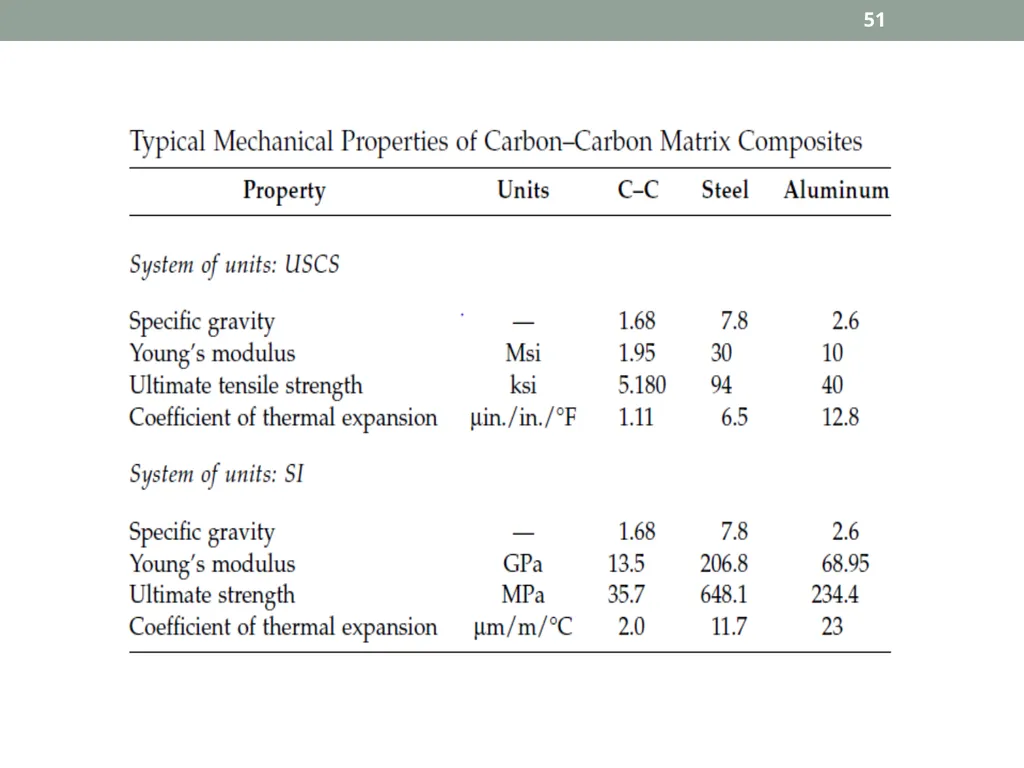
51<br>
52
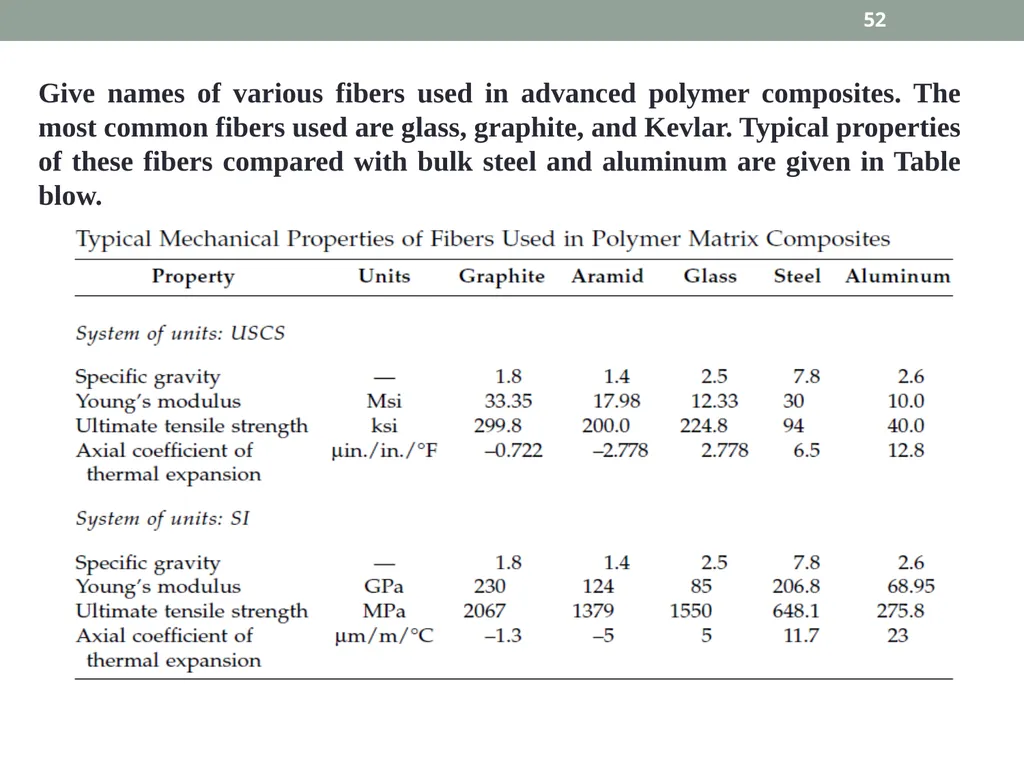
Give names of various fibers used in advanced polymer composites. The most common fibers used are glass, graphite, and Kevlar. Typical properties of these fibers compared with bulk steel and aluminum are given in Table blow. 52<br>
53
Give A Description Of The Glass Fiber.
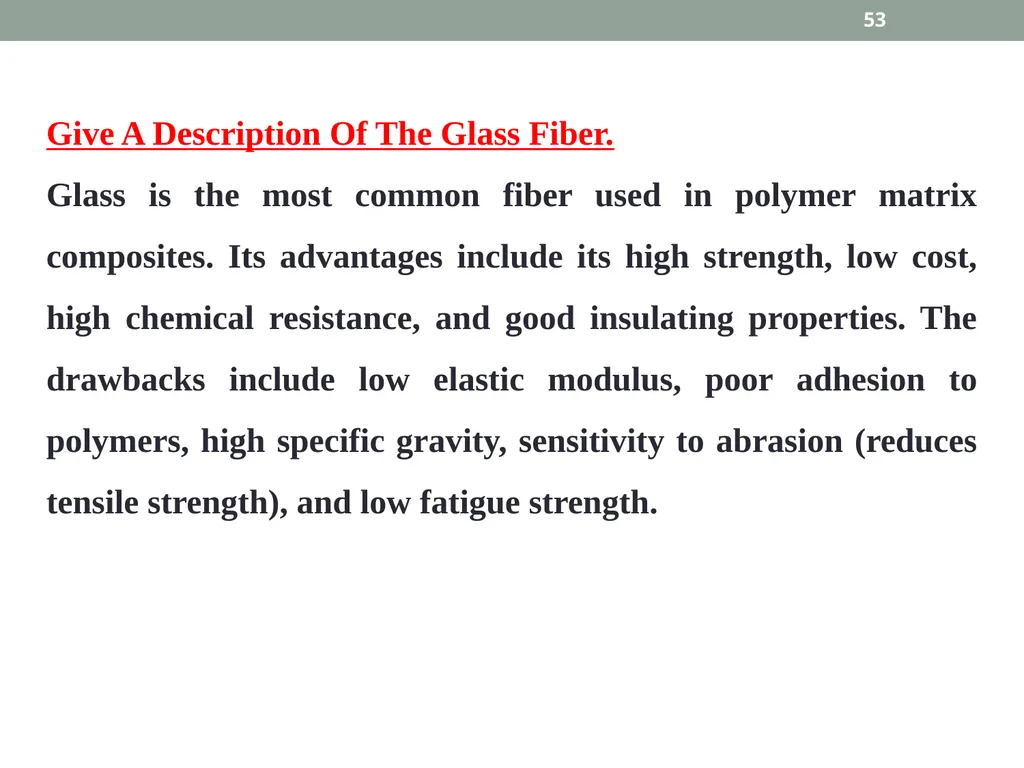
Glass is the most common fiber used in polymer matrix composites. Its advantages include its high strength, low cost, high chemical resistance, and good insulating properties. The drawbacks include low elastic modulus, poor adhesion to polymers, high specific gravity, sensitivity to abrasion (reduces tensile strength), and low fatigue strength. 53<br>
Glass is the most common fiber used in polymer matrix composites. Its advantages include its high strength, low cost, high chemical resistance, and good insulating properties. The drawbacks include low elastic modulus, poor adhesion to polymers, high specific gravity, sensitivity to abrasion (reduces tensile strength), and low fatigue strength. 53<br>
54
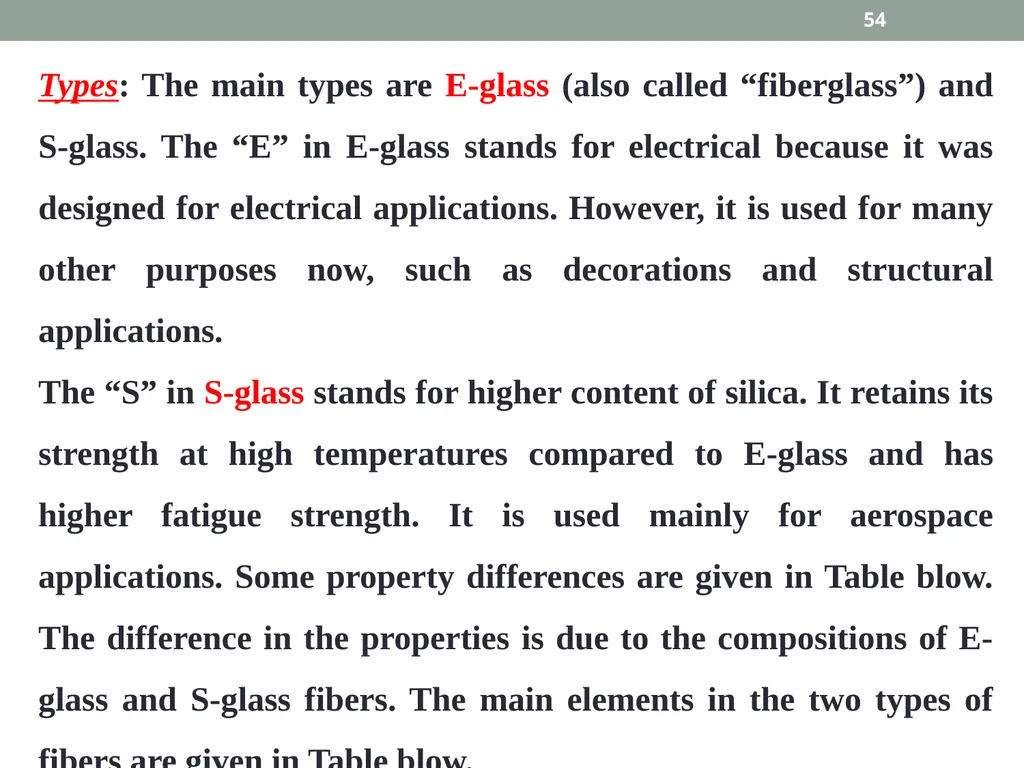
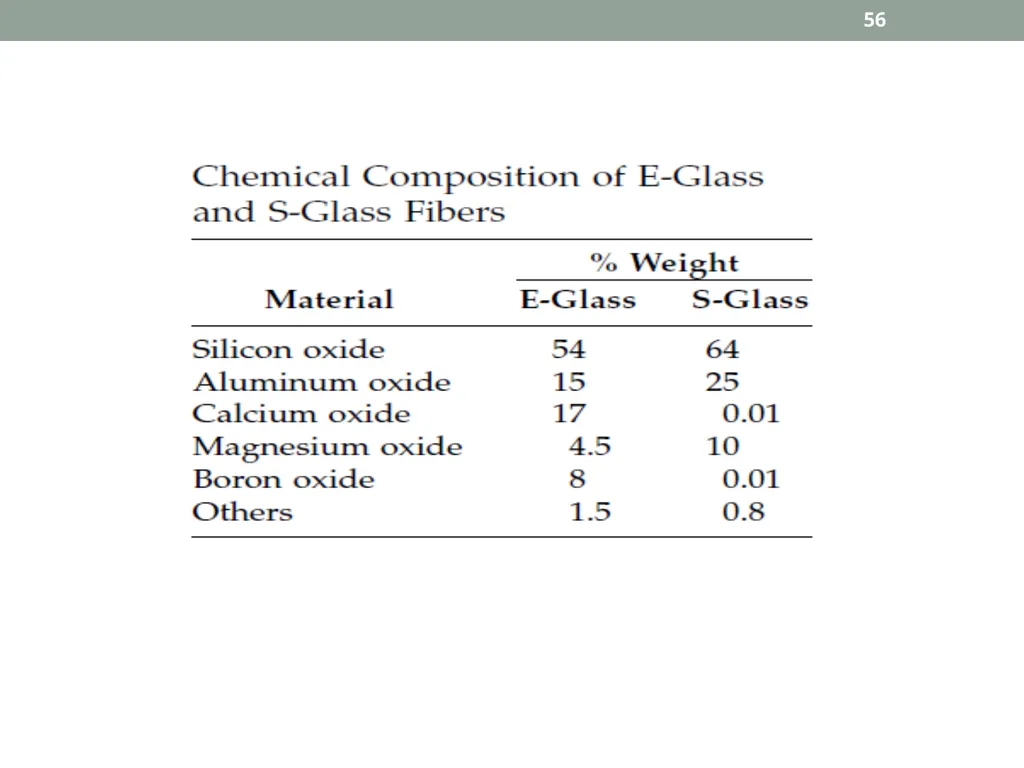
54 Types: The main types are E-glass (also called “fiberglass”) and S-glass. The “E” in E-glass stands for electrical because it was designed for electrical applications. However, it is used for many other purposes now, such as decorations and structural applications.
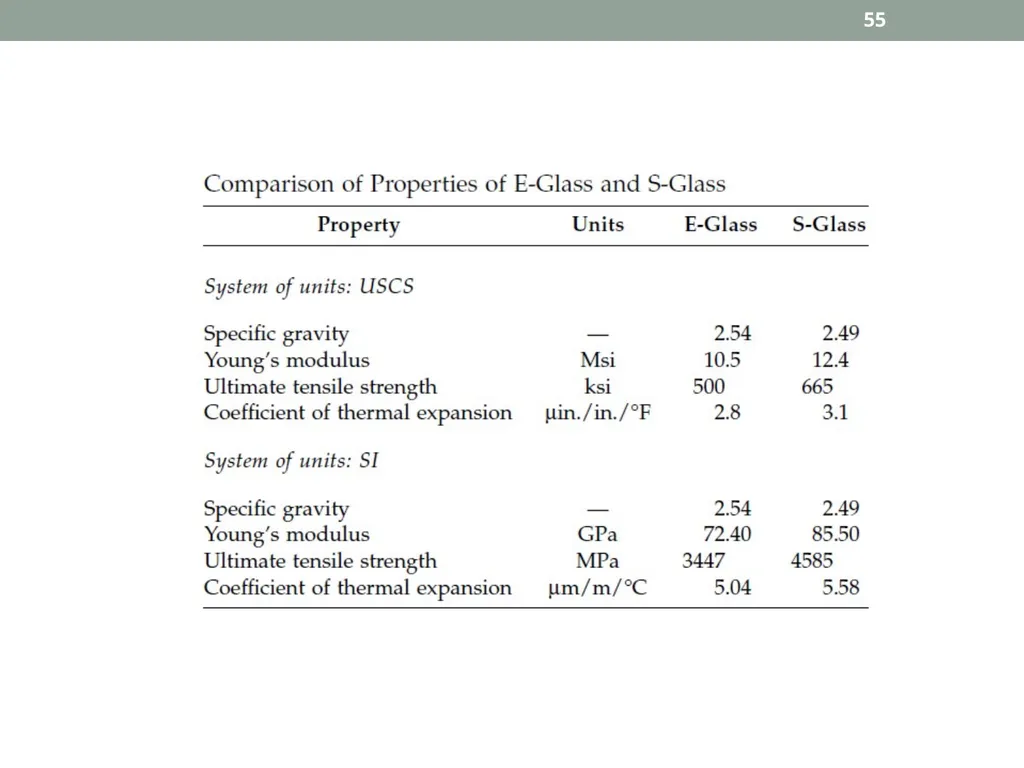
The “S” in S-glass stands for higher content of silica. It retains its strength at high temperatures compared to E-glass and has higher fatigue strength. It is used mainly for aerospace applications. Some property differences are given in Table blow. The difference in the properties is due to the compositions of E-glass and S-glass fibers. The main elements in the two types of fibers are given in Table blow.<br>
The “S” in S-glass stands for higher content of silica. It retains its strength at high temperatures compared to E-glass and has higher fatigue strength. It is used mainly for aerospace applications. Some property differences are given in Table blow. The difference in the properties is due to the compositions of E-glass and S-glass fibers. The main elements in the two types of fibers are given in Table blow.<br>
55
55<br>
56
56<br>
57
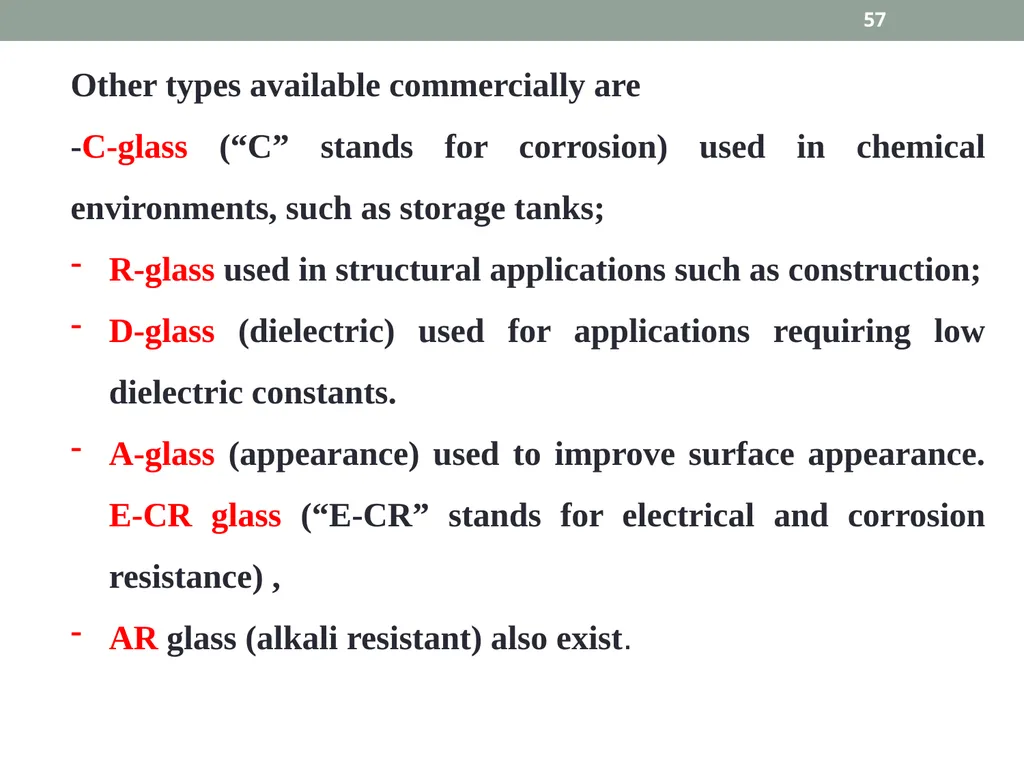
Other types available commercially are
-C-glass (“C” stands for corrosion) used in chemical environments, such as storage tanks;
R-glass used in structural applications such as construction;
D-glass (dielectric) used for applications requiring low dielectric constants.
A-glass (appearance) used to improve surface appearance. E-CR glass (“E-CR” stands for electrical and corrosion resistance) ,
AR glass (alkali resistant) also exist. 57<br>
-C-glass (“C” stands for corrosion) used in chemical environments, such as storage tanks;
R-glass used in structural applications such as construction;
D-glass (dielectric) used for applications requiring low dielectric constants.
A-glass (appearance) used to improve surface appearance. E-CR glass (“E-CR” stands for electrical and corrosion resistance) ,
AR glass (alkali resistant) also exist. 57<br>
58
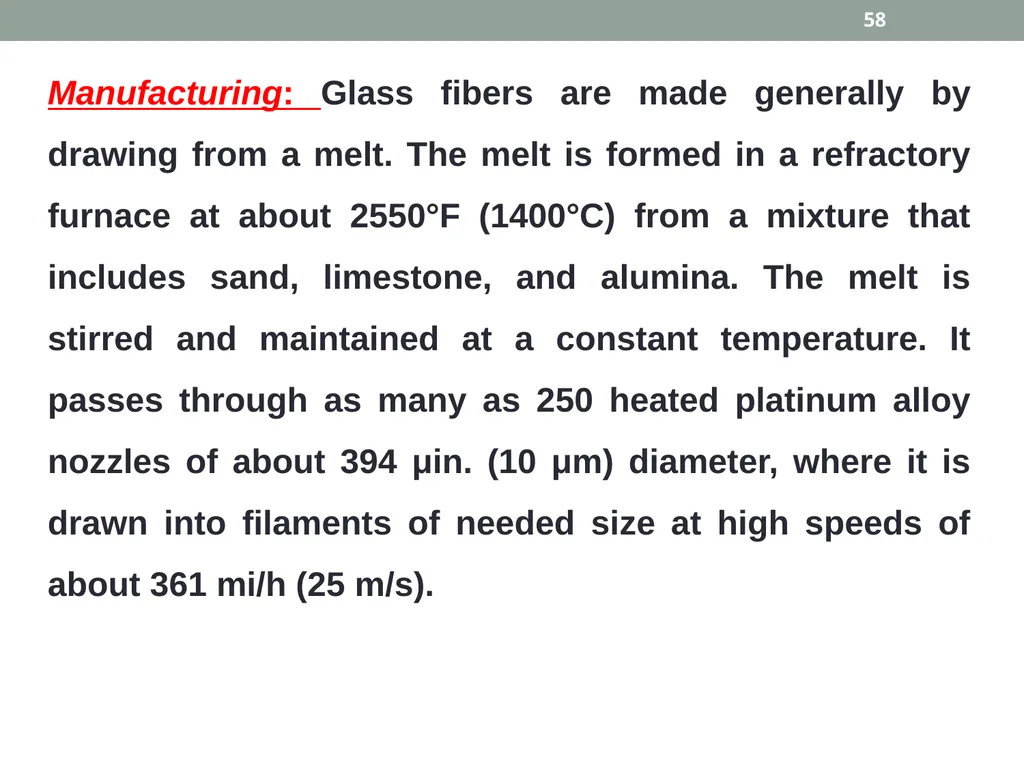
Manufacturing: Glass fibers are made generally by drawing from a melt. The melt is formed in a refractory furnace at about 2550°F (1400°C) from a mixture that includes sand, limestone, and alumina. The melt is stirred and maintained at a constant temperature. It passes through as many as 250 heated platinum alloy nozzles of about 394 μin. (10 μm) diameter, where it is drawn into filaments of needed size at high speeds of about 361 mi/h (25 m/s). 58<br>
59
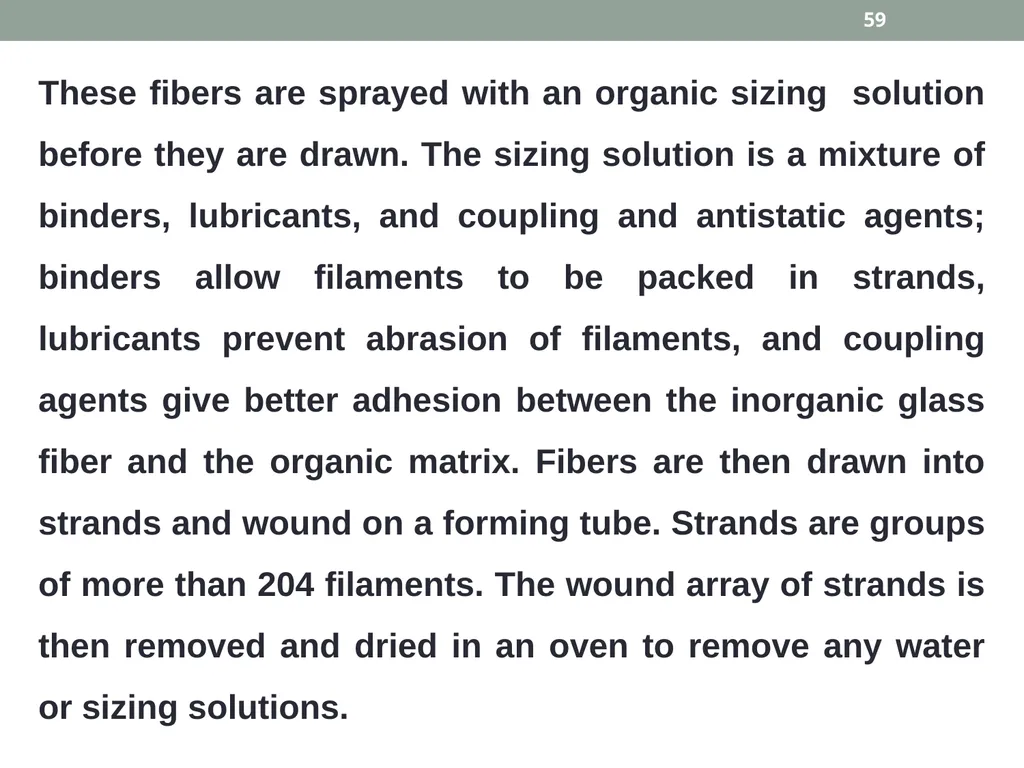
59 These fibers are sprayed with an organic sizing solution before they are drawn. The sizing solution is a mixture of binders, lubricants, and coupling and antistatic agents; binders allow filaments to be packed in strands, lubricants prevent abrasion of filaments, and coupling agents give better adhesion between the inorganic glass fiber and the organic matrix. Fibers are then drawn into strands and wound on a forming tube. Strands are groups of more than 204 filaments. The wound array of strands is then removed and dried in an oven to remove any water or sizing solutions.<br>
60
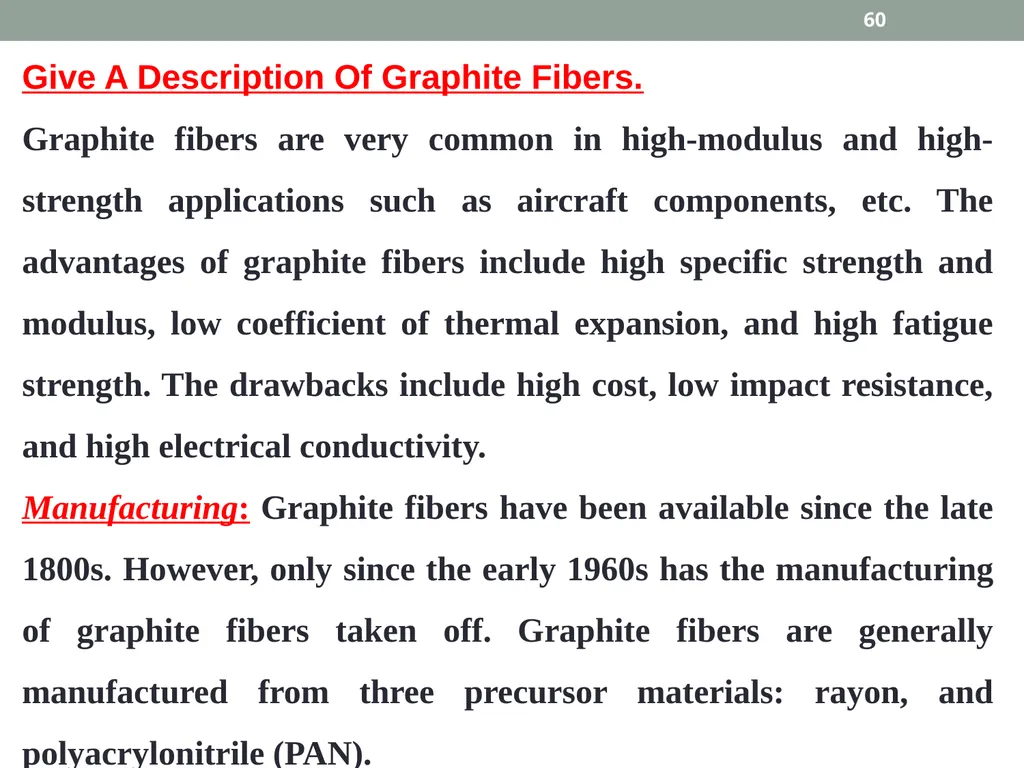
Give A Description Of Graphite Fibers.
Graphite fibers are very common in high-modulus and high-strength applications such as aircraft components, etc. The advantages of graphite fibers include high specific strength and modulus, low coefficient of thermal expansion, and high fatigue strength. The drawbacks include high cost, low impact resistance, and high electrical conductivity.
Manufacturing: Graphite fibers have been available since the late 1800s. However, only since the early 1960s has the manufacturing of graphite fibers taken off. Graphite fibers are generally manufactured from three precursor materials: rayon, and polyacrylonitrile (PAN). 60<br>
Graphite fibers are very common in high-modulus and high-strength applications such as aircraft components, etc. The advantages of graphite fibers include high specific strength and modulus, low coefficient of thermal expansion, and high fatigue strength. The drawbacks include high cost, low impact resistance, and high electrical conductivity.
Manufacturing: Graphite fibers have been available since the late 1800s. However, only since the early 1960s has the manufacturing of graphite fibers taken off. Graphite fibers are generally manufactured from three precursor materials: rayon, and polyacrylonitrile (PAN). 60<br>
61
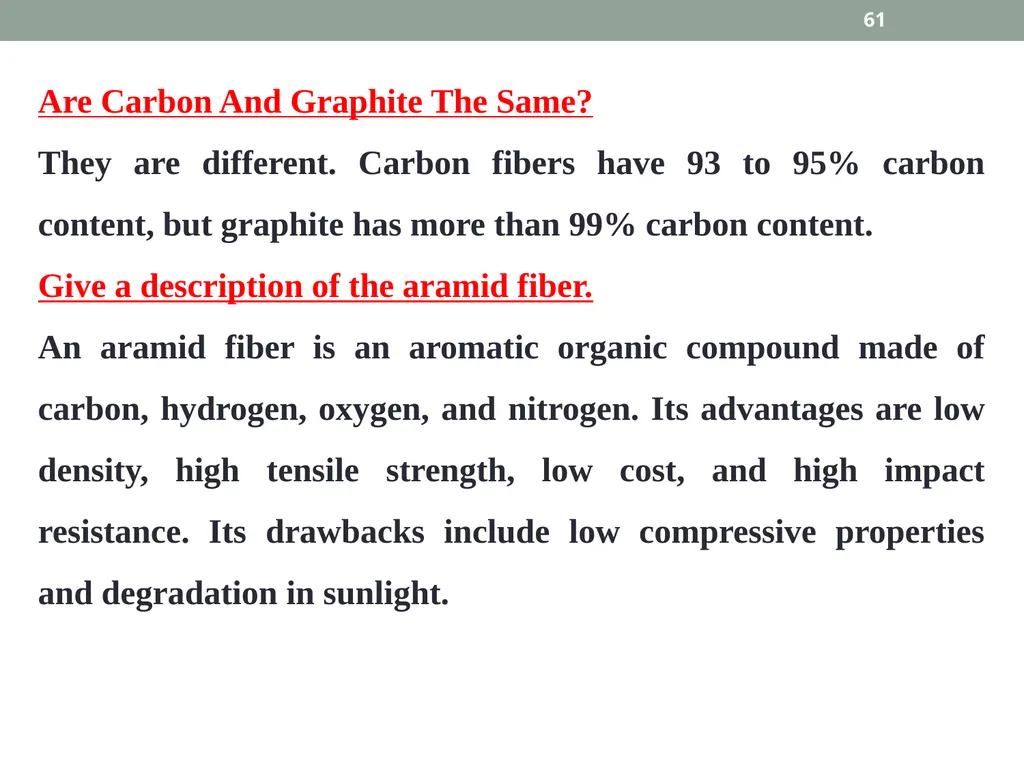
Are Carbon And Graphite The Same?
They are different. Carbon fibers have 93 to 95% carbon content, but graphite has more than 99% carbon content.
Give a description of the aramid fiber.
An aramid fiber is an aromatic organic compound made of carbon, hydrogen, oxygen, and nitrogen. Its advantages are low density, high tensile strength, low cost, and high impact resistance. Its drawbacks include low compressive properties and degradation in sunlight. 61<br>
They are different. Carbon fibers have 93 to 95% carbon content, but graphite has more than 99% carbon content.
Give a description of the aramid fiber.
An aramid fiber is an aromatic organic compound made of carbon, hydrogen, oxygen, and nitrogen. Its advantages are low density, high tensile strength, low cost, and high impact resistance. Its drawbacks include low compressive properties and degradation in sunlight. 61<br>
62
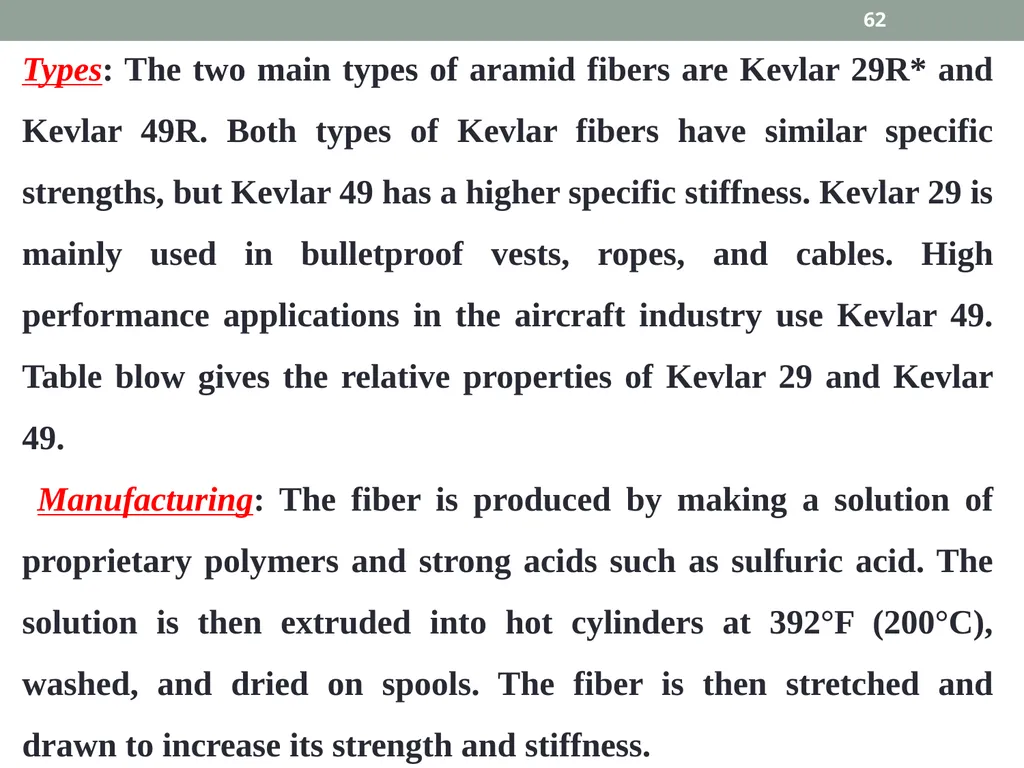
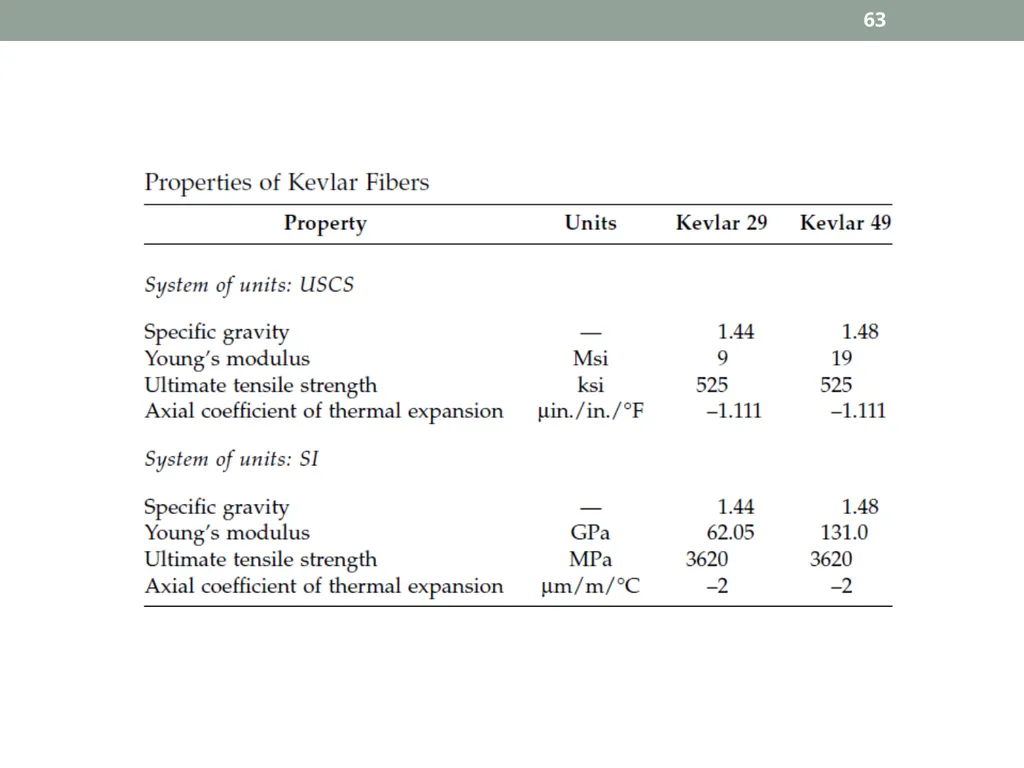
62 Types: The two main types of aramid fibers are Kevlar 29R* and Kevlar 49R. Both types of Kevlar fibers have similar specific strengths, but Kevlar 49 has a higher specific stiffness. Kevlar 29 is mainly used in bulletproof vests, ropes, and cables. High performance applications in the aircraft industry use Kevlar 49. Table blow gives the relative properties of Kevlar 29 and Kevlar 49.
Manufacturing: The fiber is produced by making a solution of proprietary polymers and strong acids such as sulfuric acid. The solution is then extruded into hot cylinders at 392°F (200°C), washed, and dried on spools. The fiber is then stretched and drawn to increase its strength and stiffness.<br>
Manufacturing: The fiber is produced by making a solution of proprietary polymers and strong acids such as sulfuric acid. The solution is then extruded into hot cylinders at 392°F (200°C), washed, and dried on spools. The fiber is then stretched and drawn to increase its strength and stiffness.<br>
63
63<br>
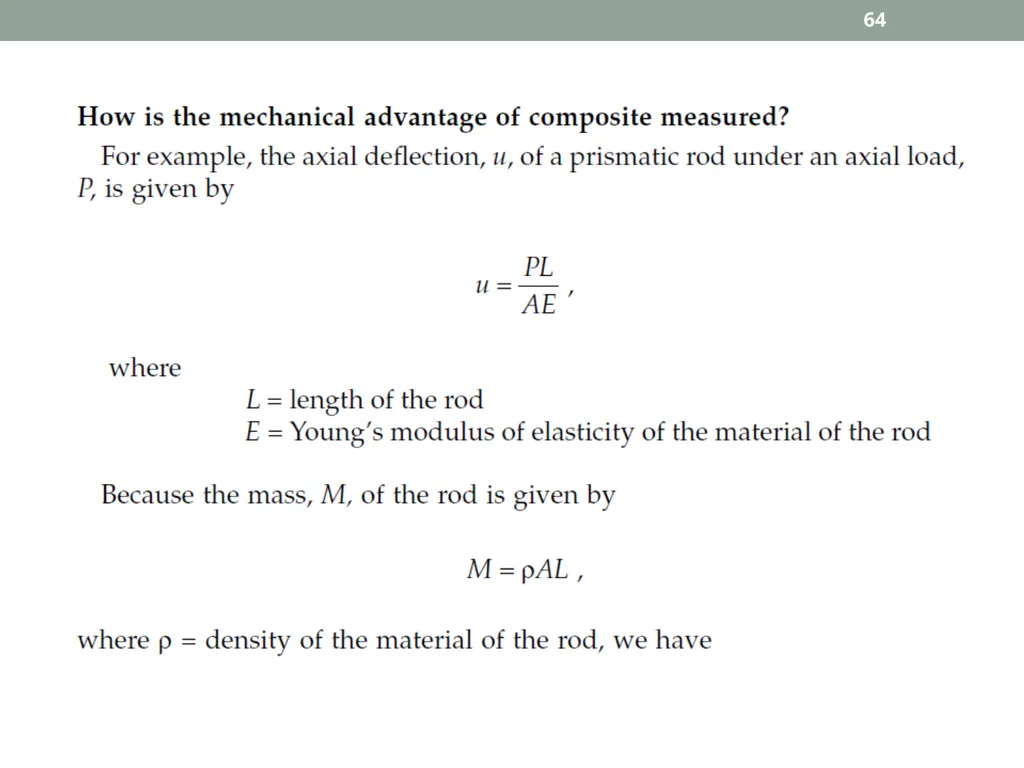
64
64<br>
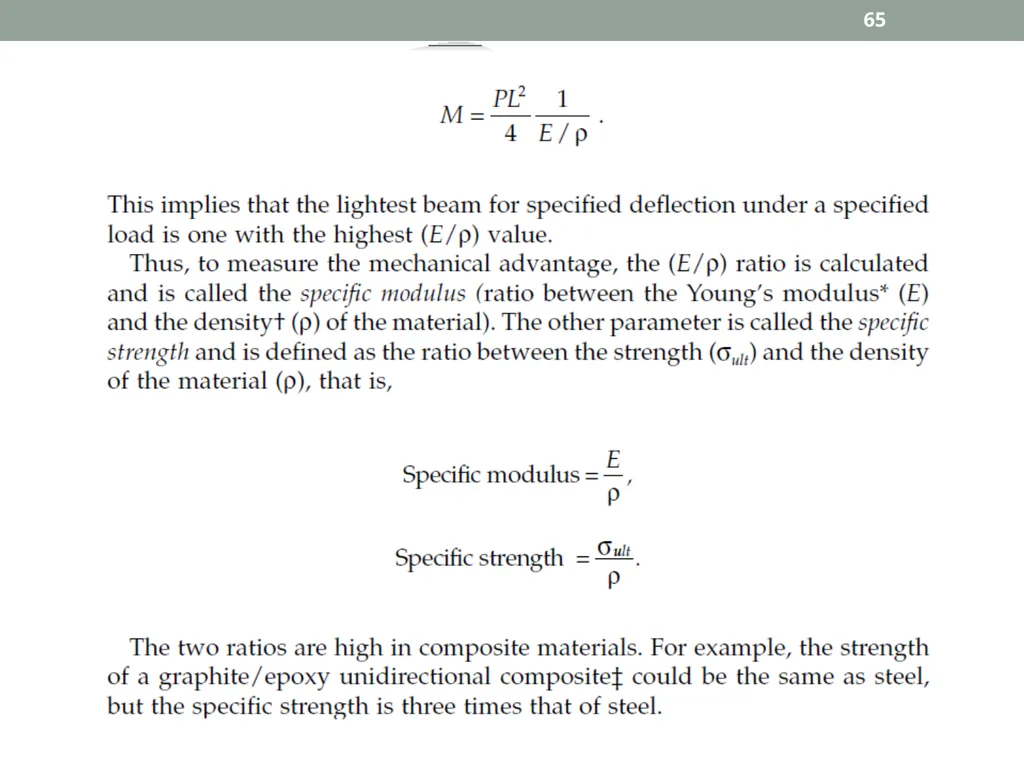
65
65<br>
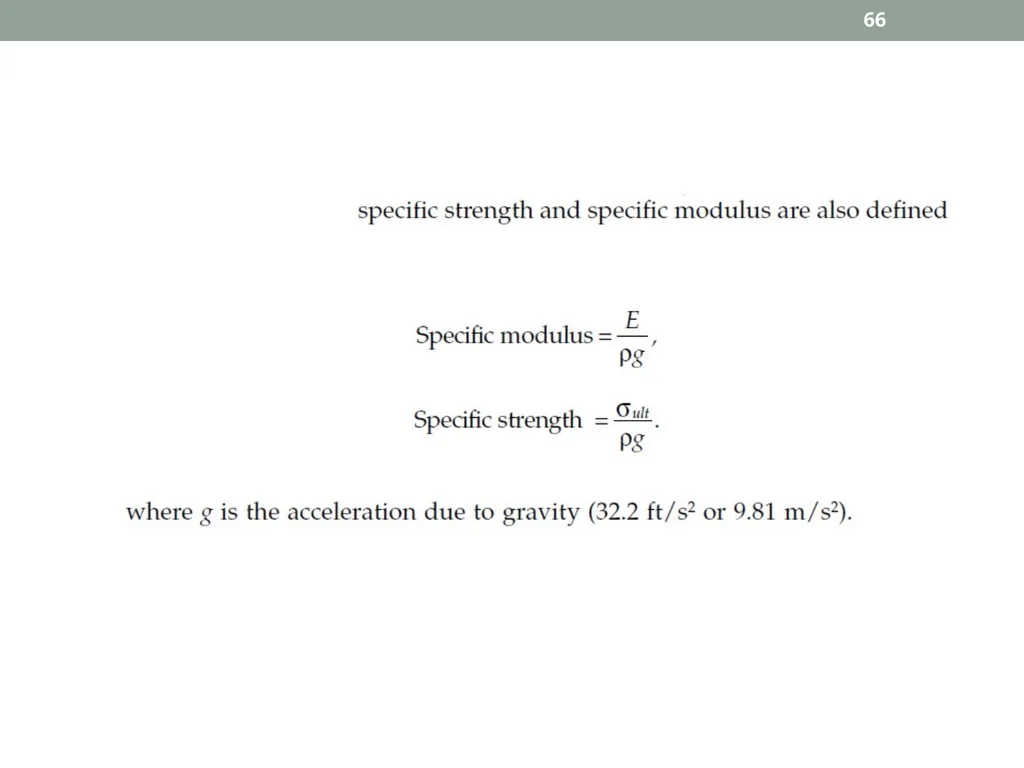
66
66<br>
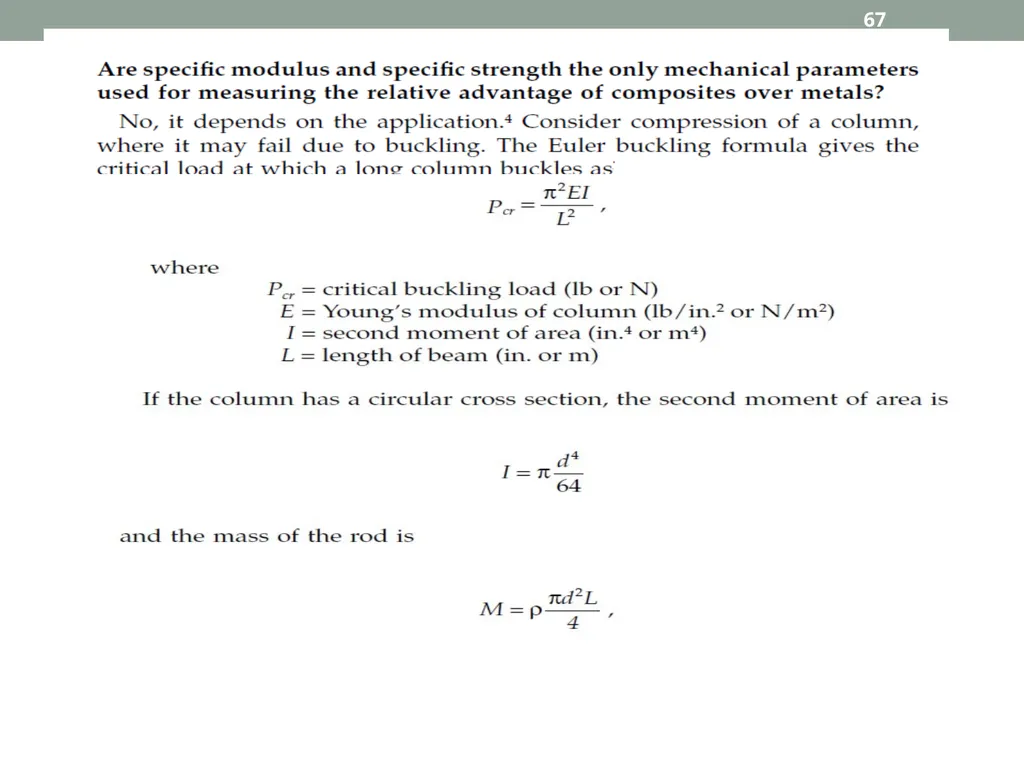
67
67<br>
68
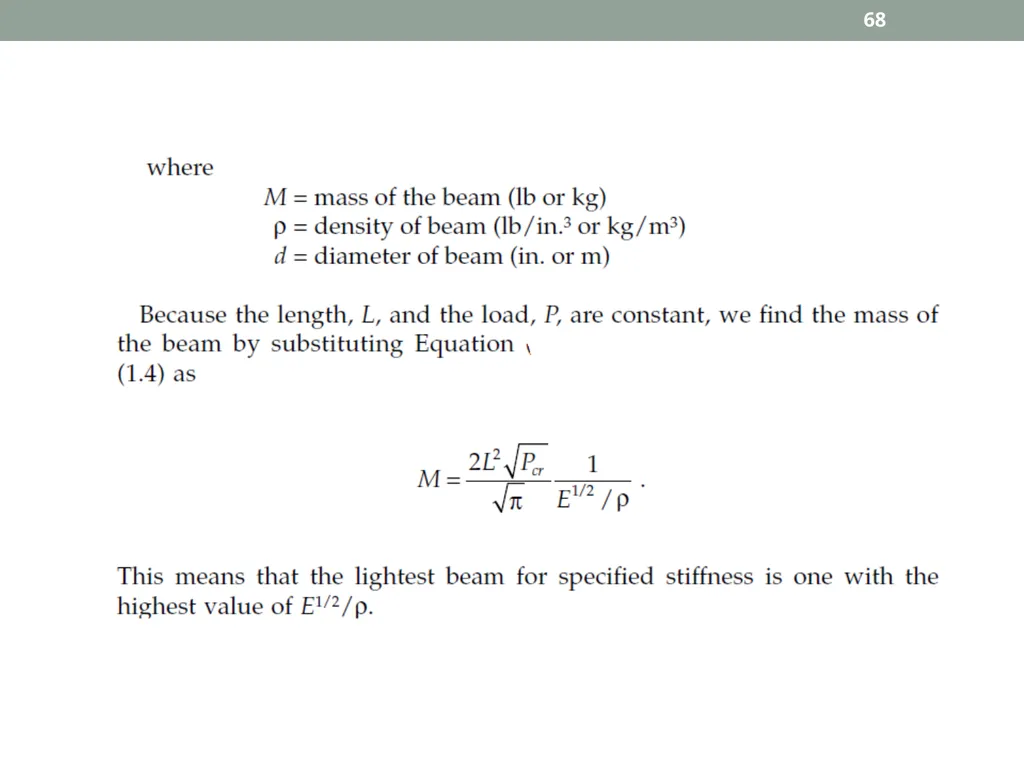
68<br>
69
69 Give a typical method of processing a carbon–carbon composite.
A typical method for manufacturing carbon–carbon composites is called low-pressure carbonization . A graphite cloth is taken, impregnated by resin (such as phenolic, pitch, and furfuryl ester), and laid up in layers. It is laid in a mold, cured, and trimmed. The part is then paralyzed, converting the phenolic resin to graphite. The composite is then impregnated by furfuryl alcohol. The process drives off the resin and any volatiles. The process is repeated three or four times until the level of porosity is reduced to an acceptable level. Each time, this process increases its modulus and strength. Because carbon–carbon composites oxidize at temperatures as low as 450°C, an outer layer of silicon carbide may be deposited<br>
A typical method for manufacturing carbon–carbon composites is called low-pressure carbonization . A graphite cloth is taken, impregnated by resin (such as phenolic, pitch, and furfuryl ester), and laid up in layers. It is laid in a mold, cured, and trimmed. The part is then paralyzed, converting the phenolic resin to graphite. The composite is then impregnated by furfuryl alcohol. The process drives off the resin and any volatiles. The process is repeated three or four times until the level of porosity is reduced to an acceptable level. Each time, this process increases its modulus and strength. Because carbon–carbon composites oxidize at temperatures as low as 450°C, an outer layer of silicon carbide may be deposited<br>
70
70 What are the applications of carbon–carbon composites?
The main uses of carbon–carbon composites are the following:
• Space shuttle nose cones: As the shuttle enters Earth’s atmosphere, temperatures as high as 1700°C are experienced. Carbon– carbon composite is a material of choice for the nose cone because it has the lowest overall weight of all ablative materials; high thermal conductivity to prevent surface cracking; high specific heat to absorb large heat flux; and high thermal shock resistance to low temperatures in space of –150°C)to 1700°C due to re-entry. Also, the carbon–carbon nose remains undamaged and can be reused many times.<br>
The main uses of carbon–carbon composites are the following:
• Space shuttle nose cones: As the shuttle enters Earth’s atmosphere, temperatures as high as 1700°C are experienced. Carbon– carbon composite is a material of choice for the nose cone because it has the lowest overall weight of all ablative materials; high thermal conductivity to prevent surface cracking; high specific heat to absorb large heat flux; and high thermal shock resistance to low temperatures in space of –150°C)to 1700°C due to re-entry. Also, the carbon–carbon nose remains undamaged and can be reused many times.<br>
71
71 • Aircraft brakes: The carbon–carbon brakes is several times more than their metallic counterpart; however, the high durability (two to four times that of steel), high specific heat (2.5 times that of steel), low braking distances and braking times (three-quarters that of berylium), and large weight savings of up to 450 kg on a commercial aircraft
• Mechanical fasteners: Fasteners needed for high temperature applications are made of carbon–carbon composites because they lose little strength at high temperatures.<br>
• Mechanical fasteners: Fasteners needed for high temperature applications are made of carbon–carbon composites because they lose little strength at high temperatures.<br>
72
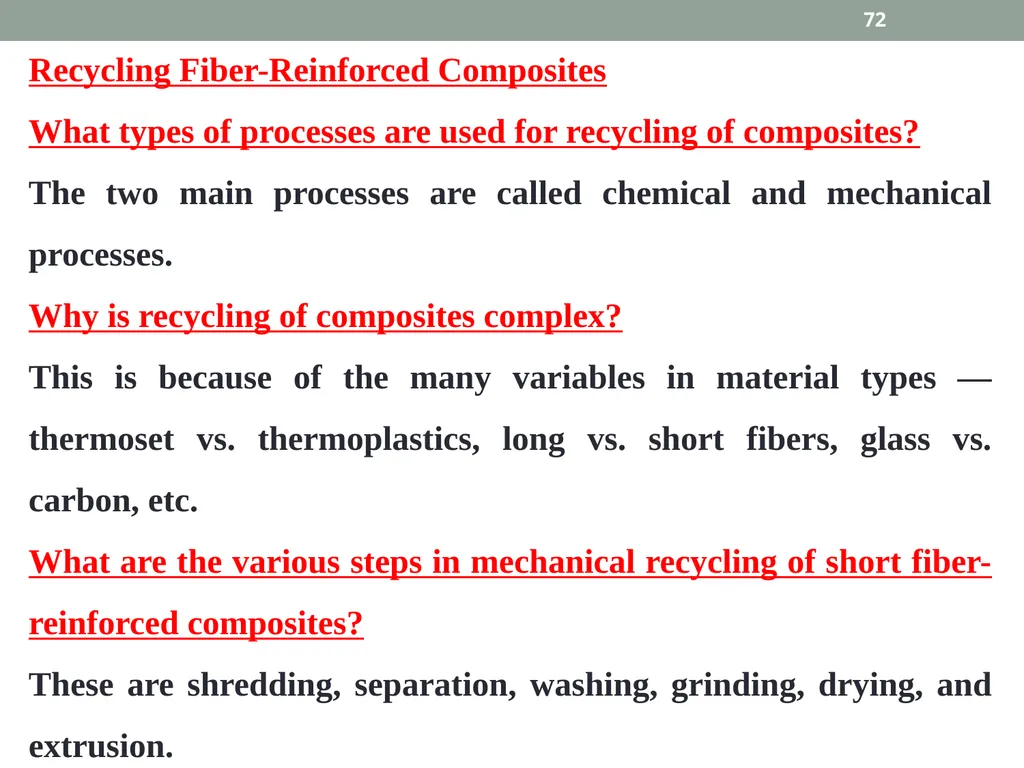
72 Recycling Fiber-Reinforced Composites
What types of processes are used for recycling of composites?
The two main processes are called chemical and mechanical processes.
Why is recycling of composites complex?
This is because of the many variables in material types — thermoset vs. thermoplastics, long vs. short fibers, glass vs. carbon, etc.
What are the various steps in mechanical recycling of short fiber-reinforced composites?
These are shredding, separation, washing, grinding, drying, and extrusion.<br>
What types of processes are used for recycling of composites?
The two main processes are called chemical and mechanical processes.
Why is recycling of composites complex?
This is because of the many variables in material types — thermoset vs. thermoplastics, long vs. short fibers, glass vs. carbon, etc.
What are the various steps in mechanical recycling of short fiber-reinforced composites?
These are shredding, separation, washing, grinding, drying, and extrusion.<br>
73
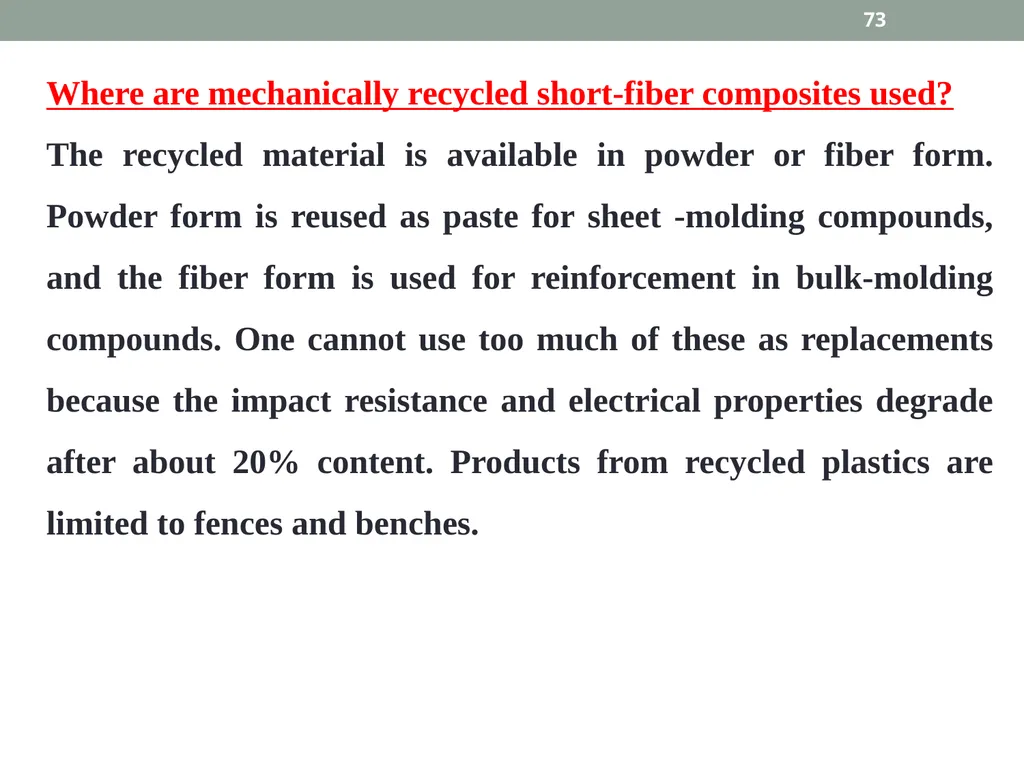
73 Where are mechanically recycled short-fiber composites used?
The recycled material is available in powder or fiber form. Powder form is reused as paste for sheet -molding compounds, and the fiber form is used for reinforcement in bulk-molding compounds. One cannot use too much of these as replacements because the impact resistance and electrical properties degrade after about 20% content. Products from recycled plastics are limited to fences and benches.<br>
The recycled material is available in powder or fiber form. Powder form is reused as paste for sheet -molding compounds, and the fiber form is used for reinforcement in bulk-molding compounds. One cannot use too much of these as replacements because the impact resistance and electrical properties degrade after about 20% content. Products from recycled plastics are limited to fences and benches.<br>
74
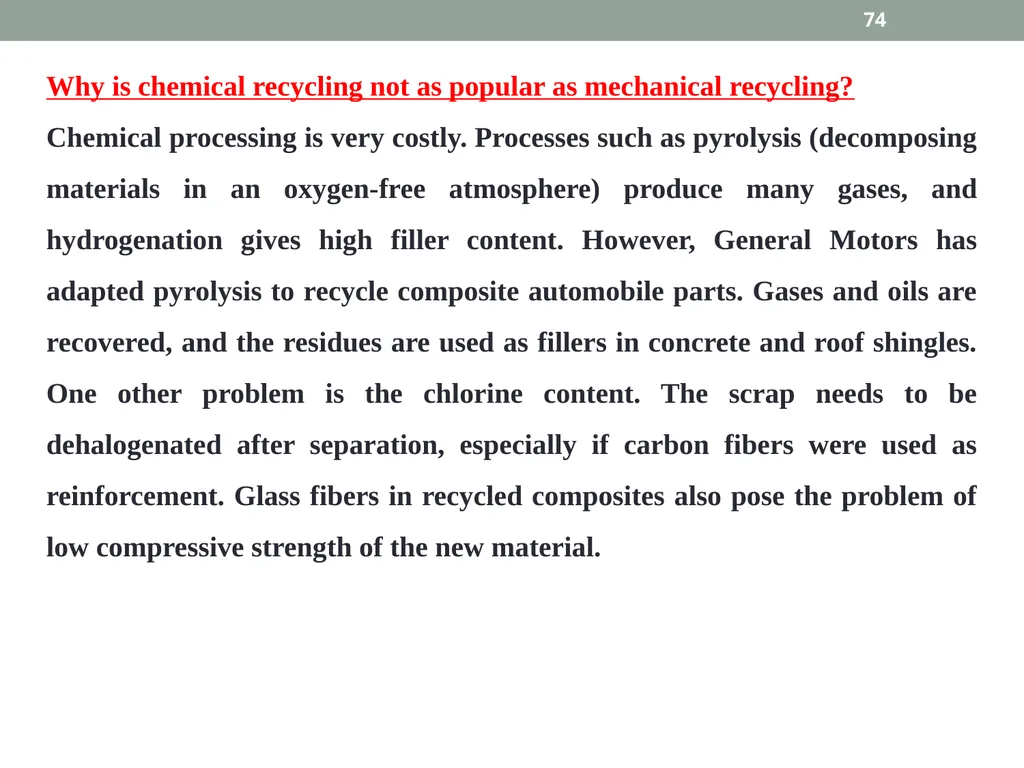
74 Why is chemical recycling not as popular as mechanical recycling?
Chemical processing is very costly. Processes such as pyrolysis (decomposing materials in an oxygen-free atmosphere) produce many gases, and hydrogenation gives high filler content. However, General Motors has adapted pyrolysis to recycle composite automobile parts. Gases and oils are recovered, and the residues are used as fillers in concrete and roof shingles. One other problem is the chlorine content. The scrap needs to be dehalogenated after separation, especially if carbon fibers were used as reinforcement. Glass fibers in recycled composites also pose the problem of low compressive strength of the new material.<br>
Chemical processing is very costly. Processes such as pyrolysis (decomposing materials in an oxygen-free atmosphere) produce many gases, and hydrogenation gives high filler content. However, General Motors has adapted pyrolysis to recycle composite automobile parts. Gases and oils are recovered, and the residues are used as fillers in concrete and roof shingles. One other problem is the chlorine content. The scrap needs to be dehalogenated after separation, especially if carbon fibers were used as reinforcement. Glass fibers in recycled composites also pose the problem of low compressive strength of the new material.<br>
75
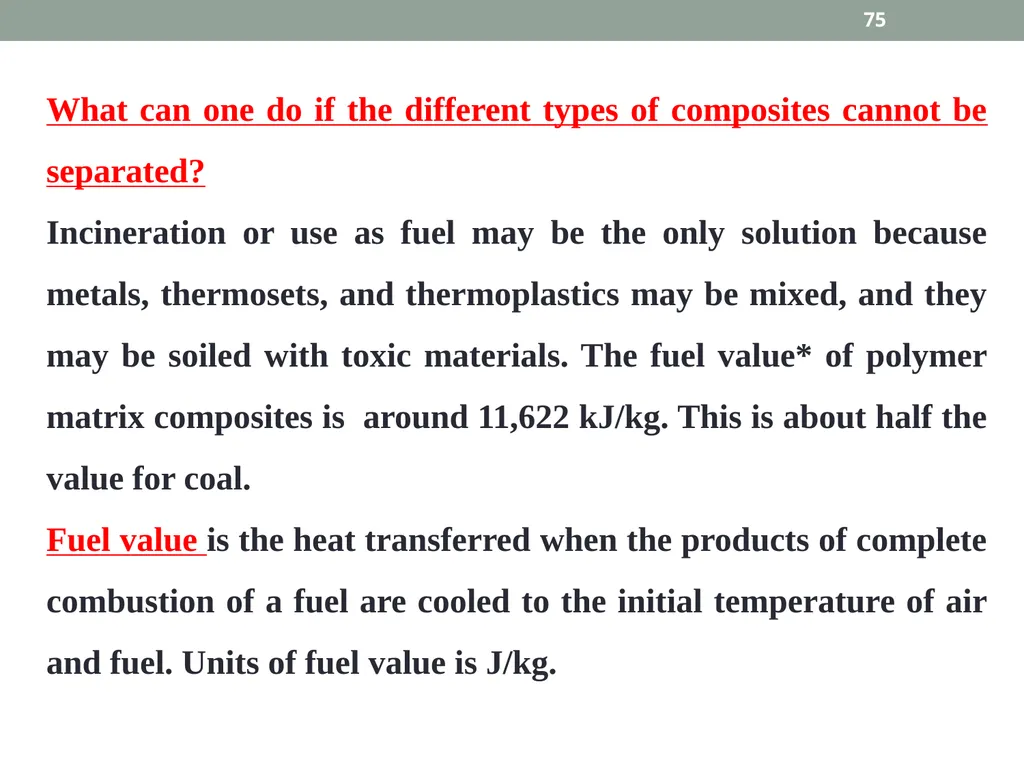
75 What can one do if the different types of composites cannot be separated?
Incineration or use as fuel may be the only solution because metals, thermosets, and thermoplastics may be mixed, and they may be soiled with toxic materials. The fuel value* of polymer matrix composites is around 11,622 kJ/kg. This is about half the value for coal.
Fuel value is the heat transferred when the products of complete combustion of a fuel are cooled to the initial temperature of air and fuel. Units of fuel value is J/kg.<br>
Incineration or use as fuel may be the only solution because metals, thermosets, and thermoplastics may be mixed, and they may be soiled with toxic materials. The fuel value* of polymer matrix composites is around 11,622 kJ/kg. This is about half the value for coal.
Fuel value is the heat transferred when the products of complete combustion of a fuel are cooled to the initial temperature of air and fuel. Units of fuel value is J/kg.<br>
76
76 Which chemical process shows the most promise?
Incineration offers the most promise. Its advantages include minimal cost, high-volume reduction, and no residual material. It is also feasible for low scrap volume.
Mechanics Terminology
How is a composite structure analyzed mechanically?
A composite material consists of two or more constituents; thus, the analysis and design of such materials is different from that for conventional materials such as metals. The approach to analyze the mechanical behavior of composite structures is as follows .<br>
Incineration offers the most promise. Its advantages include minimal cost, high-volume reduction, and no residual material. It is also feasible for low scrap volume.
Mechanics Terminology
How is a composite structure analyzed mechanically?
A composite material consists of two or more constituents; thus, the analysis and design of such materials is different from that for conventional materials such as metals. The approach to analyze the mechanical behavior of composite structures is as follows .<br>
77
77 1. Find the average properties of a composite ply from the individual properties of the constituents. Properties include stiffness, strength, thermal, and moisture expansion coefficients. Note that average properties are derived by considering the ply to be homogeneous. At this level, one can optimize for the stiffness and strength requirements of a lamina. This is called the micromechanics of a lamina.
2. Develop the stress–strain relationships for a unidirectional/bidirectional lamina. Loads may be applied along the principal directions of symmetry of the lamina or off-axis. Also, one develops relationships for stiffness, thermal and moisture expansion coefficients, and strengths of angle plies. Failure theories of a lamina are based on stresses in the lamina and strength properties of a lamina. This is called the macromechanics of a lamina.<br>
2. Develop the stress–strain relationships for a unidirectional/bidirectional lamina. Loads may be applied along the principal directions of symmetry of the lamina or off-axis. Also, one develops relationships for stiffness, thermal and moisture expansion coefficients, and strengths of angle plies. Failure theories of a lamina are based on stresses in the lamina and strength properties of a lamina. This is called the macromechanics of a lamina.<br>
78
78 What is an isotropic body?
An isotropic material has properties that are the same in all directions. For example, the Young’s modulus of steel is the same in all directions.
What is a homogeneous body?
A homogeneous body has properties that are the same at all points in the body. A steel rod is an example of a homogeneous body. However, if one heats this rod at one end, the temperature at various points on the rod would be different. Because Young’s modulus of steel varies with temperature, one no longer has a homogeneous body.
The body is still isotropic because the properties at a particular point are still identical in all directions.<br>
An isotropic material has properties that are the same in all directions. For example, the Young’s modulus of steel is the same in all directions.
What is a homogeneous body?
A homogeneous body has properties that are the same at all points in the body. A steel rod is an example of a homogeneous body. However, if one heats this rod at one end, the temperature at various points on the rod would be different. Because Young’s modulus of steel varies with temperature, one no longer has a homogeneous body.
The body is still isotropic because the properties at a particular point are still identical in all directions.<br>
79
79 Are composite materials isotropic and/or homogeneous?
Most composite materials are neither isotropic nor homogeneous. For example, consider epoxy reinforced with long glass fibers. If one chooses a location on the glass fiber, the properties are different from a location on the
epoxy matrix. This makes the composite material nonhomogeneous (not homogeneous). Also, the stiffness in the direction parallel to the fibers is higher than in the direction perpendicular to the fibers and thus the properties are not independent of the direction. This makes the composite material anisotropic (not isotropic).<br>
Most composite materials are neither isotropic nor homogeneous. For example, consider epoxy reinforced with long glass fibers. If one chooses a location on the glass fiber, the properties are different from a location on the
epoxy matrix. This makes the composite material nonhomogeneous (not homogeneous). Also, the stiffness in the direction parallel to the fibers is higher than in the direction perpendicular to the fibers and thus the properties are not independent of the direction. This makes the composite material anisotropic (not isotropic).<br>
80
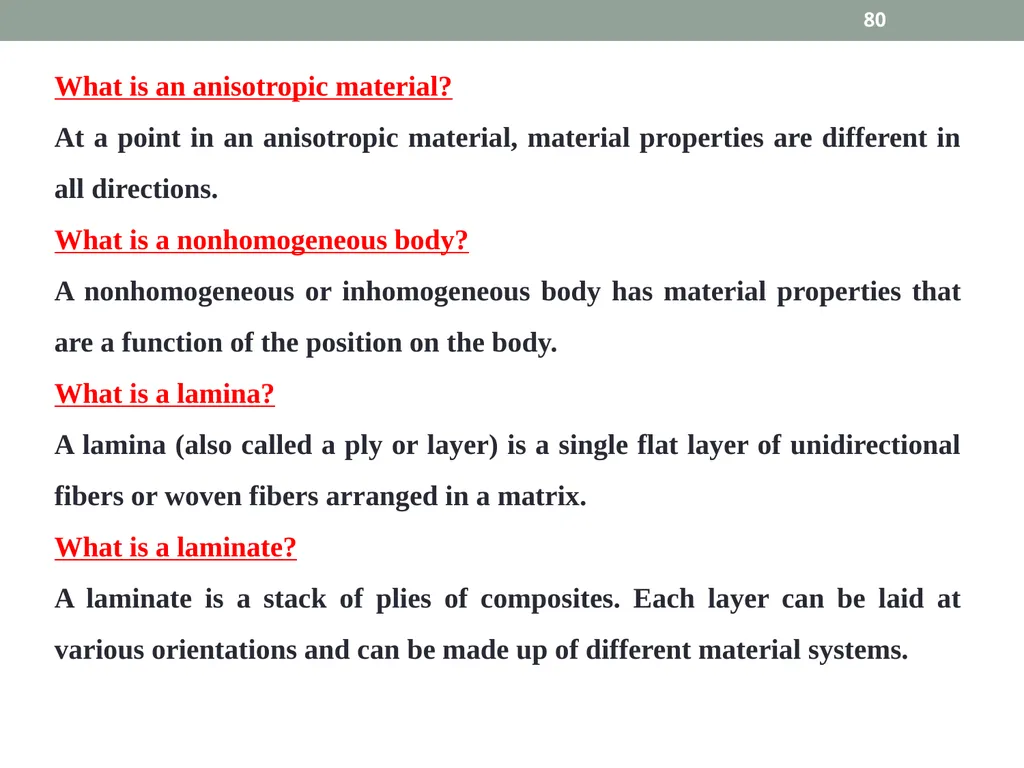
80 What is an anisotropic material?
At a point in an anisotropic material, material properties are different in all directions.
What is a nonhomogeneous body?
A nonhomogeneous or inhomogeneous body has material properties that are a function of the position on the body.
What is a lamina?
A lamina (also called a ply or layer) is a single flat layer of unidirectional fibers or woven fibers arranged in a matrix.
What is a laminate?
A laminate is a stack of plies of composites. Each layer can be laid at various orientations and can be made up of different material systems.<br>
At a point in an anisotropic material, material properties are different in all directions.
What is a nonhomogeneous body?
A nonhomogeneous or inhomogeneous body has material properties that are a function of the position on the body.
What is a lamina?
A lamina (also called a ply or layer) is a single flat layer of unidirectional fibers or woven fibers arranged in a matrix.
What is a laminate?
A laminate is a stack of plies of composites. Each layer can be laid at various orientations and can be made up of different material systems.<br>
81
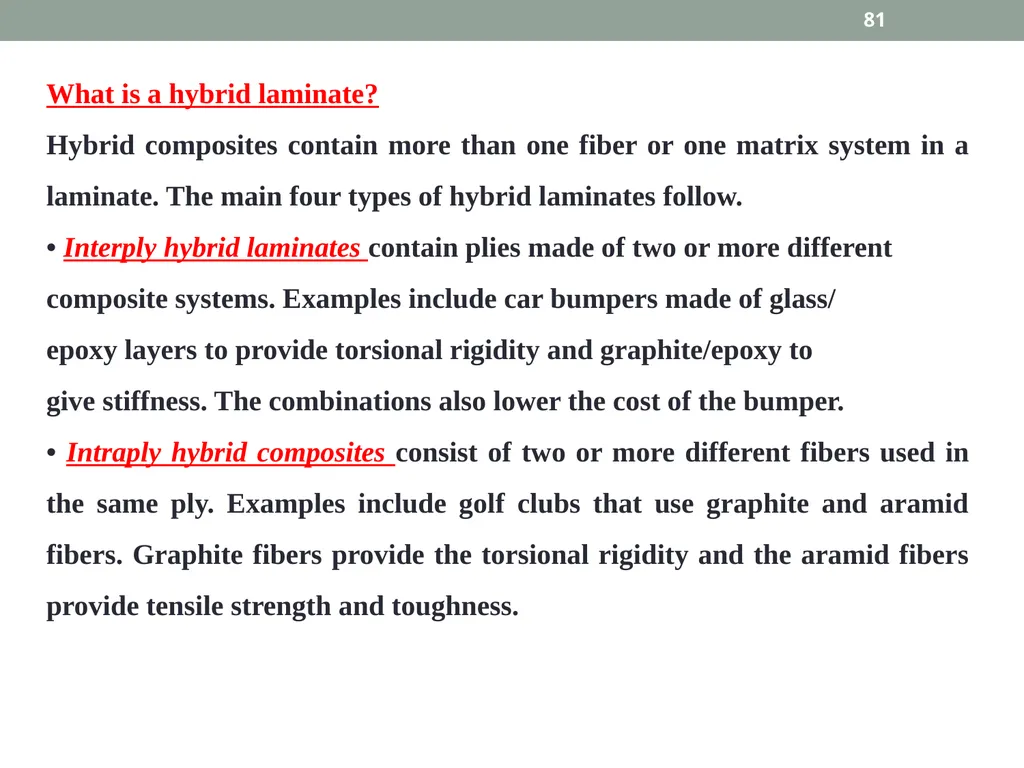
81 What is a hybrid laminate?
Hybrid composites contain more than one fiber or one matrix system in a laminate. The main four types of hybrid laminates follow.
• Interply hybrid laminates contain plies made of two or more different
composite systems. Examples include car bumpers made of glass/
epoxy layers to provide torsional rigidity and graphite/epoxy to
give stiffness. The combinations also lower the cost of the bumper.
• Intraply hybrid composites consist of two or more different fibers used in the same ply. Examples include golf clubs that use graphite and aramid fibers. Graphite fibers provide the torsional rigidity and the aramid fibers provide tensile strength and toughness.<br>
Hybrid composites contain more than one fiber or one matrix system in a laminate. The main four types of hybrid laminates follow.
• Interply hybrid laminates contain plies made of two or more different
composite systems. Examples include car bumpers made of glass/
epoxy layers to provide torsional rigidity and graphite/epoxy to
give stiffness. The combinations also lower the cost of the bumper.
• Intraply hybrid composites consist of two or more different fibers used in the same ply. Examples include golf clubs that use graphite and aramid fibers. Graphite fibers provide the torsional rigidity and the aramid fibers provide tensile strength and toughness.<br>
82
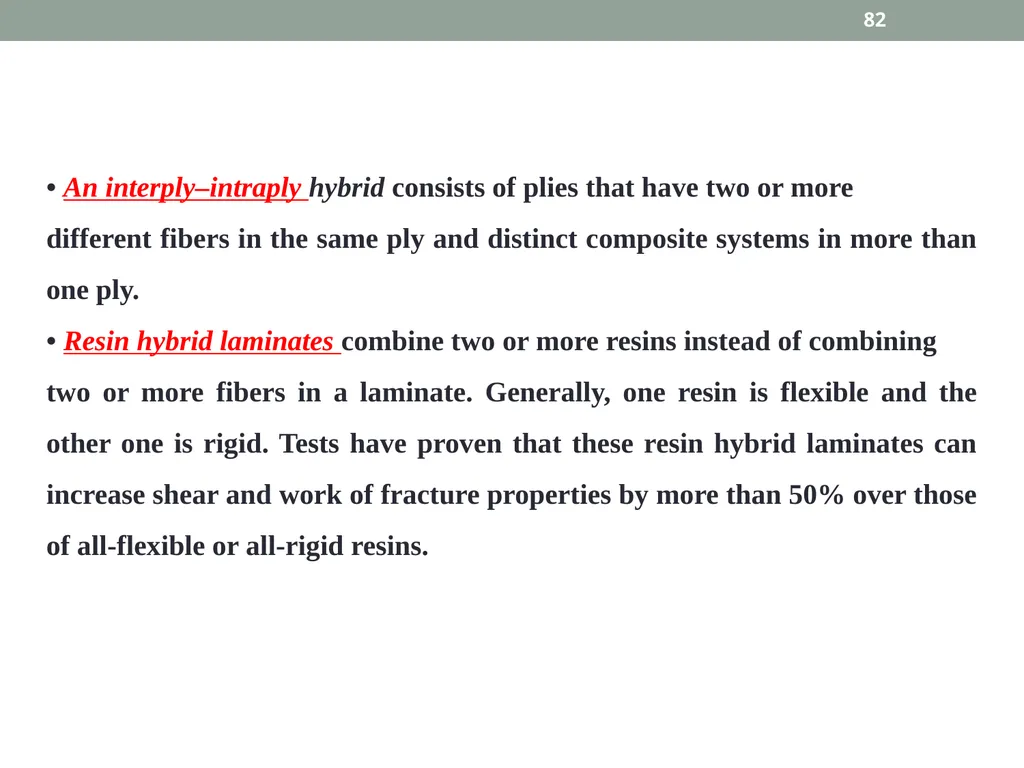
82 • An interply–intraply hybrid consists of plies that have two or more
different fibers in the same ply and distinct composite systems in more than one ply.
• Resin hybrid laminates combine two or more resins instead of combining
two or more fibers in a laminate. Generally, one resin is flexible and the other one is rigid. Tests have proven that these resin hybrid laminates can increase shear and work of fracture properties by more than 50% over those of all-flexible or all-rigid resins.<br>
different fibers in the same ply and distinct composite systems in more than one ply.
• Resin hybrid laminates combine two or more resins instead of combining
two or more fibers in a laminate. Generally, one resin is flexible and the other one is rigid. Tests have proven that these resin hybrid laminates can increase shear and work of fracture properties by more than 50% over those of all-flexible or all-rigid resins.<br>