
Introduction to Data Mining Rafal Lukawiecki
MT
Published · 33 slides · 0 views
1 / 1
Description
Introduction to Data Mining Rafal Lukawiecki Strategic Consultant, Project Botticelli Ltd rafalprojectbotticelli.co.uk Objectives Overview Data Mining Introduce typical applications and scenarios Explain some DM concepts Review wider
Related Topics
Share
Embed code
Download this presentation From Below
"Introduction to Data Mining Rafal Lukawiecki" is the property of its rightful owner. Permission is granted to download and print the materials on this website for personal, non-commercial use only, and to display it on your personal computer provided you do not modify the materials and that you retain all copyright notices contained in the materials. By downloading content from our website, you accept the terms of this agreement.
Presentation Transcript
01
Introduction to Data Mining Rafal Lukawiecki
Strategic Consultant, Project Botticelli Ltd
rafal@projectbotticelli.co.uk<br>
rafal@projectbotticelli.co.uk<br>
02
Objectives Overview Data Mining
Introduce typical applications and scenarios
Explain some DM concepts
Review wider product platform The information herein is for informational purposes only and represents the opinions and views of Project Botticelli and/or Rafal Lukawiecki. The material presented is not certain and may vary based on several factors. Microsoft makes no warranties, express, implied or statutory, as to the information in this presentation.
© 2007 Project Botticelli Ltd & Microsoft Corp. Some slides contain quotations from copyrighted materials by other authors, as individually attributed. All rights reserved. Microsoft, Windows, Windows Vista and other product names are or may be registered trademarks and/or trademarks in the U.S. and/or other countries. The information herein is for informational purposes only and represents the current view of Project Botticelli Ltd as of the date of this presentation. Because Project Botticelli & Microsoft must respond to changing market conditions, it should not be interpreted to be a commitment on the part of Microsoft, and Microsoft and Project Botticelli cannot guarantee the accuracy of any information provided after the date of this presentation. Project Botticelli makes no warranties, express, implied or statutory, as to the information in this presentation. E&OE. This seminar is partly based on “Data Mining” book by ZhaoHui Tang and Jamie MacLennan, and also on Jamie’s presentations. Thank you to Jamie and to Donald Farmer for helping me in preparing this session. Thank you to Roni Karassik for a slide. Thank you to Mike Tsalidis, Olga Londer, and Marin Bezic for all the support. Thank you to Maciej Pilecki for assistance with demos.<br>
Introduce typical applications and scenarios
Explain some DM concepts
Review wider product platform The information herein is for informational purposes only and represents the opinions and views of Project Botticelli and/or Rafal Lukawiecki. The material presented is not certain and may vary based on several factors. Microsoft makes no warranties, express, implied or statutory, as to the information in this presentation.
© 2007 Project Botticelli Ltd & Microsoft Corp. Some slides contain quotations from copyrighted materials by other authors, as individually attributed. All rights reserved. Microsoft, Windows, Windows Vista and other product names are or may be registered trademarks and/or trademarks in the U.S. and/or other countries. The information herein is for informational purposes only and represents the current view of Project Botticelli Ltd as of the date of this presentation. Because Project Botticelli & Microsoft must respond to changing market conditions, it should not be interpreted to be a commitment on the part of Microsoft, and Microsoft and Project Botticelli cannot guarantee the accuracy of any information provided after the date of this presentation. Project Botticelli makes no warranties, express, implied or statutory, as to the information in this presentation. E&OE. This seminar is partly based on “Data Mining” book by ZhaoHui Tang and Jamie MacLennan, and also on Jamie’s presentations. Thank you to Jamie and to Donald Farmer for helping me in preparing this session. Thank you to Roni Karassik for a slide. Thank you to Mike Tsalidis, Olga Londer, and Marin Bezic for all the support. Thank you to Maciej Pilecki for assistance with demos.<br>
03
Before We Dive In... To help me select the most suitable examples and demonstrations I would like to ask you about your background
Who do you identify yourself with:
IT Professional,
Database Professional,
Software/System Developer?<br>
Who do you identify yourself with:
IT Professional,
Database Professional,
Software/System Developer?<br>
04
The Essence of Data Mining as Part of Business Intelligence<br>
05
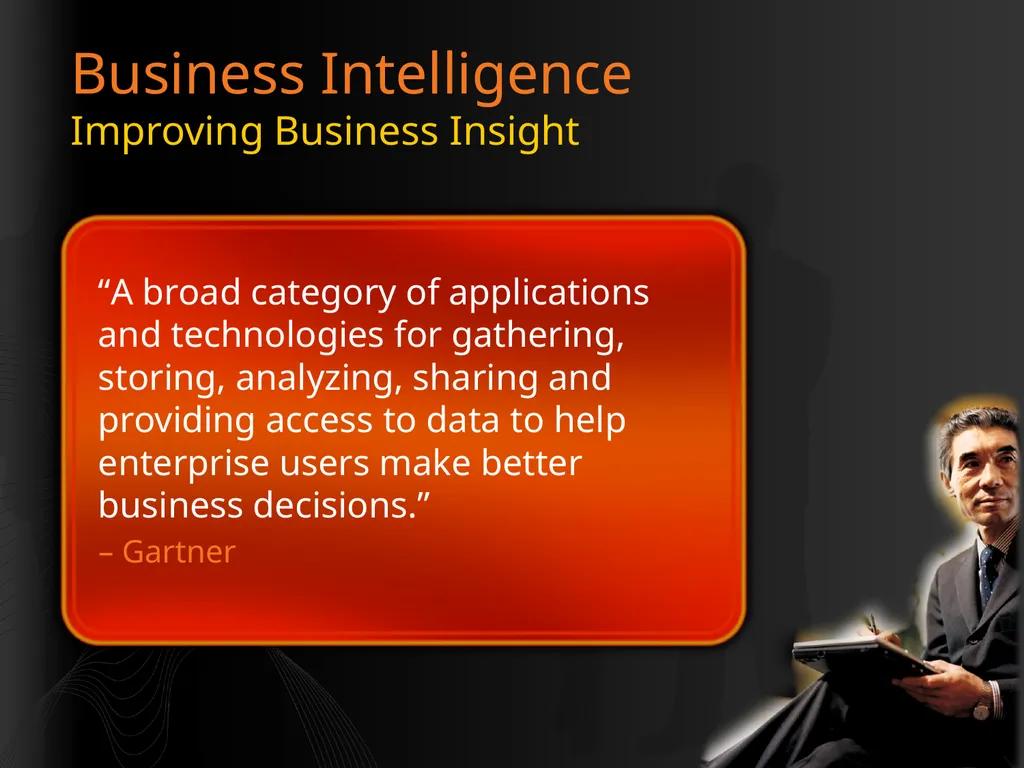
Business Intelligence
Improving Business Insight “A broad category of applications and technologies for gathering, storing, analyzing, sharing and providing access to data to help enterprise users make better business decisions.”
– Gartner<br>
– Gartner<br>
06
Relationships
And Acronyms...<br>
07
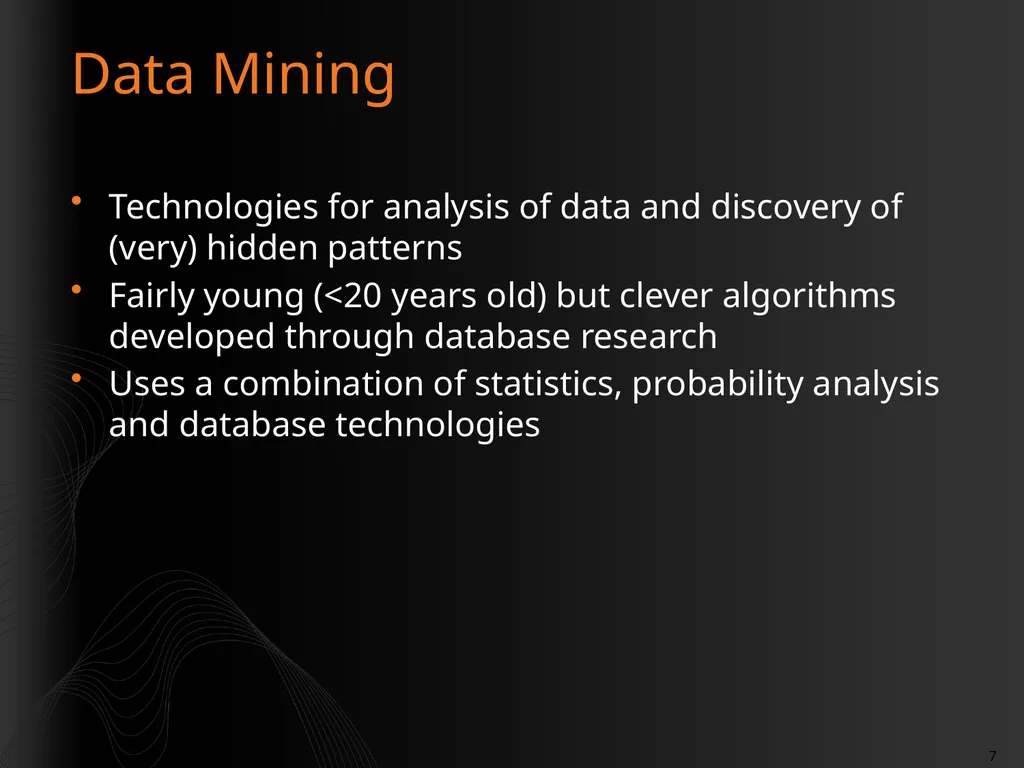
Data Mining Technologies for analysis of data and discovery of (very) hidden patterns
Fairly young (<20 years old) but clever algorithms developed through database research
Uses a combination of statistics, probability analysis and database technologies<br>
Fairly young (<20 years old) but clever algorithms developed through database research
Uses a combination of statistics, probability analysis and database technologies<br>
08
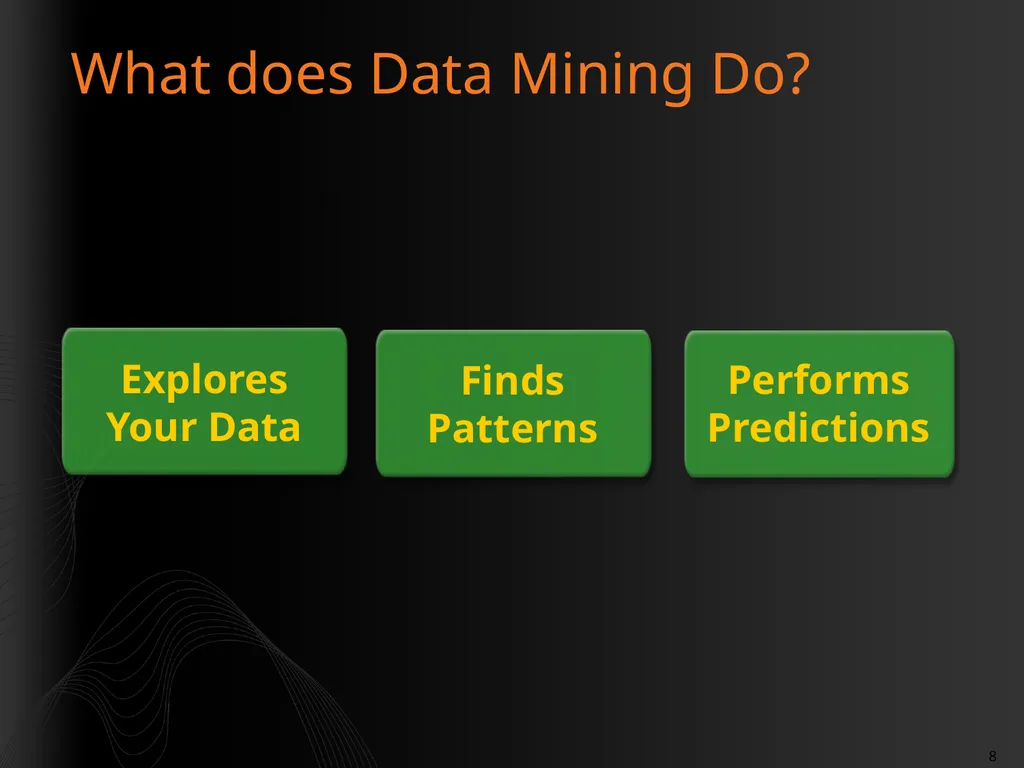
What does Data Mining Do?<br>
09
DM and BI BI is geared at an end user, such as a business owner, knowledge worker etc.
DM is an IT technology generally geared towards a more advanced user – today
By the way: who is qualified to use DM today?<br>
DM is an IT technology generally geared towards a more advanced user – today
By the way: who is qualified to use DM today?<br>
10
DM Past and Present Traditional approaches from Microsoft’s competitors are for DM experts: “White-coat PhD statisticians”
DM tools also fairly expensive
Microsoft’s “full” approach is designed for those with some database skills
Tools similar to T-SQL and Management Studio
DM built into Microsoft SQL Server 2005 and 2008 at no extra cost
DM “easy” is geared at any Excel-aware user<br>
DM tools also fairly expensive
Microsoft’s “full” approach is designed for those with some database skills
Tools similar to T-SQL and Management Studio
DM built into Microsoft SQL Server 2005 and 2008 at no extra cost
DM “easy” is geared at any Excel-aware user<br>
11
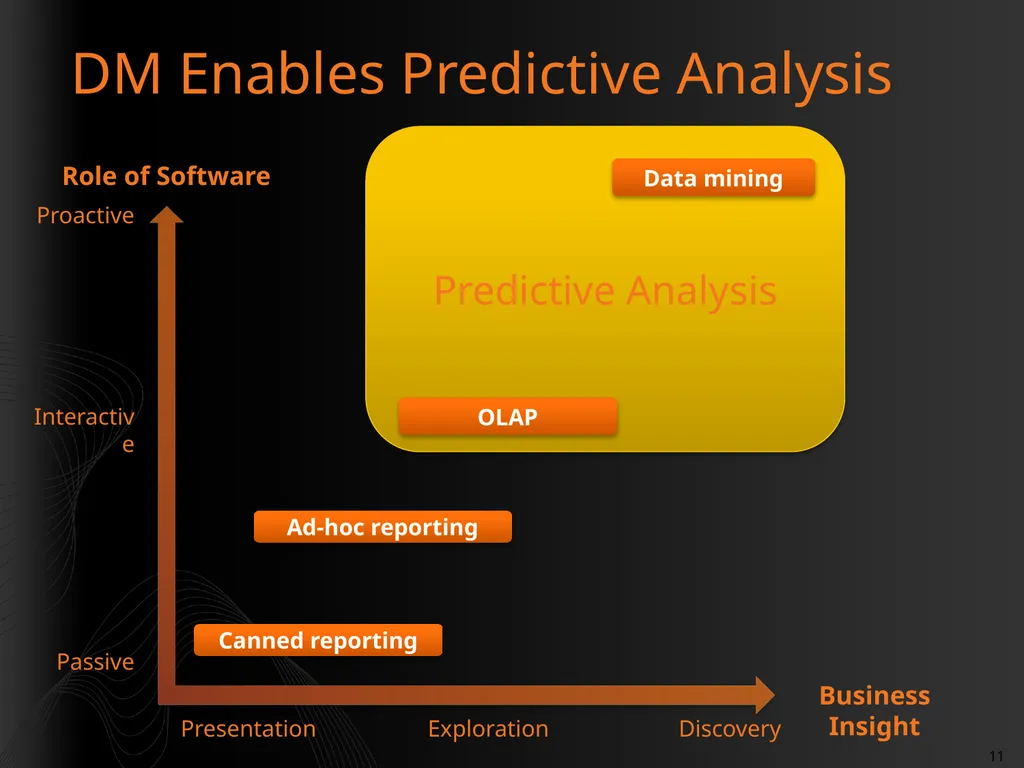
Predictive Analysis Presentation Exploration Discovery Passive Interactive Proactive Role of Software Business Insight Canned reporting Ad-hoc reporting OLAP Data mining DM Enables Predictive Analysis<br>
12
Application and Scenarios<br>
13
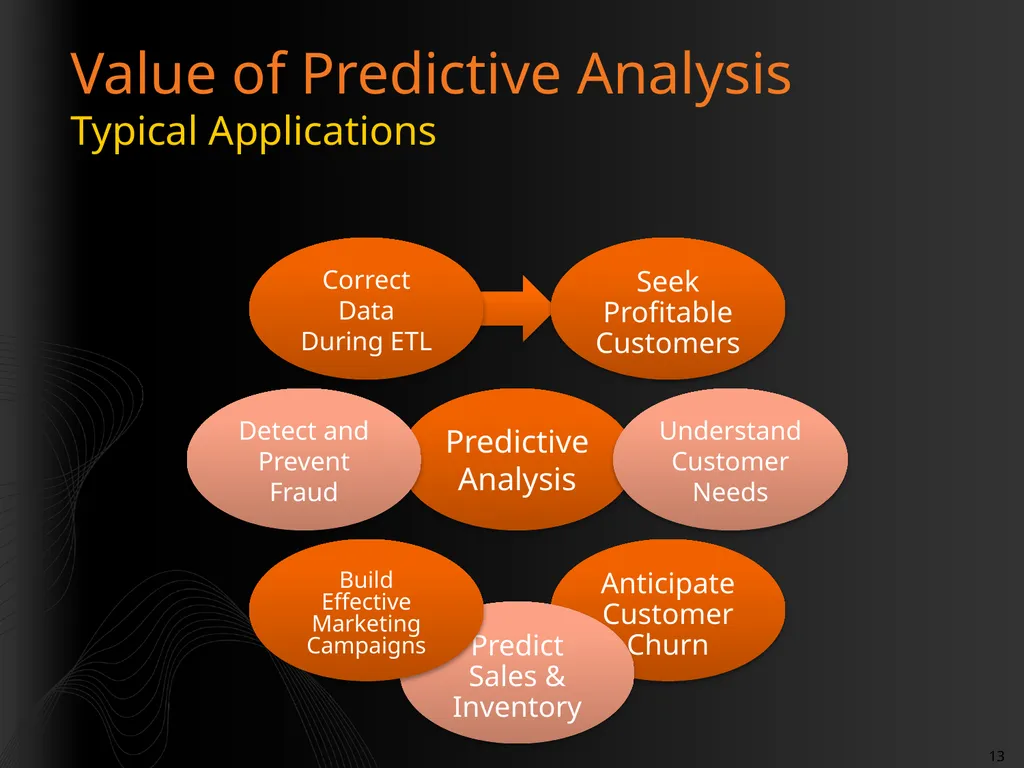
Value of Predictive Analysis
Typical Applications<br>
14
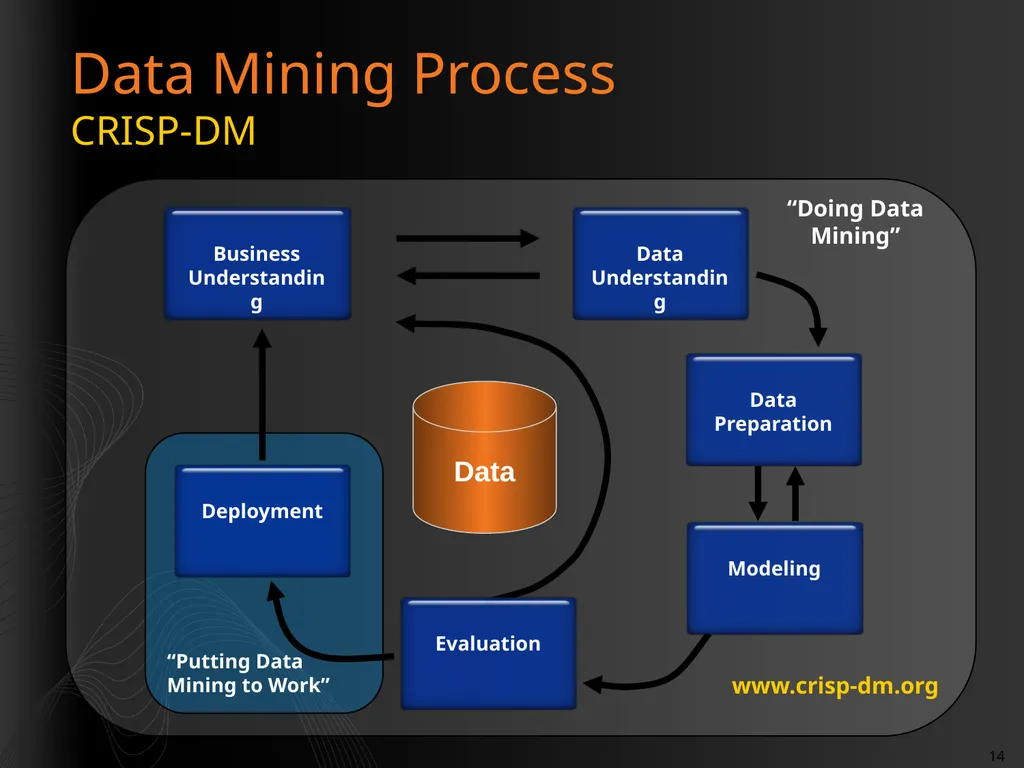
“Putting Data Mining to Work” “Doing Data Mining” Data Data Mining Process
CRISP-DM www.crisp-dm.org<br>
15
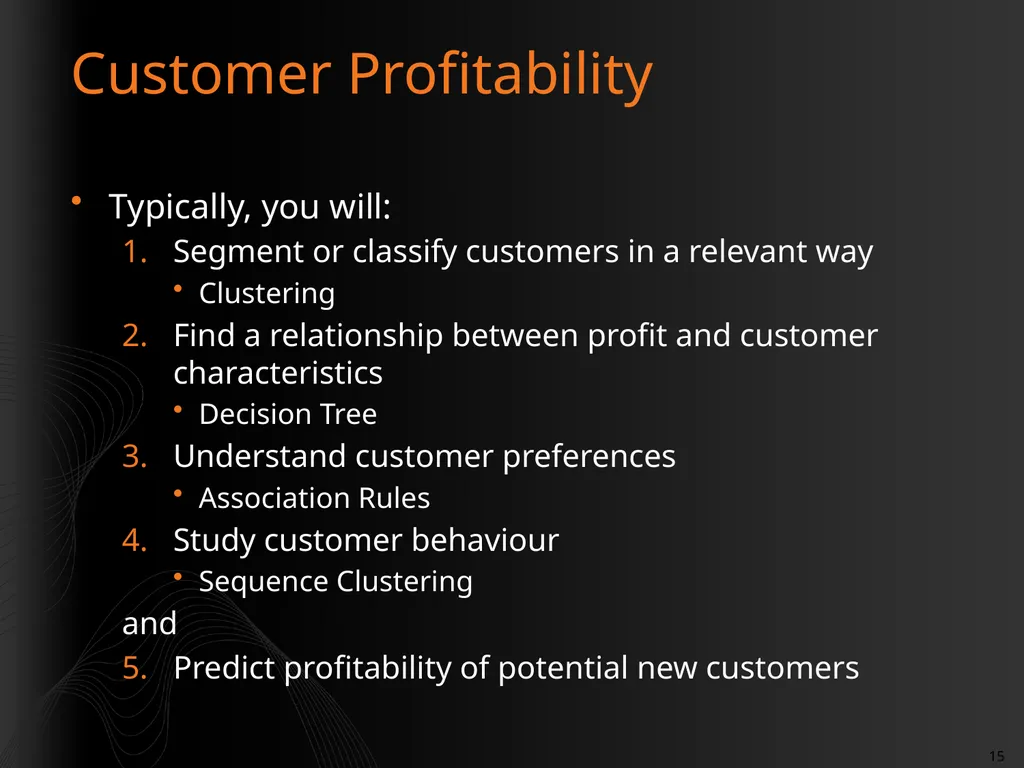
Customer Profitability Typically, you will:
Segment or classify customers in a relevant way
Clustering
Find a relationship between profit and customer characteristics
Decision Tree
Understand customer preferences
Association Rules
Study customer behaviour
Sequence Clustering
and
Predict profitability of potential new customers<br>
Segment or classify customers in a relevant way
Clustering
Find a relationship between profit and customer characteristics
Decision Tree
Understand customer preferences
Association Rules
Study customer behaviour
Sequence Clustering
and
Predict profitability of potential new customers<br>
16
Predict Sales and Inventory You may:
Structure the sales or inventory data as a time series
Perhaps from a Data Warehouse
Forecast future sales and needs
Time Series or Decision Trees with Regression<br>
Structure the sales or inventory data as a time series
Perhaps from a Data Warehouse
Forecast future sales and needs
Time Series or Decision Trees with Regression<br>
17
Build Effective Marketing Campaigns You would:
Segment your existing customers
Clustering and Decision Trees
Study what makes them respond to your campaigns
Decision Tree, Naive Bayes, Clustering, Neural Network
Experiment with a campaign by focusing it
Lift Charts
Run the campaign
Predict recipients
Review your strategy as you get response
Update your models<br>
Segment your existing customers
Clustering and Decision Trees
Study what makes them respond to your campaigns
Decision Tree, Naive Bayes, Clustering, Neural Network
Experiment with a campaign by focusing it
Lift Charts
Run the campaign
Predict recipients
Review your strategy as you get response
Update your models<br>
18
Detect and Prevent Fraud You could:
Build a risk model for existing customers or transactions
Decision Trees, Clustering, Neural Networks, and often Logistic Regression
Assess risk of a new transaction
Predict risk and its probability using the model
Or
Model transaction sequences
Sequence Clustering
Find unusual ones (outliers)
Mine the mining model – neural networks, trees, clustering
Assess new events as they happen
Predicting by means of the metamodel<br>
Build a risk model for existing customers or transactions
Decision Trees, Clustering, Neural Networks, and often Logistic Regression
Assess risk of a new transaction
Predict risk and its probability using the model
Or
Model transaction sequences
Sequence Clustering
Find unusual ones (outliers)
Mine the mining model – neural networks, trees, clustering
Assess new events as they happen
Predicting by means of the metamodel<br>
19
New Opportunity:
Intelligent Applications Examples of Intelligent Applications:
Input Validation, based on previously accepted data, not on fixed rules
Business Process Validation – early detection of failure
Adaptive User Interface based on past behaviour
Also known as Predictive Programming
Learn more by downloading “Build More Intelligent Applications using Data Mining” from www.microsoft.com/technetspotlight<br>
Input Validation, based on previously accepted data, not on fixed rules
Business Process Validation – early detection of failure
Adaptive User Interface based on past behaviour
Also known as Predictive Programming
Learn more by downloading “Build More Intelligent Applications using Data Mining” from www.microsoft.com/technetspotlight<br>
20
Data Mining Products<br>
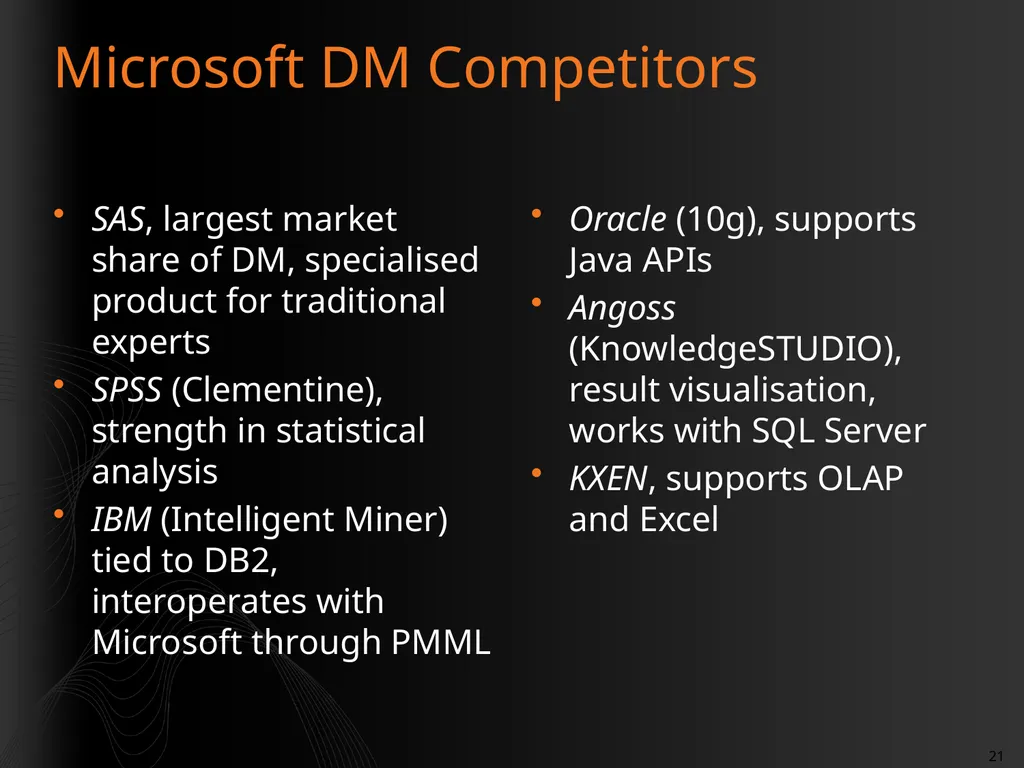
21
Microsoft DM Competitors SAS, largest market share of DM, specialised product for traditional experts
SPSS (Clementine), strength in statistical analysis
IBM (Intelligent Miner) tied to DB2, interoperates with Microsoft through PMML Oracle (10g), supports Java APIs
Angoss (KnowledgeSTUDIO), result visualisation, works with SQL Server
KXEN, supports OLAP and Excel<br>
SPSS (Clementine), strength in statistical analysis
IBM (Intelligent Miner) tied to DB2, interoperates with Microsoft through PMML Oracle (10g), supports Java APIs
Angoss (KnowledgeSTUDIO), result visualisation, works with SQL Server
KXEN, supports OLAP and Excel<br>
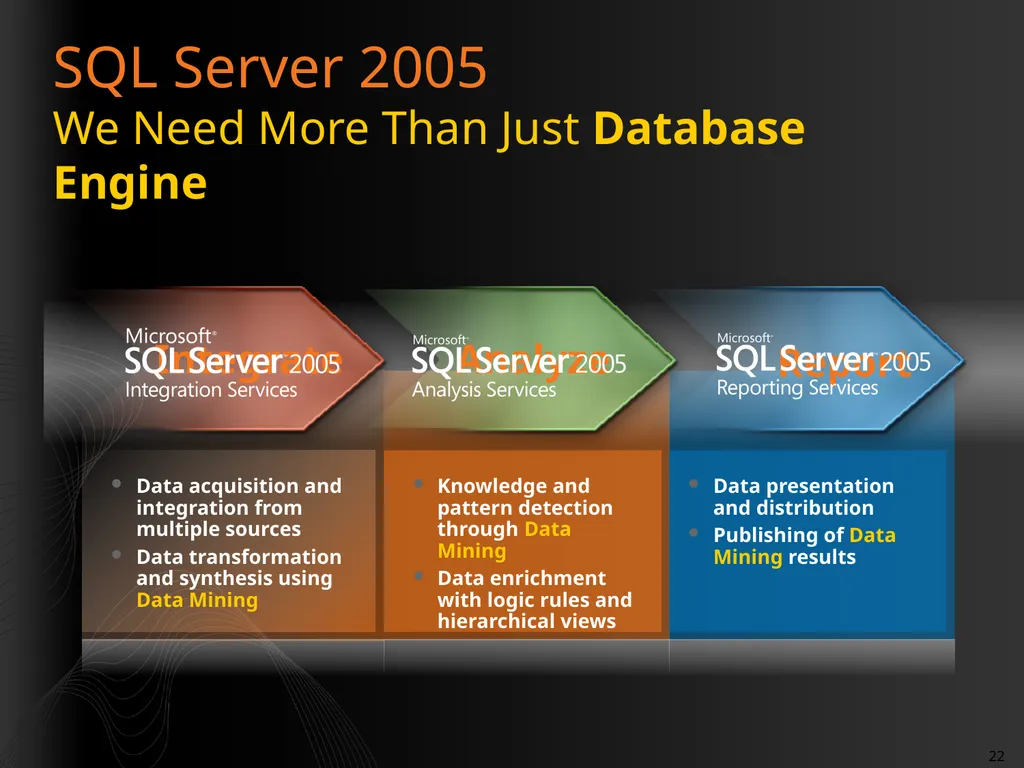
22
Data acquisition and integration from multiple sources
Data transformation and synthesis using Data Mining Knowledge and pattern detection through Data Mining
Data enrichment with logic rules and hierarchical views Data presentation and distribution
Publishing of Data Mining results SQL Server 2005 We Need More Than Just Database Engine<br>
Data transformation and synthesis using Data Mining Knowledge and pattern detection through Data Mining
Data enrichment with logic rules and hierarchical views Data presentation and distribution
Publishing of Data Mining results SQL Server 2005 We Need More Than Just Database Engine<br>
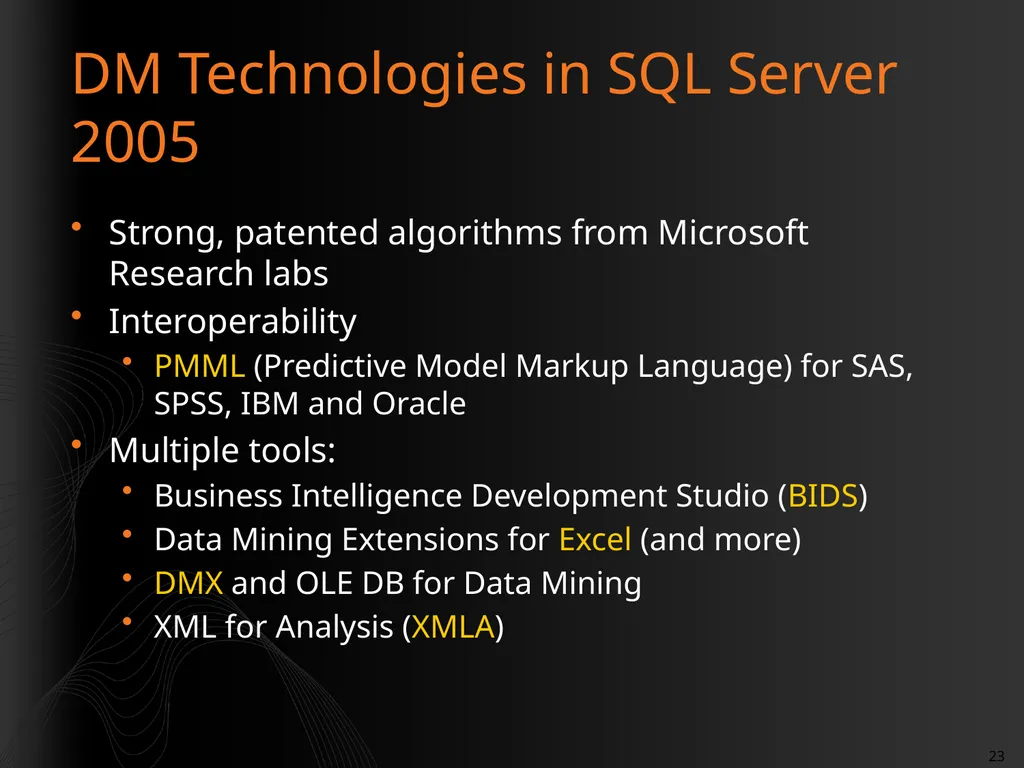
23
DM Technologies in SQL Server 2005 Strong, patented algorithms from Microsoft Research labs
Interoperability
PMML (Predictive Model Markup Language) for SAS, SPSS, IBM and Oracle
Multiple tools:
Business Intelligence Development Studio (BIDS)
Data Mining Extensions for Excel (and more)
DMX and OLE DB for Data Mining
XML for Analysis (XMLA)<br>
Interoperability
PMML (Predictive Model Markup Language) for SAS, SPSS, IBM and Oracle
Multiple tools:
Business Intelligence Development Studio (BIDS)
Data Mining Extensions for Excel (and more)
DMX and OLE DB for Data Mining
XML for Analysis (XMLA)<br>
24
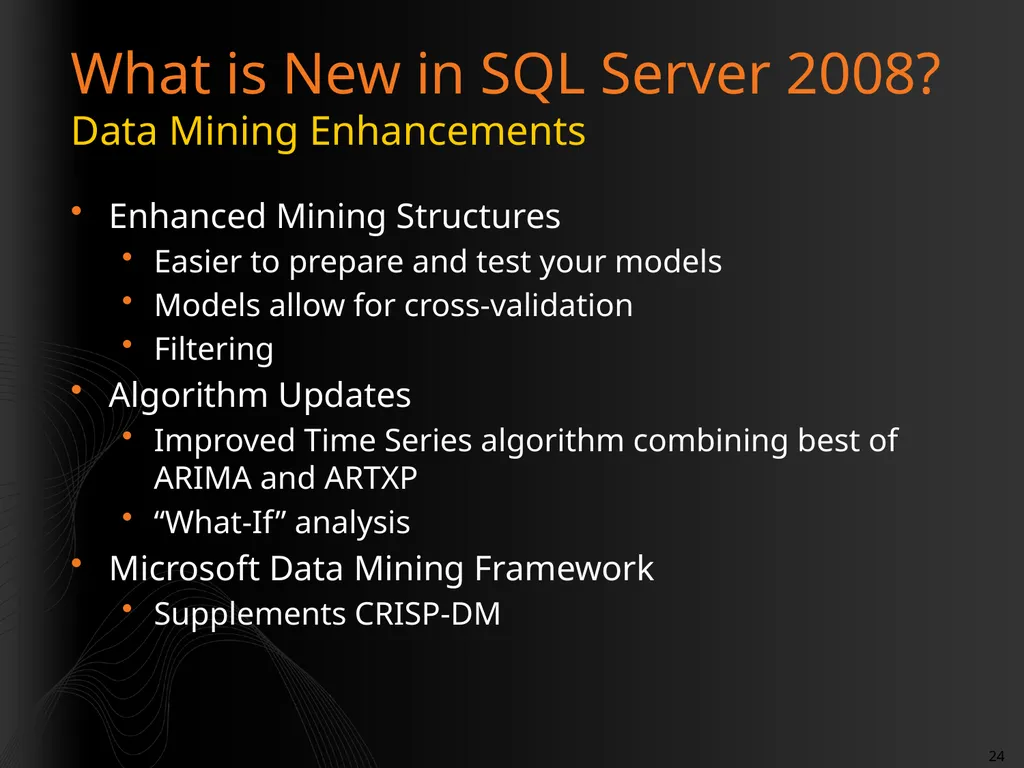
What is New in SQL Server 2008?
Data Mining Enhancements Enhanced Mining Structures
Easier to prepare and test your models
Models allow for cross-validation
Filtering
Algorithm Updates
Improved Time Series algorithm combining best of ARIMA and ARTXP
“What-If” analysis
Microsoft Data Mining Framework
Supplements CRISP-DM<br>
Easier to prepare and test your models
Models allow for cross-validation
Filtering
Algorithm Updates
Improved Time Series algorithm combining best of ARIMA and ARTXP
“What-If” analysis
Microsoft Data Mining Framework
Supplements CRISP-DM<br>
25
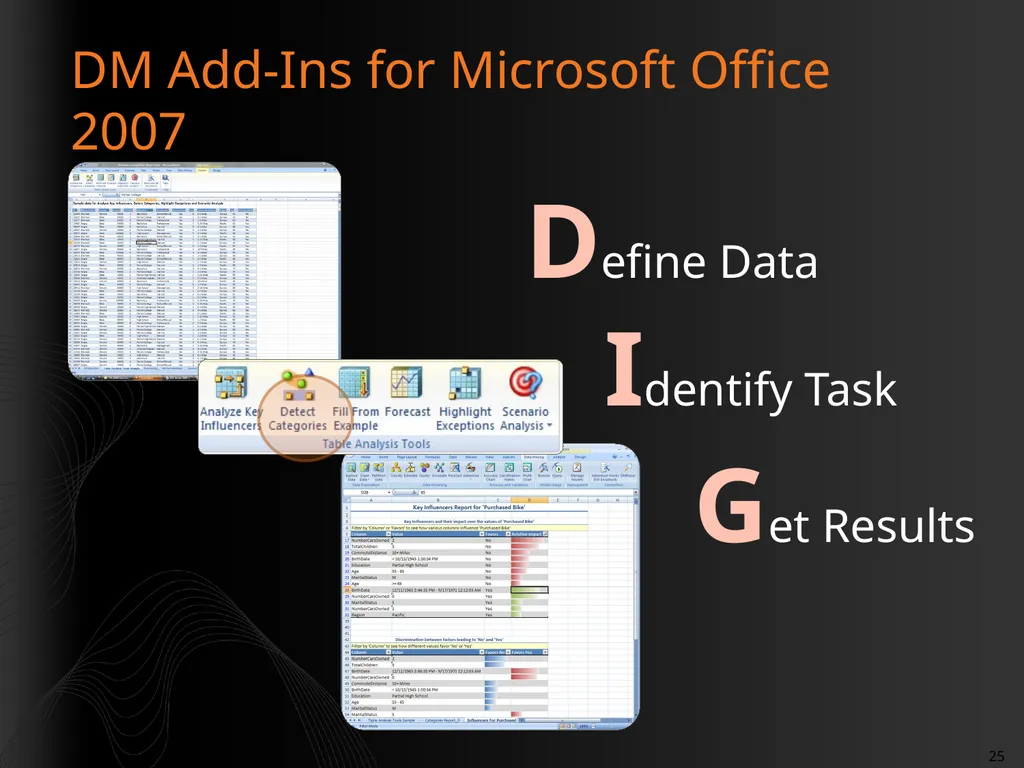
DM Add-Ins for Microsoft Office 2007 Define Data Identify Task Get Results<br>
26
Demo Using Data Mining Add-in Table Tools for Microsoft Excel 2007<br>
27
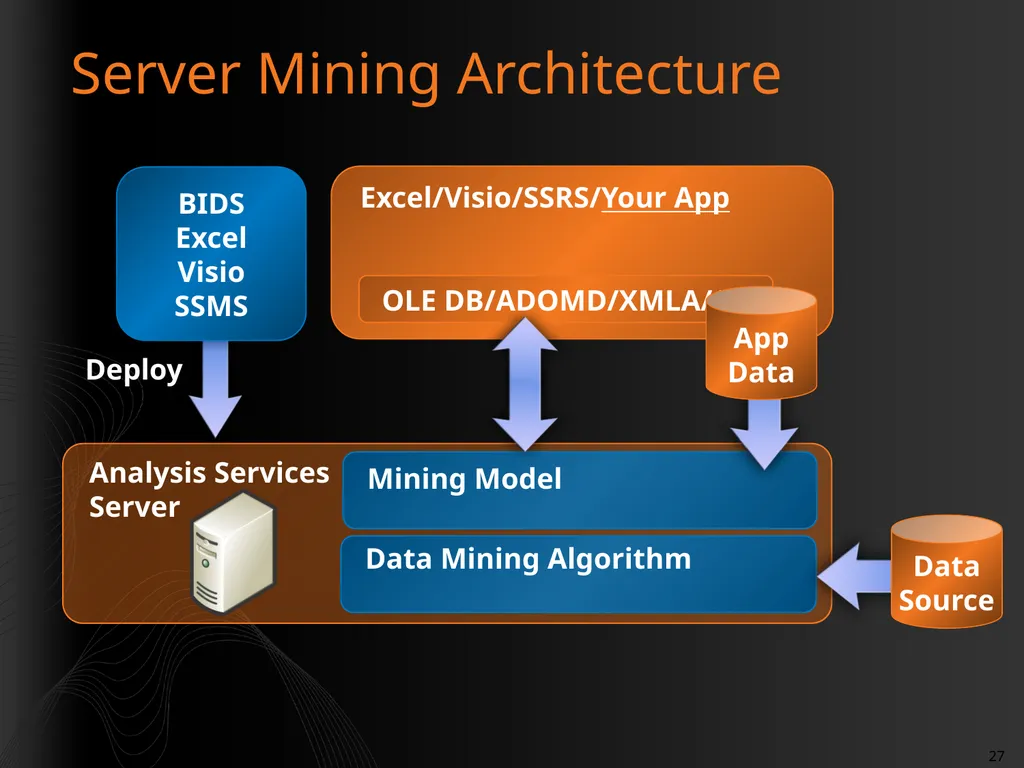
Analysis Services
Server Mining Model Data Mining Algorithm Server Mining Architecture<br>
Server Mining Model Data Mining Algorithm Server Mining Architecture<br>
28
Conclusions<br>
29
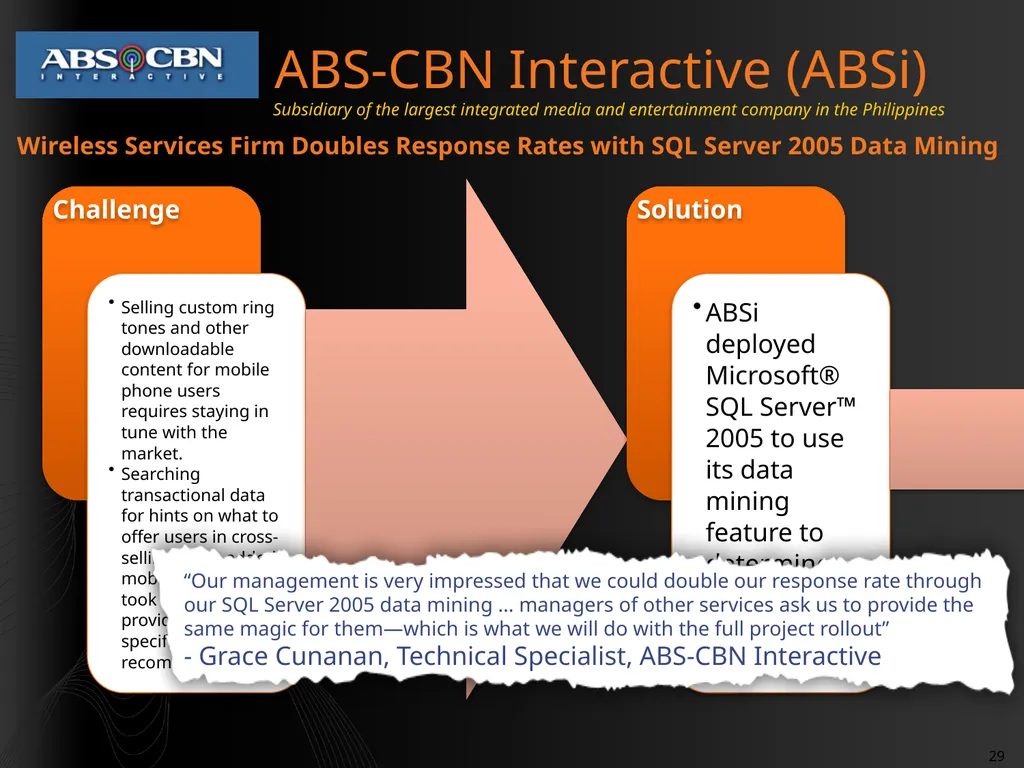
ABS-CBN Interactive (ABSi) Wireless Services Firm Doubles Response Rates with SQL Server 2005 Data Mining Subsidiary of the largest integrated media and entertainment company in the Philippines<br>
30
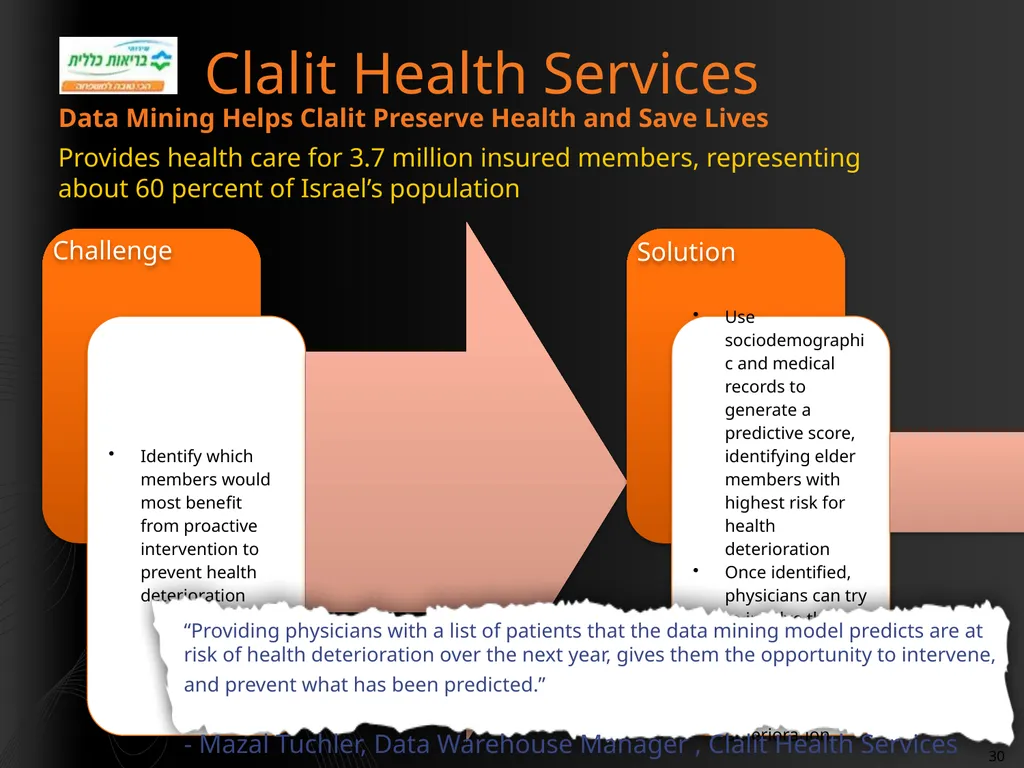
Clalit Health Services Data Mining Helps Clalit Preserve Health and Save Lives Provides health care for 3.7 million insured members, representing about 60 percent of Israel’s population<br>
31
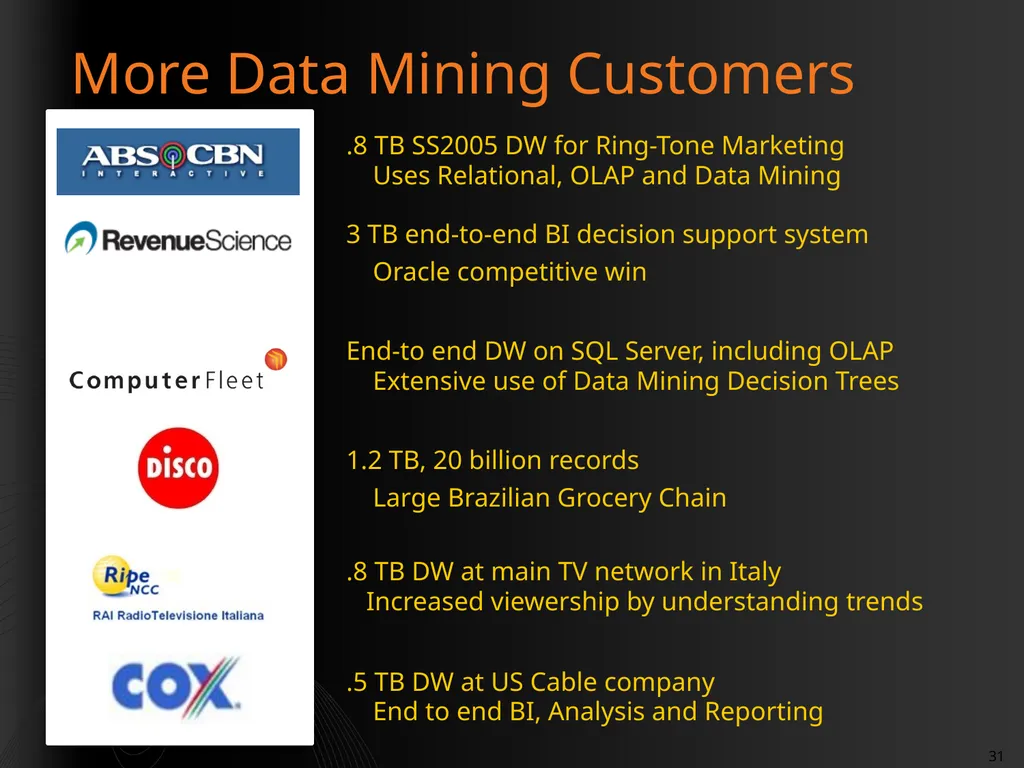
More Data Mining Customers<br>
32
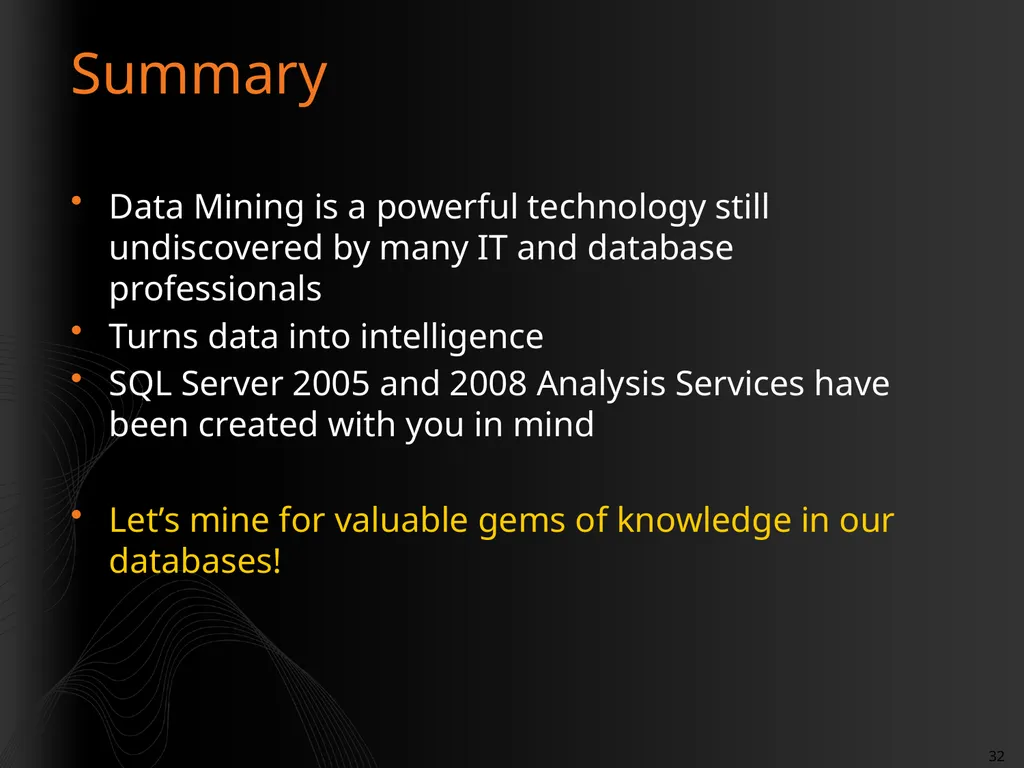
Summary Data Mining is a powerful technology still undiscovered by many IT and database professionals
Turns data into intelligence
SQL Server 2005 and 2008 Analysis Services have been created with you in mind
Let’s mine for valuable gems of knowledge in our databases!<br>
Turns data into intelligence
SQL Server 2005 and 2008 Analysis Services have been created with you in mind
Let’s mine for valuable gems of knowledge in our databases!<br>
33
© 2007 Microsoft Corporation & Project Botticelli Ltd. All rights reserved.
The information herein is for informational purposes only and represents the opinions and views of Project Botticelli and/or Rafal Lukawiecki. The material presented is not certain and may vary based on several factors. Microsoft makes no warranties, express, implied or statutory, as to the information in this presentation.
© 2007 Project Botticelli Ltd & Microsoft Corp. Some slides contain quotations from copyrighted materials by other authors, as individually attributed. All rights reserved. Microsoft, Windows, Windows Vista and other product names are or may be registered trademarks and/or trademarks in the U.S. and/or other countries. The information herein is for informational purposes only and represents the current view of Project Botticelli Ltd as of the date of this presentation. Because Project Botticelli & Microsoft must respond to changing market conditions, it should not be interpreted to be a commitment on the part of Microsoft, and Microsoft and Project Botticelli cannot guarantee the accuracy of any information provided after the date of this presentation. Project Botticelli makes no warranties, express, implied or statutory, as to the information in this presentation. E&OE.<br>
The information herein is for informational purposes only and represents the opinions and views of Project Botticelli and/or Rafal Lukawiecki. The material presented is not certain and may vary based on several factors. Microsoft makes no warranties, express, implied or statutory, as to the information in this presentation.
© 2007 Project Botticelli Ltd & Microsoft Corp. Some slides contain quotations from copyrighted materials by other authors, as individually attributed. All rights reserved. Microsoft, Windows, Windows Vista and other product names are or may be registered trademarks and/or trademarks in the U.S. and/or other countries. The information herein is for informational purposes only and represents the current view of Project Botticelli Ltd as of the date of this presentation. Because Project Botticelli & Microsoft must respond to changing market conditions, it should not be interpreted to be a commitment on the part of Microsoft, and Microsoft and Project Botticelli cannot guarantee the accuracy of any information provided after the date of this presentation. Project Botticelli makes no warranties, express, implied or statutory, as to the information in this presentation. E&OE.<br>