
Introduction to Drones Overview Regulations (Part
Description: Introduction to Drones Overview Regulations (Part 107) Pilot Requirements Drone Requirements Flight Restrictions Capturing Data Mission Planning Stitching Analysis Regulations Title 14 Code of Federal Regulations (CFR) Part 107 Regulates
Related Topics
Download Presentation
"Introduction to Drones Overview Regulations (Part" is the property of its rightful owner. Permission is granted to download and print the materials on this website for personal, non-commercial use only, and to display it on your personal computer provided you do not modify the materials and that you retain all copyright notices contained in the materials. By downloading content from our website, you accept the terms of this agreement.
Presentation Transcript
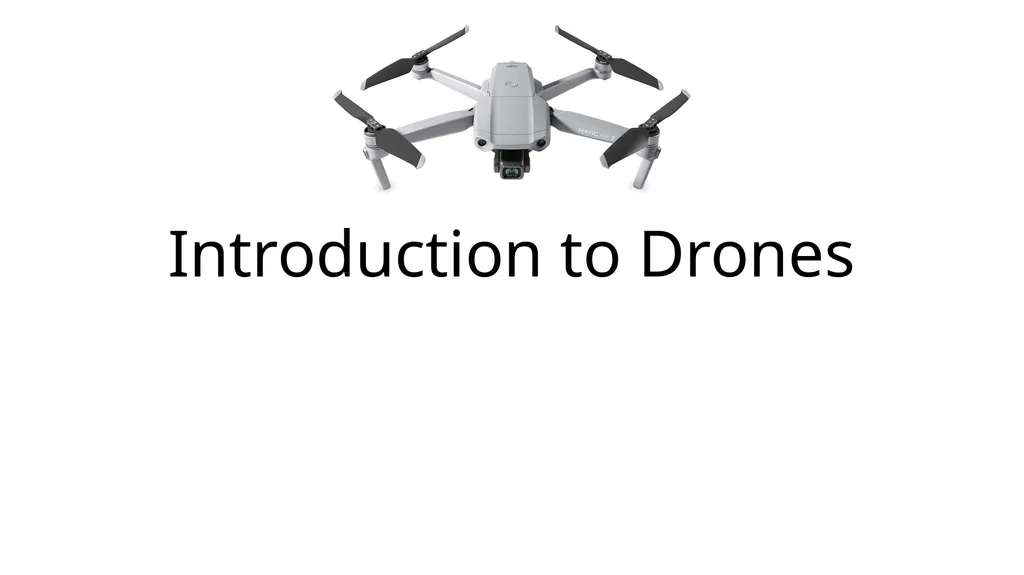
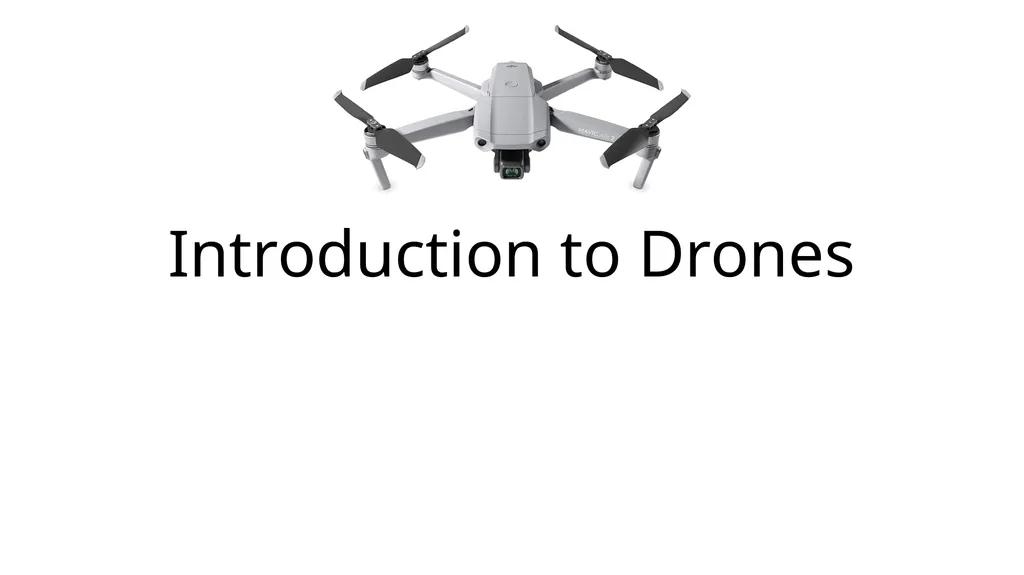
slide1. Introduction to Drones<br>
slide2. Overview Regulations (Part 107)
Pilot Requirements
Drone Requirements
Flight Restrictions
Capturing Data
Mission Planning
Stitching
Analysis<br>
slide3. Regulations Title 14 Code of Federal Regulations (CFR) Part 107
Regulates most drone operations
There is an exception (49 U.S.C. § 44809) that allows flying drones for recreational purposes (under certain conditions) without complying with Part 107. In order to fly under the statutory exception, you must comply with all portions of Section 44809, including flying your drone for recreational purposes..<br>
slide4. Part 107 General Requirements Drones under 55 pounds
Must have Remote Pilot Certificate (107.12) (or meet education exception)
Drone is registered (107.13)
Drone in safe condition to operate (107.15)
Remote Pilot, Visual Observer in medical condition to operate (107.17)
Cannot operate under the influence. < .04 and 8hours. (107.25)
Remote Pilot in Command (rPIC) is responsible (107.19)<br>
slide5. Part 107 General Requirements Cannot operate at night (with some exceptions) (107.29)
Must maintain Visual Line of Sight (VLOS) (107.31)
Yield to manned aircraft (107.37)
May not fly over people (107.39)
May not operate in Class B,C, or D airspace or Surface of Class E. (107.41)
May not operate in the area of airports as to interfere with normal operations (107.43)
May not operate in restricted airspace (107.45 and 107.47)
Preflight check required (107.49)<br>
slide6. Waivers (for UAS pilots) Some restrictions may be waived
§107.25* Operation from a moving vehicle or aircraft
§107.29 Operation at Night
§107.31* Visual line of sight aircraft operation
§107.33 Visual observer
§107.35 Operation of multiple small unmanned aircraft systems
§107.37(a) Yielding the right of way
§107.39 Operation over human beings
§107.41 Operation in certain airspace
§107.51 Operating limitations for small unmanned aircraft
§107.145 Operations Over Moving Vehicles<br>
slide7. Pilot Requirements Unmanned Aircraft Systems (UAS) remote pilot
Certificate Test (Part 61 + Part 107) $150 at testing center
Online test (for holders of Part 61 license)
Recreational Pilot
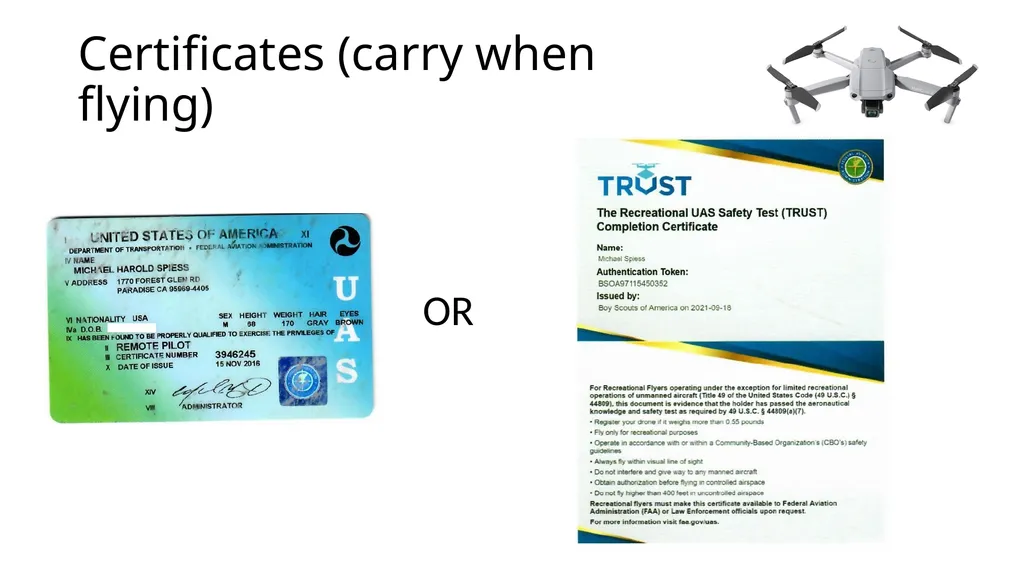
TRUST (about 30 minute training)
The Exception for Limited Operation of Unmanned Aircraft (USC 44809) is the law that describes how, when, and where you can fly drones for recreational purposes. Following these rules will keep people, your drone and our airspace safe:
Educational Uses<br>
slide8. Certificates (carry when flying) OR<br>
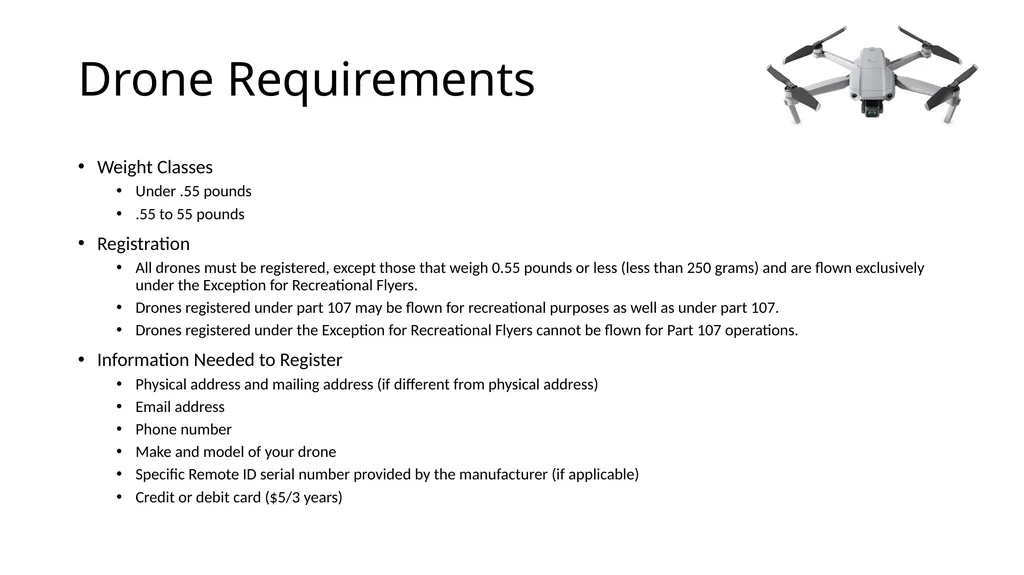
slide9. Drone Requirements Weight Classes
Under .55 pounds
.55 to 55 pounds
Registration
All drones must be registered, except those that weigh 0.55 pounds or less (less than 250 grams) and are flown exclusively under the Exception for Recreational Flyers.
Drones registered under part 107 may be flown for recreational purposes as well as under part 107.
Drones registered under the Exception for Recreational Flyers cannot be flown for Part 107 operations.
Information Needed to Register
Physical address and mailing address (if different from physical address)
Email address
Phone number
Make and model of your drone
Specific Remote ID serial number provided by the manufacturer (if applicable)
Credit or debit card ($5/3 years)<br>
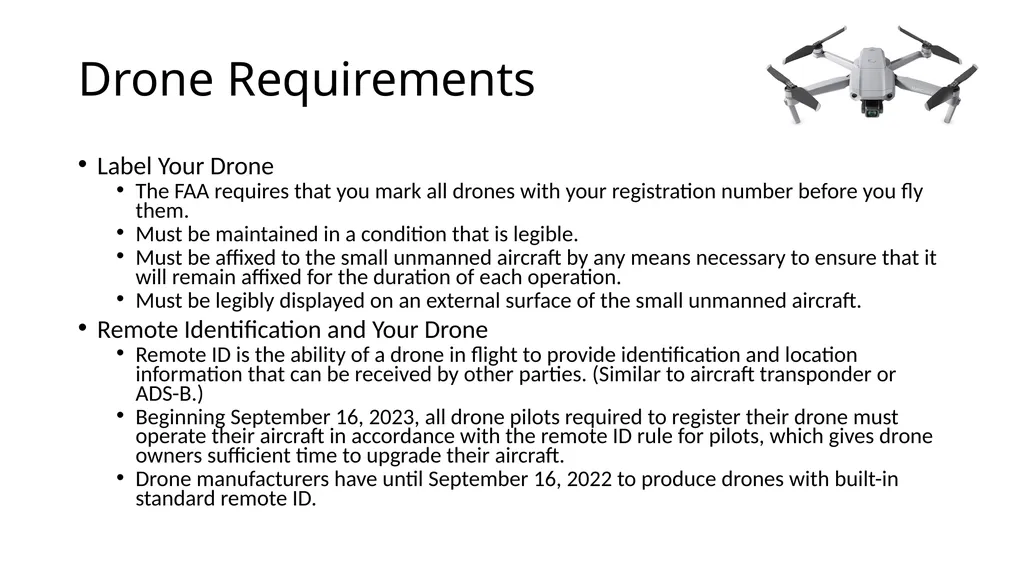
slide10. Drone Requirements Label Your Drone
The FAA requires that you mark all drones with your registration number before you fly them.
Must be maintained in a condition that is legible.
Must be affixed to the small unmanned aircraft by any means necessary to ensure that it will remain affixed for the duration of each operation.
Must be legibly displayed on an external surface of the small unmanned aircraft.
Remote Identification and Your Drone
Remote ID is the ability of a drone in flight to provide identification and location information that can be received by other parties. (Similar to aircraft transponder or ADS-B.)
Beginning September 16, 2023, all drone pilots required to register their drone must operate their aircraft in accordance with the remote ID rule for pilots, which gives drone owners sufficient time to upgrade their aircraft.
Drone manufacturers have until September 16, 2022 to produce drones with built-in standard remote ID.<br>
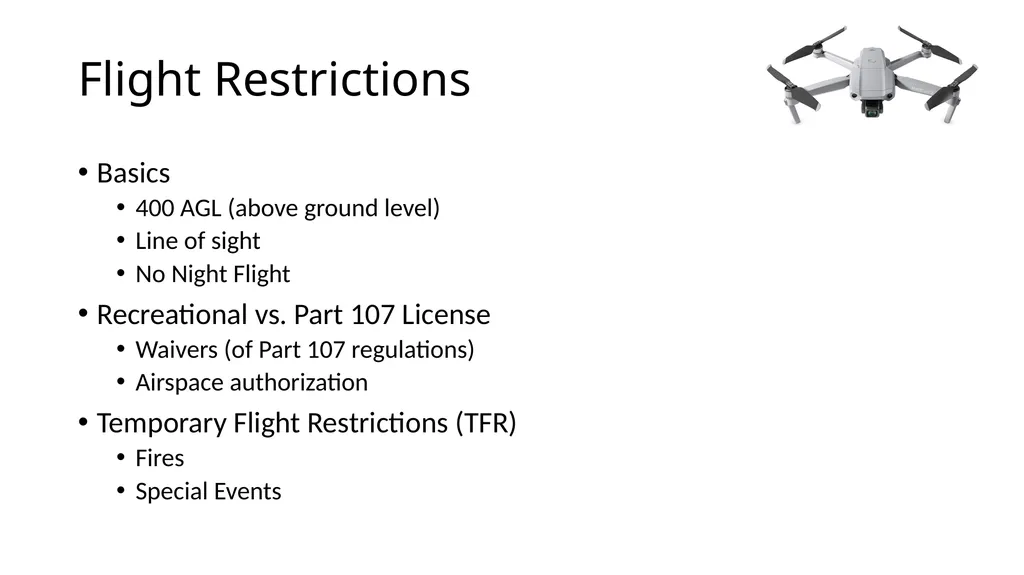
slide11. Flight Restrictions Basics
400 AGL (above ground level)
Line of sight
No Night Flight
Recreational vs. Part 107 License
Waivers (of Part 107 regulations)
Airspace authorization
Temporary Flight Restrictions (TFR)
Fires
Special Events<br>
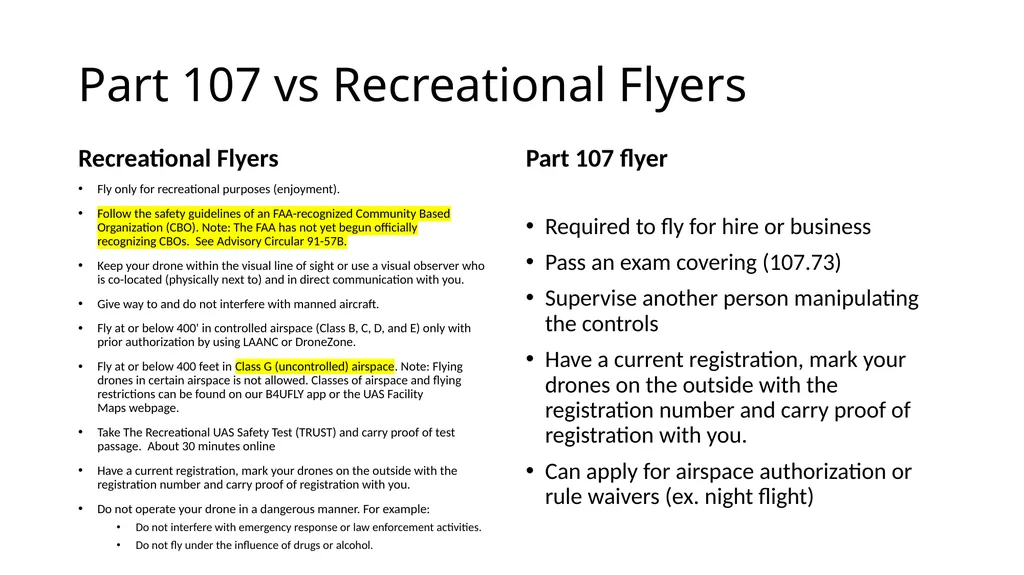
slide12. Part 107 vs Recreational Flyers Recreational Flyers Fly only for recreational purposes (enjoyment).
Follow the safety guidelines of an FAA-recognized Community Based Organization (CBO). Note: The FAA has not yet begun officially recognizing CBOs. See Advisory Circular 91-57B.
Keep your drone within the visual line of sight or use a visual observer who is co-located (physically next to) and in direct communication with you.
Give way to and do not interfere with manned aircraft.
Fly at or below 400' in controlled airspace (Class B, C, D, and E) only with prior authorization by using LAANC or DroneZone.
Fly at or below 400 feet in Class G (uncontrolled) airspace. Note: Flying drones in certain airspace is not allowed. Classes of airspace and flying restrictions can be found on our B4UFLY app or the UAS Facility Maps webpage.
Take The Recreational UAS Safety Test (TRUST) and carry proof of test passage. About 30 minutes online
Have a current registration, mark your drones on the outside with the registration number and carry proof of registration with you.
Do not operate your drone in a dangerous manner. For example:
Do not interfere with emergency response or law enforcement activities.
Do not fly under the influence of drugs or alcohol. Part 107 flyer Required to fly for hire or business
Pass an exam covering (107.73)
Supervise another person manipulating the controls
Have a current registration, mark your drones on the outside with the registration number and carry proof of registration with you.
Can apply for airspace authorization or rule waivers (ex. night flight)<br>
slide13. The Educational Exception There is also a statutory provision (P.L. 115-254, Section 350, as amended by P.L. 116-283, Section 10002) that clarifies that education and research uses of drones for educational (and research) purposes can be operated under the rules for recreational flyers.
Comply with recreational pilot (TRUST) and drone requirements.<br>
slide14. A Case for Part 107 Greater knowledge is required
Background is useful for instruction
Options exist to operate in more airspace and ask for waivers
Could also perform commercial activity<br>
slide15. Mapping (data collection) The most common use in Ag
Three basic operations:
Missing planning
Data capture
Stitching and Analysis<br>
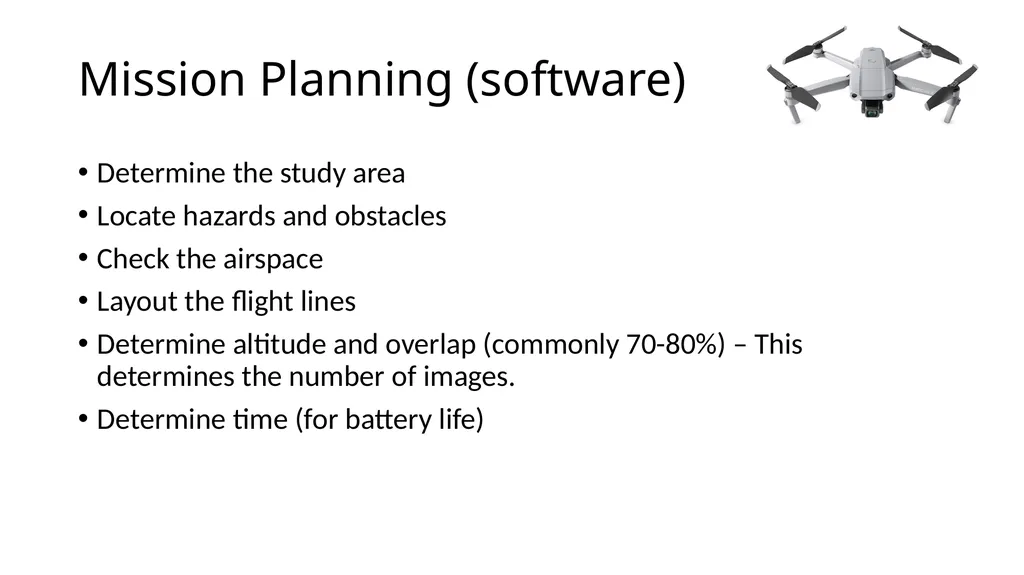
slide16. Mission Planning (software) Determine the study area
Locate hazards and obstacles
Check the airspace
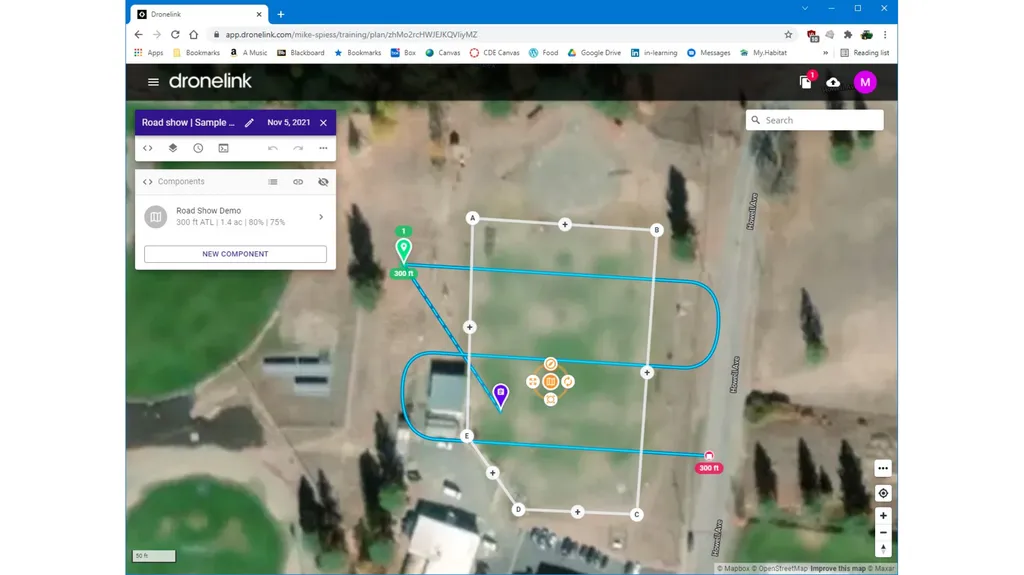
Layout the flight lines
Determine altitude and overlap (commonly 70-80%) – This determines the number of images.
Determine time (for battery life)<br>
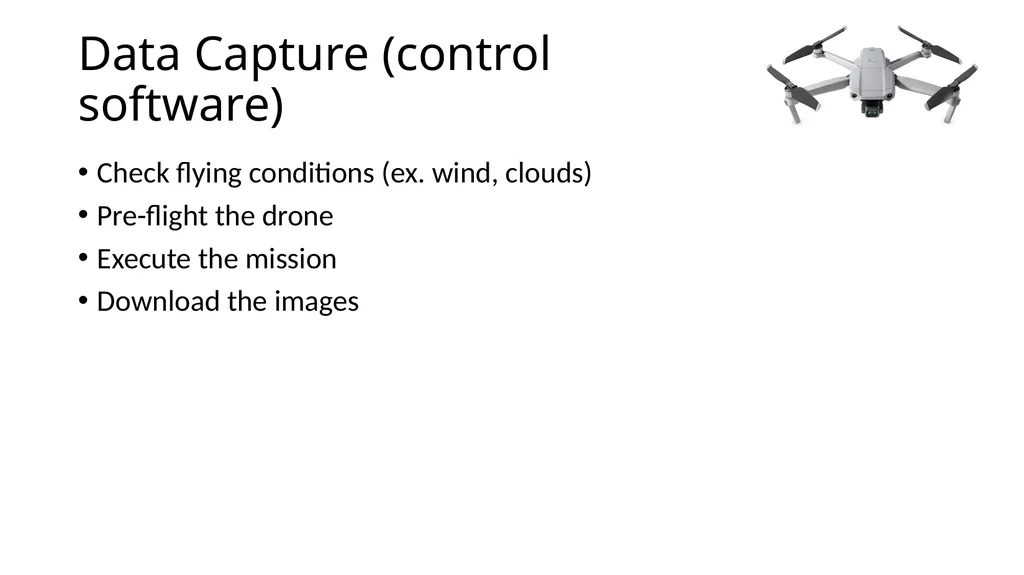
slide18. Data Capture (control software) Check flying conditions (ex. wind, clouds)
Pre-flight the drone
Execute the mission
Download the images<br>
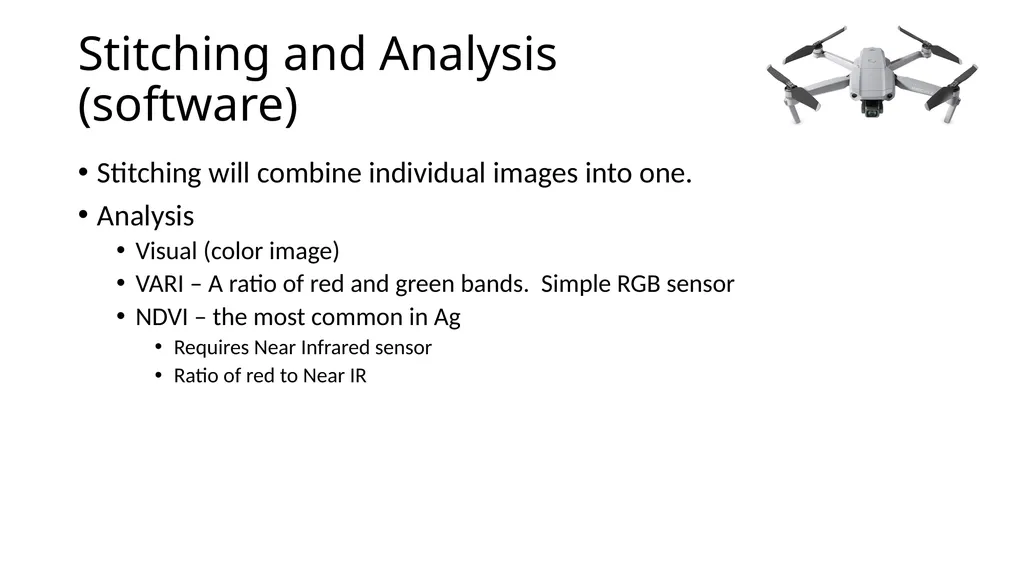
slide19. Stitching and Analysis (software) Stitching will combine individual images into one.
Analysis
Visual (color image)
VARI – A ratio of red and green bands. Simple RGB sensor
NDVI – the most common in Ag
Requires Near Infrared sensor
Ratio of red to Near IR<br>
slide20. Ideas for Activities Have student take the TRUST test. (then laminate their cards ;-)
Plan a general mission using Google Maps.
Pick a spot, scout the area for hazards (make a checklist).
Do a pre-flight check on a drone.
Field check data previously collected. Look for causes. This works well with recreation fields (lawn).
Take single images and analyze.
Plan missions using software like DroneDeploy or Dronelink.
Fly planned missions
Stitch images and analyze using software like DroneDeploy or WebODM<br>
slide21. Costs (very general idea) Drone – a good quadcopter $400-$1500
Drone with Near IR sensor - $2500+
Mapping Software: $50 up. Subscriptions $1000/year (likely will stitch too)
Stitching Software Free to $$$<br>
slide22. Mission Planning Example Dronelink
https://app.dronelink.com/mike-spiess<br>
slide23. Resources & Questions http://agedweb.org/drone<br>
slide2. Overview Regulations (Part 107)
Pilot Requirements
Drone Requirements
Flight Restrictions
Capturing Data
Mission Planning
Stitching
Analysis<br>
slide3. Regulations Title 14 Code of Federal Regulations (CFR) Part 107
Regulates most drone operations
There is an exception (49 U.S.C. § 44809) that allows flying drones for recreational purposes (under certain conditions) without complying with Part 107. In order to fly under the statutory exception, you must comply with all portions of Section 44809, including flying your drone for recreational purposes..<br>
slide4. Part 107 General Requirements Drones under 55 pounds
Must have Remote Pilot Certificate (107.12) (or meet education exception)
Drone is registered (107.13)
Drone in safe condition to operate (107.15)
Remote Pilot, Visual Observer in medical condition to operate (107.17)
Cannot operate under the influence. < .04 and 8hours. (107.25)
Remote Pilot in Command (rPIC) is responsible (107.19)<br>
slide5. Part 107 General Requirements Cannot operate at night (with some exceptions) (107.29)
Must maintain Visual Line of Sight (VLOS) (107.31)
Yield to manned aircraft (107.37)
May not fly over people (107.39)
May not operate in Class B,C, or D airspace or Surface of Class E. (107.41)
May not operate in the area of airports as to interfere with normal operations (107.43)
May not operate in restricted airspace (107.45 and 107.47)
Preflight check required (107.49)<br>
slide6. Waivers (for UAS pilots) Some restrictions may be waived
§107.25* Operation from a moving vehicle or aircraft
§107.29 Operation at Night
§107.31* Visual line of sight aircraft operation
§107.33 Visual observer
§107.35 Operation of multiple small unmanned aircraft systems
§107.37(a) Yielding the right of way
§107.39 Operation over human beings
§107.41 Operation in certain airspace
§107.51 Operating limitations for small unmanned aircraft
§107.145 Operations Over Moving Vehicles<br>
slide7. Pilot Requirements Unmanned Aircraft Systems (UAS) remote pilot
Certificate Test (Part 61 + Part 107) $150 at testing center
Online test (for holders of Part 61 license)
Recreational Pilot
TRUST (about 30 minute training)
The Exception for Limited Operation of Unmanned Aircraft (USC 44809) is the law that describes how, when, and where you can fly drones for recreational purposes. Following these rules will keep people, your drone and our airspace safe:
Educational Uses<br>
slide8. Certificates (carry when flying) OR<br>
slide9. Drone Requirements Weight Classes
Under .55 pounds
.55 to 55 pounds
Registration
All drones must be registered, except those that weigh 0.55 pounds or less (less than 250 grams) and are flown exclusively under the Exception for Recreational Flyers.
Drones registered under part 107 may be flown for recreational purposes as well as under part 107.
Drones registered under the Exception for Recreational Flyers cannot be flown for Part 107 operations.
Information Needed to Register
Physical address and mailing address (if different from physical address)
Email address
Phone number
Make and model of your drone
Specific Remote ID serial number provided by the manufacturer (if applicable)
Credit or debit card ($5/3 years)<br>
slide10. Drone Requirements Label Your Drone
The FAA requires that you mark all drones with your registration number before you fly them.
Must be maintained in a condition that is legible.
Must be affixed to the small unmanned aircraft by any means necessary to ensure that it will remain affixed for the duration of each operation.
Must be legibly displayed on an external surface of the small unmanned aircraft.
Remote Identification and Your Drone
Remote ID is the ability of a drone in flight to provide identification and location information that can be received by other parties. (Similar to aircraft transponder or ADS-B.)
Beginning September 16, 2023, all drone pilots required to register their drone must operate their aircraft in accordance with the remote ID rule for pilots, which gives drone owners sufficient time to upgrade their aircraft.
Drone manufacturers have until September 16, 2022 to produce drones with built-in standard remote ID.<br>
slide11. Flight Restrictions Basics
400 AGL (above ground level)
Line of sight
No Night Flight
Recreational vs. Part 107 License
Waivers (of Part 107 regulations)
Airspace authorization
Temporary Flight Restrictions (TFR)
Fires
Special Events<br>
slide12. Part 107 vs Recreational Flyers Recreational Flyers Fly only for recreational purposes (enjoyment).
Follow the safety guidelines of an FAA-recognized Community Based Organization (CBO). Note: The FAA has not yet begun officially recognizing CBOs. See Advisory Circular 91-57B.
Keep your drone within the visual line of sight or use a visual observer who is co-located (physically next to) and in direct communication with you.
Give way to and do not interfere with manned aircraft.
Fly at or below 400' in controlled airspace (Class B, C, D, and E) only with prior authorization by using LAANC or DroneZone.
Fly at or below 400 feet in Class G (uncontrolled) airspace. Note: Flying drones in certain airspace is not allowed. Classes of airspace and flying restrictions can be found on our B4UFLY app or the UAS Facility Maps webpage.
Take The Recreational UAS Safety Test (TRUST) and carry proof of test passage. About 30 minutes online
Have a current registration, mark your drones on the outside with the registration number and carry proof of registration with you.
Do not operate your drone in a dangerous manner. For example:
Do not interfere with emergency response or law enforcement activities.
Do not fly under the influence of drugs or alcohol. Part 107 flyer Required to fly for hire or business
Pass an exam covering (107.73)
Supervise another person manipulating the controls
Have a current registration, mark your drones on the outside with the registration number and carry proof of registration with you.
Can apply for airspace authorization or rule waivers (ex. night flight)<br>
slide13. The Educational Exception There is also a statutory provision (P.L. 115-254, Section 350, as amended by P.L. 116-283, Section 10002) that clarifies that education and research uses of drones for educational (and research) purposes can be operated under the rules for recreational flyers.
Comply with recreational pilot (TRUST) and drone requirements.<br>
slide14. A Case for Part 107 Greater knowledge is required
Background is useful for instruction
Options exist to operate in more airspace and ask for waivers
Could also perform commercial activity<br>
slide15. Mapping (data collection) The most common use in Ag
Three basic operations:
Missing planning
Data capture
Stitching and Analysis<br>
slide16. Mission Planning (software) Determine the study area
Locate hazards and obstacles
Check the airspace
Layout the flight lines
Determine altitude and overlap (commonly 70-80%) – This determines the number of images.
Determine time (for battery life)<br>
slide18. Data Capture (control software) Check flying conditions (ex. wind, clouds)
Pre-flight the drone
Execute the mission
Download the images<br>
slide19. Stitching and Analysis (software) Stitching will combine individual images into one.
Analysis
Visual (color image)
VARI – A ratio of red and green bands. Simple RGB sensor
NDVI – the most common in Ag
Requires Near Infrared sensor
Ratio of red to Near IR<br>
slide20. Ideas for Activities Have student take the TRUST test. (then laminate their cards ;-)
Plan a general mission using Google Maps.
Pick a spot, scout the area for hazards (make a checklist).
Do a pre-flight check on a drone.
Field check data previously collected. Look for causes. This works well with recreation fields (lawn).
Take single images and analyze.
Plan missions using software like DroneDeploy or Dronelink.
Fly planned missions
Stitch images and analyze using software like DroneDeploy or WebODM<br>
slide21. Costs (very general idea) Drone – a good quadcopter $400-$1500
Drone with Near IR sensor - $2500+
Mapping Software: $50 up. Subscriptions $1000/year (likely will stitch too)
Stitching Software Free to $$$<br>
slide22. Mission Planning Example Dronelink
https://app.dronelink.com/mike-spiess<br>
slide23. Resources & Questions http://agedweb.org/drone<br>