
: Introduction to Entrepreneurship for engineers 1
KB
Published · 43 slides · 0 views

1 / 1


















Description
: Introduction to Entrepreneurship for engineers 1 Lecture 1 Entrepreneurship for engineers (IEng5242) School of Mechanical and Industrial Engineering February: 2020 Course Content Part 1: Introduction to Entrepreneurship Part 2: Creation
Related Topics
Share
Embed code
Download this presentation From Below
": Introduction to Entrepreneurship for engineers 1" is the property of its rightful owner. Permission is granted to download and print the materials on this website for personal, non-commercial use only, and to display it on your personal computer provided you do not modify the materials and that you retain all copyright notices contained in the materials. By downloading content from our website, you accept the terms of this agreement.
Presentation Transcript
01
: Introduction to Entrepreneurship for engineers 1 Lecture 1 Entrepreneurship for engineers
(IEng5242) School of Mechanical and Industrial Engineering February: 2020<br>
(IEng5242) School of Mechanical and Industrial Engineering February: 2020<br>
02
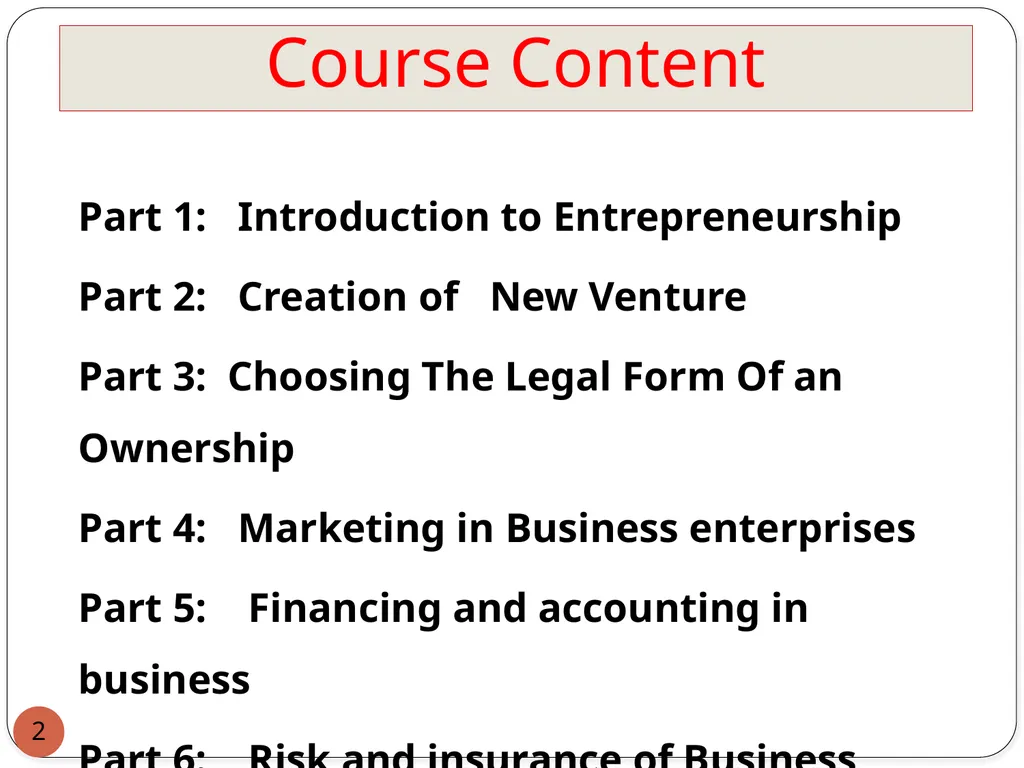
Course Content Part 1: Introduction to Entrepreneurship
Part 2: Creation of New Venture
Part 3: Choosing The Legal Form Of an Ownership
Part 4: Marketing in Business enterprises
Part 5: Financing and accounting in business
Part 6: Risk and insurance of Business enterprises 2<br>
Part 2: Creation of New Venture
Part 3: Choosing The Legal Form Of an Ownership
Part 4: Marketing in Business enterprises
Part 5: Financing and accounting in business
Part 6: Risk and insurance of Business enterprises 2<br>
03
Chapter One
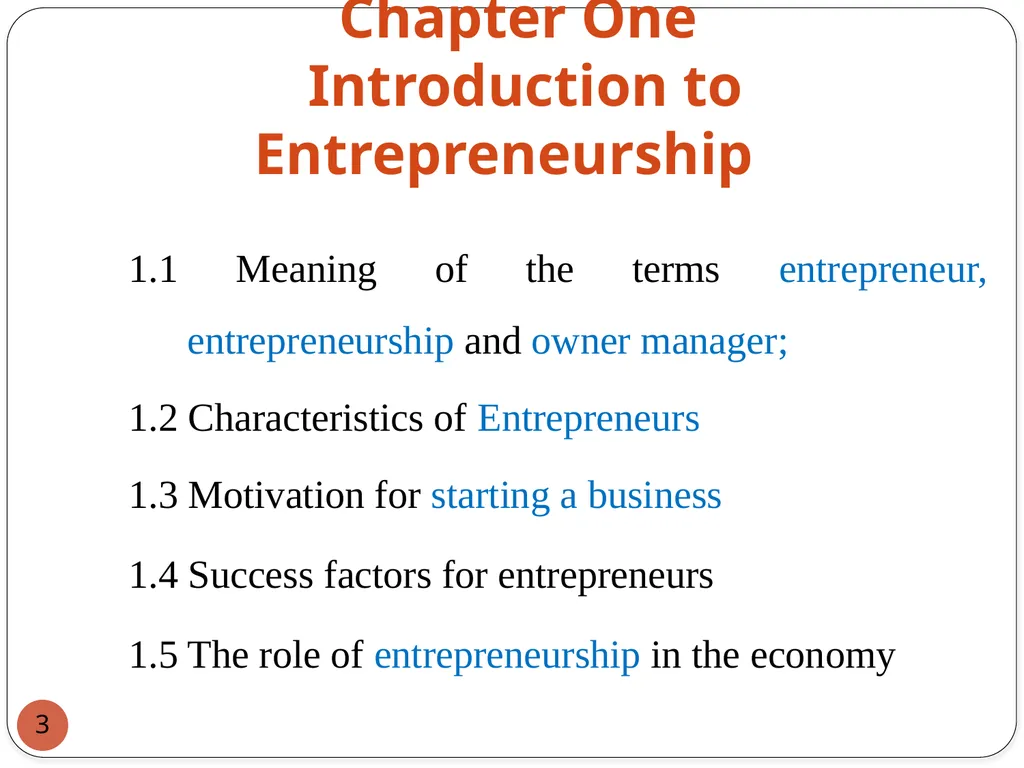
Introduction to Entrepreneurship 1.1 Meaning of the terms entrepreneur, entrepreneurship and owner manager;
1.2 Characteristics of Entrepreneurs
1.3 Motivation for starting a business
1.4 Success factors for entrepreneurs
1.5 The role of entrepreneurship in the economy 3<br>
1.2 Characteristics of Entrepreneurs
1.3 Motivation for starting a business
1.4 Success factors for entrepreneurs
1.5 The role of entrepreneurship in the economy 3<br>
04
What is Entrepreneur? An entrepreneur, is an individual who creates a new business, bearing most of the risks to achieve goals.
Entrepreneur is a visionary leader- a person who dreams great dreams. (Hisrich)
The entrepreneur is commonly seen as an innovator, a source of new ideas, goods, services, and business/or procedures. 4<br>
Entrepreneur is a visionary leader- a person who dreams great dreams. (Hisrich)
The entrepreneur is commonly seen as an innovator, a source of new ideas, goods, services, and business/or procedures. 4<br>
05
What is Entrepreneur?...cont’d Entrepreneurs are people who have the ability
to see and evaluate business opportunities,
to gather the necessary resources to take advantage of them
to initiate appropriate action to ensure success. 5<br>
to see and evaluate business opportunities,
to gather the necessary resources to take advantage of them
to initiate appropriate action to ensure success. 5<br>
06
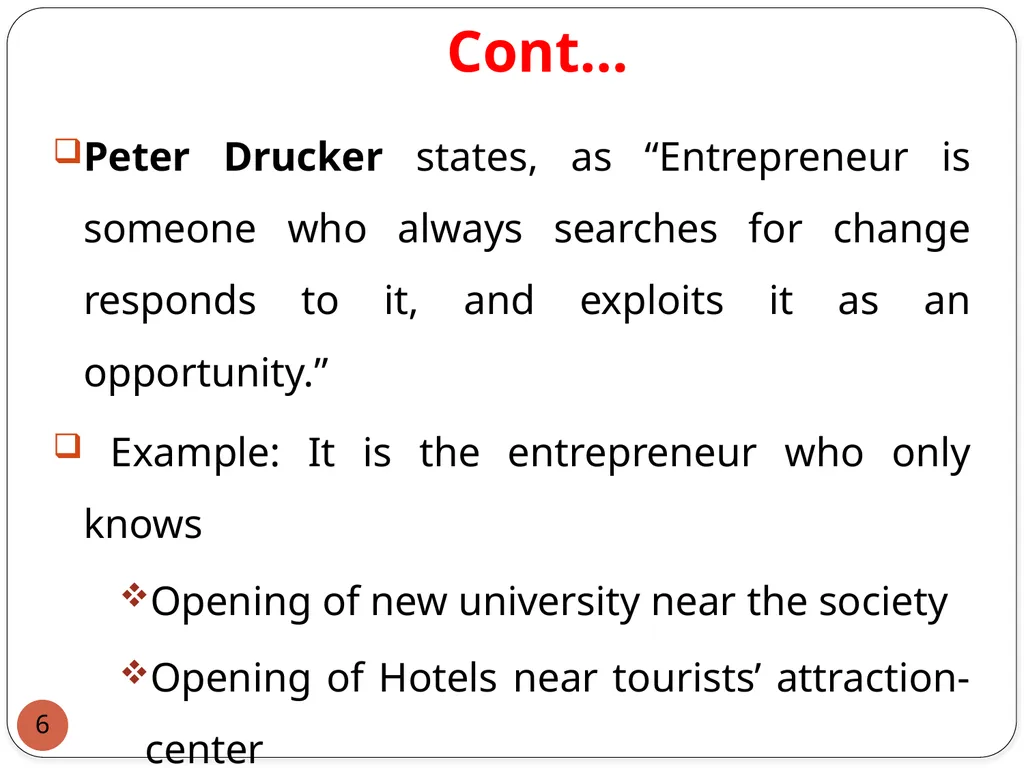
Cont… Peter Drucker states, as “Entrepreneur is someone who always searches for change responds to it, and exploits it as an opportunity.”
Example: It is the entrepreneur who only knows
Opening of new university near the society
Opening of Hotels near tourists’ attraction-center 6<br>
Example: It is the entrepreneur who only knows
Opening of new university near the society
Opening of Hotels near tourists’ attraction-center 6<br>
07
What is Entrepreneurship? Entrepreneurship is the process of designing, launching and running a new business, which is often initially a small business.
Entrepreneurship capacity and willingness to develop, organize and manage a business venture along with any of its risks to make a profit. 7<br>
Entrepreneurship capacity and willingness to develop, organize and manage a business venture along with any of its risks to make a profit. 7<br>
08
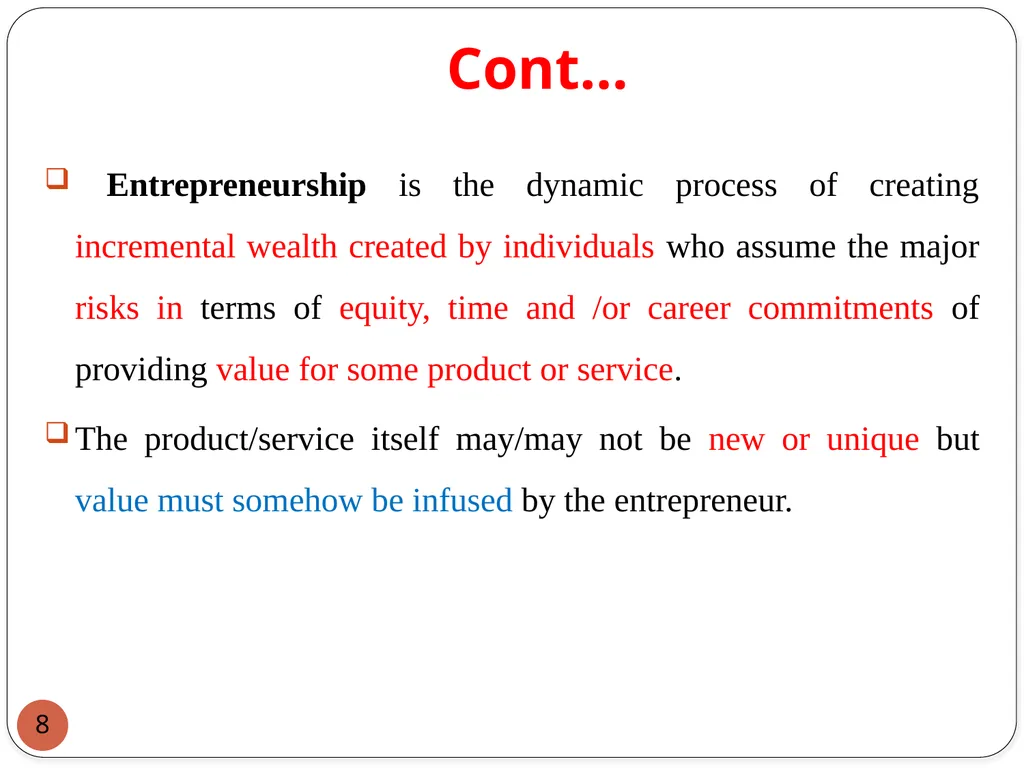
Cont… Entrepreneurship is the dynamic process of creating incremental wealth created by individuals who assume the major risks in terms of equity, time and /or career commitments of providing value for some product or service.
The product/service itself may/may not be new or unique but value must somehow be infused by the entrepreneur. 8<br>
The product/service itself may/may not be new or unique but value must somehow be infused by the entrepreneur. 8<br>
09
Generally Entrepreneur and Entrepreneurship Entrepreneur: a vision-driven individual who assumes significant personal and financial risk to start or expand a business.
Entrepreneurship: The pursuit of opportunity through innovation, creativity and hard work without regard for the resources currently controlled. 9<br>
Entrepreneurship: The pursuit of opportunity through innovation, creativity and hard work without regard for the resources currently controlled. 9<br>
10
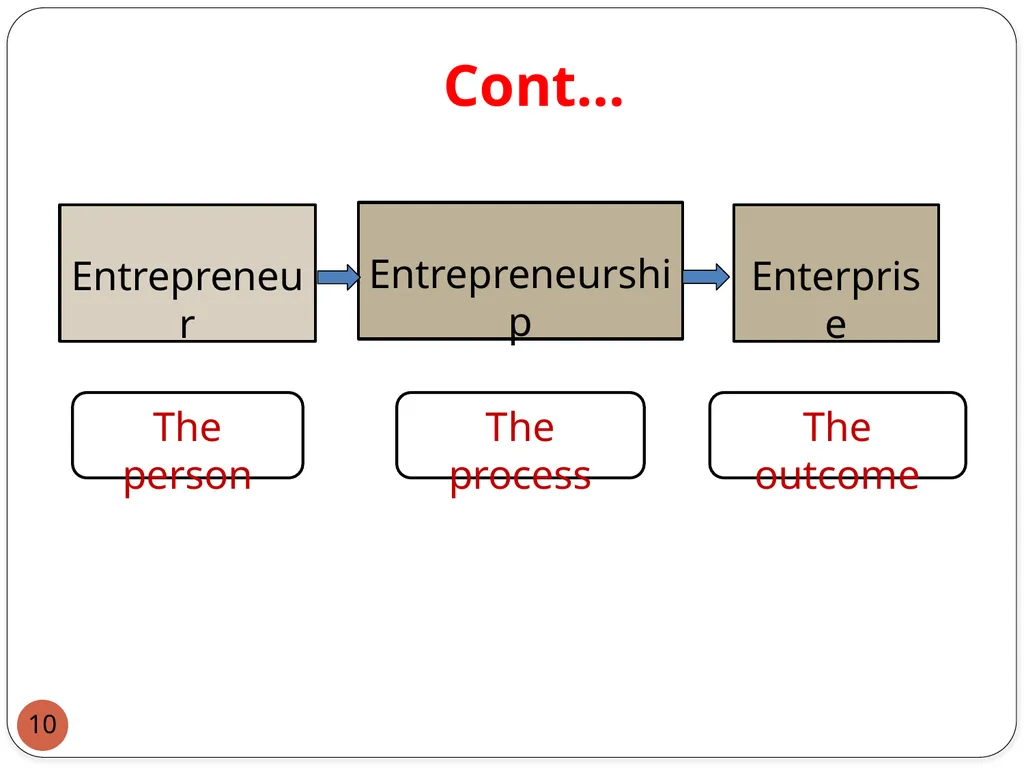
Cont… Entrepreneur Entrepreneurship Enterprise The person The process The outcome 10<br>
11
Factors Influencing Entrepreneurship 11<br>
12
The term Entrepreneur can be distinguished from other terms which are very close to each other:<br>
13
Figure 1.2: The Entrepreneur and related terms<br>
14
Entrepreneurs should unify the leadership skills and the managerial abilities – the doing and the motivation of others:<br>
15
The Entrepreneur builds new structures as well as in newly founded business units Kind of companies in a new project, Entrepreneurship may be needed, especially when the company enters into new fields of business Entrepreneurship is needed in SME as they are not as specialized as compared to large corporations.<br>
16
The Process of Entrepreneurship Entrepreneurship can be understood as a process<br>
17
An opportunity is considered as a possibility to introduce a new market offering. Opportunities however are not readily existing and visible for everybody, only for an Entrepreneur. The right timing may be a critical factor!
The Entrepreneur has to recognize existing economic imbalances as a prerequisite for an opportunity. This depends very much on the experiences and know-how of people to understand industry, markets and their customers, as well as competitive forces and how they work together.
The Entrepreneur has to evaluate the gathered information and to sort out opportunities where the costs are too high. When this decision is made, the Entrepreneur will become more formal and will continue with a feasibility study, especially in case of innovative market offerings.
Finally, the Entrepreneur has to use the opportunity and to start a new company, to open a new branch office in the foreign market, to start a new business unit etc.<br>
The Entrepreneur has to recognize existing economic imbalances as a prerequisite for an opportunity. This depends very much on the experiences and know-how of people to understand industry, markets and their customers, as well as competitive forces and how they work together.
The Entrepreneur has to evaluate the gathered information and to sort out opportunities where the costs are too high. When this decision is made, the Entrepreneur will become more formal and will continue with a feasibility study, especially in case of innovative market offerings.
Finally, the Entrepreneur has to use the opportunity and to start a new company, to open a new branch office in the foreign market, to start a new business unit etc.<br>
18
Entrepreneurial Ecosystem Societal Entrepreneurial Ecosystem<br>
19
Personal Entrepreneurial Ecosystem What makes the Entrepreneur successful?
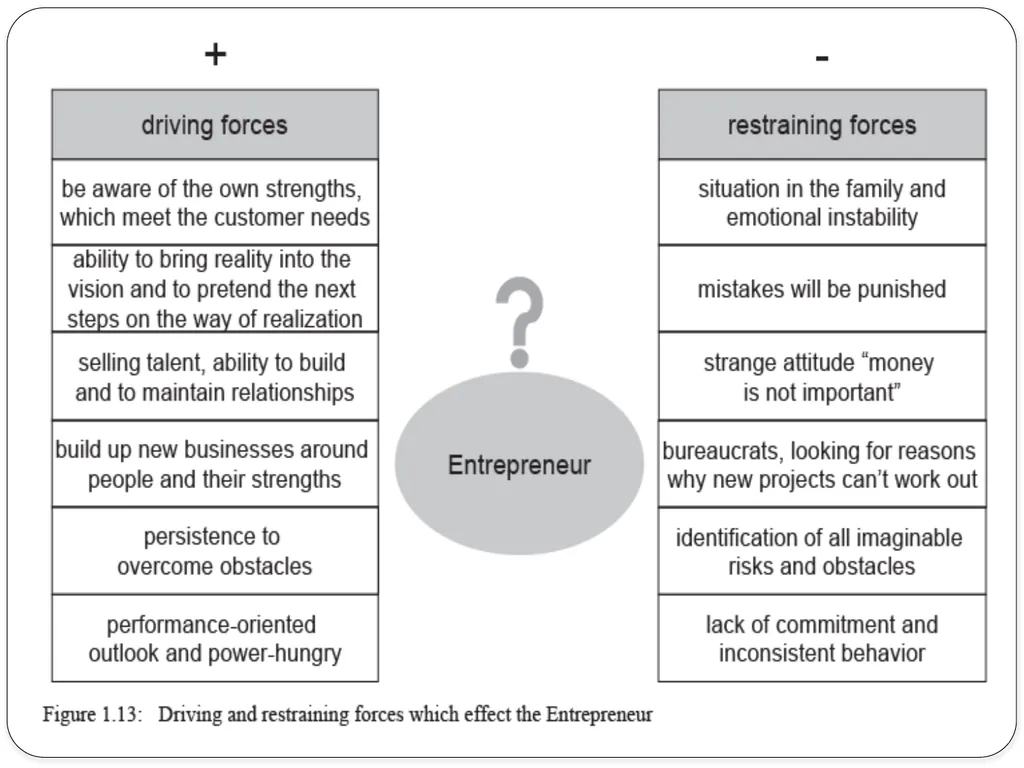
Driving forces and restraining forces which affect the Entrepreneur<br>
Driving forces and restraining forces which affect the Entrepreneur<br>
20
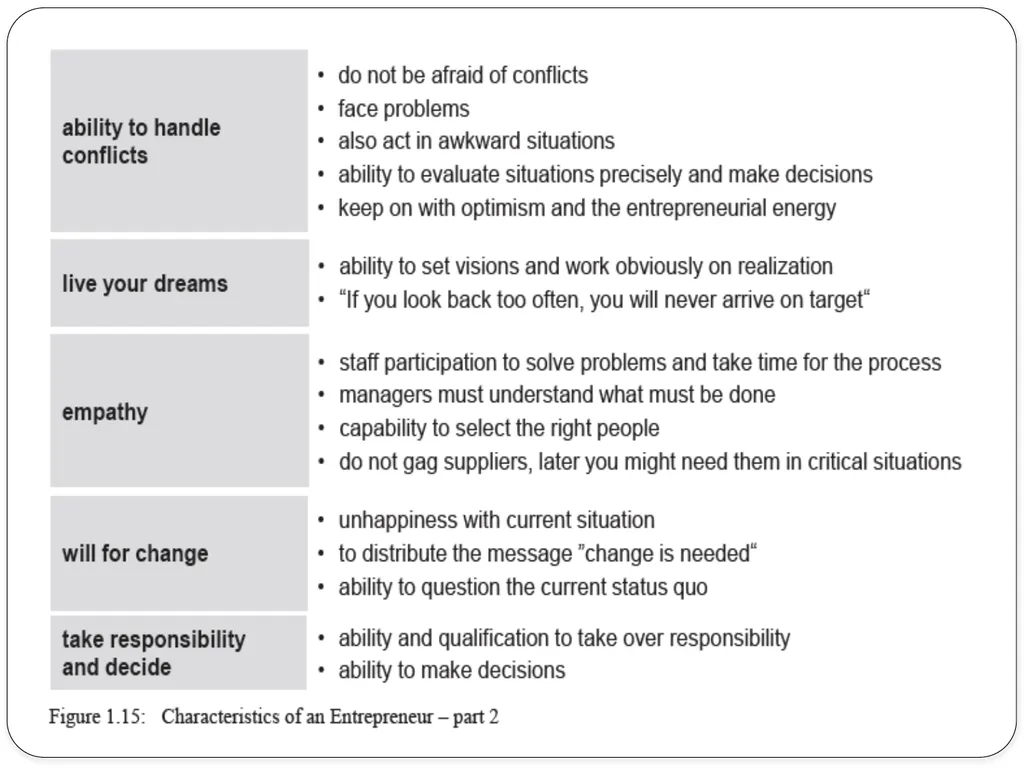
Characteristics of an Entrepreneur<br>
21
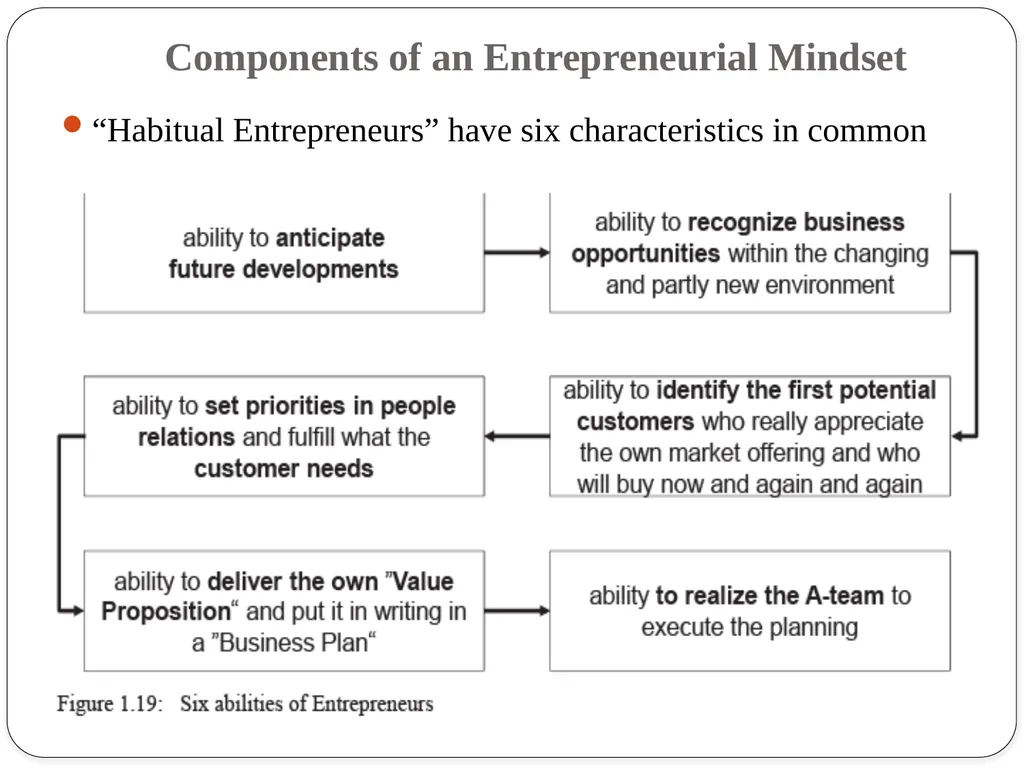
Components of an Entrepreneurial Mindset “Habitual Entrepreneurs” have six characteristics in common<br>
22
Entrepreneurs Vs. Intrapreneurs Entrepreneurs are people that notice opportunities and take the initiative to mobilize resources to make new goods and services.
Intrapreneurs also notice opportunities and take initiative to mobilize resources, however they work in large companies and contribute to the innovation of the firm.
Intrapreneurs often become entrepreneurs. 24<br>
Intrapreneurs also notice opportunities and take initiative to mobilize resources, however they work in large companies and contribute to the innovation of the firm.
Intrapreneurs often become entrepreneurs. 24<br>
23
Entrepreneurial Skills The following are foundational skills entrepreneurs need to run and operate a successful business:
Human Relations, communication and negotiation Skills
Math or financial Skills
Problem Solving & Decision Making Skills
Planning and leadership skills
Technical Skills
Basic Business / marketing Skills
Project Management Skills 25<br>
Human Relations, communication and negotiation Skills
Math or financial Skills
Problem Solving & Decision Making Skills
Planning and leadership skills
Technical Skills
Basic Business / marketing Skills
Project Management Skills 25<br>
24
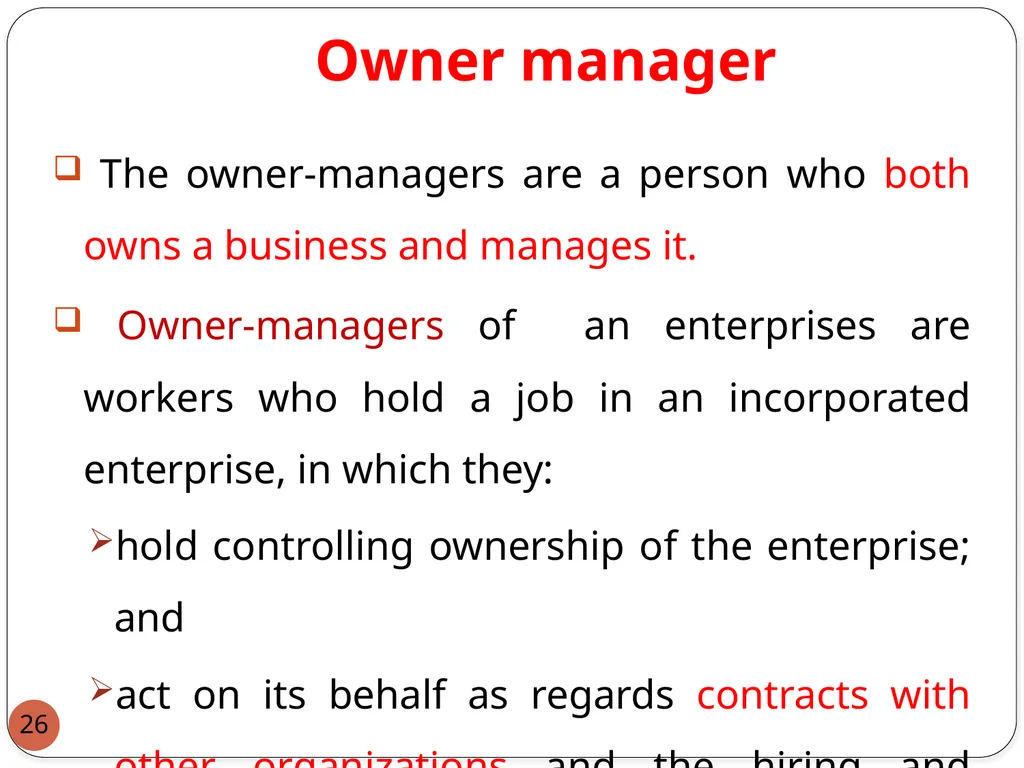
Owner manager The owner-managers are a person who both owns a business and manages it.
Owner-managers of an enterprises are workers who hold a job in an incorporated enterprise, in which they:
hold controlling ownership of the enterprise; and
act on its behalf as regards contracts with other organizations and the hiring and dismissal of persons. 26<br>
Owner-managers of an enterprises are workers who hold a job in an incorporated enterprise, in which they:
hold controlling ownership of the enterprise; and
act on its behalf as regards contracts with other organizations and the hiring and dismissal of persons. 26<br>
25
Owner Managers and Entrepreneurs Both have to follow sound principles of management like planning, staffing, delegation and control.
Generally Similarities between Managers and Entrepreneurs
To produce results
To produce results through people
To take decisions .
To cooperate under constraints
To follow sound principles of management
A successful organization needs both entrepreneurship and management. 27<br>
Generally Similarities between Managers and Entrepreneurs
To produce results
To produce results through people
To take decisions .
To cooperate under constraints
To follow sound principles of management
A successful organization needs both entrepreneurship and management. 27<br>
26
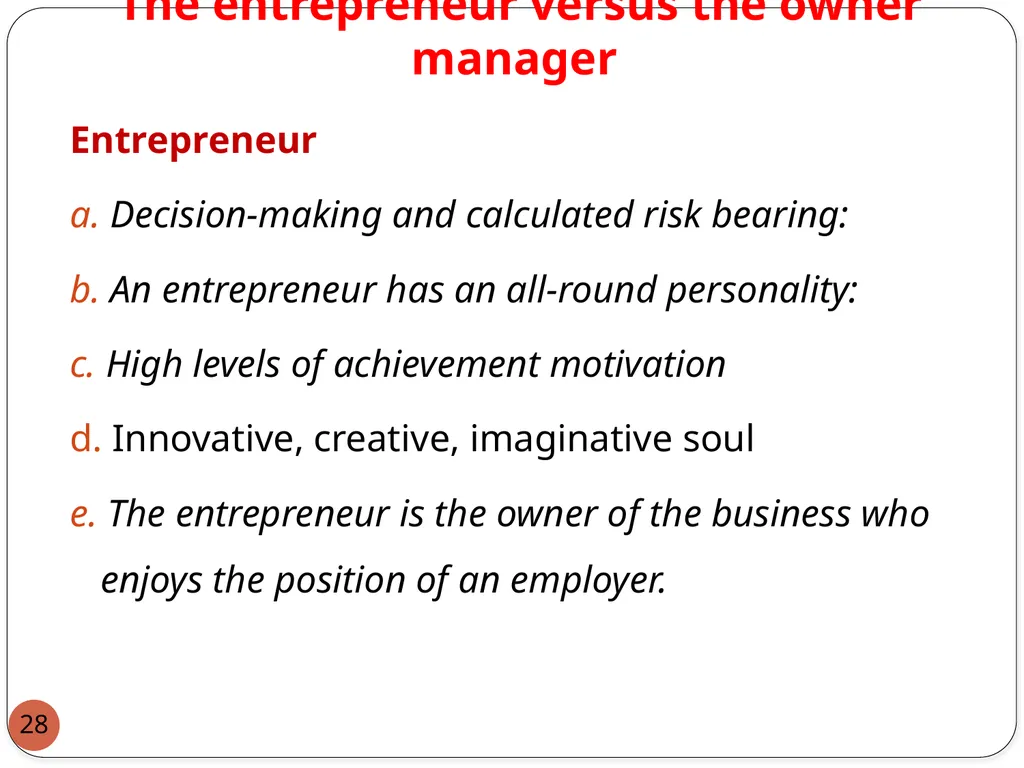
The entrepreneur versus the owner manager Entrepreneur
a. Decision-making and calculated risk bearing:
b. An entrepreneur has an all-round personality:
c. High levels of achievement motivation
d. Innovative, creative, imaginative soul
e. The entrepreneur is the owner of the business who enjoys the position of an employer. 28<br>
a. Decision-making and calculated risk bearing:
b. An entrepreneur has an all-round personality:
c. High levels of achievement motivation
d. Innovative, creative, imaginative soul
e. The entrepreneur is the owner of the business who enjoys the position of an employer. 28<br>
27
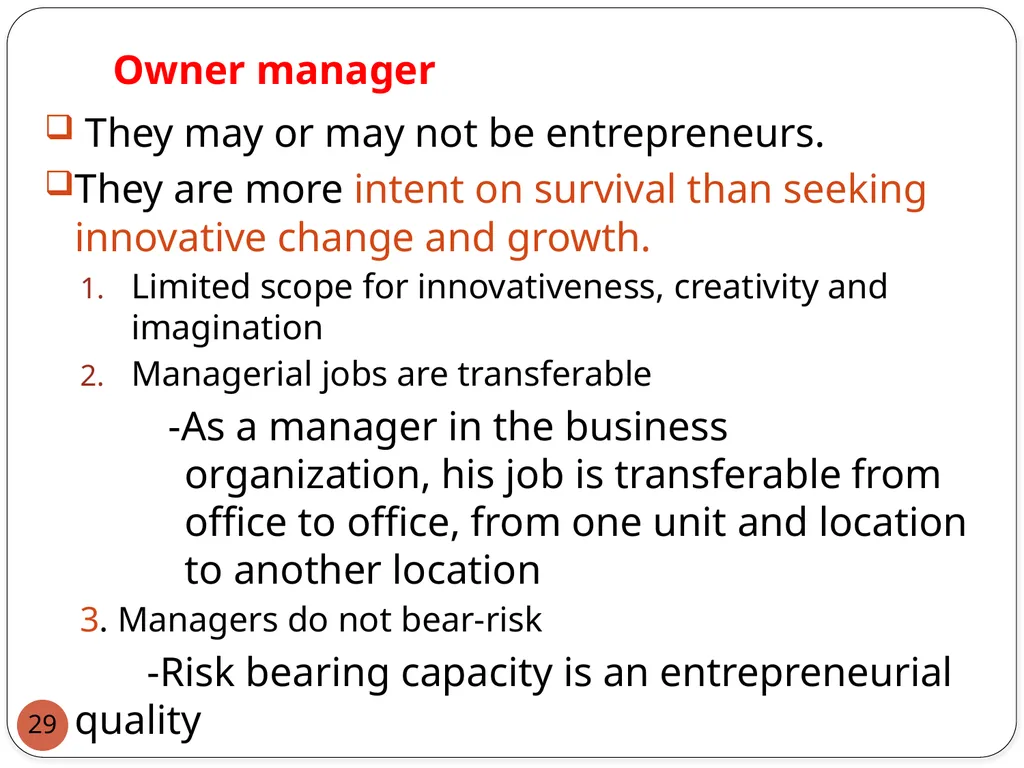
Owner manager They may or may not be entrepreneurs.
They are more intent on survival than seeking innovative change and growth.
Limited scope for innovativeness, creativity and imagination
Managerial jobs are transferable
-As a manager in the business organization, his job is transferable from office to office, from one unit and location to another location
3. Managers do not bear-risk
-Risk bearing capacity is an entrepreneurial quality 29<br>
They are more intent on survival than seeking innovative change and growth.
Limited scope for innovativeness, creativity and imagination
Managerial jobs are transferable
-As a manager in the business organization, his job is transferable from office to office, from one unit and location to another location
3. Managers do not bear-risk
-Risk bearing capacity is an entrepreneurial quality 29<br>
28
Characteristics of Entrepreneurs 1. Need for Achievement
2. Willingness to take risks:-financial, careers, family ,
3. Self-Confidence:- internal and external locus of control
4. Innovation:-. The entrepreneurial manger is constantly looking for innovations, not by waiting for a flash of inspirations, but through an organized and continuous search for new ideas
5. Total Commitment
6. All-rounders
7. A need to seek refuge:- escape from environmental factor
a. The “Foreign Refugee”
b. Corporate Refugee.
c. Other types of Refugees 30<br>
2. Willingness to take risks:-financial, careers, family ,
3. Self-Confidence:- internal and external locus of control
4. Innovation:-. The entrepreneurial manger is constantly looking for innovations, not by waiting for a flash of inspirations, but through an organized and continuous search for new ideas
5. Total Commitment
6. All-rounders
7. A need to seek refuge:- escape from environmental factor
a. The “Foreign Refugee”
b. Corporate Refugee.
c. Other types of Refugees 30<br>
29
Cont… Other types of “ refugees” mentioned are the following:
1.The parental (paternal) refugee
Who leaves a family business to show the parent that “I can do it alone”.
2.The feminist refugee
Who experiences discrimination and elects to start a firm in which she can operate independently male chauvinist.
3.The housewife refugee
Who starts her own business after her family is grown or at some other point when she can free herself from household responsibilities.
4.The educational refugee
Who tires of an academic program and decide to go into business. 31<br>
1.The parental (paternal) refugee
Who leaves a family business to show the parent that “I can do it alone”.
2.The feminist refugee
Who experiences discrimination and elects to start a firm in which she can operate independently male chauvinist.
3.The housewife refugee
Who starts her own business after her family is grown or at some other point when she can free herself from household responsibilities.
4.The educational refugee
Who tires of an academic program and decide to go into business. 31<br>
30
Motivation for starting a business
The reason for small firm formation can be divided between “pull” and “push” influences.
I.“Pull” Influence
Some individuals are attracted towards small business ownership by positive motive such as a specific idea which they are convinced will work. ”Pull” motives include:
a. Desire for independence
b. Desire to exploit an opportunity
c. Turning a hobby or previous work experience in to a business
d. Financial Incentive
The promise of long-term financial independence can clearly be a motive in starting new firm, although it is usually not quoted as frequently as other factors. 32<br>
The reason for small firm formation can be divided between “pull” and “push” influences.
I.“Pull” Influence
Some individuals are attracted towards small business ownership by positive motive such as a specific idea which they are convinced will work. ”Pull” motives include:
a. Desire for independence
b. Desire to exploit an opportunity
c. Turning a hobby or previous work experience in to a business
d. Financial Incentive
The promise of long-term financial independence can clearly be a motive in starting new firm, although it is usually not quoted as frequently as other factors. 32<br>
31
Cont… II. “Push” Independence
Many people are pushed into founding a new enterprise by variety of factors including:
1.Redundancy==>Being without a job (idleness)
2.Unemployment (or threat of)
3.Disagreement with previous employer==>Uncomfortable relation at work has also pushed new entrants into small business.
The dividing line between those “pulled” and those “pushed” is often blurred. 33<br>
Many people are pushed into founding a new enterprise by variety of factors including:
1.Redundancy==>Being without a job (idleness)
2.Unemployment (or threat of)
3.Disagreement with previous employer==>Uncomfortable relation at work has also pushed new entrants into small business.
The dividing line between those “pulled” and those “pushed” is often blurred. 33<br>
32
Outcomes of Entrepreneurship
Economic growth
New industry formation
Job creation
Success factors for entrepreneurs
Most new ventures succeed because their founders are capable individuals.
1.The entrepreneurial team
2.Incremental growth of product or services
3.Marketing and timing: Market potential is critically influenced by timing of new products or services. 34<br>
Economic growth
New industry formation
Job creation
Success factors for entrepreneurs
Most new ventures succeed because their founders are capable individuals.
1.The entrepreneurial team
2.Incremental growth of product or services
3.Marketing and timing: Market potential is critically influenced by timing of new products or services. 34<br>
33
Weakness of entrepreneurship a. Limited resource:- entrepreneurship mostly starts from small investment or contribution of owners are more than one individual
b. Lack of experience:- most of entrepreneurs have no experience and this may lead to in efficiency
c. Disagreement between member: if the owner of entrepreneur is more than one person, disagreement between them can be created. This disagreement can limit the operation of the business.
d. Uncertainty of income:- opening and running a business provide no guarantee that an entrepreneur will earn enough money to survive 35<br>
b. Lack of experience:- most of entrepreneurs have no experience and this may lead to in efficiency
c. Disagreement between member: if the owner of entrepreneur is more than one person, disagreement between them can be created. This disagreement can limit the operation of the business.
d. Uncertainty of income:- opening and running a business provide no guarantee that an entrepreneur will earn enough money to survive 35<br>
34
Cont… e. Risk:- starting or buying a new business involves risk and the higher rewards the greater the risk entrepreneurs usually face. This is why entrepreneurs tend to have evaluate risk very carefully
f. Lower quality of life until the business gets established:- the long hour and hard work needed to launch a business can take their tall in the rest of the entrepreneurs life 36<br>
f. Lower quality of life until the business gets established:- the long hour and hard work needed to launch a business can take their tall in the rest of the entrepreneurs life 36<br>
35
Elements involved in Entrepreneur 1.RISK:- Simply stated risk is “a condition in which there is a possibility of an adverse deviation from a desired outcome that is expected or hoped from applied to a business risk translates in to the possibility of losses associated with the assets and the earning potential of the firm. ” 37<br>
36
Elements involved in Entrepreneur RISK: Business risks can be classified into two broad category market risk and pure risk.
Entrepreneurs face a number of different types of risk. These can be grouped in to basic areas.
a. Political risk:-
b. Business risk:-
c. Economic risk:-
d. property risk
e. Personal risk 38<br>
Entrepreneurs face a number of different types of risk. These can be grouped in to basic areas.
a. Political risk:-
b. Business risk:-
c. Economic risk:-
d. property risk
e. Personal risk 38<br>
37
Elements involved in Entrepreneur 2. Information
Information gives the following importance to the businessmen’s
To know the position of their competitors that is their strength and weaknesses, business strategy they use and their long term plan.
To know threats and opportunity in doing business
Helps to design long term objectives and goals indicate capital requirement (labor, capital and machinery)
Helps to know market position locally and internationally. 39<br>
Information gives the following importance to the businessmen’s
To know the position of their competitors that is their strength and weaknesses, business strategy they use and their long term plan.
To know threats and opportunity in doing business
Helps to design long term objectives and goals indicate capital requirement (labor, capital and machinery)
Helps to know market position locally and internationally. 39<br>
38
Elements involved in Entrepreneur Sources of information
Information are obtained from two main methods of data collection. That is primary data collection and secondary data collection
Collection of primary data:
Observation method
Interview method
Through questioner
Other methods which includes warranty cards, consumer panels, etc. 40<br>
Information are obtained from two main methods of data collection. That is primary data collection and secondary data collection
Collection of primary data:
Observation method
Interview method
Through questioner
Other methods which includes warranty cards, consumer panels, etc. 40<br>
39
Elements involved in Entrepreneur 2. Collection of secondary data:-
Various publication of the central state and local government
Various publications of foreign government or international bodies and their subsidiary organization.
Technical and trade journals
Books, magazines and newspapers
Reports
Public records and statistics, historical documents. 41<br>
Various publication of the central state and local government
Various publications of foreign government or international bodies and their subsidiary organization.
Technical and trade journals
Books, magazines and newspapers
Reports
Public records and statistics, historical documents. 41<br>
40
Elements involved in Entrepreneur By way of caution, the entrepreneur before using secondary data must see that the process following characteristics
1.Reliability of data
a. Who collected the data?
b. What were the sources of data?
c. Were they collected by using proper methods?
d. At what time they collected. Etc.
2.Suitability of data:- the data that are suitable for one enquiry may not be suitable for another enquiry, then the researcher has to check the suitability of the data properly.
3.Adequacy of data 42<br>
1.Reliability of data
a. Who collected the data?
b. What were the sources of data?
c. Were they collected by using proper methods?
d. At what time they collected. Etc.
2.Suitability of data:- the data that are suitable for one enquiry may not be suitable for another enquiry, then the researcher has to check the suitability of the data properly.
3.Adequacy of data 42<br>
41
THANK YOU 43<br>