
INTRODUCTION TO EVOLUTION, EVIDENCE OF EVOLUTION &
LD
Published · 24 slides · 0 views
1 / 1




Description
INTRODUCTION TO EVOLUTION, EVIDENCE OF EVOLUTION VARIATION PRESENTER: ZIBOBO T. SES - CHE EXAMINATION GUIDELINES Terminology Biological evolution Population Species Hypothesis Theory Fossils Paleontology Biogeography Homologous structures
Related Topics
Download this presentation From Below
"INTRODUCTION TO EVOLUTION, EVIDENCE OF EVOLUTION &" is the property of its rightful owner. Permission is granted to download and print the materials on this website for personal, non-commercial use only, and to display it on your personal computer provided you do not modify the materials and that you retain all copyright notices contained in the materials. By downloading content from our website, you accept the terms of this agreement.
Share
Embed code
Presentation Transcript
01
INTRODUCTION TO EVOLUTION, EVIDENCE OF EVOLUTION & VARIATION PRESENTER: ZIBOBO T.
SES - CHE<br>
SES - CHE<br>
02
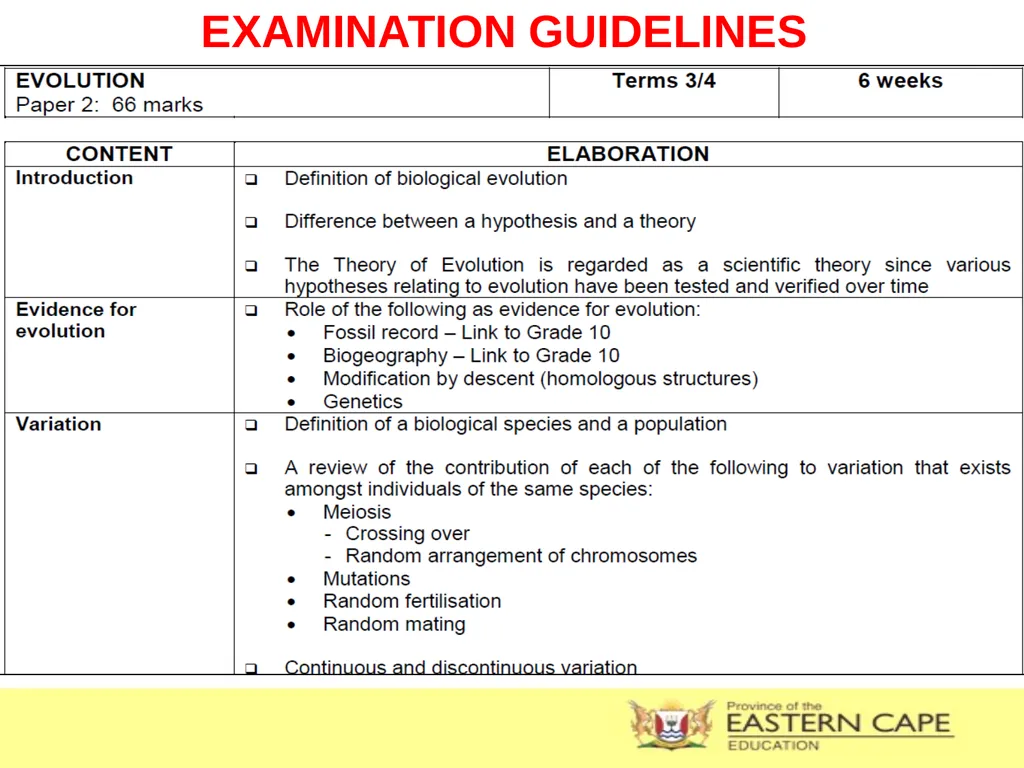
EXAMINATION GUIDELINES<br>
03
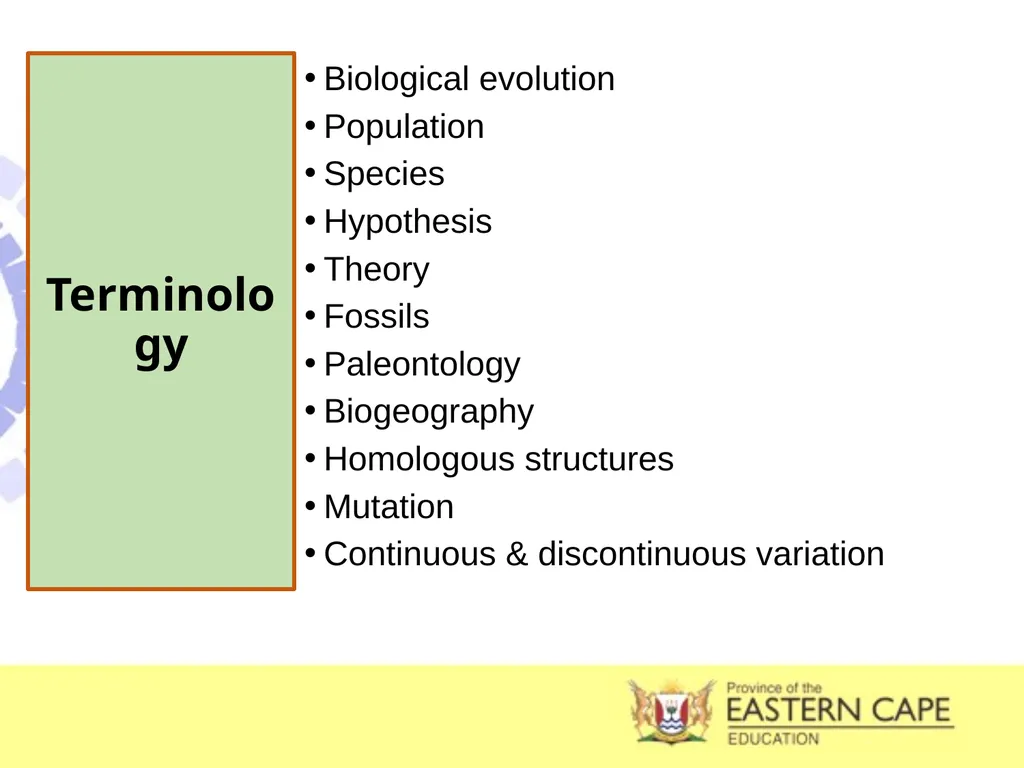
Terminology Biological evolution
Population
Species
Hypothesis
Theory
Fossils
Paleontology
Biogeography
Homologous structures
Mutation
Continuous & discontinuous variation<br>
Population
Species
Hypothesis
Theory
Fossils
Paleontology
Biogeography
Homologous structures
Mutation
Continuous & discontinuous variation<br>
04
All things we see today arose from things that existed in the past but they look different because things change over long periods of time
Biological evolution refers to the genetic changes that life forms have undergone over long periods of time.
It leads to the formation of new types of organisms (species)
Biological Evolution means that all present-day forms of life …
have descended from, and are related to, those that lived in the past
may look different because they became modified from one
generation to another What is evolution?<br>
Biological evolution refers to the genetic changes that life forms have undergone over long periods of time.
It leads to the formation of new types of organisms (species)
Biological Evolution means that all present-day forms of life …
have descended from, and are related to, those that lived in the past
may look different because they became modified from one
generation to another What is evolution?<br>
05
DIFFERENCE BETWEEN HYPOTHESIS AND A THEORY<br>
06
DIFFERENCE BETWEEN HYPOTHESIS AND A THEORY<br>
07
Evidence of evolution Evolution is a scientific theory: various hypotheses relating to evolution have been tested and verified over time, e.g. Oparin-Haldane hypothesis tested by Miller & Urey; Out of Africa hypothesis, etc.
Evidence of evolution is from the following studies:
Fossil record (Paleontology)
Biogeography
Comparative anatomy/ modification by descent (homologous structures)
Genetics<br>
Evidence of evolution is from the following studies:
Fossil record (Paleontology)
Biogeography
Comparative anatomy/ modification by descent (homologous structures)
Genetics<br>
08
FOSSIL RECORD A fossil is the remains of past life forms (plant or animal) embedded in rock and preserved in petrified form
The study of fossils is known as Paleontology
Dating techniques assist in placing the fossils discovered in rocks in a chronological sequence
The interpretation of fossil record help us to understand the patterns of development amongst the species
The overall trend from simpler ancestral forms to more complex forms as you go through the rock succession clearly shows a pattern of evolutionary change over time.<br>
The study of fossils is known as Paleontology
Dating techniques assist in placing the fossils discovered in rocks in a chronological sequence
The interpretation of fossil record help us to understand the patterns of development amongst the species
The overall trend from simpler ancestral forms to more complex forms as you go through the rock succession clearly shows a pattern of evolutionary change over time.<br>
09
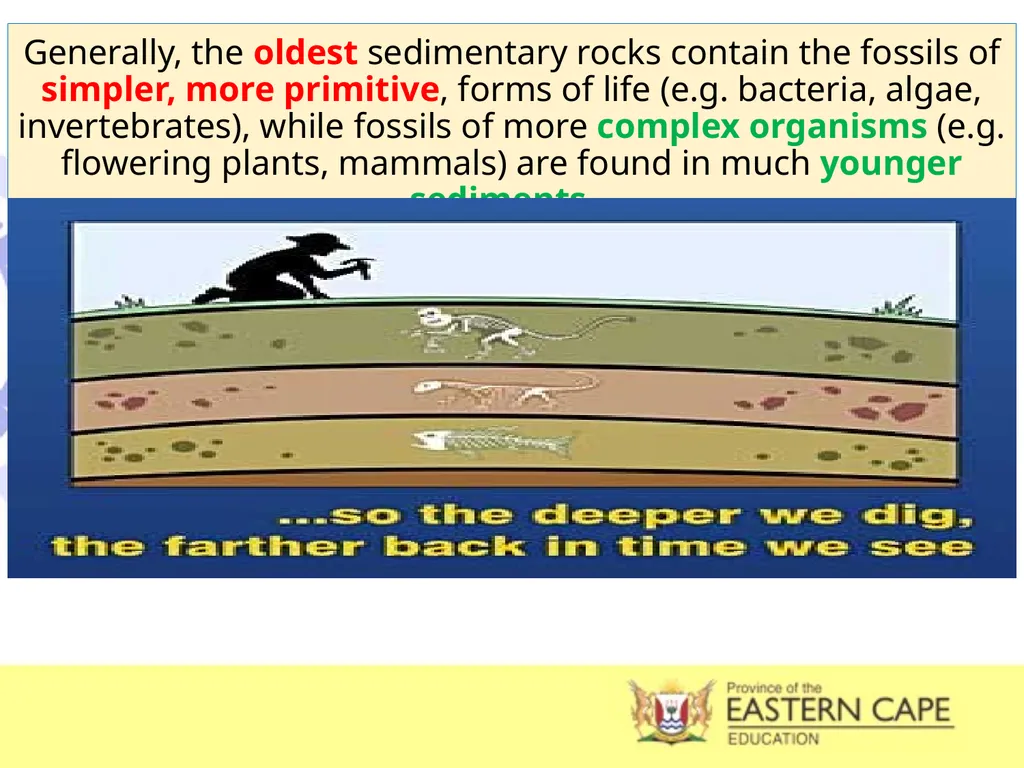
Generally, the oldest sedimentary rocks contain the fossils of simpler, more primitive, forms of life (e.g. bacteria, algae, invertebrates), while fossils of more complex organisms (e.g. flowering plants, mammals) are found in much younger sediments.<br>
10
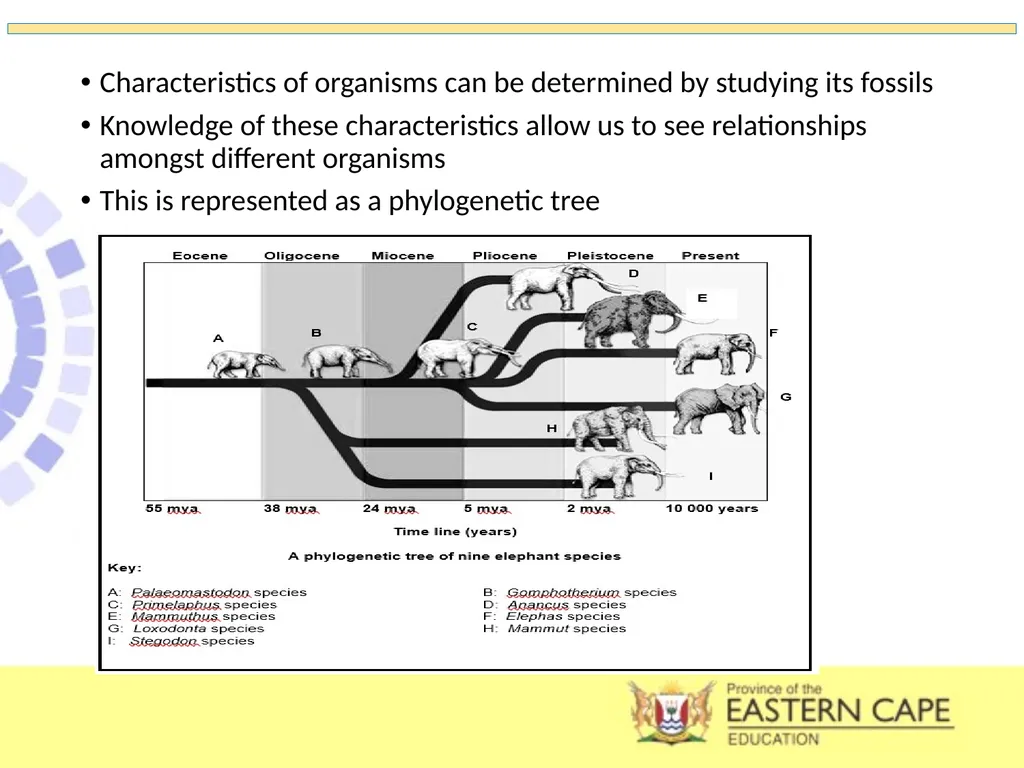
Characteristics of organisms can be determined by studying its fossils
Knowledge of these characteristics allow us to see relationships amongst different organisms
This is represented as a phylogenetic tree<br>
Knowledge of these characteristics allow us to see relationships amongst different organisms
This is represented as a phylogenetic tree<br>
11
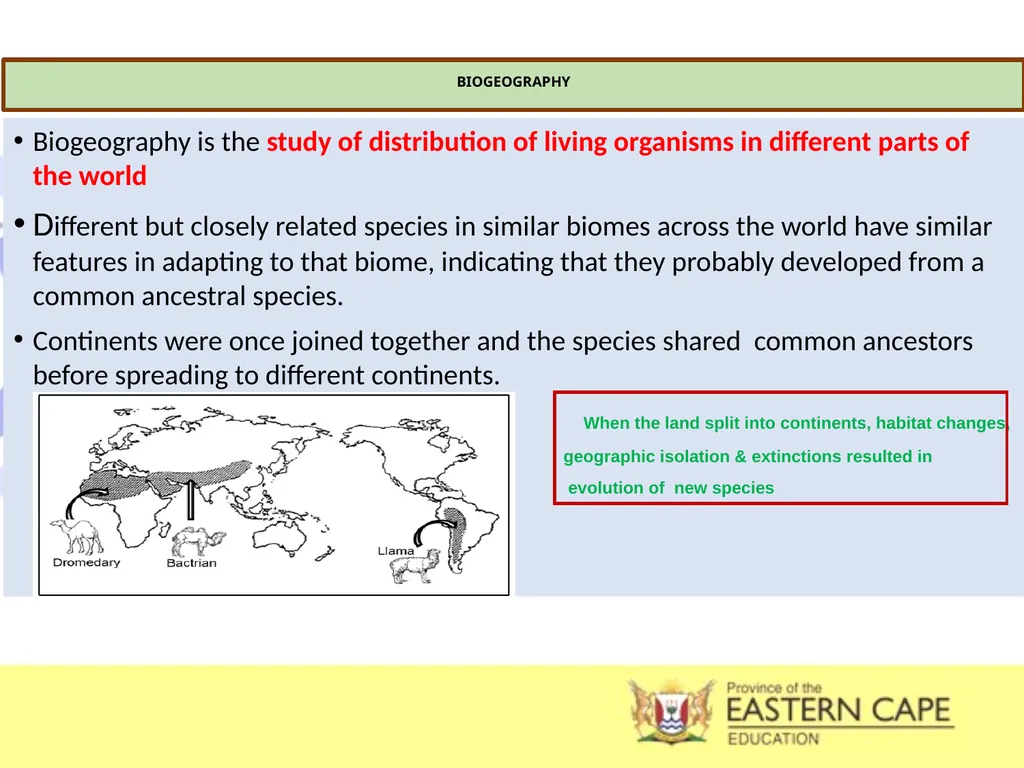
BIOGEOGRAPHY Biogeography is the study of distribution of living organisms in different parts of the world
Different but closely related species in similar biomes across the world have similar features in adapting to that biome, indicating that they probably developed from a common ancestral species.
Continents were once joined together and the species shared common ancestors before spreading to different continents.
When the land split into continents, habitat changes,
geographic isolation & extinctions resulted in
evolution of new species<br>
Different but closely related species in similar biomes across the world have similar features in adapting to that biome, indicating that they probably developed from a common ancestral species.
Continents were once joined together and the species shared common ancestors before spreading to different continents.
When the land split into continents, habitat changes,
geographic isolation & extinctions resulted in
evolution of new species<br>
12
Comparative anatomy / Modification by descent
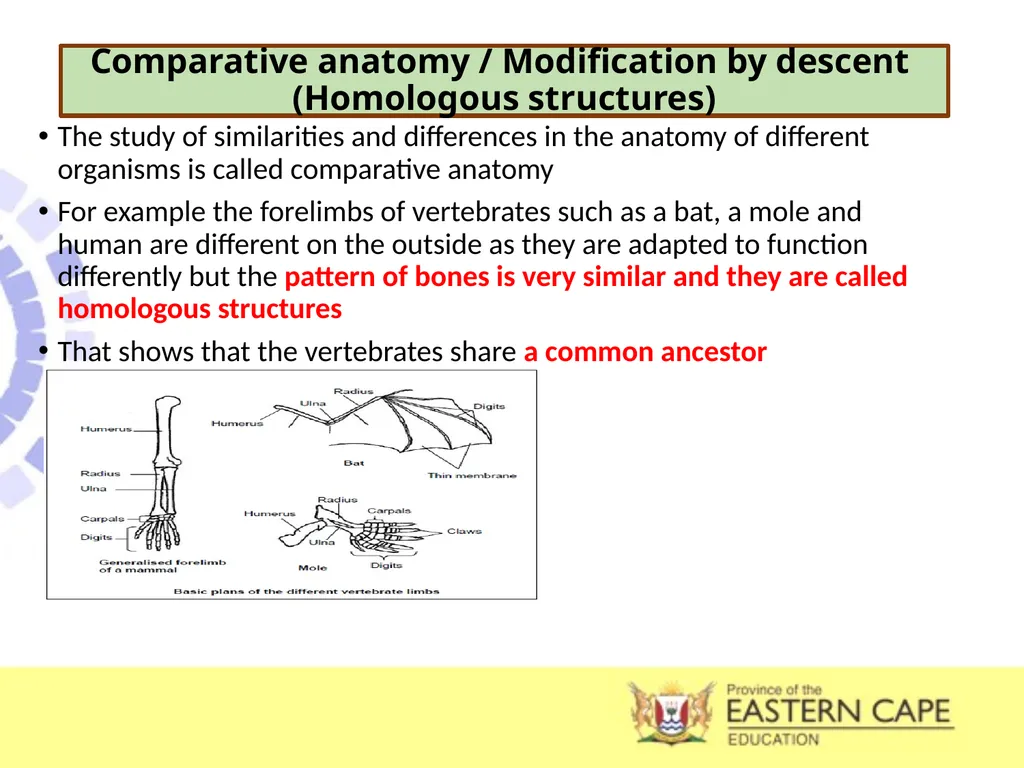
(Homologous structures) The study of similarities and differences in the anatomy of different organisms is called comparative anatomy
For example the forelimbs of vertebrates such as a bat, a mole and human are different on the outside as they are adapted to function differently but the pattern of bones is very similar and they are called homologous structures
That shows that the vertebrates share a common ancestor<br>
For example the forelimbs of vertebrates such as a bat, a mole and human are different on the outside as they are adapted to function differently but the pattern of bones is very similar and they are called homologous structures
That shows that the vertebrates share a common ancestor<br>
13
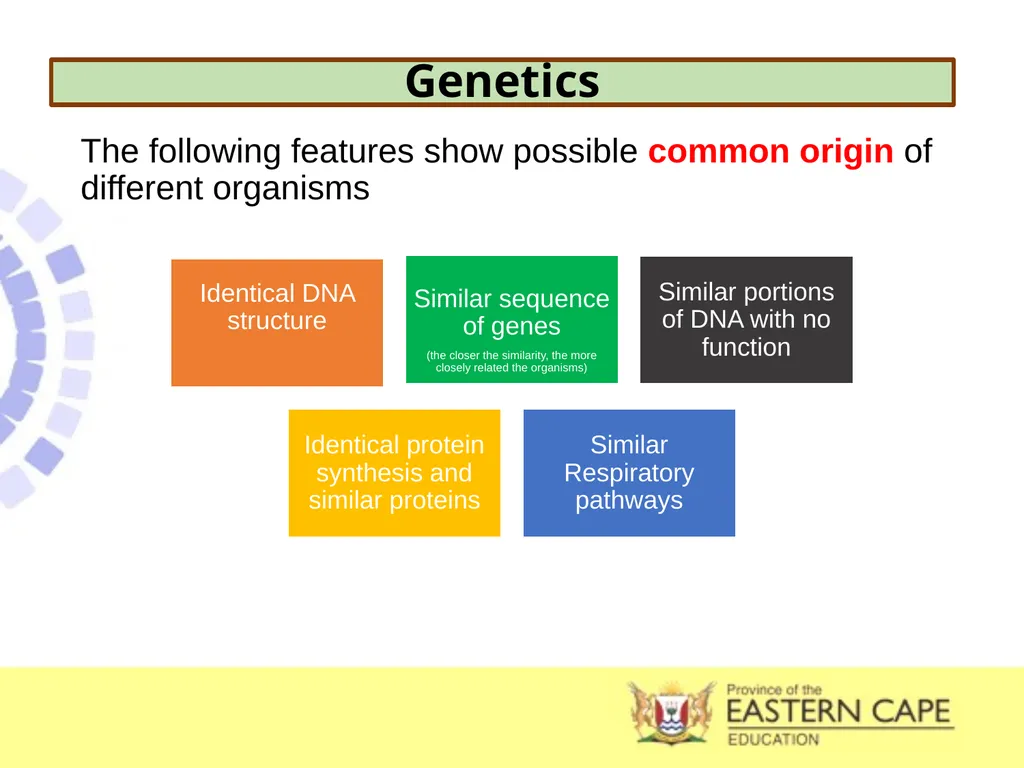
Genetics The following features show possible common origin of different organisms<br>
14
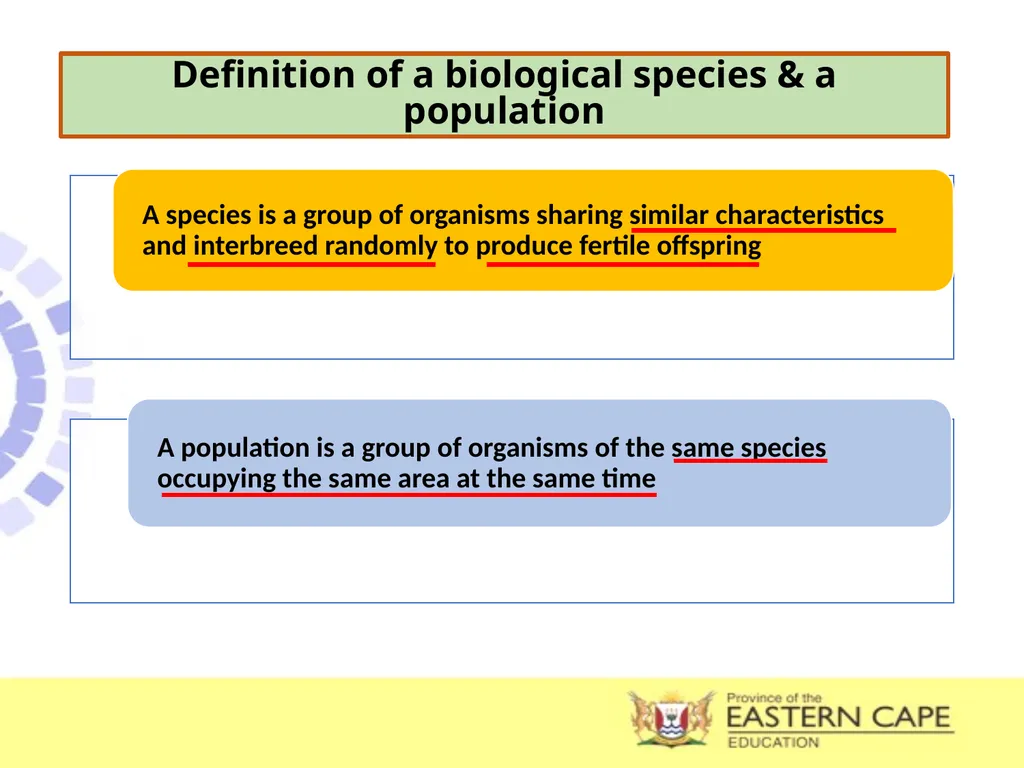
Definition of a biological species & a population<br>
15
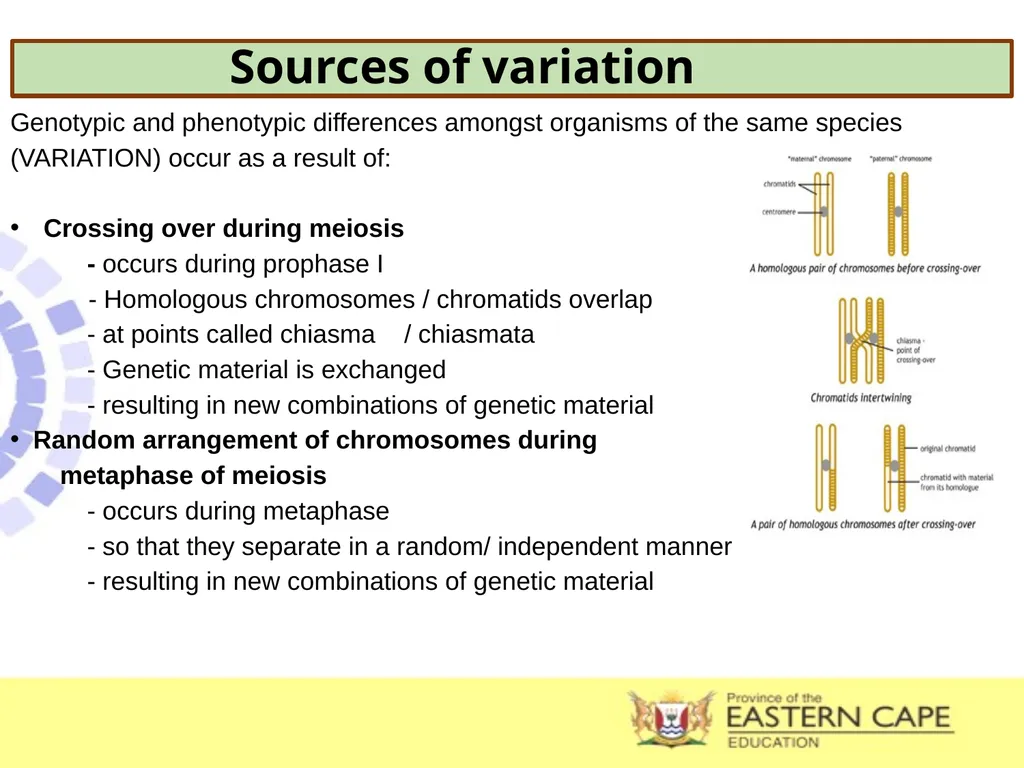
Genotypic and phenotypic differences amongst organisms of the same species (VARIATION) occur as a result of:
Crossing over during meiosis
- occurs during prophase I
- Homologous chromosomes / chromatids overlap
- at points called chiasma / chiasmata
- Genetic material is exchanged
- resulting in new combinations of genetic material
Random arrangement of chromosomes during
metaphase of meiosis
- occurs during metaphase
- so that they separate in a random/ independent manner
- resulting in new combinations of genetic material Sources of variation<br>
Crossing over during meiosis
- occurs during prophase I
- Homologous chromosomes / chromatids overlap
- at points called chiasma / chiasmata
- Genetic material is exchanged
- resulting in new combinations of genetic material
Random arrangement of chromosomes during
metaphase of meiosis
- occurs during metaphase
- so that they separate in a random/ independent manner
- resulting in new combinations of genetic material Sources of variation<br>
16
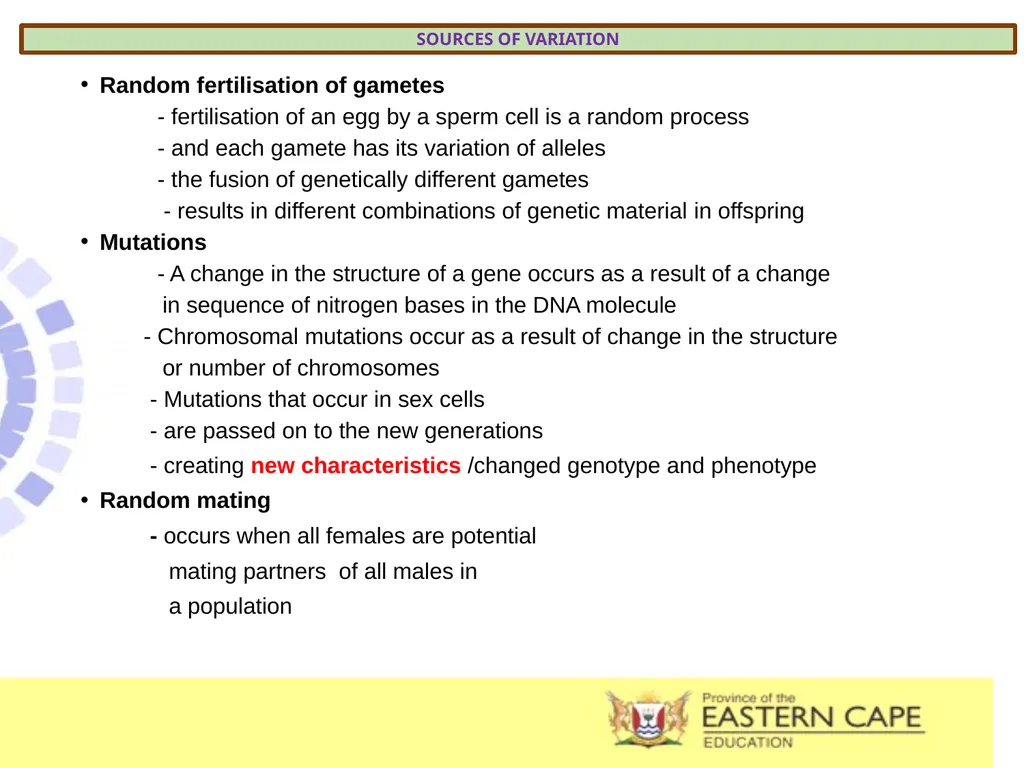
SOURCES OF VARIATION Random fertilisation of gametes
- fertilisation of an egg by a sperm cell is a random process
- and each gamete has its variation of alleles
- the fusion of genetically different gametes
- results in different combinations of genetic material in offspring
Mutations
- A change in the structure of a gene occurs as a result of a change
in sequence of nitrogen bases in the DNA molecule
- Chromosomal mutations occur as a result of change in the structure
or number of chromosomes
- Mutations that occur in sex cells
- are passed on to the new generations
- creating new characteristics /changed genotype and phenotype
Random mating
- occurs when all females are potential
mating partners of all males in
a population<br>
- fertilisation of an egg by a sperm cell is a random process
- and each gamete has its variation of alleles
- the fusion of genetically different gametes
- results in different combinations of genetic material in offspring
Mutations
- A change in the structure of a gene occurs as a result of a change
in sequence of nitrogen bases in the DNA molecule
- Chromosomal mutations occur as a result of change in the structure
or number of chromosomes
- Mutations that occur in sex cells
- are passed on to the new generations
- creating new characteristics /changed genotype and phenotype
Random mating
- occurs when all females are potential
mating partners of all males in
a population<br>
17
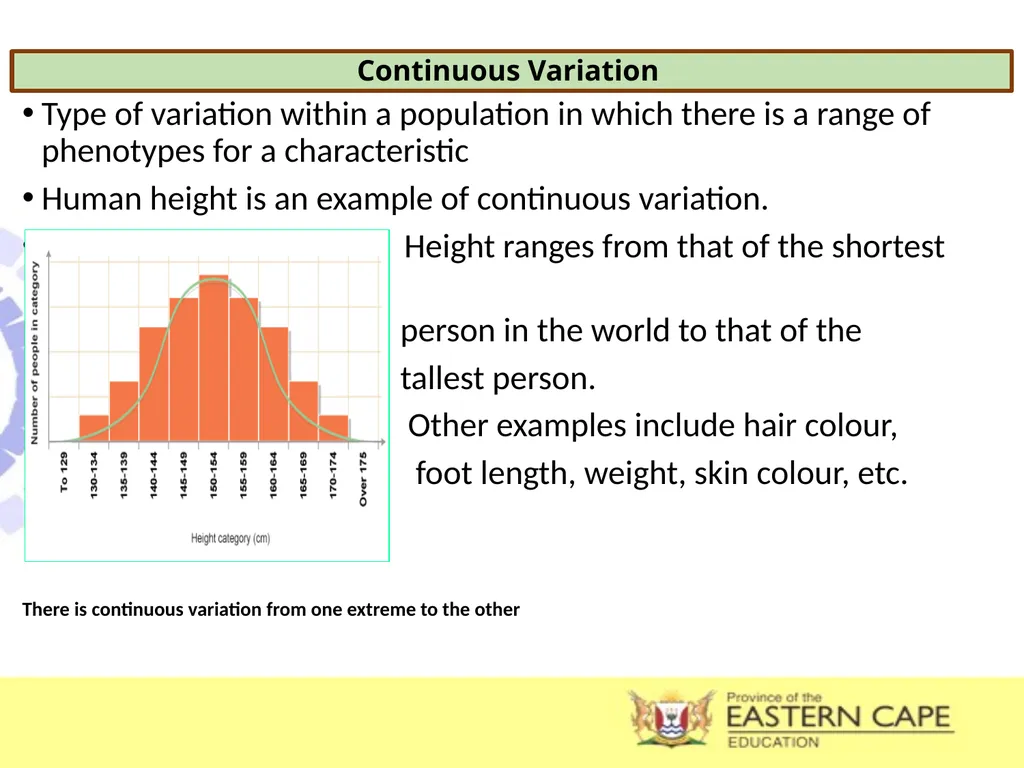
Continuous Variation Type of variation within a population in which there is a range of phenotypes for a characteristic
Human height is an example of continuous variation.
Height ranges from that of the shortest
person in the world to that of the
tallest person.
Other examples include hair colour,
foot length, weight, skin colour, etc.
There is continuous variation from one extreme to the other<br>
Human height is an example of continuous variation.
Height ranges from that of the shortest
person in the world to that of the
tallest person.
Other examples include hair colour,
foot length, weight, skin colour, etc.
There is continuous variation from one extreme to the other<br>
18
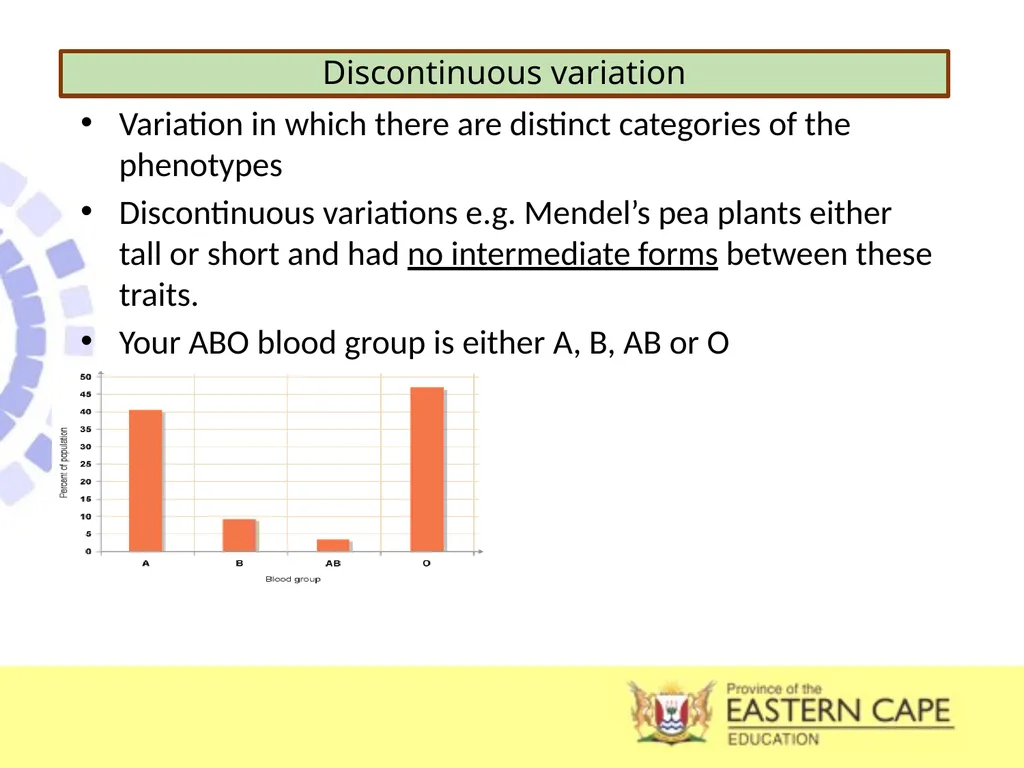
Discontinuous variation Variation in which there are distinct categories of the phenotypes
Discontinuous variations e.g. Mendel’s pea plants either tall or short and had no intermediate forms between these traits.
Your ABO blood group is either A, B, AB or O<br>
Discontinuous variations e.g. Mendel’s pea plants either tall or short and had no intermediate forms between these traits.
Your ABO blood group is either A, B, AB or O<br>
19
Activity- Question 1-MCQ 1.1.1 A scientific idea that still has to be tested is referred to as a …
A theory.
B hypothesis.
C fact.
D belief. Answer: B (2)
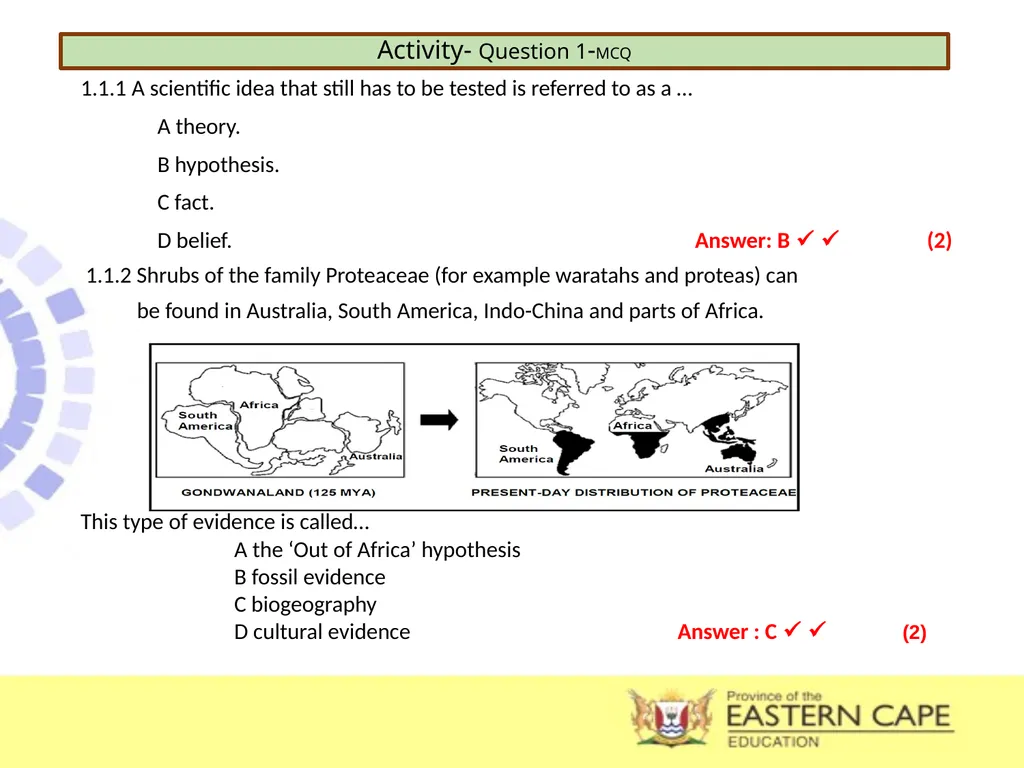
1.1.2 Shrubs of the family Proteaceae (for example waratahs and proteas) can
be found in Australia, South America, Indo-China and parts of Africa.
This type of evidence is called…
A the ‘Out of Africa’ hypothesis
B fossil evidence
C biogeography
D cultural evidence Answer : C (2)<br>
A theory.
B hypothesis.
C fact.
D belief. Answer: B (2)
1.1.2 Shrubs of the family Proteaceae (for example waratahs and proteas) can
be found in Australia, South America, Indo-China and parts of Africa.
This type of evidence is called…
A the ‘Out of Africa’ hypothesis
B fossil evidence
C biogeography
D cultural evidence Answer : C (2)<br>
20
1.1.3 Which ONE of the following can be used as evidence to support
common ancestry?
A Different DNA sequencing in different species
B Geographic distribution of different phyla
C Homologous structures of a whale's flipper and a bird's wing
D Analogous structures of a bird's wing and an insect's wing
Answer : C (2)
1.1.4 The following statements relate to fossils:
1. Very few organisms end up as fossils.
2. Some organisms tend to decay before becoming a fossil.
3. Only soft parts of organisms preserve easily.
4. Geological processes may destroy fossils.
Which of the statements above are possible reasons why there are
gaps in the fossil record?
A 1, 2 and 3 only
B 1, 2, 3 and 4
C 2, 3 and 4 only
D 1, 2 and 4 only
Answer : D (2)<br>
common ancestry?
A Different DNA sequencing in different species
B Geographic distribution of different phyla
C Homologous structures of a whale's flipper and a bird's wing
D Analogous structures of a bird's wing and an insect's wing
Answer : C (2)
1.1.4 The following statements relate to fossils:
1. Very few organisms end up as fossils.
2. Some organisms tend to decay before becoming a fossil.
3. Only soft parts of organisms preserve easily.
4. Geological processes may destroy fossils.
Which of the statements above are possible reasons why there are
gaps in the fossil record?
A 1, 2 and 3 only
B 1, 2, 3 and 4
C 2, 3 and 4 only
D 1, 2 and 4 only
Answer : D (2)<br>
21
1.1.5 The diagram below shows the fertility of the offspring produced when three populations of
mice, X, Y and Z, interbreed.
Which ONE of the following statements is CORRECT?
A All three populations are of the same species.
B Populations X and Z are of the same species, but populations X and Y are different species.
C Populations Y and Z are different species, but populations X and Y are of the same species.
D Populations X and Y are different species, but populations Y and Z are of the same species.
Answer: C (2)<br>
mice, X, Y and Z, interbreed.
Which ONE of the following statements is CORRECT?
A All three populations are of the same species.
B Populations X and Z are of the same species, but populations X and Y are different species.
C Populations Y and Z are different species, but populations X and Y are of the same species.
D Populations X and Y are different species, but populations Y and Z are of the same species.
Answer: C (2)<br>
22
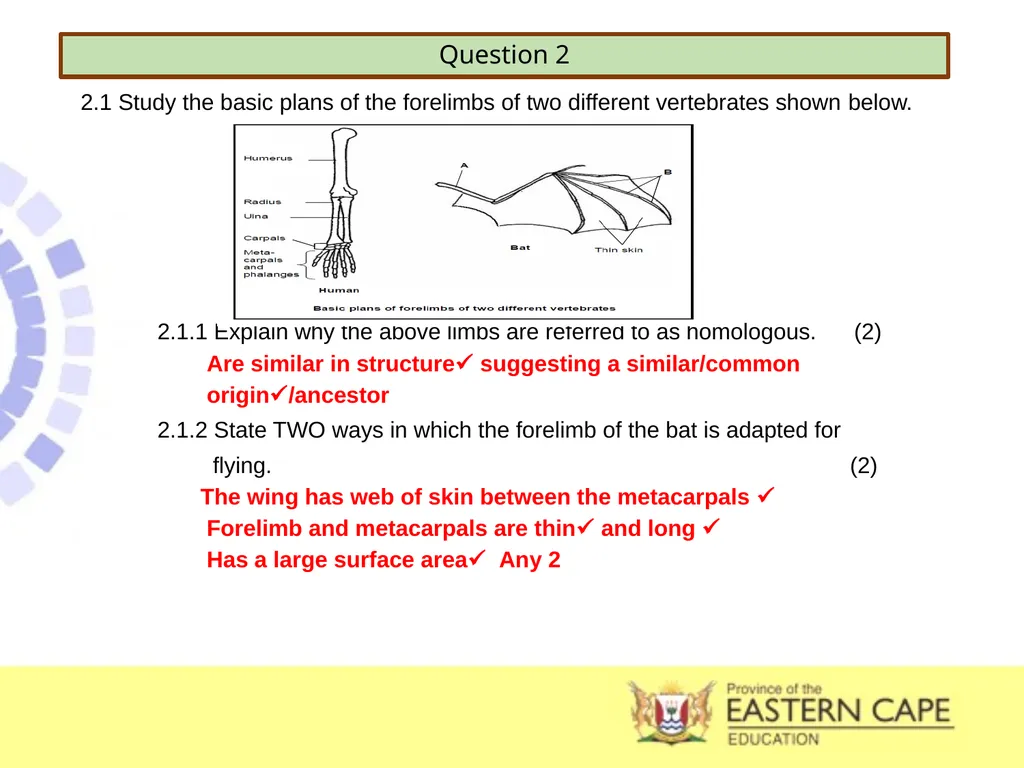
2.1 Study the basic plans of the forelimbs of two different vertebrates shown below.
2.1.1 Explain why the above limbs are referred to as homologous. (2)
Are similar in structure suggesting a similar/common
origin/ancestor
2.1.2 State TWO ways in which the forelimb of the bat is adapted for
flying. (2)
The wing has web of skin between the metacarpals
Forelimb and metacarpals are thin and long
Has a large surface area Any 2 Question 2<br>
2.1.1 Explain why the above limbs are referred to as homologous. (2)
Are similar in structure suggesting a similar/common
origin/ancestor
2.1.2 State TWO ways in which the forelimb of the bat is adapted for
flying. (2)
The wing has web of skin between the metacarpals
Forelimb and metacarpals are thin and long
Has a large surface area Any 2 Question 2<br>
23
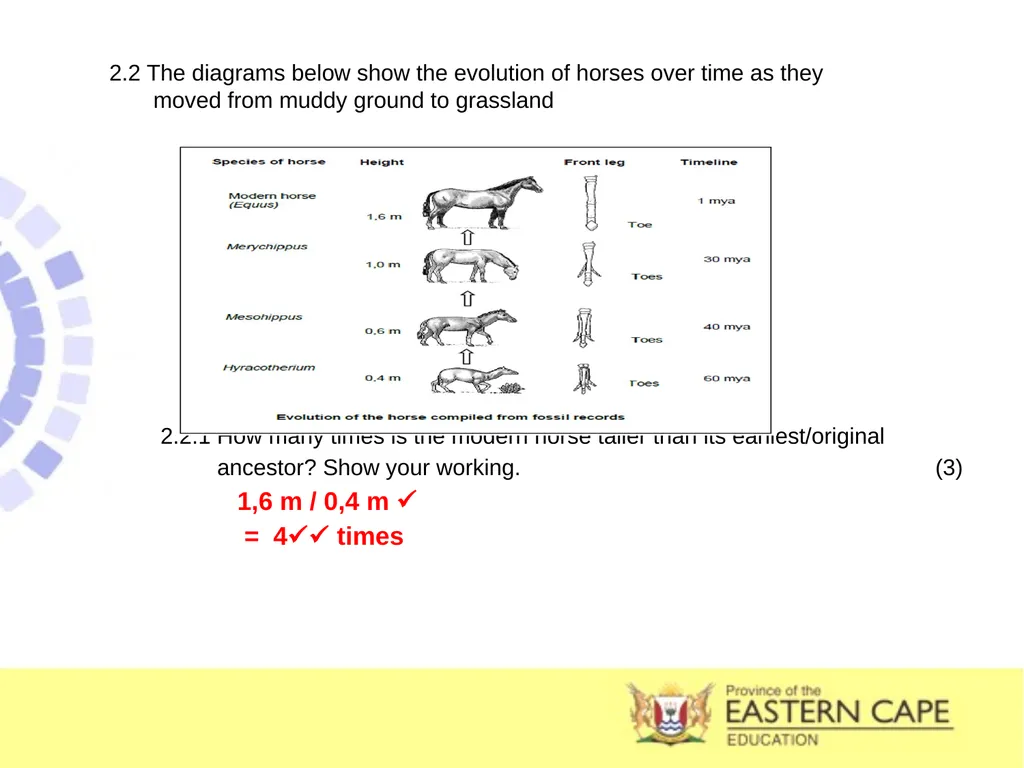
2.2 The diagrams below show the evolution of horses over time as they
moved from muddy ground to grassland
2.2.1 How many times is the modern horse taller than its earliest/original
ancestor? Show your working. (3)
1,6 m / 0,4 m
= 4 times<br>
moved from muddy ground to grassland
2.2.1 How many times is the modern horse taller than its earliest/original
ancestor? Show your working. (3)
1,6 m / 0,4 m
= 4 times<br>
24
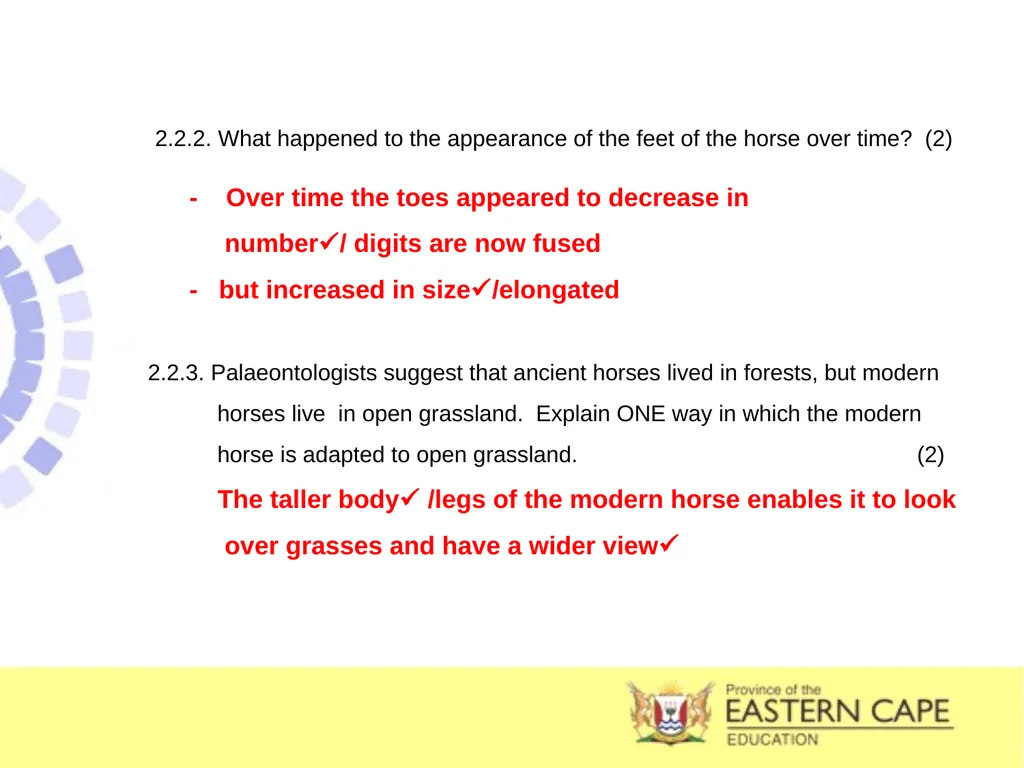
2.2.2. What happened to the appearance of the feet of the horse over time? (2)
- Over time the toes appeared to decrease in
number/ digits are now fused
- but increased in size/elongated
2.2.3. Palaeontologists suggest that ancient horses lived in forests, but modern
horses live in open grassland. Explain ONE way in which the modern
horse is adapted to open grassland. (2)
The taller body /legs of the modern horse enables it to look
over grasses and have a wider view<br>
- Over time the toes appeared to decrease in
number/ digits are now fused
- but increased in size/elongated
2.2.3. Palaeontologists suggest that ancient horses lived in forests, but modern
horses live in open grassland. Explain ONE way in which the modern
horse is adapted to open grassland. (2)
The taller body /legs of the modern horse enables it to look
over grasses and have a wider view<br>