
Introduction to Exchange Traded Funds (ETFs)
DP
Published · 27 slides · 0 views

1 / 1



Description
Introduction to Exchange Traded Funds (ETFs) Disclaimer 2 Information contained in this presentation is as on May 09, 2022. The information contained in this presentation is only for Educational and Awareness Purposes related to securities
Related Topics
Share
Embed code
Download this presentation From Below
"Introduction to Exchange Traded Funds (ETFs)" is the property of its rightful owner. Permission is granted to download and print the materials on this website for personal, non-commercial use only, and to display it on your personal computer provided you do not modify the materials and that you retain all copyright notices contained in the materials. By downloading content from our website, you accept the terms of this agreement.
Presentation Transcript
01
Introduction to Exchange Traded Funds (ETFs)<br>
02
Disclaimer 2 Information contained in this presentation is as on May 09, 2022.
The information contained in this presentation is only for Educational and Awareness Purposes related to securities market .
This presentation is only for Educational and Investor Awareness Programs and shall not be used for any legal interpretations.
SEBI or Stock Exchanges or Depositories shall not be responsible for any damage or loss to any one of any manner from use of this material.
Suggestions or feedbacks, if any, may please be sent by mail to visitsebi@sebi.gov.in.<br>
The information contained in this presentation is only for Educational and Awareness Purposes related to securities market .
This presentation is only for Educational and Investor Awareness Programs and shall not be used for any legal interpretations.
SEBI or Stock Exchanges or Depositories shall not be responsible for any damage or loss to any one of any manner from use of this material.
Suggestions or feedbacks, if any, may please be sent by mail to visitsebi@sebi.gov.in.<br>
03
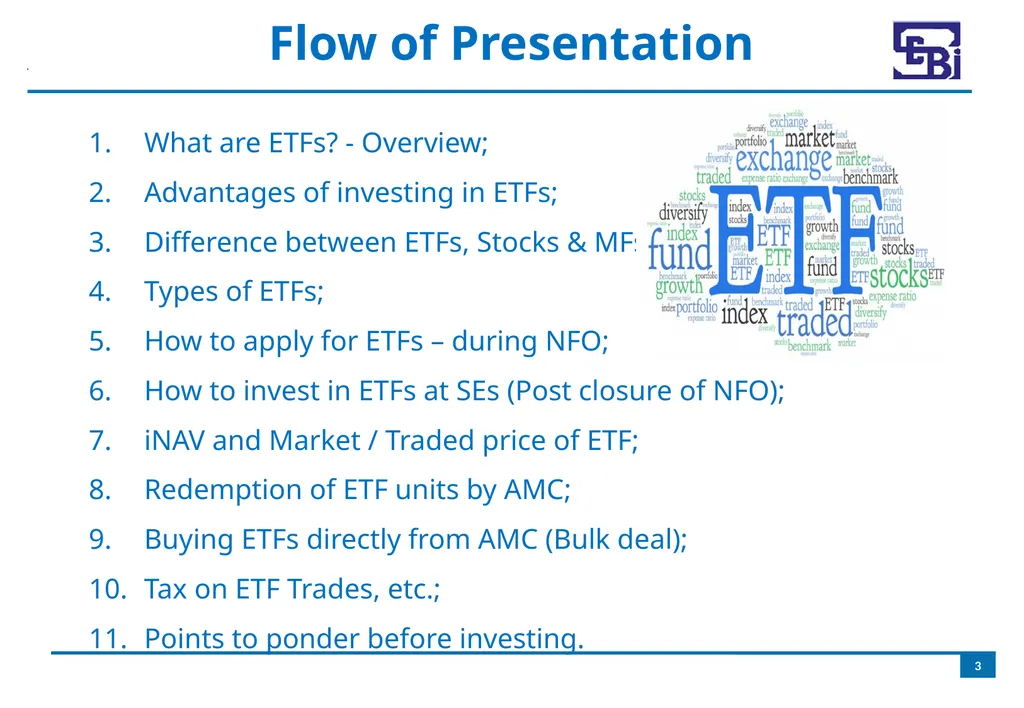
3 What are ETFs? - Overview;
Advantages of investing in ETFs;
Difference between ETFs, Stocks & MFs;
Types of ETFs;
How to apply for ETFs – during NFO;
How to invest in ETFs at SEs (Post closure of NFO);
iNAV and Market / Traded price of ETF;
Redemption of ETF units by AMC;
Buying ETFs directly from AMC (Bulk deal);
Tax on ETF Trades, etc.;
Points to ponder before investing. Flow of Presentation<br>
Advantages of investing in ETFs;
Difference between ETFs, Stocks & MFs;
Types of ETFs;
How to apply for ETFs – during NFO;
How to invest in ETFs at SEs (Post closure of NFO);
iNAV and Market / Traded price of ETF;
Redemption of ETF units by AMC;
Buying ETFs directly from AMC (Bulk deal);
Tax on ETF Trades, etc.;
Points to ponder before investing. Flow of Presentation<br>
04
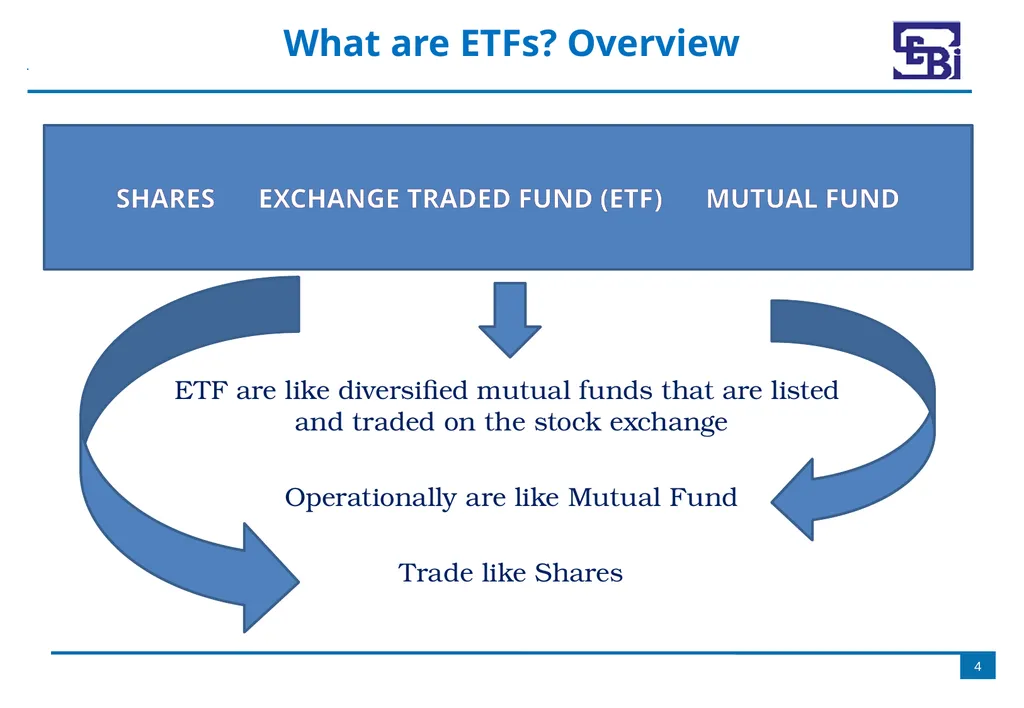
What are ETFs? Overview 4 ETF are like diversified mutual funds that are listed
and traded on the stock exchange
Operationally are like Mutual Fund
Trade like Shares Shares Exchange Traded Fund (ETF) Mutual Fund<br>
and traded on the stock exchange
Operationally are like Mutual Fund
Trade like Shares Shares Exchange Traded Fund (ETF) Mutual Fund<br>
05
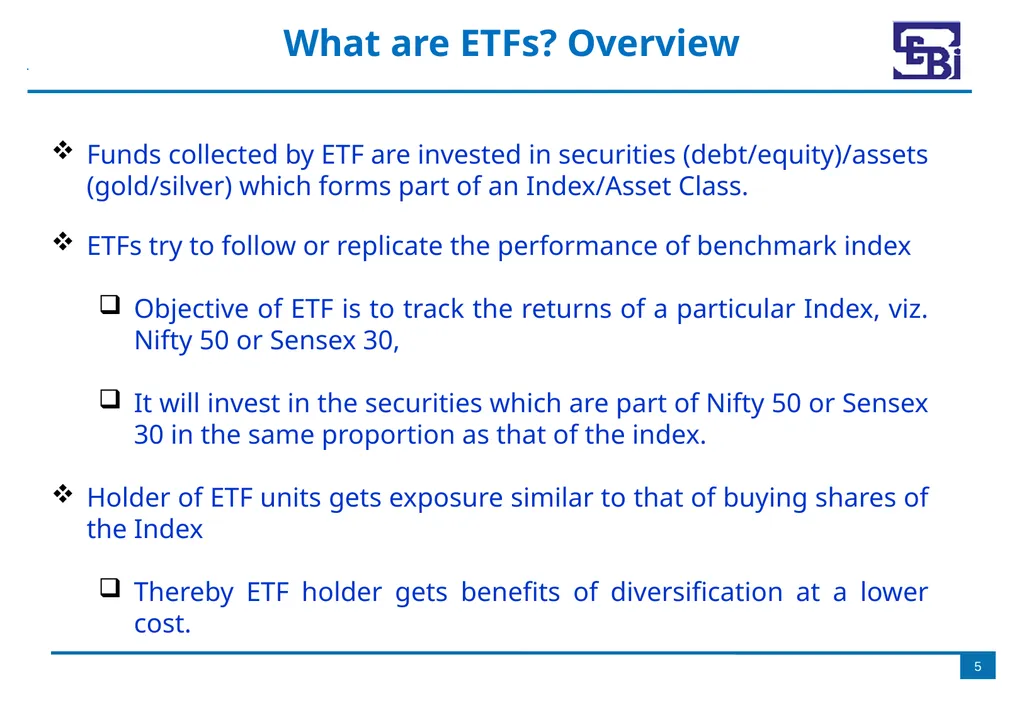
What are ETFs? Overview 5 Funds collected by ETF are invested in securities (debt/equity)/assets (gold/silver) which forms part of an Index/Asset Class.
ETFs try to follow or replicate the performance of benchmark index
Objective of ETF is to track the returns of a particular Index, viz. Nifty 50 or Sensex 30,
It will invest in the securities which are part of Nifty 50 or Sensex 30 in the same proportion as that of the index.
Holder of ETF units gets exposure similar to that of buying shares of the Index
Thereby ETF holder gets benefits of diversification at a lower cost.<br>
ETFs try to follow or replicate the performance of benchmark index
Objective of ETF is to track the returns of a particular Index, viz. Nifty 50 or Sensex 30,
It will invest in the securities which are part of Nifty 50 or Sensex 30 in the same proportion as that of the index.
Holder of ETF units gets exposure similar to that of buying shares of the Index
Thereby ETF holder gets benefits of diversification at a lower cost.<br>
06
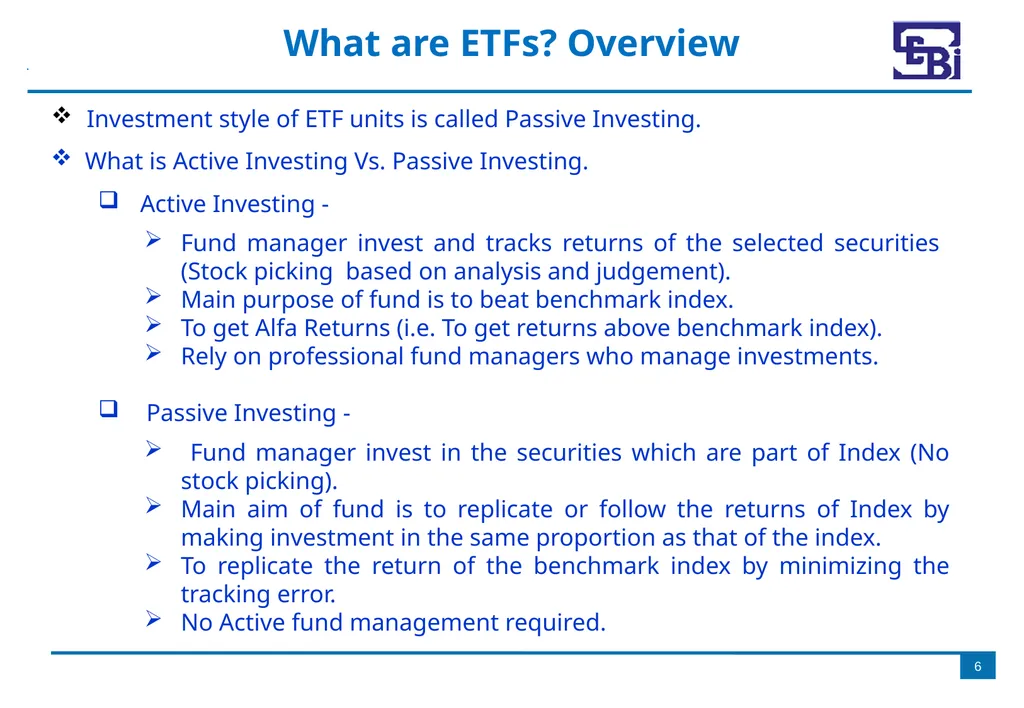
What are ETFs? Overview 6 Investment style of ETF units is called Passive Investing.
What is Active Investing Vs. Passive Investing.
Active Investing -
Fund manager invest and tracks returns of the selected securities (Stock picking based on analysis and judgement).
Main purpose of fund is to beat benchmark index.
To get Alfa Returns (i.e. To get returns above benchmark index).
Rely on professional fund managers who manage investments.
Passive Investing -
Fund manager invest in the securities which are part of Index (No stock picking).
Main aim of fund is to replicate or follow the returns of Index by making investment in the same proportion as that of the index.
To replicate the return of the benchmark index by minimizing the tracking error.
No Active fund management required.<br>
What is Active Investing Vs. Passive Investing.
Active Investing -
Fund manager invest and tracks returns of the selected securities (Stock picking based on analysis and judgement).
Main purpose of fund is to beat benchmark index.
To get Alfa Returns (i.e. To get returns above benchmark index).
Rely on professional fund managers who manage investments.
Passive Investing -
Fund manager invest in the securities which are part of Index (No stock picking).
Main aim of fund is to replicate or follow the returns of Index by making investment in the same proportion as that of the index.
To replicate the return of the benchmark index by minimizing the tracking error.
No Active fund management required.<br>
07
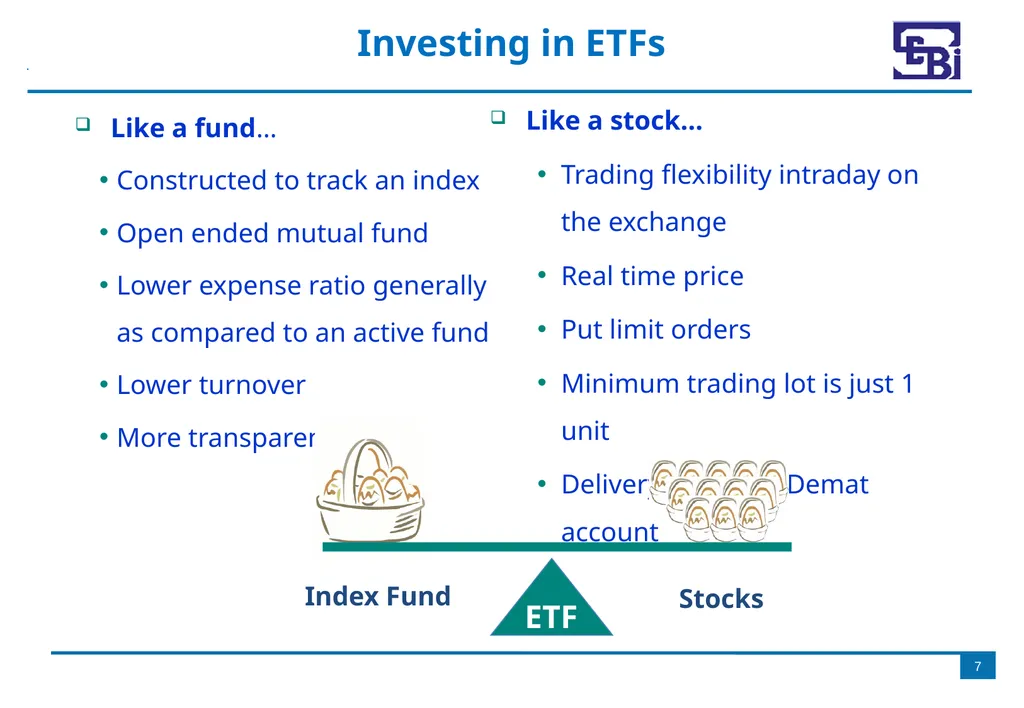
Investing in ETFs 7 Like a fund…
Constructed to track an index
Open ended mutual fund
Lower expense ratio generally as compared to an active fund
Lower turnover
More transparent Like a stock…
Trading flexibility intraday on the exchange
Real time price
Put limit orders
Minimum trading lot is just 1 unit
Delivery into your Demat account Index Fund Stocks ETF<br>
Constructed to track an index
Open ended mutual fund
Lower expense ratio generally as compared to an active fund
Lower turnover
More transparent Like a stock…
Trading flexibility intraday on the exchange
Real time price
Put limit orders
Minimum trading lot is just 1 unit
Delivery into your Demat account Index Fund Stocks ETF<br>
08
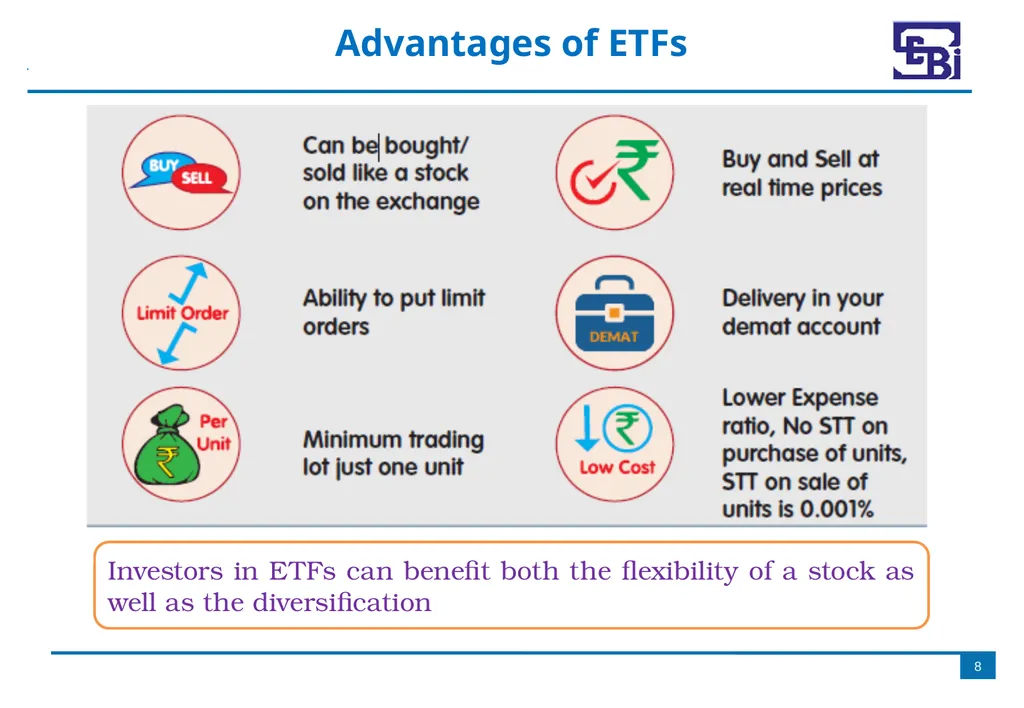
Advantages of ETFs 8 Investors in ETFs can benefit both the flexibility of a stock as well as the diversification<br>
09
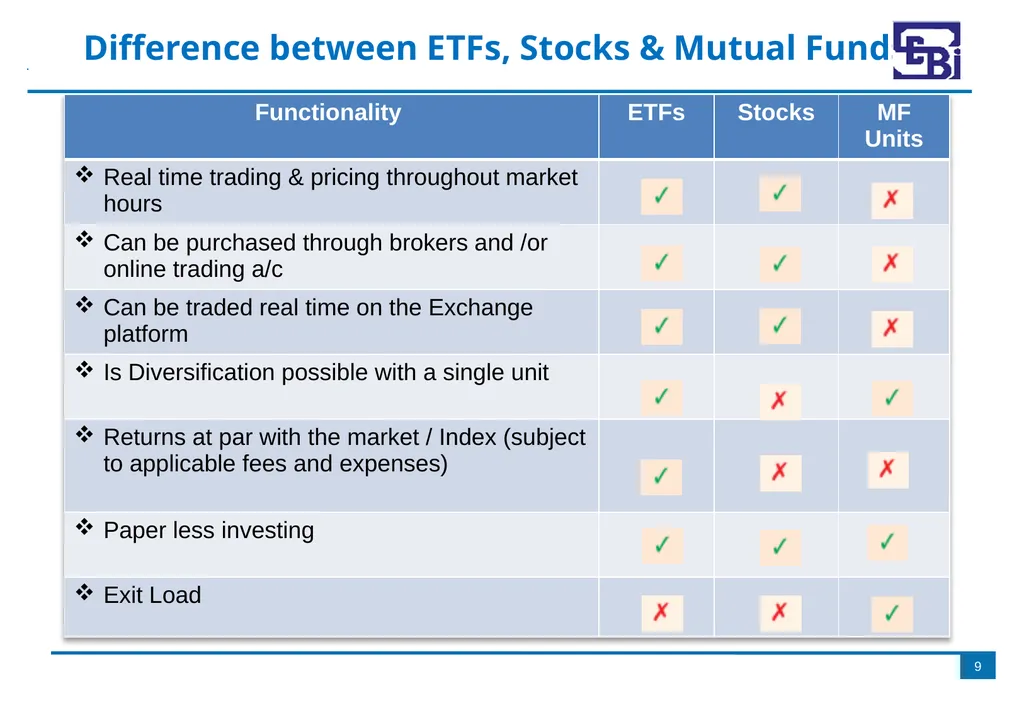
Difference between ETFs, Stocks & Mutual Funds 9<br>
10
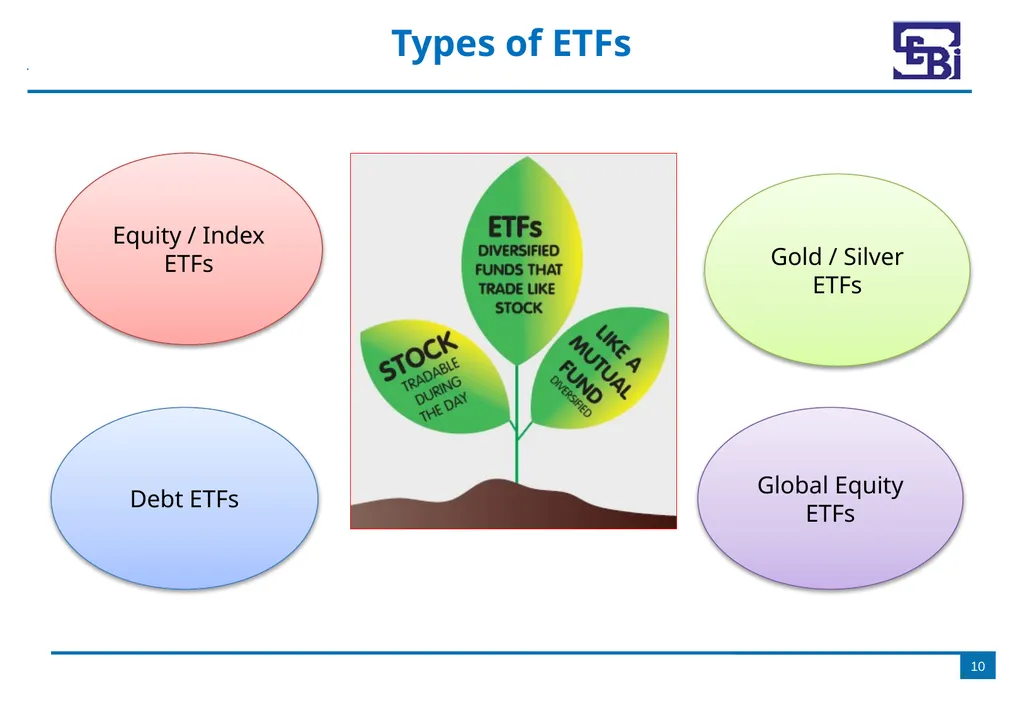
Types of ETFs 10 Equity / Index ETFs Gold / Silver ETFs Debt ETFs Global Equity ETFs<br>
11
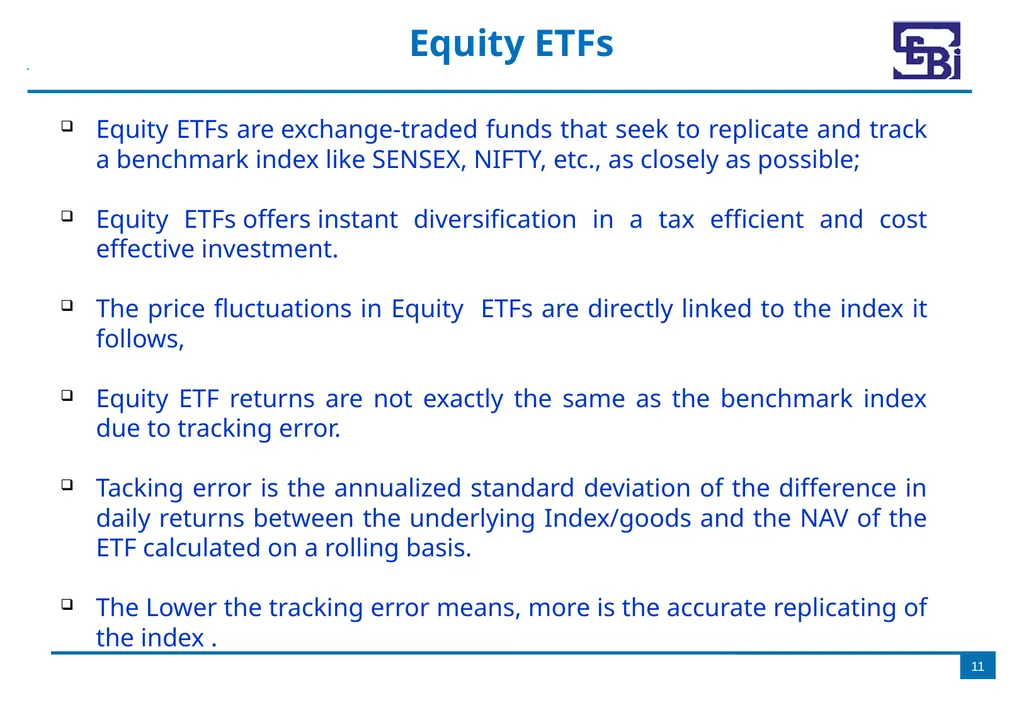
Equity ETFs 11 Equity ETFs are exchange-traded funds that seek to replicate and track a benchmark index like SENSEX, NIFTY, etc., as closely as possible;
Equity ETFs offers instant diversification in a tax efficient and cost effective investment.
The price fluctuations in Equity ETFs are directly linked to the index it follows,
Equity ETF returns are not exactly the same as the benchmark index due to tracking error.
Tacking error is the annualized standard deviation of the difference in daily returns between the underlying Index/goods and the NAV of the ETF calculated on a rolling basis.
The Lower the tracking error means, more is the accurate replicating of the index .<br>
Equity ETFs offers instant diversification in a tax efficient and cost effective investment.
The price fluctuations in Equity ETFs are directly linked to the index it follows,
Equity ETF returns are not exactly the same as the benchmark index due to tracking error.
Tacking error is the annualized standard deviation of the difference in daily returns between the underlying Index/goods and the NAV of the ETF calculated on a rolling basis.
The Lower the tracking error means, more is the accurate replicating of the index .<br>
12
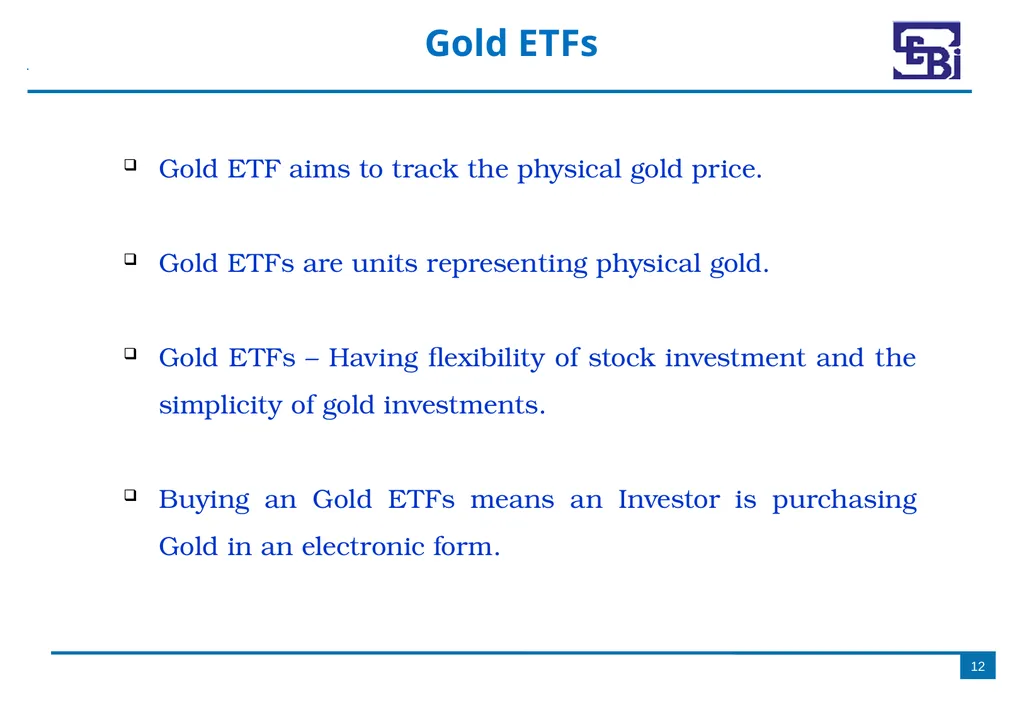
Gold ETFs 12 Gold ETF aims to track the physical gold price.
Gold ETFs are units representing physical gold.
Gold ETFs – Having flexibility of stock investment and the simplicity of gold investments.
Buying an Gold ETFs means an Investor is purchasing Gold in an electronic form.<br>
Gold ETFs are units representing physical gold.
Gold ETFs – Having flexibility of stock investment and the simplicity of gold investments.
Buying an Gold ETFs means an Investor is purchasing Gold in an electronic form.<br>
13
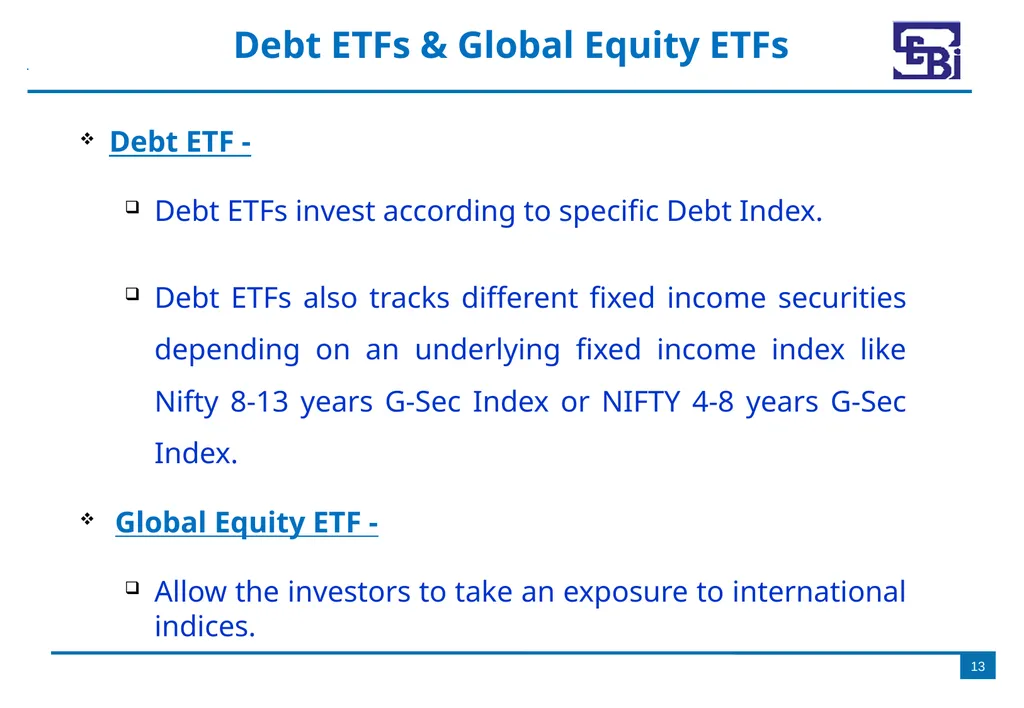
Debt ETFs & Global Equity ETFs 13 Debt ETF -
Debt ETFs invest according to specific Debt Index.
Debt ETFs also tracks different fixed income securities depending on an underlying fixed income index like Nifty 8-13 years G-Sec Index or NIFTY 4-8 years G-Sec Index.
Global Equity ETF -
Allow the investors to take an exposure to international indices.<br>
Debt ETFs invest according to specific Debt Index.
Debt ETFs also tracks different fixed income securities depending on an underlying fixed income index like Nifty 8-13 years G-Sec Index or NIFTY 4-8 years G-Sec Index.
Global Equity ETF -
Allow the investors to take an exposure to international indices.<br>
14
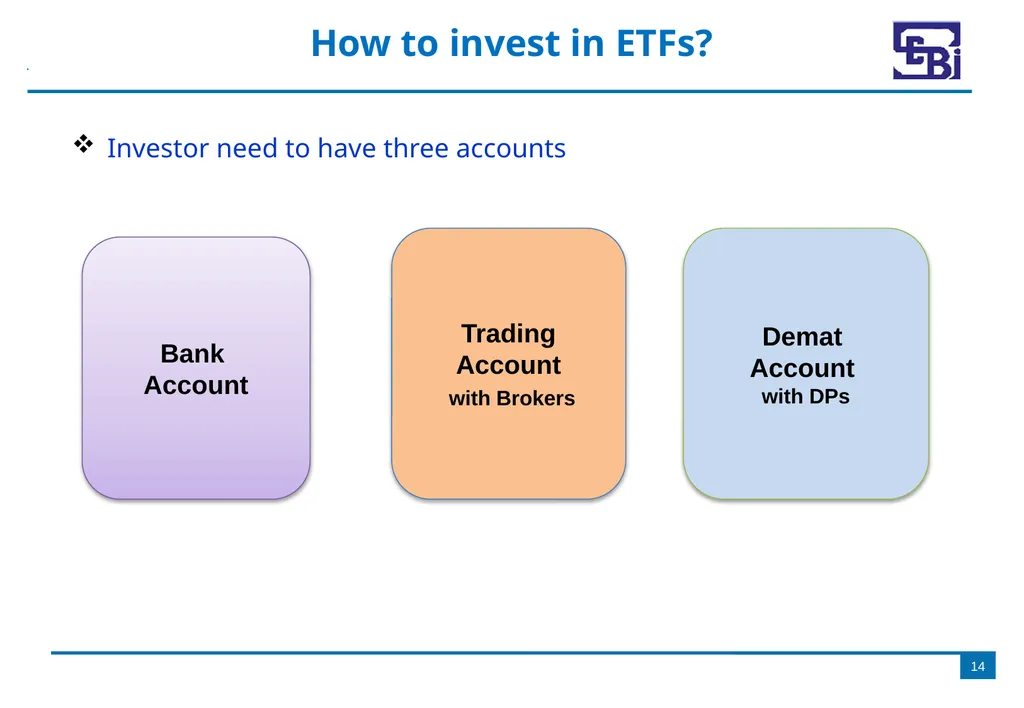
How to invest in ETFs? 14 Investor need to have three accounts Bank
Account Demat
Account
with DPs Trading Account
with Brokers<br>
Account Demat
Account
with DPs Trading Account
with Brokers<br>
15
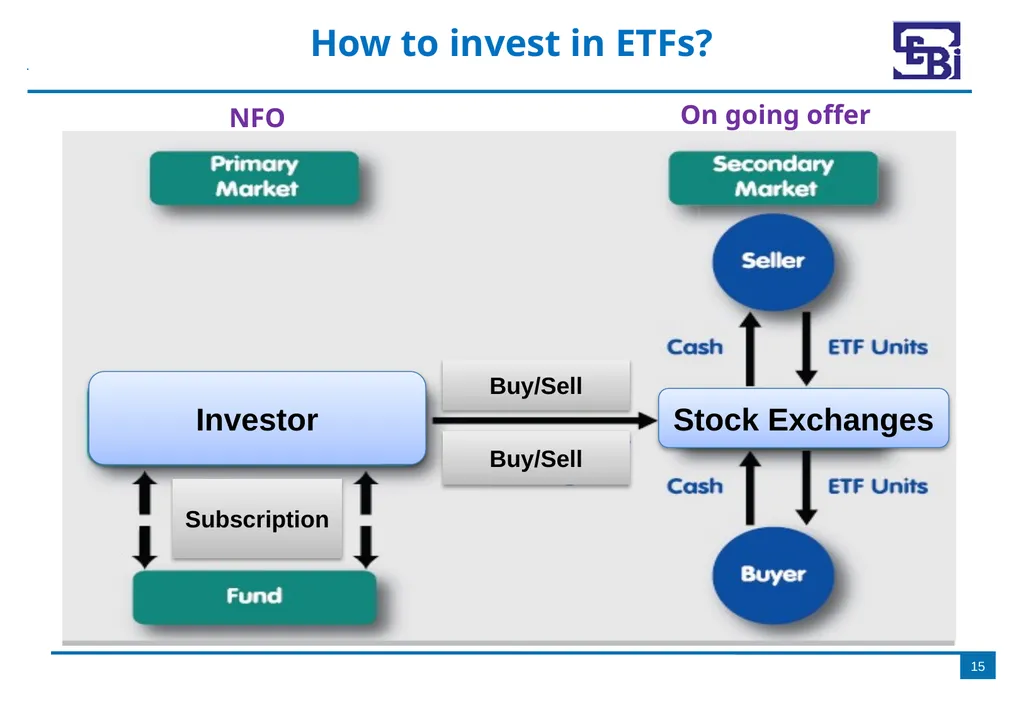
How to invest in ETFs? 15 NFO On going offer Investor Stock Exchanges Subscription Buy/Sell Buy/Sell<br>
16
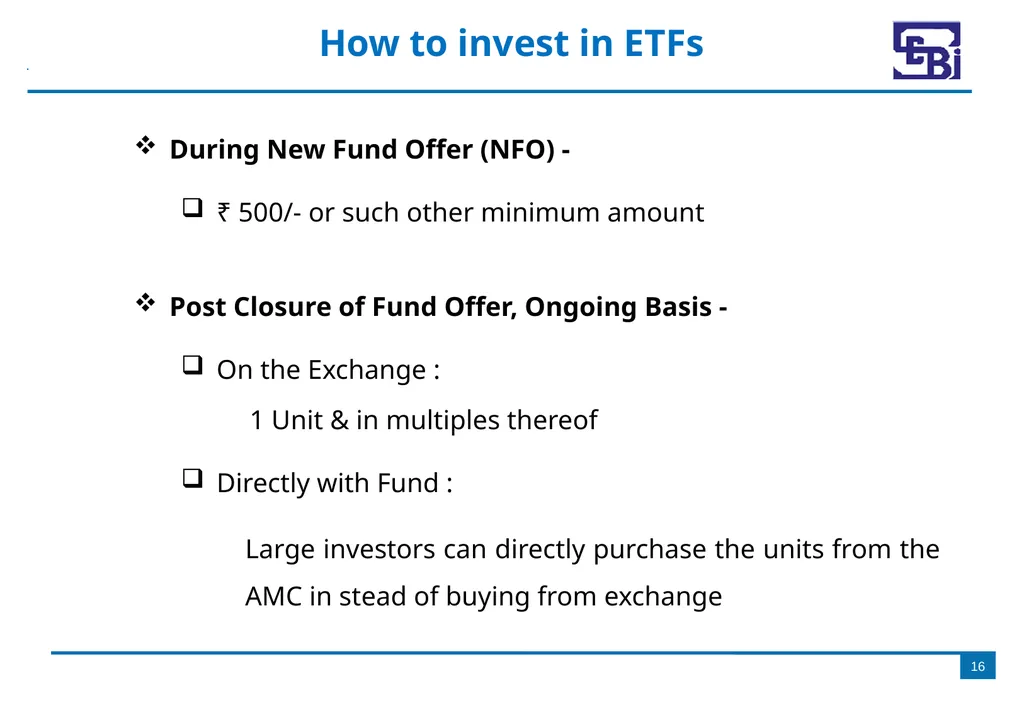
How to invest in ETFs 16 During New Fund Offer (NFO) -
₹ 500/- or such other minimum amount
Post Closure of Fund Offer, Ongoing Basis -
On the Exchange :
1 Unit & in multiples thereof
Directly with Fund :
Large investors can directly purchase the units from the AMC in stead of buying from exchange<br>
₹ 500/- or such other minimum amount
Post Closure of Fund Offer, Ongoing Basis -
On the Exchange :
1 Unit & in multiples thereof
Directly with Fund :
Large investors can directly purchase the units from the AMC in stead of buying from exchange<br>
17
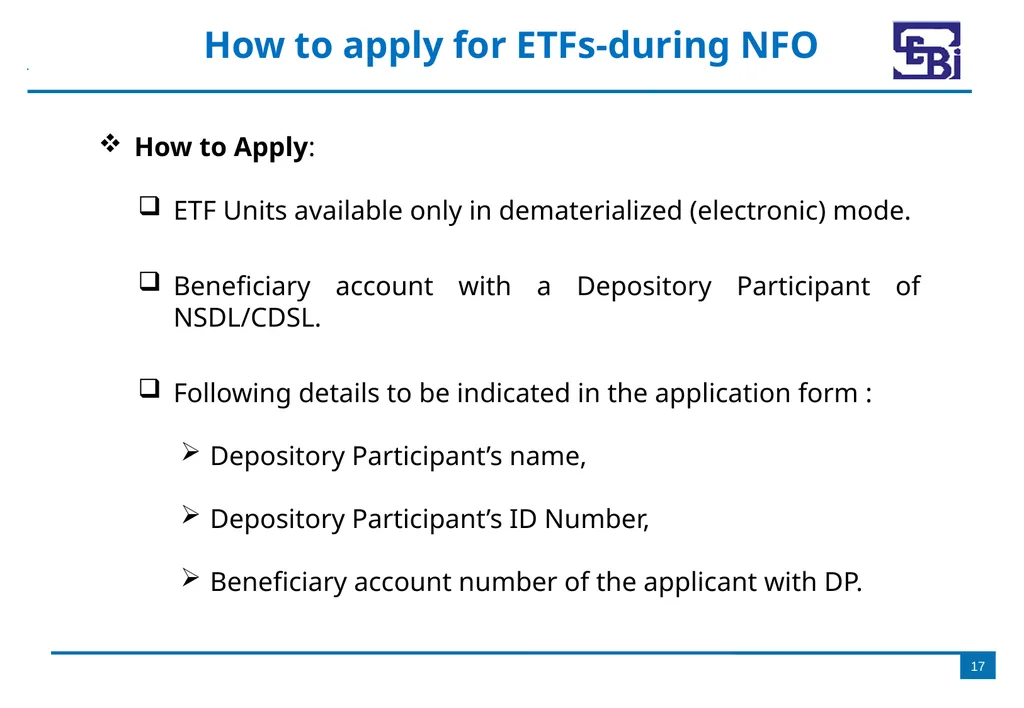
How to apply for ETFs-during NFO 17 How to Apply:
ETF Units available only in dematerialized (electronic) mode.
Beneficiary account with a Depository Participant of NSDL/CDSL.
Following details to be indicated in the application form :
Depository Participant’s name,
Depository Participant’s ID Number,
Beneficiary account number of the applicant with DP.<br>
ETF Units available only in dematerialized (electronic) mode.
Beneficiary account with a Depository Participant of NSDL/CDSL.
Following details to be indicated in the application form :
Depository Participant’s name,
Depository Participant’s ID Number,
Beneficiary account number of the applicant with DP.<br>
18
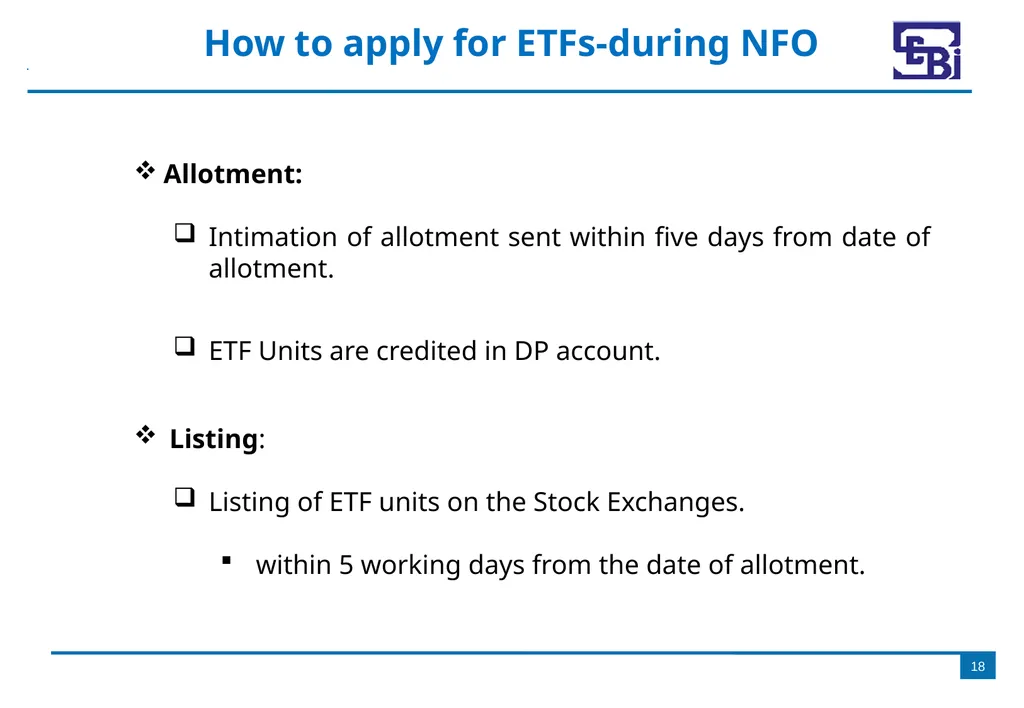
How to apply for ETFs-during NFO 18 Allotment:
Intimation of allotment sent within five days from date of allotment.
ETF Units are credited in DP account.
Listing:
Listing of ETF units on the Stock Exchanges.
within 5 working days from the date of allotment.<br>
Intimation of allotment sent within five days from date of allotment.
ETF Units are credited in DP account.
Listing:
Listing of ETF units on the Stock Exchanges.
within 5 working days from the date of allotment.<br>
19
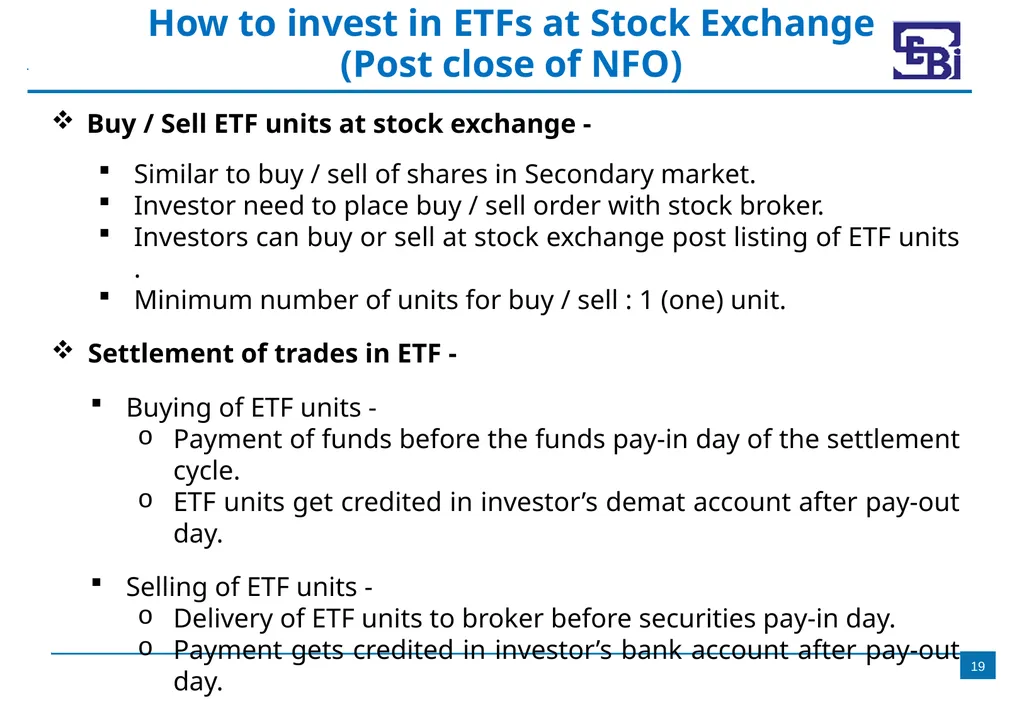
How to invest in ETFs at Stock Exchange
(Post close of NFO) 19 Buy / Sell ETF units at stock exchange -
Similar to buy / sell of shares in Secondary market.
Investor need to place buy / sell order with stock broker.
Investors can buy or sell at stock exchange post listing of ETF units .
Minimum number of units for buy / sell : 1 (one) unit.
Settlement of trades in ETF -
Buying of ETF units -
Payment of funds before the funds pay-in day of the settlement cycle.
ETF units get credited in investor’s demat account after pay-out day.
Selling of ETF units -
Delivery of ETF units to broker before securities pay-in day.
Payment gets credited in investor’s bank account after pay-out day.<br>
(Post close of NFO) 19 Buy / Sell ETF units at stock exchange -
Similar to buy / sell of shares in Secondary market.
Investor need to place buy / sell order with stock broker.
Investors can buy or sell at stock exchange post listing of ETF units .
Minimum number of units for buy / sell : 1 (one) unit.
Settlement of trades in ETF -
Buying of ETF units -
Payment of funds before the funds pay-in day of the settlement cycle.
ETF units get credited in investor’s demat account after pay-out day.
Selling of ETF units -
Delivery of ETF units to broker before securities pay-in day.
Payment gets credited in investor’s bank account after pay-out day.<br>
20
iNAV and Market /Traded price of ETF 20 Net Asset Value (NAV) of ETF -
Value of each unit of ETF calculated by AMC of ETF.
Market Price / Traded price of ETF -
Price at which ETF units brought / sold at stock exchange.
Price of ETF changes, based on market demand or supply of ETF.
Price increase, if there are more buyers of ETF.
Price decrease, if there are more sellers of ETF.
Market price is premium / discount if traded price is more /less than NAV.
What is iNAV (Indicative NAV)
iNAV reported every 10-15 sec on the website of MF AMC during market hours. Currently, iNAV for Gols and Silver ETFs are also available on Exchange Platform.
Before buying or selling decision, check iNAV of ETF units.<br>
Value of each unit of ETF calculated by AMC of ETF.
Market Price / Traded price of ETF -
Price at which ETF units brought / sold at stock exchange.
Price of ETF changes, based on market demand or supply of ETF.
Price increase, if there are more buyers of ETF.
Price decrease, if there are more sellers of ETF.
Market price is premium / discount if traded price is more /less than NAV.
What is iNAV (Indicative NAV)
iNAV reported every 10-15 sec on the website of MF AMC during market hours. Currently, iNAV for Gols and Silver ETFs are also available on Exchange Platform.
Before buying or selling decision, check iNAV of ETF units.<br>
21
iNAV and Market /Traded price of ETF 21 Live Quotes on Exchange site Real Time NAV on AMC site Real Time Pricing<br>
22
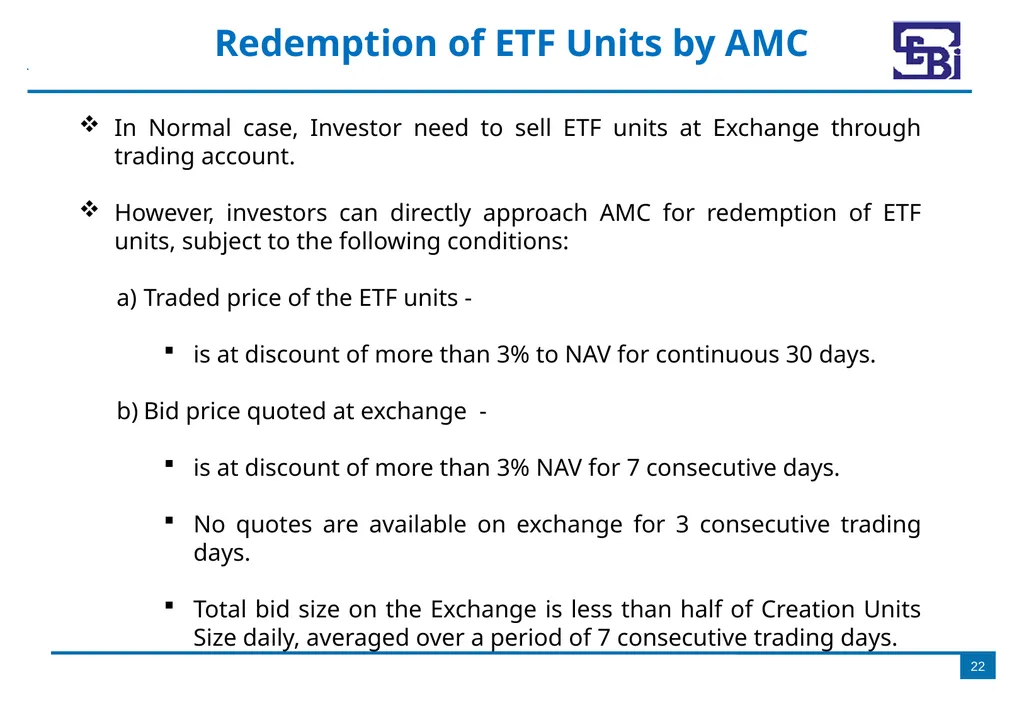
Redemption of ETF Units by AMC 22 In Normal case, Investor need to sell ETF units at Exchange through trading account.
However, investors can directly approach AMC for redemption of ETF units, subject to the following conditions:
Traded price of the ETF units -
is at discount of more than 3% to NAV for continuous 30 days.
Bid price quoted at exchange -
is at discount of more than 3% NAV for 7 consecutive days.
No quotes are available on exchange for 3 consecutive trading days.
Total bid size on the Exchange is less than half of Creation Units Size daily, averaged over a period of 7 consecutive trading days.<br>
However, investors can directly approach AMC for redemption of ETF units, subject to the following conditions:
Traded price of the ETF units -
is at discount of more than 3% to NAV for continuous 30 days.
Bid price quoted at exchange -
is at discount of more than 3% NAV for 7 consecutive days.
No quotes are available on exchange for 3 consecutive trading days.
Total bid size on the Exchange is less than half of Creation Units Size daily, averaged over a period of 7 consecutive trading days.<br>
23
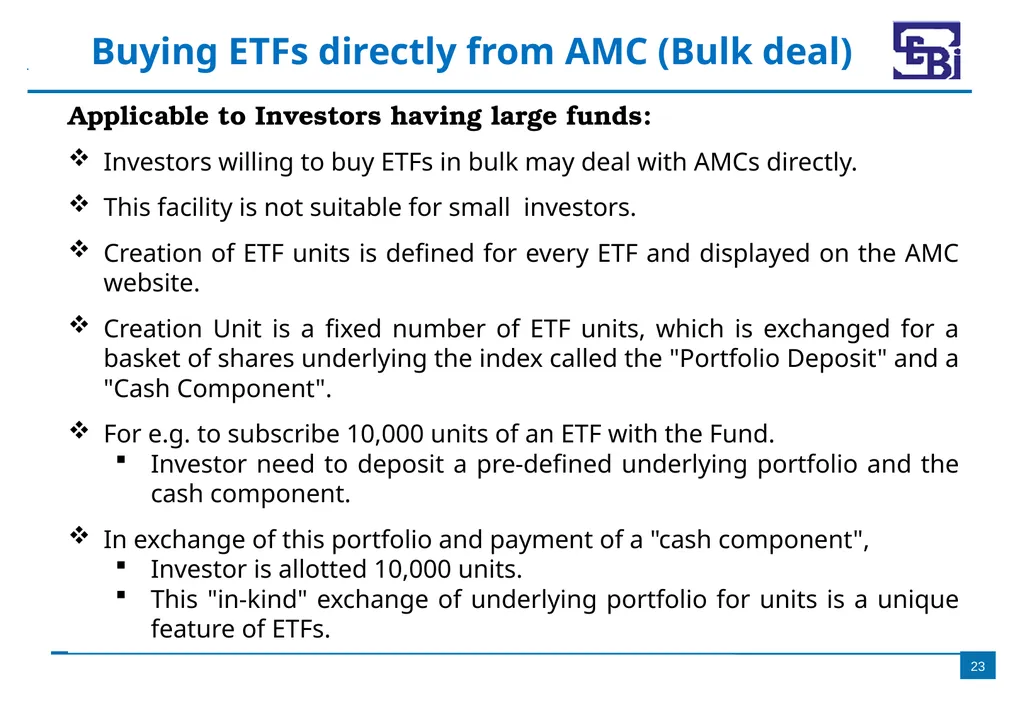
Buying ETFs directly from AMC (Bulk deal) 23 Applicable to Investors having large funds:
Investors willing to buy ETFs in bulk may deal with AMCs directly.
This facility is not suitable for small investors.
Creation of ETF units is defined for every ETF and displayed on the AMC website.
Creation Unit is a fixed number of ETF units, which is exchanged for a basket of shares underlying the index called the "Portfolio Deposit" and a "Cash Component".
For e.g. to subscribe 10,000 units of an ETF with the Fund.
Investor need to deposit a pre-defined underlying portfolio and the cash component.
In exchange of this portfolio and payment of a "cash component",
Investor is allotted 10,000 units.
This "in-kind" exchange of underlying portfolio for units is a unique feature of ETFs.<br>
Investors willing to buy ETFs in bulk may deal with AMCs directly.
This facility is not suitable for small investors.
Creation of ETF units is defined for every ETF and displayed on the AMC website.
Creation Unit is a fixed number of ETF units, which is exchanged for a basket of shares underlying the index called the "Portfolio Deposit" and a "Cash Component".
For e.g. to subscribe 10,000 units of an ETF with the Fund.
Investor need to deposit a pre-defined underlying portfolio and the cash component.
In exchange of this portfolio and payment of a "cash component",
Investor is allotted 10,000 units.
This "in-kind" exchange of underlying portfolio for units is a unique feature of ETFs.<br>
24
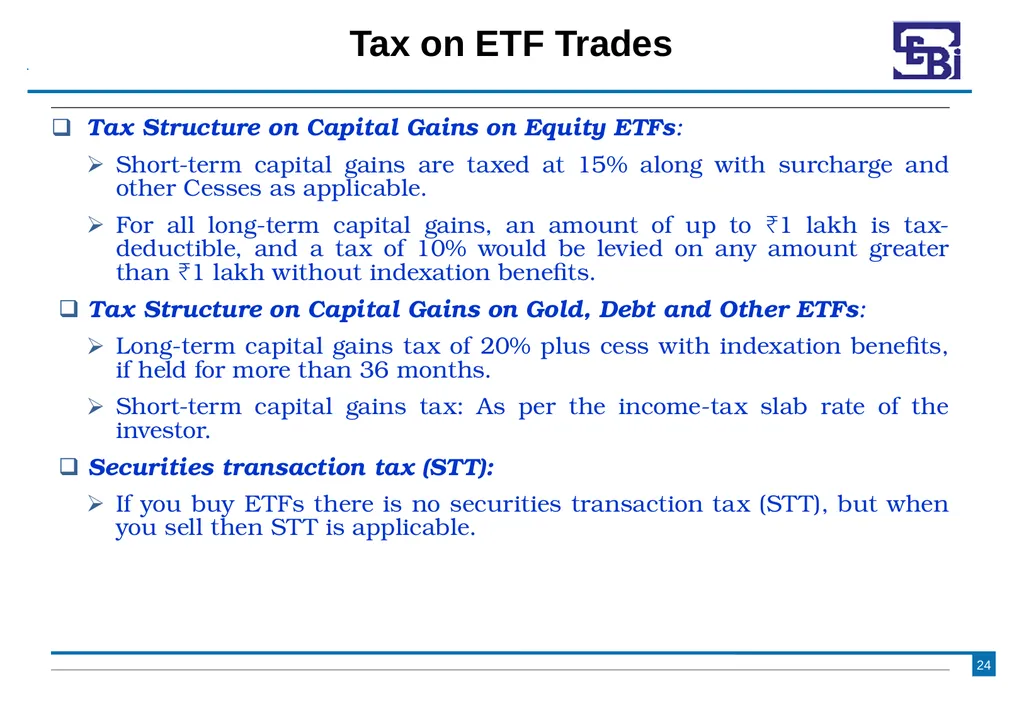
Tax on ETF Trades 24<br>
25
Points to Ponder before investing 25 Underlying Index: Investors need to first decide on the market in which they wish to invest, i.e. Benchmark Index as a whole or a Specific Sectoral Index Gold/ Silver, etc. Total Expense Ration (TER): Different funds tracking the same index can have different expense ratios (annual fee a fund charges to cover its expenses). Tracking Error : ETFs must closely track the benchmark. An ETF with lower tracking error to its benchmark should be preferred to others. Liquidity: When considering ETFs, other than TER and Tracking Error, liquidity is also very important. One should prefer ETFs with greater liquidity.
Assets Under Management (AUM) of an ETF is calculated by multiplying the shares outstanding by the market price per share. ETFs with greater AUM tend to have more liquidity. iNAV: Before buying or selling decision, check iNAV of ETF units.<br>
Assets Under Management (AUM) of an ETF is calculated by multiplying the shares outstanding by the market price per share. ETFs with greater AUM tend to have more liquidity. iNAV: Before buying or selling decision, check iNAV of ETF units.<br>
26
For further information, you may visit the following web-sites and Mobile App:
www.sebi.gov.in/
https://investor.sebi.gov.in/
Saa₹thi App
For Grievance Redressal, you may visit following website:
www.scores.gov.in/
Or, you may call SEBI at following Toll-free Helpline Numbers from 9:00am to 6:00pm on all days (excluding declared holidays in the state of Maharashtra):
1800 266 7575
1800 22 7575 Additional Information 26 Helplines are available in 8 Languages:
English, Hindi, Bengali, Gujarati, Marathi, Kannada, Telugu and Tamil 26 SEBI : HAR INVESTOR KI TAAQAT<br>
www.sebi.gov.in/
https://investor.sebi.gov.in/
Saa₹thi App
For Grievance Redressal, you may visit following website:
www.scores.gov.in/
Or, you may call SEBI at following Toll-free Helpline Numbers from 9:00am to 6:00pm on all days (excluding declared holidays in the state of Maharashtra):
1800 266 7575
1800 22 7575 Additional Information 26 Helplines are available in 8 Languages:
English, Hindi, Bengali, Gujarati, Marathi, Kannada, Telugu and Tamil 26 SEBI : HAR INVESTOR KI TAAQAT<br>
27
27 THANK YOU<br>